




Abstract
This article draws on Pierre Bourdieu’s critical sociology to explore the socio-political processes through which social resources or capital are sought and ethnic inequalities negotiated, legitimated and enforced in a postcolonial work context. Applying Bourdieusian analysis to data from interviews and vignettes in the Nigerian banking sector, the constructs ‘ethnicised identity’ and ‘symbolic identity’ are developed to show how employees across ethnic divides and work hierarchies use symbolic ethnic markers to negotiate benefits and enforce control as a status-independent capital. Realising diversity management goals in multiethnic workplaces may, therefore, require refocusing initiatives from racial to ethnic inequalities and, consequently, from inter-group inequalities (ethnic membership) to intra-group discriminations (ethnic affiliation). This research suggests that a more nuanced, contextually sensitive perspective is necessary to address workplace inequalities linked to ethnic diversity in organisations with indigenous multiethnicities.
Introduction
Many Global North economies have ethnically heterogeneous and culturally diverse workforces. As more postcolonial emerging economies globalise, however, more needs to be known regarding: the forms of inequalities; how they are mediated, constrained, or enabled by diverse identities (e.g. ethnic, class, gender); and implications for managing these in workplaces (Kamoche et al., 2015). These limit understanding of intra-ethnic discrimination, status-linked ethnocentricism and ethnocultural gendering (Umeh et al., 2022) in super-diverse postcolonial nations.
Knowledge of sociocultural difference and its link to workplace inequalities has mostly been derived from empirical studies of organisations in the Global North (Tatli and Özbilgin, 2012; Umeh et al., 2022). Studies on racial diversity, often erroneously synonymised with ethnic diversity (Randle et al., 2015), can be problematic as some nuances of class/status-linked disparities, power dynamics and inequalities within, and between, ethnic groups and associated historical trajectories and relational implications may be obscured. This often happens with indigenous ethnic groups in Global South economies that are products of forced colonial amalgamation (Ovadje and Ankomah, 2013). Even in some countries in Europe, such as the UK, there remains the conflation of White identities and specific inequalities, which often leads to assumptions of White privilege for frequently marginalised groups like White Irish and White Eastern European (Blachnicka-Ciacek and Budginaite-Mackine, 2022).
This study applies critical sociological perspectives to explore the contextual and relational dynamics of inequalities in the workplace. It draws on the work of Pierre Bourdieu to explore those socio-political processes through which social resources or capital are sought and ethnic inequalities negotiated, legitimated and enforced in a postcolonial work context. Experiences and manifestations of workplace discrimination linked to ethnicity and status are examined in two organisations using Bourdieu’s critical sociological theories of field, habitus and capital. The research question is: ‘How are workplace inequalities constrained or enabled by status and ethnic identity in postcolonial multiethnic work contexts?’. We explore how ethnic identity, status and inequalities go beyond being spontaneous or concurrent, negotiated, tangible, group contingent and bounded, to being symbolic (Erel, 2010; Karatas-Ozkan et al., 2015; Samaluk, 2016).
Bourdieu (1986, 1990) highlighted the relevance of symbols, identity and cultural values in his re-conceptualisation of Max Weber’s (1968) dichotomisation of class. Based on his concept of ‘habitus’, a socially constituted system of dispositions that orient ‘thoughts, perceptions, expressions, and actions’ (Bourdieu, 1990: 55), the rationality/rational actions of social beings are situated within a hierarchical/classed, socio-historical context (field) and are, therefore, ‘socially bounded’ (1990: 63–64). To Bourdieu, status (linked to access to social resources or capital) is the symbolic aspect of class structure, which has implications for inequalities and differentiated identities (such as ethnicity, gender, organisational, professional and managerial), and cannot be reduced to economic relations alone (Ashley and Empson, 2013). For Bourdieu, social boundaries (ethnic, class or gender differences), hierarchies (status) and implicit inequalities can be understood in terms of the social practices and identities of people enacting them (Kamoche et al., 2014).
Dominant ethnocultural values are held in Nigerian organisations, with social inequality often regarded as a virtue (Umeh et al., 2022). This can lead to cultural sanctioning of subservience and discriminatory practices to reinforce status. We consequently focus on employees’ everyday interactions that explicitly or subtly interconnect with the interpersonal, ethnocultural, organisational discursive and material structure (Samaluk, 2016). These create, reproduce, legitimise or resist inequality through practices that underpin perceptions of positional authority and manager–subordinate relationships.
This study highlights how tackling inequalities linked to ethnic identity at work requires understanding the ethnocultural and historical context in which ethnic discrimination emerges and manifests (Kamoche et al., 2015). Further, the study suggests that diversity management policies may fail to achieve desired goals when focused on racial differences (inter-ethnic conflict) rather than inter-ethnic and intra-ethnic discrimination (Cornelius et al., 2019; Inegbedion et al., 2020). Moreover, it highlights how developing a contextually strategic programme for managing ethnic diversity is germane for addressing specific formations/configurations of inequalities in a multiethnic workplace. To capture this effort, the article contributes to the literature by introducing the concepts ‘ethnicised identity’ and ‘symbolic identity’.
Re-examining ethnic identity
Ethnicity/ethnic identity is a ‘primary identity’ (Cohen, 2013) and is viewed as ‘the degree to which individuals perceive themselves to be included and aligned with an ethnic group’ (Smith and Silva, 2011: 42). Most people recognise their membership of a particular ethnic group; however, the meaning of group membership is mutable and influenced by other intersecting social identities. Consequently, ethnic identity is viewed from two broad perspectives.
Mainstream sociology scholars consider ethnic identity to have emerged from socially and geographically rooted factors such as location or territory. Like other primary or salient identities, it is robust to change due to primary socialisation and interactions with others (Barth, 1994). It is therefore argued to be socially constructed and ‘imagined but not imaginary’ Jenkins (1997: 77). This view is supported by attempts to define specific ethnic groups, where the criteria used often prove to be inconsistent. Nevertheless, this belief is criticised as essentialising culture and articulating ethnicity based on rigid, salient sociocultural boundaries (Umeh, 2019).
An alternative critical evaluation considers ethnic identity as the outcome of relational, interpersonal, factors projected through individual/individualised shared cultural markers (Cohen, 2013). It is argued ethnic identity intersects other identities (e.g. gender, class) and can be negotiated by parties in a relationship (Umeh et al., 2022). Based on this perspective, ethnic identity is who one is, in relation to others (Morand, 2005), or ‘who one is not’ (Weedon, 2004: 19). These views have been contested as they reduce ethnic identity solely to an individual’s cultural perceptions (Bader, 2001). It fails to accommodate changing relational/social and historical contexts within which individuals, as group members, construct, project and negotiate their identity in specific contexts (e.g. indigenously multiethnic, postcolonial settings).
A more nuanced understanding of the role of ethnic identity in inducing or sustaining various configurations/manifestations of workplace inequalities remains underexplored. This has been attributed to an acontextual understanding, whereby ethnicity is conflated with race (McKinney, 2003), and lacking a more socio-historical comprehension of how ethnic inequalities emerge and manifest in diverse workplace settings (Umeh, 2019). For instance, in many organisations in the Global North, increasing ethnic diversity at work is partly built on an enduring legacy of forced or economic migration (Umeh et al., 2022). This composition has motivated much of current diversity management policies and practices, albeit focused on race or racial diversity. For many countries in the Global South, however, societal and workforce ethnic diversity and interlinked inequalities are predominantly based on monoracial, indigenous, multiethnicity. This is the case with multiethnic Nigeria, Indonesia and the Philippines (with over 371, 300 and 182 ethnicities, respectively), and less populated, mostly monoracial nations of Sierra Leone (16), Senegal (7) and Sri Lanka (10) (CIA World Factbook; UN Data, 1995–2018).
Ethnic identity/ethnicity is frequently viewed and explored as a demographic variable (Kenny and Briner, 2007) despite this approach limiting more nuanced insights into the power dimensions and configurations of inequalities when intersecting with other identities like class/status, gender, social networks, or when projected through explicit or symbolic cultural markers. For instance, there is often a flawed synonymising of inequalities that results from an individual belonging to an ethnic group (membership) versus identifying with that ethnic group (affiliation), with the latter primarily projected through symbolic cultural markers (Umeh, 2019). Furthermore, in investigating ethnic inequalities, emphasis is placed on salient aspects of ethnic identity (Cohen, 2013) with less on symbolic elements like gestures, silence, tone and dialect (Ashley and Empson, 2013).
Lawler (2014: 1161) argues, ‘we need to analyse the history and politics involved in the making of identities (and distinctions between identities) rather than simply considering the effects that flow from people belonging to identity categories’. As identity is political (Umeh et al., 2022), questions of ethnic belonging relate to how people define situations as fair or discriminatory in relation to their claim of ethnic identity. Understanding ethnic identity and ethnic inequalities, therefore, involves articulation of socio-political processes that underlie power relations and context within which identities are formed. Although studies examining the role of ethnic identity in actual workplace experiences, including experiences of inequality (Cohen, 2013; Kenny and Briner, 2007), are required, assessing ethnic inequalities within groups remains problematic because of the changing landscape of ethnic identity construction in specific contexts. In postcolonial Global South countries, using geographical roots as the basis for determining ethnic identity/membership seems to have progressively paled in relevance and applicability compared with self and inter-group ascription and referencing (that frequently invoke symbolic markers; Umeh, 2019). This suggests a more context-sensitive approach is required for assessing and addressing inequalities at work linked to ethnic identity.
Bourdieu’s relational theory: Field, capital and habitus
Bourdieu discusses the importance of social relations through the concepts of field, capital and habitus. Fields are ‘structured spaces of positions or posts whose properties depend on their position within these spaces and which can be analysed independently of the characteristics of their occupants (which are partly determined by them)’ (Bourdieu, 1993: 72). They can be social (e.g. multiethnic), historical (colonial/postcolonial) or work-related (sectoral/organisational) contexts that include: structures of differences between individuals, groups and institutions, or agents (e.g. embodying status and inequalities), a pattern of practices (ethnocultural norms or organisational policies) in which conformity to rules and roles is played out by actors granted certain field-appropriate and field-recognised resources or capital (Randle et al., 2015). The agents’ identity (ethnicity) and position in the field (status) are connected, contingent on the distribution and possession of capital, which can be economic, cultural, or symbolic, segmented into dispositions (taste and lifestyle), objectified (cultural goods), or institutional (educational or professional qualifications) (Levina and Arriaga, 2014).
Within the field, agents have ‘an endless capacity to create products-thoughts, perceptions, expressions, actions- whose limits [or potential for excesses] are set by the historically and socially situated conditions of its production’ or habitus (Bourdieu, 1977: 95). Habitus stresses how objective structures (social, institutional, organisational) become embodied and internalised in agents’ cognitive structure; realised or expressed in (agentic) practice(s) (Levina and Arriaga, 2014). Common practices (e.g. language – verbal and non-verbal cues) enabling other production means (such as symbolic production) and power relations develop into disposition (Kamoche and Pinnington, 2012). Dispositions are a partly rational, partly intuitive, understanding of fields and social order by agents, giving rise to general opinions, tastes, tone, typical body movements and mannerisms, etc. The dispositions constitutive of habitus are, therefore, conditioned responses to the social world (including the workplace), becoming ingrained and occurring spontaneously, typifying an individual’s position (status), identity (ethnic, gender, class) and resources (capital) in organisational or social space (field) (Levina and Arriaga, 2014).
Bourdieu’s interest in aspects fundamental to the characterisation of agentic identities is linked to the idea that a salient, symbolic, identity embodies the capacity of agents to impose meanings as legitimate, including language as a symbolic element of culture, or what he calls a ‘language habitus’ (1991: 302). This includes speech, or communicative activities, expressing and legitimising symbolic power and identity, belonging or exclusion, through communicative features (Karatas-Ozkan et al., 2015). This leads to the mediation of specific manifestations of inequalities; for example, the devaluing of other ethnocultural forms, such as other vernacular or dialects deemed unworthy of transmission, as a way of sustaining or enhancing status (Ashley and Empson, 2013; Samaluk, 2016). Bourdieu therefore reminds us that ‘linguistic relations are always [identity-linked] symbolic power relations’ (Bourdieu and Wacquant, 2014: 193), capable of instilling domination, homogeneity, belongingness, heterogeneity and inequalities.
Although Bourdieu elaborated on identities such as race and social stratification (class/status), scepticism remains regarding whether he considers ethnicity/ethnic identity (Go, 2013). Recent postcolonial scholarship has challenged Bourdieu’s work as class-conscious, yet colour-blind, albeit with the rebuttal that such judgement is rooted in limited readings of Bourdieu’s work, rather than Bourdieu’s limited readings (Wallace, 2017).
Colonialism, ethnicity and inequality in the Nigerian banking sector
The United Nations (2018) World Economic Situation and Prospects reports that multiethnic Nigeria accounted for half of Africa’s overall growth in 2017. This growth, partly attributed to improvements in Nigeria’s banking sector, remains vital for emerging economies seeking to develop and attract foreign direct investment and economic stability.
More than half of Nigeria’s population are under 30 years of age, but unemployment has risen sharply to 33% (National Bureau of Statistics, 2020) and revenue is erratic due to unstable crude oil prices, Nigeria’s main foreign exchange earner. The Nigerian government has launched socioeconomic initiatives to address social inequalities across the economy, including the banking sector. These include promoting small and medium size enterprises (SMEs), youth entrepreneurial empowerment schemes in collaboration with the banks, and modernising banking policies to improve women and youth employment opportunities (Umeh et al., 2022). Nonetheless, positive results depend on broader domestic economic and social programmes (e.g. diversity management policies and initiatives) linked to developing and managing diverse human capital (United Nations, 2018). While many programmes are driven by, and through, Nigerian banks, perceptions of nepotism, inequalities and unfairness remain; rooted in Nigeria’s colonial legacy, ethnic structure and relations, and turbulent banking history from the colonial to postcolonial periods (Rowan, 1952; Uche, 2010).
The arbitrary demarcation of the area forming Nigeria and forceful integration of specific ethnic groups of numerous national and regional administrative regions is a colonial legacy that has accentuated present-day hostile ethnic sentiments (George et al., 2017).
Ethnic groups were treated differentially by the British colonial government. In the mainly Muslim north with a centralised political system, indirect rule, a suzerain relationship with the colonial administration, was established; local traditional rule and rulers remained wherever local practices did not compromise colonial administration (Lugard, 1922). For example, the emirs controlled local labour using traditional work and employment practices while remaining answerable to the British Governor-General. This led to the co-existence of local/traditional rule alongside British colonial administration. The strength of traditional rule and minimal development of important infrastructural and educational activities, however, resulted in underdevelopment that persists in the postcolonial era (George et al., 2017). This was not the case for Yoruba and Ibo ethnicities, located mainly in southern Nigeria. For instance, the abrogation of a Yoruba system of government, based on reciprocity between rulers and subjects, with indirect rule, resulted in revolts against British rule between 1916 and 1917 (Cornelius et al., 2019). Indirect rule subsequently became the norm across Nigeria to mitigate civil unrest.
Similarly, the introduction of warrant chiefs for forced labour was considered non-traditional and unacceptable among the Ibo. They had no system of chiefs or kings, as tribal decision-making was based on a gerontocratic political system. This led to accusations of discrimination, unequal treatment and, consequently, revolt and unrest (Cornelius et al., 2019). Infrastructure and formal education interventions were, however, widely available to both groups, laying the foundations for more rapid postcolonial development in this region compared with the north. However, it is argued British colonial rule laid the foundations for feelings of ethnic inequality, leading to the Nigerian civil war (1967–1970) and underpinning current agitation for independence by the Ibo and Yoruba ethnic groups (Umeh et al., 2022).
These socio-historical dynamics necessitated diversity management policies like the Federal Character Principle (FCP), a positive action ethnic quota system enshrined in Nigeria’s constitutional provision for managing ethnic diversity (George et al., 2017). Even with over 371 ethnic groups, Nigeria has a largely tripolar ethnic structure comprising Hausa, Yoruba and Ibo that constitute over 68% of the population. Other ethnic ‘minority’ groups tend to align politically, economically and linguistically around these ‘big three’ (Umeh et al., 2022). Ethnic heterogeneity (unique cultural traits/markers) and shared core value homogeneity co-exist. Respect for status, wealth, age, kinship, collectivism, traditionalism and ethnocentrism remain shared values across these ethnic boundaries (Ovadje and Ankomah, 2013), while ethnic identity and inequality are uniquely reinforced through cultural markers, such as language.
The banking sector: Colonial and postcolonial challenges
Colonial era
In 1929, a group of African ‘businessmen’ established the first indigenous bank in British colonial Nigeria, followed by the second in 1931. These banks arose from the constraints of colonial policies placed on the African business community, such as withholding loans to colonial banks (Ayida, 1960). Both banks were short-lived: the first went into liquidation within a year, the second within five years. These attempts at indigenous banking marked the beginning of a sequence of failures for Nigerian banking, pre- and post-independence. Some argue these failures were due to personal enrichments of the banks’ management, legitimised through shared and gendered ethnocultural values, such as patriarchy, kinship and respect for status (wealth, influence, affluence) (Uche, 2005; Umeh et al., 2022).
Furthermore, faced with the possibility of liquidation due to insolvency, most banks in this era sought financial help from regional governments and politicians representing specific ethnic groups (Rowan, 1952). Colonial bank employment practices were designed to favour one ethnic group, driven and legitimised by ethnocultural perceptions, producing various manifestations of inequalities and discrimination (Uche, 2010).
In this era, the designation ‘majority’ and ‘minority’ ethnic groups thrived. Specific ethnicities were characterised and differentiated as superior or inferior based on their connection to (political) power, social relevance, prestige and class/status (Cornelius et al., 2019). This mimicked colonial practices of administratively classifying, re-tribalising and segregating, discriminating against/or favouring members of different groups according to ethnolinguistic criteria. This situation polarised ethnic relations in postcolonial Nigeria, reinforcing the ethnic inequality dimensions of the crisis in the Nigerian banking sector.
The postcolonial era
The Nigerian government introduced reforms of the banking sector throughout the 1970s and early 1980s, resulting in 29 commercial and 12 merchant banks (Cook, 2014) to service the 84 million population. Despite the Central Bank of Nigeria (CBN) increasing minimum capital requirements and introducing non-bank financial intermediaries (e.g. Nigeria Deposit Insurance Corporation) in 1988, this increased to 120 operational banks by 1991. Rising non-performing loans and high-interest rates, however, precipitated a liquidity crisis that continued into the late 1990s (Odeleye, 2014) and led to insolvency for many of the banks. In 1998, the licences of 26 banks were withdrawn by the CBN and universal banking introduced by removing the distinction between commercial and merchant banks. In 2004, the CBN increased the minimum capital requirement (Cook, 2014) to further address undercapitalisation, resulting in consolidation by mergers and acquisitions to reduce the number to 25 licensed banks from 89.
The 2008–2009 subprime lending-initiated global financial crisis, decline in international oil prices, foreign trade finance and foreign direct investment, the lack of capital inflows and foreign exchange reserves, and declining exchange rate – all prompted a new banking crisis. These were exacerbated by flawed corporate governance structures, supervisory failures by the CBN, regulatory arbitrage (Egboro, 2016; Odeleye, 2014) and consistent disregard for CBN directives while favouring unsecured loans to ethnic affiliates and ethno-politically connected stakeholders and sponsors (executive management, board members and depositors) (Cook et al., 2021). It is contended that a lack of ethnic, linguistic and gender diversity in bank ownership and management structures, partly driven by the ethnic ‘majority/superior–minority/inferior’ designations and perceptions, also played a fundamental role in exacerbating the postcolonial bank crisis (Cook, 2014). In response, the CBN identified nine of the 25 banks as insolvent and introduced capital and liquidity injections to support eight (Egboro, 2016) and prosecuted several bank executives for the financial violations.
Consistent with established colonial practices, many indigenous banks depended on financial aid/deposits by state governments and local politicians, all of whom comprise specific ethnocultural and ethnolinguistic groups. In return, the banks were required to support their political programmes, including financing their political networks and related businesses, employment for extended family members and to favour preferred ethnic group members (Cook et al., 2021; Cornelius et al., 2019).
As the largest economy in Africa, the Nigerian banks are, nevertheless, key players in sub-Saharan African banking. They attracted an estimated 34.8% of net inflowing funds into Africa from 2004 to 2007. Moreover, in 2022, 13 Nigerian banks were ranked in the top 20 banks for the West and Central African regions (Ford, 2023). Generally, banks are major employers who typically recruit university graduates as core employees, based on their skills and merit. Nigerian banks, however, remain elitist, using recruitment to reinforce class/status distinctions and social inequalities by giving preference to ethnic and linguistic markers of identity and social connections (Umeh et al., 2022).
In 2021, rising unemployment and rate of inflation (21%) were reported, and 35 million Nigerians were estimated to be living in poverty (Lain and Vishwanath, 2021). To avert hardship, many Nigerians draw closer to their ethnic roots by invoking cultural markers such as language and ethnic symbols for belonging, financial security and status enhancement (e.g. career progression, job promotion) (Umeh, 2019). Consequently, ethnic inequalities will be increasingly enacted broadly and particularly, in sectors like banking.
Methods
This study explores those socio-political processes through which social resources or capital are sought and ethnic inequalities negotiated, legitimated and enforced in a postcolonial work context. Our study is based on data collected from purposive sampling of employees in two Nigerian banks (referred to as Bank One and Bank Two, to ensure participant anonymity). The branch manager of each bank was approached, who then permitted access to their staff.
All interviews were conducted by the first author in English, during banking hours within the banks’ premises. The interviews lasted between 60 and 80 minutes. Branch managers were interviewed first, followed by the unit/team heads who allowed direct access to team members. Participants were informed of the study, could withdraw at any time, signed a consent form and were guaranteed anonymity. Snowball sampling was also used, wherein participants referred us to others, based on our required ethnic criteria (Farquhar, 2012). While ethnicity and status were the focus of the research question, the interplay of other identity categories was also considered (e.g. gender, age, disability and professional).
Our use of the term ‘multiethnic’ does not indicate all 371 ethnicities were engaged with (indeed, this remains impracticable). The focus was on typical (shared) Nigerian values across two of the three dominant ethnic groups. The core ethnocultural values espoused by these are broadly representative of other groups and are widely used in social science research (Ovadje and Ankomah, 2013; Umeh et al., 2022). The priority here was sample composition (participants from two of the three dominant ethnic groups in Nigeria) over size. In total, 25 employees participated. Twenty were subordinates and five managers; 13 were male and 12 were female; 10 were from the Ibo and 15 from the Yoruba ethnic groups (Table 1).
Participants by gender, ethnicity and role.
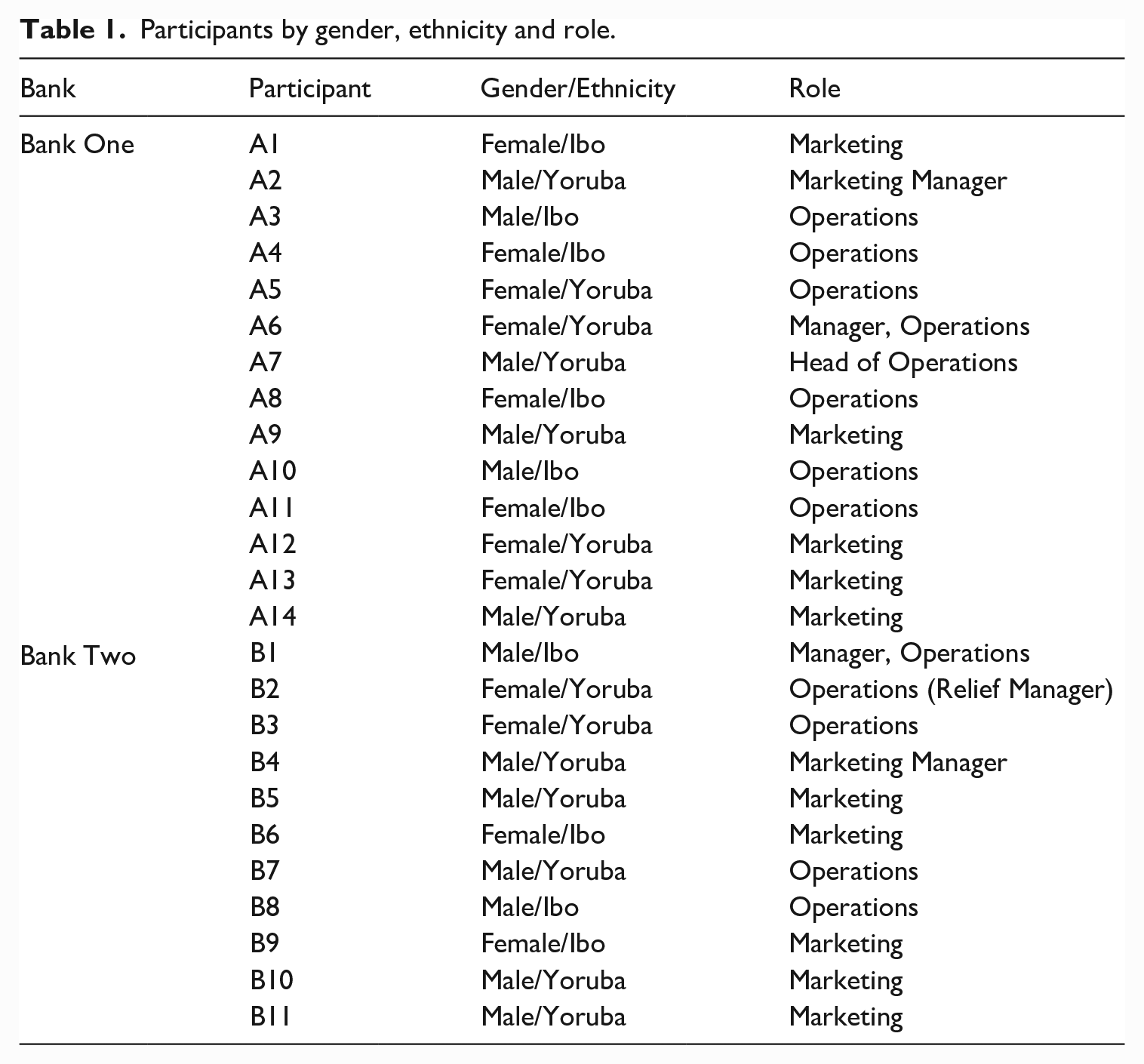
Bank One comprised more female participants below the rank of manager, with one female and two male managers. Bank Two had more male participants and two male managers but no ‘ranked’ female managers. The female manager interviewed was deputising temporarily (Table 1). At the branch level, managerial roles and positions were limited to three across operations and marketing (the only two departments at branch level).
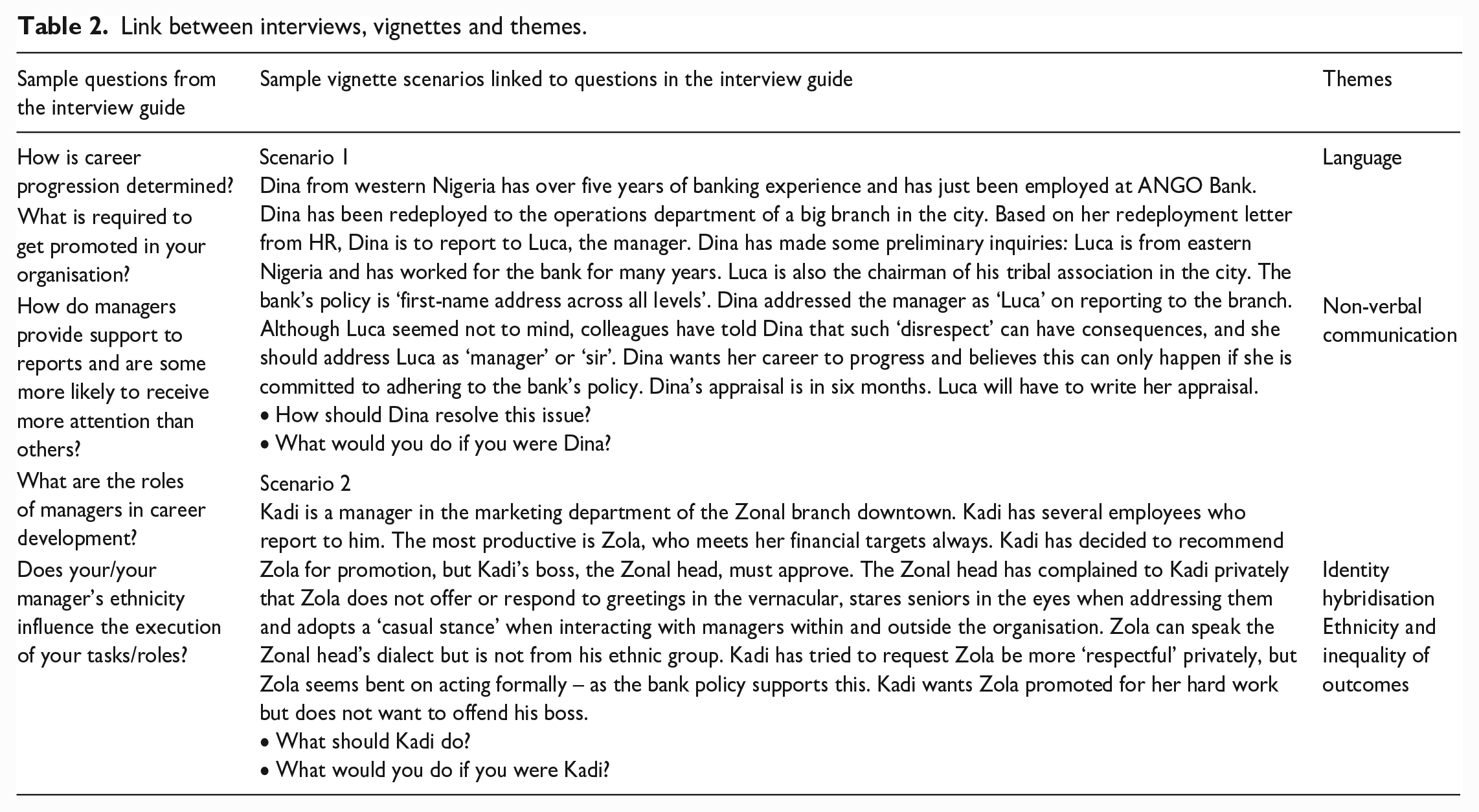
Consistent with a Bourdieusian lens, the relational practices of social actors (agents) in their historical, social, organisational and institutional contexts (fields) as they sought benefits (capital) were investigated by focusing on core ethnic values that are typically ‘Nigerian’. Two data collection methods were used: interviews and textual vignettes (Tables 2 and 3).
Link between interviews, vignettes and themes.
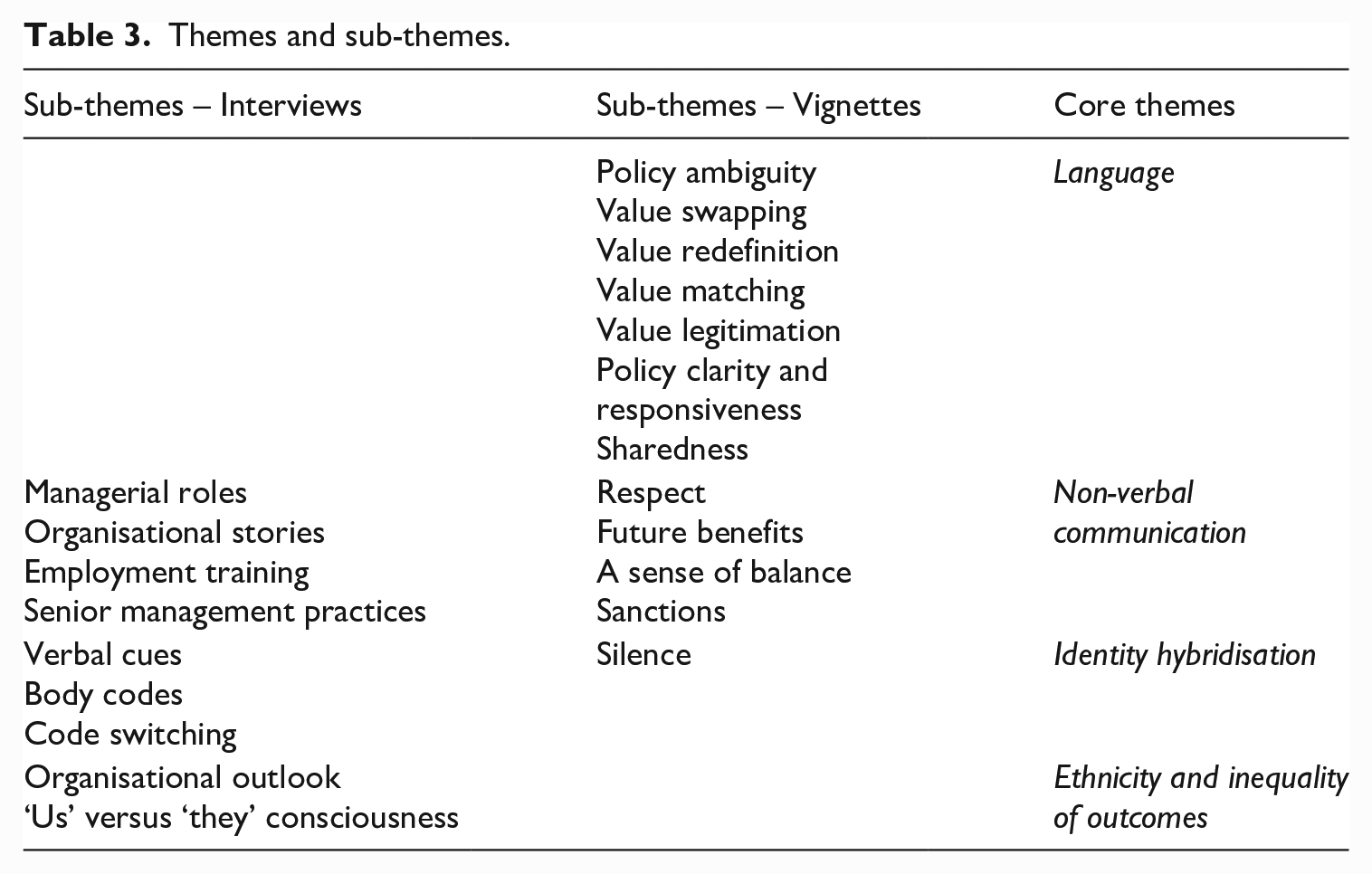
Themes and sub-themes.
Using semi-structured interviews, participants were engaged in a discussion to understand first-hand accounts of perceptions, typicality and context (professional/organisational/social requirements) (Farquhar, 2012).
Vignettes are texts, images, stories or other forms of stimuli about individuals, situations and structures, referring to crucial perceptions, beliefs and attitudes to which participants are asked to respond (Hughes and Huby, 2012). The textual vignettes were structured around daily life and practices in the banking sector, based on the first author’s decade of experience as a Nigerian banker, and fulfilled three main purposes (Kristensen and Johansson, 2008): interpretation of actions and occurrences that allowed exploring situational context; clarification of individual judgements, often in relation to moral or value dilemmas; and discussion of sensitive practices and experiences.
The methods were used sequentially: initial interview questions, then vignettes. Vignette responses functioned as triggers, leading to a follow-on interview. The questions in the interview guide were crafted around each vignette, which sought to investigate the link between ethnic culture and career progression, diversity management and feelings of equality/fairness in organisational relationships and the rules for and roles of ethnic group members in the subordinate–manager interaction.
The following questions were asked (Table 2): How is career progression determined, and what is required to get promoted in your organisation? How do managers provide support to reports, and are some more likely to receive more attention than others? What are the roles of managers in career development? Does your/your manager’s ethnicity influence the execution of your tasks/roles? Conversations were recorded, transcribed and presented verbatim, then analysed.
The interviewer (first author) introduced himself to participants as a previous banker in Nigeria but currently an academic in the UK and then introduced the study’s aim. The author was conscious of his ethnicity (Ibo) and previous banking experience and how this may influence his interpretations of participants’ narratives and how they interpreted and responded to questions and discussions. Initially, the researcher’s ethnicity, evident from his ‘ethnically Ibo name’, seemed lost to participants, who appeared more sensitive and responsive to the author’s current and past professional identity. Both seemed elitist, privileged and status-rooted. However, most participants (managers included) seemed more energised to talk rather than show subservience. They appeared eager to demonstrate their professionalism and knowledge of banking services to present themselves as equally elitist, privileged and competent. This matching exercise (during the interviews) produced responses from participants, wherein they appeared to focus on their professionalism, skills and expertise of the job, knowledge of banking products and services, and years of work experience.
Often, during interviewing, participants may refuse to divulge information because of discomfort and unfamiliarity with the researcher. This could occur when, as in this study, perceived highly educated and more ‘modern’ interviewers tend to create what Weinreb et al. (2018: 95) call ‘the stranger–interviewer norm’, whereby the social identity(ies) or perceived status of the interviewer does not match the cultural values, social positions or identities of participants. The matching exercise evidenced by participants in this study appears to signal that interviews can become ‘negotiated accomplishments of both interviewers and respondents that are shaped by the contexts and situations in which they take place’, as well as social positions, locality and (un)familiarity (Fontana and Frey, 2000: 663). However, the matching exercise also seemed to mute the impact of the author’s ethnic and professional identities on participant responses simultaneously.
Subsequently, as vignettes were introduced, participant responses seemed to focus more on everyday workplace experiences and interactions, the matching exercise vanished. This varied and timed participant response based on perceptions of (participants’ and researcher’s) status and identity during the data collection was taken into consideration while analysing the data. For instance, how inequalities manifest among diverse ethnicities may not always be primarily linked to ethnic identity but often invoked through material and symbolic manifestations of status (past or present occupation, perceived or actual occupational roles, implicit or manifest professional identity). It also signified that the methodological positioning of a researcher, specifically which data collection tools are used and how data are collected, is fundamental for providing insights into how inequalities are enacted (Umeh et al., 2022).
Thus, our interview guide and vignette design (Table 2) involved a preliminary framing of the field (Bourdieu, 1986) in a way that elicited employees’ reconstruction and deconstruction of their workplace experiences (Farquhar, 2012). This multi-method approach is novel for multiethnicity organisational studies. By acting as ‘elicitation’ for interviews, vignettes curb participants’ tendency to respond in socially, organisationally or professionally desirable ways when faced with a value dilemma (Hughes and Huby, 2012).
The wider research data were analysed using thematic analysis, ‘a method of identifying, analysing and reporting patterns (themes) across data’, enabling researchers to organise and describe data sets in rich detail (Braun and Clarke, 2006: 83). Our Bourdieusian analysis progressed in two phases. First, consistent with scholars who adopt Bourdieu’s theoretical lens and inductive analytical approaches to frame lived experiences of inequalities in specific contexts (e.g. Erel, 2010; Kamoche et al., 2014; Randle et al., 2015; Samaluk, 2016), thematic analysis was used. The emergent themes were summarised and further examined using a Bourdieusian analytical framing, which is described next.
A Bourdieusian analytical approach
Taking a Bourdieusian approach, capital, field and habitus were used to address our research question. First, the multilevel interplay between agents as organisational and ethnic group members, the positions of agents within the organisation and within/between groups and the relations of resource production and utilisation (capital) within fields, was analysed (Samaluk, 2016).
Then, drawing on the concept of habitus, our analysis focused on the tendency for employees to use their minds, words and bodies in a certain way for negotiation and benefits (Erel, 2010). Indeed, it is recognised that conflict and contention between agents based on their positions (capital or resources at their disposal), or position-taking/positioning (capital/resources they seek) suggests that even within a field, interests vary, and goals are not always shared (Kamoche et al., 2014). A Bourdieusian analytical approach engages with agents who maintain their positions or negotiate better positions based primarily, but not exclusively, on conflictual interactions.
Finally, since similar dispositions and interests do not spontaneously translate into shared identities or goals (Karatas-Ozkan et al., 2015), the primary consideration was what agents had in common and how they differed relative to social position, volume and composition of capital, habitus and social trajectory.
Findings
Bourdieu’s concepts of field, capital and habitus (Bourdieu, 1993: 72) highlight the ethnicised nature of inequality and privilege in the workplace, wherein the two banks remain ‘structured spaces of positions’ (fields) ‘whose properties’ are linked to the characteristics (ethnic identities) of their occupants or agents (employees). Ethnically diverse employees embody structures of differences or inequalities (e.g. status, ethnicity, privilege) manifested through internalised historically and socially situated patterns of practices showing conformity or resistance to rules and roles (habitus). Such practices (verbal and non-verbal) are linked to employees’ unequal access to social and organisational resources (capital), which confer advantages or disadvantages and further underpin the ethnicised character of inequality and privilege in the workplace.
In both banks, this study revealed ‘ethnicised identity’, focusing on ethnic identity mediated by status to produce ethnic affiliation, rather than group membership. It also revealed ‘symbolic identity’ or ethnicised identities projected through markers of ethnic culture, such as language and non-verbal communication. Employees were found more likely to accept individuals with the same dialect but distinct appearances than those with different dialects but similar appearances. Then, identity hybridisation revealed how often organisational identity became fused with ethnic identity. Finally, ethnicity and inequality of outcomes show how specific ethnicities suffered discrimination from those in managerially and ethnically privileged positions. The main themes emerging from our analysis, language, non-verbal communication, identity hybridisation and ethnicity and inequality of outcomes are discussed in more detail below. The sub-themes they build on are presented in Table 3.
Language
Language depicts an acceptable dialect or system for communication in organisations and may be a tool for status enhancement (Bourdieu, 1977; Kamoche et al., 2014). In both banks, the official policy was using English, the ‘colonial’ language. Ethnic dialects are prohibited:
We are mandated by management to speak English. The [bank’s] policy is English. Any other language is vernacular. But occasionally, some people speak their dialects. (Marketing, Female, Ibo)
English was meant to promote professionalism and organisational identity, preventing the domination of the dialects of any ethnic group, thereby reinforcing equality (Kamoche and Pinnington, 2012). Nevertheless, despite potential sanctions, employees still preferred their ethnic dialects precisely because English hindered a strategic form of discrimination, and diminished status and control.
In Bank One, the employee dialect (vernacular) was the dominant mode of expression among subordinates and superiors of the same and different ethnic groups, despite their gender or roles. While the bank focused on eliminating the influence of ethnicity, with that identity based on fixed geographical boundaries, employees reinforced affiliation through language. A participant explains:
Language plays a big role. I speak Ibo. I work with Yoruba, Kogi, Hausa. If an Ibo guy comes around and speaks Ibo to me, I will respond. It’s like a switch. If another person who speaks Ibo comes into that same environment, the person will switch on too. So, for me, language is just how you attract specific people to yourself. (Operations Manager, Male, Ibo)
Further, diminishing ethnic membership boundaries and the installation of affiliation through language, while seemingly not influenced by roles/tasks or gender, were mediated by status, particularly, but not exclusively, managerial status. As a manager of Bank One observed:
If the manager says in English ‘don’t sit down there’, the subordinate will think the manager is not serious. But when the manager changes his tone [speaks the dialect], the employee will act accordingly. (Marketing Manager, Male, Yoruba)
In Bank One, employees across departments used language for ethnic affiliation and as a broadly shared symbol for conveying respect for status. As one respondent in Bank One commented on this practice: ‘respect [for status] is ingrained in the wordings and gestures [of bank employees]’. Here, language is a product of the banking field wherein symbols are produced and interpreted (Bourdieu, 1991), or a language (or dialectal) habitus, which transcended role boundaries.
Similarly, Bank Two employees spoke in the vernacular because language was a distinguishing code. If affiliated or non-affiliated speakers understood it, it bestowed the speaker with a unique but transient identity. Here, employees used language for concealment, confidentiality, discretion and exclusion. One participant explained the following:
You can get to a place, and before you know it, someone is speaking Yoruba to you, and you may say, ‘What are you saying? Speak English.’ That’s when they don’t want just anyone to understand what they are saying. They change their language. (Operations, Female, Yoruba)
In both banks, position, positionality and position-taking were embodied in the employees’ ethnic tongue as an indication of symbolic power (Bourdieu, 1984; Kamoche and Pinnington, 2012) to command, mobilise, attract, marginalise or control other employees. The control element in language shows how it can be used to convey inclusion or exclusion, shared or differentiated identities. However, control seemed fragmented, as its possession and activation through language appeared diffused across hierarchies and positions, suggesting linguistic or dialectal relations embody symbolic power relations (Ashley and Empson, 2013), which seemed to mute the influence of roles and gender boundaries (Bourdieu and Wacquant, 2014).
Non-verbal communication
Employees also used non-verbal communication or non-verbal cues for communication, including tone of voice, silence, gestures, posture and gait (Morand, 2005). Ethnic identity was found to be fundamental to the cues employees engaged. Participants acknowledged that Yoruba and Ibo employees used non-verbal communication in different ways, as Yoruba employees seemed more expressive than their Ibo counterparts, who tended to be more subtle with their use of non-verbal communication:
I know Yorubas prostrate to someone higher in status. Ibos don’t. Sometimes they bow or speak softly. We try to be professional, but some are culture-minded. If you don’t prostrate, some Yoruba managers will not even listen to you. (Operations, Male, Ibo)
Thus, there were indications that non-verbal communication influenced if, and how, managers responded to reports on purely organisational matters. Such non-verbal expressions of deference from subordinates were expected by female managers also:
You still display some curtsies as this determines how fast you get a response [from managers]. I will not respond to you without such courtesies. When you say it in a particular way, I am willing to do anything. (Relief Operations Manager, Female, Yoruba)
In contrast to the banks’ egalitarian values, but consistent with the ethnic symbolism of subservience using gestures, Yoruba members were more likely to prostrate or change bodily posture in the workplace when greeting senior colleagues. Roles related to hierarchy seemed to matter here; reports showed subservience to seniors. Ibo employees were likely to bow or curtsy and respond with a measured tone of voice. While all employees, irrespective of ethnicity, seemed to exhibit this shared code for respect, female employees of managerial level (only a few in Bank Two) were more likely to imitate this (often male-dominated managerial) behaviour, thereby seeking subservience from their male reports too.
Here, non-verbal communication was ultimately a manifestation of symbolic identity, that is, ethnic identity, projected through ethnically legitimated bodily gesticulations mediated by respect for status, nonetheless reinforcing inequalities. Bourdieu’s (1984) assertion that identity and underlying values, communicated through vehicles of symbols evidencing status and inherent power, in this context uncouples the relational ethnocultural dynamics of relative power between managers and their subordinates. Respect for status, affluence and influence could, at times, override ethnic affiliation (Kamoche and Pinnington, 2012).
However, through ethnicised identity, these boundaries were deconstructed and reconstructed by employees. Further, while the banks focused on salient identities, specifically ethnicity, employees used non-verbal communication to produce symbolic identity, which was also mediated by status to produce ethno-culturally ‘legitimate’ forms of inequality.
Identity hybridisation
Corporate policy focused on diminishing ethnic-based inequalities through diversity management policies (first-name address, use of English language) with ethnic identity and membership determined by geographical origins (Barth, 1994). This runs counter to the broader ethnocultural setting in Nigeria, where titles, prefixes and acronyms are used to project and reinforce status, and where calling seniors, people of influence or status by their first name is considered disrespectful (Ovadje and Ankomah, 2013; Umeh, 2019), However, employees still used prefixes to mitigate perceptions of disrespect:
The bank insists on the first name, but we show regard by using prefixes. When we just can’t, to show respect to senior colleagues, we use the first name, but we call it subtly. (Marketing, Male, Yoruba)
While this policy of first-name address sought to reinforce a shared organisational identity and values of equality and impartiality, findings from both banks revealed identity hybridisation, whereby employees evoke multiple identities (e.g. personal, ethnic, professional or organisational) to aid negotiation and prioritisation among congruent or conflicting identities through action and inaction.
Here, action was as fundamental as inaction (Umeh et al., 2022). However, inaction was not synonymous with inertia or apathy (Umeh, 2019). Rather, it was just as valid an interactional tool as action. Indeed, while action seemed indicative of the manifest, explicit and demonstrable aspect of agentic interactions that underpin identity, status, inequality, inaction – saying or doing nothing – seemed to reflect a way of negotiating or asserting ethnic identity symbolically. In certain instances, some employees did not use the first name, titles (Sir, Oga: jargon for master, boss), prefixes or synonyms (BM: branch manager, or HOP: head of operations), leading to silence or the use of signals. One participant described her experience as follows:
Employees call her Auntie. I find it difficult to call the lady that. I tap her anytime I want to speak to her because I don’t know what to say. If I call her Auntie, it doesn’t sound nice to me, and I can’t address her by first name or as ‘Ma’ because that’s not what they call her. So, I just say, ‘excuse me’. (Operations, Female, Ibo)
Identity hybridisation shows how employees in both banks reconcile the required and sometimes conflicting organisational, ethnocultural and other identities for identity compromise. While identity hybridisation was evident in both banks, the process through which it occurred differed. In Bank One, employees internalised elements of organisational identity to the degree that they were perceived as harmonious or consistent with their ethnic identity. For instance, employees believed there was a match between two otherwise incompatible identities underpinned by a specific value: the bank’s value statement ‘respect for the individual’ and an ethnocultural value requiring respect for status, influence and affluence. In outright disregard for the organisational values of equality, by not using first names, employees, particularly of Yoruba extraction, irrespective of gender, asserted kinship by expressing themselves to superiors in ways signifying blood relationships using phrases such as ‘brother’, ‘sister’, ‘uncle’ and ‘auntie’. Using expressions signifying blood relations with unrelated others is the height of respect among members of the Yoruba group (Ovadje and Ankomah, 2013).
Ibo employees in Bank One did not show respect similarly to their Yoruba colleagues. They engaged in using acronyms and prefixes and even avoided names altogether (Morand, 2005). However, there were also indications that the need to reinforce these ethnically based inequalities was rooted in the belief that, paradoxically, these actions produced certain desirable career benefits, such as favourable appraisal and career progression. A Bank One participant clarifies such congruence:
As a management trainee your manager has gone ahead of you and, mind you, he is going to write your appraisal. If you do not do it the way it should be done, your career will not progress. (Manager, Female, Yoruba)
Here, symbolism was evident in the shared practices of employees, irrespective of their ethnic origin, roles or gender. Employee practices presented an outcome based on a process of reflection upon the dilemma of sometimes choosing between conflicting and competing identities, showing the conflictual aspects of agentic interactions (Bourdieu, 1990; Samaluk, 2016).
However, an employee from Bank Two also reported that:
There are so many cultural reasons why senior employees will not take first-name address from you. ‘Sir’ connotes respect. It’s just decorum. I call my manager ‘Sir’ no matter who is around. (Head of Operations, Male, Yoruba)
Thus, the findings from Bank Two revealed that identity hybridity could also be a product of more implicit occurrences of congruence. This was the case when employees synonymised respect as required by the bank with respect to ethnic culture, even when, unlike the former, the latter produced inequalities.
Ethnicity and inequality of outcomes
In some other cases, some employees seemed to have internalised aspects of their ethnic and organisational identities and their respective underlying values, in such a way that both seemed attached. That is, egalitarian organisational identity, paradoxically, functioned as a cue for activating ethnic identity, legitimising inequality in organisational relationships. Here, symbolic identity explains the construction of an employee’s identity demonstrated through engagement in practices that promoted those values while simultaneously nurturing feelings of connectedness (congruence) and uniqueness (conflict).
Asserting and engaging in ethnic group identity, albeit at odds with the more egalitarian aspirations of the banks, was viewed as essential for deriving potential benefits and privileges. Of course, this also resulted in those who were not part of the advantaged ethnic groups with representation at middle and senior management levels commonly experiencing unfair treatment, with their expertise and hard work largely unacknowledged:
Some people are still very hard workers, yet they have not been promoted. At times knowing certain people [from one’s ethnicity] does also help. So, you will need hard work, but you also need a bit of human relations. (Operations, Male, Ibo) Even when you are good, it takes heavens for somebody to recognise your effort [appraise you properly] and take you to the top [promote you]. Most people get to the top because they have somebody in authority [from their ethnic group] to talk to. I can’t say there is a clear process for promotion. (Marketing Manager, Male, Yoruba)
One participant recalled how a manager manipulated the appraisal system to benefit his Yoruba colleagues, with the manipulation underscored by harassment:
Two months ago, as part of our appraisal, we had our MPR [Management Productivity Review] and an Ibo guy presented his performance figures to everyone, including his manager and the senior people, who were all Yoruba. They started harassing the guy, telling him, ‘You are not performing’, and I do not believe he was doing worse than his Yoruba colleagues. He was not promoted eventually. It was just because of his tribe. We are expected to do much more than others. (Operations, Male, Ibo)
Another employee reported thus:
During a branch meeting, a manager physically assaulted a junior Ibo officer. The CCTV captured everything. This case was reported to the bank’s head office. Nothing happened to the manager. Instead, it was the Ibo guy that was asked to go. They said he was not performing. The manager kept his job because his group head, who is from his tribe, defended him. (Operations, Male, Yoruba)
Therefore, even the most extreme abusive behaviour was glossed over if the perpetrator held a managerially and ethnically privileged position in the organisation.
Discussion
Our findings show how employees used a language habitus (or verbal and non-verbal communication) to negotiate benefits, navigated the tensions between sometimes conflicting organisational–ethnocultural and other identities (identity hybridisation), and how some ethnicities suffered discrimination from those in managerially and ethnically advantaged positions.
This study revealed that in postcolonial multiethnic work contexts of Global South countries such as Nigeria, ‘ethnicised identity’ (ethnic identity mediated by status) and ‘symbolic identity’ (ethnicised identities projected through markers of ethnic culture) enabled weakening of the boundaries of ethnic membership, producing affiliation across ethnicities underpinned by status and, specifically, managerial status. Moreover, managerial roles across departments influenced this situation. Ethnicity was also deemed more important than job relevance.
Symbols like language appeared vital and were used in sustaining ethnicised identity and producing symbolic identity that generated heterarchical or shared control. In researching the manifestations of ethnic inequalities and implications for managing diversity in super-diverse postcolonial work contexts, these and other relational dynamics have been mostly overlooked and are better understood through a Bourdieusian sociological lens.
Bourdieu’s idea of the field as embodying agentic interactions, positions and position-taking, determined by negotiations of inequality and conflict (Bourdieu, 1990), partly explains the existence of ethnicised and symbolic identities. Based on Bourdieu’s idea of habitus, this study found agentic (employee) interactions and dispositions reinforce and legitimate ethnic inequalities that are frequently linked to congruence (Karatas-Ozkan et al., 2015).
Ethnicised identity is shown to be based on how inequalities were negotiated and legitimated through the induction of (subservient) members of other ethnicities into the manager’s ethnic fold (inter-ethnic inclusion), the ostracism of some bona fide (but rebellious) group members (intra-ethnic exclusion) and the informal hierarchical and heterarchical placement of employees based on the manager’s ethnic preference (extra-ethnic positioning). This suggests that diversity management interventions focusing on salient shared cultural values may miss the interplay of specific configurations of inequalities driven, paradoxically, by formal organisational structures, namely, the managerial role/function or status. Position and position-taking in the banks, based on the ethnicised identity of employees, evoked inequality. However, while Bourdieu focused on hierarchical aspects of control, our study sees language producing a heterarchical form of control, a prerogative of both managers and subordinates (Ovadje and Ankomah, 2013; Umeh, 2019).
Bourdieu’s conceptualisation shows how control as a resource (capital) can be wielded by subordinates in lower positions, and not just by managers, irrespective of their gender or organisational units/roles, through explicit/salient and symbolic ethnic markers (e.g. language, verbal and non-verbal cues: Ashley and Empson, 2013). This suggests that while corporate policies focused on disadvantaged groups, such as women, racial minorities, subordinates or minority ethnic groups (Inegbedion et al., 2020), these groups may reinforce inequalities by evoking symbolic control (Kamoche and Pinnington, 2012; Kamoche et al., 2015). Despite de-emphasising hierarchical distinctions of status at work in multiethnic settings through flatter structures, common language, or first-name address, subordinates remain able to bypass these and to reinforce discrimination through appeals to ethnic identity.
This study further found that many employees relied on organisational status-enabled inequality for career advancement. That is, paradoxically, some employees were discriminated against through specific workplace structures and processes meant to mitigate unfairness (reporting lines, roles and tasks, performance/promotion appraisals). This suggests that ethnic inequalities can grow when employees find a presumed common ground between otherwise conflicting identities and underlying values, both ethnic and organisational (Umeh et al., 2022).
The corporate policy of ‘equality and respect for all’ across reporting lines and roles in both banks seemed to inadvertently project a marker of ethnic identity ‘respect’ for status (resulting in inequality). This situation has implications for managing diversity, more broadly. In the diversity management literature, equality is seen as a necessary organisational imperative, a constraint on ethnic discrimination and desirable across different identity categories (Tatli and Özbilgin, 2012). A more context-sensitive evaluation of workplace experiences and manifestations of inequalities, however, requires the appropriate adaptation of diversity management policies and initiatives. Without such adaptation – based on considerations of shifting aspects of employee ethnocultural identity and relatively fixed organisational structures – diversity management policies may remain what Bourdieu (1977: 169) refers to as merely ‘acceptable ways of thinking and speaking’. That is, societal and organisationally established conventions in the realm of discourse, which, in principle, reject inequalities while, in practice, inadvertently reinforce them by disadvantaging some and privileging others.
Bourdieu focuses on cost-benefit considerations as the basis for position and position-taking of agents within a field (Levina and Arriaga, 2014; Samaluk, 2016), to the extent that career advancement is symbolic of status, and this is consistent with our findings. However, it was also found that ethnic inequality and subservience were not enforced or reproduced for their benefit or even for what they generated for employees, materially, but for what the product/outcome meant in ethnocultural currency, immaterially or symbolically. Interestingly, the symbolism of benefits (Kamoche and Pinnington, 2012) seemed more ‘material’ than the substance thereof. That is, symbolic identity shows agentic benefits/advantage (resource or capital) or position (status) and is more synonymous with appropriateness than favourableness. This was the case, even when appropriateness was related to ethnic identity-linked disadvantages, including ethnic discrimination and subservience/servitude for affiliates.
This idea of symbolic identity embodying paradoxes of advantages and disadvantages of ethnic inequalities and based on ethnocultural appropriateness, not outcome favourableness, or what we call crossvantage, merits further scrutiny. A major contribution that arises from a Bourdieusian position is, however, (symbolic) capital, wherein what may be determined by management in organisations as a cost, or disadvantage for some groups, may be considered symbolically appropriate in ethnocultural terms by members and affiliates. In this study, inequality and discrimination in both banks seemed rooted in ethnic endorsement, and legitimation through symbolic capital. Drawing on Bourdieu, diversity management policies may therefore be counterproductive if solely focused on organisationally defined material benefits (Kamoche and Pinnington, 2012), as symbolic benefits are equally important (Ashley and Empson, 2013; Lawler, 2014).
Bourdieu further suggests that capital or resources are linked to agent positions in the field (Erel, 2010). In this study, the means/structures through which identity and status were projected ‘legitimately’ to others (symbolic identity) were crucial for sustaining or mitigating inequalities. In the focal organisations, language (verbal and non-verbal communication) provided the required structure and legitimacy such that the structure through which status was projected (language) qualified one for acceptance, endorsement or ostracism rather than status alone.
Research participants also self-identified differently to mainstream conceptualisations (Bader, 2001; Barth, 1994; Cohen, 2013) by appealing to affiliation mediated by symbols, using dominant language and gestures in preference to their parental or geographical backgrounds. This reinforced an ethnicised and symbolic identity (Ashley and Empson, 2013). The significance of symbols in identity construction (Umeh, 2019) in postcolonial, ethnically diverse Global South contexts has been frequently overlooked in the literature on the sociology of work. Indeed, this gap may be based on how identity is conceptualised in most Western management literature, focusing on the socio-psychological and cognitive aspects of identity rather than contextual, anthropological and philosophical aspects (Lawler, 2014).
Conclusion
Drawing on Bourdieu’s (1984) sociology, the concepts ‘ethnicised identity’ and ‘symbolic identity’ are developed to highlight how status and ethnicity in an organisation comprising an ethnically diverse workforce often reflect the dimensions of difference and inequality (Ovadje and Ankomah, 2013; Umeh, 2019). It reveals how such relations may assume multifaced inequality dimensions (inter-group and intra-group) because of the varied invocation of symbolic elements of ethnic culture.
It further shows how status manifests in relations between employees and between employees and their managers. Previous studies show how status can be hierarchical, characterised by subtle manifestations of autocratic tendencies such as when managers use their power for control (Ovadje and Ankomah, 2013; Umeh, 2019). However, this study shows how status-linked inequality can be heterarchical (as is the case when otherwise disadvantaged or lower cadre employees exert control). Furthermore, it is argued that tackling inequalities linked to ethnic identity at work requires an understanding of the changing interpersonal, socio-historical and cultural context in which various formations of inequalities emerge and manifest in organisations (Kamoche et al., 2015). It highlights how diversity management policies may fail when focused on racial or inter-group differences (or group membership) (Inegbedion et al., 2020), suggesting that understanding the subtle ways inequalities may be driven within groups and through ethnic affiliation has fundamental implications for developing appropriate diversity management policies (Umeh et al., 2022).
Finally, this study provides insights into a more practical application of Bourdieu’s work in researching inequalities at work in ethnically diverse contexts. We suggest that culture is not the sole symbolic plane of collective representations, and cultural capital can only be examined through a focus on its intrinsic ethnic character. This position responds to the current situation whereby, often, in applying Bourdieu’s perspectives, ethnicity/ethnic identity is neither implicated nor explicated in conceptualisations of culture (Erel, 2010; Samaluk, 2016).
Our study has limitations. We focus on only one country and one sector in a Global South context. However, more research is needed to explore the place of symbols as an aspect of ethnic identity and ethnic inequality. Specifically, future studies can show how diversity management initiatives may address subtle inequalities enforced and endorsed through symbols in organisations with a diverse workforce in the Global North and Global South.
Footnotes
Acknowledgements
The authors would like to thank the Associate Editor and the anonymous reviewers for their insightful and constructive comments that have improved the article.
Declaration of conflicting interests
The authors declared no potential conflicts of interest with respect to the research, authorship, and/or publication of this article.
Funding
The authors received no financial support for the research, authorship, and/or publication of this article.
