




Abstract
Drawing from in-depth qualitative interviews (N = 32), this article examines the impact of indigenous tribal marks on employment chances in southwest Nigeria. It employs indigenous standpoint theory to frame the argument around what constitutes stigma and in what context. The results of our thematic analysis indicate that tribally marked job applicants and employees face significant social rejection, stigmatization and discrimination, and can suffer from severe mental illnesses and even suicidal ideation. We explain how these tribally marked individuals navigate the changing contours of tradition and modernity in Nigeria. Tribal marks, although once largely perceived as signals of beauty and high social status, are now increasingly viewed as a significant liability in the labour market. This article makes a unique and original contribution to the study of stigma and employment discrimination by eschewing the prevailing Western ethnocentrism in the extant research and instead placing the indigenous standpoint at centre stage.
Introduction
The employment relations literature is overwhelmingly Western-centric – to the representational detriment of the vast majority of the world’s population living and working in developing countries. With very few exceptions (e.g. Kamoche, 2011; Nyambegera, 2002; Wood, 2008), Africa is one particularly neglected region within the mainstream employment relations literature. Consistent with this geographical lacuna, very little, if indeed any, previous empirical research has ever been conducted investigating the effect of indigenous tribal marks on employment outcomes in Africa. In light of the opportunity that this gap in the literature poses, the present study draws from indigenous standpoint theory (Foley, 2003) to reconceptualize, or remould, the traditionally Western-centric concepts of beauty (Butler and Harris, 2015; Nath, 2011; Warhurst and Nickson, 2007b; Warhurst et al., 2000) and stigma (Crocker and Major, 1989; Goffman, 2009; Link and Phelan, 2001) by researching the neglected lived experience (Reid et al., 2005) of employment discrimination against visibly tribally marked individuals in the modern Nigerian labour market. We demonstrate that visible tribal marks not only have a deleterious impact on one’s employment chances, but they are also associated with severe mental health problems (Mortensen et al., 2019) and even, in some cases, suicidal ideation stemming from the imposition and internalization of Western cultural norms.
Throughout the pre-colonial era, tribal markings – in what is now known as modern Nigeria – were commonly thought to signal beauty among women (Ayinla, 2017) and social status and prestige among men (Tremearne, 1911). These overwhelmingly positive connotations were diluted somewhat with the advent of the British slave trade. The practice of marking children’s faces intensified during this period as a means of identifying individuals who were forced into, and eventually escaped from, slavery (Ozongwu, 2012). Facial scarification remains to this day a complex, contradictory signal that identifies one’s ancestral lineage and communicates one’s social identity (Piero, 2014), but also runs counter to colonial standards of beauty. Confusingly, tribal markings are simultaneously a source of pride as well as a source of stigma. In light of this discrepancy stemming from the processes of colonization, the present study seeks to contribute to our current understanding of the changing contours of stigma and employment discrimination from an indigenous standpoint (Foley, 2003). Accordingly, we seek to answer the following overarching research question: to what extent have the cultural forces of colonization stigmatized tribal markings, displaced the indigenous standpoint and thereby harmed the employment prospects of Nigeria’s indigenous peoples?
Our analysis of the stigmatization of indigenous tribal marks, and the subsequent employment discrimination faced by those bearing such marks, unfolds across the following sections. First, we draw from indigenous standpoint theory to reframe the prevailing Western-centric conceptualization of social stigma. After that, we describe the unique research setting and context of our study. The methods are then reported, followed by the results of our qualitative fieldwork. The key findings are then summarized and discussed, alongside a reflection of the strengths and weaknesses of our methodology and some directions for future research.
Indigenous standpoint theory and ‘trait inversion stigmatization’
Indigenous standpoint theory is an offshoot of a wider conceptual framework known simply as ‘standpoint theory’ (Hekman, 1997). The fundamental assumptions underlying standpoint theory are: (1) social groups are characterized by differential power relations, (2) more powerful social groups impose their normatively constructed ‘standpoint’ on less powerful social groups, but (3) less powerful social groups can resist the dominant hegemony by reasserting their unique values, norms, beliefs and behaviours (Rolin, 2009). From these three assumptions, it follows logically that ‘knowledge’, ‘knowers’ and that which is ‘known’ are contested constructs that are typically – albeit not exclusively (Kaufmann, 2004) – defined by majoritarian consensus, similar to what Foucault (1995, 2018) argues in his postmodernist framework. To date, the vast majority of studies on standpoint theory are of a feminist persuasion (e.g. Hardin, 2004), with the core argument being that female and non-binary standpoints are historically marginalized (e.g. Bates et al., 2020) by the heteronormative standpoint.
Standpoint theory is rarely applied to studies in employment relations and management (see Adler and Jermier, 2005 for an exception) and, to the best of our knowledge, has never previously been applied to explain employment discrimination against the indigenous peoples of southwestern Nigeria. Indigenous standpoint theory was first popularized by Foley (2003, 2006) and later expounded upon by Nakata (2007). An indigenous standpoint is one in which knowledge, or that which is known, is socially constructed (see Berger and Luckmann, 1984), but from the unique point of view of aboriginal peoples. Though indigenous standpoint theorists – much like indigenous cultures – are a heterogeneous mix of individuals from myriad backgrounds, they argue, in short, that colonialism, Westernization and modernization threaten the continued existence and integrity of the indigenous standpoint. As a result of colonizing processes, indigenous knowledge, they posit, has been, at best, diluted, and, at worst, adulterated, by competing Eurocentric ideologies and epistemologies. This cultural shift has undermined indigenous ‘ways of knowing’ (Simonds and Christopher, 2013) and largely replaced them with Western values, norms, attitudes, beliefs and behaviours (Fanon, 2004; Patton, 2006), all of which permeate the labour market.
Extant studies that have employed indigenous standpoint theory focus, in the main, on the stark differences between the thinking of ‘whitefellas’ versus the thinking of ‘blackfellas’ (Nakata, 2007), a set of terms first employed to describe race relations in Australia (Cowlishaw, 2004), wherein the expression ‘whitefellas’ refers to the European colonizers and ‘blackfellas’ refers to the Australian First Nations people. Much of this literature examines not only the explicit injuries done to aboriginal peoples, but also the ‘hidden injuries’ that are not talked about openly (Cowlishaw, 2020). Implicit within this framework is the idea that Western colonization entails the imposition of white normativity (Bhandaru, 2013), broadly construed, onto people of colour (POC). This distinction between ‘whitefellas’ and ‘blackfellas’ (Rossi et al., 2013) is grossly oversimplified, however, and could benefit from the incorporation of a third, new category: ‘blackfellas-who-have-internalized-whitefella-thinking’. In the case of the present study, employment discrimination against indigenous Nigerians with visible tribal marks may well be informed by ‘whitefella’ thinking, but it is enacted largely by ‘blackfellas’ whose acceptance of white norms and values is an under-investigated phenomenon. Our argument is predicated on the assumption that non-indigenous black Nigerian employers, as well as some indigenous employees, have internalized colonial, that is to say, Western, definitions of beauty and stigma.
The indigenous standpoint is often an inversion of the colonial standpoint (or vice versa, depending upon one’s point of view), and nowhere is this clearer than in relation to that which constitutes stigma. Goffman (2009) offers perhaps the most widely used sociological framework for the study of stigma. He argues that stigma represents a spoiled, contaminated, discredited, or discreditable feature of a socially ‘tainted’ individual as seen through these eyes of ‘normal’ people. Link and Phelan (2001) similarly posit that stigma is defined as a function of negative labelling, stereotyping, separation from the in-group, loss of social status and discriminatory behaviour on the part of the stigmatizer. The definitions of ‘normal’ and ‘stigmatized’ are, importantly, not based on objective fact; rather, they are grounded in the interplay of subjective perceptions and power dynamics. Accordingly, the same individual trait or characteristic – often, although not always, physical (Elraz, 2018) – can be considered beautiful or stigmatic simultaneously, depending on one’s standpoint. More specifically, indigenous traits that are traditionally highly valued within indigenous populations may be perceived negatively, perhaps even odiously, via the imposition of Western standards of beauty (Montle, 2020).
Evidence pointing to a Westernization of beauty standards in developing countries is widespread. For example, skin lightening, also commonly referred to as skin whitening, is increasingly prevalent across Asia (Li et al., 2008) and parts of Africa (Jacobs et al., 2016). Lewis et al. (2011) examine motivations for ‘skin bleaching’ in Tanzania and find, in spite of the significant health risks, that women are motivated by Western ideals surrounding ‘whiteness’. We argue that similar cognitive processes may be at play in relation to tribal markings. Such markings have traditionally signalled beauty, status and prestige among aboriginals, but, through the processes of slavery and colonization, have come to be perceived, from a Western standpoint, as a form of facial disfigurement (Madera and Hebl, 2012), which is associated with severe mental illness (Macgregor, 1990) and even suicidal ideation (Gupta and Gupta, 1998; Orion and Wolf, 2014).
At the core of the theoretical argument presented in this article is a novel concept that we call ‘trait inversion stigmatization’. This concept is predicated on the assumption that tribal marks are ultimately context-dependent: they can be viewed, depending upon one’s standpoint, as an asset (from an indigenous standpoint) or a liability (from a colonial standpoint). This culturally nuanced argument seeks to contribute to, and substantively further our understanding of, indigenous standpoint theory, as well as stigma theory. Beyond the obvious point that the empirical context in which these two theories are leveraged is unique and value-adding, the theoretical contributions are equally important. In particular, the concept of ‘trait inversion stigmatization’ brings together indigenous standpoint theory and stigma theory in a unique synthesis.
Extant research on social stigma is strongly grounded in the systematic analysis of stereotypes and cognitions (Hebl and Dovidio, 2005), but it has rarely been applied to workplace aboriginality, and even rarer still to an African indigenous context. This is a significant lacuna given that indigenous people often feel stigmatized and powerless in the workplace (Biddle et al., 2013). Though it has already been argued that stigma is a function of power dynamics (Link and Phelan, 2001; Toyoki and Brown, 2014), the concept of ‘trait inversion stigmatization’, as presented here, is a new theoretical lens that can substantively contribute to our understanding of the processual development of social stigma at the intersection of the changing contours of tradition and modernity. Trait inversion stigmatization implies that it is not simply the case that the colonial standpoint is imposed onto a cultural ‘blank slate’, but rather that this imposition first inverts, and thereby neutralizes, the extant indigenous standpoint. It is the novel synergies gained from combining indigenous standpoint theory and stigma theory that offer this theoretical advancement.
Research context and setting
In keeping with indigenous standpoint theory, we now give an overview of the research context. Nigeria is a country of more than 350 ethnic groups, with Hausa, Ibo and Yoruba constituting the majority of the population. A comprehensive history of the country is proffered by Falola and Heaton (2008), but for present purposes, a brief overview of its colonial history is sufficient. From the mid-19th century, the country was ruled and administered by the British Empire, with independence finally gained in 1960. The processes of colonization involved a militarily-backed dismantling of indigenous resistance and the forced imposition of a market economy, driven primarily by Britain’s unquenchable desire for Nigeria’s natural resources (Cornelius et al., 2019). Though the process of Westernization was predominantly motivated by economic imperialism, it was accompanied by cultural and religious imperialism that sought to unify the disparate ethnic groups. Although pre-colonial aboriginal cultures are highly diverse and heterogeneous, over time they were subsumed into British values, and via this process, indigenous cultures were marginalized in favour of Western norms and mores. Among the many cultural artifacts that fell victim to this process, the tribal mark is one that has not been investigated extensively in previous research, particularly in relation to its inhibiting role in the modern Nigerian labour market. The colonizers viewed facial markings as ‘backwards’ and ‘primitive’, thus giving rise to growing prejudices, many of which, we argue, permeate indigenous populations that have internalized Western values.
Tribal facial marks – what some refer to as ‘facial mutilation’ – remain common in Nigeria to this day, at least among the natives of the southwest. They are most prevalent among the Yorubas, although other tribes in Nigeria also display facial markings. Tribal marks have existed for thousands of years and have generally been a source of pride for the bearer. They became even more widespread when the slave trade became lucrative to the British Empire. Native peoples marked their children and family members in order to recognize them in the event that they were freed from slavery after being captured. The various markings were used to identify members of the same tribe and lineage, including royal heritage (Piero, 2014). Facial marks are an age-long indigenous tradition that, unlike modern tattoos, are deliberately inscribed onto individuals’ faces coercively (Akindele, 2017), often in infancy – and thus without consent – usually by their parents (Murdock, 2012), as illustrated in Figure 1 (warning: viewers may find this image distressing). Tribal marks are typically inscribed onto the cheeks, forehead, temple and under the chin. As illustrated in Figure 2, they can be slanted, vertical and/or horizontal, on both cheeks and/or on the forehead. Figure 3 depicts an adult Yoruba with tribal marks.
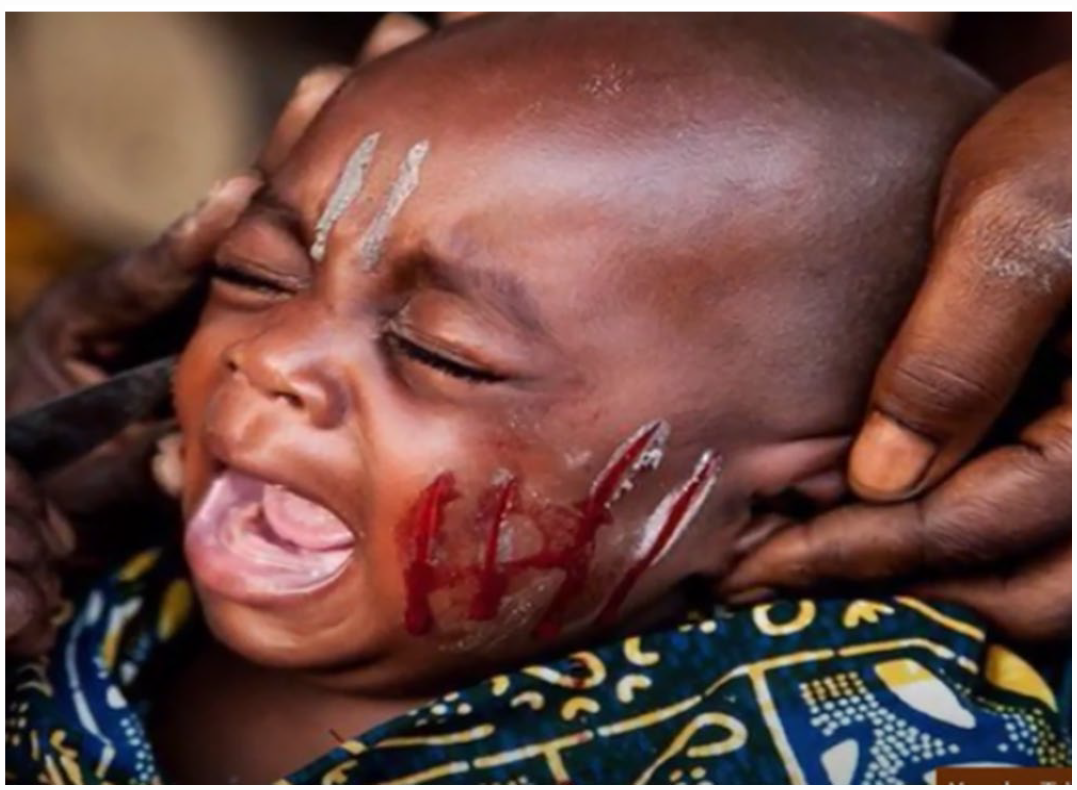
Yoruba tribal marking.
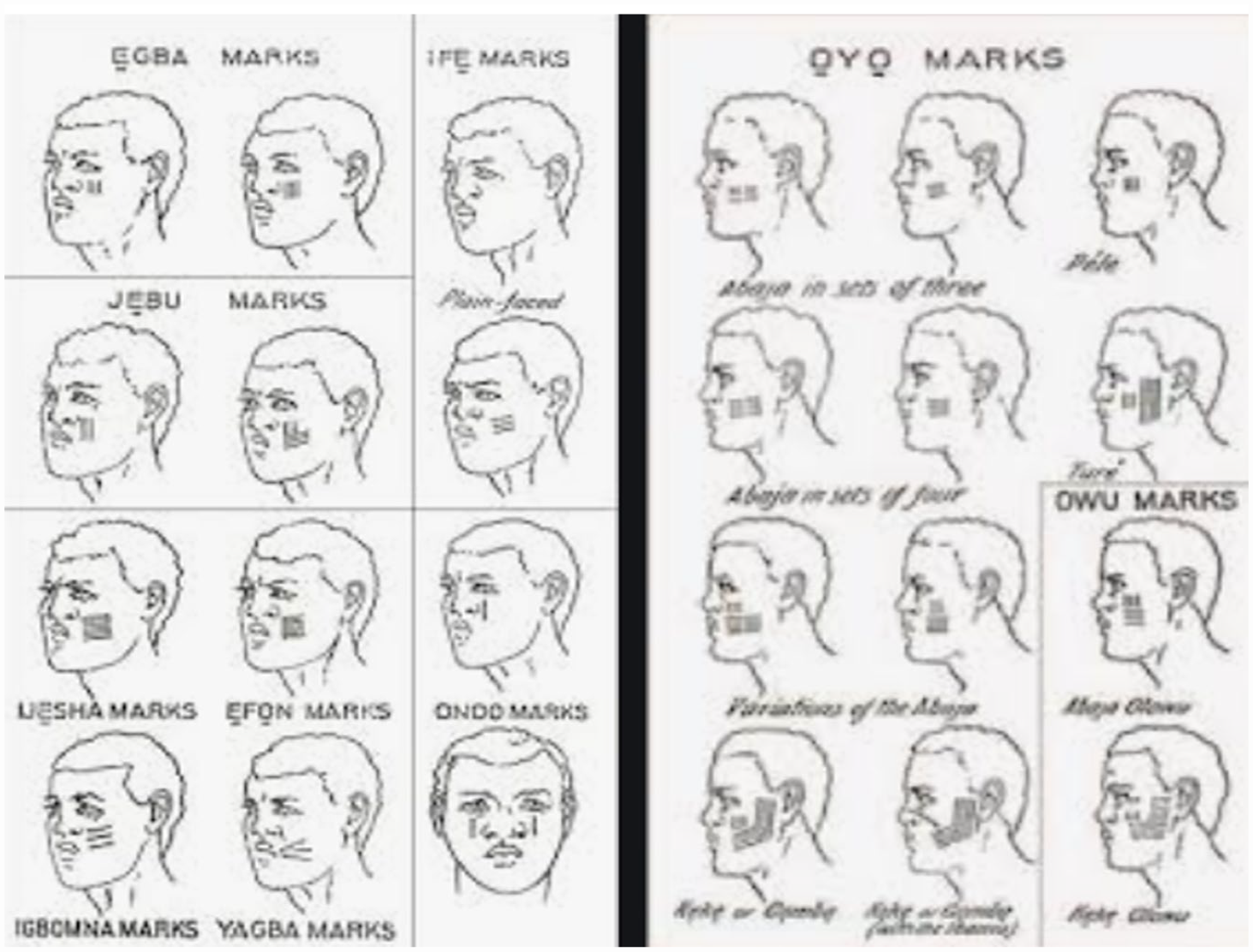
Examples of Yoruba tribal marks.
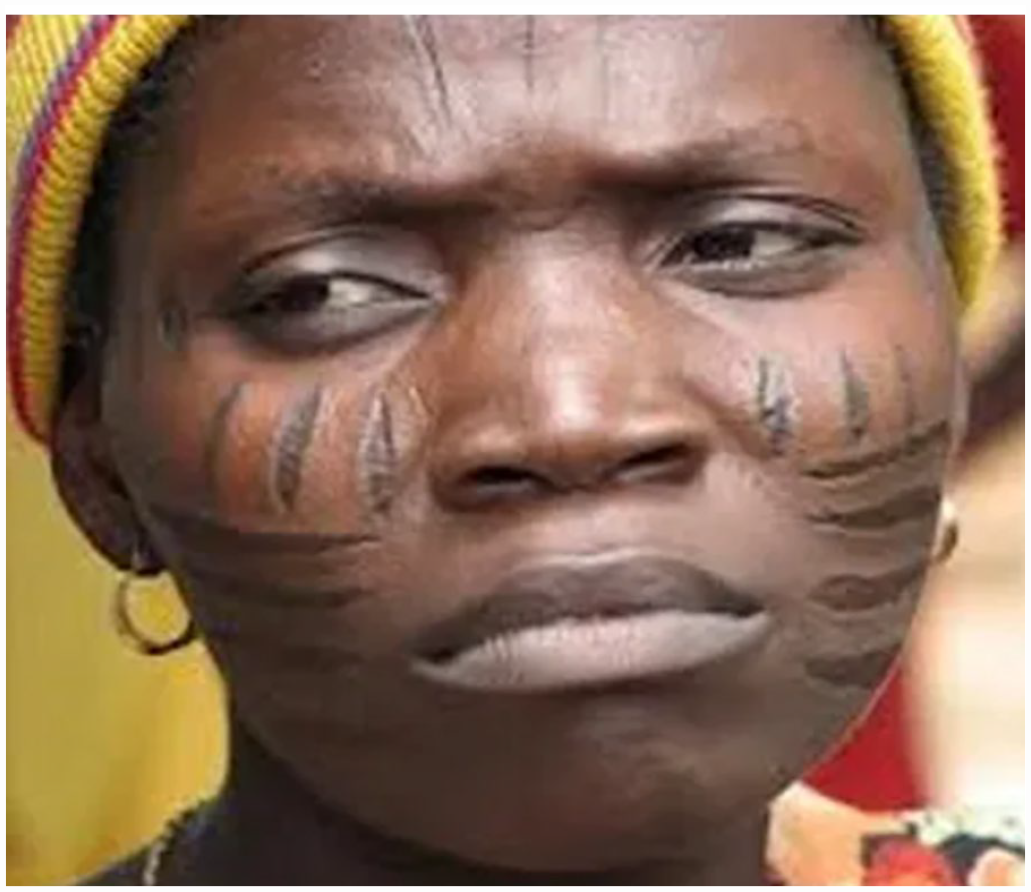
Adult Yoruba tribal marks.
Methodology
This study uses a phenomenological and narrative approach to examine the lived experiences (Creswell, 2013; Maxwell, 2013) of individuals with tribal marks in Nigeria. The phenomenological approach is grounded in the pioneering work of Husserl (1999) and Schutz (1972). The approach posits that subjective perception and experience are the main sources of information about the world and the means by which we can understand its phenomena (Patterson, 2018). In phenomenological studies, social phenomena are central; perception is the method of experiencing them; and narratives are the means of extracting information about experiences. Phenomenological interviewing focuses on ‘life stories’ and the ‘lived experiences’ of the participants. Semi-structured interviews were conducted with 32 individuals with visible facial markings. The interviews sought primarily to investigate how these facial marks impact employment chances, with a focus on participants’ everyday experiences. We employed a narrative approach, which elicits storytelling about individual experiences in a given context (Gergen, 1994). Narratives convey meaning to experiences by scripting them into structured plots (Peticca-Harris, 2019). The stories act as a symbolic form by which individuals construct shared meaning and collectively centre that meaning (Tietze et al., 2003).
The data were collected over six months in Lagos, Ibadan and Ilorin, and include natives of Oyo, Ogun, Ondo, Osun, Ekiti and Kwara from southwest Nigeria. Purposive and snowball sampling were used to recruit participants. Participants were recruited through the existing personal contacts of the researchers. Each participant was then asked to recommend someone who met the eligibility criteria of having tribal marks and was willing to participate in the study. Purposive sampling permitted us to select participants with visible tribal marks in order to achieve the research objectives of the study. Snowball sampling enabled us to access members of populations who may have otherwise been difficult to reach, like those with facial marks. Both purposive and snowball sampling are, however, vulnerable to sampling bias. Initial participants nominated acquaintances who also have facial marks for involvement in the study, resulting in a potentially homogeneous sample. In this respect, we have obtained, through our data, a ‘snapshot’ of some of the challenges that people with facial marks encounter in Nigeria. Though our sample is not readily generalizable outside this context, it is important to note that generalizability is not a relevant criterion for most qualitative research. Carminati (2018) argues that the purpose of qualitative research is focused on providing in-depth explanations and meanings, rather than generalizable findings.
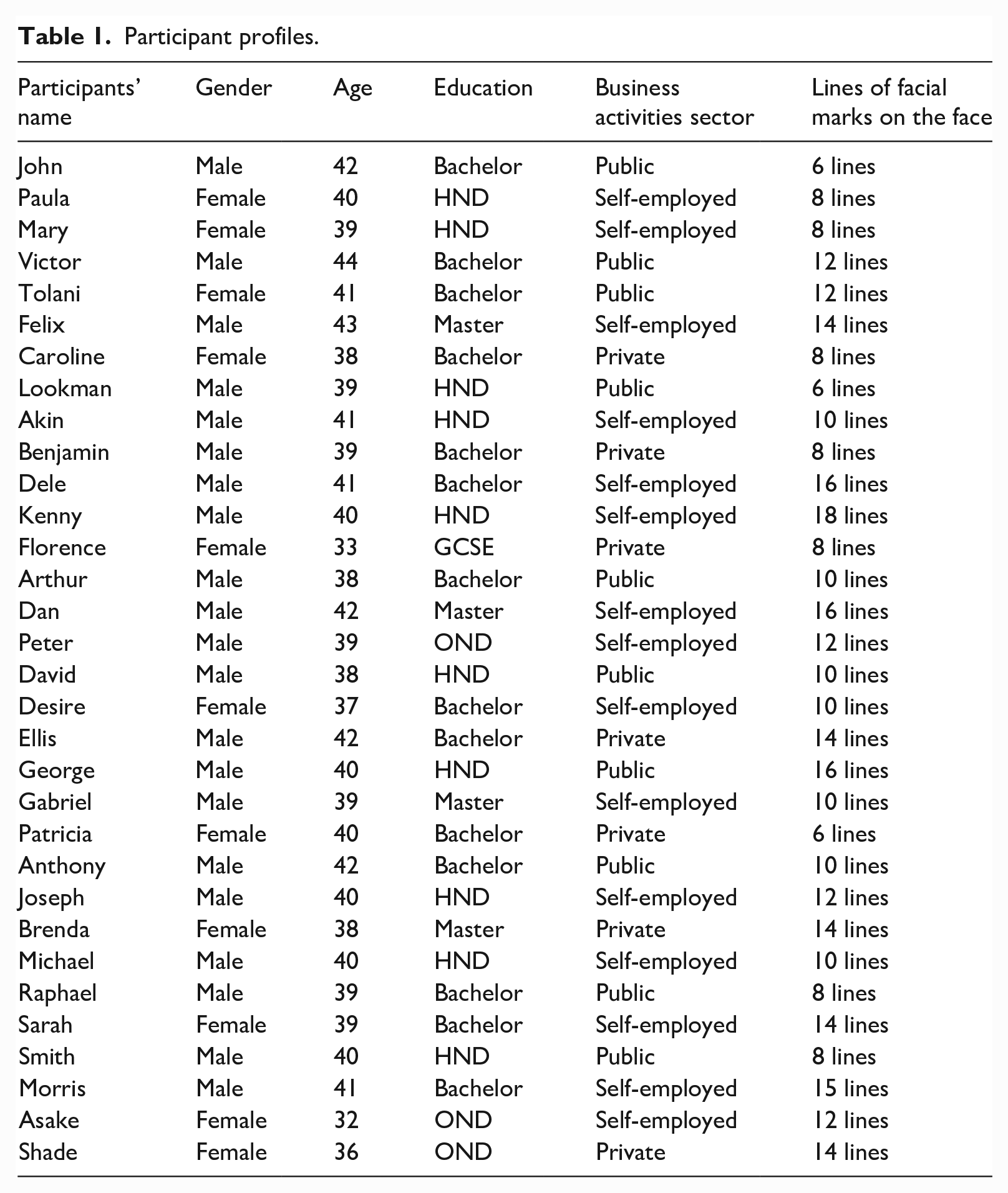
The demographic profile of the participants is presented in Table 1. There were 21 males and 11 females, and the participants’ ages ranged from 32 to 44 years old. Participants were from different sectors and occupations and had varied levels of education and numbers of tribal marks on their faces (see further demographic details in Table 1).
Participant profiles.
The interview questions were pre-defined, but open-ended; they were not strictly adhered to in order to accommodate and allow new questions and themes to emerge during the conversations (Myers, 2009). Our interviews were structured along two axes: (1) the participant’s profile and (2) descriptions of individual employment experiences as life stories. Participants were assured of confidentiality and a non-disclosure agreement was signed to protect their identities. Interviews typically lasted from 60 to 90 minutes and were recorded and then transcribed. The interviews all took place at times and places chosen by the participants for their convenience.
Table 2 summarizes the major steps in our thematic analysis. Thematic analyses typically involve the encoding of qualitative information using explicit data codes (Boyatzis, 1998). Themes and patterns are identified within the data. These can be directly observable or categorizing issues underlying the phenomena or processes under investigation. We used a data-driven approach and developed themes and codes using the inductive method. We prepared a list of inclusion and exclusion criteria for each label and identified typical and atypical examples, as described by Bernard and Ryan (2010). To bolster the internal consistency of the data, the researchers independently coded the transcripts and, where an agreement could not be reached between them, a theme was dropped from the analysis or reconstructed until full agreement was arrived at between them (Boyatzis, 1998). The two primary codes from which we worked include: ‘tribal marks experience’ and ‘employment challenges of having tribal marks’. Four sub-codes emerged, as described in the Results section.
Level of interpretive data analysis.
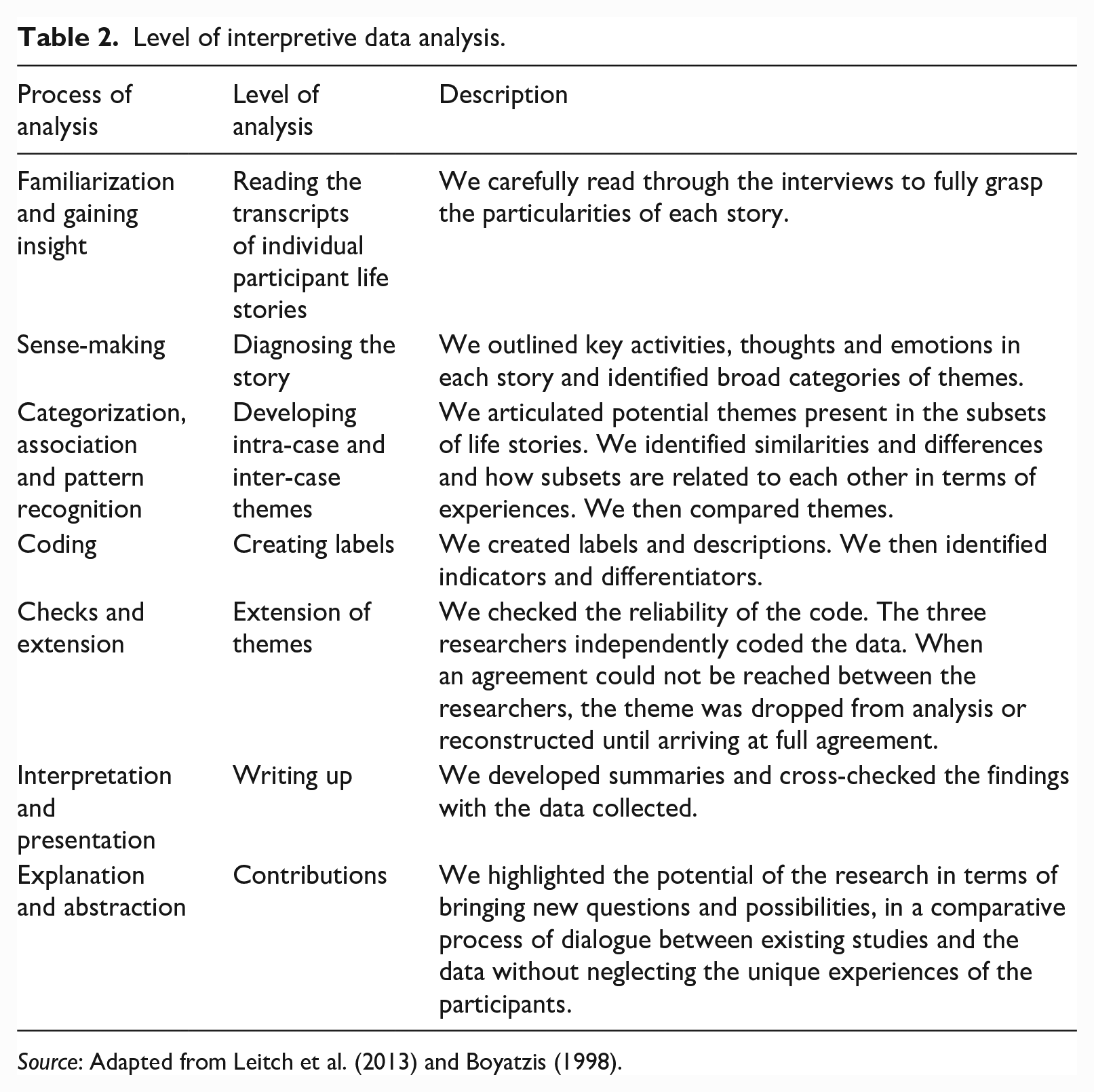
Source: Adapted from Leitch et al. (2013) and Boyatzis (1998).
We now report the results from our analyses.
Results
This section presents the findings of our research across the four themes that emerged from the data: (a) general abuse, insinuations and contempt from the public; (b) exclusion from the labour market; (c) discrimination in the workplace; and (d) self-hatred, mental illness and suicidal ideation. Each theme represents a distinct set of experiences of the participants from an indigenous standpoint and provides insights into the Euro-centric stigma associated with their tribal markings.
General abuse, insinuations and contempt from the public
From an indigenous standpoint (Foley, 2006), facial markings were traditionally seen as a form of beautification and cultural identification in Nigeria, particularly among the Yoruba people (Alo, 2018), but in contemporary Nigerian society, they are increasingly stigmatized. The participants regularly commented on the abuse, insinuations and contempt that their facial marks have brought them from the general public:
I think tribal marks represent archaic tradition and people don’t like it. I often receive all sorts of contemptible remarks and insinuations from people. For example, last week I went to buy toiletries and I mistakenly gave the shop attendant a little less money than I should . . . She rudely shouted at me: ‘Hey Okola, I don’t have marks like you . . . I’m not a fool . . . your money is not complete.’ She was insinuating that people with tribal marks are fools. It’s really saddening. I get a lot of that from the public. I wish I never had tribal marks. (Desire, aged 37)
Okola is a term used in Nigeria, often derogatorily, to refer to someone with tribal facial marks. Ellis further elaborated on the bullying that comes with being an Okola:
I have actually been dealing with insult and bullying from my primary and high school days (both from teachers and students) as a result of my tribal marks . . . Many of them will abusively refer to me as Okola, especially when I made mistakes. It affected my confidence and performance a lot. My manager always called me Okola and would pass many insulting comments at my facial marks. I could not complain or stop him because I didn’t want to lose my job. (Ellis, aged 42)
This classification of the Okola establishes an in-group/out-group dynamic that stigmatizes people with facial marks, inverting what was once, from an indigenous standpoint (Foley, 2003), beauty into Eurocentric derision and scorn. This is especially true in urban areas. The participants indicated that people with tribal marks may find life a little ‘friendlier’ in villages where such marks are more common. Sharing his experiences of life in both the village and the city, one participant recounted how he was compared to a demon:
I came to Lagos in search of greener pastures, but my tribal marks appear to be a blockade. Yes, occasionally, some people mock my tribal marks in the village, but the mockery I get in the city is enormous. I felt psychologically abused and sickened when someone referred to me as a demon on a bus. I wish I can clean them off my face. (Morris, aged 41)
Consistent with widespread belief in witchcraft in Nigeria’s Yoruba region (Bachmann, 2021), several supernatural references to ‘demons’ and ‘wickedness’ were made throughout the interviews, pointing to an interesting spiritual dimension to tribal marks. The bearers of such marks may have felt themselves cursed by the stigma imposed by Western values.
Many of the participants spoke of tribal marks as a dying and outdated feature of Nigerian culture, presenting yet more evidence of the marginalization of the indigenous standpoint. One participant commented on how he feels different among his peers and how the tribal marks sometimes make him feel uneasy:
It may be a thing of pride in the past but not anymore . . . Not in the contemporary Western-copied Nigerian society. I look odd among my friends because I’m the only one with facial marks. It always make me feel embarrassed and uneasy. Sometimes ago, a woman with a little girl of about seven years old sat beside me in a bus. After a long gaze at my facial marks, the little girl whispered something in her mother’s ear and she busted into laughter. Afterwards, she (the mother) said, ‘My daughter said your face look like a character in her book’, and everybody in the bus busted into laughter. (Dele, aged 41)
In sum, the public attitude towards such marks is one of repulsion, especially among youths and young adults and in urban areas. Bearers of such marks receive frequent insults from the public. The majority wish they had never been tribally marked.
Exclusion from the labour market
The Nigerian labour market is treacherous terrain for the country’s native peoples. Representing a small portion of the country’s population, almost half of the participants with whom we spoke said that their facial marks play a prominent role in their inability to achieve success in the labour market:
My tribal marks have always been the reasons for my rejection at job interviews, so I stopped after several rejections and started my own little business. (Paula, aged 40)
The exclusion from the labour market of people with visible tribal marks is the key reason why nearly half of the participants are self-employed. Mary recounted her experiences with exclusion:
In 2014, I was shortlisted for an interview with one big fast-food company . . . The manager called me to her office and said: ‘I am afraid you will not be progressing to the next stage . . . I am sorry I have to tell you this. The position is a customer service supervisor, which means you will often have contact with our customers. They may find your tribal marks unappealing and we don’t want to lose customers. I will get in touch with you if a backroom position becomes available. I’m sorry.’ I was really down and devastated. A similar thing happened when I was shortlisted for a position of a marketing officer at a bank . . . For me, the tribal marks are marks of rejection. (Mary, aged 39)
Although tribal marks appear to be more palatable for back-of-house roles than for customer-facing ones (Timming, 2015), the key insight here is that facial markings largely determine the success (or failure) of jobseekers in a largely service-based Nigerian economy inasmuch as employers dictate the policies surrounding appropriate appearance at work and, moreover, institutional regulations of these policies are feeble, if wholly non-existent.
The unemployed or self-employed in our sample attributed their inability to secure jobs mainly due to their facial marks. Other factors, such as the high unemployment rate and the state of the country’s economy, may have also played a part, but what is clear from the data is that the participants became self-employed after a number of unsuccessful job interviews: ‘After several failed attempts to secure a job, especially with a bank because I studied banking and finance, I had to raise money to start my own business’ (Michael, aged 40). Joseph further explained how he was rejected at job interviews because of the marks on his face:
I attended nine unsuccessful interviews. The reasons have always been my tribal marks. I became depressed after the seventh one because the previous rejections have destroyed my confidence. I became depressed . . . and my parents had to source for money for me to start my business. (Joseph, aged 40)
In sum, tribal marks appear to dramatically reduce a bearer’s employability. In a country with a weak social safety net, this has led a large number of our participants into self-employment. Labour market biases and employer prejudices against tribal marks thus pose significant barriers to employment and strongly confirm the marginalization of the indigenous standpoint (Foley, 2003) at work. The participants’ determination and effort to secure jobs are frustrated by a generalized antagonism towards tribal marks. While exclusion from the labour market was commonplace, those fortunate enough to gain employment faced significant discrimination, as discussed in the following section.
Discrimination in the workplace
The tribally marked employed were not treated equally vis-a-vis those with no facial marks. This inequality is likely linked to employers’ desire to project a certain company image and to make and keep customers happy (Chien-Hsiung, 2011), as well as by managers’ own attitudes towards facial marks. Brenda elaborated on this point:
We have 23 people working here and two of us have facial marks, with mine being the most visible with many lines. The manager dislikes my tribal marks. He once told me that I was lucky to have been employed in the first place because I was employed when he was on annual leave. I have never been selected to represent the company even though others frequently do it. We had a conversation about it, and he said: ‘I don’t have any problem sending you to represent the company like others, but our clients may not like your tribal marks . . . They are many and too visible.’ Perhaps that is the reason why I have not been promoted, too. I can’t even talk to him about promotion. (Brenda, aged 38)
Such dispositional discrimination appears to be driven by her manager’s attitude to facial marks, as well as by his views of how society at large, and his customers in particular, reject the indigenous standpoint via a stigmatization of tribal marks.
Caroline, with a similar experience to Brenda’s, also elaborated on how her facial marks have always been used against her in her efforts to seek promotion at work:
The position of a marketing manager became vacant and two of us applied for it. I knew I will not get it because the managing director is not a fan of my facial marks – he always complained about them. This is the second time this is happening. He later told me that the marketing manager role involves meetings with clients who may not like my facial marks, and that he doesn’t like it either. (Caroline, aged 38)
Again, there appears to be a regular attempt on the part of managers to ‘protect’ clients and customers from exposure to tribal markings based on the company image they want to project (Nandan, 2005).
Gabriel, a lawyer, further elaborated on workplace discrimination confronting people with facial markings in contemporary Nigerian society:
I worked in a law firm after graduation. My facial marks would be reason that I was not assigned to lead cases. The principal officer would say I was not clients’ choice. I left and joined another law firm but the situation remained the same. Then I co-founded this law firm with a friend. But again, most of our clients prefer him to me because he has no facial marks. Many of the clients would demand to see the lawyer with no facial marks . . . Yet I supervised and won the majority of the cases that we handled. In modern Nigerian society, tribal marks, especially on the faces of young adults, are passport to abuses. (Gabriel, aged 39)
In sum, facial marks are significantly associated with employment discrimination in Nigeria. The bearers patiently endure contempt from the general public as well as from employers. The extent of discrimination in the workplace depends ultimately on the attitude of the managers and their imputations of customers’ and clients’ views towards facial marks. The narrative evidence uncovered here suggests that the majority of employed participants have suffered from some degree of discrimination as a result of their stigmatized visage.
Self-hatred, mental distress and suicidal ideation
Although the emphasis of the present study was, at the outset, squarely on the effects of visible tribal marks on employment chances, one theme emerged organically outside the parameters of the initial research question, and it emerged so strongly that it cannot be ignored. The analysis of the data uncovered a shocking association between tribal marks and mental illness. These manifested in highly distressed states of mind of stigmatized people with tribal marks. Salient emotions included: self-hatred, mental distress and even suicidal ideation. Some participants expressed a fierce self-hatred for the person(s) responsible for the decision to etch tribal marks onto their face. One participant commented:
I hate my tribal marks with a passion. It has brought so much disgrace to me . . . It crushed my confidence since I was young. I hate my grandma for ruining my face. If I could hurt her, I would. Tribal marks are evil and sinister. Unless you have one, you have no idea what it feels like to look in the mirror and hate yourself. (Kenny, aged 40)
Relatedly, another participant recounted how she hated her father because of her facial marks:
My father saw my diary where I wrote how much I hate myself because of my tribal marks and I hate him too. He tried to pacify me but that didn’t change my feelings toward him because these marks will be on my face for life. (Asake, aged 32)
The hatred among some participants became particularly intense, sometimes leading to suicidal ideation. For example, Asake explained: ‘I did not attempt to kill myself because of my tribal marks, but I have contemplated it over a few times . . . Mercifully, some friends helped me through.’ Brenda shared a similar story:
It’s really terrible experience. I have endured bullies and abuses for all my schooling days. In fact, I deliberately failed my GCSE because I don’t want to go to university . . . I can’t stand the bully anymore and I can’t stand being different among others – I would just kill myself . . . There are times that I have actually contemplated committing suicide. (Brenda, aged 38)
Tolani similarly contemplated suicide more than twice due to rejection. She explained:
I am being rejected and people always look scornfully at me. I just felt I should end the whole thing . . . It has happened twice now . . . after a barrage of [being] rejected at job interviews and when my boyfriend left me . . . I think I have gotten over that feeling. I now have a job. (Tolani, aged 41)
Another participant reported how he attempted suicide due to the unbearable level of social rejection, abuse, stigmatization and discrimination. Peter explained:
I have always been a subject of mockery since my childhood due to my tribal marks . . . I actually tried to kill myself at some point to end the mockery and rejection . . . My parents rescued me. (Peter, aged 39)
In sum, these findings demonstrate participants’ personal struggles to deal with the effects of their tribal marks. The narrative evidence suggests that tribal marks in contemporary Nigerian society devalue the indigenized bearers in the eyes of their families, employers, potential customers and the general public, causing significant personal self-devaluation and psychological distress.
Discussion
The present study was motivated by the following research question: to what extent have the cultural forces of colonization stigmatized tribal markings, displaced the indigenous standpoint and thereby harmed the employment prospects of Nigeria’s indigenous peoples? In light of the results of the study, we can now answer this question. Prior to the European colonization of Nigeria, tribal marks were thought to signal honour, prestige, identity and beauty – notwithstanding the fact that aboriginality is itself heterogeneous. The advent of the slave trade began to dilute these positive connotations. Fast forward to the present day and tribal marks are now indicators of self-loathing, stigmatization and overt discrimination. The hegemonic spread of Western-centric values, norms and behaviours (Fanon, 2021) has significantly displaced the indigenous standpoint, inverting what was once largely seen as a symbol of pride and positive identity into a source of detriment, shame and rejection. This ‘trait inversion stigmatization’ goes beyond previous theorizing of stigma (e.g. Link and Phelan, 2001) inasmuch as it shows that the dominant colonial culture leveraged its power not only to impose its own framework of normality, but also to ‘erase and replace’ the indigenous standpoint. Moreover, the ‘enforcers’ of this new normality are not just colonial actors, but also indigenous Nigerians who have internalized colonial norms. The effect of this stigmatization of tribal marks on the labour market chances of indigenous Nigerians has been especially damaging. Members of Nigeria’s Yoruba tribe bearing the stigma of tribal marks struggle to find and maintain gainful employment in the labour market.
Our results corroborate longstanding research pointing to discrimination against the indigenous peoples of Africa (Woodburn, 1997) and across the world (Foley, 2003). To the extent that culture can be viewed as a ‘software’ that programs the mind (Hofstede et al., 2005), what we have uncovered in the course of our research is a case of Western, and particularly British, values, norms and mores that have largely reprogrammed a mass population, altering its historical definitions of beauty, attractiveness and social status, and turning it against itself. The displacement of indigenous standards of beauty should not be viewed as a derivative of ‘progress’ or the erasure of primitive ‘backwardness’. In other words, the stigmatization of tribal marks is not a symptom of economic modernization. After all, body art, as a form of skin mutilation, is increasingly accepted and embraced in Western market economies (Timming, 2017), including visible tattoos. The core process of the stigmatization at play is, we argue, cultural. This finding is consistent with other researchers’ work on cultural imperialism (Gramsci, 2000), which points to the reproduction of colonial standards and norms in developing countries.
Our research makes two key contributions to the literature. First and foremost, it contributes to research on indigenous standpoint theory (Foley, 2003, 2006). Whereas most of the extant studies employing this framework focus on direct discrimination against ‘blackfellas’ on the part of ‘whitefellas’ (Cowlishaw, 2004; Nakata, 2007; Rossi et al., 2013), our study brings a unique dimension to the table: the internalization of ‘whitefella’ thinking on the part of ‘blackfellas’. This terminology offers an innovative framework for thinking about not only the differences between the two ways of thinking, but also the way in which the former has infiltrated and shaped the latter. We found that non-indigenous black individuals in Nigeria have internalized the cultural imperialism of the colonizers, hence the term ‘blackfellas-who-have-internalized-whitefella-thinking’, as described above. Our research thus reinforces existing arguments about the ideological hegemony of ‘Empire’ (Hardt and Negri, 2000) and its spread across the developing world. The tribal mark, once thought to be a proud symbol of indigenous inclusion and belonging, is now perceived, from a dominant ‘whitefella’ perspective, as more repulsive than a facial tattoo (Timming, 2015), thanks to the ‘civilizing mission’ of colonialism in Africa (Conklin, 2011).
The second literature to which our research makes a theoretical contribution surrounds the sociology of stigma. The prevailing theoretical treatments of stigma (e.g. Goffman, 2009) only implicitly include power differentials into the equation. Link and Phelan (2001, 2014) are among the first researchers to explicitly recognize that normality (and deviations from it) are a function of power and that, as power changes hands, so, too, do the definitions of ‘normal’ and ‘stigmatized’. But power does much more than impose its own definitions of normality; it systematically seeks to eradicate and dismantle prior norms, thus resulting in what we have called ‘trait inversion stigmatization’, a process by which the tribal mark has been redefined as a mark of shame, rather than a symbol of pride. Social stigma is thus a sociological phenomenon (Tyler and Slater, 2018) in which dominant colonial culture-frames coerce conformity to the central narrative and simultaneously ‘erase and replace’ the marginalized ‘other’. When dominant and subordinate cultures overlap geographically – as is the case of the Yoruba in modern Nigeria – the former displaces the latter, imposing its own definitions of what it means to be normal and a set of ‘common cognitions’ (Timming, 2010) that undercut the indigenous culture-frames. Participation in the dominant culture, including in the modern labour market, thus becomes conditional on dominant norm conformity. Accordingly, the Yoruba tribal mark inhibits one’s livelihood, and thus survival.
Despite the important academic contributions of the present study, it still has some limitations, many of which lend themselves to directions for future research. We only collected data from individuals with tribal marks. Future research would benefit from in-depth interviews with employers and perhaps even consumers to incorporate their points of view. Moreover, our results are idiosyncratic to the Nigerian labour market; because results may vary across different parts of Africa, similar studies to ours should be carried out on the experiences of other indigenous populations. It may also be fruitful to collect quantitative data on employment outcomes among individuals with tribal marks to get a sense of the scale and generalizability of the problem identified here.
From a conceptual point of view, there is any number of interesting avenues of research stemming from our study. One track would be to further explore some themes that emerged during our fieldwork. For example, many of our respondents leveraged highly spiritualized terminology in describing their tribal marks, referencing those who ‘marked’ them as ‘demons’ and highlighting the ‘wickedness’ associated with the act. Such utterances point to the need for an anthropological approach to the study of tribal marks, with an emphasis on the religious undertones of having a ‘cursed’ visage.
Another potentially fruitful approach would be to employ an alternative conceptual framework beyond indigenous standpoint theory and stigma theory. One option would be to examine the implications of the concept of aesthetic labour, a framework that investigates managerial preferences for front-line staff who appeal to customers’ visual and aural senses (Karlsson, 2012; Warhurst and Nickson, 2007a, 2007b; Warhurst et al., 2000; Williams and Connell, 2010). Although aesthetic labour researchers have examined the primacy of Western values and norms in the developing world (e.g. Nath, 2011), it is an overwhelmingly Western-centric (and especially European) body of literature that could benefit from applications in places like Africa. Employing this approach would enable data collection from managers and consumers so that the ‘trait inversion stigmatization’ reported here can be verified and corroborated by other actors beyond the stigmatized.
Finally, future research might seek to link the extant literature on tattoos in the workplace (Baumann et al., 2016; French et al., 2019; Swanger, 2006; Timming, 2017; Timming et al., 2017) with tribal marks. Within this body of literature, only Adisa et al. (2021) have examined tattoos in an African context, thus pointing to a significant opportunity to expand the research into this under-investigated context.
Conclusion
In pre-colonial times, the indigenous peoples of what is now known as Nigeria used tribal marks to signal group identity, belonging, honour, prestige, status and beauty. The colonization of Nigeria and introduction of the slave trade resulted in a cultural transformation and displacement, wherein the ‘meaning’ of tribal marks evolved from exalted to discredited. A process of trait inversion stigmatization drove these changes behind the engine of British Empire and its cultural hegemony. Today, members of the indigenous Yoruba tribe, many of whom still bear tribal marks on their faces, encounter significant prejudice and overt discrimination in the Nigerian labour market. They continue to struggle emotionally, psychologically and economically. While the ultimate source of this discrimination may be colonial forces, black Nigerians who have internalized British standards of beauty and attractiveness enact these imperial norms. The present study adds yet more evidence to the long-standing displacement of the indigenous standpoint.
Footnotes
Acknowledgements
We want to thank Joana Vassilopoulou, Clare Butler, Mark Jones, Kevin Moore, and the anonymous reviewers for helpful comments in the development of this manuscript. We also want to thank the participants for their time.
Funding
The authors received no financial support for the research, authorship, and/or publication of this article.
