




Abstract
There has been a steady rise in platform-based care work around the world where private care -workers and care-seekers are matched by digital intermediary platforms for ‘care work gigs’. Care platforms position themselves as distinct from the typical transactional work arrangements in the gig economy, yet employ similar algorithmic features and functions to organise care work. Employing ethics-of-care as an interpretive lens, this article illustrates how care platforms use the relational frames of connection, community and concern to construct platform-based care work as mutually beneficial, but private, arrangements between care-workers and care-seekers. We argue, this relational framing on the one hand empowers users to exercise autonomy and control in organising care work, yet on the other hand highlights frictions that operate to limit the responsibility of care platforms, create information asymmetries and power differentials that exacerbate interdependence between care-workers and care-seekers and can create vulnerabilities for workers.
Introduction
The International Labour Organization (ILO, 2021) reports that there are over 770 digital intermediary platforms in operation globally, with up to 22% of the world’s adult population estimated to have participated in some form of platform-based work. As the gig economy has expanded across industry contexts, there has also been a steady rise in the uptake of Uberised, on-demand or platform-based care work, where private care-workers and care-seekers are matched by digital intermediary platforms to undertake in-person care work or ‘gigs’ (De Vita and Ciarini, 2025; Ticona, 2022; Ticona and Mateescu, 2018; Trojansky, 2020). Care work in the private home has a notorious legacy of indecent work conditions and exploitation of workers (MacLeavy, 2021). Therefore, the shift towards digital intermediary platforms for care services has been met with scepticism and caution from researchers, predicting increased risk and vulnerability for care-workers due to a lack of platform governance (Ticona, 2022; van Doorn, 2017). Critically, platform-specific features such as algorithmic management, control mechanisms, and arbitrary decision-making are argued to create asymmetrical reciprocities with users and foster precarious work arrangements (Mantilla-León et al., 2024; McDonald et al., 2021, 2023; Shapiro et al., 2024). The intimate, affective and relationship-based nature of private care work also creates the potential for further exploitation (MacLeavy, 2021). Platform-based or ‘on-demand’ care work can therefore be argued to compound precarity and individualised risk for care-workers (Macdonald, 2021; Pulignano et al., 2023). Flanagan (2019) cautioned that care platforms will operate as instruments to intensify worker vulnerability and simultaneously corrode the quality of care, positing that gig economy models are at odds with underlying principles of care work such as compassion, concern and connection.
In response to emerging critique, some intermediary care platforms have been vocal on media forums in an attempt to disassociate from the ‘Uberised business model’ (Trojansky, 2020), emphasising that platform-based care work is relational and connection based, and therefore distinct from gig work in sectors such as ride-hailing or food delivery (Skatssoon, 2020). In these sectors gig work has been positioned as purely transactional, managed algorithmically, and therefore creates avenues for worker exploitation (Wood et al., 2021). While care work is perceived to be more relational and consequently expected to be more long-term than other forms of gig work (Liang, 2018; MacLeavy, 2021; Molitor, 2025), there is limited empirical evidence demonstrating how care platforms distinguish themselves by emphasising relationality to establish expectations about platform-based care work and the subsequent relationships created between the various actors in work arrangements. This study addresses this gap by exploring the research questions: how do care platforms frame platform-based care work on their websites and what are the implications of the framing for workers-clients organising work arrangements via platforms?
As structurally central components of the gig economy, platforms mediate interactions and social dynamics between workers and clients (Ticona, 2022; van Doorn, 2017). Platforms hold structural power and can leverage frictions, dependencies and market imbalances to dominate users and solidify platform hegemony by controlling information (Graef and Bostoen, 2025; Shapiro et al., 2024). An emergent stream of literature highlights how care platforms specifically exercise normative control through marketised business models (Rodríguez-Modroño, 2024; Strüver, 2024), along with service terms and conditions (T&Cs), algorithmic features and policies (Hopwood et al., 2024; Mantilla-León et al., 2024; McDonald et al., 2021). Studies also show that care platforms promote a curated narrative about platform responsibilities (or lack thereof) towards users through information available in their public facing content such as websites (Dingelstad et al., 2025; Ticona, 2022; Ustek Spilda et al., 2025). Crucially, platform websites are the first point of contact for both clients seeking carers, and carers looking for work (collectively referred to as ‘users’ by the platform). Although there have been studies recognising the impact of platform power on shaping public opinion and relationships between users (see for example Blyth et al., 2024; McDonald et al., 2021; Ticona, 2022), there has been no attempt so far to systematically examine how care platforms construct and represent the social dimensions and expected social interactions to potential users through publicly available content on their websites. We employ ethics-of-care (Held, 2006; Sevenhuijsen, 2004; Tronto, 1993) in this study as a theoretical lens to examine framing and curation of information by care platforms. While emerging research recognises the role of care platforms as critical in shaping marketplace relations in the gig economy, specifically in how they leverage business models, platform operating features and availability of information (see Graef and Bostoen, 2025; Hopwood et al., 2024; Ustek Spilda et al., 2025), our study extends this line of inquiry further by illustrating how care platforms also employ socially encoded expectations about the relational nature of care work to shape carer-client relationships and work arrangements. This critical understanding of how relational elements underpin and impact care work arrangements in the gig economy is limited in extant literature. We draw on ethics-of-care (Held, 2006; Sevenhuijsen, 2004; Tronto, 1993) as a rich and appropriate interpretive lens to explain how care platforms privilege, curate and construct specific relational elements in framing platform-based care work to impact the social dynamics and relationships between platform ‘users’ (workers-clients) when organising work arrangements.
This article begins by elaborating on ethics-of-care as the theoretical lens, including its relevance to examining relationality in work arrangements in the gig economy. Next, we synthesise the literature examining relationality in the gig economy and introduce care work as the empirical context. We then outline the methodology and research context, and thereafter present the findings by illustrating how three interrelated but distinct relational frames are used by platforms to construct platform-based care work. Finally, we discuss how this analysis advances existing knowledge of the gig economy by examining the impact on obligations and responsibilities of the various actors in platform-based care work.
Theoretical underpinning
The concept of ethics-of-care offers a theoretical grounding to understand relationality in situ and within the context of this research. It is based on the notion that care is central to all human activity, economic arrangements, social interactions and relationship dynamics (Alacovska and Bissonnette, 2021; Tronto, 1993). Tomkins and Bristow (2023:16) view ethics-of-care as a set of principles and values underpinning decisions about what matters, and how people want to be treated and consequently relate to others. Sevenhuijsen (2003) frames relationality as a concept of care, reflecting a need for positive connections and a desire for responsiveness, collective wellbeing and relatedness, in any social context including experiences of organising and performing work. Held (2006) extends this concept further, positing that when interpreted through an ethics-of-care lens, relationality is understood as a form of care or recognition of the interests of others relative to one’s self interests and needs, including conflicts and frictions. In practice, care works as a frame to interpret relational tenets that are at play in social practices, interdependencies and interactions between multiple actors (Held, 2006; Sevenhuijsen, 2003). For example, mutual responsiveness, affectivities, trust, formation of bonds and mutual obligations between actors can result in positive relationality in work arrangements. This aligns with Tronto’s (1993) description of care as a lens to attribute meaning to perceptions of justice or fairness based on how actors view their rights and relationships with others. Similarly, conflicts, oppositional interests, frictions and power imbalances can be interpreted through relationality: specifically, how actors in a work arrangement feel they receive concern from others (care about); how they are able to exercise concern for others’ interests (care-for-others); and/ or how they are able to maintain self interests (care-for-self) (Held, 2006; Sevenhuijsen, 2004; Tronto, 1993). These frames of care are especially pertinent to understanding relationality in ‘gig work arrangements’, which by definition are characterised by multi-party interests and interdependent relationships (Posada, 2022).
Relationality (through frames of care) influences how actors in the gig economy respond to, interpret and experience dignity, respect or vulnerability relative to interactions with others (Held, 1995, 2006; Sevenhuijsen, 2003). For example, relationality is evident where individual workers promote mutual beneficence to create future work with the same clients (Held, 2006; Kalemba et al., 2024), negotiate favourable working conditions (Khan et al., 2023; Liang, 2018) or find motivation in gig work through a concern for the others’ wellbeing (Myhill et al., 2021; Nemkova et al., 2019). These experiences, understood through the frames of care-for-self and care-for-others can be interpreted as positive or negative relationality, depending on how individuals feel other actors in the arrangement care-about them in a given context (Tronto, 1993). Similarly, markers of relationality are evident in how individuals engage with communitarian values such as solidarity or collective wellbeing or care-for-others to influence positive experiences. For example, workers forge informal solidarity with others to resist and challenge unfair working conditions and power asymmetries to maintain self-interests in their individual working arrangements (Mendonça and Kougiannou, 2023). Platforms, through curation of information (Dingelstad et al., 2025; Ustek Spilda et al., 2025) and framing on their websites, set expectations and establish norms about the social interactions between users (workers-clients) in organising work arrangements. In care work, expectations of relational dimensions such as compassion, concern and empathy are more salient compared to other forms of work (Köhler et al., 2022; Molitor, 2025). Frames of care (care-about, care-for-self, care-for-others) illuminate how care platforms leverage relationality in constructing platform-based care work and, consequently, influence worker-client relations.
Relationality and work conditions in the gig economy
Platform-based work or gig work is assumed to encompass performance of services or tasks by a transactional, fragmented, disconnected and fungible workforce with no social ties or emotional connection to the clients they are matched with via the platform (Mendonça and Kougiannou, 2023; Wood et al., 2021). These depictions are typically reflective of ride-hailing or food delivery services and have become emblematic of the gig economy, with ‘Uberised’ or ‘Uber-like’ frequently used as a descriptor for ‘gig work’ in general (Trojansky, 2020). However, researchers have identified strong relational and social elements such as mutuality, affect, concern and network solidarity entrenched in platform-based work (Khan et al., 2023; Liang, 2018; Posada, 2022).
Relationships with platform clients have been recognised as influencing platform workers’ motivations to work (Myhill et al., 2021; Nemkova et al., 2019). Despite the organisation of work being heavily reliant on algorithmic management by platforms (Rème-Harnay, 2023), workers have to rely on relational skills and labour to elicit high ratings and testimonials and build relational capital to impact future work opportunities, particularly in work contexts requiring ongoing social interactions between workers and clients such as care work (Kalemba et al., 2024; McDonald et al., 2021). Emerging research suggests care platforms leverage this by employing operating models, policies and functionality to shape marketplace relations and absolve themselves of accountability (McDonald et al., 2021; Popiel and Vasudevan, 2024; Shapiro et al., 2024; Ustek Spilda et al., 2025). For instance, Ticona (2022) argues that care platforms deliberately emphasise a consumerised model of care that shifts the labour process from platforms to the relationships between workers, clients and other stakeholders in the work arrangements. This is pertinent in care work where, unlike other gig work, potential care-workers are selected by clients based on a range of relational aspects evident on their platform profiles and in interactions with care-seekers prior to the commencement of work (Kalemba et al., 2024; Khan et al., 2023). Care platforms strategically mobilise this shift in the labour process in how they promote and frame the social dynamics between care-workers and care-seekers.
Care work in the gig economy
Care work in this study refers to paid social reproduction work performed in the private household. This includes activities such as personal support, personal care and individualised services for children, disabled or elderly people provided in their private living space (Fairwork, 2022; ILO, 2018), that are inherently highly intimate, affective, relationship-based and gendered (Köhler et al., 2022). Historically, care work has been devalued and invisibilised in part through its informal organisation through short-term and casual arrangements that are privately negotiated (MacLeavy, 2021; Pulignano et al., 2023). Furthermore, assumptions that care work requires heightened levels of compassion, affect and empathy (Köhler et al., 2022) mean that care workers who are believed to be trusted are frequently thought to be best found via networks of kinship and acquaintances (Chun and Cranford, 2018; Easterbrook et al., 2021), which also results in de-professionalising care work as an occupation (Rodríguez-Modroño et al., 2023). In contrast, digital care platforms, offer access to complete ‘strangers’ as an alternate network of care workers (Ticona and Mateescu, 2018: 5).
The rise of platform-based care work disrupts the devaluation of in-home care work by creating opportunities for work and generating visibility, agency and autonomy for workers (McDonald et al., 2023; Ticona and Mateescu, 2018; Trojansky, 2020). However, care platforms as intermediaries employ marketised business models designed to limit responsibility towards workers or clients and contribute to the ongoing de-professionalisation of care work (McDonald et al., 2021; Rodríguez-Modroño, 2024; Rodríguez-Modroño et al., 2023; Ticona, 2022; van Doorn, 2017). The onus shifts to the workers to foster favourable care work conditions for themselves by negotiating with clients (McDonald et al., 2023; Nhleko and Tame, 2023; Pulignano et al., 2023). This establishes relationality as central to shaping work conditions. For instance, Khan et al., (2023) illustrate how care-workers draw on relational aspects such as affective ties and rapport in interactions with care-seekers to nurture mutually beneficial work arrangements. As intermediaries connecting workers with clients for care services, care platforms provide the vehicle for, and contribute to, how users engage with and interact with each other. Platforms actively shape relationality between users through their business models and fee structures (Baum, 2024; Hopwood et al., 2024; Rodríguez-Modroño, 2024; Strüver, 2024), algorithmic features and functionality such as matching and work allocation, service terms and conditions and platform policies (Mantilla-León et al., 2024; McDonald et al., 2021; Popiel and Vasudevan, 2024; Ticona, 2022). However, Ustek Spilda et al. (2025) argue that platform hegemony is attributed to what information they strategically make available or restrict for their users. In a similar vein, Dingelstad et al. (2025) discuss how digital platforms communicate information through content on websites to construct alternative work realities and set expectations for nurses. Graef and Bostoen (2025) argue that platforms wield influence over markets, individuals and societies and deliberately shape public and user opinions and choices. This study extends these arguments further by illuminating that it is not just what information platforms provide, but how they frame and curate it with the support of platform features. We examine how care platforms emphasise relationality to distinguish themselves from ‘Uber like’ platforms and set expectations for workers and clients that consequently shape the relationships and work arrangements.
Research methodology
This article is underpinned by a social constructionist paradigm, where meanings attributed to socially produced practices such as work are interpreted through discursive realities (such as language or socio-technical features) and co-produced by beliefs, values, norms and assumptions of actors within the context (Cunliffe, 2011; Sevenhuijsen, 2004). We explore how platform-based care work is socially constructed and framed by platforms for care-workers and clients (hereinafter referred to as ‘care-seekers’) through the visual and discursive content and information on platform websites. 1
Research context: Australian care sector
The research context for this study is the Australian care sector, one of the fasting growing in the economy (Jobs and Skills Australia, 2025). Participation in platform-base care work has almost doubled from 7% in 2019 to 11.9% in 2023 (Williams et al., 2024). Care platforms in Australia share similarities with platforms operating globally, with some even headquartered in Europe and North America. Commonalities encompass business models (tiered subscription or service fee) and structural features such as pre-screening, algorithmic matching, price setting and payment methods (see e.g. De Vita and Ciarini, 2025; Mantilla-León et al., 2024; Rodríguez-Modroño, 2024; Ustek Spilda et al., 2025). Critically, the curation of information and framing on platform websites is similar and examining Australian care platforms can offer insights into how care platforms socially construct care work in other contexts.
Sampling strategy
Purposeful sampling was used to identify digital intermediary platforms (hereinafter care platforms) matching care-workers with care-seekers operating in Australia at the time of data collection. Following Hurwitz et al. (2018) we relied on multiple sources to build our sample. First, prior research was used to identify prominent care platforms in Australia (Flanagan, 2019; Williams et al., 2021). Next, we conducted a scoping exercise using search engines like Google, Yahoo and Facebook, which identified 33 active care platforms. We applied our inclusion criteria to these results, retaining care platforms that (i) were intermediaries matching care-workers with care-seekers (excluding agencies employing casual staff); (ii) had an active website, and (iii) offered in-home care services like babysitting, nannying, personal care and personal support for elderly or disabled people. 2
The final sample comprised 14 care platforms operating in Australia (see Table 1). Most platforms offered free initial registration combined with tiered subscriptions (57%) (i.e. basic, premium) to access particular platform features, while others allowed free registration but charged a service fee to process payments.
Summary of data set.

Data analysis and interpretation
In line with prior studies examining content on digital platforms (Blyth et al., 2024; Hurwitz et al., 2018; Williams et al., 2021), we focused on data from high traffic user-facing sections of websites like the landing page and ‘how it works’ sections. The data comprised constitutive multimodal elements such as visual imagery, textual descriptions, iconography, language, colours, layout and design of websites. This included information on services, work arrangements and platform features such as access to jobs, mechanisms of interactions with other users, wage rates, methods of payment and entitlements available. Promotional content such as testimonials, reviews and exemplar profiles of care-workers and care-seekers was also collected. Following a systematic walkthrough method the websites were mapped section by section and screenshots of the multimodal content, images and videos were downloaded and saved offline for analysis.
An ethics-of-care driven three stage interpretive trace methodology (Sevenhuijsen, 2004) was adopted to analyse the framing for the social meaning conveyed through the interplay between the visual and discursive constitutive elements on the websites (Kress, 2010; Sevenhuijsen, 2004). First, in the tracing or identifying phase, we identified the intended meaning, assumptions and values being communicated through the visual and textual content and elements on the websites, for example how the text, visual imagery, colours, graphics, symbols and descriptions interacted to convey specific meanings and promote values about the platform, care work and interests of platform users. These encompass elements such as friendship, trust and loyalty in work relationships (Tronto, 1993) or autonomy, independence and choice in decision-making (Held, 2006). Next, in the evaluating or interpreting phase, we employed frames of care to determine how the values and meanings identified in tracing were used by the care platforms to construct narratives about care work, work arrangements and users on the platform. This phase also identified how the constitutive elements created frictions, conflicts and dialectical meanings. For example, relational tenets like mutual concern (care-for-self and care-for-others), respect and trust (care-for-others) were supported by and simultaneously in conflict with platform features such as ratings, reviews and paid access to safety verifications (care-for-self and care-about) (Held, 2006; Sevenhuijsen, 2003). Finally, in the concretising phase, we developed the dominant insights and interpretations into themes derived from ethics-of-care explicating how platforms draw on relational tenets to construct an overall meaning about the organisation of platform-based care work and social dynamics and relationships between workers-clients. This methodology enabled a rigorous and rich exploration of the social meanings emerging from the empirical data (Cunliffe, 2011; Dingelstad et al., 2025; Kress, 2010). Our findings demonstrate that care platforms promote platform-based care work through three interdependent, but distinct relational frames of care titled: connection, community and concern. Each frame reveals frictions within the framing, with implications for worker-client relations.
Findings
Detailed below, three interrelated relational frames are presented, illustrating how care platforms foreground relationality to socially construct platform-based care work. The frames, entitled connection: demonstrating mutuality and affect; community: emphasising solidarity and interrelatedness; and concern: showcasing attentiveness and sensitivity (Held, 2006; Tronto, 1993) are explained through the interplay of ‘care-for-self’, ‘care-for-others’, and ‘care-about’, as constitutive elements of relationality (Sevenhuijsen, 2003). The findings illustrate how care platforms strategically employ these frames to curate information and convey particular meanings to users about the relational nature of care work and set expectations about interactions with each other. The implications of this framing on worker-client relations are expanded on in the discussion section.
Relational frame: Connection
This frame constructs platform-based care work as an outcome of establishing authentic and ongoing connection based on mutual beneficence and care between the care-workers and care-seekers, namely, a balance between care-for-self and care-for-others. Although care platforms offer algorithmic ‘matching’ (McDonald et al., 2021; Williams et al., 2021) as a key feature of intermediation, they emphasise relationality and care by framing this feature as matching people with shared values and common interests and who are looking for mutually beneficial arrangements. This reflects that platform features are designed to care-about users and their interests. For example CarePlatform5 (Figure 1) illustrates how the multimodal elements in the frame apply multiple dimensions and meanings to the word ‘connect’ to include affective dimensions in the matching of people. Platform imagery depicts a warm, positive relationship between an idealised care-worker and care-recipient, suggesting that the match made is more than transactional and involves genuine bonding, a feature inherently associated with care work (Liang, 2018). Rather than ‘customers’ or ‘carers’, the word ‘people’ is used in the framing to make them more relatable and touch is illustrated in the imagery to emphasise human connection. Connection is not only represented as an emotional expression of attachment, but also includes embodied care depicted through close physical proximity encoded in touch and eye contact in the framing.
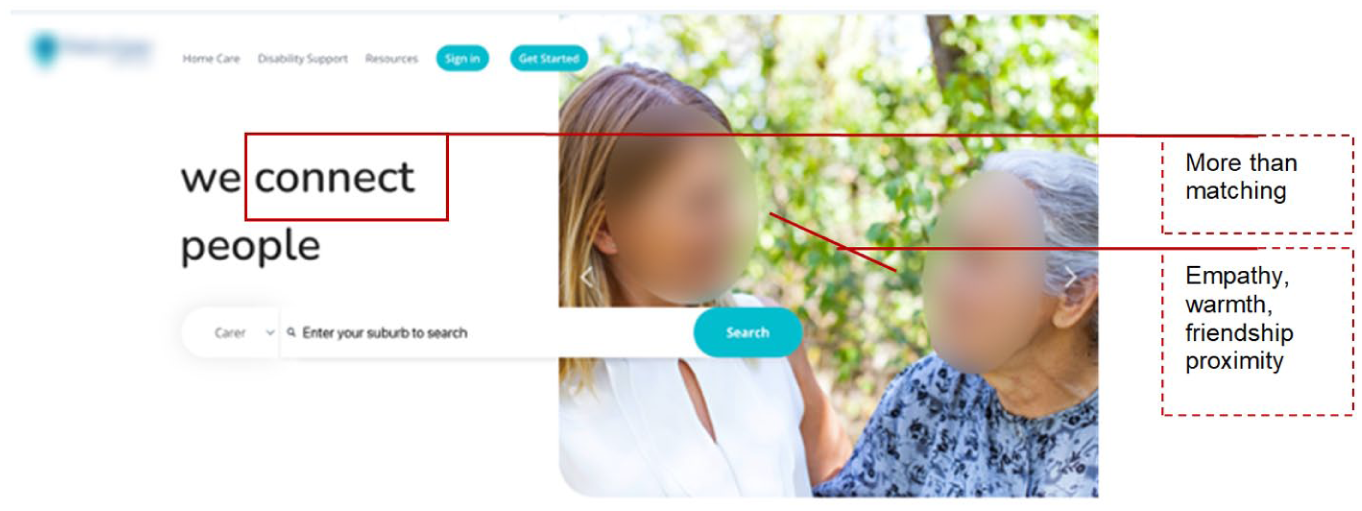
Creating connections, CarePlatform5.
Care platforms further construct a narrative of connection around a convergence of interests centred on a ‘person-person fit’ (Williams et al., 2021) or mutuality between users (Held, 2006), which also distances the platform from any direct involvement in the relationship between the care-worker and care-recipient. As CarePlatform6 illustrates, a ‘best fit’ supporting positive relationality is promoted using smiling emoticons and a line drawing of a babysitter, a child and a ‘heart’, symbol to enhance the meaning (Logi and Zappavigna, 2021). The phrasing suggests choice and autonomy for users; however the frame also highlights a friction suggesting that the responsibility to choose the ‘best babysitter’, and cultivate an authentic connection with the care-worker rests with the client (or mother as depicted in Figure 2).
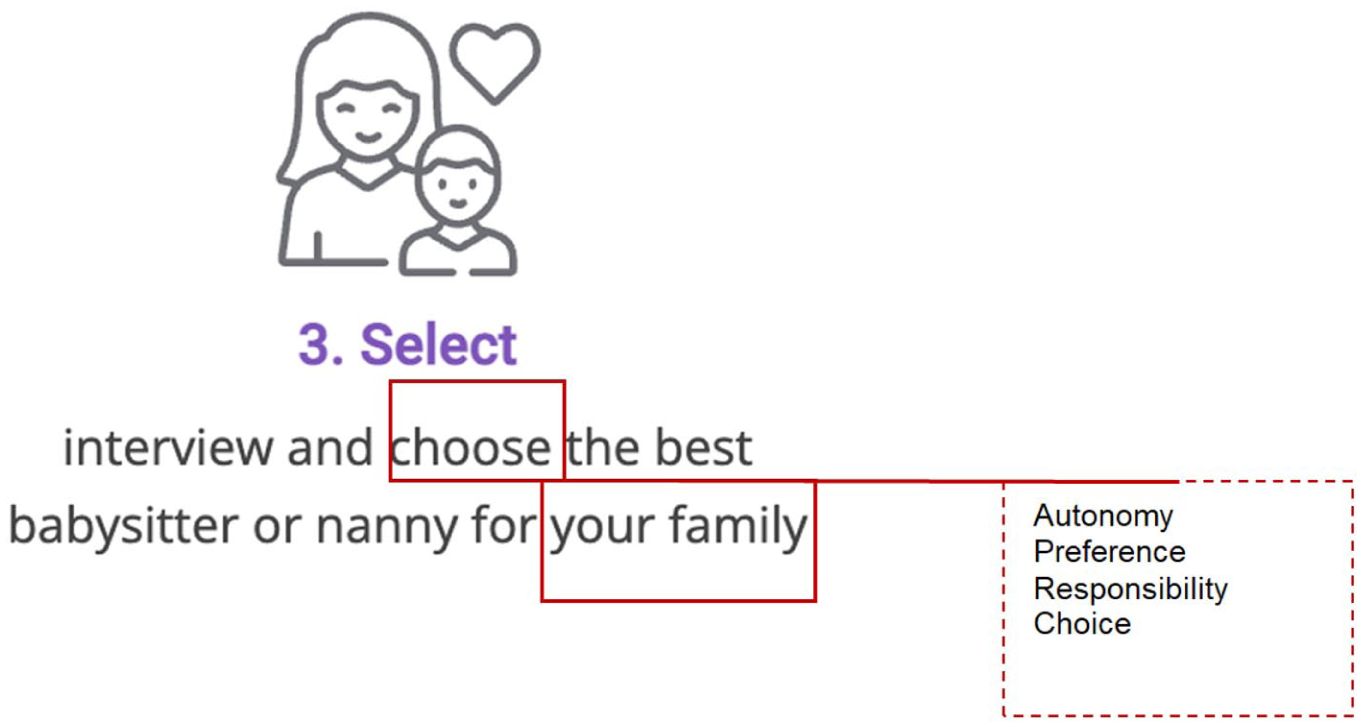
Autonomy and choice, CarePlatform6.
Platform features that facilitate strong, genuine connections were prominent in this frame. For example, the option to include a video introduction as part of a worker’s profile was featured as a way to pre-build rapport with care-seekers and gauge the ‘vibe’. Most care platforms in the sample used language such as ‘get to know’, and ‘right’, or ‘best fit’ to promote the relational dimensions of mutuality and affect required for ‘quality’ care work arrangements (Köhler et al., 2022; Sevenhuijsen, 2003). These terms preface building rapport, affective ties and bonds with each other to signal authentic connection (CarePlatform 3, 4, 6, 7, 8, 9, 12).
The framing was amplified by features allowing users to select their ‘favourite babysitter’, and ‘favourite carer. These terms emphasised choice as well as the possibility to work with the same users again. This promotion of ‘favourite’ or preferred workers suggested affective bonds and emotional ties had greater value in platform-based care work than typical gig work. At the same time, the framing highlighted a relational friction by extending connection to include favouritism, encouraging clients to choose one worker over the other. With repeat work on offer as an incentive, a competitive market for relational labour emerges, pitting individual care workers against each other, privileging care-for-self over care-for-others. This intensifies the burden on care-workers to meet relational demands associated with care work and creates a power imbalance in favour of clients. Platforms mobilised this frame to stimulate competition through gamified terminology such as ‘top helper’, ‘top scored carer’, or similar. CarePlatform8 (Figure 3), in exhortation for users to ‘know who the superstars are’, signals that ‘quality care work’ can be measured in ratings, reviews and number of jobs completed. Similarly, CarePlatform7 encouraged care-workers to ‘earn super helper status’. Care platforms strategically employ this frame where they care-about users to seemingly address the interests of both care-workers, who covet more work (Khan et al., 2023) as well as care-seekers, who want to hire trusted people to perform sensitive and intimate care work (Köhler et al., 2022). Yet the interests are often in conflict with each other and raise expectations of relational labour in these work arrangements.
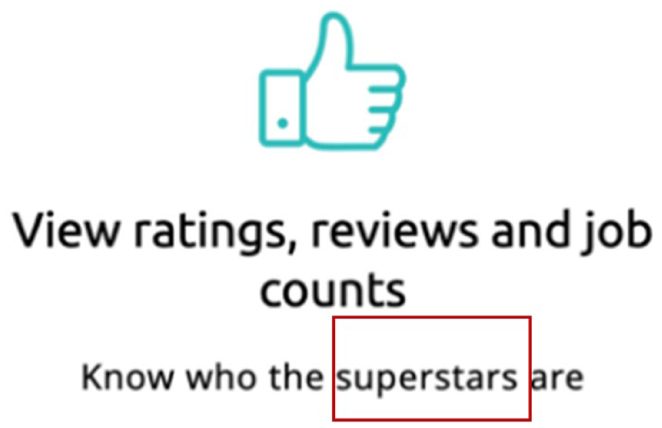
Individualised competition, CarePlatform8.
From an ethics-of-care perspective, the frame of connection highlights mutuality, interconnection and attachments between care-workers and care-seekers (Held, 2006; Tronto, 1993). Care platforms employ the frame to construct authentic relationships, rapport, affective ties, comfort and mutual beneficence as distinct characteristics of platform-based care work whereby users can maintain care-for-self and care-for-others. Care platforms suggest they also engage in a caring practise (care-about) towards users, by facilitating a way to meet their caring needs. Simultaneously, this framing includes frictions which have a contradictory and potentially adverse effect on individual users seeking to cultivate authentic connections. The care-seekers are given power to select and determine favourites or top care-workers over others, impacting future work opportunities which creates an imbalance of privileging self-interests over mutual beneficence (Held, 2006; Khan et al., 2023; Mantilla-León et al., 2024). This framing, reinforces the platform’s role as a facilitator of ‘connection’ between users, at the same time privileging individual choice by shifting the responsibility onto care-workers and care-seekers to organise and negotiate work arrangements between themselves.
Relational frame: Community
In contrast to individualised connections explored above, this frame privileges relatedness, solidarity and collective welfare in platform-based care work, a practice of care-for-others. Through this framing, care platforms signal that their care services are endorsed, utilised and provided by like-minded people within the users’ local community. The emphasis on terms like ‘local area’, ‘in your area’, ‘in your community’, and ‘near you’, (CarePlatforms 1, 2, 3, 6, 7, 8, 9, 10), suggests convenience and ease (evidence of care-about by the platform), yet the framing represents a deeper meaning about ‘community’. Care platforms construct ‘community’ as a collective of people with shared interests and values, and a solidaristic concern for the collective wellbeing and welfare of others similar to themselves: promoting a balance between care-for-self and care-for-others for individuals. This framing mobilises traditional assumptions about the importance of sourcing care work from familial networks, personal relationships and kinships (Chun and Cranford, 2018; Easterbrook et al., 2021). Some care platforms explicitly described all users as a ‘care community’, or called out to platform users to ‘join others’ to become part of a broader community. Through this framing, care platforms suggest that their users are embedded in a community network, albeit one where direct contact between members (between different care-workers or care-seekers) is not enabled.
Over 10000 growing care community [CarePlatform12] Join other satisfied parents [CarePlatform6] Join thousands of . . . [CarePlatform9]
This frame draws on community to construct trust and credibility. The majority of care platforms analysed claimed to be the ‘most trusted website’ in Australia for care work, demonstrating caring-about their users’ welfare in the platform design. However, the framing relied on an expectation of communal concern resulting in endorsements of particular ‘trusted’ platforms. Care platforms used the number of platform users as evidence of being widely trusted by community members. As Ticona and Mateescu (2018) explain, features like ratings, testimonials and reviews establish the trustworthiness of care-workers for care-seekers who are hiring strangers, claiming this feature is more pertinent in care work when compared to other forms of gig work such as on-demand driving. The following examples illustrate how the framing uses large number of users and jobs completed to convey legitimacy, credibility and trust in the platform. The term ‘local’ further signifies relational aspects such as comfort, familiarity and trust (Sevenhuijsen, 2003).
[Platform] is the leading on-demand platform for childcare and tutoring jobs in Australia and New Zealand. We’ve Based on our data, we estimate over a
Barba et al. (2025) reinforce that trust in in platform-based care work continues to rely on affectivities between workers and clients. Care platforms utilise reviews and rating mechanisms to reinforce the messaging of ‘trust’ based on relatedness and expectations of support from others in the ‘community’. For example, CarePlatform1 emphasises ‘trusted by people like you’, alongside a recommendation from a platform user positioned as a member of the community. This language intentionally constructs a narrative of relatedness to incorporate users into a trusted community of like-minded people with shared values, interests and concerns. Platforms place testimonials and reviews from care-workers and care-seekers side by side (Figure 4), selecting reviews with emotive language to emphasise all users on the platform are part of a community of people who can be trusted. This framing constructs solidarity between users (Sevenhuijsen, 2003).
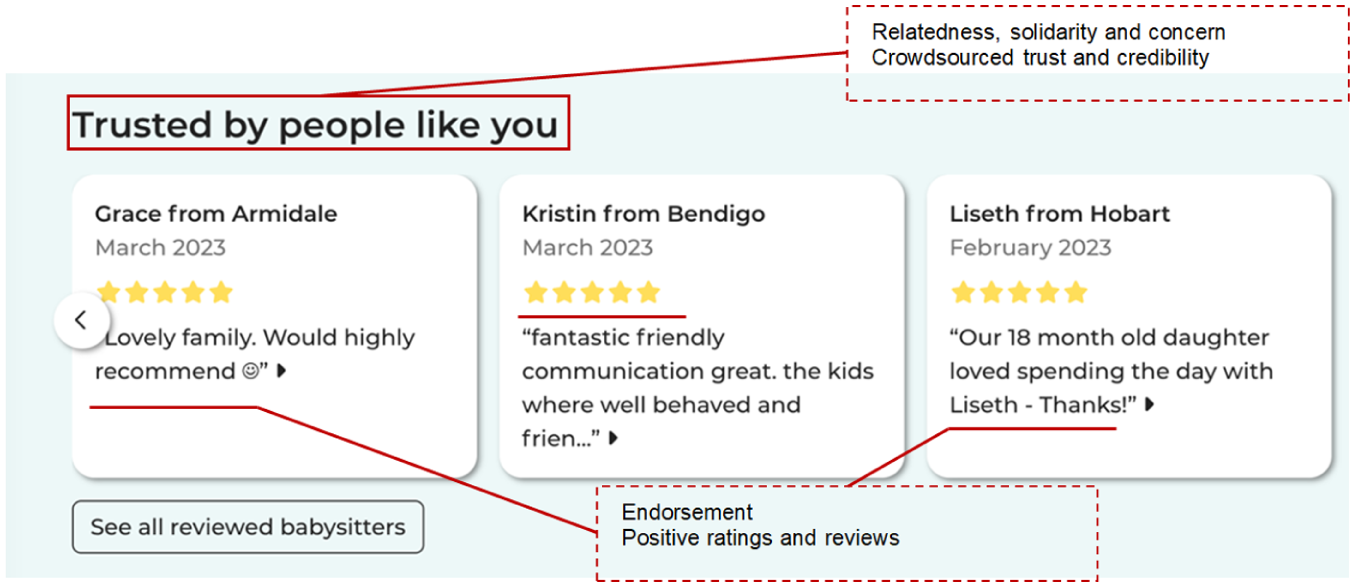
Constructing trust and crowdsourcing credibility, CarePlatform1.
While relying on relational dimensions such as community interdependencies and collective welfare as central frames, care platforms carefully distance themselves from any responsibility towards users, a friction within the practice of caring-about. For instance, CarePlatform1 uses the phrasing ‘you are in full control of who you choose to work with and how you interact with other members’ to emphasise choice but also to extract itself from the relationship between users. Similarly, CarePlatform13 emphasises offering ‘support’, and ‘guidance on technical issues’. The framing deliberately positions the care platform as a facilitator or a ‘marketplace’, (illustrated by CarePlatform5 below) to ensure it is not perceived as an employer. CarePlatform12 reinforces this distance by encouraging users to ‘get connected
[Platform] is an
From an ethics-of-care perspective, the frame of community represents relatedness, support and collective welfare among platform users (Held, 2006; Sevenhuijsen, 2003). In this framing, care platforms employ others’ opinions and endorsements to construct platform-enabled care work as a legitimate avenue to find and provide authentic and well-intentioned care. They promote care work as offered, performed, and serviced by trustworthy, reliable and relatable community members (Alacovska and Bissonnette, 2021; Sevenhuijsen, 2003). However, this framing enables care platforms to set user expectations and emphasise individual choice and empowerment, whilst simultaneously limiting platform responsibility (care-about) to govern care work arrangements or guarantee safety of platform users.
Relational frame: Concern
This frame constructs concern as a core feature of platform-based care work, in two ways. The first focuses on concern for others or caring-about from platforms, promoting a sensitivity to diverse individualised needs of all users (Sevenhuijsen, 2003) that can be met through work arrangements and multiple configurations of care activities organised via the platform. The second represents mutual concern and responsiveness (Held, 2006) between care-workers and care-seekers, a practice of care-for-others. Platform-based care work is constructed as a way for individual users to maintain self-interests while also being responsive and attentive to the wellbeing needs and interests of others, reinforcing expectations about the inherently relational nature of care work (Köhler et al., 2022; Molitor, 2025).
The framing portrays care platforms as sensitive to the individualised needs of their users offering support, assistance, and improved quality of life. As CarePlatform1 illustrates in its construction of care-seekers, for example, ‘hardworking parents’, . . . ‘who need time for themselve’, platforms position themselves as a solution for clients, demonstrating concern (caring-about) by recognising and responding to their users’ needs and motivations. The term ‘hardworking parents’, conveys sympathy for time poor parents (who can maintain care-for-self). The term ‘hardworking’ also expresses a moral judgement defining which parents are deserving of support, which operates to evoke empathy in care-workers. As noted above, platforms use the term ‘people’ and apply care-based relational terms like ‘support’ and ‘help’ to signify a concern for others and attentiveness to others’ needs. The phrasing constructs an empathetic narrative about the wellbeing of parents who ‘work’, yet the ‘people’, providing support are not portrayed as workers. Simultaneously, the private arrangement between parents and the people who ‘help’ them is reinforced. In this way, the select language use in the framing reinforces the elision of care services, especially childcare, as ‘real’ work (MacLeavy, 2021; Pulignano et al., 2023).
[Platform] is here
The frame mobilises socially entrenched assumptions about care work as grounded in emotional ties, and love and empathy for care-recipients (Liang, 2018). Deviating from the assumptions about care work as purely altruistic (Baines et al., 2022; Köhler et al., 2022), care platforms frame it as ‘rewarding’ and empowering for individuals. In this way, recognition of individual motivations and a concern for self-interests is communicated by platforms (Tronto, 1993). The framing generates an affective atmosphere and produces a heightened focus on mutual concern and positive relationality between care-workers, care-seekers, and care-recipients (Kalemba et al., 2024). The framing evokes compassion, empathy and concern for the diverse interests of all stakeholders on the platform, as illustrated by the info-graphic used by CarePlatform4 (Figure 5). The framing reinforces socially encoded expectations about care work reflecting ‘love’, also pointing to higher relational demands in this form of work (Liang, 2018; Molitor, 2025). At the same time, CarePlatform2 through phrasing like ‘kids being cared for’, ‘parents being empowered’ and ‘carers getting local work’ suggests all the parties in the work arrangement have their needs met. The framing suggests that users’ concern for self and concern for others both can be met by using the platform (Sevenhuijsen, 2004), mirroring findings from Baum (2024) that platform-based care work is viewed by workers and clients as a route to quality care meeting their individualised needs.
THE LOVE. This site is about kids being cared for, parents being empowered and carers getting local work [CarePlatform2]
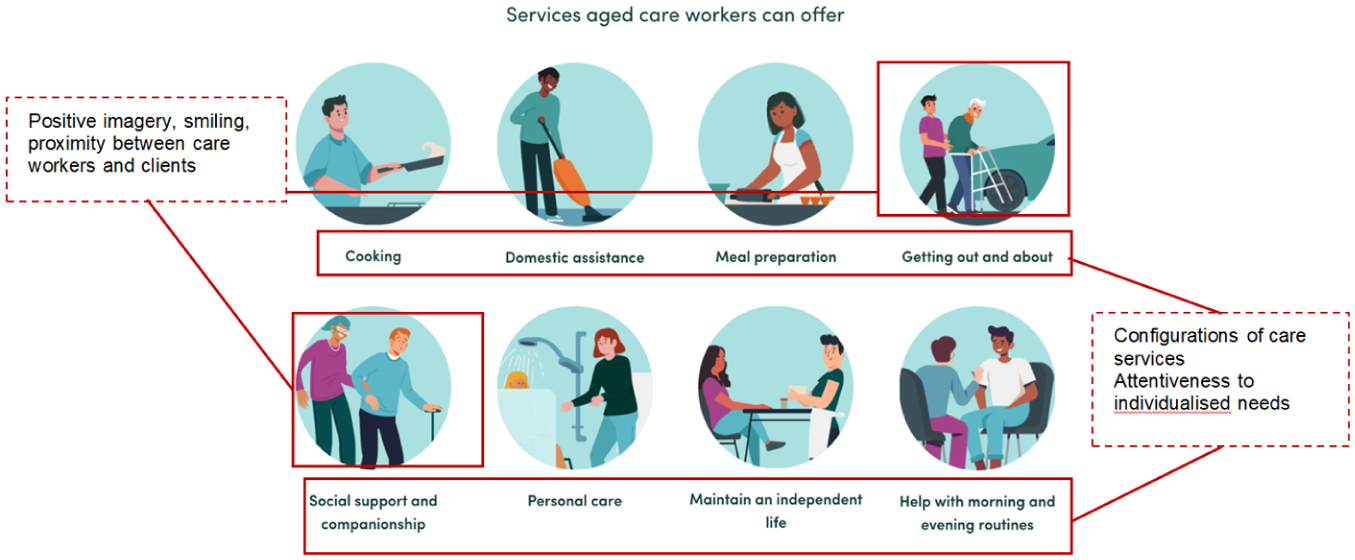
Configurations of care, CarePlatform4.
However, the structural features of the care platforms create frictions and limit the extent to which users can exercise mutual concern. A sensitivity to needs is undermined by features that simultaneously empower and disempower platform users (Franke and Pulignano, 2021). For instance, care-seekers can sign up for free to post jobs and match with potential care-workers, but platform features that address their concerns, such as ID verifications, indemnity insurance, or direct access to popular workers, require subscription fees (Figure 6). This privileges the marketised business-model and undermines the caring-about claim that care platforms are sensitive to all individualised needs of users or that platform-based care work is affordable and convenient for all platform users.
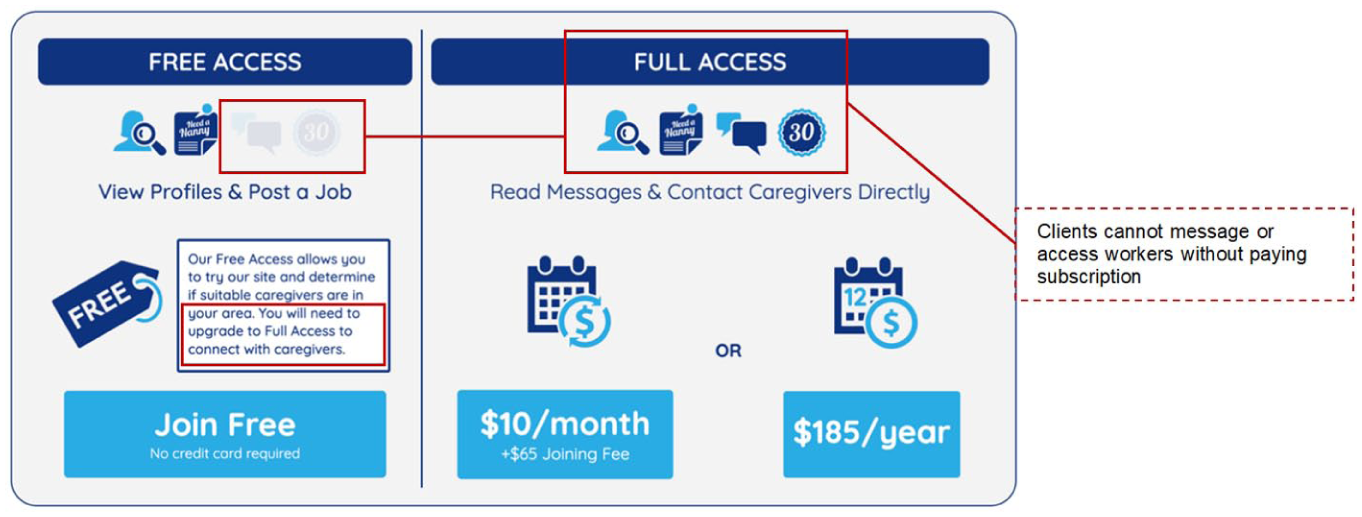
Features undermining concern, CarePlatform14.
Similarly, while care-workers can set their own wage rates or choose their own working hours, importantly, this framing sets an expectation that workers should always be available, and be ready to go above and beyond to find and undertake work (Mantilla-León et al., 2024; McDonald et al., 2023). This is reinforced through testimonials from care-seekers describing ‘favourite’ workers who receive regular, repeat work precisely through going above and beyond. The restrictive platform features suggest there are no guarantees that diverse needs and interests will be met through the platform, placing additional burden on both care-seekers and care-workers to negotiate arrangements where the concern for self and others can be realised.
From an ethics-of-care perspective, the frame of concern encompasses a recognition of and responsiveness to the needs of self and others, or a balance between care-for-others and care-for-self (Held, 2006). Care platforms portray concern and caring-about as an integral and ongoing component of work facilitated by intermediary platforms. At the same time, their limiting structural features create frictions that influence what and how platform users choose to prioritise and respond to (maintain care-for-self) when negotiating work arrangements with each other. The overt emphasis on mutual concern in the framing reinforces the need to rely on relational elements in interactions and negotiations with other users to safeguard self-interests (Alacovska and Bissonnette, 2021; Khan et al., 2023).
Discussion and conclusion
This article examined the framing of platform-based care work on platform websites for care-workers and care-seekers. Our findings reveal that care platforms employ three interrelated relational frames to establish expectations for their users. They cultivate connection by emphasising authentic attachment, social ties and relationships, foster community and relatedness through expressions of solidarity, communal welfare and trust, and demonstrate concern for self and others by highlighting attentiveness and sensitivity to individualised needs and interests. Using ethics-of-care, we explicate how platforms leverage these positive connotations of care – connection, community and concern – in framing care work, while simultaneously creating frictions with significant implications for worker-client relations.
We argue that care platforms, through such framing amplify interdependence between care-workers and care-seekers and exacerbate existing unequal power dynamics, by encouraging unregulated private work arrangements. We demonstrate how care platforms stimulate a hyper-competitive labour market, skewing the power balance in favour of clients whose self-interests and needs are privileged over those of care-workers. Unlike other forms of gig work, in care work, the decision and authority to offer work rests directly with the client. Care platforms emphasise relationality to promote platform-based care work as a mutually beneficial arrangement between workers and clients. Yet in practice this places additional burdens to rely on relational labour to build rapport and positive relationships with clients in order to find and sustain ongoing work (Khan et al., 2023; Molitor, 2025). This creates unequal power relations and privileges self-interest over mutual beneficence. Furthermore, we contend that care platforms capitalise on these relational dimensions to promote individual choice and empowerment (Held, 2006; Tronto, 1993), as a means to de-emphasise their own roles in the organisation of care work and to absolve themselves from any responsibility towards workers and clients.
Our insights advance knowledge of care work in the gig economy by demonstrating how relationality is central to representations of platform-based care work and functions as a challenge to criticisms of gig care work as transactional (Flanagan, 2019). Building on research interrogating how relational labour, social elements and relationships shape the experience of gig work arrangements (Alacovska and Bissonnette, 2021; Khan et al., 2023; Liang, 2018), we identify how rapport, social ties, authentic attachment, relatedness, trust and mutual concern between workers and clients are fundamental to the construction of platform-based care work (Barba et al., 2025; Held, 2006; Sevenhuijsen, 2003; Tomkins and Bristow, 2023). While researchers have begun to identify the potential for increased visibility and recognition of private care work through digital intermediaries (De Vita and Ciarini, 2025; McDonald et al., 2023; Pulignano et al., 2023; Ticona and Mateescu, 2018; Trojansky, 2020), by interrogating the framing on platform websites, we identify how care platforms contribute to social discourse about care work in the gig economy. Our study illustrates that care platforms attempt to positively mobilise socially entrenched assumptions about care work as highly intimate, affective and relational (Baines et al., 2022; Köhler et al., 2022) by framing connection, community and concern as foundational tenets of platform-based care work.
In examining the construction of care work by platforms, our study extends gig economy literature on the role and design of platforms in shaping the experience and organisation of gig work arrangements. Prior critique of platforms has identified how algorithmic opacity and design features keep workers siloed and distanced from understanding how work is organised (Hopwood et al., 2024; Popiel and Vasudevan, 2024; Rodríguez-Modroño, 2024). Moreover platforms use restrictive platform features in combination with terms and conditions of service on websites to force workers and clients to negotiate ‘off-the-platform’ (Mantilla-León et al., 2024; McDonald et al., 2021; Nhleko and Tame, 2023; Pulignano et al., 2023). In contrast to other forms of gig work, relationality is foregrounded in care work due to socially entrenched expectations for this form of work. Relationality is a central aspect in the organisation of platform-based care work, especially in how clients and workers interact prior to commencement of paid work (Khan et al., 2023; Molitor, 2025). Our study demonstrates how care platforms employ relational framing as a key strategy to maintain positive favour with users despite setting expectations for care-workers and care-seekers to privately negotiate work arrangements. Both care-workers and care-seekers have to rely on relational tenets in negotiating favourable work arrangements (Kalemba et al., 2024; Khan et al., 2023), setting in motion power asymmetries, situating workers with stronger reputational capital in a better position to obtain work from clients and creating vulnerabilities for others (McDonald et al., 2023). Care platforms are argued to offer greater choice of clients for workers than is likely the case in personal networks and, as a consequence, generate greater income earning opportunities (McDonald et al., 2023; Trojansky, 2020). However, clients also have a wider choice of workers and can exert control over who they hire, and they can influence future work opportunities for care-workers by providing positive or negative ratings, testimonials and reviews. Ultimately the relational framing creates new forms of power differentials between workers and clients (De Vita and Ciarini, 2025; McDonald et al., 2023; van Doorn, 2017) and exacerbate interdependence between users.
This study contributes to the literature on platform hegemony, by elucidating how care platforms retain power and shape marketplace relations by controlling information and fostering asymmetrical reciprocities (Baum, 2024; Shapiro et al., 2024; Strüver, 2024; Ustek Spilda et al., 2025). Care platforms construct a narrative about mutual concern, solidarity, sensitivity and attentiveness to individualised needs (Held, 2006; Sevenhuijsen, 2003; Tronto, 1993), including access to work opportunities and expectations of quality of care, targeting both care-workers and care-seekers. Yet there is potential for conflict where they have opposing interests (Schörpf et al., 2017): for instance, workers’ needs to maximise income vs clients’ needs to minimise costs. This is exacerbated by platform features such as paywalls or tiered subscription fees models, limiting how workers and clients can organise care work that they perceive as affordable and convenient. Extending the analogy of ‘faux control’ (Baines et al., 2022), we argue that platforms portray ‘faux concern’ for users who have no guarantees of having their diverse needs met. This ‘faux concern’ is evident in framing where care platforms give the impression that they are sensitive to the needs of users, and that they sympathise with their circumstances and offer support and autonomy. In practice however, users are ultimately responsible for achieving the most favourable outcome for themselves (McDonald et al., 2023). Our study demonstrates that care platforms promote individual choice and options to maintain self-interests as key features of platform-based care work, by strategically framing it through positive connotations of relationality and care. Yet this is ultimately a disingenuous portrayal of platform-based care work and has a disruptive impact on the traditional care economy, by creating an apparently appealing parallel or alternative pathway to finding care work/ers. The framing presents platform-based care work as a ‘win-win’ work arrangement for clients and workers; yet platform-based care work in reality can drive down wages, and create uncertainty along with new forms of vulnerability (Pulignano et al., 2023; Ustek Spilda et al., 2025). Moreover, care platforms directly contribute to a new dimension of intensified competition among workers, which can impact the quality of care and overall work conditions.
The framing by care platforms establishes expectations about interactions and relationships between clients and workers and creates further vulnerability and opportunities for exploitation. Consequently, the framing creates an atmosphere of heightened relational demands resulting in disingenuous attempts by workers to form bonds to gain and maintain favour. Workers often undertake hours of unpaid labour to develop positive relational experiences with potential clients (Khan et al., 2023; McDonald et al., 2023; Pulignano et al., 2023), such as curating their platform profiles to demonstrate ‘person-person fit’ (Blyth et al., 2024; Williams et al., 2021) or following-up interactions to cultivate rapport (Kalemba et al., 2024). Our study demonstrates how platform framing sets expectations for relational labour to commence before a work arrangement is even confirmed. We further demonstrate how care platforms crowdsource credibility and trust to users to build legitimacy and simultaneously absolve themselves from any responsibility towards workers and clients. In this way, users wholly assume the risk when engaging with others to organise care work arrangements (Macdonald, 2021), creating individualised safety and security concerns (Pulignano et al., 2023; Ticona and Mateescu, 2018). This study demonstrates how framing of gig work by care platforms directly shapes the organisation of care work, thus paving the way for future research examining how platforms impact worker-client relationality across the broader gig economy.
Footnotes

Ethical considerations
This study received ethical approval from the Queensland University of Technology Ethics (approval #5304).
Consent to participate
Not applicable. This study does not involve human participants and data gathered was from publicly available websites.
Funding
The authors disclosed receipt of the following financial support for the research, authorship, and/or publication of this article: This work was supported by the Australian Research Council Discovery Grant DP180101191.
Declaration of conflicting interests
The authors declared no potential conflicts of interest with respect to the research, authorship, and/or publication of this article.
Data availability statement
The datasets generated are available from the corresponding author on reasonable request.