




Abstract
This article takes the case of therapy dogs who visit hospitals, care homes, schools and universities in Britain and asks whether we should conceptualise what they are doing as work. Marx defined the capacity to work as what sets humankind apart from other animals, but more recent analysts see similarities between animals and humans in their capacity to work. Animal work is often defined through training and the acquisition of skills; for therapy dogs, however, training is not required, and their skills go unrecognised. Drawing on a study of therapy dog visits to a British university and using a methodology that attends to the experiences of the dogs as well as the human actors, we argue that therapy dogs engage in emotional work and body work and that the concepts of ‘encounter value’ and ‘feeling power’ need to be deployed to theorise the work they are doing.
Introduction
Since the ‘animal turn’ of the last few decades, researchers have made considerable strides in transforming our understanding of society to one that recognises the relations between human and non-human animals as a central axis of social life (Benton, 1993; Carter and Charles, 2018). While the study of animals’ labour has been part of this, with some exceptions (for instance, Coulter, 2016a, 2016b; O’Doherty, 2016; and a Special Issue of Gender, Work & Organization [Sayers et al., 2019]), it has yet to be integrated into mainstream sociology of work, where it may have implications for how we understand work more generally. In this article we draw on our study of therapy dog visits to a British university to explore whether what the dogs do during these visits can be understood as work, how we can conceptualise it and whether we need to expand the sociology of work in order to encompass its multi-species nature.
The kind of concepts suitable for understanding animals’ work in contemporary societies is far from decided. Some have assumed that, as new understandings of non-human animals’ subjectivity highlight their similarities to humans, existing understandings of work, developed around human activity, readily incorporate what we know about animal work (Coulter, 2016a; Dashper, 2019). Others have suggested that the specificity of animals’ contributions means that new understandings of work (Porcher and Estebanez, 2019) or new concepts of the value created by their labour (Barua, 2016; Haraway, 2008) are required.
These initiatives draw on several distinct if overlapping theoretical frameworks: first, the human–animal studies literature focusing on the centrality of human–animal relations to every social sphere (Carter and Charles, 2018; Cudworth, 2011; Peggs, 2012); second, initiatives that highlight the entanglement of human social worlds with non-human ‘actors’ of all kinds, including objects as well as non-human animals (Cerulo, 2009); and third, scholars whose concepts, such as ‘lively capital’ (Barua, 2020; Haraway, 2008), ‘lively commodities’ (Barua, 2016; Collard and Dempsey, 2013) and ‘biolabour’ (Cooper and Waldby, 2014), see the vitality of living beings as increasingly central to capital accumulation. These initiatives parallel and extend the success of feminists in showing that much of women’s activity globally consists of domestic and subsistence activities that need to be conceptualised as work, even when they are unpaid (Boserup et al., 2007[1970]). Yet whereas it is now accepted that these activities are work, it is less accepted that what animals do is work.
The question of animals working with/for humans raises ethical issues. There are those who argue that all forms of animal work are unethical and should be abolished (see Donaldson and Kymlicka, 2011, for a useful discussion). Others challenge the idea that animals are simply the victims of exploitation, demonstrating instead that they engage actively in the labour processes of which they are part (Blattner et al., 2019; Despret, 2016; Porcher, 2014; Porcher and Estebanez, 2019). Indeed, some suggest that in order to argue for improvements in animals’ lives, it is more helpful to think in terms of animals’ work than animal rights (Haraway, 2008; Porcher and Estebanez, 2019). Porcher and Schmidt (2012), for instance, draw on their study of a family dairy farm in France to argue that the cows are like their farmers in so far as they invest (and produce) their subjectivity in and through their work, albeit under certain constraints. Moreover, since the cows’ work makes the farmers’ work possible, we need to rethink the scope of what we mean by work, so that it incorporates what animals do alongside humans. Animals are seen as co-workers who should be accorded the dignity and shared membership for which workers’ movements have long struggled (Blattner et al., 2019; Cochrane, 2019; Coulter, 2016b). We share these concerns, but here we focus on how animals’ work with humans can widen understandings of work.
In what follows, we begin by discussing how animal work has been conceptualised within the social sciences and describe our methodology. The main body of the article considers whether the different participants in the therapy dogs’ visits to a university experience these encounters as work and how best to conceptualise what the dogs do. The evidence suggests that, not only is it appropriate to see what the dogs do as work, but that doing so enhances our understanding of what happens during dogs’ university visits. Hence, we examine not only the usefulness of concepts created with human work in mind, but also introduce two concepts from the animal studies literature that have been designed to grasp the specificity of human–animal relations in the context of bio-capital and biopower. While therapy dogs can be understood as engaging in both emotional work and body work, we argue that these concepts do not fully capture what they are doing; consequently, we develop the concepts of encounter value and feeling power with animal work in mind.
Do animals work?
Marx and Engels defined work, specifically production, as what separates humans from animals and therefore as what defines humanity (Ingold, 1994). They distinguished between ‘collection’ and ‘production’; collection being what animals and hunter-gatherers engage in and production being associated with pastoral, agricultural and urban societies (Ingold, 1994: 2). They defined production as something that could only take place in the context of specific social relations and as involving a mental image of ‘the task to be performed’ prior to engaging in that task (Ingold, 1983: 2). This distinguished intentional work from that which was instinctive. Marx’s much-quoted comparison of architects and bees is where this distinction is most famously set out:
A spider conducts operations resembling those of the weaver, and a bee puts to shame many an architect in the construction of her cells. But what distinguishes the worst architect from the best of bees is this, that the architect raises his structure in imagination before he erects it in reality. (Marx, 1970: 178)
For Marx and Engels, this implies that animals cannot be workers participating in a production process; they are merely instruments or objects of labour (Clark, 2014; Cochrane, 2019; Ingold, 1983). This view has been challenged. Tim Ingold, for instance, takes Marx and Engels to task, arguing that the work of domestic animals is intentional and purposeful and that they are therefore not simply instruments or objects of labour but labourers in their own right. Furthermore, ‘the relationship between man [sic] and animal is in this case not a technical but a social one’ involving inter-subjectivity (Ingold, 1983: 4). Porcher and Estebanez similarly argue that animal work produces social ties and is therefore ‘tied to subjectivity’ (Porcher and Estebanez, 2019: 21). Rather than being guided by instinctive behaviour, animal ‘work is the result of a subjective investment on the part of animals, as it is for humans’ (Porcher and Estebanez, 2019: 26) and animals ‘make choices, take some initiative and propose solutions to problems’ (Porcher and Estebanez, 2019: 25). 1
Alongside these theoretical arguments about whether what animals do can be conceptualised as work, we often refer colloquially to working animals and their centrality to agricultural and industrial production. Historically what we think of as (purely) human work has been supported by animal labour, that of dogs and horses but also oxen and other animals whose strength is harnessed to carry heavy loads. Animal labour was essential to industrialisation in the UK and US as both a source of power and for transport (Greene, 2008; McShane and Tarr, 2007). Since the beginning of the 20th century, other forms of animal work have grown in importance. Dogs were introduced into the police and armed forces in the early years of the 20th century (Pearson, 2016; Wlodarczyk, 2018) and are now widely used to track and detain suspects while, in the current pandemic, dogs have been trained to detect Covid (Henley, 2020).
Many of the examples above involve dogs doing a job for which they are trained and working as part of a dog–human team so, for some analysts, training is key to defining an animal as working. Donna Haraway, for instance, observes that the jobs dogs do require that ‘dogs and people . . . train together in subject-changing ways’ (Haraway, 2008: 57) and others suggest that being trained to perform set tasks is what defines a working animal (Wlodarczyk, 2019). Indeed, it has been argued that working dogs undergo a process of professionalisation through training, that they have careers (Mouret et al., 2019) and that they should be entitled to protection through the granting of labour rights (Cochrane, 2016).
Animals have also been increasingly involved in supporting humans in various ways – as guide dogs for the blind, assistance dogs and, since 1942 in the US, service animals (usually dogs) supporting veterans with post-traumatic stress disorder (Wojtkow, 2016). Animal Assisted Therapy has emerged as an important aspect of health care, especially in the area of mental health (Fine, 2010). Animals’ therapeutic support for humans is often seen as innate and not a result of training (Wlodarczyk, 2019). In the US, in addition to service dogs, who are trained, there are also emotional support animals who are not. Moreover, it has been argued that companion animals should be seen as working, voluntarily, in the homes where they live, undertaking care work for their humans (Coulter, 2016a; Cudworth, 2022).
Care work
This sort of animal work is conceptualised in different ways but is most commonly seen as care work (Mouret, 2019), often including emotional work and body work and, sometimes, affective labour. According to Coulter (2016a, 2016b), emotional work, as first conceptualised by Hochschild (1983), is a key component of the work that animals do with humans and at their behest (as well as being an element in the work of humans working with animals). As she says, both humans and animals ‘must learn to control and harness their instincts and feelings, illustrating what could be called emotional work and emotional labour’ (Coulter, 2016a: 73). Whether or not a dog is feeling afraid, enthusiastic, joyful or angry, in work situations they would usually be expected to display appropriate emotions, which might be aggression (as in some policing roles) or calmness (as with assistance dogs [Charles et al., 2022]). Another example of animals’ emotional labour, this time in tourism, comes from Dashper’s (2019) study of trail horses, whose personalities feature in tour companies’ publicity material on horse-riding holidays and make a big difference to clients’ experience.
However, it is not just a matter of emotions. Even for humans, ‘The body is the vehicle for performing service work’ (Kang, 2010: 20, cited by Wharton, 2014: 349), including communicating emotions like deference or pleasure as well as undertaking physical tasks. Bodily performance at work includes what Wolkowitz (2006) and others call ‘body work’, which refers to jobs in which workers focus on the bodies of clients, customers and patients, usually involving touch (i.e. it is ‘hands-on’ work). In retrospect, this could be seen as anthropocentric, as dogs have (are) ‘paws not hands’ (Haraway, 2008: 56), so inevitably being touched will be a more important part of their work than touching.
It is widely recognised that human care work, including emotional work and body work, is highly gendered, and most frequently feminised (Cohen and Wolkowitz, 2018). We suggest that animal care work is also feminised (Charles and Wolkowitz, 2019) and often carried out in the context of gendered organisations (Charles et al., 2022). Indeed, one of the problems with another way of conceptualising human and animal care work, as affective labour (Plourde, 2014; Wlodarczyk, 2019), is that it neglects the gendering of the work. When affective labour is seen as a kind of ‘immaterial labour’, both terms misconceive the work undertaken by mainly women workers attending to the physical and emotional needs of other people (McDowell and Dyson, 2011). Far from leaving no physical trace, women’s care work is often ‘formative’ (Bolton, 2009), in the sense of producing changes in the material well-being of patients and clients, and marked by historical continuity rather than novelty. Rather than being mobile or weightless, this work depends on the embodied co-presence of the worker and recipient of care, usually in identifiable and specific locales, such as hospitals, nursing homes and domestic premises. The same is usually true of animals’ so-called affective labour; while human–animal encounters undeniably have an affective dimension, the term ‘affective labour’ may obscure the material embodiment of this work and thus some of the constraints that shape it.
In light of this, the question that we explore in this article is whether and how to recognise as work the ‘low-key and constant physical presence, coupled with what is perceived as emotional support’ that constitutes the ‘therapeutic power of animal presence and animal touch’ (Wlodarczyk, 2019: 88). Animals’ emotional work and body work are part of the story. However, we argue that we need to go beyond the sociology of work as it is usually understood to capture the distinctiveness of more-than-human labour. We do this by considering Donna Haraway’s concept of ‘encounter value’ and the lesser-known concept of ‘feeling power’ (Shukin, 2011, 2013). These concepts will be easier to comprehend after exploring what Pets as Therapy (PAT) dogs do and how their university visits are experienced.
The study
Universities in Britain have recently begun bringing therapy dogs onto campus as part of student engagement programmes that seek to reduce students’ stress levels and increase their ‘happiness’. These dogs are pets; they live with their human companions and are brought onto campus for students to touch but are not specifically trained for their therapeutic role. In ‘Midland University’, where our research took place, the dogs’ campus visits were organised by library staff in liaison with PAT, a UK charity that coordinates visits by dogs and their guardians to hospitals, residential homes, schools and, latterly, universities. These visits are undertaken on a voluntary basis, but the dog–human teams are assessed for their suitability and, for the dogs, the assessment focuses on their temperament. They have to be calm, tolerant of human touch, not easily scared and able to take a treat from someone’s hand gently. Their temperament is particularly important as many of those whom they visit are frail and would be unable to cope with a boisterous dog.
We undertook a small, qualitative study of five PAT dog visits to Midland University library in the 2015–16 academic year, with a further visit in May 2018, obtaining permission for the research from the library staff in charge of the visits. Our methods included observation, interviews and visual recordings, both still and moving, of the events. Elsewhere we have discussed the importance, as far as is possible, of exploring the university visits from the dogs’ point of view (Charles and Wolkowitz, 2019; see also Fox et al., 2022; Smith et al., 2021). To this end, we observed the interactions between the dogs, their guardians, the students and university staff, recording them through fieldnotes, still photographs and recordings made by stationary video cameras. At each event we moved around, observing different dogs, taking photographs and talking to students, guardians and library staff.
Between three and eight dogs and their guardians attended each event, spread across a large, airy room and visited in turn by students (Figure 1). This was unlike the dogs’ other visits where they initiated contact with people; here they stayed in one place and waited for students to approach, which they did in groups, moving from one dog–guardian team to another. The dogs and their guardians chose where to position themselves, spacing themselves so that there was plenty of room for students to get close to the dogs.
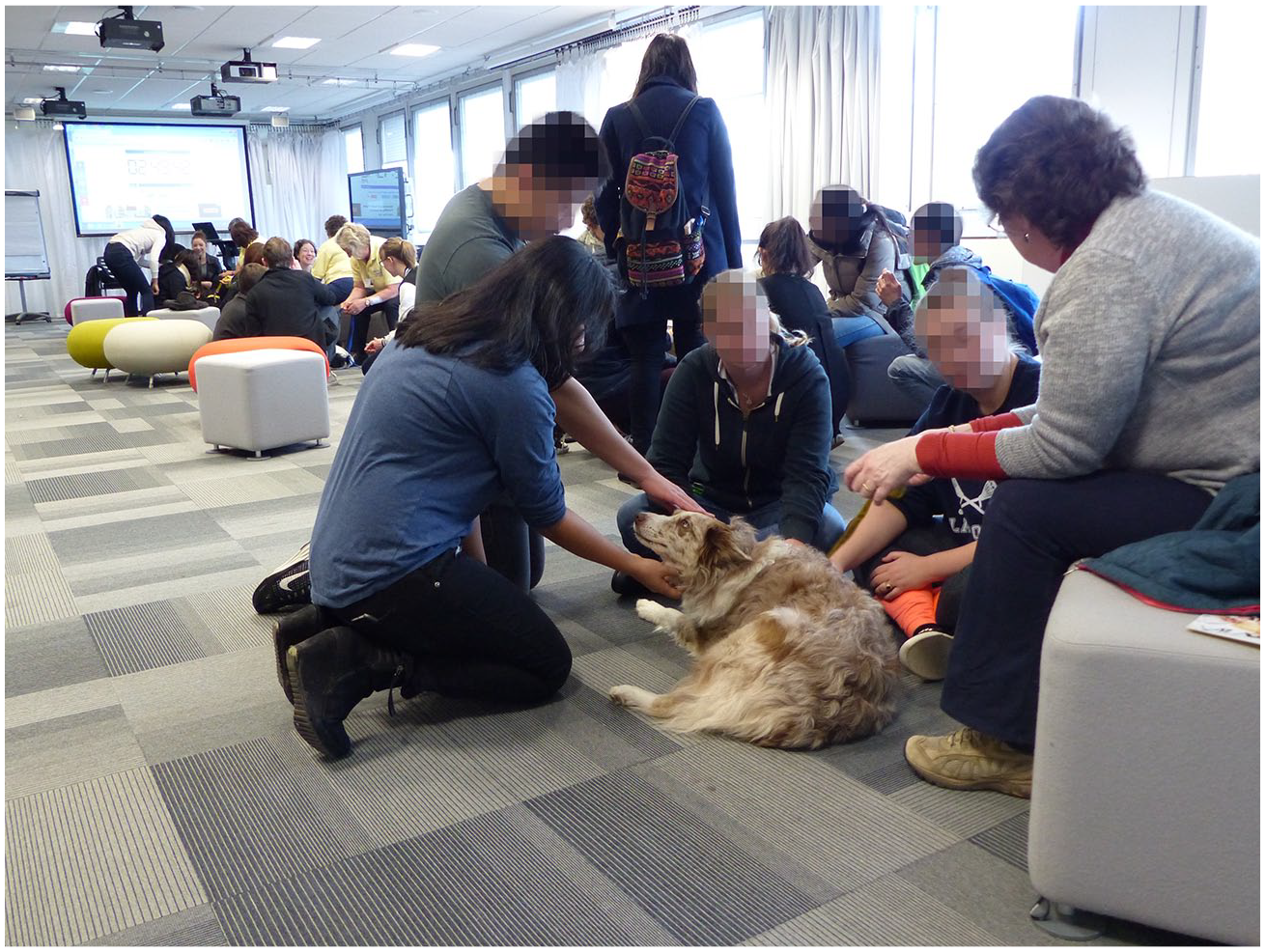
PAT dogs in the library.
During the visits, we introduced ourselves and the study to the guardians and students as we chatted to them. We asked the guardians if they would be willing for us to contact them for an interview and recorded their contact details if they agreed. All the students who had attended the sessions were emailed by the library staff with some information about our research and our contact details; subsequently they got in touch with us if they were willing to be interviewed. We developed the interview schedules after carrying out observations at two of the PAT dog visits and talking to the organisers informally; the interviews were therefore informed by these conversations and our observations of the events. We interviewed nine participating students and two of the library staff who organised the visits; these interviews took place in university offices and campus cafes. We also interviewed five of the dogs’ human companions in their own homes, with their dogs present. All interviewees were given information sheets and signed a consent form before proceeding with the interview.
All our interviewees, apart from two of the students, were women: this reflected the feminisation of the events both in terms of human participants and its affective atmosphere, which emphasised the dogs’ fluffiness and cuteness, something that the students associated with femininity. Those organising the events were women, more women than men students attended and all the interviewed guardians were women. There were no male guardians at five of the six sessions we observed, although two men and their dogs had attended the first event. We were unable to contact either man for interview, although we were told that one of them had brought his dog to several sessions the previous year. 2 The interviews lasted between 45 and 90 minutes and were recorded and transcribed verbatim. The names of dogs and people have been changed to preserve anonymity.
Both authors carried out interviews and observations, comparing notes and discussing emerging themes as the project progressed. Once all the data had been produced, we conducted a thematic analysis of our fieldnotes and the interview transcripts, reading them through, discussing emerging themes and re-reading them several times. The main themes that emerged related to the atmosphere of the events, which was described as calm and relaxed; the participants’ enjoyment, including the dogs’; the feminisation of the events and differences in the ways women and men students interacted with the dogs; the evocation of home for the students, who often likened the PAT dogs to their family dog; control of dog–student interaction and control of dogs; and the importance of touch to dog–student interaction.
The observations were particularly crucial in allowing us to see the centrality of touch to the dog–student interactions. Over the course of each one and a half-hour session, successive groups of up to 30 students were allowed into the room for 10- or 15-minute slots, during which they could circulate and interact with the dogs and their guardians. 3 The main form of interaction with the dogs was touch and, at any one time, most of the dogs had many student hands on their bodies.
As well as taking photographs of the dogs, students and guardians, we also photographed the whiteboard on which students were asked to write feedback. We use the photographs and video recordings as memory prompts – although they would repay further analysis – and as a way of representing the event that does not rely on words.
Different participants’ experiences of the PAT dogs’ visits
In deciding whether to see the PAT dogs as working, we consider the different experiences of participants at these events. We begin by looking at the dogs’ guardians and then at the students before discussing the dogs’ experiences and considering whether what they are doing can be understood as work.
Guardians as voluntary workers
Guardians talk about what their dogs do as ‘work’, using this word explicitly, and see what they themselves do as voluntary work for the PAT charity. In this, they follow PAT publicity material, which clearly identifies the dogs’ participation as work. For instance, its noticeboard at Crufts specifically mentions the PAT ‘working dog’, and their book on PAT, Doug the Pug, by Cate Archer (2016), is subtitled A Working Dog’s Tale. Moreover, according to the PAT website the dogs and their companions are said to ‘work alongside’ health care therapists in the rehabilitation of stroke patients. Although PAT dog–human teams are not specifically trained, the dogs’ companions are provided with detailed factsheets, including specific ‘dos and don’ts’, implying that participants are expected to follow instructions rather than act spontaneously.
The guardian–dog teams we interviewed had been working with PAT for between two and six years. The guardians interest in participating had usually been sparked by their dog’s evident aptitude for this sort of work, which for the guardians was a ‘worthwhile’ activity and a source of pride; for instance, Dorothy had put together two albums of photographs of Sydney visiting nursing homes, primary schools and the university. Prior to the university events, and usually concurrently, the PAT dog teams visited patients in hospitals and nursing homes or participated in reading programmes with primary school children. The guardians understand the voluntary work they are doing as gendered and something that women are more likely to engage in than men, sometimes because of the pressures of paid work and sometimes because women are more inclined to undertake caring roles:
I suppose most of the Pets as Therapy work has tended to be going into nursing homes, that’s probably the biggest part of their work, and I suppose it’s more of a woman’s, a caring thing, isn’t it? And I suppose perhaps women have had more time at home than their partners or husbands, to be able to do it, I don’t know. (Janet and Monty)
For one of the PAT guardians, working with PAT offers the same satisfactions as a paid job working with animals. Laura said that she had ‘always wanted a job with a dog, you know, and this was, like, the next best thing’ (Laura and Winston). At the same time, however, guardians regarded their dogs as pets, as our title quote suggests. Laura went on to say that ‘they’re not trained at all . . .. They’re just our pet.’ Here, training is linked to being a ‘working dog’, while the PAT dogs are pets who work occasionally. The guardians also recognise the work that they themselves carry out to make sure their dogs are clean, that they have the right equipment and that they keep control of their dog at all times, as PAT instructions insist.
Since the dogs do much of what the guardians do, it makes sense to see their participation as work. The guardians certainly think that their dogs see it as different from everyday life, noting that their dogs recognise their uniforms and get excited about going to work; they also display particular attitudes and capacities when participating as PAT dogs. The dogs ‘seem to know’ when they are at work and are exhausted afterwards. However, the guardians also recognise that the students relate to the dogs as pets rather than as working dogs – as pets who can be stroked, have their photos taken and evoke a feeling of home and comfort. Most say that their dogs enjoy the work, not only in the university but also elsewhere, and they were alert to how their dogs felt and took action if their enjoyment waned. One told us that she and her dog had withdrawn from visits to a residential home because her dog was becoming bored with them, while another was considering withdrawing from the university visits as her dog was no longer interested in engaging with the students.
The guardians’ role in the PAT programme reminds us of the important part played by the voluntary sector in providing services that, for whatever reason, the statutory agencies of the welfare state are unable to provide. In this sense, the work of the PAT dog teams could be understood as unpaid care work replacing services that otherwise could be provided by paid workers. Indeed, Shukin (2013: 194) suggests that one reason for the increasing demand for Animal Assisted Therapy may be that affective support is no longer so freely provided by women, with whom it is traditionally associated. The PAT guardians themselves recognise that in so far as therapy dog visits are a kind of unpaid care work, they are a feminised form of work but, as we discuss later, conceptualising what the dogs do solely as care work does not adequately capture what is going on, since what the dogs contribute, as dogs, does not simply mirror human – usually women’s – care work.
The students’ experience
The students’ experience is different from that of the guardians or library staff as, alone among the human participants, they see neither their own nor the dogs’ participation as work. They relate to the dogs as objects of pleasure – comments on the whiteboard referred to them as ‘soft pillows’, ‘cute’ or ‘fluffballs’– possibly reflecting the publicity for the events, which featured outline drawings of puppies, or images of animals on social media (Barua, 2016). They also see them as pets who remind them of home. One of the guardians reported students saying things like: ‘Oh you know, this is lovely because I’ve really missed the contact with my dog at home, I left my dog at home to come to university and I’ve missed the touch, I’ve missed the contact’. This focus on the dogs as pets located at home minimises any potential association with work.
All the students reported experiencing an overall calming effect through touching the dogs and being in a quiet and calm environment, and for some this was sufficient. Others regretted that the interaction was usually limited to a ‘touch-and-go kind of feeling’ and reported being unable to form as much of a relationship with individual dogs as they would have liked; these students wanted a less formal and more meaningful encounter.
The students’ focus on the benefits they themselves get from the encounter may partly reflect their positioning by the university’s student engagement programme as consumers (MacFarlane and Tomlinson, 2017). Some students even see their time with the dogs as something they are entitled to; one commented that the university spends so much energy ‘stressing us out’ that it was only right it should do something to help students cope. Although some recognise that the visit is exhausting for the dogs, they see the dogs as ‘being themselves’; the dogs are relaxed and enjoying the encounters rather than working and they are also undemanding. One student said that, ‘They’re really different from humans, like they’re really happy and they don’t expect anything’. This view is reinforced by the way the room is arranged, which means that the dogs do not appear to be doing anything; they rarely approach students, but rather are presented to students as there to be touched.
Other aspects of the students’ definition of the situation also inhibit their recognition of the dogs’ participation as work. For students, the dog visits represent a break from studying – that is, from work. They see the visits as totally absorbing, with the dogs taking their minds off work and other obligations. ‘It takes you out of yourself’, was a frequent observation. They hope to recharge their energies, rather than to expend them, and sometimes to escape, for a short time, from their parents’ expectations of perpetual high performance.
Finally, the students’ immediate physical experience of the visits contrasts strongly with how they think of work. There is a contrast between students’ academic work (intellectual) and their bodily contact with the dogs (non-work and physical), although few themselves make this contrast.
If we take the students’ experiences as typical of many people’s casual interactions with companion animals, it is easy to see why it has been hard to recognise what these animals do as work, especially when it seems to require no special physical exertion or training (cf. Wlodarczyk, 2019). To set against that are the perceptions of all the other people involved in running the events, including the dogs’ guardians, who recognise how much their dogs’ behaviour at the university differs from how they are at home and how much effort is expended to create a calming and enjoyable experience for the students.
The dogs
While the guardians are clearly engaged in voluntary work, for the dogs it is less clear. It is voluntary (i.e. unpaid) in the sense that their board and lodging are not dependent on their doing it but whether it is voluntary in the sense of freely chosen is more complicated. Our own and the guardians’ observations suggest that the dogs’ engagement with students is quite complex and involves choice and cooperation, which Porcher (2014) sees as important indications that animals are ‘working’.
Unlike their guardians, the PAT dogs do not choose to come to the university library, but once at the event they choose whether to cooperate and how to engage, and in so doing they shape the encounter with students. Some of the guardians report that their dogs are eager to go to the university and enjoy it more than the other places they visit as they can be ‘more themselves’. Others, though, said that their dog was overwhelmed by the number of students or that they were unable to get to know individual students. This contrasted with the other places they visited, where their dog had got to know particular nursing home residents, or children who read to them, and were able to establish a relationship with them. This suggests that the dogs, as well as some students, might welcome a more meaningful encounter.
The extent to which the dogs actively engage with the students varied greatly, both between individual dogs and over the course of each session. Some were quite active, wagging their tails, accepting treats and interacting with the students and their guardians. Others cooperated only in so far as they passively accepted the students’ attentions; for instance, two dogs lay on their backs or sides virtually the whole time, which is a way of disengaging while still allowing students to touch and stroke them (Figure 2). Very occasionally, as we discuss below, a dog resisted participating.
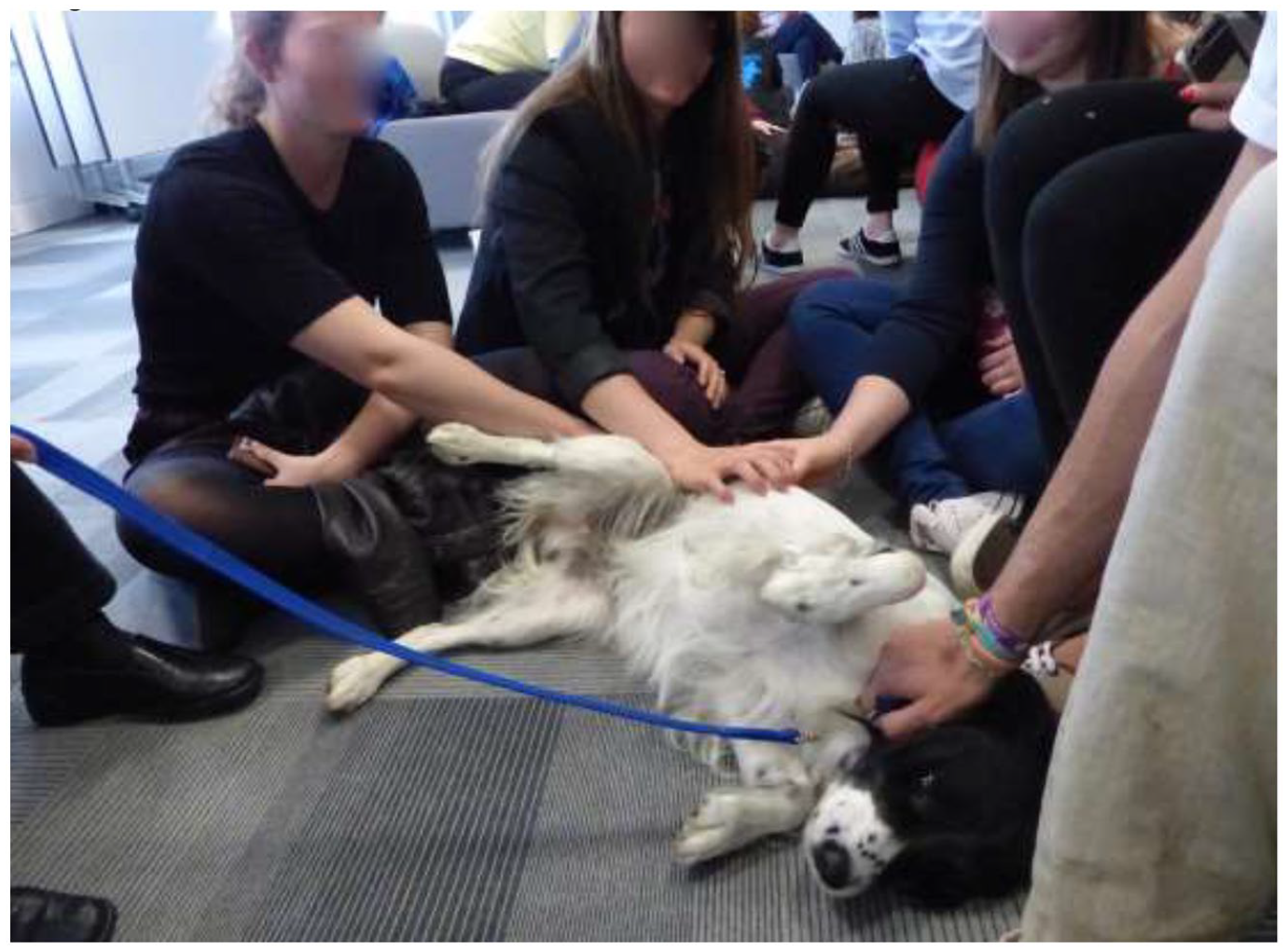
Harvey letting students stroke him.
The characteristics of what the dogs do with the students can be identified by comparing it with what they do in other situations. In contrast to how they were with the students, they engaged more actively with staff members who greeted them when they arrived or played with them after the session was over. The dogs were interacting with people and responding to their friendly overtures. This more animated encounter was the sort of interaction that some of the students would have preferred, one in which the dog could also take the initiative rather than simply accepting human touch. What was noticeable was that the students, unlike some of the staff, did not seek to engage the dogs. They expected to be able to stroke them without communicating their intention to the dog and giving the dog the chance to say ‘no’. 4 There is no point in the dog responding in those circumstances because even if they would prefer not to be touched they are unable to do anything about it. For some of the dogs, interest was maintained by the possibility of their guardian rewarding them with food treats, and this made for a livelier interaction, but by the end of the session almost all the dogs were clearly exhausted, or as one of the library staff put it, ‘peopled out’.
It is possible that the interactions with students would be different if the events were organised differently. We each attended a visit by Guide Dogs to the Students’ Union, but at different times. A Guide Dogs volunteer, Gloria, also volunteered for PAT and talked about the difference between the Guide Dogs event and PAT dog visits. Our fieldnotes recorded differences in dogs’ behaviour, as follows:
Here [Students’ Union] the dogs were all on their feet, or sitting on students, or interacting with different people and each other, asking for food, not always on their leads, [their leads] being held by other people not their owners and generally interacting and being dogs. [. . .] The dogs were interacting and having fun – they wagged their tails most of the time and were moving about and engaging with each other and with the people. Very different from the library dogs – and I think this is probably what Gloria was referring to – that, as PAT dogs visiting older people, they need to be much quieter and calmer, but here they were active and engaged. (Fieldnotes, 24/2/16)
These dogs were enjoying themselves; they were freer to choose how to engage – including by sitting on students who were on the floor with them, and they did not appear to be stressed. In contrast, one or two of those in the library showed signs of stress and seemed to close down.
To summarise, then, the way the events are organised, as well as their brevity, made it difficult for the dogs and students to establish a relationship or to develop social ties, which Porcher and Estebanez (2019) associate with satisfactory work for animals. Although only humans can see the digital clock projected onto a wall of the room to tell students how much time they have left, it paces the interactions for both humans and dogs. The dog–student interaction is not only time-bound, it is also monitored by the guardians and constrained by the need for the dogs to control themselves and accept student touch.
For both students and guardians, dogs were seen as pets, albeit, for the guardians, pets who were working, but during the PAT dog visits we saw much more work going on than in some other studies of therapeutic human–animal interactions. For instance, while the title of Plourde’s (2014) article on cat cafes in Japan uses the term ‘affective labour’, the substance of the article actually casts the cats in the cafe as ‘the affective object through which patrons seek a sense of healing’ (Plourde, 2014: 115). Although Plourde describes consumers ‘seeking direct, sensory engagement with cats’, there is no attempt to identify the labour that the cafe cats contribute. Perhaps Plourde did not see this labour going on because, in the cafe she studied, the cats were unwilling to perform the labour that the PAT dogs do, instead evading the customers by hiding away whenever they could!
Emotional and body work
These contrasting observations render visible the work that dogs have to do in order to control themselves and behave calmly and quietly when working as PAT dogs. Both emotional and body work are required to sustain their interactions. Concepts like these sensitise us to forms of labour that used to be unrecognised, even for humans, being taken for granted, or conflated with women’s ‘natural’ (and therefore effortless) provision of comfort or hospitality. However, whereas human body work usually involves the worker touching another’s body, dogs’ body work consists mainly of being touched; in fact, the dogs are not permitted to raise their paws.
This form of body work requires self-control. Dogs do not necessarily like to be touched by strangers (Glenk, 2017), particularly when several different people are touching them at the same time, on different parts of their bodies. It is almost as if they switch off, letting it happen to them rather than engaging in the interaction. The dogs are not asked whether they want to be touched and they do not have the opportunity to move away from any unwanted touch. This switching off may partly explain why some of the students felt that the dogs were more like ‘fluffy toys’ than a companion animal that you knew and could relate to. Even the dogs who were initially quite active in approaching students eventually grew tired and reduced the amount of effort they put into the encounter.
For humans, making oneself available to be touched is mainly limited to sex work, where workers are known to undertake boundary work to maintain their safety and self-identity (Brewis and Linstead, 2000). The guardian and dog teams also perform a degree of boundary work as they must be specially dressed and sanitised for PAT visits. Guardians usually wear sweatshirts with the PAT logo and their body work includes making sure their dogs are clean. The boundaries between work and non-work are defined for the dogs by the technology of lead or harness and their ‘uniform’, although Dorothy says she removes Sydney’s jacket so the students can more easily touch him. Wearing these ‘tells them’ that they are working and, conversely, that they are able to switch off when they are not wearing the technology (Mouret, 2019). This is important because maintaining boundaries between work and non-work is a crucial protection against exploitation (Coulter, 2016a).
The biggest worry about the PAT dogs’ body work at the university is that their ability to withstand such close contact takes effort. By an hour into the session the dogs’ interest in engaging with students is much depleted and by the end of the session they are exhausted, which may signal resistance to any more contact. This exhaustion is evident in this photograph of Winston (Figure 3).
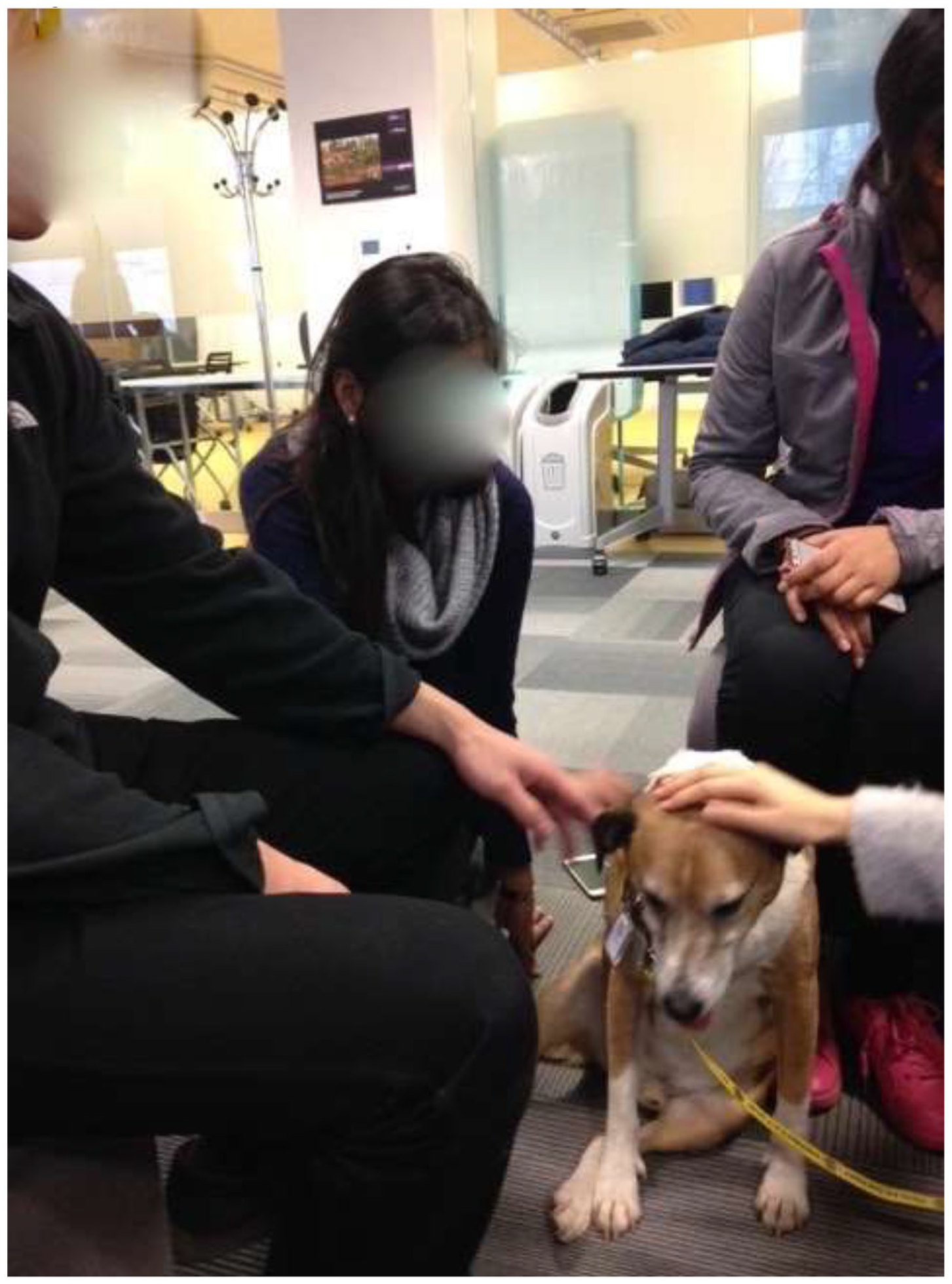
Winston withdrawing from interaction with students.
The notions of emotional work and body work enable a recognition of the work PAT dogs are doing. However, they mainly draw attention to efforts that parallel human labour, even if the mode of expression is different. For instance, Dashper’s (2019) study of trail horses’ emotional labour shows how they are required to supress signs of annoyance, which in their case are ‘pinning their ears back and baring their teeth’ (Dashper 2019: 47). This raises again the question of whether a distinct concept or concepts are needed to capture more-than-human work.
Encounter value and feeling power
Thus far, we have argued that the PAT dogs undertake both emotional work and body work to sustain their interactions with students but that these concepts do not fully capture the distinctiveness of the interaction or what it contributes to students’ experience. Two further ways of looking at the dog–student interaction build on Haraway’s (2008) notion of ‘encounter value’ and Shukin’s (2013) concept of ‘feeling power’.
Haraway, along with several others, rejects the idea that what animals do can be understood through anthropocentric frameworks, although rarely do they consider the sociology of work (Barua, 2016; Haraway, 2008). Recognising that interspecies interactions take place in a context in which capital seeks to subsume all social relationships, Haraway creates new concepts. In particular, she identifies ‘encounter value’ as an ‘underanalyzed axis’ of what she calls the current regime of ‘lively capital’ and its ‘biotechnologies of circulation’ (Haraway, 2008: 65). ‘Encounter value’, which she adds to the Marxist concepts of use value and surplus value (Haraway, 2008: 45), is the unique and irreducible effect of the interaction between ‘subjects of different biological species’ (p. 46). It is not dissimilar to the notion of ‘becoming with’, taken from Despret (Haraway, 2008: 308n19), which insists that both human and animal lives are shaped through mutual encounters. The question is who, and what kinds of activity, produce encounter value.
Certainly, something like ‘encounter value’ is produced by the PAT dogs’ interactions with students. Although the university’s student engagement programme does not produce profits, it is not outside the business model that now governs nearly all British higher education institutions. According to library staff, the programme helps the university to attract applicants (the visits are said to be a frequent topic on the students’ social media) and enhances current students’ identification with the university (encouraging them to make donations as alumni later on). But the genuinely transformative experiences students told us about transcend the instrumental objectives of the programme. Those students queuing to visit the dogs several times a year look forward to the visits, seeing them as a necessary top-up to what sounds like their sense of self, although they do not use that phrase.
However, in focusing on ‘encounter value’, Haraway avoids specifying the work that non-human animals need to do to create successful interactions. We suggest that the concept of ‘feeling power’ (Shukin, 2011, 2013) helps to identify the dogs’ contribution to the creation of encounter value.
Shukin (2013: 178) defines ‘feeling power’ in terms of animals’ ‘capacity for loving attachment’ with humans. The therapeutic, and sometimes ‘tenderising’, effects of contact with non-human animals are in turn contextually dependent on the historical construction of animal touch:
The perception that touch is a sheerly physical and therefore animal mode of communication is what constitutes, arguably, its healing (not to mention killing) powers. Without a popular belief in the unmediated vitality of animal touch, therapeutic practices that involve bringing the sick, elderly, abused, grieving, stressed or lonely (or people suffering from any number of elusive affective disorders associated with late capitalism) into contact with animal bodies would arguably lose much of their force. (Shukin, 2011: 486)
While recognising that the concept of ‘feeling power’ echoes Marx’s concept of labour power, Shukin’s Foucauldian account sees feeling power as a political rather than economic force, as a form of biopower rooted in historically new forms of governmentality in which obedience is instilled through loving attachment rather than coercion. This certainly fits our observation that the dog–student interactions result not just in students feeling calmer, but also in their transformation into good (uncomplaining) student subjects. It also captures the therapeutic work of the dogs, over and above their emotional work and body work, who are left exhausted but well-behaved, good canine subjects. While the dogs’ and guardians’ body work and emotional work are necessary to sustain the interactions, these are not sufficient in themselves to produce ‘encounter value’. Rather, encounter value depends on the dogs’ feeling power, on their ability to embody the ‘therapeutic power of animal presence and animal touch’ (Wlodarczyk, 2019: 88). This capacity also has an economic value in some contexts. The deployment of animals’ ‘feeling power’ may be analogous to employers’ exploitation of human workers’ personalities and cultural capital to provide consumers with pleasurable or rewarding experiences (in hospitality and tourism, for instance), but provides what is perceived to be a quite distinctive type of experience. Moreover, identifying the ‘feeling power’ of animal touch has the advantage of recognising the inextricability of physical and emotional sensations, especially where human interactions with other animals are concerned. As one of the students says, despite spending only 10 minutes with the dogs, he was left with a ‘lingering warmth that remains with you for the rest of the week’.
Conclusions
This article has explored what dogs do during their therapeutic visits to a university campus and what that can tell us about the meaning of work more generally. We suggest that what the PAT dogs do is complicated. They are engaged in voluntary (i.e. unpaid) work and, to some extent, choose to cooperate – guardians do not continue with placements if their dogs do not enjoy them. They are required to display appropriate emotions and stifle others, and this requires emotional work and body work. The encounter value produced by the interaction between PAT dogs and students, which changes both dogs and students, depends primarily on the dogs’ capacity for ‘feeling power’. Although one cannot actually see the dogs expending feeling power, our observations and interview material suggest that the interactions have an affective dimension: the students feel calmer and the dogs are exhausted by their encounters. Some of the guardians say that when their dogs get home, they relieve the tension by racing around – the exhaustion being mental rather than physical. This demonstrates the effort that the dogs’ self-control requires.
The fact that the PAT dogs’ labour is not easily recognised, especially by the students, does not mean it does not exist. There are definite parallels with the emotional and aesthetic labour required by many human service sector workers, where skill is required to ensure that the onerousness of their effort is not apparent to the consumer. In service sector employment, human workers’ existing personalities, social skills and aesthetic capital are often more critical for employers than technical skills (Nickson et al., 2012) and this is also the case for PAT dogs. Moreover, in hospitality and tourism, workers are supposed to show that they enjoy their interactions with customers, obscuring the effort involved in creating this impression. When human workers are implored to ‘just be themselves’, this conceals ‘the very nature of the performances as work’ (Blackwell-Pal, 2020). But the invisibility of the labour involved is greatly increased in the case of animals’ feeling work, in part due to what Shukin (2011: 486) terms the ‘historical construction’ of the meaning of animal touch.
Our discussion is also complicated because it has to address somewhat different definitions of work, as does the literature on animal work more generally. The first, often implicit, notion distinguishes work from leisure, as effort made under relations of constraint. We think it is clear that therapeutic work of the kind these PAT dogs perform goes beyond their roles as companion dogs and shares similarities with the conditions experienced by other working dogs. The intrusiveness of the students’ touch and the limits on the dogs’ activity, along with the sharp constraints on the event’s timing and location, requires them to maintain an exhausting degree of self-control. The effort most of the dogs put in is especially visible in its absence, in the relatively few times a dog refuses to entertain students’ touch. If it is not more visible this is to do with the selection of dogs with the right temperament. However, it should be possible to think of ways the events could be organised that would not be so taxing for the dogs and which would satisfy the preference shown by many of the dogs and students for more lively encounters.
Recent developments in the study of animal work emphasise that, for animals as well as for humans, work may be a vehicle for choice, agency, cooperation, respect and intersubjectivity (Porcher, 2014). All of these are evident in the dogs’ participation in the PAT programme, although the scope for choice is limited for the dogs (and students) in terms of how they interact. But we certainly cannot say that what they do is not work simply because the dogs are not permitted to work in ways they might prefer.
What then does our analysis contribute to the sociology of work? We follow many others in thinking that it is not sufficient to add animals onto existing models of society, or, by extension, add animal work onto existing understandings of human work; rather, we need to re-examine what work entails and who does it. ‘Work’ has never been purely human; as Porcher and Estebanez (2019) say, ‘animals are not only involved in human work, they help to make it possible’ (p. 23). There are parallels here with the feminist insistence that bringing women’s roles in social life into view requires rethinking disciplinary assumptions about what social life consists of (Smith, 1987). Yet at present, with rare exceptions, human–animal studies and the sociology of work are located in almost entirely different worlds, each paying little attention to what the other has to say.
Reporting on a small-scale study is perhaps an unlikely place to talk about disciplinary transformation. Nonetheless it can help to make animals’ contribution to human work more visible. The dependence of human work on the work of animals and the connectedness of animal and human labour is easier to see in hunting, pastoral and industrial societies, where the participation of horses, dogs and oxen is more visible in production processes than it is in post-industrial societies. But even in post-industrial societies, dogs and other animals work in transport, tourism and other leisure activities, show business, policing, security and the armed forces, and, more contentiously, medical laboratories and livestock farming (Clark, 2014; Haraway, 2008; Porcher and Estebanez, 2019). They also assist and support humans as companion and assistance animals. The role of therapy dogs at universities is part of the growth in Animal Assisted Therapy and is indicative of the social importance of assistance animals (Davis, 2022) and human reliance on cooperation with other animals more generally. Many of the students said that they depended on the PAT visits to retain or regain their equanimity, helping them to concentrate on their studies. Moreover, the librarians said that the PAT visits were by far the most popular of the student engagement events they organised, and they would not be able to do their work so successfully without the dogs.
Exploring the quality of the work the PAT dogs do enables us to think of work differently, as something that is not exclusively human and that creates social relations across as well as within species. It allows us to explore the parallels between human and animal work as well as the differences, and to recognise that animal work has particular characteristics. Thus, PAT dogs can be seen as engaging in care work, specifically emotional and body work, but they also bring something different to their work that has to be captured by new concepts. It remains to be seen whether our understanding of work could be expanded by applying these new concepts to human work, or whether there is something specific about animal work that needs to be captured by concepts that respect their difference while, at the same time, recognising their participation in the social world of which they and the humans they work with are part.
Footnotes
Acknowledgements
We wish to thank all those who made this research possible: the library team responsible for organising the PAT dog visits; the PAT dogs’ humans who were so generous with their time; and the students who volunteered to come and talk to us about their experiences with the dogs. We are also grateful to the dogs for the part they play in these events and their willingness to welcome us into their homes; to Hannah Hickman, who kindly made available to us her photographs of the dogs and their human admirers; and to John Solomos, former Head of Department, who made departmental funds available to help us complete the study.
Funding
The authors disclosed receipt of the following financial support for the research, authorship, and/or publication of this article: The research was supported by a small grant from the Department of Sociology, University of Warwick, UK, which enabled us to cover transcription costs.
Notes
 .
.