




Abstract
This article revisits a central tenet of the welfare state paradox, also known as the inclusion-equality trade-off. Using large-scale survey data for 31 European countries and the United States, collected over a recent 15-year period, the article re-investigates the relationship between female labour force participation and gender segregation. Emphasising the transitional role played by the monetisation of domestic tasks, the study identifies a ‘gender equality hurdle’ that countries with the highest levels of female labour force participation have already passed. The results show that occupational gender segregation is currently lower in countries with high female labour force participation, regardless of public sector size. However, the findings also indicate that high relative levels of public spending on health, education and care are particularly conducive to desegregation. Hence, rather than being paradoxical, more equality in participation begets more equality in the labour market, as well as in gendered tasks in society overall.
Introduction
Advanced post-industrial service economies have typically been associated, simultaneously, with high levels of female labour market participation and high levels of occupational gender segregation (Blackburn et al., 2002; Charles, 1992; Charles and Grusky, 2004; Nermo, 2000). Cross-country differences in occupational gender segregation across welfare state regimes have directed attention to progressive welfare policies and large public service sectors as central explanations for high levels of segregation (Mandel and Semyonov, 2006). Researchers have argued that there is a trade-off between high levels of female labour market participation and gender inequalities in the labour market, which is exacerbated by welfare state interventions intended to facilitate the reconciliation of work and care (Gupta et al., 2008; Mandel and Semyonov, 2006; Pettit and Hook, 2009). This trade-off has been labelled the ‘welfare state paradox’ (cf. Mandel and Semyonov, 2006) or the ‘inclusion-equality trade-off’ (Pettit and Hook, 2009).
In these studies, the Scandinavian countries are typical examples of gender regimes with high participation and high segregation. However, studies using more recent data have identified a trend towards desegregation in the Scandinavian countries, from being highly segregated in the 1990s to being moderately segregated today (Bettio and Verashchagina, 2009; Ellingsæter, 2013; Halldén, 2014; Østbakken et al., 2017). Though segregation in Europe overall was stable from 1992 to 2007, the Scandinavian countries experienced relatively fast desegregation, while many Southern European countries and a few Eastern European countries experienced an increase in segregation (Bettio and Verashchagina, 2009). The period up to the early 1990s coincides with that of the data used in research evincing a welfare state paradox (e.g. Mandel and Semyonov, 2006). This begs the question whether the positive association between high female labour force participation and gender segregation is a transitional phenomenon, which attenuates and even becomes negative once female labour force participation is the norm.
In this article, the relationship between female labour force participation, occupational gender segregation and the welfare state is re-examined using longitudinal data from 32 Western countries. Based on a theoretical model that links high occupational gender segregation to a transitional phase in which tasks are transferred from unpaid labour in the home to female-dominated occupational niches in the labour market, the expectation is that the relationship between female labour force participation and gender segregation is curvilinear. The first phase, when increasing labour market participation is associated with increasing gender segregation, thus represents a transitional ‘equality hurdle’ rather than an equality paradox. Once women’s labour force participation becomes the norm at levels on par with men, the relationship is expected to turn negative, resulting in occupational desegregation.
The study compares patterns of occupational gender segregation over time and segregation across tasks, including unpaid domestic tasks, from 2004 to 2019. Moreover, it analyses occupations within industries to gauge the magnitude of gender segregation in job types. Finally, the study empirically tests the argument that the size of the public service sector is at the heart of the alleged paradox by investigating the association between occupational segregation and public sector spending on health, education and care across European countries and the United States.
Empirically, the article makes three important contributions. First, it shows that the relationship between segregation and labour force participation follows a concave pattern, increasing at low levels of participation and decreasing at higher levels. This pattern is observed not only across countries but also within countries over time. Second, it considers gender segregation across tasks by including unpaid domestic work (homemaking) in the set of jobs distributed between men and women, revealing a dominant negative relationship. Gender segregation is significantly higher at lower levels of female labour force participation when homemaking is included in the calculation than when it is not. The overall pattern is, therefore, that higher participation rates are associated with lower segregation when both paid and unpaid jobs are included. Third, contrary to previous research, the study finds a negative association between gender segregation and the size of the public service sector. This association remains after controlling for female labour force participation, both between and within countries over time. Taken together, these empirical findings provide support for the proposed theoretical model and suggest that the association between female labour force participation and occupational gender segregation is better described as an ‘equality hurdle’ than a welfare state paradox.
The following section presents and discusses the literature on the welfare state paradox. Before describing the data, variables and analytic strategy, the article briefly delineates the relevant differences between welfare state types. The results are then presented in two sections. The first section focuses on the association between female labour force participation and occupational gender segregation, while the second considers the association between gender segregation and public sector size. In the final part of the article, the findings are discussed in relation to their implications for rethinking the association between female labour force participation, occupational gender segregation and the size of the public sector.
Gender segregation, labour market participation and welfare regimes
The welfare state paradox and its critics
Several oft-cited studies find a positive association between high female labour market participation and occupational gender segregation (Charles, 1992; Charles and Grusky, 2004; Mandel and Semyonov, 2006; Pettit and Hook, 2009). This association has been attributed to welfare state policies encouraging women’s labour market participation while at the same time relegating women into female-typed service jobs in the public sector (Mandel and Semyonov, 2006). The common argument is that an ‘inclusion-equality trade-off’ (Pettit and Hook, 2009) occurs, in which some welfare state arrangements seem to increase women’s labour market participation while creating inequalities within the labour market along various dimensions, such as occupational segregation, pay and part-time work.
A basic assumption in the literature on the welfare state paradox is that large public service sectors contribute to higher levels of gender segregation in the labour market because they tend to ‘channel women in disproportionate numbers into feminine occupational niches and away from lucrative and powerful positions’ (Mandel and Semyonov, 2006: 1916). However, the extant literature disagrees on whether welfare state policies are the main explanatory factor for variation in occupational gender segregation across countries. Arguing against the assumption that welfare state interventions are important explanations for higher levels of gender segregation, Nermo (2000: 296) distinguishes between primary and secondary aspects of gender segregation, with primary aspects referring to the division by gender of paid and unpaid labour and secondary aspects to the uneven distribution of men and women in the labour market. Focusing on the secondary aspects of segregation, Nermo (2000) shows that occupational segregation is largely similar across Western countries, despite major differences in how they organise their welfare states, and that the relatively small differences in segregation across countries do not follow a clear pattern that corresponds to welfare state arrangements. Therefore, institutional differences between countries concerning how the welfare state is organised can better explain gender segregation between unpaid work at home and paid work in the labour market than the distribution of men and women across occupations (Nermo, 2000: 326).
In line with this argument, Korpi et al. (2013) find small differences across welfare state types in gender wage gaps at the highest deciles of earnings distribution. According to their analyses, women’s access to ‘lucrative’ management positions is also similar across different welfare state regimes. The biggest differences are found at the bottom of the earnings distribution, where the ‘earner-carer’ welfare states (typically the Nordic) have lower gender wage gaps and higher labour market participation rates than the ‘market-oriented’ and ‘traditional-family-oriented’ welfare states.
Several recent studies explore the effects of family policies on labour market opportunities for women and find little evidence of trade-offs (Brady et al., 2020; Hook and Li, 2020; Kowalewska, 2021). Childcare coverage and paid leave are the most investigated policies. According to Hook and Li (2020), an ‘uneasy consensus’ has emerged regarding the equalising effect of childcare coverage, not only on female labour force participation but also on occupational integration, longer work hours and reductions in motherhood penalties. Moreover, recent studies using experimental methods to investigate employer behaviour indicate that generous welfare state policies generally do not lead to statistical discrimination against women (Bygren and Gähler, 2021; Carlsson et al., 2021; Mun and Jung, 2018).
Despite finding little evidence supporting the explanatory power of welfare state policies, this latter strand of research typically retains the assumptions that large public service sectors channel women into feminine occupational niches and that this pattern becomes a relatively stable feature in countries with high female labour force participation. The present article addresses these assumptions.
Welfare state regimes and gender equality
Scholars have often classified welfare states into regime types (Esping Andersen, 1990; Hall and Soskice, 2001; Korpi, 2000; Lewis, 1992; Pontusson, 2005; Saint-Arnaud and Bernard, 2003). A core feature of such classification is the extent of government intervention. Although new public management has taken hold in most post-industrial service economies, changing the public sector and the role of government over the 20th century, substantial cross-national variation remains in the degree to which services are provided to the public and how the labour markets are regulated (Lane, 2002).
The Scandinavian countries are typical examples of social democratic welfare state regimes with relatively generous publicly funded family policies and services and high female labour force participation. Individual rights and obligations are at the core of these welfare state models, and, hence, entitlements and legislations encourage the dual earner/dual carer model. In this model, mothers and fathers share both breadwinning and caring responsibilities (cf. Hook, 2010), and the state enables labour market participation for both by providing public and/or highly subsidised care.
In liberal welfare states, often exemplified by the United States and the United Kingdom, family policies are more limited. Services such as childcare and elderly care are largely market-based, and public subsidies are less common than in the social-democratic regimes. At the same time, these countries have highly developed service economies and relatively high female labour force participation.
Conservative and corporatist welfare states are found in both Northern and Southern Europe. Northern European conservative welfare states, exemplified by Germany, have historically been associated with strong family ties and are characterised by legislations and entitlements directed at the household, intended to keep the family together. Southern European countries such as Italy and Greece are typically characterised by welfare state models in which family and kinship play a much more important role as providers of social services than their Northern European counterparts. These countries are marked by particularly low or heterogeneous levels of welfare spending, characterised by a history of political clientelism (Rhodes, 1996; Trifiletti, 1999). In both types of conservative welfare states, female employment tends to be lower, especially among married women and mothers, and an increase in female labour force participation has occurred later than in other countries.
Former socialist countries in Central and Eastern Europe have typically been excluded from welfare state typologies, although some recent attempts to classify them have been made (Aidukaite, 2009; Fenger, 2007). Regarding gender, Central and Eastern European countries are characterised by a strong state and a dual-earner model, but with little emphasis on the dual-carer dimension. As a result, women typically bear the double burden of work at home and in the labour market (Heinen, 1997; Saxonberg, 2013).
The growth in the service economy after WWII prompted a rapid expansion in female labour force participation, especially in the Nordic countries and Anglo-Saxon liberal regimes. As tasks traditionally performed in the household were increasingly carried out in the labour market, the demand for labour in the service sector, particularly in health and care services, intensified (Bettio, 2002). The push for female emancipation – particularly through economic self-sufficiency – also provided a demand for these services. The initial transfer of domestic tasks from unpaid to paid work induced increasing segregation in paid work because of the high level of gender segregation in domestic tasks.
Although high female labour market participation has historically been associated with higher levels of occupational gender segregation, there are reasons to believe that this relationship weakens over time (cf. Bettio and Verashchagina, 2009), as participation rates increase, and new generations of women enter the labour market on par with men. In initial stages of a massive influx of women into the workforce, a gender-segregated labour market is not surprising. However, when female employment rates become sufficiently high, more women could be expected to enter predominantly male occupations, eventually leading to desegregation. This article aims to test this proposition.
Data and variables
The data cover a 15-year period and 31 European countries as well as the United States, which was included for the analyses to be more comparable with previous empirical studies and for the data to have a better representation of liberal welfare states. The study utilises the two following large-scale surveys covering European countries and the United States from 2004 to 2019: the European Union Statistics on Income and Living Conditions (EU-SILC) (2004–2019) and the March Current Population Survey (CPS; cepr uniform extracts) (2005–2018). The EU-SILC is an annual survey that provides micro data on a wide range of social indicators, including income, poverty, social exclusion and living conditions. The first release in 2004 included 13 member states of the European Union (Austria, Belgium, Denmark, Estonia, Finland, France, Greece, Ireland, Italy, Luxembourg, Portugal, Spain and Sweden), as well as Norway and Iceland. In the following years, the survey included new member states. By 2007, most new and old EU-member states were included, in addition to Switzerland, Norway and Iceland. Consequently, the data are an unbalanced panel of countries (see Table A1 in the online technical appendix for year in sample by country). The survey was not based on a universal questionnaire; all countries had to provide the same set of social and economic indicators, but the questions asked were determined internally by each country. In this article, the cross-sectional part of the EU-SILC (2004–2019) was used.
The CPS is a monthly survey of households and one of the largest surveys in the United States. It is the primary source of labour force statistics and is used to collect data for social indicators on the populations’ economic and social well-being. The March Supplement, used in the present study, includes information on income received and employment in the previous calendar year, as well as comprehensive information on employment, unemployment, persons outside the labour force, earnings, demographics and various labour force characteristics.
The data included individual-level information on gender, occupation (2-digit ISCO-08/2-digit Census 2002/2010 for the United States), industry (NACE Rev.2, aggregated at class-level/2-digit Census 2002 for the United States) and self-reported main activity (work or domestic work). During the reference week, a person was considered as employed if they worked at least one hour for pay or profit or if they were not working but had a job or business from which they were absent. A person is considered a homemaker if they were not working and reported domestic work/care as their main activity.
Occupation and industry were combined to capture a more comprehensive pattern of gender segregation in each country (England et al., 1996; Weeden and Sorensen, 2004). In this article, ‘occupations’ are defined as a unique combination of a two-digit occupation (e.g. ‘office clerks’) within high-level aggregates of industry (e.g. ‘financial activities’ or ‘public administration’). Occupations defined in this way capture labour market positions more precisely than if industries and occupations were treated separately. In other words, they constitute separate job types within given labour market contexts (Reisel et al., 2019). This definition of occupation gives a more precise measure of labour market segregation than two-digit occupations or a one-digit industry code would alone and provides a relevant labour market comparison for the tasks and responsibilities among domestic homemakers. Although the mechanisms contributing to segregation by occupation and segregation by industry may differ, the empirical reality remains that every occupation is nested within an industry.
The sample included individuals aged 20–65 years, excluding persons in military service and students. In total, the sample comprised nearly 6.5 million observations of individuals in 32 countries over a 15-year period. 1 Observations were weighted by cross-sectional weights (representing 6451 million individual-year observations in total). Individual-level data were used to calculate country-year-specific segregation indexes and the share of homemakers. The data consist of an unbalanced panel with a total of 456 countries-X-year observations. Furthermore, country-specific labour force participation rates (for the age group 20–64 years) were retrieved from Labour Force Surveys in the Eurostat database for the European countries (Eurostat, 2021a) and from the Organisation for Economic Co-operation and Development for the United States (OECD, 2021a). The size of the public sector was measured by government expenditure on health and education as a percentage of gross domestic product (GDP), retrieved from the Eurostat database and OECD for the United States (Eurostat, 2021b; OECD, 2021b, 2021c). As opposed to total governmental spending, these two sources of public spending capture cross-country differences in the size of public service production rather than differences in collective services, such as defence and the judicial system. Moreover, because most countries have introduced new public management strategies, such as outsourcing and competition, to various degrees, public spending rather than public employment constitutes a major difference between welfare states (Rubery, 2013). Expenditures on health and education, therefore, measure more accurately than the overall public sector size, or public sector employment, the extent to which the traditional care of household activities is transferred to the labour market as services provided by the public sector. Data on public spending benefits in kind for the elderly, including residential care and home help services, and data on benefits in kind for families, including early childhood education and care, were retrieved from the OECD Social Expenditure Database (SOSX).
Analytic strategy
In the analyses of gender segregation, the Duncan index of dissimilarity (D) was used (Duncan and Duncan, 1955). It is defined as follows:
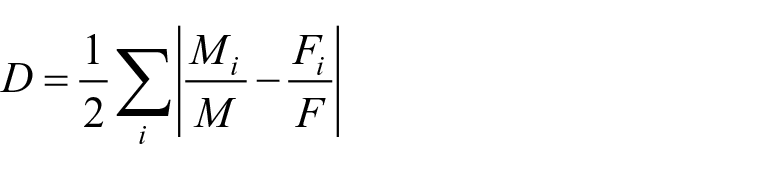
where M is total male employment, F is total female employment, and Mi and Fi are respectively men and women employed in occupation i. The Duncan index ranges from 0 to 1, with low values indicating a low degree of gender segregation: 0 indicates a completely gender-balanced occupational structure with no gender segregation, whereas 1 indicates a completely segregated labour market in which men and women work in separate occupations. The index of dissimilarity measures the share of women (or men) that would have to shift occupation so that every occupation would be gender balanced.
The Duncan index is a standard measure of the degree of gender segregation in the labour market. Some researchers argue that one of its major weaknesses is that it is not ‘margin free’ – meaning it is sensitive to changes in gender shares of employment and occupational structure and, therefore, problematic for cross-country studies (e.g. Charles and Grusky, 2004). In the presented analyses, this weakness is compensated for by including homemaking as an occupation in certain models to explicitly model unpaid labour, which contributes most significantly to cross-country margin differences.
In the multivariate analysis, the panel of countries was used to estimate the within-country association between segregation, measured by job segregation with and without homemakers, and female labour force participation/size of public sector. The following linear regression model was specified:

where
Descriptive statistics
The descriptive statistics in Table 1 show that the sample of individuals was gender-balanced, comprising nearly equal shares of prime working-aged men and women. However, women were less likely to be working. In the sample, 72% of men were categorised as working compared with 62% of women. Furthermore, 14% of women were homemakers, meaning that they were outside the labour market and reported domestic tasks and/or care as their main activity. Regarding country-specific characteristics, the female labour force participation and female employment rates among 20–64-year-olds varied considerably across country-years. Owing to variations in female unemployment rates, the standard deviation of female employment rates was lower than that of female participation rates.
Descriptive statistics (2004–2019): Means and standard deviations.
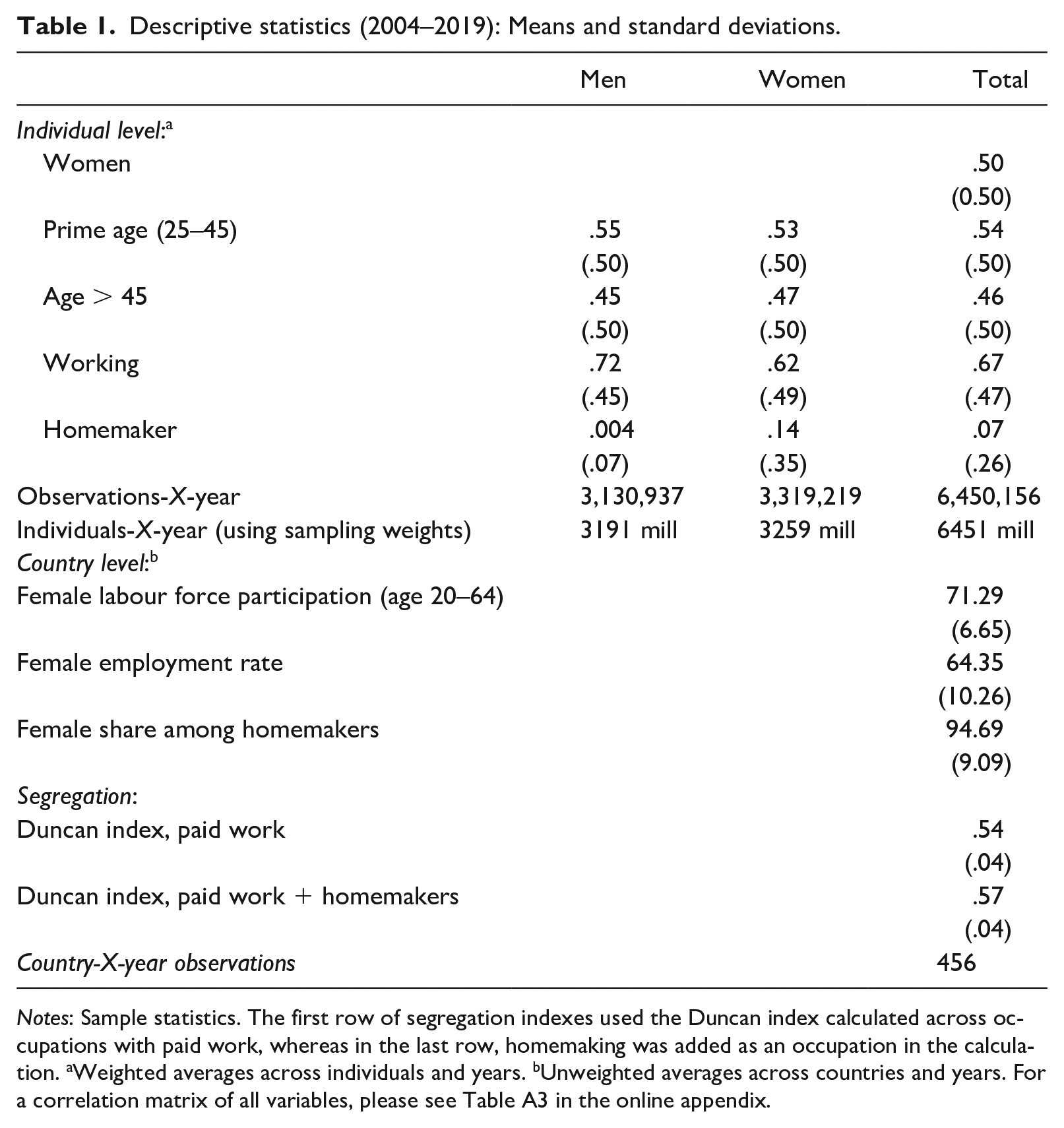
Notes: Sample statistics. The first row of segregation indexes used the Duncan index calculated across occupations with paid work, whereas in the last row, homemaking was added as an occupation in the calculation. aWeighted averages across individuals and years. bUnweighted averages across countries and years. For a correlation matrix of all variables, please see Table A3 in the online appendix.
Country-year-specific Duncan indexes also varied across countries and definitions of ‘jobs’. The average Duncan index among paid workers in the observation period was .54. In other words, 54% of all men and/or women would have to switch jobs to achieve a perfectly gender-balanced labour market in Europe and the United States. When homemakers were included, the index increased to .57 because homemaking is a female-dominated job; in almost every country in the study, more than 90% of homemakers were women. However, most countries in the study experienced a decline in homemaking as a main activity (see online appendix Table A2).
Figure 1 describes recent changes in occupational segregation by country. Because the data comprise an unbalanced panel of countries, the level of segregation in 2007 is compared with 2017, when a larger share of the participating countries are observed. In Figure 1, countries above the 45-degree line experienced an increase in segregation from 2007 to 2017, whereas countries below the 45-degree line experienced desegregation.
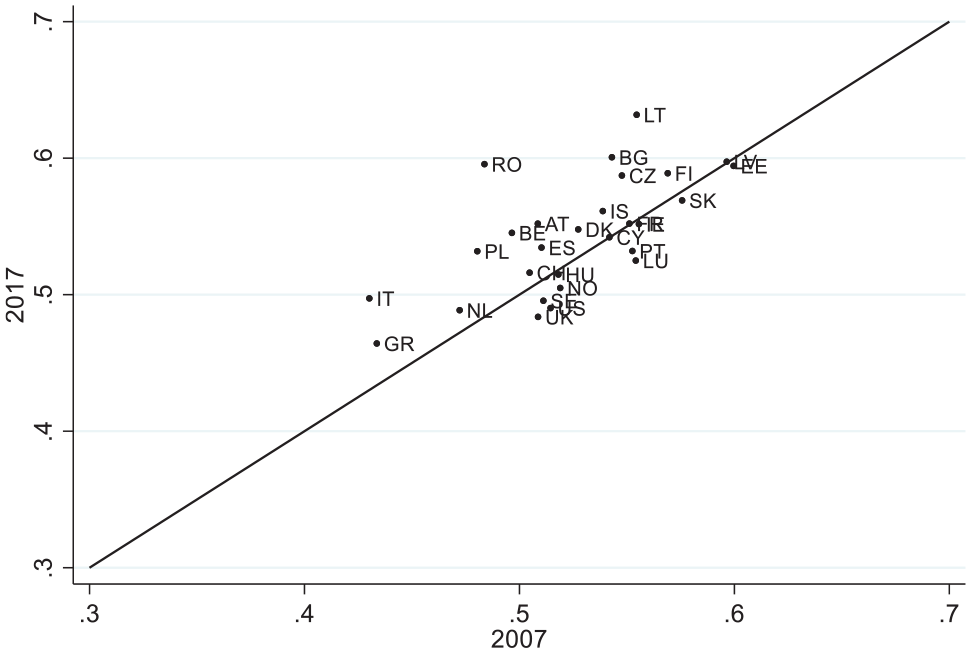
Occupational segregation in Europe and the United States (2007–2017).
The overall pattern shows that the level of segregation across countries was strikingly narrow. With only a few exceptions, every country had a Duncan index in the range of .4 to .6. Moreover, some countries experienced an increase in gender segregation, and others experienced a decrease. Overall, the range in segregation across countries decreased over time. In recent years, countries such as the United Kingdom, the United States, Norway and Sweden have seen a decrease in gender segregation, whereas countries such as Italy, Romania, Lithuania and Poland have seen an increase.
Participation and segregation: The equality hurdle
The previous section established the descriptive patterns comparing the level of segregation in individual countries a decade apart. This section provides an analysis of the association between occupational gender segregation and female labour force participation. The analysis was conducted by pooling the data from all the countries over the 15-year timeframe. As the data consisted of an unbalanced panel of countries, the relationship between labour market segregation and participation was presented in a binned scatterplot. 2 Figure 2 shows the average levels of occupational segregation plotted in 20 equally sized bins of female labour force participation (black circles), net of common year effects. The corresponding best quadratic fit line through the bins (black line) matches the coefficients of a multivariate regression.
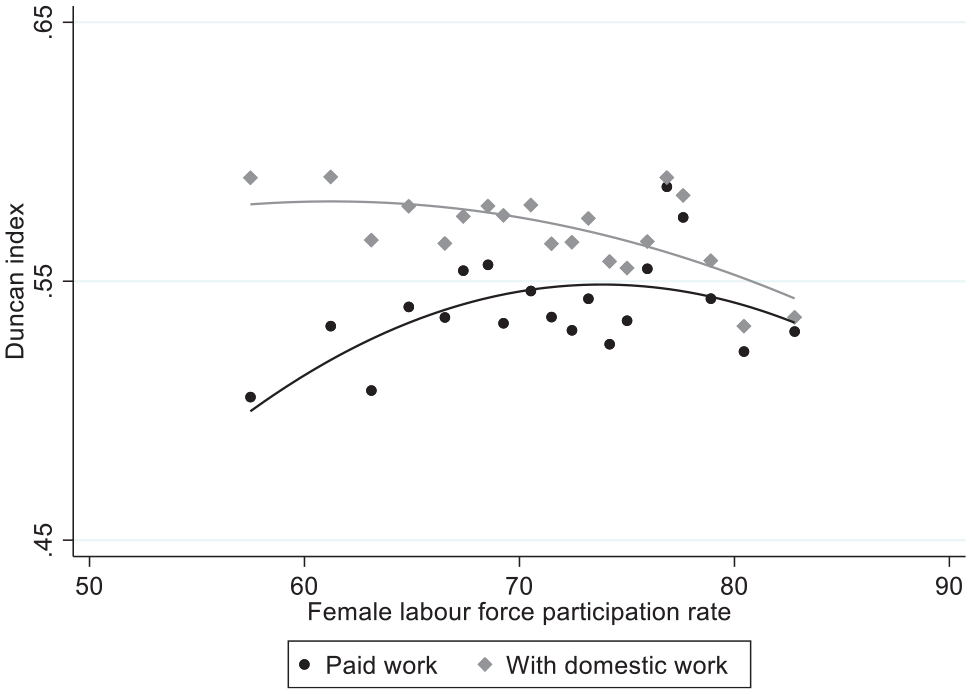
The equality hurdle: labour market segregation and participation in 31 European countries and the United States. Binscatter of longitudinal data (2004–2019).
The figure shows a concave association between occupational gender segregation and female labour force participation. Based on this pattern, the participation-segregation nexus is best described as an equality hurdle. At lower levels of female labour force participation, labour market segregation increased with participation. However, at a point, the relationship turned negative, and job segregation declined as female labour force participation increased. Following the fitted lines in Figure 2, the predicted value of the Duncan index increased by almost 8%, from .51 at 60% participation to the peak of almost .55 at 73% participation, after which it declined towards .53 at participation above 82%. Although the level of segregation was higher at the highest levels of participation than at the lowest levels of participation, the concave empirical association suggests that after a certain point of participation, higher segregation is no longer a hidden cost of higher female participation.
In the next step, the tasks undertaken as unpaid domestic work were added as an additional job category. In the calculation of the index of segregation, those who were outside the labour force but who reported in the survey that domestic tasks were their main activity were included. In this way, homemaking was included as an ‘occupation’ in the calculation of segregation, albeit an unpaid one. The grey diamonds in Figure 2 show the level of segregation by 20 equally sized bins of female labour force participation (as conventionally measured) when homemaking was included in the segregation index.
As expected, the level of segregation was higher when unpaid domestic work was included. Furthermore, the difference between the two segregation measures was larger in countries with low female labour force participation. Unpaid domestic work is dominated by women, and this type of work is more prevalent in countries with lower female labour force participation rates than in countries with high female labour force participation rates. The curve depicted in grey in Figure 2 started to decline at lower levels of participation and approached the level of segregation in paid work as participation rose. Including homemakers in the calculation, the Duncan index declined from .58 at 60% participation to .54 at 82% participation. Even at low levels of participation, women appeared to have shifted from homemaking to jobs with lower levels of gender segregation. As participation increased further, the segregation level approached that of paid work as the role of homemaking diminished.
The descriptive analyses so far show that countries with medium-level female labour force participation rates showed higher segregation rates, while those with low or high female labour force participation showed lower rates of segregation. To ensure that these patterns did not arise from how occupations were defined as occupations within industries or the binning of countries in the scatterplot, a series of sensitivity analyses was conducted, presented in this article’s online technical appendix. Figure A1 in the online technical appendix checks that the observed concave relationship held also when jobs were defined by 2-digit occupation codes only. Figure A2 shows that concave relationship held when looking at median values across countries only. Figure A3 separates between low, medium and high-participation countries according to their median values across all years. This figure shows that countries with low median participation rates contributed to the part of the curve with rising segregation, whereas countries with high median participation rates contributed to the part of the curve with declining segregation. The countries with median participation rates in the middle of the distribution, contributed to the flatter part of the curve, and there was a considerable overlap between the country groups.
Another concern could be that the observation period included the Great Recession and its aftermath, and that this influenced the pattern in the data because of unusual labour market disruptions in the period. Both the recession period and the following years when many European countries implemented heavy austerity measures involved employment changes that affected male- and female-dominated occupations differently (Perugini et al., 2019; Vaughan-Whitehead, 2013). Figures A4 and A5 in the online technical appendix confirm, however, that the observed concave relationship held both during the Great Recession and the main austerity period, as well as outside this turbulent period alone.
Formally, the equality hurdle was tested by comparing a linear specification of the relationship between segregation and female labour force participation with the concave specification. The first model in Table 2 presents the linear specification. This model shows a significantly positive relationship between participation and segregation. In model 2, female labour force participation squared was added. The second-order term was significantly negative, confirming a concave relationship. Adjusted R-squared improved from .144 to .164, and the Within R-squared, considering only variations between countries within years in the data, improved from .053 to .113. The difference in the Aikake Information Criterion (AIC) between the linear and quadric model was 28 (–1653–(–1681)), providing no support for the linear specification (see e.g. Burnham and Anderson, 2004: 271). These observations strongly support the hypothesis of an equality hurdle. Corresponding to the observation in Figure 2, the implied peak of the segregation index was at 73.4% of female labour force participation, after which the relationship turned negative.
Gender segregation and female labour force participation: Occupational segregation with and without homemakers.
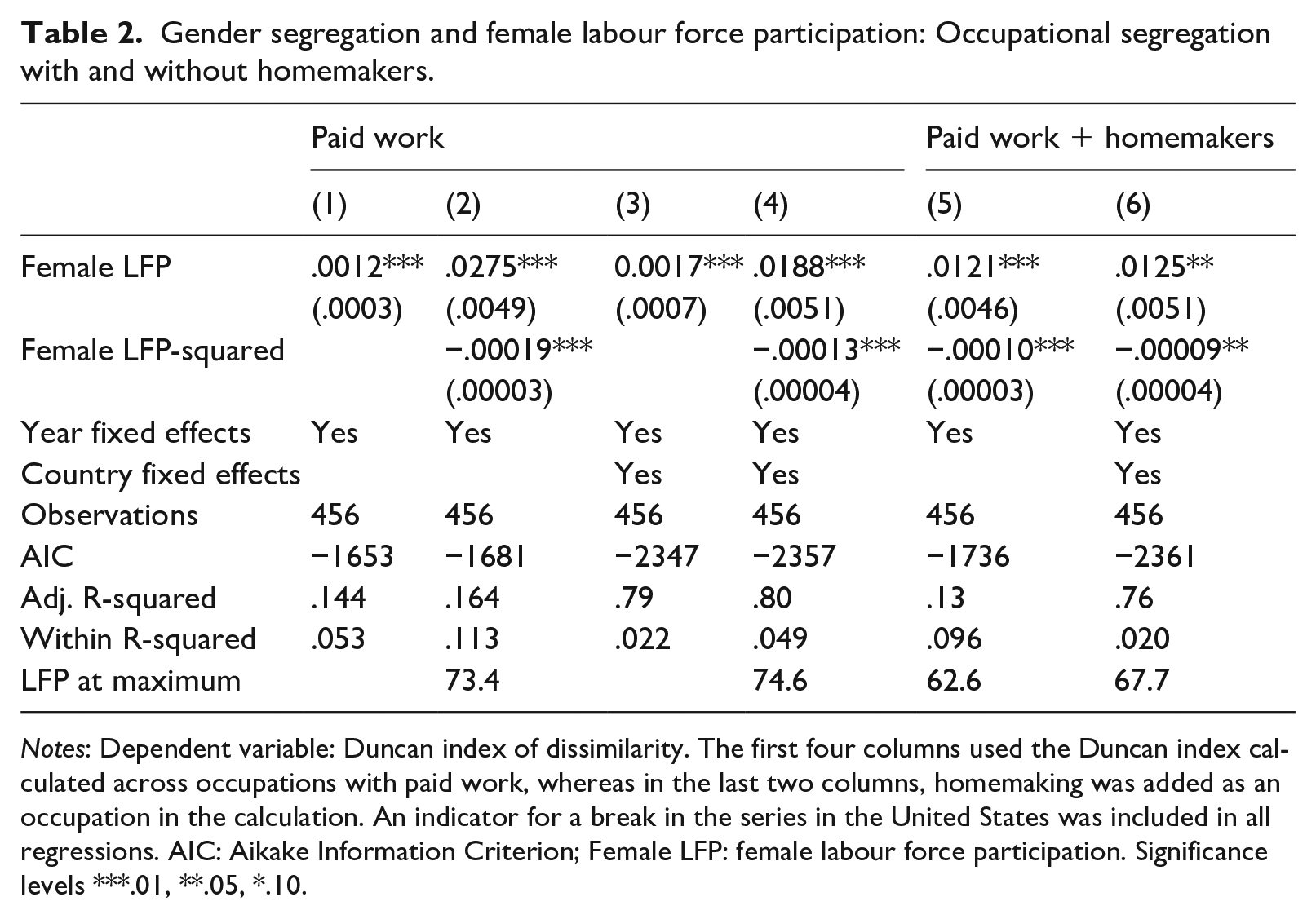
Notes: Dependent variable: Duncan index of dissimilarity. The first four columns used the Duncan index calculated across occupations with paid work, whereas in the last two columns, homemaking was added as an occupation in the calculation. An indicator for a break in the series in the United States was included in all regressions. AIC: Aikake Information Criterion; Female LFP: female labour force participation. Significance levels ***.01, **.05, *.10.
An important concern regarding the interpretation of the findings could be that the observed pattern was the result of unobserved country-specific factors that determine both segregation and female labour force participation. The longitudinal data offered an opportunity to identify the association between female labour force participation and segregation using within-country variation only. Adding country fixed effects to the model effectively removed all unobserved time-invariant factors. Of course, changes in participation within a country over time were much smaller than differences across countries in participation rates, and including both year and time effects may have removed most relevant variation in the data. Despite this, the comparison between models 3 and 4 established a strong concave relationship between gender segregation and female labour force participation utilising only variations within countries. Again, the linear specification was statistically rejected by the significance of the second-order term. The Within R-squared, now measuring the importance of participation for segregation considering only variations within countries as well as years in the data, increased from .022 to .049 when the second-order term for participation was added. The difference in the AIC between the linear and the quadratic specification is 10 when comparing the models with both year and country effects, suggesting that the quadratic specification provided a better model fit. Thus, the equality hurdle is not only a cross-country phenomenon but is also characteristic of the development within countries.
When homemaking was added to the ‘occupations’ in the calculation of the segregation index, the relationship between participation and segregation became less concave and turned negative at a lower level of participation, as suggested in Figure 2. Adding fixed country effects, both coefficients remained significant. This means that within countries, the relationship between gender segregation in paid and domestic tasks and female labour force participation was concave and negative after a participation rate of 69%.
Gender segregation and public sector size
Welfare states with large public service sectors stimulate both the demand for and supply of female labour. They offer services, such as care work, that both provide typically female-dominated jobs and make it easier for women to participate in paid work. Other welfare state regimes may also encourage the supply of female labour. Women’s entry into the labour market on par with men in liberal welfare states, such as the United States and the United Kingdom, implies that many of the same services are established there as well, albeit outside the public sector. Previous research has not convincingly demonstrated why the public ownership, subsidisation and/or organisation of such services (e.g. day care, early childhood education and elderly care) would affect the concentration of women in these jobs. In fact, analyses indicate strong similarities across countries in the share of women in these sectors, but significant variation in these sectors’ share of total employment, as well as women’s integration into private sector jobs (Rubery, 2013). The similarities in demand for such services may, in fact, be one of the reasons why several studies have failed to find a consistent relationship between welfare state regimes and occupational gender segregation (e.g. Charles and Grusky, 2004; Korpi et al., 2013; Nermo, 2000).
The next analysis tested the following simple assumption associated with the so-called welfare state paradox: that welfare states with a large public service sector have higher levels of gender segregation than other welfare states because women disproportionately crowd into feminine occupational niches in the public sector. Women are typically overrepresented in public sector services, such as health care, child and elderly care and education. The first three columns of Table 3 show results from regressions of the relationship between segregation in paid work and public spending on health and education, as a share of GDP. Column 1 shows that a one percentage point increase in public spending was associated with a .5 percentage point reduction in gender segregation. Adding controls for female labour force participation in column 2, the negative relationship between the size of the public sector and gender segregation was retained. The relationship between segregation and participation was not altered when the size of the public sector was introduced to the model. There was no indication that increased public spending on education and health was related to higher gender segregation; instead, the contrary appeared to be the case. The within-country estimates on the public service sector in column 3 remained significant, demonstrating that the observed negative empirical association also arose from variation in the public sector size within countries over time.
Gender segregation and measures of public spending: Occupational segregation in paid work.
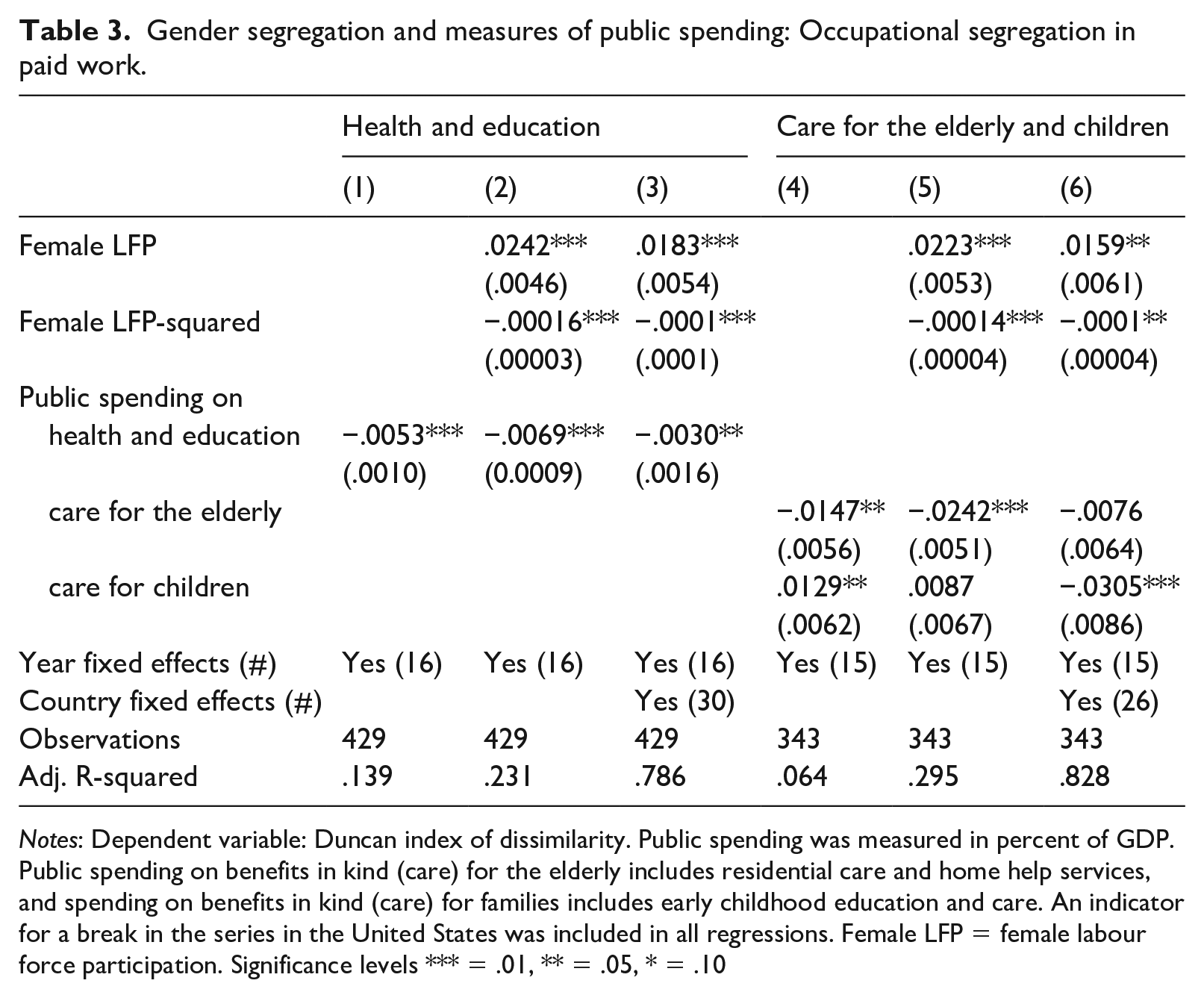
Notes: Dependent variable: Duncan index of dissimilarity. Public spending was measured in percent of GDP. Public spending on benefits in kind (care) for the elderly includes residential care and home help services, and spending on benefits in kind (care) for families includes early childhood education and care. An indicator for a break in the series in the United States was included in all regressions. Female LFP = female labour force participation. Significance levels *** = .01, ** = .05, * = .10
Next, more specific measures of public spending that tend to facilitate women’s labour force participation were introduced; those allocated to care for the elderly, including residential care, and those allocated to care for children, including early childhood education (models 4–6). Again, higher public spending was associated with lower rather than higher segregation. Furthermore, all these models retained a concave association between gender segregation and female labour force participation, after controlling for public spending.
Discussion and conclusion
This article provides a new theoretical framework for understanding the relationship between female labour force participation and occupational gender segregation. The notion of an ‘equality hurdle’ is suggested and confirmed through three key empirical contributions. The first and main finding is that the relation between occupational segregation and female labour force participation is best described as nonlinear, rather than the rising pattern identified in earlier literature. While previous research has been concerned with theoretically explaining and empirically testing the positive association between female labour force participation and gender segregation (Charles and Grusky, 2004; Gupta et al., 2008; Mandel and Semyonov, 2006; Pettit and Hook, 2009), this study is the first to identify a concave relationship between the two. This has implications for future research, which should further explore how and why gender segregation starts to decrease when female labour force participation is high. At low levels of participation, more women entering the labour force is associated with an increase in segregation, whereas at higher levels of participation, more women entering the labour force is associated with a decrease in segregation. It seems that women crowd into female-dominated occupations at earlier stages of female labour participation, but as more and more women work, an increasingly dispersed pattern occurs.
The second key empirical finding is that rising levels of gender segregation are strongly associated with the monetisation of otherwise unpaid domestic work. Once homemaking is included as a job in the calculation of segregation, the relation between labour force participation and segregation turns negative at lower levels of labour force participation. This confirms the theoretical assumption that increased labour force participation among women is associated with a monetarisation of tasks previously undertaken at home – the transformation of non-paid work into paid work. When homemakers are included in the calculation of gender segregation of jobs, gender segregation becomes higher overall, and a concave pattern occurs, peaking at lower levels of female labour force participation, then turning flat and then negative. The initial part of this process is parallel to the pattern described in the literature on the welfare state paradox or inclusion-equality trade-off, but the existing literature has failed to identify the second phase of the process, which seems to occur when female labour force participation stabilises on par with men.
Taken together, these patterns support a theoretical model where women’s increased labour force participation is initially associated with the transfer of tasks into the paid labour market but that this has limited consequences over time. This dynamic is not particular to welfare states with small or large public sectors. The analyses in this article show that the concave pattern remains evident, even after controlling for public service sector spending. In other words, it seems to be a general feature of countries with high female labour force participation, regardless of how the welfare state is organised in terms of public or private service provision. This conclusion is further evinced by the similarities rather than differences in segregation across social democratic and liberal welfare states, such as Norway, Sweden, the United Kingdom, and the United States.
The third key contribution, however, is that high levels of public spending are particularly conducive to decreasing occupational gender segregation in countries with otherwise similar female labour force participation rates. This empirical finding stands in stark contrast to the literature on the welfare state paradox (Mandel and Semyonov, 2006) and the inclusion-equality trade-off (Pettit and Hook, 2009). One reason for this could be that the public sector provides more than ‘sheltered labour markets for women’ (Mandel and Semyonov, 2006: 1911). Although the public sector employs many women, less than half of working women typically work in the public sector, even in the Nordic countries (cf. Rubery, 2013). For many women who work in the private sector, and their families, the welfare state remains a provider of services, labour market protection and fiscal benefits that may be perceived as more accessible and stable in countries with higher levels of public spending on health, education and care.
The role played by public sector employment for occupational gender segregation is, of course, complicated by the various degrees to which new public management strategies, such as outsourcing and competition, are implemented. This study, therefore, emphasised public spending, which has been less affected by outsourcing and competition than public employment. The accessibility, stability and affordability of welfare services that are associated with higher levels of public spending likely produce similarities across countries with varying levels of outsourcing of public services to private employers. Prime examples are Norway and Sweden, where patterns of labour market participation and occupational gender segregation are very similar, even though the outsourcing of public services has been more pervasive in Sweden than in Norway.
Recent research indicates that welfare states that actively support dual earner/dual carer norms also seem to reduce employer bias towards women (e.g. Bygren and Gähler, 2021; Carlsson et al., 2021), which may help explain why high public sector spending on health, education and care contributes to desegregation. Moreover, in welfare states with relatively large public sectors, the share of women in high-level positions in the public sector has increased dramatically over time. Although most women in the public sector work in childcare, teaching and nursing, the increased share of women among high-level managers, doctors, lawyers, academics and politicians indicates that, in contrast to the proposition that public sector employment channels women away from lucrative and powerful positions (cf. Mandel and Semyonov, 2006), women have been gaining access to more diverse careers in the public sector in recent decades.
Future research should investigate why occupational gender segregation starts to decrease when women’s labour force participation approaches parity with men’s. Of particular interest would be whether there is variation in the concentration of men and women across countries that differ in economic structure and why public spending seems to have been negatively associated with gender segregation over the last decades. The analyses in this article have been limited to testing the influence of public service sector spending, but future research should investigate the influence of other features of welfare state regimes, such as variation in labour market regulation. It would also be relevant to explore what roles labour migration and ethnic inequality play in increasing or decreasing gender segregation in various national contexts. Moreover, some desegregation has likely occurred due to men’s gradual inroads into care tasks that have been established as paid rather than unpaid labour. How the representation of men in female-dominated occupations vary across welfare state contexts and what contributes to non-traditional occupational choices among men could be pursued in future research.
As the concave empirical pattern and suggested concept of the equality hurdle indicate, there seems to be a lag in the consequences of female labour force participation for labour market desegregation. This lag has policy implications in the sense that increasing levels of gender segregation within a national context in which female labour force participation is low should be met with different policy measures than in a context of increasing or unchanging levels of gender segregation in which participation is medium or high. Moreover, the equality hurdle implies that the monetisation of previously unpaid domestic work increases gender segregation in the short term, but that high female labour force participation eventually leads to desegregation of both jobs and tasks in the longer run. One policy implication, strengthened by the empirical analyses provided in this article, is that welfare state policies that contribute to female labour force participation eventually contribute to desegregation as well.
Given the relatively small variation in levels of occupational gender segregation across countries with similar levels of female labour force participation but vastly different welfare state models, this article’s main conclusion is that countries with expanding opportunities for women’s labour force participation tend to experience a decrease in gender segregation once women’s labour force participation becomes the norm. This overall pattern holds regardless of public sector size. However, the findings also indicate that high relative levels of public sector spending contribute to desegregation. In other words, far from being paradoxical, more equality in participation begets more equality in the distribution of jobs, as well as in gendered tasks overall.
Supplemental Material
sj-docx-1-wes-10.1177_09500170231155293 – Supplemental material for The Equality Hurdle: Resolving the Welfare State Paradox
Supplemental material, sj-docx-1-wes-10.1177_09500170231155293 for The Equality Hurdle: Resolving the Welfare State Paradox by Erling Barth, Liza Reisel and Kjersti Misje Østbakken in Work, Employment and Society
Footnotes
Acknowledgements
The authors would like to thank the anonymous reviewers for their constructive feedback, and Pål Schøne and Ines Hardoy for their contributions at the initial stages of the research process. An earlier version of this article was presented at the ESA conference in Athens in 2017, and at Stockholm University, SOFI in 2019. The authors would like to thank the organisers and participants for useful comments.
Funding
The authors disclosed receipt of the following financial support for the research, authorship, and/or publication of this article: The authors would like to acknowledge funding from the Research Council of Norway, through the projects Gender Segregation in the Labour Market: Comparative Perspectives and Welfare State Challenges, grant no. 236770 and Changing Health and Skills Requirements, grant no. 280307 and CORE, Centre for Research on Gender Equality.

Supplementary material
The supplementary material is available online with the article.
Notes
References
Supplementary Material
Please find the following supplemental material available below.
For Open Access articles published under a Creative Commons License, all supplemental material carries the same license as the article it is associated with.
For non-Open Access articles published, all supplemental material carries a non-exclusive license, and permission requests for re-use of supplemental material or any part of supplemental material shall be sent directly to the copyright owner as specified in the copyright notice associated with the article.
