




Abstract
Does entering the labour market via precarious employment have a long-term scarring effect on one’s career? Prior research proposes diverse arguments, but firm conclusions remain elusive. Using panel data from Hong Kong, this study rekindles this debate by revealing the long-lasting effect of first job precarity on workers’ subsequent career prospects. A comprehensive measure of precarious employment is constructed to simultaneously account for employment status, contractual status and occupational status, and random effects models are used to test the scarring effect of first job precarity on subsequent monthly income, job satisfaction and fringe benefits. It is also observed that macroeconomic situations, particularly periods of economic crisis, have a detrimental effect on entry into precarious employment. Importantly, the results show the substantial negative consequences of initial precarious employment, highlighting the adverse impact of economic crises on first job precarity and the subsequent scarring effect on career prospects.
Introduction
There is a common saying that ‘a good start is halfway to success’. For young graduates entering the labour force, the conditions of their first job can have lasting effects on their career progression. As the labour market becomes increasingly deregulated and competitive in the era of neoliberal globalisation, new entrants are facing increasing pressures to successfully transition from school to work (OECD, 2018). Under the doctrine of ‘any job is better than none’, many people are forced to start their careers in temporary, insecure and undesirable jobs (Buchholz et al., 2009; Hofmeister et al., 2006; Stuth and Jahn, 2020). Such jobs are inherently precarious because they typically provide relatively low wages, limited benefits, inadequate protection of labour rights and offer no security or advancement (Alberti et al., 2018; Campbell and Price, 2016; Kalleberg, 2011). Precarious jobs also deprive young people of the sense of stability needed to make long-term life decisions and plan their careers, which inevitably fuels frustration and grievances. The rise of precarious work increases inequalities in modern societies (Kalleberg and Mouw, 2018) and underscores the importance of studying the long-term scarring effect of initial precarious employment status on workers’ future career prospects.
In recent decades, the global economy has suffered from a number of economic crises, manifested through an increasingly monopolised trend of capital, the deregulation of the labour market and employment and the rapid emergence of precarious work regimes that may have adverse and long-term impacts on workers worldwide (Harvey, 2014). In the face of economic crises, policymakers have promoted labour market flexibility to enhance the competitiveness of firms and ensure economic rebounding, leading to a decline in lifelong, full-time, regular and decent work while increasing temporary, part-time, atypical and undesirable work. This has led to the transfer of risks and responsibilities from employers to employees, leaving the working class more deprived and vulnerable than before (Smith and Pun, 2018). This fundamental transformation in labour relations since the 1970s has raised concerns over employment precarity, particularly among social scientists working to enrich the debate on the relationships between the labour market, flexible employment and decent work (Rubery et al., 2018; Standing, 2014; Vosko, 2006).
It is important to note that the concept of job precarity extends beyond flexible, non-standard work and temporary contracts (Benach et al., 2014). Precarious jobs refer to more than flexible jobs with non-permanent contracts. They are, by any standard, bad jobs with multiple connotations (Kalleberg, 2011). A narrow, contract-based definition may fail to conceptualise the scope of employment precarity. Thus, a comprehensive measure of precarious employment is constructed in this study to investigate whether job precarity has long-lasting effects on subsequent labour market outcomes.
This study also investigates whether periods of economic crisis led to a higher risk of entering into precarious employment as systematic research on this relationship is lacking, particularly among new entrants. The importance of addressing this knowledge gap is highlighted by the amount of young people affected by increasing fluctuations in the global economy throughout the COVID-19 pandemic and its aftermath. Even before the pandemic, some scholars suggest that the Great Recession in 2008 catalysed further labour market deregulation and casualisation, leading to severe employment insecurity among workers worldwide (Kalleberg, 2011; Rubery et al., 2018; Standing, 2014; Vives et al., 2010).
This article thus examines whether initial precarious employment has lasting effects on subsequent labour market outcomes, paying special attention to the role of economic crises. To establish a contextualised theoretical framework of precarious employment that facilitates international comparisons, a Precarious Employment Index (PEI) is constructed to extend beyond traditional definitions based on contracting or agency labour. This composite measure encompasses three dimensions: employment status (part-time/full-time employment), contractual status (temporary/permanent contract) and occupational status (International Socio-economic Index of Occupational Status, ISEI).
The empirical analysis is based on data from four waves of the Hong Kong Panel Study of Social Dynamics (HKPSSD) collected between 2011 and 2018. Hong Kong provides an interesting case study for study because it illustrates both the benefits and pitfalls of a globalised economy in the developed world. With a focus on economic efficiency and corporate profits, Hong Kong is one of the most developed economies in the world and ‘the modern exemplar of free markets’ (Friedman and Friedman, 1990: 34). On the other hand, Hong Kong has extremely high inequalities in terms of job prospects, and many young workers are heavily burdened by the growing structural uncertainty induced by labour market flexibilisation (Wong and Au-Yeung, 2019). Furthermore, Hong Kong’s deep involvement in the global economy easily exposes its workers to global economic fluctuations. For these reasons, this study employs the example of Hong Kong to illustrate the impact of economic crises on precarious employment, especially among young graduates.
The consequences of bad labour market entry
Prior quantitative studies have attempted to examine the career effects of flexible entry into the labour market via a temporary contract or part-time job (Gebel, 2010; Scherer, 2004; Steijn et al., 2006; Stuth and Jahn, 2020). Contrary to expectations, these studies find that non-standard work arrangements among new entrants are not associated with significant career penalties in subsequent years. Labour market outcomes converge with regular work despite longer durations of early-career unemployment (see Scherer, 2004; Steijn et al., 2006). For example, in a comparative study of West Germany, Great Britain and Italy, Scherer (2004) finds that a fixed-term contract does not harm new entrants’ future occupational positions. Similarly, Gebel (2010) observes that temporarily employed entrants to the German workforce typically obtain permanent employment and overcome their initial disadvantages within five years, while this integration is even more pronounced in the UK. Moreover, a study of 11 European countries suggests that part-time work is more likely to promote entry into, rather than exit from, the labour market (Buddelmeyer et al., 2005). Overall, these studies suggest that flexible employment can serve as an ‘entry port’ or a ‘stepping stone’ to stable employment.
The lack of a negative career effect may be because focusing on the temporal or contractual aspects alone does not sufficiently capture the lasting impact of employment precarity. Nonetheless, recent efforts have been made to develop multidimensional measures of precarious employment. For instance, the Employment Precariousness Scale (EPRES) focuses on six domains of job precariousness: temporariness, disempowerment, vulnerability, low wages, workplace rights and the ability to exercise them (Vives et al., 2010). Despite the usefulness of these measures, data limitations often inhibit comparative analysis as they typically require information obtained from detailed questionnaires, which have only been recently introduced in regional and thematic surveys. The flexibilisation of employment contracts is not unique to low-skilled workers (Bernardi, 2003), and its application to well-paid, high-status jobs may somewhat mask the damages of labour market deregulation and precarious work conditions. Therefore, narrow and simple definitions of precarious employment based on contractual aspects alone should be supplemented by occupational status in the analytical framework of employment precarity.
Numerous studies in stratification research have long sought to meaningfully categorise and rank people’s occupations to study their relative positions within the social hierarchy (Ganzeboom et al., 1991; Treiman and Ganzeboom, 2000). One of the most compelling findings from this line of research is the ‘Treiman Constant’, which shows that occupations are similarly ranked across the industrialised world and over time (Hout and DiPrete, 2006). This finding leads to the creation, validation and application of an international measure of occupational status derived from the International Standard Classification of Occupations (ISCO), also known as the ISEI (Ganzeboom and Treiman, 1996). The ISEI scale has proven to be an extremely useful tool for comparative social research because it provides an overall assessment of the quality of a set of similar jobs and is closely linked to many individual socio-economic outcomes. This study integrates this index into the framework of employment precarity, which not only adds another layer to existing theory but also greatly improves the explanatory power of the measure.
Economic crises and precarious employment
Despite frequent media speculation that economic crises create unemployment and precarious employment, few labour studies explore this relationship in depth. Other than impressionistic or descriptive reports, the effect of economic crises on the nature and extent of precarious employment remains understudied. Sociologists observe that economic downturns may put more pressure on employers to cut labour costs by flexibilising jobs (Kalleberg, 2011; Rubery et al., 2018; Vives et al., 2010). During economic crises, unemployment rates not only rise dramatically but many full-time positions are filled by part-time or casual workers (Kang et al., 2020). For instance, precarious employment rates significantly increased in most European countries after the Great Recession (Gutiérrez-Barbarrusa, 2016). An OECD report also suggests that young workers may particularly suffer during economic crises due to higher levels of unemployment and the possible negative consequences of unsuccessful labour market entry (Scarpetta et al., 2010).
Thus far, few studies have directly investigated the impact of economic crises on the precariousness of young workers’ first jobs and on their subsequent career prospects. This study therefore specifically tests whether entering the labour market during a period of economic crisis leads to first job precarity, which subsequently has a scarring effect including wage penalty, job dissatisfaction and lack of fringe benefits. In doing so, it challenges the belief that ‘bad jobs’ are derived from individual characteristics and unrelated to macro-economic factors, and contributes to establishing the hypothesis that economic crises strongly influence new entrants’ job precarity in the labour market and lead to negative career outcomes with a scarring effect. This study thus fills research gaps by directly investigating the relationship between economic crises and precarious employment among young workers in Hong Kong. Background information on this point is provided in the following section.
The case of Hong Kong
Milton Friedman, Nobel laureate in economics, once said: ‘If you want to see capitalism in action, go to Hong Kong!’ (Tsang, 2010). For decades, neoliberal economists have praised Hong Kong as the world’s freest economy and attributed its success to the so-called laissez faire approach (Friedman and Friedman, 1990). The Hong Kong government long maintained an ideology of positive non-interventionism in the economy until the recent strong influence of China’s central government and Hong Kong’s subsequent economic integration into the Greater Bay Area of Guangdong. Despite this huge and rapid change, extremely low levels of labour market regulation and unionisation continue to promote precarious employment characterised by fixed-term employment contracts, flexible working hours and overtime work (Wong and Au-Yeung, 2019). Young recent entrants to the labour force suffer the most from this deepening labour market deregulation, despite being more educated than earlier cohorts (Jin et al., 2022; Pun et al., 2022).
Given Hong Kong’s strong global economic integration, employers generally have great freedom in hiring and firing, leaving employees exposed to various risks in the labour market (Pun et al., 2021). This instability in employment relationships is most evident during severe economic crises when employers typically carry out massive layoffs and downsizing to reduce costs and cope with business downturns. As shown in Figure 1 and listed as follows, major economic crises 1 in Hong Kong have always been accompanied by sudden spikes in unemployment and underemployment rates. (1) 1981–1983: In 1981, the Sino–British negotiations on the transfer of sovereignty over Hong Kong reached a deadlock, triggering a severe stock market crash and economic disturbance. (2) 1998–2000: Not long after the handover, fallout from the Asian financial crisis (AFC) in 1998 hit Hong Kong’s economy. Under heavy stock market speculation, the Hang Seng Index fell more than 60% in August 1998. The real economy also suffered as the property market deflated by half and GDP fell by 5.1 percentage points (IMF, 1999). (3) 2001–2003: Between 2001 and 2002, Hong Kong’s economy entered an economic crisis amid a worsening external environment prompted by the global economic downturn. GDP growth decelerated sharply from 10.5% in real terms in 2000 to only 0.1% in 2001 (IMF, 2002). Just as signs of economic recovery were emerging, the SARS epidemic struck in March 2003, leading to another collapse in domestic demand. (4) 2009–2011: Triggered by the bursting of the US housing bubble, the global financial crisis (GFC) ravaged most of the world’s major economies, including Hong Kong. Hong Kong’s export demand worsened during 2008, putting strong downward pressure on the local economy. Between September 2008 and March 2009, Hong Kong’s trade volumes fell by 21% (Yellen, 2010) and GDP fell by 10.8%. 2
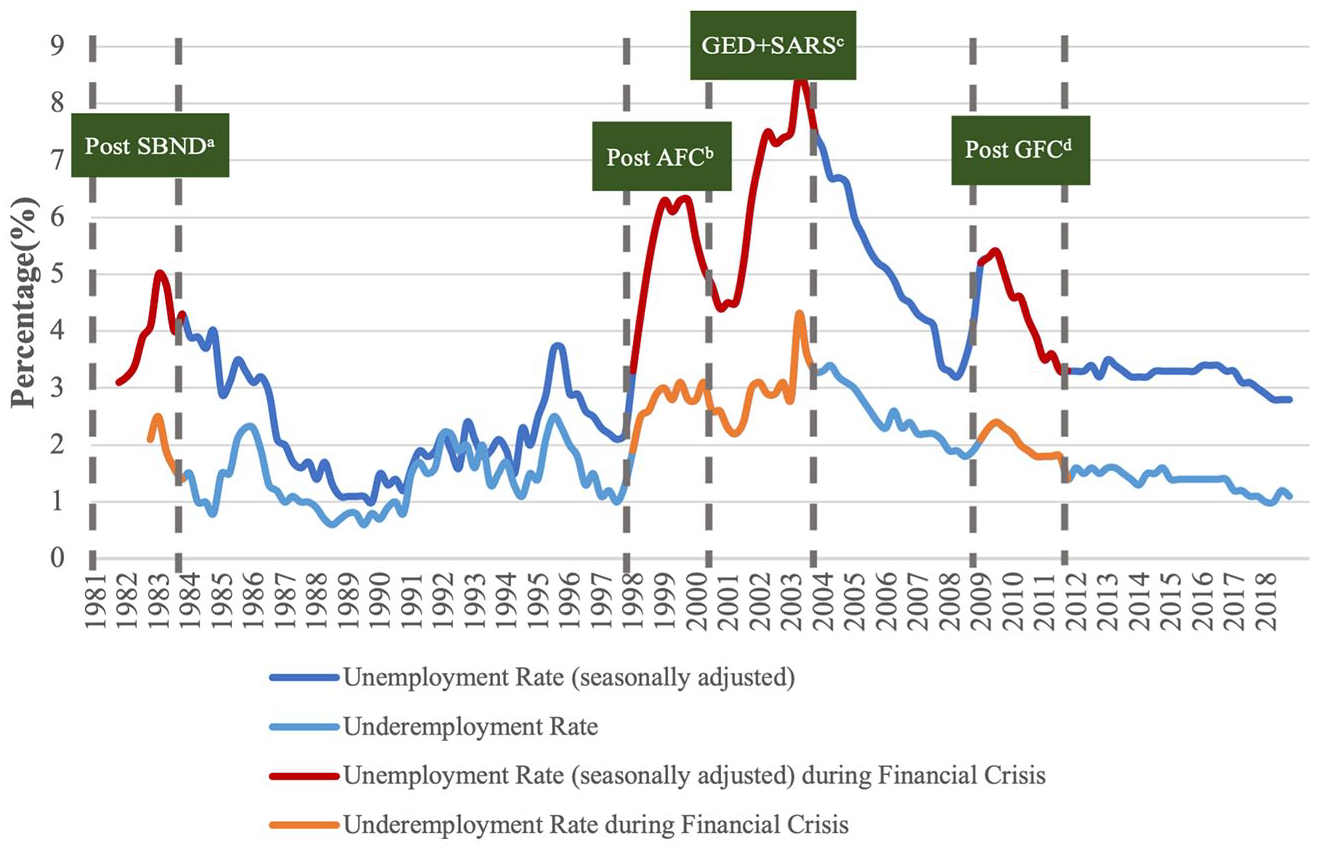
Unemployment and underemployment rates in Hong Kong, 1982–2018.
Presumably, when unemployment or underemployment rates are high, the resulting labour surplus reduces the bargaining power of workers. This disincentivises the recruitment of new employees and makes companies less likely to offer attractive benefits or packages when they do hire new employees. Faced with such poor labour market conditions, jobseekers, particularly new graduates, are more likely to enter precarious employment. While precarious first jobs may be a ‘stepping stone’ in societies with comprehensive employment protection systems (such as in EU countries: Gebel, 2010; Scherer, 2004), this may not be the case in Hong Kong. With extremely weak employment protection legislation, there are limited regulations to restrict the negative impact of precarious employment on workers’ future career development.
Based on the above discussion, Hong Kong provides a valuable case for studying the labour market consequences of precarious employment in times of economic crisis in a neoliberal market economy.
Data and variables
The empirical analyses draw on four waves of data from the HKPSSD. As the first city-wide representative panel study in Hong Kong, the HKPSSD collects data at the household and individual levels to track social and economic changes in Hong Kong and their effects on people’s lives. The baseline survey conducted in 2011 included 7218 adults and 958 children from 3214 households, who then participated in subsequent survey waves in 2013, 2015 and 2017/18 (Wu, 2016). The individual-level retention rates of the HKPSSD were 72.5% and 85.1% for the second and third waves, respectively (Wu, 2016). As not all respondents from the baseline survey were available for all of the follow-up surveys, the data set is intrinsically unbalanced as the number of observations of each individual may vary.
The study sample is restricted to individuals who (1) were born in Hong Kong or mainland China after 1949, (2) worked as salaried or hourly employees at the time of the survey and (3) had changed jobs at least once since leaving school by the time of the last wave of the survey. Note that data from employers, self-employed individuals or unpaid family workers are excluded, as these groups are extremely heterogeneous and only represent 7.3% of Hong Kong’s total labour force. 3
Information about the respondents’ first jobs 4 was collected retrospectively at the first wave of the HKPSSD (if their current job was not their first job), and information about their current job was collected at the time of each wave. This means that individuals in the sample entered the labour market at different time points before 2011, and some may already have substantial work history. In the sample used in this study, 73% of the respondents had more than 10 years of work experience and 48% had 20 or more years. This data structure allows for an examination of the long-term effect of precarious employment at labour market entry.
The key independent variable first job precarity is measured by a multidimensional index that includes three aspects of the precariousness of entry into the labour market: (1) employment status (1 = part-time employment, 0 = full-time employment); (2) contractual status (1 = temporary contract, 0 = permanent contract); and (3) occupational status (ISEI score based on the three-digit ISCO-88 code).
As two of the three indicators are dichotomous, a factor analysis using a polychoric correlation matrix is used instead of the Pearson correlation matrix (Holgado-Tello et al., 2010; Kampen and Swyngedouw, 2000; Kolenikov and Angeles, 2004). The factor analysis yields a single principal component and a PEI measure is constructed by standardising this principal component. The standardised PEI scores range from 0 to 100, with higher values indicating higher levels of employment precarity. A composite index of employment precarity can offer us a general view on the overall precariousness the worker experienced and allow direct comparisons cross time and region. However, as a dimension reduction technique, factor analysis unavoidably results in a loss of information and the differences in index values are difficult to interpret meaningfully. Thus, a standardised scoring equation illustrating the relationship between the index and each sub-index is provided to improve understanding:

This denotes that temporary contracts and part-time employment, respectively, increase the PEI score by 11.64 and 8.84. A one-point increase in the ISEI score leads to a decline of 1.15 points in the PEI score. For example, a part-time street cleaner (ISEI score: 23) with a temporary contract has a PEI score of 91.99 (97.96 + 11.64 * 1 + 8.84 * 1 − 1.15 * 23), a full-time salesperson (ISEI score: 43) with a temporary contract has a PEI score of 60.15 (97.96 + 11.64 * 1 + 8.84 * 0 – 1.15 * 43) and a full-time accountant (ISEI: 69) with a permanent contract has a PEI score of 18.61 (97.96 + 11.64 * 0 + 8.84 * 0 – 1.15 * 69). Note that the relative weights of these three indicators in the PEI composition can vary across social contexts, which could be an interesting topic for further studies.
The consistency of the relationship between the PEI measure and related variables with theoretically derived hypotheses concerning precariousness is examined to evaluate the construct validity of the PEI measure. Theoretically, the disadvantaged social groups in the labour market, such as immigrants (e.g. Nobil Ahmad, 2008) and non-college graduates (e.g. Kalleberg, 2011), are more likely to have precarious jobs. This is supported by t-test results showing that immigrants and non-college graduates have significantly higher PEI scores than their counterparts, which validates the construct validity of the PEI measure.
Three outcome variables are used to evaluate the career effects of precarious entry for all subsequent jobs: (1) average monthly employment income (in logarithmic form to account for the highly skewed distribution); (2) job satisfaction (using a five-point scale ranging from 1 ‘very unsatisfied’ and 5 ‘very satisfied’); and (3) rights to fringe benefits (a dummy equal to 1 if a respondent is entitled to any of the following: medical benefits, dental benefits, pension other than the Mandatory Provident Fund [Hong Kong’s official contributory pension scheme], education allowances for children, and housing allowances).
Other socio-demographic controls include sex (male = 1), birth cohort (post-50s = 1, post-60s = 2, post-70s = 3, post-80/90s = 4), highest level of education attained (primary school or below = 1, lower secondary = 2, upper secondary = 3, tertiary [sub-degree] = 4, tertiary [degree] = 5), immigrant status (native resident = 1, mainland immigrant who arrived at or before age 14 = 2, mainland immigrant who arrived at or after age 15 = 3). Parental occupational status (professional/managerial = 1) when a respondent was 14 years old is also included as an indicator of their family socioeconomic background.
Empirical results
Descriptive statistics
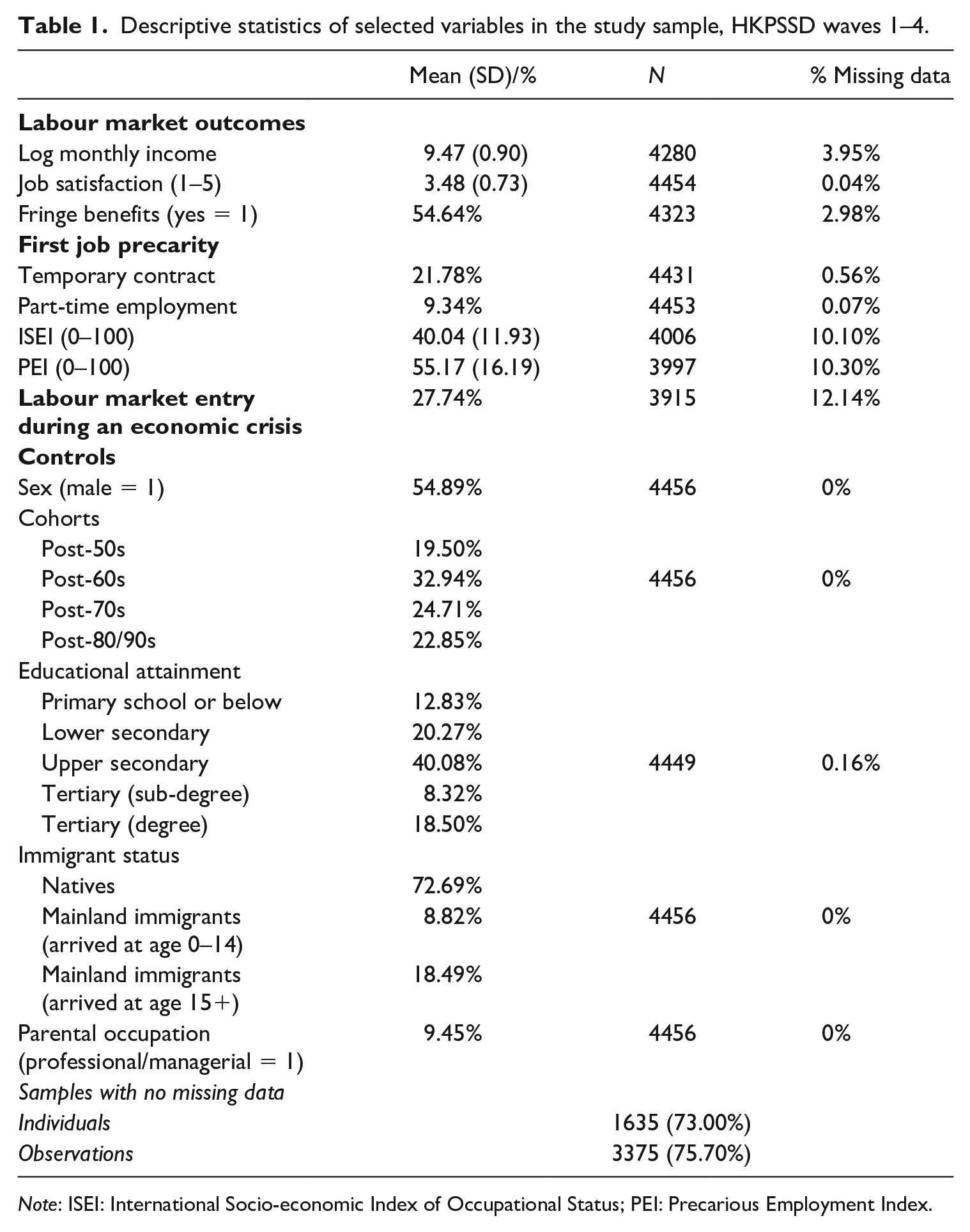
The distribution of the key variables in the study sample is reported in Table 1. Over 70% of the cases have no missing data on any of the relevant variables. Most of the missing data concern detailed occupational information and the exact year of labour market entry. After listwise deletion, 3375 person-year observations from 1635 unique workers remain for analysis. 5
Descriptive statistics of selected variables in the study sample, HKPSSD waves 1–4.
Note: ISEI: International Socio-economic Index of Occupational Status; PEI: Precarious Employment Index.
Among all new entrants to the labour market (N=1635), 11.01% worked part-time, 21.65% were employed with a temporary contract and 23.43% had a relatively low occupational status (see Figure 2). 6 The Venn diagram in Figure 2 illustrates the similarities and differences among these three characteristics of first jobs. Some degree of overlap among the three circles is expected because they represent interrelated dimensions that are rooted in a common underlying concept: employment precarity. However, substantial overlap suggests that a single factor can capture most of the variance, eliminating the need to focus on separate factors. As shown in Figure 2, this is not the case in this study, necessitating the consideration of all three dimensions simultaneously when assessing employment precarity and supporting the use of the PEI measure.
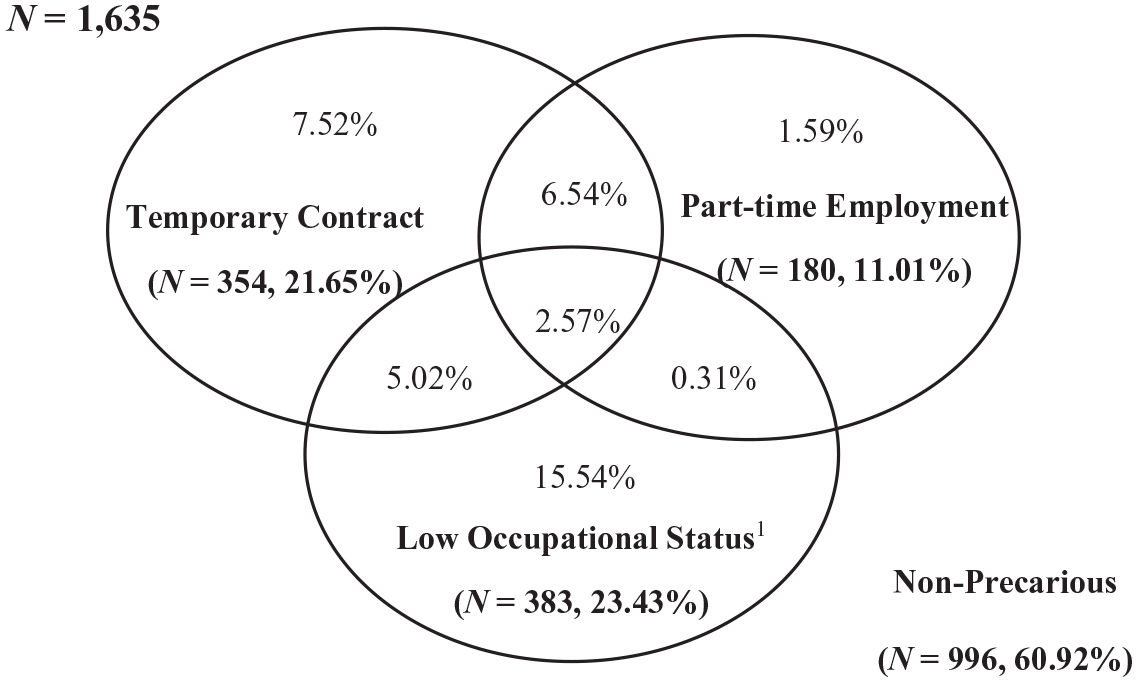
Venn diagram of the three dimensions of employment precarity.
This study uses three labour market outcomes. The average monthly income of the respondents was HK$12,965 (e9.47), which was very close to the official statistic of HK$12,880 reported at the end of 2011. 7 The average self-rated job satisfaction among workers was 3.48 (on a scale of 1 to 5) and more than half were entitled to at least one fringe benefit. A wide array of socio-demographic variables is also controlled for in the analysis. Owing to the lower rate of participation of women in the labour force, men represented over half of the sample. Data from the two youngest generations are combined as few respondents born after the 1990s had joined the labour force by the time of the baseline survey in 2011. More than a quarter of the respondents completed tertiary education, including sub-degree (8.32%) and degree (18.50%) programmes, before entering the labour market. About 27% of the sample were mainland immigrants, a third of whom arrived before the age of 15. Less than 10% of the respondents had fathers or mothers belonging to the professional–managerial class when they were 14 years old.
The scarring effect of first job precarity on subsequent labour market outcomes
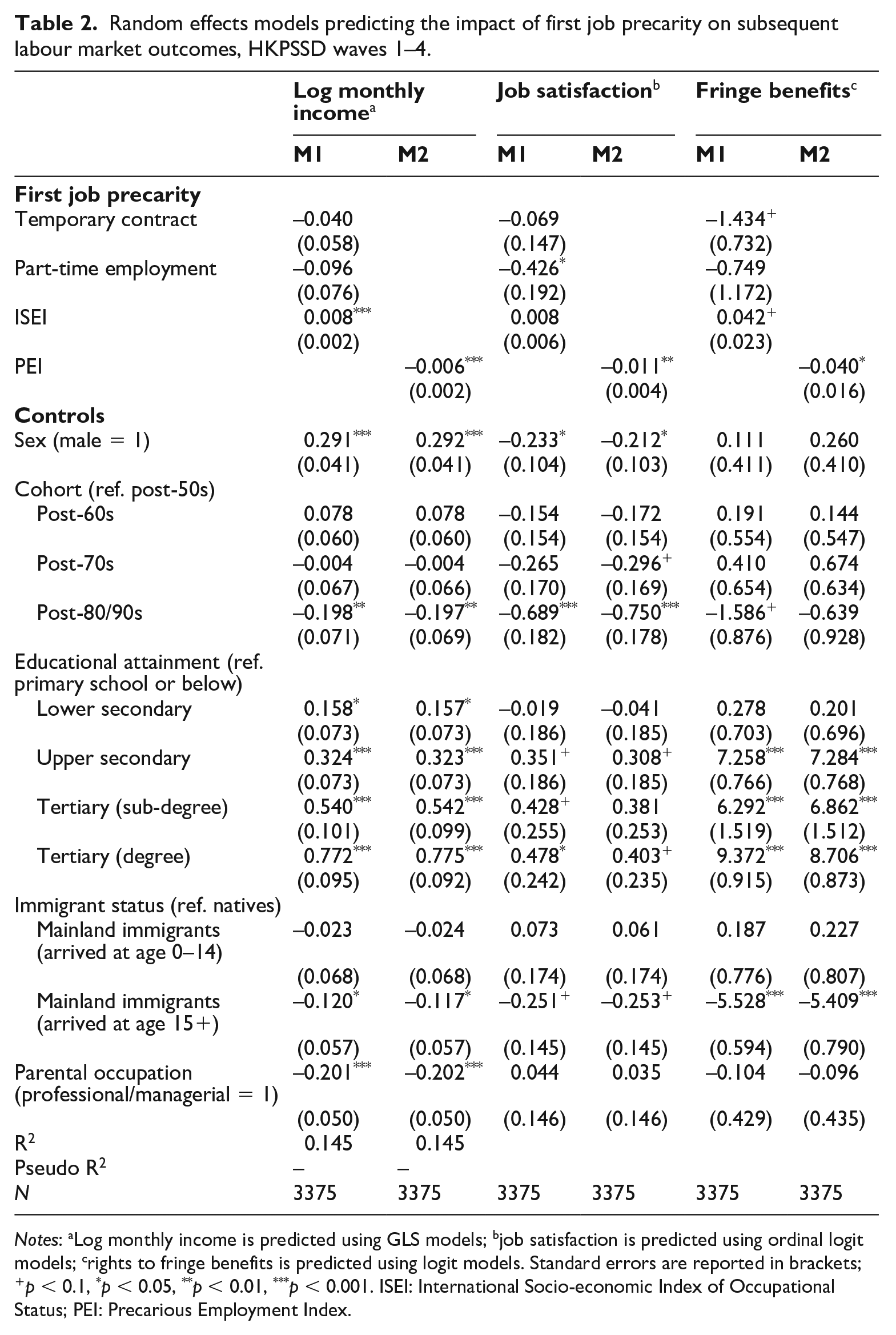
Given that the main variable of interest is time-constant and would be automatically dropped in a fixed effects model, random effects models are used. Depending on the level of measurement of the outcome variable, generalised least squares (GLS) regressions, ordered logit regressions and binary logit regressions are respectively used to predict log monthly income, job satisfaction and rights to fringe benefits. The results are reported in Table 2.
Random effects models predicting the impact of first job precarity on subsequent labour market outcomes, HKPSSD waves 1–4.
Notes: aLog monthly income is predicted using GLS models; bjob satisfaction is predicted using ordinal logit models; crights to fringe benefits is predicted using logit models. Standard errors are reported in brackets; +p < 0.1, *p < 0.05, **p < 0.01, ***p < 0.001. ISEI: International Socio-economic Index of Occupational Status; PEI: Precarious Employment Index.
In Model 1, employment status, contractual status and occupational status are added separately. As shown in Table 2, these three variables are associated with different labour market outcomes to varying degrees. Specifically, workers who started with an occupation with a low ISEI rank tended to earn less in their subsequent careers; those who started with part-time employment tended to be less satisfied with their subsequent jobs; and those who started with a temporary contract or an occupation with a low ISEI rank were less likely to receive job benefits in the future. In general, the three variables of first job precarity have different influences on subsequent labour market outcomes.
Model 2 uses the PEI composite measure and reveals a persistent scarring effect of first job precarity on all labour market outcome measures. All else being equal, entering the labour market via precarious employment is associated with lower levels of income and job satisfaction, as well as reduced opportunities to receive fringe benefits in subsequent employment. For example, holding other things constant, a 10-point increase in first job PEI (on a scale of 0–100) is associated with a 6.2% (1 − e–0.006*10) decrease in monthly income, a 10.4% (1 − e–0.011*10) decrease in the odds of high job satisfaction and a 33.0% (1 − e–0.040*10) decrease in the odds of having fringe benefits. Compared with the three components used in Model 1, the PEI measure integrates different aspects of precarious employment and thus can better predict future labour market consequences. This further demonstrates the strong explanatory power of the proposed measure.
In addition to the above results, several interesting patterns are observed. For example, younger generations (i.e. individuals born after the 1980s or 1990s) were less likely to find a decent job throughout their careers, although this could partially arise from their short work history compared with more experienced workers. Moreover, while being a mainland immigrant generally confers labour market disadvantages, only late arrivals (those who arrived in Hong Kong at or after age 15) experienced significant and persistent negative career outcomes. This is consistent with findings from previous studies (Xu and Wu, 2017; Zhang and Ye, 2018; Li, 2022). Interactions between the PEI measure and each of the socio-demographic variables are also tested to see whether certain social groups are more vulnerable to the negative impact of precarious entry, but in the absence of any significant effects, these results are omitted.
The impact of economic crises on first job precarity
As a small and highly open economy, Hong Kong is extremely vulnerable to external economic shocks. As mentioned, Hong Kong experienced four major economic crises during the study period (Figure 2). Overall, unemployment rates were 71.3% higher and underemployment rates were 55.9% higher during these crises than in regular years. Therefore, a test is conducted to determine whether entering the labour market during a crisis year increases the incidence and prevalence of first job precarity according to both the PEI measure and its three dimensions. The results are presented in Table 3. Based on the levels of measurement of the outcome variables, OLS regressions are used to predict the PEI score and occupational status (ISEI score) and logit regressions to predict contractual status and employment status.
Models predicting the impact of economic crises on first job precarity, HKPSSD wave 1.
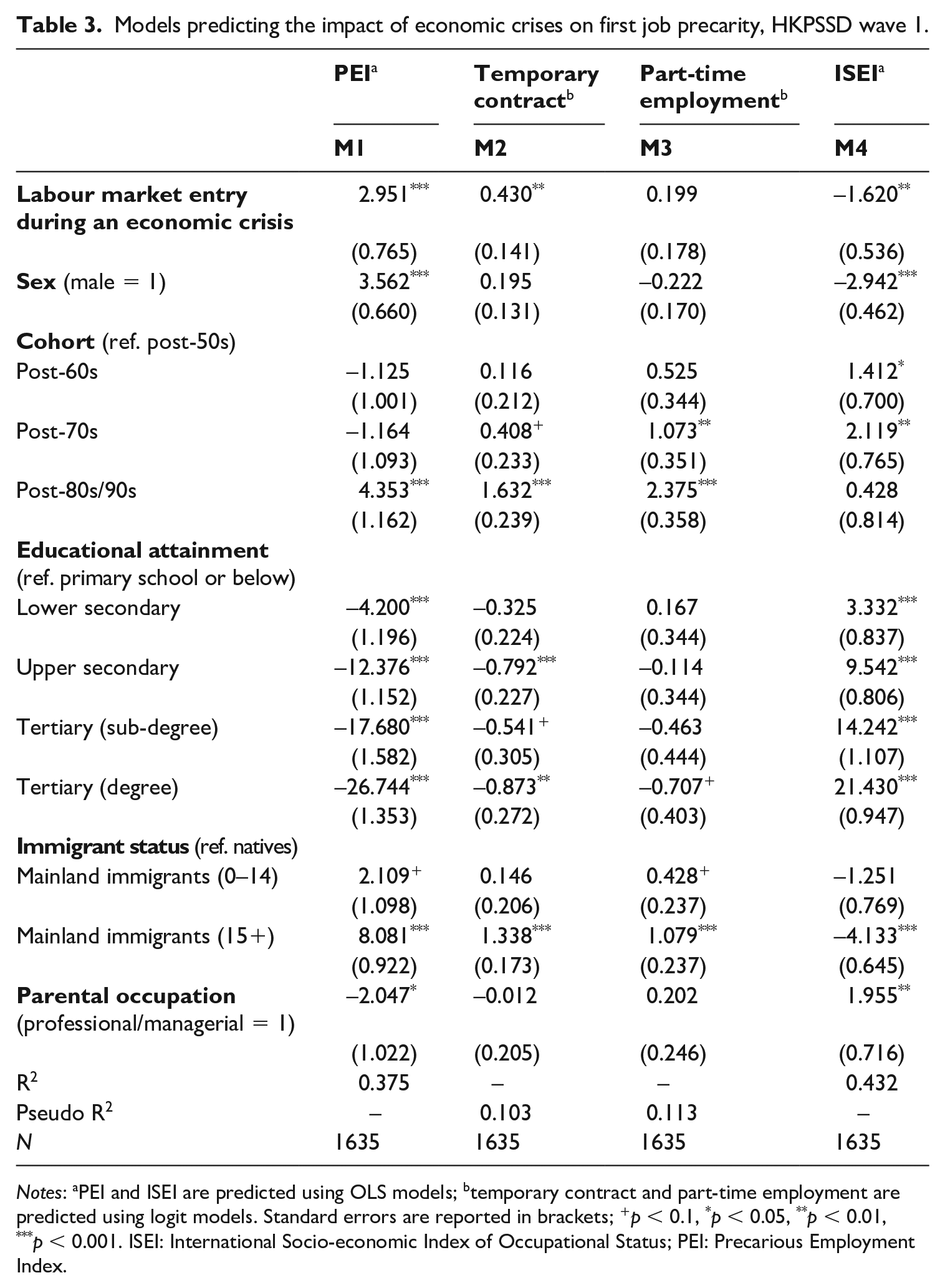
Notes: aPEI and ISEI are predicted using OLS models; btemporary contract and part-time employment are predicted using logit models. Standard errors are reported in brackets; +p < 0.1, *p < 0.05, **p < 0.01, ***p < 0.001. ISEI: International Socio-economic Index of Occupational Status; PEI: Precarious Employment Index.
According to the results in Table 3, ‘unlucky’ graduates who entered the labour market during economic crises were significantly more likely to have a precarious first job. All else being equal, these new entrants found jobs with 2.951 higher PEI scores than their ‘luckier’ counterparts who entered the labour market in non-crisis years. Specifically, they were 54% more likely to have a temporary contract than a permanent contract, and the ISEI scores of their first jobs were on average 1.6 points lower. Weak evidence also suggests a higher likelihood of holding part-time employment, although the lack of statistical significance may be due to the small sample size. These results support the assumption that macroeconomic conditions are closely associated with job placement in the labour market and that individuals are more likely to enter precarious employment during economic downturns. More importantly, based on the previous result of the persistent negative impact of first job precarity on subsequent performance in the labour market, these results indicate that even temporary economic crises may permanently affect young graduates’ career prospects.
A distinct cohort disadvantage among generations born after the 1980s and 1990s is also observed. Despite being the most educated group in Hong Kong, these individuals were far more likely to fall into precarious employment upon entering the labour market. This highlights the growing difficulty for young people to smoothly transition from school to work in Hong Kong (Wu, 2010; Wu and Guo, 2022). Women were also less likely to have a precarious first job than men, largely because few women choose manual occupations with low ISEI scores. However, as more working women marry and have children, their PEI scores are expected to fall as many may choose less demanding jobs (typically fixed-term, part-time and/or low-status jobs) to achieve work–life balance (Vosko, 2000; Chen and Zhou, 2022). Having a college degree also buffered individuals against precarious employment at the beginning of their careers. Sub-degree holders were no less likely than high school graduates to become temporary or part-time workers, but they often secured relatively more prestigious jobs due to their educational qualifications. Furthermore, compared with Hong Kong natives and early immigrants, late immigrants were more likely to experience precarious entry into the labour market in all three aspects. Finally, in accordance with conventional stratification research, family backgrounds strongly influenced the first job obtained. Individuals whose parents held professional or managerial occupations when they were 14 were more likely to obtain a high-status and less precarious job upon entering the labour force. 8
Conclusion
With deepening global economic integration and frequent economic crises, the worldwide prevalence of labour market deregulation and the impact of precarious employment increasingly draw the attention of researchers and policymakers. Although prior studies have documented the negative effects of precarious employment on various aspects of workers’ lives, such as life satisfaction (Helbling and Kanji, 2018) and physical and psychological well-being (Kim et al., 2008; Lewchuk et al., 2008), the impact of precarious employment when entering the labour market on future employment remains underexplored. Studies focusing on the effects of temporary employment on career mobility mostly adopt a unidimensional measure of precarious employment that exclusively emphasises contract type or duration and may underestimate the negative consequences of first job precarity.
A composite measure of precarious employment constructed from a city-wide representative panel dataset in Hong Kong is thus used to investigate the potential scarring effect of entering the labour market via a precarious job. The random effects models show that entering the labour market via a precarious job exerts significant negative impacts on a variety of subsequent labour market outcomes. Unlike previous quantitative studies that find no long-term scarring effect of job precarity, this study reveals that instead of serving as a stepping stone to stable employment, precarious first jobs may trap young workers in persistent precarious employment with limited income mobility, low job satisfaction and limited job-related welfare. The analysis further illustrates that this negative association may be exacerbated by deteriorating economic conditions. During economic crises, new graduates are more likely to be pushed into precarious jobs, which can have long-term consequences on their future careers.
The case of Hong Kong also warns of the lasting negative impacts of neoliberal labour market policies on workers’ career development. Lallement (2011) suggests that in response to the Great Recession in 2008, advanced capitalism adopted various labour market adjustment strategies to address the negative impacts of flexibilisation and liberalisation. However, as presented in this study, Hong Kong does not have such strategic measures to mitigate the scarring effect of employment precarity on younger generations of job seekers. The young working population is forced to enter an extremely competitive and precarious labour market, particularly in times of economic crisis. With no bargaining power, young workers who have recently left school are hardest hit during economic crises. By expediting young workers into precarious employment, laissez faire social policies not only neglect the welfare of workers at the time but also endanger their future career prospects. In this sense, policies and regulations to combat the increasingly precarious labour market, such as regulating non-standard employment, extending labour protection to casual and informal employees and facilitating instead of limiting unionisation, are needed to protect young workers against the trap of the ‘precarious job carousel’ (Barbieri and Scherer, 2009). Recent studies further call for unemployment insurance and other employment protection measures to insulate workers from the risks of precarious employment and unemployment (Pun et al., 2021, 2022).
The present study is also limited in several ways. First, the lack of data on workers’ complete work history since leaving school makes it difficult to observe their unemployment experience before the start of their first job and to investigate the trajectories into and out of precarious employment throughout their careers. Second, the use of random effects models allows the inclusion of first job precarity as a time-invariant key explanatory variable but is not sufficient to establish a causal claim, as some unobserved worker characteristics may simultaneously influence first job precarity and subsequent labour market outcomes. Finally, the current PEI measure may not adequately account for the dependent self-employed (e.g. platform workers), an important form of precarious employment affecting a growing number of workers in the current economy. More research is needed to study the impact of self-employment on future career development.
Despite these limitations, the study has important implications for future research and policymaking. In particular, the construction of the PEI combining employment status, contractual status and occupational status provides a more comprehensive measure of precarious employment for future research. With respect to policymaking, the findings suggest that improving the quality of initial employment is essential for long-term career development. Thus, increased efforts should be made to explore how to address the challenges of young people’s first job precarity in the labour market, particularly in times of economic crisis.
Footnotes
Acknowledgements
We thank Center for Applied Social and Economic Research (CASER) at NYU Shanghai for providing access to the data. We are grateful for the helpful comments and suggestions from the anonymous reviewers.
Funding
The authors disclosed receipt of the following financial support for the research, authorship, and/or publication of this article: The research is funded by the Early Career Scheme (27604821) from the Hong Kong Research Grants Council (RGC) to Duoduo Xu. The data collection of the Hong Kong Panel Study of Social Dynamics (HKPSSD) was funded by the RGC-Central Policy Unit Strategic Public Policy Research Scheme (HKUST6001-SPPR-08), the European Research Council Start-up Grant (ERC StG 716837), and the Collaborative Research Fund (C6011-16GF) from the Hong Kong RGC to Xiaogang Wu, who was previoulsy affiliated with Hong Kong University of Science and Technology. Xiaogang Wu also ackowleges funding support from a Key Program Grant of the China’s National Office for Philosophy and Social Sciences (22AZD101) and the Center for Applied Social and Economic Research at NYU Shanghai. Ngai Pun acknowledges funding support from Global China Social Research Cluster, Faculty of Social Sciences, HKU.
