




Abstract
The article identifies how tensions between different levels of worker solidarity helped shape the possibilities of collective action in automobile and related sector trade unions in Argentina. It advances the framework proposed by Morgan and Pulignano in two ways. First, it highlights the interrelation of both the complementarities and the tensions between different solidarity practices. Second, it extends the understanding of how these solidarity practices connect the workplace and community. The contribution is based on thematic analysis of interviews with trade union leaders, representatives and activists that shed light on solidarities produced, as well as tensions and complementarities between them. This is contextualised by the impact of crisis in the automobile sector after 2015, showing how increased worker vulnerabilities affected emergent solidarities. Overall, the article demonstrates the significance of these dynamics for understanding the continued resilience and limitations of trade unions in Argentina and beyond.
Introduction
There has been a much-needed resurgence of debate on how solidarity is constituted in the workplace and in trade unions. As Beck and Brook (2020) argue, the relative decline of trade unions over the last decades has produced a relative marginalisation of conceptual and theoretical debate on trade union and worker solidarities. Important recent work highlights the relevance of emergent solidarity practices and collective identities to new trade unions in the gig economy and among precarious workers (Carver and Doellgast, 2020; Tassinari and Maccarrone, 2020). Research on strikes and collective organising in workers’ organisations shows how collective solidarity practices underpin continued disruption and resistance to neoliberal capitalism (Ness, 2016; Nowak et al., 2018). Debate, too, has turned to the need to understand possibilities of ‘inclusive’ solidarities in trade unions, highlighting the conflict and tensions between established institutions and new memberships (Grady and Simms, 2019; Weghmann, 2019). Unpacking the multiple ways in which these solidarities emerge between workers and within trade unions increasingly animates these resurgent debates.
More recently, the emphasis on trade unions as the locus around which solidarity is – and can be – constituted among workers has been called into question. Atzeni (2021) argues against a ‘trade union fetishism’, pointing to the need to embrace other organisational forms. This is an important intervention that points toward a recognition of the complexity and heterogeneity of workers’ organising practices and their capacity to exceed traditional trade union institutions. Drawing on recent debates around trade union solidarity, however, this article argues that even within the traditional trade union institutions there exists a heterogeneity that needs to be unpacked to reveal the tensions and complementarities between different solidarity practices within these spaces and how they shape the pathways and possibilities of collective action.
This article engages debates on worker solidarity in this journal to understand workers’ solidarity practices in Argentina when facing continuing crises in automobile and related sectors after 2015. In particular, the article contributes to advancing the framework proposed by Morgan and Pulignano (2020) on the interactions between ‘levels’ of solidarity practices within trade unions to further extend understandings of (1) complementarities and tensions between these and (2) relationships between workplace, community and the trade union. This makes a significant contribution to understanding the key role played by workers and their organisations under the continuing crises of global austerity, drawing out the specific characteristics of this crisis and conflicts in Latin America.
It begins by showing how the crisis that accelerated from 2015 produced new vulnerabilities, with heightened insecurity of job losses and reduced working hours combining with the rising cost of living and withdrawal of state support. The article shows how trade unions representing workers in the sector – SMATA and UOM – mobilised workers ‘in defence’ of the automobile sector, organising large-scale mobilisations confronting the Macri government and prioritising sectoral stability over direct confrontation with employers. At the same time, interviews with union representatives and activists demonstrate how new solidarities emerged in increasing tension with the union strategy. The article identifies the generative tensions between these levels of solidarity and how they shaped and constrained the possible field of collective action. It shows how institutional structures did not always provide support for the expression of solidarities, as Morgan and Pulignano (2020: 27) point out, but also constrained workers’ strategies to build solidarity in the workplace. In these cases, the article shows how community and collective action beyond the workplace became a fertile terrain to confront the crisis, as well as showing the ways in which this terrain also came to be configured by the union.
The article addresses the following questions: in what ways did workers in Argentina respond to the increasing vulnerabilities produced by crises between 2015 and 2019? What solidarities emerged between workers and within the trade unions? How did these solidarities complement and constrain one another? The first section outlines recent debate on worker solidarities, how these emerge in different forms and operate across different levels. From here, it develops the concept of generative tensions that underpins the argument about how workers and their unions differently navigate times of crisis. After presenting the research methodology, the third section contextualises this period of crisis and conflict in Argentina. It traces the impact of crises on workers and trade union responses. The final section presents evidence from thematic analysis of semi-structured interviews, identifying the intersections and impact of generative tensions between worker solidarities within trade unions.
Worker solidarities in times of austerity
Worker solidarity is a practice and social relation emergent within a shared encounter with changing conditions of social life, in the workplace and beyond, providing the material foundations for collective action. It is a ‘living encounter’ (Atzeni, 2009):
Workers do not need to search for a definition or to look for solidarity’s preconditions. They simply have a living encounter with solidarity, a sense of empowerment when it becomes manifest and drives their action forward or a sense of disappointment and anger when it does not appear. (Atzeni, 2010: 30)
Santella (2016) situates mobilisation of this living encounter in the cracks of ‘political opportunities’ of management failures, competing trade union representations, or other ‘cris[e]s of capitalist management’ (Santella, 2016: 155–156). Tensions within institutions that constrain worker solidarities, therefore, offer avenues for workers to organise around.
Using Atzeni’s (2010) concept of ‘embryonic solidarity’, Tassinari and Maccarrone (2020) argue that solidarities are constituted through shared identities connected to the structural conditions of the labour process. They argue that ‘collective feelings of reciprocity and responsibility . . . [and] an awareness of their ultimately shared interests and purpose’ enable collective action (Tassinari and Maccarrone, 2020: 39). Identities are important to the constitution of solidarities. They are concretised in moments of action; as Weghmann (2019) argues: ‘solidarity relations do not come automatically on the basis of identity but rather are active practices which create unity within and between diverse groups and movements of struggle’ (Weghmann, 2019: 448). It is in these ‘active practices’ that solidaristic identities then shape the possibilities of collective action.
The different solidarity practices of workers and trade unions can be ‘mechanical’ or ‘organic’ (Hyman, 1999 cited in Grady and Simms, 2019: 492). Mechanical solidarity emerges from, mainly, union leaderships to order and collectively organise worker mobilisation around its shared trade union identity. Organic solidarity emerges from the demands of workers, often exceeds typical union concerns and has links to non-union constituencies (Grady and Simms, 2019: 503–504). Understanding different solidarity practices as mechanical or organic helps differentiate these activities within trade unions and position relations between them.
Morgan and Pulignano (2020) propose a framework for conceptualising how solidarity practices interact and how interactions explain the continued resilience of trade unions. They conceptualise solidarity as ‘a set of bridging and bonding processes . . . embedded in moral discourses, political coalitions and social performances’ that can be viewed at different levels: in the labour process, the organisational form of trade unions and other collective actors, and various legal and political institutions (Morgan and Pulignano, 2020: 20). They argue it is these complementarities that help explain the persistence and resilience of trade unions.
In articulating their framework, they offer a way of understanding the solidarities emerging at these levels: the workplace and community offer ‘moral’ components, producing bonds between workers through shared experiences of work or community; the organisational level performs the ‘bridging’ role connecting this collective sensibility to institutional and legal mechanisms, and vice versa, acting as ‘carriers’ of solidaristic practices and identities; and the institutional and legal levels sustain material and representational benefits that support workers’ collective action and aims (Morgan and Pulignano, 2020: 24–27). These levels operate through interaction and as ‘no one level is likely to be sufficient in itself to sustain solidarity at work . . . it is necessary to examine these interconnections and potential substitutions’ (Morgan and Pulignano, 2020: 27). In positioning the roles of these levels and their interactions, this provides an invaluable lens for understanding how complementarities between solidarity practices sustain trade unions’ collective action.
There are two theoretical advances to this framework proposed in this article. First, alongside the complementarities of these levels, there are also structural tensions. This is emphasised, for example, by Atzeni (2010) and Santella (2016) in relation to the specific institutional configurations of Argentina’s trade unions. Organisational structures of trade unions, and particularly bureaucratic leaderships, can act to disengage and fragment the organic forms of solidarity that emerge in and beyond the workplace (Atzeni, 2010: 19–20). This produces tensions between the different levels at which solidarity operates, which must be systematically brought into our understanding of their interrelation. By combining these tensions with Morgan and Pulignano’s (2020) complementarities, the article develops the concept of generative tensions, to focus on how organic solidarities at the workplace and community level intersect with union solidarities, simultaneously complementing and entering into different tensions.
Focusing on tensions and intersections as generative avoids a dichotomy between top-down mechanical solidarities operating within organisational and institutional levels and organic solidarities observed ‘from below’. Connolly (2020), for example, shows how internal tensions enabled a process of trade union revitalisation in the United Kingdom, as left-wing union leaders and activist members re-established combative forms of ‘internal solidarity’. The mobilising potential of intersecting and competing workplace solidarities are clear, as processes of internal conflict re-oriented existing institutional spaces to radicalise the union.
These generative tensions between workplace and community, and organisational and institutional levels operate through the specific structures of trade unions in Argentina and their roles in constituting collective action within the labour movement. The concept of ‘industrial legality’ is particularly useful in explaining their dual role (Marticorena, 2017; Santella, 2012; Soul, 2012). It reveals how worker solidarity is conditioned by the shifting composition of the working class and how this is incorporated into the legal-institutional structures of the trade union, most notably through the internal commissions that represent the union in the workplace (Marticorena, 2017). This highlights the importance of foregrounding the generative tensions between these levels, as while organic solidarities may at times radicalise existing workplace institutional forms into greater combativeness, they can simultaneously be incorporated into these existing institutional forms of factory discipline in the process (Marticorena, 2017: 231–232). This knowledge of trade unions in Argentina, therefore, reveals the specific institutional mechanisms that mediate and facilitate interaction between different levels of solidarity.
Second, the article contributes to a wider engagement with the relationship between workplace and community, not solely as a site for the constitution of organic solidarities, but also as spaces in which institutional and organisational levels can be observed in action. Specifically, in Argentina, the community is an arena in which trade unions sustain organisational, mechanical solidarities that complement and conflict with those emerging from below. Links between workers in the factories and their communities are essential to constituting workplace solidarities (Elbert, 2017; Fishwick, 2019) and, as Soul (2019) has shown, trade unions in Argentina play an active role in organising everyday forms of community life, even shaping the form of the ‘working-class family’ (Soul, 2019: 143). Understanding how these levels complement and conflict outside the workplace helps to shed light on the possibility of collective action under the worsening conditions of ‘labour and life’ (Lazar, 2017) that were produced with the turn to austerity in Argentina after 2015.
In making these connections between workplace and community, this approach extends an understanding of the impacts of austerity on emergent forms of solidarity. Morgan and Pulignano (2020) argue that there has been a ‘gradual convergence across different varieties of capitalism away from an emphasis on maintaining social solidarity’ (Morgan and Pulignano, 2020: 19), which provides the material basis for new forms of solidarity to emerge (Morgan and Pulignano, 2020: 31). Critical political economy approaches help extend this argument by exploring how crises generated by austerity also mediate and produce divergences in worker solidarities across geographical contexts. Responses to austerity in Europe, for example, are shown to reveal an always-already existing ‘pragmatically prefigurative disruptive subjectivity’ to continually, and incompletely, be contained (Bailey et al., 2018: 10). Drawing attention to, and starting from, these new divergences in political economies helps to foreground the tensions across the observed levels at which solidarities are (re)produced.
Consequently, while crises do not necessarily produce radical forms of solidarity, they do potentially enable processes of renewal by transforming the trajectories of neoliberal capitalism in unexpected ways (Las Heras and Ribera-Almandoz, 2017). As Sil and Wright (2018) argue, drawing on cases across the Global South and post-socialist world, increasing ‘vulnerabilities’ – related both to changing working conditions and to the impacts of the withdrawal of state support – produce ‘pathways’ towards more militant forms of worker protest. Changing patterns of worker vulnerabilities produced by crisis generate divergent forms of neoliberal capitalism and the possibility for radical, organic forms of solidarity to emerge in and beyond trade unions.
Methodology
The article is based on descriptive statistics, comprising statistical reports produced by the automobile employer association, ADEFA, between 2014 and 2019, an unpublished database of labour conflict statistics provided by the Ministry of Labour covering the years 2015 to 2018 and an unpublished internal report provided by the SMATA trade union leadership, and on qualitative research, comprising a round of semi-structured interviews conducted in May 2019.
Analysis of the trajectory of crisis in the automobile sector was derived from 62 annual and monthly reports produced by ADEFA, which are published online and available open access via their online portal. Data on the evolution of labour conflicts were collated from the Ministry of Labour (MTESS) database, which tracks labour conflicts ‘understood as the series of events triggered by the performance of a conflictive action of a group of workers or employers to achieve their labour demands’ (MTESS, 2018: 2). The series includes 120 press media from all over the country and media outlets specialising in union news.
Semi-structured interviews were conducted during May 2019 in Buenos Aires, Argentina, with trade union officials, representatives and activists from two selected metallurgical factories: the auto parts enterprise Metalsa and Electrolux, which produces home appliances. In both selected factories, the UOM represents workers, which, along with SMATA, represents workers across the automobile sector. In selecting these cases, with active conflicts led by grassroots activists, organic solidarities could be identified in related and similar industrial firms. Participants were selected across different levels of the trade unions (Table 1) to offer different viewpoints from the institutional level (union leaders and representatives), and the workplace and community level (workers and activists in ongoing labour conflicts).
Interviews information.
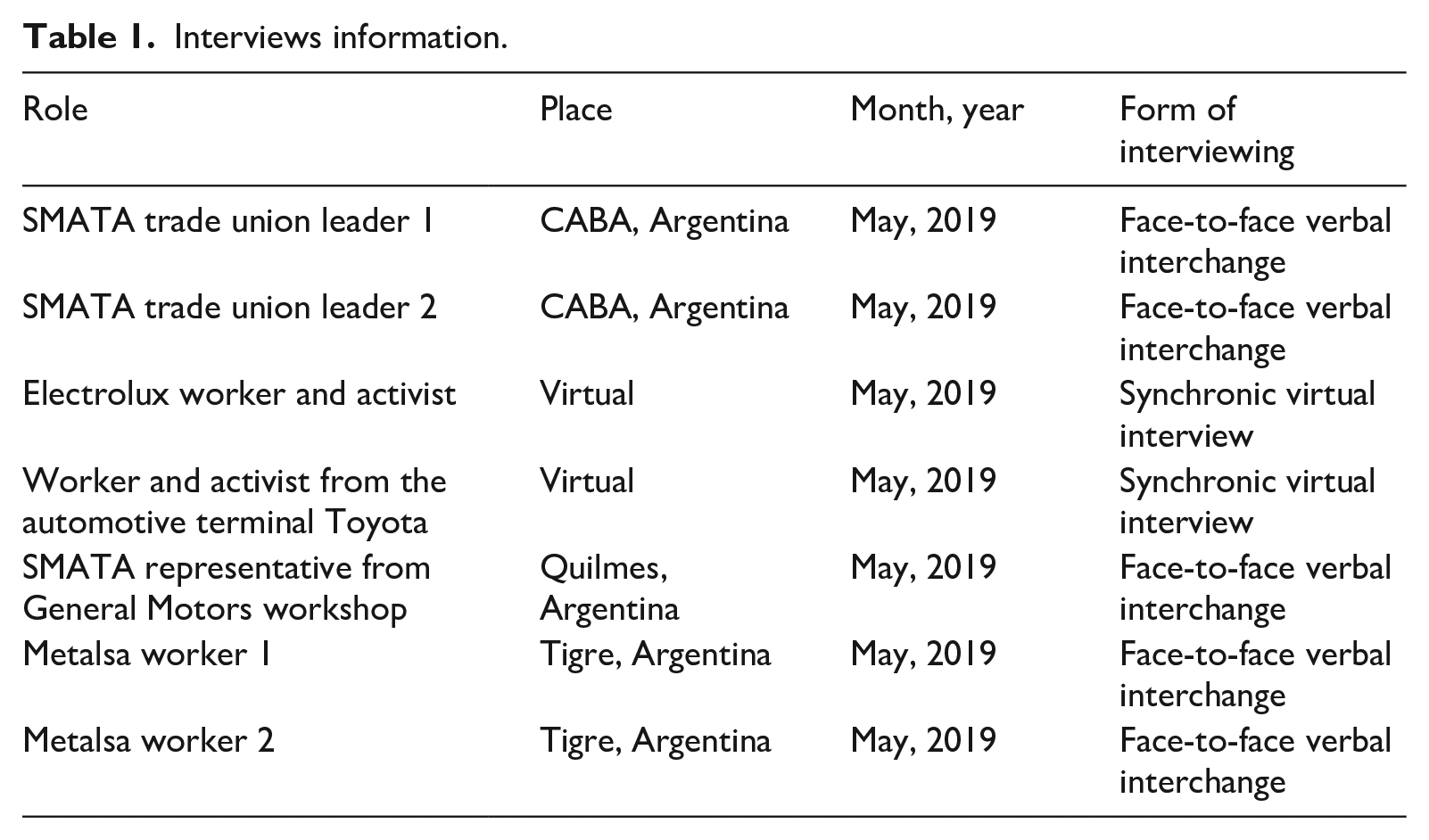
The rationale for adopting this qualitative approach was to interpret the different practices and understandings of solidarity across different levels of trade unions. As Kvale (2007) points out, qualitative interviewing attempts to understand the world from the subjects’ points of view to unpack the meaning of their experiences. Interviews were undertaken face-to-face and as synchronous virtual interviews – to reduce costs and time in the case of two interviewees (Table 1). Separate thematic analysis of the interviews was undertaken by both authors, with results compared for the verification of findings. Initial categories were derived from preliminary analysis of the interview transcripts, with further sub-categorisation emerging through the analysis process, tracking different clusters of representation around experience of crisis and solidarity practices. The thematic analysis began with three categories: austerity impacts on labour and life; changes in the labour process in and beyond the workplace; and emergence of new forms of solidarity. Key themes that emerged through these iterations of the thematic analysis in relation to solidarity, which is discussed in depth in the final section of the article, focused on barriers to solidarity, grassroots solidarity, community solidarity and trade union solidarity. Undertaking this analysis enabled comparison of different understanding and practices of solidarity, highlighting overlaps, complementarities and tensions between them.
Crisis and conflict in the automobile sector in Argentina
In the 2016 ADEFA Annual Report, Macri’s reforms were described approvingly as ensuring ‘many obstacles were removed’, celebrating favourable tax regimes and payment regulations. Employer support for government policy continued with the Plan 1 Million introduced in 2017, which aimed at the ambitious target of one million automobiles being produced per annum. The Plan, though, led to a process of industrial restructuring with output decline and rising imports, damaging the viability of the sector as a whole and conditions of workers within it.
First, aggregate growth stagnated between 2015 and 2018 (Figure 1). Although decline following crises that began in 2013/14 was curtailed, there were few signs of recovery. Monthly data published for January/February 2019 by ADEFA showed output levels were again below those of 2018, falling in January 2019 by over 30% relative to January 2018 and by around 16% in February 2019 relative to February 2018: a relative drop over the same period of over 22%.
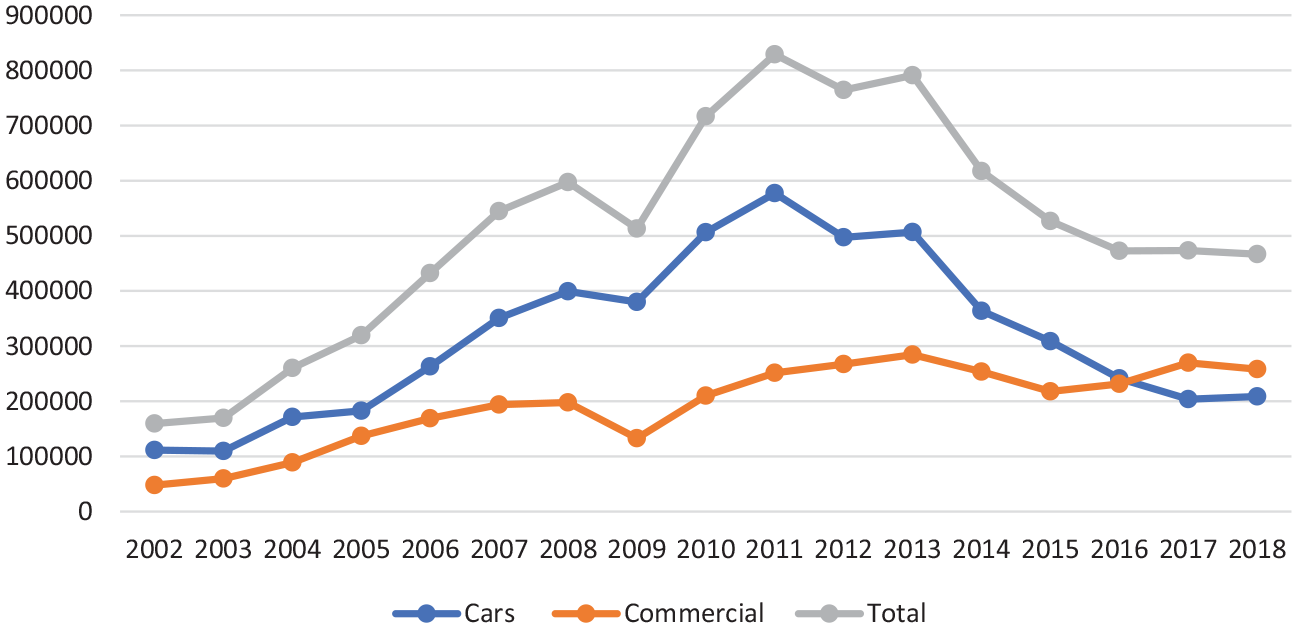
Vehicle output (total and by type, authors’ own elaboration based on ADEFA, 2022a, 2022b).
One key factor was the problem of the stagnating productivity levels from 2015 onwards, which highlighted long-standing problems of technological upgrading, product-level fragmentation and an intensifying labour process. The impact of these changes on workers was discussed by interview participants, explaining how work rhythms slowed, while technological developments were targeted primarily at replacing workers in the terminals.
Second, and the focal point of the SMATA strategy, was the increase in imports, which, by 2017, already surpassed the previous 2013 high (Figure 2). This could be considered a return to the earlier trajectory of import growth, with 2014/15 a brief downturn reflecting Latin America’s regional crisis. However, while high import levels coincided, previously, with high output and export growth, substantial import growth after 2015 significantly exceeded export growth and occurred alongside stagnating output. In combination, this placed significant pressure on local producers, with over 22,000 lost jobs – 8% of the total workforce – estimated by SMATA during 2019 across automotive and related sectors (SMATA, 2019: 4).
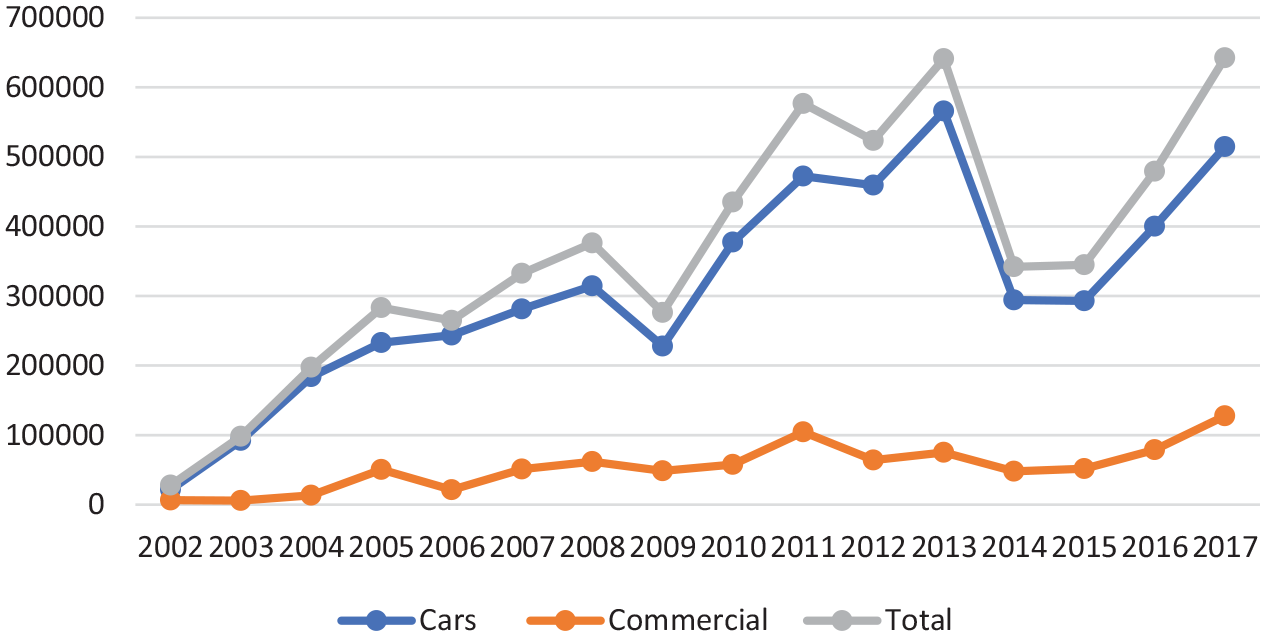
Total imports (authors’ own elaboration based on ADEFA, 2022a, 2022b).
The implications for worker vulnerability were significant. The previous 15 years had seen a series of agreements between SMATA, automobile manufacturers and the state that had consolidated employment and wage growth, but with major concessions on the labour process (D’Urso, 2016; Guevara, 2012; Santella, 2016). As noted by interview participants, reducing available hours became one of the main trends in the sector between 2015 and 2019. In part, job losses were averted in major production terminals, but not entirely. Intensified work rhythms from preceding years were replaced by the import of new machinery and steady reduction of employment. The changes shown in Figure 3 illustrate the trend of declining personnel and hours worked on aggregate across the sector.
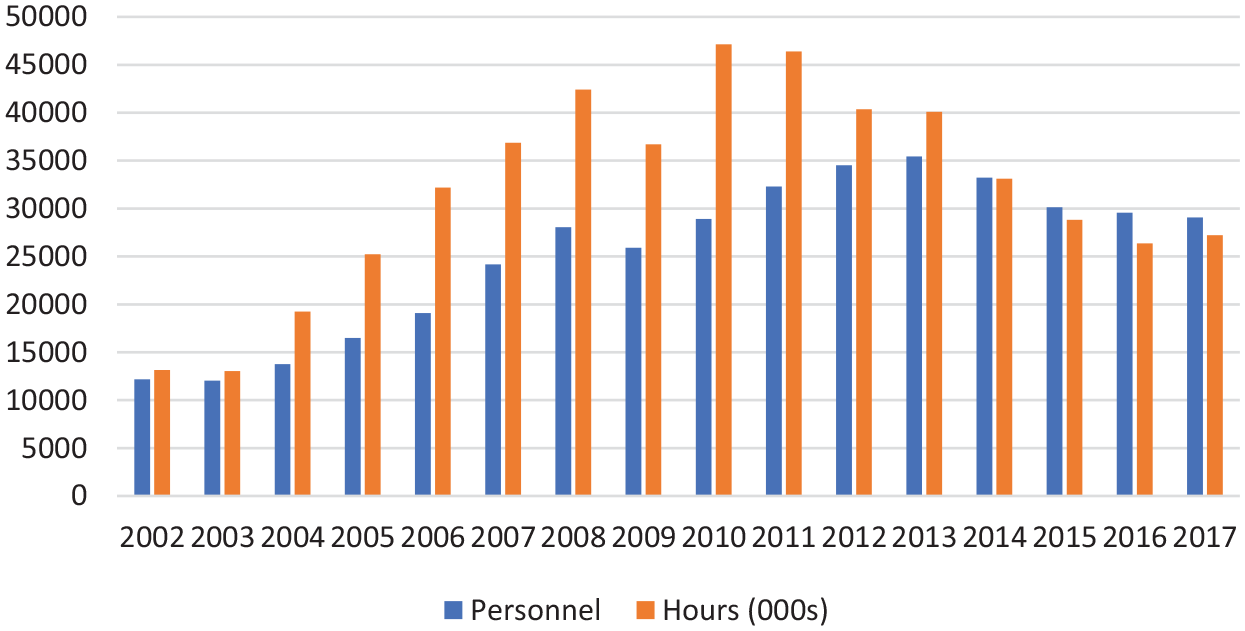
Total employees and hours worked (authors’ own elaboration based on ADEFA, 2022a, 2022b).
In this context, labour conflict from 2015 to 2018 continued at similar levels to previous years (Figure 4) but there were an increasing number of conflicts related to the crises’ impact on employment levels. This key difference reflected two key dynamics: the impact on employment that increased worker vulnerabilities and the dynamics of trade union solidarity constructed within SMATA in defence of employment and the national sector.
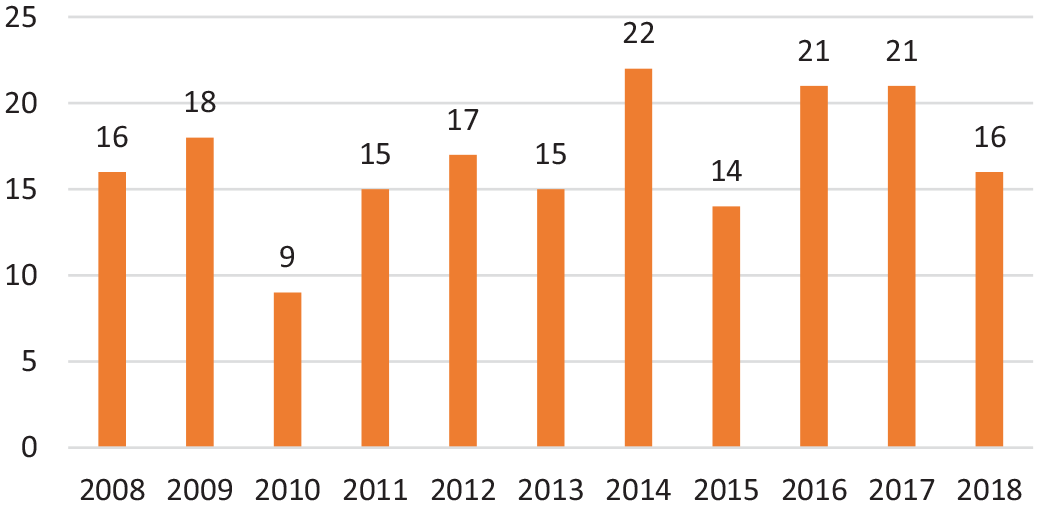
Annual distribution of labour conflicts in the Argentinean automotive sector (2008 – October 2018, data adapted from MTESS, 2019).
Between 2015 and 2018, official labour conflicts focused on dismissals or contract renewal represented 65.2% of the total. This type of claim also appeared in labour conflicts between 2003 and 2014, but as a smaller proportion (49.2%). Labour conflicts related to salary improvements, in contrast, declined during this same period, representing only 9.7% of the total compared with 2003–2014, when they were 28.1%. This shift was important to the strategies pursued by SMATA that aimed at defending jobs and articulating national plans to restrict imports. The importance of this to trade union solidarity, articulated at an institutional level, was further evidenced in the interviews with union leaders (author calculations based on MTESS, 2019).
Union mobilisation from 2016 onwards responded to attempts to reduce hours and employment levels across most firms. Within assembly plants and auto parts producers countrywide, unions mobilised on specific issues around salaries and against dismissals. It was this solidarity produced at the institutional level that underpinned most labour conflicts through this period. 1
The main mobilisations led by SMATA and UOM brought together workers from the entire sector. These targeted labour and industrial policies and focused on defending employment levels. In April 2016, the SMATA general secretary, Ricardo Pignanelli, denounced that the crisis was caused by a decrease in national production of auto parts in cars made in Argentina. SMATA then presented in Congress – through the Partido Justicialista (PJ) deputy, Oscar Romero – the ‘Auto Parts Law’ aimed at guaranteeing 50% of auto parts would be produced in-country. To support the bill, the union mobilised in all 11 terminals, refusing to work with parts produced outside Argentina. In June 2016, SMATA called a massive mobilisation to support the bill and it was approved. This demonstrates how mechanical solidarity was built around a defence of the sector, articulated by the leadership of SMATA in collaboration with other leading industrial unions.
One of the most important actions occurred at the end of 2017, when SMATA and UOM supported a general strike against pension reforms. The General Confederation of Labour (CGT) called a strike for 24 hours and, the following day, a second of 12 hours, which SMATA maintained in the province of Buenos Aires for the entire day. In 2018, a high-profile conflict was led by the UOM in Córdoba province during a visit of Macri to Fiat. Union representatives protested in the doorway of the factory, rejecting the national government’s austerity policies. Similar important conflicts were led by SMATA across the period, with the aim of expressing disagreement with the government ‘leaving the national industry in the hands of the market’.
To summarise, the period 2015–2018 saw little increase in the number of conflicts, but a reorientation in response to the deteriorating conditions of labour and life. The deepening crisis produced worsening vulnerabilities in employment, and this provided the primary driver for mobilising workers, with trade union solidarity articulated around the defence of a key national industry to protect jobs and challenge trade liberalisation, particularly in auto parts. Worker vulnerabilities produced by this crisis intersected with those outside the workplace, producing increasing discontent with the Macri government and these strategies of the union.
Worker solidarities after 2015 in Argentina’s automobile sector
The different ways that trade union leaders, representatives and workers built solidarity in the automobile sector in Argentina after 2015 allowed identification of the generative tensions between Morgan and Pulignano’s (2020: 24) three ‘levels’: workplace and the community, organisational and institutional. Thematic analysis showed how solidarities were expressed across these levels and how interactions simultaneously enabled contestation against deteriorating conditions of ‘labour and life’ (Lazar, 2017) and constrained the pathways along which that contestation developed.
The analysis demonstrated how trade union leaders developed their strategies at the institutional and organisational levels through highlighting the limits imposed by Macri’s industrial policies and their impact on collective bargaining and agreements to achieve wage improvements and/or better labour conditions. For union representatives and activists from the Toyota automotive terminal and the General Motors workshop, the analysis showed how their perspective also came from the institutional and the organisational levels, focusing on how the crisis had impacted the sector and labour process, but also the limits of union action in a context marked by trade union weakening. The findings demonstrated how these worker solidarities were expressed in different and, at times, conflictual ways, demonstrating how the ‘bridging’ role identified by Morgan and Pulignano (2020) operated through the dual role of trade unions in Argentina radicalising and constraining the possibilities for collective action.
On the other hand, analysis of interviews with workers and activists involved in ongoing conflicts when the interviews were conducted showed how different solidarities were being constructed at the workplace and community level, which entered into more direct tension with the organisational and institutional levels. These actions also showed how the organisational structure, in particular the role played by traditional and more conservative union leaders, could be in some cases a barrier ‘to extend ideas of collective action and solidarity into new groups’, rather than providing a pathway to achieve an extension of solidarity at the organisational level, as identified in the framework of Morgan and Pulignano (2020: 26).
Trade union solidarity at institutional and organisational levels
The most visible crisis effect was production stagnation and its link with employment levels. For SMATA’s leaders, the macroeconomic policies applied during Macri’s government hindered automobile sector development. Opportunities to build mechanical solidarity at the organisational level changed when union claims – focused mainly on wage improvements – were channelled through collective agreement at the workplace level. Increasing job losses meant, from the union perspective, protecting the level of employment was the priority, with issues such as salaries, labour conditions and deteriorating conditions of everyday life secondary to the union. In the words of one of the union leaders:
First it is having a job. We can’t be talking about wages if we don’t have a job. (SMATA trade union leader 1; 21 May 2019)
Employment in the sector was marked by increasing suspensions and dismissals, which represented a challenge for union strategy and its role in labour market negotiations. To face this, SMATA strengthened its partnership strategy at the organisational level to preserve jobs and/or mitigate the consequences of dismissals through mechanisms such as early retirements.
As a SMATA representative highlighted, the union avoided an offensive strategy. Nonetheless, for him, the loss of salary purchasing power was an important consequence of the crisis. Collective bargaining did not recover salaries in the context of increasing inflation, but union strategy was a moderate claim for salary increases and maintaining social dialogue with firms. The threat of dismissal drove workers’ acceptance of this strategy:
Most people understand the crisis . . . People are being laid off everywhere, but workers did not take badly that the union did not negotiate a higher salary increase. (SMATA representative from the GM workshop; 21 May 2019)
Following Morgan and Pulignano’s (2020: 24) perspective, ‘the overlap of work and community create a strong sense of solidarity’, and even more so in crisis contexts. However, in the case of SMATA, the encounter between the workplace and community level was mediated by the discipline generated by the crisis. This was paralleled by a ‘new regime’ inside the factories, underpinned by the flexibilisation of working conditions:
The worker becomes more flexible himself because he must take food home. As an organisation, I can stop it, but it is very difficult to get everywhere [. . .] when unemployment is very high, all the conditions are set by the boss. And we [. . .] prioritise that companies do not close. (SMATA trade union leader 1, emphasis added; 21 May 2019)
This sense configured by the union was in tension with the more confrontational strategy taken by workers involved in ongoing conflicts. Likewise, from the point of view of the official union representatives in factories, the boundaries between the workplace and community levels were less rigid and, in the interviews, it became clear that such difference in experience and perception impacted differently on the pathways to constituting forms of solidarity. As the SMATA representative explained, the crisis impacted the workday and changed contractual conditions, which entailed the addition of second jobs. Although this was a common strategy, in previous years it was a way to gain an ‘extra’ salary, whereas now it was necessary to survive:
Basically, most of us have two jobs. I work at the dealership and outside the dealership I continue working [. . .] as a double shift. [. . .] We have been doing this forever, but before we would choose [. . .]. I hate getting out of there and having to keep working, but anyway . . . (SMATA representative from the GM workshop; 21 May 2019)
Related to contractual conditions, a Toyota worker explained that, since 2015, contracts were unstable, and that instability was intensifying:
Before, contracts were up to one year [. . .] now the contracts of 24 to 36 months returned [. . .]. If production drops, they do not renew the contract and send the workers to their homes. (Worker and activist from the automotive terminal Toyota; 17 May 2019)
In some factories, the crisis did not impact the level of employment, but there was no renewal of contracts, workers who took leave for illness or accidents were not reinstated, and, when production started to decrease, the enterprise began to suspend shifts. This began, according to one of the interviewees, in 2019 when Toyota established a holiday advance and reduction of the working day or week. In this way, a new hour bank system became the mechanism to control changes in the production.
This interview analysis illustrated how these generative tensions emerged in the ways workers experienced the crisis, with the deterioration of workers’ life and labour conditions increasingly in conflict with the predominant union strategy located at the institutional and organisational level characterised by efforts to maintain the role played by union leaders in labour market negotiations. The evidence showed the distinctions between union leaders and those of official union representatives and activists involved in the day-to-day lives of workers in factories.
The SMATA representative from General Motors identified internal impediments to solidarity at the workplace level via restriction of information and/or minimising local conflicts:
For me, they [the union leaders] could have fought a little more, but according to them it is not yet the time to put a concrete measure of force against the concessionary [the enterprise in conflict] because it is seen that they are managing with the issue of layoffs and all that. (SMATA representative from the GM workshop; 21 May 2019)
Although union solidarity was developed at the institutional and organisational level, organisation outside the workplace was also a key constitutive element, which showed the importance of the community to mechanical solidarity formation. SMATA, for example, developed different activities outside the workplace with the aim to build ‘spaces of community’: the family day, football championships, meetings at the end of the year – which union leaders enthusiastically explained as being integral to the ‘making of the SMATA worker’. This provided a clear demonstration of putting into practice the constitution of union identity as a form of organisational solidarity.
The management of everyday forms of community life were a key component of union solidarity practices. These focused on the different ways in which the trade union offered spaces and/or tools for solidarity. The SMATA union representative from General Motors and union activist from Toyota explained different support strategies developed by the union:
Those who end up leaving always negotiate more money than their due . . . if, for example, you have to leave, it’s like they have you on a list and they try to relocate you in another factory, if possible, or in another dealer, they look for a solution. (SMATA representative from GM workshop; 21 May 2019) When I had problems with sickness, they gave me a lot of help for the relocation issue, to find me a good job where I could work with the condition that I had in my hands. That is, they provided me with medical evaluations, they took me to the doctor in Buenos Aires to get a certificate done, that was prompted by SMATA so that I could present in the factory, with the condition that I had and indicating the tasks I could do. (Worker and activist from the automotive terminal Toyota; 17 May 2019)
In both cases, union solidarity was related with benefits that the union provided for workers through collective negotiation and protecting work conditions. However, it was possible to identify experiences in which workers’ actions went beyond the union structures, opening ways to build solidarity at the workplace and community level, as well as identifying how the tensions between these forms of solidarity engendered different pathways to collective action.
Workers in conflict: Building solidarity at the workplace and community level
Solidarity at the workplace and community level represented a key element in the case of workers involved in ongoing conflicts. At Electrolux, activists developed strategies that involved workers and their families, neighbours, unions from other sectors and social movements. These actions were important to stop dismissals, mainly, in cases where union structures were a barrier to building solidarity around increasing vulnerabilities.
In comparing the techniques for constituting solidary by union leaders and activists of Metalsa and Electrolux, the first difference was that while in the case of SMATA the crisis was narrated in macroeconomics terms, at Metalsa and Electrolux this impact was narrated in the first person, explaining how austerity impacted their lives directly:
The reality is that we have the crisis, we don’t know how we are going to make ends meet and we want to try to make that very clear to the government so that it takes action on the matter in favour of workers. (Electrolux worker and activist, emphasis added; 14 May 2019)
In those interviews, changes to household consumption were key. Even in the context of intensive labour conflicts against dismissals, the impact on family living conditions was the first priority:
If you had a drop in sales and it is real, the solution to that is not to leave 25 families on the streets with only between 10 and 12 thousand pesos per fortnight, the solution does not come that way. (Electrolux worker and activist; 14 May 2019)
Organisation in Electrolux and Metalsa also illustrated the strategies developed by workers to disrupt union strategies and configure organic solidarity around democratic assemblies and workplace organising. At Electrolux, workers organised a camp in front of the factory in May 2019. The way decisions were taken during that action demonstrated a difference with the partnership strategy followed by the union, manifesting the distinctive forms of solidarity practice:
We began to manage ourselves through assemblies, each step that we were taking was decided in assemblies of the dismissed workers, making motions, voting on proposals made by the same colleagues and resolving it that way, this is how we organise ourselves. [. . .] For us, the assemblies are sovereign, what the compañeros vote in the assembly is what we do and if there are doubts, we will hold a new assembly. But we organise ourselves that way because we consider it to be the best, or at least the most democratic. (Electrolux worker and activist, emphasis added; 14 May 2019)
In both cases, patterns of inter-union solidarity and mobilisation were identified, through building alliances with other organisations. At Electrolux, the conflict had support from different sectors including education, health, trade and public employees. At Metalsa, the role played by the Coordinadora Sindical Clasista de la Zona Norte (a group of workers and activists from industries in the northern area of the Greater Buenos Aires) was essential.
In some cases, the manifestation of tensions that produced new pathways to collective action were clear in the strategies and tactics adopted in forms of community solidarity that exceeded the factory. At Electrolux, the union did not oppose dismissals, so laid off workers decided to develop a conflict in which solidarity in and outside the workplace was a distinctive element:
We went out to seek solidarity because we considered that in the absence of the union, before fighting against a multinational company that is very powerful and the state that had not yet given any response or signals, we went to seek solidarity with the mobilisation on the day of the strike. (Electrolux worker and activist, emphasis added; 14 May 2019)
The idea of ‘going out to seek solidarity’ shows how the workers attempted to create solidarity within the unions and by going around them. At Electrolux, the impact of austerity generated new vulnerabilities that precipitated the emergence of spontaneous forms of solidarity that, until that moment, had been blocked:
We arrived at the conflict without having previously organised ourselves, as if reality and the situation imposed it. [. . .] We were fired and spontaneously with all the colleagues who had gone that day, we decided to stay demonstrating at the company’s door, something that I think is great and that had not been expressed. [. . .] the workers’ spontaneity, the reaction not to resign themselves to being fired and being pushed into poverty. (Electrolux worker and activist, emphasis added; 14 May 2019)
The forms of community and grassroots solidarity expressed a stark difference between the militant activists in Metalsa and Electrolux and the SMATA-aligned trade unionists in the auto terminals, a difference that was even more pronounced with the SMATA leadership. For the Electrolux activist, organic forms of community solidarity were integral to mobilisation, drawing across movements and community organisations, as well as family and friends. Austerity had generated conditions for solidarity alongside workers’ claims, because the possibility of being fired increasingly became a latent threat:
I associate it [a certain sympathy generated by the conflict] with what I was telling you at the beginning, that now the situation is a more generalised discontent, that is, the crisis is beginning to deepen, layoffs are beginning to be generalised. (Electrolux worker and activist; 14 May 2019)
The workplace continued to be a key locus for organising and a site of organic solidarity practices:
The idea is to coordinate, for example, in case of layoffs, as was the case last week with Frigorífico Rioplatense. But that does not solve the lack of organisation in our workplace. (Metalsa worker 1, emphasis added; 21 May 2019)
This was clear, too, in the tensions between different levels of solidarity. At Electrolux and Metalsa, where workers had developed alternative organisational forms to express disagreements, the union carried out what Metalsa workers called ‘surgical’ strategies against grassroots activism:
There is a lot of solidarity, the issue is that there is also a great campaign of fear on the part of the company that states that the factory is going to close, that if it is not produced, they will discount the bonuses, that they will suspend us [. . .]. There is a great control of the company and the union so that the workers are docile, calm, they use the word ‘calm’, ‘we want to bring them calm’, ‘stay calm’. (Metalsa worker 1, emphases added; 21 May 2019)
The analysis presented showed that the impact of austerity and crisis generated new vulnerabilities that produced different solidarities. This was configured by interactions and tensions between the institutional, the organisational, and workplace levels, which were also present within the community where similarly competing forms of organic and mechanical solidarity were observed. These generative tensions shaped the possibilities of collective action, imposing constraints on the form and practice of solidarity and helping configure new pathways beyond these barriers themselves.
Conclusion: Generative tensions and contested levels of trade union solidarity
The article demonstrates the importance of Morgan and Pulignano’s (2020) framework for understanding the resilience of trade unions in the face of crisis, demonstrating how different forms of solidarity – organic and mechanical – interact across varying levels. It shows how these interactions shape the opportunities for collective action and the ways in which trade union and worker identities are formed in practice, both through the ‘living encounter’ of work and of the changing conditions of everyday life. It also illustrates the impact on competing identities produced – from the ‘making of the SMATA worker’ to the workers ‘going out to seek solidarity’ in the community. Importantly, it also draws attention to the tensions between these interacting levels, highlighting the ways in which unions are resilient but that this resilience can also come at a cost. That cost, as shown particularly in the distinct struggles faced by workers at Electrolux and Metalsa, can be the disarticulation of organic solidarity and the blockage – at work and beyond – of new solidarity practices and identities.
Consequently, the article contributes to extending this important framework by identifying the effect of generative tensions between levels of worker solidarity in three ways. First, it reviews how conflicts in response to combined crises of austerity and industrial decline were narrated by trade union officials, representatives and activists. It highlights the different solidarity practices generated by vulnerabilities caused by dismissals, precarity and subcontracting and by the rising cost of living and wider social effects of the crisis. Second, the article draws out the intersections of organic and mechanical solidarities that linked workplace and the community, identifying these in relation to existing trade union organisational structures and to organic forms of solidarity among workers and in the wider community. These include community mobilisations in support of combative action by workers and the role of unions in crafting particular trade union identities among workers and the communities in which they live. Third, it addresses how the tensions that were produced generated distinctive solidarity practices mediated by both grassroots mobilisation and forms of institutional organisation, thereby helping to shape the contested terrain of trade union collective action.
In establishing a future research agenda from this framework and attempts here to extend it, it is particularly interesting to observe in detail how these tensions exceed conventional trade union spaces. Specifically, in terms of how the solidarity practices of trade unions in the wider community construct forms of institutional, mechanical solidarities and, in turn, how they interact with organic solidarities and practices of ‘going out to find solidarity’. Understanding the effects of this would require further extension of our sample, tracking the practices of trade union leaders and activists within the sector over time and in a range of sites – at other workplaces engaged in ongoing conflict and in working class communities where identities and solidarities are configured through trade union membership and participation. It would also be important in extending the utility of this framework to develop comparative perspectives beyond the unique institutional configuration of trade unions in Argentina, where internal commissions and workplace delegates provide an invaluable empirical manifestation of the ‘dual role’ of mediating between the different levels of solidarity practices discussed here. From here, future research could ask the following: what types of community and worker solidarity are built, at what interacting levels and under what conditions? And how can these provide foundations for linking and reshaping the tensions between solidarity practices operating at these levels? These are important questions that further research can help to better understand new forms of solidarity that extend beyond, but also sit alongside, solidarity in the workplace.
Footnotes
Acknowledgements
The authors would like to thank the Leverhulme Trust and Centre for Urban Research on Austerity for supporting this project. They also thank participants at the ISA Forum 2020 RC44 stream and the Economic Worlds Seminar Series at University of Nottingham for useful comments and suggestions. Finally, they thank the three anonymous reviewers for WES for their comprehensive and valuable feedback on the manuscript.
Funding
The authors disclosed receipt of the following financial support for the research, authorship, and/or publication of this article: This research was generously supported by a Leverhulme Trust International Academic Fellowship (IAF-2019-006) held by Adam Fishwick between 2019 and 2020.
