




Abstract
This article studies mothers’ employment transitions around childbirth. It argues that leaving employment around childbirth and returning after an interruption might depend on multiple influences: the micro-context of individual and household characteristics, the meso-context of women’s jobs and the macro-context of broader cultural and institutional factors. This conceptual model is tested using data from the Italian Institute of Statistics (ISTAT) ‘Family and Social Subjects (2009)’ survey. The findings confirm that mothers’ transitions out of employment are shaped by micro-characteristics such as education, meso-characteristics such as status and security of prior jobs, and macro geographical and temporal factors. Subsequent returns to employment also reflect micro and macro influences, as mothers born before 1950, with low education, and large families are less likely to return; but they seem less dependent upon prior job characteristics. The research highlights the importance of considering multiple levels of influence to understand the enabling factors of maternal employment.
Introduction
Employment rates of women in Europe have increased substantially over the past few decades but they remain considerably lower than those observed for men. Further, mothers have lower employment rates than childless women, particularly if they have young children, as they give up paid work after having a child (EUROSTAT, 2018). Higher rates of female employment are central to the promotion of economic growth in the current context of an ageing and shrinking workforce, and to women’s economic independence (Nieuwenhuis et al., 2020). Employment breaks and reduced work commitment during the childrearing years might affect mothers’ earnings, future employability and income in later life (Adams et al., 2016; Grimshaw and Rubery, 2015; Muller et al., 2020). Despite policy consensus on the need to promote and support higher levels of maternal employment, the motherhood gap in labour force participation remains common across Western economies (Eurofound, 2016), and the complexity of the mechanisms at force is still to be fully understood.
Theoretical debates have traditionally emphasised the role of either preferences or constraints – agency or structure – in their attempt to understand why some women continue to work after childbirth, while others abandon employment around the time of family formation. On the one hand, women’s labour market participation is seen as the result of individual choices based on rational considerations of their roles within the household (Becker, 1981) or their preferences for family or work (Hakim, 2000). On the other hand, it is structural, institutional and cultural factors that are thought to explain mothers’ employment behaviours (Crompton and Harris, 1998; Fagan, 2001; McRae, 2003).
Both approaches, however, have their limitations: one for its failure to acknowledge that individual choices are rarely unconditional or exclusively based on rational considerations or preferences; the other for its inability to account for differences between women within the same cultural or institutional context. Recently, more scholars have suggested that mothers’ moves into and out of the labour market should be regarded as the outcome of intentional choices, taken in a particular context of structural opportunities and constraints and conditioned by the prevailing cultural and normative models defining the expected roles of men and women (Dotti Sani and Scherer, 2018; Duncan et al., 2003; Grimshaw and Rubery, 2015; Kang et al., 2018; Korpi et al., 2013; Solera, 2009).
This study contributes to knowledge in two substantive ways. First, following on from such perspective, it proposes a comprehensive theoretical framework for understanding employment transitions around the time of childbirth. These transitions are conceptualised as the result of mothers’ individual and household characteristics (micro-context), their work environment (meso-context) and national policies and institutions (macro-context). These contexts – it is argued – might play a different role on transitions out and back into the labour market following childbirth. Second, it illustrates the model empirically, by drawing on rich quantitative evidence from the Italian Institute of Statistics (ISTAT) ‘Family and Social Subjects’ survey. The survey reconstructs and contextualises the work and family histories of a nationally representative sample of mothers in Italy who were working before childbirth. The theoretical model, and the expectations around the role of its distinct contexts of influence, are tested empirically by addressing the following research questions:
To what extent is mothers’ likelihood of leaving employment around the birth of the first child influenced by their personal and household characteristics (micro-context) and their work environments prior to childbirth (meso-context)?
And among women who left employment when they became mothers, to what extent does their likelihood of never returning to work respond to the characteristics of their micro and meso-contexts?
Lastly, does women’s likelihood of leaving employment and never returning to work vary over time and across regions (macro-context)?
Italy provides an interesting case study. On the one hand, the combination of traditional gender norms, a family-centred welfare regime, and a late and weak tertiarisation of the economy, have long inhibited mothers’ participation in the labour market (Bettio and Villa, 1998; Saraceno, 1994). On the other hand, high levels of employment protection have contributed to greater stability in the labour market, particularly for women employed in the public sector (Breen, 2004; Solera, 2009).
The next section reviews empirical studies on mothers’ micro and meso-contexts and sets out expectations about their importance for employment decisions around childbirth. It also draws a picture of the Italian macro labour market and welfare context and discusses how its development over time and regional variation can contribute to differences in levels of maternal employment. Then, data, methods and empirical results are presented. The final section summarises and discusses the main findings and their implications.
Micro, meso and macro contextual influences on maternal employment
The micro-context: The role of individual and household characteristics
Theoretical explanations emphasising the role of women’s individual characteristics within both sociological and economic literature agree on education being the most important factor in determining women’s labour force participation. Perhaps less univocal are the mechanisms through which education is hypothesised to affect mothers’ employment (Konietzka and Kreyenfeld, 2010). Sociological approaches emphasise how the expansion of mass education has contributed to broader social and cultural changes that have reshaped women’s preferences and life choices, and questioned traditional gender roles (Hakim, 2000). Human capital theories (Becker, 1981) posit that women who have invested time and resources in education and training have more incentives to work because of more favourable employment conditions and the expected returns in terms of wages. Women who postpone motherhood have had more time to accumulate human capital and work experience and to establish themselves in the labour market, which might, in turn, increase their chance to remain in the labour market after childbirth (Gustafsson et al., 1996; Miller, 2011).
Women’s labour market decisions after childbirth also respond to characteristics and preferences of other household members. For instance, studies on couples report a positive association between men’s egalitarian gender role attitudes and their female partners’ participation in employment (Farré and Vella, 2013). Partners’ employment status, occupation and income are also important factors that affect women’s labour market participation (Becker, 1981; Bernardi, 1999; Solera, 2018). When family resources are scarce, particularly in the event of men’s unemployment, women may be compelled to work (Vitali and Arpino, 2016). The relationship between partner’s income and maternal employment, however, might be less univocal: for instance, mothers whose partners earn stable and high income may have the option to reduce their working hours or to abandon employment after the birth of a child, as well as the ability to afford childcare and to remain in employment (Solera, 2018).
The availability of extended family networks may also act as an enabling factor of mothers’ labour force participation. For example, by providing childcare or domestic work, grandparents contribute to easing women’s difficulties in combining work and family life and reducing the financial cost of childcare, thus allowing mothers to continue to work (Arpino et al., 2014; Di Gessa et al., 2016). Literature also suggests an intergenerational link between fathers’ wealth and education and their daughters’ successful labour market outcomes (Hellerstein and Morrill, 2011). Moreover, the similarity between mothers’ and daughters’ employment is well established: mothers’ employment may shape daughters’ behaviour and attitudes towards employment and family roles (McGinn et al., 2019). Lastly, family and kinship networks might influence mothers’ decisions in relation to employment by constructing and enforcing norms and expectations around the gendered division of roles and morally approved notions of ‘good motherhood’ (Duncan et al., 2003).
Thus, mothers’ micro-contexts – defined here as the combination of mothers’ personal and household characteristics – are likely to shape the employment transitions around the time of childbirth, and define the nature (temporary or permanent) of their absence from the labour market. Mothers who invested in human capital and with a supportive household environment will be more likely to remain employed after having a child and to return to employment if they leave around childbirth (Tomlinson et al., 2009).
The meso-context: The role of job characteristics
Mothers’ participation in the labour market also responds to the opportunities and constraints of the jobs available to them. According to Desai and Waite (1991), occupations might encourage women’s labour force participation either by making it relatively easy to combine work with motherhood (‘convenience’ of working), or by making it difficult to stay away from work (‘costs’ of not working).
The likelihood to remain in employment after having a child thus varies depending on the type of job women hold at the time of pregnancy. Generally, the chances of working after childbirth are higher among women in higher-level, non-manual and professional occupations whose higher wages represent an incentive to work after childbirth (Desai and Waite, 1991; Norman, 2020; Saurel-Cubizolles et al., 1999; Wenk and Garrett, 1992). Women in higher-status occupations might also be better able to afford to pay for childcare (Fagan and Norman, 2012).
Remarkable differences in levels of employment after childbirth are also observed between women working in the public and in the private sector (Lu et al., 2017; Saurel-Cubizolles et al., 1999; Solera and Bettio, 2013). Jobs in the public sector tend to be characterised by a high level of stability and employment protection, which make them particularly attractive for women planning to combine work and motherhood. At the same time, they offer more opportunities for flexible working schedules, including shorter hours or less pressure to work long hours, and more generous parental leave policies. Moreover, jobs in the public sector are often in highly feminised sectors such as health, education and public administration. These conditions yield non-monetary returns that reduce the wage costs of motherhood and increase the convenience of returning to work (Desai and Waite, 1991).
Rates of maternal employment are also higher among women with permanent contracts (Baxter, 2009; Bratti et al., 2005; Saurel-Cubizolles et al., 1999) and those working in larger firms (Bratti et al., 2005) – reflecting the importance of contractual stability and maternity protection in supporting participation rates among new mothers (Bratti et al., 2005; Solera and Bettio, 2013). The role of part-time employment, on the other hand, is less clear-cut. Although most scholars suggest that working part-time is a common strategy for combining work and childrearing (Del Boca, 2002; Desai and Waite, 1991), others highlight that part-time work often involves low-paid precarious jobs with poor benefits and might be an indicator of lower motivation to work (Saurel-Cubizolles et al., 1999).
Part-time arrangements are also very common among mothers returning to the labour market after a period of inactivity due to caring responsibilities. However, whether this denotes a preference for, rather than an acceptance of, part-time jobs is contended (Rose, 2001). The move to part-time jobs after childbirth might be part of a process of occupational downgrading, whereby mothers accept jobs beneath their capabilities and qualifications, and inferior in status, pay and working hours to those held at the time of pregnancy (Tomlinson et al., 2009). Indeed, it has been argued that once women leave employment after their first child is born, the characteristics of their past occupation become irrelevant for their future employment choices (Desai and Waite, 1991; Wenk and Garrett, 1992).
Given that job characteristics before and after childbirth might not necessarily be aligned, it is thus reasonable to assume that the meso-contexts defined by the characteristics of the jobs held at pregnancy would play a much stronger role on mothers’ transitions out of employment following childbirth, than on the subsequent return of those mothers who left employment. Nevertheless, the meso-context before childbirth might still be relevant, as mothers in insecure and low-status positions would have accrued less work-related human capital and therefore face greater challenges if they intend to return to the labour market.
The macro-context: A focus on the Italian labour market and institutional setting
Women’s decisions regarding employment and motherhood are also defined by opportunities and constraints at a broader institutional level, such as the way welfare functions are distributed among the state, the market and the family (Esping-Andersen, 1990). Therefore, mothers’ employment outcomes may vary substantially across countries and over time. Evidence suggests that mothers’ labour force participation tends to be higher in countries with a tax benefits system that rewards dual-earner households, a large share of jobs with part-time and flexible working schedules, and available and affordable childcare services (e.g. Dotti Sani and Scherer, 2018; Korpi et al., 2013; Nieuwenhuis et al., 2012). Similarly, the variation in maternal employment rates over time has been interpreted in light of structural and institutional changes such as economic fluctuations and changes in parental leave regulation or provision of public childcare (Berghammer, 2014; Konietzka and Kreyenfeld, 2010).
In Italy, despite its increase over the last 40 years, the employment rate in 2017 for all women aged 15–69 was 49%, still below the corresponding male rate (67%) (ISTAT, 2018) and the level observed among women elsewhere in Europe (63%) (EUROSTAT, 2018). Moreover, the employment rate for mothers aged 25–49 was 56%, much lower than for women of the same age without children (74.3%), as many mothers leave employment to take care of their children (ISTAT, 2018).
Several features of the Italian context have contributed over time to this low level of female (and maternal) labour force participation. First, the expansion of the services sector in Italy has been comparatively limited. Whereas in most OECD countries this sector has grown extensively and has represented the main source of employment for women (Nieuwenhuis et al., 2012; Thévenon, 2013), in Italy the development of services has been slow and has contributed little to the growth of female employment (Solera, 2009). Second, the familistic nature of the Italian welfare state (Esping-Andersen, 1990; Saraceno, 1994), with low levels of public expenditure for families and children and the expectations that families should provide care and support to their family members, has further hindered the creation of social reproduction jobs, reinforcing a gendered model of society where women are responsible for (unpaid) care and have limited opportunities to take up (paid) employment. The childcare infrastructure for children under three is illustrative of the insufficient institutional efforts to promote maternal employment, with the average coverage rate in 2018 being only 25.5%, well below the EU 2002 target of 33% (ISTAT, 2020). The lack of public support is often compensated for by the informal childcare offered by grandparents (Di Gessa et al., 2016). Third, the Italian tax system encourages a gendered division of labour within households. With individuals being the basic unit of taxation and with tax-credit and cash-transfers for children and non-working spouses, the system disincentivises the labour force participation of wives, particularly from households at the bottom of the income distribution (Colonna and Marcassa, 2015). Lastly, the high regulation of the Italian labour market during the 1970s and 1980s, while increasing job security and protection for full-time labour market participants, created barriers and restricted employment opportunities for new entrants and/or individuals (and women in particular) looking for temporary or part-time employment within larger firms (Barbieri and Scherer, 2009; Del Boca, 2002). Moreover, it encouraged the development of smaller, less regulated, family firms, often employing women in informal and irregular employment, and in self-employment, with consequent disadvantages in terms of income, employment protection and work–life balance (Bettio and Villa, 1998; Del Boca, 2002).
Different categories of female workers also benefit from different opportunities to maintain employment throughout childbearing years. Maternity protection introduced in the 1970s, and further extended in the 2000s, granted the right to maternity leave for all female employees in both the public and private sector, although contracts within the public sector provide enhanced protection, particularly in terms of pay and leave of absence, and allowing shorter and more flexible working patterns. However, the rights of female workers employed on non-standard short-term contracts or in self-employment, whose incidence on total female employment has grown over the last three decades (Barbieri and Scherer, 2009), are more limited. For instance, women employed with so-called atypical contracts – who now represent the 14% of total female employment (ISTAT, 2018) – often do not meet the criteria (such as length of prior employment) to be granted maternity pay, or have no guarantees of employment following maternity leave (Addabbo et al., 2019).
The Italian labour market also differs dramatically at the geographical level, with higher employment rates in the North compared to the South (49% vs 32%, respectively, for women in 2017) (ISTAT, 2018). The North–South divide is a long-standing phenomenon, dating back to the unification of two very distinct areas, and the consequently different paths and paces of development. Whereas abundant natural resources and proximity to foreign markets favoured early mass industrialisation of the Northern regions, Southern regions long remained predominantly agricultural. Consequently, very different employment opportunities and employment conditions have been available in these two parts of the country. Larger proportions of women have entered employment in the industry and manufacturing sector in the North, while the smaller proportion of women in the South have been predominantly employed in agriculture, and then in the public sectors of government, health and education (Daniele and Malanima, 2011). Equally stark are the North–South differences in the provision of childcare services, with coverage rates above 40% in some Northern regions and below 15% in most Southern regions (ISTAT, 2020). More generally, the divide extends to all spheres of social and economic development, and the two parts of the country also differ in their acceptance of (and adherence to) norms on gender roles within the family (Pinnelli and Fiori, 2007), with historically more conservative views towards women’s employment in the South.
It can therefore be assumed that mothers’ employment transitions following childbirth in Italy respond also to the macro-context of regional and historical opportunities and constraints. Mothers’ participation in employment will depend on the development of employment protection over time, on structural opportunities of the labour market, and the prevailing gender and family models. Thus, younger women will be more likely to remain employed, and mothers in the South might benefit from employment in sectors facilitating work–family balance while at the same time conforming to more traditional gendered expectations. Moreover, personal, household, or job attributes might play different roles across different macro-contexts.
Data and methods
Study population
The data are drawn from ‘Family and Social Subjects’, a large-scale nationally representative face-to-face survey carried out by ISTAT in 2009 (ISTAT, 2013). With a response rate of 75%, the survey collects information on a range of demographic and socioeconomic information on 43,850 individuals. The percentage of women in the sample aged 15–64 in employment is 44%, comparable to estimates from the European Labour Force Survey for the same year (46%).
The analyses are restricted to female respondents born between 1920 and 1969 (i.e. aged 40 and over at the time of the interview) (N = 13,079), who had had at least one child (N = 11,226) and who were in employment before the birth of their first child (N = 6197). A more recent edition of the survey in 2016 could have allowed the extension of the analyses to women born in the first half of the 1970s, but its release did not include the information necessary to derive age at motherhood or to reconstruct employment circumstances at that time.
Given the focus on women’s employment transitions around the birth of the first child, the following were excluded from the analyses: mothers who interrupted their work careers for reasons other than ‘marriage’ or ‘childbirth’; those with no information on the characteristics of their job at the time of the birth of their first child; and mothers who were single when they gave birth to their first child. The final analytical sample consisted of 5454 mothers in (formal or informal) employment before the birth of their first child. Attention is limited to employment interruptions around the birth of the first child as it has the greatest disruptive effect on female labour force participation (Desai and Waite, 1991). Employment interruptions for ‘marriage’ reasons are treated as interruptions for the ‘birth of the first child’ due to the correlated occurrence and close timing of the two events among older cohorts of Italian women (Dalla Zuanna and Castiglioni, 1994).
Outcome variables
Retrospective information on each working episode is used to derive two dichotomous variables synthesising mothers’ work trajectories following the birth of their first child. The first variable is measured for all mothers and captures whether they left employment around the birth of their first child (defined as the period within 2 years before or after the childbirth). Maternity leave is not considered a job interruption, as it is not a formal interruption of the employment relation (for employees) or cessation of trading (for self-employed). The second variable is measured only for mothers who left employment around the birth of the first child, and it distinguishes between those who never returned to work and those who went back to work.
The micro-context: Individual and household characteristics
As personal and household characteristics, models include: age at motherhood (< 25, 25–29, 30+); total number of years in employment before the birth of the first child; total number of children (1, 2, 3 or 4 and more); and respondents’ and their husbands’ educational attainment. The original survey variable reported the highest level of completed education: none; primary (age 11); lower secondary (age 14); upper secondary (age 19); and higher education. Owing to small numbers of women with no and higher qualifications, the main analyses distinguish only between up to lower secondary qualification and upper secondary qualifications or above.
As characteristics of the wider family, models include two variables that, by survey design, refer to when respondents were aged 14. These are the employment status of the respondent’s mother (in paid work vs not in paid work, including unemployed, homemakers, or retired) and their father’s occupational status (employed in medium–high occupations such as managers and professionals, or clerical and administrative occupations; employed in low technical and routine occupations; and self-employed, for which no information on occupational status was available). Lastly, women’s residential proximity to parents or in-laws at the time of the first marriage was included, distinguishing between women co-habiting with at least one of them, those living in the same municipality and those living in a different municipality. The percentage distribution of these variables is reported in Table A1 (in the online Appendix).
The meso-context: Mothers’ job characteristics around the birth of the first child
A series of indicators described mothers’ job characteristics around the time of their first childbirth. Employed respondents were asked what their occupation was, whereas self-employed could self-describe as entrepreneurs, freelance, self-employed without employees, or occasional helpers. Based on these characteristics, a four-category variable was created distinguishing between employees in higher (e.g. manager and professional) or lower (e.g. labourer or apprentice) occupational status, or self-employed in higher (e.g. entrepreneurs and freelance) or lower (e.g. occasional helpers) occupational status. Then, a variable distinguished between full-time and part-time jobs (based on respondents’ account of working time, not on actual hours worked). Based on the economic sector of work, respondents were classified as working in the third sector (health, education or public administration); in manufacturing; in agriculture, hunting and fishing; or in other sectors (including predominantly those in retail trade – no finer classifications were possible because of low numbers of mothers employed in sectors such as construction or transport). Employees also provided information about their contract duration (fixed or open-ended); sector (public or private); and contractual agreement (formal contract or verbal agreement). Table A2 (online Appendix) reports the percentage distributions of the characteristics of the mothers’ working context.
The macro-context: Mothers’ birth cohort and region of residence
To explore the role of the macro-context, the empirical analyses include two variables: geographical area of residence (North versus Centre/South), considered as a proxy of exposure to different cultural and normative contexts, as well as to different contexts of opportunities for female employment; and birth cohort (distinguishing between mothers born in the 1950s and 1960s, and those born in the decades before) to capture differences in labour market opportunities and social policies over time, as well as broader social and normative changes shaping gender and family behaviours (see Table A2 for their percentage distributions).
Statistical analyses
Two sets of logistic regressions were used to assess the relationship between micro, meso and macro contextual influences and mothers’ work trajectories. First, we assessed whether these influences relate to a mother’s likelihood to leave paid work around the birth of the first child. Second, focusing only on those mothers who had left the employment, we tested whether they also affect the likelihood to never return to work.
The base models only include personal and household-related characteristics. A second version of the models then comprises also the characteristics of a mother’s working context. To disentangle the specific contribution of the different aspects of mothers’ work context, separate models were estimated for each of the job-related variables described above. The last model specification includes the two macro variables.
Results
Overall, among mothers aged 40 and older who were in paid employment before the birth of their first child, over three-quarters (77%) remained employed when their first child was born, while 10% left employment but only temporarily and 13% never returned to work. The majority of the sample was working full-time, with about 70% employed with an open-ended contract.
Micro and meso influences on leaving employment after childbirth
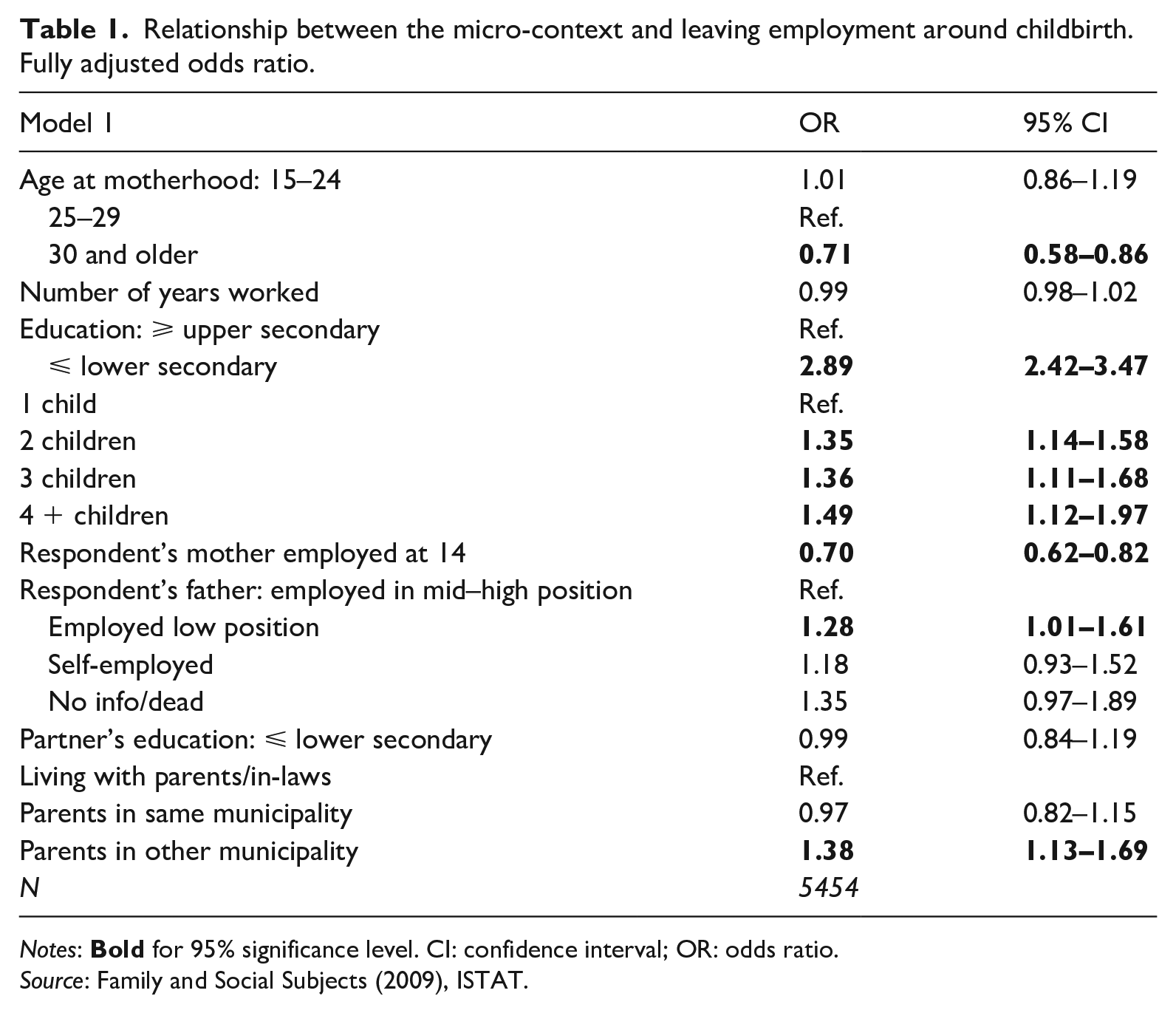
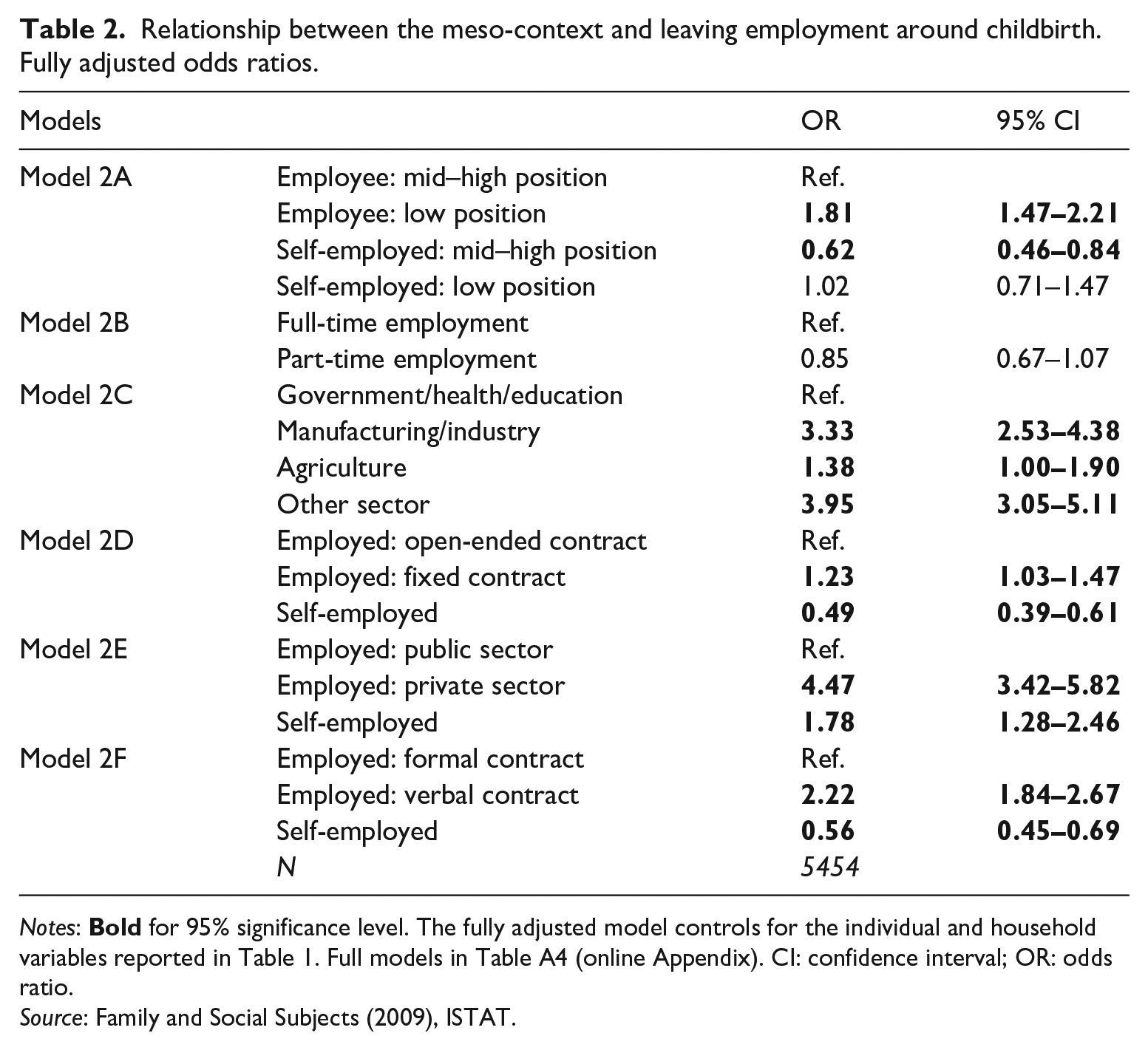
Tables 1 and 2 show results from logistic regression models on the likelihood of leaving employment and its associations with personal and household characteristics (Table 1, model 1) and job characteristics (Table 2, models 2A–F).
Relationship between the micro-context and leaving employment around childbirth. Fully adjusted odds ratio.
Notes:
Source: Family and Social Subjects (2009), ISTAT.
Relationship between the meso-context and leaving employment around childbirth. Fully adjusted odds ratios.
Notes:
Source: Family and Social Subjects (2009), ISTAT.
Model 1 (Table 1) shows significant differences between mothers who never left their job and those who did. For instance, low level of education and the total number of children were significantly associated with higher odds of leaving the labour market. Sensitivity analyses using a finer educational classification confirm the finding (Table A3, online Appendix). Older mothers and those who had a working mother in childhood were significantly less likely to leave employment around the birth of their first child, whereas mothers whose fathers were employed in low positions were more likely to do so. Moreover, compared to mothers who lived with at least one of their parents or parents-in-law, respondents who lived away from them were more likely to leave their job when their first child was born.
Models 2A–F in Table 2 show the role that each job attribute plays on the likelihood of leaving employment around the birth of the first child, once personal and household characteristics are controlled for (full details in Table A4, online Appendix). Except for the number of hours worked, all job characteristics are significantly associated with the likelihood to leave the labour market. Mothers employed in low positions (compared to those employed in mid–high), in the private sector (compared to public), with a verbal contract (compared to written) and a fixed-term contract (compared to open-ended) who work in manufacturing, agriculture, or other sectors (compared to the third sector) are more likely to leave employment around the birth of their first child. Self-employed mothers are less likely to leave employment compared to employees with an open-ended contract and with a formal contract. However, self-employed mothers are more likely to leave compared to those employed in the public sector. Additional analyses investigating the simultaneous effects of multiple work characteristics confirm the findings above (full details in Table A5, online Appendix).
Micro and meso influences on non-returns to the labour market
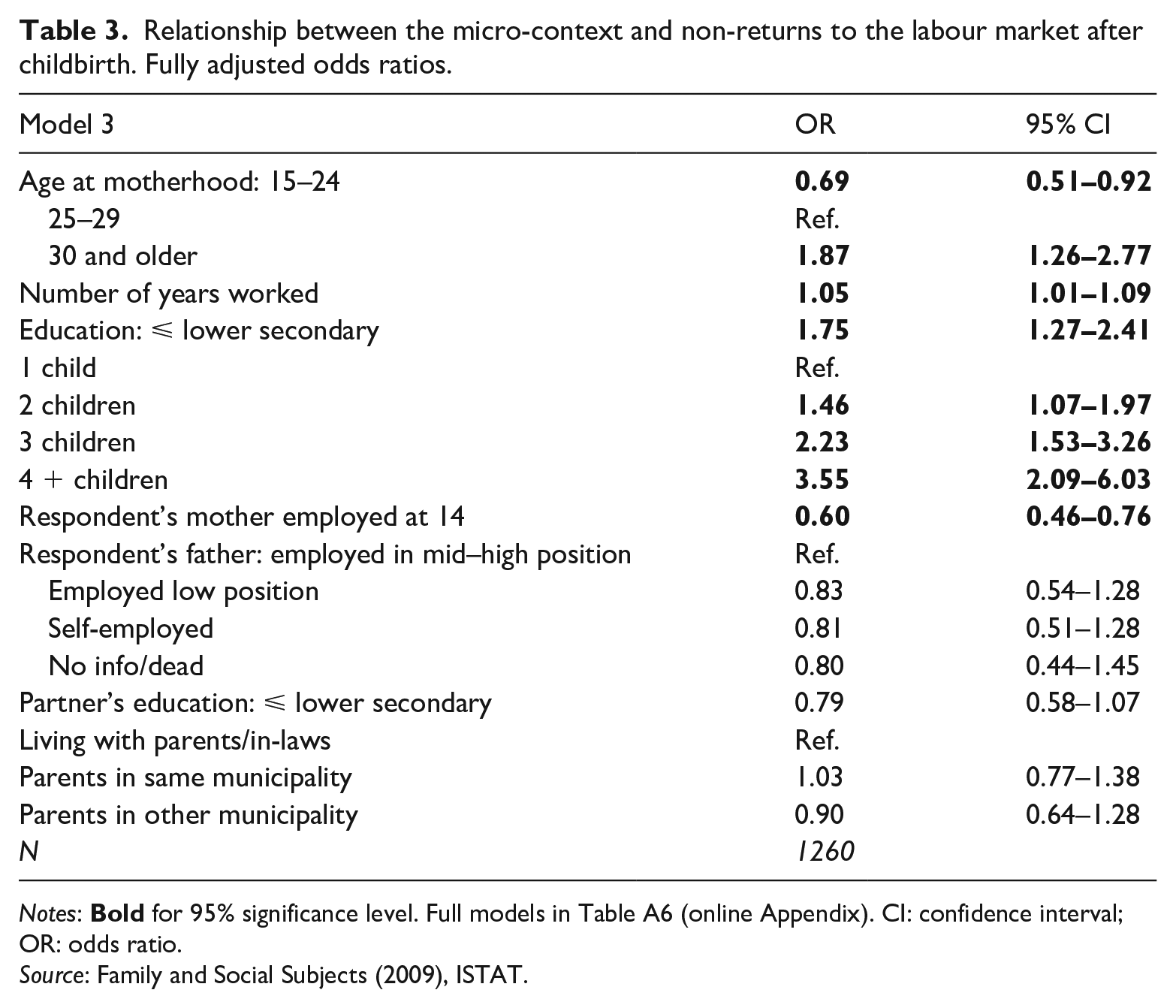
Models on the likelihood to never return to work for mothers who left employment after their first child show no significant association with mothers’ job characteristics. Therefore, Table 3 only shows results from the base model (model 3), while full details on job characteristics can be found in Table A6, models 5A–F (online Appendix).
Relationship between the micro-context and non-returns to the labour market after childbirth. Fully adjusted odds ratios.
Notes:
Source: Family and Social Subjects (2009), ISTAT.
Among those mothers who interrupted their careers, those who are older, less educated, with multiple children are more likely to have never returned to work, whereas those whose mothers were in employment were more likely to return to work. Partner’s education and proximity to parents/in-laws are not associated with the duration of the exit from the labour market.
The role of the macro-context
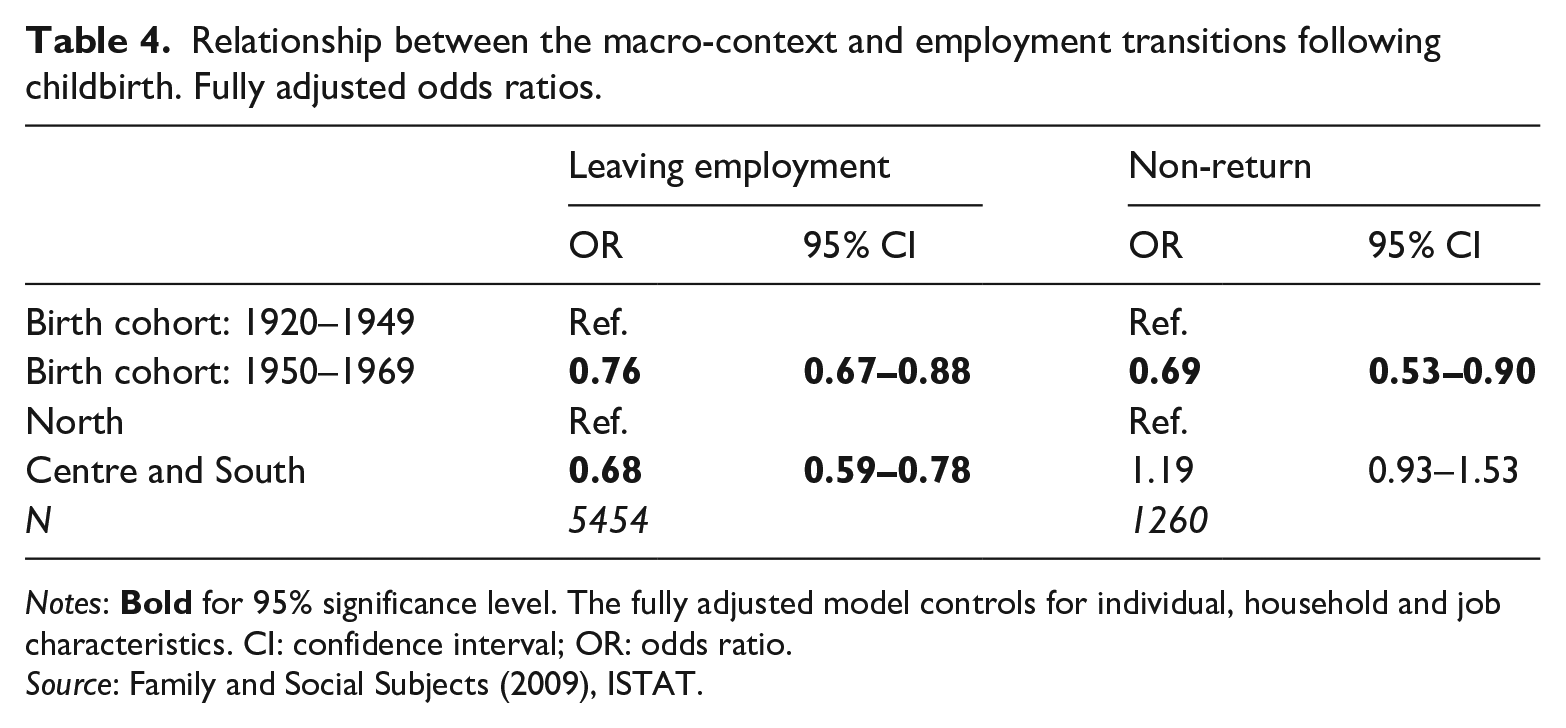
Table 4 explores the role of macro variables. Even when individual, household and job characteristics are controlled for, mothers in the Centre–South and those born in the 1950s and 1960s were less likely to leave the labour market compared to mothers in the North and those born in preceding decades. Further, among mothers who left employment, those born in the 1950s and 1960s were less likely to never return. Similar results were also found when small sub-categories of education were excluded (Table A7, online Appendix). Additional analyses (available upon request) further explored whether the role of micro and meso-level characteristics varied across birth cohorts and regions, with consistent findings across macro-contexts.
Relationship between the macro-context and employment transitions following childbirth. Fully adjusted odds ratios.
Notes:
Source: Family and Social Subjects (2009), ISTAT.
Discussion and conclusions
Contemporary policy debates view female employment as crucial for the well-being of women and society at large and call for sustained research examining its enabling factors and variation across countries and social groups. Academic research traditionally focuses on the role of either individual agency or macro-structural factors, and only more recent studies acknowledge the importance of looking across several levels of influence to advance understanding of mothers’ labour force participation. This study contributes to this literature by proposing a holistic theoretical framework that situates mothers’ employment transitions by examining the intersection of the micro-context of their personal and household characteristics; the meso-context of their working environments before childbirth; and lastly the macro-context of broader structural, institutional and cultural forces to which their lives are exposed. This framework has the potential to capture the multidimensionality and the complexity of mechanisms shaping transitions both out and back into the labour market following childbirth and periods of intensive childcare.
This model is illustrated by drawing on quantitative longitudinal evidence from Italy – an interesting study context for its distinctive pattern of low female labour market participation but comparatively stable careers in full-time jobs for the select group of women who enter employment, as opposed to patterns of discontinuous or curtailed participation observed elsewhere in Europe (Breen, 2004; Solera, 2009). Most women who were employed before the birth of their child remained in employment (77%). Of those who left, however, nearly 60% never returned. Empirical analyses confirm that employment transitions should be understood as the result of a complex system of influences acting at different levels.
First, women’s micro-contexts are defining factors of employment transitions after childbirth. In line with expectations, women’s moves out of employment first, and then their return to work, respond to personal characteristics – particularly prior labour market attachment, as measured through investment in education, and seniority – as well as to features of the wider household context – such as residential proximity to the child’s grandparents. Only partners’ characteristics do not exert any influence, although this is possibly due to homogamy between partners (Bernardi, 1999; Solera, 2018). Overall, the findings support the hypothesis that the micro-context acts as a significant influence on both the transition out of employment around childbirth, and later returns to the labour market.
The influence of mothers’ micro-context, however, should not conceal the role of the occupational meso-context, which – as expected – largely defines women’s employment behaviour around childbirth. Both the statistical significance and the magnitude of the effects indicate stark differences by occupational status, industry sector and contractual type, confirming both the segmented nature of the Italian labour market and the associated variation in levels of employment protection of different categories of workers. Women employed in the predominantly public sectors of education, health and public administration are the least likely to leave employment after the birth of their first child. The contractual security, the enhanced level of maternity protection and the greater flexibility of working arrangements within this sector offer some women the privilege to combine work and family (Solera, 2009).
However, once women leave employment after their first child, characteristics of their past occupation become irrelevant to their subsequent return to work. As suggested by research on Britain (Tomlinson et al., 2009), this might be explained by a misalignment of the employment contexts before and after interruption during childbearing/rearing years, as mothers downgrade to low-wage, part-time occupations upon their return to the labour market. Future research should extend the longitudinal perspective to investigate which aspects of the meso-contexts of working arrangements post-interruption enable the return of mothers to the labour market. Indeed, the employment profiles and trajectories of women returners are an under-researched but extremely relevant topic (Tomlinson et al., 2009). As women who take longer breaks from the labour market have lower socioeconomic status than those with continuous employment, downgrading to even lower pay and shorter hours upon their return to the labour market can exacerbate class inequalities.
The model’s application to Italian data also supports the importance of the macro-context. As expected, structural characteristics of the labour market and changes in welfare provision have created different opportunities for women to combine work and family life. First, younger cohorts who have benefitted from the expansion of public employment in the tertiary sector and enjoyed progressively greater levels of maternity protection (Bettio and Villa, 1998; Del Boca, 2002) were less likely to leave employment, both temporarily and permanently. Second, probabilities to leave the labour market around the time of childbirth are significantly lower for women living in the Centre–South. This partly reflects the nature of female employment in the South – first, within family-run agricultural businesses (with a weak separation between the productive and domestic sphere) and, second, within the more secure and family-friendly public sector (Daniele and Malanima, 2011). However, Southern women who leave employment are less likely to return. It is plausible that the more traditional norms and cultural expectations on women’s roles that exert a stronger conditioning on their entry into the labour market in the first place (Solera and Bettio, 2013), also hinder the returns of those who abandoned employment upon becoming mothers.
Lastly, the study theorised and addressed the potential interplay between levels of influence, specifically exploring whether the role of the micro and meso-contexts varies across birth cohorts and regions of residence. Although in this study the effect of individual, household and job characteristics on mothers’ employment transitions is similar across macro-contexts, the potential interplay between contexts of influence should not be dismissed. It is plausible that in other country contexts, or when comparing different countries, the role of the micro and meso-context might be more strongly dependent on the broader institutional and cultural context, as suggested by Dotti Sani and Scherer (2018), and that the same set of attributes produce different outcomes in different contexts. Similarly, future studies could extend the theoretical model and test how micro characteristics interact with the meso-context. For example, they could explore whether education plays a stronger protective role for mothers in precarious and lower-paid occupations.
The merits of this research should be weighed against some limitations, mostly imposed by the data. First, the research design did not fully account for potential endogeneity in the relationship between the birth of the first child and employment experiences. More sophisticated analyses could attempt to reduce the bias due to selection of mothers-to-be in employment depending on their family–work orientation. Second, as the survey does not reconstruct individuals’ residential histories, it was not possible to include time-referenced contextual indicators of the mothers’ area of residence, such as regional activity rates or childcare provision. Third, all measurements are self-reported and the possibility of recall bias in the retrospective accounts of work and fertility histories cannot be excluded. Lastly, the model could not be tested on more recent cohorts of women (born after 1970) as they had not yet completed their reproductive and employment histories. Their experience would have been of interest as they have been exposed to more flexible and less protected forms of employment following the labour market reforms in the 2000s. Applying the same theoretical model to more recent data would also shed light on the extent to which factors conditioning maternal employment have changed following the impact of the Great Recession of 2008–2009 and the Covid-19 pandemic on the labour market. Nevertheless, the richness of information on women’s life courses allowed a thorough investigation of the complex mechanisms influencing their labour force participation.
In conclusion, this study contributes to advancing the understanding of maternal employment by proposing a novel theoretical framework that accounts for the complex interplay of multiple levels of influence on mothers’ employment transitions around childbirth. These, it is argued, are shaped by mothers’ individual and household characteristics (micro-context), employment characteristics (meso-context) and broader cultural and institutional influences (macro-context). The efficacy of this integrated approach is supported by analyses based on large-scale, high-quality nationally representative data from Italy. Future research could extend this conceptual model to other countries, to enhance understanding of maternal employment, and its enabling factors, across different cultural and institutional contexts. Such multifaceted evidence is critical to developing policies capable of supporting mothers’ employment and shaping their micro (e.g. through employability schemes), meso (e.g. through flexible working arrangements) and macro-contexts (e.g. through funded high-quality childcare). Supporting mothers who want to enter, re-enter, or remain in employment contributes to the Sustainable Development Goals of a fairer and more gender-equal society, and as such it should be a societal and governmental priority.
Supplemental Material
sj-docx-1-wes-10.1177_09500170221082479 – Supplemental material for Influences on Employment Transitions around the Birth of the First Child: The Experience of Italian Mothers
Supplemental material, sj-docx-1-wes-10.1177_09500170221082479 for Influences on Employment Transitions around the Birth of the First Child: The Experience of Italian Mothers by Francesca Fiori and Giorgio Di Gessa in Work, Employment and Society
Footnotes
Funding
The authors received no financial support for the research, authorship, and/or publication of this article.

Supplemental material
Supplemental material for this article is available online.
References
Supplementary Material
Please find the following supplemental material available below.
For Open Access articles published under a Creative Commons License, all supplemental material carries the same license as the article it is associated with.
For non-Open Access articles published, all supplemental material carries a non-exclusive license, and permission requests for re-use of supplemental material or any part of supplemental material shall be sent directly to the copyright owner as specified in the copyright notice associated with the article.
