




Abstract
This article aims to question the dominant understanding of work–life balance or conflict as primarily a ‘work–family’ issue. It does this by exploring the experiences of managers and professionals who live alone and do not have children – a group of employees traditionally overlooked in work–life policy and research but, significantly, a group on the rise within the working age population. Semi-structured interviews with 36 solo-living managers and professionals were carried out in the UK, spanning a range of occupations. In addition to previously identified work–life issues, four themes emerged that were pressing for and specific to solo-living managers and professionals. These are articulated here as challenges and dilemmas relating to: assumptions about work and non-work time; the legitimacy of their work–life balance; lack of support connected to financial and emotional well-being; and work-based vulnerabilities.
Introduction
The ability to reconcile work and private life is a pressing social issue – one driving a large body of academic research as well as government policy, employment legislation and organizational policy and practice (Abendroth and Den Dulk, 2011; Booney, 2005; Gerstal and Clawson, 2014; Kelly et al., 2014; Warren et al., 2009). The most familiar term, work–life balance, can be defined as a situation in which ‘an individual [has] sufficient control and autonomy over where, when and how they work to enable them to fulfil their responsibilities both inside and outside paid work’ (Visser and Williams, 2006: 14). While the term appears to have applicability for all individuals who undertake paid work, there has been a rather narrow conceptualization of what makes up the ‘life’ part of the equation – focusing almost exclusively on domestic work, family and care (Eby et al., 2005; Eikhof et al., 2007; Kelly et al., 2014; Kinman and McDowall, 2009). While there has been some critique of the limitations of a care-focused framing, reflected also in the changing policy context which includes an extension of the right to request flexible working to all employees by the UK government in 2014, those without immediate family care responsibilities remain underresearched in the literature on work–life balance. This article attempts to address this by exploring the work–life challenges faced by one previously understudied group – importantly one that is on the rise within the working-age population – employees who live alone and do not have children.
Over 20 years ago, the single-person household was identified as the fastest growing household form throughout most of the developed world (Sorrentino, 1990). This reflects the ‘second demographic transition’ (Ogden and Hall, 2004), where a combination of factors including reduced fertility levels, reduced mortality rates, marriages taking place later in life and an increase in the number of marriages ending in divorce, result in an increase in both the total number of single-person households and frequency of transitions from one household type to another (Social Trends, 2009). A marked increase in the proportion of the population who live alone at some stage of their lives is one notable outcome. In terms of the working-age population, there is more than three times the number of people living alone in the UK than there was in 1971 – increasing from one million to 3.5 million – while the number of multi-adult households remains largely unchanged (Palmer, 2006). Within the UK, solo-living has been found to be especially pronounced among young and middle-aged workers (Lewis, 2005), higher socio-economic groups (Hall et al., 1999) and those living in urban areas (Census, 2011).
From the changes noted above, one concern is that organizations – especially those in urban areas with a young, highly skilled workforce – might employ a significant number of solo-living professionals and/or managers and yet know very little about their work–life concerns and requirements (Ford and Collinson, 2011; Young, 1999). The research project at the heart of this article seeks to address this knowledge gap, by exploring the work–life experiences of 36 young to middle-aged solo-living, childless managers and professionals from Greater Manchester in the UK. The article responds to Sturges’ (2013) call for more exploration of ‘qualitative’ notions of working-time and work–life experiences, particularly among young people, who are reportedly keen to reconcile work and private life but are often simultaneously drawn into working long hours while they establish careers (Sturges, 2012). Furthermore, Ford and Collinson (2011: 259) argue that increasingly managers and professionals are required to be ‘totally committed, more balanced and in control both at home and at work’ and thus experience a distinct set of competing and contradictory expectations at work. Thus the decision to focus on young, solo-living managers and professionals combines interest in focusing on a rarely studied group of employees who may also experience a distinct set of work pressures and challenges beyond family-life, children and care.
The structure of the article is as follows. The next section of the article reviews two key concepts in the literature: work–life balance and work–life conflict, arguing that in the case of solo-living managers and professionals, concepts that emphasize conflict, challenge and dilemmas rather than balance and harmonization appear most relevant. The review also explores common assumptions made about work–life balance, including a tendency for ‘work–life’ to equate to ‘work–family’, and identifies a series of work–life challenges and dilemmas experienced among the solo-living managerial and professional individuals in our sample. The article moves on to outline the method and sample of the study, then the analysis is presented in terms of four specific work–life challenges and dilemmas that emerged from the data. These relate to assumptions about work and non-work time, legitimacy of work–life balance, concerns about emotional and finance support, as well as perceived heightened vulnerability to disappointments at work.
Conceptualizing the work–life interface
A number of ‘linking mechanisms’ (Edwards and Rothbard, 2000) have been proposed to better articulate the relationship between work and other aspects of life. In the 1970s, the language tended to emphasize family friendly policies and work–family balance or conflict, as more women entered the workforce and employers became aware of the challenges faced by working mothers and nuclear families (Lewis, 1997). In the following decades, the concept broadened to encompass the challenges experienced by different groups of employees. As such, the more inclusive concepts of ‘work–life balance’ and ‘work–life conflict’ became common at the turn of the century. At the same time, attention was being paid to the way that the integration of work and life outside work could lead to either harmony or tension, positive or negative consequences for the well-being of individuals and their families. Thus the terms work–life facilitation, enrichment (McMillan et al., 2011) and boundary management (Nippert-Eng, 1995) became increasingly popular. Arguably work–life balance remains the most commonly used term but, following a review, we argue that the inherently positive frame implying a goal of harmonization and equilibrium, may not be the most useful in terms of actual lived experiences, particularly among certain groups of workers facing particular sets of working-life pressures, challenges and dilemmas.
Work–life balance
Though widely applied and used in the literature, a number of criticisms of the concept of work–life balance can be articulated. These include the assumption that a clear distinction between ‘work’ and ‘life’ can be made (Donkin, 2010; Eikhof et al., 2007; Warhurst et al., 2008), or that balance is possible, desirable and the sole responsibility of individuals to achieve it. A related assumption follows that ‘balanced’ or equal time should be allocated to each domain, neglecting the ‘perceptual experience of time and the subjective meanings people assign to it’ (Thompson and Bunderson, 2007: 17; see also Sturges, 2013). Finally there is a perception that it is possible to get the ‘right’ balance between work and non-work via one-off adjustments to activities/priorities, which tends to overlook the shifting nature of people’s involvements, commitments and priorities across the life course (Gambles et al., 2006; Sturges, 2013).
For Cohen et al. (2009: 229) work–life balance is ‘fast becoming a kind of cultural shorthand for a rather ill-defined set of lifestyle choices and workplace responses’. The authors acknowledge the potential of the concept, but argue that it has been inadequately defined, and has become somewhat reified as it has become more commonly used – being seen as something that simply exists and provides an easy answer, rather than something that should ‘challenge, provoke and illuminate’ (Cohen et al., 2009: 230).
Interestingly, many of these contributions contest the notion of work–life balance on the issue of time – the division or balance of time allocated to work and non-work activities, with an emphasis on time squeeze and time poverty (Chatzitheochari and Arber, 2010). More recent contributions have quite rightly emphasized the importance of financial matters in addition to time-based concerns in the work–life equation. Warren (2015) argues that time and too much labour market time has dominated work–life balance debates. Warren (2015) states that while time is important it is too narrow a focus on what she articulates as a ‘middle-class’ problem. She argues that financial issues also matter, in particular the rise in economic insecurity and underemployment, which are concerns more aligned with working-class lives. For Warren, finances remain inadequately addressed in the literature on work–life balance. We agree that both time and finances are central aspects of balance or imbalance in working lives, but we also seek to highlight that concerns regarding household finances are not confined to working-class households – they are often acute concerns for managers and professionals who live alone too, though perhaps for slightly different reasons.
The critique that resonates most strongly with this study, however, is the slippage between terms work–life balance and work–family balance where the ‘life’ aspect is conceptual shorthand for family care and parenthood. A call for ‘a broader, more diverse approach to the “life” component of the work–life balance equation’ has been made by Kamenou (2008: 99) in her article on the experiences of ethnic minority women workers in the UK – whom she found to have additional cultural, community and/or religious demands in the non-work domain in addition to family responsibilities. Likewise, Ozbilgin et al. (2011: 191) in their critical review of working-life, diversity and intersectionality research, urge researchers to consider the experiences of employees beyond the ‘ideal work–life balancer’ mould. This is reinforced in other review articles, which report an ‘overwhelming focus’ in work–life balance literature on traditional family households and on childcare as the primary non-work concern (Eby et al., 2005). Eikhof et al. (2007: 328) attribute the latter to the fact that while governments talk about equality for all, their ultimate aim ‘is not having better lives but breeding new lives; more specifically the reproduction of the future labour force at a time when birth-rates are in decline’. With these criticisms in mind, it is useful to think about alternative terms of reference, which emphasize the challenges of and dilemmas faced in reconciling work and personal lives.
Work–life conflict
Work–life conflict can be defined as the ‘interference between work and non-work’ (Kelly et al., 2014: 485). Key causes of work–life conflict, especially for managerial and professional staff, are said to be long working hours and unpredictable finish times (Bunting, 2003; Chatzitheochari and Arber, 2010; Durbin and Tomlinson, 2010); boundary-blurring (Kossek et al., 2005); and in particular the impact these have on family life (Kelly et al., 2014), though studies also focus on home to work spillover or interference too (Gerstal and Clawson, 2014).
Despite the family retaining its prominent place in most research to date, there is evidence to suggest that employees face work–life challenges beyond those connected to family care, for example in relation to time management pressures (Ford and Collinson, 2011), forming friendships and leisure time, sleep loss and general well-being (Chatzitheochari and Arber, 2010; Pedersen and Lewis, 2012; Sturges, 2012). There is even evidence to suggest that those without families may struggle the most in areas connected to well-being. Jones’ (2006) study on behalf of the Work Foundation revealed that excessive work demands made young, single professionals without children the most likely group to neglect nutrition, and in the Third Work–Life Balance Survey, of the respondents who had failed to take all of their holiday entitlement for the previous year, 72 per cent were employees without dependent children (Hooker et al., 2007). As De Janasz et al. (2013: 205) note:
Whereas substantial research attention has been given to the conflicts non-SAWDCs [single adult workers without children] face in balancing their work–life priorities, relatively little attention has been focused on the work–life balance issues of SAWDCs and the pressures they face.
This article seeks to address this omission, and in doing so expand conceptual vocabulary, arguing that when dealing with competing work and non-work time demands and financial pressures, as many young managers and professionals forging careers while living alone are, it may be more appropriate to speak of work–life challenges and dilemmas set against concerns about time, finances and emotional well-being, which are actively under construction and reconstruction. In particular, challenge and dilemma are not neutral terms but neither do they invoke such positive (balance) or negative (conflict) connotations, they also usefully imply capacity for change, agency and potentially resolution.
Research design and methodology
In order to explore the attitudes and experiences of solo-living managers and professionals in relation to their working lives, a qualitative methodology was applied as we sought to generate data that could ‘celebrate richness, depth, nuance, context, multi-dimensionality and complexity’ (Mason, 2002: 1). In addition, we sought to generate accounts of people’s working lives and identified biographical or life history methods as appropriate given our central research objective was to explore and better understand the working lives of professionals and managers who live alone and do not have children (Chamberlayne et al., 2002). The data set comprised 36 semi-structured interviews with male and female managers and professionals, from a range of different occupations, in the Greater Manchester area of the UK. All interviews were undertaken in 2012. The sample was primarily purposively driven, with managers and professionals aged 25 to 44 being sought because solo-living is especially prevalent in higher socio-economic groups (Milliken and Dunn-Jensen, 2005). In addition, managers and professionals are particularly prone to time-based work–life conflict (Chatzitheochari and Arber, 2010; Ford and Collinson, 2011; Hooker et al., 2007), potentially more so when they are investing in progressing careers (Sturges, 2013). Respondents were aged between 25 and 44 years to capture the intersection of solo-living with forming early and mid-careers, but with a view to retaining some diversity in the age profile of respondents as they potentially face different sets of issues beyond those typically concerning family care and children.
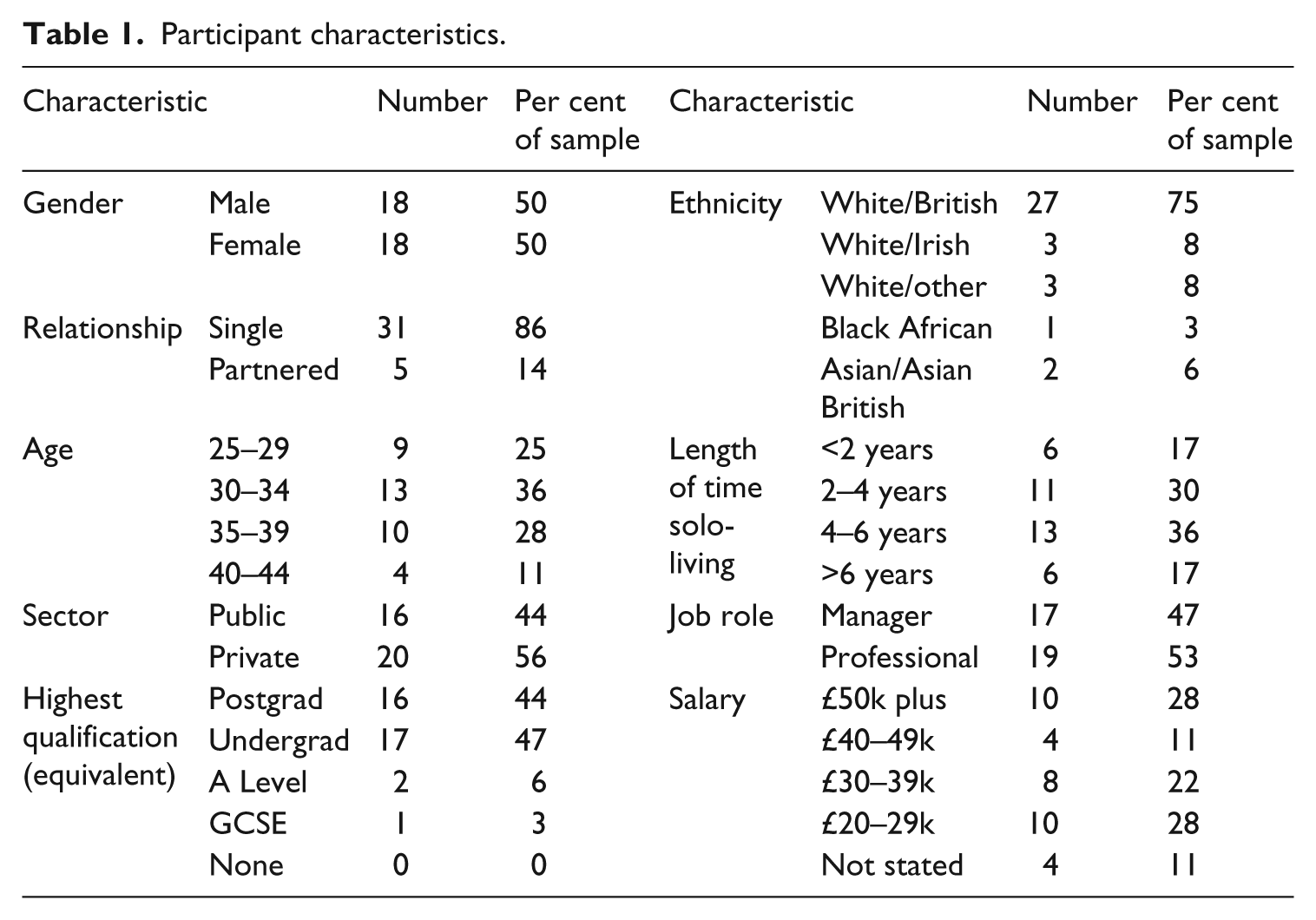
An initial call for study participants was made via a social network in the Manchester area, whose membership demographic largely matched those sought. Most were recruited directly from the initial call but, to boost the sample, some respondents recommended friends and acquaintances beyond the network who were willing to participate. The final sample contained participant diversity in terms of gender, age, occupation, earnings and relationship status (see Table 1). Relationship status is fluid and can change quickly. Nearly all respondents at the point of interview were single (31/36). Three respondents recruited to the research had very recently started new relationships (they viewed themselves as coupled though none were cohabiting) but drew largely on their experiences living alone and being single. In two instances respondents were partnered but lived alone in long distance relationships where they saw partners infrequently and typically only on occasional weekends. In terms of ethnic diversity, the population was predominantly white British (n = 27, 75%), though others were white/Irish (n = 3); white/European (n = 3); Black African (n = 1) and Asian/Asian British (n = 2) as would be expected of a young to mid-age professional population in an ethnically diverse city. While questions did not focus specifically on ethnicity as this was not a primary aim or objective of this exploratory study, respondents were free to discuss ethnicity, culture or religion at any point in their life story, facilitated through the Biographic-Narrative Interpretive Method (BNIM) approach.
Participant characteristics.
In terms of research design, two requirements were identified in terms of data generation. The first was that there should be scope for each participant to express their views and experiences in an open and fairly unstructured way, using their own frames of reference. A second requirement was that the interviews provided opportunity to discuss concepts and themes which relate back to overarching research questions, concepts and theories. In light of these requirements, the first part of the interview design was inspired by the BNIM (Wengraf, 2011). This is a method which seeks to attain life stories from participants by starting the interview with one open question, then basing subsequent questions primarily on the information emerging from that opening narrative through probing and returning to issues raised (Wengraf, 2011). This openness was appealing because there is so little prior research focusing on work–life issues for this demographic, and this also allowed each participant to set the agenda and focus of their interview as much as possible.
Interviews were conducted in a location of the participant’s choice, typically lasted around 90 minutes (36 interviews generating 50 hours of recorded data) and comprised two parts. The first part was designed to elicit narrative from the participant about their work–life history via a single, open question, following the format used in BNIM:
As you know, I’m interested in how people reconcile their work and their lives outside of work. Can you please tell me your life story, all of the events and experiences you feel have been important to you personally. Start wherever you like and please take all the time you need. I’ll just listen and won’t interrupt, I’ll just take some notes. If I have any questions we can return to them after you have finished.
As the research sought to identify aspects of the work–life interface that may not have previously been acknowledged in the literature, the open nature of this question was valuable – allowing each participant to use their own frame of reference and raise issues significant to them. As with BNIM, this was followed by the use of probing questions to elicit more information on parts of the participant’s story that were relevant to their working lives.
The second part moved away from BNIM conventions towards a more standard semi-structured format based on research questions connected to established themes in the existing literature, in addition to a participant information sheet. The semi-structured interview included questions on: what work meant to participants; how much of their time was occupied by work; what made up the rest of their ‘life’ but also what the term ‘work–life balance’ meant to them; their opinions on and experiences of living alone, and actions undertaken to alter or adjust their working lives, if required.
The data analysis comprised several stages. Initial analysis took place shortly after each interview via a researcher self-debrief which included ‘feel’ of the interview, observations about the setting, language and rapport between the researcher and participant and so on. A second stage analysis was conducted noting first impressions of the interview and the use of memos relating to research questions and themes jotted down during the transcription process, following Wengraf (2011). Then, a structured coding process was undertaken for all transcripts – starting with codes that emerged from the data itself, and then adding codes derived from thematic analysis in the literature review. As advised by Seidel and Kelle (1995: 55), after the identification of relevant themes, the focus was on collecting examples of those themes and examining them in order to find patterns of commonalities and differences. As a penultimate analysis stage, each transcript was considered holistically as advocated in BNIM, with a case account being produced around the life story and work–life trajectory. This allowed for the final stage of analysis to take place – in which individual cases were compared and contrasted.
Work–life challenges and dilemmas for solo-living managers and professionals
When conducting the interviews and carrying out primary analysis, it became clear that there was heterogeneity within the sample in terms of the experiences of and attitudes towards work and private life. The respondents held diverse attitudes towards their work, non-work activities and living alone; had varied relationship histories (in terms of family, partners, friends); and varied intentions for the future. Notwithstanding, a number of themes were identified. One common theme, also evident in Sturges’ (2013) research on young professionals, was that most spoke positively about their work and were enthusiastic about their careers. However, in addition to the work–life time-based demands noted in the literature – long working hours, unpredictable finish times and boundary blurring – four issues (articulated here as challenges and dilemmas) emerged which appear specific to, or heightened among, solo-living employees. These were two challenges assumptions about time and legitimacy of private lives and non-work time; and two dilemmas relating to lack of support (emotional and financial) in the non-work domain; and heightened vulnerability to disappointments at work.
We position the first two issues as challenges because they required individuals to challenge or rethink underlying or normative assumptions within organizational contexts about work–life policies (who they are primarily designed for, who needs them and why), so as to legitimize their private lives, priorities and concerns. The second two issues we pose as dilemmas – these were more often, but not exclusively, internal tensions and dilemmas. For example many of the key concerns raised about solo-living – absence of emotional support from a partner; inability to enhance wider social networks and form lasting friendships; lack of financial support with household expenditure – were positioned as difficult imbalances to resolve while working long hours and dedicating most of oneself to work. A major dilemma was how, when desired, to adjust investments in work, income security and personal relations. Each of these (interrelated) challenges and dilemmas will be explored in turn.
Assumptions about time
The first issue concerned participant work and non-work time. Participants suggested that several inaccurate assumptions were made in the workplace about solo-living workers’ non-work time: (a) that their time was solely leisure based; (b) that non-work time was less critical than for those with family care responsibilities; and (c) that unlike those with children, solo-living workers did not require flexibility in their work schedules. Most respondents felt these claims were a misrepresentation of their lives and challenged these assumptions.
In relation to the first assumption, many said they felt that they had less time for leisure than employees with cohabiting partners, though not necessarily those with children, because they did not have a partner to share the workload associated with running and maintain a home. While it is acknowledged that many households are dual career and therefore not households with a full-time homemaker, the point made was the inability to share or divide tasks and responsibilities with another adult which created a distinct time pressure when coupled with a demanding working environment. Charlie (female Training and Development Manager, NHS, 40–44 years) who described a typical workday as one where she often missed lunch and returned home around 7.30 p.m. commented:
The weekends then, you end up doing the things that you have to do… shopping, cleaning the car, the house, the washing, you know all that kind of thing… I think people assume that you’ve got a wad of time – that because you live on your own you’ve got loads of time – when you haven’t. I do a lot of DIY myself, but I’m like, well who do you think is going to do it – the DIY fairy? Sometimes I think it makes you better because you’re more independent, but equally there is no one to help take some of that on. And if you’re not getting home from work until late, you can’t start stuff like that then. So that’s the biggie. Everything’s more expensive, so rent, the house insurance, contents insurance, that sort of thing wouldn’t be double, loads of bills, TV licence, line rental… It feels like there’s a massive burden of expenses… Shared household stuff, washing and cooking and cleaning – it’s just nicer to be able to share some of those things. And I mean it from both ways, like its sometimes nice for somebody to make you a cup of tea or cook a meal, but it’s really nice to be able to do it for someone else. (Gemma, Clinical Psychologist, 35–39 years)
In relation to the second assumption, many respondents felt their non-work time was equally important to them as it was to those colleagues who were cohabiting and/or parents, for a number of different reasons. Cultivating lasting and meaningful friendships was one important example. The embryonic literature on friendships and work–life balance emphasizes that friendships are critical for sense of well-being and fulfilment (Pedersen and Lewis, 2012). Friendships were repeatedly cited as being very important and respondents reflected they relied heavily on friendships during periods of solo-living and when single. This resonates with research into the social support systems of single individuals (Fischer, 1982; Putnam, 2000; Reilly, 1996) and also debates about the ‘decentring of the family’ (Budgeon and Roseneil, 2002; Jamieson et al., 2006; Spencer and Pahl, 2006). One male participant emphasized the importance of investing in friendships over time saying:
It has taken a long time to work out what I need from friends and what friends I need… and to strengthen those as time goes by… I like the idea of turning round when I’m 50 and having had relationships which have lasted 25 years, just really solid friendships. (Seb, Pharmacist, 30–34)
Some respondents emphasized the time required to invest in long-term friendships and the importance of friends for emotional support and companionship in the absence of a partner. Added to this, social lives were thought to take less active planning when individuals are cohabiting – as one respondent thought, rightly or wrongly, ‘things just evolve’ more when one is coupled as opposed to the active planning more often required when single. Grace (Solicitor, Law Firm, 30–34 years) articulated this issue well:
It’s the thought process of actually thinking of things where you might meet people who have got a common interest – because people work long hours, especially in your 30s… you’ve got to really think about where am I going to meet these people that I’m going to really like, and really focus down on your hobbies and that type of thing. And really put a lot of energy into those people when you actually meet them.
A further significant issue raised in relation to sustaining close friendships was the investments and time involved at a life-course stage when friends’ priorities may shift as they start cohabiting with a partner, marrying or becoming parents. As Pedersen and Lewis (2012) note, when experiencing time squeeze, parents often put work and family first, viewing friendships as a necessary sacrifice. Examples from our respondents also supported this claim discussing the efforts required to maintain friendships when friends’ commitments change. A second issue concerned forging new friendships when participants relocated for work. Paul (Sports Journalist, Media Firm, 40–44 years) spoke of both these issues in relation to his own relocation and the challenge of making and sustaining new friendships at an age when many new colleagues had young families:
It took me a long time to make friends, that was the biggest problem really to be honest, it took me getting on for 12 months to really make any friends who I could socialize with at the weekends, I mean the people who I worked with were great, but the problem was, they had families and stuff, you know they tried to integrate me whenever they could, but obviously that wasn’t always possible.
Another time-based challenge was the trade-off between a work-centred existence and making time to date and invest in the early stages of a relationship. Some cited difficulties relating to work commitments, long hours and unpredictable finish times. Ann (Anaesthetist, NHS, 30–34 years) said that investing in the early stages of a relationship was difficult alongside a demanding work schedule and study commitments, noting how she ‘ended up finishing [one] relationship because he… wouldn’t understand that I could only see him once, twice a week’ and reflected that ‘other relationships didn’t really get started properly’.
These concerns about the challenges of forming intimate relationships were discussed more among older female participants some of whom were keen to find a partner and hoped to start a family in the near future (also see Kelan, 2014). Time pressures for these women were not just about daily or weekly rhythms, but about life-course stages and fertility concerns beyond their immediate control. For them it was not so much a challenge about how to combine work with a family, but whether the opportunity to face that challenge would actually materialize. Jenny (Marketing Manager, Food Company, 35–39 years) commented: ‘[i]t’d be nice to meet somebody and settle down, you know whether I’ll have kids – probably not given that I’m nearly 40, but you know it’s that type of thing – to try and put the effort into meeting somebody’.
Suzanne (HR Manager, 35–39 years) articulated a similar point but emphasizing long hours and comparing her ability to manage compared to her colleagues at the same ‘grade’ who were all married men with wives and children:
I feel a bit like I’m stuck in a catch-22 situation – like I’m in work so much there’s not time to meet somebody… I’m really looking forward to having a cohabiting relationship again, but I’m just in such a [work-based] frenzy and because there isn’t anyone to share the load outside of work a bit and give a bit of emotional support […] I do look around the company and it is a gender issue – all the Senior Managers are male, they’ve all got wives at home… and they can have kids at home.
Legitimacy of non-work time and private life
The second challenge relates to perceptions about legitimacy of non-work time and private life. Participants often raised the concern that only certain non-work roles and activities were considered to be legitimate reasons for pulling time and energy away from the workplace – primarily those related to care and family responsibilities.
Interestingly some respondents questioned their own legitimacy relative to others in terms non-work time. Not only did they feel unable to request working-time flexibility, they also felt unable to refuse requests to work over and above their contracted hours. Respondents regularly contrasted their own needs with those of colleagues who were parents. Ed (Business Development Director, Bank, 24–29 years) stated:
If you’re double-heading a deal with someone, and something needs to be out that night… and one of you just wants to go home to watch TV and the other one wants to go home to the kids, then the latter is the one who’s going to go home.
To some extent, the legitimacy problem is linked to the self-oriented nature of most non-work activities cited such as relaxing, seeing friends or exercising, which were perceived as less legitimate reasons to leave work than activities related to caring for others or parenting.
Other activities were frequently cited as important to solo-livers including study/professional development; household maintenance and spending time with extended family, friends and forming new relationships. However, as most of these activities carried little by way of fixed time requirements, this further hindered the extent that they could be used to put boundaries on working-time pressures. Thus despite exercise being increasingly recognized as important for both mental and physical health and well-being, Patrick (Regional Contract Manager, Recruitment Firm, 24–29 years) saw little comparison between his desire to go to the gym ‘which is open 24/7’, and a colleague’s need to get home ‘because they have a living thing to care about’.
It was often quite difficult to unpick in interview transcripts whether the ‘legitimacy problem’ reflected the respondent’s perceptions of the attitudes of their employers and work colleagues, or their own beliefs about managers and work colleagues’ perceptions. However, most were clearly frustrated that their non-work life was seen as less important. A good example is how Ed concluded the comment that is cited above about double-heading a deal, saying: ‘[b]ut you know, we get paid the same salary basically, so why is my going home less important?’
Absence of emotional and financial support
In terms of dilemmas faced, one issue reported by the group of solo-living employees relates to the trade-off between work investments with a view to ensuring income security versus time spent investing in relationships which could provide other kinds of supports and security relating to emotional and financial concerns. Starting with emotional support, Charlie (female T&D Manager, NHS, 40–44 years), spoke about a time in recovery after a back operation:
It was a nightmare – I couldn’t do anything. My mum had come to stay which was really good – but then she is 76 […] My friend Nic helped out quite a bit. But when the [first] 10 days were up, they both went away, so I had literally nobody there, but I couldn’t really do anything. Even daft things like putting washing in the washer, I couldn’t bend over and I actually got stuck on the floor in my utility room. I was off work for three months… So it was tough – quite lonely.
While it is generally recognized that solo-living employees have fewer non-work responsibilities than those with families, this flip side is perhaps less widely acknowledged – that there is often no one who prioritizes their well-being. One respondent said she sometimes asked herself ‘would anyone notice if I disappeared? Like, how long would it take for someone to notice?’ (Judith, University Academic, 30–34 years).
The second issue raised concerned financial support. Having sole responsibility for rent or mortgage payments was a significant pressure for many of the respondents, especially during a period of economic strain which had led to recession, austerity and restructuring across both the public and private sectors. Bob (Senior Manager, Drinks Company, 35–39 years) stated:
I think if you are living on your own or you are operating financially on your own, then there’s naturally a more personal ethos to motivate yourself to do your job properly, because ultimately, there’s not a second wage coming into the household… it’s a self-protection thing.
A number of the participants discussed how they were entirely reliant on their own earnings in an unstable economic environment. Many claimed this vulnerability was not recognized by colleagues. Grace (Solicitor, Law Firm, 30–34 years) for example said:
I remember a friend of mine who’s a scientist, she said that when they were under threats of redundancy a lot of the people were saying ‘oh it’s all right for you, you’re single, you can go anywhere’, and she was saying Yeah, but I’m the only one paying the mortgage, there’s no one else backing me up! I can’t rely on other people because other people are not reliable. So if I’m not to be homeless and destitute or something then I have to achieve this. So I feel quite sort of driven a lot of the time… whatever I do or don’t do is quite often informed I think, on some level, by how much it might threaten my sense of security as a whole. (Gemma, Clinical Psychologist 35–39)
Vulnerability to disappointments at work
The issue of vulnerability went beyond financial concerns, relating also to robustness in response to disappointments at work. Work was, for many respondents, the primary anchor in their lives. Many took pride in their occupational status, work ethic and commitment, and saw their work colleagues as close friends, even akin to a sort of family, similar to the young professionals in Sturges’ research (2013). While this is not unique to solo-living managers and professionals, there was a view that living alone intensifies attachment to work, because for some, not all, sense of fulfilment was often not anchored to their personal lives. The following participants illustrate this point well:
My life kind of revolves around work, you know… because I haven’t got that many other distractions… You get a lot of criticism [in the job] if things aren’t happening, and for someone like myself, where your job is very important, you feel that criticism quite hard. So you’d rather put in the extra hours to try to avoid it – because you want to feel like you’re doing a good job – because if you don’t get that kind of sense of achievement from your work then that’s quite hard isn’t it, when that is such a focus in your life. (Jenny, Marketing Manager, Food Company, 35–39 years) You go home and you are still thinking about it, there is nothing there to distract you from it. Little things sometimes get a bit exaggerated in your head I think, because you come home to an empty house, and there is no one there to say ‘oh, it’s okay, it’s not that bad, it’s all right… don’t take it personally’. (Lewis, Senior Manager, Pensions, 35–39 years)
Conclusion
This article has explored and analysed the work–life experiences of a group of individuals traditionally overlooked in work–life balance research – young to mid-age professional and managerial employees who live alone and do not have children. The findings reinforce earlier studies that have found that young managers and professionals enjoy and are committed to their careers (Sturges, 2012), but that those who are solo-living employees also experience work–life balance concerns. This article goes beyond existing studies by identifying four specific challenges and dilemmas connected to: assumptions about work and non-work time; the legitimacy of their work–life balance; lack of supports linking to financial and emotional well-being; and work-based vulnerabilities. We positioned work and non-work time, and legitimacy of work–life balance as issues as challenges because they required individuals to challenge or rethink underlying or normative assumptions within organizational contexts about work–life policies (who they are primarily designed for, who needs them and why). The second two issues we posed as dilemmas – these were more often, but not always, internal tensions where respondents struggled to resolve aspects of personal and working-life, alongside emotional and financial demands of solo-living.
In terms of broader research implications, it is suggested that current conceptualizations of work–life balance and work–life conflict, largely focused on time squeeze and childcare, are inadequate in terms of understanding the experiences of a diverse workforce. In particular the focus on balancing work with children and care, for example, fails to accurately capture the experiences of childless solo-living individuals whose working hours are inhibiting their ability to form and sustain relationships, in particular friendships and intimate partnerships which may or may not open up opportunities for forming families of their own in the future. Dilemmas about how to focus adequate time on demanding yet rewarding careers, while also wanting to invest time in forming relationships with a view to starting a family were quite striking dilemmas, particularly for women in the sample who were approaching the age when fertility concerns were pronounced, but also as social norms about age and motherhood evolve (Friese et al., 2006). Time-based pressures, both immediate (daily, weekly, monthly rhythms) and in terms of life-course dynamics, were important to all participants, but life-course concerns were articulated as central dilemmas for the female participants approaching middle age. This illustrates the point made by Gambles et al. (2006) that perceptions that work–life balance or harmonization can be achieved by making one-off adjustments to activities or priorities is wide of the mark and underemphasizes the significance of and the different ways that time can impact on working lives of women and men. It illustrates, in contrast, the fluid nature of involvements, commitments and priorities across the life course.
Time, however, was not the only major work–life issue. Emotional well-being and financial stability were also frequently discussed. In particular how to balance investments in friendships, forming intimate relationships alongside safeguarding economic security through work and the responsibility for the maintenance of households alone, were also central to dilemmas about working lives.
Returning to this literature, we argue that Warren (2015) is correct to emphasize relative absence of financial concerns to the literature on work–life balance, which has to date focused disproportionately on time. However, we argue that the financial or economic dimension to work–life balance is not solely a working-class preoccupation. Furthermore, this research emphasizes a third dimension to the work–life balance debate – that of emotional well-being. The importance of investments in both intimate relationships and wider friendship networks were perhaps the most pronounced concerns among solo-living managers and professionals.
Future studies might extend the small body of research that has explored the impact of work pressures on friendships (Pedersen and Lewis, 2012), but extend this to consider the way in which friendship networks, or lack of, may alleviate or intensify work and non-work pressures, especially for those who live alone.
Footnotes
Funding
The authors received no financial support for the research, authorship and/or publication of this article.