



Abstract
This article draws on the ‘double indeterminacy of labour power’, a key conceptual development in labour process theory, to examine mobility power in Saudi Arabia. State control over the mobility of migrant workers is crucial to the labour process and the wider political-economy of Saudi Arabia. However, little is known about mobility–effort bargaining and the specific forms of mobility power in the Saudi context. This article argues that not only is mobility–effort bargaining at the core of capital–labour relations in Saudi Arabia, but that mobility and effort are variably controlled by different sponsors/agents of control. Importantly, the control exercised by the state, capital and other sponsors over migrants’ mobility is not absolute. Developing mobility power further, the article details the multiplicity of mobilities and labour contracts to delineate a ‘sponsored labour regime’, and highlights the underexplored role of the state, and other agents of control, in conceptualising mobility–effort bargaining.
Introduction
Capital–labour relations and the workplace remain under-researched in Arab Gulf capitalisms. Analyses of the labour process are even rarer. Scholarship remains dominated by either political-economy approaches and their predominant focus on state–capital relations (Buhr and Frankenberger, 2014; Schlumberger, 2008) or by HRM perspectives (Alzalabani, 2017; Lauring, 2013; Mellahi, 2007). Addressing these gaps in scholarship, the article examines state–capital–labour relations in Saudi Arabia through a qualitative case study of a Saudi workplace. Analytically, it draws on the ‘double indeterminacy of labour power’, a key conceptual development in labour process theory, which remains underexplored at the workplace, to examine mobility–effort bargaining at the Saudi workplace. In proposing mobility power, Smith (2006, 2010) argues for the ‘double indeterminacy’ of labour power in the capitalist labour process, referring to the conjunction of effort power and mobility power. He contends that the indeterminacy of labour mobility is as crucial as indeterminacy around work–effort bargaining in shaping relations between capital and labour, providing workers a measure of agency in negotiating production and mobility indeterminacies.
The ‘double indeterminacy’ or mobility–effort bargaining in Arab Gulf countries constitutes an interesting context given their extensive and long-standing reliance on migrant labour as well as the significant role of the state in controlling migrant labour’s mobility. Of these, Saudi Arabia is the largest employer of migrant labour and a key regional (and global) power. More than 80% of the total workforce in the Saudi private sector consists of ‘temporary’, highly controlled and low-cost migrant workers from South and South-East Asia (Saudi Arabia Authority of Statistics, 2021). The state controls the mobility of migrants in and out of the country as well as between employers through the sponsorship system or kafala system. It gives employers control over migrant workers who cannot change their employers, while the employer can lay off migrants easily (Alsadiq and Wu, 2015; Hanieh, 2015). The Saudi context raises further important conceptual questions as the movement of migrants is controlled by a sponsor who can, but does not have to be the employer, leading to complex bargains around mobility, wages and effort (Rahman, 2018).
Despite the evident significance of migrant labour to Saudi (and other Gulf) capitalism, little is known about mobility–effort bargaining and the specific forms of mobility power in the Saudi context. The crucial role of the state and global capitalist dynamics, which shape patterns of mobility in the Saudi context, remain marginal to labour process theory (LPT) and mobility power. This lacuna is addressed in the migration literature where the uncertainty created by workers’ effort and mobility power for capital features prominently. It captures the complex relationship between the state, workers’ migration status, possibilities for value extraction by various intermediaries and employers, with implications for workers’ mobility power (Anderson, 2010; Forde and Slater, 2016; Howe et al., 2020; Wright and Constantin, 2021).
Integrating these insights, the article examines, first, how different instances of the control of mobility and effort interact to form a highly segmented labour market and workplace in the construction sector in Saudi Arabia. Second, it examines different forms of mobility power, looking specifically at the way sponsors, employers and agent-subcontractors frame the double indeterminacy at the workplace. The article argues that not only is mobility–effort bargaining at the core of capital–labour relations in Saudi Arabia, but that mobility and effort are variably controlled by different sponsors or agents of control: the state, Saudi sponsor, the employer, the tasattur entrepreneurs (migrant worker-manager-intermediary who manages the tasattur or ‘concealed’ business of their Saudi sponsor and other migrant workers on his behalf). Consequently, there is not one but multiple forms of mobility–effort bargaining, and variable mobility power, in the workplace depending on how sponsoring, migration status, employment and subcontracting practices are linked. This constitutes a specific form of labour regime of mobility–effort bargaining – what we term a ‘sponsored labour regime’.
This article is the first to examine mobility–effort bargaining in Saudi Arabia, highlighting the hitherto underexplored role of the state, and other agents of control, in conceptualising mobility–effort bargaining. The study develops mobility power further through detailing different types of mobility control, multiple forms of mobility–effort bargaining and the consequent variable forms of mobility power at the workplace. Importantly, the control exercised by the state, capital and other sponsors over migrants’ mobility is not absolute, even in a highly controlled context. Resulting from the empirical reality and reflexivity of the research, the article makes a conceptual contribution to the sociology of work, as it links workers’ social spaces with the workplace in order to achieve a deeper examination of workplace dynamics.
The article is structured as follows. The next section reviews the literature on mobility power and migration to develop the research questions. Section three outlines the research design, and sections four and five present and analyse the case study. Conclusions are drawn in section six.
Mobility power and the state
Mobility power is a key concept in LPT, which provides a sophisticated conceptualisation of the labour process and labour power that is sensitive to the flows of migration (Smith, 2010). This perspective emphasises a ‘double indeterminacy’ in the capitalist labour process. First, there is uncertainty regarding the conversion of labour power (the potential for work) into actual work effort. Although wages may be known in advance, the conversion process remains open-ended as employers seek higher levels of effort intensification while workers may vary their levels of productivity and motivation. The second type of indeterminacy relates to uncertainties regarding how labour enters, remains within or exits the capitalist labour process. What is highlighted here is the mobility of labour, which can enhance or impede the conversion of labour power into productive effort. ‘Mobility indeterminacy’ arises because there is no guarantee of permanency in the employment relationship. Firms try to minimise the mobility power of workers. Therefore, there is also an important, albeit often unacknowledged, level of mobility–effort bargaining between employers and workers (Smith, 2006). Thus, labour power consists of both effort power and mobility power, providing workers a measure of agency in negotiating production and mobility indeterminacies, respectively, and this is in juxtaposition to employers’ attempts to control the effort and mobility of workers.
Although a powerful conceptual tool that captures the dialectics of employer control and agency of labour (Alberti, 2014), mobility power remains underexplored in the workplace, while the role of the state and global capitalist dynamics remain largely marginal to discussions of LPT and mobility power. This is despite Smith’s (2010: 276) emphasis on a direct connection between labour mobility and the effects of ‘policing borders and the differentiation of labour power into legal and illegal categories with differing implications’. This is significant in Saudi Arabia, where the role of the state is crucial in organising and controlling the mobility as well as the bargaining power of a vast international migrant workforce through the sponsorship system of kafala (Adham and Hammer, 2020, 2021; Hanieh, 2015). These gaps in conceptualising mobility power – the role of the state and the wider social and economic processes that shape patterns of mobility – are addressed in the scholarship on migration, providing valuable insights to examine mobility control and power in the Saudi context.
The state and sponsorship in mobility control and power: Insights from the migration literature
Critical migration scholarship offers an understanding of the indeterminacy of labour and mobility power with its focus on the complex relationship between the state, workers’ migration status, and possibilities for value extraction by employers and various intermediaries. First, it brings to attention the profound effects of the state, through its migration policies, on the operation of the labour market and outcomes for migrant labour. Anderson (2010) argues that immigration controls can undermine labour protections by helping to form types of labour with particular relations to employers and the labour market. This gives employers and intermediaries particular mechanisms of control over a weakly regulated migrant workforce. Knox (2010) and Forde and Slater (2016) detail how the absence regulation of temporary work and uneven protection of workers by the state entrench temporary work while creating opportunities for large labour agencies.
Second, migration literature highlights the key role labour intermediaries play in the migration processes along with, and often as a consequence of, state migration policies. They provide services to assist the mobility, labour market entry and integration of migrant workers, as well as harassment, bullying and unpaid wages and overtime (MacKay, 2009). Van den Broek et al. (2016) highlight how migration intermediaries shape recruitment, selection and placement, thereby in part determining labour market outcomes for particular groups of migrant workers. Third, emerging scholarship also emphasises the significance of visa type and visa status in labour market segmentation and outcomes for migrant workers (Howe et al., 2020; Wright and Constantin, 2021). Different segments of the temporary migrant workforce are employed on the basis of identifying their ‘productivity and reliability’ according to visa class and visa status, making some more attractive to employers and others more vulnerable to exploitation.
Importantly, migration scholarship reveals that migrant labour is neither homogenous nor disposable. Rather, migrant labour (and employers) is driven by a range of motivations (MacKenzie and Forde, 2009). Samaluk (2016), for example, examines how migrant workers recruited through transnational labour market intermediaries acquire various working and training opportunities and mobilise the intermediaries to their advantage. Similarly, employers use migrant (often undocumented) labour while being aware of the disadvantages associated with language skills and length of stay of migrant workers (MacKay, 2009).
Taken together, LPT and migration scholarship deepen our understanding of mobility control and power. LPT benefits from the migration literatures’ nuanced conceptualisation of the role of the state, diverse migrant status, and the role of intermediaries in structuring transnational as well as local labour regimes. Both argue that the employment of migrants is an unpredictable and contradictory process for employers and migrants, and mobility constitutes a terrain of control and resistance. The article applies this understanding to examine mobility power in the Saudi migrant labour regime. All Gulf Cooperation Council states rely heavily on migrant labour through the use of the kafala system. Of these, Saudi Arabia is the largest employer of migrant labour, and a key regional power.
The state and migration regime in Saudi Arabia: Inconsistencies and contradictions
Saudi Arabia is characterised as a patrimonial rentier state that controls all resources and functions through two clientelist societal mechanisms of co-optation and coercion of Saudi elites and citizens (Schlumberger, 2008). The citizenship and kafala mechanisms create the main dividing line between Saudis and migrants and are central to the construction of the Saudi labour market. The state shapes the labour market through the kafala system, a long-standing and structured state policy that controls the mobility of migrants in and out of the country as well as between employers (Dito, 2015). It is a sponsorship system that gives employers (as sponsors or kafeels) control over workers who are constrained by being unable to change their employers. This control is accentuated through precarious living conditions in migrant labour camps and enforced separation of migrants from their families. Thus, a strong state exercises control over the mobility and bargaining power of a vast migrant workforce, which includes both documented and undocumented migrants. It also ensures a near absence of industrial relations through the kafala system as it helps create a centralised decision-making approach where the decisions of owners and managers are rendered unquestionable. Labour management in Saudi as well as of multinational firms tends to be that of a ‘hire and fire culture’ that prefers ‘employees who fear authority and work with minimum demands’ (Lauring, 2013; Mellahi, 2007: 85). In the absence of trade unions, the near authoritarian labour-relations regime, and the immense power the kafala system gives to employers, migrant labour appears to have almost no bargaining power with their employers (Rahman, 2011).
This scholarship, however, overlooks the capitalist nature of the Saudi state and accords limited agency to capital or labour (Hanieh, 2015). As argued by Adham and Hammer (2021), the dynamics in Saudi capitalism are better analysed as a tension between logic of capitalist accumulation and policies of state legitimation. A historical assessment of the Saudi migration regime reveals the inconsistencies in the functioning of state power. Shifting migration regimes attest to crises that stem from internal struggles between state and labour and pressures from global capitalist dynamics, both belying the overarching role of the Saudi state. Conceptualising the state as a terrain of class struggle (that is not simply an instrument in the hands of the ruling class) (Poulantzas, 1978) opens a number of other possibilities – for example, ruptures through which labour can confront ideological apparatuses of the state and capital, and of struggles between capital and the state (even if patrimonial and authoritarian) – widening the possibility for understanding mobility beyond absolute mobility control over migrants and non-existent mobility power of migrant labour).
Between the 1930s and 1970s, Arab Gulf countries recruited migrant labour from surrounding countries – 80% of the total migrants in Saudi Arabia. This labour regime was challenged in the 1950s and 1960s with frequent labour unrest. As a counter, the state instituted a new migration regime in the 1960s–70s with the kafala system at its core. This proved effective in controlling the working class, labour extraction and capital accumulation. Central to this shift was the tight control by the state over the mobility of migrant workers. Between the 1970s and 1986, Saudi Arabia shifted to recruiting more non-Arab migrants. While Arab migrants were seen ‘as a primary cause of Arab nationalism, Nasserism and leftism in the Gulf’ (AlShehabi, 2015: 21), migrants from South and South-East Asia, recruited and managed through the kafala system, were considered cheaper and malleable. They were easier to isolate from Saudi citizens due to cultural and language barriers, easier to deport in the event of strikes, and their presence helped create divisions among the wider working class (Khalaf et al., 2015). Today, non-Arabs constitute more than two-thirds of the total migrant population, with the highest concentration in manufacturing, construction and retail (Figure 1).
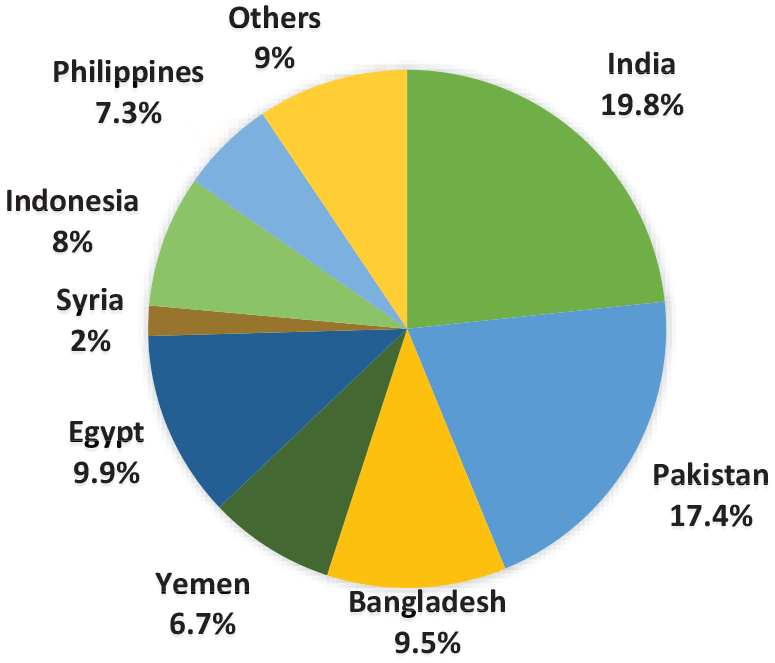
Estimates of migrant populations in Saudi Arabia.
The global crisis of the 1980s and 1990s revealed the inconsistencies of this otherwise successful regime. Declining oil prices and high unemployment among Saudi citizens saw the state introduce Saudisation, a bundle of policies to promote the employment of Saudis in state-owned and private firms. It acts as a mechanism of co-opting Saudi citizens into the authoritarian state, and accompanies the existing sponsorship system of kafala. However, the operation of both policies – Saudisation and kafala – has resulted in tensions. Saudisation imposes cost and control constraints on firms. Firms have to pay an annual fee to the state for the work permits of migrant workers and employ and pay Saudi workers who are less amenable to managerial controls than migrant workers. Thus, firms circumvent Saudisation, and by extension state control, by outsourcing a majority of their workforce while meeting the mandatory Saudisation requirement among their directly employed workforce. Similarly, state control through the kafala system is not absolute as evidenced by a complex intermediary system (Adham and Hammer, 2020, 2021). Of particular interest here is the practice of tasattur. Tasattur or ‘commercial concealment’ refers to a Saudi citizen who allows an expatriate to use his/her licence and commercial registration to set up a business in return for a fixed amount of money. Tasattur entrepreneurs (who are migrant workers) act as intermediaries/agents of capital for the Saudi sponsor/kafeel by managing and controlling other migrant workers. This practice acts as ‘a rentier system that allows the citizen to extract revenues from the expatriate with little or no contribution themselves’ (Kinninmont, 2015: 24), but also allows for a modicum of agency as some migrants have transformed their position from labourers to entrepreneurs through tasattur practices (Rahman, 2011, 2018).
Going forward: Types of mobility control and forms of mobility power at the Saudi workplace
The differentiated understanding of state–capital–labour relations in Saudi capitalism provides a novel perspective to study mobility power at the workplace. Both state migration policies and the intricate intermediary migration industry suggest a greater complexity at the Saudi workplace than recognised so far in the scholarship. The presence of tasattur practices suggests variations in the functioning of kafala at the workplace. It indicates segmentation among migrant labour as well as the presence of different agents of control (other than the state and employer) of migrant labour’s mobility and effort. This in turn raises questions about the extent of state and employer control over the mobility and effort of a diverse and segmented migrant workforce, and its implications for mobility power.
Integrating insights from LPT and the migration literature, this article examines the dynamics of state–capital–labour interactions in mobility–effort bargaining through the functioning of the kafala system at the workplace. It analyses the intricate relationship between the state, workers’ migration status, possibilities for extraction by various intermediaries and employers, with consequences for mobility power. First, the study scrutinises how mobility is used to control effort in the Saudi workplace. Second, in view of the evidence of tasattur entrepreneurs, it interrogates the possibility of more than one agent of control over migrant mobility (i.e. the possibility of different types of mobility control). Third, it considers the implications for mobility power that arise from different agents of control (i.e. the possibility of different forms of mobility power depending on how and to what extent capital and labour challenge or circumvent the state’s apparatuses of control).
Research design
The research adopts a qualitative case-study design. The construction sector was selected for its potential to reveal aspects of mobility–effort bargaining. Predominantly reliant on migrant labour, the sector is under considerable pressure from the government to allocate jobs to Saudis. The dynamics of state, capital and labour interactions as well as resistance to state policies by firms and labour were expected to be present here.
The case study firm, anonymised as ConstructCo, is typical of the construction sector in Saudi Arabia. It is a family-owned Saudi firm founded in 1989, operating exclusively in Saudi territory with a wide portfolio in the public and private sectors. The firm hires low-skilled, low-paid Saudis mostly to meet the Saudisation quota requirement, but relies overwhelmingly on migrant labour. Saudi nationals comprise approximately 26% of the workforce, whereas Arab migrants from five different countries (Egypt, Lebanon, Palestine, Jordan and the Yemen) constitute 29%, and non-Arab migrants 45% of the workforce (Table 1).
Key figures for ConstructCo’s employees.
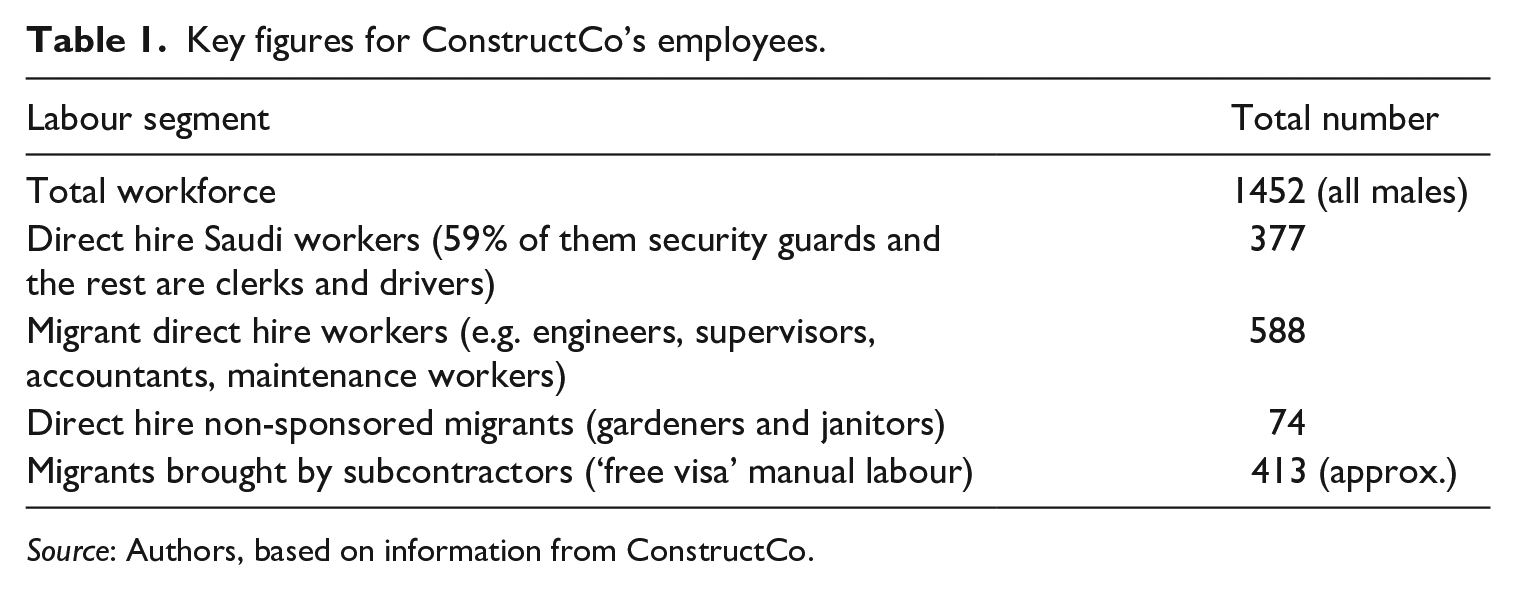
Source: Authors, based on information from ConstructCo.
The research was conducted between November 2016 and January 2017 with 70 hours of observation and interviewing in the firm. Personal connections (wasta) of one of the researchers (who is from Saudi Arabia) with an employee of the firm, fluency in Arabic, promise of anonymity and the researchers’ academic background were key to gaining access and securing the trust of participants. All British Sociological Association (BSA) ethical norms of confidentiality, anonymity and written consent were rigorously adhered to, except for eight interviewees who granted oral consent since they could not read or write.
The choice of the sample was guided by the diverse status of workers and managers in the firm. The state-instituted kafala system suggests a highly controlled and relatively homogenous migrant workforce. However, workplace reality at ConstructCo revealed a segmented migrant workforce and a complex and multi-layered sponsorship system. Nearly half the workforce were non-Arab migrants segmented into three main groups: direct hire labour, non-sponsored workers and ‘free visa’ labour. The latter constitute a majority and are supplied by tasattur entrepreneurs. The tasattur are covert/concealed businesses owned by Saudis but run by non-Saudis who act as intermediaries as well as managers. A fourth category of migrant labour, undocumented migrants, includes those who have ‘escaped’ from their sponsor, omrah (on pilgrimage visa) or visa-overstayed migrants. The research design aimed to link this diverse status directly to the sample – the interviewed workers/managers presented in Table 2 – so that the variety of migration status becomes more visible within the organisational hierarchies.
Interviewees in ConstructCo.
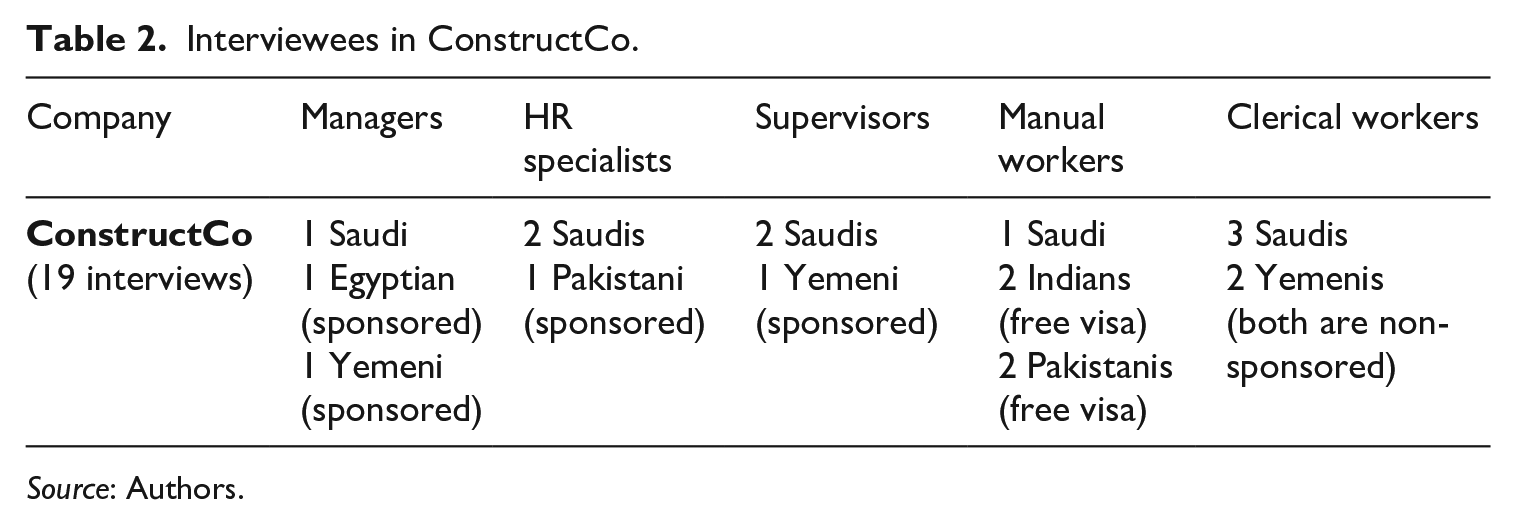
Source: Authors.
Data were collected through three methods – 19 semi-structured interviews, participant observation and document analysis – using ‘purposive’ and ‘snowball’ sampling techniques (Bryman, 2016). The majority of interviews were semi-structured, lasting from 40 minutes to two hours; however, unstructured and informal interviews allowed a deeper engagement with exploratory questions of a sensitive nature. Observation – direct observation in the workplace, participant observation outside the firm – yielded both valuable verbal and non-verbal data on working conditions and organisational culture. ConstructCo’s documents on job descriptions, salary ladders, organisational structure and performance appraisal sheets were analysed for coding and categorising, as were Saudi employment laws and regulations.
Along with the workplace focus – where all interviews with sponsored workers were conducted – a key and methodologically novel aspect of the design included socialising with workers both inside and outside the workplace, lasting more than 15 hours. Most interviews with non-sponsored migrants, tasattur the tasattur subcontractor and HR specialists were conducted both inside and outside the workplace; the latter often more conducive to engaging with challenging themes such as those related to ‘illegal’ practices. In addition to the 19 interviews, there were informal discussions with groups of workers, ranging from two to six, during breaks and lunchtime at work on general topics as well as key workplace issues. Conversations with five free visa migrants provided vital insights.
The time spent outside the workplace with workers was invaluable in reducing power differentials between the researcher and workers and adding depth to the qualitative data (see also Hammer, 2010). It involved, for example, sharing food and playing volleyball with workers on several occasions. Shared spaces and common language helped in building trust. The informal engagement was vital to understanding workplace dynamics such as workers’ relationships with managers and other groups of workers and their experiences in the workplace. Workers were more forthright in discussing control, fear, anger, resistance, and the notions of fairness and legitimacy in their social spaces.
The research process was both concept-driven and reflexive. Most categories were initially developed based on the theoretical concepts of the research framework (mobility, effort, power, control), and the particular issues that relate to the research question (Saudisation and kafala, recruitment, employment contract, wages, working conditions). During the analysis, initially developed categories were modified based on emerging themes (varying migration status of workers and managers, role of the intermediaries/tasattur, contradictions and unintended consequences of migration and employment policies, variable mobility power). Template analysis was used to code and categorise the data in a hierarchical thematic frame (King, 2012).
Overall, this research design as well as its multiple methods were crucial since qualitative studies of Saudi workplaces and labour often face insurmountable challenges of access.
Segmented workers, differential mobility control and variable mobility power in ConstructCo
This section presents findings and analyses differentiated forms of the double indeterminacy by investigating the links between sponsor, employer and agent/subcontractor, and worker strategies around mobility, wages and effort in ConstructCo. It details how different instances of the control of mobility and effort interact to form a highly segmented labour market and workplace. The mobility of four categories of migrant labour – direct hire labour, non-sponsored workers, ‘free visa’ migrants and undocumented labour – is controlled to varying degrees and through varying mechanisms by the state, the employer, the Saudi sponsor (kafeel) and the tasattur entrepreneur, as shown in Table 3. Lastly, it examines different forms of mobility power, looking specifically at the way sponsors, employers and agent-contractors frame the dual indeterminacy at the workplace.
Mobility control and mobility power in ConstructCo.
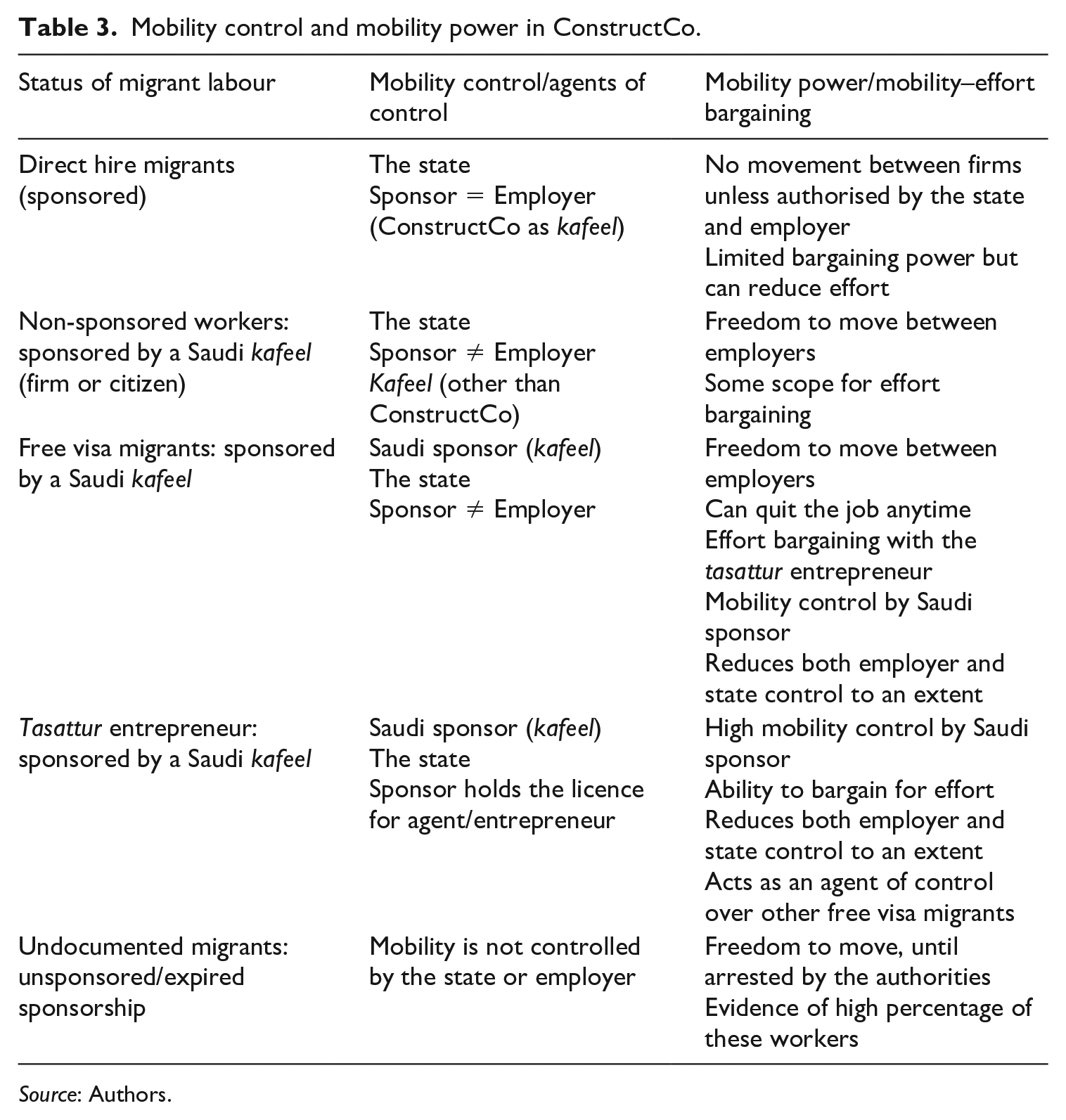
Source: Authors.
Direct hire migrant labour
Direct hire migrant workers are employed by ConstructCo under its own kafala. The firm pays an annual fee to the government for their work permit. Their mobility is controlled by the state as well as the employer. They have no control over their exit from and entry to the country and they cannot move between workplaces unless authorised by the state and the employer. They have limited mobility power in the workplace, although they have some power to reduce effort through delays or minor sabotage in the workplace as revealed during informal conversations.
The strong mobility control and weak mobility power is offset by their formal employment contract and some entitlements such as medical insurance, annual leave and airline tickets to visit their home country. Despite the relative security enjoyed by direct hire labour, ConstructCo fired and deported more than 500 direct hire workers (more than a quarter of its workforce) within 18 months during the economic downturn in 2015–16. This is because direct hire labour imposes restrictions on the firm. As Anwar (an Egyptian maintenance manager) stated: Normally we do not recruit unskilled workers from abroad, instead we transfer their kafala from other kafeels to us. I would say around 80% come in through a kafala transfer. We hire them for a short period of time. If they suit us, we keep them. Otherwise, we give them their salaries at the end of the month and lay them off.
The number of direct hire labourers employed affects its Saudisation compliance, flexibility with respect to its labour force, and the cost of labour. The firm circumvents the constraint of Saudi law by using non-sponsored workers.
Non-sponsored labour
There are 74 non-sponsored, full-time direct hire workers who were recruited through recommendations made by existing staff of ConstructCo; some have been working for the firm for almost three years. These workers are sponsored by another kafeel and hired by ConstructCo without a written employment contract because it is illegal to hire a migrant sponsored by another kafeel. Hamza, a non-sponsored Yemeni clerk, stated: My kafeel is a Saudi citizen, who is a very kind man. My occupation in the Iqama [work permit] is registered as driver . . . I have no intention to transfer my sponsorship to this company because I do not know what could happen in the future . . . In my situation I can change my employer whenever I want to.
ConstructCo avoids transferring kafala from other sponsors. If it recruits more direct hire workers, its Saudisation rate would be affected and more Saudis would need to be recruited. Once the kafala transfer occurs, the firm has no right to deport the migrant to his home country. According to Saudi law, only Saudi individuals and firms who have recruited the workers directly can make a deportation request. Therefore, ConstructCo can lay off the worker but the worker remains linked to the original sponsor.
The firm prefers to recruit these more easily dispensable non-sponsored workers. A key advantage is the low cost and the option of easy dismissal. Since there is no official agreement between the worker and the firm, both parties are free to end this verbal contract whenever they wish. Workers, not the firm, bear the cost of the annual fee to the government, medical insurance and their airline tickets to visit their home country. Nevertheless, according to some workers, this arrangement provides them greater freedom to move between employers as compared to sponsored workers of the firm, even though the freedom comes with financial cost and precarity for them. Overwhelmingly, however, the firm relies on free visa workers and tasattur.
Free visa migrant labour
Although the free visa workers are not employees of ConstructCo, they constitute the majority of the workforce. ‘Free visa’ is a term used among migrant workers to refer to the purchasing of a work visa in one’s home country, before being sponsored by a Saudi citizen or organisation on arrival in Saudi Arabia. The free visa recruitment process starts when the Saudi owner of a tasattur obtains a work visa from the government. This costs 2000 Saudi Arabia riyal (SAR) (533 United States dollars (USD)). The Saudi owner then asks the migrants he is sponsoring to find workers who want to come and work in Saudi Arabia. Work visas are subsequently sold to migrants for between 12,000 and 15,000 SAR (3200 to 4000 USD). This amount is paid in full to the Saudi owner before initiating the legal process of bringing the person to Saudi Arabia. The sponsor then asks for monthly fixed payments as well as all government fees. The worker will be free to work anywhere subject to monthly payments to the kafeel. Free visa workers have the relevant legal documents, but work illegally by working for a tasattur.
Free visa workers are day labourers and earn around 150 SAR (40 USD) for skilled work and 100 SAR (27 USD) for unskilled work. If a worker works 25 days in a month (based on six days a week) he would earn 1000 USD. From this he would pay 133 USD to his Saudi sponsor, 150 USD for his shared accommodation and 200 USD for other expenses. The worker also needs to pay for his air tickets to visit the home country.
All free visa migrants lived in shared accommodation, with two to three men sleeping in a single room. They endure the worst working conditions and are subject to exploitation by their tasattur entrepreneur. They work around 10 hours a day, from 7:00 a.m. to 5:00 p.m. Saturday to Thursday. Some entrepreneurs impose even longer working hours using various strategies. According to Hussein, a Pakistani entrepreneur who runs a tasattur: After 5:00 p.m., I do not come straight away. When they call me, I tell them I am nearby until it is almost six o’clock. Contractors like me have to make excuses and play games, so that the workers work more hours. This is the system here in Saudi; we are not in America.
In the absence of employment contracts, the workers can be laid off easily and need to show their commitment to the entrepreneurs. The free visa migrants interviewed were aware of being easily replaceable. As Ali (a Pakistani builder) said: If I stopped before 5:00 p.m., the next day the contractor would not take me for work; he would replace me with someone else. We are not paid by the hour like in Britain [laughs].
Workers’ power to opt out from working with a particular entrepreneur depends on whether they can find work with other entrepreneurs. Therefore, free visa workers rely on community and personal connections to find work.
Outside the workplace, free visa workers are subject to high control by their kafeels and often subject to exploitation by them. The kafala system gives the Saudi sponsor immense power to control the migrants and to enforce almost any rules they want to. Ahmed (a Pakistani painter) stated: He starts with a small number of workers and then these workers invite others. In the beginning the kafeel is good, but when he has a large number of workers, he becomes very mean. I used to pay him 300 [per month] and now he asks for 500 [SAR].
The more workers a kafeel recruits, the more leverage he gains to negotiate monthly payments or change the kafala expenses. If a free visa worker wants to change his kafeel he must negotiate with both the old and new kafeel, which may require payment to one or both of them. For instance, Mirza (a Pakistani floor installer) explained: I paid 28,000 [SAR] to the new kafeel because the old kafeel was on the government blacklist. Otherwise, I would have paid just 4000 . . . If I had not paid him, the government would have sent me home.
The Saudi kafeel may refuse to provide a migrant worker with an exit visa, although this is rare. According to Muhammed (a Pakistani painter): Yes, you can go home; you just need to pay him the 500 [SAR] each month, but some kafeels do not allow you to go. One of my friends wanted to go to Pakistan because his daughter had died, but his kafeel refused to allow him. When you come to this country it is no longer your decision; it is the kafeel’s decision.
Firms prefer free visa workers because they have no responsibility for them, while workers appreciate the freedom to move and choose their employer. The free visa recruitment method has been prevalent for a long time and is favoured by some migrants. For example, two workers interviewed had been in Saudi Arabia for over 20 years.
Tasattur: Migrant entrepreneur, labour intermediary and agent of control
The key to understanding the complexity of the work organisation at ConstructCo lies in comprehending the role of tasattur entrepreneurs, who are the main suppliers of free visa migrant labour. Hussein, a Pakistani citizen, manages his entire tasattur business using legal documentation registered under the name of a Saudi citizen. According to Saudi law, foreigners cannot own a private firm (except for large corporations). However, this legislation is widely circumvented by tasattur, where an expatriate entrepreneur such as Hussein makes a ‘verbal’ agreement with his Saudi sponsor (kafeel) who owns a registered entity to run a business for him.
Hussein stated that the legal owner of the business is a Saudi citizen in the police force, who used his brother’s name to form the firm. The owner is not involved in Hussein’s business in any way, but he sponsors him and 120 Pakistani workers. Each worker pays this Saudi sponsor a fixed monthly payment of 500 SAR each, equivalent to 133 USD.
In negotiations over a contract between Hussein and ConstructCo, Hussein was asked to bring the registered entity’s official documents (a photocopy of the owner’s ID and the commercial registry articles). ConstructCo’s project manager paid 20 SAR (6 USD) per each m2 of a certain type of flooring. The price did not include materials, only the labour cost. Hussein accepted this offer and took the agreement to have it signed and stamped by his kafeel. Hussein paid his kafeel 15% of the total value of this contract, amounting to 93,000 USD. Hussein was unhappy about this practice: I bring the workers and do the work, while he sits on his chair and just takes the money. He takes money because he is a Saudi. This is not fair.
When asked how the price of 20 SAR per m2 would guarantee him a profit, Hussein said that each floor layer manages around 30 m2 per day, while the total cost of a floor layer per day is 200 SAR (53 USD). The actual cost of flooring for Hussein was almost 7 SAR per m2 (200/30 = 6.66) (1.8 USD). Therefore, while the Saudi owner earns 15% of the total contract, Hussein as the migrant entrepreneur reaps the reward from the effort of his fellow Pakistani workers whom he manages. These Pakistani workers constitute the majority of free visa migrant labour.
Undocumented migrants: Escaped, omrah (pilgrimage visa) and overstayed
Undocumented migrants represent the extreme form of ‘freedom’ for firms with respect to labour and the extreme form of control exercised by capital and the state. They include ‘overstayed’ (due to an expired work visa) or those reported as ‘escaped’ by their kafeels. These are often workers whose sponsorship has been terminated by their kafeel and who are unable to find an alternate kafeel.
ConstructCo sponsors 92 migrant workers who work for other firms. In 2014, the firm tried to dismiss these workers, who had transferred their kafala from previous sponsors to ConstructCo, but had no right to issue an exit visa. The HR manager gave the workers six months (unpaid) to find other sponsors. Only seven out of the 92 managed to do so, while the rest remain under ConstructCo’s sponsorship. This brings ConstructCo into conflict with Saudi laws as this practice is illegal. The Saudi HR officer stated: We informed all workers that they had 30 days. If they did not transfer their kafala to other kafeels, the firm would register them in the Passport Department as ‘escaped’.
To be reported as an ‘escapee’ renders the migrant’s presence in the country illegal and leads to deportation. Here, mobility is not controlled by the state or the employer and the migrant worker is ‘free’ until arrested by the State authorities. While official figures are not available for this category of migrants, the percentage of this category of worker is considered high.
The ‘sponsored labour regime’ of mobility–effort bargaining
The case study reveals the Saudi workplace as a contested terrain shaped simultaneously by the state’s repressive measures, pressures to facilitate accumulation and the agency of labour (Adham and Hammer, 2021; Edwards, 1979; Hanieh, 2015; Poulantzas, 1978). Mobility control of migrant labour by the state, employer and tasattur entrepreneur at the workplace is key to Saudi capitalism. Yet, the state and capital’s control over migrants’ mobility and effort is not absolute, providing workers a measure of agency in negotiating production and mobility indeterminacies (Smith, 2006, 2010).
State, segmentation and control at the workplace
The highly controlled and state-instituted migrant labour regime has a profound effect on the outcomes for migrant labour (Anderson, 2010; Forde and Slater, 2016). This is manifest in the ‘textbook’ example of direct hire/employer sponsored labour. The state controls their mobility in and out of the country, as well as between employers. This gives employers as sponsors control over workers who have very limited scope for mobility–effort bargaining in the workplace.
At the same time, workplaces are characterised by a migrant workforce segmented by visa status and the operation of an intricate intermediary system of tasattur entrepreneurs (also free visa workers), as shown in Table 3, undermining state policies. The different types of labour and tasattur are ‘illegal’, yet they represent how firms overwhelmingly use migrant labour. The diverse visa status help form segments of migrant labour with particular relations to employers and intermediaries, allowing them to exploit workers’ im/mobility (Howe et al., 2020; Wright and Constantin, 2021). Mobility, or limits to it, of these different segments of migrant labour acts as control mechanism and structures both the work organisation and the mobility–effort bargaining (Smith, 2006, 2010).
Different agents of control, different levels of control over mobility
The segmentation further indicates different agents of control over mobility as well as different levels of mobility control (Table 3). While the employer as the sponsor controls the mobility of direct hire labour, employers of non-sponsored and free visa labour are not necessarily their sponsors. The mobility of these categories of workers is controlled by the sponsor (kafeel) and not the employer. This deviates from the state’s aim to accord mobility control to employers and leads to a rise in tasattur as intermediaries and a separation of sponsorship and managerial authority at the workplace.
In the case of free visa workers, the state, employer, Saudi sponsor and tasattur entrepreneur exercise variable levels of control. The state’s control over mobility extends only to entry and exit from the country, while the employer has no control over mobility and does not hold the right to deport them. It is the Saudi sponsor who exerts control over their mobility. Undocumented workers are even ‘freer’ inside and outside the workplace, unless arrested. Their mobility is not controlled by the state or the employer. Their high numbers in Saudi Arabia suggest the viability of this status for both workers and firms.
Mobility–effort bargaining: Variable mobility power
Variations in mobility control by different agents of control (state, sponsor, employer, tasattur) lead to multiple forms of mobility–effort bargaining at the workplace (Table 3). Absolute state-employer control over the mobility of direct hire labour accords them little bargaining leverage. However, non-sponsored and free visa workers, whose mobility is controlled by their original kafeel and not the employer, engage in mobility bargains with the kafeel but with greater freedom to move between employers and more scope for effort bargaining at the workplace.
Free visa workers can choose to work for any firm or tasattur entrepreneur and may work for several during their time in Saudi Arabia. At the workplace, they experience less managerial control than direct hire workers and have greater flexibility (e.g. to travel home), so long as they meet the monthly payments to their kafeel. They have greater flexibility in negotiating pay and work intensity with the tasattur entrepreneur, compared to directly sponsored migrants with their sponsor-employer. Thus, the quitting potential enhances their position in mobility–effort bargaining, reducing both state and employer control to an extent. This is counterbalanced by their ‘dual exploitation’ (Rahman, 2011) – by the sponsor over their mobility and by the tasattur entrepreneur over effort. The sponsor can exploit the ‘informal’ nature of their agreement by withholding travel documents and through periodic increases in monthly payments, with workers unable to take any collective action.
Tasattur entrepreneurs, the ‘enterprising’ free visa workers, who have become intermediaries and managers of other free visa workers, have their mobility controlled by the sponsor but they have considerable power in effort bargaining with the kafeel.
What emerges from this workplace study is a specific regime of mobility–effort bargaining where the sponsor or the kafeel is key, be it the employer or another party – we term it a ‘sponsored labour regime’. Importantly, and going beyond Smith’s (2006) conceptualisation, there is not one but multiple forms of mobility–effort bargaining depending on how sponsoring, employment, and subcontracting practices and intermediaries are linked. The separation of sponsorship and managerial authority means control in the workplace becomes more differential, functioning through different sponsors or agents of control of, both, the mobility and effort of workers. Complex and asymmetric bargains over mobility, wages and effort arise from this differential control. The outcome is variable mobility power of migrant labour in the workplace, even in a highly controlled context. While direct hire workers have almost no power, non-sponsored workers have some mobility power at the workplace, while free visa workers can exercise some vis-a-vis the tasattur. The tasattur entrepreneur, in turn, has some leverage with the kafeel.
Mobility dynamics at the workplace shape, as well as reflect, a contest between the state to control mobility (and effort) by workers to create spaces for some freedom and bargaining vis-a-vis the state and the employer, and by firms trying to circumvent the constraints that arise from Saudisation and kafala policies. A vast segmented migrant workforce, in a state-instituted migrant labour regime, and the various ‘illegal’ segments, actors and practices generate incongruities, providing spaces for firms and workers to subvert the labour regime with implications for mobility control, effort and power.
Conclusions
The article examined mobility power at the Saudi workplace and detailed highly differentiated mobility–effort bargaining arising from a complex interaction between the state, workers’ migration status, and possibilities for extraction by the employer and various intermediaries. It highlighted the underexplored role of the state, and other agents of control, in conceptualising mobility–effort bargaining. The unexpected intricacies of the ‘sponsored labour regime’ revealed the multiplicity of mobilities and labour contracts, challenging the simple understanding of the kafala system. They also exposed the conflict between state policies of Saudisation and kafala, the latter being key to profit extraction from migrant labour. Thus, mobility–effort bargaining is at the core of state–labour–capital relations in Saudi capitalism, questioning the erroneous characterisation of the Saudi state as patrimonial and rentier.
This research makes a key intervention in LPT by developing the double indeterminacy of labour power further. Empirically, it examines mobility power at the Saudi workplace, which is underexplored in LPT. Conceptually, it extends the understanding of mobility–effort bargaining in LPT through an analysis of different types of mobility control, multiple forms of mobility–effort bargaining and the consequently variable forms of mobility power. Insights from the migration literature help delineate a particular form of labour regime of mobility–effort bargaining – a ‘sponsored labour regime’. Migration literature, in turn, may benefit from LPT’s focus on workplace dynamics, especially the negotiation of effort and mobility indeterminacies at the point of production.
The study develops a novel conceptual and methodological approach through the incorporation of workers’ social spaces (along with the workplace) in the research design. The socialisation with workers was vital to understanding workplace dynamics, explore challenging themes, and to access difficult-to-access groups of workers – making a crucial difference to the depth of data and analysis. The intricacies of state–capital–labour interactions at the workplace could not have been captured without worker engagement outside their workplace.
Looking forward, a replication of this study may yield different results with the introduction of ‘Vision 2030’ by the Saudi state, which aims to diminish the practice of tasattur, enhance Saudisation and increase the cost of migrant work permits with implications for the labour market and the workplace; for example, the kafala policy introduced in March 2021. Furthermore, analyses of the Saudi labour regime may have wider resonance in other Arab Gulf states.
Footnotes
Acknowledgements
We would like to thank the editors and the reviewers for their positive and thoughtful suggestions, which have been incorporated into the article.
Funding
The authors received no financial support for the research, authorship, and/or publication of this article.
