




Abstract
Owing to the rapid ageing of societies, studying the labour market consequences of caring for ill, disabled or frail old-age partners, parents and/or other family members (hereafter: ‘family care’) is of urgent concern. Previous research has mainly concentrated on examining the impact of differing family care situations on women’s employment. Building on household decision-making approaches, this study focuses on the moderating role of the household economic situation in the family care–employment relationship among women. Cox shared frailty regression analyses of German Socio-Economic Panel data (SOEP, 2004–2017) indicate that the family care–employment relationship depends not simply on time committed to care but is also stratified by household economic situations: full-time employed, low-intensity caregivers down-scale to part-time hours only in more affluent households; full-time to non-employment transitions are more likely for married, high-intensity caregivers; part-time to non-employment transitions are more likely for high-intensity caregivers contributing marginally to the household income.
Keywords
Introduction
Much existing research has extensively elaborated on the relationship between childcare and employment for mothers and identified a range of negative labour market outcomes affecting them (for an overview, see Perry-Jenkins and Gerstel, 2020; Pollmann-Schult, 2015). However, the question of whether other unpaid care activities over one’s life course also have a negative impact on women’s labour market behaviour – and therefore might have implications for current wages or age-related retirement entitlements – has been addressed rather less frequently in social science research. Family care – that is, caring for an (adult) child, partner, parents (-in-law) or other family members in need of regular care due to severe illness, disability or age-related frailty (Kröger and Yeandle, 2014) – is one such neglected area. However, given the likelihood that the conflict between family care and paid work will intensify in future – particularly for women – it is essential to find answers to this question as populations rapidly age and an increasing proportion of elderly people come to rely on (family) care. However, women – who have traditionally been the primary providers of caregiving within families – are increasingly entering the labour force and are also expected to prolong their working lives, leaving them with less time to meet growing family care needs. Nonetheless, they continue to be the primary source of care provision within families (Klaus and Vogel, 2019; Patterson and Margolis, 2019), in addition to their work in the labour market, putting enormous pressure on them to reconcile family care tasks with paid work (Kröger and Yeandle, 2014; Naldini et al., 2016).
Previous research has provided important insights into family care–employment relationship, by investigating how various family care demands on time (e.g. Kelle, 2020; Van Houtven et al., 2013), family care relationships (Bertogg et al., 2020; Carr et al., 2018), family care locations (e.g. Carr et al., 2018; Heitmueller, 2007) and family care tasks (Van Houtven et al., 2013) impact on women’s labour market activity in a variety of ways. Although this body of work has substantially improved our understanding of the family care–employment relationship, the existing literature is guided mainly by a time allocation approach (Becker, 1965), which focuses on the time demands imposed by family care and on how such demands impact on labour market activity. However, people’s lives are embedded within social relations and family caregivers’ work–family reconciliation strategies are therefore also expected to be bound and shaped, among other things, by their specific household economic setting (cf. Schneider et al., 2001). This study builds on two prominent approaches to investigating household decision-making – economic theory of the family and relative resources theory – using data on women in Germany drawn from the German Socio-Economic Panel Study (SOEP). It investigates the extent to which specific household economic situations – that is, a household’s absolute economic resources, its marital status and women’s relative economic position within the family – shapes the family care–employment relationship. The study thus contributes to the literature in three main ways. First, it provides new insights into the explanatory and predictive strength of two common approaches to examining household decision-making. Up to now, both approaches have been applied mainly to establish predictions relating to the gendered division of childcare (e.g. Raley et al., 2012) and household labour (e.g. Bianchi et al., 2000; Lachance-Grzela and Bouchard, 2010). Here, though, the two theories’ predictions are transplanted into the context of family care and paid work. Second, the study makes an empirical contribution by providing evidence of the moderating role of the household economy in the family care–employment relationship. Third, by analysing employment transitions from (1) full-time to part-time employment, (2) full-time to non-employment and (3) part-time to non-employment, this study supplements existing research that focused either on a Boolean employed/not employed dichotomy, or on working hours (e.g. Glauber, 2019; Van Houtven et al., 2013); for exceptions, see Kelle (2020) and Schneider et al. (2001). Against the background of common theoretical approaches to investigating household decision-making, the analysis of differing employment patterns provides a more differentiated understanding of what strategies women use to reconcile work and family life.
The work–care context in Germany
This study uses German data to investigate its chosen research question. Germany is known internationally as a conservative welfare state characterized by a gender regime that promotes the traditional or modernized male breadwinner model along with a familialistic care regime that delegates care responsibilities mainly to families (Esping-Andersen, 1990, 1999; Lewis, 1992; Trappe et al., 2015). As a result, work–family trajectories tend to be highly gendered, so that women are generally less integrated into the labour market and provide more unpaid care work than men (e.g. Aisenbrey and Fasang, 2017). Although the organization of care for the chronically ill, disabled or elderly is a comparatively new area in social policy, it is one in which traditional German conservatism manifests itself, ‘explicitly’ delegating care responsibilities to the family by prioritizing home-based care by family members over professional alternatives (Leitner, 2013). According to recent estimates, approximately 9% of the German population (7.8 million individuals) suffer conditions severe enough to cause them difficulties in performing some of the essential activities of daily living. Of these, 90% receive care and support in their own home environment on a daily basis or from time to time, mainly by family members or friends, while 10% of all care-dependent individuals receive full-time care in care homes from professional care workers (Geyer and Schulz, 2014). Thus, in Germany, family caregivers constitute the central pillar of the care system. Although women and men of retirement age (65 years and older) form an integral part of the collective of family caregivers (together 32%), a substantial amount of family care is provided by people of working age (17–64 years), and particularly by women (42%), but also to a lesser extent by men (26%) (Ehrlich, 2019).
Although the German care system relies heavily on working-age family caregivers to meet the care needs of the chronically ill, disabled or elderly, policies aiming at supporting balancing family care and paid work are rather rudimentary, tending to favour part-time work arrangements or temporary career interruptions for family caregivers (Leitner and Vukoman, 2015). However, wage losses following reductions in working time or temporary career breaks to facilitate family care are compensated only to a marginal extent by the welfare state (Frericks et al., 2014; Leitner and Vukoman, 2015), meaning that the household in which the family caregiver is living becomes a crucial factor in ensuring the family caregiver’s welfare and in decision-making on paid work. This national policy environment makes Germany a good setting in which to investigate whether the household economic context shapes women’s family care–employment relationships – and, if so, to what extent.
Literature review and hypotheses
Family care–employment relationship: The importance of time demands of family care
Given that time and income resources are invariably in short supply, individuals are expected to allocate time to paid work and unpaid non-market work efficiently (Becker, 1965). Based on cost-benefit considerations, family caregivers are expected to reallocate their time as required, with family care and employment competing for limited time resources. The growing international literature on the family care–employment relationship provides support for the notion of time conflict. It has been found that the need to provide family care leads to people either reducing their working hours (Leigh, 2010; Meng, 2013; Pavalko and Artis, 1997; Spieß and Schneider, 2003; Van Houtven et al., 2013) or stopping work altogether (Colombo et al., 2011; Schneider et al., 2001). It has also been shown that people who spend more time on family care are significantly more likely to adjust the intensity of their employment than those who spend less time on such activity (Berecki-Gisolf et al., 2008; Heitmueller, 2007; Kelle, 2020; King and Pickard, 2013; Van Houtven et al., 2013). Other studies have demonstrated that caring for a household member as opposed to a non-household member is associated with negative employment outcomes for caregivers (Carr et al., 2018; Heitmueller, 2007; Michaud et al., 2010), which can be attributed to the fact that co-residential caregivers spend on average more time on care than extra-residential caregivers (e.g. Ehrlich and Kelle, 2019). Yet others have started out from the expectation that the relationship between family caregiver and care recipient (Bertogg et al., 2020; Carr et al., 2018) or the various family care tasks (Van Houtven et al., 2013) are essential factors in determining the employment behaviour of caregivers. However, research along these lines has as yet yielded only inconclusive results.
Overall, the literature review suggests that women face difficulties in retaining the level of employment they enjoyed before engaging in family care. Moreover, differing family care time demands – rather than family care location, family care relationships or differing family care tasks – were found to yield more consistent results with respect to employment. Accordingly, a first hypothesis concerns the replication of previous findings that, in general, the more family care hours women provide, the more likely they will be to either reduce work hours or to withdraw from the labour market altogether (Hypothesis 1).
Family care–employment relationship: The role of the household economic context
Although the time demands of family care are expected to be the determinant in women’s employment behaviour, career choices and decisions, over the course of family caregiving, are also expected to depend on the broader household context in which the individual lives (cf. Schneider et al., 2001). Irrespective of family care activities, though, a household’s absolute economic resources are also an important factor in women’s employment decisions. According to arguments based on the economic theory of the family (Becker, 1993; Himmelweit et al., 2013), household members allocate time rationally to paid work in the labour market and to non-market work during their leisure time with the aim of maximizing overall joint household utility. It is argued that specialization is usually the most efficient strategy: the person with the resources most valued on the labour market specializes in paid work and provides the household income, whereas the person with the less marketable resources will specialize in unpaid care and household responsibilities. However, Oppenheimer (1997) claims that such specialization can jeopardize the economic security of the household. Depending on the economic vulnerability of the specific household, income losses resulting from reductions in working time or exits from the labour market can damage the household’s welfare and be incompatible with joint household utility. For this reason, specialization options of households will also depend on the household’s absolute economic resources. This view is supported by O’Reilly and Bothfeld (2002), who found that German women in high-income households are less likely to move from part-time to full-time employment than their peers with lower incomes. Their results suggest that women in high-income households ‘have the “luxury” of being able to afford not to work full-time’ (O’Reilly and Bothfeld, 2002: 432, emphasis in original). Conversely, household budgets need to be in a position to afford the financial loss associated with reduced working time or labour market exits. These considerations should also apply to women who find themselves juggling family care with paid work. Although providing family care may complicate their level of engagement in paid work, for household budgetary reasons, such women may opt not to reduce their working hours or not to exit the labour market. Family caregivers’ household income can therefore be expected to have a considerable impact on their employment behaviour, resulting in caregivers from low-income households suffering more limited employment options while their peers from more affluent households enjoy more flexibility in their choices. I therefore hypothesize that the expected association between family care and employment (H1) will be stronger as a household’s economic resources are more plentiful (Hypothesis 2).
However, in general, one might also expect decisions to down-scale to part-time work or to interrupt one’s working career to depend on marital status. Single women are economically self-reliant, tending not to enjoy the flexibility that allows them to specialize in combining unpaid work inside with paid work outside the home, while those with a partner will tend to be in a better position to specialize: they can rely on pooled income sources and are thus more likely to enjoy alternative sources of income security. However, among couples, those formally married are more likely than those simply cohabitating to pool their money (e.g. Hamplová et al., 2014; Hiekel et al., 2014), suggesting that married women in particular enjoy a higher degree of choice in specialization. Moreover, the rather conservative German welfare state provides incentives for married couples to choose a traditional or modernized male breadwinner family model: policies such as a joint taxation and the fact that non-employed and marginally employed marital partners are covered by their partners’ public health insurance encourage wives to either reduce their working hours or to leave the labour market altogether (e.g. Trappe et al., 2015). These (institutionalized) specialization options for married couples can also be expected to have implications for the choices of wives juggling family care tasks with paid work. Given that marriage provides an economic safety net for most marginally employed or non-working spouses, wives enjoy wider options in balancing family caregiving and employment than cohabitating or single women (Pavalko and Artis, 1997). Therefore, I assume that the expected association between family care and employment (H1) will be stronger for married women (Hypothesis 3).
While most single women are unable for economic reasons to down-scale their employment activity in response to family care needs, for women with a (marital) partner, their economic position relative to their partner is expected to play an important additional role in making career choices during periods of family caregiving. Both economic theory of the family (Becker, 1993; Himmelweit et al., 2013) and relative resources theory (Blood and Wolfe, 1960; Kulic and Dotti Sani, 2020) predict similar outcomes, though channelled through different mechanisms. According to economic theory of the family, the higher a woman’s relative economic position within the family, the less likely she is to reduce her working hours or to leave the labour market: she enjoys a comparative advantage in that market and would otherwise be more likely to put the household’s utility (i.e. the household’s economic well-being) at risk. However, the question of whether partners always decide jointly in the interests of efficiency and household utility is a subject of much debate (for an overview, see Kulic and Dotti Sani, 2020). Thus, relative resources theory, basing its logic on within-couple power structures, suggests that career choices are made through on-going negotiations in which each partner tries to bargain his/her way out of performing the household’s less attractive tasks. Accordingly, the person bearing the larger share of economic resources can exert greater power and will end up doing less in family care in favour of their own career. Empirical work, using differing relative economic resources indicators, tends to confirm this line of argument (Bernardi, 1999; Bröckel et al., 2015; Dieckhoff et al., 2016). Such effects are expected to intensify among female family caregivers struggling with competing time demands. Consequently, as a final hypothesis, I suggest that the expected association between family care and employment (H1) will be stronger for women in a relative weak economic position within the household (Hypothesis 4).
Data and method
Data
The empirical analyses are based on data from the SOEP, which is a representative household panel study that started in 1984 in West Germany and was extended to East Germany in 1990. In order to account for panel attrition and decreasing sample sizes, refresher samples were added at several points (for information on initial response rates and attrition, see Siegers et al., 2020). Its data, organized annually, come from a total of more than 30,000 interviewees (individuals aged 17 and older) residing in almost 15,000 households (Goebel et al., 2019).
The study’s observation period starts in January 2004 and ends in December 2017, as regular part-time employment – one of the study’s dependent variables – only becomes clearly distinguishable from marginal part-time employment from 2004 onwards. The sample is restricted to the employment episodes of women in prime working age (25–59 years).
Measures
Dependent variables
The dependent variable is the transition rate between the origin and the destination state, which in this study are the transitions from (1) full-time to part-time employment, (2) full-time to non-employment and (3) part-time to non-employment. The non-employment category includes both homemakers and people registered as unemployed. Although the two non-employment statuses differ with respect to their potential sources of income – with homemakers depending on their savings or partner’s income while the registered unemployed rely on the unemployment benefit system – they resemble each other with respect to the time devoted (or rather not devoted) to employment. Moreover, both statuses refer to career breaks rather than to definitive final exits from the labour market, as in the case of (early) retirement. All statuses are mutually exclusive. Employment status measures are based on respondents’ self-reported employment status. 1 During the observation period, a woman can experience several transitions between the employment statuses of interest. As precise information on the start and end month of each reported employment status is available in the data, it was possible to obtain a continuous record of respondents’ working careers in episode format. Furthermore, the data set provides information on whether or not a person experienced one of the employment transitions of interest and, if so, when, as well as on when the last valid observation for a person who has not yet experienced a transition was made. As this study’s focus is on transitions between standard working time models, other changeovers – such as to short-time work (‘Kurzarbeit’), to marginal part-time work (‘Minijob’), to retirement and to ‘other’ statuses (e.g. education, further training) – are censored. So, the type of data I have obtained is time-to-event data, also known as event history data. My final sample consists of 10,498 full-time episodes, of which 1,901 end with entering part-time employment and 1,397 end with leaving the labour market, as well as 11,089 part-time employment episodes, of which 1,430 terminate with labour market exits.
Independent variables
‘Family care’ provision is based on the survey question: ‘What is a typical day for you? How many hours do you spend on the following activities on a typical workday – care and support for individuals in need of care?’ Following the practice of previous research (e.g. Carr et al., 2018; Ehrlich et al., 2020; Kelle, 2020; King and Pickard, 2013), I distinguish between (1) no family care (reference category), (2) low-intensity family care with up to 10 hours of caregiving per working week and (3) high-intensity family care with more than 10 hours of caregiving per working week. Weekly family care hours were calculated by multiplying the typical workday care hours by five. Childcare, in its usual sense, is not captured in this variable. Respondents are asked to report hours spent on nine activities, among them ‘care and support for persons in need of care’ and, separately, ‘childcare’. The response item on childcare also appears earlier in the battery than the item on the amount of time expended on family care. Thus, it is unlikely that respondents could mix up childcare (in its usual sense) with family care.
The household economic situation is captured using three measures. First, household economic resources are captured by the household’s annual net income in the previous year. This ensures that current labour market strategies are determined exclusively on the household’s absolute economic resources enjoyed the previous year, rather than in part on one’s resources after having already made a labour market transition (in the current year). Furthermore, the income information is adjusted for household size following the new revised OECD scale, expressed in 2017 prices. Second, married respondents are defined as those living with their marital partner (reference category: no (marital) partner in household). Third, following Dieckhoff et al., who stated, ‘that pay differentials between spouses offer a more direct measure of economic inequalities within households’ (2016: 134), a woman’s relative economic position within the household is captured by her relative contribution to the household’s gross earnings from labour. If a woman earned 30% or less of the household’s gross labour earnings in the previous year, she is deemed to have contributed a small share to the household labour income. If a woman is living alone, she falls automatically into the reference category (those with an equal or larger share of household income from labour in the previous year), as she is either economically self-reliant or has no opportunity to bargain over unpaid work in her home. Where income information is missing, I applied the imputations provided by the SOEP group (Frick and Grabka, 2014). To test the impact of household-level variables on the family care–employment association, I included interaction terms for the three household context variables with ‘family care’. All models included a variety of controls, based on previous research practices. For details, see Table A.1 in the online Appendix.
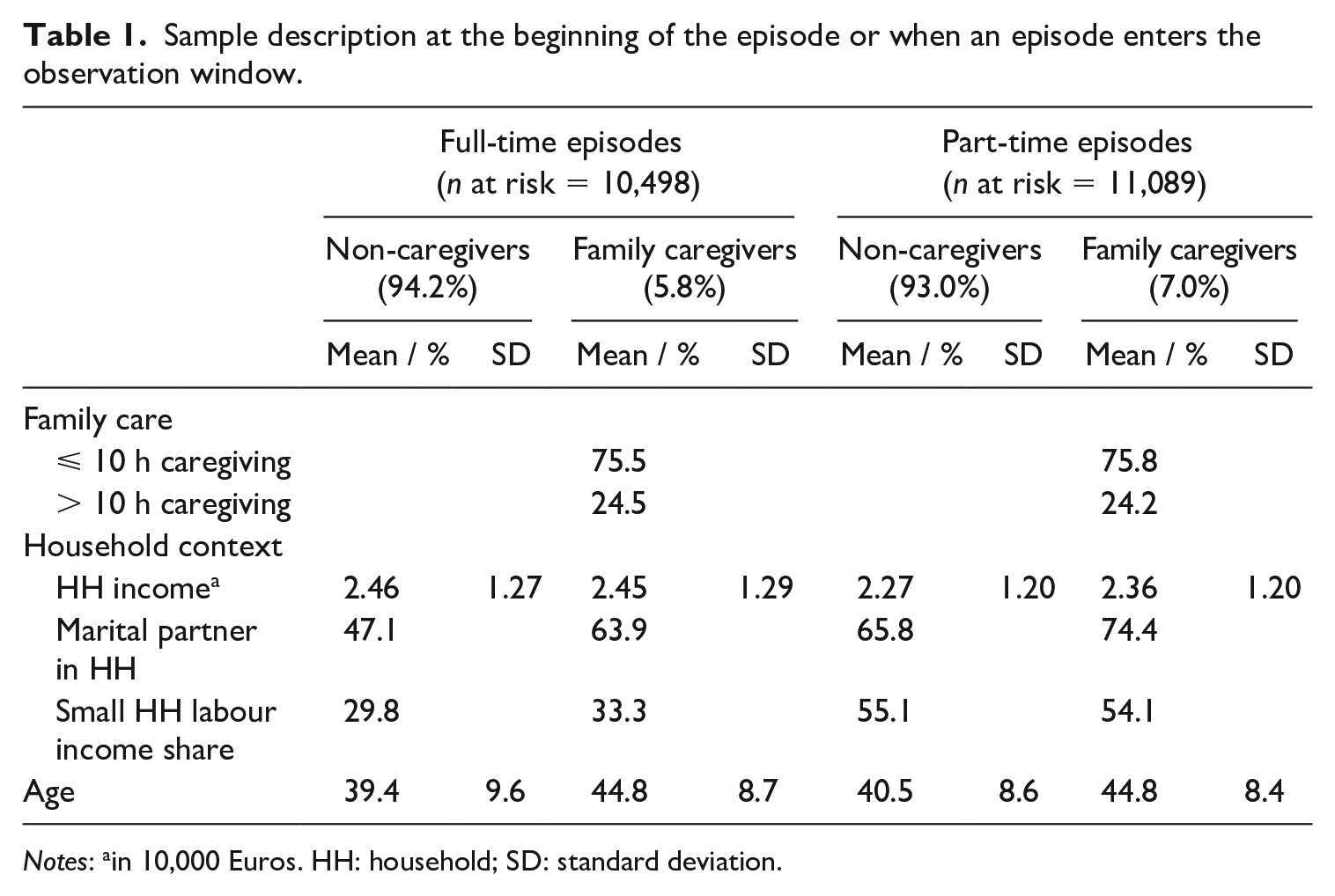
Table 1 displays the distribution of the main independent variables separately for non-caregiving and caregiving women in each origin employment state, either at the beginning of the episodes or at the moment when the episodes entered the observation window, respectively.
Sample description at the beginning of the episode or when an episode enters the observation window.
Notes: ain 10,000 Euros. HH: household; SD: standard deviation.
Analytic strategy
I apply event history regression techniques in order to estimate the transition rates (i.e. hazard rates), from (1) full-time to part-time employment, (2) full-time to non-employment and (3) part-time to non-employment. Event history analysis is most suitable, in contrast to standard regression techniques, as it allows one to analyse the time-to-event data containing information on the occurrence and timing of events, here labour market transitions, as well as censored information – that is, observations where the subject does not experience the event of interest before dropping out of the sample, but for whom we know when the last valid observation was made (for further details, see Mills, 2011).
In particular, I apply Cox shared frailty modelling as it has two main advantages over standard event history regression techniques. First, using Cox semi-parametric regressions, allows me to leave the baseline hazard rate unspecified (Cox, 1972), making it suitable for the purposes of this study. I aim to estimate how the hazard rate changes with its covariates, and am not trying to estimate the baseline rate itself. Second, I enhance conventional Cox regression models using a shared frailty specification. Owing to this specification the hazard rate is a function of covariates and an additional random parameter. This additional random parameter accounts for correlation between recurrent events on the within-person level. Within-person correlation can come from unmeasured risk factors (e.g. personality, preferences or orientations towards work and family), or from event dependence (Mills, 2011).
Results
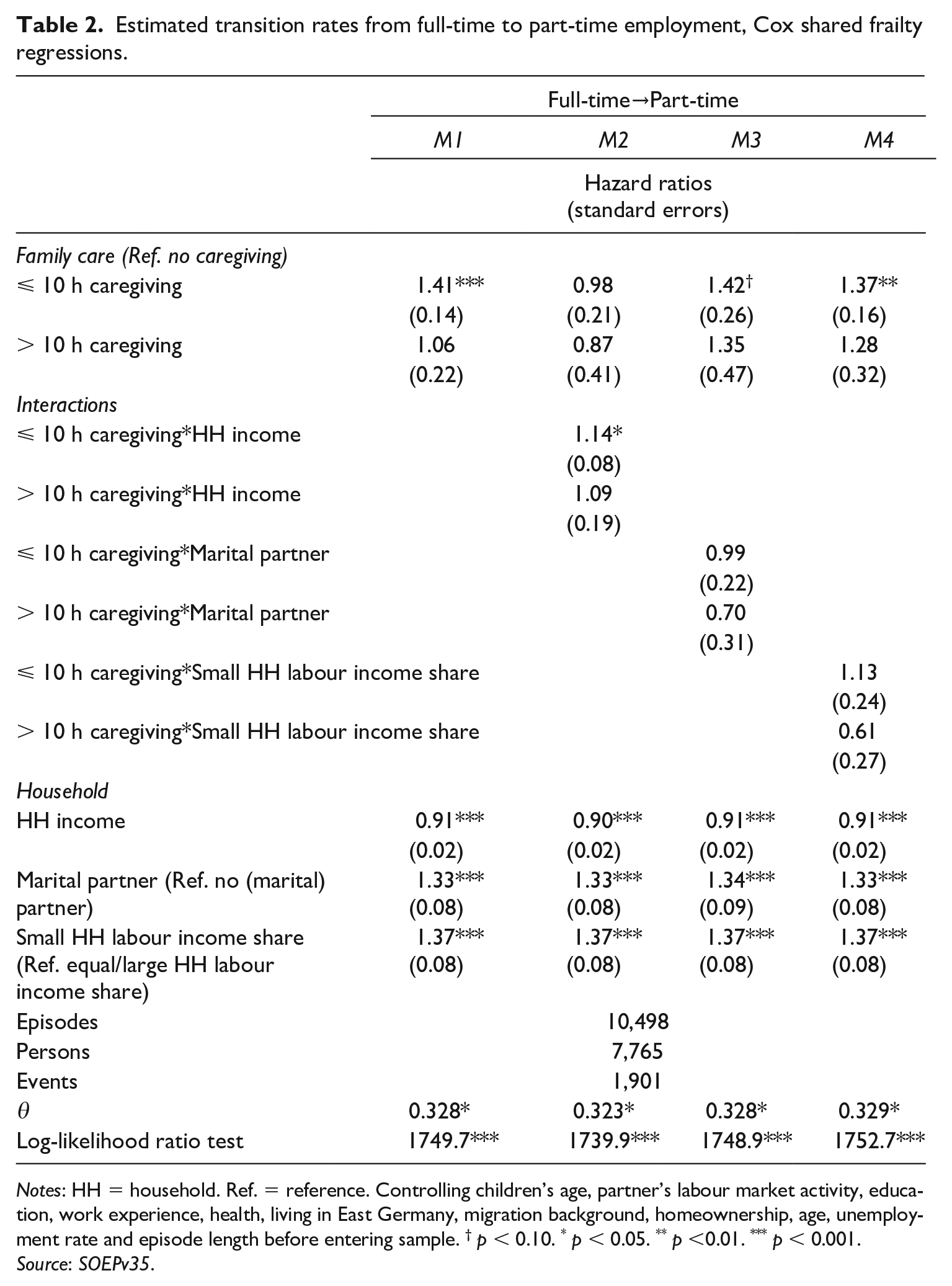
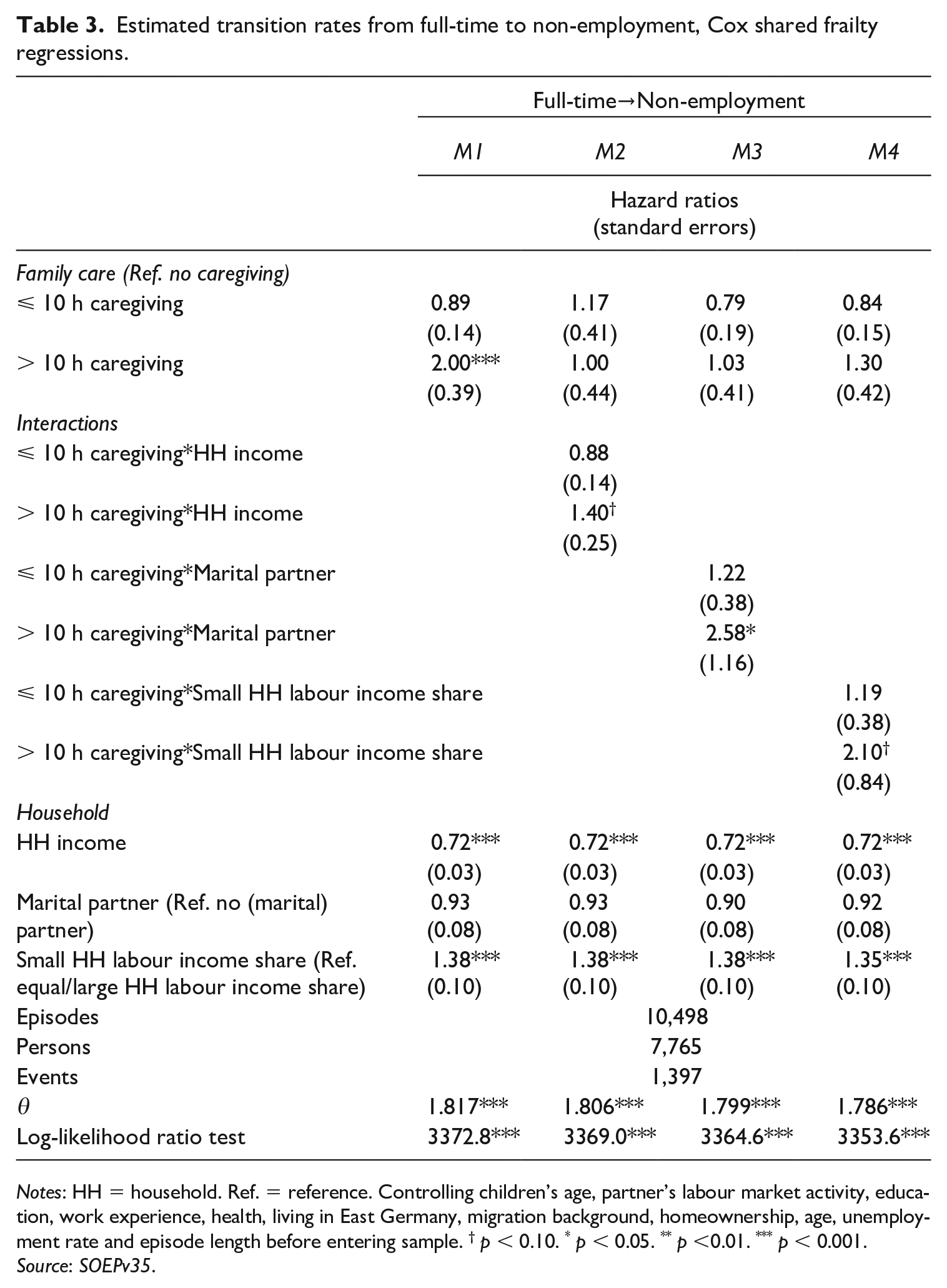
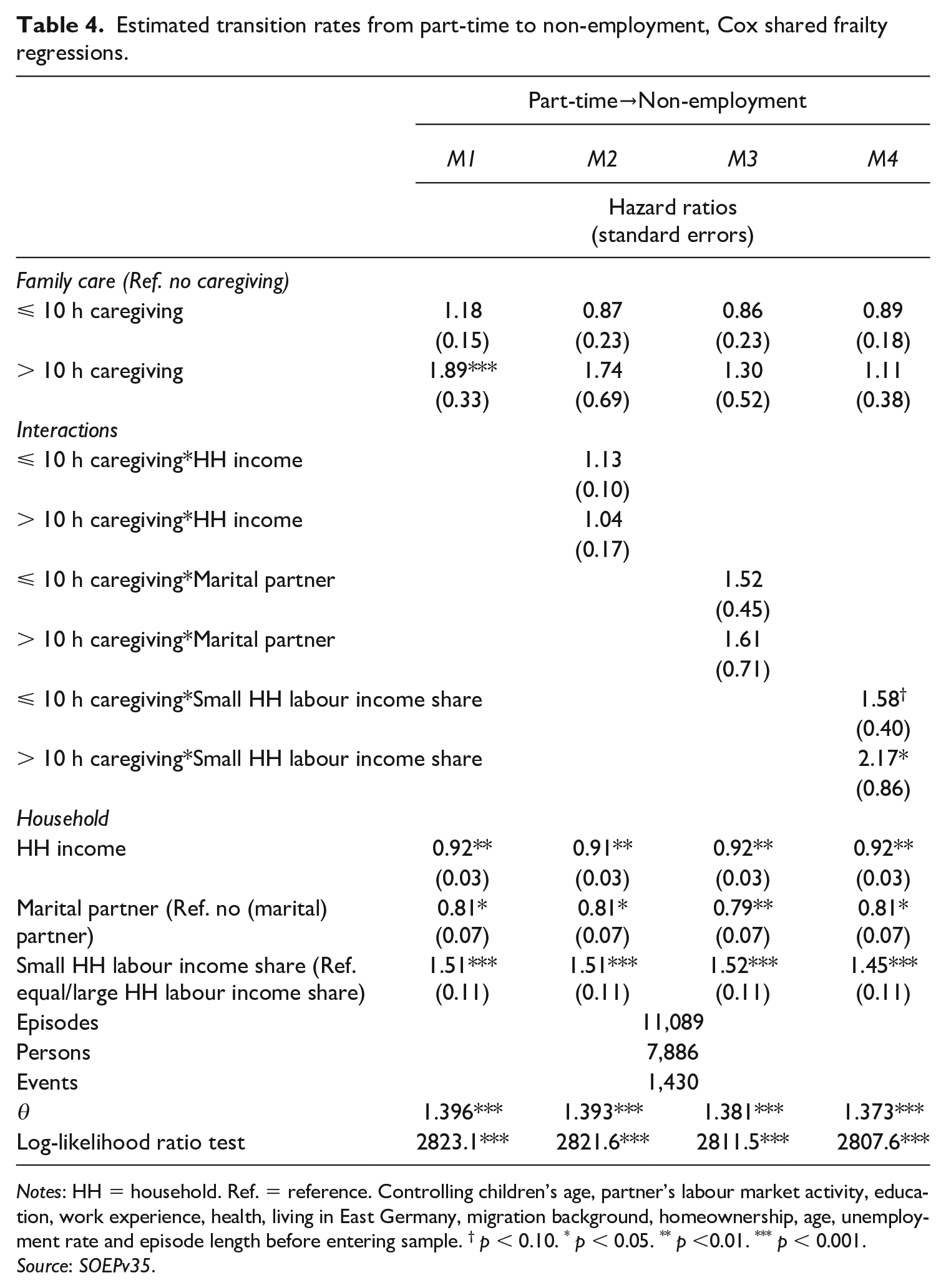
Tables 2–4 present the estimates obtained from the Cox shared frailty regressions. The estimated employment transition rates are reported in the form of hazard ratios (HR), making them easily interpretable. A HR greater (or less) than 1 indicates that a covariate is positively (or negatively) associated with the relevant employment transition. Moreover, HRs can be re-interpreted as per cent changes by applying the following calculation: (HR – 1)*100. Given that the majority of covariates run in the directions expected of them and remain consistent under all models (in magnitude, direction and significance), I present only those results most pertinent to the study’s overall argument. The full models can be found in the online Appendix (Tables A.2–A.4).
Estimated transition rates from full-time to part-time employment, Cox shared frailty regressions.
Notes: HH = household. Ref. = reference. Controlling children’s age, partner’s labour market activity, education, work experience, health, living in East Germany, migration background, homeownership, age, unemployment rate and episode length before entering sample. † p < 0.10. * p < 0.05. ** p <0.01. *** p < 0.001.
Source: SOEPv35.
Estimated transition rates from full-time to non-employment, Cox shared frailty regressions.
Notes: HH = household. Ref. = reference. Controlling children’s age, partner’s labour market activity, education, work experience, health, living in East Germany, migration background, homeownership, age, unemployment rate and episode length before entering sample. † p < 0.10. * p < 0.05. ** p <0.01. *** p < 0.001.
Source: SOEPv35.
Estimated transition rates from part-time to non-employment, Cox shared frailty regressions.
Notes: HH = household. Ref. = reference. Controlling children’s age, partner’s labour market activity, education, work experience, health, living in East Germany, migration background, homeownership, age, unemployment rate and episode length before entering sample. † p < 0.10. * p < 0.05. ** p <0.01. *** p < 0.001.
Source: SOEPv35.
I start by testing whether women providing more family care hours are more likely to reduce their working hours or to leave the labour market (Hypothesis 1). I found it confirmed: providing low-intensity family care significantly increases women’s hazard of down-scaling from full-time to part-time work – by 41% (p = 0.000; Table 2, Model 1) – while providing high-intensity family care significantly increases their hazard of withdrawing from the labour market – in fact, doubling it (HR = 2.00, p = 0.000; Table 3, Model 1). Likewise, transitions from part-time employment to non-employment occur only to women providing high-intensity family care: their hazard of leaving the labour market is increased by 89% (p = 0.000; Table 4, Model 1).
Before turning to the interaction hypotheses tests, I analyse the general impact of the household economic situation on women’s employment patterns (Tables 2–4, Models 1). Contrary to expectations, it turns out that an increasing household income has a negative association with all labour market transitions under study. Surprisingly, marital status – interpretable as having the option to pool economic resources – plays out differently in each of the different labour market transitions. While transitions from full-time to part-time hours are significantly more likely for married women, transitions from full-time to non-employment are largely unaffected by marital status. In contrast however, married part-timers are significantly less likely to leave the labour market than women with no (marital) partner. As expected, though, having a relatively weak economic position within the household increases women’s hazard of dropping out of the labour market, either partially or entirely. This effect is strongest for part-time working women.
Hypothesis 2 stated that the expected family care–employment relationship will be stronger the higher the household economic resources. Yet the only case where a significant interaction was found was for the full-time to part-time employment transition (Table 2, Model 2). In contrast to the model involving no interactions (Table 2, Model 1), the main estimate for low-intensity family care is non-significant for this transition, indicating that low-intensity caregivers living with the lowest household incomes do not differ significantly in their employment behaviour from non-caregiving women. However, low-intensity family caregivers do tend to reduce their working hours as their annual household income increases: every additional 10,000 Euros increases their hazard of switching from full-time to part-time arrangements by 14% (p = 0.048), compared to the effect of household incomes of women not providing family care (HR = 0.90, p = 0.000). Model 2 on Table 3 additionally suggests that high-intensity family caregivers’ transitions from full-time employment to non-employment also depend on the disposable household income (HR = 1.40, p = 0.066). However, this interaction failed to reach a conventional level of statistical significance. As a consequence, support for Hypothesis 2 was found only for the full-time to part-time transition.
Hypothesis 3 postulated that the expected relationship between family care and employment is stronger for married women. Yet any significant interaction between family care and being married was found only for the full-time to non-employment transition (Table 3, Model 3). However, that interaction runs in the direction expected by Hypothesis 3, thus confirming it. Taking this particular transition rate model, the main estimate for high-intensity family care – in sharp contrast to the model with no interactions (Table 3, Model 1) – is non-significant, indicating that unmarried high-intensity family caregivers do not significantly differ in their employment behaviour from non-caregiving women. The main estimate for married women is also non-significant, indicating that married non-caregivers show no increased propensity to leave the labour market. However, married high-intensity caregivers exhibit a significantly increased risk of leaving the labour market: up by 158% (p = 0.035).
Next, Hypothesis 4 predicts that the expected family care–employment relationship is stronger for women holding a relatively weak economic position within the household. And indeed, there is a significant interaction between high-intensity family care and contributing a small share of household labour income in the part-time to non-employment transition (Table 4, Model 4). For this transition, the main estimate for high-intensity family care – unlike the model with no interactions (Table 4, Model 1) – is non-significant, indicating that high-intensity caregivers who are the household’s main economic providers do not significantly differ in their employment behaviour from non-caregiving women. The main estimate for those contributing a small share of the household labour income is positive and significant (HR = 1.45, p = 0.000), indicating that female non-caregiving secondary earners have an increased propensity to move from part-time employment to non-employment. However, the relative risk of experiencing that transition is stronger for caregiving women: being a high-intensity caregiver and the household’s secondary earner significantly increases the hazard of moving from part-time to non-employment – by 117% (p = 0.049). Moreover, Model 4 on Table 3 as well as Model 4 on Table 4 each suggest that high-intensity caregivers in full-time employment (HR = 2.10; p = 0.062), and low-intensity family caregivers in part-time employment (HR = 1.58; p = 0.067), both exhibit an increased risk of withdrawing from the labour market if their relative economic position within the household is weak. However, given that the results did not reach a conventional level of significance, the results support Hypothesis 4 only for high-intensity family caregivers’ transitions from part-time work to non-employment.
The robustness of the results was checked using a battery of sensitivity tests based either on alternative measurement codings or additional control variables. First, the codings of the dependent variables were tested for full-time employment by including short-time working (‘Kurzarbeit’) and for part-time employment by including marginal part-time work (‘Minijobs’). The results obtained from these additional analyses proved similar to the study’s main results. Second, I re-ran transition rate models with higher thresholds for low- (⩽ 15 and ⩽ 20 hours/working week) and high-intensity family care (> 15 and > 20 hours/working week). The results did not influence the direction or significance of the results. However, with increasing intensity thresholds the risk of transitioning from full-time to part-time hours slightly decreased, while the risks of transitioning into non-employment increased. As the higher thresholds would blur the fact that transitions from full-time to part-time hours are primarily made by those who care for up to 10 hours a week, the original thresholds for low- (⩽ 10 hours/working week) and high-intensity family care (> 10 hours/working week) are appropriate. Third, I swapped the control unemployment rate for three dummies created to control for pre-recession, recession and post-recession years, an exercise that yielded consistent results. Fourth, I ran three transition rate models including all interactions at once. With the exception of the full-time to non-employment transition, the interactions remain relatively robust (see Tables A.2–A.4 in the online Appendix).
Discussion and conclusion
In this study I build on existing approaches to analysing household decision-making to empirically test the extent to which the specific household economic situation shapes the family care–employment relationship. This research extends the pre-existing literature, which has been guided primarily by arguments relating to time allocation in explaining the family care–employment relationship (e.g. Carr et al., 2018; Heitmueller, 2007; Spieß and Schneider, 2003) without taking into account the social embeddedness of the family care–employment relationship. Conversely, the literature on the study of household decision-making has rarely been applied to unpaid working responsibilities other than childcare and household labour. Integrating these two strands of the literature, this study extends our understanding of the family care–employment relationship among women. Furthermore, by analysing three different employment patterns, this study set out to provide a more nuanced view of family caregivers’ strategies to reconcile work and family life (i.e. their specialization strategies).
The results show that women’s employment behaviour in response to family care needs are shaped by a complex interplay of women’s employment patterns, the time committed to caregiving and the economic context in which the household operates: low-intensity family care tends to lead full-time employed women to down-scale to part-time work. However, part-time employed low-intensity caregivers show no increased propensity to change their working hours. Both full-time and part-time working women providing high-intensity family care show an increased propensity to give up employment altogether. However, when a family caregiver’s specific household economic situation is considered as a moderating factor, the following results are obtained: full-time employed low-intensity family caregivers down-scale to part-time hours only in more affluent households. Moreover, transitions from full-time to non-employment during periods of high-intensity family caregiving are more likely for married women. Finally, only part-time employed women whose economic position within the family is relatively weak tend to give up employment during periods of high-intensive family care.
The first set of results was consistent both with time allocation-related arguments and with previous research (e.g. Berecki-Gisolf et al., 2008; Heitmueller, 2007; Kelle, 2020; King and Pickard, 2013; Van Houtven et al., 2013), showing that the impact of family caregiving on employment tends to be stronger where women’s caring commitment is more intensive. Moreover, the analysis revealed the importance of uncovering women’s specialization strategies by analysing the three employment patterns. Although previous analyses were able to show that women tend to either decrease their working time (e.g. Leigh, 2010; Meng, 2013; Van Houtven et al., 2013) or give up employment altogether in response to family care needs (Colombo et al., 2011; Schneider et al., 2001), this study demonstrates that (1) providing family care is difficult to reconcile with full-time working; (2) part-time work is used as a strategy to reconcile family and working life where family care needs are less intensive; and (3) high-intensity family care is often incompatible with either full-time or part-time employment.
By adding to the literature on household decision-making, the second set of results provides a test of the (critique against) economic theory of the family – and of relative resources theory. It provides evidence that family caregiving–employment relationships depend not just on the time that caregivers commit to care but are additionally stratified by caregivers’ household economic situation. According to critics of the economic theory of the family, a household’s income situation constitutes a driving force for women’s employment behaviour in the context of family caregiving in the sense that households must also be in a position to afford a degree of specialization. In general, women included in this study (with and without family care responsibilities) were less likely to down-scale or to give up their paid work as household income increased, underscoring their instrumental role in the generation and maintenance of higher household income. However, for low-intensity caregivers in full-time employment, the income mechanism turns out to be just as expected: as household incomes increase, women show an increased propensity to minimize conflict between family care commitments and paid work by down-scaling to part-time hours. Women in full-time employment coming from better-off households seem to make particular use of their individual earning power and of their household’s overall resources. While specializing in part in response to family care commitments, women continue to contribute a relatively large share of household income and are careful not to jeopardize their joint household utility (i.e. their household’s economic well-being). In less well-off households, in contrast, women are fully exposed to the work–care conflict, as the household needs the income from their full-time work to make ends meet.
In line with the economic theory of the family, marital status is held to be a significant shaping factor in the family care–employment relationship. Marriage offers specialization options (such as income pooling, joint taxation and shared social security rights) that women without a (marital) partner cannot rely on. For this study, this mechanism applies only to high-intensity family caregivers transitioning from full-time work to non-employment. In general, transitions from full-time to part-time employment have a positive association with being married, while transitions from full-time work to non-employment exhibit no relationship with women’s marital status. This indicates that a partial specialization strategy is preferred over full specialization among the married women studied here, probably due to economic necessities. However, when confronted with high-intensity family care needs, full-time workers take advantage of the full (institutionalized) specialization options provided via marriage. Thus, although relinquishing paid full-time work has substantial financial penalties at the individual and household level, married-couple households can to some extent buffer the financial hit when high-intensity family care needs make full specialization inevitable.
Finally, consistent with both economic theory of the family and relative resources theory, having a relatively weak economic position within the household is crucial in family caregivers’ employment behaviour. In general, women who hold the position of secondary earners within their households tend to show an increased propensity to down-scale their employment or give it up altogether. In terms of the family care–employment relationship, only high-intensity family caregivers in part-time employment who have a relatively weak economic position within the household show any increased propensity to stop working. Why is it that family caregivers working part-time are so especially responsive to this indicator? As part-time workers have relatively low individual earning power compared to full-time workers, their earnings often do no more than top up already adequate household incomes. Thus, according to economic theory of the family, any decision by secondary earners to leave employment is unlikely to put the household’s economic welfare at risk. In contrast, if one were to adopt the relative resources theory, one would appeal to the fact that women in part-time work contributing only marginally to the household income have a particularly weak bargaining position within the household and therefore find themselves unable to negotiate their way out of high-intensity family care, ultimately leading them to quit employment.
Although this study demonstrates a certain explanatory and predictive power in the theoretical approaches to household decision-making under the rubric of family care and employment, the mechanisms predicted by such approaches through household income, marital status and relative economic position within the household do not apply universally to all employment patterns – or specialization strategies – under study. No single approach can fully explain the mechanisms in household economics that shape the family care–employment relationship. Moreover, given this study’s quantitative character, the household economic mechanisms that shape family caregivers’ transitions from part-time work to non-employment cannot be fully disentangled, indicating that further qualitative research could be well worthwhile. Nevertheless, this study demonstrates the importance of analysing the family care–employment relationship as a complex interplay between employment patterns, varying family care intensities and differing household economic situations.
Finally, this study contributes to the literature on female employment, an area that all too often means simply literature on maternal employment. As family care is an essential aspect of women’s life courses, this study’s research on the family care–employment relationship is urgently needed. Most importantly, since family care provision is a highly gendered activity, this study provides insights into how family care commitments can act to magnify existing gender gaps in employment, pay and pensions.
Supplemental Material
sj-docx-1-wes-10.1177_09500170211069841 – Supplemental material for The Association between Family Care and Paid Work among Women in Germany: Does the Household Economic Context Matter?
Supplemental material, sj-docx-1-wes-10.1177_09500170211069841 for The Association between Family Care and Paid Work among Women in Germany: Does the Household Economic Context Matter? by Ulrike Ehrlich in Work, Employment and Society
Footnotes
Acknowledgements
I am grateful for the useful comments and valuable suggestions by Sonja Drobnič, Hilke Brockmann, Lena Hipp, Heinz Rothgang, Steffen Hillmert, Laura Romeu Gordo, the participants of the BIGSSS Field B colloquium (University of Bremen) and the anonymous reviewers. The German Socio-Economic Panel data were kindly provided by the SOEP Group at the German Institute for Economic Research (DIW), Berlin.
Funding
The author disclosed receipt of the following financial support for the research, authorship, and/or publication of this article: Deutsche Forschungsgemeinschaft (DFG), grant/award number: GSC 263/1; Research Network on Pensions (FNA).

Supplementary material
The supplementary material is available online with the article.
Notes
References
Supplementary Material
Please find the following supplemental material available below.
For Open Access articles published under a Creative Commons License, all supplemental material carries the same license as the article it is associated with.
For non-Open Access articles published, all supplemental material carries a non-exclusive license, and permission requests for re-use of supplemental material or any part of supplemental material shall be sent directly to the copyright owner as specified in the copyright notice associated with the article.
