




Abstract
Despite women’s increased market employment and earnings, the gender housework gap persists. Drawing on US data from 1999 to 2017 waves of Panel Study of Income Dynamics (6643 dual-earner heterosexual couples, 19,602 couple-year observations) and using couples fixed effects, this study examines the impact of having children on the relationship between partners’ housework time and spousal relative income. While parenthood could theoretically incentivize a more efficient division of labour, I find it has a traditionalizing effect and parents’ housework exhibits significant gender deviance neutralization, while housework division of childless couples is independent of relative income. In fact, these effects are so sizeable, that parents’ gender gap in the division of domestic labour increases in the higher range of women’s relative income. As the gender earnings gap closes and women’s relative income increases, the gender housework gap opens. Additionally, the traditionalizing parenthood effect is identified only among married and not cohabiting parents.
Keywords
Introduction
Having children increases housework and intensifies the gendered division of labour within households (Craig, 2007). In turn, gendered division of domestic labour is one of the key phenomena contributing to gender inequality (Lyonette and Crompton, 2015). Despite rising female labour force participation, women still are usually responsible for the majority of the housework and this persistence of unequal gender division of unpaid domestic labour is typically attributed to three possible causes: limited male time availability, unequal relative resources and conforming to traditional gender ideology (Brines, 1994; Coltrane, 2000; Greenstein, 2000). Therefore, housework is assigned to women because of men’s higher commitment to the labour market and higher wages, and due to traditional gender identity norms (Craig and Mullan, 2010). This study examines what happens to partners’ domestic labour and the gender housework gap when it is the female partner who is the relatively higher earner, specifically after the transition to parenthood. The motherhood wage penalty in the US is on average 7% per child (Budig and England, 2001) and Parrott (2014) shows using Panel Study of Income Dynamics (PSID) data that housework hours indeed have a negative impact on women’s hourly wage.
Parenthood is an interesting context in which to examine spousal housework division. Children are costly in terms of time and money, their presence increases the demand for housework (Craig, 2007), and therefore the demand for efficiency and possibly returns to specialization. To meet these higher demands, mothers traditionally were responsible for the majority of the housework, while men earned the family income. As a result, children tend to widen the housework gap. However, given increasing female labour force participation and earnings, this traditional division of housework may no longer be the optimal solution. According to Becker’s (1991) theory of specialization and bargaining theories, if the female partner takes on the breadwinner role, then her male partner should increase household work. Gender perspective predicts the opposite effect. When faced with an outcome that deviates from traditional gender identity norms, such as wives outearning their husbands, to neutralize this husbands deliberately decrease and wives increase their domestic labour time to reaffirm threatened identities and increase traditionality in their relationship (Baxter and Hewitt, 2013; Bittman et al., 2003; Brines and Joyner, 1999; West and Zimmerman, 1987). This article tests these theories by exploring the impact of parenthood on the relationship between partners’ housework hours and the gender housework gap, and spousal relative income. Using US data from 1999 to 2017 waves of PSID and couples fixed effects regressions, I examine the existence and strength of these alternative perspectives by answering the following research questions:
RQ1: Is there evidence of gender deviance neutralization or bargaining-exchange theory in the pooled (with and without children) population of couples?
RQ2: Does the relationship between partners’ housework hours and spousal relative income differ depending on whether the couple has children or not, and if so, is it consistent with gender deviance neutralization or bargaining-exchange theory?
RQ3: Does the relationship between gender housework gap and spousal relative income differ depending on whether the couple has children or not?
RQ4: Does transition to parenthood have a different effect depending on the couple’s marital status?
How a couple divides the increased load of housework after they become parents has important implications for mothers’ labour market participation. Given the increased financial and time demands that come with parenthood, households have high incentives to find an efficient (i.e. surplus maximizing) division of market and household labour. However, to foreshadow the results, I find that gender deviance neutralization overrides the logic of efficient resource exchange specifically among parents. Children indeed expand a mother’s housework hours more than a father’s, widening the housework gap; however, these effects are not uniform across spousal relative income. Contrary to the specialization and bargaining theories, a wife’s relatively higher income coincides with an even larger difference between her and his housework time.
This article provides new evidence that gender deviance neutralization via housework among heterosexual couples is specific to married partners with children. While there is considerable research on transition to parenthood and domestic labour division, to the best of my knowledge this is the first study that investigates the shape of the relationships between housework and spousal relative income separately for couples with and without children. The identified distinct patterns have important theoretical, empirical and methodological implications.
Theoretical background
Over time, men’s and women’s allocation of time to paid and unpaid work had become more similar, and the gender housework gap has narrowed substantially (Altintas and Sullivan, 2016; Sayer, 2005). However, the question of why a significant gap still persists remains largely unanswered (Bianchi and Milkie, 2010). The answer is central to understanding gender inequality in paid work outcomes, where mothers continue to suffer a ‘wage penalty’ (Budig and England, 2001).
Housework provision, specialization and exchange, and bargaining theories
In a perfectly transferable utility framework (Becker, 1991), labour is divided to maximize total household surplus and marriage is seen as an exchange of resources between spouses. The partner who earns more has higher opportunity costs of unpaid labour at home. Gains from trade will lead to specialization and the partner with lower market earning power will do more housework. In light of this theory, as one spouse’s relative income increases, their housework contribution should decrease. Bargaining models (Lundberg and Pollak, 1993, 1996; McElroy, 1990; McElroy and Horney, 1981) offer the same prediction. Whether due to external or internal threat points, the party with a relatively higher income can strike a better bargain in the marriage. Both theories predict that as a spouse’s relative income increases, their housework contribution will decrease.
As a consequence, the spousal gender housework gap will be negatively associated with wife’s relative income.
Housework provision and gender perspectives
The economic work that husbands and wives do at home and in the market results from bargaining, exchange, specialization and gains from trade, but it may also be a way of constituting relationships and identities – ones that are profoundly impacted by gender identity norms. Exchange and bargaining theories has been confirmed by a number of empirical studies in a range where the wife makes from zero to less than 50% of household income (i.e. Brines, 1994; Greenstein, 2000; Gupta, 1999; etc.). However, there is no empirical consensus regarding housework supply patterns among couples where the wife outearns the husband, and whether in this range spousal housework hours follow the exchange theory or whether gender comes into play (Schneider, 2011). Many gender scholars believe that as gender operates on so many levels, a gender-neutral model of bargaining and exchange is unlikely to be adequate (Wilkie et al., 1998). Gender deviance neutralization suggests that when men earn less than women, couples neutralize this non-normative spousal income distribution by increasing traditionality through housework (e.g. Bittman et al., 2003; Brines, 1994; Greenstein, 2000; Gupta, 2007; Killewald, 2011). This compensation is the opposite of what exchange and bargaining theories predict (i.e. wives do more and husbands do less housework when wives outearn their husbands).
If these effects are sufficiently strong, the spousal gender housework gap will be U-shaped in wife’s relative income.
As pointed out by Cornwell et al. (2019) and Schneider (2011), no consensus has yet emerged as to the relative importance of these explanations (Bianchi and Milkie, 2010; Killewald and Gough, 2010; Sullivan, 2011). Evidence in support of gender perspectives has been challenged by research showing that these results are driven primarily by the lowest earning husband outliers (Bittman et al., 2003; Gupta, 1999). Research by Bittman et al. (2003) and Evertsson and Nermo (2004) finds that it is only women that engage in gender performance.
On the other hand, Brines (1994) and Greenstein (2000) identify this pattern for men’s domestic labour in the US; but in their analysis, wives’ housework supply was consistent with the bargaining-exchange theory. Kan (2008), using the British Household Panel Survey, shows that traditional gender-role attitudes coincide with longer housework hours in the case of women and shorter hours in the case of men, but finds no conclusive evidence of gender deviance neutralization beyond that. None of these studies analysed these patterns separately for parents and childless couples.
Evertsson and Nermo (2004) present mixed evidence of gender deviance neutralization among US couples and find no effects of gender display for Swedish couples.
The cultural and institutional country contexts definitely play an important role in how these traditional gender identities are threatened and enacted. This study focuses strictly on couples living in the US, a country fairly representative of the Anglo world in terms of identified housework patterns (Craig and Mullan, 2010), ranked between egalitarian countries such as Sweden and more traditional ones such as Germany, where according to Grunow et al. (2006), in contrast to the US, ‘the good mother’ is still expected to interrupt her career for young children.
Children and housework division: Efficiency vs gender deviance neutralization
Research has associated parenthood with greater daily time commitments for fathers and mothers than for childless men and women, and with deeper gendered division of labour in households.
Birth of a child increases both domestic workload and household income pressures. Consequently, this event is a strong determinant of time allocation but is also associated with deeper gendered division of labour (Baxter et al., 2008; Craig and Mullan, 2010). Causal explanations for changes in women’s and men’s behaviour after the transition to parenthood often invoke the theories described earlier. Under the specialization model (Becker, 1991), the spouse with the higher earning potential will focus on paid work, while the spouse with the lower earning potential, typically the wife, will take care of the children and household. Gains from specialization increase over time, solidifying the initial allocation. It is important to note here, that while Becker’s model provides an explanation for why specialized division of labour exists, it does not necessarily sanction a gender-specific housework division. Agents will simply find it optimal to specialize when gains to doing so are present. While there are some biological gender-specific advantages and constraints to having children, the socially sanctioned gendered division of labour may not maximize the household surplus. Specifically, if a wife is the relatively higher earner, transition to parenthood should not result in a more traditional division of domestic labour. Similarly, according to economic bargaining theories, the allocation of domestic work is repeatedly renegotiated based on a spouse’s relative resources, such as relative income.
How couples divide the increased domestic workload after becoming parents is an important determinant of earnings inequalities between women and men over the life-cycle (Sigle-Rushton and Waldfogel, 2007). According to Baxter et al. (2008), transition to parenthood is a critical moment in the development of the gender housework gap. Kühhirt (2011) argues that this gap is mainly driven by social norms and the interplay of economic and normative factors in shaping housework allocation needs to be addressed further, both empirically and theoretically. While theories of specialization, bargaining and gender deviance neutralization are very different in terms of assumptions and predictions, what they share is the weakness of ignoring the event-driven housework configuration changes, and of treating couples as homogenous (Bühlmann et al., 2010; Kühhirt, 2011). This study addresses this gap by investigating the impact of transition to parenthood on the relationship between domestic labour provided by wives and husbands (and as a result, the gender housework gap), and spousal relative income. Interestingly, US Institute for Family Studies data show that the most common area of contention among couples with children is precisely the division of chores and responsibilities 1 and that this is primarily due to the clash between the traditional division of labour along gender lines and the modern reality of working mothers, sometimes earning more than their male partners do.
Growing evidence shows that gender-role attitudes may not be stable over a lifetime, but rather change after significant events such as entry into parenthood. Using Australian data, Baxter et al. (2014) indeed find that gender-role attitudes become more traditional after the birth of a first child. A similar shift in attitudes towards more traditional views was also identified in a UK longitudinal study (Grinza et al., 2017) and in a cross-sectional Dutch sample, where parents display more traditional gender-role stereotypes than nonparents in an Implicit Association Test (Endendijk et al., 2018). Psychological literature argues that becoming a parent can produce substantial changes in the self-identity of women and men, that in turn may modify gender-role attitudes (Stewart, 1982; Stewart et al., 1986). As a consequence of this change in self-identity, couples with and without children may differ significantly in their attitudes and housework patterns.
Parenthood crystallizes a gendered division of labour (Sanchez and Thomson, 1997) and if indeed traditional gender norms are stronger among parents, then gender deviance neutralizing behaviour follows. On the other hand, transition to parenthood and the accompanying increased demands on household resources should incentivize an efficient division of market and household labour consistent with the bargaining-exchange theory. Therefore, this study investigates how the relationship between housework and spousal relative income differs between parents and nonparents.
As a result, this may also have implications for the relationship between the gender housework gap and spousal relative income, as this pattern may vary depending on whether the couple has children or not.
Parenthood and gender deviance neutralization: Cohabiting vs married couples
Evidence shows that nowadays it is the arrival of the first child, and not marriage, that leads to a more gendered housework division (Grunow et al., 2012). Yet, production of gender is likely to be more pronounced in married couples than in cohabiting households (Baxter, 2005; South and Spitze, 1994). Cohabiting men report performing more household labour than do married men, and cohabiting women report performing less household labour than do married ones (Baxter, 2005; Davis et al., 2007). As Kalmijn et al. (2007) point out, few scholars have yet examined how relative income effects vary between married and cohabiting couples. Their findings suggest that equality is more protective for cohabitation, whereas specialization is more protective for marriage, although only when it fits a traditional pattern. In an earlier study, Brines and Joyner (1999) find similar patterns for work hours. While this is not the central focus of this study, the social construct of marriage may play a critical role in how spouses divide domestic labour. Therefore, I also examine whether a wife’s higher relative income has a different effect on partners’ housework time among married and cohabiting couples, and whether the transition to parenthood sets off different housework patterns depending on the relationship status. Owing to a small sample share of cohabiting couples, this is rather explorative in nature and not conclusive.
Data and methods
Data
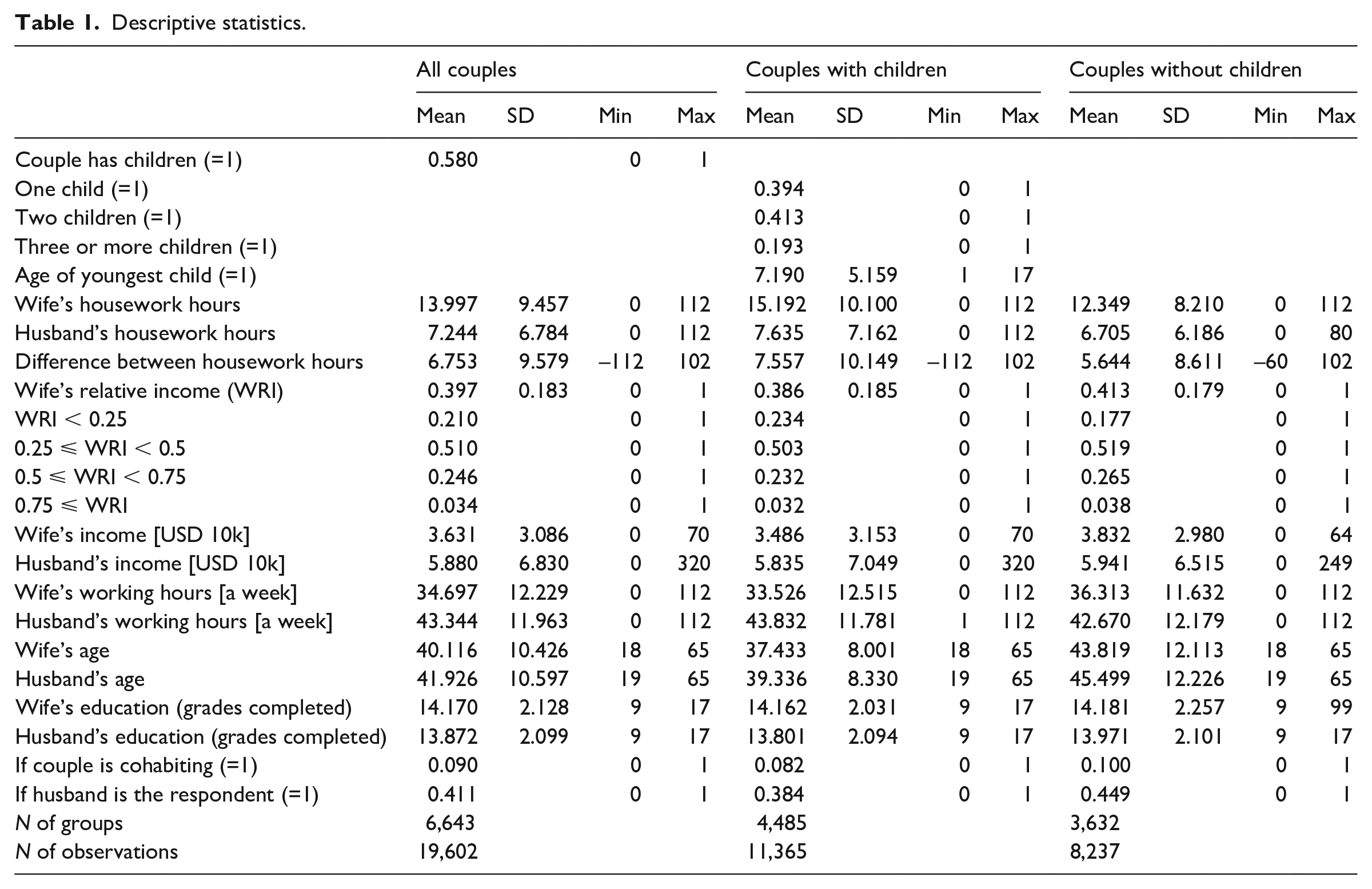
This study uses US data from the PSID 1999–2017, which is a longitudinal household survey that biennially collects a wide range of individual and household demographic, education, income and labour market variables. The sample consists of 6643 heterosexual dual-earner couples aged 18–65, amounting to 19,602 couple-year observations in total. The sample used in this study was drawn from the complete PSID sample consisting of 22,598 unique households in the period between 1999 and 2017, of which 53.64% were married or cohabiting, and of that less than 71% had both spouses working full time. Further, age and other restrictions reduce the sample to over 7100 observations. The last difference is due to missing data, especially on wives’ education. Importantly, there are no missing data on parenthood status, and only 261 missing observations for wives’ housework and 121 for husbands’. Table A1 in the online Appendix presents sample size details. The reported housework hours are the answer to a survey question: About how much time do you (does your spouse) spend on housework in an average week? I mean time spent cooking, cleaning, and doing other work around the house. Table 1 presents summary statistics.
Descriptive statistics.
Empirical strategy
This study investigates how the relationship between the husband’s and wife’s housework time (and the resulting gender housework gap) and spousal relative income changes with the transition to parenthood. Arguments and evidence is mixed on whether couples who desire a more traditional division of labour select into marriage and children, or if instead the institution of marriage and having children result in a gendered display (Cooke and Baxter, 2010). Preferences for traditional values is an example of a time-invariant omitted variable bias and this is addressed by taking advantage of the longitudinal structure of the data and couples fixed effects, so that couples serve as their own controls. To alleviate concerns about time-variant omitted variable bias, in each spouse’s estimation their partner’s housework is also controlled for. While fixed effects capture the time-invariant factors that drive household demand for domestic labour, partner’s housework time additionally controls for time varying circumstances contributing to lower or higher demand for domestic labour. To identify exchange and bargaining or gender deviance neutralization patterns, this specification indirectly compares spousal relative income and spousal relative housework.
In every estimated specification, the independent variable spousal relative income is defined as wife’s relative income (WRI) equal to wife’s income/(wife’s income + husband’s income). This ratio is an interaction term and therefore each estimated specification also includes accompanying main terms (i.e. wife’s income and husband’s income), as failing to include these would violate the ‘marginality’ principle (Nelder, 1998). This is also dictated by theoretical arguments raised by previous research. Under the resource-based framework, in addition to relative resources, absolute resources that give a person autonomous agency may also shape housework supply. Gupta (2006, 2007) argued that previous findings of gender deviance neutralization can be better explained by women’s absolute rather than relative earnings as higher absolute income gives wives the ability to outsource housework and hire help.
The chosen functional form of the WRI variable may have limiting consequences if the degree of the polynomial is assumed to be restrictively low. Therefore, quadratic, cubic and higher degree specifications have been tested and cubic and higher degree models rendered insignificant coefficients for both husband and wife (similar to Bittman et al., 2003). Therefore, WRI is entered in a quadratic form which allows both quadratic and linear patterns to be detected. Finally, through appropriate interaction terms, I let the WRI coefficients vary depending on whether the couple has children or not, and estimate these patterns separately for these subgroups. A similar procedure follows for transition to parenthood among married and cohabiting couples. Robustness checks are addressed and described in the online Appendix.
Control variables
In addition to the variables for which the estimates are reported in the results tables, every specification controls for partners’ age and education, treating these as continuous, and year and state of residence with appropriate dummy variables. Where possible, specifically in estimations (1) and (3) in Table 2, and (1) in Table 3, the number of children and age of youngest child are also controlled for.
Housework hours household fixed effects estimations: all couples (1 and 3) and depending on having children (2 and 4).
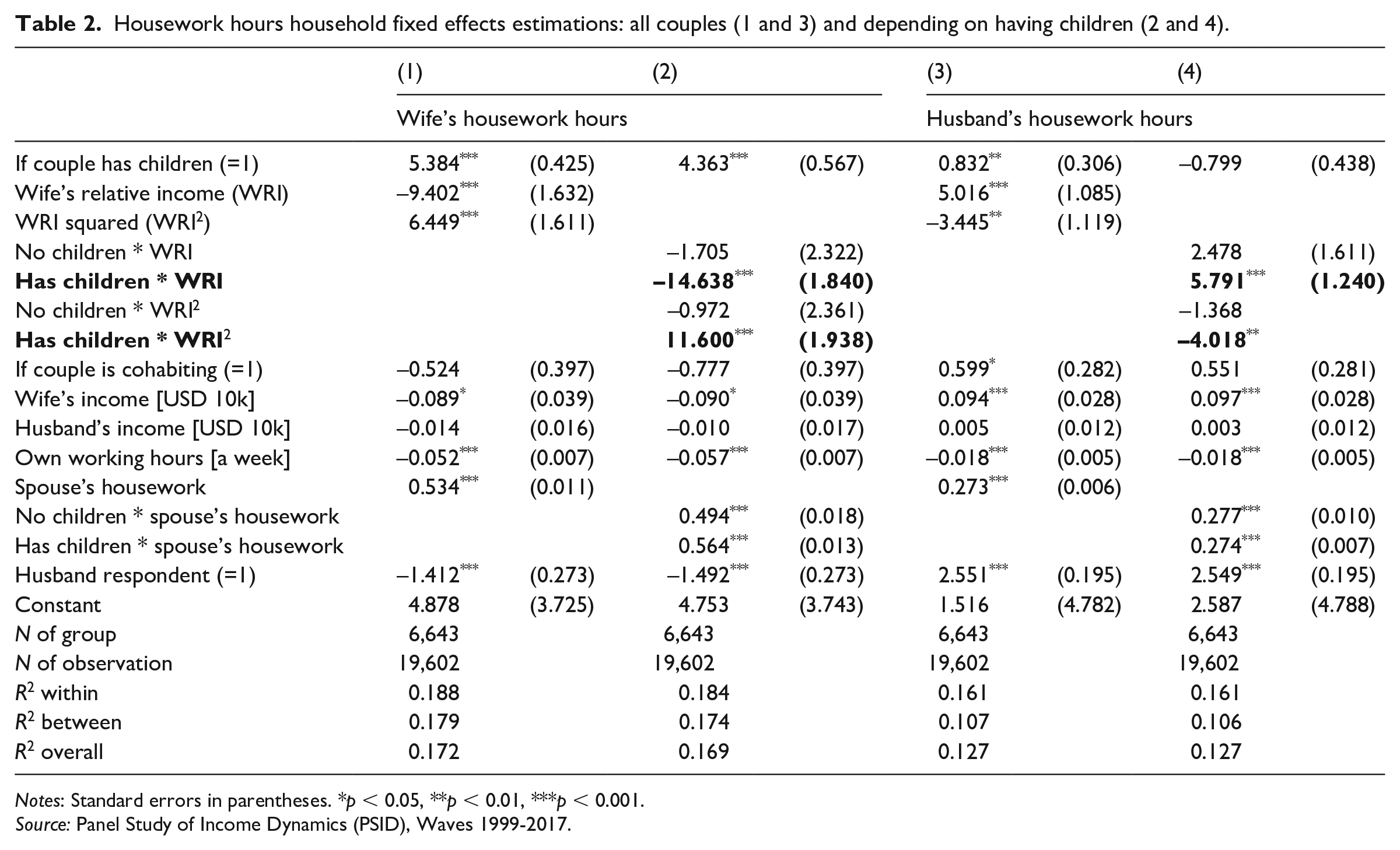
Notes: Standard errors in parentheses. *p < 0.05, **p < 0.01, ***p < 0.001.
Source: Panel Study of Income Dynamics (PSID), Waves 1999-2017.
Difference between wife’s and husband’s housework hours estimations: couples with and without children.
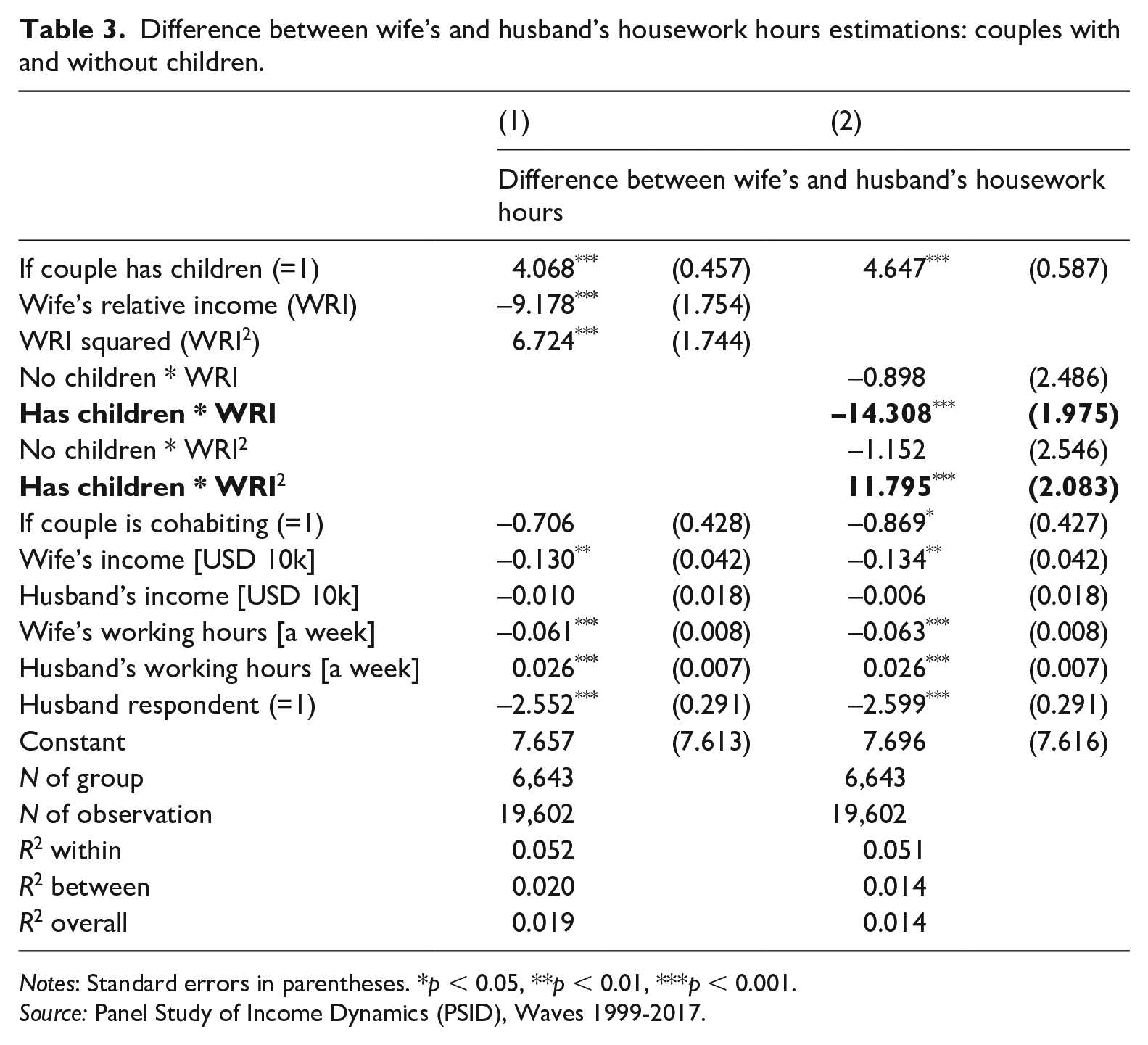
Notes: Standard errors in parentheses. *p < 0.05, **p < 0.01, ***p < 0.001.
Source: Panel Study of Income Dynamics (PSID), Waves 1999-2017.
Results
Descriptive statistics in Table 1 show that on average both parents do more housework than childless couples and their housework gap is also wider (15.2 vs 12.4 hours). In 58% of observations, couples had children; in 28%, women earn more than their male partners. Cohabiting couples constitute only 9% of the sample; therefore, this part of the analysis is largely exploratory.
Table 2 shows the relationship between spouses’ housework and WRI, first controlling for parenthood status only with an indicator variable (specifications 1 and 3), and then estimating the relationship between housework time and WRI separately depending on whether the couple has children or not (specifications 2 and 4). While models (1) and (3) indicate some gender deviance neutralization for wives’ and husbands’ housework hours, introducing a parenthood interaction term, that allows WRI coefficients to vary depending on whether the couple has children or not, identifies a much different picture. Parents’ housework hours display a significant and sizeable gender deviance neutralization pattern. The curvilinear relationship is especially pronounced for mothers’ domestic labour (p < 0.001), but the quadratic term coefficient is also significant for fathers’ housework hours (p < 0.01). Importantly, for childless couples, there are no significant relative income effects.
Using Table 2 specifications, Figures 1 and 2 show average predicted hours of housework for husbands and wives over the entire range of WRI to offer a clear presentation of these results. Figure 1 presents housework patterns estimated for all wives and husbands (with and without children, married and cohabiting) based on estimations (1) and (3). Figure 2 presents what shapes these patterns take when the relevant WRI coefficient can vary depending on the parenthood status based on models (2) and (4). Note that in the figures there is a different vertical axis scale for husbands and wives, as wives tend to do significantly more housework on average than their husbands. The 95% confidence interval becomes wider due to fewer observations in the extreme tail of WRI, but as discussed in the online Appendix, the estimates are robust to exclusion of the 5% of the extreme WRI values. While there is moderate evidence of gender display for the entire sample of wives and husbands in Figure 1, these patterns are dramatically different when transition to parenthood is taken into account. In Figure 2, both mothers’ and fathers’ housework patterns are ‘U-shaped’ and inverted ‘U-shaped’, respectively, in line with gender deviance neutralization. These patterns are linear for couples without children in line with bargaining and exchange theories, and while there were no statistically significant spousal relative effects identified for this group (see Table 2), this is driven by wife’s absolute income. As for the role of absolute resources in determining housework division, only wife’s absolute income is significant in decreasing her and increasing his domestic labour.
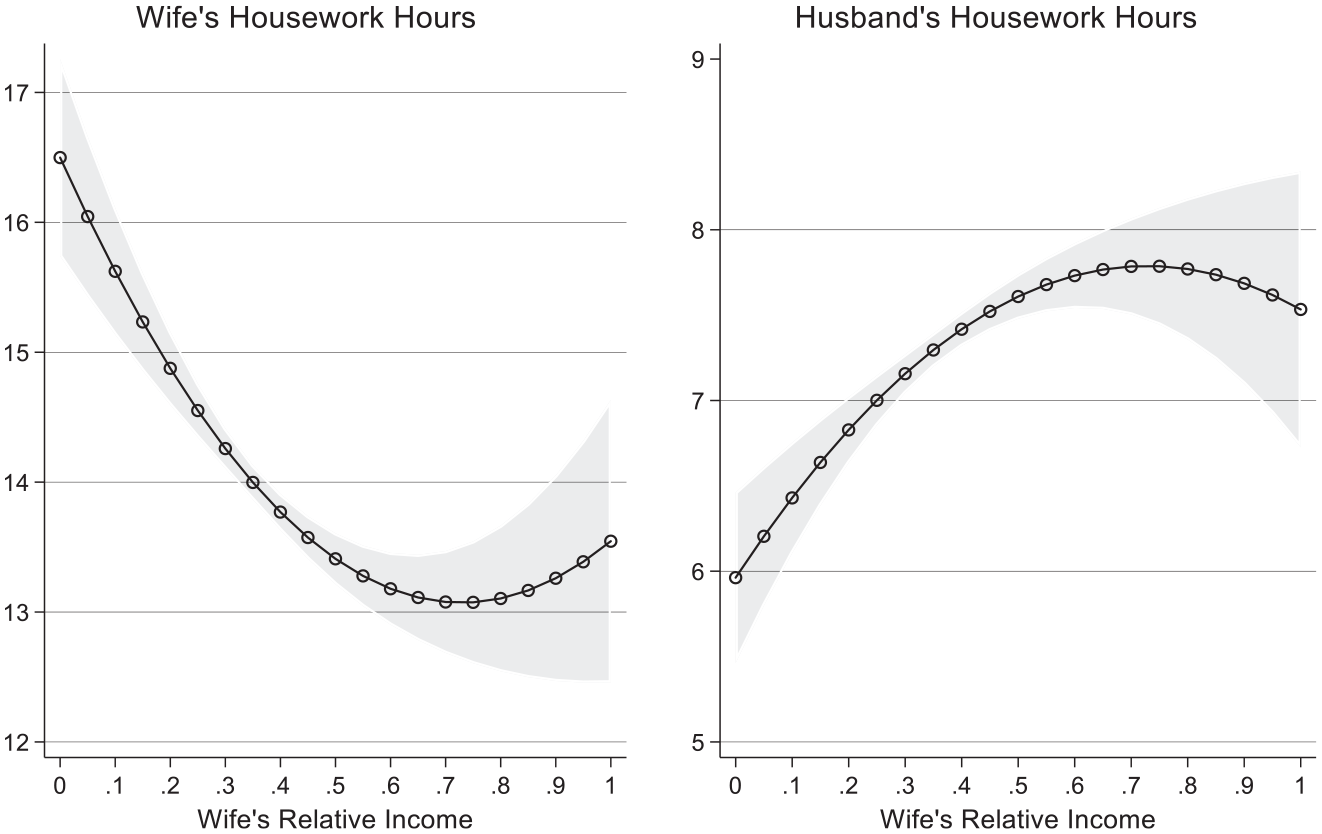
Wife’s and husband’s average predicted housework hours.
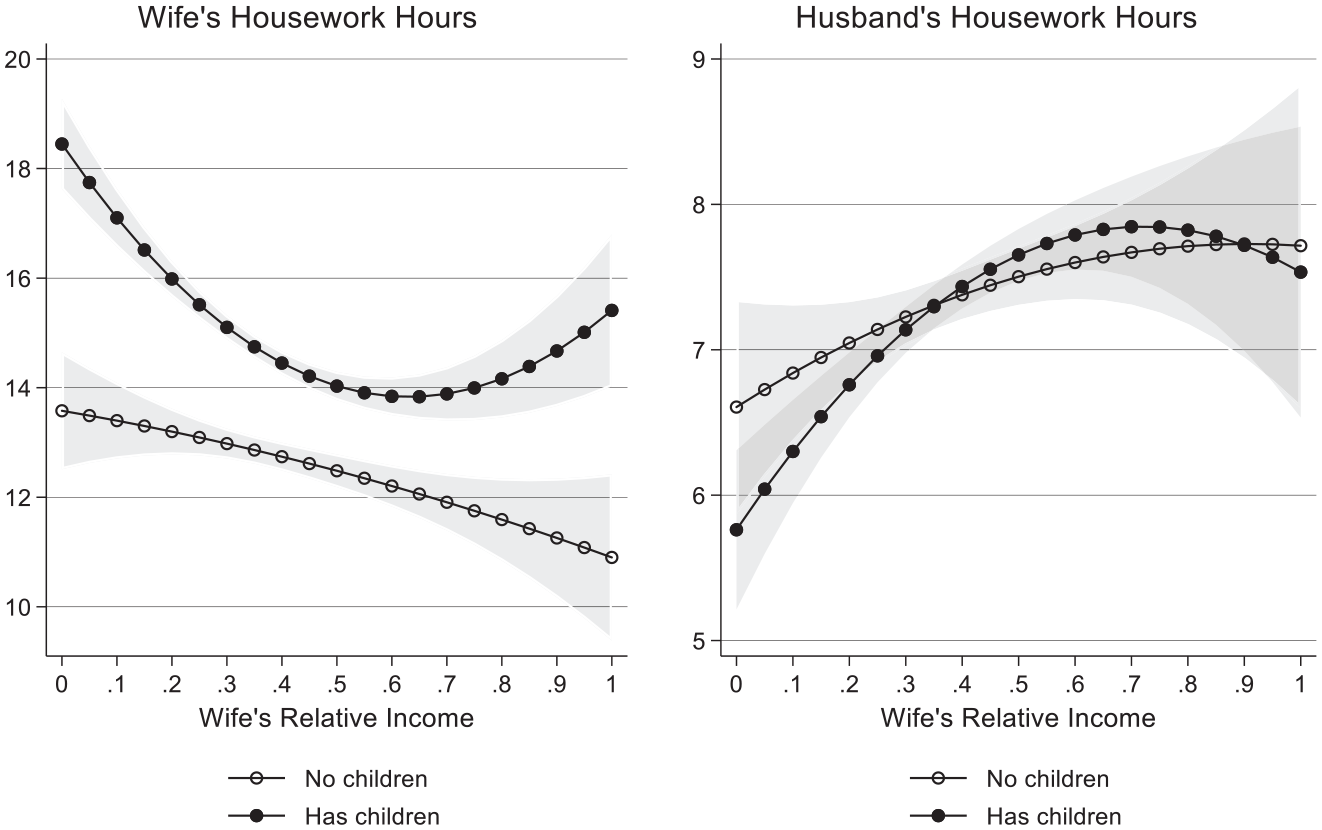
Wife’s and husband’s average predicted housework hours depending on having children.
The birth of the first child impacts especially women’s domestic labour. Husbands’ housework hours display different patterns but not levels, but for women parenthood not only comes with significantly higher domestic labour, but also very strong gender deviance neutralization (i.e. increased time spent on household chores despite higher relative earnings). There is an issue of direction of causality and possible parenthood selection (i.e. spouses that share traditional gender norms may be more likely to choose to have children). In addition to using fixed effects regression for every estimation, to address this, in results not shown, I introduce a forward-looking parenthood indicator variable and all estimates are robust to this modification.
One central variable of interest in the research about housework time trends and studies on gender equality is the gender housework gap. Strong and significant gender deviance neutralizing behaviour, especially by high-earning mothers manifested by an increase in time devoted to domestic labour, leads to the question about the net effect (i.e. what happens to the housework gap as mothers outearn the fathers?). Table 3 presents estimation results analogous to the specifications in Table 2, but here the dependent variable is the difference between wife’s and husband’s housework hours. While the results intuitively follow previously established patterns, it is striking how for parents the gender housework gap is strongly and significantly curvilinear in WRI, and there are again no significant relative income effects for childless couples. For both couple types, the wife’s higher absolute income is a significant predictor of lower housework gap. However, Figure 3 clearly shows a very different relationship between gender housework gap and WRI for parents and nonparents.
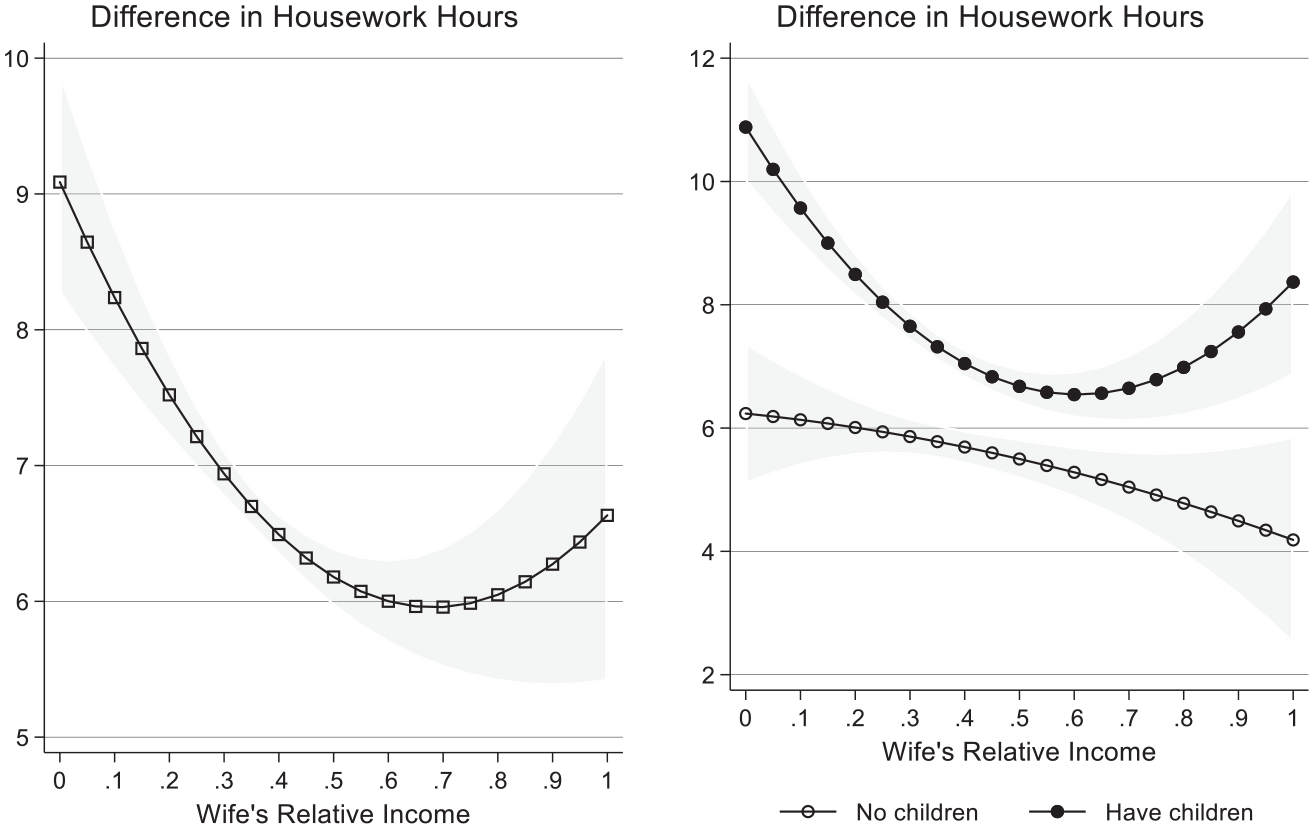
Average predicted difference between wife’s and husband’s housework hours: all couples and depending on having children.
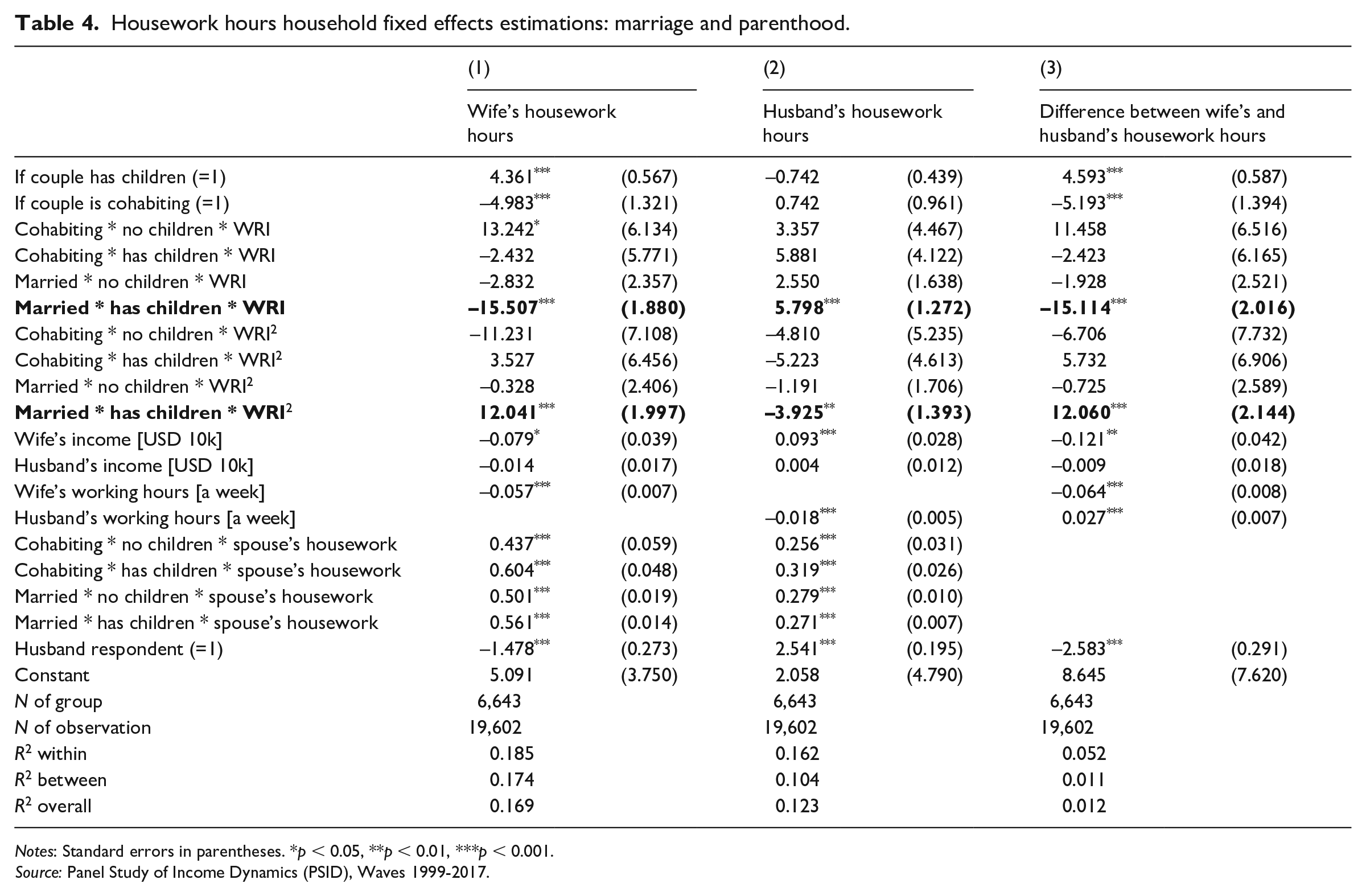
These results show that the gender deviant outcome that requires neutralization via housework time is not as much about wives outearning their husbands, but mothers earning more than the fathers. Still, the social construct of marriage has been shown to shape how traditional gender norms are shaped and enacted, therefore this study additionally compares married and cohabiting couples in how their housework behaviour responds to higher values of WRI. Results in Table A6 in the online Appendix show that for all dependent variables of interest (i.e. wife’s and husband’s housework hours and the difference between the two), the typical and inverted U-shaped patterns hold only for married partners and are absent among cohabiting individuals. Finally, results in Table 4 show that the discussed gender deviance neutralization among parents is specific to married couples and does not occur in the cohabiting group. These specifications analyse jointly the impact of parenthood and marital status on domestic labour supply. The key result is that WRI effects, linear and quadratic, are only present for couples ‘married with children’, and these patterns are significantly and strongly in line with gender deviance neutralization. Within the analysed period, no significant time trends were identified.
Housework hours household fixed effects estimations: marriage and parenthood.
Notes: Standard errors in parentheses. *p < 0.05, **p < 0.01, ***p < 0.001.
Source: Panel Study of Income Dynamics (PSID), Waves 1999-2017.
Additionally, in the online Appendix, Table A7 presents results of estimations where the WRI coefficients of interest vary depending on the couple having zero, one, two and three or more children and Figure A1 presents visualization of these patterns. Interestingly, while there is a monotonic relationship between wife’s housework time and number of children in the low WRI range, past the midpoint the patterns do not differ significantly and resemble mother’s pattern of gender deviance neutralization in Figure 2.
Conclusions and discussion
The birth of a child increases the time and money demands a couple faces. At the same time, it may heighten the salience of norms regarding gender-typical behaviour or even shift individual gender-role attitudes. The popularly offered explanation behind this ‘traditionalization’ are changes in self-identity and self-concept driven by life-course experiences. The transition to parenthood results in a larger change in the division of labour within couples than brought by other events, such as getting married or having more children (Bianchi, 2000; Gershuny and Sullivan, 2003). Drawing on the sample of married and cohabiting dual-earner heterosexual men and women from the 1999 to 2017 waves of the PSID dataset, I examine the relationship between spousal relative income (WRI) and housework time depending on a couple’s parenthood status. While I find that in the entire sample, independent of the couple’s parenthood status, the relationships between housework and WRI are curvilinear, these patterns vary significantly between nonparents and parents. The former are independent of relative income, and the latter are quadratic in line with gender deviance neutralization. The key striking result of this study is that gender deviance neutralization happens not when wives outearn husbands, but when mothers outearn fathers. Having children not only increases traditionality in housework division (higher share done by the wives) but also gives rise to gender deviance neutralization and in this way gender norms and attitudes impact housework distribution among the spouses in multiple ways. Therefore, I find evidence in support of hypotheses 2 and 3 and I reject hypotheses 1 and 4, as for childless couples I find no relative income effects. Finally, while this is not the central focus of this study, I find evidence in support of hypothesis 5. Indeed, these gender deviance neutralization patterns are present among married parents and not cohabiting mothers and fathers.
While there is considerable and growing literature on transition to parenthood and its impact on division of unpaid labour, to the best of my knowledge this is the first study that goes beyond linear or nominal effects. For instance, Schober (2013) did not find relative wages to be a significant predictor, but the dependent variable was housework change after transition to parenthood and these were assumed to be linear in effect. This study tests a number of functional forms, controls for partners’ absolute income and focuses on dual earners in current employment to exclude income effects of potential maternity and paternity leaves.
Traditional gender identity norms induce an aversion to a situation where wives earn more than their husbands. Syrda (2020) shows that this situation coincides with higher male psychological distress and Bertrand et al. (2015) find that this aversion impacts wife’s labour force participation and wife’s income conditional on working. Indeed, the threat to traditional gender identity norm has significant consequences for paid and unpaid labour supply. However, the fact that parenthood has a strong traditionalizing effect on housework division, especially among mothers who outearn their husbands, is not necessarily an intuitive result. One could argue that the increased financial and housework demands that come with having children would lead to an efficient, and not necessarily gendered, division. This research shows that housework among parents is shaped by gender norms and attitudes in multiple ways, in the disproportionately increased burden for women and in the strong gender deviance neutralization patterns (i.e. relatively higher earner mothers perform more housework and their husbands do less). Optimal housework allocation also depends on partner’s relative household productivities which are rarely, if ever, observable and measured. However, it is unlikely that higher income earners are also on average relatively more productive in terms of housework and if so, this would have unusual suggestions for the matching market outcomes in the first place.
This study focuses on couples in the US and other studies have found this makes for a fairly representative case for the Anglo countries. Craig and Mullan (2010) find that parents have higher, less gender-equal workloads than nonparents in the US, Australia, Italy, France, and Denmark; but, overall, time commitments and the difference by parenthood status were most pronounced in the US and Australia. Methodologically and empirically, this article shows that gender deviance neutralization housework patterns are not uniform across couples, and parenthood and marital status should be considered in estimating these parameters. Theoretically, as couples are not homogenous, these results identify that traditional gender identity norms are particularly strong among (married) parents. As for future research, it would be interesting to see how these dynamics (i.e. strong gender deviance neutralization specifically among married couples with children) vary between countries, cultures and other differentiators. Moreover, it would be useful to verify these patterns using other types of housework data (i.e. daily time use diary data). The PSID housework data, while widely used in research, is ‘stylized’ 2 and hence its accuracy may be limited by measurement error, recall difficulty and social desirability bias (Kan and Pudney, 2008), and lack detail that would allow for identifying hebdomadal patterns (Kolpashnikova and Kan, 2019). Still, estimated relationships based on ‘stylized’ data can reveal a lot about desired housework division outcomes, and as this study focuses on dual-earner couples in full employment, arguably both partners are equally constrained by the structure of the week.
One expectation of the ‘gender revolution’ of the 1960s and 1970s was that women’s increased market employment and earnings will be accompanied by men’s greater participation in domestic activities. Married men and women, however, never equalized in the level of housework they performed, leading many scholars to proclaim a ‘stalled revolution’ (Raley et al., 2012). Bianchi et al. (2006), in hypothesizing on future developments, doubt that full gender equality will happen in the near future, precisely because parents fall into gender-specialized roles once a child arrives. A pattern once settled upon is often difficult to renegotiate. Moreover, through intergenerational transfer of norms and beliefs, children may repeat them as adults. This article shows that this process goes even deeper, and housework patterns of gender deviance neutralization (i.e. increased housework hours by breadwinning mothers) are strong and significant, precisely among couples with children. This is important because as the gender education gap has been reversed, women are increasingly likely to outearn their husbands and the prevalence of female-headed households has significantly increased (McLanahan and Percheski, 2008).
Supplemental Material
sj-docx-1-wes-10.1177_09500170211069780 – Supplemental material for Gendered Housework: Spousal Relative Income, Parenthood and Traditional Gender Identity Norms
Supplemental material, sj-docx-1-wes-10.1177_09500170211069780 for Gendered Housework: Spousal Relative Income, Parenthood and Traditional Gender Identity Norms by Joanna Syrda in Work, Employment and Society
Footnotes
Acknowledgements
I would like to thank the editor and three anonymous reviewers for their valuable comments and suggestions, which have strengthened this article.
Funding
The author received no financial support for the research, authorship and/or publication of this article.

Supplementary material
The supplementary material is available online with the article.
Notes
References
Supplementary Material
Please find the following supplemental material available below.
For Open Access articles published under a Creative Commons License, all supplemental material carries the same license as the article it is associated with.
For non-Open Access articles published, all supplemental material carries a non-exclusive license, and permission requests for re-use of supplemental material or any part of supplemental material shall be sent directly to the copyright owner as specified in the copyright notice associated with the article.
