



Abstract
Active labour market policies (ALMPs) have evolved as pivotal social policy instruments designed to place the unemployed and other disadvantaged groups in sustainable employment. Yet, little is known about what drives employer participation in such initiatives. This article provides a nuanced account of the socio-economic aspects of the demand-side of ALMPs, by investigating employer embeddedness in wider social networks created by employer associations and employee collective voice as enabling mechanisms for employer participation in ALMPs. Drawing on an original survey of employers in the United Kingdom (UK) and Denmark, we found that the extent of employer embeddedness in such social networks is positively associated with employer participation in the UK but not in Denmark, where the effect was indirect and mediated through collective bargaining. The effects of employer network ties and employee collective voice affirm the importance of a more integrated analysis of the interactions between network ties and institutions in ALMP research.
Keywords
Introduction
Active labour market policies (ALMPs) have evolved as the means by which national governments look to integrate the unemployed, and other individuals outside the labour market, back into work. Comprised of various employability programmes, work placement schemes and policies directed towards the most disadvantaged groups in the labour market (e.g. disabled people, single parents), ALMPs are typically viewed as ‘supply-side measures’. However, an increased emphasis on ‘work first’ policy approaches, within ever more marketised forms of provision (Greer, 2016), has started to shift attention to the ‘demand-side’ of ALMPs: namely, how ALMP providers can engage employers to participate in such programmes and provide jobs to those out of work and disadvantaged in the labour market (Liechti, 2020; Wang et al., 2020). While raising what is often seen as weak employer demand is recognised as challenging (Greer, 2016), employer participation is nonetheless seen as central to the successful delivery of such policy initiatives (van Berkel and van der Aa, 2012).
Despite this recognition, analyses to-date offer only a partial explanation of what drives employers to participate in ALMPs. One well-established argument is that employers are more likely to participate in ALMPs where they are members of national-level employers’ associations (EAs) (Martin and Swank, 2004, 2012). Varying degrees of employer coordination is a common explanation for differences between countries in relation to employer take-up of ALMPs; for example, between the United Kingdom (UK) and Denmark, the countries viewed as pioneers of ALMPs (Martin, 2004). In such accounts, membership of national EAs is seen as a more important factor than any wider collective negotiations that EAs may themselves participate in. This article challenges such an explanation and argues that deeper, sociological consideration needs to be given to the social network function of EAs and to the role of wider institutional arrangements that such social networks may be embedded in – notably in terms of mechanisms of employee collective voice (Granovetter, 1985; Useem, 1979).
The article has two objectives: first, in understanding what drives employers to participate in ALMPs, it explores the extent to which employers’ social networks impact the take-up of ALMPs. Second, and related, it considers the extent to which employer participation in ALMPs is mediated by wider structures of employee collective voice, most notably through channels of collective bargaining. The literature on ALMPs often examines social networks in relation to unemployed people themselves (Feuls et al., 2014; Liechti, 2020). Where consideration is given to the social networks of employers this is limited to simple membership of business associations (Martin and Swank, 2004). This perspective is problematic because the focus on the membership status of individual employers downplays the role of EAs in tying otherwise disparate firms into a social network and the extent of employer connectivity within such networks – that is, the strength of ties between network members. In contrast, this article approaches the problem from the theoretical position of social embeddedness, where economic behaviour is predicated upon the strength of networks of inter-personal or inter-organisational relations and their interaction with wider institutions (Granovetter, 1985: 504). Employers’ network ties are thus seen as an important explanatory variable and the analysis shows that in certain institutional environments their interaction with mechanisms of employee collective voice can increase the likelihood of employer participation in ALMPs.
This article’s emphasis on social networks and collective voice is important for at least two further reasons. First, the (quasi) marketisation of ALMPs has led to increased complexity in their delivery (Greer, 2016; Wang et al., 2020) – involving public, private and voluntary organisations – arguably accentuating the importance of social networks (Liechti, 2020). Second, the role of EAs, and hence employers’ participation, has changed from their traditional role in coordinating employers’ actions and attitudes towards facilitating social networks among employers (Barry and Wilkinson, 2011; Gooberman et al., 2018), against the backdrop of trade union decline.
Empirically, we draw on the findings of a unique, representative survey of 1500 employers in the UK and Denmark. The UK and Denmark are particularly appropriate cases to examine employer participation in ALMPs. First, set against the work of Martin and Swank (2004), such a comparison allows for a reappraisal of the significance of social embeddedness and employee voice in shaping employer outcomes in the two countries. Second, while both countries are leading advocates of ALMPs based on flexible labour markets, such policies are implemented under diverging approaches of employment regulation: the Danish social partnership model contrasts to the UK’s market model. ALMPs are increasingly delivered via hybrid support structures, including a now-residual public employment service in the UK (Jobcentre Plus) and Jobcenters in Denmark, as well as by for-profit and non-profit service providers. In both countries, participation in ALMPs is increasingly a requirement for receipt of out-of-work benefits (‘conditionality’) (Greer, 2016) and includes job search and employment preparation, training and in-work support.
In what follows, we present our research hypotheses, focusing first on the role of employer associations as social networks and then on the theoretical rationale for the mediating effect of collective voice. We analyse the survey data, present the findings and discuss their contribution to theory and practice. The findings corroborate the centrality of both employers’ networks and collective voice in shaping employer participation in ALMPs and reveal significant differences between Denmark and the UK. In Denmark, employers’ networks were not a sufficient explanation of employer participation in ALMPs, as such involvement was itself mediated by collective voice. In the UK, in contrast, employer embeddedness in wider networks did drive their participation in ALMPs, but within a system that lacked wider structures of collective voice. In conclusion, we reflect on the theoretical value of more nuanced accounts of the socio-economic aspects of the demand-side of ALMPs and how such a perspective can contribute to widening the boundaries of academic study of ALMPs (Fernandez-Urbano and Orton, 2021; Liechti, 2020). Furthermore, with the lingering COVID-19 crisis and withdrawal of job retention schemes in the UK and elsewhere, understanding employer engagement in ALMPs becomes ever more significant as the overall success in reintegrating those displaced by the crisis into the labour market will depend on employers’ positive predisposition to ALMPs.
Hypothesis development
Hypothesising the effect of employer associations as social networks
The starting point for analysis of employer participation in ALMPs remains the seminal research of Martin and Swank, who examined ALMPs in Denmark and the UK (Martin, 2004; Martin and Swank, 2004, 2012; Swank and Martin, 2001). Their analyses identify differences between how and why employers engaged with ALMPs in the two countries: UK employers saw ALMPs as a way to access cheap labour hires, while Danish employers accessed ALMPs for skilled blue-collar workers. Martin and Swank explain these differences with reference to the role of national and sectoral EAs, which were seen to play a coordinating role that shaped both employers’ perceptions of, and their participation in, ALMPs (Bredgaard, 2018; Martin and Swank, 2012; van Berkel and van der Aa, 2012).
As a contemporary explanation of employer participation in ALMPs, this position needs reappraisal. While employer coordination at national-level played a significant role in the 1990s and early 2000s, this has become less clear-cut as ALMPs have become more complex and EAs have changed their structures. Owing to the contracting-out of service delivery (Greer, 2016) and an increasingly diverse range of interventions (e.g. financial incentives, employment assistance, work experience, training) (Bonoli, 2010; Fernandez-Urbano and Orton, 2021), ALMPs in both the UK and Denmark now involve multiple actors at different spatial levels: public, private and non-profit organisations operating at national, regional and local levels (Greer, 2016).
In the same vein, EAs have undergone considerable transformation. Historically, EAs evolved in response to unionisation and were seen as ‘pure’ membership-based structures involved in collective negotiations with employee representatives (Gooberman et al., 2018). Yet, in response to ongoing union decline and the liberalisation of labour markets across most developed economies, EAs have increasingly adopted ‘mixed models’ that include membership-based bodies not directly involved in collective negotiations, such as professional associations (e.g. CIPD in the UK) (Traxler, 2004). As EAs seek to adapt their organisational structures in response to the erosion of collective business and employee interests (Brandl and Lehr, 2019), we are witnessing the shift from the traditional role of EAs in coordinating employers’ actions and attitudes towards a role in facilitating social networks among employers. As affiliations comprised of social networks, EAs can thus be seen to influence employers’ behaviours (Gooberman et al., 2018; Ibsen and Navrbjerg, 2019) through processes of social embeddedness (Antcliff et al., 2007; Granovetter, 1985).
Useem (1979) was among the first to examine the social organisation of the business elite as a social network, concluding that social networks stemming from employers’ involvement in EAs are associated with involvement in other institutions, such as government advisory bodies and non-governmental non-profits (Useem, 1979: 567). From this, the deeper employers’ embeddedness in their social networks, the more likely they are to participate in social policy instruments such as ALMPs. Central to this assumption is the capacity of social networks to shape a trust relationship within an economic exchange (Liechti, 2020; Marsden and Gorman, 2001). Indeed, evidence to date suggests that in terms of hiring decisions, employers value recommendations from their direct contacts and that public employment services cannot substitute for the effect of social networks (Liechti, 2020). It follows that employers holding simultaneous memberships of various ‘pure’ and ‘mixed’ associations (e.g. peak associations, business interest groups and professional associations) have a higher degree of social connectivity or, in other words, social embeddedness. They are more likely to receive information on ALMPs that they would deem trustworthy, which in turn increases the probability of employer participation.
Overall, in order to understand employer participation in ALMPs, the first step is to extend the approach of Martin and Swank (2012) by situating employers not just in terms of membership of EAs, but the social networks that stem from employer membership of EAs. This leads to our first hypothesis that those better connected in social networks are more likely to participate in ALMPs.
Hypothesising collective voice as a mediator of employer participation in ALMPs
In contrast to previous studies (Martin and Swank, 2004, 2012), one of the key theoretical assumptions of this study is that employers’ networks alone are not a sufficient explanation for employer participation in ALMPs. Drawing on the body of work concerning spillover effects of employee voice beyond the workplace (Budd et al., 2018), we theorise that employee collective voice increases the likelihood of employer participation in ALMPs.
Understood at its simplest as the mechanism whereby workers have a ‘say’ on workplace matters of relevance to them (Wilkinson and Fay, 2011), employee voice has implications beyond the workplace (Budd et al., 2018). At an organisational level, voice is found to facilitate broader, environmentally friendly, sustainable business practices (Markey et al., 2016), whereas, at an individual level, voice can influence workers’ engagement with politics (Budd et al., 2018) and their voting intention (Pontusson et al., 2002). More widely, there is an established link between forms of collective voice (such as union representation and collective bargaining) and employers’ behaviour outside the workplace, including in participatory democracy, public spending (Bonoli, 2010) and investment in skills and training (Iversen and Stephens, 2008). Central here is collective bargaining as an established proxy for collective voice, an institution that is well established in comparative, socio-economic research (Hadziabdic and Baccaro, 2020; Pontusson et al., 2002).
As a form of economic and social protection, collective bargaining creates an environment supportive of welfare state provision (Bonoli, 2010). There are several theoretical reasons why collective bargaining could increase the likelihood of employer participation in ALMPs. The first is that trade unions are by default positively predisposed to the recruitment of the unemployed, even if there is evidence to suggest that unionised workplaces take a cautious approach to recruitment, prioritising incumbents’ job security over new hires (Brändle and Heinbach, 2016). When firms look to expand, we know that trade unions typically support recruitment from ALMPs because employers opt for ALMPs to fill routine and clerical jobs traditionally seen as the core of union membership. Once integrated, new hires contribute to increased trade union membership bases and leverage union bargaining power.
The second reason is that trade unions can pressure employers into policy instruments in much the same way as they do about socially responsible staffing (Forde et al., 2009) and environmentally friendly policies (Markey et al., 2016). Participation in ALMPs presents cost-effective methods of recruiting new hires and also of upskilling existing staff that can be particularly attractive for organisations involved in wage bargaining with trade unions. Furthermore, where trade unions and employers are directly involved in the design and delivery of ALMPs, either through industry-wide collective bargaining structures at the national level or where ALMPs are proscribed by collective agreements (as is the case in Denmark), ALMPs are likely to become a default recruitment channel.
The third reason is that in employment systems such as in Denmark, unions play a key role in the administration of unemployment benefits; termed the Ghent model (Lind, 2009), workers need to belong to unions to receive benefits. Perhaps because of this, unions in Denmark have a long history of involvement in the design and delivery of ALMPs through social dialogue at national, regional and local levels. Furthermore, participation in ALMPs in Denmark (e.g. Flexjobs for disabled people) involves payment of wages set by collective agreements and the right to union representation (Ingold and Valizade, 2017). It follows that:
Hypothesis 2 justifies a general association between collective voice and employer participation in ALMPs. However, our main theoretical position is that under the right institutional conditions collective voice acts as a mediating mechanism that enables employer participation in ALMPs. Theoretically, this assumes an intrinsic connection between employers’ ties and collective voice such that the latter transmits the effect from the former on employer participation. In line with a classic mediation model (Baron and Kenny, 1986; Imai et al., 2010), the foregoing assumptions can be presented as distinct, testable hypotheses: first, there is a need to hypothesise an association between employers’ networks and collective voice; second, to test a mediation effect whereby collective voice absorbs some or all of the effect of network ties on the outcome. We justify these hypotheses in turn.
A direct association between employers’ networks and collective voice is backed by a wealth of conceptual and empirical research. Indeed, both organised labour and employer associations are historically embedded in national employment relations systems (Gooberman et al., 2018; Martin and Swank, 2012). National and peak EAs evolved in response to strong labour organisation (Barry and Wilkinson, 2011; Ibsen and Navrbjerg, 2019; Traxler, 2003), with an emphasis on bargaining designed to take distributive conflicts out of the workplace. This was the case in both the UK and Denmark. Hence, Hypothesis 3 is as follows:
Notwithstanding Hypothesis 3, it is important to recognise that the institutional foundations of collective bargaining differ between the UK and Denmark. In the UK, employee collective voice is fragmented and largely decentralised, while in Denmark employer associations and trade unions are embedded in employment relations at national, regional and sectoral levels. Thus, the mechanisms underlying the relationship between employers’ ties, collective voice and employer participation in ALMPs may differ between these two countries.
That the UK is characterised by a decentralised system that places more emphasis on firms themselves is a result of an ongoing decline of collective bargaining (Purcell, 1993). The role of EAs in collective deliberations is confined to selected sectors and industries where industry-wide collective agreements still take place (e.g. construction) (Brandl and Traxler, 2005). Unlike their Danish counterparts, UK trade unions historically resisted state intervention in collective bargaining in favour of dialogue with EAs, following the voluntarist principle of free bargaining between employers and employees (Flanders, 1974). By contrast, the Danish coordinated system of industrial relations rests on social partnership, where working conditions are established through negotiations between EAs, trade unions and the government at national and sectoral levels. Since the 1980s, there has been sector-based coordination of wage bargaining, with Dansk Industriet (DI – the Confederation of Danish Industry) playing a leading role in collective negotiations. Deliberations at the national level that cover broader economic and political issues are under the remit of Dansk Arbejdsgiverforeningen (DA), a national peak employers’ association. Yet, considerable power relating to working conditions and recruitment policies resides at workplace level. Owing to such a mixed ‘centralised-decentralised’ system, in Denmark EAs are closely tied to collective bargaining at all levels. Nationally, this occurs through a tripartite system of collective negotiations where the parties take joint responsibility for enacted social policies. At a municipal level, collective agreements between local authorities, trade unions and the Local Government Association (KL) agree on specific mechanisms of policy realisation that includes compulsory consultations with shop stewards about recruitment from ALMPs; for example, in respect of Flexjobs, a scheme for disabled people and those with permanently limited working ability (Bredgaard, 2018).
Overall, the institutional backdrop in Denmark is conducive to the pivotal role of collective voice in shaping the framework for employer participation in ALMPs, while a greater emphasis on employers’ behaviours in the UK is likely to result in a stronger effect of employers’ network ties. The concluding hypothesis is:
Figure 1 is a graphical summary of our theoretical assumptions presented as a mediation model with direct and indirect effects. In the figure, the notation c = c′ + (ab) stands for an indirect effect of employers’ networks on employer participation in ALMPs through collective voice.
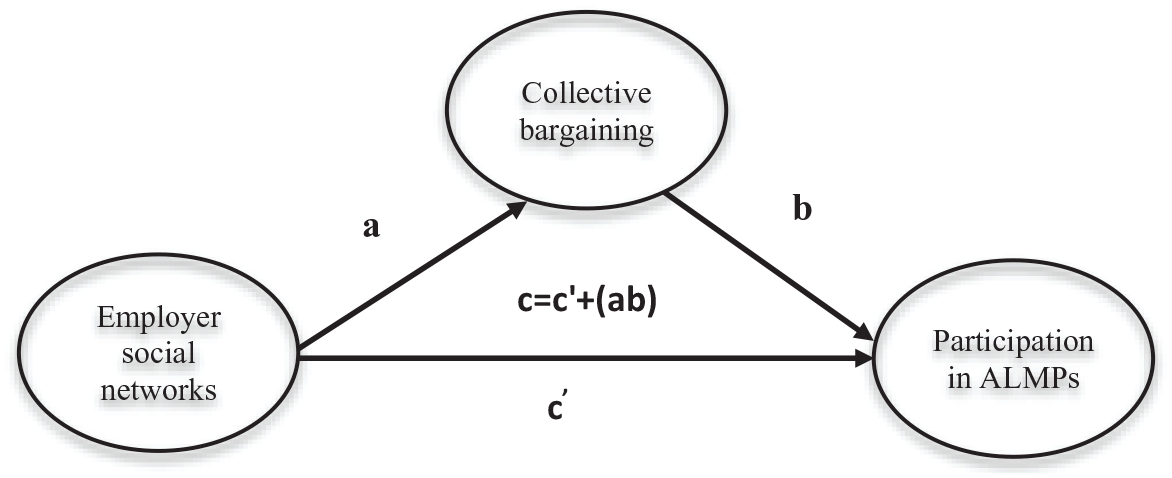
Conceptual model.
Data
The research draws on an original, establishment-level survey of employers administered by an external agency on behalf of the authors. A total of 1003 computer-assisted telephone interviews (CATI) were conducted with employers in the UK (England, Scotland, Wales and Northern Ireland) and 500 in Denmark (the smaller sample size was due to the significantly smaller business universe in Denmark). The rationale for the country selection was threefold. First, the UK and Denmark were among the first countries in Europe to introduce ALMPs, in the context of flexible labour markets. Second, such national comparisons were useful because of different institutional structures of collective voice between the two countries; there have been only a limited number of studies of employer participation in ALMPs, and these have tended to be single-country case studies (van Berkel and van der Aa, 2012). Lastly, as noted, it allowed us to revisit the classic analysis of Martin and Swank, which also focused on the UK and Denmark but treated employee voice as a confounding factor rather than a mediator of employer participation in ALMPs.
The UK sample was derived from Sample Answers, which uses LBM and Experian business files based on records from Thomson Directories and Companies House. The sample included business telephone numbers randomly stratified by company size and sector. The Danish sample was derived from Experian, an online database. The sampling frame was representative of employers in both countries, including key sectors and industries, private and public sector organisations, service and non-service firms, large organisations and small and medium enterprises (SMEs). Micro-firms with less than 10 employees in the UK and fewer than five employees in Denmark were excluded from the sampling frame. This is a common approach in labour market research as micro-enterprises can skew statistical distributions. Respondents were asked a set of standard questions about their organisations, including industry, firm size, labour turnover and more detailed questions about their involvement in a range of ALMPs in the UK and Denmark and their membership of EAs. Prior to the main fieldwork, a pilot study was carried out, with 20 interviews undertaken in each country. The survey instrument was subsequently revised to amend measurement scales following participants’ feedback. The questionnaire was initially designed in English and translated into Danish, then back-translated into English. This ensured the consistency of our survey design, minimising bias caused by language differences. Data analysis was undertaken in R, the software environment for statistical computing.
One limitation of our data is its cross-sectional nature, which precluded more confident conclusions on the basis of our empirical analysis. Despite this shortcoming, our data provided a unique opportunity for a comparative study that simultaneously measures employers’ networks, collective voice and participation in social policy instruments. This level of detail was essential for testing our theoretical assumptions.
Measurements
Employer membership of employer associations (EAs)
Employers were asked if they were members of the following associations: peak EAs (Confederation of British Industry (CBI) and Confederation of Danish Employers (DA)); national associations (British Chamber of Commerce, Danish Chamber of Commerce, Dansk Industriet); sectoral trade associations (e.g. Make UK); and professional associations (e.g. Chartered Institute of Personnel and Development (CIPD) in the UK). We then asked employers to specify their membership of other associations not included in the list, recording each association as a dichotomous variable. As anticipated, employer membership of EAs was higher in Denmark: in the UK, 45.1% of employers were not members of any business networks, compared to just 17.3% in Denmark. Only 4.8% of UK employers were members of the CBI (a peak association), while in Denmark the corresponding figure for the Confederation of Danish Employers was 51.2%. A further 13.3% of UK employers were members of the British Chamber of Commerce; in Denmark, 52.3% of employers were members of national associations such as Dansk Industry and the Danish Chamber of Commerce. In the UK, employers tended to be members of what Traxler (2004) has referred to as ‘mixed’ EAs, rather than ‘pure’ EAs; for example, the CIPD – this membership alone stood at 37.5%.
The data on employers’ shared membership of business associations were used to construct a measure of employers’ social networks. We accommodated various routes to membership by differentiating between organisational (through membership in lower level EAs; for example, membership of peak associations through industry-level EAs) and individual memberships where employers were directly involved in EAs; for example, the CBI. A prominent indicator of the strength of social ties in social network analysis is a measurement of network centrality (Borgatti, 2005; Celant, 2014). This can be seen as a proxy for the relative importance of a given node (i.e. employer) in the network. Three centrality measurements feature prominently in social network analysis (Bonacich and Lloyd, 2001): betweenness centrality (quantifies the number of times a particular node is located in the shortest path between two other nodes); degree centrality (the number of connections a particular node has in a network); eigenvector centrality (measures a node’s influence within the network as proportionate to the degree of connectivity of its direct ties). In this study, we used eigenvector centrality as a more pertinent measurement to capture the extent to which a given employer is central for information transfer and economic exchange occurring within the network. That said, we also computed the other two centrality measures to demonstrate that an arbitrary choice of a centrality metric has not affected the key properties of employers’ social networks.
Employer participation in ALMPs
Three dependent variables were used to estimate the likelihood of employer participation in ALMPs, reflecting different types of ALMPs. The key programmes in each country are set out in Table 1. Respondents were asked a range of questions to ascertain their participation as it could not be assumed that respondents would necessarily know the names of programmes. The figure for ‘work placements’ is comprised of the UK public employment service’s Sector-Based Work Academies, delivered in partnership with employers and comprising pre-employment training, a work experience placement and guaranteed job interview. The measure encompasses other forms of work placements and could potentially include placements for students in both compulsory and post-compulsory education. Unlike work placements, ‘funded programmes’ provide a clearer pathway to sustainable employment. These programmes usually involve material incentives to employers for recruiting the unemployed. In many such programmes, additional incentives (e.g. paying part of an employee’s salary) are provided if the person remains in employment for a specific period of time (often six months or more). This reflects the complexity of programmes in the UK in both number and type, as well as the myriad delivery organisations. Danish ALMPs are predominantly focused on time-limited placements in companies in the form of wage-subsidised jobs (Lontiskud) and company internships (Virksomhedspraktik), both brokered by Jobcenters. The key difference is that in Denmark participants are paid a wage, while in the UK the unemployed merely receive minimal welfare benefits.
Types of ALMP in the UK and Denmark.
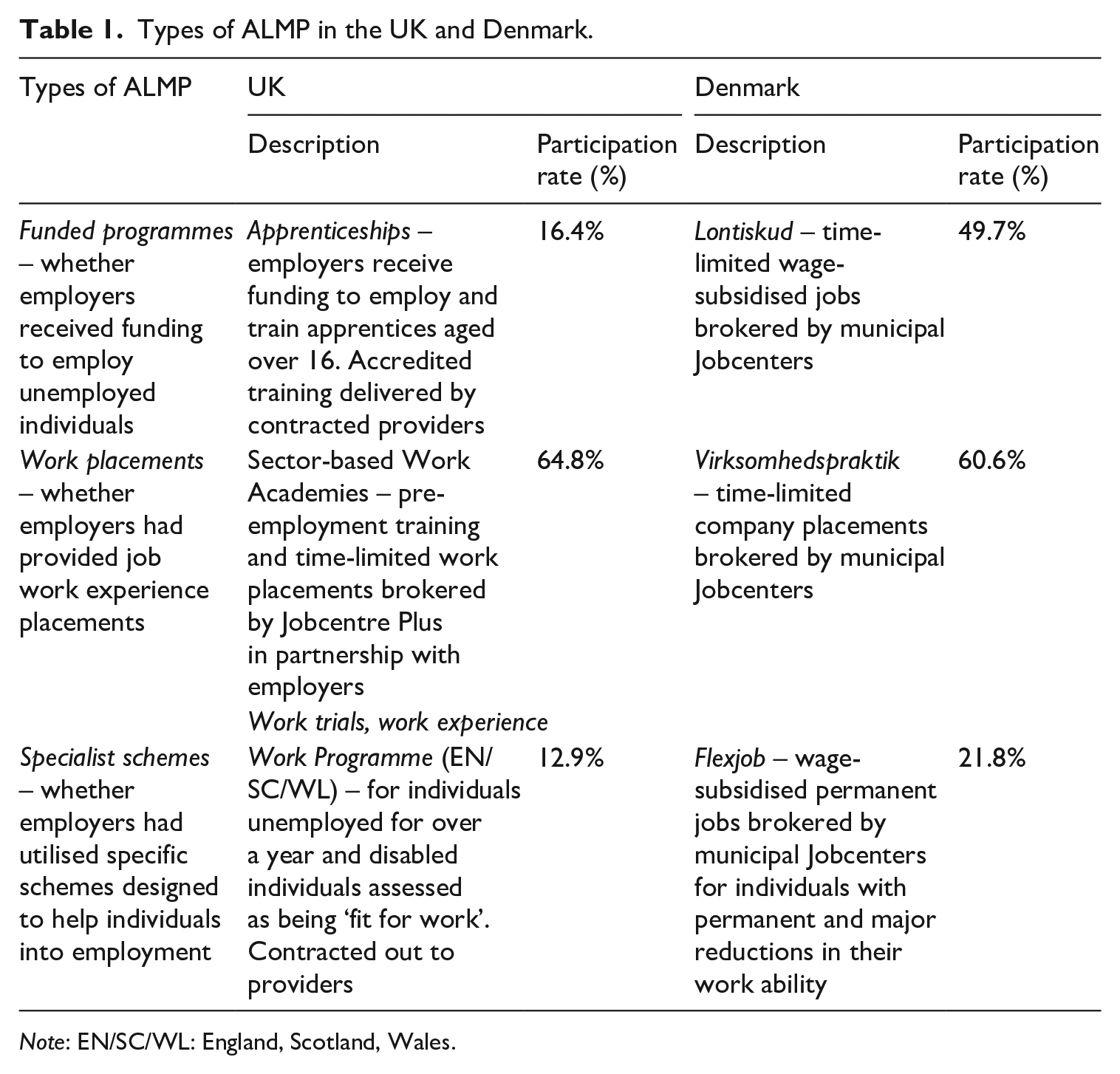
Note: EN/SC/WL: England, Scotland, Wales.
Collective voice
We used employee coverage by collective agreements (in percentages) as a proxy for employee collective voice (employers reported the proportion of staff covered by collective agreements). Both the presence of collective bargaining and its coverage were considerably higher in Denmark: 68% of employees in Denmark were covered by collective agreements compared to just 7% in the UK.
Control variables
All regression models controlled for firm size, sector, industry and the number of vacancies placed by an employer in the last two years as these variables were assumed to affect the likelihood of employer participation in ALMPs.
Descriptive statistics for the main study variables are reported in Table 2.
Descriptive statistics (mediator and control variables).
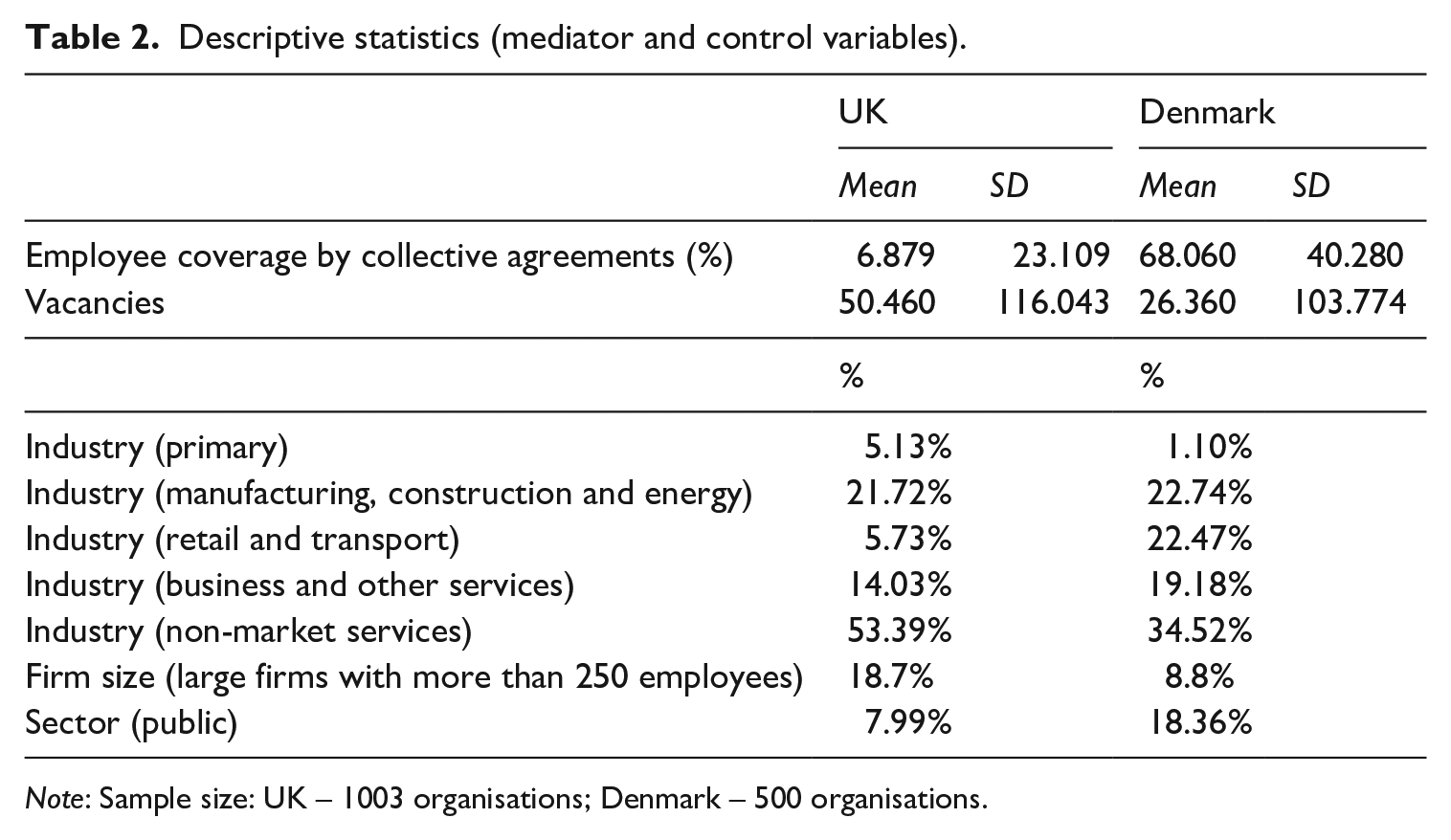
Note: Sample size: UK – 1003 organisations; Denmark – 500 organisations.
Method
Regression analysis was used to estimate the hypothesised relationships between employers’ networks, collective bargaining and employer participation in ALMPs. Where participation in ALMPs featured as a dependent variable, logistic regression was used owing to the dichotomous nature of the outcome. The effect of employers’ networks on employee coverage by collective bargaining was estimated by multiple linear regression with heteroskedastic (robust) standard errors. We estimated indirect relationships in line with conventional mediation analysis (Baron and Kenny, 1986); regression coefficients were standardised prior to estimating such effects.
Findings
Descriptive analysis: employers’ ties and employer participation in ALMPs
We begin with a descriptive analysis of employers’ social networks and employer participation rates in ALMPs in the UK and Denmark. Key statistics describing employers’ social networks are presented in Table 3, including eigenvector centrality alongside two alternative centrality measurements (betweenness and degree centrality). The social network of Danish employers was denser as all centrality metrics were significantly higher. However, this effect held only in the complete network with isolated nodes (employers not connected to any other employers through common membership of EAs). Once employers with no connections have been excluded, the difference between the UK and Denmark disappeared (except the most basic measurement of degree centrality). Although Danish employers were considerably more likely to be members of EAs, connected employers in both countries formed social networks comparable in terms of the overall degree of connectivity within them (as shown in Figure 2).
Properties of employers’ networks in the UK and Denmark.
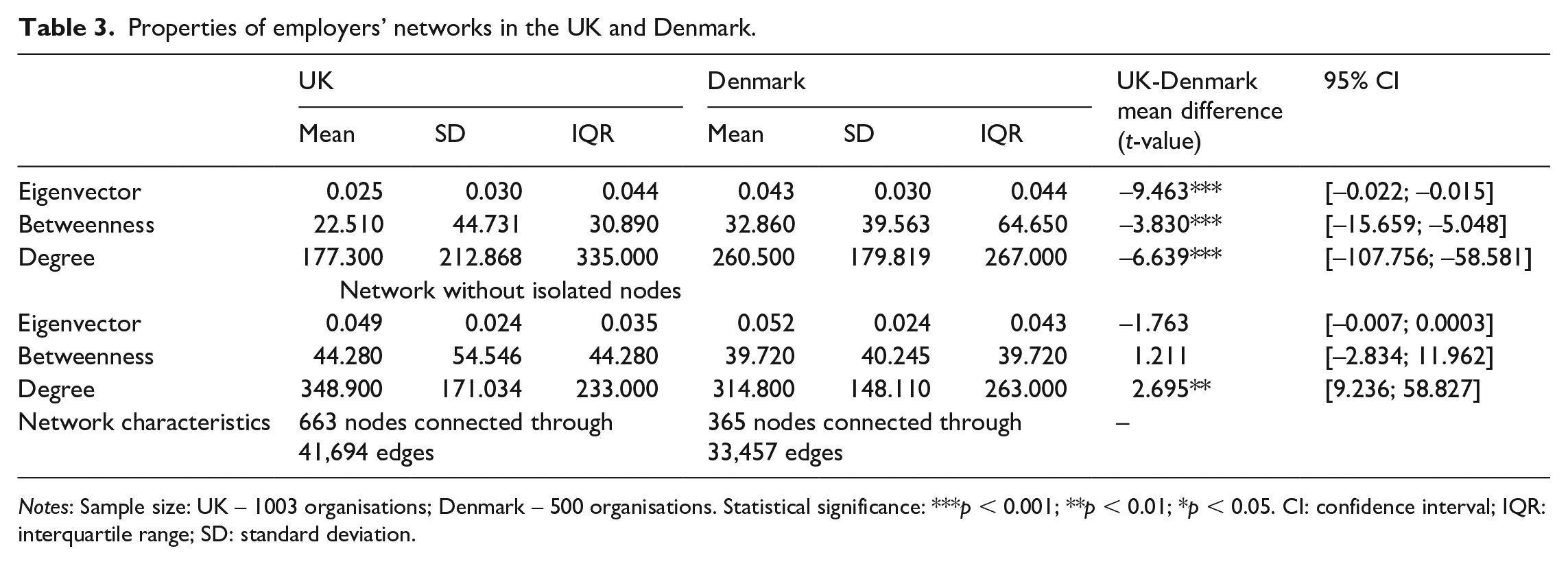
Notes: Sample size: UK – 1003 organisations; Denmark – 500 organisations. Statistical significance: ***p < 0.001; **p < 0.01; *p < 0.05. CI: confidence interval; IQR: interquartile range; SD: standard deviation.
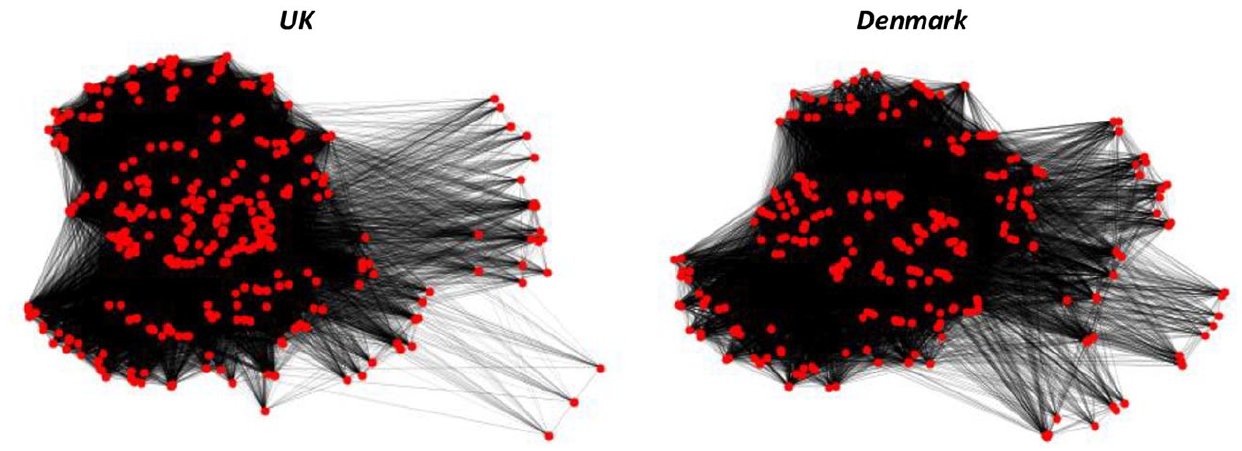
Employers’ social networks.
Turning to employer participation in ALMPs, Danish employers were more likely to participate in funded programmes (49.7% against 16.4% in the UK) and specialist schemes targeted to specific groups, such as disabled people (29.8% in Denmark and 12.9% in the UK). Employer take-up of work placements was fractionally higher in the UK. The wide gap between work placements and other types of programmes suggests that UK employers were not willing to commit to a long-term employment relationship with participants. The unemployed in Denmark were much more likely to secure employment than their UK counterparts. By virtue of taking part in funded programmes, Danish employers signal their intention to recruit the unemployed. This shows a key distinction between the two countries that can in part be explained, as we know from prior research, by higher levels of trust in ALMPs in Denmark (Fernandez-Urbano and Orton, 2021). However, these descriptive statistics do not show whether such a stark contrast remains if we look at employers deeply embedded in wider social networks. Regression analysis, to which we turn below, sheds light on this question and on the mediating effect of employee collective voice.
Regression estimates
Table 4 reports regression estimates for all direct effects in our model: the effect of employers’ networks on employer participation in ALMPs (
Regression estimates for direct effects.
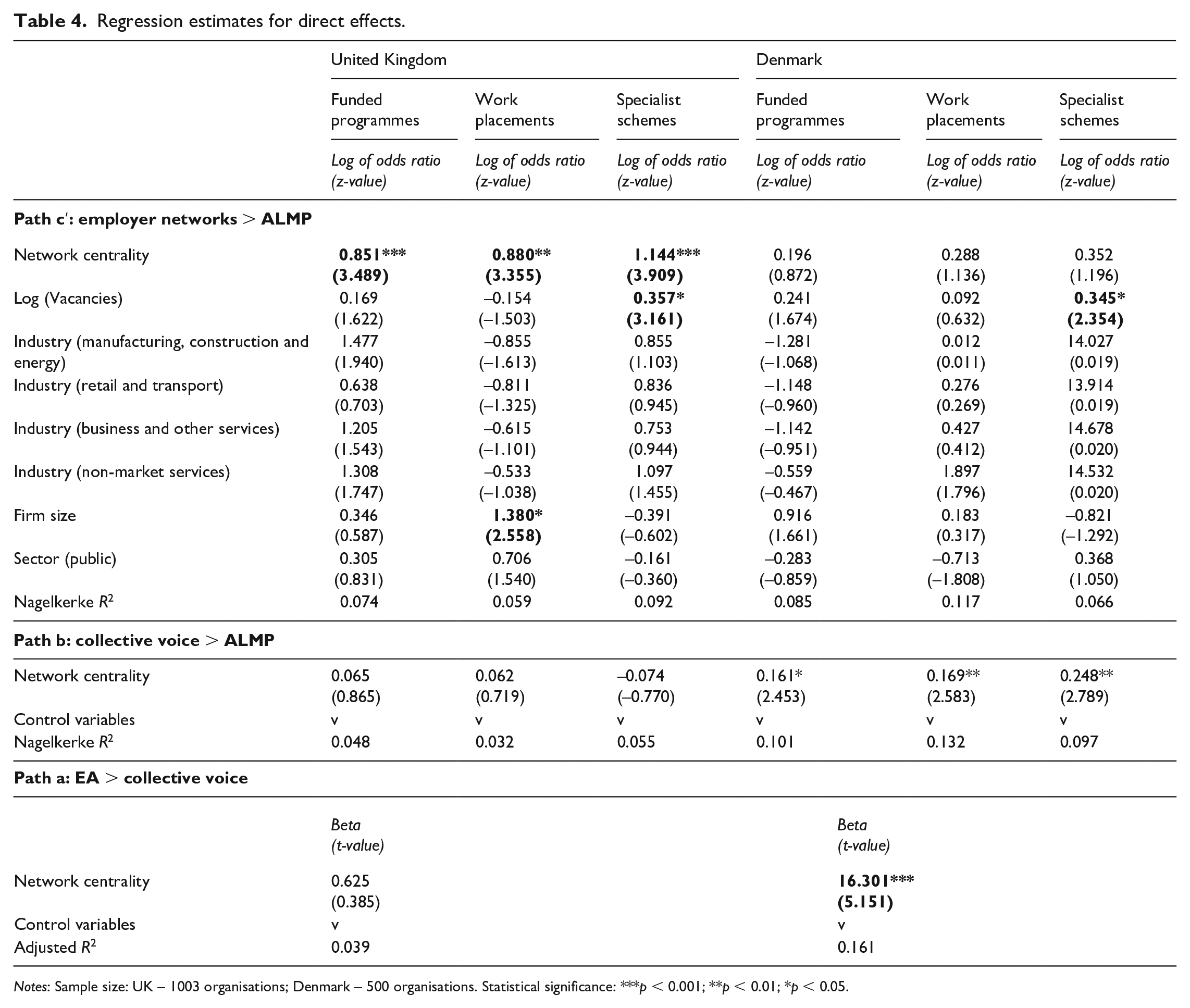
Notes: Sample size: UK – 1003 organisations; Denmark – 500 organisations. Statistical significance: ***p < 0.001; **p < 0.01; *p < 0.05.
Table 5 contains estimates for the indirect effects of employers’ network centrality on participation in ALMPs through collective bargaining in Denmark with the corresponding 95% confidence intervals (
Regression estimates for indirect effects (EA > collective voice > ALMP, Denmark).
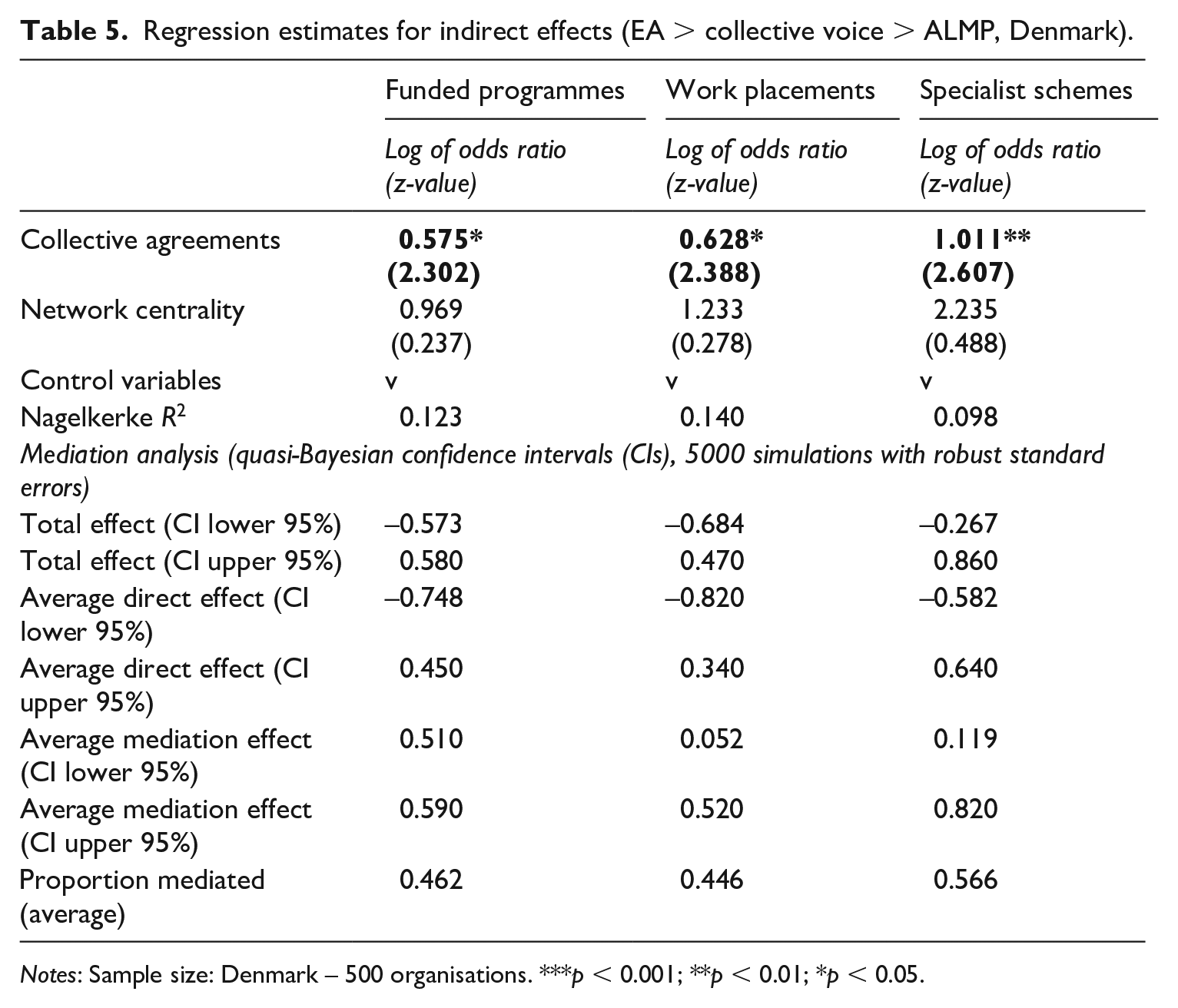
Notes: Sample size: Denmark – 500 organisations. ***p < 0.001; **p < 0.01; *p < 0.05.
Sensitivity analysis
The cross-sectional nature of our data precluded robust causal inference and raised the issue of omitted variable bias. We conducted sensitivity analysis to increase confidence in the empirical results reported in this study. Specifically, we tested a sequential ignorability assumption, a key assumption of mediation analysis (see Imai et al., 2010). We simulated possible values of a mediator, corresponding values of an outcome variable and the mediation effect at different p-values. The purpose of this exercise was to estimate the potential confounding effect of an omitted variable that can cancel out the effect of an observed mediator. Our estimates suggest that such an omitted variable would have to explain more than 50% of variation in an outcome variable and in the mediator to render our mediation model insignificant. Further to that, we replicated the regression analysis with alternative measures of network centrality and analysed the data separately for individual and collective membership of employer associations, also distinguishing between large and small and medium enterprises. These manipulations had no material consequences for the hypothesised direct and indirect effects.
Discussion and conclusions
Drawing on a comparative analysis of Denmark and the UK, this article has shown that employers’ social networks and employee collective voice are important factors of employer participation in ALMPs. While the UK and Denmark have been at the forefront of the design and implementation of ALMPs, the principle that the unemployed need to be ‘activated’ back into work has become the sine qua non of public policy across the developed world (Wang et al., 2020). Employer engagement is seen as central to the effectiveness of ALMPs (Ingold and Valizade, 2017), yet we still know relatively little about what drives employers’ participation in such initiatives. In order to explore this issue, we developed a novel model that examined the hypothesised direct and indirect relationships between employers’ membership of social networks through employer association (EAs) and their participation in ALMPs, mediated by collective bargaining.
Our theoretical approach contrasts with prevailing accounts in two important respects. First, prior research by Martin and Swank (2004, 2012) emphasised membership of national EAs in explaining differences in employer participation in ALMPs in Denmark and the UK. In contrast, our focus was less on membership of EAs per se, but on the social networks that memberships of EAs, and other professional associations, can confer on employers. This is an important distinction, as it shifts attention towards employers’ actions and behaviours fostered by their social networks. The theoretical assumption is, therefore, that employers’ propensity to participate in ALMPs is predicated upon the strength of their socio-economic ties (i.e. network centrality).
Second, we developed this point to show that employers’ deeper involvement in ALMPs – notably where they participate in funded programmes that provide sustainable employment – can be enabled by employee collective voice. Our analysis shows that in Denmark, where employers’ networks are still embedded in collective bargaining, collective voice was a predictor of employer participation in ALMPs. Cohesive, centralised social networks of employers were a pivotal factor facilitating collective bargaining, which, in turn, increased the likelihood of employer participation in ALMPs. In the UK, where collective bargaining is fragmented and collective voice has been undermined over the past decades, employers’ social networks were the main predictor of employer participation.
Our central empirical finding that collective bargaining transmitted the effect from employers’ network ties to their participation in ALMPs only in Denmark, but not in the UK, advances important debates on the role of social embeddedness in labour markets. While previous research typically prioritises the impact of inter-personal ties (Villesèche and Sinani, 2021), our study demonstrates the importance of a more integrated analysis of the interactions between network ties and institutions (Nee and Ingram, 1998). Our analysis offers a deeper sociological appreciation of the impact that employers’ (social network) embeddedness in wider institutional arrangements of collective voice may have for employer participation in social and public policy instruments. This approach enabled us to advance theoretical and practical understanding of a crucial regularity, whereby employers’ take-up of ALMPs is predicated on their trust in such policy instruments (Fernandez-Urbano and Orton, 2021). We demonstrate that, in the UK, employers were more likely to participate in ALMPs if they were more deeply embedded within wider social networks, which allowed for a higher chance of receiving information on ALMPs from direct ties (Liechti, 2020). In Denmark, trust in ALMPs was transmitted more widely through a network of employer associations and trade unions and the normative expectations this creates for more progressive employment policies and employment relations. This also explains why Danish employers were more likely than their British counterparts to commit to ALMPs that subsidised and guaranteed jobs to the unemployed, while UK firms opted for short-term work placements.
Overall, this article presents a compelling case for a wider use of social embeddedness theory in comparative employment relations and social policy research. The argument advanced serves as a corrective to existing empirical studies of employer participation in ALMPs and contributes to a growing broader interest in the demand-side (Fernandez-Urbano and Orton 2021; Liechti, 2020), and to analyses of contemporary EAs (Barry and Wilkinson, 2011; Gooberman et al., 2018). In relation to ALMPs in Denmark, we emphasise the changing (but still important) context of collective voice within the Ghent model of insurance, social partnership and dialogue. In the UK, the analysis draws attention to the potential for both policy-makers and organisations delivering ALMPs to make central to them strategies that deepen social networks and employer embeddedness to counter the absence of strong collective voice mechanisms.
As the economic crisis spurred on by the COVID-19 pandemic takes hold, causing job losses at a scale not seen since the Great Recession of 2007/2008, ALMPs will become critical social policy instruments designed to prevent long-term economic depression. Critical to their deployment will be the extent to which employers can be engaged to participate in such schemes and provide much needed jobs to those out of work. The knowledge that employers’ networks and collective voice are potentially significant factors determining the success of ALMPs can help national policy-makers adjust them to a rapidly unravelling situation in the labour market and inform their delivery.
Footnotes
Funding
The authors disclosed receipt of the following financial support for the research, authorship, and/or publication of this article: This work was supported by the Economic and Social Research Council Grant Number ES/K008617/1. Datasets can be accessed from the UK Data Service (10.5255/UKDA-SN-853205).
