



Abstract
This article conceptualises refugees’ endeavours for upward social mobility through subentrepreneurship. Subentrepreneurship refers to various self-employment forms that are undeclared to relevant authorities to escape superimposed historical, temporal, spatial, institutional and social contexts, which constrain actors’ entrepreneurial activities. Using a mixed theoretical underpinning combining Mixed Embeddedness (ME) with Weber’s Iron Cage of Rationality (ICR), we signify liquidity of refugee subentrepreneurship, which is neither linear nor long-term rational. A liquid cage is envisaged to allow more freedom as refugees become embedded within intersections between transformative journeys and Constrained Institutional Contexts (CICs). This new theorising signifies a pronounced emphasis on agency whereby refugees cleverly contemplate implicit skills (i.e. unrecognised or downgraded skills), opportunities and processes to escape CICs. The article adds clarity as to how contexts become part of the production of entrepreneurial actions through two-way interactions that promote liquidity, enabling a strong foundation for future research exploring subentrepreneurship.
Keywords
Introduction
This article conceptualises the endeavours of refugees to gain upward social mobility through subentrepreneurship, which is defined as different forms of self-employment that are undeclared to, or hidden from, relevant authorities (hence the prefix ‘sub’), whereby superimposed institutions that constrain entrepreneurial activities are escaped to gain upward social mobility. The constraining exogenous institutions that refugees find themselves bounded within, henceforth referred to as Constrained Institutional Contexts (CICs), comprise ‘the humanly devised constraints that structure human interaction. They are made up of formal constraints (rules, laws, constitutions), informal constraints (norms of behaviour, conventions and self-imposed codes of conduct) and their enforcement characteristics’ (North, 1994: 360). These CICs have promoted more interest in the largely overlooked phenomenon of constrained entrepreneurship (McElwee et al., 2018), whereby actors’ entrepreneurial actions are significantly constricted by superimposed external institutions.
While we recognise the potential value of entrepreneurship in enhancing refugees’ integration (Crawley et al., 2018), socio-economic engagement (Bizri, 2018), economic impact (e.g. Gold, 1992) and social innovation (Jones et al., 2019) in their host country, we stress that CICs can restrict refugees’ employment/self-employment. Such constraints include, for example, policy, language and financial barriers (Refai et al., 2021), structural discrimination, high-entry costs and under-capitalisation (Crawley et al., 2018; Jones et al., 2014), as well as skills and knowledge gaps (Vinokurov et al., 2017). Edwards et al. (2016) conclude that CICs can promote informal business practices, which are evident in more than half of the ethnic minority businesses in low-level sectors in the UK. Such businesses are undeclared, and typically use cash payments and unpaid helpers despite otherwise operating legally. Informal business practices in minority contexts can add social value by promoting inclusion, employment and integration across the community of minorities (Jones et al., 2019). However, such activities are likely to become a source of growing ethical concerns as the number of people engaging in them increases due to issues around tax avoidance and reduced contribution to national services, which offer social benefits to everyone (Williams and Kayaoglu, 2020). This is relevant to subentrepreneurship, which involves evading ‘tax and social security contributions and/or labour laws’ in order to escape CICs (Williams and Kayaoglu, 2020: 915). Subentrepreneurship can, thus, result in different informal and sometimes illegal forms of entrepreneurship, which can occur in any sector or anywhere within a product or service’s supply chain, particularly within constrained contexts (McElwee et al., 2017), where examples can range from cash payments, paying bribes or avoiding taxes to trading in drugs, money laundering or human trafficking (McElwee et al., 2017).
While our conceptualisation of subentrepreneurship can add clarity to these various forms of undeclared entrepreneurial activities, it is important to point out that there is hardly any evidence of extreme illegal or criminal entrepreneurial engagements in the refugee context, where subentrepreneurship is more likely to be seen as a means of survival (Refai et al., 2018), and can involve socially legitimate activities (Williams and Kayaoglu, 2020). CICs have attracted growing attention in the wider literature exploring the labour markets of migrants, ethnic minorities and refugees. For example, Ahmad (2008) explores human smuggling consequences in London’s illegal economy among constraints facing smuggled migrants. Bloch and McKay (2015) investigate employers’ perspectives around undocumented migrants’ employment within increasingly punitive legislations. Toğral Koca (2016: 73) highlights how scrutinising legislations to control Syrian refugees in Turkey ‘mask structural and political problems such as racism, exploitation, discrimination, and inequalities’, thus emphasising the framing of refugees as ‘threat’ factors to the labour market, while Keles et al. (2019) explore ‘unauthorised’ Kurdish migrants, highlighting ‘stretched’ solidarity to support access to labour markets against in-border migration enforcement threats in the UK.
It is thus important to conceptualise refugee subentrepreneurship if understanding is to be taken forward. This focus is timely in light of the high influxes of refugees into the EU and UK independently or through refugee resettlement programmes, particularly following the Arab uprising between 2011 and 2016, 1 where such influxes are likely to lead to more concerns around subentrepreneurship by interested commentators. Consequently, more calls for supporting refugees’ integration through employment and self-employment are noted (Crawley et al., 2018; Refai et al., 2021), and several government-funded entrepreneurship resettlement programmes have been launched in the UK to promote formal entrepreneurial engagements (Home Office, 2019a; Richey et al., 2021). Our conceptualisation is not to suggest that refugees will purposefully target subentrepreneurship, nor to propose it as the primary way for refugees’ upward social mobility. Rather, we add clarity as to how CICs can push refugees into subentrepreneurship. This theorising can further support recent UK government-funded entrepreneurship resettlement programmes in understanding and consequently overcoming the challenges facing refugees, in order to achieve these programmes’ aims of enhancing refugees’ social responsibility, integration and awareness around contributions to national life through formal entrepreneurship (Home Office, 2019a; Richey et al., 2021).
The article applies the term refugee to refer to both asylum seekers and refugees, where the former are those pending decisions as to their eligibility to qualify for the status of refugee. We focus, in particular, on refugees who arrive in host countries with a high level of ‘implicit’ skills. ‘Implicit skills’ refer to skills stemming from special expertise and knowledge (Fong et al., 2008; Kirk, 2004; Wauters and Lambrecht, 2006), which are often downgraded or not formally recognised in the new context (Vinokurov et al., 2017), but yet with potential to be employed in entrepreneurial endeavours. Examples can include professional qualifications, work experience and expertise, and personal skills that are not formally recognised in the host country, or downgraded particularly in light of language and discrimination barriers that can worsen the skill and knowledge gaps (Crawley et al., 2018). Those skills can often be depicted as the only, or at least main, form of capital that refugees have since, unlike migrants, refugees escape war and terror to find home and shelter in new countries, where they are often not familiar with the CICs, nor well established or networked due to their unpredicted and unplanned journeys (Crawley et al., 2018).
In order to support advancing knowledge of refugee entrepreneurship through focusing on subentrepreneurship, we avoid an approach that focuses on placing this phenomenon at the ‘meso-level’ (Ram et al., 2017b) as such an approach will render refugee entrepreneurship mainly as an outcome of group-based attributes and features, while avoiding other dynamic contextual interactions (Romero and Valdez, 2016). We thus build on Mixed Embeddedness (ME) (Jones et al., 2019; Kloosterman, 2010; Kloosterman and Rath, 2001; Kloosterman et al., 1999; Ram et al., 2017b) that acknowledges intersectionality of entrepreneurial activity with changes in socio-cultural frameworks by taking a broader view that considers an entrepreneur’s social location (Villares-Varela et al., 2018). This social location reflects the many intersections of experience with ethnicity, gender, class, religion, disability and so on (Ram et al., 2017b), thus shifting from a narrow focus on a single intersection to recognise wider economic and institutional contexts. This location affects entrepreneurs’ understanding of how institutions work, their ability to access these institutions and the diverse entrepreneurial outcomes that could result (Villares-Varela et al., 2018). Refugee subentrepreneurship is explored in this article through the intersections between refugees’ transformative journeys (Crawley et al., 2018) with contexts that are characterised by increased constraints, including ‘historical, temporal, spatial, institutional and social contexts’ within which refugees are embedded, thus showing how those contexts ‘both provide opportunities and set the boundaries for entrepreneurship’ (Welter, 2011: 165).
Embeddedness views have been valuable in entrepreneurship research in various contexts (Rath, 2000), notably in immigrant and ethnic minority entrepreneurship (Ram et al., 2008), gendered structure dynamics (Roos, 2019), women minority entrepreneurship (Carter et al., 2015) and rural entrepreneurship (Korsgaard et al., 2015). Yet, refugee entrepreneurship remains a context with relatively little attention (e.g. Bizri, 2018; Gold, 1992; Refai et al., 2018; Wauters and Lambrecht, 2006, 2008), and less so through the embeddedness lens. Furthermore, ME has not been widely applied in exploring informal/illegal entrepreneurship; some exceptions include Kloosterman et al. (1999) and Ram et al. (2017a).
By focusing on refugees with confined capital in the form of implicit skills, we draw attention towards the limited ME literature that accounts for the individual dynamics of refugee entrepreneurs at the micro-level. To overcome this limitation, we combine ME with Max Weber’s (1978[1922]) metaphor of the ‘Iron Cage of Rationality’ (ICR) that presents long-standing views of how individuals act to develop authoritative bodies and maintain them through a legitimation process within an ICR, which we liken to CICs. The ICR views individuals to be bound by rationality within organisational structures that define formal systems, and lock individuals in a system of controls within an ‘iron cage’ of subjugation and restraint, similar to Calvinists who are guided by asceticism and abstinence (Weber, 1978[1922]).
Weber’s contributions are well applied in the sociology of work and religion and in organisational studies (e.g. Clegg and Baumeler, 2010), but hardly so in the work of entrepreneurship. Cultivation of contingencies in entrepreneurship will, arguably, demand more liquidity that cannot be achieved within a constrained ICR; this liquidity is often interpreted as a steady movement of change, but is actually never ubiquitous or linear (Clegg and Baumeler, 2010). The adaptability of an ICR has thus been called for in organisational studies (e.g. Clegg and Baumeler, 2010). For example, Clegg and Baumeler (2010) propose a liquid cage to explore the modern organisational self that adapts to the needs of others whom one needs to develop ‘swift trust’ with. Gabriel (2005) provides a metaphor of a glass cage, where customers become sovereign through observing and impacting organisations’ ideologies and political order. A velvet cage is also interpreted to enable fulfilment of dreams, or a rubber cage that can be ‘stretched to allow adequate means for escape’ (Ritzer, 1996: 177). In this article, a liquid cage is particularly relevant to the work of subentrepreneurship in the context of refugees who face times of uncertainty and unpredictability through their transformative journeys. Such times demand liquidity as solid institutions can no longer serve as points of reference for human actions (Bauman, 2000). In this regard, Elliott (2009) calls for more attention to the often-overlooked embeddedness of liquidity; a lacuna we overcome by positioning subentrepreneurship as an embedded phenomenon within heterogenous intersections.
Our discussion does not aim to empirically explore different typologies of refugee subentrepreneurship, but rather to conceptualise subentrepreneurship to add clarity on how it emerges under CICs. Simply put, our main question is: Can a combined approach of ME with ICR support conceptualising refugees’ upward social mobility through subentrepreneurship? Through this combined theoretical underpinning, the article contributes to literature on constrained entrepreneurship. A liquid cage is envisaged as refugee entrepreneurs find themselves trapped in life-changing situations, constrained by an institutional cage within which they are incarcerated. A gap arises between refugee entrepreneurs’ need for upward social mobility, which demands liquidity, and CICs that restrain entrepreneurship. A liquid cage signifies the role of agency, prompted primarily by implicit skills. The pronounced emphasis on agency in this article contributes to calls by Alvi et al. (2019) around the need to explore the strong relationships between entrepreneurship and agency. Agency becomes an enabler to access more freedom and flexibility outside CICs through subentrepreneurship by means of two-way interactions that allow refugees to cleverly contemplate implicit skills, opportunities and processes to gain upward social mobility, while simultaneously transforming social structures by reshaping their ICR to become more liquid. The role of agency in reshaping contexts stresses liquidity in subentrepreneurship, which cannot be observed in linear or long-term rational ways considering the heterogenous intersections within CICs, thus emphasising contexts as part of the production of entrepreneurial actions – enabling or constraining them (McMullen et al., 2020). The article’s contributions are re-visited in detail in our conclusion.
The remainder of the article is structured as follows. First, we present refugee subentrepreneurship as an embedded phenomenon. Second, we explore Weber’s ICR, then relate it to views on ME to add clarity to our re-interpretation of this solid cage. A discussion follows to conceptualise subentrepreneurship by envisaging a liquid cage that signifies the role of agency in transforming social structures. We finally conclude by revisiting the main question and highlighting the novelty and contribution of this article.
Embeddedness of refugee subentrepreneurship
We position refugee subentrepreneurship as an embedded phenomenon that continuously unfolds over time through transformative stages (Crawley et al., 2018) that involve ongoing interactions and organisational activities within contexts (Ram et al., 2017b). Subentrepreneurship is specifically positioned through the intersections between CICs and refugee entrepreneurs’ transformative journeys. This view enables uncovering the dynamic interplays at the levels of ‘macro’ institutional constraints, ‘meso’ market factors and ‘micro’ individual resources, which all become relevant to understanding refugees’ entrepreneurial behaviour, and inevitably influence their upward social mobility (Kloosterman et al., 1999). We relate the macro level to CICs, which – in line with North (1994) – help us distinguish between formal institutions that influence economic outcomes, and informal institutions emerging from culture, social norms or peer influences that influence perceptions of legitimacy, but are not necessarily always legal (Webb et al., 2009). ‘Meso’ market factors are relevant to the social context and networks that shape entrepreneurship (Kloosterman, 2010). Finally, ‘micro’ individual resources relate to refugees’ implicit skills.
This multi-layered perspective on entrepreneurship emerges from ME views (Jones et al., 2019; Kloosterman, 2010; Kloosterman and Rath, 2001; Kloosterman et al., 1999; Ram et al., 2017b) that entrepreneurs are grounded socially and economically in a mix of personal resources, yet similarly grounded in wider structural organisational and national contexts, including markets, competition and legal systems. Kloosterman’s (2010) opportunity structures offer a typology based on migrant entrepreneurs’ human capital versus market sectors’ growth potential. Human capital is viewed in terms of specific knowledge and skills, proposing that opportunities are accessible to aspiring entrepreneurs without the need for much financial capital. Here, more (formal) human capital gives access to high-value market sectors, while low human capital restricts this accessibility. The latter usually results in migrant entrepreneurs accessing low profitability or low-entry barrier sectors.
Kloosterman’s (2010) opportunity structures for migrant entrepreneurs are relevant to refugee entrepreneurs who encounter skill and knowledge gaps (Vinokurov et al., 2017), which render them likely to operate in stagnating markets with low growth or low-entry barriers (Kloosterman, 2010). Similarly, some will choose not to operate in stagnating markets, or any markets at all. In fact, studies on refugees in Uganda (Werker, 2007) and Belgium (Wauters and Lambrecht, 2008) show that refugees present with low engagement rates through employment and self-employment. Nevertheless, it is necessary to highlight that those low rates of entrepreneurial engagement must be carefully interpreted considering that they mainly represent rates of engagement in formal (or legal) entrepreneurship (Kloosterman et al., 1999). It is very likely that these rates will be much higher if subentrepreneurship rates are considered, but this is rather difficult to quantify as there are obviously difficulties in obtaining this information. Kloosterman et al. (1998) develop this theme by suggesting that markets characterised by high competition and low growth combined with low-skilled labour are likely to promote informal economic strategies. Agnew’s (1992) Strain Theory concurs with this and stresses that high levels of strain, which involve blocking individuals from social mobility by institutional and social structures, can drive individuals to react in illegal or criminal ways. This stresses our argument that subentrepreneurship is likely to become an option to refugees with high implicit skills, within CICs.
The focus on refugees’ implicit skills becomes more relevant considering the wealth of skills they have. A study of refugees in the US by Fong et al. (2008) notes their high levels of autonomy, leadership, innovation, proactiveness and future outlook through identifying resources and overcoming barriers. Many of these refugees originate from countries with high self-employment rates, suggesting that many have already been self-employed (Kirk, 2004; Refai et al., 2021). Similarly, Wauters and Lambrecht (2006) highlight the wealth of skills and knowledge of refugees in Belgium, which can promote their economic contributions.
Next, we add more depth to our discussion on embeddedness through exploring intersections between refugees’ transformative journeys and CICs.
The transformative journeys of refugees
Refugee entrepreneurship is often mistakenly viewed as a linear and quick process that is concerned with economic growth, largely overlooking the ‘in-between’ phases of refugees’ transformative journeys (Crawley et al., 2018). Throughout these journeys, refugees encounter barriers that add to the constrained nature of their context and the difficulty of building capital, finding employment/self-employment and planning for the future. Examples can be drawn from ‘red tape’ government restrictions, including education (Jungblut et al., 2020) and housing restrictions (Coddington, 2019). Barriers to employment/self-employment become more relevant considering refugees’ lack of geographical stability imposed by strict border controls, and EU policies that focus on ‘countries of first arrival’ as ‘transit’ stations with an obsession to ‘keep refugees out’, thus directing political and economic resources towards maximising border controls, rather than offering financial and other support (Crawley et al., 2018).
These state regulations are critical determinants of variations in entrepreneurial activity (Kloosterman and Rath, 2001), and ethnic minorities are generally more vulnerable to this ‘politico-institutional element’ (Ram et al., 2008), particularly considering the constrained European regimes that restrict immigrants’ legal self-employment (Rath, 2000). For example, work permits are not normally granted in the UK during the asylum phase, but might be considered in cases of outstanding applications of more than 12 months. If granted, permits are restricted to shortage occupation jobs by the Home Office, and will come to an end if asylum applications are refused (Home Office, 2019b).
Going through multiple geographic locations that are governed by different institutions will influence refugee entrepreneurship, particularly as refugees cannot know the duration of time they will spend in a location, nor where the next station will be (Crawley et al., 2018). This can worsen their low capital further; Cortes (2004) demonstrates that implicit differences in time horizons between refugee and non-refugee groups impact on their human capital investments and wage adjustments in the labour market.
The highlighted constraints bring about the relevance of intersections with spatial and temporal contexts to refugee subentrepreneurship. Temporal contexts relate to time and the sequence of events, while spatial contexts comprise the geographical locus of entrepreneurial endeavour including global, national, regional and local distribution (Welter, 2011), as well as the policies and social norms in a location (Autio et al., 2014). These intersections can be made clearer by considering the journeys of other groups of entrepreneurs, whom despite presenting with some different characteristics, can share several contextual experiences with refugee entrepreneurs. For example, the entrepreneurial activities of Polish migrants in the UK are shown to be ‘time-bounded’, thus highlighting the relevance of historical contexts to ethnic entrepreneurship (Vershinina et al., 2011). Ethnic entrepreneurs can also share language barriers (Wauters and Lambrecht, 2008), discrimination (Jones et al., 2014), and skills and knowledge gaps (Vinokurov et al., 2017) with refugees. The experiences of necessity of entrepreneurs acting in precarity ‘can shed new light on how organisation-creation activities become necessary to navigate conditions of crisis and austerity and develop “liminal” entrepreneuring’ (Garcia-Lorenzo et al., 2018: 374). Those experiences become relevant to the financial struggles of refugees in crisis, which can influence their entrepreneurial identities and embodied dispositions of survivability that influence both their ability and approach to entrepreneurship (Refai et al., 2018).
Heterogeneous intersections during transformative journeys within CICs draw interesting links with the under-explored notions of over-, and under-, embeddedness (Wigren-Kristofersen et al., 2019). While over-embeddedness is noted in being embedded within strictly CICs, there is also under-embeddedness as experienced by refugees through their journeys to new host countries (Evansluong et al., 2019). The transformative nature of refugees’ journeys can often drive them to co-create and reshape CICs, where their precarious conditions push them ‘to find “structure” by themselves, since the institutions they used to rely on find it difficult to provide one for them’ (Garcia-Lorenzo et al., 2018: 377). As such, we agree that contexts shape new entrepreneurial outcomes and identities (Johannisson, 2010), where subentrepreneurship becomes one possible outcome. Next, we explore this reshaping of CICs in more depth in relation to Weber’s ICR.
Weber’s ‘Iron Cage’ of Rationality
Weber’s ICR, described in his work Economy and Society (1978[1922]), is a metaphor to explain the interpretive understanding of social action (here, refugee subentrepreneurship), as it relates to authority. Weber views social actions as either rational or non-rational. Non-rational action relates to ‘traditional’ (i.e. legitimised by long-standing customs, as in patrimony for example) or ‘charismatic’ (i.e. based on personal qualities, thus temporary and unstable, as in military leaders for example) authorities. Rational action determines an individual’s ability to orient actions on the basis of value through ‘rational-legal’ authority (Kalberg, 1980: 1148), whereby individuals legitimise their actions through rationally established rules and procedures, making authority a particular of the office not the person.
According to Weber, increased bureaucracy with strict institutions results in increased formal rationality, leading people to live in an ‘iron cage’ with strict controls and minimal freedom (Haferkamp, 1987). He views this as the ‘inescapable’ fate of his century, where bureaucratic organisations force people into helpless submission motivated by the wish for survival and a better standard of living (Weber, 1958 in Haferkamp, 1987: 41). With this increased formal rationality, grows an orientation towards power through ‘administration and provision’, which Weber saw as the ‘foremost and only values people have’ (Haferkamp, 1987: 32). In subentrepreneurship, this power is observed through upward social mobility, which increases as entrepreneurs gain freedom, networks and access to potentially high growth markets (Kloosterman, 2010).
Adler (2012) and Clegg and Baumeler (2010) add clarity to Weber’s views on administration and power, as illustrated in Figure 1, by directing attention towards Weber’s ‘thought of bureaucracy as a Janus-faced organisation, looking two ways at once. On the one side, it was administration based on expertise; while on the other, it was administration based on discipline’ (Gouldner, 1954: 22). Janus-faced views align with Weber’s types of authority: administration based on expertise points to high interest in rational views of bureaucracy based on expertise and instrumental qualities, where the focus is on formal procedures as opposed to personal qualities, rendering ‘rational-legal’ authority more relevant. Administration based on discipline, however, points to the disciplinary side of bureaucracy, where the focus becomes on domination of some individuals over others through personal qualities (Adler, 2012), rendering authority in this case ‘charismatic’.
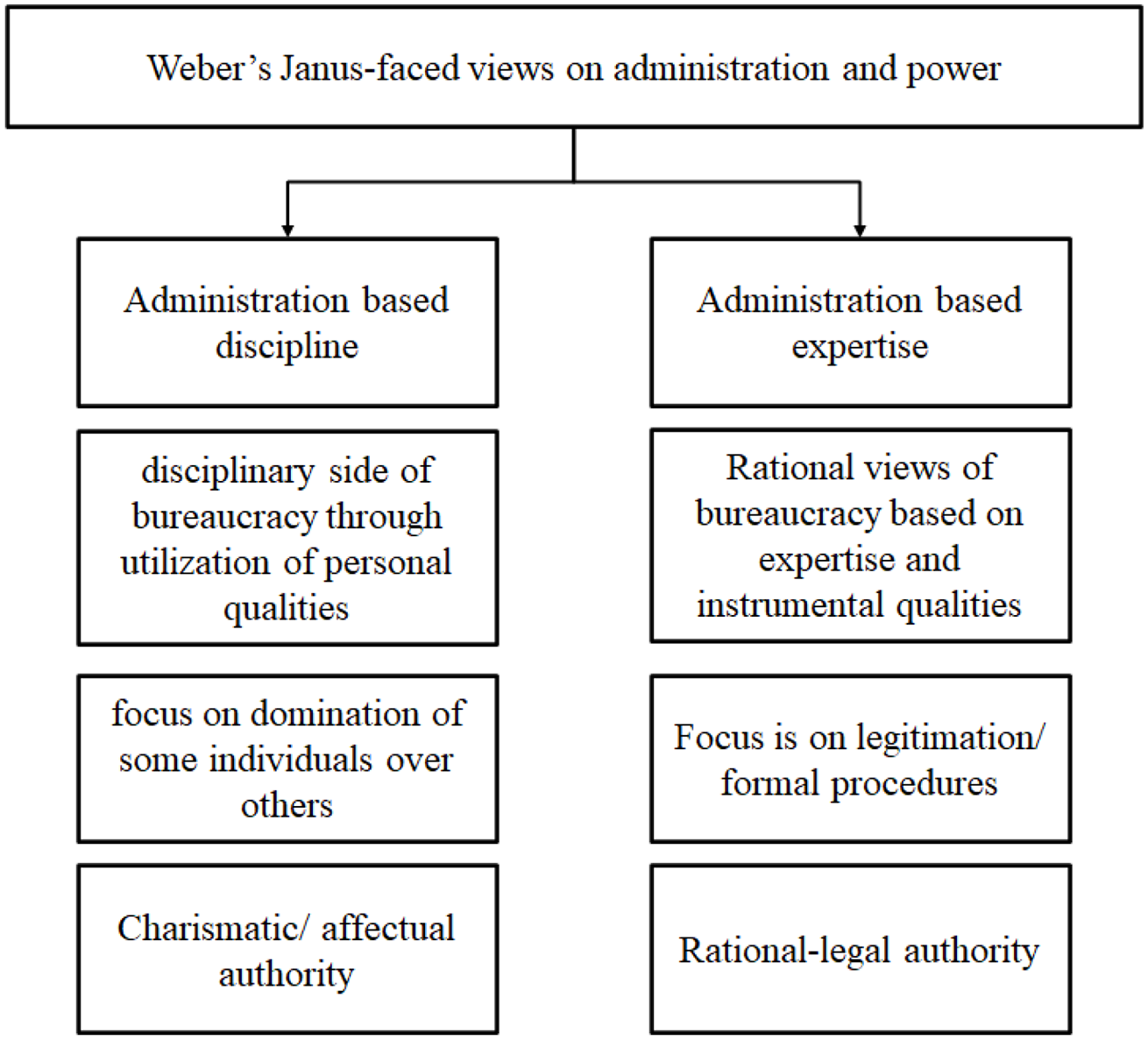
Weber’s Janus-faced views on administration and power.
Administration based on discipline can lead to deviation from legitimation. In fact, it has been common throughout history for administration based on discipline to emerge temporarily in times of crisis (here, refugee crisis). This aligns with Tocqueville (2000[1835/1840]), writing almost a century before Weber, and Haferkamp (1987), who view deviation from legitimation, including criminality and illegal actions, as normal consequences of growing individualism that increases actors’ feelings of power leading sometimes to undesired social actions when people fail to meet their aspirations. Criminality is seen as an outcome of economic inequalities, whereby people seek to escape constraining formal structures and political systems (Council of Europe, 1986). When deviation from legitimation happens, actors escape strict institutions and act more freely. Here, the ICR, which Weber conceptualised to inescapably create prosperous communities, through strict controls and minimal freedom, will require re-interpretation to support understanding and recognition of subentrepreneurship as a social phenomenon. We therefore concur with Clegg and Baumeler’s (2010) metaphor of a liquid cage, which we explore next.
Utilising ME with ICR to inform refugee subentrepreneurship – The emergence of a liquid cage
The heterogenous intersections in refugees’ transformative journeys are likely to render the capital they build during these journeys transitory, inevitably rendering their entrepreneurial paths temporary, rather than long-term rational. These intersections may create many constraints that can disrupt refugees’ entrepreneurial identities (Refai et al., 2018) and sense of self and place (Beech, 2011), leading to a process of identity and contextual reconstruction to find a more meaningful social position (Beech, 2011), where subentrepreneurship becomes a possible outcome.
We envisage the emergence of a liquid cage, which can support our conceptualisation of refugee subentrepreneurship through its inherent characteristics that make ‘the subject slippery, but still visible beneath the surface’ (Clegg and Baumeler, 2010: 1715). On the one hand, a ‘slippery’ cage entails supporting refugees in eluding CICs within spaces of contextual fluidity in the porous and viscous structure that ‘coats and smears’ them (Clegg and Baumeler, 2010: 1715), thus helping refugees avoid the risk of having their subentrepreneurial actions exposed. On the other hand, this cage also offers the flexibility of remaining ‘visible beneath the surface’, which means visible to the relevant authority that lies on the other side of the cage by moving freely in and out of the pores within the viscous structure, thus allowing refugees to maintain their legal status as formally registered refugees. Understandably, refugee entrepreneurs would not want their subentrepreneurial actions exposed, neither would they want to completely hide away from the system as either option would involve the potential risk of being deported from the host country, and/or losing the financial and immigration benefits available to them through formal institutions (e.g. Home Office, 2016). Obviously, an ICR cannot support such movement as it ‘frustrates all attempts at escape with its brutish and inflexible force’ (Gabriel, 2008: 314). A glass cage would also prevent refugees from eluding the system and moving freely as they will always be on view within an inescapable structure that is ‘neither porous nor viscous’ (Clegg and Baumeler, 2010: 1715), while a velvet or rubber cage would not offer the flexibility of being visible under the surface, thus rendering a liquid cage more conducive to conceptualisation of subentrepreneurship.
We present our conceptualisation of refugee subentrepreneurship in Figure 2. We relate back to Weber’s Janus-faced views presented in Figure 1 and the ME literature to understand how refugee subentrepreneurs transform their social structure to become more liquid. In the first instance, ‘administration based on expertise’ relates to refugee entrepreneurs who prioritise legitimising their presence in host countries by abiding to formal procedures, where formal routes to entrepreneurship can be seen as means to enhance ‘rational-legal’ authority through legitimised socio-economic contributions and encouraging social cohesion (Bizri, 2018), which support their upward social mobility. In the second instance, this rational-legal authority, whereby legitimation is prioritised, cannot explain refugee subentrepreneurship. The freedom that refugees seek through subentrepreneurship would obviously be difficult through ‘administration based on expertise’. Here, the second view of ‘administration based on discipline’ becomes more relevant, where CICs lead refugees to focus on personal qualities – as opposed to formal procedures – to gain upward social mobility (Adler, 2012; Clegg and Baumeler, 2010).
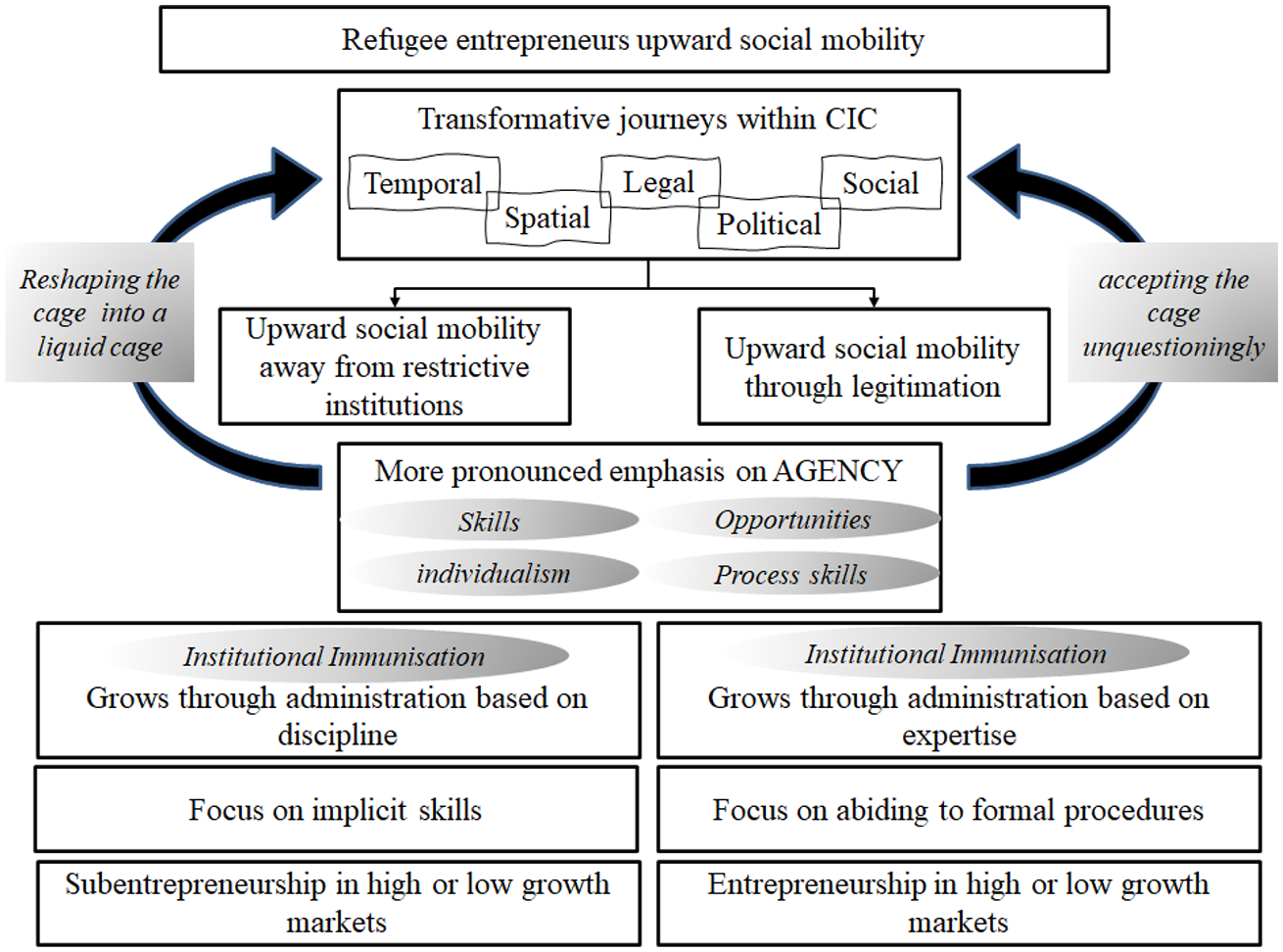
Conceptualisation of refugees’ subentrepreneurship.
Here, it becomes appropriate to highlight how the mixed theoretical underpinning of ME and ICR lends support to recent literature on agency, which highlights ability, motivation, opportunity, process skills and institutional immunisation as important elements of entrepreneurial agency that are required to introduce novelty (McMullen et al., 2020). Yet, a valid question to address here is: How is this agency conducive to the conceptualisation of refugee subentrepreneurship and the emergence of a liquid cage?
Certainly, agency is observed in both entrepreneurial and subentrepreneurial activities. As shown in Figure 2, refugee entrepreneurs’ ability is reflected in the skills and expertise that they have, which in the case of subentrepreneurship are predominantly unrecognised implicit skills, yet very valuable in terms of enhancing bargaining power and access to markets. Through employing their skills and expertise, refugees access more power as they realise a wider range of opportunities and act more freely (Haferkamp, 1987) with greater individualism. Their motivation becomes more pronounced, and they become alert to their own abilities: what they know and who they know in order to build networks, resources and access value, which enable further access to information and resources (Harmeling et al., 2009). Gradually, those refugee entrepreneurs develop more process skills as they employ staff, mobilise capital and learn about market dynamics that enable further exploitation of opportunities, taking action and organising resources to achieve outcomes and access more attractive markets (Johannisson, 2010; Kloosterman, 2010).
The uniqueness of the pronounced emphasis on agency in subentrepreneurship prevails in the way through which the ability, opportunities, motivation and process skills are employed to develop institutional immunisation (McMullen et al., 2020). In subentrepreneurship, institutional immunisation develops primarily through administration based on discipline (here, implicit skills), as opposed to administration based on expertise. In the case of formal entrepreneurial activities, refugee entrepreneurs will gain institutional immunisation by abiding to formal procedures and accepting any level of upward social mobility that comes through legitimation. To those, accepting CICs unquestioningly is agreeable, so they prefer to remain caged in an ICR even if it means that certain groups will enjoy more power than others (Giddens, 1979). In line with ME opportunity structures (Kloosterman, 2010), those could be, on the one hand, refugee entrepreneurs with a high level of formally recognised skills, who might not find the cage very constraining since their formal skills allow them to build networks and operate in high growth markets. This accords with Edwards et al. (2016), who show how the skills of recent waves of migrants give them access to labour markets through employment agencies, and Refai et al. (2021) who distinguish between refugees with professional as opposed to trade skills, highlighting that the earlier are more equipped to fend for themselves through entrepreneurship within constrained contexts. On the other hand, those could also be refugee entrepreneurs with low levels of formally recognised skills, who opt for low growth markets or those with low-entry barriers; for example, Al-Dajani et al. (2015) demonstrate how Palestinian women refugees in Jordan are able to employ craft skills through intermediary organisations to reconstruct their lives, build networks and engage in formal entrepreneurship. Either way, legitimation through rational-legal authority is prioritised in guiding actions.
In the case of subentrepreneurship, however, refugee subentrepreneurs will not find the simple grind of becoming accepted within a rigid cage worth the effort, so it is easier to avoid formal entrepreneurship and act with more individualism within a liquid cage, which facilitates escaping CICs while remaining visible under the surface. Here, power is evident through upward social mobility that grows through administration based on discipline, which we portray through administration based on implicit skills. As Perrow (1986) explains, ‘administration based on discipline’ is not necessarily limited to bureaucratic formality, but rather to implicit, as well as explicit, rules. Implicit rules encompass individuals’ bargaining power, special expertise, knowledge and self-enforcement, which are not always tied to explicit rules. Through administration based on implicit skills, institutions can be made more adaptive to humanity needs (Perrow, 1986) – in this case, refugees’ need for survival and upward social mobility. Institutional immunisation develops in a liquid cage through administration based on implicit skills enabling refugees ‘to escape the docility-enhancing effects of institutions [CICs that limit entrepreneurial actions] enough to attempt structural transformation [emergence of a liquid cage]’ and become ‘immune or somehow inoculated to the effects of institutionalisation [eluding within the viscous porous structure, while remaining visible under the surface]’ (McMullen et al., 2020: 1200).
In a liquid cage, refugee entrepreneurs become less (or non-) grounded in the ‘macro’ CICs that constrain monetary goals, autonomy and upward social mobility, and promote negative emotions that increase their likelihood to react illegally (Agnew, 1992). Their actions will represent a deviation from instrumental long-term rational actions as they become confronted ‘with reality [that] can react back on the thinker’s action and introduce new regularities of action’ (in Kalberg, 1980: 1153). Such new regularities can manifest in the form of transitory subentrepreneurship in a liquid cage, which allows refugees to reshape CICs, since prioritising legitimation cannot guide their upward social mobility. A liquid cage creates a tendency to accept new values that demand an ability to move fast and swiftly, where power becomes measured by ‘the speed with which responsibilities can be escaped. Who accelerates, wins; who stays put, loses’ (Bauman and Tester, 2001: 95).
This conceptualisation of subentrepreneurship is not to say that all refugee entrepreneurs with a high level of implicit skills will engage in subentrepreneurship. Rather, it stresses the role of agency in prioritising administration based on discipline or administration based on expertise, where the earlier becomes the primary driver of agency in subentrepreneurship. It will always be the case that some refugee entrepreneurs will place higher regard on legitimising themselves, even when they have high administration based on discipline (here, implicit skills). In fact, it is common to see administration based on discipline guiding the action of leaders/entrepreneurs in authoritative and formal institutions, alongside their administration based on expertise. Equally so, there will always be the case of refugees who do not have the required agency to engage in any entrepreneurial activity. This view adds clarity to the discussion around complex intersections of entrepreneurs with their contextual factors (Kloosterman et al., 1999). Clearly, agency shapes, and is simultaneously shaped by, CICs in ways that promote refugee entrepreneurs’ ‘power of transformative capacity of agency’, whereby they ‘intervene in worldly events to produce definite outcomes by getting circumstances and others to comply with one’s wants’ (McMullen et al., 2020: 1200). Such wants of refugee subentrepreneurs are linked to their upward social mobility, which will often be transitory in a liquid cage, within CICs.
Conclusion
This article set out to conceptualise refugee subentrepreneurship by considering whether a combined approach of ME with ICR can support conceptualising refugees’ upward social mobility through subentrepreneurship. Our discussion portrays refugee subentrepreneurship embedded within heterogenous intersections between CICs and transformative journeys. The CICs, which we liken to an ICR, do not obviously deter refugee entrepreneurship, but could potentially push refugees into alternative routes, including subentrepreneurship. The ICR here paradoxically encourages the very enterprise it is designed to prevent; it is the iron cage that forces refugees to take up subentrepreneurship, counterintuitively providing both a challenge and a benefit to the established order of things. Unlike Weber’s views of an ICR, from which he thought to inescapably create a prosperous society, this article’s proposition on subentrepreneurship is coterminous with the view that power is measured by the speed and swiftness through which responsibilities can be escaped (Bauman and Tester, 2001), and is not necessarily always limited to bureaucratic formality (Perrow, 1986). Domination and power do not always support the economic welfare of societies (Haferkamp, 1987), rendering the age of ruling through an ICR a concept demanding more liquidity when exploring subentrepreneurship.
The mixed theoretical underpinning in this article addresses calls to highlight the significance of the embeddedness of actions (here, subentrepreneurship) in modern times (Elliot, 2009). On the one hand, ME shows how liquidity in subentrepreneurship is never linear in light of continuous and heterogenous intersections that refugee entrepreneurs experience; signifying the relevance of constrained historical, temporal, spatial, institutional and social contexts, throughout transformative journeys, to refugee subentrepreneurship. On the other hand, Weber’s ICR supports examining disparate notions of the embedded nature of subentrepreneurship, and utilising them to explore the adaptability of Weber’s ICR metaphor (1978[1922]), where agency becomes primarily pronounced through administration based on discipline (here, implicit skills) to enable reshaping the ICR into a liquid cage. The role of agency supports ME in accounting for refugee entrepreneurs’ individual dynamics in opportunity structures (Kloosterman, 2010), particularly in cases of high informal/unrecognised capital. This discussion on agency also confirms the role of entrepreneurship in shaping contexts (e.g. Harmeling et al., 2009; Villares-Varela et al., 2018), and contexts in shaping entrepreneurship (e.g. Welter, 2011).
Through the pronounced emphasis on agency, we add clarity to refugees’ upward social mobility in subentrepreneurship, showing how CICs become part of the production of entrepreneurial actions, enabling or constraining them (McMullen et al., 2020). The way refugees experience and negotiate CICs depends on their social location, which reflects the many intersections they go through (Villares-Varela et al., 2018). Conceptualisation of subentrepreneurship extends this discussion by showing that this social location can be experienced and negotiated differently by different refugees depending on how agency is prompted. This view stresses that ‘entrepreneurial outcomes are created by a two-way interaction in which agency is shaped by structure and vice versa’ (Ram et al., 2008: 440). Unlike refugee entrepreneurs who prioritise legitimation and accept the iron cage unquestioningly, the way refugee subentrepreneurs experience and negotiate intersections will prioritise administration based on discipline, thus prompting agency in ways that enable escaping CICs and acting with more freedom within a liquid cage. This liquid cage provides ‘institutional immunisation’ (McMullen et al., 2020) to serve upward social mobility. The cage itself is then moulded and reshaped, providing a renewal of old established orders. This conceptualisation moves beyond the over-rationalised Weberian views to understand refugees’ constrained entrepreneurship; it shows how cultivation of contingencies in subentrepreneurship will demand more liquidity as it cannot be disengaged from ongoing heterogenous intersections within CICs, nor from entrepreneurs who demonstrate agency in cultivating those contingencies, indicating that some engagements are likely to be subentrepreneurial. Such emphasis on agency contributes to Alvi et al. (2019), stressing that the strong relationship between entrepreneurship and agency should not be simply around entrepreneurial motivations of actors, but rather on how agency enables entrepreneurs to navigate challenging intersections, within which they are embedded; an area that remains under-explored (Alvi et al., 2019).
Conceptualisation of subentrepreneurship in this article addresses recent calls to explore informal and illegal entrepreneurship in general (McElwee et al., 2017; Smith et al., 2015) and in the context of refugees in particular (Refai et al., 2018). Subentrepreneurship highlights the uniqueness of the refugee context in exploring the downside of being negatively embedded within CICs, which could push refugees (and possibly other groups) into subentrepreneurship. This stance highlights the uniqueness of refugee subentrepreneurship through acknowledging two paradoxes involving a dyadic component of over-embeddedness and under-embeddedness that remain under-explored (Wigren-Kristofersen et al., 2019), as opposed to research investigating the positive outcomes of embeddedness.
With regard to implications for policy-makers, the article highlights that superimposed institutions can lead refugees to employ potentially valuable implicit skills in subentrepreneurship, particularly considering that the skills they have are hardly considered in resettlement processes (Crawley et al., 2018). This is not to say that immigration and resettlement controls should be removed, but rather to call on governments to explore means to overcome refugees’ skills’ gaps, while maintaining necessary controls. We acknowledge the challenges of considering refugees on a case-by-case basis, yet such consideration can relieve financial pressures on governments and promote socio-economic contributions of refugees, which are worth exploring in future research.
Conceptualisation of a liquid cage in subentrepreneurship, underpinned by ME and ICR, proposes a theoretical precursor that calls for more empirical analysis of the realities facing entrepreneurial refugees. We call for research investigating the nature of contingencies that refugees encounter and how they exploit them. We raise questions around what makes the cage more liquid for some and not others (e.g. those who engage in more extreme forms of subentrepreneurship). Here, issues around the role of agency become even more paramount, as well as any figurations, market factors or relations that could promote refugees’ engagement in subentrepreneurship. Last, but not least, focusing on the refugee entrepreneur, we also raise questions around the wider networks, processes and typologies of entrepreneurs that can significantly help in advancing knowledge of refugee subentrepreneurship and entrepreneurship in general.
Footnotes
Acknowledgements
We would like to thank the editor and reviewers for their valuable feedback. We would also like to extend our thanks to Professor Nick Williams and Professor Kerrie Unsworth, from the University of Leeds, for their insightful comments.
Funding
The authors disclosed receipt of the following financial support for the research, authorship, and/or publication of this article: This work was supported by the BA/Leverhulme Small Grants Fund (grant number SRG1819\191522).
Notes
 ), which he launched in 1999. He is particularly interested in rural entrepreneurship and rural sustainability. His recent work has focused on farm diversification strategies for upland farmers and the role of animateurs. Latterly, he is working on illegal entrepreneurship in rural environments and the extent to which informality and illegality are in themselves manifestations of diversified personal or firm strategies.