



Abstract
Drawing on border theory, this article presents a study of the role that social class plays in the interplay between work and non-work life. A survey was used to collect subjective ratings of social class for class origin, home and work domains. Interviews were then conducted with 20 individuals to explore participants’ experiences of social class across their work-life domains. The analysis identified five groups of individuals who experienced different work-life outcomes depending on their self-perceived social class and any experiences of social class travel. The study found that socially mobile interviewees had more complex work-life experiences and found work-life interplay more challenging than those whose social class was congruent across domains, challenging the assumption that social mobility is inherently beneficial. The article proposes that social class acts as a bridge, which either facilitates or impedes the ease with which individuals move between their work-life domains.
Keywords
Introduction
This article presents a study of the role that social class plays in the interplay between work and non-work life. How individuals manage the relationship between their work and non-work lives has gained attention in recent years, such that there is now a significant body of academic research, as well as organisational and governmental interest, in the notion of work-life and work-life balance (Powell et al., 2019). At the same time, social class is becoming increasingly recognised as playing a critical role in social and workplace outcomes (Ashley et al., 2015; Friedman et al., 2015). Yet, the literature only gives minimal attention to the role of social class in the relationship between work and non-work life (Warren, 2015).
To address this lacuna, the research study explores the work-life interface through the lens of social class using the question: ‘How does social class influence the interplay between work and non-work lives?’, drawing on border theory to explore how individuals traverse work and non-work domains (Clark, 2000). In doing so, this article makes three contributions to the extant literature. First, it adds to work-life scholarship by exploring a social class perspective to challenge the typically narrow treatment of the work-life concept, which often neglects different strands of diversity, other than gender. Second, it enhances knowledge about social mobility, which is typically assumed to be beneficial for individuals, by critically examining how it can have both positive and negative consequences. Third, it contributes to border theory (Clark, 2000) by identifying social class as a bridge that plays a significant role in how successfully individuals move across borders and navigate the relationship between their work and non-work lives.
Work-life interplay and social class
The relationship between work and non-work life has long been the subject of attention and is often presented in terms of work-life balance and categorised along a continuum from conflict through to enrichment (e.g. Ford and Collinson, 2011; Kelliher et al., 2019; Prowse and Prowse, 2015). Drawing on this literature, work-life balance can be defined as congruence between work and non-work where an individual has satisfaction and good functioning in their work-life interplay with minimal conflict or interference between the two (Greenhaus et al., 2003). However, existing work-life research has tended to concentrate on the work-family interface, nominally concerned with dual working heterosexual parents, resulting in a significant focus on women, namely working mothers (Gatrell et al., 2013). While the focus on gender and parenthood is cogent, it is largely at the exclusion of other demographic characteristics such as ethnicity, age, sexuality, marital status and social class (Kelliher et al., 2019; Özbilgin et al., 2011; Pederson and Lewis, 2012; Powell et al., 2019; Wilkinson et al., 2017).
This article focuses on social class in the UK. Bourdieu (1984) defines social class as systematic differences in society based on economic, social and cultural capitals reflected in an individual’s position of relative advantage or disadvantage. These differences can be measured using objective markers such as income, education and occupation, or more subjective notions, such as an individual’s perception of their social class (Marks and Baldry, 2009; Surridge, 2007). Central to class difference is Bourdieu’s view of society as a multidimensional space consisting of different fields, such as workplaces, local communities, educational institutions, neighbourhoods and religious communities, whereby the maintenance of class difference is dependent upon an individual’s relative capitals and habitus, and the socialised norms of the field (Bourdieu, 1984).
Importantly, and key to this study, is the gap in work-life literature about how an individual’s social class affects their ability to achieve congruence between, and satisfaction in, their work and non-work lives. This is despite Özbilgin et al.’s (2011) call to embed social class into related research to acknowledge the power imbalances relevant to work-life dynamics. The few exceptions have been criticisms of the dominance of middle-class discourse (Warren, 2015) and middle-class dual parents (Gatrell et al., 2013) in work-life research. Even where working-class employees have formed part of the analysis, the focus has remained resolutely on working mothers (e.g. Crompton and Lyonette, 2010; Smithson and Stokoe, 2005).
It is argued that individuals ‘tend to carry social class from relationship to relationship and situation to situation’ (Côté, 2011: 49), including their social class origin related to childhood (Kish-Gephart and Campbell, 2015). Yet, research often neglects the impact of class origin on labour market outcomes (Friedman, 2016). Social mobility, or class travel, suggests that class is a relatively fluid concept, providing opportunity to transition between classes with the scope of travel corresponding to the ‘distance that people have travelled from their social class origin’ (Martin and Cȏté, 2019: 619). This means that socially mobile individuals could inhabit work and non-work fields that are quite different in their socialised norms. With only a partial understanding of the consequences of class travel for socially mobile individuals (Friedman, 2013), this study advocates that individuals’ perceptions of their social class in comparison to others are critical for understanding their experiences of navigating between different fields (Kraus et al., 2012). Subjective measures of class are key to an individual’s habitus and can show how individuals compare their position vis-a-vis others (Bourdieu, 1991; Phillips et al., 2020). Hence, a subjective lens can better capture outcomes of social class for work-life experiences than conventional objective measures.
Furthermore, subjective class measures can help to challenge the dominance in academic and political discourse that social mobility is almost exclusively beneficial, to the neglect of any costs. Some exceptions in the literature do consider more unfavourable outcomes of social mobility, such as Hughes’s (2004) account of class and gender and ‘feelings of dislocation’, Bourdieu’s (2007) ‘cleft habitus’, Lahire’s (2011) ‘split self’, and Friedman’s (2012) ‘cultural homelessness’, but focus less on work-life interplay. Although Gray and Kish-Gephart’s (2013) theory of class work recognises the challenges at work for class travellers, its sole focus on the workplace means it only provides a partial understanding of the interplay between work-life and social class. Conversely, this article theorises that socially mobile individuals are more likely to perceive incongruities in their social standing compared to other members across their work and non-work fields, with potentially negative implications for their work-life experience.
Border theory
The neglect of social class in work-life literature means little is known about how socially mobile individuals navigate between their work and non-work lives, where fields and associated habitus may be quite different. Border theory conceptualises this interplay through its components of domains, borders, border crossers, and domain members (Clark, 2000). Domains are viewed as quite separate spaces, each with a distinct set of rules, emotions, thinking and behaviour patterns (Clark, 2000), akin to Bourdieu’s concepts of fields and habitus (Bourdieu, 1984). In border theory, individuals who traverse domain borders are border crossers whose experience of border crossing can be a minor or extreme experience depending upon the degree of difference between domains (Ashforth et al., 2000) and the border crosser’s judicious domain management (Clark, 2000). Where domains are dissimilar, crossing the borders becomes more precarious (Anzaldua, 1987; Clark, 2000).
Domain borders vary in terms of permeability and flexibility, whereby higher levels make the border crosser’s transition across domains easier with corresponding work-life balance (Ashforth et al., 2000: 474). In addition, border keepers, other domain members and contextual factors play a role by either supporting or challenging the border crossers in their navigation across domains. For example, support from other domain members increases ease of transition, assuages work-life balance, and improves the border crosser’s sense of well-being (Clark, 2000).
Border theory also states that the border crosser’s preference to integrate or segment domains is important, where an ‘ideal-typical integrator’ behaves the same way across different domains, whereas an ‘extreme segmentor’ views the domains as mutually exclusive (Nippert-Eng, 1996). The theory argues that higher levels of domain integration ease the transition between domains and increase work-life balance. This, in turn, is shaped by whether the border crosser is a central or peripheral domain member. Central domain participants experience a degree of influence (competence) in that particular domain and identify closely with its values, while peripheral participants relate less with the domain’s socialised norms (Lave and Wenger, 1991). Border crossers are argued to experience an imbalance when identification or influence is lost in one domain, which can result in a diminishment of commitment to that domain and a withdrawal from relationships with other domain members (Clark, 2000).
While Clark’s (2000) border theory is focused more on work-family conflict, it is nonetheless a useful framework with its notions of border crossing and domain management. In using border theory this article explores the interplay between work and non-work life through the lens of social class to address the lack of attention on class in work-life literature.
Method
A two-stage methodology was used to examine participants’ experiences of social class in work and non-work domains. Both stages of the research were subject to ethical review, ensuring all participants provided consent and were informed of their right to withdraw. First, a short survey, which was part of a pilot project, was sent out to individuals working in the UK’s private, public and voluntary sector roles to collect data on participants’ subjective perceptions of their social class, current occupation, and levels of engagement at work. Of the 161 participants who completed the survey 26 agreed to be interviewed and 20 of these individuals were available when interviews were conducted. All 20 participants were British, 12 were women and their average age was 47. They worked in a range of roles including management, administration, logistics, higher education, sales, civil service and marketing. To ensure participants’ anonymity pseudonyms are reported.
Class travel
The initial survey was used in this study to provide insight into participants’ subjective perceptions of their social class, by asking them to complete the MacArthur scale of subjective social status (Adler et al., 2000). This scale asks participants to place a marker on the rung of a 10-step ladder; where one represents the lowest social status, and 10 represents the highest social status, yet specific interpretation is left open for the participant. To establish patterns of class travel, three versions of this scale were used, where participants were asked to indicate (1) their class origin, or social class position on the ladder during their childhood, (2) their current social class in relation to their home and family life, and (3) the social class of their work colleagues. The results of these three class-ladders were analysed by examining the distances between an individual’s perceived social class origins (o), current class at home (h) and current class at work (w).
The analysis revealed that the sample of 20 interviewees consisted of three overall categories of individuals, as summarised in Table 1. The first two categories comprised individuals who had class travelled or moved from their class origin in either their home and/or their work domain. First, were individuals who felt their home (h) and work (w) life had transferred from their class origin (o) by at least two rungs on the ladder, so were named ‘class transfers’ (CT=7). Second, were individuals who rated their social class on the same rung of the ladder for origins and home but perceived their work domain members to be of a different (usually higher) class. This group was named ‘class commuters’ (CC=6) because upon going to work they entered a different class domain, but returned to their class origin when at home. The final category was labelled ‘class statics’ (CS=7) as their home and work life origins were on the same rung, or within one rung on the ladder. These groupings were used to guide the interviews and subsequent analyses.
Interviewees’ perceived social class.
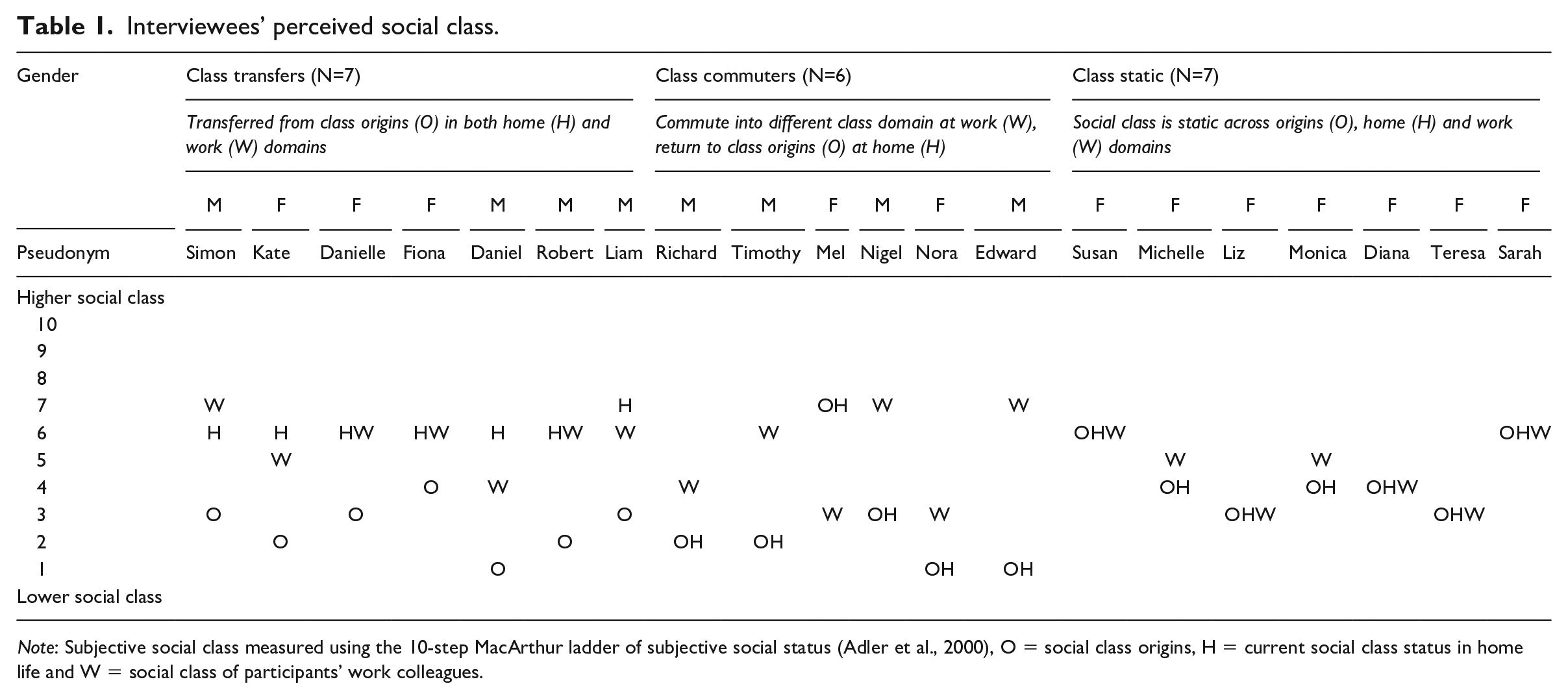
Note: Subjective social class measured using the 10-step MacArthur ladder of subjective social status (Adler et al., 2000), O = social class origins, H = current social class status in home life and W = social class of participants’ work colleagues.
Interviews
Interviews were conducted either face-to-face, or via telephone and recorded for transcriptions. Interviews lasted between 27 and 78 minutes, averaging 50 minutes, with 20 interviews generating over 16 hours of data. Interviewees were asked to give a narrative account of their work-life history including experiences growing up, occupation of parents, community in which they lived, education, and career history. Semi-structured questions were then used to explore whether interviewees self-identified with any particular social class and the extent to which they believed their social class origin had been relevant to their work-life experiences. The critical incident technique (Flanagan, 1954) was also used to ask interviewees to identify specific positive or negative events in their work and non-work lives where they perceived social class to be salient.
Interview data was analysed using NVivo software. In the first stage of data analysis content from the interviews was grouped under the key components of border theory (i.e. domain characteristics, border crossers, domain members and work-life outcomes) alongside an analysis of respondents’ meanings, processes and contexts to uncover themes in the interviews. The second stage involved an examination of the three groups of individuals to evaluate the social class dimensions of their work-life interplay.
Findings
The findings are presented in relation to the key areas of border theory: domain characteristics, border crossers, domain members and work-life outcomes.
Domain characteristics
The initial stage of the data analysis examined similarities and differences in the socialised norms of the interviewees’ work and non-work domains; and the relative strength and characteristics of domains. Strength of domain was identified where social class specific schema was perceived to be particularly salient. At work, this was most relevant for those who had class travelled: My work environment is all very white middle class. (Robert, CT) The organisational culture is very middle class where it might be that you can quote Latin, that you can drink wine rather than beer, that you socialise in a certain way. (Kate, CT)
Social class was also perceived as salient in non-work domains, such as family home life, sporting societies and local communities: I grew up working class, but owned a horse so I found that I was mingling more with middle-class people who were mums that didn’t work, all the children went to private school and those types of things. (Michelle, CS) When [friends from home-town] come to visit here they go, ‘Oh this is nice’, but I’ve got friends who live in Richmond which can be seen as, you know, quite upper class . . . when I first moved here, I was surprised – like the badminton group in how very narrow minded they were in their outlook on race and possibly class. (Monica, CS)
Class transfers (CT) cited differences in speech (accent), use of language and vocabulary, attire, social skills (e.g. ordering from a restaurant menu), informal discussion topics (e.g. holiday destinations, sport, hobbies) and even food choices at lunchtimes. Some described their work and non-work fields as being ‘like different worlds’ (Danielle, CT) with differences between the socialised norms of their work domains and social class origin being very pronounced: I come from a lower class than the majority of people I work with as it tends to be very middle-class, upper-class type people as opposed to having parents who are traditionally working-class backgrounds, so I’m aware of my social class at work. (Simon, CT)
Many class transfers began noticing differences between fields through their educational experiences, particularly those of a working-class origin who attended grammar school:
1
When I went to grammar school, I appreciated that I was a minority. I remember thinking oh crikey, the world is different. (Richard, CC)
Conversely, class static interviewees were more indifferent to social class across their work-life domains: I think it’s a difficult one, social class, because personally I think it’s more and more dying out. I don’t think there’s so much on social class now. (Diana, CS)
When considering domain and border strength it was informal rules about the appropriate cognitive, behavioural and emotional patterns of each domain, or the psychological borders (Clark, 2000), that were pertinent and made the transition between domains more challenging for class transfers (CT) and commuters (CC).
Border crossers
The next stage of analysis explored how factors internal to border crossers contributed to their work-life outcomes, such as their self-identification of social class, participation, integration and segmentation across domains. Interviewees varied in the extent to which they identified with a particular class, providing nuances to the findings from the survey. Class static individuals were very clear in their subjective self-classification of social class: I’ve always assumed my family was middle class and I class myself as that now still. (Sarah, CS)
Some class transfers confidently identified with the class associated with their current occupational role: I was historically working class, but very much now middle class. (Robert, CT) Well, I mean I’m middle class now because of the job I do and the way I live. My parents were working class being manual labour and no qualifications. (Kate, CT)
Conversely, others identified more closely with their non-work domains and social class origin such as family background and upbringing: I’d like to think that I’m still working class. In my heart of hearts, I feel working class, but people around me would probably say I’m middle class. (Daniel, CT)
In line with border theory, the extent to which interviewees were central or peripheral domain members was explored by looking for evidence of influence and competence in different domains, and their identification with domain values and socialised norms. Some class transfers identified as central participants in their work domain, principally through a professed competence in their work roles: I’m good at the job I do and I don’t need to conceal my class because I have other attributes . . . which can get me progression. (Simon, CT)
Such strong identification with their work domain sometimes led to a more peripheral involvement in their home domain, including detachment from extended family members and keeping domains very separate. Correspondingly, they aligned themselves more closely with occupational and work roles, effectively relocating their self-perceived social class away from their class origin: I was ambitious so I made sure I learned how to fit in more with that world of work. I just internalised the need to conform to the standard of the world I found myself in. (Kate, CT)
Conversely, class commuters identified more strongly with their class origin so were central participants in their non-work domains. Most perceived themselves as being of working-class origin. They spoke about the sense of pride they derived from their social class roots. Their central participation in non-work domains meant they retained their social class origin across domains and took a more integrated approach to their domain management: I prefer the working-class attitude to life. . . I always talk about ‘home’ being [where I grew up]. I’ve never tried to conceal my class. I can’t remember an instance where I’ve tried to pretend that I’m from a higher social class. (Richard, CC)
Some talked about the importance of maintaining their working-class origins despite successful careers. For example, Edward (CC) discussed how he frequently visited his hometown to reacquaint himself with his class background: I just want to just keep that root thing going and I want to make it feel as though I’ve not changed much. (Edward, CC).
In contrast, class static individuals lacked regular exposure to social class differences in their work-life experiences, such that there was no sense of conflict, or need to separate their work and non-work domains: I’ve never felt uncomfortable about my background because I think middle class is generally what the population is and that’s true in most roles and jobs. (Diana, CS)
This sense of security was sustained even in situations where class-discrepancy was more salient: I’m actually quite comfortable being plonked in a room of people I don’t know and I can generally make small talk and fit in. It’s just like at Christmas we went to someone’s drinks party. We thought it was going to be all quite low key and just them and some friends but it wasn’t. There was waiting staff, there was lots of very posh people who I had no idea who they were, but having to talk to them. I was fine and they are normal and you can have a normal conversation. (Sarah, CS)
Additionally, class travellers, particularly commuters, were more likely to attribute any peripheral participation in the work domain to a sense of ‘knowing their place’ and so did not challenge any class norms inherent to those domains: As a whole, the idea that we’re all actually colleagues, is something that is essentially given lip service to and really you should shut up and know your place. (Nigel, CC) I look at those on a higher grade to me and I think I could do that, but I would never dream of applying for that job – I know my place. (Nora, CC)
Domain members
The influence of other domain members on the work-life experiences of border crossers was explored with interviewees referring to both positive and negative experiences in their interactions with other domain members. Class transfers and commuters often spoke about their family’s role in supporting their work ethic and travel into higher social class via work: My whole family values have always been about hard work should pay off. (Liam, CT)
Yet, although there were some examples of positive cross-class encounters in their work-life domains, many cited occasions when other domain members derided their social class origin. This included colleagues in their work domain: I get mocked, it’s not a regular thing, but I don’t hide the fact I’m of that class. There’s kind of a joke that I have progressed quite a lot from what my class suggests I should be. (Simon, CT) He made a formal complaint about me saying that I was unprofessional and he actually used the words ‘how can she meet anyone speaking like that?’ (Nora, CC)
Others had similar experiences in non-work domains: I was introduced to someone as: ‘This is Kate, she’s rather common but she’s very nice.’ And I did shrivel rather. (Kate, CT)
To offset the challenges of border crossing, some class transfers allied with domain members of a similar social class origin, such as colleagues in their work domain: You’d realise that you all had Alan Bennett
2
-ish backgrounds and have been on similar journeys so you live in a broadly middle-class way, but don’t forget your working-class origins. You realise you have these connections and you develop a bond with them. (Kate, CT)
Work-life outcomes
The interview data provided evidence that class static interviewees were likely to integrate their work-life domains and had little experience of work-life tensions related to their social class: Whether I just personally ignore it myself because it’s not important to me, or I feel comfortable where I am, but it doesn’t matter what class I’m in to be honest with you. (Michelle, CS) I don’t conceal my background or social class as I think I can just speak how I am. (Diana, CS)
These individuals had good integration because they experienced weak domain borders due to overlapping social norms, which provided opportunity for blending. As such, border keepers and members were not significant factors in the maintenance of any balance between domains.
Conversely, class travellers were more aware of class differences across their work-life domains and employed greater effort to navigate between the two, which caused tensions and conflict. Some referred to their embodied cultural capital, such as dialect, when discussing feelings of unease, while others withheld information to conceal their social class origin: I used to be a lot more self-conscious about how I spoke as I used to have a stronger working-class accent. If I was in a situation where someone was, who I deemed to be, of a higher social class or standing then I’d probably be more careful with how I spoke and try not to have such an accent. (Danielle, CT) I’m not ashamed of my background at all but if I was out with my husband’s contemporaries who all went to public school would I say to them my dad was a postman? Probably not. (Fiona, CT)
Others gave examples of withdrawing in their work and non-work lives. For example, Nora (CC) reported: During meetings I just didn’t speak a lot because I thought I’m going to make a fool of myself sounding like this. My husband went to public school and while him and I together were great, as soon as we got with his friends, I would almost cower in a corner because I didn’t want to say anything in case I said it wrong or how I said it.
Furthermore, class travellers spoke of the challenges they faced in non-work domains related to their class origin (e.g. extended family, childhood friends and childhood communities), where they engaged in class work behaviours in an effort to integrate back with family and friends: If I’m home then I’m speaking differently and I do it because I’ve got a lot of friends who probably didn’t get the break and I want to melt back in with them. (Edward, CC) I’m conscious of trying to be articulate and when I go back home, I feel muscles relax and I then have to tune back in to the voices I hear when I go to my hometown and going to a pub because I am conscious then of going into my local pub and it’s funny, I don’t want to come across as middle class. I mean I’ll go to a pub and I’ll read a book which is, you know, slightly risky – not too bad – but I do feel that sort of adjustment. When I go back home, or when I’m talking to my mother on the phone and my sister, my accent definitely changes. (Richard, CC)
Disparities between the socialised norms of work and non-work domains of class transfers were more likely to trigger feelings of insecurity and uncertainty: You feel insecure and a little bit at sea. I just thought I’m inadequate. It’s tarring because you’re aware of it and looking out for it and you’re never utterly secure in any situation, including the one you left. (Kate, CT)
Class commuters also spoke of the additional effort required to navigate between their work-life domains, particularly those who segmented their work and non-work lives: You’re acting all the time, having to bite your tongue and finding that you’re a chameleon half the time. Sometimes it would just be great to just be yourself, but you can’t. (Edward, CC)
For others, the effort required to navigate between domains was too onerous and resulted in dis-identification or even withdrawal. Some chose to withdraw from the work domain. For example, Michelle (CS) spoke about how she had resigned from a post in which she had felt class-discrepant: I didn’t feel as if I fitted in at all. I felt completely uncomfortable there, as they were a different type of people totally. They were all luvvies who very much looked down on me. I felt very lonely and just couldn’t face working there any longer so I resigned. (Michelle, CS)
Others spoke of a sense of disconnection from domain members, such as extended family, leading to their withdrawal from relationships in their non-work lives: I don’t think I fit in with my dad’s family anymore. They just don’t understand my job so I can’t communicate with them because they don’t understand what it feels like . . . so I just don’t go and see them that often, or as much as I did. (Simon, CT) So, I was once engaged to a posh girl, but I ended it because I couldn’t live in that world because I was too uncomfortable. (Timothy, CC)
Some described feeling marginal in both their work and non-work domains: You end up in some sort of no-man’s land. (Kate, CT)
Conversely, some class transfers and commuters reported feeling adept at social class transitions because of their social mobility and felt it formed an important skillset, which supported their border management and was linked to work-life enrichment: I think I’m quite a social chameleon in the fact that I’ve got a very working-class background, but I went to a grammar school and university. I do find that useful that I’ve had those different bits in my life which means I know how to talk to people. (Robert, CT)
Summary of findings
The analysis reveals that border crossing can be a complex process in which social class plays a key role. Table 2 summarises the patterns between components of border theory and social class, presenting five groups of individuals who experienced the interplay between class and work-life differently. Group 1 comprised class transfers who had moved away from their class origins at both home and work. They prioritised their work domain, had variable support from other domain members so tended to segregate their work and non-work lives resulting in a higher propensity for work-life conflict. Group 2 had also travelled in their social class at home and work but were more likely to achieve work-life balance because unlike Group 1, they integrated their work and home by accepting their class travel and being more at ease with their ‘new’ social class, only occasionally feeling the need to conceal their origins. They also had supportive domain members, and did not necessarily regard work as their central domain. In addition, there was evidence that they sometimes drew on their experience of class travel to facilitate border management. Group 3 had class travelled in their work domain, but maintained their class origins in both work and non-work lives. As such, they were more likely to take an integrated approach to domain management with no prioritisation of any one single domain and received support from non-work domain members so experienced better work-life outcomes. Group 4 had class travelled through the work domain, but a lack of support from domain members at work and a tendency to segregate their home and work domains led to a higher propensity for work-life conflict. Finally, Group 5 experienced congruence in their social class across all domains and only attempted to segregate their work and non-work lives when work domain members were unsupportive. Regardless of any integration or segregation of domains, this group was more likely to experience a seamless interchange between their work and non-work lives.
Patterns of social class and work-life border characteristics.
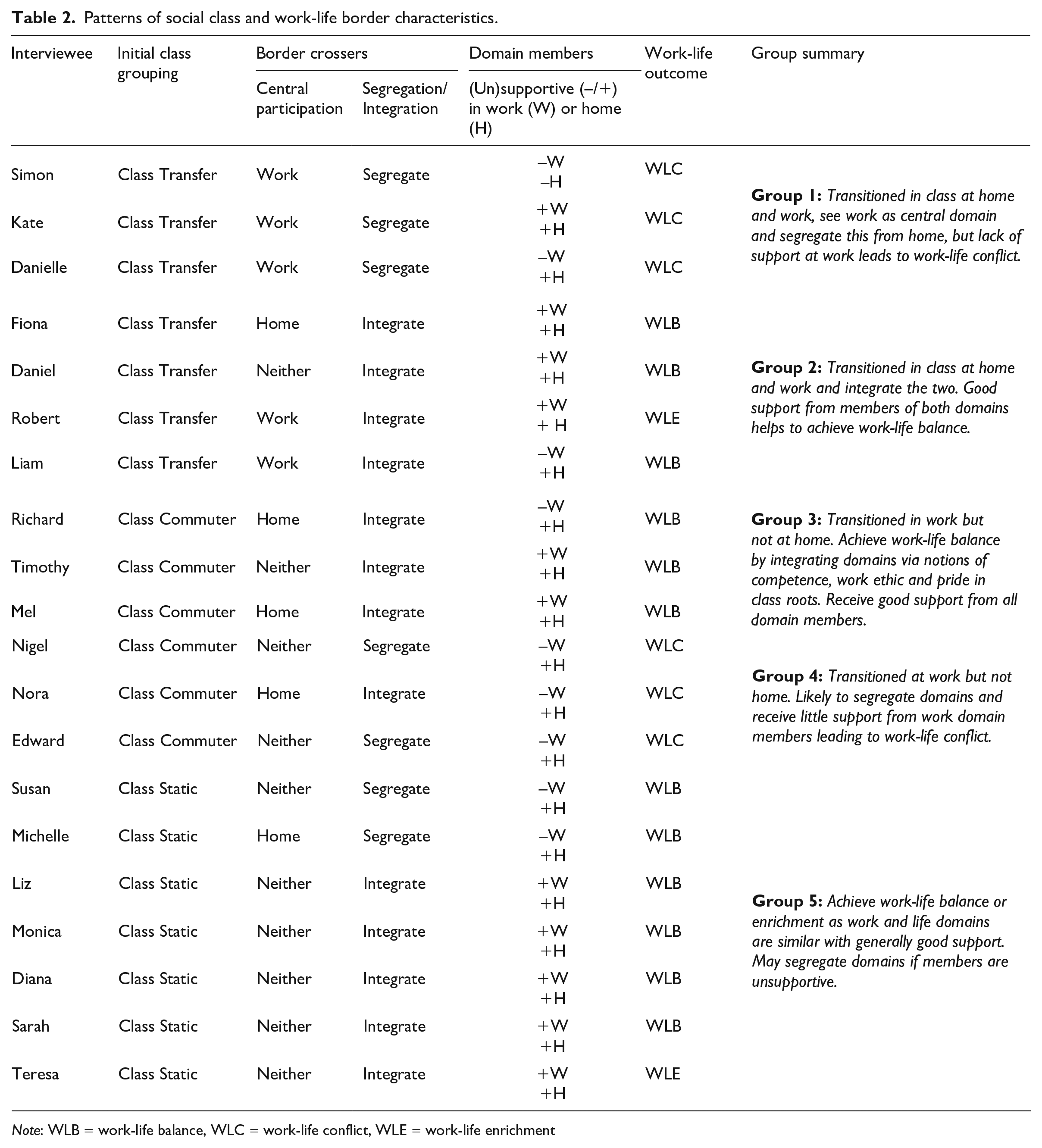
Note: WLB = work-life balance, WLC = work-life conflict, WLE = work-life enrichment
Discussion
This article draws on border theory to answer the question of how social class influences the interplay between work and non-work life. The study contributes to broadening the remit of work-life research to examine wider strands of diversity beyond gender and family (Özbilgin et al., 2011; Warren, 2015) while centring social mobility in discussions of class (Friedman, 2013). These findings show how socially mobile interviewees had more complex work-life experiences, finding work-life interplay more challenging than those whose social class was congruent across domains. The findings highlight the significant role of social mobility and the need to capture subjective assessments in social class analysis. This provides a greater insight into how people gauge their ‘sense of place’ by experiencing changes in habitus and perceived capitals relative to other domain members when navigating between different fields (Bourdieu, 1984). The study presents more nuanced insights into social mobility and subsequent related work-life challenges, enhances knowledge about both the positive and negative consequences of social mobility for work-life outcomes and thus, challenges the assumption that social mobility is inherently beneficial.
Building on these findings, this study extends border theory by proposing that social class influences how individuals navigate the relationship between their work and non-work lives by acting as a ‘bridge’ across domains. Despite some reference to bridges in work-life literature (e.g. Kreiner et al., 2009), few articles have examined the concept, or provided examples of how bridges form. In this study, bridges are deemed overarching structures that connect domains and either facilitate, or impede, border crossing (Simmel, 1997 [1909]). As such, social class can operate as a bridge and influence an individual’s border crossing experience. For some, such as the class static group, the bridges between domains are easy and quick to traverse with strong support. For others, such as class transfers and commuters, the bridges between work-life domains are less stable and can incur heavy tolls.
Open roads vs drawbridges
This study found that those who experience class congruence across domains (Group 5) faced fewer work-life tensions attributable to their social class. Hence, their social class offered them short and stable bridges across their work-life domains because of the overlap in socialised norms providing a sense of belonging and more opportunity to be ‘ideal-typical integrators’ (Nippert-Eng, 1996). However, this group was not entirely immune to negative cross-class encounters at work, which sometimes drove a more segmented approach to offset the tensions this created. Meanwhile, others (e.g. Groups 2 and 3) had a better sense of their domain position (Bourdieu, 1984) and mastery of domain management (Clark, 2000), by identifying with associated socialised norms across domains. In taking an integrated approach to border management, their bridges were shorter and more stable, reducing work-life conflict.
Generally, the bridges that social class travellers traversed were longer and more precarious because of the greater degree of difference between their domains. This often-required careful navigation when border crossing made work-life balance more problematic. Feelings of insecurity related to perceived social standing and an inability to be their authentic selves in either their work or non-work domains gave rise to feelings of conflict between subjective and objective social class. This led to a sense of displacement in one or more domain (Anzaldua, 1987; Bourdieu, 2007; Lahire, 2011; Marks and Baldry, 2009), leaving some describing themselves as ‘chameleons’.
Taking an integrated approach to border management (Nippert-Eng, 1996) through being more transparent about their class origin in both work and non-work domains seemed to ease feelings of conflict for individuals. However, some border crossers were reluctant to do this (Groups 1 and 4) and instead tended to segment domains, which increased their propensity for work-life conflict. For example, a belief in job-related competence motivated Group 1 to seek central participation in their work domain (Lave and Wenger, 1991), resulting in less ability to associate their habitus with their non-work domain and brought about feelings of dislocation (Bourdieu, 1984). Dis-identification or complete withdrawal from that domain often followed with a pulling up of the proverbial drawbridge through a withdrawal from relationships with other domain members when identification or influence in that domain is lost (Clark, 2000). In contrast, Group 3 drew on notions of competence from their social class origin to strengthen their bridges. Some interviewees were proud of their working-class roots and used this to shape their habitus and sense of place within these domains (Bourdieu, 1984), facilitating a more integrated approach to their border management (Nippert-Eng, 1996). In line with border theory, this was associated with better work-life balance outcomes.
Bridge tolls
Interviewees described a range of behaviours they used to traverse social class bridges, or what could be termed ‘tolls’, to mitigate the challenges of moving between work and non-work domains. These tolls included altering accents, vocabulary, dress, and topics of conversation and align with Bourdieu’s concepts of capital, particularly embodied capital. Such modifications are similar to Gray and Kish-Gephart’s (2013) notion of class work, although this study extends their theory by finding that individuals engage in these behaviours during cross-class interactions in both their work and non-work lives. For example, Group 1 who had upwardly class travelled through occupation paid higher tolls in taking a segmented approach to domain management, which required them to make changes to their behaviours while operating in the work domain to hide their social class origin. They also made similar behavioural adjustments in their non-work domains to downplay their class travel, particularly in the company of family and childhood friends.
Trusses and suspension
Lastly, this study supports the notion that other domain members have an impact on a border crosser’s work-life balance (Clark, 2000; Kreiner et al., 2009). Support from other domain members and their acknowledgement of other relative domains acted as strong trusses, stabilised bridges, and eased work-life balance (Groups 2, 3 and 5). Conversely, where domain members in either work or non-work domains were unsupportive, border crossers experienced greater work-life tensions and instability (Groups 1 and 4). For some border crossers, the effort required to move between domains led to a diminishment of commitment to one domain, as predicted by Clark (2000). This often resulted in a reduction in their commitment to the domain in whose social norms they least identified with (usually the domain where they felt unsupported by other domain members), thus becoming a peripheral participant with decreased engagement and even complete withdrawal, such as resignation from a work role, or non-engagement with family members. This was more likely to occur for social class transfers with central membership in one domain and a segmented approach to their work-life domains (Group 1).
Limitations and future research
This study highlights the importance of researching diversity strands beyond gender in work-life research. Examining the role of intersectionality is also important; particularly as all the class static participants (Group 5) were female. However, the sample was too small to make these inferences in the current article. Therefore, future research would benefit from larger samples to enable analysis of the intersectionality between class and other strands of diversity, such as gender, age, and ethnicity, on the formation of bridges and work-life interplay. The sample also comprised individuals from similar white-collar UK work contexts and although the analysis was reflexive about the impact of work role, future research might look to explore whether work-life conflicts shaped by social class are more salient in certain occupations. Furthermore, examining how individuals from wider cultural backgrounds traverse the class borders of British society is also important. Future studies might look to investigate how migrants to the UK experience social mobility and their perceptions of social status across work and life domains.
This research builds on Bourdieu’s (1984) assertion that work-life is a multi-dimensional space with associated socialised norms that shape a sense of place for domain inhabitants. In exploring interviewees’ day-to-day home life and their experiences of going ‘home’ to their class origin involving extended family, childhood communities and friends, this study exposes the nuances of ‘life’ domains beyond the more typical work-family domains presented in the literature. Therefore, future research needs to consider the full scope of ‘life’, to improve understanding of how individuals navigate between them. To do this, future research could draw on micro-role transitions (Ashforth et al., 2000) to examine the variety of roles individuals adopt across domains and the influence of this on the formation of bridges.
Importantly, this research shows that in terms of supporting individuals at work, if organisations are truly on board with the agenda to improve social mobility and diversity, they need to consider ways to support the work-life interplay of all staff. This could be achieved through class-fluent cultures and the acknowledgement that social mobility can be a problematic experience for their employees.
Footnotes
Funding
The authors received no financial support for the research, authorship, and/or publication of this article.