



Abstract
This article investigates the effect of hiring temporary workers on the voluntary turnover of permanent employees. It argues that inflows of temporary workers erode the working conditions of permanent employees, prompting their voluntary departure. Using a unique panel dataset of individual-level monthly payroll data over an eight-year period in a sample of Spanish companies, a positive association between temporary worker inflows and the voluntary turnover of permanent workers is found. The results are robust to diverse specifications and are strongest for firms in non-manufacturing sectors and for firms that hire proportionally more low-skilled workers, contexts where the hiring of temporary workers may be more disruptive for permanent employees. Since the hiring of temporary workers is unlikely to threaten the employment of permanent employees in the dual labour market of Spain, the results indicate serious disruption costs associated with temporary hiring in organisations.
Keywords
Introduction
Organisations face an increasing need for flexibility in their employment systems partially because of the growing unpredictability of the business environment (Kalleberg, 2018). Challenged to foresee their human capital needs even in the short term, firms have embraced human resource practices, allowing them to adjust their staff according to changing demands over time (Cappelli, 2008). Specifically, the use of temporary workers on an as-needed basis has acquired special relevance (Cappelli and Keller, 2013; Houseman, 2001; Katz and Krueger, 2019). The incidence of temporary employment ranges from 4% to 25% in Organisation for Economic Co-operation and Development (OECD) countries (OECD, 2021). This rate surpasses 20% in Poland, Portugal, and Spain, where hiring temporary workers has become normalised (Green and Livanos, 2017; Prosser, 2016). In contrast to regular employees, temporary workers can be dismissed easily without breaking psychological contracts or legal contracts (Matusik and Hill, 1998), leading to an unstable company workforce with growing levels of turnover due to constant inflows and outflows of temporary workers.
Workers with permanent contracts often see their employment terms altered by the arrival of temporary employees (Stecy-Hildebrandt et al., 2019) and may react accordingly depending on whether their working conditions improve or worsen. In this article we focus on a specific employee behaviour, i.e., voluntary quitting, and explore the effect of temporary workers’ inflows on permanent workers’ voluntary turnover rates.
Despite the increased use of contingent workers and ample research on the consequent precariousness of workforces (Kalleberg and Vallas, 2018; Rubery et al., 2018), knowledge of how inflows of temporary workers affect permanent employee retention is relatively limited. Several studies explore the relationship between the presence of temporary workers and potential turnover-related attitudes of permanent employees, including commitment and intentions to leave (Davis-Blake et al., 2003; George, 2003), but they do not directly measure turnover. The few studies that consider actual turnover behaviour (Batt and Colvin, 2011; Batt et al., 2002) reveal that organisations that make greater use of temporary workers experience a higher voluntary quit rate among permanent employees. Notably, none of the aforementioned studies explores the inflows of temporary workers but instead focuses on their presence in organisations.
Thus, the current study contributes to the literature by exploring the effect of temporary workers’ inflows on permanent employees quitting using the unfolding model of turnover as a guiding framework (Lee and Mitchell, 1994; Lee et al., 1996). The central tenet of this model is that shocks to the system, or events that disturb the steady state or status quo of how the individual thinks about his or her job, may foster voluntary turnover. This issue is explored in the context of Spain, a country that exhibits a dual labour market characterised by high employment protection legislation (EPL) for permanent employees and nearly no protection for temporary workers. Prior research that suggests that the normalisation of temporary work erodes the social contract relative to standard employment relationships is considered (Rubery et al., 2018) to argue for a positive effect between temporary inflows and permanent employees’ voluntary turnover.
The arguments are empirically evaluated using a unique longitudinal dataset derived from the records of a consulting company that manages outsourced firm payrolls. Importantly, these data allow for identifying voluntary turnover, the exact number of inflows and the types of contracts of each company on a monthly basis. Consistent with the expectations, temporary inflows were found to increase the voluntary turnover of permanent employees. Since the threat of being fired is relatively low under high EPL, this finding is interpreted as evidence of the deterioration in the working conditions of permanent workers. This study augments existing empirical evidence by exploring this phenomenon in a dual labour market and by precisely modelling both temporary worker inflows and stocks using unusually detailed firm-level data.
In what follows, we first review the related literature on the effects of temporary inflows on permanent workers’ outcomes. Then, we establish predictions for the Spanish context and describe the research methods employed. The results suggest that the costs of the disruption associated with temporary worker hiring outweigh the benefits of any extra support temporary workers could offer to permanent employees.
Permanent employee turnover as a reaction to temporary worker hiring
Scholars have proposed encompassing frameworks explaining turnover in organisations (e.g., Hom et al., 2017). A relevant theory for this study is the unfolding model of turnover (Lee and Mitchell, 1994; Lee et al., 1996), which proposes that ‘shocks to the system’, or events that disturb the steady state of how the individual thinks about the job, may foster voluntary turnover. These shocks can be expected or unexpected, and they may be unique or recurring events. What matters is that these shocks make the employee reevaluate his or her fit with the job and potentially initiate the psychological decisions involved in quitting.
Inflows of temporary workers can represent such an event. Prior work on the effects of temporary workers on permanent employees has offered two contrasting explanations. The ‘helping hands’ hypothesis suggests that temporary workers may make work easier for permanent employees (Harrison and Kelley, 1993) and thus improve their working conditions. Traditional explanations of numerical flexibility contend that the use of temporary workers expands the capacity of units while buffering core organisational employees (Atkinson, 1984). As adjustable resources, temporary workers can help cover high-demand peaks but can be dismissed when no longer needed without incurring severe psychological or legal costs (Matusik and Hill, 1998). Furthermore, temporary workers are often assigned the least desirable work shifts and tasks (e.g., George et al., 2012; Houseman et al., 2003; Parker, 1994). In addition, their permanent counterparts, who consider competition for promotions reduced because temporary workers are not usually considered for vacancies (Barnett and Miner, 1992), may welcome these new workers. From this perspective, hiring temporary workers could be perceived as beneficial by permanent coworkers, thereby reducing the likelihood of voluntary turnover.
In contrast to this view, a vast body of research identifies the negative effects associated with temporary inflows. Upon the arrival of temporary workers, working conditions and job quality tend to deteriorate (Stecy-Hildebrandt et al., 2019). While any new arrivals may generate a disruption (Hausknecht et al., 2009), in the case of temporary workers, this disruption is expected to be substantial, partly because temporary workers are usually excluded from the formal processes of training and socialisation. Workloads increase because training new temporary workers becomes the responsibility of permanent employees, often without a corresponding pay increase (Geary, 1992; Smith, 1994). In addition, since temporary workers are often assigned to work alongside permanent workers (e.g., Bidwell, 2009; Davis-Blake et al., 2003), frequent team membership changes can create coordination challenges. Thus, permanent workers are required to exert greater effort to accommodate these changes (De Stefano et al., 2019). Furthermore, the potentially low levels of commitment of temporary workers (Ashford et al., 2007) may lead to conflict, negatively affecting the organisational climate (Smith, 1994).
Moreover, temporary worker inflows may represent a threat to permanent employees, increasing the polarisation of a two-tiered employment system. The threat is twofold. First, permanent employees’ status may be devalued in the overall workforce. Temporary workers are usually perceived to be of a lower social status and prestige than permanent employees (George et al., 2012; Smith, 1994). When a temporary worker is hired to perform the same job as a permanent employee, the identity of the permanent employee may be shaken (e.g., Eldor and Cappelli, 2021).
Second, hiring contingent workers can suggest to permanent employees that the firm intends to depart from an employment model based on long-term commitment and high quality (George, 2003; Stecy-Hildebrandt et al., 2019). Temporary workers are often hired to reduce labour costs in an organisation (Cappelli and Keller, 2013; Kalleberg, 2000), including salary costs and other fringe benefits (Booth et al., 2002; Stecy-Hildebrandt et al., 2019; Van Lancker, 2011). Thus, hiring temporary workers may signal to permanent employees that their jobs are at risk of being transformed into less costly temporary positions (Smith, 1994) and increase their perceptions of job insecurity (Kuroki, 2012). Overall, these arguments suggest that temporary inflows may prompt the turnover of permanent employees.
These competing theoretical narratives are explored, and this issue is empirically examined in the context of Spain, a country with a dual labour market characterised by high EPL for permanent workers and nearly none for temporary workers.
The Spanish institutional context
Since the 1980s, the institutional context of employment relationships in Spain has been characterised by high EPL applied to permanent workers and a sequence of reforms aiming to liberalise so-called atypical employment contracts, i.e., temporary arrangements. The resulting labour market reflects a striking insider-outsider divide (Bentolila et al., 2012, 2020; Golsch, 2003) in which permanent contracts are much more costly to terminate than temporary contracts. 1
Due to the stark difference in dismissal conditions between permanent and temporary workers, temporary employment surged to nearly 35% in the early 1990s and has since been among the highest in Europe (Bentolila et al., 2008; OECD, 2021). Additionally, given the high insecurity of their jobs, temporary workers in Spain usually have low bargaining power to negotiate good working conditions; this situation is even more likely to apply to involuntarily temporary staff, who account for most temporary contracts (Amuedo-Dorantes, 2000; Banyuls and Recto, 2017). According to Eurostat, in 2018, the ratio of temporary workers to the total number of employees was 26.9%, 21.3% of whom were considered involuntary.
This employment protection legislation should lower the extent to which inflows of temporary workers signal a risk of permanent employment loss. Specifically, hiring temporary workers may better protect the jobs of permanent workers. For example, in high EPL Germany, the jobs of permanent workers were more stable when their employers used temporary workers (Hirsch, 2016). Similarly, a cross-country study revealed that the use of temporary workers appeared linked to workload fluctuations in high EPL contexts, which suggests that the hiring of temporary workers helps prevent companies from needing to dismiss permanent employees when facing changes in demand (Dräger and Marx, 2017). 2 Furthermore, when permanent workers perceive their jobs to be more secure, they are less likely to view temporary hires as a threat (Kraimer et al., 2005) and therefore may not change their propensity to quit. The findings of a study in the Canadian labour market show just that: temporary workers seem to generate more problems for employee retention when they are hired to reduce labour costs than when they are hired to provide stability for the firm’s permanent employees (Way et al., 2010).
Nevertheless, existing research suggests that temporary workers may still disrupt the work of permanent staff and threaten their identities. First, temporary workers in Spain tend to receive worse working schedules (Amuedo-Dorantes, 2002), lower wages and fewer benefits (Avlijas, 2019; Jimeno and Toharia, 1993) as well as facing higher job insecurity (Jimeno et al., 2018) than their permanent counterparts. Consequently, temporary workers are likely to show low levels of commitment. In addition, temporary workers in Spain tend to lack training opportunities (Albert et al., 2005; Dolado et al., 1999). Their lower commitment and lack of training may impact permanent workers who need to collaborate with them. Finally, research shows that temporary workers are often used in Spain as a cost-cutting strategy (Güell and Petrongolo, 2007), which raises doubts regarding the potential benefits of hiring temporary workers as helping hands. In general, existing evidence in the Spanish labour market suggests that the positive effects of temporary workers are likely to be thin and outweighed by the negative effects. Thus, temporary inflows may represent a shock for permanent employees who may react by leaving the organisation.
Overall, while some accounts of numerical flexibility suggest that temporary workers should improve the working conditions of permanent employees, most studies reviewed here, as well as the conditions in Spain’s EPL context, lead us to expect that inflows of temporary workers should negatively impact permanent employees and outweigh the benefits of a potentially expanded capacity. Thus, new temporary hires could be considered a negative shock to permanent employees, who may in turn negatively reevaluate their conditions and decide to leave the organisation. Accordingly, the main prediction is as follows:
Hypothesis 1: Inflows of temporary workers will increase the voluntary turnover of permanent employees.
Data and empirical strategy
The data used were derived from a software outsourcing company that manages the payroll of all employees of its client organisations in Spain, all of which are companies in the private sector. The information was extracted (and anonymised) from payroll registries. The dataset contained detailed administrative information regarding all individuals’ employment situations at the end of each month, including whether they were newly hired, the type of contract, their job classification (based on a standardised classification used in their contracts for legal purposes), their tenure in the organisation, and basic demographic characteristics, such as sex and age. Additionally, the dataset contained information regarding the reasons for terminating the employment relationship (if applicable during that month), allowing us to distinguish between voluntary turnover behaviour and other types of turnover, e.g., firing due to poor performance or contract expiration.
The data covered the period from January 2010 to September 2018. The number of firms varied over time due to changes in the client base of the consulting company; thus, there was an unbalanced panel dataset. Each observation in the original dataset corresponded to a single firm-employee relationship during a specific month. For a smaller group of firms and a shorter time span, additional data regarding workers’ compensation were obtained. Furthermore, 18 of the 21 industries classified in the Statistical Classification of Economic Activities in the European Community (NACE) are represented.
Employee information was aggregated at the company-month level to construct all workforce-related variables. Data from companies with fewer than 10 employees were removed because microfirms tend to have ad hoc employment practices. The distribution in the resulting sample was skewed towards small and medium enterprises (72% of the firms have 250 employees or less). The final dataset had 9845 observations corresponding to 193 companies over 93 months.
Although this dataset cannot be considered statistically representative of the Spanish labour market, it exhibited substantial similarities. From a demographic perspective, the sex distribution was approximately 52% men and 48% women, resembling the 55% and 45% values registered by Labour Force Surveys (LFS) during the observed period. Similarly, the 24% proportion of temporary contracts in the dataset approached the 25% registered in the LFS. 3
Variables
Dependent variable
The dependent variable is the company rate of voluntary turnover of permanent employees. For each company-month, the total number of permanent employees who voluntarily left the organisation during the 12-month period prior to that month was determined and divided by the average number of permanent employees in the company during that same 12-month period. 4 This measure allowed for observing turnover during a sufficiently large period without needing to make a strong assumption regarding when turnover is likely to occur. This variable also enabled smoothing seasonal patterns (i.e., the prior 12-month period should encompass potential seasonality trends throughout the year). 5
Independent variable
We measured temporary worker inflows by the proportion of workers hired by the company with temporary contracts over the total number of workers hired by the same company. Because the effects of temporary inflows on turnover may not be immediate (e.g., it may take time to find a new job), we followed prior research that examines how shocks affect voluntary turnover (e.g., Felps et al., 2009; Liu et al., 2012) and included the lagged value of inflows in the model. For each company-month, the variable temporary inflows was calculated as the sum of hires with temporary contracts divided by the total number of hires during the 12-month period prior to the beginning of the turnover period. 6
Control variables
We controlled for several company characteristics. First, we controlled for the proportion of temporary workers at the beginning of the period of temporary inflows. Thus, the main independent variable, temporary worker inflows, captured the effects of new hires beyond the effects of the stock of temporary workers in the organisation. The total number of hires during the same period of the temporary inflows was also controlled for, as were workforce demographic characteristics (all of them calculated at the beginning of the period of temporary inflows), including the proportion of workers who are male, the average employee age, the average tenure, the proportion of employees who hold jobs that require a high skill level, and the proportion of employees who hold jobs that require a medium skill level (according to their job classification). Moreover, we controlled for the total number of employees (we take the log of this variable due to its skewness to the right). Finally, we also controlled for the quarterly unemployment rate in the firm’s geographical region to account for the economic conditions of the external labour market. 7
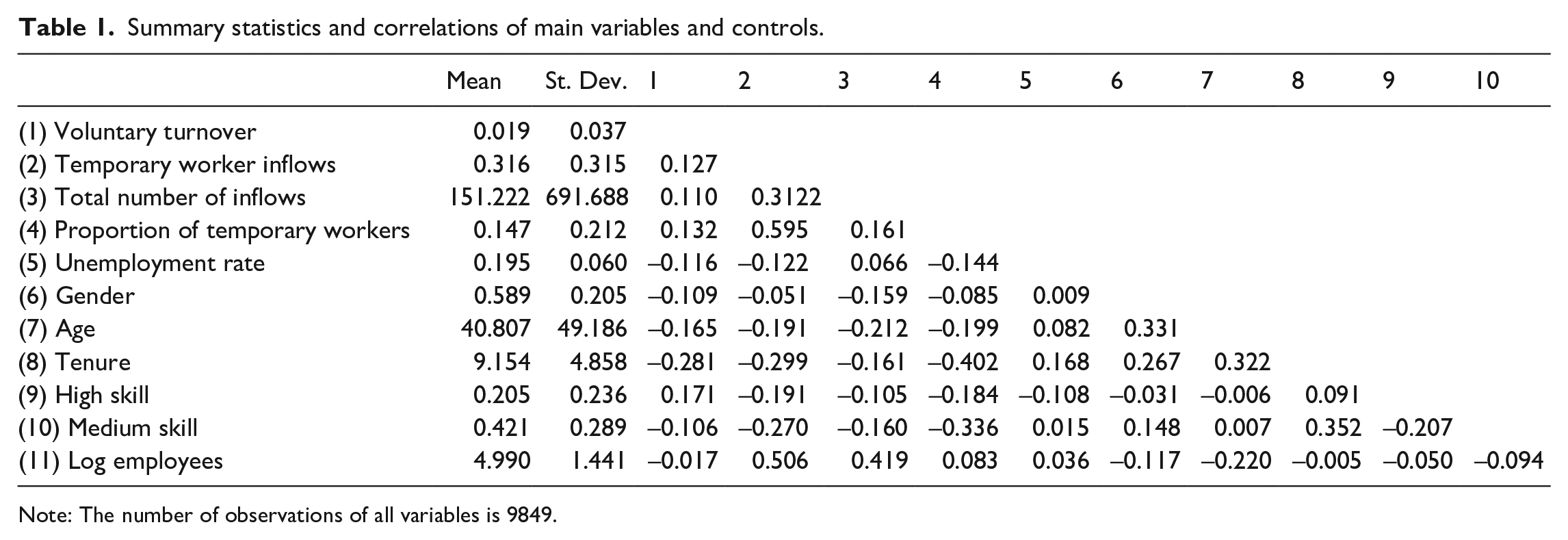
To account for any unobserved time-invariant company characteristics that could drive both temporary worker inflows and the voluntary turnover of permanent employees, the models also included company fixed effects. Considering potential environmental trends, they also included month and year fixed effects. Table 1 shows the summary statistics and correlations among variables.
Summary statistics and correlations of main variables and controls.
Note: The number of observations of all variables is 9849.
Results
The incidence of voluntary turnover over the total employment of permanent workers and the incidence of temporary hiring over the total number of hires were first plotted. In Spain, employment growth generally occurs through temporary contracts, which account for over 90% of new contracts signed (Felgueroso et al., 2018). Figure 1 shows the evolution of these two measures over time, representing the main dependent and independent variables of the models. Voluntary turnover exhibited a similar increasing behaviour, although it was very modest at an average monthly value of approximately 0.2%.
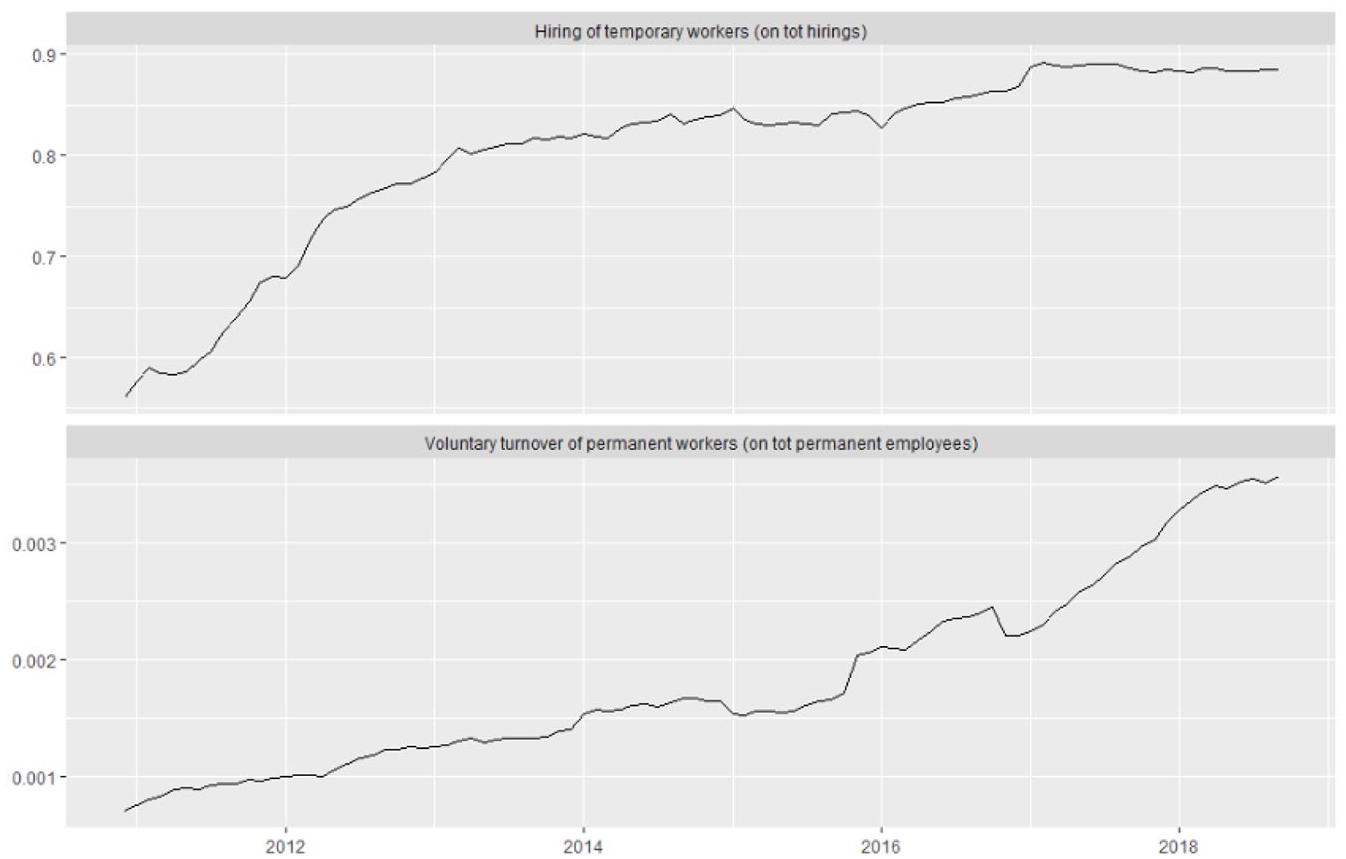
Evolution of the hiring of temporary workers (ratio of total employees) and turnover of permanent employees (ratio of total employees) during the study period.
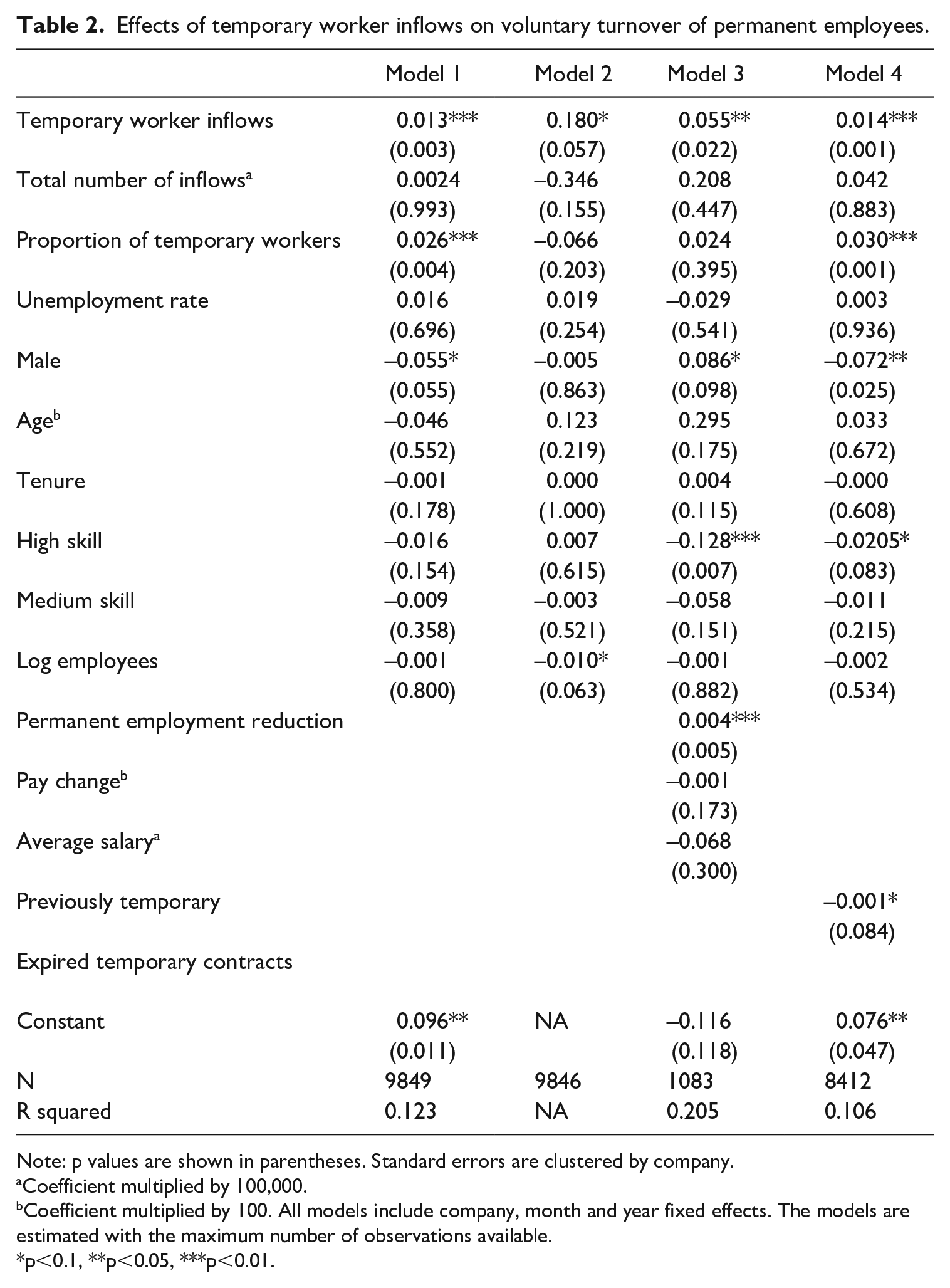
Table 2 shows a set of regression models for the estimated coefficients of the effect of temporary worker inflows on the voluntary turnover of permanent employees in the presence of controls. The core model is Model 1, which includes all the controls listed earlier. Because the residuals of a given company could be correlated, standard errors are clustered at the company level. 8
Effects of temporary worker inflows on voluntary turnover of permanent employees.
Note: p values are shown in parentheses. Standard errors are clustered by company.
Coefficient multiplied by 100,000.
Coefficient multiplied by 100. All models include company, month and year fixed effects. The models are estimated with the maximum number of observations available.
p<0.1, **p<0.05, ***p<0.01.
Model 1 supported the main prediction of a positive relationship (β=0.012, p=0.001). A one-standard deviation increase in the inflows of temporary workers with respect to the mean increased the voluntary turnover of permanent employees by 28%, which, in an average company of 292 permanent employees, would correspond to an increase of 5 to 7 permanent workers leaving the firm during the following 12-month period. 9
Regarding control variables, the proportion of temporary workers in a unit was found to be positively related to the voluntary turnover of permanent employees, which is consistent with the findings of previous studies (Batt et al., 2002; Davis-Blake et al., 2003). Thus, both inflows and the stock of temporary workers induce permanent employee turnover. Second, companies with a higher proportion of male employees tend to experience lower turnover rates, possibly due to female employees’ typically lower average tenure (Sicherman, 1996). Furthermore, seniority is negatively related to turnover, which could reflect the employment protection system in Spain, where severance payments depend on tenure (Rebollo-Sanz, 2012). Finally, the coefficient of unemployment rates in a region was positive but not statistically significant. 10
For each region-year, a new variable, proportion converted due to labour inspection, was calculated, which is the total number of temporary contracts that became permanent contracts due to a labour inspection divided by the total number of temporary workers. There was substantial variation across the 17 regions of the data and yearly variation in the incidence of irregularity, partially because inspections are delegated from the central administration to regional governments. Model 2 in Table 2 shows the estimates corresponding to Model 1 when instrumenting inflows of temporary workers. The first-stage estimation revealed that the variable proportion converted due to labour inspection had a positive and significant coefficient value (β=4.46, p=0.012). 12
The use of an instrumental variable for the inflows of temporary workers did not affect the substantive conclusions of this study. That is, companies with higher inflows of temporary workers still experienced higher voluntary turnover rates among permanent employees (β=0.180, p=0.057). The higher coefficient of the variable for temporary inflows in the instrumented model suggests that the disruption generated by temporary worker inflows may be even more problematic when temporary hires are used in jobs that require permanent workers (according to the law). 13
Employment reduction was measured with a dummy variable that assumes a value of 1 if the company reduced its permanent employee workforce by more than 5% during the three years prior to the current period, and 0 otherwise. 14 To capture cost reduction through lowering compensation, a variable called change in pay was created to capture the difference in annual change in the average pay of permanent employees with respect to the year prior to the turnover period. Compensation data for only a small sample were obtained (fewer firms and only from January 2010 to February 2014). The total number of company-monthly observations for this analysis is 1083, corresponding to 54 companies. These analyses should be interpreted cautiously. Model 3 revealed that, consistent with prior studies (Batt et al., 2002; Trevor and Nyberg, 2008), employment reduction was positively related to voluntary turnover, although the annual change in average company pay is not significant. Importantly, the coefficient of temporary worker inflows remained positive and significant (β=0.055, p=0.022), indicating that the effect of temporary hiring on voluntary turnover in this sample cannot be explained by higher downsizing or salary cuts. 15
Effect of temporary inflows by company type
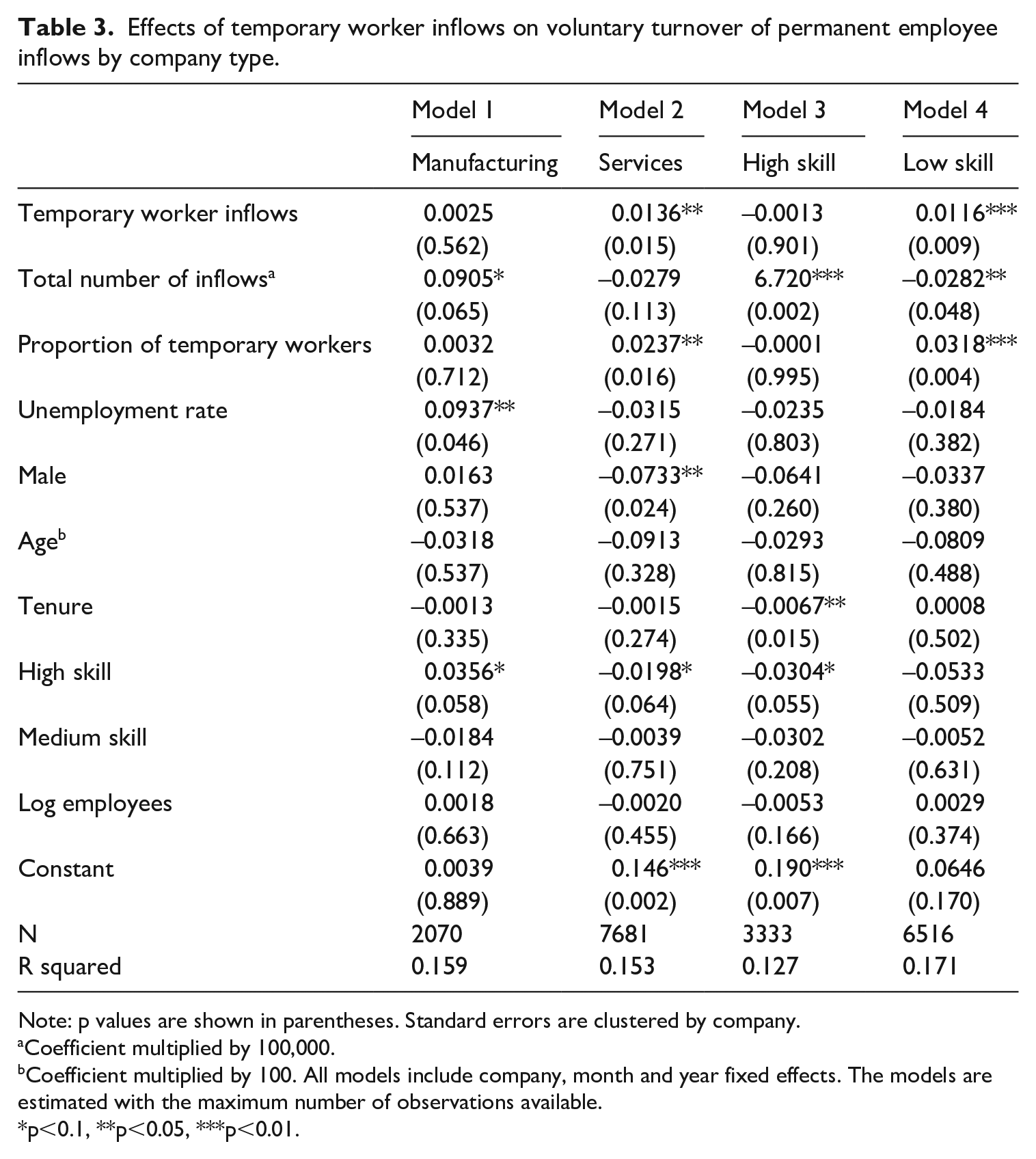
We further examined whether the results were consistent across different types of companies. These results are reported in Table 3. First, differences across sectors were evaluated, as previous research suggests that the use of contingent workers to attain flexibility affects permanent employees differently depending on the sector (Cappelli and Neumark, 2004). Specifically, we estimated Model 1 separately for the two subsamples of firms in the manufacturing and non-manufacturing sectors. Companies in the service industry experience higher turnover of permanent workers and more temporary inflows. The effect estimates shown in columns 1 and 2 suggest that the overall results were driven by companies in the non-manufacturing sector, as a significant coefficient was found in this subsample only (β=0.013, p=0.015). Thus, manufacturing companies seem to mitigate the disruption costs of temporary inflows.
Effects of temporary worker inflows on voluntary turnover of permanent employee inflows by company type.
Note: p values are shown in parentheses. Standard errors are clustered by company.
Coefficient multiplied by 100,000.
Coefficient multiplied by 100. All models include company, month and year fixed effects. The models are estimated with the maximum number of observations available.
p<0.1, **p<0.05, ***p<0.01.
We also tested whether the effect of temporary inflows varies with employees’ skill set, as high-skilled employees may be relatively buffered from the disruption associated with temporary workers (Davis-Blake et al., 2003). We separated the subsample of companies with a relatively high proportion of high-skilled workers (more than 20% of workers are high-skilled, the top 25th percentile of the sample) from those with a low proportion. Companies with more high-skilled workers had a higher permanent turnover rate and fewer temporary inflows. Models 3 and 4 in Table 3 suggest that the overall results were driven by companies with relatively lower proportions of high-skilled workers (β=0.011, p=0.009).
Discussion and conclusions
Does hiring temporary workers increase the turnover of permanent employees in an organisation? The results of this study show that it does. Even if the threat of losing a permanent job can be mitigated by legal protection, as is the case in Spain, permanent workers are more likely to quit after temporary workers are hired. This finding suggests that the disruption and worsening of working conditions associated with working alongside temporary workers may be large enough to outweigh the benefits of potential helping hands, such that permanent employees may reevaluate their working conditions and decide to leave their organisation.
The findings are significant only in the sample of companies in the non-manufacturing sector. One plausible explanation is that the manufacturing companies in the sample organise work in such a way that temporary workers cause less work disruption for their permanent coworkers. In addition, the results tend to be valid for firms that hire proportionally more low-skilled workers. High-skilled workers may see themselves as more secure and less replaceable, so they may not perceive the hiring of temporary workers as a threat to their jobs (Barnett and Miner, 1992; George, 2003). They are also usually less likely to be blended with temporary workers. Therefore, high-skilled workers may be buffered from the disruption generated by temporary worker inflows.
This study contributes to existing research that identifies higher turnover in companies with a higher incidence of temporary workers. Consistent with previous work focusing on the effects of the incidence of temporary workers, the presence of temporary workers was found to lead to higher voluntary turnover (Batt and Colvin, 2011; Davis-Blake et al., 2003). However, the findings highlight that temporary worker inflows have a separate effect on turnover beyond that of the presence of temporary workers in the unit. Organisations that need to hire temporary workers but wish to retain permanent employees may seek ways to decrease the disruption costs associated with the arrival of temporary workers and their employment. For example, companies may evaluate how the demands of permanent workers change as they strive to integrate new temporary hires. Companies may choose to either adjust their workloads throughout that period or offer a reward for integrating and training temporary workers.
This study also augments empirical evidence on how the use of temporary workers impacts permanent employees by exploring this phenomenon in a marked dual market context. The studies reviewed investigate the consequences of using temporary workers on the retention of permanent employees in the US, whose flexible labour market may explain why employees’ negative reactions seem to outweigh their positive judgements and lead to higher turnover. The results confirm this finding in a dual labour market in which firing costs are high, and thus, the hiring of temporary workers may not pose a real threat to the employment of shielded permanent workers (Kraimer et al., 2005). This finding suggests that hiring temporary workers substantially disrupts the work of permanent staff and questions the rationale of segmenting jobs into different contracts to protect a core workforce that needs to be retained (Smith, 2006). Indeed, the findings suggest that the opposite outcome emerges.
The current study has sobering social implications. If employment flexibility increases precariousness for workers, it does not seem to provide significant benefits for companies either. The paradox for organisations is that the apparent cost reduction obtained by hiring temporary employees may be overridden by the higher costs of losing permanent employees. Organisations’ awareness of these negative effects could support efforts to reduce the normalisation of precarious work (Rubery et al., 2018). Companies, as much as regulators, are change agents. The findings of the current study may serve as a wake-up call that could inform companies’ best practices in hiring decisions for quality employment if they want to retain their core employees.
Regulators should also be interested in providing more inclusive protection for at-risk workers who otherwise become entrapped in a cycle of recurrent temporary work and unemployment (Rubery et al., 2018). Such a vicious circle of aggravated labour market segmentation and consequent institutionalised inequality is detrimental to social progression.
This study has several limitations. First, the data are not representative of the Spanish company population; therefore, the findings cannot be generalised to the country’s economy. In addition, although information often not available at the company level was collected, information regarding other human resource practices that may exacerbate or mitigate the estimated effect of temporary hiring on permanent voluntary turnover was lacking. For example, the effect may be larger in companies with high commitment systems in which a breach of the implicit contract may have a large impact. Finally, although we suspect that most temporary hires are involuntary, information to confirm this suspicion was not available. Existing evidence suggests that involuntary temporary workers affect the outcomes of permanent workers differently (e.g., von Hippel and Kalokerinos, 2012). Future research that utilises this information could clarify whether the effect varies based on individuals’ willingness to be hired temporarily.
Footnotes
Acknowledgements
We are grateful to participants at the Madrid Work and Organisations Workshop and the 8th Wharton People and Organisations Conference for helpful comments. We especially thank Federica de Stefano, Roberto Fernandez, and David Wehrheim for detailed feedback in this study. Cegid-Meta4 kindly contributed to the empirical study.
Funding
The authors disclosed receipt of the following financial support for the research, authorship, and/or publication of this article: Research reported in this article was partially funded by the Spanish Ministry of Economy and Competitiveness (MCIU), State Research Agency (AEI) and European Regional Development Fund (ERDF) Grant No. PGC2018-098767-B-C22. IESE Business School’s Chair in Family-Owned business also supported the study.
