




Abstract
This article explores the underexamined role of personal enablers in migrant entrepreneurship. Drawing on timeline interviews, the study relays the importance of entrepreneur enablers in migrants’ business endeavours over time, ranging from coincidental and ephemeral encounters to the development of supportive communities. In the absence of accessible business support structures, the role of chance in migrants’ entrepreneurial trajectories increases, leading migrants to become self-employed, often against the grain of their own expectations or those of their inner circle of contacts or the wider society. The timeline interviews are a helpful method to capture how particular people, in conjunction with broader societal and smaller personal developments, influence entrepreneurial choices and progression over time. The study adds a dynamic and agentic perspective to migrant entrepreneurship literature underlining the importance of personal enablers to support migrant entrepreneurial developments over time.
Keywords
Introduction
The [ownership] transfer actually only started in the year 2000. It took about a year because I delayed it. I didn’t trust myself in a real Dutch business. I was just 27 or something, I thought that I was too young, with my migrant background and in a company with 95% Dutch people . . . I had doubts to say yes right away . . . I didn’t know the culture or how people would respond to me. But the owner – my boss – kept pushing, for over a year, and eventually I said yes, and I took over the business. (Ebo, Dutch-Ghanaian, 25 years in the Netherlands)
The choice for entrepreneurship is not made in isolation. Ebo, quoted above, became an entrepreneur because his boss convinced him to take over the business, after having mentored him for years, offering advice, trust and a business opportunity. Cederberg and Villares-Varela (2019: 125) relay a similar story where Melek, from Turkey, bought a food business in the UK when friends of her husband offered it cheaply. This coincidental business opportunity set Melek on a different career path. Neither Melek nor Ebo had entrepreneurial intentions before receiving the offers to take over the shop.
Entrepreneurship literature acknowledges the critical role of entrepreneur enablers, yet underlying mechanisms and contextual influences remain understudied and undertheorized (Ratinho et al., 2020; Thompson, 2010; Thompson and Downing, 2007). The literature on migrant entrepreneurship does engage with the combined influence of opportunity structures (created by the state, market and regulations) and migrants’ resources on migrants’ business ventures (the mixed embeddedness frame of Kloosterman et al., 1999). While studies address the decision-making process of migrant entrepreneurs drawing on different kinds of resources (Cederberg and Villares-Varela, 2019; Storti, 2014), most research assumes individual actions (explicitly or implicitly) as structurally determined, thus leaving little consideration for individual agency (Cederberg and Villares-Varela, 2019), let alone attention for the role of personal entrepreneur enablers. This article brings insights from the entrepreneurship literature on enablers to refine the mixed embeddedness insights on migrant entrepreneurship, highlighting the importance of personal enablers and different forms of support provided in different moments of entrepreneurship. While enablers are important for business development in general, for entrepreneurs with a migration background who rarely use formal business support services (Stephens, 2013), they are specifically important to bridge cultural and bureaucratic hurdles (Harima et al., 2019; Meister and Mauer, 2019).
While different resources and especially (ethnic) social connections are seen as critically important to business start-up (Light, 1972; Waldinger et al., 1990; Zhou, 2004), most studies tend to take for granted that migrants slot into networks or enjoy available support, even though people have different means to access resources, support structures or to establish supportive ties in host societies (Ryan et al., 2008). Instead of taking this for granted, this article explores, based on timeline interviews with 81 (aspiring) migrant entrepreneurs 1 in the Netherlands, how migrants build their networks, looking specifically at the people who enable entrepreneurship. 2 Drawing on migration trajectories literature (Gladkova and Mazzucato, 2017; Schapendonk, 2015), the relevance of support dynamics and fleeting, lasting and newly developed network connections that shape entrepreneurial trajectories is shown. The importance of support from family and friends is acknowledged, yet, the relevance of coincidental, though influential, encounters and ‘weaker’ ties (such as former colleagues or fellow entrepreneurs) and the development of these connections during the entrepreneurial trajectory, is addressed specifically. Timeline interviews are used to capture the dynamic interplay between social ties within and outside someone’s close circle of contacts (Granovetter, 1983), and broader societal and smaller personal developments. Bringing these insights to the migrant entrepreneurship literature, the article shows that the susceptibility for influential chance encounters increases, particularly in the absence of institutionalized and informal sources of business support (Bandura, 1982; Gladkova and Mazzucato, 2017). Thus, by emphasizing the important role of personal enablers in migrant entrepreneurship trajectories, this study contributes an agentic and dynamic perspective to the literature on migrant entrepreneurship. For policymakers, our findings underline the important role of diversity and personal relationships in creating more accessible and effective structures to support migrant business development.
Migrant entrepreneurship enablers: Literature overview
Valuable resources are key to successful business creation. ‘Entrepreneur enablers’, such as individuals or organizations that support functional aspects or career development (information, advice, counselling, training/education, talent recognition) or provide psychosocial support (business or personal (life) coaching or mentoring), facilitate access to such resources (Deepali et al., 2017; St-Jean et al., 2017; Thompson, 2010; Thompson and Downing, 2007; Wilbanks, 2013). The literature discusses various kinds of support provided by entrepreneur enablers, principally considering institutionalized support settings, such as incubator 3 programmes, which mostly target businesses with innovative growth potential (Ratinho et al., 2020; Thompson and Downing, 2007). It thus engages with the characteristics of support providers, neglecting the perspective of (aspiring) entrepreneurs on their support preferences (for an exception, see Deepali et al., 2017) or the different phases of entrepreneurship (for an exception, see Mamabolo et al., 2017). Small, micro (and ethnic) businesses with limited growth potential and informal and incidental sources of support (which are difficult to monitor) are seldomly addressed in entrepreneurship literature, even though Rotefoss and Kolvereid (2005: 124) suggest the need for formal business start-up programmes to specifically trigger migrant entrepreneurship. Further, owing to the limited theoretical underpinning of entrepreneurship literature (Ratinho et al., 2020: 2), underlying mechanisms of entrepreneurial support as well as the context in which support is embedded are rarely considered.
In the literature on migrant entrepreneurship, context is one of the main areas of research. According to the mixed embeddedness perspective (Kloosterman et al., 1999, 2016), it is the opportunity structures (created by the state, market and regulations) combined with migrants’ resources that motivate and shape business ventures. While the need for business support is not migrant-related per se, certain areas of support are. The recognition of this differential need has sprouted incubator and mentoring programmes, specifically geared to entrepreneurs with a migration (or refugee) background. Besides practical forms of business support and training, these programmes also offer transversal skills acquisition (such as language training or intercultural communication), mediation services and networking (Harima et al., 2019; Solano et al., 2019). Forms of emotive and psychological support by raising confidence and minimizing anxiety to bureaucracy and institutions, are found to be equally important as practical support for migrant entrepreneurs (Harima et al., 2019). These programmes often connect (aspiring) entrepreneurs with a mentor. Most mentors have an entrepreneurial background themselves, though some programmes value a personal connection between mentor and mentee over a business connection (De Lange et al., 2020). Despite the growing presence of these programmes, the propensity among entrepreneurs with a migration background to use such business support services and business networks remains low, leaving informal support channels as the prime source for business support (Harima et al., 2019; Kloosterman et al., 2016; Meister and Mauer, 2019; Smallbone et al., 2003; Stephens, 2013).
The essential role social networks – webs of interpersonal relationships in the business or social sphere – play to support successful entrepreneurship has received careful academic attention both in entrepreneurship and migrant entrepreneurship literature (Apa et al., 2017; Ratinho et al., 2020; Stephens, 2013). For (aspiring) entrepreneurs with a migration background, a limited embeddedness in the local business environment or business networks beyond their close circle of friends, creates a stronger reliance on (ethnic) communities (i.e. the so-called ‘strong’ ties instead of ‘weak’ ties that stretch beyond one’s own close circle of friends and family; Granovetter, 1983). Ethnic networks are then often critical to migrants’ entrepreneurial endeavours, as a source of finance, clientele, as well as labour (Light, 1972; Waldinger et al., 1990). Cheap and flexible labour, for example, is sourced within families (Anthias and Cederberg, 2009; Cederberg and Villares-Varela, 2019), or the (transnational) ethnic community (Miera, 2008). Faced with limited access to formal sources of financial capital, migrants turn to relatives or reach out to migrant communities to procure start-up capital (Ram and Jones, 1998; Villares-Varela et al., 2018). Still, the reliance on (weak or strong) ties varies between different migrant entrepreneurs, business activities and the development stage of the business. Marger (2001) for instance concludes that migrants who enter Canada on a specific business visa have little need for local social networks and predominantly rely on their human capital for entrepreneurial progression. For others, relatively high levels of human capital and local language skills are not sufficient to break out of primarily co-ethnic support via family and friends, as Kloosterman et al. (2016: 926) show for Ghanaian entrepreneurs in the Netherlands. Furthermore, what appear to be functional strong network ties for one group of migrant entrepreneurs may not equally benefit another (Zhou, 2004). Storti (2014), for instance, shows that Italian entrepreneurs in the pizzeria and ice-cream business, operating in the same German city, exploit different social networks: where the former predominantly use local suppliers and employees, the latter source their produce and labour mostly from Italy.
Different entrepreneurship stages may also require different support networks. Deepali et al. (2017) highlight, based on survey research among potential entrepreneurs in India, a preference in the early phase of entrepreneurship for mentors that are known or trusted, where they may be unknown experts in later stages of business development. Stephens (2013) similarly points out that migrant entrepreneurs in Ireland initially draw support from migrant communities, and only if that is absent, turn to existing business communities, education and training centres or chambers of commerce. While generic support related to business start-up may thus be found within strong ties, business-related support, requiring experience and expertise, is more difficult to source from close networks.
On yet another level are contacts and the interaction with bureaucrats in various institutionalized settings (Lipsky, 1984) − be it banks, municipalities, tax offices − makers or breakers of migrant entrepreneurship (De Lange et al., 2019). Relevant here is the diversity within receptive business environments: Eliasson (2014), for instance, shows that the presence of co-ethnic bank employees relates to the prevalence of migrant entrepreneurship in Sweden. In other words, they allow for easier financial access for migrant businesses. In business, as in other areas of life, knowing (how to connect with) people who are embedded in other communities than one’s own close circle of friends and family is important, as they act as functional bridges to access information or support that otherwise would be unattainable (Granovetter, 1983: 202).
Thus, being embedded within a supportive ‘reservoir of social relations’ (Snel et al., 2020: 6), of both weak and strong social ties with different durability, matters. Yet, equally important is the extent to which migrant entrepreneurs can capitalize such social resources as social ties are not automatically mobilized for social advantage. In fact, it takes effort (‘agency’) to turn social resources into social capital (Anthias and Cederberg, 2009). In the United States, Mung (1996, as cited in Zhou, 2004: 1048) reports on the critical role of ‘uncles’ in the informal credit system within the Chinese community: without a testimony of good reputation by an ‘uncle’, accessing financial funds via the community’s credit system is impossible. In other words, enablers, such as these ‘uncles’, may be crucial connectors to capitalize on existing sources of community support. Many incubator and mentoring programmes contribute to community development for business support by linking (aspiring) entrepreneurs with their peers (Apa et al., 2017). Such networks can function as a community of practice, a type of informal organization that engages participants in a process of collective learning (Wenger, 1996), where aspiring entrepreneurs learn to become entrepreneurial, stretching beyond practical skills acquisition (Rigg and O’Dwyer, 2012). Nevertheless, both entrepreneurship and migrant entrepreneurship literature tend to depart from structural accounts with a focus on stable relationships, leaving little room for the consideration of individual agency (Cederberg and Villares-Varela, 2019), nor paying attention to the development of social connections or to transient or coincidental encounters.
The kind of support and networks needed changes over time, as research on migrant trajectories highlights: network connections change over time, with the forging of new ties and disappearance of others; and with the nature of social connections changing, shifting in terms of power and strength (Ryan et al., 2008; Schapendonk, 2015). Moreover, chance encounters can importantly shape entrepreneurial paths (Bouchikhi, 1993). The effects of chance encounters, whether fleeting, long-lasting, or life-changing, depend on personal characteristics, such as openness to change, as well as migrants’ embeddedness in social networks and the nature of those social connections (Bandura, 1982; Chen, 2005). When social ties are weak or lacking, or during life transitions, the susceptibility to fortuitous influences increases (Bandura, 1982). Furthermore, when people lack financial means and cannot rely on trustful or institutional sources of support, there is more space to rely on chance (Gladkova and Mazzucato, 2017). The sedentarist tendency within (migrant) entrepreneurship studies misses the importance of chance connections for entrepreneurial decisions and trajectories because the ephemeral nature is seen as exceptional and therefore as not important (cf. Gladkova and Mazzucato, 2017).
Focusing on the entrepreneurial trajectories allows teasing out of the intertwined effects of crucial (coincidental) personal connections and developments and acknowledges the broader societal circumstances over time in which migrant entrepreneurs are embedded. Though the occurrence of chance encounters remains unpredictable, there are contexts facilitating the likelihood of making lasting or life-changing connections, such as the above-mentioned entrepreneurial mentoring programmes. Equally relevant are broader societal changes, such as adjustments to social welfare programmes, or a changed legal status, which may open previously unattained opportunities for entrepreneurship. Thus, this contribution takes heed from Elo et al. who warn for a too narrow lens when studying migrant entrepreneurs and the notion of migrant entrepreneurs as ‘having a deficit-necessity position in a society and as entrepreneurs, but at the same time, they may mobilize diverse resources that foster business development’ (2018: 121).
Data and method
This article draws on in-depth interviews during which timelines were drawn (‘timeline interviews’) with migrant entrepreneurs in the Netherlands. The timeline interview approach captures people’s subjective experiences and interpretations within the broader (socio, economic, political, legal) context shaping their lives. Similar to biographical interview approaches, timeline interviews are useful to understand the ways actors navigate different structural contexts (Cederberg and Villares-Varela, 2019; Grabowska, 2018; Nowicka, 2013), and to capture responses to personal developments and the unexpected over time. Timeline drawing adds visual expression to spoken words as a source of knowledge production (Bagnoli, 2009). These interviews capture migrants’ understanding of their (business) lives, link personal dimensions with broader developments and move beyond structuralist accounts, delineating influential personal entrepreneur enablers, including short-lived and chance encounters in the past and present. The timeline visualization further helps overcome tendencies to reflect mainly on people that are important in current (business) lives (cf. Gladkova and Mazzucato, 2017: 5).
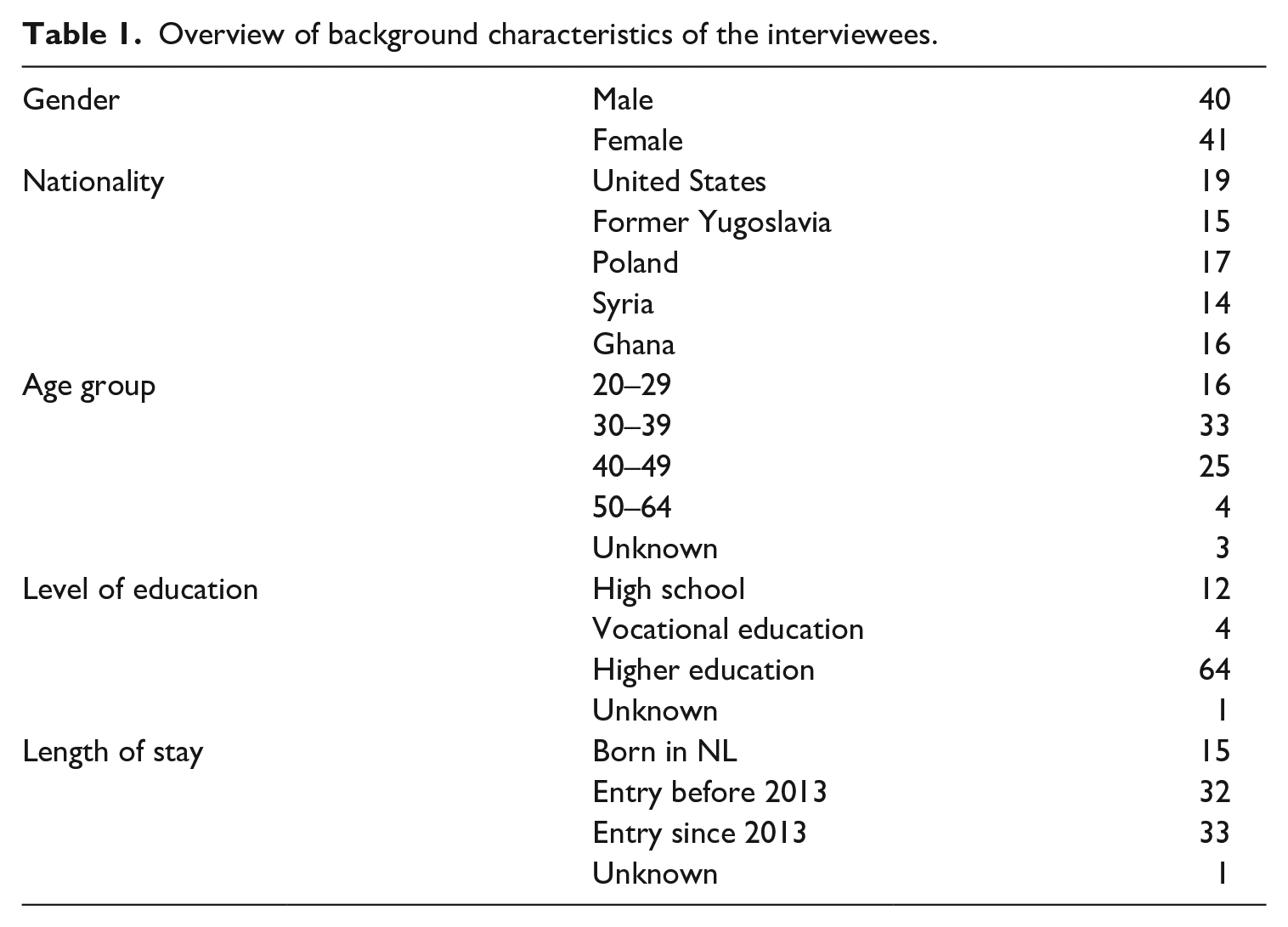
This article is based on 81 timeline interviews with entrepreneurs from different ethnic backgrounds (Ghanaian, Syrian, American, former Yugoslavian and Polish), including first- and second-generation migrants. This ties into the literature on ‘newcomer’ entrepreneurs, focusing on the migrant entrepreneurship of less well-established groups (Kloosterman et al., 2016). 4 See Table 1 for background characteristics of our interviewees. The interviews were conducted within a larger project studying the relation between legal migration entry regimes and entrepreneurial experiences in the Netherlands (De Lange et al., 2019). The ethnic backgrounds were chosen as they predominantly use different legal migration regimes: economic, family and asylum. Of the interviewees, 28 were small-scale business owners (employing less than five employees) and 53 self-employed workers, active in a variety of sectors, ranging from retail to jobs in creative industries, the care sector or hospitality. Both full-time entrepreneurs, with one or multiple business activities (so-called portfolio entrepreneurship or patch-working; Villares-Varela et al., 2018), and hybrid entrepreneurs, combining self-employment with waged employment or study (Folta et al., 2010), were interviewed.
Overview of background characteristics of the interviewees.
The interviews were conducted by peer researchers: interviewers who shared the cultural and linguistic background with the interviewees. The entrepreneurs with a migration background from the former Yugoslavia, for instance, were interviewed by a researcher from the former Yugoslavia (one of the authors). Peer researchers are able to quickly build up rapport, minimizing the time-consuming process of building trusting relationships with interviewees (Narriman Guemar and Hintjens, 2013). A disadvantage of using peer researchers is the possible lack of reflexivity due to the interviewer’s ethnic or highly educated lens (Amelina and Faist, 2012). To minimize this reflexivity bias, the target group was as diverse as possible, aiming for an equal gender balance, various entrepreneurial activities/sectors, entrepreneurs active in different geographical regions and of different ages. Bi-weekly debriefing sessions during which new observations, challenges and opportunities from the field were discussed with the authors, as well as among the peer researchers, offered the peers intensive guidance throughout the three months of fieldwork in 2019. These sessions also enlarged the authors’ first-hand and comprehensive knowledge of the experiences of migrant entrepreneurship and the importance of enablers.
The peer researchers established contact with the entrepreneurs primarily via informal channels (personal contacts and social media platforms) and used snowball sampling to recruit more interviewees. The interview guide used covered the following themes (derived from the literature on entrepreneurship enablers and constraints): labour market and entrepreneurial experiences, migration trajectories, the impact of formal and informal support structures and networks, access to finance, regulations and plans for the future. During the interviews, the peer researchers (often together with the interviewee) drew the timeline, highlighting important people, personal and societal developments. The interviews lasted one to three hours, were audio-recorded, transcribed verbatim, and – if needed – translated by the peer researchers. To analyse the interview transcripts and timelines drawn, the authors used thematic analysis because of its flexibility and suitability to order larger sets of qualitative data into broader themes. The data were first organized under the broad themes identified above, which were subsequently refined and substantiated with subthemes and categorizations (such as ‘embeddedness in professional networks’ or ‘persons of influence’ 5 under the higher-level code ‘role of social networks’). The coding process thus integrated both theory-driven and data-driven codes, identifying the importance of personal enablers, both in the presence and absence of institutionalized and informal sources of entrepreneurial support.
Findings
The role of personal enablers in migrant entrepreneurship
[How did the idea for entrepreneurship develop?] Actually, that was by accident. One of my friends opened a company and he started receiving letters from the tax authorities and he had no idea what it was about. He just called me and asked me if I could help him because I know some Dutch. I did this for him and some others for a few months. And then he just said: ‘Why don’t you go to the Chamber of Commerce – and open your own company and just start charging money for it? Because what you do is work.’ And that was exactly a moment when a lot of Polish people came to the Netherlands, starting their companies. I opened my company in 2005 and in 2006 and 2007 there was an explosion of those people. (Aneta, Polish, financial administrative services, 19 years in the Netherlands)
In Aneta’s story, the combined suggestions to start a business by people close to her and Poland’s 2004 accession to the European Union, were crucial to set her on an entrepreneurial path (Figure 1). In fact, entrepreneurship was nowhere on Aneta’s mind when she arrived in the Netherlands in 2000 to work as an au pair in the informal economy. Her friends’ suggestion and initial informal experience providing financial administration assistance to Polish acquaintances sprouted the idea for a business in financial administration services. The timing was ideal as Poland’s accession created a large Polish customer base in need of financial administrative assistance in the Netherlands.
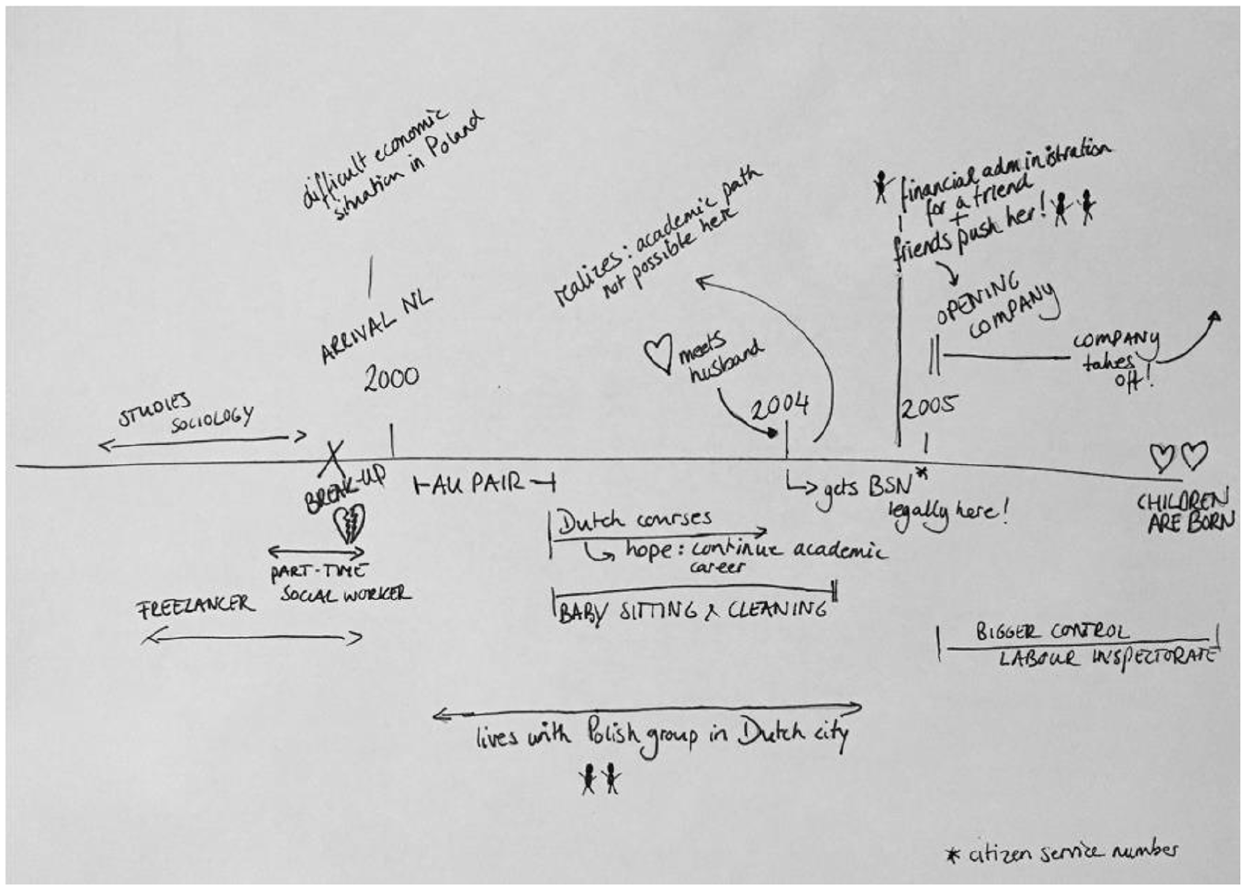
Timeline: Aneta, Polish, financial administrative services, 19 years in the Netherlands.
Both Aneta’s and Ebo’s stories, presented above, illustrate the importance of personal enablers in entrepreneurial trajectories (Deepali et al., 2017). Without the motivating suggestions and reassuring perseverance by these enablers (Wilbanks, 2013), neither Aneta nor Ebo would have become entrepreneurs. While differences in opportunities for entrepreneurship exist depending on migrants’ residency status, and other individual characteristics (such as length of stay, marital status, level of education, age, gender and occupation), our research showed remarkable similarities regarding the importance of personal enablers for migrants’ entrepreneurial endeavours. In every timeline interview, there is a personal enabler that supports or shapes entrepreneurship. Though the form and source of support needed and accessed varied between our interviewees, our aim here is not to disentangle group differences, but draw attention to the often-overlooked, yet remarkably similar, importance of personal enablers in shaping migrant entrepreneurship. 6
Where Ebo and Aneta needed encouragement, the benefit of enablers for others lay foremost in practical forms of business support. Even interviewees embedded in established (migrant) communities lacked practical business support; for example, interviewees from the former Yugoslavia related this lack of business support potential to the low propensity of entrepreneurship within the ex-Yugoslav community, where waged employment is more common (Bakker and Dagevos, 2017). For Ghanaian entrepreneurs, on the other hand, business experience was available within the ethnic community, but restricted to ethnic niche markets, leaving little support to break out of marginal entrepreneurship (Kloosterman et al., 2016). Our interviews with (Dutch-)Ghanaians echoed this finding and pointed to difficulties in accessing forms of institutionalized support, despite Dutch qualifications and familiarity with Dutch bureaucracy. In the face of this, entrepreneurial enablers from ‘weaker’ connections proved to be important to navigate complex bureaucratic systems, provide guidance in the way businesses operate, or assist in expanding one’s client base.
Mira, an American national with roots in the former Yugoslavia, engaged the help of an immigration lawyer for her residency application. Her lawyer not only helped with migration matters, he also gave Mira the confidence to start her business and occasional business advice. Farid, a Syrian national living in the Netherlands since 2015, took over the property lease of a supermarket (with source money from a relative) and shadowed the previous supermarket owner – Ali, a Dutch national with a migration background – for two months. Ali taught Farid how to deal with the municipality, taxes, the accountant and produce suppliers. Though Farid and Ali did not stay in touch, unmistakably, without this connection, Farid’s start as an entrepreneur would have been less smooth. Karam, a Syrian social entrepreneur, decided to start his business when he failed to find a job matching his professional experience in Syria. He enjoyed assistance from a municipal welfare programme for self-employment
7
and enrolled in a mentoring programme that matched him with a Dutch mentor. Interestingly, Karam noticed that Dutch clients were more likely to sign up when his Dutch mentor accompanied him on business meetings: To one of my business visits I went alone and the reception was a little colder than when I went together with my coach, who has 20-year experience in Dutch business. Although, this is not something that is testable, I feel that they [prospective clients] are more comfortable when there is a Dutch person with me. Therefore, I am thinking of having a Dutch partner with me in order to accompany me on business visits. (Karam, Syrian, 3 years in the Netherlands)
The mentor’s presence raised Karam’s awareness of needing a Dutch business partner. Other interviewees expressed similar concerns. Vlado, an internationally operating IT business owner, with parents from the former Yugoslavia, considered hiring someone with a Dutch-sounding name to prevent the prejudices and stereotypes he (with his Slavic name) encountered when engaging Dutch clients. Karam and Vlado in a way both indicated the need for a Dutch enabler to bridge the seeming lack of diversity in the Dutch business environment (cf. Eliasson, 2014).
The availability of municipal support programmes for entrepreneurship and refugee/migrant incubator programmes depends on migrants’ residency status (De Lange et al., 2019). Even when such institutionalized support was present, personal connections helped to capitalize on such sources of support, as their existence, let alone ways to access them, were often unknown (De Lange et al., 2019), explaining the limited use of formal support structures by migrants (Meister and Mauer, 2019; Stephens, 2013). Julia, a 30-year-old freelance Dutch language teacher from Poland – moving through various moments of solo self-employment and combinations of (part-time) waged employment and freelancing for the eight years she had lived in the Netherlands – was not aware of the special welfare facility for the self-employed, which Karam enjoyed as discussed above. During a period of unemployment, when Julia was on social welfare, a friend (a business owner himself) advised her to apply for it. Had it not been for the fellow entrepreneur, Julia would not have known of this facility, and, according to her, she would not have become the self-sufficient entrepreneur she is now. Another area where enablers were important is finance – a classical barrier to migrant entrepreneurship and generally overcome by sourcing start-up money from family or the migrant community (Kloosterman et al., 2016; Smallbone et al., 2003; Mung as cited in Zhou, 2004). Kwame, a Dutch-Ghanaian lawyer who had lived in the Netherlands for 31 years, was unable to secure a bank loan to finance his buy-in to a law practice. The loan was not granted because of his assumed heritage (the exact same business plan submitted at the bank by a white Dutch colleague was granted). Luckily for Kwame, he had a personal connection with another lawyer, who offered him a spot without a buy-in, and helped Kwame become a practising lawyer. Kwame’s experience is actually unusual: financial support sourced from colleagues, someone from the outer circle of contacts, is generally more difficult to access.
Thus, personal connections were important to set and help migrants on entrepreneurial paths: to capitalize on institutional support available (Julia), to bridge clientele to build and expand a business (Karam, Vlado), to secure financial start-up capital (Kwame), to gain business advice (Mira) and, early on, to inspire entrepreneurial thinking (Aneta). The duration of the enabling connection might be long-lasting (as in the case of Karam), contain a short intensive period (Farid and the previous business owner), or be of a more short-lived nature.
Short-lived chance encounters in the absence of entrepreneurial support structures
In the absence of institutionalized or informal networks to provide business support, the influence of ephemeral and chance encounters on shaping entrepreneurial trajectories increases. This echoes Gladkova and Mazzucato’s (2017) observations: when people lack financial means to source trustworthy information, the influence of chance on shaping people’s life trajectories increases.
As an EU citizen, Marek obtained the right to freely move and search for employment in other EU member states in 2007. Upon arrival in 2009, Marek found a job at a tomato production glasshouse via an acquaintance already working there. Marek, however, quickly searched for other job opportunities because of unpaid salaries and abominable accommodation facilities. Via a Polish job advertisement website for the Netherlands, he coincidentally connected with a Polish construction worker. Marek worked for this person informally, learning the particulars of the construction trade. After two years, he realized he had acquired enough knowledge of and professional contacts in the construction industry to work on his own and started his business in 2014. Marek’s susceptibility to an influential chance encounter was thus high during a period of unexpected unemployment shortly after his arrival in the Netherlands, which crucially shaped his entrepreneurial trajectory.
Chance encounters turned migrants towards different career trajectories. For Qasim, a former business owner from Syria, the choice of entrepreneurship was the preferred one (Figure 2). However, when Qasim pitched the idea of opening a restaurant to his municipal contact person, he was informed that his idea to open a restaurant ‘in a street full of restaurants’ was unlikely to succeed and was advised to find waged employment instead. If not for a chance encounter, the municipal dissuasion would have stopped Qasim pursuing his business idea: At that point, I didn’t want to open a restaurant but then I found this restaurant when I was walking in the street. I stopped and talked to the owner. This made me realize that I could start a business. I discussed it with my father and my wife and decided to go for it. (Qasim, Syrian, 4 years in the Netherlands)
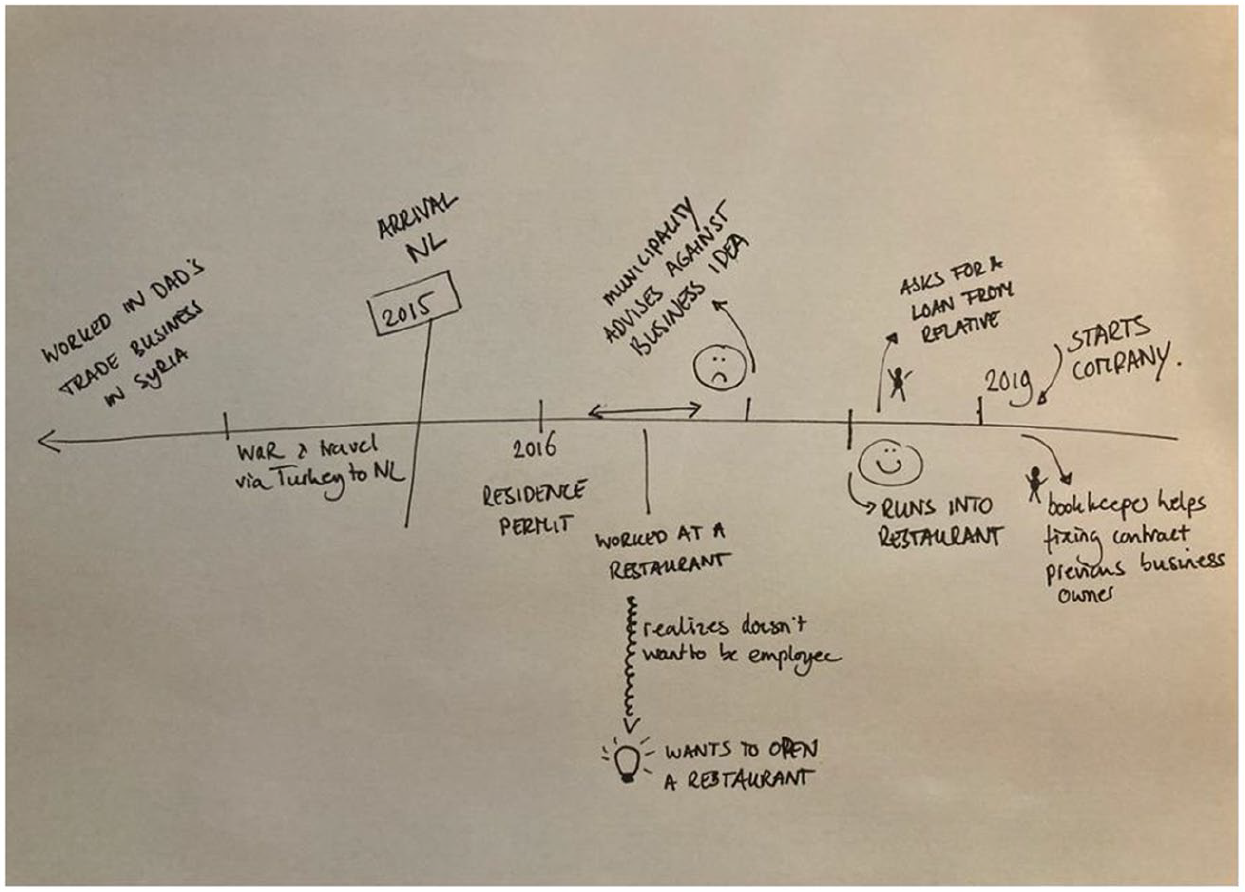
Timeline: Qasim, Syrian, restaurant business, 4 years in the Netherlands.
For Qasim, a coincidental encounter boosted again his previously paused business idea. For others, a chance encounter was only capitalized on later, when it suited personal and career developments. This was exemplified in Lara’s story. For Lara, a Dutch national born to parents from the former Yugoslavia, who moved to the Netherlands in the 1970s to work, the initial idea to become self-employed was born years before she actually ventured into freelancing. Lara was personally invited to start as a freelancer with a company when she still held a public service job. At that time, she declined the offer out of doubts about the insecure status of self-employment. Only years later, after a bout of unemployment and having become a mother, Lara decided to reach out to her contact and start freelancing. At that point in time, Lara was unable to find suitable waged employment, and therefore mobilized her previous short-lived personal business connection to change towards an entrepreneurial career (cf. Anthias and Cederberg, 2009).
Where the entrepreneurial path was chosen by Marek, Qasim and Lara for economic reasons, others turn towards self-employment for non-work-related reasons. The American Susan, for instance, was contemplating ways to be closer to her daughter and grandchildren in the Netherlands. When she visited her family, she coincidentally met an American entrepreneur on a bus who told her about the existence of an entrepreneurship visa for Americans. 8 Susan’s chance encounter thus came at a time in her life when she was contemplating the possibility to move countries, and possibly change careers, which she eventually did. These stories illustrate that an influential encounter that enables entrepreneurship relates to moments in life when openness to change is higher and to a lack of institutionalized sources of business support (Bandura, 1982; Chen, 2005).
Communities of support for migrant entrepreneurship
Experienced lack of (accessible) entrepreneurial support motivated some migrants we interviewed to offer such support themselves to fellow (aspiring) entrepreneurs. Some migrants developed small-scale initiatives to form communities of support, similar to the ‘communities of practice’ established by some incubator programmes (Apa et al., 2017). Aneta, the Polish financial administrative services provider introduced earlier, helped out fellow entrepreneurs by providing business advice stretching beyond her financial administration expertise. Zlatko, a healthcare professional from the former Yugoslavia, started an advisory bureau to help people from the ex-Yugoslav community. He recalls helping an elderly woman get accepted into a care home, and helping people to access welfare or benefits, to obtain residency permits and navigate Dutch culture and practices. Likewise, Magda, a former beauty salon owner from Poland, managed to turn her own struggle with Dutch realtors to secure business space into a business opportunity for fellow entrepreneurs. She offered joint business space for other Polish people, saving them the trouble of dealing with prejudiced (Dutch) realtors when starting out a business venture. This goes to show that the support offered by entrepreneurial migrants can sometimes be more insightful into the needs and wants of ethnic and migrant entrepreneurs in general.
Where some turned their entrepreneurial experience into a business, others became inspirators for potential entrepreneurs. Kofi, a Dutch-Ghanaian retail entrepreneur, decided to take a supportive and advisory role himself, exactly because of the general lack of accessible formal support and mentoring he experienced when developing his business (Figure 3). To do so, he gave talks at ethnically diverse high schools about his business development, providing practical information and inspiration. By acting as an inspirator for youth, Kofi hoped to set an example of the possibility of another career trajectory.
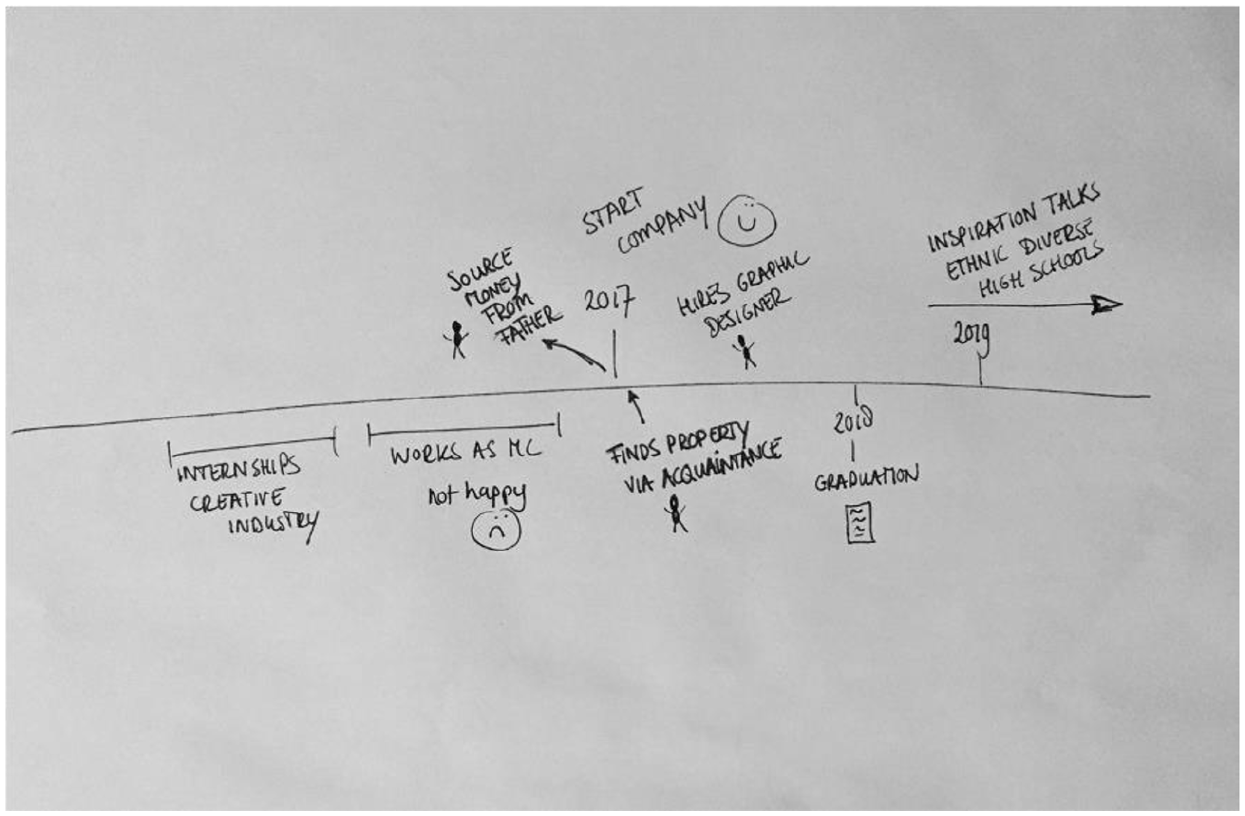
Timeline: Kofi, Dutch-Ghanaian, retail, born in the Netherlands.
The cross-over effects of ethnic business communities offering business and social support has been shown. Anthias and Cederberg (2009) described examples of a Greek Cypriot family business that turned into a social hub for mainly older men from the ethnic community, as well as a Turkish family business located in a neighbourhood where many Turkish people live and socialize. Similarly, a Polish small-scale retail business owner we interviewed hosted regular meet-ups for Polish as well as non-Polish people at her shop. These get-togethers functioned as social events, where attendees also built up more-than-professional relationships, turning her shop into a social and potential business hub. Similarly, Julia, the freelance Dutch teacher, created her own community of support with two other freelance teachers, Polish and Dutch nationals. They shared clients among each other, and one of them also advised Julia on the tariffs she should ask for. On top of that, the personal relationships they developed contributed to a more comfortable working sphere. We noted more examples of such communities of support migrants established via previous professional and personal connections, where knowledge and experience is shared to help each other out in business and beyond.
Discussion and conclusion
This article explored the underexamined role of personal enablers in migrant entrepreneurship. Combining insights from entrepreneurship literature on entrepreneur enablers with insights from migration trajectories on the relevance of fleeting and lasting support dynamics, this article refines existing literature on agency and migrant entrepreneurship (Anthias and Cederberg, 2009; Cederberg and Villares-Varela, 2019), stressing the important role of personal enablers to capitalize on existing (social) resources and support structures for migrant entrepreneurship. Drawing on timeline interviews, the analysis highlights the value of personal enablers in migrants’ entrepreneurial trajectories over time, ranging from coincidental or ephemeral encounters to the development of supportive communities. This therefore adds a dynamic and agentic perspective to migrant entrepreneurship literature that, with its emphasis on structural determinants, downplays the importance of individual agency and oversees the potential significance of ephemeral and chance connections for entrepreneurial trajectories.
In the absence of institutionalized or informal sources of business support, opportunity arises for personal connections to have defining influences on migrants’ entrepreneurial trajectories. Given this absence, chance encounters and community development are two forms of network connections that are particularly important in migrants’ entrepreneurial decision-making and business development. Such entrepreneur enablers develop migrants’ ideas to become self-employed, often against the grain of their own, their inner circle of contacts and wider societal expectations. Like in other studies, some of our interviewees engage with enablers associated with entrepreneurship support organizations (Ratinho et al., 2020; Thompson and Downing, 2007), some specifically targeting the needs of migrant/refugee entrepreneurs (Harima et al., 2019; Solano et al., 2019). The interview material shows the need for entrepreneur enablers to access such formal programmes, and the often-critical importance of personal connections and interaction between an (aspiring) migrant entrepreneur and a specifically assigned mentor or a randomly encountered bureaucrat on how entrepreneurial trajectories develop. Thus, this study refines existing insights on the role of informal and formal entrepreneurship support structures for migrant entrepreneurship (Apa et al., 2017; Kloosterman et al., 1999; Stephens, 2013), showing the additional relevance of coincidental and ephemeral encounters as well as the development of personal communities of entrepreneurial support.
Entrepreneur enablers further help migrants overcome the adverse effects of a business environment that lacks diversity (Eliasson, 2014) and to ameliorate discriminatory practices (cf. De Lange et al., 2019; Rafferty, 2019). Such obstacles combined with lack of accessible institutionalized business support prompts some migrants to hire or collaborate with a Dutch person to act as an intermediary with the local business environment, yet motivates others to develop supportive communities themselves. Where the literature highlights the bridging quality of mentorship programmes and its mentors (Solano et al., 2019), our study accentuates the added value of mentorship by fellow migrant entrepreneurs, whose experience may help aspiring migrant business owners in other ways. This underscores the benefit of diversity within government bodies and private agencies engaging with migrant entrepreneurs, a practical and policy implication of our research.
These findings provide at least four suggestions for actors involved in designing (migrant) entrepreneurship support programmes. First, attune support structures to the differential needs and interests of migrants in different stages of business development. Second, engage people with both a migrant and an entrepreneurial background in business support. Third, facilitate the development of peer-support structures in the start-up phase as well as later stages of business development. Fourth, support programmes would ideally not only be available for newly arriving refugees or migrants in welfare programmes, as entrepreneurship may also be a valuable career move for (migrant) employees.
The sample size and time frame of this study limit the ability to further disentangle the extent to which our findings are migrant-specific, or that these support dynamics are relevant to entrepreneurs in general or differ according to entrepreneurial background. This calls for comparative research among different groups of entrepreneurs with and without a migration background, with varying lengths of residency and different embeddedness in (ethnic or business) communities, to further unravel how entrepreneurial trajectories are shaped by personal connections, characteristics and developments, as well as broader societal changes.
Footnotes
Acknowledgements
We would like to thank our peer researchers and our interviewees for their participation in this research project and the anonymous reviewers for their helpful feedback.
Funding
The authors disclosed receipt of the following financial support for the research, authorship, and/or publication of this article: The research was funded by Institute Gak.
