




Abstract
How do women from the one-child generation make fertility choices and negotiate work–family relationships under the two-child policy? I address this question by using 82 in-depth interviews with siblingless women from the first one-child cohort. This study unifies Gerson and Peiss’s and Kandiyoti’s conceptual frameworks on boundaries and gender strategies but adds a new dimension of self-worth. The data reveal three different fertility strategies: rejection, acceptance and procrastination, each representing different negotiations with patriarchal boundaries and assessment of self-worth. In particular, the findings highlight how the patriarchal tactics – within the state, the workplace and individual families – are coordinated and transformed into widely available discourse on fertility duties, meritocracy and productivity, thus maintaining rigid patriarchal boundaries across private and public spheres. Rather than being subservient to multifaceted patriarchal power, women strategise to evaluate and validate their competing work–family identities through the language of moral, financial and/or status worthiness.
Keywords
Introduction
Studies of the impact of China’s one-child policy, which extended from 1979 to 2015, have largely focused on the adolescent years of children without siblings and their educational experiences (Fong, 2004; Hu and Shi, 2018; Kim et al., 2014), thus providing a very foreshortened life-course perspective. Sociologists specialising in gender, focus on the implications of the one-child policy for women’s fertility rights or life opportunities (Fong, 2004; Kim et al., 2014). Demographic research has used large datasets and a quantitative approach to examine the effects of the demographic policies on population trends, gender ratios and fertility patterns in China (Greenhalgh, 2012; Hu and Shi, 2018; Qian and Jin, 2018). Thus, we have little information about the effect of the two-child policy on women in the one-child generation and the impact of this shift on their decisions regarding care work and wage work.
Women in China have experienced both tremendous opportunities and increasing challenges since the implementation of the one-child policy in 1979. Education opportunities expanded massively during the past three decades (Kim et al., 2014; Tsui and Rich, 2002), and participation in tertiary education rose to 50% in 2013 among one-child generation women (Liu, 2017). Meanwhile, China’s economic transition from a labour-intensive ‘world’s factory’ to its new role as a technology-oriented industrial powerhouse has created a growing demand for skilled labour (Berik et al., 2007; Liu, 2017). However, despite China’s many advancements in industrial and technological development, a number of factors, some long-term and others more immediate, constrain young women’s opportunities. The persistent patriarchal culture, lack of adequate employment rights and protections since the Reform era, and intensified competition between men and women in the labour market have made women vulnerable (Attané, 2009; Cao and Hu, 2007; Shu et al., 2012; Zhang and Hannum, 2015). Specifically, weak legal protections for maternity rights and limited childcare provision impose a penalty on mothers (Ji et al., 2017; Qi and Dong, 2016; Qian and Jin, 2018).
The dramatic end of the one-child policy in 2015 and the subsequent introduction of the universal two-child policy has injected complications into the lives of the first cohort of women from one-child families, who were born in the 1980s. More educated than their predecessors but facing uncertainty post-Reform, they now have the opportunity denied their mothers: to have a second child. What implications does the prospect of a second child have for these women of prime employment age? To address this question, this research explores the position of women from the first one-child generation, focusing on their fertility choices and work–family trajectories from a qualitative, life-course perspective.
Work-family conflicts, boundaries, gender strategies and self-worth
Sociological research across different contexts evinces an enduring interest in gender, parenthood and work-family conflicts (Blair-Loy, 2001; Bolak, 1997; Collins, 2019; Dotti Sani and Luppi, 2020; Gerson, 1985, 2010; Hochschild, 1989). Scholarship focusing on macro-level gendered employment outcomes suggests that women’s childcare responsibilities are linked to greater wage reduction, lower earning potential, fewer career prospects and greater lifelong earning loss compared to men in both developed and developing countries (Agüero and Marks, 2011; Budig et al., 2012; Dotti Sani and Luppi, 2020). However, institutional support and state policies, such as flexible working hours or days, gender equality legislation, maternity and paternity leave, and publicly subsidised childcare greatly affect the extent of the motherhood penalty (Budig et al., 2012; Collins, 2019; Dotti Sani and Luppi, 2020).
Sociologists have also investigated a range of individual-level factors, such as parenthood expectations, gender attitudes, employment aspirations and their implications for the persistent reproduction of gender inequality in the labour market (Bass, 2015; Pedulla and Thébaud, 2015; Stone, 2007). Some scholars use cultural schemas to analyse gender strategies to mitigate conflicts between motherhood and women’s employment (Blair-Loy, 2001; Ridgeway, 2011); these include ‘opting out’ (Stone, 2007) or having an egalitarian Plan A and a neo-traditional fallback Plan B (Gerson, 2010). Other studies focus on different patterns of shifting gender role attitudes associated with parenthood, employment opportunities and constraints. For instance, some scholarship identifies a pattern of cognitive dissonance between attitudes and practices, arising from the translation of prenatal gender-role traditionalism/egalitarianism to postnatal arrangements, in relation to mothers’ employment, earnings and education (Schober and Scott, 2012; Zhou, 2017). By contrast, other studies show a pattern of alignments between husbands and wives in terms of their gender attitudes towards care responsibilities and women’s paid employment, which illustrates a cognitive process of editing and modification of attitudes and behaviour associated with parenthood (Hochschild, 1989; Kalmijn, 2005).
Despite the rich insights that these literatures have provided on gendered work-family conflicts across different contexts, scholarship has not presented systematic examinations of the interplay between state policies, gender strategies and consciousness in Work-family relationships. Research on transitional societies like China, where the state’s top-down demographic experiments such as the one-child and two-child policies have massive impacts on women’s life chances and work-family trajectories, has been particularly thin. Addressing this gap, the current study will develop a unified conceptual framework of boundaries, gender strategies and self-worth. My theoretical framework is firstly informed by Gerson and Peiss’s (1985) conceptualisation of boundaries, processes of negotiation and domination, and consciousness and secondly by Kandiyoti’s (1988) theory of patriarchal bargains.
To analyse gender relations, Gerson and Peiss (1985) propose a concept of boundaries to replace the private/public dichotomy. Boundaries capture a variety of ‘physical, psychological, social, and ideological structures’ from which ‘differences and commonalities between men and women, among men and among women’ emerge (Gerson and Peiss, 1985: 317). Boundaries have two distinctive conceptual qualities which apply to gender relations. First, they mark the rigid nature of gender-based codes and rules at micro- and macro-level structures. Second, they allow us to recognise dynamic gender relations and lived experiences which are shaped and changed by social interactions. In turn, how women negotiate and interpret gendered relationships within individual families, in the labour market and with the state affects how boundaries are established, maintained and shifted.
Kandiyoti further extends Gerson and Peiss’s framework to conceptualise patriarchal boundaries as marking and naturalising patriarchal power over women at macro-, meso- and micro-levels (1988). These variants of patriarchal boundaries across social, psychological and ideological structures create multifaceted constraints as well as opportunities for women to strategise (1988). Both theories identify processes of negotiation with persistent patriarchal coercion to maintaining or contesting patriarchal boundaries and acknowledge a variety of strategies that women utilise to bargain for opportunities, resources and security.
Moreover, both theories highlight the importance of gender consciousness, which both reflects negotiations with multifaceted patriarchal boundaries, and affects the processes of negotiation and influences women’s choices. These conceptual perspectives are particularly helpful in examining women’s employment opportunities, fertility choices and family formation as interlinked and dynamic processes. However, they do not identify markers of gender consciousness or the processes of its development or recession. This is perhaps because gender consciousness is often invisible and highly subject to structural and contextual conditions as well as individual experiences. Neither conceptual framework provides adequate analytical tools to locate the ‘agent’ to which gender consciousness is attached. Thus, I introduce the concept of self-worth, which unifies boundaries and strategies, to address this conceptual weakness.
Worth is a crucial concept to make sense of how individuals draw symbolic boundaries, through which they generate feelings and evaluate status. Some defining sociological works highlight that worth is deeply embedded in individuals’ or group consciousness and is used as a powerful cultural tool to give recognition and misrecognition to in- and out-group cultural membership (Lamont, 1992, 2000; Silva, 2019). Lamont (2000) famously investigates the similarities and differences between how American and French working-class men validate their self-worth using a variety of moral values. Silva (2019) explores working-class people’s use of available moral codes to confer dignity and self-worth when the coal industry no longer offered the means to earn a living. With few socioeconomic and cultural resources, Silva’s study participants highlighted their experiences of poverty, war injuries and chronic illnesses to distinguish themselves, morally, from imagined others.
By unifying Gerson and Peiss’s and Kandiyoti’s frameworks with the concept of worth, I develop a conceptual map of boundaries, gender strategies and self-worth (Figure 1). This conceptual map helps us to analyse how young Chinese women live and feel gender inequality as they negotiate fertility choices and balance career prospects. This framework allows us to navigate the complexities between women’s fertility choices and strategies in light of the two-child policy through the investigation of private and public boundaries as well as patriarchal boundaries at home, in the workplace and between the state and individual families. More importantly, it allows women’s voices and strategies to emerge from the negotiations with different levels of patriarchal power and assessment of self-worth.
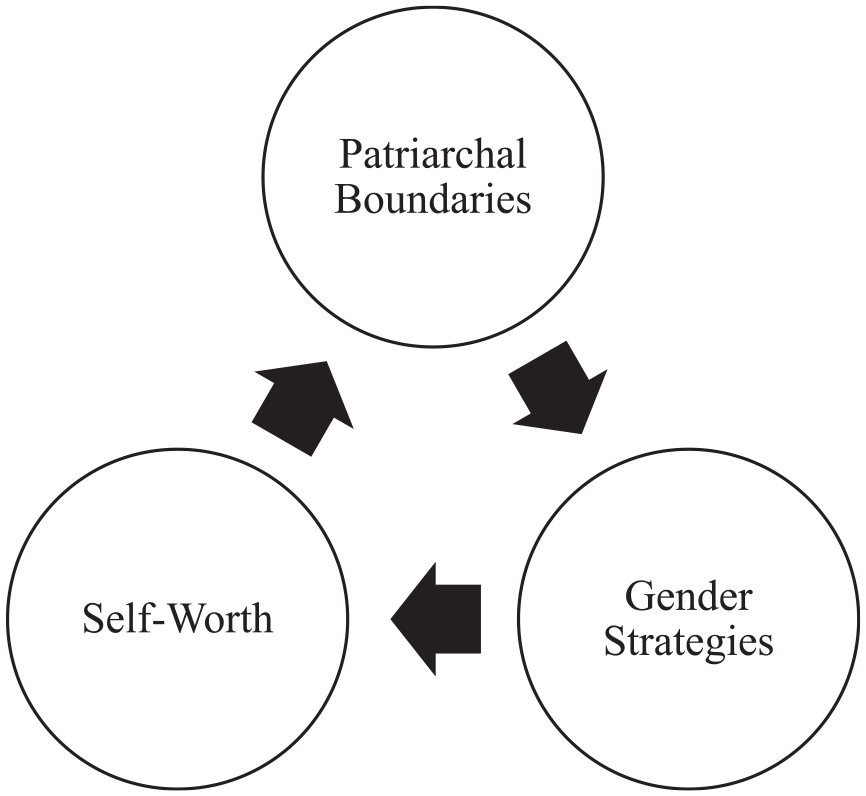
A conceptual map of patriarchal boundaries, gender strategies and self-worth.
The Chinese context
The vast majority of literature on gender, work and family transitions in China takes either modernisation or the cultural perspective of Confucian patriarchy as its theoretical point of departure. In the former category, scholars have focused on the impact of the economic transformation that began in the 1980s and the implications of changing patterns of labour force participation (Ji et al., 2017; Jia and Dong, 2013; Shu et al., 2012; Zhang and Hannum, 2015). Qualitative studies link market-oriented reforms at the macroeconomic level to gender segregation in the division of labour and widening of the pay gap (Berik et al., 2007; Ding et al., 2009).
Quantitative research shows that China’s market reform has exacerbated gender inequality (Attané, 2009; Ji et al., 2017; Zhang and Hannum, 2015). Between 1990 and 2005, women’s annual income decreased by 21.7–22.4% (Jia and Dong, 2013). Likewise, the gender pay gap increased from 18% in 1991 to 35% in 2009 (Zhang and Hannum, 2015). The arrival of children exacerbates women’s disadvantage; Jia and Dong (2013) find that the employment rate for women with children under three years and under six years of age decreased, respectively, from 89.2% to 56.6% and from 90.3% to 77% between 1990 and 2005.
Research from the cultural approach explores the extent to which Confucian patriarchal norms and values still influence women’s fertility choices and work–family transitions. Confucian patriarchy refers to persistent female subordination in both natal and conjugal families (Kandiyoti, 1988; Shu et al., 2012). The associated male superiority is limited in the private sphere; however, the hierarchy privileging male and older individuals is central to Confucian patriarchy, which is used to analyse the complexity of gender relationships arising from fertility choices and work–family transitions in the modern context.
Recent scholarship has highlighted the persistent cultural norm of male domination and its implications on family dynamics (Ji et al., 2017; Qian and Jin, 2018; Shen and Jiang, 2020; Shu et al., 2012; Zhang and Hannum, 2015; Zhou, 2019). For instance, married women from dual-income families employed by state-owned enterprises (SOEs) have perceived voluntary redundancy as a necessary sacrifice to protect their husbands’ job security (Cao and Hu, 2007), which suggests, in line with Confucian virtues, they prioritise their husbands’ honour over their own (Berik et al., 2007). Evidence suggests the traditional patriarchal norm of husbands serving as the main breadwinners made a comeback in which ‘men attend the outside and women attend the inside’ after the market reform (Cao and Hu, 2007; Ji et al., 2017).
Focusing on both the economic rationale and on the persistent patriarchal values and norms provides rich insights on the changing nature of gender and work-family trajectories. However, both have limitations. They do not generally specify the age cohorts in terms of employment opportunities, which leaves questions about women from the one-child generation born after 1979 and their labour market opportunities and constraints before and after the end of the one-child policy. Likewise, market logics and traditional values both suggest they might be particular sources for self-worth, including for women, but we do not know how individual women assess their values in relation to the work–family conflicts. Neither do we know how women negotiate strategies which might mitigate gender disadvantages arising from maternity leave, childcare and fertility choices, or how the processes of gender consciousness facilitate or hinder further boundary-shifting. Scholarship has not reflected women’s own perspectives on their struggles and strategies.
To fill the gap in existing research, the present article uses a conceptual map of boundaries, gender strategies and worth to investigate women from the first one-child generation and their fertility choices and work–family relationships. In so doing, it highlights two important life events – the introduction and the end of the one-child policy during their life trajectories. The former marks them as the first experimental cohorts of the demographic policy, and the latter occurred during their prime employment years. By situating work–family transitions in the life-course trajectories, this article examines the stories of women from this unique generation managing work–family conflicts. This article explores three questions: (1) How has the universal two-child policy affected these women’s work–family relationships? (2) What strategies do they develop to address work–family conflicts relating to the new fertility opportunities? (3) How do they assess their self-worth in their multiple roles as wives, mothers, daughters (in-law) and career women?
Methods and data
This article reflects an 18-month field study in Beijing, Shanghai and Nanjing between 2017 and 2018. Semi-structured in-depth interviews allowed me to trace the interviewees’ unique life events, from a siblingless upbringing to later work–family transitions, and to allow their different stories to emerge regarding the transition to the two-child policy. In-depth individual interviews were used to give voice to this unique cohort of siblingless women and help to explore their strategies and consciousness on their own terms.
Data for this article consist of 82 in-depth individual interviews with women born between 1980 and 1987. Table 1 provides a summary of the respondents’ employment status, employment sectors, marital status and the socioeconomic and demographic details of the sample. The preponderance of married (91.4%) and full-time employed (89%) women aligns with the general marriage and employment rates among women aged 30 to 39 (Davis and Friedman, 2014). Interviewees were also spread fairly evenly across a range of employment sectors. The characteristics with respect to educational attainment and the proportion from professional families are consistent with findings from previous research on women from one-child families (Hu and Shi, 2018; Kim et al., 2014).
A summary of interviewees’ socioeconomic and demographic details (N=82).
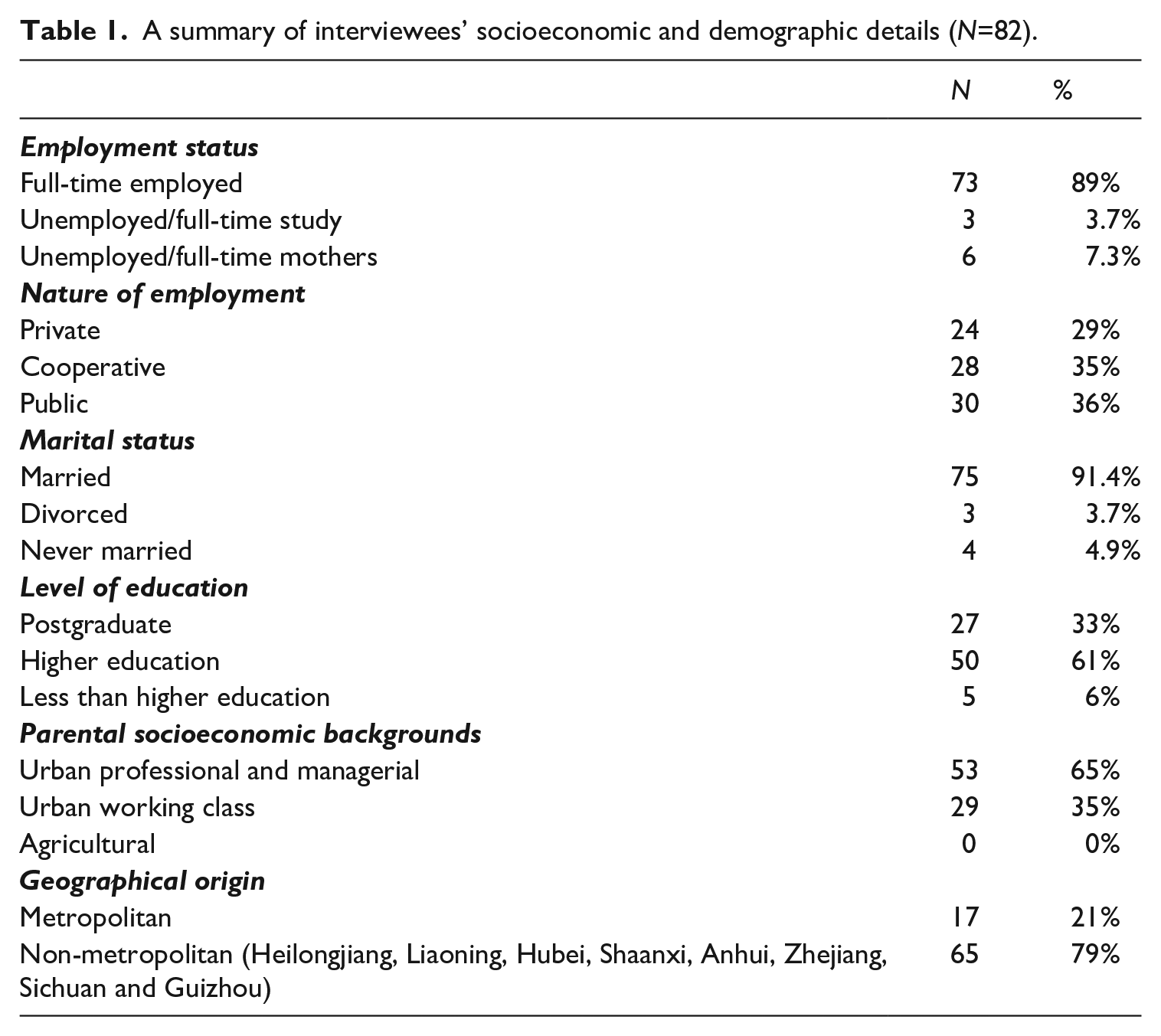
Beijing, Shanghai and Nanjing are my primary research sites because the young people in these cities were born and raised in a wide range of provinces, as many young migrants come to these cities for university and stay for the employment opportunities, quality of schooling and health care, and the varied cultural life available (Hartog et al., 2010). For example, non-Beijing natives accounted for around 37.9% of the total permanent population of Beijing in 2015 (Beijing Municipal Bureau of Statistics (BMBS), 2016). Participants with non-metropolitan origins came from eastern, central and western provinces (Table 1).
I recruited my respondents mainly from two channels. First, I used social media websites and applications such as WeChat to search for the eligible research population. I posted a research recruitment advertisement titled ‘Only-Child Girls Born between 1980 and 1987 and Their Reflections on Life and Family’ 八零后(80–87)独生女的生活和家庭的调查 on WeChat on 8 March 2017. This research advertisement was subsequently circulated via several social media outlets. Second, I visited various department stores, nail salons and restaurants to search for potential interviewees in each of the three cities. The first approach was the most effective; I ultimately obtained only two participants by in-person recruitment.
Following my university’s issuance of formal ethical approval on 24 February 2017, interviews began; they lasted approximately 2.5 hours each. I conducted all but four interviews in person, in a public place chosen by the interviewees, generally restaurants and cafés close to their homes or workplaces. Interviews were digitally recorded with the permission of the respondents and were transcribed in Chinese. This study was conducted in full compliance with the research ethics codes and practices established in my university’s Research Ethics Policy. Personal identifiable characteristics were removed; the data were anonymised through pseudonyms and number codes.
Interview questions related to education experiences, transitions to work, marriage and parenthood. The analysis began with three stages of coding. First, I applied open coding to identify the trends in the interview transcripts by closely following the words and phrases the interviewees used. I focused on identifying the patterns of interviewees’ natal family–education–work paths, which marked significant personal junctures in their life-course transitions. The second round of coding involved identifying the incidents that represent clashes and compromises with patriarchal power in these patterns. In the final round of coding, I extended the conceptual map of gender strategies and self-worth to analyse how interviewees articulated these different strategies through the language of moral, status and financial worth.
Findings
Figure 2 summarises the key findings by using the conceptual framework of patriarchal boundaries, gender strategies and self-worth. First, patriarchal domination is fleshed out through naming of common tactics at three different levels. The two-child policy has provided an all-encompassing patriarchal fertility discourse which resonates with the deeply rooted Confucian culture of family reproduction on the one hand (Wang and Hesketh, 2019) and Socialist citizens’ rights and responsibilities on the other hand (Zhou, 2019). This patriarchal fertility discourse provides a new territory for the state’s control of family reproduction.
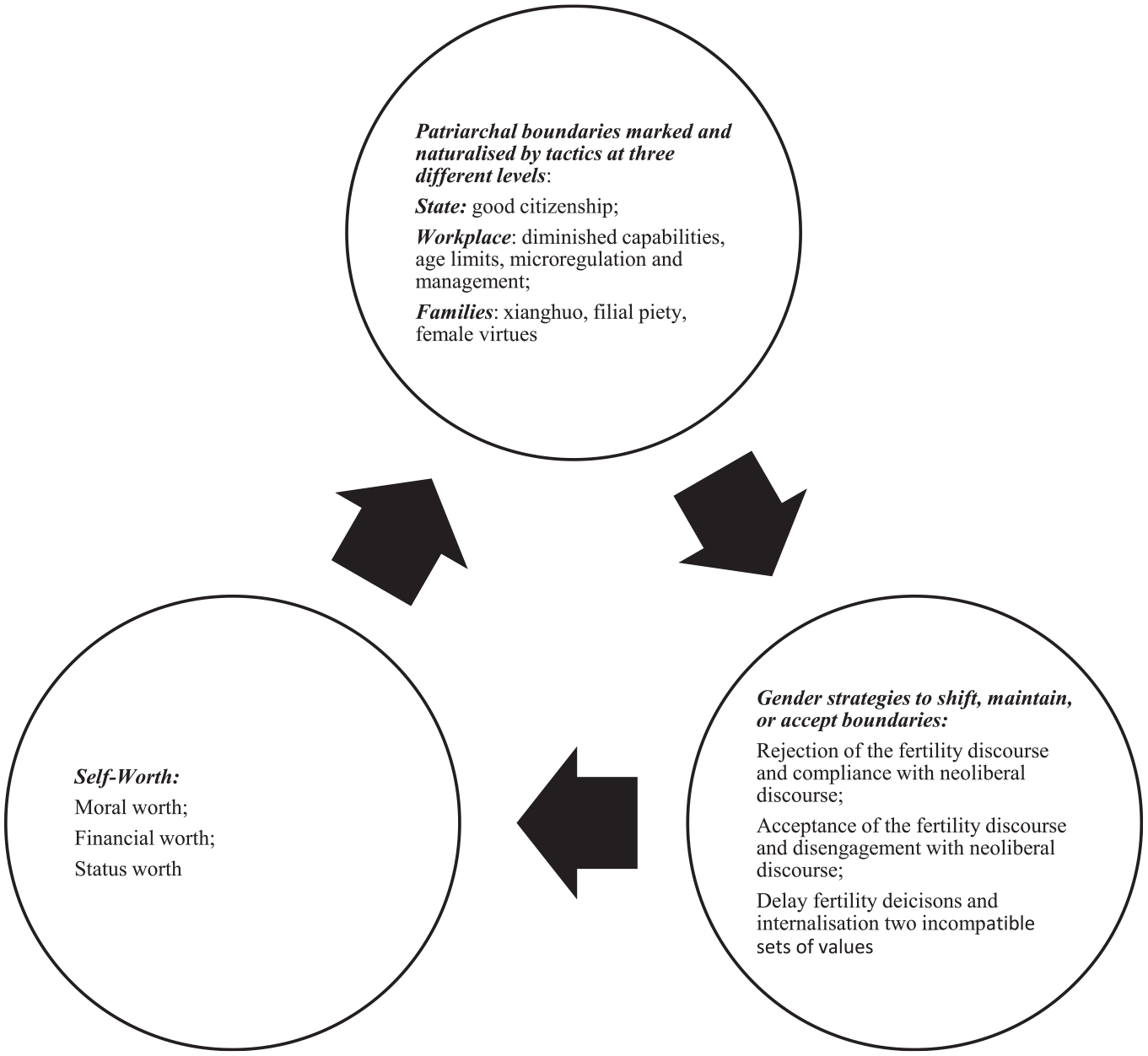
Patriarchal boundaries, gender strategies and self-worth in China.
In the workplace, my respondents shared common narratives regarding the enduring influence of the motherhood penalty on their careers. Many described a ‘pregnancy queue’ whereby their employers seek to prevent multiple workers from taking maternity leave at once, a lack of career progression opportunities, and open discrimination and discourse on diminished capabilities associated with their pregnancies and child-rearing. These workplace patriarchal tactics – diminished capabilities, age discrimination, micro-regulation, and management of maternity and post-maternity-related work conditions – demonstrate how the neoliberal discourse of competitiveness, efficiency and productivity (Liu, 2007) along with the meritocracy discourse (Liu, 2016) are woven systematically into employment practices. The result is gender discrimination in workplace cultures. At the individual family level, patriarchal values of the xianghuo 香火 (the reproductive responsibility to have male offspring), filial piety and female virtues shape participants’ strategies of managing work–family conflicts. I began by identifying three fertility strategies and then extending the conceptual framework to analyse how they represent different approaches of boundary maintenance or shifting and how the language of self-worth justifies different and sometimes contradictory rationales.
Three fertility strategies – acceptance, rejection and procrastination
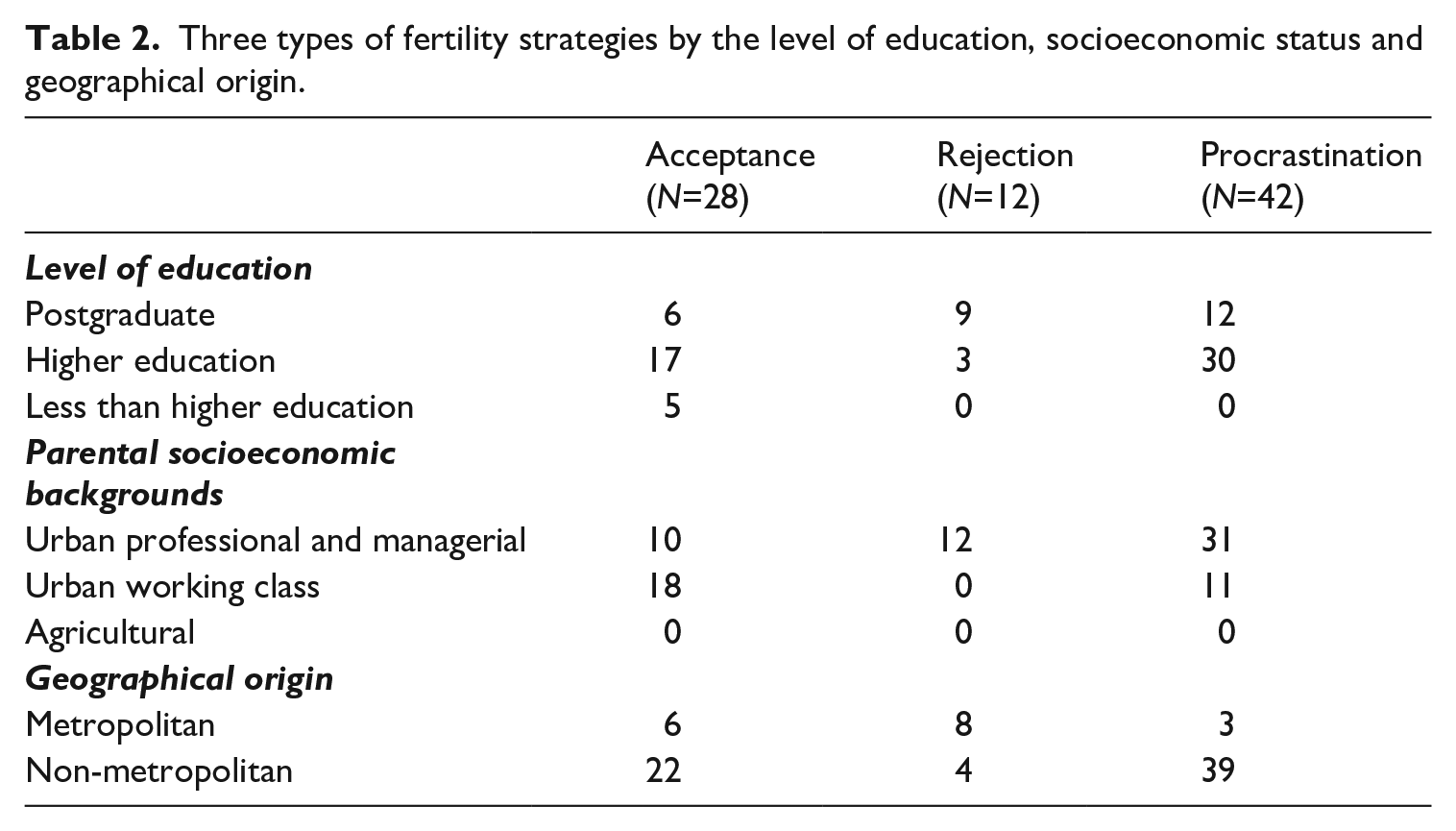
Based on the qualitative analysis of my respondents’ narratives, I constructed a typology of three strategies by which participants consider, negotiate and decide whether to have a second child (Table 2). These strategies include an acceptance of patriarchal fertility discourse (N=28), a rejection of the fertility burden (N=12) and a procrastination strategy (N=42). Different rationales underly each of these strategies, and their processes of development were highly complex, as the respondents often mobilised competing and sometimes contradictory logics to make sense of their work–family relationships and their identities as mothers, wives and professionals. I first discuss these strategies in detail.
Three types of fertility strategies by the level of education, socioeconomic status and geographical origin.
The first strategy concerns the way some respondents accept and accommodate patriarchal fertility discourse. Among them, 12 had already had a second child, and 16 respondents were trying or planned to get pregnant in the next 12 months. Most of these 28 mentioned ‘reproductive responsibilities’ as the core of their primary identities as mothers, wives and daughters-in-law, and they considered their identities as professional or career women secondary. They described broad benefits associated with their fertility decisions, such as ‘combating the loneliness of only children’ and ‘improving family dynamics’. The acceptance of the fertility discourse allows these women to further consolidate their status associated with their ‘female virtues’ and identities as a ‘good mother’, a ‘virtuous wife’ and an ‘obedient daughter-in-law’. Nonetheless, they expressed contempt for persistent gender discriminations and exclusions in the workplace.
Another group, the ‘rebels’, resisted the pressure of the two-child policy. Instead of a second child they planned to seek a ‘second spring’ in their careers – a season of renewal. For these women, their external identity as professional career women has greater meaning than their roles as mothers, wives and daughters-in-law. Rebels from modest socioeconomic origin, they mollified their husbands, rejecting fertility commitments as ‘rich people’s choices’. Those from privileged families mobilised their kin support, financial assets and social capital to resist patriarchal fertility pressure. Their seemingly rebellious fertility decisions also illustrate how they internalised gendered stereotypes and neoliberal discourse of competitiveness and efficiency in the workplace.
The last strategy is a delay of fertility decisions. Respondents who employed this strategy were torn between fertility commitments and career ambitions. Having had one child in their late 20s or early 30s, and having resettled into their jobs after maternity leave, the two-child policy came at a critical junction of their career trajectories. Weighing irreconcilable demands between a competitive career prospect and family commitments, many chose to delay their fertility decisions.
The three strategies regarding a second child seemed to be different and contradictory; yet each one was validated by coherent narratives on maintaining or shifting patriarchal boundaries at home and in the workplace through the language of self-worth. The next section explores how patriarchal boundaries are negotiated or contested across different lines of moral, socioeconomic status and self-worth.
Boundary maintenance and moral self-worth
The narratives on the acceptance of fertility responsibilities emphasise self-worth through moral values of female virtues as well as negotiating status and financial rewards at home to compensate for a lack of career recognition. For some respondents, this fertility commitment was a ‘golden opportunity’ to elevate their status as wives and maximise their demands, in line with the Chinese saying that ‘mothers’ honour increases as they have sons’. The second pregnancies, which women acknowledged were associated with ‘personal sacrifices’ such as ‘stretch marks’, ‘speedy ageing’ and ‘withering beauty’, allowed them to negotiate concessions from their husbands and prove their self-worth. These concessions were wide-ranging, such as their husbands’ commitment to an equal share of childcare and family work, becoming legal ‘co-owners’ of their husbands’ family properties and receiving gifts such as ‘a new luxury car’ or ‘a new designer handbag’. Having a second child also gave women bargaining power in winning financial and childcare support from their husbands’ families.
Conforming to patriarchal codes of female virtues at home is often a consequence of a lack of career development opportunities in the workplace. Binger Chai was 35 and her first child was a girl. She was planning to have another child, in part, she said, because she sensed she had reached a ‘career ceiling’ in her large cooperative company: There is a saying: ‘Women peak in their careers at the age of 35’. It is not possible to be in the top management team; they are all men like a fraternity group. I am sick of competitions. It’s time for me to concentrate on my family. At least I make my husband and his family happy.
Binger had been highly competitive and exceedingly capable. She had climbed the career ladder to become head of her company’s training department. Nonetheless, she felt powerless to break through age and gender boundaries in a highly competitive business environment. Thus, she suppressed her career ambitions and retreated into her roles as a mother and a wife. This allowed her at least to articulate a sense of moral self-worth by being a ‘xianqi liangmu 贤妻良母’ (virtuous wife and good mother). Patriarchy in the form of xianghuo 香火 also played a role in Binger’s plans. She said that her ‘failure’ to produce ‘a son’ for her husband’s family haunted her. Most of the informants who had or planned to have another child faced such pressures from their husbands’ families.
Yingye Huang had already had her second child. She was a 36-year-old employee of a state-owned enterprise and said she had once believed in meritocracy but now advocated for female virtues. Like many girls from the one-child generation, Yingye did well in school and graduated from university with honours. Past research has described how siblingless girls have found educational success because they benefited from their parents’ undivided support (Fong, 2004; Kim et al., 2014). But, in the workplace, she found that even though she was more qualified and able than ‘some mediocre men’, she battled gender stereotypes and discrimination. She had experienced the motherhood penalty after the birth of her first child. She described a toxic culture of ‘labelling women with children as having diminished productivity and efficiency’. Facing patriarchal boundaries at work she could not surmount, her ambitions subsided. She prioritised becoming an all-around ‘domestic goddess’ – ‘a baoma 宝妈’ (mother of a precious child), ‘a virtuous wife’ and ‘an obedient daughter-in-law’. These identities became the basis of her self-worth.
Participants also described conforming to the patriarchal state as a source of moral self-worth. They referenced fulfilling ‘an obedient citizen’s obligation to the state’s fertility call’ and explained that they felt free to negotiate concessions at work, such as ‘flexible working hours’, ‘less performance-based assessment’ and ‘suspension of all long-haul business trips’ because they had answered the state’s call. Through such negotiations, informants utilised hierarchical patriarchal power by pitting the state against patriarchal management in the workplace. Yingye recalled her negotiation: I told my manager that I strongly believed in the Party’s new two-child policy. As a loyal Party member, I wanted to make my own contribution to the state by having a second child. Since the Party’s new policy emphasises the quality of new babies, I asked for an office away from Mr Wei next door, who smokes too much.
Yingye said the management cannot openly refute the Party’s fertility discourse. By taking advantage of the hierarchical nature of patriarchy, Yingye maximised her maternity-related benefits in the workplace.
Self-worth among the rebels
Those who rejected the patriarchal fertility discourse emphasised that their careers and financial status gave them greater fulfilment than child-rearing. Diyu Jiang, a 36-year-old mother of a girl and a partner in a law firm in Shanghai, recalled her painful transition to motherhood, prolonged postnatal depression and a mental breakdown when her daughter was around six months old. Returning to work gave her ‘sanity’, a sense of fulfilment, and a way to recover from depression. Her salary was also her family’s key to maintaining their ‘middle-class lifestyle’ in Shanghai. Diyu reflected on her self-worth: I finally figured out I don’t have to be a virtuous mother and wife. Virtues do not pay the mortgages, the Land Rover, or foreign holidays. I signed up more clients than my male colleagues. My salary and bonus give us status in Shanghai. That’s all that matters.
By evaluating herself through neoliberal markers of productivity and emphasising her financial self-worth, Diyu managed to shift patriarchal gendered boundaries at home and in the workplace.
Yanqi Su, a 35-year-old mother of a three-year-old girl and a senior manager in a large national bank in Shanghai, said she prefers to be addressed by her professional title rather than ‘a mum or someone’s wife’. She earned an MBA from a well-known business school in the USA 10 years ago and subsequently climbed the corporate ladder to a senior position. Her description of her educational and career achievements and her salary clearly articulate her sense of self-worth and identity. Yanqi talked about her private identities as a wife, a mother and a daughter-in-law in a matter-of-fact manner: ‘I believe that women can have a life outside the kitchen. Any woman can be a wife or a mum. But this should not define who we are.’ Her flat rejection of having a second child is related to her humiliating experience during her first pregnancy and the subsequent harm to her career development. When she was five months pregnant, management asked her to transfer the leadership of a project to a male colleague due to her ‘diminished capacities’, even though she had already spent 10 months on various difficult negotiations associated with the project. Upon returning from her maternity leave, Yanqi was given a junior role in the same department, and she had to climb the corporate ladder all over again.
Yanqi was determined not to face further career setbacks. She had seen other women who had a second child pushed to work in human resources – a place where she said her company parks women ‘lacking productivity and efficiency after the childbirth’. Another 37 respondents described their companies’ human resources departments in the same way. These departments became salient sites of excluding and segregating women with childcare responsibilities from competitive positions and rewards, thus breeding and normalising a toxic gendered culture.
Yanqi’s family of origin made it difficult for her husband’s family to pressure her. Her family connections got her husband his current job and her parents gifted her the apartment where she co-resides with her in-laws. Her parents also contributed to her daughter’s expensive bilingual kindergarten. Empowered by substantial social and financial capital from her natal family, Yanqi was able to reject the patriarchal fertility discourse but at the same time embraced the neoliberal discourse of productivity and efficiency in the workplace.
Disconnect between moral identification in private and professional self-worth
The majority of the respondents were at a crossroads between pursuing career advancement or abandoning their ambitions, a dilemma which resulted in delaying their fertility decisions. This dilemma not only arises from the way they ascribe meanings of work–family boundaries but also from how they associate private and professional identities with incompatible sets of values. Women’s professional identities seemed to grow organically from a set of values such as meritocracy and gender egalitarianism from their siblingless upbringing, undivided parental investment and empowering university experiences (Fong, 2004; Kim et al., 2014; Tsui and Rich, 2002). By contrast, their moral identification with particular female virtues in the private sphere is often modelled on respondents’ mothers or other close female kin and, sometimes, sacrifices which are essential to marital and familial harmony. When two sets of values are out of sync, it results in a variety of emotions, from prolonged agony to a denial strategy, to the blame game – which all contribute to mounting doubt of worthiness.
Weiwei Yuan, a 37-year-old senior journalist for a national magazine and a mother of one girl in Shanghai, discussed her two role models: her loving grandmother who ‘raised 9 kids and grandkids’ and the Facebook executive and author Sheryl Sandberg as her career model. She shared many touching stories of how her grandmother raised her and was keen to follow in her grandmother’s footsteps for a ‘dynamic’ family with multiple children, noting that having a second child ‘would make my husband and his family happy’. But she was concerned about the impact of a second fertility penalty on her career as ‘her plan of becoming chief editor is going so well’. Apart from her career ambitions, she was concerned about the ‘pregnancy queue’ in her firm: [Before getting pregnant] we have to discuss our fertility plan with our line manager first and then submit the application for taking maternity leave. You need to earn your place in the queue. It’s all based on performance. We are a small team so we cannot afford to have many people on leave. But I felt my biological clock is ticking. If I don’t decide, I will run out of time.
Torn between two competing sets of values – patriarchal female virtues of reproduction commitments and neoliberal performativity and merit-based rewards – Weiwei faced the patriarchal practice of the pregnancy queue in the workplace with anxiety. She fears losing all source of self-worth if she ‘loses both sides’ by not advancing in her career or producing a second child.
Chunyan Liang, a 35-year-old mother of one girl, is a ‘star employee’ in the innovation department of a private company which specialises in digital technology. Graduating from a key university as one of 20 women in her cohort majoring in computing science, she declared confidence in the codes of meritocracy; that is, she understood hard work and perseverance as the sources of her career success. Gender discrimination was a blind spot for her and she even showed some contempt for some female colleagues who ‘needed to spend more time with their children’. As she said: I don’t believe in gender inequality. I never experienced any discrimination. As long as you can pull long hours and get the job done, it does not matter if you are a man or a woman. I find some women whine too much about childcare. It’s weak character.
Yet, Chunyan’s confidence in gender equality and meritocracy in the workplace conflicted with her identities as a mother, a wife and a daughter-in-law. She earns as much as her husband but does not believe in an egalitarian marriage. Rather, she supported female virtues and described her mother as a role model for a successful marriage and for ‘the family harmony’, saying she believed in ‘knowing my place, never crossing the line to undermine my husband’s dignity’. Her husband made all the important decisions on the flat purchase, family financial arrangements and co-residence with his parents while she was in charge of day-to-day housework and logistic arrangements for their daughter’s play dates. Informed by the moral values of being a virtuous wife like her mother, her self-worth as a wife, mother and daughter-in-law relies on her ability to elevate her husband’s honour and virtues of being a ‘filial son’. Central to her husband’s filial piety is the reproduction of the family line. Thus, having a daughter left an ‘unfinished task’ for Chunyan as she admitted that her husband’s family was ‘traditional’ and thus ‘longing for a boy’. Although eager to affirm her self-worth by being a virtuous wife, she was concerned about the fertility commitment: ‘how can I pull long hours at work if I am pregnant again? How can I meet the deadlines with all morning sickness?’ The inability to combine both identities without giving up fertility commitments or career ambitions gives Chunyan a sense of loss and complicates her sense of self-worth.
Discussion and conclusions
This study investigates women from the first generation of the one-child policy and the implications of the introduction of the two-child policy for their fertility choices and work–family relationships. Based on the analysis of 82 in-depth interviews, I identify three different fertility strategies: rejection, acceptance and procrastination. My data illuminate the complex processes of different strategies through which women negotiate patriarchal boundaries at home and in the workplace and articulate self-worth. Some women emphasise moral self-worth and female virtues, whereby recognition, appreciation and even financial rewards from their husbands and their families offset a loss of career prospects. In particular, the switch from meritocracy to patriarchal moral codes is consistent with previous research on cognitive alignments between husbands and wives (Hochschild, 1989; Kalmijn, 2005). This finding also resonates with prior research on gender strategies to mitigate work-family conflicts by compromising or sacrificing women’s career ambitions such as family devotion schema (Blair-Loy, 2001) and ‘opting out’ of competitive careers (Stone, 2007).
By contrast, some women who value their identities as professional women more than their familial identities articulate coherent socioeconomic and status self-worth marked by their income and career achievements. By relying on powerful resources and networks from their own natal families and/or their husbands’ support, they resist the patriarchal fertility pressure and prioritise their career ambitions. This finding confirms previous research in other contexts on women who prioritise careers by suppressing fertility desires (Blair-Loy, 2001). However, whereas previous research found women tended to adopt masculine schema of work devotion to level up competitiveness in the workplace (Blair-Loy, 2001), my findings suggest that the ideology of meritocracy developed from my respondents’ education experiences serves as a cultural code of work devotion as a unique Chinese case. The seemingly gender-blind discourse of meritocracy problematises gender relations and further disguises gendered inequality in the workplace.
However, for most respondents, to obtain a sense of self-worth through a combination of both identities is difficult. Central to work identities is the code of meritocracy, but it clashes with female virtues and family harmony modelled on their close female kin in the private sphere. As self-worth markers as a competitive professional and a virtuous wife are out of sync, respondents are suspended in a narrative of loss and worthlessness. This sense of worthlessness poignantly resonates with voices and lived experiences of women from other contexts who struggle with work–family conflicts. Hochschild’s study of the emotional and physical toll from extensive labour in the ‘second shift’ (1989), and personal sacrifices of ‘opting out’ of competitive careers (Stone, 2007), or alternatively by trading career ambitions with the labels of ‘raven’ mothers (Collins, 2019), resonate with my findings.
Different from prior scholarship in which macro- and micro-level work–family conflicts and gender relations are congealed in gender identities (Blair-Loy, 2001; Collins, 2019; Hochschild, 1989), this study elevates the voices and lived experiences of women through a new theoretical dimension of self-worth. Built on Gerson and Peiss’s (1985) and Kandiyoti’s (1988) conceptual frameworks, I add a new dimension of self-worth in synthesising the complexity between multifaceted patriarchal boundaries, gender strategies and consciousness. This new theoretical framework is conceptualised in Figure 1 and further contextualised in Figure 2. Figure 2 shows how the patriarchal boundaries, from the state to the workplace and to individual families, mark and naturalise patriarchal power over women through mobilising a variety of tactics, from gender stereotypes (diminished capabilities) to gendered workplace systems (the pregnancy queue) and to gendered cultural codes (virtuous wives). These pervasive patriarchal tactics are coordinated and naturalised into widely available discourse on fertility duties, meritocracy, competitiveness and productivity, which maintain rigid patriarchal power over women across the private and the public spheres. Yet, instead of being subservient to complex patriarchal power, these women strategise to evaluate their competing identities within patriarchal families and at the competitive workplace through the language of moral, financial and/or status worthiness.
These strategies often involve contradictory logics of boundary maintenance and shifting. For instance, pushing patriarchal boundaries at home requires some compliance with patriarchal power in the workplace. Similarly, the maintenance of patriarchal boundaries at home needs to disengage with toxic patriarchal work culture. Sometimes, participants leveraged the state against patriarchal power in the workplace. The complexity and contradiction of these strategies are made coherent through the way they validate their self-worth through moral values or financial and/or status value. However, for the majority of respondents, the validation of self-worth proved difficult, if not impossible, because their moral values based on their role models in the private sphere are incompatible with gender egalitarianism of meritocracy or neoliberal competitiveness and productivity. A sense of inferiority coupled with moral inadequacies entraps these women within the rigidity of patriarchal boundaries, thus furthering a sense of worthlessness.
This study also contributes to our knowledge on women from the one-child generation and their work–family conflicts, an under-researched cohort. Most influential scholarship on work–family conflicts focuses on developed countries (Collins, 2019; Hochschild, 1989). Researching non-Western contexts provides new avenues for understanding the impact of social policy on women’s life chances. In particular, it sheds light on the intersections between social class, gender inequality and work-family relationships and suggests a new pattern of intergenerational transaction of financial assets and social capital. Findings suggest this pattern might benefit siblingless women from the one-child generation in terms of negotiation power with patriarchal families. A recent quantitative study on housing ownership in urban China showing women with male siblings are losing out in intergenerational transition of assets echoes my findings (Chen and Yu, 2020).
Future research on the children of the one-child policy should build on this study in several ways. First, there are only six homemakers in my sample, and thus this study has little understanding of self-worth in this group. Further research could investigate the trajectories of this group of women from education to family formation and parenthood, and examine what factors shape their choices and how they articulate their self-worth. Second, how does mothers’ sense of self-worth affect their child-rearing attitudes and practices? Will gender attitudes and self-worth reproduce across generations? Third, how is the two-child policy affecting women from other one-child cohorts – namely, those born in the 1990s and the 2000s? Fourth, a comparative study of women from the same age cohorts in South Korea, Taiwan and Japan would further illuminate my findings about gender relations on the Confucian patriarchal belt (Kandiyoti, 1988) in the 21st century.
Footnotes
Acknowledgements
I would like to thank the editor, Prof. T Alexandra Beauregard, for her constructive feedback and helpful guidance for my work. My sincere gratitude also goes to the anonymous reviewers who provided incredibly detailed and thoughtful comments, which made this article more theoretically sound, methodologically rigorous and clear. I am deeply indebted to the 82 women who trusted me to share their life stories of devastating pain and tremendous pride. It is my humble wish that this article will do some justice to their voices of self worth.
Funding
The author disclosed receipt of the following financial support for the research, authorship, and/or publication of this article: this research was supported by the Department of International Development Research Grant, King’s College London, UK.
