




Abstract
Using data from the Survey on Support for Work–Life Balance conducted in Japan, this study investigates the role of female managers in enhancing their male and female subordinates’ access to family-friendly measures in the workplace. Research on organisational gender inequality has proposed two contrasting perspectives regarding the impact of female managers on gender inequality, describing female managers as either ‘change agents’ or ‘cogs in the machine’. However, previous research has rarely investigated whether female managers address men’s limited access to family-friendly measures, which is often the hidden side of the coin of gender imbalance in male-dominated organisations. Results indicate that female managers were more likely to have subordinates who take parental leave and to exhibit stronger support for male subordinates’ family-related requests than male managers, although, like male managers, they reported feeling that managing their sections during these absences is a challenge. The implications of the findings are discussed.
Keywords
Introduction
This study investigates the role of female managers in enhancing their male and female subordinates’ access to family-friendly measures in the workplace. Although measures to reduce employees’ work–family conflict are widespread in post-industrial countries, their implementation is stagnating, especially in countries where masculine norms of the ideal worker continue to predominate (Brinton and Mun, 2016; Williams, 2000). Even when such measures are formally adopted, conventional organisational arrangements can make it difficult in practice for employees actually to use them (Kossek et al., 2010; Ryan and Kossek, 2008). Among other organisational factors, managers’ attitudes and behaviours play key roles in implementation of work–family measures because managers have considerable discretion over who can use these benefits and how (Blair-Loy and Wharton, 2002; Brinton and Mun, 2016; Ryan and Kossek, 2008; Sweet et al., 2017). In fact, Behson (2005) finds that informal work–family support, such as managers accommodating and understanding employees’ work and family issues, explains a much greater portion of variance in employees’ work–family conflict and stress than does formal means of work–family support.
Previous research that has examined the impact of a manager’s gender on organisational gender inequality has proposed two contrasting perspectives: female managers can be ‘agents of change’ or ‘cogs in the machine’ (Cohen and Huffman, 2007). On the one hand, the change agents perspective argues that the increasing proportion of women in upper-level management reduces organisational gender inequality (Cohen and Huffman, 2007), whereas the cogs in the machine perspective posits that female managers do not have the power or motivation to reduce gender inequality and they may instead disassociate themselves from ‘women’s issues’ (Maume, 2011).
Prior studies investigate the impact of female managers on a range of aspects of organisational gender inequality, including wages, hiring and promotion, as well as on the interactions between superiors and subordinates (see Huffman, 2013, for a review). However, they tend to focus on issues related to women’s access to power and resources in male-dominated organisations. How they approach the other side of the coin of gender imbalance – men’s limited access to family-friendly measures and options – has rarely been investigated. As Fraser (1997) argues, promoting women’s equal access to employment without addressing masculine-oriented workplace cultures can have only limited impact in dismantling gender inequality. For meaningful change, rhetoric that views the male breadwinner as the ideal employee must also be modified.
Examining whether and how female managers affect the ideal worker norm is the purpose of this study. This study uses data on managers in large Japanese firms from the Survey on Support for Work–Life Balance (SWLB) conducted in 2006 by the Japan Institute for Labour Policy and Training (JILPT). Although managers have significant influence on organisational practices across industrialised nations, the Japanese employment system makes the role of managers in implementing family-friendly policies particularly important. In the absence of viable inter-firm career paths, employees’ career mobility in the internal labour market depends largely on their superiors’ evaluation of performance within firms. In such a workplace context, managers in Japanese firms can critically influence whether their subordinates can access family-friendly policies (Brinton and Mun, 2016). The data of this study on managers in 863 large Japanese firms provide a unique opportunity to test the role of female managers in implementing family-friendly policies and their potential role in transforming worker norms. The following two sections discuss norms of the ideal masculine worker and the debates in prior research (Cohen and Huffman, 2007) on the role of female managers. Then, the state of labour market gender inequality around the time of the SWLB survey (2006) is reviewed in light of recent trends in Japan. The following section explains the data source and methods used in this study. The descriptive statistics and regression results are provided in the results section. The last section summarises the results and discusses their implications.
Work–family conflict and ideal worker norms
Ideal worker norms
Employees’ work–family conflicts often arise from the sharp discrepancy between the conventional image of male breadwinner and the actual life and family needs of workers. Brinton and Mun (2016: 263) summarise the ideal worker’s image in Japanese organisations as exhibiting ‘undiluted commitment to the workplace’, which is ‘only possible to fulfil if the worker devotes minimal time to housework and care responsibilities’.
A similar image of the ideal worker prevails in the United States and European countries. Wharton et al. (2008) argue that many US firms operate according to a work devotion schema that mandates that elite employees be fully committed to their work. An entrenched overtime culture, where a worker’s performance is measured in terms of the amount of time spent at work, dominates private corporations (Fried, 1998). Therefore, balancing work and family responsibility has been very difficult for many American women motivated toward careers. A nationwide survey found that 34% of women with high income (earning more than $100,000) work more than 50 hours a week (Hewlett, 2002). Female managers face gendered ageism, which is often linked to their care responsibilities, whether real or imagined (Jyrkinen and McKie, 2012). Previous research shows that women employed in American and European corporations suffer a wage penalty for having children (Budig and England, 2001; Gangl and Ziefle, 2009; Gash, 2009).
Williams et al. (2013) suggest that employees have made limited use of work flexibility programmes because they fear being stigmatised as being insufficiently committed. Thus, ironically, employees with the heaviest job demands and those in the least supportive work groups are least likely to feel able to use flexibility policies (Blair-Loy and Wharton, 2004). In fact, managers perceive employees’ commitment to the organisation to be lower when employees use flexible work practices to enhance their personal lives (Leslie et al., 2012).
Men’s limited access to family-friendly measures
Negative reactions towards male workers seeking to attend to family responsibilities are even harsher because the gendered expectations presume men to be the breadwinners with few family responsibilities. Most managers in Japanese firms assume that parental leave is for women, and for men, the work–family balance issue is mostly disregarded (Brinton and Mun, 2016). In their study of Canadian managers, Barham et al. (1998) find that managers are less willing to grant alternative work arrangements to male managers than to female managers. In one American organisation, fathers providing care for their family members experienced more harassment at their workplaces than those who did not (Berdahl and Moon, 2013). Even in Sweden, not all companies support fathers taking advantage of family-related measures (Haas and Hwang, 2015).
Research conducted in a large Japanese firm finds that the length of family-related leave has larger negative coefficients on men’s wages than women’s (Kato et al., 2013). In such a harsh environment, male workers would be extremely hesitant to even express their needs for family-friendly concessions, which in turn reinforces masculine worker ideals. These studies suggest that limited access to family-friendly measures for employees, especially for male employees, must be addressed as a key component of organisational gender inequality.
Female managers: Agents of change or cogs in the machine?
As noted, previous research has proposed two contrasting analogies regarding the impact of female managers on organisational practices (Cohen and Huffman, 2007). One perspective expects female managers to function as change agents in male-dominated organisations; thus, an increased proportion of female managers is expected to reduce an organisation’s gender inequality. However, the other perspective suggests that female managers are just cogs in the machine and do not have a significant impact on organisational behaviour.
Women as change agents
Previous research indicates potential mechanisms through which the level of an organisation’s gender inequality might be lowered in the presence of a higher proportion of female managers (Cohen and Huffman, 2007; Stainback et al., 2016). The first of these is the increased number of women occupying positions of power. In her classic study, Kanter (1977) suggests that female managers’ status as a small minority has made them ‘tokens’ and limited their power and authority in organisational structures. Therefore, promoting more women into powerful positions would reduce gender inequality by granting these women greater access to organisational resources and power.
Second, if female managers exhibit homophily-based preferences toward female subordinates, as male managers have historically done with male subordinates, female subordinates would be more likely to receive promotions in organisations where women are represented in top-level management. Research indicates that female architects are excluded from the male-dominated networks required for career progression (Sang et al., 2014). In addition, the higher density of male–male connections operates as a selection device, advantaging male applicants in recruitment (Checchi et al., 2019).
Third, because women tend to support policies that promote gender equality, such as affirmative action measures, one would expect them to be more supportive of introducing such policies in their organisations (Cohen and Huffman, 2007). Using the 1997 General Social Survey data, Cohen and Huffman (2007) found that women are more likely to agree with the statement ‘Employers should make special efforts to hire and promote qualified women’. Moreover, women leaders tend to hold different values and attitudes from those of male leaders (Eagly, 2013; Matsa and Miller, 2014). For instance, to a greater extent than men, female business owners tend to take employee well-being into account when making business decisions (Matsa and Miller, 2014). They also exhibit a ‘transformational leadership’ style, which puts emphasis on ‘the development and mentoring of followers and attends to their individual needs’ (Eagly et al., 2003: 571). Finally, based on a social psychological perspective, a greater representation of women superiors will be associated with weaker bias against women (Ely, 1995).
Empirical research on the gender wage gap has demonstrated that a higher proportion of women in positions of power is associated with a lower gender wage gap (e.g. Cohen and Huffman, 2007; Hultin and Szulkin, 2003; Stainback and Kwon, 2012). In addition, the increased presence of women in decision-making positions is positively associated with increased hiring of women in law firms (Gorman, 2005). An increased number of female superiors is also associated with lower organisational gender segregation (Huffman et al., 2010; Stainback et al., 2016).
Research that considers superior–subordinate interaction pertaining to work–family conflict is limited. Foley et al. (2006) find that female subordinates perceive stronger personal- and family-supportive supervision from their female supervisors and that male subordinates perceive it more from their male supervisors, whereas other research indicates that reporting to a female supervisor is associated with lower levels of work–family conflict among both female and male subordinates (Moore et al., 2005). Moreover, few studies to date have addressed female managers’ role in improving subordinates’ access to family-friendly measures. In their firm-level research, Mun and Brinton (2015) report that companies with more women in managerial positions provide female employees with better access to parental leave.
Hypotheses: Change agents
Following this discussion, hypotheses regarding the change agent perspective are proposed. In relation to these hypotheses, three workplace conditions are indicated as imperative for dislodging the masculine-oriented norm of the ideal worker and are used to form hypotheses on the impact of female managers. These conditions are as follows: first, employees have sufficient access to family-related options as needed; second, the use of family-related options by employees is considered to be part of ordinary business operations, not an exceptional or disruptive event; and third, gender-equal access to family-related options is secured. Without these conditions, the negative stereotype of female workers with substantive family responsibilities may be reinforced.
According to the change agent perspective, female managers should enhance organisational gender equality. Thus, this study posits that they have positive effects on these three conditions:
Hypothesis 1.1: Female managers have a positive effect on their subordinates’ likelihood of taking leave.
Hypothesis 1.2: Female managers perceive managing their sections during the absence of their subordinates to be less difficult than their male counterparts do.
Hypothesis 1.3: Female managers are more supportive of their male subordinates’ leaves than their male counterparts.
Women as cogs in the machine
In contrast, the other perspective suggests that female managers are just cogs in the machine. Proponents of this view argue that women might not be effective as change agents because organisational structures, cultures and policies remain strongly male-centred, and female managers must conform to these prevailing practices to be considered for promotion (Maume, 2011). Empirical research finds either no significant effect or even a negative effect of female managers on the gender wage gap (Penner and Toro-Tulla, 2010; Srivastava and Sherman, 2015).
These results may be because female managers have fewer resources and less decision-making power than male managers (Halldén et al., 2018). Evidence from social psychological research indicates that evaluations of task performance are gender biased, and female managers are evaluated less positively than male managers (Correll et al., 2007; Eagly and Karau, 2002). Blair-Loy and Wharton (2002) find that employees who have more social resources, such as having a male supervisor, are more able to use flexibility and family-care policies.
Additionally, to attain upward mobility, female managers may have to adhere to a conventional ideal work ethic, for example, by working long hours and on holidays. Women in managerial positions might work even harder in an attempt to prove themselves in a male-centred organisational structure and to demonstrate that they can handle a masculine work ethic (Wajcman, 1998). Maume (2011) suggests that because female managers had to demonstrate the strong work ethics to be promoted, they may distance themselves from ‘women’s issues’. In fact, male subordinates who report to female superiors receive more job-related support and are more optimistic about their careers than female subordinates (Maume, 2011). In academia, women scientists distance themselves from female colleagues who claim gender discrimination in Science, Technology, Engineering and Mathematics disciplines (Rhoton, 2011). If female managers disassociate themselves from women’s issues, they might actually have a negative impact on reducing gender inequality. Thus, Maume proposes two versions of the cogs in the machine perspective: a weaker version in which female managers have no significant impact on gender inequality and a stronger one, where they actually exacerbate it.
Hypotheses: Cogs in the machine
Three hypotheses are proposed for each of the weak and strong versions of the cogs in the machine perspective. First, following the weak version of the cogs in the machine perspective, this study poses the following hypotheses:
Hypothesis 2.1: Female managers have no effect on their subordinates’ likelihood of taking leave.
Hypothesis 2.2: Female managers have no effect on managers’ perception of subordinates’ leave.
Hypothesis 2.3: Female managers have no effect on managers’ support for male subordinates’ leave.
Additionally, based on the strong version of the cogs in the machine perspective, the following three hypotheses are proposed:
Hypothesis 3.1: Female managers have a negative effect on their subordinates’ likelihood of taking leave.
Hypothesis 3.2: Female managers perceive managing their sections during the absence of their subordinates to be more difficult than their male counterparts do.
Hypothesis 3.3: Female managers are less supportive of their male subordinates’ leave than their male counterparts.
By examining the impact of female managers on subordinates’ access to family-related policies, this study analyses the role of female managers in transforming the masculine norms of the ideal worker in organisations.
Gender inequality in the Japanese labour market
Because managers’ attitudes and behaviours are deeply affected by their social and institutional environment, this section briefly reviews the labour market structure and economic gender inequality around the time of the SWLB survey and more recent trends in Japan. Japan is known for the expression karoshi (overwork death) and the phenomenon it represents. Japan’s work-centred lifestyle has encroached onto other domains of life; full-time workers in Japan spend fewer hours on personal care and leisure than their international counterparts (OECD, n.d.). A key institutional factor that inhibits the advancement of employed women in Japan is the dual labour-market structure. Employees in firm internal labour markets are evaluated by seniority and promoted internally, which encourages employees to signal their loyalty by working long hours (Ono, 2018). Ono (2018) suggests that in Japanese firms, long working hours and years of service are more highly valued than an individual’s ability, performance or output. In the early 2000s, 17.6% of those working at least 35 hours per week worked more than 60 hours per week, and that rate was still high in 2016, at 12% (Ministry of Health, Labour and Welfare (MHLW), 2017). Thus, in Japanese firms, many female workers are caught between being discriminated against for not being able to work long hours and sacrificing their personal lives for companies by striving to work long hours, emulating the masculine ideal worker norms (Nemoto, 2013). It is suggestive of severe work–family conflict that 42.3% of female managers in firms with 300 or more employees are unmarried, compared to 8.6% of men (JILPT, 2014).
With regard to the trend in economic gender inequality, there had been some notable reduction during the decade – although the gap had remained extremely large compared to other post-industrial countries. For instance, the female-to-male ratio of estimated earned income increased from 0.44 in 2004 to 0.54 in 2018 (World Economic Forum, 2007, 2019). In addition, the percentage of women in positions of power increased from 10% in 2006 to 14.8% in 2018 (World Economic Forum, 2007, 2019). Nonetheless, overall, women still tend to work for companies with less than 30 employees and for lower wages, and they are concentrated in lower managerial positions (MHLW, 2015).
Data and methods
Data source
This study uses data from the SWLB, conducted in 2006 by the JILPT. The survey used a national random sampling of 863 private Japanese enterprises that employ 300 or more employees (survey number of respondents, 6000; valid response rate, 14.4%). 1 From each corporation, up to five employees in a managerial position were sampled by a member of staff in the human resources department. In all, 3275 managers (501 women and 2774 men) were sampled in this study. The response rates are extremely low, partly owing to the tendency for corporate surveys to have low response rates when a survey is conducted by mail and by an agency other than a regulatory government agency. Because the survey measured organisations’ willingness to reconcile employees’ work and family responsibilities, firms that are less attentive to work–family reconciliation may be underrepresented in the sample. Thus, firms in the sample may appear more gender egalitarian than the national average. Additionally, because a few respondents were selected by staff in the human resources department, respondents with attitudes that align with their firms’ policies may be overrepresented. This may result in an overestimation of differences among firms in their attitudes and behaviours regarding employees’ work–family conflict. Hence, this study should be deemed exploratory, and the results must be interpreted with caution. However, with the lack of alternative large-scale data, particularly for female superiors on male subordinates’ access to family-related options, it is worth exploring the existing data to open up sociological inquiries on the mechanisms of gendered organisations.
Variables
Dependent variables
The study contains three dependent variables. The first is a dummy variable based on respondents’ answers to the question: ‘Have you ever experienced your subordinates taking parental leave?’ The response was coded as 1 for yes and 0 for no.
The second dependent variable indicates the level of difficulty felt by managers in handling their section’s daily business when a subordinate takes leave. This question was posed only to those respondents who answered yes to the previous question. Responses were originally coded as: (1) ‘very difficult’; (2) ‘difficult’; (3) ‘easy’ and (4) ‘very easy’. In the regression analysis, this set of responses was changed to a dummy variable, with 1 representing ‘very difficult’ or ‘difficult’ and 0 representing ‘easy’ or ‘very easy’.
Although the first variable examines whether the managers themselves experienced their subordinates’ use of leave, there may be managers who responded affirmatively to the question even though their subordinates took leave under a previous manager’s supervision. To reduce potential miscoding of the first variable, five respondents who answered yes to the first variable but did not provide information on the evaluation of their experience (the second question) are treated as a missing value for the first variable.
The third dependent variable categorises managers’ answers to the survey question ‘How would you respond if your male subordinate requested parental leave or a shortened work schedule?’ Responses were coded as: (1) ‘positively support the request’; (2) ‘support with conditions (support while mentioning some unresolved issues that need to be addressed)’; (3) ‘persuade not to make the request’; (4) ‘deny the request’ and (5) ‘I have never imagined that a man would request parental leave (and would thus deny the request)’. For regression analysis, this variable was dummy coded with ‘positively support the request’ as 1 and all other answers as 0.
Independent variables
The main independent variable is a dummy variable indicating the manager’s gender (1 for woman, 0 for man). Additionally, the study tests the effects of family-friendly measures and female workers’ empowerment in an organisation since an organisation’s efforts to enhance family-friendly measures and gender equality would encourage employees to take advantage of such measures.
The variable on family-friendliness reflects the availability of family-friendly measures in organisations, as indicated by the respondent. This variable was created by counting the number of family-friendly measures cited (‘not available’ = 0, ‘available’ = 1) among the following 12 possibilities: shortened work hours; flexible work hours; later starting time or earlier ending time; no overtime work requirement; company childcare centre; financial support for babysitter fees; support system for employees returning from parental leave; leave for male employees whose spouse gives birth to a child; family-care leave; limited relocation requirements; preferential re-employment treatment for employees who leave their jobs to care for a child; and telecommuting for employees with children. The family-friendly variable thus could range in value from 0 to 12.
The women’s empowerment variable is constructed from the statements: ‘Your organisation positively utilises female employees’ skills and abilities’; ‘Your organisation cultivates human resources regardless of the employee’s gender’ and ‘Female workers engage in jobs that are not only routine but also require high creativity’. Respondents indicated their answers on a five-point scale from 1 (do not agree) to 5 (agree). Responses to the three statements were summed (Cronbach’s alpha = .85).
Control variables
Additionally, the effects of organisational characteristics that are likely to affect interactions between superiors and their subordinates are also controlled. 2 Firm size indicates the number of employees for the firm. The original variable is coded into categories: less than 300; 300–499; 500–999; and 1000 or more employees. This value is recoded by replacing the values with the mid-point of each category. Variables indicating the percentage of female employees in the firm are also included, coded at five thresholds: less than 10%; 10% to less than 20%; 20% to less than 30%; 30% to less than 50%; and 50% and higher. Dummy variables are created for each threshold. As younger employees are more likely to ask for family-related requests, a variable indicating the average age of female employees at the firm is also included. Dummy variables are created for occupational sectors, namely, construction, financial and insurance services, manufacturing, real estate, retail, transportation, wholesales, and the service sector (the service sector is the reference category in the regression analyses). Because the sample sizes for the food service, information and communication, real estate and utilities sectors are small, they are dummy coded together as ‘other’. Further, firms without sector information are indicated as sector NA.
Additionally, because the number of subordinates also affects the likelihood of being asked to provide family-related work options for an employee, this variable is tested as well. 3 A dummy variable was constructed to indicate the respondent’s rank as general manager or higher. A variable indicating whether the respondent had ever taken parental leave is also included. For the income variable, respondent earnings are measured in increments of 10,000 yen (approximately 80 EUR). 4 Respondents’ educational attainment (bachelor’s degree or higher = 1, other = 0), work hours, job tenure and whether the respondent was married or had ever had a child are also controlled. The descriptive statistics and correlation matrix of independent variables are in Appendices 1 and 2 in the online supplementary material.
Analysis
Due to the sampling design, in which respondents are nested in an organisation, the data structure could be hierarchical. Thus, for regression analyses, this study used hierarchical generalised linear models for which organisation-level intercepts vary significantly (Ene et al., 2015; Snijders and Bosker, 2012). Preliminary analyses indicated statistically significant variability in the outcome variable in Model 1 (dependent variable 1). Therefore, regression models were estimated using hierarchical generalised linear model for Model 1 and logistic regressions for Models 2 (dependent variable 2) and 3 (dependent variable 3).
Results
Table 1 shows the distribution of dependent variables by gender. The first row shows the percentage of female and male managers who reported that a subordinate had taken parental leave. Whereas 61.2% of women answered this question affirmatively, only 36.1% of men did, suggesting that subordinates who reported to female superiors had a better chance of gaining access to measures that mitigate work–family conflicts. However, it should be noted that because female managers tend to work in firms with a higher proportion of female employees, their higher percentage may simply reflect the workplace environment where female managers are more ‘exposed’ to the risk of being requested for leaves.
Distribution of dependent variables by gender.
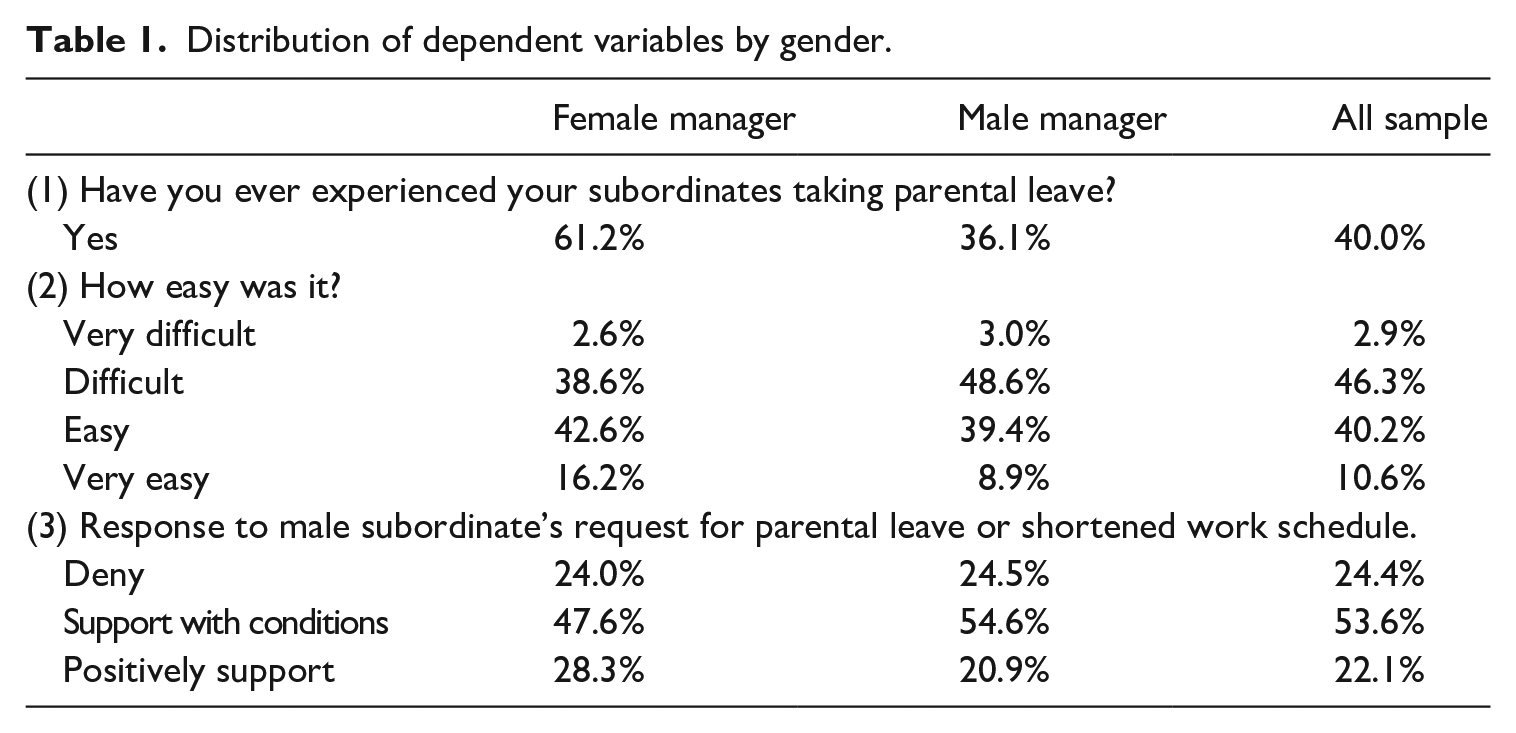
The second dependent variable was constructed from managers’ responses to the question ‘How easy was it to manage your section’s daily business when your subordinate took a leave?’ Whereas 16.2% of female managers stated that they found managing in the subordinate’s absence to be ‘very easy’, only 8.9% of men gave this same response. In contrast, almost half of male managers (48.6%) found this ‘difficult’, as compared with 38.6% of women. These differences suggest that female managers may feel better able to manage their section well in the absence of a subordinate than do their male counterparts.
The third dependent variable was constructed from responses to the question: ‘How would you respond if one of your male subordinates requested parental leave or a shortened work schedule?’ In Table 1, three of the responses – ‘persuade not to make the request’, ‘deny the request’ and ‘I have never imagined that a man would request parental leave’ – are all coded as ‘deny’. On average, about one-fourth (24.4%) of managers answered that they would deny a male subordinate’s family-related request; fewer than one-fourth (22.1%) responded that they would fully support the request. These results indicate that many managers – both women and men – are reluctant to acknowledge men’s family responsibilities and expect them to prioritise paid work. However, women were somewhat more likely to react positively to such a request than were men (by 28.3% to 20.9%). Additionally, 54.6% of male managers indicated that they would place some condition on the request, as compared with 47.6% of female managers.
Table 2 indicates the results for the hierarchical generalised linear model (Model 1) and logistic regression analyses (Models 2 and 3). Model 1 shows the results for the first dependent variable: ‘Have you ever experienced your subordinates taking parental leave?’ Results show that both family-friendly measures and women’s empowerment variables had positive effects on subordinates’ access to parental leave. This result suggests that these measures and efforts are conducive to expanding subordinates’ opportunities to take advantage of leave policies. The percentage of female employees also positively affected the dependent variable, suggesting that managers in firms with a higher percentage of female workers are exposed to a higher risk of leave requests from subordinates. 5 Longer job tenure and a greater number of subordinates were also associated with higher odds that a subordinate had made a family-related request. 6
Results for hierarchical generalised linear model (Model 1) and logistic regression (Models 2 and 3).
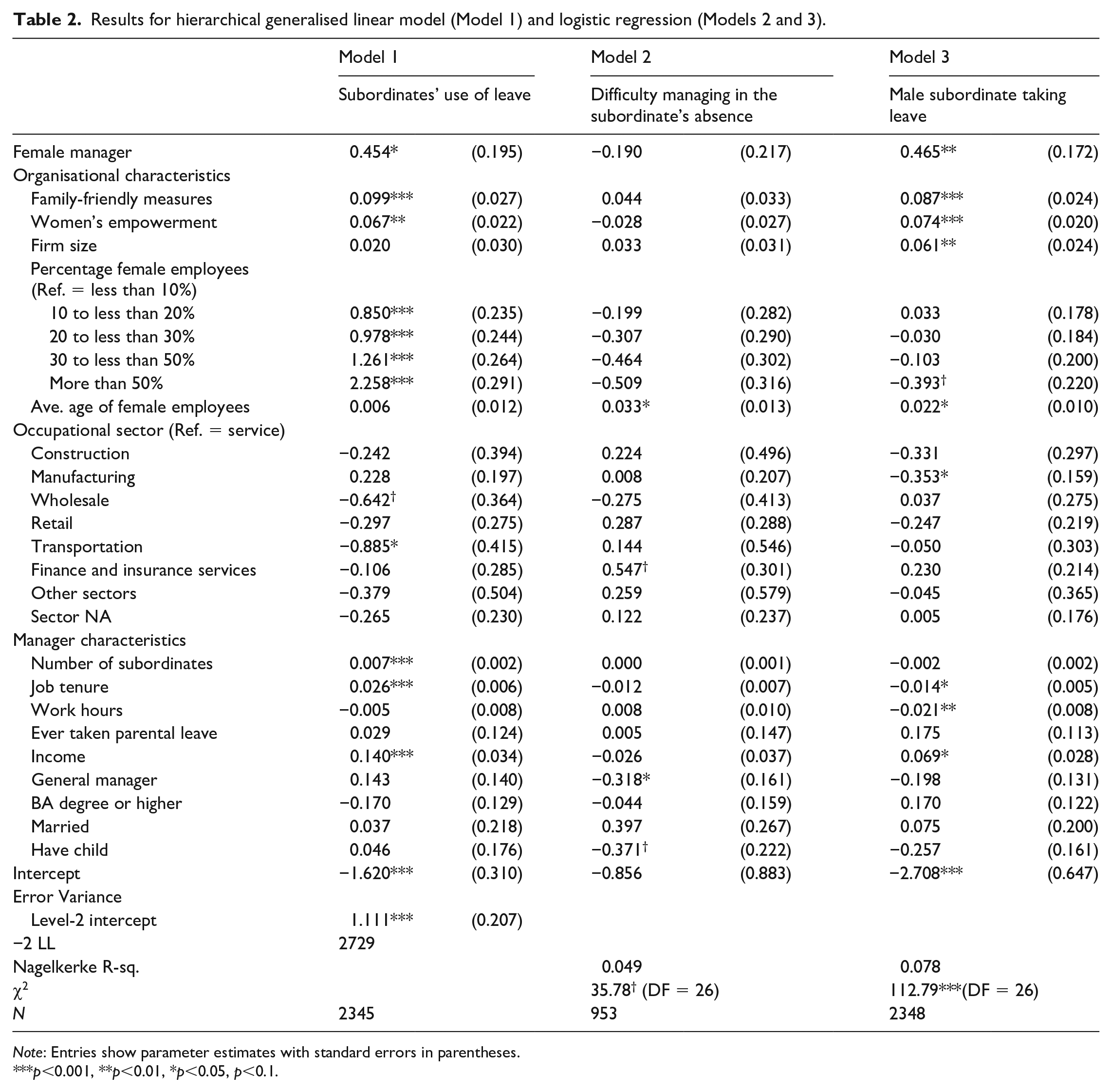
Note: Entries show parameter estimates with standard errors in parentheses.
p<0.001, **p<0.01, *p<0.05, p<0.1.
Finally, the results show that after controlling for these workplace and manager variables, the effect of a female manager was positive and statistically significant. This provides support for Hypothesis 1.1 of the change agent perspective. The odds ratio of female managers affirming that they had let their subordinates take leave, relative to that for male managers, was 1.57 (= exp [.454]).
Model 2 presents the results of logistic regression for responses to the question regarding the difficulty in managing their section’s daily business when a subordinate took leave. The results show that although women had a negative coefficient, this difference did not reach significance. Female managers felt no less difficulty in the case of an absence than their male counterparts. The weak version of the cogs in the machine perspective (Hypothesis 2.2) was supported. As discussed above, in the male-centred Japanese workplace, it would be certainly difficult to facilitate subordinates’ work–family integration for both male and female managers.
The findings so far suggest that subordinates who report to female managers may have better access to family-related options than those with male managers. However, if subordinates requesting family-sensitive work arrangements were mostly women, this situation could intensify the negative stereotypes of female workers. This is a major reason why this study focuses on managers’ attitudes toward male workers’ family-related requests.
Model 3 exhibits logistic regression results for the question: ‘How would you respond if your male subordinate requested parental leave or a shortened work schedule?’ The results indicate that managers at companies that provided family-friendly options and made efforts to empower women were more supportive of male subordinates’ family-related requests. However, managers who worked longer hours tended to view such requests more negatively. This group may have instilled in themselves a commitment to overtime culture and may expect their male subordinates to do the same.
Finally, female managers displayed stronger support for their male subordinates’ requests than did male managers. As in Model 1, the effect of the manager’s gender remained significant after controlling for effects of other important workplace and manager characteristics. This provides support for the change agent perspective (Hypothesis 1.3). The odds of female managers supporting male subordinates’ family-related requests, relative to male managers, were 1.59 (= exp [.465]). Having a female superior seems to encourage both female and male employees to integrate family responsibilities into their work patterns.
Discussion
This study investigated the role of female managers in enhancing access to family-friendly measures, particularly focusing on men’s limited access – an often overlooked dimension of organisational gender inequality. Previous studies have debated the role of female managers as either agents of change or cogs in the machine (Cohen and Huffman, 2007). The findings here show that female managers positively affect their subordinates’ access to parental leave measures and encourage male subordinates to utilise family-related measures, although female managers felt challenged during their subordinates’ absences. Thus, the findings largely support the change agent perspective, suggesting that female managers could be key change agents in gendered organisations.
The findings of this study add supporting evidence for the change agent argument. However, this study also offers a significant expansion of the debate framework. As reviewed above, much of the previous research on female managers has limited its investigative scope to gender power imbalances – such as the gender gap in wages, promotion and recruitment – in male-centred organisations. However, the findings indicate that female managers may be catalysts for a more fundamental organisational change. They may help transform the conventional masculine rhetoric toward a view that respects family responsibilities for all workers. Future discussion on women in positions of power could benefit by including not only the issues of reducing gender imbalance within a conventional organisation but also transformation of how work operates and, eventually, the organisation itself. This study is among the first to explore such a framework.
This study has also shown that the positive impact of female managers on subordinates’ work–family integration remains significant even after controlling for their organisations’ measures to support gender equality. However, it is important to note that, in doing so, female managers may shoulder the burden of change agents. Female managers felt challenged when managing their section in their subordinates’ absence because they are likely to face contradictory demands from their organisations. Thus, merely increasing the number of female managers is not sufficient for achieving organisational gender equality. The efforts made by those individual managers must be acknowledged and buttressed by organisational support. It is only when the effort by female managers is met with organisational commitment to gender equality that a real transformation of the workplace can be achieved.
As mentioned, previous research suggests possible mechanisms that allow female managers to impact organisational gender inequality. One line of research highlights the dynamics of managers’ homophily-based preferences as a key workplace mechanism. However, the results of this study are not compatible with that argument because female managers not only support female workers but also positively encourage men to take family responsibility more than male managers.
Others argue that female leaders may have different values, attitudes and leadership styles from male leaders and may consider the welfare of individual employees to a greater degree than men when making business and management decisions (Eagly, 2013; Matsa and Miller, 2014; Moore et al., 2005). The findings of this study are in accordance with these arguments. Female managers may support their subordinates’ use of family-related measures because their values and management styles put more emphasis on the welfare of their subordinates’ family lives.
It should be noted, however, that if female managers are supportive of their subordinates, this does not mean that they are ‘naturally’ more caring. Rather, one of the mechanisms involved may be women’s adaptation to a gendered workplace culture. Because female leaders who adopt masculine behaviours tend to experience backlash (Brescoll, 2011), they may modify their behaviour so that their subordinates evaluate them more favourably.
In this regard, cross-national differences in the severity of gender inequality and conventional gender ideologies are likely to be an additional layer of factors that differentiate female managers’ responses to their subordinates’ requests. The difference in the results of this study from those of Maume (2011), in research conducted in the United States, which supports the cogs in the machine perspective, may reflect such variance. For instance, in that country, women are 40.7% of legislators, senior officials and managers, while, as discussed above, female managers in Japan are still a small minority. In a society where conventional gender ideologies are dominant, female managers may have to pay extra attention to take care of their subordinates to alleviate their subordinates’ negative views toward female superiors. This suggests that research into female managers’ behaviour should be carried out in relation to the surrounding organisational and societal gender inequality. The generalisability of the findings beyond Japan is consequently limited.
In closing, the study’s limitations should be noted. First, although this study controls for the effect of various family-friendly measures and the gendered structure of organisations, there may be a more complex relationship that differentiates the risk of subordinates’ family-related requests for female and male managers. Further research with a more detailed analysis of gendered organisational structure is needed. In addition, this study was unable to directly examine subordinates’ behaviour with respect to family-related measures. For instance, employees who report to female managers may feel less intimidated when they make family-related requests because of gender stereotyping that causes them to expect women to be more family-oriented. In addition, as suggested above, research is needed in other post-industrial countries because cultural and institutional environments surrounding female managers vary widely across countries.
However, as an exploratory inquiry using existing survey data, this study has shown that female managers may help diminish the rhetoric of the male breadwinner as the ideal worker by enhancing access to family-related policies among both female and male subordinates. Further research investigating the relationships between female managers and employees’ use of family-friendly provisions will enrich our understanding of organisational gender inequality.
Supplemental Material
sj-pdf-1-wes-10.1177_0950017020987409 – Supplemental material for Women Managers’ Impact on Use of Family-friendly Measures among Their Subordinates in Japanese Firms
Supplemental material, sj-pdf-1-wes-10.1177_0950017020987409 for Women Managers’ Impact on Use of Family-friendly Measures among Their Subordinates in Japanese Firms by Makiko Fuwa in Work, Employment and Society
Footnotes
Acknowledgements
Data for this research – from the Survey on Support for Work–Life Balance (2006) – were provided by The Japan Institute for Labour Policy and Training.
Funding
The author disclosed receipt of the following financial support for the research, authorship, and/or publication of this article: This study was supported by JSPS KAKENHI Grant Number JP19K02044.

Supplementary material
The supplementary material is available online with the article.
Notes
References
Supplementary Material
Please find the following supplemental material available below.
For Open Access articles published under a Creative Commons License, all supplemental material carries the same license as the article it is associated with.
For non-Open Access articles published, all supplemental material carries a non-exclusive license, and permission requests for re-use of supplemental material or any part of supplemental material shall be sent directly to the copyright owner as specified in the copyright notice associated with the article.
