



Abstract
Working in a domain to which one feels called has been heralded as a source of deep meaning and fulfilment, but not everyone is able to pursue their calling through paid employment. Current thinking positions such abandoned occupational callings as a source of regret, stress and disappointment but, by focusing on the perspectives of those still in mid-career, extant research has overlooked the potential for a calling to re-emerge in late adulthood. Drawing on life history narratives from retired individuals who felt called to music at an early age but did not pursue a musical career, we contribute to the corpus of work on unanswered callings by proposing the construct of latent callings to explain how callings may be held in the individual’s identity set primed to re-emerge, and reveal the mutable calling identity scripts that re-awaken the potential to live out a calling later in life. Our research shows how latent callings may be resumed via accommodation, deferred and emergent pathways and highlights the potential for a previously unanswered calling to become a source of social connection, deep happiness and enjoyment late in life.
Introduction
In contrast to those who regard their work as a ‘job’ or a ‘career’, those who experience their work as a calling have ‘a consuming, meaningful passion . . . toward a domain’ (Dobrow, 2012: 434). While definitions vary, research on work as a calling has shown that called individuals experience higher levels of engagement, satisfaction and meaning in their work (Bellah et al., 1985; Berkelaar and Buzzanell, 2015; Hall and Chandler, 2005; Wrzesniewski et al., 1997).
To access these positive benefits, it has been suggested that it is not enough to feel called to a particular occupational domain, but that, to be fully realised, callings should also be actively pursued via paid employment; a calling thus suggests ‘a call to action’ (Elangovan et al., 2010: 429). However, the expansion in the range of occupational choices to which people are exposed, coupled with the difficulties many experience in trying to follow their calling, mean that we are likely witnessing a significant growth in the number of individuals whose callings remain unanswered. Consequently, Berg et al. (2010: 974) have argued that ‘it is critical to understand how individuals experience and respond to unanswered occupational callings’, particularly since research has shown that individuals who do not live out their calling may experience a range of negative outcomes, such as feelings of failure, frustration, depression, stress and regret (Berg et al., 2010; Gazica and Spector, 2015; Hennekam and Bennett, 2016). In fact, Hirschi et al. (2018) suggest that having an occupational calling without being able to experience it may be even more detrimental than not having a calling at all. Theoretically, it has been argued that individuals with an unanswered occupational calling experience a lack of alignment between their sense of self and their lived reality, leading to challenges in constructing a coherent identity and sense of authenticity (Ashforth and Schinoff, 2016; Elangovan et al., 2010).
While extant research has focused on the negative experiences of those who have abandoned their calling (Berg et al., 2010; Hennekam and Bennett, 2016), less is known about the circumstances that might prompt individuals to rediscover a calling they previously set aside. This would seem an important omission, since life changes and career transitions (Ibarra, 1999) may offer the motivation and opportunity for individuals to return to their calling and thereby experience the fulfilment of living out their calling at a later point in their lives. Such a rediscovery would be consistent with the notion that callings are not a ‘once and for all’ accomplishment but rather a dynamic process of adaptation over time (Dik and Duffy, 2009; Duffy et al., 2012). To address this issue, we set out to answer the following question: how and why are callings that were once set aside reactivated later in life? Responding to exhortations for more research on callings that involve older age groups (Ahn et al., 2017; Duffy and Dik, 2013; Hall and Chandler, 2005), we adopt a life history narrative approach to examine the lived experiences of individuals who felt called to be musicians in early life, abandoned their calling in favour of an alternative occupation and then returned to music during late career or retirement.
We make four theoretical contributions. First, we expand current thinking on unanswered callings by introducing latent callings as a new form of unanswered calling (Berg et al., 2010). We define latent callings as callings that are currently unanswered but are held within the individual’s set of identities (Bataille and Vough, 2022), primed to re-emerge in later life. Second, to explain this, we introduce the notion of mutable calling identity scripts that underpin how the meaning of living out a calling changes across the life course, thereby opening the door to the resumption of activity within the calling domain. Scripts have been described as ‘interpretive schemes, resources and norms’ (Barley, 1989: 53) arising at the nexus between individual preferences and contexts that ascribe legitimacy to certain courses of actions and prescribe appropriate behaviours. We define calling identity scripts as interpretive schemes that ascribe legitimacy to the pursuit of a calling. In the same way as the meaning attached to career success varies over time (Dries et al., 2008), so we find notions of what it should mean to live out one’s calling change with age and experience, enabling the resurgence of calling later in life.
Third, our research uncovers three pathways back to a calling that draw on the identity development opportunities (Ibarra and Obodaru, 2016) afforded by changing calling identity scripts: accommodation, deferred and emergent. These three pathways are characterised by varying degrees of involvement in a calling during individuals’ working careers, differing emotional experiences associated with calling enactment and variations in how people re-engage with their calling in later life. These overarching processes by which callings fall into latency in early life and then become renewed in the late career/early retirement years are summarised in our data map (Figure 1), which adds to our understanding of callings across the life course.
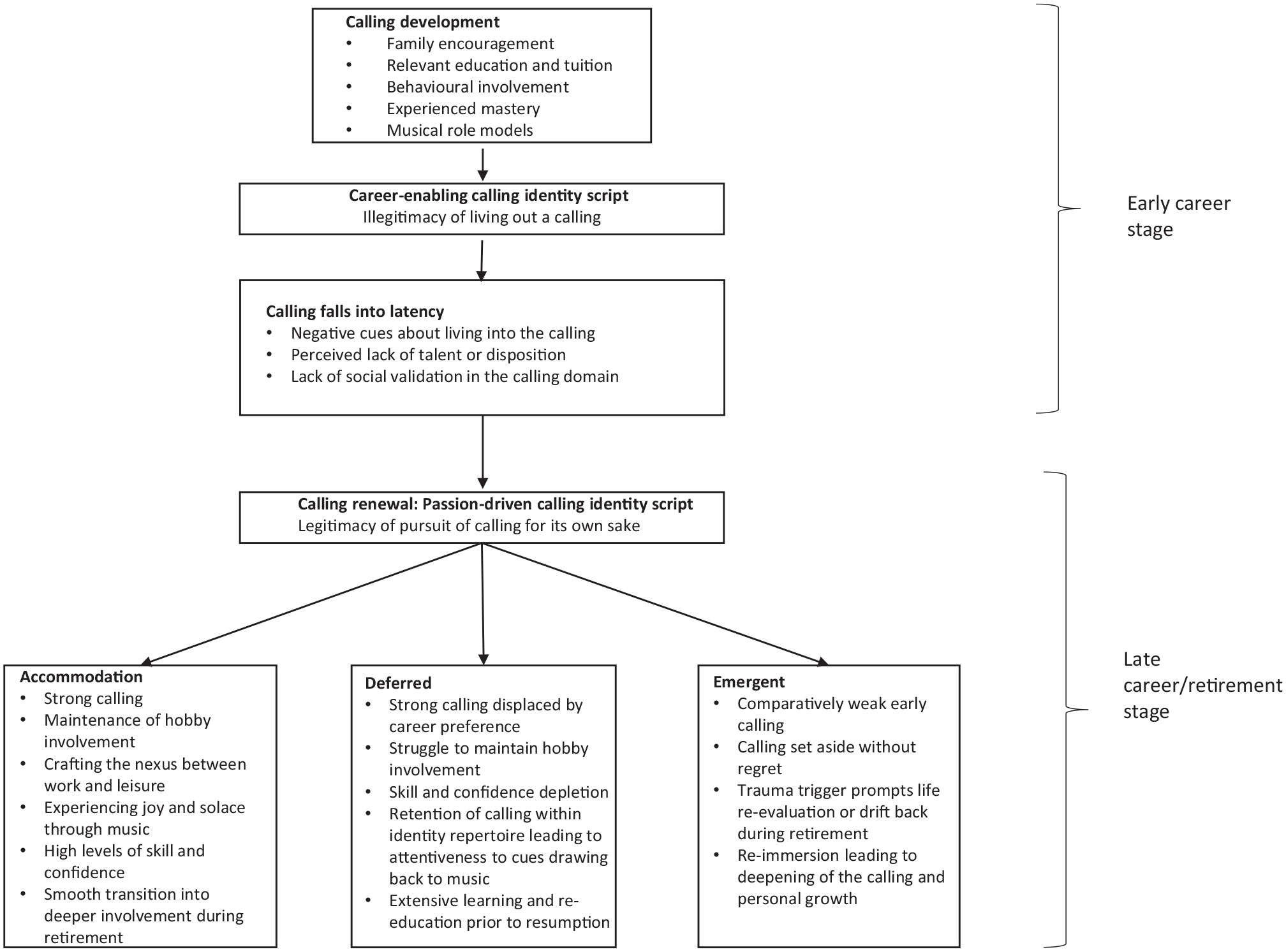
Data map.
Finally, our study challenges the prevailing notion that unanswered callings inevitably lead to negative emotions such as regret (Hennekam and Bennett, 2016) by showing how retired individuals who have been able to accrue sufficient resources (Birkett et al., 2017) are able to re-immerse themselves in their calling domain, yielding a range of positive affective experiences and outcomes. In sum, the research uncovers the dynamic nature of callings across the life course, counters the prevailing negative view of unanswered callings and highlights the emancipatory potential of latent callings that re-emerge in later life as a source of profound joy and fulfilment.
In the next section, we outline the relevant literature in relation to the development and abandonment of callings. We then present the methods used in our study. In the findings, we first show how a sense of a calling to music emerged but was subsequently abandoned by our informants, before explaining the three pathways via which informants experienced a resurgence of their calling in later life and outlining the informants’ retrospective accounts of their calling across the life span. Finally, we elaborate on how our study contributes to the literature on abandoned callings and outline implications for future study.
Literature review
The development and abandonment of callings
The literature distinguishes between experiencing or feeling a calling on the one hand and enacting a calling on the other (Hirschi et al., 2018). The awareness that one has a calling to a particular domain may arise through processes of exploration or discernment in early adulthood (Conklin, 2012; Duffy et al., 2012; Elangovan et al., 2010; Sturges et al., 2019). However, the enactment of a calling takes this a step further with active engagement in the calling domain via paid employment (Lysova and Khapova, 2019; Weick et al., 2005). It has been argued that it is via the pursuit of a calling through paid work that the positive benefits of experiencing a calling arise, including job satisfaction, meaningful work and fulfilment, rather than simply through the feeling that one has a calling (Ahn et al., 2017; Conway et al., 2015; Hall and Chandler, 2005), while failing to live out one’s occupational calling may lead to negative outcomes such as feelings of grief and loss (Hennekam and Bennett, 2016).
One reason for this is that callings are closely bound up with identity, since those who have a calling also identify strongly with their work or occupation (Hirschi et al., 2018). Identity has been defined as the various meanings attached to a person by the self and others (Ibarra, 1999) and it has been argued that the development and maintenance of a calling over time is a form of identity work (Lysova and Khapova, 2019). Identity work entails ‘forming, repairing, maintaining, strengthening or revising the constructions that are productive of a sense of coherence and distinctiveness’ (Sveningsson and Alvesson, 2003: 1165). It has been noted that such identity work in the calling domain serves to create a convergence among an individual’s actual, ideal and ought selves, or their sense of who they are now, who they would like to be and who they perceive they should be in relation to their calling, reducing potentially uncomfortable levels of dissonance (Elangovan et al., 2010).
However, sometimes the process of starting to live out a calling may be interrupted in young adulthood. During these early career stages (Super, 1957), individuals are likely to experiment among a range of potential selves in an effort to clarify a fully elaborated professional self (Dobrow, 2012; Ibarra, 1999) that will help determine their optimal career choice. This may involve a challenging array of effortful and self-directed behaviours, including exploration, planning, goal-setting and networking (Praskova et al., 2014). Such challenges may be especially acute in seeking to establish a career in an uncertain calling domain such as music where employment is scarce and insecure, pay can be low and working conditions unpleasant (Dobrow and Tosti-Kharas, 2011; Hoedemaekers, 2018; Kubacki and Croft, 2005; Umney and Krestos, 2015). Amassing the resources and skills necessary to enter into a musical career and develop a positive identity as a musician can depend on factors such as early exposure to relevant role models, access to lessons from talented tutors, high-quality musical instruments, appropriate space for long hours of practice and encouragement from family members, many of which may only be accessible to those from affluent backgrounds (Dobrow, 2012). Thus, a range of socio-cultural, occupational and individual factors may explain why not everyone is able to follow their calling to music (Duffy and Autin, 2013; Hirschi et al., 2018). This is common across other artistic domains as well. For example, in the Netherlands, Schreven and De Rijk (2011) estimate that as many as 60–70% of graduate artists cease their artistic activities within the first years of professional life, often owing to multiple unsuccessful entry attempts, while injury, trauma or crisis may also play a role (Maitlis, 2009).
Although some individuals may deliberately trade off material expectations and sacrifice stability in order to answer their call to music (Dobrow and Heller, 2015), others may not have sufficient resources, or may not be in the socio-cultural circumstances that enable them to pursue this option, positioning a creative calling like music as one that is especially likely to be abandoned. From a lifespan perspective, socio-emotional selectivity theory (Jung and Takeuchi, 2018) posits that younger adults are more focused on maximising resource gains and minimising resource losses than are older adults, implying that they may be especially attentive to cues concerning the potential of their calling to provide valued resources such as a stable career, and therefore be willing to cast aside called identities that do not meet these criteria.
The potential for callings to be reactivated
To date, the underlying assumption within the callings literature is that once a calling has been abandoned then it is only through processes such as job and leisure crafting – that is, taking steps to alter one’s work or hobby – that some of the threads of a calling can be woven into individuals’ lives, but in a rudimentary fashion that can heighten rather than attenuate the negative experience of abandoning a calling (Berg et al., 2010). This line of research suggests that the detrimental effects of not answering a calling through paid employment are likely to be long-lasting, seemingly closing the door to the possibility that a calling may become reactivated.
Yet, rather than being permanently abandoned, it is possible that such callings may re-emerge later in life, when circumstances change. Research has shown that past selves may not be forgotten but can be retained within the self-concept, since individuals have cognitive and social space for several authentic versions of themselves (Obodaru, 2012, 2017). The self-concept has been defined as ‘the totality of a [person’s] thoughts and feelings that have reference to [themselves] as an object’ (Rosenberg, 1979: 7) constructed from their various identities. Given creative individuals tend to feel an especially strong, passionate call towards their domain (Hennekam and Bennett, 2016; Maitlis, 2009), it could be argued that they may be particularly inclined to retain their calling within their repertoire of alternative selves, or self-representation of who they could have been (Obodaru, 2012: 34), and therefore may be highly motivated to seek out their calling again later in life. Status passages such as career transitions may furthermore provide opportunities to renegotiate the self (Ibarra, 1999) and to reconsider the importance of a calling. In particular, macro-role transitions, such as moving jobs, retirement and other career discontinuities may constitute ‘alert intermissions’ (Ibarra, 2003) during which individuals see things in new ways, giving rise to fundamental changes in the individual’s self-definition (Ibarra and Barbulescu, 2010; Petriglieri et al., 2019; Vough et al., 2015), potentially creating space for the re-emergence of a previously abandoned calling. Prompts may also arise from negative experiences in one’s current occupation that encourage individuals to seek out previous activities that were experienced as a deep passion and were therefore set aside only with great reluctance (Ahn et al., 2017; Obodaru, 2012). Since possible future selves may be derived in part from past selves (Markus and Nurius, 1986), life changes may therefore resurface the appeal of an unanswered calling.
Callings such as music may be easier than others to retain within the self-concept via enactment during leisure time outside the formal working day and this continued involvement, rather than triggering stress and regret (Ahn et al., 2017; Berg et al., 2010) could potentially cue further identity work (Caza et al., 2018) over many years, leading to re-immersion within the calling domain. As Markus and Nurius (1986: 955) note, possible selves extend backwards and forwards through time such that ‘the selves of the past that remain and are carried within the self-concept as possible selves are representations of the individual’s enduring concerns’. Contemplating these possible future selves may trigger cognitive, emotional and behavioural identity work oriented towards ‘identity opportunities’, occasions viewed by the individual as a chance to grow, that ‘spur feelings of hope and focus the individual’s attention on self-enhancement’ (Bataille and Vough, 2022: 94). Thus, past selves could be transformed under the right conditions into possible future selves and become activated and influential in directing behaviour. Moreover, health, financial and social resources may accumulate over the life course, enabling individuals to reclaim previously foreclosed choices (Birkett et al., 2017; Brown, 2015).
Callings in retirement
From a temporal perspective, it could be argued that the late career/retirement years may represent a natural time-point at which previously abandoned callings might resurface, since studies have shown that the salience of a calling may grow in relation to one’s maturity (Ahn et al., 2017). For example, Duffy et al. (2017) found that perceiving one’s activities as a calling after retirement is associated with higher levels of well-being and life meaning. Retirement may also constitute a macro-career transition that triggers the re-evaluation of the meaning of a good life (Alacovska et al., 2021; Vough et al., 2015), motivating individuals to rediscover once-valued identities. This has parallels with the notion that identity growth (or the self-authoring that is associated with a progressively increasing sense of authenticity) is not just restricted to younger individuals but can arise at any age (Ibarra and Obodaru, 2016). Such growth is associated with the questioning of previously held normative assumptions, leading to the exploration of alternatives, experimentation and growing creativity. Identity growth can be facilitated by a form of identity work referred to as ‘identity play’ (Ibarra and Obodaru, 2016) where individuals experiment and explore with possible selves rather than ought selves.
Whereas earlier research on career stages tended to position retirement as a period of decline and disengagement following on from the establishment, advancement and maintenance of a career (Super, 1957), recent treatments have instead suggested that careers progress in a more dynamic, cyclical manner (Post et al., 2012). Studies have pointed to the increasing flexibilisation of retirement as it is reinvented as another career stage privileging individual choice and active ageing, at least for those with sufficient resources (Birkett et al., 2017; Kojola and Moen, 2016), a time period during which the hoped-for self still remains vital (Cross and Markus, 1991). In fact, according to life course theory, retirement may constitute ‘adulthood’s greatest project of deferred gratification’ (Eckerdt, 2004: 3), a period of self-discovery, renewal and self-development (Sargent et al., 2011) offering plentiful affordances for embracing a once-abandoned calling. Thus, by bringing together the literature on callings with notions of the self-concept, we open up the possibility for once-abandoned callings to become revitalised later in life.
Methodology
We utilised life history narratives, or retrospective life course data (Birkett et al., 2017) to build theory about how individuals who initially felt called to music abandoned their calling but then took the decision to resume it later in life. The life history technique ‘focuses on the ways in which individuals account for and theorise about their actions in the social world over time’ (Musson, 2004: 34), thus prioritising individuals’ own explanations and interpretations. The narration of life history is ‘concerned with transitions from one set of personal and organizational circumstances to another’ (MacLean et al., 2012: 21). Such narration enables individuals to negotiate and renegotiate their identities in relation to their career histories, manage identity conflicts and re-author the self (Cinque et al., 2021), creating meaning and generating a sense of authenticity across the temporal evolution of identity, roles and transitions (Ibarra and Barbulescu, 2010). The life course approach is particularly relevant to studying older people’s careers since it enables change over time to be discerned and recognises how the past can shape the future (Birkett et al., 2017). It also recognises that people make decisions about their lives, careers and retirement but not within a context of their own choosing and offers a nuanced approach to the interrelationship between work, domestic circumstances and access to health and other resources over time (Birkett et al., 2017).
Music is an especially relevant domain within which to explore these issues, since prior research has shown music to be the focus of especially intense callings (Dobrow, 2012). In fact, as Obodaru (2017) notes, the identity of musician is one that individuals are especially likely to retain within their identity set (Bataille and Vough, 2022), even if not working as a musician. However, on the other hand, individuals face significant difficulties in pursuing a career in music owing to the highly competitive, project-based nature of the music labour market (Umney and Krestos, 2015). These difficulties mean that the decision over whether to become a musician is particularly challenging.
Interviewees were identified by drawing on the first author’s personal network, and a call for participants to members of the UK-based Making Music organisation. Informants mainly lived in London or South-East England and were selected for participation based on their response to a series of screening questions. We provided them with Dobrow’s (2012) definition of a calling and checked whether this resonated with them about how they felt about music. All informants confirmed they had experienced an initial call to music. For example: It’s not that I’m doing wonderful things in music, the music is speaking to me and calling me . . . you hear a voice you must respond to. (Mark) My calling has certainly been to music, I’ve earned a living by working in computing. (Kathy)
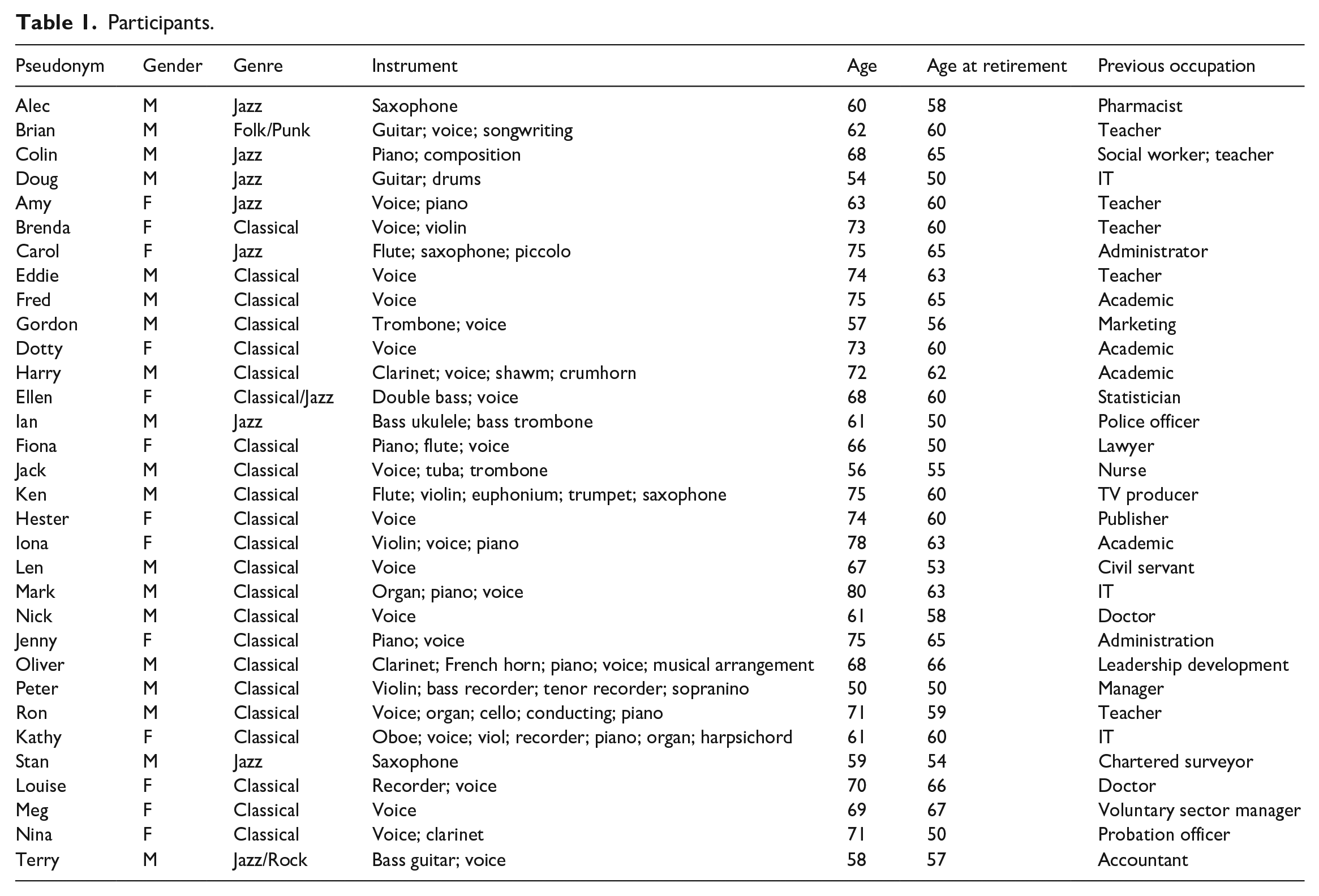
Informants also stated that they had set aside their music calling in favour of an alternative career path, all were now at least semi-retired, and they reported having resumed their musical calling in later life. Four potential participants who had volunteered for interview were excluded at this stage as they did not meet the screening criteria. A total of 32 interviews took place with individuals who met the criteria, with participants ranging in age from 50–80. Informants reported playing a very wide range of different instruments, and most played within the classical or jazz genres (see Table 1).
Participants.
We adopted a career and life history approach to conducting the interviews (Chase, 2005; MacLean et al., 2012), asking interviewees to relate their career and musical histories from childhood through to the present day, identifying critical turning points and transitions in an effort to elicit rich descriptions. We followed a semi-structured format focusing on early exposure to music, the development and experience of a calling to music, the decision not to pursue a career in music, whether and how their musical calling was enacted during their working lives and then the resurgence of music in later years. The interviews generally took place in the informants’ own homes, or the first author’s office, but also occasionally in public spaces such as cafes. The interviews lasted on average one hour and were all recorded and then transcribed verbatim before being loaded into NVivo for preliminary analysis and exploratory coding.
Data analysis
We took an interpretivist approach to analysing the narratives that prioritised the lived experience of the individuals involved (Chase, 2005). The analysis proceeded through several interlinked stages. The first stage entailed data familiarisation and open coding (Corbin and Strauss, 1990) to identify emergent themes and common elements across the transcripts. This led to a preliminary coding structure that broke down the narratives and helped to surface core themes and common issues experienced by the participants. This stage led to an understanding of how calling identities emerged and were formed during early life as well as the range of reasons why individuals chose not to pursue their music calling. Through this analysis, we were able to identify how and why individuals chose to abandon their callings. In the second stage, we reverted to the full text of the interviews and wrote chronological summaries of the life history of each informant, treating each narrative as an analytic unit (Reissman, 2008). This was an essential element of the data analysis stage, given that many of the participants had begun their stories ‘in the middle’ (Shipp and Jansen, 2011: 77) and enabled us to create a narrative map that ordered each life history in sequence (Bloom et al., 2021). These summary narratives plotted each informant’s life and work history against their engagement with music across the lifespan from childhood, early, mid- and late career and finally retirement, and captured their evolving attitude towards their music calling. Each summary narrative was two to three pages in length. This narrative analysis helped us to see ‘the connections in people’s accounts of past, present and future events and states of affairs’ (Bryman, 2016: 590) and to identify three pathways back into music: accommodation, deferred and emergent.
In the third stage, we moved to a higher-level iteration (Vough et al., 2015) between the summary narratives, the preliminary codes and the literature. For example, at this point we were able to explore the identity work that the resumption of a calling entailed by zooming in on the preliminary codes relating to re-engagement with music, and zooming out to the summary narratives to situate these activities within their context. Through iteration, we were able to discern how conceptions of what it means to live out a calling changes over time, leading to the identification of mutable calling identity scripts that performed a facilitating role in the development of latent callings. Our analysis showed how informants drew on the script of ‘career-enabling calling identity’ in early life to legitimate setting music aside, and then on the script of ‘passion-driven calling identity’ to legitimate its resumption in later life. These are explained in the next sections with example quotations given in Table 2.
Sample quotations – calling scripts.

Figure 1 depicts the conceptual map of the dataset, showing how these strands are connected.
Findings
In this section, we first explain how our informants’ callings emerged and were then subsequently abandoned. We then explain the three pathways that individuals pursued in relation to their music while in paid employment. Finally, we show how the informants then re-engaged with music in their later years.
The emergence and early abandonment of music as a calling
Comparable to called individuals in other occupations, all the informants traced the emergence of their calling to music back to their childhoods, in some cases to as young as two years old (Bloom et al., 2021; Conklin, 2012). Many talked of their introduction to music in their early years as taking place via family members who played an instrument or sang, listening to music being played at home or immersion in a community where music was a core element of the social fabric: From an early age, I wanted to dance. Every time there was music I got up and danced and moved around. (Amy) It goes right back to when I was about two or three and my father had an old wind-up gramophone with the old 12-inch records . . . I had to listen, I had to hear it, I was drawn to it, it was very powerful and that’s my earliest memory. (Eddie)
This early fascination with music blossomed through their school years with music lessons, additional extra-mural classes, encouragement from family members or involvement in choirs, groups and orchestras: I was at a bit of a sink comprehensive [school] but it did have . . . an outstanding music department . . . run by an inspirational teacher and he set me on my love of music. (Ian) I had private [violin] lessons . . . every Friday my Dad used to drive me all the way to [city] to play in a schools’ orchestra. (Peter)
Most of the informants spoke of a deepening insight that music was their calling at some point during their teenage years; for example, Ian noted he was around ‘14–15’ when he became aware he ‘couldn’t have lived without’ music; Jenny realised music was her calling – ‘all my life . . . just like breathing’; Iona said music was ‘in her blood . . . and always has been’, denoting a visceral fusion of the self and the calling domain. Thus, an awareness of musical ability, behavioural involvement in the musical arena and social comfort among a musical community combined to reinforce a sense of being called to music in early life (Dobrow, 2012).
Despite feeling drawn to their calling, all the informants nevertheless took the decision not to pursue a career in music, generally during their late teens or early 20s, linked with growing feelings of discomfort, indecision and identity confusion in the calling domain (Ahn et al., 2017). Three main reasons emerged as pivotal in this unfolding process of calling abandonment. First, as informants deepened their involvement in the music domain through further courses at music college or performing with older musicians, they began to attend to cues concerning the lifestyle and working conditions associated with a career in music, including poor pay, antisocial working hours and job insecurity (Hoedemaekers, 2018; Kubacki and Croft, 2005). This future-oriented sensemaking (Ashforth and Schinoff, 2016) helped informants develop a concept of their future possible self as musician (Cross and Markus, 1991) and served to discourage them from living out their calling: I got to meet middle-aged orchestral musicians who were just cynical and jaded . . . I got to thinking, this is a great, fun hobby but I’m not sure it’s a great career, it’s stressful, you’re living on your nerves, you’re working in the evenings. (Oliver)
The second factor was a perceived lack of musical talent or personal disposition required to be a successful musician, underlining the salience of perceived efficacy and social comparisons in choosing whether to pursue a calling (Dobrow, 2012; Twenge, 2006; Vignoles et al., 2008): ‘I sang in my teens, I was in a group . . . it’s a spectacle, a performance, you’re like a performance artist, you know, I didn’t really have what it took’ (Amy).
The third reason was lack of social validation in their calling domain (Ashforth and Schinoff, 2016). Some were discouraged by family members at a formative point in their identity development, thus depriving them of support from significant others in pursuing their calling (Berkelaar and Buzzanell, 2015; Duffy et al., 2012): I got an audition [with a military band] and got in . . . I was engaged to a girl . . . but she said, ‘I can’t have this’, and I stopped playing . . . she was afraid I would end up going on tour and I’d be away and all the rest of it. (Ian)
For others, the absence of social validation took the form of unsuccessful entry attempts into a musical career (Hennekam and Bennett, 2016). These trials for a possible professional identity as a musician (Ibarra, 1999) also provided negative cues that discouraged their efforts to assume an identity as a musician: I’d come to London to do more music . . . I was accompanying dance classes . . . I was starting to gig; dance classes merged into adult education classes . . . then there were cutbacks and I thought I’d got to jump ship and grab a full-time job . . . more manager, less music. (Colin)
Negative cues across these three domains combined to create a sense for the informants that music ‘isn’t something grown-up [people] do’ (Doug), and thus provided insufficient career stability to warrant making a full commitment to their calling domain. Normative social expectations concerning how a career should be enacted (Dries, 2011) came into conflict with the uncertain realities of pursuing music (Hoedemaekers, 2018; Umney and Krestos, 2015), pushing informants away from enacting their calling. This period of experimentation and uncertainty around career commitment is consistent with career stage theory (Super, 1957), which suggests that young adults go through a period of experimentation in an effort to determine their optimal career choice before making a commitment to a particular pathway. In contrast with the informants in Bunderson and Thompson’s (2009) study who were found to overestimate the benefits of pursuing their calling and thus committed too soon, the informants in this study conversely reported how these factors determined a growing sense of unease over the unattractiveness and unfeasibility of pursuing music, leading them to doubt the wisdom of pursuing their calling and instead privilege an alternative, more stable career choice. This hegemonic notion of what commitment to a calling should entail in the early career formative phase was undergirded by a career-enabling calling identity script. We define these as scripts that legitimate the pursuit of a calling only if this will satisfy career-style needs such as job security, high levels of remuneration and a stable career path (Potter, 2020).
Latent callings across the life course
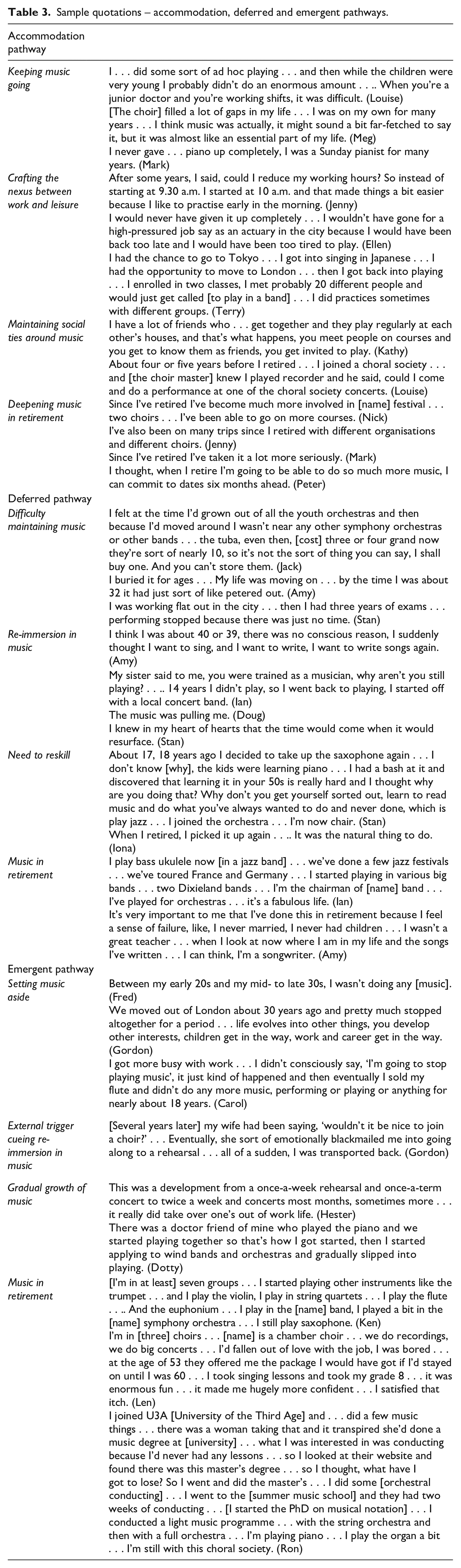
After this point, the informants took divergent routes to navigate involvement in their calling alongside their main employment. These three pathways differed in terms of the extent and frequency of their engagement in music, their affective responses to music, and their routes back into their calling. Sample quotations relating to each of these pathways are provided in Table 3.
Sample quotations – accommodation, deferred and emergent pathways.
Accommodation pathway
Twelve informants took an accommodation pathway via which they maintained a low level of hobby involvement in music alongside their main career, which then formed a springboard from which they could launch a deeper investment into their calling during retirement. This group explained that music ‘kind of stepped a bit into the background’ (Ellen) between their 20s and their 50s as the demands of their career and family commitments took over: ‘I still did gigs even though I was running the business but, you know, I’d probably turn up at rehearsal not having practised anything.’ (Alec).
However, those on the accommodation pathway were determined to overcome any challenges they faced in order to keep their music alive. These informants deliberately crafted the nexus between work and music to create time and space to engage in their calling outside work. This included changing their working hours or location; for example, Jenny put back the start of her working day ‘because I like to practise early in the morning’ and Ellen moved to London where she knew there would be more opportunities for music. For Meg, ‘the rehearsal slot was always sacred, I had to do it’. For several of these informants, although music may have become simply a ‘once-a-week thread’ (Nina) owing to other pressures on their time, continued involvement in their calling was described as vital to their personal well-being, providing them with the personal resources to cope with shortcomings or disappointments in other areas of their lives, or even with major personal tragedies: ‘My life has been peppered by some pretty big stuff, things have happened, and that’s made me realise how incredibly important music has been throughout all of those’ (Nina).
Ongoing involvement in music meant that these informants regularly sought out opportunities to nurture and develop their musical skills; for example, through playing or singing and attending workshops and courses, thus also enabling them to maintain confidence in their ability as musicians and sustain a network of valuable contacts in the industry, which, in turn, enabled further enhancement of their calling: I enrolled in one class at [name] college and . . . once you get to know people in a certain circle . . . in that year . . . I met probably 20 different people and . . . people would just call up and say, ‘we’re putting together a new group, would you be interested?’ (Terry)
Those on the accommodation pathway therefore experienced a smooth and ‘natural’ transition into a deeper level of involvement in music during late career and retirement as time spent at work decreased: Pressures from business and family have gradually reduced . . . when I realised I could afford to stop, I was very keen . . . I had to make sure we were financially stable enough to do it . . . so now I’m working hard at music. (Alec)
Through careful crafting of the transition from work to retirement, these informants were able to gradually increase their music while letting go of work. For example, Kathy reduced her hours to four days a week so she could play in a group with friends during the daytime a couple of years before completely retiring. Thus, music formed a continuous thread through the lives of this group, and hobby involvement emerged as important in enabling re-immersion in the calling domain in later years. Those on the accommodation pathway were typically drawn during retirement to deepen their involvement with similar genres of music, instruments and types of activity as had characterised their working years. For example, Meg had been a member of several choirs throughout her career and in retirement continued to focus on singing while expanding into the management of choirs. Thus, for this group, involvement in music post-retirement represented an extension of earlier experiences.
Deferred pathway
Eight informants reported lengthy periods, sometimes several decades, during which they did not engage in any kind of music before resuming their calling in late career/retirement. Given the strength of their initial calling, we have classified these as pursuing a deferred pathway. Whereas those on the accommodation pathway engaged in crafting activities to shape their work commitments and living arrangements to enable hobby participation, the deferrers struggled to create time and space for music. For example, Jack stopped playing tuba for 40 years; Brian said that his life had ‘gone through different phases in terms of my ability to be free for music’. Iona stopped playing violin for 20 years: ‘It wasn’t a matter of giving it up, it was a matter of having time and other interests. I was very interested in my work and you can’t do everything.’
Many of the deferrers experienced these periods in negative ways. Brian said that ‘it’s like having a leg taken away’; Doug said he ‘missed it all the time’ when he stopped playing for five years, and Brenda explained she ‘wasn’t as happy’ when she was unable to play the violin. These negative affective responses are resonant of the regret, stress and grief felt by informants in other studies who set their creative calling aside (Hennekam and Bennett, 2016). However, this group actively chose to prioritise career stability over their calling: ‘It was extremely important to be financially secure, more important than playing music, there’s no doubt, however happy or unhappy that makes you’ (Doug).
One consequence of the erratic nature of their involvement in music was that these informants were not able to accumulate the same kind of skill or confidence in their calling domain as those enjoyed by the accommodators: ‘It was frustrating because I lost a lot of technique so I’m playing drums and actually hating it because I can’t do what I used to do’ (Doug). Despite their infrequent engagement in their calling, the deferrers paradoxically said that they ‘knew’ they would return to music one day in the future: I’ve always known that at some point I’d go back to it . . . you think of passions as something red hot and steaming but they’re not always, sometimes they simmer and they’re always there, always at the back, there’s this sort of beat. (Jack)
Thus, these individuals had retained their identity as a musician within their self-concept (Hennekam and Bennett, 2016; Obodaru, 2017) and experienced a strong calling even when not engaged in music: Ian said, ‘it’s absolutely a huge part of my identity’. Although they experienced short-term feelings of frustration at not being able to engage in their calling and live out their identity as a musician, in the longer term and with the benefit of a life history perspective this group did not express any regrets at having set music to one side; Stan explained that ‘it was fine . . . I was doing something [career] . . . that was very engrossing’. Their careers were experienced as interesting and absorbing and provided them with valued financial resources that then enabled them to pick up their calling again in later life.
The strength of their calling led the deferrers to be attentive to environmental cues (Bunderson and Thompson, 2009) that drew them back to music, in contrast with Berg et al.’s (2010) finding that negative psychological states prevent actors from continuing their efforts to pursue an unfilled calling. For example, Iona was recovering from a serious illness when she heard a concert being played at a church near her office, ‘so I drifted in . . . and I was absolutely amazed by the quality of the playing’. This led to her involvement in the group as a supporter, which, in turn, enabled her to foster positive relationships with the musicians, paving the way to a sense that ‘I’m not too old to take it up again.’ Social involvement and interactions (Ashforth and Schinoff, 2016) in the musical community thereby enabled her to regain her feelings of comfort and belonging (Sturges et al., 2019), while cognitive and behavioural identity work (Caza et al., 2018) led to the confidence to resume playing and attending courses prior to a deeper re-engagement during retirement. For this group, given the gaps in their music making, re-immersion in the calling domain entailed a significant degree of learning and education. For example, Doug’s realisation he had lost technique inspired him to learn a new instrument: ‘I realised actually if I start a new instrument, I’ll always be better than yesterday and I can just go on that learning journey and enjoy it.’ Thus, the deferrers experienced greater challenges in their path to the resumption of music than the accommodators and had to invest more in their own development to do so.
Emergent pathway
Twelve informants experienced a weaker call to music (or little sense that their music was a calling) during their youth compared with the other groups, lending weight to Dik and Duffy’s (2009) contention that individuals experience callings along a spectrum: ‘It was something that you started off doing and you were fairly good at it and enjoyed doing it, but it wasn’t a grand passion’ (Fiona). In consequence, these informants were more easily able to set aside their music almost entirely during their working years without experiencing negative emotions. While some just drifted away from music, for some this was a deliberate decision based on personal circumstances or prior experiences: ‘I decided not to pursue a career in music but you play to such a high level that the thought of playing as an amateur didn’t feel good. It was probably really easy to drop’ (Oliver).
This group was characterised by intermittent periods of playing or singing during their working lives as commitments allowed, but others stopped entirely:
I didn’t play any music at all from the age of 25 onwards.
Did you miss it?
No . . . I’ve just never really missed it . . . I kept my instruments in the loft . . . and the flute, when I went to get it out, had completely gone, it was unplayable.
However, all those on the emergent pathway then returned to music in their late careers/retirement and experienced an intense deepening of their calling. Re-engagement with music arose through one of two routes. First, some experienced trigger events including traumas such as bereavement or illness, or even simply chance encounters that cued processes of life re-evaluation (Ashforth and Schinoff, 2016; Cross and Markus, 1991; Vough et al., 2015): I was in my 40s when I had another crisis . . . at a friend’s daughter’s funeral . . . I thought, I’ve got to do something different . . . and I thought I’d take early retirement . . . and try to take up more music. (Eddie)
For others within this group, music was perceived as an activity they could engage in when retired: ‘it was something to do, when you retire, the days are very long’ (Ken). These individuals then experienced a growth and renewal of their calling through their retirement. These informants were paradoxically the most likely of the three groups to engage in very extensive re-training and re-education in the music domain, studying for a master’s degree (Fiona) or a doctorate in music (Ron), setting up an orchestra (Oliver) or learning new instruments and genres (Carol, Ken). Rather than over-estimating their abilities in the calling domain (Elangovan et al., 2010), those on the emergent pathway demonstrated a strong willingness to learn and grow their skills as musicians. Re-immersion in their calling led to a changing attitude towards music: ‘it’s reached the inner musician in me which nothing ever did when I was younger’ (Carol). Thus, personal life changes over several decades (Chreim et al., 2007) facilitated experimentation with provisional selves that served as trials for a new, called identity as a musician (Ibarra, 1999).
A life history perspective on calling abandonment
With the benefit of a life history perspective, informants on all pathways were able to reflect on their feelings about not pursuing their calling to music. Although those on the deferred pathway expressed unhappiness associated with times they were not able to engage in music, none of the participants had any regret at having set their calling aside. This viewpoint was often described in terms of an imagined alternative self (Cross and Markus, 1991; Obodaru, 2017) as musician: It would have been hard work, I probably wouldn’t have had the variety of musical experience that I have had because I would have had to have practised, got degrees or whatever, spent eight hours in a job doing it, I don’t think it would have been as enjoyable. (Ellen)
This alternative self was perceived as accruing fewer financial resources and as experiencing less job security, but also crucially as experiencing less joy in the pursuit of their calling (see Table 2). Informants equated pursuit of a career as a musician with significant constraints in their musical autonomy; for example, in terms of limiting the type and variety of music they could play. Oliver described one musician who played for many years in the orchestra of a famous musical and who now ‘would panic at being asked to play anything else’; he added, ‘it would kill me’. Instead, the informants talked of how keeping their calling as their hobby served to sustain their passion for music, which aligns with the central tenet of self-determination theory that external rewards can serve to drive out intrinsic motivation (Deci, 1971): ‘People say keep your passion as your hobby but not your career, because it will be more satisfying . . . I think in retrospect looking back that was probably sound advice’ (Gordon).
Being an amateur musician meant that informants experienced high levels of agency over the nature of their engagement with music, such as being able to choose when to play, which instruments to play, being able to switch genres of music and decide which people and groups to join, thus enabling them to retain their passion for their calling: I think it would have lost some of the lustre if I’d made a go of it and it wouldn’t have been an escape from the day job, it would be the day job, and then at some point I wonder if it would have become a chore. (Terry)
This alternative self served as a negative comparator (Obodaru, 2012) that enhanced informants’ well-being and self-concept through demonstrating how their situation could have been worse had they pursued their calling as a career. The pressure to achieve an exceptionally high standard of musicianship was lifted, and pursuing music in later years was associated with enjoyment and community: It used to matter to me a lot when I was younger [to be good at music] and I think that’s what scared me off . . . but actually now . . . it’s just: enjoy yourself and smile! . . . If you can relax and enjoy yourself it means so much . . . we enjoy playing and it’s infectious . . . just give it a go: if it works, it works, if it doesn’t, have a laugh! (Jack)
Thus, subjective evaluations of what successful immersion in the calling domain means, and the legitimacy of living out a calling appear to evolve over the life course. During late career/retirement, pursuing a calling is legitimated in the context of a ‘passion-driven calling script’. We define this as a script that legitimates pursuit of a calling about which one is passionate but which may not necessarily lead to career or material success, consistent with the notion of identity growth through enjoyment and discovery (Ibarra and Obodaru, 2016). Nevertheless, this enjoyment was facilitated by the accumulation of sufficient resources during their working lives that enabled them to quit paid work and invest in their calling; as Doug said, ‘I’ve got the fundamentals of life and therefore I can do what I want.’
Discussion
We have responded to calls for more research on callings involving older age groups (Ahn et al., 2017; Duffy and Dik, 2013) and for a greater understanding of unanswered callings (Berg et al., 2010) by exploring the lived experiences of individuals who felt called to the domain of music, abandoned their calling before fully living it out, but then returned to music as serious amateurs/semi-professionals in late career and retirement. A life history perspective affords insights into the evolution of callings over a lifetime, and hence we are able to contribute to the literature on unanswered callings in four principal ways.
Thus far, scholars have identified two forms of unanswered calling: missed callings – that is, those that are abandoned and never fully resumed – and additional callings that arise when individuals experience more than one calling but can only pursue one as their main occupation thereby leaving one or more unanswered (Berg et al., 2010). We theoretically extend this typology by proposing that unanswered callings may also be latent. We define latent callings as callings that are set aside early in life in favour of an alternative career but are nevertheless retained in the individual’s repertoire of alternative selves, primed to re-emerge in later life. Creative callings are often aligned with individuals’ strongly held values (Lysova and Khapova, 2019; Montanari et al., 2021) and hence are especially likely to fall into latency. While Pratt and Foreman (2000) argue that diverse identities can be held via compartmentalisation, deletion, integration or aggregation, our study therefore additionally suggests that identities may also be held in latency. Such latent calling identities emerge as central to the self-concept even when not enacted, since individuals instinctively ‘know’ they will return to active engagement in the calling domain at some point in the future.
Our second contribution is to identify the calling scripts that provide the scaffolding for latent callings. The decision to set a deeply felt calling aside is underpinned by a hegemonic script concerning the importance of pursuing a ‘traditional career’ (Potter, 2020). During the early career stages, the decision not to live out a calling is informed by a career-enabling calling script. Following the initial development of a sense of calling in childhood and adolescence, in early adulthood, individuals become attentive to cues that lead them to determine whether pursuit of their calling will enable the satisfaction of career-oriented goals, such as stable employment and sufficient remuneration. These cues concern both the viability of the calling domain itself, through immersion in what might be termed the pre-calling domain and the observation of mature incumbents, as well as feedback on whether the individual’s personal talent and disposition will likely position them to succeed. Where this feedback suggests that the calling domain will not enable them to satisfy material needs or that the individual lacks the necessary characteristics to pursue a successful career in the domain this then leads to the formation of a feared future self (Obodaru, 2012). Visions of the undesirable lifestyle associated with living out their calling then guide the individual away from full immersion in the calling domain. Thus, pressures from family and peers, as well as normative societal expectations serve to then steer the individual instead towards an aspirational career-oriented path that holds significant socio-cultural resonances (Alacovska et al., 2021; Dries, 2011) in preference to a calling-oriented path. In consequence, individuals are motivated to explore other possible selves that would better enable them to satisfy their motives for self-esteem and self-efficacy (Vignoles et al., 2008), consistent with the notion that instrumental values dominate the early to mid-career stage (Post et al., 2012). Thus, in contrast to those whose unswerving pursuit of their calling via paid work and unwillingness to listen to advice (Dobrow and Tosti-Kharas, 2011) led to sacrifice, financial stress and the disregard of other essential life roles (Berkelaar and Buzzanell, 2015; Schabram and Maitlis, 2017), the informants in our study demonstrated a broader career vision and openness to exploring alternative options (Bloom et al., 2021).
However, subjective evaluations of what successful immersion in the calling domain means were found to evolve over the life course. This notion is aligned with prior literature, which has suggested that callings may change over time (Dobrow, 2012), which we extend through our finding that it is also the legitimacy of living out a calling that evolves, driven by a passion-driven calling identity script, as the accrual of important resources over time such as finances, health and well-being affords informants the possibility of following their passion free from the constraint of engagement in a stable career path. After individuals have pursued a career to which they do not necessarily feel called and normative societal expectations are lifted, thoughts of their calling then return, underpinned by the growing salience of passion. This supports Ibarra and Obodaru’s (2016) contention that, over time, individuals are motivated to move away from conformity to societal expectations towards identity growth via playful exploration, enjoyment and discovery. The changing notion of what it means to live out one’s calling thereby serves as a psychological resource (Cross and Markus, 1991) enabling and underpinning a changing view of the potential outcomes of living out a calling in later life as compared with young adulthood, with the passage of time signalling a new concept of the identity of a called individual (Petriglieri et al., 2019). Following Duffy et al. (2017), we therefore suggest that there are more diverse ways of living out one’s calling than simply occupational fulfilment, and that leisure involvement and immersion during retirement years may be equally important ways of living out one’s calling. Thus, from a temporal perspective, individuals demonstrate a willingness to trade off and sacrifice their identity as a called individual (Brown, 2015) during the formative early career years in the hope or expectation of resuming it at a later stage.
Our third contribution is to identify the three pathways via which individuals navigate their latent calling during their working life and into retirement: accommodation, deferred and emergent. We found that those who maintain a consistent, low level of hobby involvement in their calling via the accommodation pathway are able to experience the solace and pleasure of their calling throughout their lives and are then better placed to transition smoothly into a deeper involvement in their calling during retirement since they had retained good levels of skill and social comfort in the calling domain (Sturges et al., 2019). In contrast, individuals who go for prolonged periods without involvement in their calling during their working years on the deferred pathway experience short-term bouts of distress at the absence of their calling from their lives, and moreover lose important skills and social networks. Nevertheless, the strength of their calling resurfaces in later years, motivating them to engage in effortful retraining and personal renewal within the calling domain. Individuals with a weaker initial calling are able to set their calling aside during their working years without experiencing the same kind of distress. However, these individuals on the emergent pathway, once re-engaged with their calling, then experience a significant growth and development into their calling as their initial enjoyment during early youth blossoms into a greater passion during later life.
These processes of re-engagement with a calling are achieved through forms of identity work (Caza et al., 2018) that individuals are motivated to pursue in light of the change to their calling script. Prior studies have identified a range of different forms of identity work including ‘creating, presenting, sustaining, forming, repairing, maintaining, strengthening or revising’ (Caza et al., 2018: 890). However, we suggest that the kind of identity work that is undertaken by individuals who are re-engaging with their calling may be regarded as a form of identity play. Identity play has been defined as an alternative form of identity work concerned with enjoyment, self-expression and discovery, driven by intuition and emotion rather than being directed towards a particular goal or target (Ibarra and Obodaru, 2016). Identity play has a contrasting logic from identity work since ‘play’s context is the threshold between current reality and future possibilities’ and entails ‘iterative engagement in provisional trials of possible future selves’, compared with the orientation of much identity work towards conformity with social norms and rules and the development of an ‘ought self’ (Ibarra and Obodaru, 2016: 56). In sum, our data map (Figure 1) adds to our understanding of the processual dimensions of calling abandonment and re-engagement across the life course.
Our fourth contribution is to challenge the notion that unanswered callings are largely negative experiences for individuals and that hobby participation comes a poor second to immersion in the calling domain via paid employment (Berg et al., 2010). Extant research shows that pursuit of a calling via one’s occupation enables individuals to reduce the uncomfortable discrepancy between the actual, ideal and ought selves (Elangovan et al., 2010) while the inability to make a living from a calling leads to a sense of grief and failure by bringing feared possible selves more sharply into focus (Berg et al., 2010; Hennekam and Bennett, 2016). Conversely, the potential positives that may be associated with the experience of a calling via leisure involvement have largely been overlooked (Dik and Duffy, 2009; Duffy et al., 2017). None of our informants expressed any regret at not having pursued their calling; on the contrary, with the benefit of a life history perspective, many explained that their enjoyment of their calling had increased as a result of not doing so. Whereas professional musicians have little choice over the music they play and their work schedule, leading to growing disillusionment (Dobrow, 2012), pursuit of a calling to music in later life is associated with greater agency and autonomy over how to engage in the calling domain, enabling playful experimentation with alternative instruments, genres and groups. Our research suggests that not pursuing one’s calling may therefore be a better option for some, laying the foundations for calling growth and reinvigoration via a calling-infused career transition in later years (Ahn et al., 2017).
Whereas socio-emotional selectivity theory (Jung and Takeuchi, 2018) proposes that older adults in the career stage of ‘decline’ are less concerned with growth goals or with acquiring new knowledge, networks and opportunities than younger people, our findings conversely lend weight to the argument that older adults have decoupled the notion that living out a calling may only be achieved via paid employment and are able to reinstate and activate a personally salient dream (Markus and Nurius, 1986) involving growth, development and resource gain via immersion in their calling during retirement. As Ibarra and Obodaru (2016) note, identity growth can occur at any age, given the time and opportunity to question previous givens, explore and then commit to a renewed self-concept. Our study thereby supports the argument that retirement is a project of deferred gratification (Lytle et al., 2015; Moen and Flood, 2013; Post et al., 2012; Schultz, 2003). Thus, the hoped-for self (Cross and Markus, 1991) remains vital for older adults including those in the 60+ age group, many of whom may well choose second or third careers at this time (Johnson et al., 2009). The reinvigoration of a called identity at this point is nevertheless dependent on access to resources accumulated over the life course (Birkett et al., 2017; Hall and Chandler, 2005). Provided these resources are in place, mid-life provides individuals with the opportunity to rediscover their calling and pursue a more intrinsically meaningful path (Ahn et al., 2017; Duffy et al., 2017). Our findings thus also support developments within the careers literature that signal how careers can no longer be characterised as a single life-long stage-based cycle, but rather comprise a series of shorter learning cycles each involving processes of exploration, achievement and identity change (Hall and Chandler, 2005), of which the revitalisation of callings during retirement may constitute an additional cycle.
Limitations and future research directions
Although our research has added to our understanding of how callings develop and are experienced over the life course, there are some limitations. While the informants in our study largely enjoyed positive health in their later years and had pursued careers that enabled them to accrue sufficient financial and temporal resources to invest into their callings, others may not be so fortunate, and so the resumption of a calling during late career and retirement may not be achievable for all (Birkett et al., 2017; Duffy et al., 2017). Future research might explore whether opportunities for calling renewal are gendered, raced or classed, given that the chance to accumulate resources over the life course may be stratified. Conversely, Post et al. (2012) argue that women may be more likely than men to view retirement as an opportunity to resume or take up roles they have neglected owing to caregiving responsibilities, and so future research could investigate more deeply the inter-linkages between work and non-work life in the resumption of a calling. Moreover, individuals may have different attitudes to retirement shaping their willingness and motivation to re-engage in their calling (Post et al., 2012). Future research could therefore usefully explore the boundary conditions that enable the resumption of a calling in late adulthood. Our research focused exclusively on those who were called to music and research that examines the experiences of those with different callings would shed light on whether these findings apply to other domains as well, including those that are not so readily pursued via hobby involvement. Future research could also examine in more depth the question of how callings are pursued in other ways outside formal paid work, for example via caregiving or volunteering. Building on Alacovska et al. (2021), future research could also examine the contextual and structural conditions that enable or limit the renewal of a latent calling.
Conclusions
Our study has revealed that callings that may at one point in time appear to be unanswered and therefore constitute a potential source of disappointment and regret can in fact remain latent in individuals’ identity sets and re-emerge much later in life, leading to re-immersion in the calling domain, providing individuals with a profound source of fulfilment and joy in late adulthood as individuals shed organisational constraints and move past the hegemonic script of a career-enabling calling. Our research gives hope to those who have had to renounce a once deeply held calling that the time will come when this may be resumed and the beneficial experiences of living out their calling may once again be felt.
Footnotes
Acknowledgements
The authors would like to thank Heather Vough and Mike Clinton for their comments and insights on an earlier draft of this article, as well as the reviewers and Associate Editor Melanie Simms for their very helpful feedback. We would also like to thank Making Music for their help in recruiting the research participants.
Funding
The authors received no financial support for the research, authorship and/or publication of this article.
