




Abstract
This article considers whether degree apprenticeships could disrupt traditional university routes to professional careers and redress longstanding inequalities in access between individuals from different social backgrounds. Using the solicitors’ profession as a pertinent case, issues of access and choice are explored, utilising Breen and Goldthorpe’s theory of Relative Risk Aversion to understand variation across social background. Drawing on 23 in-depth interviews with law students, trainee solicitors and solicitor degree apprentices from four universities and five law firms across England, the analysis illuminates the decision-making approaches of aspiring solicitors through both the university and the degree apprenticeship routes. Contrary to expectation, the degree apprenticeship route appears to be discounted as unfamiliar and risky by many of those from disadvantaged backgrounds. Instead, it is tactically adopted as an alternative by some middle-class students. As such, the degree apprenticeship is not likely to disrupt existing patterns of access to the solicitors’ profession.
Introduction
Social scientists and policymakers have long been concerned with the connection between education, occupation and life chances. The worldwide expansion of higher education (HE) into a mass participation system (Schofer and Meyer, 2005) and the tightening link between credentials and professional entry (Baker, 2011) have created the promise of upward social mobility through HE. Governments in many countries have sought to maximise this by opening up HE to previously underrepresented groups. In England, for instance, considerable investment has been made in ‘widening participation’ to HE. However, the resulting crowded graduate labour market (Brown, 2013) and an intensification of social and institutional stratification in HE (Boliver, 2013) have threatened to undermine progress. Increasingly, social scientific research and government reports point to social closure in the professions (Maslen, 2018). For instance, the Panel on Fair Access to the Professions (2009), established through a government White Paper, highlighted the socially exclusive character of the legal profession, whereby privately educated individuals from financially advantaged backgrounds are substantially overrepresented. Noting that disadvantaged individuals tended to be overrepresented in vocational qualifications, it called for the creation of on-the-job learning routes into the professions, such as apprenticeships.
Apprenticeships are presented as solutions to problems of unemployment, skills shortages and low productivity, but also as a means to disrupt traditional recruitment and progression routes by opening new pathways to increase social mobility into professional occupations. In England, this potential is recognised by the parliamentary Skills Commission (2019), the Office for Students (2019) and social mobility charity the Sutton Trust, which notes that, for young people, apprenticeships in the UK ‘have the potential to be a major engine of social mobility’ (Kirby, 2015: 1).
Degree apprenticeships (DAs) are a novel innovation, particularly as they relate to professions with a long history of university-level training. Even in countries with strong apprenticeship traditions, such as Germany and Switzerland, entry to certain professions, including law, follows an academic, university-based pathway. In the USA, legal training is only available at postgraduate level. Offering legal qualification via on-the-job training thus evokes medieval guild-based professional training; however, it is also disruptive, since, in the case of law, the connection with universities is as old as the European university itself. Breaking this link is against the grain of the globally pervasive credentialisation of professions (Baker, 2011) and, at least in principle, could undermine the reproduction of inequalities through access to (particular kinds of) universities (Friedman and Laurison, 2019).
However, a report of the UK Government’s Social Mobility Commission raises concerns about young people’s perceptions of DAs as a route to progression. In a survey, only those aged over 65 reported being ‘much more likely’ to view apprenticeships as the ‘best opportunity’, compared with younger people who view HE as offering ‘a better opportunity’ [for progression] (2018: 1). The report’s findings are significant, as the pessimism of young people and their view of the gap between the rich and poor in Britain is illuminated, together with their perception that life chances are dependent upon social background and that too little is being done by ‘government, employers and schools’ to address inequalities (Social Mobility Commission, 2018: 1). It remains to be seen whether DAs will provide an alternative pathway from which the disadvantaged can benefit, or will instead be consigned lower status and hence a pathway blocked by a ‘class ceiling’ (Friedman and Laurison, 2019). The solicitors’ profession provides an apt case for exploring issues of access to the professions, as it has been highlighted as needing to increase diversity and open access for individuals from different backgrounds (Milburn, 2012). It is also theoretically interesting as the social and institutional stratification that has developed in HE (Boliver, 2013; Shavit et al., 2007) has parallels in the solicitors’ profession (Ackroyd and Muzio, 2007). Since 2016, there has been a DA route to qualification as a solicitor, which provides a useful means of evaluating this particular attempt to increase access and diversity in the solicitors’ profession (and, by extension, other professions). There do not appear to be any previous studies of the DA route.
This article investigates how aspiring solicitors from different class backgrounds choose between pathways in the face of uncertainty. The budding solicitor is faced with a potentially bewildering set of pathways to qualification, each with different costs and benefits. Accordingly, the study includes those on different routes: university law students whose entry into the solicitors’ profession is still uncertain, university law students who have already secured their route to qualification through receiving an offer of a training contract, graduates on training contracts and individuals on the DA ‘solicitor’ pathway. The study draws on Relative Risk Aversion theory (RRA) as a candidate for explaining how they go about navigating choices and the extent to which this varies by social class background. While this study is focused on access to the solicitors’ profession in England, the findings will resonate more widely, both within and beyond England, as the competition for graduate entry to the professions is a global issue (Brown et al., 2010).
Background and context
The assumption that an expanded HE sector has removed significant barriers to university access and that individuals investing in their employability skills at university are guaranteed a high skill, high wage job in the knowledge-based economy needs to be challenged. Brown et al. (2004) argue that graduate labour markets have not kept pace with the supply of graduates. The oversupply of graduate labour exacerbates the problem of credential inflation by intensifying the competition for credentials from elite institutions and creates ever greater competition for graduate jobs (Brown et al., 2004, 2010). Additionally, as Hazelkorn (2018) argues, the expansion of HE has led to a combination of institutional positioning and intensification of the hierarchical stratification of universities. Moreover, this expansion, rather than creating opportunities for all in access to lucrative graduate jobs, serves to differentiate pathways and divert those from less privileged backgrounds into less selective, lower status institutions with limited access to higher status rewards in the graduate jobs market (Boliver, 2013; Shavit et al., 2007; Wakeling and Savage, 2015). This raises questions as to whether DAs are a diversionary, lower status route or, as intended by their architects, an alternative to university as a vehicle for social mobility.
University stratification
There are distinctions among university institutions with an informal hierarchy bestowing varying degrees of prestige upon graduates and, hence, access to institutionalised symbolic capital and rewards. The ‘Post-1992’ or ‘Modern’ universities were formed from former polytechnics and tend to have a focus on more technical subject areas and a more regional identity (Wakeling and Savage, 2015). The Russell Group 1 of 24 research intensive universities, including the ‘Golden Triangle’ 2 universities, form an elite group. While Oxford and Cambridge are notoriously competitive and inflexible in their entry tariffs, other universities may often advertise stiff entry requirements, but in practice are more flexible in their requirements if an applicant falls short of this, particularly in the case of widening participation applicants (i.e. university applicants who are considered as being from a ‘disadvantaged social and educational background’) (Naidoo, 2009: 28). The metrics for deciding university league table rankings (Boliver, 2015) give the impression of comparability and that individuals use these to inform their choices. However, a degree from a university in one cluster is not necessarily valued – for instance by employers, students, parents, other universities – in the same way as a degree from a university in a different cluster, which complicates decision-making in the choice of university.
Financing the university route
English HE student finance has been significantly restructured over the past 25 years and involves a transfer of the burden of tuition costs from the state to students through income-contingent loans (Marginson, 2018). The Student Loans Company, a non-profit making government-owned organisation, does not provide finance for the additional postgraduate qualifications required to qualify in law. The Graduate Diploma in Law (GDL), a conversion course for those without a first degree in law, costs approximately £11,000 in tuition, with the Legal Practice Course (LPC) roughly £12,000 – £17,000. Students are required to self-fund through other means or secure sponsorship, for instance by obtaining a shorter-term ‘Career and Professional Development Loan’, where repayment starts when the course ends regardless of income, unlike the student loan. Alternatively, students can attempt to obtain a training contract, which may include tuition and living expenses funding for this stage of qualification. Some universities now offer a Master’s-level course combining a Master of Laws (LLM) and LPC (one year full-time); as this is a Master’s-level course, a loan (currently £10,906) is available through the Student Loans Company, for which the stand alone LPC is ineligible. The tuition fees incurred by a student pursuing a law degree (£9,250 per year) and combined LLM/LPC (e.g. £12,000) total around £40,000. This does not take into account living costs or additional tuition fees incurred by students converting to law from non-law degrees. The availability of funding for the combined LLM and LPC may provide enhanced opportunities for higher-level postgraduate qualifications. However, the increased level of debt incurred by self-funded students places them at significant potential financial disadvantage when compared to those following the DA route, who do not pay tuition fees.
University and degree apprenticeship routes to the solicitors’ qualification
It is important to outline the routes that are included in the study, as they currently stand, to get an understanding of the associated features, costs and risks that may influence individual decision-making for aspiring solicitors. Figure 1 provides an overview of the university and apprenticeship routes to qualification. The number of UK students registering onto law degree courses in England and Wales for 2017–2018 was a record high of 18,850, around two-thirds of whom were women (The Law Society, 2018: 4). For law graduates, the competition for training contracts is intense, with 5719 training contracts registered for the year up to July 2017 (The Law Society, 2018: 2). Even allowing for some law graduates deciding against a legal career, there is a clear oversupply of law graduates compared to the number of training contracts available, further exacerbated by competition from non-law graduates entering via conversion courses. Additionally, the institutional stratification of the university sector can also be seen in the legal sector. The solicitors’ profession is highly stratified in terms of the type of practice (such as corporate, criminal, family), career progression, geographic location and law firm profile (for instance, High Street, Large Corporate, Regional Mid-tier) (Aulakh et al., 2017). Given the large numbers of people from different backgrounds now attending university, advantage is conveyed to those who attend elite universities (see Wakeling and Savage, 2015), as the institution attended has greater salience in the competition for training contracts.
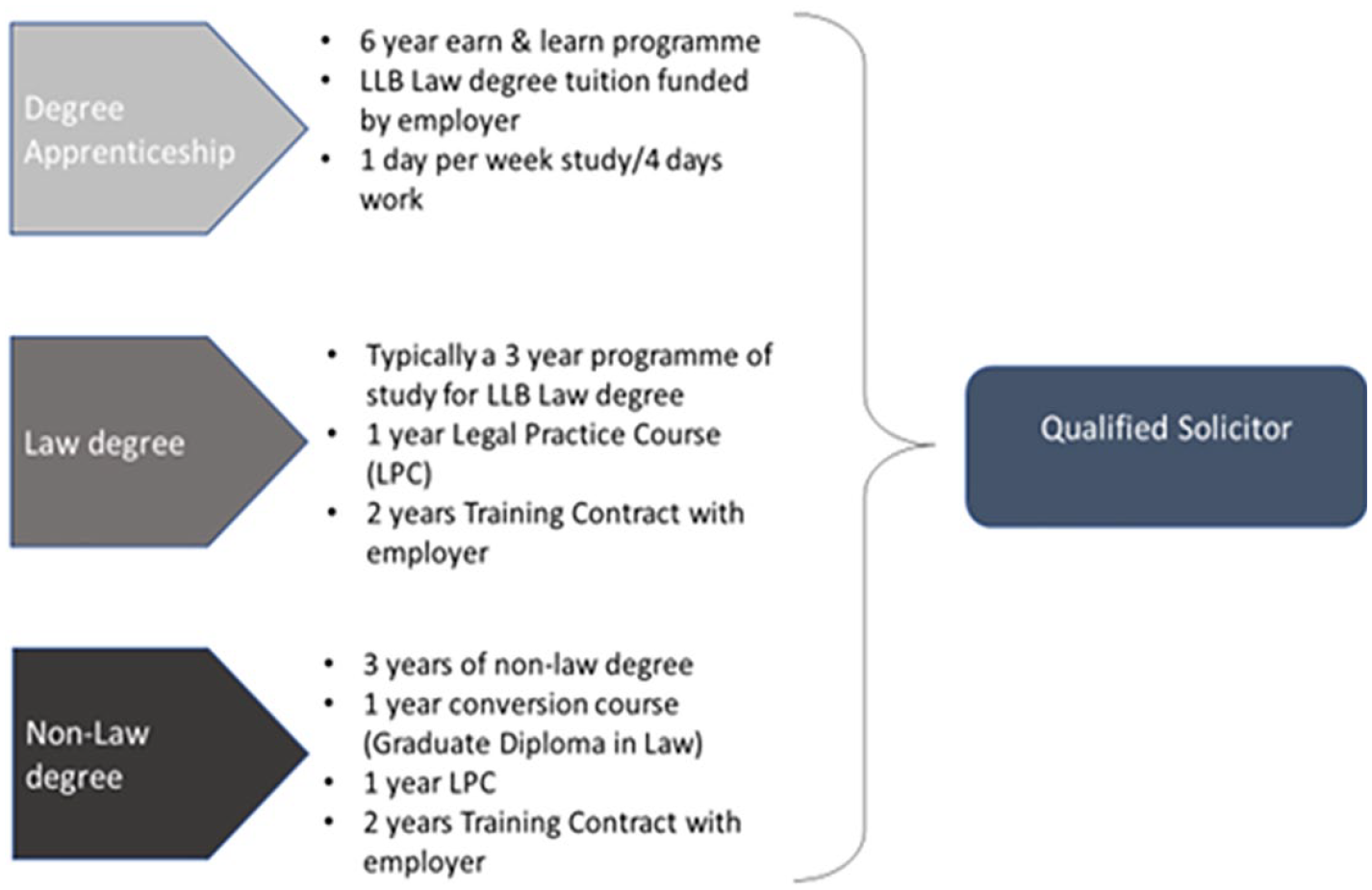
Routes to qualification as a solicitor in England and Wales.
Intense competition for training contract places and the high cost of tuition do not feature in the alternative DA route. These routes into professional occupations combine part-time study and employment as a route to a professional career and a university degree with the cost of tuition borne by the employer (through an ‘Apprenticeship levy’, charged to larger employers in England from 2017). There were almost 11,000 DA starts in 2017/18 (Office for Students, 2019), of which just over 100 were on the solicitor route. Total DA starts for the solicitor route in the period 2016/17 to 2018/19 were just over 300. 3 Depending on the law firm applied to, the entry requirements for the DA pathway range from grades ABB to CCC at A-level, 4 which is comparable to some, though not all law degrees. Apprentices following the DA route can expect to earn a minimum of £3.70 per hour, although some law firms pay more and the annual salary can vary between £15,000 and £22,000 in the first year. There are thus clear differences in upfront costs between routes and a large element of risk for the potential student, since the relative long-term merits of the different routes are not yet clear. In practice, DAs are being used by employers as just one of several recruitment tracks, rather than replacing traditional graduate recruitment. However, studies indicate strong potential for differential prestige since recruitment into professional service firms, for instance law, accountancy and business consulting, has been dominated by entrenched social discrimination and a preference for elite universities (Ashley et al., 2015; Francis, 2011; Friedman and Laurison, 2019; Milburn, 2012). As this pathway is still quite new – no apprentices have yet completed the full six-year programme – it remains to be seen whether there will be any distinction in prestige, pay or career progression between the different pathways or whether the DA route leads to further stratification based on qualification pathway.
Conceptual framework
Rational action theories (RAT) represent a potentially fruitful set of explanations for decision-making for individuals from different social class backgrounds in the choice of pathway. Boudon’s (1974) model of primary and secondary effects, for instance, distinguishes two broad influences on differential outcomes by social class. Primary effects are those arising from class-based differences in educational achievement. Secondary effects are those arising from the choices which individuals from different social class backgrounds make when beginning with similar levels of educational attainment. According to Boudon, in the face of uncertainty, classed perceptions of the desirability of certain destination goals and of relative costs and benefits lead individuals from different social class backgrounds to opt for diverging pathways. These secondary effects are the result of RAT-based decision-making (Glaesser and Cooper, 2014: 465).
The concept of RRA (Breen and Goldthorpe, 1997) is influential in explaining educational choices in relation to individuals’ social starting points. Breen and Goldthorpe (1997) argue that the decision-maker tries to minimise the chance of intergenerational downward social mobility and seeks to achieve at least the same class position as their parents. Decision-making for upward mobility, seeking a higher class position than that of their parents, then becomes a matter of risk-reward assessment, with individuals from different class backgrounds behaving differently despite having an equal objective chance of success (based on prior academic attainment), such that those from more advantaged backgrounds are ‘more likely to engage in financially costly, status-seeking behaviour than those from disadvantaged backgrounds, who will prioritise the minimisation of financial risk’ (Pásztor and Wakeling, 2018: 985). In terms of RRA, one would expect that individuals from disadvantaged backgrounds would be more likely to choose the DA route, attracted by the absence of a tuition fee and the ability to earn while gaining their qualifications, thereby minimising financial risk and maintaining at least the same familial social class position. On the same basis, one would expect the more advantaged to choose the financially costly university route and to seek out more elite institutions. While rational action theories, for instance RRA, are commonly associated with large-scale quantitative studies, such studies can ‘lack data on processes and mechanisms’ (Glaesser and Cooper, 2014: 467). Goldthorpe (2007) recommends focusing on secondary effects and adopting a subjective view of rationality, recognising that social actors do not act rationally the whole time, but that they may ‘hold beliefs and in turn pursue courses of action, for which they have “good reasons” in the circumstances in which they find themselves’ (2007: 143). We, therefore, expect there to be some evidence of rational thinking in individuals’ accounts of their educational and career decision-making that would fit the assumptions of RRA.
Data and methods
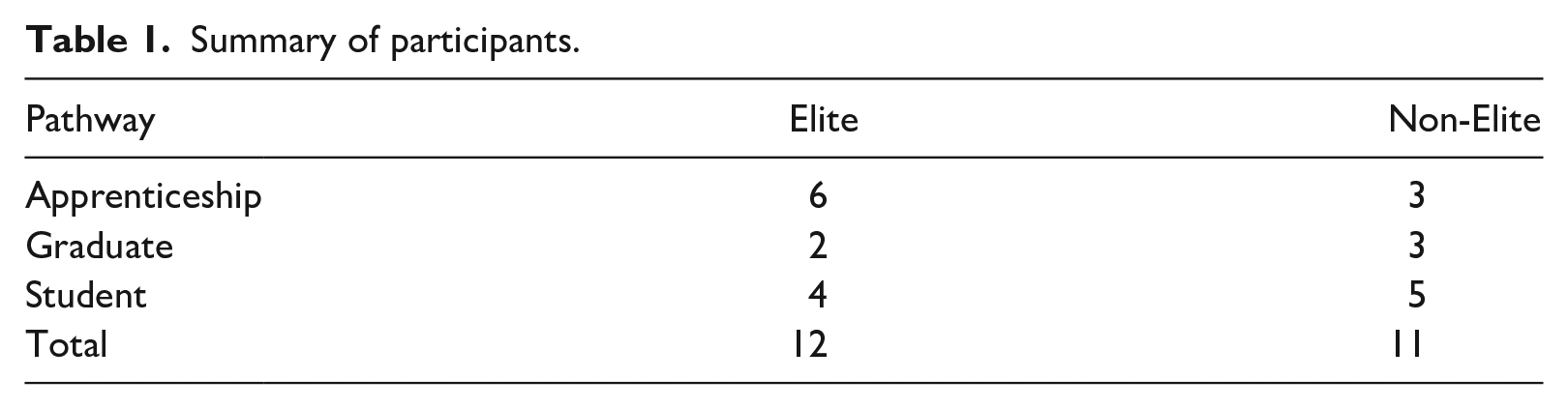
Since the focus is on how aspiring solicitors narrated their pathway choices, an idiographic approach was apposite. The research design (Table 1) divided the sample into three purposively selected groups based on pathway (apprenticeship, graduate or student). Participants were further categorised by the type of institution in which they worked or studied (law firm/university, elite or non-elite) to give a maximum-variation sample of possible perspectives and experiences. The sample included three elite law firms 5 with participants based in offices in London, the Midlands and the North of England (tiers 1–3) and two non-elite law firms – one based in a northern city (tier 5) and one based in a northern town (unranked). The categories of elite and non-elite were chosen to distinguish between types of university based on membership of the Russell Group (elite) or Post-1992 group of universities (non-elite). The university students came from two elite universities (both in northern cities) and three non-elite universities (one located in the Midlands and the other two in the North of England). It is recognised that even within the elite group of universities there are varying degrees of prestige; however, the study does not seek to explore the symbolism attached to belonging to any particular university but rather the type of university attended (elite or non-elite).
Summary of participants.
Our focus on class background presents the need to operationalise social class. Recognising the complexities in providing a definition of social class, individuals were classified using a combination of self-definition, type of school attended, highest level of parental education and parental occupation. On this basis, participants were divided into two simplified groups: working class and middle class. Inevitably, not all individuals fitted neatly and unambiguously within the working-class or middle-class categories (such as those who had graduate parents in lower paid occupations or parents who were self-employed but lacking qualifications). For the minority of interviewees in this position, a best approximation was made to assign the individual to one category or the other.
Participants were recruited using a combination of invitation emails, identified from university websites and social media (LinkedIn). Using email and LinkedIn, university Law School heads of department and lecturers were requested to (a) provide a pre- or post-lecture time slot for a call for participants to be made in person, or (b) to share a link to a research webpage with their law students – this contained information about the study and a link to the participant information and consent form. This approach using LinkedIn was also applied with success in recruiting apprentices through their tuition providers (private universities), as several attempts by email to law firms were fruitless. Additionally, some participants were recruited through other participants (‘snowballing’). Data collection occurred during 2017 and the first half of 2018. In total, 23 interviews were conducted, in which individuals’ socio-economic and academic characteristics were captured (see Table 2 for a full description). The semi-structured interviews typically lasted between 30 minutes and 1 hour. Interviews explored motivations and influences on educational and career decision-making processes, together with reflection on experiences and perceptions of their chosen route. Interviews were recorded, transcribed and coded, both inductively and deductively, firstly through immersion in the data, with prominent themes then highlighted for in-depth analysis, which comprised close reading and creation of the most prominent themes.
Characteristics of quoted participants.
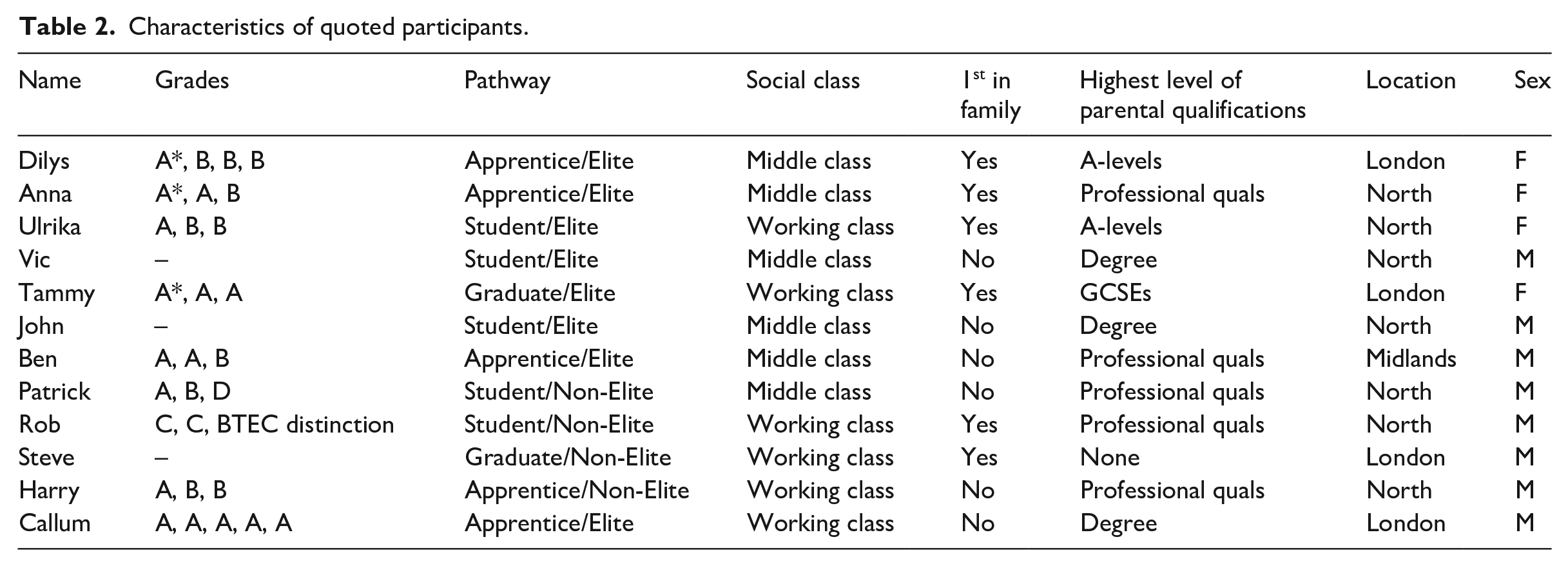
Pseudonyms were assigned to protect interviewees’ anonymity; any identifying characteristics have been removed. The names of institutions, law firms and universities have been removed or replaced by pseudonyms. However, where interviewees discussed institutions other than the one which they attended, the names have been retained to aid understanding of the context of individual decision-making.
Findings
All except three interviewees attended state comprehensive schools for their secondary education, with a few later attending sixth form colleges for A-levels. Most interviewees had very strong A-levels (A*s, As and Bs), with only a few interviewees achieving more moderate grades (Cs). Most of the high achievers had applied to elite universities (Russell Group or Golden Triangle), regardless of social background. All interviewees spoke of their concern about the highly competitive nature of gaining entry to the solicitors’ profession, where the competition for training contracts and level of student debt associated with the university route were prominent features.
Risk of pathway
University was seen by many interviewees as a high-risk pathway with no guaranteed route to full qualification as a solicitor and with high financial costs (undergraduate and postgraduate tuition fees). Awareness of the high level of competition for training contracts intensified the nature of the risk of this route for some:
I was going to university to get a law degree to be a lawyer, not just to get a law degree . . . the idea of not getting a training contract or not getting a job afterwards absolutely terrified me. So, when I knew that I’d got this job . . . it seemed really stupid to give up that option to kind of have my career path planned out, guaranteed and have some security for the next 6 years. (Dilys, A*BBB, Elite Apprentice, middle class, female)
The competitive nature of the graduate legal recruitment environment and the security of the pathway to full qualification were typical motivations for those choosing the DA pathway:
Because it’s so competitive that the thought of coming out of uni with a degree [. . .] and then having to find a training contract terrified me. So, I think in terms of like security, doing an apprenticeship was definitely one of the reasons why I wanted to do it. (Anna, A*AB, Elite Apprentice, middle class, female)
It is interesting here to note that, contrary to expectation, most of the interviewees deterred from the university route and attracted to the DA were middle-class interviewees, as with the two examples above.
Although the DA route offered a secure pathway and clearly addressed the issue of risk in respect of achieving full qualified solicitor status, this was not sufficiently motivating in all cases. Some university students, when asked whether they would have considered the DA route if they had known about it, thought that it presented a risk in terms of being a new pathway. Additionally, there was little understanding of the effect of this qualification route on future employability. There was an appreciation, even among first year undergraduate students, of the higher prestige associated with certain universities and how this was connected to gaining access to a career in law. It could, therefore, have presented a risk, especially in terms of employability at more prestigious law firms, to depart from the usual recognised pathway of qualifying through university:
I’d have definitely considered it but because it’s quite a new thing [the DA route], I don’t know how people would react to that . . . or how it would compete . . . they have such a heavy focus on the universities that you go to. (Ulrika, ABB, Elite Student, working class, female)
Some students had not been aware of the DA route to the solicitor qualification and believed that university had been the only pathway for them. However, considering in hindsight whether they would have chosen the DA route, their perception of it as lower status was sufficient to deter them:
I wouldn’t want to do it myself. I think I would have, rightly or wrongly, a perception of it being a lesser pathway. (Vic, Elite Student, middle class, male)
Interesting here is how the difference in status is articulated: for middle-class Vic, the anticipated perception of the more vocational DA pathway as having lower status is borne out; for working-class Ulrika, the risk is associated with her lack of knowledge about the pathway.
Recognition of the status of the chosen pathway was significant for some where there was an awareness of their own family’s social mobility and an imperative for each generation to do better than the previous one. When asked about the importance of having the distinction of attending a Russell Group university, the issue of social progression and doing better than one’s parents was evident:
I wish I wasn’t that vain because it did mean something to me . . . there was always this thing where I felt that I had a big progression because my dad went to Hull and my mum went to Plymouth and I’ve done one better than that . . . I felt there was a need for progression because even though I consider myself middle class, there’s almost the familial memory of the fact that that’s a recent development. (Vic, Elite Student, middle class, male)
Institutional status was seen as a measure of success and was of such importance that deviation into an unknown pathway, which risked the progression in social status, would have been too great a risk to take. This concern with institutional status is discussed further below.
Respect for pathway
For those who had attended an elite university pathway, the prestige of the institution, both university and law firm, was a concern whereby the type of law firm aspired to was mirrored in the perceived prestige of the university attended. Graduates thought that the DA route was a good idea in theory, particularly in terms of making the solicitor profession more accessible to people from non-traditional backgrounds. However, there was an understanding that the most elite, London-based law firms were not engaging with this route and that it was perhaps more of a regional initiative and, therefore, not an ‘aspirational’ route:
I wanted the prestige of going to a reputable university and a reputable law school and as much as I know that lots of the big law firms are starting to encourage the solicitor apprenticeship scheme . . . I’m not sure how many of the big London firms are actively encouraging it yet, or if it’s . . . a regional initiative . . . I wanted the prestige of going to (a) a Russell Group university and (b) a big Silver Circle, Magic Circle, American type of law firm in the City. So, I’m not sure in that sense, if it would have been something I’d have gone for, in all honesty. (Tammy, A*AA, Elite Graduate, working class, female)
Significantly, the newness of the DA route meant that some, particularly non-traditional students, had not considered this pathway and preferred the more recognised and trusted route of university:
I did hear about the Legal Apprenticeships, but I haven’t heard of many people . . ., like, it’s not a common thing that you hear about. University’s the standard, safest. (Ulrika, ABB, Elite Student, working class, female)
The perception of university having been the standard and safer route links to the concept of risk, above, where there was a concern about departing from the recognised pathway to qualification. This was echoed in concerns about the uncertainty of the longer-term outcomes of both routes, discussed below.
Uncertainty of outcome
Some law students were aware of the importance of applying to law firms for vacation scheme placements. These placements, generally with more elite commercial law firms, were for a two or three-week period in the summer break for successful applicants to conduct work experience and had a guaranteed interview for a training contract at the end of the placement. The application process for a vacation scheme placement was ultra-competitive and time-consuming:
[. . .] the application was very difficult to get through – many, many hoops to jump through, which actually reinforced the idea that it’s quite hard to get through to the firm. I think there were five different stages . . . I applied in early October, I can say the stages – Application with a covering letter, then it was psychometric testing, followed by video interview, followed by another psychometric test and an assessment centre after that. (John, Elite Student, middle class, male)
Such placements were notoriously competitive but highly advantageous in that these often led directly to an interview for a training contract, where the placement was with a more elite and commercial law firm and thereafter sponsorship for the next stage of qualification – the LPC. An offer of a training contract with sponsorship for the LPC shifted the burden of tuition fees onto the future employer (the law firm), secured the route to full qualification as a solicitor and removed the uncertainty faced by most law students who aspired to the solicitor qualification.
Although the freedom from tuition fees was appreciated, all of the apprentices in the study were pulled to the DA route by the certainty of progression to full qualification as a solicitor:
I wanted to find a route that was structured in such a way that I was guaranteed to progress the whole way through. (Ben, AAB, Elite Apprentice, middle class, male)
Employability
Some universities had an active student law society which was important for opportunities to network and engage with law firms. In addition to this, the networks the university maintained with law firms provided opportunities for their students to become more familiar with the culture of particular firms and access work experience. This was particularly important for some students – for instance, those from underrepresented backgrounds, who had no prior legal work experience or any professional connections:
I think, because of my background, I am at a bit of a disadvantage. I do have people on my degree, like their dad’s a lawyer or their uncle’s a lawyer and they’re getting all these opportunities that I can’t really get unless it’s through the university – and I have to apply for it and stuff, so . . . sometimes I feel like I am [disadvantaged]. I feel that if the university didn’t have that aspect to it . . . if maybe I went somewhere else where there wasn’t such a heavy focus on it [getting work experience], then I really would be stuck. (Ulrika, ABB, Elite Student, working class, female)
Other students went to university already having substantial legal work experience but valued the opportunities provided by their university’s network to enhance their profile:
There’s a lot of opportunities, I haven’t really taken any of them up. I’ve got a ‘link day’ at a chambers [barristers] . . . which is kind of just to say that I’ve done it. I don’t anticipate me ending up working in any chambers in the future, but it was just to explore the option, so I can’t say that I ignored it completely. (Vic, Elite Student, middle class, male)
The opportunities that were available to Ulrika and Vic were not possible at every university, for instance at a non-elite university where there were no strong links with law firms:
I feel bad saying this, but this university has been terrible at keeping relationships up with the legal field . . . there’s not really been any opportunities to network with lawyers. (Patrick, ABD, Non-Elite Student, middle class, male)
Some students were aware of how law firms might have perceived different universities and the relationship this had with opportunities for networking events and work experience:
It’s one of the reasons why the Law Society [student body] is trying to push to be more research-based [as a university] because that way you become more of a first-class rather than a second-class university, which is when firms go ‘Oh, we’d like someone to come in to speak to you’, rather than us having to chase them round constantly. (Rob, CC BTEC Distinction, Non-Elite Student, working class, male)
While opportunities to gain legal work experience and enhance individual employability were important to students, for those who followed the DA route the pathway itself was viewed as offering enhanced employability by providing actual legal experience:
The apprenticeship route, in my eyes, is much better – the experience you get and when you qualify you have all these years of experience that have mounted up, etc, it’s a no brainer. Things like the finance [funding for the degree], that’s a bonus almost. It’s definitely the experience and the opportunity to qualify – that was the main driving force. I knew straight away that I’d rather earn and learn. (Ben, AAB, Elite Apprentice, middle class, male)
While all interviewees recognised the importance of work experience and its associated informal contacts as a means to smooth access to the profession, it was mainly those from middle-class families opting for the DA route as a means of achieving this. Their accounts suggest they saw the DA route as a calculated risk, not likely to give access to the most prestigious outcomes, but with a better chance of avoiding missing out on entry to the profession at all.
Cost of qualifications
The financial cost of pursuing the solicitor qualification through the university route is considerable and was raised as an issue across the sample population. For many, the possibility of self-financing postgraduate legal qualifications (even through the Master’s loan system) would not have been feasible due to insufficient coverage of tuition fees and living costs. Where individuals self-funded this stage of qualification without having secured a training contract, it represented a considerable financial risk, as there is no guarantee that a training contract will be secured after completion of the course. This risk was removed for those who were successful in securing a training contract with law firm sponsorship for the postgraduate stage of qualification:
I wouldn’t have been able to have self-financed it . . . realistically, if I’d not got a training contract and had the sponsorship lined up. I, personally, don’t think I would have taken the risk. (Tammy, A*AA, Elite Graduate, working class, female)
The financial cost of postgraduate legal qualification was recognised as an enduring barrier to the profession for those without the resources to self-fund or access to sponsorship:
I think it’s constant barriers, how much it costs. I think if you came from an underprivileged background – one where you couldn’t afford to do something like this – you may have to work for a couple of years or end up going into very large debt in order to train, and that’s a huge shame. I’m lucky in that I’m able to go to a firm that’s willing to pay for my tuition fees for my LPC and give me a substantial grant to live in London while I study that, as well as a very good salary, but that’s not the norm by a longshot. (John, Elite Student, middle class, male)
Others described the system which allows uncapped student numbers with no guarantee of a training contract in somewhat stronger terms:
[The price of legal education] is criminal, with this self-funding thing. The LPC and the Bar . . . they need to sort it out because it is outrageous . . . and people are getting ripped off of so much money and they are being sold a dream. (Steve, Non-Elite Graduate, working class, male)
Sponsorship for legal qualifications was significant in easing access to the solicitors’ profession, removing financial risk and the uncertainty of a successful transition for those following the university route. The financial barrier to access also featured in the decision-making of apprentices. For some, the DA route provided an opportunity to obtain a degree and qualify as a solicitor without incurring tuition fees and student debt:
A lot of it was sort of the idea of having – because I wanted to qualify as a solicitor – up to £60,000 worth of debt by the time I’d qualify. (Harry, ABB, Non-Elite Apprentice, working class, male)
This route to qualification and a university degree with tuition fees paid was the pull for those pursuing the DA route, where some individuals were strategic in their choice of route:
[University] was never an option. It was a case of I knew exactly what I wanted to do and I could go down a route that took me to university but don’t have to pay for it. (Ben, AAB, Elite Apprentice, middle class, male)
Discussion
The findings from the study suggest that decision-making in the choice of route features tensions in relation to individuals’ perceived risk in the certainty of qualification, the cost of qualification, respect for the route and its effect on employability. There was some consistency with the RRA thesis in that the majority of decision-makers sought to secure upward mobility and in doing so compared the available options (where these were known) to make risk/reward assessments. However, while RRA would indicate that those from disadvantaged backgrounds would seek to minimise financial risk – by pursuing the DA route – and that the more advantaged would be more likely to engage in more financially costly behaviour – the university route – the findings depart from those expected in that working-class aspiring solicitors were more likely to make the choice to pursue the more financially costly university route. There was a minority of individuals for whom the DA route might have seemed an obvious and attractive choice. However, these individuals perceived the route as too risky in terms of future employability outside of the firm hosting the apprenticeship and the uncertainty of whether the DA route to qualification would be as respected as the established university route. There was a perception that the respect for the route and future employability were traded for the tuition-free qualifications, perhaps surprisingly making the DA route an unattractive choice for the more disadvantaged participants. However, it was principally working-class interviewees who rejected the DA route on grounds of its novelty and therefore uncertain status.
The push for university from school was also familiar with all the participants in the study who chose the DA route. Although some had stumbled across information about the DA route on social media, most had actively researched their options independently; information about the DA route had typically not been obtained through school. For most of the DA cohort, the positive features of the university route, such as going away from home, enhanced social life and delaying career decisions, were traded for the certainty provided by the DA route – the opportunity to work in a law firm and follow a progression route that led to full qualification as a solicitor. The certainty of the route to qualification, albeit through a new pathway, trumped the university route with its associated costs and risks, which were viewed as not winning in the competition for training contracts and not gaining entry to the solicitors’ profession. A minority of individuals choosing the DA route were driven by the prospect of obtaining their degree for no cost. These individuals were sceptical of the benefits of going to university but recognised the value of a degree in access to valued work. It is interesting that those coming to such conclusions were almost all from middle-class families, even though many middle-class interviewees still preferred the traditional university route, especially those with ambitions to secure work in the most prestigious firms. Messages from widening participation to HE initiatives are clearly now well-embedded such that, contrary to expectation, university is seen as a ‘safe’ route for the upwardly mobile, and work-based DAs a risk.
Given these findings, RRA does not fully explain the individualised decisions of those navigating their options and new pathways. Harrison (2019: 757) suggests that Goldthorpe and Breen ‘were concerned primarily with average effects across social groups’ and argues that approaches focused on the individual and their decision-making can add to our understanding, such as Simon’s (1997) ‘bounded rationality’. However, the DA policy also seems to have achieved its intended ‘disruption’, albeit not in the way its architects perhaps predicted. Faced with a new uncertainty, those from more advantaged social class positions ended up adopting different strategies, reaching different conclusions about risk and reward. While the sample is not large enough to be definitively conclusive, and interviewees do not divide entirely neatly across social class lines, there are hints that the most advantaged and disadvantaged tend to favour the university route to qualification, although for different reasons. Those in the middle were more heterogenous, with some sceptical about the value of HE, perhaps mirroring the horizontal stratification of middle-class fractions seen in some recent sociology of stratification (Savage et al., 2015).
Conclusion
This article has investigated a potentially disruptive new pathway to the solicitors’ profession and how those from different social class backgrounds deal with the risk and uncertainty this, and the more traditional HE pathway, present. While RRA explanations offer some help in understanding the choices and actions of individuals in the study, some of the findings are contrary to expectation. It appears that, currently, the new DA route to qualification as a solicitor is not sufficiently recognised and understood by the individuals from disadvantaged backgrounds who might benefit from, and are a principal target of, this route. While the most elite firms continue to favour (elite) university routes to qualification, opportunities for the disadvantaged remain somewhat out of reach due to differential access to particular kinds of informal work experience. Given this evidence, it seems unlikely that DAs will be successful in closing the gap in access to the solicitors’ profession between individuals from different backgrounds. One would expect similar findings in other well-rewarded professions, such as banking and consulting, which typically recruit from elite universities.
Additional research in two areas could generate further insight. First, this could involve tracking a greater number of degree apprentices across different professions and through to completion and full employment to explore the longer-term costs and benefits (actual and perceived). Second, the take-up of DAs could be usefully investigated across other dimensions of inequality, including race/ethnicity and, in particular, gender. Should the ongoing experiment with DAs persist, this area will have potential for further theoretical exploration for those working on the sociologies of work, the professions, social mobility and education.
Footnotes
Acknowledgements
We wish to thank Laurence Etherington, Daniel Muzio and Chris Wilkinson for their support with the project, three anonymous reviewers for their helpful feedback, and our participants – without whom the study would not have been possible.
Funding
The authors received no financial support for the research, authorship, and/or publication of this article.
