




Abstract
This article studies the organizational implementation of public policy, specifically shared parental leave (SPL) legislation (2015), through the lens of attribution theory (that is, actors’ inferences for why policies are implemented by their employing organization), drawing on 26 in-depth interviews with a range of actors in a British university. Our findings highlight that attributions vary between different organizational actors despite SPL being an externally-mandated, unavoidable policy. Our key contributions are to study attributions associated with under-considered external policy, highlight the unintended intra-organizational variations in these attributions, and explore how the co-existence of varying actor attributions impacts policy implementation.
Introduction
Parental leave policy, that is where fathers as well as mothers can access leave, takes different forms across countries (Brandth and Kvande, 2016; Haas, 2003; Koslowski, 2010; Robila, 2012). At one end of the spectrum are the active state policies found in Scandinavian countries, aimed at increasing fathers’ involvement in childcare (such as Sweden’s value care model and Norway’s flexible parental leave arrangements). At the other end are entirely privatized care models with limited state interventions (Central Europe, Spain and Greece) and a devolved approach (in a market-oriented United States of America it is up to employers and parents to figure out parental leave arrangements rather than the state). Despite the United Kingdom adopting a market-based approach to welfare (Haas, 2003), there is some state intervention to support more ‘traditional social democratic goals’ (Lyonette et al., 2011: 37), such as a normative shift away from the enduring male breadwinner model (Connolly et al., 2016; Hoherz and Bryan, 2019). Thus, the UK has gone further than European Union mandates by introducing shared parental leave rights but low state-provided pay for parental leave is in line with its market-oriented, residual welfare state model.
Implementation of parental leave policy must be located in this broader socio-institutional backdrop, including the national institutional approach to parental leave (Bünning and Pollmann-Schult, 2016; Esping-Andersen, 1990; Esping-Andersen and Billari, 2015). However, parental policy implementation is also impacted by sectoral effects, workplace norms and managerial attitudes at the meso level (Gatrell et al., 2014; O’Brien and Twamley, 2017) and individual characteristics and attitudes of mothers, fathers and families at the micro level (Borgkvist et al., 2018; Geisler and Kreyenfeld, 2011). This article therefore, takes a granular, multi-actor, and cross-level approach to policy implementation by applying the theoretical lens of human resources (HR) attributions (that is, employee beliefs as to why an organization has introduced a policy – Nishii et al., 2008) in the specific context of a British university. This facilitates an interdisciplinary approach to policy implementation whereby organizational psychology’s emphasis on individual actors’ attitudes and experiences with respect to work/family themes (Eräranta and Moisander, 2011; Greenhaus and Beutell, 1985) is combined with sociological literature’s more societal emphasis on family practices and organizational contexts (Ford and Collinson, 2011; Gatrell, 2007).
This article focuses on the shared parental leave (SPL) regulations, introduced in the United Kingdom under the terms of the Children and Families Act 2014 (section 117). From 2015, fathers (or the mother’s spouse/partner/civil partner) can take leave once the mother has ended her maternity leave. If both parents are eligible for SPL they can share leave concurrently or in blocks, minus any maternity leave taken, between the birth of a child and the child’s first birthday (Shared Parental Leave Regulations 2014, reg. 3(1)). However, low uptake of SPL in the UK, with less than 1 per cent of eligible fathers taking it (O’Brien and Koslowski, 2017), signals a problematic translation of national policy within organizations (van Gestel and Nyberg, 2009). Therefore, our overarching research objective is to study the organizational implementation of an under-utilized public policy (that is, SPL) by drawing out different actors’ attributions, and the simultaneous impact of individual, organizational and environmental factors on these attributions. The following section explores our conceptual framework, followed by a consideration of the methodological approach and key findings. The article ends with an overview of our key theoretical contributions and their implications for public policy implementation.
Conceptual framework
A conceptual bricolage is applied in order to theoretically achieve our broad research objective of a multi-actor analysis of SPL implementation. First, attribution theory is used to unpack organizational actors’ beliefs about why their employing organization implements an employment policy in the first place (Nishii et al., 2008; Shantz et al., 2016). Crucially, attributions refer not only to the ‘inner workings’ of individual minds but also the broader processes through which individuals make sense of an event (Bowen and Ostroff, 2004: 208). For example, an event such as the introduction of legislation within an organization necessitates individual sensemaking of its consequence(s), including the differential translation and implementation of said legislation (van Gestel and Nyberg, 2009). Additionally, the institutional logics perspective is applied to highlight how interconnections between individuals, organizations and socio-institutional arrangements (Thornton et al., 2012) can impact these attributions. More specifically, the coexistence of competing logics is explored (Thornton and Ocasio, 1999) that is, how differential meanings conferred upon process(es) by different actors can result in a range of consequences within the same organization with respect to the same policy. A critical overview of attribution literature, and the relevance of studying external policy like SPL through this lens, is offered. Next, intra-organizational variations in attributions, and why these differentials exist, are theoretically explored by considering underlying competing logics surrounding SPL implementation.
SPL implementation through an attribution lens
Existing literature highlights that attribution processes are triggered by unusual, surprising and significant rather than routine events (Martinko et al., 2011) so that organizational actors can ‘make sense of their surroundings. . .and attempt to (re)establish control over their lives’ (Sanders and Yang, 2016: 203). However, despite this theoretical remit, employment-focused attribution literature primarily studies organizationally-driven policies rather than external policy and employment legislation. This dominance of the organizational narrative has resulted in an over-emphasis on internal attributions, that is, actor inferences that employment policies are implemented (and subsequently controlled) by management in order to achieve specific organizational objectives (Koys, 1991; Nishii et al., 2008). However, external attributions, that is, actor inferences that employment policies are implemented in response to unavoidable environmental pressures such as public policy, union contracts, and governmental/regulatory pressures (Jones and Davis, 1965; Nishii et al., 2008), and therefore outside the control of management (Weiner, 1979), remain under-explored (the exploration of trade unions by Nishii et al., 2008 is a notable exception).
This article seeks to extend attribution theory on two counts. First, furthering theorization about attributions associated with under-considered external policies. Union compliance is the sole external attribution category that has been studied thus far, generating the assumption that external attributions ‘exhibit a nonsignificant relationship with employee attitudes’ (Nishii et al., 2008: 513) because they a) are subject to external, unpredictable change (Jones and Davis, 1965), b) do not offer organizational insights (Jones and McGillis, 1976) and c) are perceived to be outside the control of management (Weiner, 1979). However, UK’s parental legislation, particularly paternity leave arrangements, has primarily undergone incremental change with different governments focusing on institutional continuity (see Figure 1 for a timeline of UK’s paternity leave legislation) (O’Brien and Twamley, 2017; Streeck and Thelen, 2005). Furthermore, employment legislation sets a minimum compliance threshold that forcibly reduces variation across contexts and time. Both these boundary conditions minimize the purported instability and unpredictability of environmental conditions vis-a-vis actors’ external attributions. The government also devolves the implementation and tracking of SPL to individual employers (with no reporting requirements) (O’Brien and Koslowski, 2017), rendering organizational activities and processes (for instance, design and implementation at or beyond the legal minimum, internal policy communication etc.) subject to managerial rather than external purview. This increases managerial control over the strategic reframing and interpretation of national policy (van Gestel and Nyberg, 2009) and subsequent managerial implementation of SPL is likely to impact employee attributions.
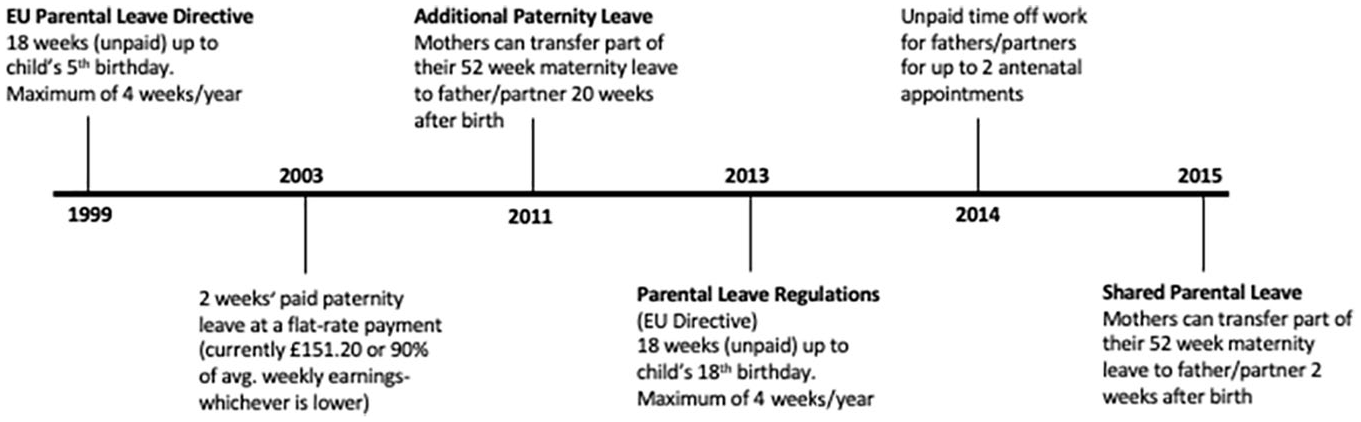
UK’s paternity leave legislation.
Second, extending attribution literature by exploring whether the existing distinction between internal versus external attributions (Koys, 1991; Nishii et al., 2008; Shantz et al., 2016) is applicable in the public policy context. In reality, attributions with respect to public policy are likely to be influenced by a range of coexisting organizational and environmental factors. Organization-specific characteristics, such as the way legislation-driven policies are communicated within organizations (e.g. Den Hartog et al., 2012) or implemented by different managers (e.g. Purcell and Hutchinson, 2007) as well as external factors such as popular opinion, media representation, and larger public policy debates surrounding that legislation are both likely to impact actor attributions. Furthermore, organizational actors may end up making internal attributions for externally-driven employment policies (for example, when employees see their employer offering enhancements beyond minimum governmental guidelines that signals organizational ownership of an external policy) (Troeger and Epifanio, 2018) or external attributions for internally-driven employment policies (for instance, when employees attribute flexible working arrangements to equal opportunity/parental legislation rather than their employer’s family-friendly agenda). With respect to the SPL, organizations have to meet minimum legal standards but also have leeway to implement the policy in line with broader organizational objectives – potentially allowing for simultaneous internal and external attributions. This signals a more complicated terrain than the rather neat theoretical distinction between internal versus external attributions (Koys, 1991; Nishii et al., 2008; Shantz et al., 2016), which may be tied to the predominantly quantitative focus in current attribution theory (Hewett et al., 2018).
Actor attributions and competing logics
Bowen and Ostroff (2004) apply the meta-features of distinctiveness, consistency and consensus on employment policies to theoretically explore the relationship between actor attributions and desired organizational outcomes (Nishii et al., 2008). This section defines each of these features, in the process drawing out underlying institutional orders/logics (Thornton et al., 2012), in order to unpack potential intra-organizational variations in attributions and the subsequent implications for public policy implementation.
Distinctiveness refers to employment policies that are considered important/interesting by organizational actors because of their visibility, understandability, legitimacy and relevance (Bowen and Ostroff, 2004). For instance, SPL may have high external visibility and legitimacy because it is a statutory instrument formally endorsed by the government, widely reported by the media, and implemented across a range of industries/sectors. However, it may have low internal visibility and relevance because it applies to a relatively small subset of employees (would-be parents from 2014 onwards), is a voluntary arrangement (employees may choose to take/not take SPL), and applies only for a short/fixed period of time (SPL is applicable for a maximum of 50 weeks). Additionally, the SPL is highly complex in nature – not all employees are eligible for it, SPL entitlements require coordination of leave for both parents who may work in different organizations, and leave arrangements tend to vary case-by-case dependent on the financial/personal situation of the employee requesting it. This inherent complexity may lead to both lower understandability of the SPL as well as greater intra-organizational variation in understandability (for instance, variations between actors who have managed and/or taken SPL versus those who have limited experience of it), thereby undercutting the creation of shared beliefs and behaviours at the organizational level (Scott, 2008). Therefore, the implementation of SPL is likely to be affected by the degree of distinctiveness ascribed to it by actors as well as their variable understanding of it, resulting in more complex (and potentially competing) attributions compared to other organizational policies, such as talent management.
Consistency refers to clarity, and unambiguous communication, by focusing on features such as instrumentality, validity, and consistency of/between employment policies; whereby the same effect is observed over time and across individuals and contexts (Bowen and Ostroff, 2004). First, consistency and unambiguity of organizational messages can be complicated by organizational actors’ personal attitudes towards legislation (Child, 1997). Parental/family leave legislation in particular is often underpinned by socially constructed (and sometimes prescriptive) gender roles and gender biases/stereotypes (Guerrina, 2002; Ingold and Etherington, 2013). Actors ascribing to more egalitarian gender norms may view SPL positively while those ascribing to more traditional gender roles may be neutral or even negative towards SPL. These differences in the meaning attached to SPL by different actors may impact the consistency of policy communication and subsequently its implementation. Second, consistency is impacted by potential dissonance between intended (that is, what managers’ report they are doing) versus actual practices (that is, what employees’ actually experience) (Nishii and Wright, 2008; Piening et al., 2014). Third, while existing literature offers a detailed analysis of the impact of management on employee attributions (Nishii et al., 2008; Purcell and Hutchinson, 2007; Sanders and Yang, 2016) less attention has been paid to how distinctions between different managerial actors (i.e. line managers versus HR managers) or extra-organizational stakeholders such as trade union representatives can impact the consistency of communication. For instance, organizational communication and implementation of policy may be governed by competing logics (Thornton and Ocasio, 1999) whereby line managers offer individualized arrangements (in line with operational realities), HR managers emphasize consistency (focusing on broader strategic objectives), and union representatives pursue more collective gains (in line with ideological aims). The coexistence of these competing logics vis-a-vis the same policy may lower the credibility of both the information received as well as the credibility of the organizational actor(s) communicating that information (Bowen and Ostroff, 2004; Nishii et al., 2008).
Finally, consensus refers to agreement and accuracy of attribution among message-receivers (i.e. employees) that is impacted by perceived agreement between message-senders (i.e. managers) as well as actor inferences as to the fairness of the overall human resource management (HRM) system (Bowen and Ostroff, 2004). If some managers are seen to pursue the dominant logic of compliance (i.e. the SPL is a legal requirement) whereas others pursue the dominant logic of equity and fairness (i.e. the SPL enhances employee well-being) (Koys, 1991) variations in employee-level attributions as to why the SPL was introduced in the first place can emerge. Furthermore, employee inferences with respect to fairness of the HR system can also be heavily impacted by lack of agreement among the ‘message-senders’. For example, operational/line managers may not see a relationship between the logics of fairness and legal compliance while HR/personnel staff do (Koys, 1991). Koys (1991: 290) ascribes this variation to line managers ‘policing’ employment policies in terms of their effect on organizational outcomes while HR professionals (in their more independent advisory role) emphasize equity considerations. To date attribution research has not focused on externally-driven policies like the SPL. Therefore, it is unclear how different organizational actors’ socially constructed values and beliefs (Thornton et al., 2012) impact not only the implementation of specific employment policies but also perceptions of fairness/unfairness of the overall HR system.
Our theoretical consideration of the meta-features of distinctiveness, consistency and consensus (Bowen and Ostroff, 2004) underscores how actors may end up making very different attributions with respect to SPL and how these attributions are underpinned by a range of competing logics (Thornton and Ocasio, 1999). Existing sociological and public policy narratives have already studied how visibility, communication and degree of stakeholder agreement/disagreement can impact public policy implementation – albeit from a predominantly macro lens. For example, the Swedish government’s investment in communication of policy content was aimed at increasing the visibility and subsequent uptake of parental leave (Ekberg et al., 2013). Furthermore, parental leave in New Zealand was informed by dissenting stakeholder narratives, whereby the women’s movement emphasized equality and social justice while the National Party aimed to facilitate businesses (Ravenswood and Kennedy, 2012). Our aim is to extend and supplement this existing body of work by studying public policy implementation at the micro level. The lens of attribution theory highlights different organizational actors’ inferences with respect to SPL while institutional logics enable an understanding of how, and why, these inferences may vary because of actors’ differing ‘belief systems’ (Reay and Hinings, 2009). The key research questions are:
RQ1 – How do different organizational actors’ attribute an externally-mandated public policy?
RQ2 – How can actor attributions impact organizational implementation of public policy?
Methodology
This article examines actors’ attributions with respect to SPL in a British university. Our case study organization has a strong focus on work-life balance, offering both formal family leave policies (for instance, parental, maternity and paternity leave and flexible working arrangements) as well as informal family-friendly initiatives (for instance, family activity holidays, coaching programmes for returning parents etc.) to support a range of personal/family situations. The organization started offering SPL from 2015 onwards (see Figure 2 for details on legislative provision versus organizational enhancements).
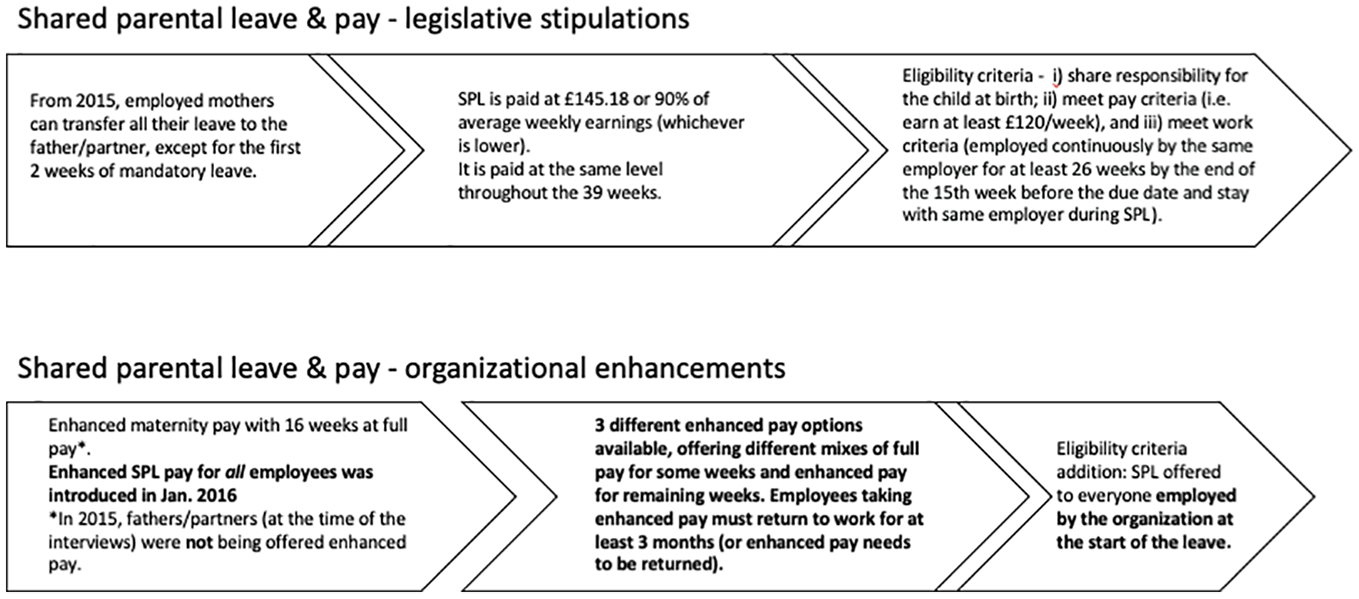
SPL – Legal provision versus organizational enhancements.
Our study is based on 26 in-depth interviews with 19 employees (11 academics and eight professional service staff) and seven other organizational stakeholders (three line managers, two senior HR managers and two trade union representatives). Employee-level participants were initially recruited through theoretical sampling. In 2015, the university’s HR department invited all expectant/new fathers who formally qualified for SPL to participate in the study. This was supplemented with ongoing participant recruitment via purposive sampling up until early 2018. However, low overall uptake of SPL (see Table 1) necessitated a pragmatic approach to sampling and limited control over participant numbers across schools/functions for the employee-level interviews. Given our multi-actor approach, interviews were also conducted with other organizational actors in order to supplement information gleaned from employee interviews, enhance overall data reliability, facilitate triangulation and capture the diversity of perspectives and intra-organizational complexities surrounding SPL. Line managers across different schools/functions were initially identified through the university website (following a process of random sampling) but only those with some experience/engagement with SPL were included in the final sample. Interviews with senior HR managers and trade union representatives were also conducted to gain a broader organizational perspective on policy implementation.
Comparative uptake of family leave policies in case study university.
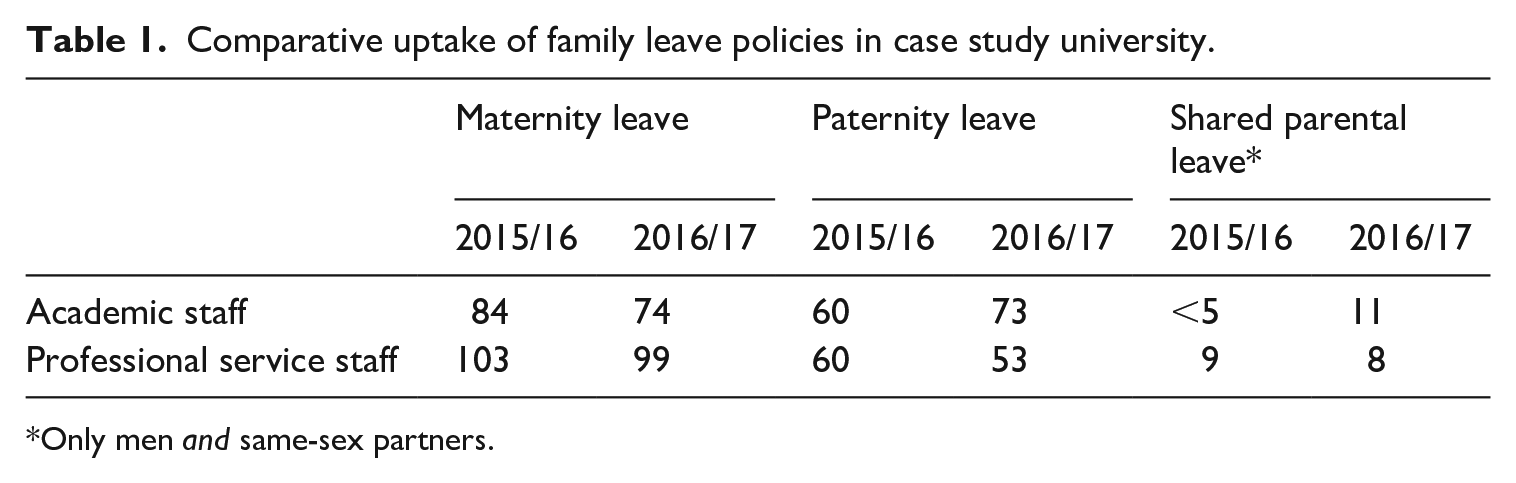
Only men and same-sex partners.
There are research limitations attached to the university context being considered. First, the charitable status of universities may predispose them to offer enhancements when implementing public policy/employment legislation, using their work-life balance and parental leave arrangements in particular to distinguish themselves as attractive employers (Troeger and Epifanio, 2018) (see also Figure 2 for enhancements offered by the case study organization). Second, academic staff enjoy high levels of autonomy and flexibility which can facilitate informal, ‘hidden’ parental leave at certain times of the academic year. By way of an empirical redressal academics on less flexible contracts (for example, post-doctoral fellows tied to project deadlines and fixed-term contract holders) and professional services staff (with lower flexibility in their working arrangements) were included. More broadly, it can also be argued that since the introduction of New Public Management practices from the 1980s, employment practices in the university sector are now largely similar to the private sector (Pollitt and Bouckaert, 2004).
Recruitment of participants was circumscribed by two theoretically-driven sample criteria. First, there was a focus on participants who either had actual experience of SPL or at the very least an explicit awareness of it (for example, employees who might have looked into SPL options but ended up taking only statutory paternity leave). Attribution theory highlights that actors engage in attribution-making processes when an employment policy has motivational significance and relevance for their personal goals (Bowen and Ostroff, 2004). Therefore, actors who were unaware of the SPL, and had no theoretical or practical engagement with it (for instance, fathers who had children pre-2014 or line managers who had never processed SPL applications), would be unlikely to make attributions about a policy that had very little relevance and significance for them and were therefore excluded from our sample. Second, with respect to our employee-level participants we specifically focused on fathers (and same-sex partners) and excluded mothers because differentials in the characteristics of the attribution-maker can result in very different cognitive framing/reframing and attribution-making processes (Nishii et al., 2008). SPL necessitates mothers giving up some of their leave whereas fathers are increasing their leave, thereby requiring very different framing between mothers and fathers. Exploring these differences would have necessitated an analysis of dispositional and psychological processes (Sanders and Yang, 2016) which are beyond the primary aims of this study.
All interviews were audio recorded and transcribed and then coded in NVivo. The first stage of data analysis was descriptive and included open coding to identify emergent themes and patterns in the data (Gioia et al., 2013), that captured wider actor perceptions of SPL (e.g. gender norms, equality, individual negotiation patterns, knowledge of SPL, financial implications of taking SPL, personal reasons for taking SPL, and barriers to taking SPL). The second round of coding involved theoretical thematic analysis (Braun and Clarke, 2006), that is, analysing data using a pre-existing theoretical lens based on Bowen and Ostroff’s (2004) meta-features of distinctiveness, consistency and consensus. Coding was undertaken by the first author, and reliability checked by the second author. During the second round of coding certain sub-themes such as instrumentality and legitimacy of authority (as identified by Bowen and Ostroff, 2004) did not emerge as significant findings and were subsequently discarded.
Findings
The main research objective was to explore actor attributions vis-a-vis SPL and the subsequent impact of these attributions on organizational implementation of public policy. The following sections focus on Bowen and Ostroff’s (2004) meta-features which emerged from our data analysis in order to offer a richer understanding of different actors’ attribution-making processes in our chosen organizational and policy context.
Distinctiveness of SPL
In line with Bowen and Ostroff’s (2004) definition of distinctiveness, our data highlighted that SPL had high legitimacy and relevance on account of its intended social goals, principally moving away from a male breadwinner model, increased involvement of fathers in child-rearing, and greater gender equality in terms of careers, financial security, caregiving etc. (Connolly et al., 2016; O’Brien and Twamley, 2017). This signals successful normative recalibration across the organization (Ingold and Etherington, 2013).
I think it’s quite sort of egalitarian. . .people (need to) realize the importance of the father forming a bond with the new baby. (AC4) . . . the spirit of this legislation. . .what the government wants us to do is to treat the mother and the father as joint. . .parents effectively. . . making sure that women in particular were not disadvantaged in their careers, because of long caring responsibilities. (M22)
However, our micro-level analysis highlighted that, except for this consensus on SPL’s societal goals, there were considerable differences in the degree of distinctiveness assigned to SPL by different actors. First, there were attribution differentials between employees and managers. Managerial actors primarily made external attributions underscored by the logic of compliance. They emphasized that the SPL was being implemented because of externally-driven legislation that was ultimately beyond the control of the organization and distinctiveness/understandability was low because of the complexity of the legislation itself, ‘it’s far too hard, it’s far too complicated. . .’ (M16).
. . . the university of course complies with all legislation. . . (M22) . . .the conditions (that) have got to be met are statutory. . . if you have the (length of) service with us, and you meet the statutory conditions. . .then (you get) the leave. . . (M24)
However, employees (both academics and professional staff) were more likely to make simultaneous internal and external attributions. While employee interviews acknowledged that the SPL had been introduced because it was ‘a government policy’ (PS18), necessitating ‘statutory entitlements’ (AC14), its implementation was also tied to their organization’s overall commitment to family-friendly initiatives. And it was this interplay of external compliance pressures with internal, family-friendly narratives that could compromise overall understandability of the policy, ultimately impeding implementation effectiveness,
. . . it turns out the HR department did not understand their own policy. . .so I ended up having to have a phone conversation with the deputy director for the whole university. . .to try and make them understand the words that are written in their own policy. (PS19)
Additionally, the distinctiveness and subsequent strength of attributions varied between academic versus professional staff. Academics’ attributions vis-a-vis the SPL were impacted by policy conflation and goal conflict. SPL distinctiveness for them was low because it overlapped with the existing range of formal and informal flexible work arrangements offered to academics (given the inherent flexibility and autonomy of their jobs).
My kind of job is flexible. . . being a university lecturer is not really a sort of 9–5 office job, so most of the standard paternal leave things don’t make sense. . . (AC3) I think (my colleagues) thought I was. . .a bit foolish for maybe going through the official channels rather than just working from home as most of them would have. (AC5)
Low policy distinctiveness was also impacted by goal conflict. Organizational competitiveness (tied to academics’ research outputs) and associated performance pressures meant academics made negative attributions whereby the introduction and implementation of SPL was seen as detrimental to the attainment of professional career goals and the organizational performance agenda.
. . .my wife (also an academic) wanted to go back to work very early and I also didn’t want to stay too much at home because it was important for our careers. . .this is a very competitive environment. . . there is quite a lot of pressure to perform and to deliver at the university. . . If you leave work for a couple of months you will become less competitive. (AC1)
However, professional service staff in more structured jobs with clearer reporting lines experienced lower policy conflation. SPL was considered as highly distinctive and taking SPL required formal approval and considerable pre-planning,
It was my responsibility to plan my work in advance of (SPL) so that somebody was there to keep an eye on things or to take things over while I wasn’t there. . .there’s a lot of work involved in that (planning). . . (PS7)
Additionally, since professional staff did not face similarly intense performance pressures (as their work did not directly impact the university’s external competitiveness), SPL did not impact their individual career goals. Therefore, professional service staff made more positive attributions and were also more likely to take longer paternity leave under the new regulations: ‘There’s not like any performance-related incentives or anything like that. . . I’ve never felt any pressure (to return early). . .’ (PS7).
Consistency
Consistency of employee attributions is closely tied to repetition and reinforcement principles (Bowen and Ostroff, 2004) involving not only within-policy consistency (organizational intent matches implemented reality) but also cross-policy consistency (compatibility between different employment policies).
One would expect legislation-driven policies like SPL to generate consistent attributions given the dominant logic of legal compliance. However, a multi-actor analysis highlighted that within-policy consistency was low because of the coexistence of competing logics (Thornton and Ocasio, 1999). Line managers supplemented the dominant logic of compliance with what was classified as the logic of operational flexibility that is, SPL had been introduced to comply with external regulation but was implemented on a ‘very flexible basis’. This additional logic of flexibility resulted in variable policy implementation across different departments, the type and level of job (for example, SPL conversations with employees on fixed term contracts were a lot less flexible) as well as the nature of work (leave arrangements were considerably more flexible for academic jobs in comparison to professional service staff).
. . . the negotiation here. . .was straightforward. . . local management were supportive, they took the time to quickly understand the policy, what I wanted, what would be effective (for them). . .we discussed what sort of patterns would be quite good for me. . . I didn’t (want to) fall massively behind in work. . .we sort of agreed that locally but then we sent it to HR. . .(and) there was an awful lot of back and forth. . . (AC17)
However, HR managers’ attributions were driven by the logic of legal compliance alongside what was identified as the logic of family-friendly economics. For them SPL had been introduced to honour public policy mandates and organizational strategic initiatives such as gender equality, enhanced work-life balance, family-friendly work culture, etc.
. . .probably not a lot of people knew about (SPL). . . it was sort of ‘government stuff’ in its early days. . . But the HR office. . . thought it was pretty good that I was taking time off and looking after the children. . . sort of taking (equal) responsibility. (PS18)
These differences in managerial attributions (because of varying logics) lowered within-policy consistency and in turn impacted the polarity of attribution outcomes across employees. Some employees made overall positive attributions whereby SPL was seen to have been introduced to achieve both societal and organizational family-friendly goals whereas other employees completely disengaged from SPL because managerial implementation favoured operational realities over external, social goals.
Analysis also highlighted issues with cross-policy consistency. With respect to academic staff, inconsistency was visible between SPL’s overall intent to encourage fathers to take longer parental leave versus performance pressures primarily driven by the university’s Research Excellence Framework (REF – an external mechanism for ranking British universities on the basis of their research outputs) goals. Academics underlined pressures to publish, apply for research funding, and juggle several projects which made longer parental leave impossible.
. . .as an academic we’re under a lot of pressure to perform. . . (there’s) REF and we’ve got a number of projects going on. . .I’d love (a longer leave) but. . .there are responsibilities here which need to be met. (AC2) I had a look at the number of papers I’ve published over the last 8 years, and in fact (if) I show(ed) you the graph I bet you could tell me exactly when my children were born. It certainly rises and then it drops. . .so you can see exactly when my children were born. (AC6)
Cross-policy inconsistency was also visible with respect to professional service staff but instead tied to lean management structures. This meant that in principle they could apply for longer parental leave, but the complication of finding suitable cover for a few weeks/months indirectly reduced the time actually taken off.
. . .nobody would have complained about it . . .it would have just been harder (to take longer leave) . . .there aren’t so many mechanisms (of) support. . . A lot of the work that I do. . .it’s not like I’ve got anyone to hand it over to. So if I’m not there things just stop. (PS7)
Consensus
The meta-feature of consensus refers to the accuracy of attributions based on the i) degree of agreement in communication and implementation between ‘message-senders’ (that is, managers) and ii) perceived fairness of the HR system (Bowen and Ostroff, 2004). Our data analysis highlighted low agreement between organizational ‘message-senders’ on two counts. First, differences in communication and implementation between line managers and HR managers (also highlighted in the previous section, in line with Bowen and Ostroff’s (2004) suggested link between consistency and consensus) lowered the accuracy of actor attributions,
there’s a difference between. . .the HR . . .and the kind of personal line (management). . . my line manager was very much kind of ‘yeah just take it off and we’ll see you when you get back’. . .without necessarily pushing me towards. . .the official routes. . .whereas once (HR) heard that I was having a baby they wanted to make sure I filled in all the right forms and actually went through the process properly. . .so there was that kind of disconnect between. . . school policy and actual kind of line manager interaction. . . (AC5)
Second, accuracy of attributions was impacted by intra-organizational variation between line managers (across different schools and functions), tied to their socially-constructed ‘belief systems’ (Reay and Hinings, 2009). Line managers who gave precedence to work-life balance issues and had personally experienced the strain of care responsibilities as parents were seen to be more supportive and flexible when making SPL arrangements. However, other line managers were seen to view SPL as ‘tricky’ and emphasized the impact on workloads and project deadlines rather than the broader family-friendly narrative. This in turn resulted in low agreement between employees because the parental leave experience ‘depends quite a lot on the understanding of your boss’ (AC4).
. . .even though there is a policy I think it really depends on the line manager. . .I was lucky that my manager was very supportive and said take the time, it’s important. (PS13) (My line manager) was the type of person if I’d said I wanted to take three months. . . and legally I could take three months. . . that would be fine because he wouldn’t have had an option, but I don’t think he would have been that happy. . . he wouldn’t have made it hard for me but I don’t think he would have made it easy. (AC8)
Therefore, unsurprisingly employees with supportive line managers made positive attributions whereby legislation like SPL was seen as only one part of a broader family-friendly work environment that also included a supportive work group, a collegiate culture, as well as high uptake of parental leave by peers. However, employees working with line managers that emphasized operational realities often tended to make negative attributions whereby SPL had been introduced as an externally-mandated policy with low/half-hearted organizational buy-in.
Additionally, a lack of fairness within the HR system was highlighted by several respondents specifically in reference to female counterparts. For instance, when SPL was initially introduced in the case study organization, female employees were offered enhanced maternity pay (which was above the statutory limit) while male employees were only paid the statutory paternity pay (which in the case of all our participants was considerably less than their regular income). This financial disparity was the key reason our male respondents took shorter parental leave, with subsequent distributive and procedural justice implications.
I was a bit frustrated with the actual kind of parental leave kind of package that we got from the university. . . we (had) just bought a house as well so. . .we’re fairly dependent on having the income. . . (AC5)
Fairness was also affected by enduring gender norms. Several employees highlighted how ‘if a male asks for paternity leave I think I would probably expect some raised eyebrows’ (AC1) whereas ‘for female colleagues there’s an unspoken expectation that they take a longer time off. . .’ (AC5) because ‘in most people’s mind, maternal leave is more of a right’ (AC3) while ‘the expectation (is) that you go back sooner. . .for a male’ (AC4). Our findings on consensus in particular highlighted how studying attributions involves going beyond individual inferences and also considering broader processes of communication and implementation. Variations in organizational implementation as well as parity issues impacted consensus within and between both message-senders (that is, managers) and message-receivers (that is, employees) resulting in attribution differentials. These findings in turn have implications for broader policy changes – lack of fairness within internal, organizational HR systems can ultimately compromise distributive and normative recalibration at the external, societal level (Ingold and Etherington, 2013).
Discussion and conclusion
The primary research objective is to study the organizational implementation of external policy from the specific lens of attribution theory. Our multi-actor analysis of attributions vis-a-vis SPL contributes to attribution literature in three key ways. First, current theorization needs to move beyond internal pressures, and the somewhat singular focus on how internal attributions impact performance (Bowen and Ostroff, 2004; Nishii et al., 2008; Sanders and Yang, 2016), and also consider attributions with respect to external pressures. Extant emphasis on the organizational narrative has been justified by classifying external pressures as ineffective, uncontrollable and statistically insignificant (Jones and Davis, 1965; Nishii et al., 2008). External policy is indeed uncontrollable (due to mandatory organizational compliance). However, organizational implementation of external policy generates diverse attributions that are simultaneously impacted by individual (for example, negative attributions tied to academics’ career goals), organizational (for instance, employee agreement on attributions tied to perceived fairness of the HR system) and societal factors (for example, positive external attributions tied to social outcomes such as improving gender equality, strengthening the family unit, prioritizing work-life balance etc.). This signals much more complicated attribution-making processes with respect to the under-considered external pressures. Crucially, attributions vis-a-vis external policy necessitate the simultaneous reconciliation of individual, organizational and societal factors which can result in differential/patchy policy implementation of legislation – an equally important outcome as organizational performance.
Second, our findings question the neat distinction between internal versus external attributions in existing literature (Koys, 1991; Nishii et al., 2008; Shantz et al., 2016). Managerial actors do make distinctive external attributions (Jones and Davis, 1965), underpinned by the dominant logic of legal compliance, and consider SPL as complex and beyond managerial preserve. However, employees make simultaneous internal and external attributions despite clear recognition that SPL is an external policy underpinned by broader societal goals. Employees’ dual attribution-making potentially signals their desire to reduce uncertainty and instability (tied to a significant life event like having a child as well as the complexity of distal legislation) by continuing to hold their employing organization accountable as the owner and implementor of external policy.
Third, our findings highlight variations in attributions both within and between actors (as discussed above). This extends existing attribution work on differences among actors that has focused exclusively on either managers (for example, Bowen and Ostroff’s 2004 consideration of differences between ‘message-senders’) or employees (notably the discussion by Nishii et al., 2008 on employee-level attributions). Our findings highlight that managerial actors’ attributions vary with line managers supplementing the logic of legal compliance with the logic of operational flexibility while HR managers supplement with the logic of family-friendly economics. This highlights how differential meanings (Thornton and Ocasio, 1999) assigned to SPL can impact the accuracy of attributions between managerial actors (Bowen and Ostroff, 2004). Additionally, variations in employee-level attribution-making processes are explored (see Table 2). Both academics and professional service staff have similarly low consistency and consensus, crucially with different underlying drivers. For instance, low attribution consistency for academics is tied to SPL’s incongruence with high performance pressures while professional staff’s is because of SPL’s clash with lean management practices. More significantly, there are attribution differentials between academics and professional service staff with respect to policy distinctiveness. Academics do not consider SPL as distinctive (because of overlap with highly flexible work arrangements and goal conflict) while professional service staff do see SPL as distinctive (given lower autonomy and flexibility in their regular jobs).
Attribution-making processes across employee groups.

These theoretical contributions with respect to actor attributions in turn have implications for policy implementation. First, attribution differentials between actors can lead to entrenched intra-organizational variations in policy implementation over time. Attribution-making will result in attribution-sharing, whereby peers influence each other and share organizational norms (Weick, 1995). This attribution-sharing is likely to be higher within specific employee groups (in line with the identification by Nishii et al., 2008 of collective sense-making because of group-based social interaction). Therefore, academics are likely to rely on other academics for information (through rumours, office gossip, first-hand observation of colleagues’ experience of the SPL etc.) and professional service staff on their own group peers. This can create a self-perpetuating cycle of persistent variations in attribution whereby academics continue to assign low distinctiveness to SPL and professional staff higher distinctiveness. Persistent attribution differentials will impact the degree and frequency of SPL uptake and create divergent patterns within the same organization, eventually undercutting the intended social goals of SPL.
Additionally, our findings may be especially beneficial in the context of other external policies like SPL, whose implementation and monitoring is devolved to organizations. Organizational psychology literature highlights how organizational culture and organisational climates (Bowen and Ostroff, 2004) are impacted by attributions as to why a policy is introduced in their organization, what is considered as important, and what behaviours are expected and rewarded within an organization (James and Jones, 1974). Sociological research then ties organizational culture to intended policy outcomes such as uptake of parental leave (Haas and Rostgaard, 2011). However, the variations in attributions that emerge in our article signal that in reality there may not be a shared perception of organizational policies, practices, routines, and rewards (James and Jones, 1974). The resulting ambiguous/weak organizational climates (Bowen and Ostroff, 2004) may in turn result in patchy policy implementation and only partial realization of policy outcomes.
Finally, our multi-actor approach highlights how the ‘translation’ of national policy within organizations is not a straight-forward process because of the ‘role of human agency’ (van Gestel and Nyberg, 2009: 545) when reconciling individual, organizational and societal factors. Variations in attributions underscore the co-existence of several types of ‘strategic reframing’ (i.e. interpretation of national policy) (ibid) within and between managerial and employee actors. For instance, our discussion of academics’ attributions shows that their interpretation of SPL is concurrently tied to individual (goal conflict), organizational (policy conflation, supportive/unsupportive line manager) and societal (social goal of gender equality) pressures. HR managers’ attributions are subject to organizational (emphasis on family-friendly policies and compliance) and environmental (complexity of external policy, social goals) pressures. The coexistence of these varied processes of reframing/interpretation (van Gestel and Nyberg, 2009) highlights a degree of institutional complexity at the local level that is not necessarily captured in work focusing on policy implementation at the national (Connolly et al., 2016; Hoherz and Bryan, 2019) and international levels (Bünning and Pollmann-Schult, 2016; Haas, 2003; Ingold and Etherington, 2013; Koslowski, 2010; Robila, 2012).
Footnotes
Acknowledgements
We would like to thank Professor Kofman and the three anonymous reviewers for their invaluable guidance that was instrumental in shaping and improving this article. A debt of gratitude is also owed to Professor Jill Rubery, Dr Maryam Aldossari and Dr Kristina Potočnik for their unfailing support, encouragement and insightful comments on many draft versions of this article.
Funding
The authors received no financial support for the research, authorship, and/or publication of this article.
