




Abstract
From an analysis of everyday practices of flexible working captured in video diaries, a form of pervasive but invisible support work is identified and presented. Labelled ‘digi-housekeeping’, this is work that is required to maintain the digital tools that enable flexible working, and incorporates the tasks of clearing, sorting, preparing, provisioning and troubleshooting. Through the sociocultural processes of responsibilization, personalization and work extension, interpreted here as emblematic of wider neoliberal contemporary work arrangements, digi-housekeeping is devalued and made invisible, characterizing these tasks as not ‘real’ work. Classifying these tasks as not ‘real’ work is a new kind of boundary work that supports the continuing displacement of work activities onto individual workers. It is argued that such tasks need to be made visible in order to address feelings of work intensification.
Introduction
‘It’s my first email download and look what I’ve got. It’s a full screen of emails to deal with … A lot of them are rubbish, but you’ve still got to sort the rubbish’ (Jez, social entrepreneur). This epigraph illustrates a recognizable routine phenomenon; clearing junk emails is a daily task but, like domestic housework, an activity not culturally and economically recognized as ‘real’ work. Here, this invisible work is termed ‘digi-housekeeping’, activities performed to support and sustain the use of digital technologies in pursuit of flexible working, part of the ‘major reorganization of work which expands and depends on many kinds of activities that are occurring out of sight’ (DeVault, 2014: 777).
In this article, digi-housekeeping is analysed in relation to three groups of knowledge workers, offering a cross-section of flexible work arrangements. Social entrepreneurs (SEs) reflect the rise of self-employment in the UK (Office for National Statistics (ONS), 2018), which is said to offer ‘greater freedom and flexibility’ as a result of ‘being your own boss’ (Hatfield, 2015: 4–6); office workers (OWs) have the option to request flexible working arrangements (under UK Flexible Working Regulations 2014); and university students (USs), as tomorrow’s graduate workers, are urged to view flexibility as an employability competency or attribute (Handley, 2018). The Chartered Institute of Personnel and Development (CIPD) (2019) argues that flexible working is likely to increase in future with, for example, 70% of the workforce engaged in mobile working as early as 2020. Identification and analysis of digi-housekeeping’s specific tasks, captured through participants’ video diaries, provides a critique of flexible working by distinguishing sociocultural processes through which such digi-housekeeping goes unrecognized and devalued yet adds to a growing feeling of work intensification.
The article begins by critiquing flexible work as an example of contemporary work arrangements, with specific focus on the nature and practice of invisible work. Following an outline of the research methodology, the characteristics of previously unappreciated digi-housekeeping tasks are highlighted and described in detail. It is argued that, although pervasive and time-consuming, these tasks are positioned as not ‘real’ work through three sociocultural processes (responsibilization, personalization and work extension). The article concludes that the operation of neoliberal working arrangements can be seen even in such apparently mundane tasks as essential labour, which is distributed to the worker without acknowledgement or recompense.
Flexible working
Flexible working originally centred on configuring work arrangements (mainly through adjusting spatial and temporal factors) to accommodate the requirements of returning mothers (Smithson et al., 2004) or older workers (Platman, 2004). Digital technologies played a key part in this process, expanding choice about where and when it is possible to work (Bal and Jansen, 2016). Today, flexibility has moved beyond accommodating the requirements of specific groups and ‘flexible capitalism’ describes the contemporary economic regime where changes to employment practices, production processes and management strategies have re-shaped the conditions of work (Snyder, 2016). Significantly, flexibility is also extended from contextual factors to the characteristics of the individual worker who chooses or is required to work flexibly. The ‘flexible worker’ is an idealized identity within contemporary work discourses (Swan and Fox, 2009), extending beyond those already in work to inculcate students into assumptions about expected work practices even before they formally enter the labour force (Handley, 2018).
Consequently, scholars highlight the need for more critical approaches to an understanding of flexible working (Smith, 1997). For employees, the managerial positioning of flexible working as a benefit is associated with work intensification through employee feelings of reciprocity (Kelliher and Anderson, 2010) or even privilege (Mescher et al., 2010). Women have been more likely to adopt flexible working practices partly because of gender stereotypes about childcare (Chung and van der Lippe, 2018), taking the brunt of the negative consequences for career development. Self-employment has been positioned as the epitome of flexible working through idealizing personal responsibility and enterprise as the preferred way to generate jobs and income (Harvey et al., 2017). Self-employment now accounts for 15% of the UK workforce (ONS, 2018), the main source of employment growth since the last recession (Moore and Newsome, 2018). However, self-employment may shift ‘unproductive’ time outside paid work while still requiring such labour from individuals (Moore and Newsome, 2018).
Such developments suggest that it is vital to understand the lived experience of flexible working (Cañibano, 2019) and the ‘resources needed by workers to learn and perform the different forms of flexibility’ expected (Swan and Fox, 2009: S149). The research reported here addresses this issue by exploring the consequences of digitally enabled flexibility at the level of everyday working practice across a range of contemporary work arrangements. Specifically, this article focuses on how essential tasks may be positioned as not ‘real’ work and the consequences of this for contemporary work patterns.
The invisibility of work: From domestic to digi-housekeeping
Usually unpaid, often characterized as mundane and undertaken in private rather than public (Daniels, 1987), invisible labour ‘is economically devalued through cultural, legal and/or spatial dynamics’ (Hatton, 2017: 345). Housekeeping is commonly cited as an example of invisible labour and extends beyond ‘repetitive physical tasks’ (Eichler and Albanese, 2007: 231) to include the mental labour of responsibility for planning what, how and when tasks are undertaken (Daniels, 1987). Occurring in private domestic locations, housework has traditionally not counted as ‘real’ work in formal economic analysis (Day, 2015), despite the estimated annual value of domestic housework in the UK as approximately £38,162 of annual unpaid work per household (ONS, 2016). Such work is positioned as ‘women’s work’ as it is associated with the home and reproductive labour (Mies et al., 1988). Ironically, technological developments promising time and labour savings tend to marginally increase the time spent on housework as appliances contribute new tasks, such as loading and emptying the dishwasher (Bittman et al., 2004). These appliances also need cleaning, maintenance, repair and eventual replacement (Glucksmann, 2016). Moreover, new technologies also change sociocultural standards (Shove, 2003). Clothes are washed more often in the era of washing machines, reflecting adjustment of what are acceptably clean clothes (Shehan and Moras, 2006).
As an example of invisible work, domestic housework highlights how the distinction between ‘real’ work and not ‘real’ work can be made. The former takes place in public, is regulated and contracted, involves production and is theorized within economics. The latter is associated with the private domain, is largely unregulated and a site of reproduction (i.e. necessary to maintain the productive economy but otherwise outside the economic model of labour). This characterization of domestic tasks has been extended to describe other sorts of tasks not necessarily associated with the home or women in a process described as ‘housewifization’ (Mies et al., 1988: 48), wherein some labour takes on the characteristics of housework in being easily accessible but socially undervalued. Such labour represents an externalized cost that does not have to be borne by the employer but is necessary for paid labour to take place (Fuchs, 2014).
In the same way that various technologies have been introduced into housework in the name of efficiency, so digital technologies are positioned as enabling more flexible working (Jarrahi and Nelson, 2018). However, just like domestic technologies, they may give rise to new forms of housework, such as ‘digital housekeeping’ (Kennedy et al., 2015). ‘Digital housekeeping’ has been defined specifically as household tasks enabling a functioning internet. However, unlike traditional housework, Kennedy et al. (2015) found that digital housekeeping was particularly linked to male members of the household given its associations with ‘technical’ tasks. This article goes beyond this concept of digital housekeeping to propose the concept of ‘digi-housekeeping’ as a more pervasive set of activities that have become critical to the commercial enterprise. As with other aspects of digitalization, such as installing domestic broadband (Glucksmann, 2016), work is passed to the consumer/employee in a ‘do-it-yourself’ way and the labelling of such tasks as ‘mundane’ discounts their significance, rendering them invisible.
This article identifies the tasks of ‘digi-housekeeping’ through the analysis of everyday activities captured in the video diaries of three groups representing a cross-section of contemporary work arrangements across multiple locations. This micro-sociological approach demonstrates how the more macro-issue of the cultural devaluation of work that authorizes the critical boundary between ‘real’ work and not ‘real’ work (Rabelo and Mahalingam, 2019) plays out in even the most apparently mundane everyday practices.
Research approach
The research presented arose from a wider qualitative project examining the integration of digital technology into the negotiation and maintenance of boundaries between domains such as ‘work’ and ‘life’ (Digital Brain Switch Project, n.d.). Boundary theory argues that in order to avoid role conflict, we maintain physical, temporal and psychological boundaries between work and life domains (Clark, 2000) and consequently adopt particular boundary management strategies (or ‘boundary work’) to keep those boundaries in place or adapt them to new situations (Ashforth et al., 2000). The original focus of the project was on how digital technologies affect our ability to switch across these physical, temporal and psychological boundaries (Ashforth et al., 2000).
However, the participant-led video diary methodology (explained further below) exposed a set of common activities, not specifically related to the management of work–life boundaries, which were then identified and labelled as digi-housekeeping. Video methods allow such unanticipated insights by focusing on ‘doings’ as well as ‘sayings’ (Schatzki, 1996), and accessing practices with low visibility (Sarpong and Maclean, 2017). In conceptualizing and theorizing these practices in this article, the focus is less on managing work–life boundaries and more on how these activities, associated with the use of digital technologies, were positioned as not ‘real’ work. The boundary at issue therefore is not work and leisure/family, but what is to count as ‘real’ work and what is not ‘real’ work in a more existential sense.
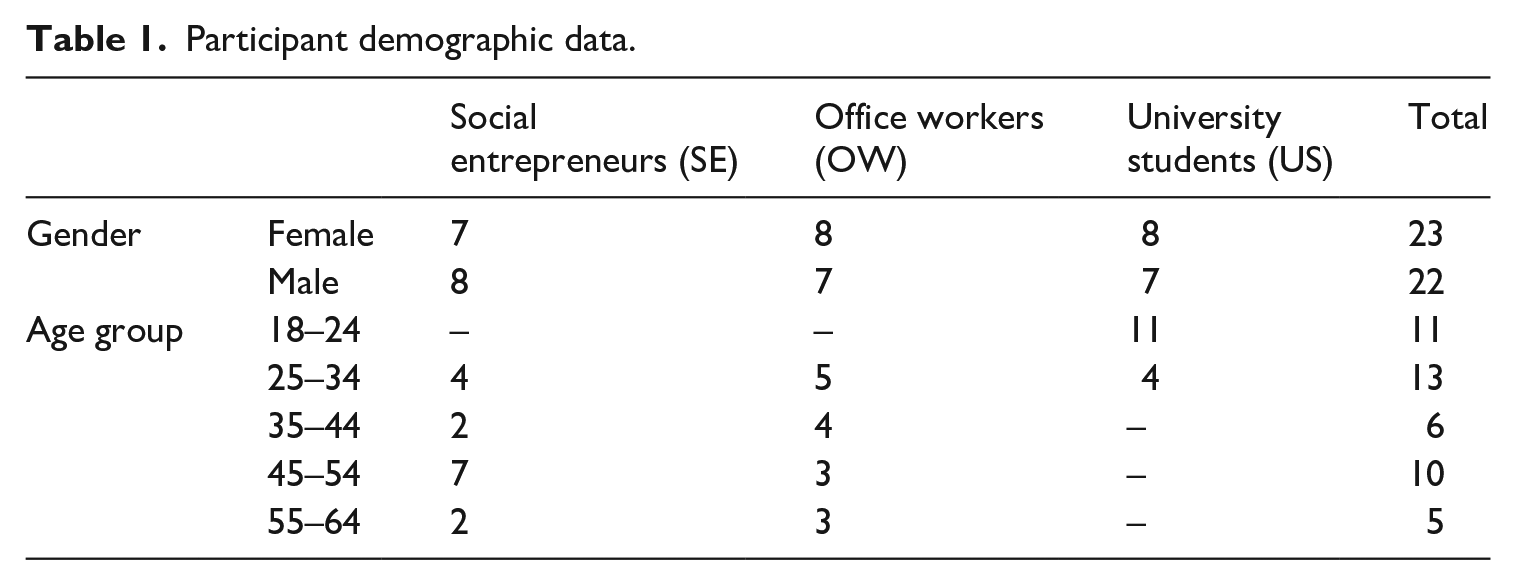
Forty-five participants from three UK-based groups were selected to address the project’s original research question, with equal numbers of men and women in each group. Participants were selected in line with boundary theory (Ashforth et al., 2000) to provide potentially contrasting occupational experiences of both work–life boundaries and digital technologies. It was anticipated that social entrepreneurs may have more permeable boundaries between family/leisure activities and work (e.g. having a shifting set of ‘work’ locations); office workers more fixed boundaries (e.g. specific times and places of work); and that student boundaries may be more variable (e.g. incorporating voluntary and part-time work as well as study), leading to potentially different implications for technology use. While the student group were generally younger than the other two groups and childless, there was otherwise heterogeneity within the groups in terms of childcare responsibilities and leisure activities. Brief participant demographic data are set out in Table 1.
Participant demographic data.
Unanticipated was the extent of take-up of flexible working arrangements among the office workers, thereby making their places and times of work less different from the SEs than originally conceived but allowing the exploration of flexible working as an unplanned research focus. With flexibility also positioned as a key aspect of graduate employability (Handley, 2018), students are a key group to include in such an inquiry.
Participants kept a week’s video diary of ‘switching’ between roles across different aspects of their lives, usually with accompanying commentary. The focus was on how they switched, tried to switch, or were externally prompted/forced to switch between roles. Where possible, participants were asked to capture what they saw in front of them rather than narrate these switches retrospectively. The briefing, however, reiterated no ‘right way’ to approach the task, thus participants were free to be creative and choose how to record material.
Detailed accounts of the methodology are published elsewhere (Whiting et al., 2018a, 2018b). Here, however, it is noted that the video diary method allowed the capture of intimate moments in participant lives, arguably not usually made visible to either researchers or work colleagues, and also experiences and activities not specifically associated with the research focus. Once the video diary was finished, participants returned the videocam and recordings, keeping a copy of their data for their own use. Two to four weeks after the video recordings concluded, a follow-up interview took place, covering: general career narrative; meaning and experience of work–life balance; switching; and the role of digital technologies in all these areas. Interviews included some participant reflection on excerpts from their video data chosen either by themselves or the researchers.
It was the researchers’ unique perspective across all the participants’ videos which triggered the recognition and identification of digi-housekeeping. Researchers noticed certain repeated tasks relating to digital technology across all three groups: charging mobile devices, updating software, setting up equipment with which to work, and troubleshooting technology problems. The participants themselves did not label these tasks as ‘housekeeping’ but the researchers’ viewing of the nature and positioning of these tasks across the sample prompted an association with domestic housework (Eichler and Albanese, 2007).
Template analysis was the data analysis strategy adopted for the main project, a generic style of thematic analysis which enables both the pursuit of prehoc analytical themes and the emergence of unexpected themes in the data (King and Brooks, 2017). The various individual tasks collectively comprising the emergent code ‘digi-housekeeping’ were identified through the examination of task content and context along with any accompanying participant narratives which explained what they were doing and why. Data were then coded via an inductive and recursive process involving (re-)viewing the videos and (re-)reading the interview transcripts leading to identification of five core tasks (each mapping onto a different aspect of domestic housekeeping). Each author then took the role of challenging the interpretations identified by the other, to refine and develop the findings. These justifications required further iteration with the data as the analysis progressed. Findings were then related back to the literature via the overall positioning of digi-housekeeping as supporting and sustaining flexible working.
The tasks of digi-housekeeping
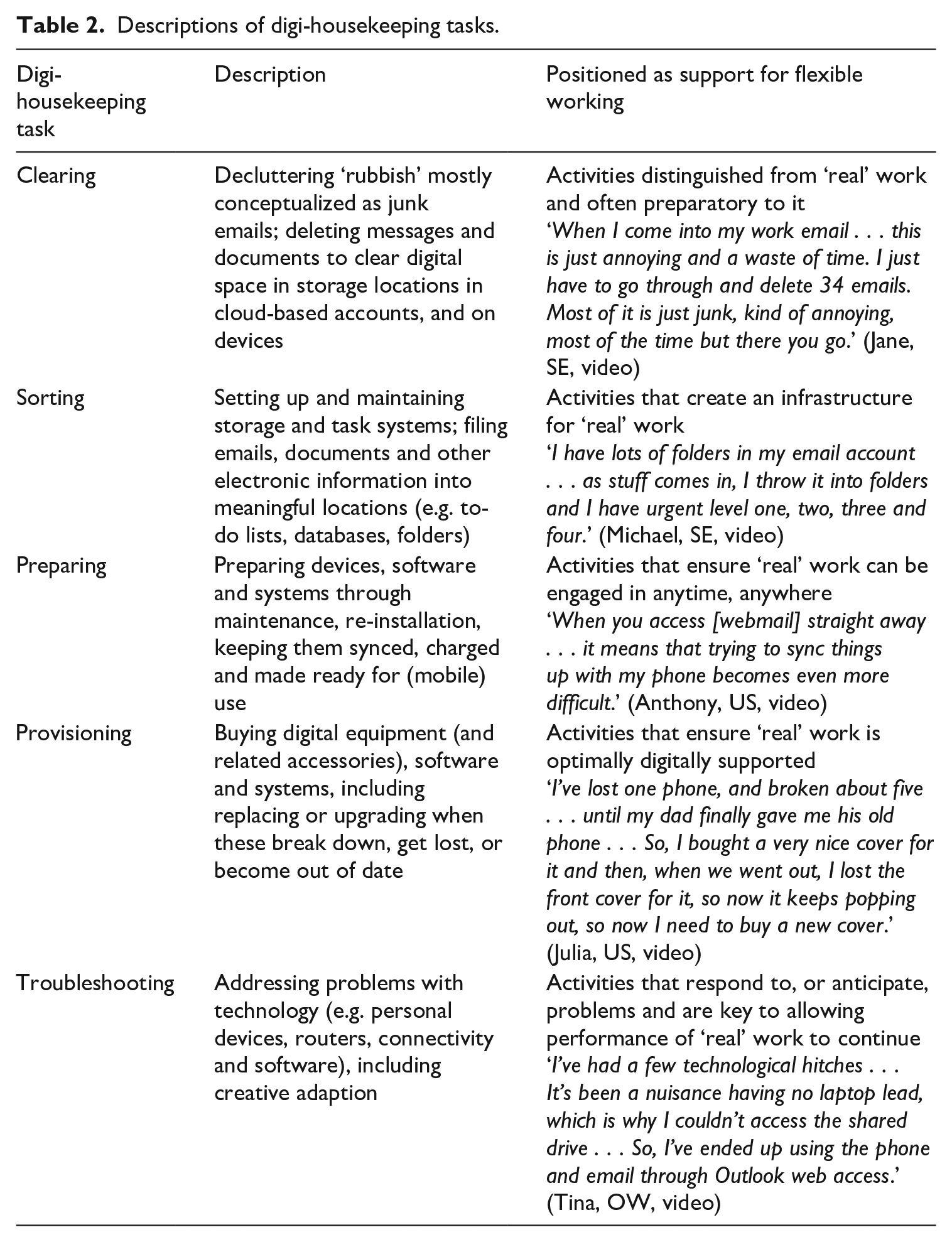
The first contribution of this research is identifying, conceptualizing and describing the everyday tasks of maintaining digital tools in pursuit of flexible working. While many may be aware of engaging in some of these tasks individually, viewed across individuals and contexts, such tasks can be identified as forming a particular set of related activities. These tasks are interpreted here through the metaphoric lens of traditional housekeeping. In this sense, the analysis is similar to that offered by Harvey et al. (2017) who found in the contemporary hyperflexible working patterns of fitness instructors echoes of the medieval practice of villeiny. Table 2 defines and, through quotations from the sample, illustrates each of the five core elements of digi-housekeeping that were inductively derived during the data analysis: clearing, sorting, preparing, provisioning and troubleshooting. Though broadly distinct, there is some inevitable inter-relationship between these mutually sustaining tasks.
Descriptions of digi-housekeeping tasks.
Clearing
Clearing comprised planned or spontaneous preparatory activities to ensure space on devices and storage clouds was used to its full potential in support of ‘real’ work (Table 2). The repetitive nature of clearing echoed its domestic housework equivalents, such as laundry and washing up. Such activities could be undertaken in non-traditional worksites, including trains and home. Some participants even reported using their bathroom for such tasks, such that inbox and participant were both cleaned up in preparation for the day.
Sorting
Technological ‘sorting’ comprised infrastructure activities that enable ‘real’ work to happen across a range of flexible working patterns (Table 2). The domestic housework equivalent includes filing paperwork and putting away groceries, which enable the smooth running of the house through facilitating finding items. Here, digitized systems centred on the management of participants’ work, allowing it to be identified and done with minimal further organizing. Such tasks could be personally customized as they were less subject to compliance with organizational-based norms.
Preparing
Preparing involved keeping devices, software and systems maintained and ready for mobile use to ensure ‘real’ work could be undertaken anytime, anywhere (Table 2). Most common was charging devices. The domestic housework equivalent involves preparing for daily routines (e.g. planning meals). Such activities are highly repetitious and were largely carried out at home.
Provisioning
Provisioning comprised activities that ensured ‘real’ work was optimally digitally supported, such as buying and replacing digital equipment and related artefacts (Table 2). The domestic housework equivalent involves buying food and other resources for household consumption. Here, it related to devices participants relied on for flexible working: obtaining them; getting them up and running; and rendering them consumable, customized to the particular user.
Troubleshooting
Troubleshooting involved addressing problems with digital technology. Rather than buying new equipment (provisioning), it involved creating solutions in response to or in anticipation of likely or repeated problems, plus more spontaneous moments of creative adaption (Table 2). Domestic housework equivalents include having solutions on hand to anticipated problems (e.g. lists of contractors to call when appliances break down). Just as with its domestic equivalent, troubleshooting also included the mental labour of anticipating issues as well as real-time problem-solving.
Detailing these unremitting tasks as experienced by the research participants every day establishes digi-housekeeping as the invisible infrastructural work associated with the digital technologies that sustain flexible working (DeVault, 2014) and which are the unanticipated and unacknowledged resources required for flexible working (Swan and Fox, 2009). Having provided a description of the tasks that together comprise digi-housekeeping, this article moves on to argue that such activities taken together are emblematic of sociocultural processes of contemporary work practice through which (necessary and required) labour becomes othered as not ‘real’ work, and to consider the implications of this for the individual experience of flexible working. In other words, identifying the operation of macro-neoliberal processes even in these micro-mundane practices. Three sociocultural processes are highlighted – responsibilization, personalization and work extension – and illustrated through further examples of digi-housekeeping tasks. For each process, examples are drawn from each of the three groups of participants, illustrating the widespread nature of such tasks while also illustrating their implications in particular contexts.
The responsibility of digi-housekeeping
Participants consistently constructed the practices labelled here as digi-housekeeping as a matter of individual responsibility, required to make flexible working operate for themselves, thus normalizing and internalizing societal and organizational positioning of flexible working as a luxury and a privilege, rather than a necessity for managing work–life demands (Mescher et al., 2010). For the SEs, digi-housekeeping was unanticipated additional work for which they had sole responsibility, which undermined societal assumptions of the privilege of self-employment. Jane, a single mother who accommodated working at home or in client offices around school hours, remarked that using digital tools was essential to her ability to work flexibly: ‘[it’s] brilliant for me, and really … creates flexibility’. However, her mobile phone had broken: When I know I’ve got a lot to do, and I can only do it in short bits now and then, it’s hard … my phone broke and I’m waiting for a new [one] … [company name] gave me this while my smartphone’s down and I have no idea how to use it. (Jane, SE, video)
This extract illustrates how having to engage in provisioning and troubleshooting digital tools broke up work flow and was time-consuming. Additionally, acquiring new tools required familiarization, which took up further time. Issues like this occurred regularly for individuals across the sample. As a self-employed worker, Jane had sole responsibility for finding the time to make these changes and understand (temporary) new work processes (not unlike learning to use a new washing machine). Valuable work time had been lost but Jane cannot charge such time to her clients. Exhortations to the freedom and flexibility of self-employment do not recognize these extra tasks, being so mundane as hardly to require comment, but creating unacknowledged extra work experienced as burdensome.
The OWs took on the responsibility of digi-housekeeping tasks to make flexible working operate for their organizations. Here, Kath, whose flexible part-time work involved job-share, was at home using her laptop on a non-workday: Okay, I’m just checking my work emails using the Outlook web app from home … My mailbox is almost full so I’ll probably just have a quick five-minute clear out of junk mail and stuff while I’m in here. (Kath, OW, video)
Although not officially at work, not only did Kath read some work emails, she undertook a digi-housekeeping task, an unplanned preparing task to avoid her inbox getting clogged up and to allow future ‘real’ work to take place. The positioning of the work as not taking up much time devalued the activity as not ‘real’ work, despite it being essential to maintain ‘real’ work. It is implicitly required by Kath’s organization – and her responsibility – but not explicitly remunerated by them as it fell outside her official work hours. Additionally, this clearing task was made necessary on a regular basis by the size limit of her inbox imposed by her employer organization. Thus, the organization has created this situation but takes no responsibility for resolving it, and as the tasks are completed on days not regarded as ‘real’ workdays, employees undervalue the work involved as an inevitable by-product of the flexible working arrangement enabled by digital tools.
In preparation for the digitally enabled world of work, students had already taken on the responsibility of the digi-housekeeping task of provisioning to offset potential digital problems. Jason, a doctoral student who worked flexibly at home or in a shared campus office, initially panicked on sitting down at his laptop at home to discover there was no internet connection: Now because we have so many devices connected to our router … we’re constantly having to re-discover the internet connection … I’ve made a point of storing a photograph of my wireless router’s password on my phone … OK, my warning message has gone away, I have a home network. Panic over. (Jason, US, video)
Without an internet connection Jason is unable to work from home: ‘If this doesn’t work, I’m going to need to go to the office’. This example illustrates that to engage in flexible multi-location working, individuals need to learn specific digital maintenance skills (not taught to them) and think ahead to anticipate problems. Personal responsibility is taken for acquiring these skills, and the time to work out solutions is positioned as a necessary but unacknowledged process of achieving flexible working.
As in other critical accounts of flexible working (e.g. Harvey et al., 2017), here such working arrangements offer flexibility but deliver responsibility without recompense and almost invisibly. With the spread of digital technologies in many areas of work, such tasks are common. Individuals complain about the technology but do not count up the hours spent and its equivalent in working time (see ONS, 2016), accepting and internalizing the responsibility for such tasks as an inevitable consequence of ‘choosing’ to work flexibly.
The personalization of digi-housekeeping
Digital devices are used for both work and leisure and thus engagement with devices is often quite personalized. Such personalization means that many digi-housekeeping tasks can only be executed by the owner of the device and in the silent communion between individual and their devices such activities are rendered invisible. Here, Leanne, who worked flexible hours, was cooking family supper, which gave her some moments to think about work, check work emails on her iPad and consider the next day’s activities: So, to try and keep track on all of this stuff I need to do across work, home and Brownies and everything else, I use something called Trello … a to-do list program. I’ve got boards which I’ve set up – I have one for work, I’ve got a to-do list for my in tray … I’ve got what I need to do that day. (Leanne, OW, video)
Such ‘sorting’ work created a structure essential to manage and enable ‘real’ work to take place. Mobility of devices and combining work and leisure tasks on one device renders tasks ambiguous, thus work efforts may be invisible to others and under-played by the individual themselves. In the same way that clean clothes just appear in children’s bedrooms, such work is somehow accomplished without any obvious effort or time spent. Indeed, as in the above example, combining work with other tasks downplayed the time and effort required, contributing to the conceptualization of the work tasks as not ‘real’ work. Indeed, participants enjoyed the efficiency of using small periods of time in multiple locations, allowing work to be accomplished everywhere and all the time (Mazmanian et al., 2013).
The personalized nature of the tasks challenged boundaries around culturally accepted ideas of ‘real’ work. As an example of the personalization of digi-housekeeping, Stephen (about to undertake a work trip) explained the kit bought to support his flexible working: I’ll just show you my bag and how it’s all put together … the computer which I’ll be using when I go on my travels … I always carry a small camera … it has video capacity as well, and obviously it’s a hobby, but it’s kind of handy for work as well because it can capture video and moments as we need …. (Stephen, SE, video)
Stephen’s provisioning work was invisible to others who would only see the outcome, namely the ‘flexible worker’ (Swan and Fox, 2009). Stephen’s devices supported activities across the public/private boundary, thus making the distinction between these activities less obvious to others. Here photography may be more associated with a personal hobby but also constituted work for Stephen in ways others may not recognize. His digi-housekeeping supported the particular requirements of his flexible working, but the use of non-domain-specific devices strengthened the personalization of work processes.
In a similar way to Leanne, Anthony, a final year doctoral student, had learnt the value of ‘sorting’ as a self-driven form of highly personalized digi-housekeeping to support his flexible PhD work, which he described as ‘not really a “Monday to Friday” thing, it’s more of a “whenever you can find time to work on it” thing’: One of the most useful things I have for organizing different aspects of my life is … having some way of organizing my emails … The way I do this is just to have a bunch of filters in place and tons of different folders here … for my personal finances, for the [research] facility … for where I’m looking for applying for jobs …. (Anthony, US, video)
This structure is very specific to Anthony and his various life roles, could not be undertaken by anyone else, and indeed is invisible to anyone else. This personalization of work processes through digi-housekeeping activities makes supporting and executing these tasks only feasible for the person who has set up the infrastructure, meaning that the work cannot be shared out.
Such personalization of tasks and devices across work and leisure activities, in conjunction with security settings on devices, means digi-housekeeping is undertaken by users rather than others on their behalf, reflecting the wider social reorganization of labour (Glucksmann, 2016). Additionally, the use of the same digital devices for labour and leisure heightens the experience of such activities as personal; such technologies are not only individualized in terms of operation, but are devices wherein the division between work and not work is blurred, such that digi-housekeeping is not only for work purposes. In this context, maintaining devices for the purposes of work may be under-appreciated, ignored or seen as an adjunct to personal uses rather than work.
The work extension of digi-housekeeping
The digi-housekeeping tasks described here were plentiful, repetitive, involved the additional mental labour of planning and organizing and, taken together, added up to many extra hours of (unacknowledged) work. Elizabeth, an office-based worker, was on a ‘self-managed contract’ with her organization; this meant ‘you’re flexible, it’s up to you how you use your time … you don’t have to count your hours so much, so you’re just expected to work to get the job done’. Here she was trying to complete her overdue annual appraisal at home one evening through a virtual private network (VPN) and verbalized her frustrations as she tried to do that: Let’s see if my connection will actually connect me to the network … I’m going to have to do the time-honoured test of disconnect[ing] the Wi-Fi first. I’ll just connect VPN and reconnect without … It wants my credentials again. Why does it want my credentials? I’m going to have to switch it off and back on again. Terrific. So that’s taken me about half of my life to do that. (Elizabeth, OW, video)
Digital technology enabled Elizabeth to work from home and on the move; her videos showed her doing so on the train to and from her office. Her employer organization also benefited from this flexibility, with Elizabeth committing to additional hours to complete work tasks. Ironically, Elizabeth additionally had to troubleshoot the very technology that enabled her to do so, creating a digi-housekeeping task which she did not count as ‘real’ work. Indeed, her flexible work arrangement relied on such activities being classified as outside the realm of ‘real’ work, otherwise there would be insufficient time available for ‘real’ work to be completed.
Neoliberal conceptions of the entrepreneurial worker (Taylor, 2015) translate into contemporary university study being increasingly centred on promoting employability skills as a form of self-investment (Handley, 2018). In response, students may combine study with additional work (including part-time work to provide additional income), and this is enabled by digital technologies. Chloe, a full-time student, had also started a clothing customization business. Here she described preparing for an internet-enabled video call: It’s five to four and I’m getting ready for an international Skype meeting; however, I realized that my laptop has just been re-booted and I have to re-install Skype, so I’m just waiting for that and I’m just going to let people know that I’m trying to download Skype. (Chloe, US, video)
As well as already extending her working day to encompass study and enterprise, Chloe is also learning that to work flexibly she will need to engage in additional unanticipated digi-housekeeping tasks – here, ‘preparing’ tasks. Such tasks are normally invisible (as above) but here exposed – washing digital dirty linen in public – as a lack of preparedness becomes evident to clients. Chloe, and students like her, are learning that digi-housekeeping needs to be invisible to maintain professionalism and involves additional hours of mundane tasks not immediately apparent from the positive framing of the entrepreneurial worker (Taylor, 2015).
As an SE working in multiple locations, Michael also had to be cognizant of various ‘preparing’ activities. Here he explained about charging various devices: One constant thing with keeping gadgets going is making sure they’re all charged or there is a way of charging them. Stopping them dying on one. (Michael, SE, video)
In order to give a convincing performance of the ‘flexible worker’ (Swan and Fox, 2009), Michael had to have functioning digital devices. Michael’s life and death analogy reinforced the significance of this preparing task. Time must be spent in an ongoing fashion to effectively present oneself as engaged with contemporary neoliberal discourses of work. While digital devices enable this much-needed connectivity, they also absorb mental effort and time.
The work extension associated with digi-housekeeping is emblematic of a wider process of neoliberalization of work (Taylor, 2015) and provides some explanation of the work intensification often expressed in these early years of the 21st century (Kelliher and Anderson, 2010). Digital technologies create and reinforce new socially acceptable standards of flexibility, such as being contactable and responsive through connectivity (Symon and Pritchard, 2015). This mirrors the new standards of cleanliness associated with contemporary domestic technologies (Mylan and Southerton, 2018) and in a similar way extends the range of expected activities. As the tasks are not recognized as work, so the source of increased activities may be hard to trace and not factored into workloads or client invoices. Experiencing self-blame for failing to achieve work (because it is an individual responsibility) is an outcome of not recognizing tasks like digi-housekeeping as work. Additionally, as the introduction of digital technologies is often positioned as increasing work efficiencies, the additional work that comes with using such technologies may be downplayed, ignored or simply unrecognized (Plesner et al., 2018).
Discussion
Jez clearing his junk emails represents a wider and more significant phenomenon. In these everyday digi-housekeeping tasks we see the operations of contemporary sociocultural work processes writ small. Digital technology creates additional tasks necessary to the effective functioning of the technology and effective engagement in flexible working (Kelliher and Anderson, 2010). However, the processes of responsibilization, personalization and work extension also render these tasks invisible, apparently mundane and blur the boundaries between such tasks and leisure activities with the outcome that they are positioned as not ‘real’ work. While positioned as not ‘real’ work they are nevertheless experienced as taking time and effort away from work (or leisure), which leads to feelings of work intensification without apparent source. Ultimately, necessary work has been displaced on to the individual worker without recognition or recompense (Harvey et al., 2017). A major contribution of this research is to make those activities visible and highlight their prevalence.
These tasks were identified across all three diverse groups of participants in this research. These participants were not selected for their potential disadvantage; they were not engaged in care work, aesthetic labour, or other ‘regimes of labour disadvantage’ which are culturally devalued through some combination of sociocultural, socio-spatial or socio-legal mechanisms (Hatton, 2017: 338). Indeed, it can be argued that they represent privileged groups. Nevertheless, they illustrate how digi-housekeeping is rendered invisible as work to others (and themselves) as contemporary neoliberal expectations of work are internalized as individual choice. The OWs are disciplined through thinking that flexible working is a benefit or privilege rather than a right (Bathini and Kandathil, 2019). The SEs are disciplined by their self-employed status where digi-housekeeping is the inevitable price of achieving constant connectivity with those whom they seek to engage (Symon and Whiting, 2019) and also the inevitable price of choosing a more autonomous style of working (as encouraged by various UK employment policies). The USs are disciplined into a certain way of working that already encapsulates digi-housekeeping as a given and a matter of individual responsibility, as well as by norms of employability (Handley, 2018). Indeed, such tasks are generally highly familiar and constitute many individuals’ everyday experience, from food delivery couriers to traders in the stock market. Consequently, this research goes beyond the conclusions of Harvey et al. (2017), who focus specifically on fitness instructors, to argue for a much more insidious operation of sociocultural processes to ‘other’ necessary work activities as not ‘real’ work, leading to widespread work displacement and intensification.
The metaphor of ‘housekeeping’ helps to conceptualize the nature of these tasks and their general invisibility. In the traditional housekeeping literature, this invisibility is normally interpreted as a function of gendered power relations. Oakley’s (1985) sociological analysis of domestic housework challenged its cultural devaluation and the invisibility of housewives by recognizing this activity as work and those who perform it as workers. Similarly, exposing digi-housekeeping as labour contests its cultural devaluation through problematizing its positioning as a natural part of working flexibly. The operation of gender relations, however, is not straightforward. Kennedy et al. (2015) identified ‘digital housekeeping’ as the domain of men, concerned as it was with the technical maintenance of the networked household specifically. In the research reported here, digi-housekeeping was not confined to men but nor was it confined to women. Indeed, there is no real logical reason why digi-housekeeping should be more in the province of either gender as both genders use similar digital technologies (laptops, smartphones, tablets). However, to the extent that women continue to dominate the take-up of flexible working (Bal and Jansen, 2016), it may be the case that women will be disproportionately affected by the necessity to engage in digi-housekeeping. This is not an issue that can be explored in this qualitative, micro-sociological study. Further research may seek to address this question through a larger survey establishing the extent of digi-housekeeping more widely. However, it can be argued that digi-housekeeping is part of the process of ‘housewifization’ (Mies et al., 1988) of many aspects of contemporary working arrangements. Through responsibilization and personalization such tasks are rendered mundane and invisible. Such tasks extend the working day to increase labour value without cost to either an employer or a client, and workers entering the workforce are pre-disciplined into accepting this positioning. In other words, through this process men may begin to experience the same undervaluing of their labour as women have done through the gendering of domestic labour.
While research on work–life boundaries is largely concerned with how we maintain physical, temporal and psychological boundaries between work, family and leisure (Kossek et al., 2012), particularly in the age of digital communication (Schlachter et al., 2018), the research reported here involves not just deciding where and when we will work but, more fundamentally, the very nature of what will count as work at all. Digi-housekeeping tasks were not positioned by participants as either leisure or work, but activities that get in the way of ‘real’ work, thereby being almost liminal in nature. Indeed, digital technologies as personalized devices that enable both work and ‘life’ management blur the boundaries and make it more difficult to distinguish when individuals are engaged in ‘real’ work. In line with calls for housework to be recognized as labour, it is argued here that this should be recognized as necessary labour without which flexible working would not be possible.
Given the abductive nature of this research, there are limitations to the conclusions drawn here which open up areas for further research. Since digi-housekeeping was an emergent finding, a more purposeful research design would be beneficial, such that group differences may be further examined. For example, it may be that wealthier and more senior managers have the means to buy the resources to work flexibly, thus creating a new class divide between those who perform digi-housekeeping tasks and those who pay others to do so. Future research could therefore involve examining the role of socioeconomic status in determining resources for digi-housekeeping. Given how third-party expectations (e.g. colleagues and family) determined some digi-housekeeping tasks, research could also explore how new forms of power relations are created and implicated in flexible working. This approach could be a useful counterpoint to the existing organizational focus on reducing costs and improving productivity (Steelman et al., 2016).
Conclusion
In the 21st century, both female and male knowledge workers respond to declining administrative support by substituting their own labour, enabled by digital technology, to produce work of the required standard and to perform as ideal, namely, flexible workers. Digitization, and its domestication, has allowed these tasks to be absorbed and unnoticed. These need to be more explicitly acknowledged as essential activities to be scheduled into daily timetables and counted as part of their overhead for the self-employed. Bring your own device (BYOD) policies may bring efficiencies (Steelman et al., 2016) but do not address where the time for digi-housekeeping is meant to come from and indeed suggest that such mundane tasks are conducted in employees’ downtime (Steelman et al., 2016). There needs to be an estimate of how much time is ‘saved’ by use of digital technologies for both the self-employed and employees and how this squares with extra time demands. However, if work systems do not acknowledge such invisible labour, it is likely to remain unrewarded, unregulated and unaddressed in organizational and governmental policies.
Footnotes
Acknowledgements
An earlier version of this article was presented at the WORK2015 Conference in August 2015 in Turku, Finland and we thank all who attended the session for their useful feedback. We are also grateful to Dr Rebecca Taylor for her very helpful comments, which assisted in the development of this article. The authors acknowledge the contribution of their research project colleagues Helen Roby and Petros Chamakiotis regarding the design of the video study and collection of the interview data, respectively. Finally, the authors would like to thank all the participants who generously gave up their time to take part in this project; the research would not be possible without their support and participation.
Funding
The Digital Brain Switch project (http://digitalbrainswitch.org.uk) was funded by the Engineering and Physical Sciences Research Council (EPSRC) (Ref: EP/K025201/1). The project metadata statement is available here: 