




Abstract
This article describes changes associated with increased bureaucratisation and surveillance in the regulation and management of the 21st century shipping industry. Drawing upon 303 ‘real-life’ vignette-based interviews, it describes how these transformations are experienced by contemporary navigating officers, and engineers, working on commercial cargo vessels. The article draws attention to the dysfunctional effects of distrust in organisations, describing how lost trust and associated fears impact on the decision-making process of officers thereby inducing a degree of organisational paralysis. This finding may be of particular significance to employers who have introduced punishment-centred bureaucratisation in order to improve organisational efficiency and who are concurrently undermining it.
Introduction
Most sociological accounts of management practice, and the experience of work, are built on a long-standing appreciation of the lack of trust which is generally placed in workers by managers. Frequently, this is an explicit component of management theory and can be baldly and transparently expressed (Taylor, 1998). At times of rapid change, and cost-cutting, trust issues are especially likely to come to the fore. In the contemporary context, this is particularly pertinent in relation to professions (especially in the public sector) where increased surveillance, audit cultures, and stringent performance management are relatively new phenomena. Across a range of professions, employees are beginning to appreciate that their judgements are no longer welcome. Examples of teachers losing their jobs in private colleges having criticised their organisations (Crichton, 2013), nurses who fear that dissent will result in increased surveillance and the possibility of sanctions (Cooke, 2006: 236), and bank workers who feel so undervalued that they resign voluntarily (Laaser, 2016) are becoming more commonplace. However, beyond a consideration of the negative experiences of work which are associated with loss of trust and a deterioration in the relationships between managers and workers (Ferres et al., 2004; Leiter et al., 2011; Poon, 2003), there has, to date, been insufficient attention paid to the operational consequences of a breakdown in intra-organisational trust – even where this has been clearly identified. This is the focus here, where we consider sociological theories of trust in relation to the ways in which changes to seafaring officers’ work, and levels of autonomy, impact upon both their experience of work and on organisational performance. In doing so, we highlight the importance of going beyond a consideration of workers’ satisfaction/attitudes and we prioritise the analysis of the linkages between changes in the labour process, bureaucratisation, and the implications of lost trust for interpersonal relationships and organisational effectiveness.
The article considers the multi-billion pound international shipping industry. It is an industry that is highly globalised, cyclical, and volatile. Downturns in world trade are rapidly reflected in depressed freight rates and ship operators have limited options with regard to cost-cutting given that many outgoings are not readily controlled (e.g. port dues/fuel/provisions). In times of booming demand, investors place orders with shipyards. However, there is a significant time-lag with regard to vessel delivery/launch. This means that ships frequently ‘come on stream’ when markets have turned and the industry is in recession (Sampson and Tang, 2016). In this context, there is considerable competition between companies for cargoes and there are circumstances in which companies continue to operate vessels at a loss. Faced with such challenging circumstances, companies may circumvent regulation by switching vessel registration/flag. This was reported in relation to the vessel Swanland, which was lost off the North Wales coast in 2011 with six crew members. The ship broke up as a result of a lack of maintenance which was facilitated by flag switching (MAIB, 2013). Not only will ship operators seek to evade regulatory oversight in order to cut costs, however, they will also accept charter-party agreements which do not offer sufficient leeway to vessels in relation to inevitable delays. This was found to be the case by investigators considering the loss of the Cemfjord in 2015 (MAIB, 2016). The delayed ship was lost with all hands as it attempted to proceed in highly adverse weather/sea conditions. Cemfjord was operating with a punitive charter-party agreement which would have imposed penalties (for the vessel’s late arrival) on an operating company that was already in financial difficulty. Such tragic incidents may be considered to be the ultimate expression of organisational failure. They have financial, and reputational, consequences for companies and may result in bankruptcy.
In this ‘cut-throat’ context, and following a sequence of high-profile maritime disasters resulting in pollution, economic damage, and loss of life (e.g. Herald of Free Enterprise/Exxon Valdez/Prestige), international regulators have sought to increase control over ship operators resulting in high levels of bureaucratisation. It is also in this context, that companies have sought to exert maximum control over their professional seafaring officers. This article considers the implications of both bureaucratisation and efforts to control the actions of officers on board. The article reflects on, and links, understandings of bureaucratisation, autonomy, and trust, and considers their combined potential in supporting/undermining effective organisational operations within a safety critical industry. In doing so, it does not specifically dwell on the impact of lost trust on the experience of work, or the overall attitude of workers, but instead places particular emphasis on the necessity of trust as a facilitator of action in workplace settings. It describes the ways in which bureaucratisation serves to erode trust and the consequences of this for organisational stalling. In this way, it innovatively highlights the direct connections between sociological theories of trust and organisational success/failure and considers the negative consequences for employers (and employees) of efforts to exercise greater control over the labour process.
The importance of trust
Trust is so significant as a central feature of human society that it has been regarded by some sociologists (Lewis and Weigert, 1985) as under-considered. Many sociologists conceptualise trust with reference to the work of Georg Simmel (Hardin, 2006) for whom ‘confidence’ was ‘one of the most important synthetic forces within society’ (Simmel, 1950: 318). Simmel argued that without such confidence, and/or trust, the wheels of social action and interaction would simply grind to a halt. Those building on his perspective suggest that it acts as the social ‘lubricant’ that allows humans to act in situations where they have imperfect knowledge and in which they must face a degree of risk. As Möllering (2001: 404) describes it, ‘Trust can be defined, first of all, as a state of favourable expectation regarding other people’s actions and intentions’. Such expectation is based on a degree of knowledge or familiarity (Luhmann, 1979; Meyer and Ward, 2009) for without any familiarity with ‘the object of trust’ (individuals or institutions) ‘we can gamble but we cannot trust’ (Lewis and Weigert, 1985: 970).
In the absence of certainty relating to the outcome of a deed, trust is therefore understood to be essential to action in any forum. Furthermore, in relation to sociology, the function of trust in social systems is of greater interest than the psychological orientations of individuals engaged in trusting/distrusting. Without trust as a basis for social action, contemporary theorists argue that society may be paralysed, chaotic, and fearful (Lewis and Weigert, 1985; Luhmann, 1979). This assertion clearly echoes Simmel, who observed that ‘without the general trust that people have in each other society itself would disintegrate’ (Möllering, 2001). Khodyakov (2007) similarly emphasises the importance of trust to all forms of social organisation. He suggests that: To create a good or ‘functional’ family, parents try to establish mutual understanding and build trust with their children. Newly married couples develop trustworthy relationships and learn how to rely on each other in their marriage. Managers are concerned with building trust among team members to maximize group potential. (Khodyakov, 2007: 115, our emphasis)
Bureaucratisation and mistrust
In his classic text focusing on worker–manager relations in a gypsum factory, Gouldner (1954) describes a period of transition which reveals high levels of mistrust (associated with bureaucratisation) in the workforce and some of the consequences which emerge as a result of this change. In doing so, he suggests that Weber’s conception of bureaucracy encapsulated two forms: ‘representative’ and ‘punishment-centered’. The former is based upon rules which are ‘established by agreement, rules which are technically justified and administered by specially qualified personnel, and to which consent is given voluntarily’ (Gouldner, 1954: 24). It is predicated on trust; for example, trust in the credentials of personnel who administer and justify the associated rules. The latter form, ‘punishment-centered bureaucracy’ is founded, as the term implies, on notions of obedience/reprimand/penalty. 1 This is based on lower levels of trust in as much as it assumes that sanctions are necessary in order to enforce rules, regulations, and procedures.
In his study of the factory, Gouldner traces bureaucratic changes associated with the introduction of new forms of management/personnel. He describes how a new manager made broad-reaching bureaucratic changes, explaining that ‘A college educated, authority conscious, rule-oriented individual was substituted for an informal “lenient” man who had little taste for “paperwork”’ (Gouldner, 1954: 63). This substitution represented a move from a mode of work which relied on individual commitment, judgement, and self-discipline (an environment of higher trust) to a rather different pattern placing emphasis on the uniform imposition of rules, regulations, and ‘paperwork’ (an environment of lower trust).
In many respects, this description of change in a 1950s gypsum factory has great resonance with 21st century developments in the management of the shipping industry where reliance on the judgement of professional officers has been incrementally replaced by the introduction of procedures and rules (Sampson and Wu, 2003). These changes are linked, in part, to international regulations requiring vessel-managers to establish written procedures for all shipboard operational tasks (Bhattacharya, 2009). This means that tasks which were previously carried out in accordance with the judgement of senior officers have become transformed into activities which follow a set of prescribed steps (designed by shore-side managers) which are laid out in a manual and often supported with requirements for the completion of further documents such as checklists. Alongside these changes, and as in other sectors (Head, 2014), technological innovation has served to facilitate the erosion of seafarers’ autonomy, providing greater opportunities for shore-based personnel to monitor/manage seafarers on behalf of their companies (Sampson, 2013). This shift can be seen to have taken place since the late 1990s when technological innovation in terms of satellite technology/computer software allowed vessels to be closely monitored by shore-based managers for the first time (today data on vessel course/speed/engine performance can be transmitted directly to remote offices ashore). Such innovation also sparked a communications revolution in the international shipping industry such that officers, who at the turn of the century had only been required to fax daily reports to managers ashore (Sampson, 2013), became connected by regular email to their shore-based offices. As a result, decisions that they had previously been required (and trusted) to take on board in isolation from shore-side management have rapidly become subject to scrutiny and contestation. This has produced a tension for captains, in particular, who are charged with formal responsibility for safety on board their vessels whilst being subject to considerable pressure from shore-side managers who are more concerned with commercial success and who can facilitate their instant dismissal.
Despite the very different contexts of Gouldner’s factory and the 21st century shipping industry, there are some notable parallels in terms of the consequences of bureaucratisation in the two settings. These are particularly revealing in relation to trust and trust-based relationships. As one of the workers interviewed by Gouldner’s team opined, ‘Doug trusted his men to do a job. Vincent doesn’t’ (Gouldner, 1954: 87). In the factory these comments were associated with the replacement of one manager/style of management, by another. In 21st century shipping, loss of trust is associated with industry-wide changes involving increased levels of control over the labour process.
Trust and the workplace
Trust is acknowledged to be a feature of exchange and is recognised as playing a part in production systems involving inter-organisational co-operation. Fordism can be characterised as a production system based on less trust – ‘just in case’ – with post-Fordist systems – ‘just in time’ – based on more. Equally, trust may be placed by businesses in institutions or in personal relationships. For example, while many firms base their transactions on contracts (particularly in shipping), some small businesses have been found to place greater trust in local networks than in institutional powers when negotiating deals (Uzzi, 1997). This phenomenon is also apparent in the post-Fordist era in relation to the rise of platform work/crowdfunding/peer-to-peer (P2P) forms of exchange.
In the context of significant structural changes in the shipping industry (flagging-out/out-sourcing/consolidation and a move from family-owned concerns to shareholder corporations), the focus of this account is on interpersonal trust and its potential impact on organisational performance. The article considers trust between managers and workers based in the same organisations and the possible operational consequences of a breakdown of trust-based workplace interactions. It focuses on what Khodyakov refers to as ‘thin interpersonal trust’ (i.e. ‘trust in people whom we do not know well’) (Khodyakov, 2007: 121) and it highlights the extent to which bureaucratisation not only derives from a lack of interpersonal trust but also serves to enhance distrust in something of a vicious circle. In this, it considers the sentiment that is attributed to Vladimir Ilych Ulyanov (Lenin) that ‘trust is good but control is better’ (Seligman, 1998: 391) alongside the analysis of Sztompka (1999) suggesting that ‘fear, control, power, and corruption’ are all present in organisations and societies where trust is absent (Khodyakov, 2007). Such analyses imply that autonomy is predicated on trust while control substitutes for it (see also Fox, 1974: 69). Thus, in Gouldner’s factory, it is unsurprising that workers understood the introduction of more rigid mechanisms of control as a lack of trust in them as individuals. This had implications for the reciprocity that had previously characterised workplace relationships and, in response to greater control, workers withdrew the ‘goodwill’ that had previously allowed managers to count on their co-operation in matters such as ‘overtime’ (Gouldner, 1954: 175). More recent accounts of the impact of lost trust on job satisfaction, employee experiences, and attitudes highlight similar tensions between a desire to work co-operatively and the consequences of a loss of goodwill (Barberis, 2001; Cooke, 2006; Crichton, 2013; Laaser, 2016; Torpey and Johnson, 2013). In the 21st century shipping industry, the efforts by shore-based managers to exert greater control over professional seafaring officers (partly as a response to regulation and partly due to commercial pressures) have had similarly undesirable effects. This article will outline how seafarers consider that a lack of trust has come to characterise relationships between workers and managers in shipping and the implications of this for both seafarers and shore-based managers. The article ends with a reflection on the overall consequences for the experience of work and on the potential implications for corporate/organisational performance.
Method
The article is based on research undertaken in 2012–2016. It considered the experiences of seafarers with regard to their interactions with shore-based personnel. It adopted an inductive, mixed methods, approach. As such, issues of trust and the relationship with surveillance/bureaucratisation emerged from the accounts provided by seafarers and did not drive the research design.
The study involved three phases of data collection. In phase-one, the research team undertook eight voyages (3–6 weeks long). In the course of the voyages, non-participant observation was undertaken and fieldnotes were made. In addition, 87 formal semi-structured interviews were conducted with both officers and ratings. 2 These were open-ended and provided the opportunity for seafarers to offer us their perspectives on interaction with shore-based personnel in a variety of contexts.
Having coded these materials, we identified the key issues that emerged in the findings and used these to help us construct an interview schedule to be utilised with seafarers who could be accessed whilst ashore. The purpose of phase-two of the research was to explore/verify/elaborate on the key findings from the voyages using a larger group of (303) officers. This was deemed important given the relatively small numbers of seafarers on board and the fact that they occupied different positions in the hierarchy (in the course of our fieldwork we learnt that it is mostly senior officers who interact with shore-side personnel). Using anonymised examples of interactions observed/heard on board and/or which emerged during interviews, we created a schedule for the conduct of ‘real-life vignette-based’ interviews with officers on leave/shore leave. This is an adaptation of the use of fictionalised vignettes which we have discussed elsewhere (Sampson and Johannessen, 2019). The choice of ‘real-life’ vignettes was made in order to establish the interview conditions under which we felt that seafarers would readily elaborate on similar experiences, or disconfirm the examples provided, as they deemed appropriate. We sought to counteract our inability to create significant rapport in the time-constrained environment of hour-long interviews with ‘strangers’ by using accounts (real-life vignettes) which had been provided to us by other seafarers or which we had witnessed on board ships. This provided us with a temporary identity as ‘insiders’ who seafarers regarded as ‘worth’ talking to. Seafarers knew that we were academics and understood our research intentions but the vignettes allowed them to appreciate our knowledge as people who had experienced shipboard life and talked with many of their ‘colleagues’. As a consequence, we were rapidly able to add a variety of rich and focused accounts to the data we had already collected. It is the data from these 303 vignette-based interviews which we draw upon in this article. However, our analysis and interpretation is inevitably shaped by the understanding we gained from the other phases of the research, which are briefly described here but not directly drawn upon.
In phase-three of the study, a large-scale administered questionnaire was completed by 2500 officers at seafarer centres and training institutions in Singapore, India, Philippines, China, and Britain. 3 The questionnaire distilled the findings from the first two phases of the research into questions that could be answered rapidly by a large sample of respondents. It was designed to provide industry managers (whom we sought to influence) with some confidence about the overall relevance of the issues that were identified in the observational and interview stages of the research.
The complete dataset was supplemented with a final voyage relating to a very specific area of interaction (with corrupt port officials), which had emerged as important to the overall research findings but which is not dwelt upon here. In the course of this voyage, the opportunity was taken to conduct the same observational work as had occurred in earlier voyages and a small number of additional vignette-based interviews with the officers who were present. All qualitative data (including diaries) were thematically coded using NVivo version 11, while questionnaire data were analysed using SPSS 18. Figure 1 shows the global reach of the study, indicating the places where ship-based and shore-based fieldwork was undertaken.
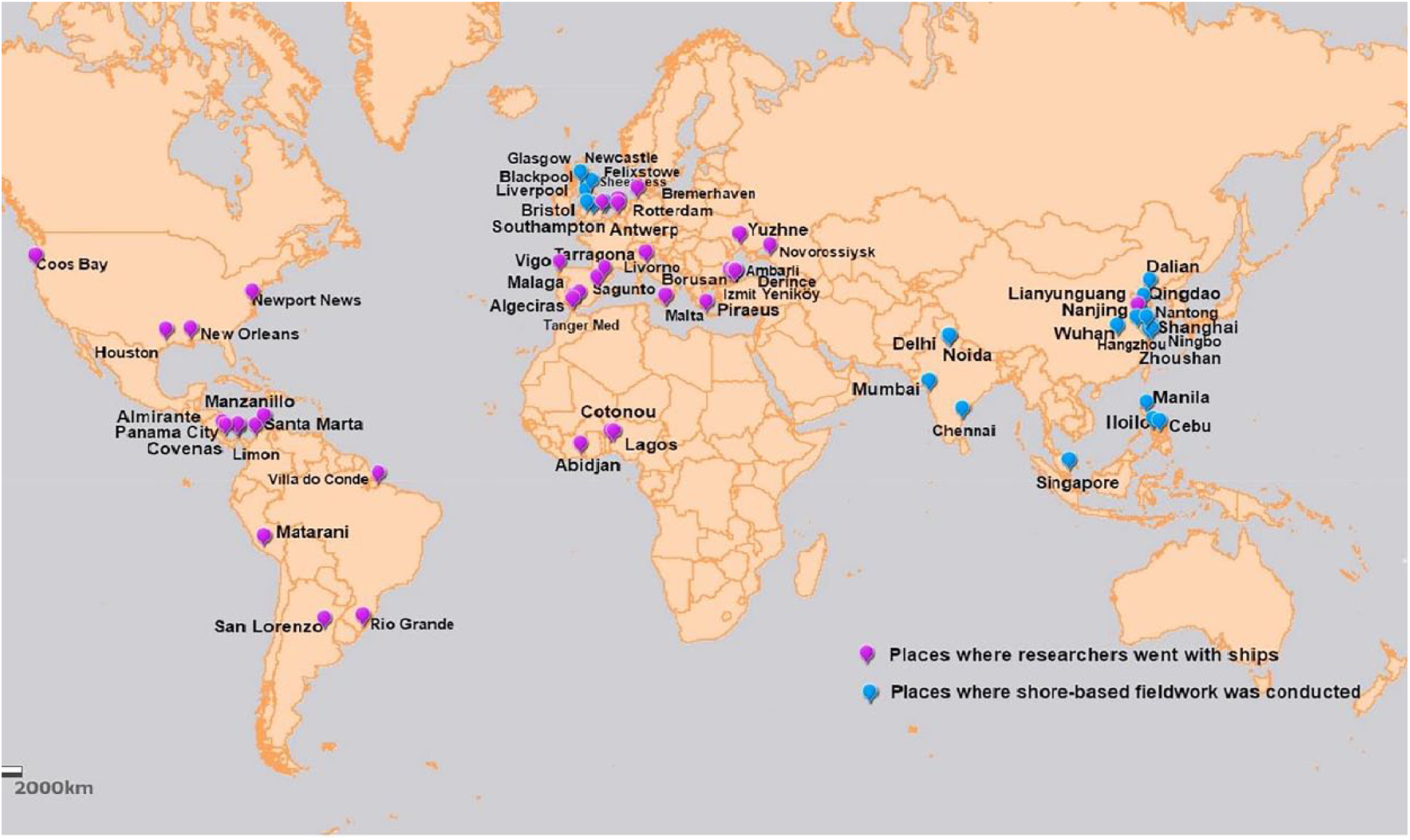
Global reach of the study.
In all reporting (and in the construction of real-life vignettes), pseudonyms are used for seafarers, vessels, companies, and shore-side personnel.
Bureaucracy and perceptions of trust in the shipping industry
The International Maritime Organization (IMO) provides a regulatory framework to govern international shipping. Initially, the adoption and enforcement of regulations by the IMO was relatively ineffectual (Sampson and Bloor, 2007); however, the demands made of ship operators increased towards the end of the 20th century and today the IMO engages in a continuous cycle of meetings to update/introduce regulations. 4 In 2000, a formerly voluntary code relating to safety management systems on board (known as the International Safety Management (ISM) code) was updated and new provisions came into force in 2002. These required companies to develop a safety management system to cover each ship and also made the carriage of a paper copy mandatory on board. Many, if not all, of the procedures within ships’ safety management systems are supported with paperwork that has to be produced and maintained in order to demonstrate regulatory compliance. This has been identified as an unwelcome administrative burden for officers (Knudsen, 2009) and a review conducted on behalf of the IMO in 2006 recommended a reduction in paperwork that has yet to be appreciably realised (http://www.imo.org/en/OurWork/HumanElement/SafetyManagement/Documents/17-1.pdf, accessed 7 August 2017). It is not only the ISM code that has increased shipboard paperwork. Almost all forms of regulatory enforcement in the shipping industry rely on the maintenance of records which serve to demonstrate compliance with international standards (e.g. records of fuel consumption/waste disposal/working hours). Companies may be heavily fined if found to be in breach of regulations, whilst seafarers are potentially subject to incarceration by nation states (e.g. in cases of pollution) and/or dismissal from their positions. Thus, the modern industry is strongly characterised by elements of a punishment-centred form of bureaucracy which may be considered to arise from a lack of trust by regulators in companies and by managers/regulators in seafarers.
Accompanying this bureaucratisation, there has been a ‘revolution’ in IT which allows for greater communication (via satellite) with vessels. Twenty-four-hour monitoring is facilitated by such technology. As a result, modern ships routinely, and automatically, transmit data to office managers relating to location/fuel consumption/engine performance, etc. (Bhardwaj, 2013). Such data are complemented by ‘black box’ technology, which records data (including speech) from the bridge. As with aviation, this may be accessed/used as evidence by inspectorates/authorities in the event of an undesirable incident.
Whilst the context is different, in the course of the research it emerged that the effects of such bureaucratisation and surveillance on seafarers were similar to those experienced by Gouldner’s factory workers. In both cases, operational personnel shared the feeling that they were less trusted by managers. As one officer explained: [There are] so many checklists […] and the requirements have increased. Say the ISM, it requires a lot of paperwork. Or when you need to report [to shore-based managers] […] the conduct of monthly safety meetings, drills, and other checklists regarding tasks. Apart from that we also have to take pictures [photographs] of the equipment during maintenance. You have to explain also what you did and how it looked like before you did something to it. Then send that as evidence of your job. So it seems that they don’t really trust you with what you do on board. (Vignette-interview IA35)
This feeling that managers no longer trust officers to carry out their professional duties was widely expressed by interviewees. Such situations would be almost unimaginable at the turn of the century when captains were entrusted with most decision-making on board (Sampson, 2013). Even today, captains remain charged with legal responsibility for the safety of their vessels and crew members/passengers on board. In some jurisdictions, where passengers have lost their lives, murder charges have been brought against surviving officers (e.g. the 2014 Korean ferry disaster).
5
Seafarers are aware of the impossible position that they have been placed in and describe it as being between a ‘rock and a hard place’. One interviewee described the present situation as follows: At the [shipboard] management level, […] yes they are supposed to be taking/making decisions … but they are not given the power to do so. (Vignette-interview NE07)
Interviews established that in many cases, the things that senior officers felt unable to independently manage were related to safety. In one example, an officer reported a situation where the captain of his vessel wished to deviate course because his ship was approaching the track of a typhoon. He explained how: We were facing a typhoon […] master informed the owners or charterers that ‘I will deviate from this route it’s much safer’ […] but the company […] they want to make their port schedule, they don’t want it. But later on when we were in [the] bad weather then the company […] called ‘OK […] it’s up to you’ […] she [manager] was relying on the information which was coming from another ship … and we were stuck in [the typhoon] and that was a dangerous situation. She would not trust us until she got an information from another ship. If something happened, then people will ask why the captain did not take the correct route but […] this concept of the captain being the authority on the ship, it’s just on the papers, nothing else. (Vignette-interview NT14)
This example is particularly interesting as it demonstrates how it is not only the captain who is afraid to act. In the context of a system which does not allow individual judgements to be trusted, shore-based managers are also afraid to act without some form of further verification. In this example, the manager needed to ‘cover her back’. This indicates the high levels of mistrust which extend across hierarchies and in both directions – something that will be returned to in due course.
In relation to shipboard maintenance, engineers experienced similar difficulties of being over-ridden by personnel based ashore. One chief engineer described the limits of his resistance when he told us that: I remember that it happened to me also that this superintendent
6
was not really giving me what I ordered for like a piston ring. He wanted us to use the old ones. What I did was, ‘Okay sir, I will use it but whatever happens to the engine then it will be your responsibility’. So it was stressful. If anything happens … but he is not on the ship [and] it is me who will have to answer for it.
7
(Vignette-interview IA44)
In this illustration, the chief engineer felt obliged to acquiesce to the instruction from ashore. However, he had misgivings about the wisdom of the action which he felt could compromise the safe operation of the vessel. He attempted to ensure that the shore-based manager accepted responsibility for the decision in the event of anything going wrong whilst contradictorily acknowledging that any incident would first and foremost affect him and his colleagues on board and that, furthermore, he would have to ‘answer for it’.
The consequences for seafarers who resisted instructions from shore-based managers, in order to protect the safety and welfare of their crew/vessel, were perceived by seafarers as severe. In an industry characterised by short-term contracts, and little in the way of employment rights/protection (Sampson, 2013), senior officers were conscious that refusing an office instruction was inviting dismissal. Some described direct experience of this. A captain described a situation where a winch was damaged, posing a risk to personnel should the anchor be raised/lowered. He ended up undertaking a task that he and a company surveyor both considered to be unacceptably risky. He was aware of his responsibility in terms of the crew and at the same time the likely consequences, for him, of resisting pressure from management. This demonstrates an uneasy situation where captains remain formally charged with responsibility for crew safety whilst being insufficiently protected against dismissal to resist management pressure. He explained: I joined the ship and went to the [previous] captain’s cabin and he told me that the gear’s teeth were broken […] the whole thing could give way. […] the personnel attending to the operation […] risk their life. […] They finally called a surveyor and he made a [written] remark. ‘The starboard anchor not to be used except during emergency’. […] When you are entering Immingham you need to send a message what time the anchor is ready for use. I did that. From my heart I knew that I was not right because I myself knew it was risky. But I said, ‘Otherwise I will lose my job’. […] Then we went to Columbia where we were supposed to use the two anchors in the anchorage. […] I got a call from a senior manager, ‘Okay, he said, you use both the anchors’ and I said, ‘Well, until now you said “don’t use” and now I can use them?’ […] I told him that the surveyor told me that I could only use the anchor in emergency. Then he told me ‘But this is emergency!’ It’s funny. A normal routine has become an emergency! ‘Captain’, he told me, ‘I am asking you to use it but you can use your overriding authority and don’t use’. […] We did as told but I got a very bad name [for my resistance]; in fact I was sacked later. (Vignette-interview NT64)
These consequences for seafarers are severe and we would expect (given the literature which links lack of autonomy to low morale) that such circumstances impact on their desire to continue with a job at sea. The link between management control and low morale/poor health (Carter et al., 2013) is important but here we additionally consider the operational consequences of lost trust by managers in seafarers and vice versa, drawing on some of the original writings on trust and their development in recent times (Luhmann, 1979; Möllering, 2001; Simmel, 1950). As such, the focus will now turn to the notion of trust as a ‘two-way street’ and subsequently the means by which seafarers seek to either continue to exercise their own judgement on board without managers’ knowledge/interference, or take steps to deflect manager intervention. In cases where both strategies fail, we also illustrate the ways in which seafarers make use of bureaucracy and new technology to ‘cover their backs’.
The consequences of lost trust
Seafarers experienced bureaucratisation as the expression of a lack of trust. However, they often described a further sense of betrayal with regard to the lack of support/respect they received from shore-side staff who were generally characterised as authoritarian and sometimes verbally abusive. One captain described how this felt: I had an experience of being shouted at by the superintendent, like he was asking me why I did not do this and that. I was just calm. You can’t argue with them. […] I felt low, I felt like I was disrespected. I am a captain and here is someone yelling at me. (Vignette-interview IA33)
They also described a lack of faith in shore-based managers’ experience and knowledge and felt that managers were ill-placed to offer proper assistance when unexpected problems arose. Seafarers were not trusted by shore-based personnel but equally they did not trust their shore-based managers. This lack of confidence was compounded by a strongly held view that even where managers had appropriate shipboard experience they generally ‘changed sides’ as soon as they left the sea and went to work in the shore-based office, becoming concerned with the ‘bottom line’ above all else. As one seafarer put it: They [shore-based managers] are not concerned about the ship or the persons on it, they’re only concerned about the inventory and the profit. They are not bothered about the ship. (Vignette-interview NT37)
One of the organisationally dysfunctional effects of seafarers’ lacking trust in their managers was that they commonly reported not sharing information with their office and not always telling shore-based managers the ‘full truth’ about situations that had arisen on board.
8
In the interviews, it became apparent that this was frequently because they felt there was a need to protect themselves. In one example, the oars from the fast rescue boat went missing and theft by shore-side port personnel (which is relatively common) was suspected. Nevertheless, the seafarers did not trust managers not to blame them. A seafarer told us: The oars were lost, I don’t know why. I don’t know how and why the oars are lost. […] maybe it was pilferage or something so I told the captain that the oars were lost. After 15 days of searching each and every corner of the ship […] the captain told me, ‘Please I’m not telling this matter to the company because what they’ll do is they will blame you’. (Vignette-interview NT16)
However, such ‘cover-ups’ were not restricted to ‘minor’ matters. Oil pollution is regarded as a major issue by companies, as states impose highly punitive fines on operators found to be in breach of international regulations. This creates pressure on seafarers who fear the consequences of mistakes and may collectively conceal them, as the following example shows: We had an issue, where the second engineer, a qualified man, and we told him very clearly, ‘This pipe might have some oil’. And he goes on and opens it, and oil spills on the deck. Everything goes overboard. Say, 50–60 litres of black, heavy oil. […] That issue never went out. […] So, this is the reality because we managed it nicely. […] it would really reflect badly on a good engineer. A person who is due for his promotion, he is going to be a chief engineer. So, why to spoil his …, you know. (Vignette-interview NT63)
These kinds of examples where seafarers covered up for colleagues are particularly revealing. In this case, the interviewee and his colleagues believed that shore-based managers could not be trusted to regard the incident as a ‘one-off’ error and felt that they would dismiss the engineer without due consideration of his record. Such cover-ups are in themselves high risk, however, and seafarers were aware that they could also be dismissed for failing to keep their shore-based managers fully informed. As one seafarer described: Once I was going to dry dock, we had a problem with the auxiliary engine […] generator. So the superintendent every day called […] and the chief engineer was trying his best to do some repair, I mean we were on the sea, and we were going to dry dock, but the superintendent wants everything opened up before dry dock […] But the vessel was running, […] And we have only two motormen only, and one engine cadet, so the chief engineer told the superintendent, ‘Okay, we are doing our best’, but before dry dock he had done maybe 30% of the jobs what the superintendent had asked. And eventually after two days the chief engineer was dismissed. (Vignette-interview NE4)
In this context, seafarers did not relish attempting to hide things from personnel ashore (notwithstanding the fact that many did so). Faced with situations where they felt constrained in making decisions, they also described a variety of other responses: following instructions that they believed were inherently unsafe, dithering awaiting office decisions, or taking unapproved action and facing the consequences.
In our data we found examples of all of these responses – none of which are organisationally advantageous. Seafarers who were afraid of being fired and unwillingly followed instructions from office-based personnel, which they felt were inherently unsafe, generally made an effort to protect themselves by demanding instructions in writing. They had learnt that this was necessary and many were aware of cases where seafarers had failed to take such protective action and were consequently exposed to blame when things went wrong.
This defensive strategy was reported to work well and sometimes shore-based managers retracted their demands once asked to put them in an email. As one seafarer explained: I’ve seen many masters in front of me, ‘Please send it to me by writing if you want me to do this and I’ll go ahead and do it’. But it never comes back in writing. (Vignette-interview NE23)
However, in some cases, senior officers simply dithered until the office made a decision. One seafarer described how: It has got to the point, I’ve seen now myself personally if some work needs to be done, they won’t make the decision on ship, they’ll just go to the office and make the office make the decision. (Vignette-interview NE11)
Another described how the involvement of superintendents, who did not trust captains to make decisions relating to circumstances on board, frequently impeded progress with necessary work. He suggested that: This is common for superintendents […] to be involved in the work, or the master, or to impede; maybe in our company in 50% of the cases they make the decision, and everything goes very slowly […] this is bad management of the company let’s say. […] But then again they don’t trust the captains, so this is a problem of the company, but I don’t think this is common only for one company – this may be common for a lot of the companies. (Vignette-interview NE03)
One seafarer went so far as to suggest that a captain should even wait for authorisation from his company before making the decision to abandon ship. He told us: Due to the development of communication technology, captain’s decision making power is almost deprived of. Even if you want to abandon the ship, you cannot if the company does not give you permission. So this is common. (Vignette-interview LT24)
Where captains found they were constantly engaged in contested authority with office personnel, they felt that they would eventually be sacked as a consequence of their resistance or that they had no choice but to resign. One captain explained his own experience with his last company: I did not come back to that office afterwards. I resigned. Here is the truth: if you will not follow the office’s instruction you will be in trouble and that is for sure. […] Even if you are right but that means going against what they want, then they will not want you in their company anymore. They will not hire you again. (Vignette-interview IA42)
Reflections
The move to punishment-centred bureaucratic systems in shipping, combined with new forms of surveillance, has altered shore-based management practice with knock-on adverse impacts on seafaring officers who feel unable to exercise their professional judgement in contexts where they retain legal/moral responsibility for the consequences of their action/inaction. In short, they feel that they are no longer trusted as professionals to carry out their roles with a substantial degree of autonomy. Conflict and lost trust between managers and ‘subordinates’ is also alluded to in other contemporary studies. Laaser describes how bank workers who had experienced ‘tightened control over their work’ (Laaser, 2016: 1009–1010) developed more conflictual (presumably less-trustful) relationships in the workplace, while Cooke suggests that tighter control in the NHS has contributed to nurses feeling that their cherished professional practice is being thwarted by ‘Taylorist management practices, which force them to conform to a production line style of care giving’ (Cooke, 2006: 225). As with seafarers, the implication is that nurses cannot be trusted and must be controlled more tightly by managers seeking higher levels of performance at lower cost.
In such contexts, increased bureaucratisation is also experienced as a lack of trust by workers who in turn learn that they can no longer place their trust in their supervisors – at least insofar as their right to the exercise of professional judgement is concerned. In shipping, the development of two-way, low-trust relationships also undercuts the support available to seafarers when faced with difficult decisions, resulting in increased stress (and potentially poor decision-making). However, these data go further in illustrating the dysfunctional nature of work-based relationships characterised by a two-way lack of trust. The classic contention of trust theorists, building on the work of Simmel, that trust (or confidence) is necessary to allow people to take action in situations where outcomes are uncertain, is empirically borne out by the accounts of many seafarers who hesitated in making key decisions. The example of the captain who did not deviate course in the path of a typhoon because the office had not given approval is shocking in the context of the danger in which this placed his vessel and crew. However, there were many other examples in the study where seafarers acquiesced to decisions they did not subscribe to as a result of mistrust in the reactions of their managers (superintendents) ashore. Hesitation, inaction, and taking the wrong actions all have the potential to produce very serious consequences for seafarers, and companies, because of the safety-critical nature of the industry. However, hesitation in any organisational context is likely to be negative and may result in the persistence of bad practice, lost deals, and so forth. In this respect, loss of trust can be seen to have potentially negative consequences for employers as well as employees. In the shipping industry the loss of a vessel has the potential to bankrupt a company as it can result in huge fines for pollution, and it carries strongly negative consequences for reputation, which usually result in lost custom from charterers (Sampson et al., 2014). Equally, the loss of experienced personnel with integrity/commitment is arguably disadvantageous to both private companies and public sector organisations. When organisations dismiss staff who speak out about what they believe is ‘right’ they achieve two kinds of negative outcome: they lose a valuable worker; and they reinforce the lack of trust that others already have in their organisation and its management. Seafarers talked openly about the fears they had in connection with standing up for what they believed was right (and frequently safe) in the light of their professional experience and training. Many seafarers were concerned that disagreements with their managers would result in future sanctions, including dismissal, and in this context it is no surprise that there are increasing reports of senior officers simply awaiting their next instruction from the office rather than exercising their own discretion. That this happens in a sector where timing may be critical and workers’ lives are frequently in the balance is especially disturbing.
Conclusion
Further research into the impact of lost trust on workplaces would be beneficial in revealing more about the organisational consequences of the erosion of trust within professional jobs. It would complement existing studies that have highlighted the potential consequences of managerialism, bureaucratisation, and conflict for employee experiences and attitudes (Cooke, 2006; Crichton, 2013; Laaser, 2016; Torpey and Johnson, 2013). It would also add to the work that focuses on the importance of trust-based relationships in the context of client–professional relationships (Brown and Calnan, 2009; Lee and Lin, 2009; Smith, 2001). By placing a greater focus on the sociological significance of trust, it is possible to highlight the ways in which distrust not only impacts on workers (and clients/service users) but also has highly dysfunctional effects on organisations (Fox, 1974). This finding may be of significance to employers who have pursued punishment-centred bureaucratisation in order to improve organisational efficiency and are unwittingly undermining it. For, as trust theorists argue, and these data confirm, trust is a key constituent of ‘collaboration and co-operation processes, themselves crucial to the management of workplace enterprises’ (Torpey and Johnson, 2013: 147).
Footnotes
Acknowledgements
We would like to thank all of the seafarers who gave up their valuable time to take part in the research project underpinning this article. We would like to thank Lloyd’s Register Foundation and TK Foundation for funding the research upon which this article is based. Lloyd’s Register Foundation helps to protect life and property by supporting engineering-related education, public engagement and the application of research.
Funding
This research was funded by Lloyd’s Register Foundation and TK Foundation.