




Abstract
Surprisingly little attention has been given to an integrated understanding of the interaction between ethnicity, gender and parental household’s employment status affecting young people’s educational and labour market outcomes. Drawing on data from Understanding Society, the article compares youth probabilities of becoming NEET (not in employment, education or training) in the UK, focusing on the outcomes for young men and women from different ethnic groups and from four types of ‘households of origin’: workless, one-earner, single-parent-earner and two-earner. The article shows that while, on average, young people with workless parents have a higher likelihood of becoming NEET compared to individuals from households with at least one employed parent, this does not apply universally to all ethnic minority groups, nor equally to young men and women. Having workless parents is much less detrimental for second-generation Indian and African men, and for second-generation Bangladeshi men and women, than for white British individuals. An intersectional analysis illustrates the universal and differentiated effects of disadvantage among youth.
Keywords
Introduction
Since the economic crisis of 2008, young people have been one of the most vulnerable groups experiencing high levels of unemployment (Bell and Blanchflower, 2011; O’Reilly et al., 2015). The youth unemployment rate for 16 to 24 years olds in the UK peaked in 2011 at over 20 per cent compared to the adult unemployment rate of around 6 per cent (Office for National Statistics, 2014: 7). NEET rates (young people not in education, employment or training) reached 17 per cent (Office for National Statistics, 2016b: 4). Although youth unemployment and NEET rates have started to decline as the UK economy improves, these figures remain comparatively high in a European context (Hadjivassiliou et al., 2015; Mascherini, in press; O’Reilly et al., 2015), with NEET rates still affecting 12 per cent of young people in the UK (Office for National Statistics, 2016b).
However, not all young people are equally vulnerable in terms of educational and employment opportunities. Individuals raised in poor households or where no adult member works are, generally, more likely to leave education earlier or be unemployed (Macmillan, 2014; Schoon, 2014). Women and some ethnic minority groups, including the descendants of Caribbean, Pakistani and Bangladeshi individuals, also tend to have higher rates of non-employment compared to other groups (ONS, 2013), even if they have similar educational levels (Cheung and Heath, 2007). Concurrently, most second-generation ethnic minority groups – i.e. the children of migrants – have very high participation rates in education and are, on average, significantly more likely to go to university than their white British counterparts (Crawford and Greaves, 2015). Although the effect of individual and household characteristics on educational and employment outcomes has received considerable examination, very little is known about how their interaction may affect youth opportunities.
Intersectionality has been one approach used to understand some of these differences among adult populations (Cho et al., 2013; Collins, 2015; Crenshaw, 1991). Rather than focusing on one dimension, or comparing bi-modal inequalities of race, gender or class separately, the concept of intersectionality captures discrete combinations of multiple sources of disadvantage. These reflect differentiated locations of power, domination and discrimination (Crenshaw, 1991). While intersectionality has been extensively discussed in radical feminist forums, a growing literature is using the concept as an analytical strategy (Collins, 2015), comparing differences between categories, such as between ethnic groups, as well as within categories of class, gender and ethnicity. These studies do not necessarily explicitly address the sources of power and discrimination; rather, they use intersectionality to acknowledge the interplay of different dimensions of inequality. The application of an intersectional approach to empirical examination in the field of labour studies is well overdue (McBride et al., 2015; Mooney, 2016).
The article uses this approach to study the educational and labour market experiences of young people in the UK, examining the associated risks of being NEET. The NEET concept captures individuals not accumulating human capital through formal educational or employment channels (Eurofound, 2012, 2014). Critiques of this concept have pointed to the increasing heterogeneity of the population as it has moved from originally referring to young people between the ages of 16 and 17 during the 1980s to including those between the ages of 15 and 24, or in some cases between 15 and 29 today (Furlong, 2006; Mascherini, in press). As the concept has become more popular, the population it covers has also become more diverse, including those who are there by choice or by constraints. However, being NEET is often a sign of disadvantage (Furlong, 2006) and a powerful measure of current and future opportunities, as studies on scarring effects have shown (Burgess et al., 2003; Crawford et al., 2010; Gregg, 2001, 2012). Using intersectionality as an analytical strategy, the article develops and tests expectations about the differential effects of ethnicity, gender and parental households’ employment status on young people becoming NEET.
Changing household arrangements and ethnic differences
A greater array of family household types, including workless, single-parent and dual earner households, reflects the long-term decline of the traditional male breadwinner household (Gottfried and O’Reilly, 2002). The proportion of homes with no one working has increased from around 7 per cent in 1975 to around 15 per cent in 2016 (Gregg and Wadsworth, 1994; Office for National Statistics, 2016a). Simultaneously, there has been an increase in dual earner households generating a process of household polarisation between the work-rich and the work-poor families (Gregg and Wadsworth, 2001; Gregg et al., 1999). There has also been an increase of lone parent households with dependent children over the past 20 years, from 1.6 million in 1996 to 2 million in 2015. These account for around 25 per cent of all families with dependent children in the UK; furthermore, around 90 per cent of lone parent households are headed by women (Office for National Statistics, 2015).
The relative share of different household types varies greatly by ethnicity. Although traditional male breadwinner households are decreasing, they are still very common among Asian communities (Brah, 1993; Kabeer, 2002) since women are more often economically inactive (Dale et al., 2002; House of Commons Women and Equalities Committee, 2016). Peach (2005) refers to these as a traditional ‘patriarchal model’ of the family. Furthermore, a disproportionally high number of Pakistani, Bangladeshi, Caribbean and African populations live in workless households, with lower levels of socio-economic resources and higher levels of economic vulnerability (Office for National Statistics, 2010: Table 1(iv); Platt, 2010). In addition, the Afro-Caribbean community has a higher share of single-parent households, usually headed by mothers, many of whom are also in employment. In the US, this has often been explained as a legacy of the effects of slavery on family cohesion (Dale et al., 2006); in the British case, this might also be connected with patterns of early migration, characterised by a large amount of single Caribbean women coming to work in the UK (Sunak and Rajeswaran, 2014).
Household of origin of young individuals (aged 16–29) when they were 14 years old, by ethnic group (row %).
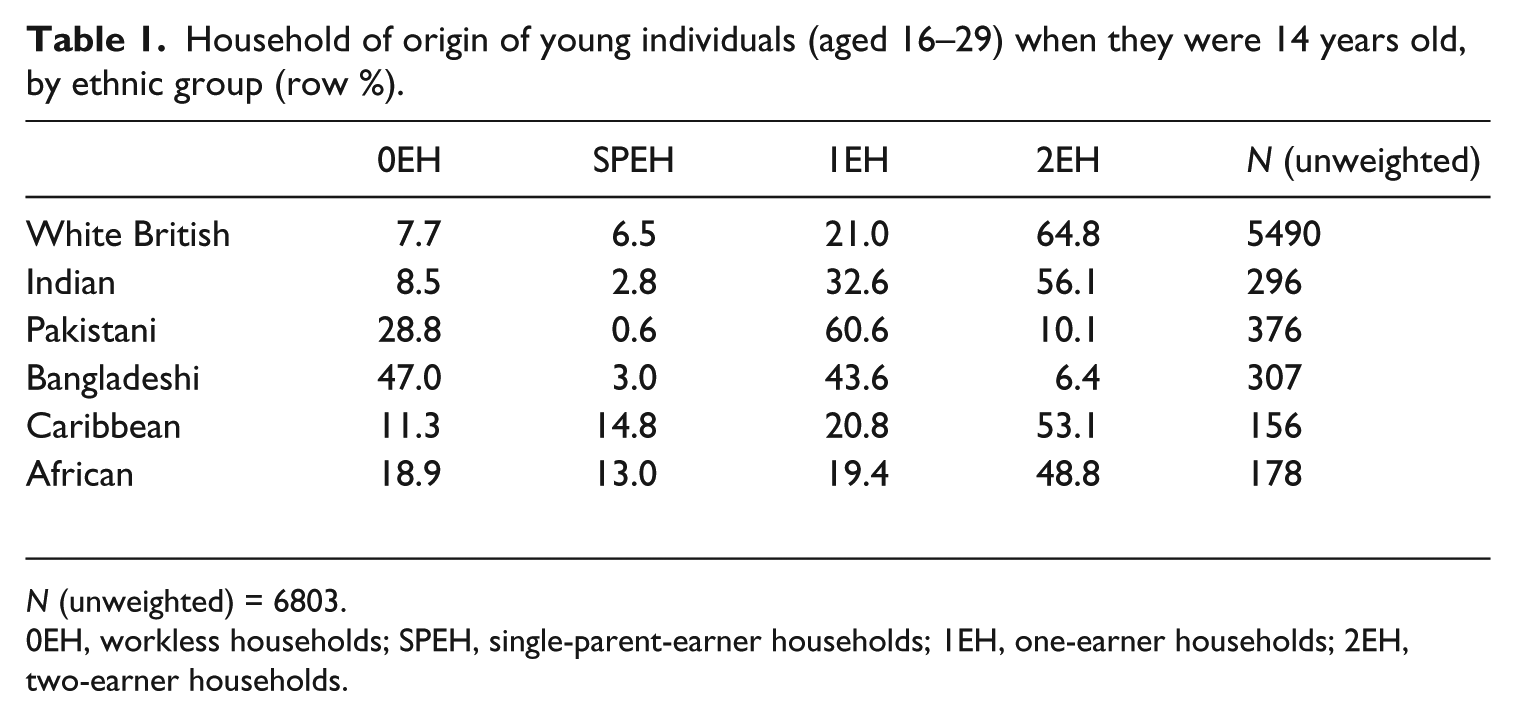
N (unweighted) = 6803.
0EH, workless households; SPEH, single-parent-earner households; 1EH, one-earner households; 2EH, two-earner households.
Household characteristics and their effects on young people
The impact of worklessness and father’s and mother’s employment has been widely discussed in the literature on educational and labour market outcomes. This article uses these studies as a starting point to argue how and why living at a young age in certain households might differentially affect men and women from diverse ethnic groups. The analysis, as well as the expectations detailed below, is based on the construction of four ‘household of origin’ types: zero-earner or workless, one-earner (usually with a working father), single-parent-earner (usually with a working mother), and two-earner (with two working parents).
Worklessness and ethnicity
Several studies have shown that there is a higher likelihood of being unemployed, spending longer in unemployment or becoming NEETs for individuals raised in workless households (Barnes et al., 2012; Ermisch et al., 2004), or where the father was unemployed (O’Neill and Sweetman, 1998; Zwysen, 2015). Rather than being through an intergenerational transmission of a ‘culture of worklessness’, this relationship is likely to be connected, at least in part, to regional economic factors (MacDonald et al., 2014; Macmillan, 2014). The first expectation (E1) is that young people living in workless households are more likely to be NEET compared to individuals from households where at least one parent was working.
Having workless parents might have a different impact for ethnic minorities and white British individuals; however, how this might occur is a matter of debate. Platt (2010) shows that among children between 0 and 5 years old living in working households in 1991, those of Pakistani and Bangladeshi origin were more likely to have parents who became workless in 2001, compared to those of white British origin. Among children who had workless parents in 1991, the parents of Pakistani children were more likely to remain workless in 2001, compared to those of white British children. This suggests that young individuals living (or who lived) in these households might not only be subject to parental worklessness over a longer period of time, but also to unmeasured characteristics of the groups and their contexts (including discrimination) that have the potential to lead both to parental worklessness and to their own poorer socio-economic outcomes. Following this reasoning, having had workless parents might have more negative effects for some young ethnic minorities than for white British children (E2a).
As a counter argument, there is also evidence suggesting that even with poor socio-economic backgrounds, ethnic minority groups manage to attain higher university rates than white British individuals (Crawford and Greaves, 2015). Some groups (Indian and Bangladeshi men in particular) are also more likely to attain higher class positions than their white British counterparts (Zuccotti, 2015a). This points to unmeasured, but positive, characteristics of the groups and/or a context that might lead to fewer penalties associated with worklessness. Although the mechanisms for this finding have not yet been conclusively explored, evidence suggests that this might be connected to the transmission of high aspirations from parents to children, which occurs more often among ethnic minorities (see Heath et al., 2008). Duckworth and Schoon (2012) show that individuals’ aspirations have a positive effect in avoiding a NEET outcome. Social networks or ethnic capital (Borjas, 1995) might also play a role in overcoming an initial disadvantaged situation. For example, Zuccotti and Platt (2017) find that having lived at a young age close to members of the same ethnic group has a positive effect on adult occupational outcomes among Indians (a group with relatively high human capital). It follows from these arguments that having had workless parents might have less of a negative effect for some young ethnic minorities than for white British individuals (E2b).
Paternal and maternal employment, ethnicity and gender
What differences are associated with having a working father and/or a working mother on the outcomes for their children, and how does this differ by ethnicity and gender? In a recent European study, Berloffa et al. (2015) examined the effect of both maternal and paternal employment on their daughters’ and sons’ labour market outcomes. For Anglo-Saxon countries, the authors find that, after controlling for education and other social background characteristics, both fathers’ and mothers’ employment had a positive effect on their sons’ employment probability; for daughters, only their mothers’ employment had a positive effect.
In the case of the dependent variable examined here – i.e. measuring the combined probability of (not) working and (not) studying – outcomes might work differently. Young women’s employment might be connected to having had a working mother as a role model; continuing in further education might also be related to fathers’ employment, via greater availably of socio-economic resources from the family of origin. Parents’ employment statuses are therefore expected to affect both genders’ NEET probabilities. In particular, young men and women from two-earner households are expected to have an advantage over those from households with only one earner (E3).
Individuals raised in lone parent households often have lower probabilities of attaining high status occupations (Beller, 2009; Lampard, 2012), and a higher likelihood of becoming NEET (Ermisch et al., 2004; Schoon, 2014), compared to individuals raised by two co-residential (biological) parents. Schoon (2014) also shows that boys growing up with a single parent are slightly more likely to be NEET than young women growing up in similar circumstances. Although individuals living with a single working parent will probably be in a better position than individuals living with a single workless parent, the expectation is that their NEET probabilities are higher compared to individuals raised with two parents where at least one of them was working (E4). This might, however, vary by gender: young women raised in single-parent-earner households (mostly headed by mothers) might have a lower likelihood of becoming NEET compared to young men raised in comparable circumstances (McDowell, 2014). 1 The inverse may be true for young women raised in one-earner households (headed mainly by fathers) where young women’s probability of becoming NEET is likely to be higher than that of young men from a similar household.
It is difficult to test whether all these patterns might hold in all groups, given that some household types are very uncommon among some ethnic groups. For example, dual-earner households or those with a single female working parent are rare among Pakistanis and Bangladeshis. In terms of this study, gender roles might play a part in explaining differences in household effects. In particular, an employed father might be less beneficial for Pakistani and Bangladeshi women than for white British women because socio-economic resources within the household are likely to be more unequally distributed across genders in Pakistani and Bangladeshi families than in white British families. Although having had a working father (versus workless parents) is expected to reduce NEET probabilities for all groups, this reduction should be less for Pakistani and Bangladeshi women than for white British women (E5).
By contrast, a working mother might have a more positive effect for some minority groups than for others. Although unemployment is more common among Caribbean and African black women (Zuccotti, 2015b), they are also more likely to be employed full-time compared to white British women, who are more likely to be working part-time (Dale et al., 2006; O’Reilly and Bothfeld, 2002). Children with a working Caribbean or African mother might therefore experience more positive effects on their own educational and labour market outcomes, especially those from single-parent-earner households (common among black groups). Therefore, having had a single working parent, compared to having had, for example, two working parents, is expected to have a less negative effect among Caribbean and African young individuals than among white British young individuals (E6).
Objectives
Drawing on data from Understanding Society (University of Essex, 2015), this article studies the role of parental household’s employment status on NEET experiences of young men and women (16–29 years) from the five most numerous black (Caribbean and African) and Asian (Indian, Pakistani and Bangladeshi) ethnic minority groups growing up in the UK, in comparison to the white British. The research questions guiding this analysis ask:
What association is there between parental household’s employment status and young people’s NEET probabilities?
How does ethnicity and gender affect the probability for young people coming from different household backgrounds of becoming NEET?
How does an empirical application of an intersectional approach shed light on the effects of multiple inequalities for youth?
Data, sample and variables
The analysis is based on the survey Understanding Society – the United Kingdom Household Longitudinal Study (UKHLS), Wave 1 (2009–2010); additional household background information contained in later waves (2 to 5: 2011–2014) was also used when missing in Wave 1 (University of Essex, 2015). The UKHLS is a household panel survey based on interviews with around 50,000 individuals in 30,000 households in the UK; it also includes an ethnic minority booster sample (Berthoud et al., 2009).
Ethnicity is measured through a question on ethnic self-identification. The article distinguishes between white British and five ethnic minority groups – Indian, Pakistani, Bangladeshi, Caribbean and African – as these are the most numerous second-generation ethnic minorities in the UK. The sample is based on a selection of young people (16–29 years old) 2 who were either born in the UK or who arrived here before or at the age of 10. 3 This includes younger migrants who completed their secondary education in the UK.
Household of origin is constructed using a retrospective question on parental employment when individuals were 14 years old. Workless households (0EH): where no parents present in the household were in employment (this includes both dual and single-parent households). One-earner households (1EH): where only one parent (usually the father) in a dual resident parent household was in employment. Two-earner households (2EH): where both parents worked (this includes both dual full-time earners and households were one parent is working full-time and the other parent is working part-time, usually the mother). 4 Single-parent-earner households (SPEH): where the present single parent (usually the mother) worked. 5
The dependent variable identifies the types of young people likely to become NEETs – i.e. unemployed youth, those whose major activity is being responsible for housework, who are long-term sick or disabled, who are doing unpaid work, or who are engaged in another unspecified activity. Despite the contested value of the NEET concept, due to the heterogeneity of the population included (Furlong, 2006), it is recognised as a sign of disadvantage with scarring effects present on later labour market outcomes (Crawford et al., 2010; Gregg, 2001; Zuccotti and O’Reilly, in press). These effects are particularly strong among those with low educational levels (Burgess et al., 2003). In this respect, the inclusion of education as a reference category (next to employment and training) is important not only because many young individuals are still studying, and education is increasingly a necessary asset for future labour market prospects, but also because the children of migrants are more likely to be in education for a longer period of time (Crawford and Greaves, 2015).
The composition of NEETs varies across ethnic groups and genders (Table A1 in the Appendix online), which might imply different explanatory mechanisms as to why individuals are not working, studying or training. Being NEET might also mean different things for different ethnic groups at different ages. For example, a 16-year-old from an ethnic minority group is likely to be particularly disadvantaged if NEET (i.e. negatively self-selected), given that ethnic minorities have, in general, a much higher probability of being in education than the white British individuals. Similarly, a 28-year-old white British person might be more negatively self-selected if NEET than ethnic minorities, given that their employment chances are higher. These measurement issues are, however, present in any type of comparison, given that groups are indeed different. By including in the models the employment and occupational status of the parents and the level of unemployment in the neighbourhood, the article partly addresses potential selection problems.
The occupational status of parents is based on the young person’s recall of what their parents were doing when they were 14 years old. Their status is measured using the International Socio-Economic Index (ISEI) (Ganzeboom and Treiman, 1996). 6 The ISEI ranges from 16 to 90 and measures the attributes of occupations that convert a person’s education into income. The highest score is given to judges (90), the lowest to cleaners and low qualified farm workers and helpers (16). One of the advantages of this measure is that it is continuous rather than categorical, which helps with the statistical analyses by reducing collinearity with parental employment. The score of the household is obtained by identifying the highest parental score. There is no available parental occupational status information for individuals who declared their parents to be workless when they were 14 years old. Missing cases have been imputed using information on parental education (where available) and on the ethnic group of the individual; these two factors predict the parental ISEI of individuals raised in households where one or two parents work. The average parental ISEI is 36 for individuals with workless parents, 45 for individuals with one working parent and 50 for individuals with two working parents. Information for individuals who had missing parental occupations but declared to have employed parents has also been imputed using these average ISEI scores. (Further details are available upon request.)
Unemployment at the neighbourhood level is measured as the percentage of all unemployed individuals divided by the total active population (16–64) in the same neighbourhood as the young person being considered. These neighbourhood data are based on the ONS measure of Lower Layer Super Output Area (LSOA) 7 using the 2001 Census, and are attached to each respondent of the survey (University of Essex, 2011).
The analysis is based on logistic regression models run separately for men and women. Other control variables included in the models are age and (maximum) level of education achieved 8 (No qualifications, Other qualifications, GCSEs and their equivalent, A-levels, Other higher degree and Degree level). 9
Findings
Descriptive statistics
Comparing young people’s households of origin indicates some important differences between ethnic groups (Table 1). Bangladeshis, followed by Pakistanis, have the highest share of young people who lived in workless/zero earner households (0EH) when they were aged 14: almost half of young Bangladeshis and 29 per cent of young Pakistanis reported this. Nearly a fifth of young Africans (19%) and just over a tenth of young people from Caribbean descent (11%) lived in workless households; for white British and Indian young people this amounted to around 8 per cent.
Bangladeshi and Pakistani youth were more likely to have lived in traditional one- earner (usually male) households (1EH) when they were 14 years old. Dual-earner households (2EH), where both parents were working, were common for all ethnic groups, apart from Bangladeshis and Pakistanis. The highest proportion of young people coming from single-parent-earner households (SPEH), with that parent working, tended to be from young Caribbean and African communities. The number of Indian, Pakistani and Bangladeshi individuals with SPEH is very low, as is the number of Bangladeshis from 2EH.
Figures 1 and 2 show the distribution of the dependent variable – individuals with a NEET status – among men and women of different ethnic groups. For comparative purposes, it also shows the share of employed individuals and students in each group. Comparing ethnic groups within genders, Caribbean men is the only group that has higher NEET rates than white British young men (32% versus 17%); the other groups have similar (Indian and Pakistani) or lower (Bangladeshi and African) NEET rates, compared to the majoritarian white British. Among women, Pakistanis have particularly high NEET rates (33%), followed by Bangladeshi and Caribbean young women (around 24%). White British women are somewhere in the middle, while Indian and African young women have lower NEET rates.
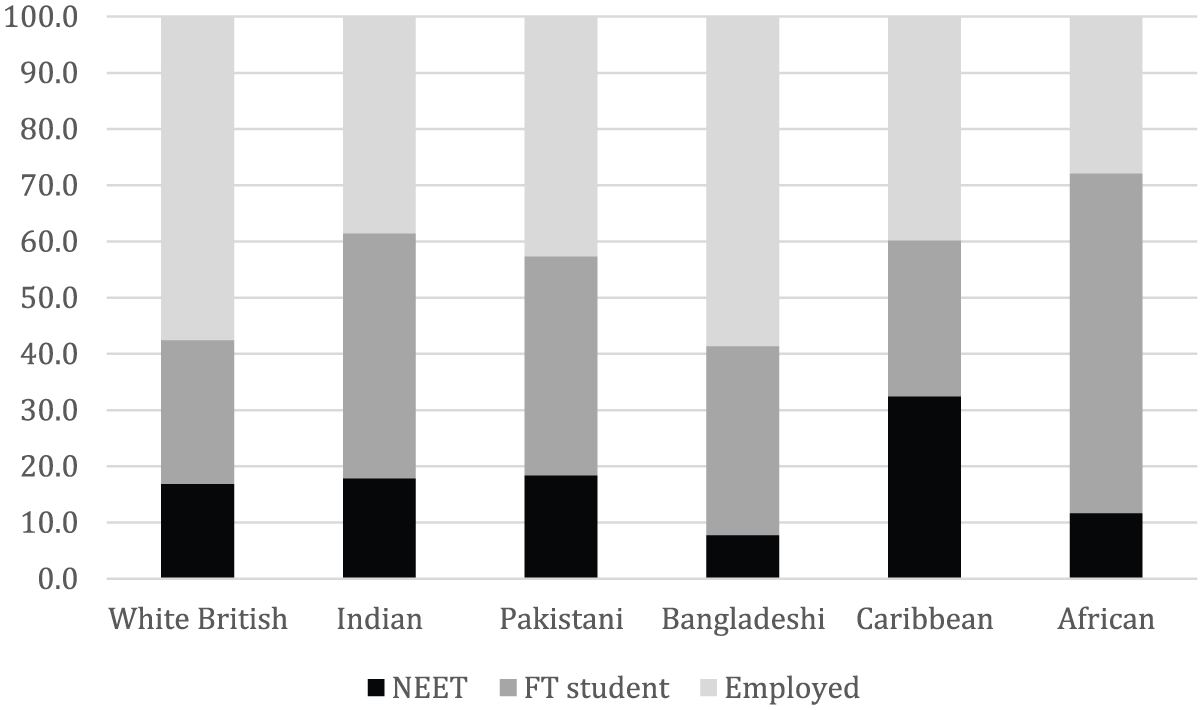
Distribution of NEET, full-time (FT) students and employed across ethnic groups: young individuals (aged 16–29), men.
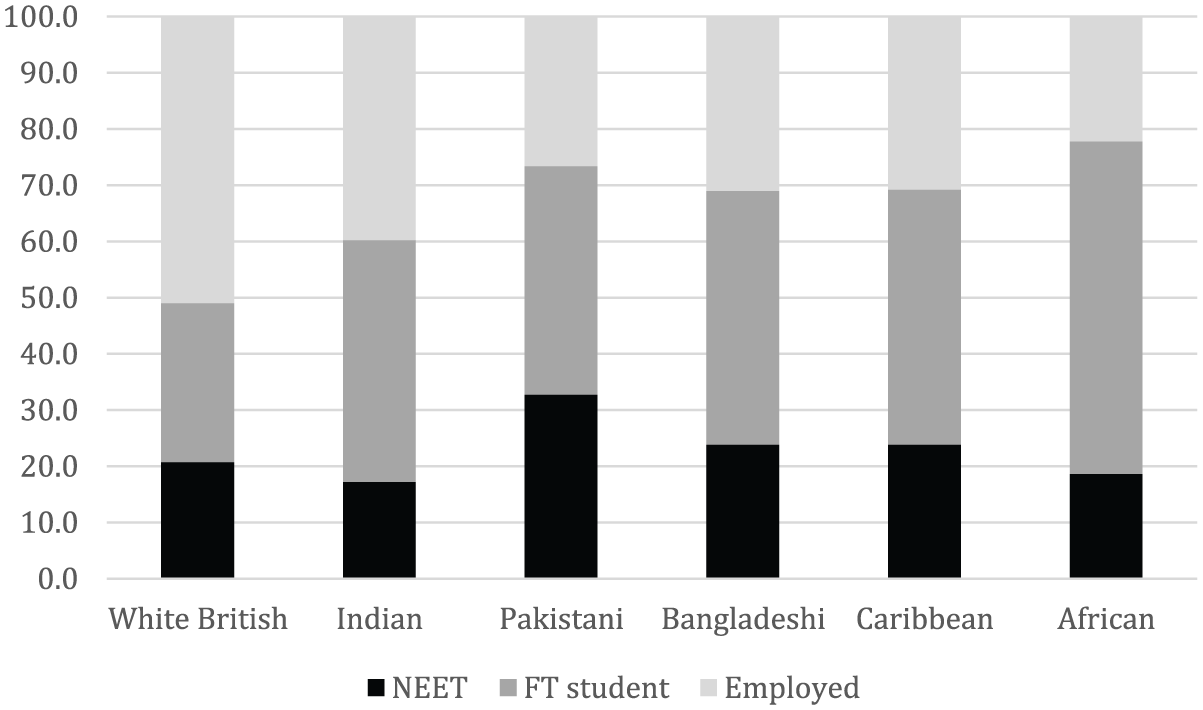
Distribution of NEET, full-time (FT) students and employed across ethnic groups: young individuals (aged 16–29), women.
Comparing NEET rates by gender, within ethnic groups, indicates that males have lower NEET rates than females among white British, Pakistani, Bangladeshi and African youth; Caribbean is the only group where the opposite occurs. NEET rates for Indians are very similar for both genders.
It is interesting to note that although most ethnic minority groups have higher proportions of workless parents compared to white British, the share of NEETs is not consistently higher for the ethnic minorities. An important difference between ethnic minority and white British youths is that the former are, in general, much more likely to be students and less likely to be employed. This suggests that independent of their social origins there might be different forms of parental investments or aspirations for their children.
The next section explores these patterns more in detail using multivariate models including age, level of education, parental occupational status and neighbourhood conditions (which are also usually poorer for the ethnic minorities). (A detail of the distribution of these variables across ethnic groups can be seen in Table A2 in the Appendix online.)
Household effects on becoming NEET by ethnicity and gender
A series of multivariate logistic regressions are used to examine household, gender and ethnicity effects on becoming NEET. First, the main effects of ethnicity and household of origin are analysed (Table 2); next, interactions between these are explored (shown in Figures 3 and 4).
Probability of being NEET (16–29); average marginal effects (standard errors).
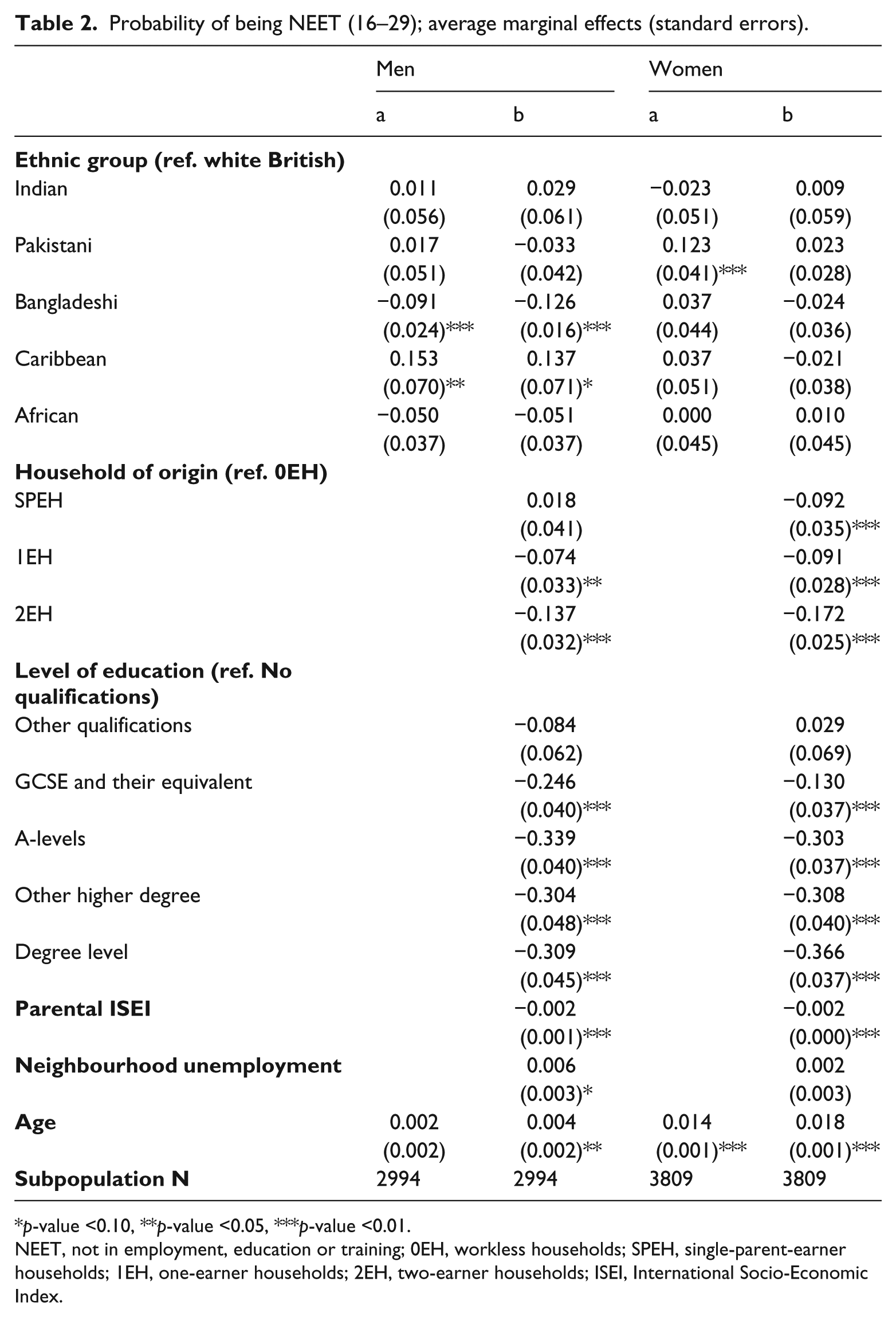
p-value <0.10, **p-value <0.05, ***p-value <0.01.
NEET, not in employment, education or training; 0EH, workless households; SPEH, single-parent-earner households; 1EH, one-earner households; 2EH, two-earner households; ISEI, International Socio-Economic Index.
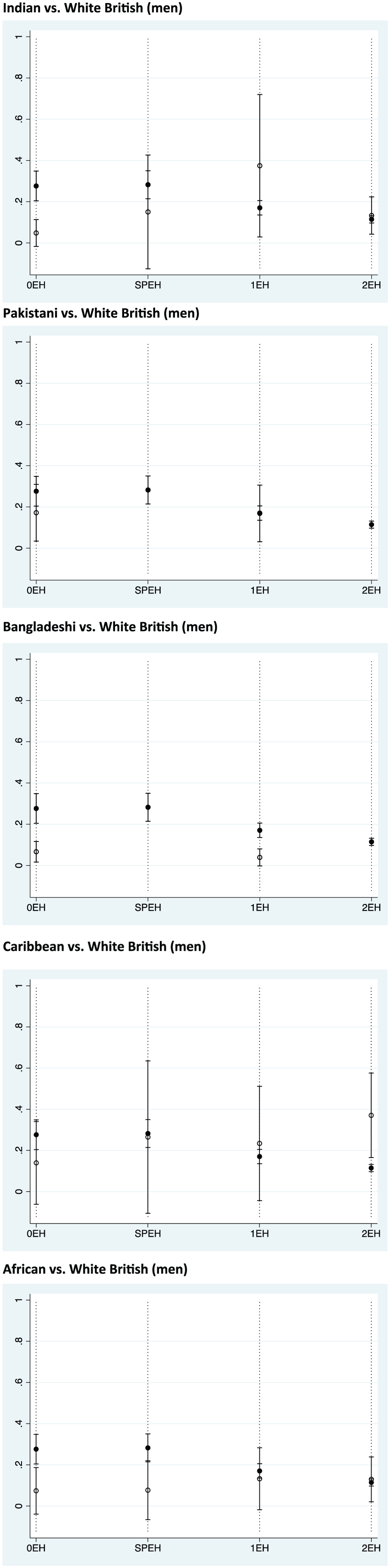
Predicted values of NEET (90% CI): comparisons between each ethnic minority group (hollow circle) and white British (black circle); men.
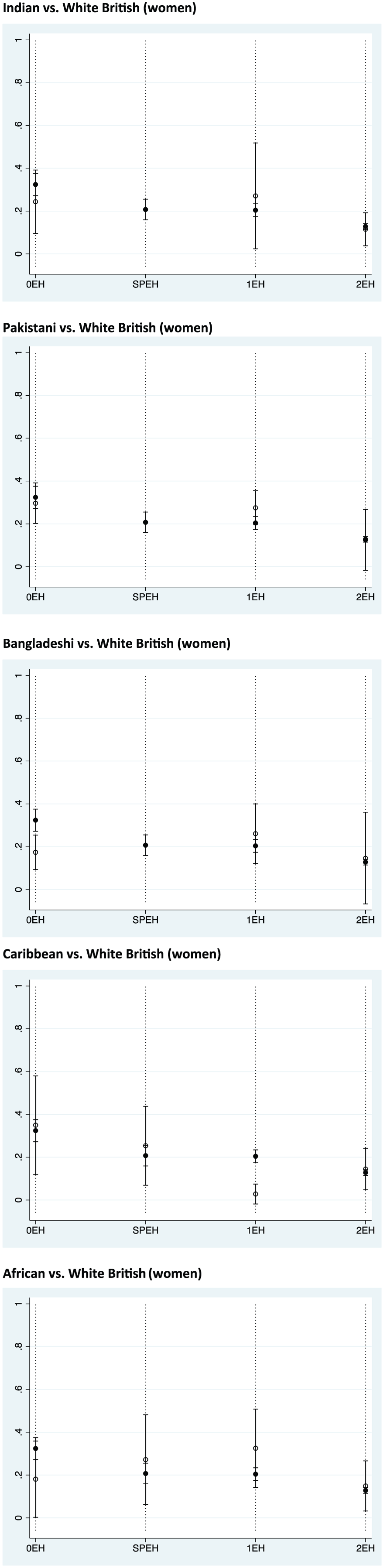
Predicted values of NEET (90% CI): comparisons between each ethnic minority group (hollow circle) and white British (black circle); women.
Table 2 has two models: a baseline model (a), with ethnic group and age controls; and a second model (b), where household of origin, as well as other controls (parental occupational status, neighbourhood unemployment rate and level of education), are included. Results are presented separately for men and women; coefficients represent average marginal effects derived from logistic regressions.
Controlling for age, young Caribbean men and Pakistani women are the only groups with higher NEET rates compared to young white British men and women; in contrast, Bangladeshi men have a lower NEET rate (Model a). After controlling for household of origin and other controls (Model b), the effect for Pakistani women reduces substantively, becoming statistically non-significant; however, the effects remain for ethnic minority men. For Bangladeshis it becomes even larger: this is because the model controls for the fact that young Bangladeshi men are more often raised in households with poorer socio-economic resources (and this in turn increases their NEET probabilities). On average, young Bangladeshi men are 13 per cent points less likely to be NEET than white British men, while Caribbean men are around 14 per cent points more likely to be NEET.
Concerning the household of origin effect (Model b), and noting that it is the majoritarian white British driving these average effects, a first clear outcome corroborates the first expectation (E1): having had workless parents increases the probabilities of a young person being NEET. For example, young people from 0EH are around 14 (men) and 17 (women) per cent points more likely to be NEET compared to individuals from 2EH, and around 7 and 9 per cent more likely when compared to individuals from 1EH. Furthermore, having had two working parents is also better for avoiding being NEET than having had only one working parent, which corroborates E3; there are no statistically significant gender differences on the effect of having had two working parents.
Regarding individuals who lived in SPEH, the expectation (E4) was that having lived with a single working parent was preferable than having lived with workless parents, but it was worse than having lived in a one-earner household (with two present parents). The results do not show strong evidence in this direction, although they do show some expected gender differences. Quite surprisingly, for men, having lived in a SPEH at the age of 14 seems to have the same effect on being NEET as having lived in a workless household. For women, the probability of becoming NEET for those who lived in a SPEH is almost the same as that observed among those from 1EH. Perhaps the positive gender role models compensate for the absent parent, which leads single mothers to have a more positive effect for their daughters than for their sons. Men do not seem to be particularly advantaged over women if they come from 1EH (see also Figures 3 and 4).
The inclusion of interactions between household of origin and ethnicity allows the exploration of whether the types of household in which individuals lived at the age of 14 have a different effect on the probability of becoming NEET across ethnic groups. The analysis is performed with logistic regression models, so statistically significant interactions were identified by means of margins and contrasts 10 (keeping age, level of education, parental occupation and neighbourhood unemployment at their mean). The results suggest that the relationship between origin household and the risk of being NEET varies across ethnic groups and genders. In order to have a better understanding of how different groups compare, and to better test the expectations, the margins derived from the interactions are plotted in Figures 3 (men) and 4 (women). For each graph, age, level of education, parental occupation and neighbourhood unemployment are set to the mean. Margins are shown in Table A3 in the Appendix online.
For individuals who had workless parents, ethnic minorities do not seem to be particularly disadvantaged compared to white British. On the contrary, the results show that Indian, Bangladeshi and African men, as well as Bangladeshi women, who had workless parents when they were aged 14, are (statistically significantly) less likely to be NEET than equivalent white British individuals. This advantage is also quite considerable: around 15–20 per cent points difference, supporting Expectation 2b.
Concerning the effect of a working parent (usually the father) for Asian women, it is interesting to compare not only with white British women, but also with Asian men. Among white British women, having had a working parent at the age of 14 reduces NEET probabilities (this also applies to young white British men). For Pakistanis, having had a working parent does not seem to reduce NEET probabilities. While in principle this would support the expectation about a lower parental effect among Asian women (E5), this pattern is also observed for Pakistani men. This suggests that the presence of a working father does not seem to reinforce mechanisms of gender inequality for Pakistanis. However, there seems to be a detrimental effect associated with having had a working parent for Bangladeshi women (but this is not statistically significant). Although NEET probabilities are similar for Bangladeshi and white British women coming from typical male-breadwinner households (1EH), the gender gap among Bangladeshis is bigger for those in 1EH (compared to those in 0EH). There is some evidence that a working father might not necessarily be a positive resource for Bangladeshi women, which would confirm the fifth expectation (E5).
Finally, regarding the role of single parent-earner households among black groups, there is not a clear pattern. Only African men from SPEH are less likely to be NEET than equivalent white British men, supporting E6 (which expected a positive role model of black working mothers). However, this relative advantage is also connected to the fact that having lived in SPEH when aged 14 seems to be a particularly disadvantaged situation for young white British men in these data.
Discussion
This analysis can be used to contribute to debates on intersectionality. Collins (2015) distinguishes between three distinct approaches for intersectionality: (a) as a field of study; (b) as an analytical strategy; and (c) as a critical praxis that informs projects on social justice. Here intersectionality is used as an analytical strategy to illustrate universal and differentiated effects of multiple forms of disadvantage among groups of young people in the UK. An intersectional approach encourages comparison of inequalities not only between categories, but also within categories (McBride et al., 2015). Mapping different forms of inequality draws our attention to the possible sources and remedies to these. Ethnicity, gender and parental households clearly affect access to education and employment. However, as evidenced in this article, different types of households have differential effects across ethnic groups and genders.
On average, having had workless parents at a young age increases the probabilities of being NEET, compared to those with at least one working parent (an exception are men from SPEH, who do not seem to benefit from the working parent). This supports the first expectation (E1). Having had two working parents reduces NEET probabilities to a greater extent than just having one working parent, supporting the third expectation (E3). Among those individuals from a SPEH when aged 14, gender differences are evident. Supporting the fourth expectation (E4), men who lived with one working parent are worse off than those who had two parents (with at least one working); however, they have almost the same NEET probabilities as men who lived in workless households. Among women, having lived with a single-working parent when aged 14 leads to the same NEET probabilities as those who lived with two parents, where one of them was working. There is no additional negative effect for young women connected to coming from a SPEH.
Having had working (or workless) parents does not exert the same effect across ethnic groups. The first key finding, supporting E2b, is that Indian, Bangladeshi and African young men who lived in workless households when aged 14 are doing better than their white British counterparts: on average, they have around 20 per cent points less chance of being NEET. A similar finding exists for Bangladeshi women, who are around 15 per cent points less likely to be NEET compared to their young white British counterparts. The fact that some ethnic minority groups with poor social origins manage to avoid becoming NEETs to a much greater extent than white British individuals with similar backgrounds – and after controlling for education – is an important finding. This becomes even more striking once one acknowledges the fact that groups such as Bangladeshis have very high rates of worklessness. The cause of these differential effects might be due to the attitudinal and aspirational disposition of ethnic minorities (Heath et al., 2008; Reeskens and Van Oorschot, 2012), which are known as key predictors of participating in education and on becoming NEET (Duckworth and Schoon, 2012). Mechanisms that occur at the neighbourhood level, especially for relatively highly segregated groups such as Indians and Bangladeshis, might also be relevant. These could include, for example, the transmission of role models or the exchange of experiences across social groups (Galster, 2012), especially among Indian communities, who have a relatively high share of members with good educational and occupational levels.
Second, although there is no evidence that Pakistani and Bangladeshi women are particularly less likely to be NEET than white British women among those raised in one-earner households, the role of a working parent (usually a father) seems to be detrimental for Bangladeshi women, especially since the gender gap (i.e. NEET probabilities with respect to Bangladeshi men) increases in this household type. There is, therefore, some limited evidence in favour of E5, in line with Peach’s (2005) arguments about patriarchal families.
Third, there is not much evidence either in favour of E6: only African men raised in SPEH are particularly advantaged compared to their white British counterparts, they have more chances of being either in education or in employment. This might be connected with employment experiences transmitted from their working mothers to their children. However, there is no evidence of a pattern among African women or for Caribbean youth, for which other unknown mechanisms are probably at play.
Finally, one last finding worth mentioning is that young Caribbean men raised in two-earner households are more likely to be NEET compared to their white British counterparts (and even to those raised in 0EH or 1EH). Similar findings were observed in social mobility studies (Platt, 2007; Zuccotti, 2015a, 2015b). This may in part be due to difficulties in transferring cultural capital in terms of social networks and habitus (Rafferty, 2012), which in turns affects educational and labour market opportunities.
It is rare to find an analysis that goes beyond two dimensions of gender or race; and it is even less common to make links between these dimensions and household influences. Recognising more complex levels of inequality within and between groups, Mooney (2016) argues, is important in revealing how different categories of ethnicity or gender might simultaneously be related to both privilege and oppression. One of the key findings of this article is that while having had workless parents or being an ethnic minority are often expected to be sources of disadvantage, this is not always the case in the UK.
Conclusion
This article shows that having workless parents, or being from an Asian ethnic minority, are not sufficient predictors of individuals’ education and labour market opportunities. On the contrary, it is the intersection between these different dimensions that needs to be acknowledged, as a way to obtaining more precise indicators of life chances. The lower NEET rates found among some ethnic minority groups, especially among those who had workless parents, shows, for example, how an apparently problematic initial condition does not necessarily have the expected negative outcomes across ethnic groups.
Future research needs to identify the mechanisms accounting for these differential outcomes for young men and women, and the effectiveness of policies to remedy these inequalities. By means of looking at different dimensions of inequality, not only has this study added to our knowledge of youth labour market trajectories in the UK, but also to the UK debate on worklessness by linking its effects to gender and ethnicity using an analytical intersectional approach.
Footnotes
Acknowledgements
Understanding Society is an initiative funded by the Economic and Social Research Council and various Government Departments, with scientific leadership by the Institute for Social and Economic Research, University of Essex, and survey delivery by NatCen Social Research and Kantar Public. The research data are distributed by the UK Data Service.
The authors are very grateful to critical comments on earlier versions of this article that were provided by Tiziana Nazio, Colette Fagan, Paola Villa, Fatoş Gökşen, and the anonymous reviewers. We would like to thank policy advisors and, especially, Edward Badu from North London Citizens, for their useful comments and for discussing our results.
Funding
The authors disclosed receipt of the following financial support for the research, authorship, and/or publication of this article: the work for this article has been financed from the STYLE project funding from the European Union’s Seventh Framework Programme for research, technological development and demonstration under grant agreement no. 613256 (www.style-research.eu) and from the NEGOTIATE (Negotiating early job-insecurity and labour market exclusion in Europe) project funding from the European Union’s Horizon 2020 research and innovation programme under grant agreement no. 649395 ( ).
).
Notes
References
Supplementary Material
Please find the following supplemental material available below.
For Open Access articles published under a Creative Commons License, all supplemental material carries the same license as the article it is associated with.
For non-Open Access articles published, all supplemental material carries a non-exclusive license, and permission requests for re-use of supplemental material or any part of supplemental material shall be sent directly to the copyright owner as specified in the copyright notice associated with the article.
