




Abstract
Unemployment, especially in insecure times, has devastating effects on families, but it is not clear what happens to domestic work. On the one hand, unemployment frees up time for more housework by both men and women. On the other hand, once unemployed, women may take on more additional housework than men do, either because they capitalize on their time to act out traditional gender roles or because unemployment compounds women’s general disadvantage in household bargaining. Multi-level analyses based on the European Social Survey show that both men and women perform more housework when unemployed. However, the extra domestic work for unemployed women is greater than for unemployed men. They also spend more time on housework when their husband is unemployed. Compared to their employed counterparts, unemployed women, but not men, perform even more housework in a country where the unemployment rate is higher.
Introduction
Since the start of the recession in 2008, a long period of unemployment followed in Europe (Eurostat, 2016). Unemployment, especially in insecure times, has devastating effects on families. Susceptibility to unemployment and economic reversals often leads to declines in family functioning (Kalil, 2013; Ponnet et al., 2016), derailed career trajectories (Hamermesh, 1989; Mendenhall et al., 2008), negative health and subjective well-being (Andersen, 2009; Calvo et al., 2015; Snorradottir et al., 2015) and economic hardship (Burgard et al., 2013; Russell and McGinnity, 2014). Although consequences of unemployment have been documented with regard to paid work (Fevre, 2011; Harkness and Evans, 2011; Mattingly and Smith, 2010; Teachman et al., 1994), this has been less the case regarding unpaid household work. In this article, we aim to gain more insight into the impact of unemployment on the division of housework in European family life.
For American families coping with economic reversals in the 1930s, Elder (1999) showed that an intensification of unpaid household labour is likely – either in response to or anticipation of new financial constraints. People tend to cut their expenses on recreational activities and their outsourcing of domestic work. They spend more time at home, which may result in an increased amount of housework to be done. Since gender considerations continue to underpin the organization of couples’ domestic lives (Kan, 2008; Treas and Drobnič, 2010), household adjustments to unemployment are likely to map onto gender inequality in the division of household labour.
European countries present a useful case to analyse the relationship between the economic circumstances and housework, as unemployment rates differ substantially between European countries (Eurostat, 2016; Gallie, 2013). Our research asks two questions: what are the consequences of unemployment for time spent on housework by men and women in Europe, and does the effect of individual unemployment experiences differ depending on the varying macroeconomic circumstances of European countries? Our contribution is threefold. First, our study investigates whether unemployment experiences relate to the hours men and women spend on housework weekly. Second, using 2004 and 2010 European Social Survey (ESS) data, we examine whether men’s and women’s reactions to unemployment are consistent with gender-neutral time availability arguments or with theoretical reasoning that suggests a gendered response. Third, our study sheds light on the importance of the macro-level context (namely, the unemployment rate and public satisfaction with the economy) for the association between individual unemployment and the division of housework.
Theory and hypotheses
In the face of unemployment, the volume of domestic work to be done by household members – and the time devoted to accomplishing it – can be expected to increase. If household members spend less time working away from home and cut back on costly recreational activities, their more intensive use of the home is apt to require them to do more cooking and cleaning. Limited income will discourage outsourcing their chores to hired help, buying products they can make at home and purchasing labour-saving appliances (De Ruijter et al., 2005; Heisig, 2011). To smooth their consumption in the face of lower income, they will substitute their own labour. Furthermore, tasks may not be done as efficiently. Having more discretionary time, individuals may feel less pressure to complete them quickly. Recent research for the US confirms that unemployment is linked to more time spent in household work (Gough and Killewald, 2011). Although most newly free time goes to leisure, 30 per cent of the market work hours lost to the recession was reallocated to unpaid home production (Aguiar et al., 2013).
Theoretical perspectives in housework division
Although there are reasons to expect unemployed women to take on more housework than unemployed men, one consistently reliable predictor of housework suggests men and women will behave similarly. Gender inequality in housework has been linked to a seemingly gender-neutral and rational consideration, described in the literature on housework as the ‘time availability’ explanation (Shelton, 1992). The partner with more discretionary time will be the one to do more of the unpaid household work. In practice, this translates to the person who works fewer hours for pay. This is also in line with Becker’s ‘theory of the allocation of time’ (1965), which states that whichever partner is less efficient at market work will spend more time on domestic activities. For decades this was usually the wife, whose market work efficiency suffered from her having less job experience (Van der Lippe and Van Doorne-Huiskes, 1995). This explained, in part, why women did a disproportionate share of work around the house (Van der Lippe, 1994). Of course, women’s rising labour force participation cut into their available time for domestic activities. For our purposes, the important point is that the logic of time availability does not assume any difference between men and women in their response to unemployment. Greater time for housework should translate into more time spent in housework for both men and women.
In contrast to gender-neutral expectations, other arguments contend that women experiencing unemployment will take on more additional housework than unemployed men will. Treating gender as a household accomplishment, the ‘doing gender’ perspective assumes that women display their femininity through homework while men demonstrate masculinity by avoiding what has traditionally been seen as ‘women’s work’ (Berk, 1985; West and Zimmerman, 1987). Because a clean home reflects on competence as a wife and mother (Bianchi et al., 2000), we might expect women to invest more in these feminine identities when unemployment allows them to do so. Routinizing gender production via housework, unemployed men may do less housework even as unemployed women do more. In what Greenstein (2000) described as the neutralization of gender deviance, unemployed men who fall short of the male breadwinner ideal may reassert masculinity by avoiding stereotypically women’s work while their wives compensate by doing more. Indeed, women in partnerships where they earn more than their male partner are sometimes shown to do more housework than otherwise (Lyonette, 2015).
Also predictive of gendered responses to unemployment, power-based theories argue that the division of housework is the outcome of struggle and negotiation. In negotiations over who does the housework, a ‘relative resource’ disadvantage works against whichever partner has fewer resources (Brines, 1993; Kan, 2008). However, the overarching societal context of gender subordination means that women’s resources are systematically discounted (Blumberg, 1984; Fuwa, 2004). Without gender symmetry in the weight given to resources, the domestic expectations for women will be more sensitive to lost earnings from unemployment than is the case for men.
While all gendered arguments predict women will increase housework more than men in response to unemployment, gender display, deviance neutralization and relative resource approaches have been subjected to scepticism and limiting conditions (England, 2011; Sullivan, 2011; Van der Lippe et al., 2011). There are, however, still reasons to believe that additional housework will not be divided gender neutrally based on time availability (see also Evertsson and Nermo, 2007; Gush et al., 2015). First, due to the primacy of the male provider role, men are more readily demoralized by unemployment (Luchmann et al., 2014; Van der Meer, 2014). Thus, men’s declining psychological well-being may deter them from taking on more work around the house. Second, following Becker (1965), men may not have the specialized domestic skill set to substitute efficiently for wives’ housework, particularly when a high level of economizing is called for (Treas, 2008). Nor may men have the mindset that leads to engagement in domesticity. Compared to men, Dutch women hold more favourable attitudes towards housework, enjoy it more, feel more responsible for it and embrace higher housekeeping standards (Poortman and Van der Lippe, 2009).
Studies on the US are consistent with these gendered arguments. Unemployed women assume more additional domestic work than do out-of-work men (Gough and Killewald, 2011). In a Great Recession trend analysis, Berik and Kongar (2013) report that women, in response to having more paid work hours, spent predictably less of their time in housework; surprisingly, men took on no more housework when their employment hours were reduced. In further evidence of gender differences, French mothers who were out of work were more likely than unemployed fathers to increase their time in childcare activities (Pailhe and Solaz, 2008). Thus, there is empirical evidence that men and women will differ in their sensitivity to the experience of unemployment.
In sum, considering the implications of own and partner’s unemployment for household labour gives rise both to general hypotheses grounded in the gender-neutral time availability logic and to gendered expectations based on other arguments, including ‘doing gender’ and relative resources.
H1a: The unemployed will do more housework than their counterparts who are employed.
H1b: Persons with an unemployed spouse will do less housework than their counterparts with an employed spouse.
H2a: Compared to their employed counterparts, unemployed women will do more housework than unemployed men.
H2b: Compared to their counterparts with an employed partner, women with an unemployed partner will do relatively more housework than men with an unemployed partner.
Unemployment and housework in context
A robust cross-national research literature shows that societal context is a predictor of the division of housework and moderates the influence of individual and household circumstances (Moreno-Colom, 2015; Treas and Lui, 2013). Despite the lack of cross-national studies linking country-to-country differences in joblessness to housework, within-country analyses point to macro-level considerations. In Spain, regional unemployment rates were positively associated with the time unemployed men and women devoted to household labour (Gimenez-Nadal and Molina, 2014). Also, in the years immediately preceding the recession, change in local US employment rates proved consequential for housework (Burda and Hamermesh, 2010). In metropolitan areas where unemployment rates rose more sharply, people devoted considerably more time to home production than they did elsewhere. Similarly, as state-level unemployment rates rose, fathers, but not mothers, spent more time on children’s enrichment activities (Morrill and Pabilonia, 2012).
Because couples modify their lives in anticipation of financial reversals, business cycles may be reflected in time allocated to housework – above and beyond the couples’ immediate experience with unemployment. If individuals calibrate their housework to labour market conditions, their domestic labour will be more sensitive to unemployment in a negative economic context than in a stable and secure macroeconomic environment. A robust labour market implies short spells of unemployment and quick re-employment, so disruptive changes in household routines may not be necessary if a partner loses a job. Living where many are out of work does not seem to normalize unemployment. Where joblessness is high, the unemployed – far from being buffered from the pain of job loss – actually suffer more disadvantage and dissatisfaction compared to workers, students and housewives (Calvo et al., 2015). Experiencing more strain and anticipating prolonged unemployment (Fernandez-Crehuet et al., 2016), those out of work in countries with high unemployment may well take on more housework.
Unemployment rates are complemented by the general public’s subjective assessment of the economic situation. While the two concepts are positively associated, satisfaction with the economy reflects not only direct economic risks, such as reduced pay and job loss (Kalleberg, 2009), but also broader concerns (e.g. cutbacks in social programmes, local merchants going out of business, negative current events). High unemployment may prompt couples to make unwelcome and even pre-emptory adjustments to household routines – in part, because it diminishes subjective evaluations (e.g. optimism about prospects for getting and keeping a job).
As with high unemployment rates, we expect a high level of public dissatisfaction with the economy to be linked to a stronger association between individual unemployment and domestic work. Increases in positive public sentiments should embolden individuals to trade housework for leisure and purchase substitutes for their own domestic production. Conversely, the growth in negative assessments should relate to doing more housework, especially for the unemployed. Summarizing, the anticipated positive effect of an individual’s unemployment on housework will, we hypothesize, be moderated by the national unemployment situation and public satisfaction with the economy.
H3a: The positive association of unemployment with housework hours will be stronger in countries with higher unemployment.
H3b: The positive association of unemployment with housework hours will be stronger in countries with declining public satisfaction with the economy.
Data and methods
We used data from the ESS, conducted in 2004 and 2010. Pooling data from the two waves provided an adequate number of unemployed respondents to test our hypotheses. The ESS is conducted every two years and contains both core and rotating modules, but only these two waves have information on housework. The second ESS round from 2004 collected data from 49,066 respondents aged 15 years or older in 26 countries. The fifth round from 2010 contains information collected from 52,458 respondents of the same age in 27 countries.
We excluded respondents outside the age interval of 18–65 (21,236 out of 90,351 respondents), those in a household but not living with a partner (37,476 respondents) and those who were retired at the time of the survey (22,535 respondents). Analysis was restricted to respondents who indicated performing paid work, being unemployed, or doing housework as their main activity. We excluded individuals who reported being either in education (8105 respondents) and community or military service (167 respondents) as their main activity, or were permanently sick or disabled (2016 respondents). After restrictions and excluding missing cases on the dependent and independent variables, our final merged sub-sample contained 29,312 cases in 28 countries (13,414 men and 15,898 women).
Dependent variables
The dependent variable is the total number of hours a respondent spends on housework per week. For the 2010 wave of ESS, the questionnaire contained a direct measure of housework hours per week (‘About how many hours a week, in total, do you personally spend on housework?’). The dependent variable was limited to the maximum value of 70 hours. The 2004 wave of ESS did not use the same question wording. Questions measured the number of housework hours that people in the respondent’s household carried out on a typical weekday and weekend (‘On a typical weekday (weekend) about how many hours, in total, do people in your household spend on housework for your home?’). We multiplied these hours by the respondent’s reported share of this time in the household (‘And about how much of this time do you spend yourself?’). The respondent’s share of housework time in the household was measured with six categories from ‘none or almost none’ to ‘all or nearly all of the time’. We recoded these categories to equal intervals, ranging from 0 to 1. The hours for weekends and weekdays were combined into a weighted sum based on their respective shares of the seven days in the week.
Key independent variables
Unemployment is a dummy variable, coded 1 for respondents who reported being unemployed and actively or passively looking for a job as their main activity at the time of the interview. Partner’s unemployment was based on information provided by the respondent about whether his or her partner was unemployed and actively or passively looking for a job during the seven-day period before the interview. The difference between the self-reported unemployment of female respondents and proxy reports by males about their female partners (and vice versa) is around 1 per cent (see Table 1). This inspires confidence in the reliability of respondents’ reports about their partners’ unemployment status.
Descriptive statistics of all variables in the analysis.
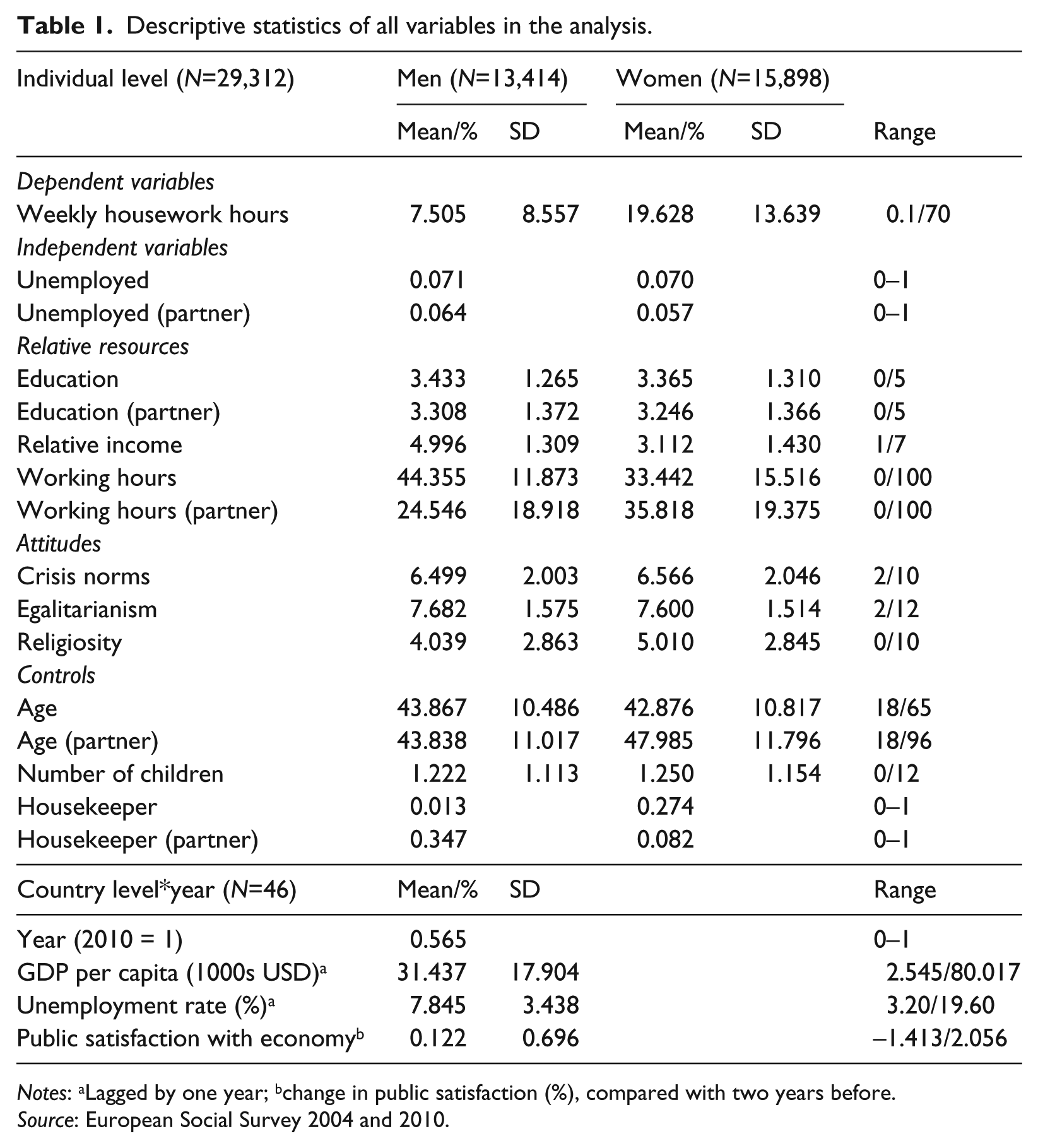
Notes: aLagged by one year; bchange in public satisfaction (%), compared with two years before.
Source: European Social Survey 2004 and 2010.
Other explanatory variables
Relative resources were measured vis-a-vis the partner. First of all, we included the respondent’s income and education as resources to control for the respondent’s ‘power’ in bargaining the division of housework in the household (Poortman and Van der Lippe, 2011). Relative income of the respondent came from the question ‘Around how large a proportion of the household income do you provide yourself?’. Seven categories range from ‘none’ to ‘all’. Missing values for this variable were recoded to 0 (‘none’) if the respondent’s main activity was housekeeping. For the other relative resource measure, the education value for each partner is included in the models. Education levels were calculated using the standardized seven-category ES-ISCED measure of education. To control for time availability, working hours for the respondent and for the partner were top coded to a maximum of 100 hours per week to eliminate implausible outliers.
As measures of normative influences, gender attitudes (Davis and Greenstein, 2009), like religious beliefs (Voicu et al., 2009), are associated with the division of housework. We used three attitude measures as control variables. First, we gauge gender egalitarianism using the respondent’s agreement on a six-point Likert scale with two statements: ‘Tradition is important to him/her. He/she tries to follow the customs handed down by his/her religion or his/her family’ (reverse coded) and ‘He/she thinks it is important that every person in the world should be treated equally. He/she believes everyone should have equal opportunities in life’. The items were combined into an 11-point summated scale, where higher scores indicated greater egalitarianism. Additionally, the measure of gender crisis norms addressed attitudes towards gender roles in a recession context. It was based on two items: ‘Women should be prepared to cut down on paid work for sake of family’ and ‘Men should have more right to a job than women when jobs are scarce’. Both items were measured with five Likert response categories (reverse coded). This crisis measure of support for gender equality is the sum of these two variables. Religiosity is a measure of general feelings of religiousness instead of religious practice. We used the question ‘How religious are you?’, coded as a 10-category scale ranging from ‘not at all religious’ to ‘very religious’.
In addition to the respondent’s gender (female=1, male=0), we controlled for the respondent’s and partner’s age as well as the number of children in the household at the time of the interview. The respondent’s and partner’s housekeeping are dummy variables identifying those with housework as their primary activity. The respondents who reported their primary activity to be housework, nonetheless, showed a large variation in domestic hours. We also controlled for year the ESS data were collected (2010=1, 2004=0).
Country-level variables
The unemployment rate was obtained from the World Bank data. The unemployment rate refers to the share of a country’s labour force that is unemployed but available for and seeking employment. We used a lagged measure of one year for each country. The direction of public satisfaction with the economy was calculated using the ESS item that asked respondents to specify their satisfaction. To ascertain the direction of national sentiment, data from waves 2002 and 2004 calculate the trend in satisfaction levels for each country in 2004, and similarly, waves 2008 and 2010 for 2010. Since public satisfaction as a construct might be less comparable between countries than unemployment rates, we chose to use year-over-year change. Negative values mean public satisfaction had decreased in the country during the previous two years. The association between unemployment rate and public satisfaction with the economy is relatively low (r = 0.195). To control for the general differences in prosperity between countries, we used GDP per capita (in current US$, 1000s), one year lagged, also obtained from World Bank data.
Methods
We tested our hypotheses using hierarchical linear regression models, taking into account the nested nature of the data. Individual observations were nested in countries, resulting in two-level regression models. Individual-level measures were centred, where applicable. We used separate models for men and women. This is the conventional approach because factors often go in different directions for men and women. Merging female and male responses into a single model may result in a biased estimation of the importance that these factors have for time spent on housework. To test differences between men and women, however, interactions between variables and gender were added in a merged model with both genders, as reported in the online Appendix A.
All of the models contain a random intercept for the country-level and fixed effects for all independent variables. Beginning with the main-predictor-and-control-variables-only model, we added groups of individual-level and country-level independent variables sequentially. In the final models we tested cross-level interactions of country-level predictors and individual-level unemployment, one interaction per model. 1
Results
The descriptive statistics for the individual-level variables by sex are provided in Table 1. The table demonstrates that women spent more than twice as many hours as men on weekly housework. The average respondents were in their early 40s with a child in the home. About 7 per cent of men and women reported being unemployed and 6 per cent of their partners were unemployed.
As Table 2 shows, the countries differed on both their dependent and their macro-level contextual measures. Total amount of housework differs between the countries: Ukraine had the highest weekly hours of housework for both women (31.2) and men (16.6). The lowest hours were reported by women in Denmark (12.4) and men in Portugal (4.7). It can be calculated that the share of housework for women differs between countries: in Greece, for example, women performed 82 per cent of housework and in Sweden 61 per cent. The countries also differed in their economic situation. Average unemployment rates ranged from 3.5 per cent in the Netherlands to 14.8 per cent in Spain.
Country-level descriptive statistics.
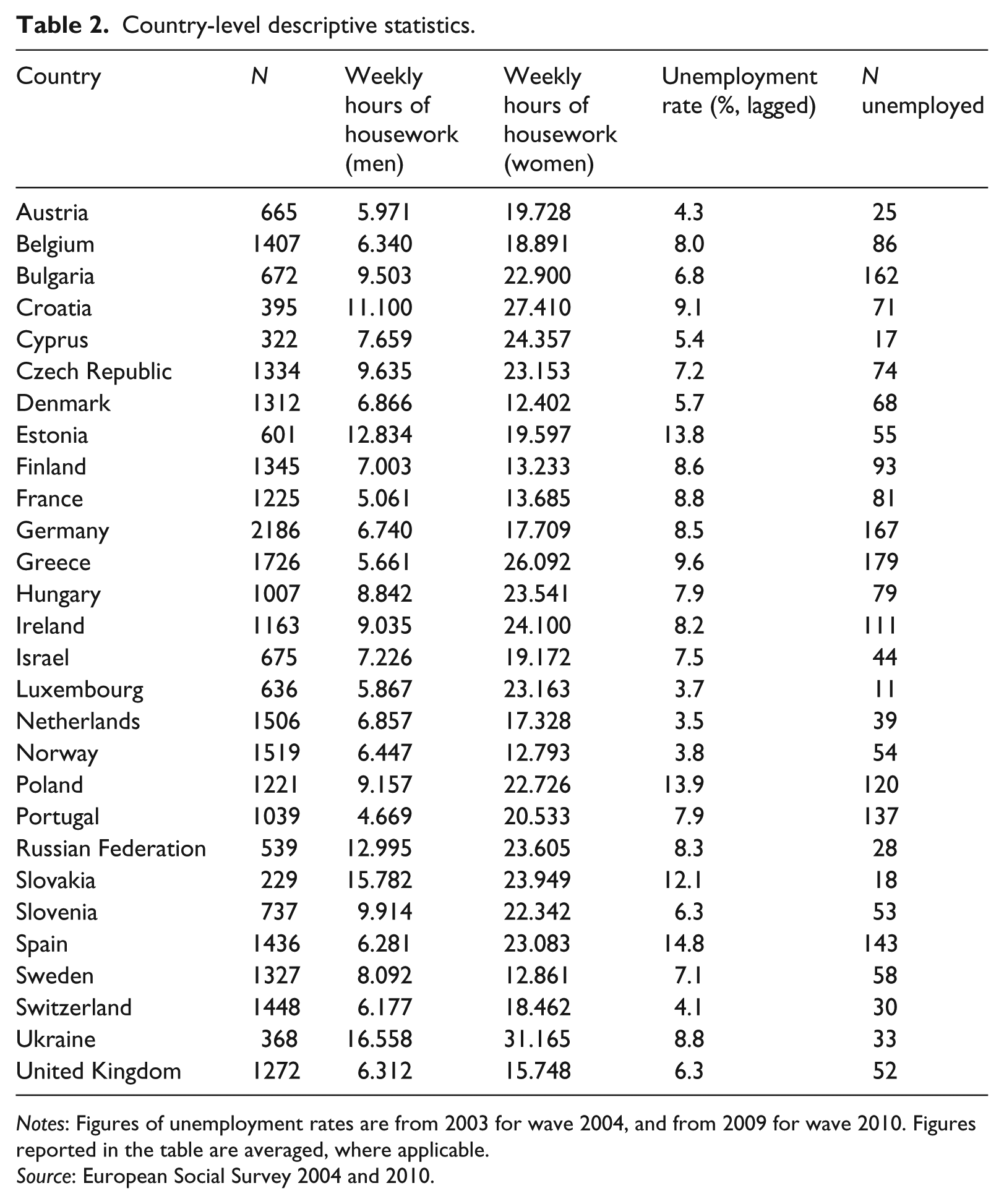
Notes: Figures of unemployment rates are from 2003 for wave 2004, and from 2009 for wave 2010. Figures reported in the table are averaged, where applicable.
Source: European Social Survey 2004 and 2010.
To evaluate the implications of own and partner’s unemployment for household labour, Table 3 presents the hierarchical linear model results for time spent on housework. Model 1 shows the influence of unemployment while including only the individual-level demographic controls; model 2 adds theoretically motivated individual-level variables (relative resources, time availability, normative attitudes); and model 3 includes the country-level indicators. The variance on the contextual level was calculated by dividing the variance of the intercept by the total variance (i.e. variance of the intercept plus residual variance). As is usual with multi-level models, most of the variance is at the individual, not the country, level. The contextual-level variance for hours of housework is 11.91 per cent for men and 17.82 per cent for women. Each model for men and women in Table 3 has a significantly improved model fit over the preceding model, which was tested using likelihood ratio tests (M1 vs intercept-only χ2(8) = 513.96 (men), 2862.52 (women), p <0.01; M2 vs M1 – χ2(8) = 155.69 (M), 516.79 (W), p <0.01; M3 vs M2 – χ2(3) = 27.70 (M), 76.84 (W), p <0.01).
Hierarchical linear model (HLM) results for individual and country-level predictors of housework hours weekly. a
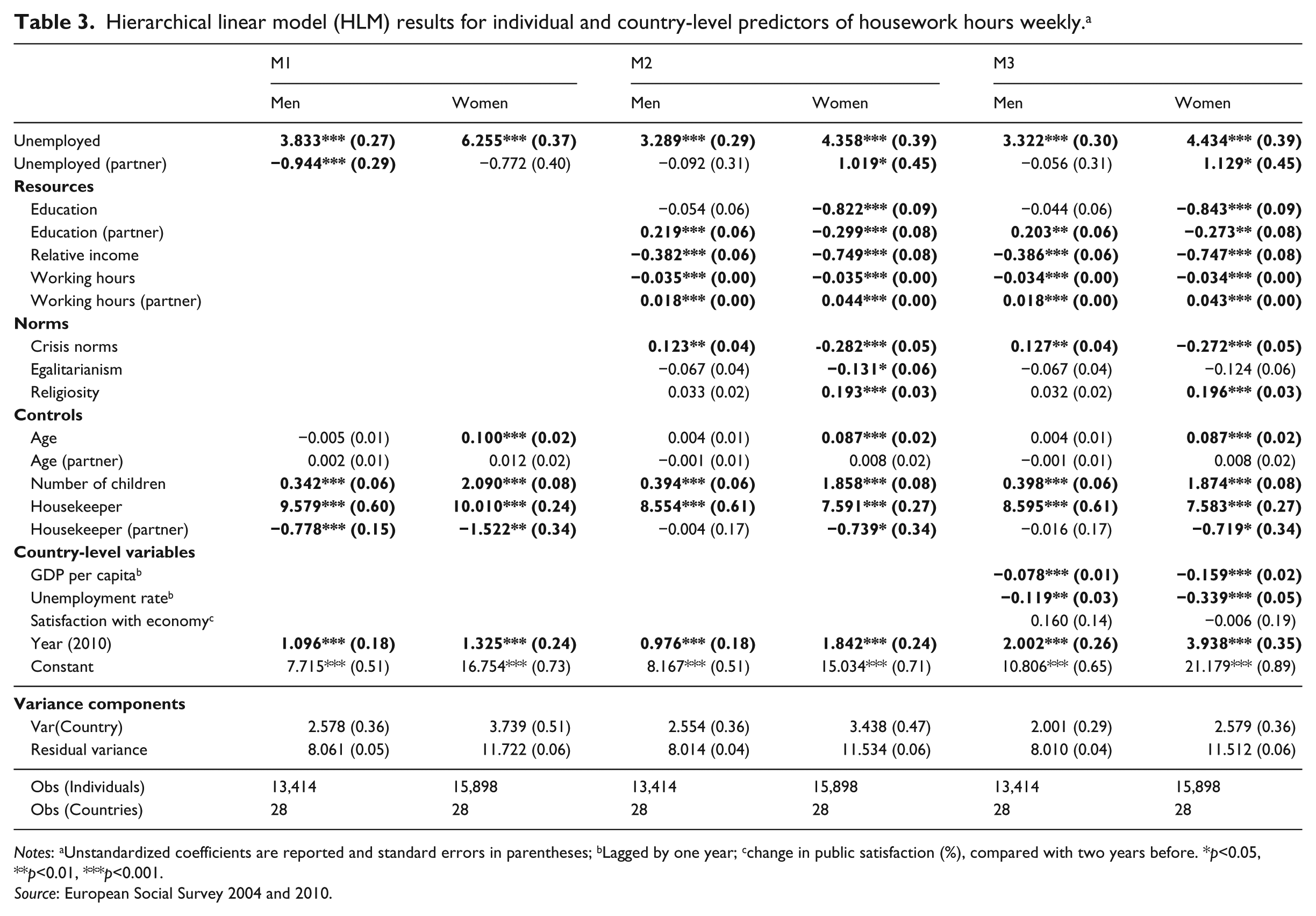
Notes: aUnstandardized coefficients are reported and standard errors in parentheses; bLagged by one year; cchange in public satisfaction (%), compared with two years before. *p<0.05, **p<0.01, ***p<0.001.
Source: European Social Survey 2004 and 2010.
As expected, model 1, controlling only for basic demographic variables such as age, showed that unemployed men spent 3.8 (p<0.001) and unemployed women spent 6.3 (p<0.001) more hours weekly on housework than their employed counterparts. In line with hypothesis 1a, men and women show some elasticity of substitution between home production and market production. In response to unemployment, the respondent may have undertaken new economizing chores and previously unnecessary or neglected tasks. Or, with fewer time constraints, the unemployed may have simply performed work less efficiently.
Results for the partner’s unemployment are less compelling. According to model 1, men with an unemployed partner did less extra housework than men with an employed partner, but the result ceased to be statistically significant when time availability, relative resources and gender norm variables were added in model 2. For women, model 1 indicated no effect for having an unemployed spouse, but the results in model 2 showed that an unemployed partner translated to one more hour of housework weekly, contradicting the time availability arguments of hypothesis 1b. Although the unemployed partner results for women are consistent with the gendered logic of hypothesis 2b, an extra hour of housework weekly is small compared to the result for women’s own unemployment or their average housework hours (nearly 20).
Model 2 adds other theoretically motivated variables, such as relative resource measures. Net of her partner’s education, higher education for the woman was linked predictably to less housework, but education was not statistically significant for men. Similarly, a larger contribution to household income translated to fewer hours of housework weekly for men, but particularly for women. As anticipated given time availability, more hours of paid work by employed respondents were associated with fewer hours of domestic chores, although the effect size was rather small. The partner’s paid work hours were linked to more housework for men and especially for women. The results of model 2 showed that more attitude measures were significant for women than men. Women performed predictably more housework if they were more religious, but less if they supported egalitarianism and crisis norms. For men, only crisis norms were significantly related to housework and the relationship with housework was positive.
Adding the country-level variables in model 3 had little or no effect on the individual-level variables. All things considered, unemployed men spent three more hours weekly on housework than their employed counterparts and unemployed women four more hours. Thus, the full model with country-level indicators continues to support hypothesis 1a, which states that the unemployed spend more time on housework than their employed counterparts. In line with hypothesis 2a, interaction analyses on the full sample (reported in online Appendix A) showed a significant gender difference in unemployment’s association with time spent on housework. Women reacted more strongly to unemployment than men. Net of country-level factors, not only was being unemployed linked to doing more housework hours for women than for men, but also having an unemployed partner led to more housework for women, which supports hypothesis 2b.
The results in model 3 showed that both men and women did less housework in countries with higher GDP per capita. Net of GDP, however, they spent unexpectedly less time on housework in countries with a higher unemployment rate than with a low one. Public satisfaction with the economy was not statistically significant. Even taking account of macro-level factors such as unemployment rates, we found that, on average, both men and women did more housework in 2010 than 2004.
To investigate further the implications of the country economic context for the association of individual unemployment with housework, Table 4 shows the results of adding to model 3 micro–macro interactions of country-level indicators and being unemployed. Again, the models were run separately for men and women. Unemployed women did more housework than their employed counterparts, but model 4 reports that the gap between the employed and unemployed was even greater in countries with higher unemployment rates. This is illustrated in Figure 1. Consistent with our hypothesis 3a, the positive effect on women’s housework time of being unemployed is stronger where the country-level unemployment rate is higher. There was, however, no similar interaction for men. Furthermore, we found no significant interaction between public satisfaction and individual employment status for either men or women. Compared to 2004, however, unemployed men spent significantly more time on housework in 2010 than in 2004.
Housework hours weekly: cross-level interactions of unemployment by country-level variables for men and women. a
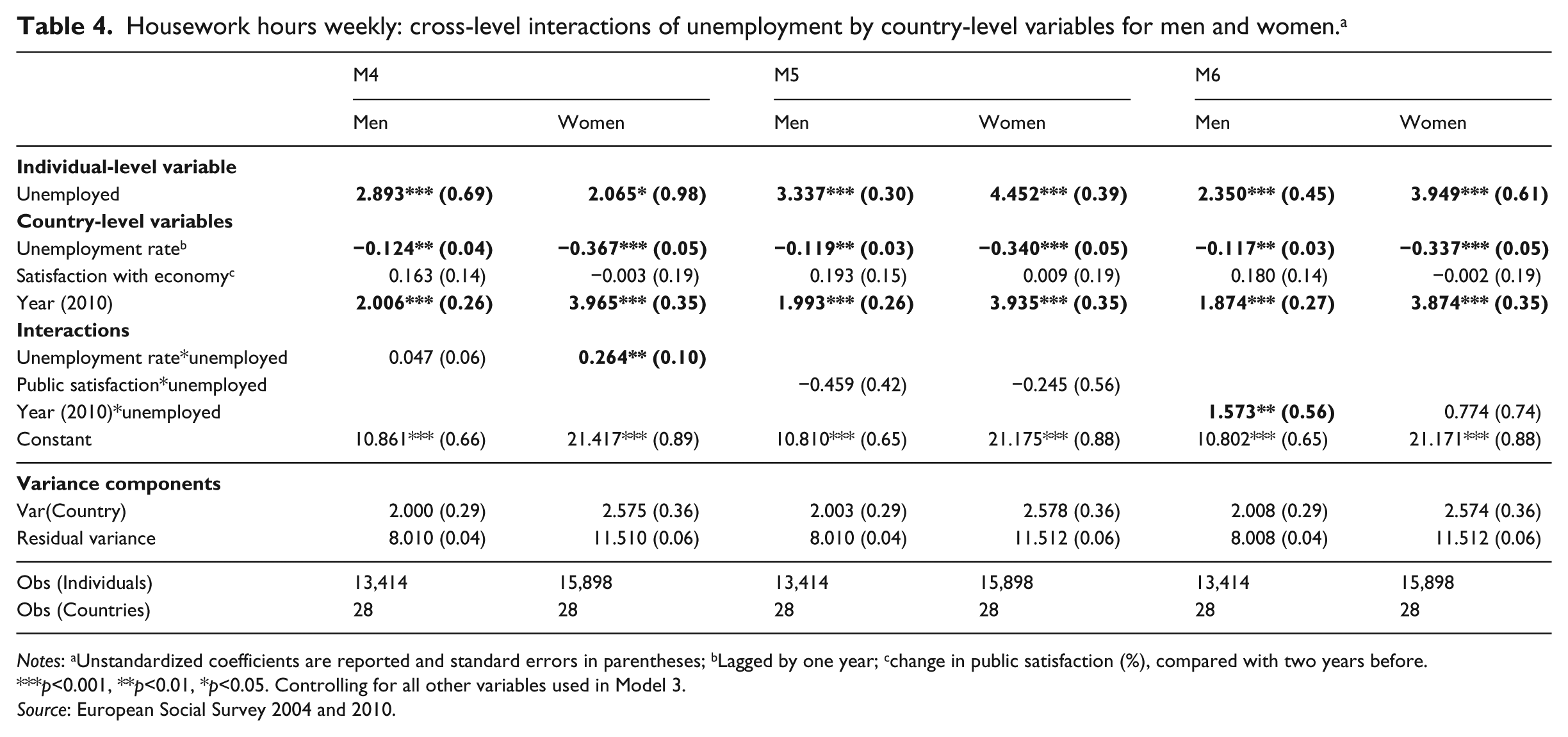
Notes: aUnstandardized coefficients are reported and standard errors in parentheses; bLagged by one year; cchange in public satisfaction (%), compared with two years before.
p<0.001, **p<0.01, *p<0.05. Controlling for all other variables used in Model 3.
Source: European Social Survey 2004 and 2010.
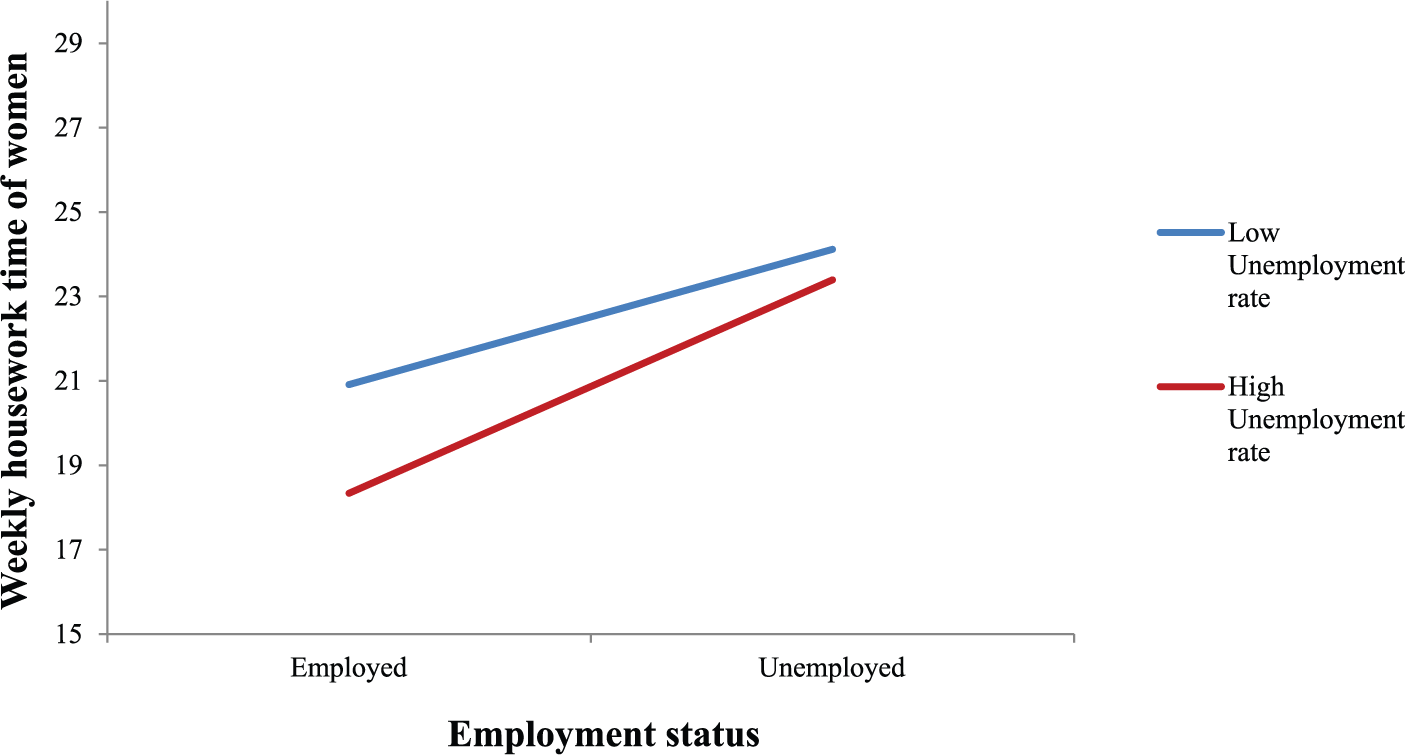
Women’s housework by employment status in high and low unemployment countries. (Low and high unemployment rates reflect ±1 SD from the country-level mean value.)
Sensitivity checks
To assess the reliability of our cross-level interactions, we performed several sensitivity checks on our models (see online Appendix B). Since there were relatively few cases of unemployed individuals in the data, we assessed the influence of these cases by analysing residuals. We found that the residual distribution is relatively equal between employed and unemployed individuals in the data and therefore these cases are unlikely to bias the results of the models. There were several groups of outliers in models for both men and women; namely, individuals who reported a very high number of housework hours. We repeated the analyses with these cases excluded and it had no effect on the results. Finally, we checked for outliers on level 2 using DFBETAs to assess the influence of country cases on the effect of being unemployed for men and women separately. We excluded possible outliers in a step-by-step procedure. Both significant interaction terms in Table 4 proved to be robust to this sensitivity check in that the results did not change.
Conclusion and discussion
Empirical research on the consequences of unemployment has typically focused on paid work or quality of life while neglecting unpaid work outcomes. We have argued that we can improve our understanding of housework and its gendered meaning by studying the relationship between unemployment and housework in different contexts. Focusing on the European context, we make several contributions. Not only do we relate the time individuals spend in household labour to the experience of unemployment, but we test whether the association is consistent with gender-neutral considerations such as time availability or with theoretical reasoning that points to different responses for men and women. In addition, we amplify these results by leveraging on country-level data to examine how national economic context conditions the relationship of individual unemployment and housework hours.
Pooling 2004 and 2010 data from 28 European countries, we conclude that both men and women contribute more to housework when unemployed. This likely reflects an economizing strategy in the face of financial pressures; that is, substituting household labour for purchased goods and services. Consistent with time availability arguments, the greater housework time of the unemployed may also be a function of their having more discretionary time for domestic chores. Being unemployed, however, is associated with even more extra hours of housework for women than for men. To the extent that time spent on housework is an adaptation to economic woes, it would appear that women can be credited with the majority of the household benefits coming from this strategy. In the face of unemployment, the division of housework is even more gender unequal than otherwise.
Women’s reaction to an unemployed partner is consistent with gendered arguments (i.e. gender display, gender deviance neutralization, relative resources). Women whose partner is out of work spend more time on housework than women whose partner is employed. Whatever the explanation, gender-neutral, time availability notions are insufficient to account for any counter-intuitive pattern of women doing more housework when the partner is unemployed (Evertsson and Nermo, 2007). With other variables controlled, men’s housework is not associated with the female partner’s work status. Of course, couples may be unwilling to disrupt established routines and gender display rituals for stints of male unemployment that they hope will be temporary. As indicated by the interaction between gender and having an unemployed partner (online Appendix A), women appear significantly more responsive to their partner’s unemployment than are men. If unemployed men do not step up their housework enough to compensate for extra work that they create by spending more time around the house, women’s domestic workload will be higher than is the case for men with an unemployed partner.
Whether they or their partner is out of work, it is women who see the greater increase in the domestic workload. Compared to their employed counterparts, unemployed women, but not men, perform even more housework in a country where the unemployment rate is higher. The pervasiveness of unemployment may go hand in hand with more severe hardship. Women’s domestic preferences may dispose them to mobilize their gender-typed homemaking skills to compensate for the loss of earnings by economizing. In any case, unemployed women seem to spend time in ways that reduce expenses by insourcing more of the housework both in low and high unemployment countries. Unemployed men do not seem to react to a high unemployment rate with an intensification of household labour, perhaps because homemaking is not a critical part of their gender identity and skill repertoire. Again, this points to a gendered reaction to joblessness.
Why women’s housework hours are more sensitive to a high unemployment context than men’s is a matter of speculation. As the latest recession revealed, new employment patterns have altered partners’ relative resources and, thus, likely challenged traditional power relations between the genders. Being concentrated in industries (e.g. construction, manufacturing) hard hit by the recession, men experienced higher unemployment than women, who worked in relatively recession-proof sectors such as education or health care (European Commission, 2010; Jacob and Kleinert, 2014; Sahin et al., 2012; Teachman et al., 1994). During the recession in the UK, working women with partners who lost jobs were more likely to remain employed than in previous economic downturns (Harkness and Evans, 2011). Faced with their partner’s job loss, women, if anything, increased their labour supply (Landivar, 2012; Mattingly and Smith, 2010). If female workers are more employable and re-employable than male workers, we would not expect couples to divert unemployed women from job hunting to additional housework when high unemployment poses higher risks of joblessness for men.
It is possible, however, that the traditional gender roles in countries with high unemployment rates (e.g. Spain, Estonia, Poland) account for unemployed women’s intensification of housework, but that this traditionalism is not adequately captured by our attitude measures. More egalitarian gender norms in low employment countries may allow unemployed women to forego some extra housework to search for a new job during what may – in a gender egalitarian culture – be only a short spell of joblessness. Beyond the unemployment rate measure, the subjective measure of public satisfaction with the national economy offers no extra insight into the division of housework.
This study raises a number of questions for examination. First, although it is more likely that unemployment influences housework than the other way around, there are limits to the causal claims that can be made with cross-sectional data. It would be informative to study the relationship between unemployment and the allocation of time to housework with panel data. Although we suspect that households do not instantaneously adapt their domestic practices to unemployment, we do not know when changes are apt to occur or how long-lasting they may be. Nor do we know whether the country-level context of high unemployment conditions the timing and persistence of any changes in the behaviour of men and women. Second, more detailed information on housework and child care tasks would help to unravel what exactly influences unemployed men and women, and whether they take up all tasks or only more familiar, gender-typed ones. The different behaviour of women and men may reflect gender not in the sense of internalized identities to be performed, but rather in terms of gender differences in the learned competencies that women and men can bring to work around the home (Tai and Treas, 2012). Third, this article invites further consideration of the implications of the recession on families. As deep employment crises create widespread hardship for families, they also challenge lingering gender inequalities – as demonstrated by the fact that working women fared somewhat better economically than men in the recession.
An increase in housework resulting from unemployment need not be a negative outcome. Rather, it may be a signal of greater energy and attention devoted to various domains of family life. Our results, however, show that changes in the allocation of domestic responsibilities in the face of unemployment may be a stimulus to greater gender inequality for partners in the home.
Footnotes
Funding
The research leading to these results has received funding from the European Research Council under the European Union’s Seventh Framework Programme (FP/2007-2013)/ERC Grant Agreement n. 340045.
Notes
References
Supplementary Material
Please find the following supplemental material available below.
For Open Access articles published under a Creative Commons License, all supplemental material carries the same license as the article it is associated with.
For non-Open Access articles published, all supplemental material carries a non-exclusive license, and permission requests for re-use of supplemental material or any part of supplemental material shall be sent directly to the copyright owner as specified in the copyright notice associated with the article.
