




Abstract
The question of how to achieve ‘work–life balance’ has been a central debate for several decades. Hitherto, this subject has primarily been explored in organizational contexts; less is known in the context of self-employment. This article advances our understanding of work–life balance by analysing the everyday stories of self-employed immigrant parents in Norway. In this study, work–life balance is constructed in contrasting ways between mothers and fathers on the individual level and simultaneously in binary and potentially competing ways on the couple level. Hence, through an analysis of the participants’ work and family availabilities, this study sheds light on how gender relations may be shaped at the micro level within the Nordic dual-earner family model.
Keywords
Introduction
From as far back as the 1960s, studies on the linkages between work and family roles have proliferated (Eikhof et al., 2007; Hilbrecht and Lero, 2014). Balancing work and family is an issue that creates significant tension. Hence, especially for single parents or dual-career couples with caring responsibilities, managing the demands of the workplace and the home has become a difficult balancing act (Hill et al., 2001). In the literature, the question of how to achieve ‘work–life balance’ has largely been studied in organizational contexts by highlighting how employees with care responsibilities may experience time pressure as a result of their employers’ requirements of long and unsocial working hours (Bergman and Gardiner, 2007; Southerton and Tomlinson, 2005). Another common focus has been workplace negotiations of different work–life balance provisions aimed at increasing the autonomy of workers in terms of, for example, ‘flextime’ and ‘flexplace’ (Hill et al., 2001).
Unlike in organizations, working conditions in the context of self-employment are not imposed upon the worker by the management. Rather, arrangements related to presence and time spent in the family and work spheres are primarily negotiated with one’s spouse. In addition, the demands from customers as well as the need to make a certain income should be met. Our knowledge about the work–life interface among self-employed parents is limited. Hence, to address this knowledge gap, this article explores how work–life balance is shaped among 11 mothers and seven fathers, all of whom are immigrants who have started and currently operate their own businesses. The data analysed are drawn from a broader study of immigrant entrepreneurship 1 involving in-depth interviews, firm visits and fieldwork in Finnmark, Norway where the Nordic dual-earner family model prevails.
Work–life balance is a contested term. Lewis et al. (2007: 361), for instance, argue that the work–life balance construct has emerged in response to increased pressures in the neoliberal labour market, but that the concept ‘fails to focus on the broader systemic issues that these changes raise’. As a response to this critique, new concepts have emerged such as work–family harmonization, work–life articulation and work–life integration. While these terms may be promising, they are still so little used that the term work–life balance will rather be used as the main concept in this article.
A gender analysis of constructions of work–life balance will be conducted by combining family–work perspectives (Eddleston and Powell, 2012; Sümer, 2009) with the availability approach developed by Bergman and Gardiner (2007). Following a presentation of the theoretical framework and the qualitative methodology used, the subsequent section analyses the empirical data on how the work–life balance is shaped in different gendered ways at the personal and interpersonal levels. The analysis shows that conceptions of how different tasks and duties should be shared within a couple and which sharing arrangements may (or may not) forge a feeling of ‘balance’ for women and men are highly gendered issues. In fact, in this study, work–life balance is constructed in contrasting ways between the mothers and the fathers at the individual level and simultaneously in relational and potentially competing ways at the couple level. The final section examines the findings in relation to the immigrant and welfare state contexts of this study, discusses the limitations of the results and provides conclusions and suggestions for future research.
Availability, family–work perspectives, gender and migration: a theoretical framework
As Felstead et al. (2002: 56) suggest, work–life balance can be defined as ‘the relationship between the institutional and cultural times and spaces of work and non-work in societies where income is predominantly generated and distributed through labour markets’. Based on this understanding, and inspired by Gregory and Milner (2009), this article perceives work–life balance as a subjective feeling of overall satisfaction with one’s quality of life both at work and at home and with the way these two spheres are connected. Lewis et al. (2007: 361) remind us that work–life balance in many western countries is constructed as an individual choice entailing a ‘personal responsibility to get the balance right’.
In order to operationalize the participants’ subjective experiences of work–life balance, it has proved valuable to use the availability perspective developed for this specific purpose by Bergman and Gardiner (2007). ‘To be available,’ the researchers postulate, ‘is to be accessible in time and space and responsive to the needs and wants of others’ (2007: 401). Moreover, availability is conceptualized as both a ‘disposition’ and a ‘capacity’, thereby referring to both structural conditioning and individual agency (2007: 401). Thus, the concept has the benefit of linking structure and agency ‘without merging them together or giving priority to the one over the other’ (2007: 401). Theorized in this manner, availability serves as an analytical tool that enables the deconstruction of the work–life balance concept by exploring how self-employed parents respond to claims for spatial and temporal accessibility by customers, colleagues and family members. Hence, availability refers to an individual’s ability to be accessible with respect to different and sometimes conflicting demands in the domestic and work spheres, whereas work–life balance can be understood as a positive outcome for an individual who is satisfied with how he or she is able to respond to such demands. By contrast, and following Shelton (2006), the term work–family conflict is used to refer to situations where the participants explain that they are not satisfied with the way the work and family spheres are integrated.
Work–life balance is not only about availability but also about how the domestic and work spheres interrelate. Hence, the availability framework can be usefully combined with the family–work perspectives of Eddleston and Powell (2012), who distinguish between ‘family-to-business enrichment’ and ‘family-to-business support’. Family-to-business enrichment occurs ‘when resources generated in the family domain are applied in the business domain in a way that benefits the business’ (2012: 517). This enrichment may involve the transfer of skills, such as multitasking, planning or prioritizing. By contrast, family-to-business support is defined as ‘emotional and instrumental support received from family members for one’s career as entrepreneur’ (2012: 514). Emotional support includes family members’ encouragement about one’s career choices or empathy for business problems, whereas instrumental support involves offering feedback on business ideas, advice on how to address problems or concrete assistance in business operations.
Drawing on these theoretical perspectives, the following questions are posed: how much are self-employed immigrant mothers and fathers available for work and for their family? What patterns of availability contribute to a feeling of work–life balance (or lack thereof) for different participants at the individual and the couple levels in this study? Moreover, family-to-business support is explored by asking how the self-employed mothers and fathers talk about spousal (instrumental and emotional) support in relation to their business’ start-up and development.
In view of the existing literature about work–life issues, gendered differences in the data should be expected (Brandth and Kvande, 2001; James, 2014; Jennings and McDougald, 2007; Sümer et al., 2008). Ortner (1974) was among the first to argue that femininity seems to be universally conceptualized as a complementary but subordinate opposite of masculinity. In line with this, gender can be defined as expectations, values and meanings associated with male and female bodies that result from negotiations at various levels (Haavind, 1998; Søndergaard, 2000). This article views gender as dynamic and varying from country to country, and from region to region (Massey, 1994). What is constructed as male and female, in other words, is not only a social but also a spatial process that is shaped through the everyday life practices of women and men (Forsberg, 2001). According to gender contract theory (Forsberg, 2001; Haavind, 1998), one can assume that work–life balance is shaped in simultaneously contrasting and relational ways. In this study, contrasting entails that a specific work–life arrangement at the individual level is experienced in different ways by mothers and fathers, primarily because they enact different gender roles and, thus, have different expectations regarding their individual activity spaces. Relational, on the other hand, means that experiences of work–life balance or lack thereof result from negotiations at the interpersonal (couple) level between husband and wife, where sharing arrangements are shaped in reciprocal yet potentially conflicting ways.
In fact, according to traditional gender roles, women’s proper place is in the home caring for their families, whereas men’s place is in the work sphere. In the Nordic countries, however, this male breadwinner family model has changed since the 1970s, as discussed by, for example, Nadim (2016). Today, nearly as many women as men perform paid work outside of the family. This change has been stimulated by various policy initiatives in Norway including, inter alia, one year of universal paid parental leave 2 after having a child (Kitterød and Rønsen, 2012). The parental leave provision includes a requirement that the father must take 10 weeks of leave time, which is intended to result in more active fathering (Brandth and Kvande, 2001). Additionally, several time-use studies suggest enhanced engagement by fathers in the domestic sphere in recent years, particularly with respect to childcare (Kitterød and Rønsen, 2012). Moreover, the Norwegian state provides extensive public childcare in kindergartens at a capped cost, 3 thus guaranteeing parents’ access to childcare during daytime hours after their parental leave has ended. However, despite public policies supporting the dual-career goal, and despite changing gender roles in equality oriented middle-class families in particular (Aarseth and Olsen, 2008), many couples in Norway do not share the tasks and duties in the domestic sphere equally; in most families, we find that women are still responsible for more of the domestic tasks and caretaking, no matter whether they work part time or full time (Kitterød and Rønsen, 2012). In contrast, fathers work less in the home and engage in substantially more paid work than mothers do (Kitterød and Rønsen, 2012).
These ongoing changes regarding family models, gender, work and family life intersect with new patterns of migration in the Nordic countries. Finnmark, in northernmost Norway, where this study is located, has for decades suffered from a steady population decline due to out-migration (Munkejord, 2014). However, since 2007, the population rates have stabilized. This emerging trend is primarily due to immigration. Today, nearly 10 per cent of the population of Finnmark was born in countries such as Russia, Finland, Poland, Lithuania and Sweden. 4 Migration is conceived as a temporary or permanent change of residence (Bonifacio, 2014). Whereas some immigrants settle in Finnmark together with their partner from their country of origin, many of them, particularly female migrants from Russia and Thailand, settle with a Norwegian partner and integrate into the Norwegian culture and society through family establishment (Flemmen and Lotherington, 2008). This mix is also evident among the participants in this study: 10 of them (nine women and one man) are married to a Norwegian partner, whereas the rest (two women and six men) are married to a partner from their own country of origin.
Methodology and presentation of participants
The empirical data analysed in this article are drawn from a study of immigrant entrepreneurship in Finnmark, Norway. The fieldwork for this broader study was conducted in 2012 and included firm visits, informal conversations and semi-structured, in-depth interviews with 29 immigrant women and men who had started their own businesses and thus were self-employed. The participants were identified using a strategy that was designed to identify male and female immigrant entrepreneurs working in diverse businesses: regional entrepreneurship advisers and local leaders of business associations were approached, and personal networks and Facebook were used. These steps resulted in a list of potential participants, and a selection of these individuals was contacted to ensure diversity in gender, migration backgrounds, nationalities and firm types. All of the participants provided their informed consent. 5
Eighteen of the entrepreneurs in the broader study were parents of at least one young child living at home and were, therefore, included in the data analysed for this specific article. The 18 participants, including 11 women and seven men, operated four male-led, six female-led and eight couple-led businesses. There was some variation in the size of the businesses, in their capacity to provide income and in the hours worked by the entrepreneurs. Only two of the businesses were operated from home, whereas 16 businesses operated in a workplace outside of the home. The businesses included grocery stores; restaurants; clothing shops; an architectural firm; a lingerie shop; companies offering leisure activities for children; a painting and surface treatment company; a tourism business; and businesses providing personal services, such as beauty treatments and massage therapy.
Most of the participants were interviewed at work, but a few preferred to be interviewed at home or at a café. During the interviews, the theme of work–life balance was explored by discussing availability in terms of time use at work and at home, the distribution of tasks and duties related to the home and family care in each family and the participants’ overall reported satisfaction with their everyday lives as self-employed parents. The interviews were primarily conducted in Norwegian and lasted from 35 to 130 minutes (the average was 75–80 minutes). The author personally conducted, transcribed and thematically analysed all of the interviews. 6 The quotations were translated to English for the purpose of this article. For reasons of confidentiality, pseudonyms are used. The following Table 1 provides an overview of the participants included in the analysis.
Overview of participants.
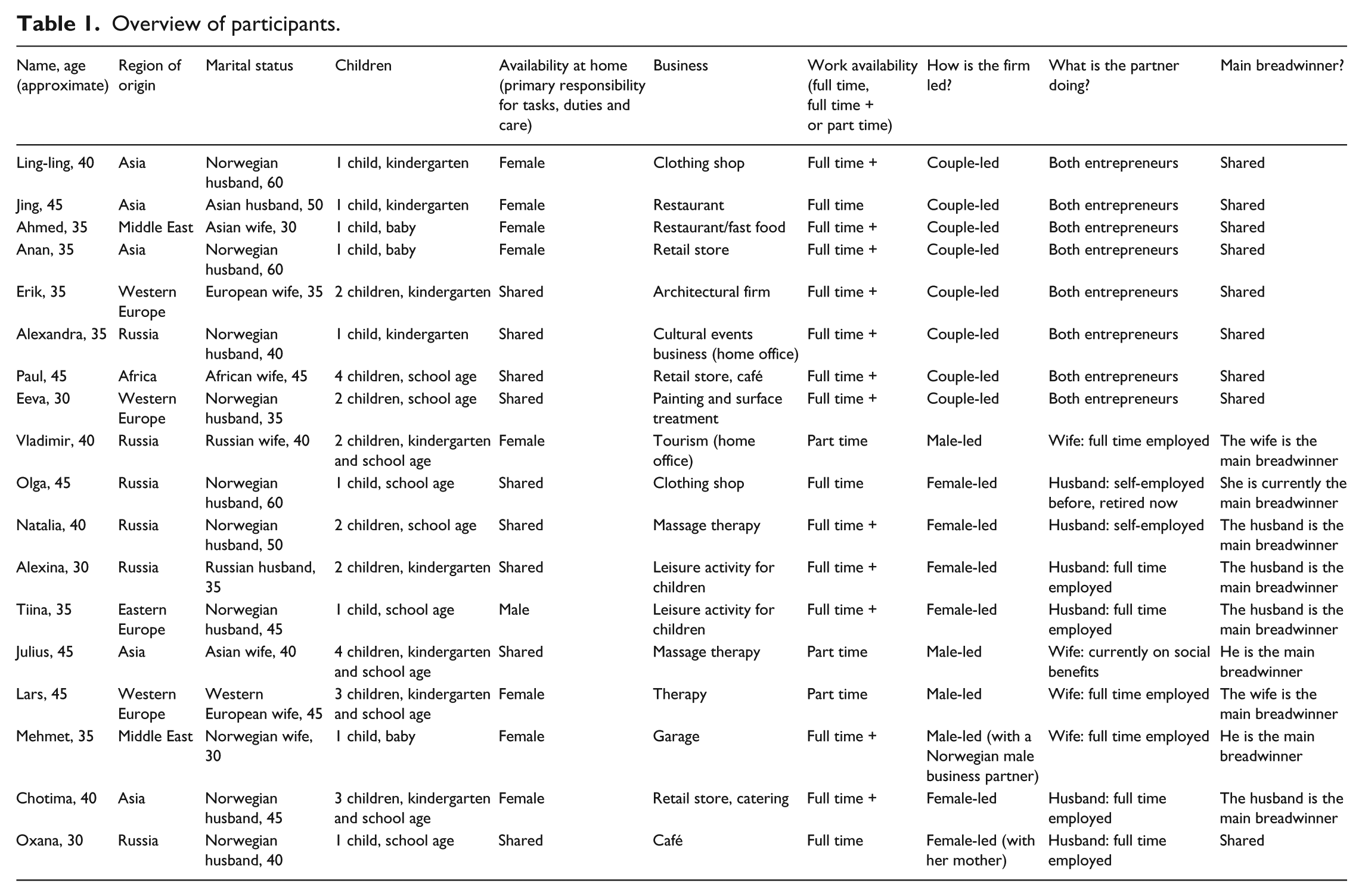
As Table 1 indicates, the analytical potential of these data is not limited to gender; they also address age, nationality and marital status, and they represent an opportunity to analyse the experiences of entrepreneurs being engaged in different sectors and having access to slightly different levels of income. These dimensions, however, are beyond the scope of this article and will not be elaborated here. Instead, while keeping the immigrant backgrounds of the participants in this study in mind, the analysis will focus on their stories about their own and their partners’ availability in the domestic and work spheres, and how various availability patterns are gendered. In addition, how the work and family spheres interrelate will be examined in order to analyse whether and for whom different availability patterns seem to generate a subjective feeling of work–life balance.
The next section will present examples of parents reporting experiences of work–life balance, followed by examples of lack of reported work–life balance, or work–family conflict. When discussing availability in the domestic sphere at the couple level, the participants’ stories about how they ‘share’ tasks and duties related to care and domestic tasks are important. Sharing is a complex phenomenon, and researchers going back to Hochschild (1997) have examined how individuals and couples have incentives to present ‘family myths’ about sharing when a researcher asks about it. When writing below that some couples ‘shared’ tasks and duties, it does not imply that they ‘objectively’ shared every domestic and care task equally; rather, it implies that the participants reported that they made an effort to realize what Aarseth and Olsen (2008: 278) call ‘equalized arrangements’ and that they explained the content of their various sharing arrangements. It is important to note that experiences of work–life balance are shaped and reshaped in gendered, relational and changing ways both at the individual and at the interpersonal levels, and that they will change over time.
Experiencing work–life balance
As established below, the feeling of work–life balance may be related to different factors, among which the participants’ home situation, rather than their work availability, appears to be the most significant. Indeed, in this study, all of the self-employed mothers who experienced work–life balance had what they call a ‘good, modern husband’ who not only shared tasks and duties equally in the domestic sphere but also provided emotional support. Moreover, some of these husbands helped their wives with their businesses in different ways, such as accounting, performing other paperwork tasks or renovating the business premises, thus engaging in various forms of family-to-business support (Eddleston and Powell, 2012).
Natalia is a case in point. She arrived in Finnmark 15 years before our encounter to marry her Norwegian partner, and she launched a beauty salon within one year. Natalia explained that quite soon after her arrival in Norway, she was able to obtain various types of low-skilled employment using the little Norwegian that she had learned while still in Russia. However, she stated that because she had a university degree from her country of origin and had ‘ambitions for herself’, the types of jobs she obtained were not what she wanted. Natalia explained that she had always been interested in the body, and before migrating to Norway, she had taken courses in both anatomy and massage techniques. Hence, due to this interest and because, as she said, ‘the niche was vacant’, she decided to open a beauty treatment and massage salon. Her husband already ran a business and was proud that Natalia also wanted to start a firm. He supported her in many ways: by completing paperwork, finding a location and painting and redecorating the workplace. Within a few months, she was ready to launch her business. Natalia explained as follows: ‘My husband was clearly the one who helped me and supported me the most throughout the preparation and start-up phase. Without him, I could not have started the business at all. He also guaranteed the bank loan. I’m grateful!’
Natalia soon hired a woman to work with her, and during the time of the interview, she still had one employee. Natalia indicated that she worked long hours. At times, she has worked up to 50–60 hours per week, but at the moment of our encounter, her normal working hours were approximately 40 hours per week. Compared with her workload, her income was low. However, Natalia explained that because they had a stable, higher income from her husband’s business, there had never been any feeling of insecurity related to her fluctuating earnings.
Natalia and her husband had two children consecutively shortly after she started the business. She took a relatively short maternity leave after both pregnancies (a leave of a few months). The baby period was ‘really heavy’ in terms of workload. Natalia explained, ‘I don’t regret what I did, but I wouldn’t advise anyone to start a business and get two children in such a short time as I did.’ The entire time, however, her husband provided ‘immense support’. According to Natalia, ‘he cooks, he cleans the house, he looks after the children and he follows up on their activities. […] You know, he was a single father when we met, so he was used to care work.’
Natalia stated that a few times a year, perhaps once per month, she used to go away on work-related travel to attend courses, conferences and trade fairs (for an analysis of work-related travelling among immigrant entrepreneurs, see Munkejord, 2015). While she was away, her employee looked after her business, and her husband took care of everything in the home. Natalia explained that her husband had always been a good father and a supportive husband. She concluded, ‘not that it has been perfect all the time. There are ups and downs in all relationships. But on average, I can say that without my husband, I wouldn’t be able to run my business.’
Natalia therefore expressed a general and overall satisfaction with her life and is a good example of a self-employed mother who, despite working long hours five days a week, still told that she experienced a satisfactory balance between work and family tasks. Olga, Oxana, Eeva, Tiina and Alexina told similar stories. All of them, except for Eeva (from Western Europe), had Russian or Eastern European backgrounds; they were all married to husbands who, according to them, ‘shared’ the tasks and duties in the home; and they all told that they received extensive spousal emotional and instrumental support with regard to their business (Eddleston and Powell, 2012). In all but one case, 7 their partners were ethnic Norwegian men who, according to the participants in this study, wanted to be good, present fathers and caring husbands. Olga, for instance, had a Norwegian husband who was also the stepfather of her daughter. She stated, ‘my husband is a rare man: he does everything at home. Nothing is a problem, and it has always been like that.’ However, when these hard-working self-employed migrant women told that they were satisfied with their own workload in the domestic sphere, although it was quite high, their statements must be understood in light of what the alternative might have been if they had established a family in their country of origin, and in particular if they had tried to combine a career as a self-employed woman with being a mother and wife there. Most of the participants made this comparison explicitly and concluded that certainly, the Norwegian husband was more supportive and more helpful than they had expected. For instance, Natalia said, ‘as a Norwegian, my husband is more into equality and less of a chauvinist than men in Russia’. 8 Hence, although these migrant women were indeed very available to both the work and home spheres, and although their total workload was high, they stated that they experienced an overall satisfaction with their quality of life both at work and at home, and with the way the two spheres were connected.
Some of the self-employed fathers also reported experiencing what can be interpreted as work–life balance. 9 Two examples are Ahmed and Mehmet. They both worked more than full time, but they had wives who performed most of the tasks and duties in the home. Ahmed was married to a partner from his own country of origin, whereas Mehmet was married to a Norwegian partner. Both wives worked full time. Moreover, a work–life balance was experienced by the three fathers who worked part time: Julius, Vladimir and Lars. In Norway, it is not typical for men to work part time. By working part time, these three fathers were not the main breadwinners; rather, they were in dual-earner households where the wife was the main breadwinner in two of the cases. These atypical examples may point to a movement in men’s activity space or in male gender roles in a northern context, and they therefore represent particularly interesting cases to examine.
Lars, for instance, ran a well-established business that offered Chinese acupuncture treatments. He previously worked at least full time, but several years before our encounter, he and his wife, who both came from a Western European country, bought a house that was in need of renovation. Rather than paying professionals to complete the work, Lars decided to do most of the work himself. Thus, he and his family saved a great deal of money. In addition, Lars reported that he enjoyed taking long walks in the mountains. At the time of the interview, he worked at the business part time while spending extensive time renovating the house (a project that was progressing slowly). In addition, he also spent a great deal of time outdoors. Conversely, his wife was currently both the primary breadwinner and the primary caretaker in the home and of the children:
Yes, we rely on my wife’s income right now. Without her steady income, this way of doing things wouldn’t be possible. […] For the moment, I can say that I am doing the cement and carpeting, and she is cooking, washing clothes and caring for the children. There is a certain bias there… I’ll have to catch up at home when the house is ready.
Both Lars’, Vladimir’s and Julius’ wives were emotionally supportive of their husbands’ firms; in addition, Vladimir’s wife was also engaged in many practical business issues and activities. Moreover, although the husbands assisted with childcare, cleaning and other tasks in the home, the wives were responsible for most of these duties. All three part time working men clearly stated that they felt a sense of work–life balance: they were quite satisfied with their quality of life being able to combine fathering with an interesting business and other enjoyable activities.
Experiencing work–family conflict
Four of the mothers (Ling-ling, Jing, Anan and Chotima) and two of the fathers (Paul and Erik) reported that they experienced tensions in the work–family interface. Whereas these migrant women (except for Jing) were married to husbands from Norway, the migrant men were married to partners from their countries of origin. These participants were satisfied with running their own businesses, but their overall workloads simply appeared to be too much. This experience of work–family conflict seemed to primarily result from their home situations. Thus, the commonality among the self-employed mothers experiencing lack of work–life balance was that they worked full time and their husbands participated in the domestic sphere to a limited degree. With respect to the self-employed fathers, however, lack of work–life balance was experienced by those working at least full time whose wives were reported to share the tasks and duties in the domestic sphere. This pattern is discussed below through an analysis of the stories of Chotima and Paul.
Chotima, who is from Asia, had lived in Finnmark for 10 years with her children and her Norwegian husband at the time of our interview. To a certain degree, her situation was exceptional. While the other self-employed mothers told stories about business-related moral support and instrumental assistance from their spouses, Chotima’s husband had long been resistant to her idea of starting a business:
In the beginning, he asked me questions all the time: Are you sure about this? Can you really do this? And is this really what you want? All the time, he asked questions. I said, ‘I can try’ and ‘I can learn’, and ‘If it doesn’t work for me, then we know that it doesn’t work. Then at least we have tried.’ But he still wasn’t persuaded.
After a couple of years, Chotima contacted the municipality for assistance and advice. Her husband finally started to support Chotima emotionally. She then launched her business, and she currently operated a food store with a small café and a catering service. Although Chotima loved her work, her everyday life situation was quite exhausting. She had to be available for her work, customers and colleagues throughout most of the day. She did, however, have a full time assistant in her shop and additionally had two cousins who offered help when needed.
In addition to Chotima’s work with the business, she performed most of the housework. Chotima had a teenager who offered some assistance at home, but her husband did very little. ‘But,’ she added, ‘even though he doesn’t clean, my husband is responsible for taking care of our youngest child in the afternoons.’ In fact, Chotima’s husband retrieved their child from kindergarten every day. The father and child sometimes went home to eat, but often they came to eat dinner in Chotima’s small cafeteria.
Chotima’s days were filled with tasks and duties. However, as she stated, ‘with my background, running this business was the only way to get a nice job here. I have no education, nothing to build on from my home country, so I only got assistant jobs in kindergartens and nursing homes.’ She stated that for a period of time, she enjoyed having assistant jobs, not least to improve her knowledge of the Norwegian language. However, after some years, she wanted ‘something better’: she wanted to earn more money and experience greater challenges. Hence, currently, Chotima was living her dream, even if it involved an exhausting workload. Chotima is an example of a self-employed mother who worked at least full time but who also had to be available for the domestic sphere by performing most of the tasks and duties in the home. Her life was quite stressful, she admitted, but she hoped that the situation would improve over time, particularly if she could employ more people at the shop and, therefore, work fewer hours herself.
Ling-ling, Jing and Anan had similar experiences. All of them were from Asia, and all of them were married to husbands who did not participate extensively in the home sphere. Three of these non-egalitarian, or should we say ‘traditional’, husbands were ethnic Norwegians, and one was from Asia. These women received emotional and, in some cases, instrumental support for their businesses from their husbands. However, their total workload caused them to experience conflicts in the work–life interface.
The male participants who worked at least full time and who reported that they shared tasks and duties quite equally in the domestic sphere (Paul and Erik) appeared to have challenges with reconciling the expectations and demands from the work and family spheres. They were both married to wives from their own countries of origin. Paul can serve as an example. He came to Finnmark several years before our encounter as a refugee. Together with his wife, Sabina, Paul operated an international food shop and café. In addition, to secure a steady family income, he had a part time job with the municipality. Paul’s overall workload was heavy. Paul estimated that he worked more than 12 hours per day, five days per week, as well as shorter hours every Saturday and Sunday. Paul and Sabina had four older children living at home; therefore, there was a great deal of work related to care and domestic tasks as well. Paul stated that when his youngest son was smaller, he would bring him to the retail store in the afternoon to spend time with him there. Life was becoming easier now as the children grew older and began to care for themselves, but the situation remained quite stressful for Paul. He engaged in various domestic tasks in the home, but he said that he performed less household work than he did in the past. He described his situation as follows:
We are fortunate that we don’t have babies anymore. We have older children, so they can help and take some responsibility, but we [Paul and Sabina] do many things at home, too. So after work, I’ll go home and help feed the children and so on as best as I can. And then I come back to the shop and release her [Sabina] so that she can go home.
Paul added that unfortunately, there was little time for rest and that he looked forward to a time when the stress of his everyday life would decrease: ‘If I have a choice in the matter, I hope that I will not stress myself out so much in the future. I hope I can reduce a lot of my stress.’ Being available for work every day of the week in addition to having duties and tasks in the domestic sphere was too much responsibility for Paul and led him to a lack of work–life balance.
Discussion
This article advances our understanding of work–life balance by analysing the everyday stories of self-employed immigrant parents with at least one young child living at home. As revealed in the empirical stories above, some of the women who were very available for work still reported that they experienced what can be interpreted as a sense of work–life balance. This was the case when they felt that their (mostly Norwegian) husbands shared tasks and duties in the domestic sphere. These women often spoke warmly of their husbands, whose efforts facilitated their self-employed lifestyles. Conversely, the analysis revealed that self-employed mothers who were very available for work, experienced a lack of work–life balance when they felt that their husbands were not available (or not willing to be available) in the home to assume responsibility for ‘their share’ of the domestic tasks and duties.
Some of the male participants also reported that they experienced a balance in their work and family life. This feeling was expressed by men working part time, full time or more and whose wives assumed primary responsibility for the tasks and duties in the home. Two of the other male participants, however, reported that they experienced what can be interpreted as work–family conflict. This situation was observed among men who worked at least full time, and who at the same time were quite active in the home, stating that they shared domestic tasks with their wives. The fact that these men experienced great difficulties in integrating work and non-work tasks, unlike the self-employed mothers being in a similar situation, indicates that work–life balance on an individual level seems to be shaped in different ways for the female and male participants in this study.
Moreover, at the couple level, the analysis revealed two primary sharing patterns: (1) an arrangement in which both the male and female partners worked at least full time and in which they shared the tasks and duties in the domestic sphere, 10 and (2) an arrangement in which the woman worked at least full time and assumed responsibility for most of the caring and domestic work in the domestic sphere, regardless of whether the man worked full time or part time. 11 In the first arrangement, which was the case for eight of the couples in this study, he seemed to feel work–family conflict, whereas she seemed to feel work–life balance, while in the second arrangement, which was the case among the other eight couples, she seemed to feel work–family conflict, whereas he seemed to enjoy work–life balance. 12
Moreover, all of the participants in this study noted the importance of emotional support from their partners. However, the analysis revealed that women appeared to appreciate spousal emotional support differently than men did, particularly when this emotional support was coupled with both instrumental support and collaboration in the domestic sphere. Conversely, the male participants appeared to take both their wives’ emotional support and their participation in the domestic sphere more for granted. In other words, these factors did not appear to generate the same level of ‘gratitude’ and, thus, satisfaction with the work–life situation for men as it did for the women in this study. Other studies have also shown that men, contrary to women, may receive (and expect to receive) praise and gratitude from their partners for their involvement in domestic work (Szabo, 2014). However, if men’s domestic work is perceived as a ‘gift’, whereas women’s domestic work is taken for granted, the ‘economy of gratitude’ in the couple becomes unbalanced (Hochschild, 1997; Hochschild and Machung, 1990).
Conclusions
This study reveals how immigrants living within the Nordic dual-earner family model (Isaksen, 2010; Nadim, 2016; Sümer, 2009), together with their partner, attempt to reconcile family and work responsibilities. Among the participants in this study, work–life balance is shaped in various ways at the intersection of the work and family spheres at both the individual level and the couple level. Both levels of work–life balance construction are gendered in specific ways. At the individual level, work–life arrangements are experienced differently by mothers and fathers. At the couple level, on the other hand, negotiations between husbands’ and wives’ work–life arrangements are experienced in relational and possibly conflicting ways.
Distinctions between the individual and the couple levels are rarely made in the existing work–life balance literature. Rather, questions of how to achieve a work–life balance have mostly been studied in organizational contexts by highlighting how individual employees with care responsibilities for children living at home may experience work–life balance or not as a result of their employers’ imposition of various work conditions (Bergman and Gardiner, 2007; Southerton and Tomlinson, 2005). Current research, in other words, tends to disregard that employees with family responsibilities often have a partner at home and that arrangements that may shape work–life balance for the employee may indeed shape a quite stressful work–family situation for his or her partner.
Hence, future research should focus on availability patterns and situations that create a work–life balance not only at the individual level, but also at the couple level. This should be done among different mothers and fathers, whether they are self-employed or employed, migrants or natives. Moreover, this should be done in the context of different welfare regimes (Esping-Andersen, 1990) as one may assume, according to Sümer (2009), that the state has a considerable capacity to shape gender relations in the society. So far, however, theories of the state are often unhelpful in theorizing how this relationship is formed (Sümer, 2009: 34). Thus, through an analysis of concrete work–family negotiations among self-employed immigrant parents, the main contribution of this micro study from Norway is to shed light on just how this relation may indeed be formed in the context of people’s everyday lives.
Footnotes
Acknowledgements
Warm thanks to editor S Kanji and to the anonymous reviewers for helpful and inspiring comments to earlier versions of this article. Many thanks also to my colleagues Siri Gerrard, Marit Aure, Sara Carter, Ingrid Kielland, Halldis Valestrand, Deatra Walsh, Ole-Andreas Brekke, Eva Jørgensen, Gry Brandser, Gigliola M Nyhagen, Kristian Bjørkdahl, Knut Grove and in particular Sevil Sümer for having read and commented on former versions of the article.
Funding
This article is based on data from the research project ‘Border-crossing business activity in the Barents Region: understanding the drivers and barriers for transnational entrepreneurship’ (2012–16), financed by the Norwegian Research Council.