




Abstract
This study examined whether the type and timing of handwriting instruction (manuscript-first vs concurrent manuscript-and-cursive) influence first graders’ reading performance in Hebrew. We further assessed whether effects vary between typical and at-risk readers. A total of 102 first graders participated. Classrooms were assigned to two conditions. One group learned manuscript handwriting throughout first grade, with cursive introduced only in the last 2 months; the other learned manuscript and cursive in parallel from the start of the year. Students were examined at the beginning of the year to check their language and letter-naming abilities before learning to read and again at the middle and at the end of the year to examine their reading fluency and comprehension. Results showed that by the end of the year, the manuscript group had higher scores on all reading measures. When students were divided into typical and at-risk readers based on end-of-year orthographic word recognition, typical readers in the manuscript group had higher fluency scores, whereas at-risk readers in the manuscript group had higher accuracy. Reading comprehension was also higher in the manuscript group for both reader types. Educational implications for the timing of cursive instruction in novice Hebrew readers are discussed in the context of reading development and orthographic characteristics.
Introduction
Handwriting plays a central role in the reciprocal development of reading and writing, as it grants young learners access to the symbolic structure of language through print (Berninger & Wolf, 2009; Ravid & Tolchinsky, 2002). These relationships, in turn, have important implications for understanding the cognitive mechanisms that underlie literacy (Ray et al, 2022).
Handwriting is defined here as the process of forming letters and words at the structural level, distinct from higher level writing skills such as spelling, syntax, or text composition. A central issue within this scope is the timing of handwriting instruction, an area in which empirical evidence remains limited (Bara et al, 2016; Morales-Rando et al, 2021; Morin et al, 2012; Stevenson & Just, 2014). Moreover, researchers remain divided on this issue. Some argue that manuscript-first instruction supports reading development by reinforcing letter-sound relations and orthographic patterns of words, with cursive introduced only after fluency is established (Berninger & Wolf, 2009; Graham, 2010). Others, however, suggest that introducing cursive from the beginning of first grade (a) may be advantageous, since it is the form most commonly used in everyday handwriting (Bara & Morin, 2009), (b) may reduce reversals of easily confusable letters (Morin et al, 2012), and (c) promotes more fluid, continuous motor movements that support writing fluency (Morales-Rando et al, 2021). Another important consideration is the linguistic context in which reading and writing take place. The most effective timing may vary across orthographies due to differences in script form and orthographic complexity (Arfé et al, 2020).
The persistence of these conflicting perspectives, combined with the lack of systematic evidence across languages, has left insufficient evidence to guide decisions about the optimal point at which to introduce cursive handwriting in early schooling (Morales-Rando et al, 2021; Morin et al, 2012). In some educational contexts, such as Israel, decisions are left to the discretion of individual schools or even teachers, resulting in wide variation in practice. This gap provided the rationale for the present study, which examined how the type of handwriting instruction relates to Hebrew-speaking children's reading performance during first grade.
Like other languages, Hebrew uses both manuscript and cursive handwriting. Manuscript is used in printed texts and instructional materials, whereas cursive is used for everyday writing. Many cursive letterforms differ visibly from their manuscript counterparts, which may have implications for the consolidation of letter-sound mappings and orthographic patterns during the early stages of reading. Unlike Roman-based orthographies, Hebrew cursive letters are not joined; they appear in isolated form, preserving discrete grapheme boundaries. These features make Hebrew a useful context for testing whether the choice of script in handwriting instruction relates to reading development, consistent with language-specific tuning in reading (Frost, 2012) and with accounts of how handwriting experiences help establish stable visual representations that support orthographic learning (McBride et al, 2021).
The current study adds to the research on reading acquisition in several ways. First, by comparing two groups of students that learn handwriting differently, we can expand our knowledge regarding reading–writing relationships in the first year of the reading acquisition process. Second, by manipulating handwriting, we can learn about the proper timing for teaching cursive script. Third, by examining handwriting-reading relations in Hebrew, a transparent orthography, we can situate our findings within the cross-orthographic literature.
Literature Review
Reading–Writing Relationships
Reading acquisition does not happen in isolation, and other aspects of literacy, such as writing, are closely interrelated with its development (Berninger & Wolf, 2009; Kim et al, 2024; McBride et al, 2021; Ravid & Tolchinsky, 2002). Writing letters, for example, is a component of alphabetic knowledge; thus, certain aspects of reading and writing overlap (Aram & Levin, 2004; Drouin et al, 2012; Wolf, 2008). To better understand how writing might influence reading acquisition, it is helpful to consider theoretical frameworks that account for cross-linguistic variation in literacy development. Here we will focus on two specific models, Frost (2012) and McBride et al (2021).
Frost's universal model of reading (Frost, 2012) conceptualizes reading as a cognitive system that is universal in architecture yet dynamically adaptive to the statistical and structural properties of individual writing systems. According to this model, learning to read involves a process of cognitive calibration, or self-tuning, through which readers gradually optimize their use of orthographic, phonological, morphological, and semantic information. These sources of linguistic information interact in parallel during word identification. This theoretical lens is particularly relevant for languages such as Hebrew, whose orthographic system requires sensitivity to morpho-orthographic structures, even when phonological transparency is initially supported through pointed text.
McBride et al (2021) developmental-cognitive model provides an important complementary perspective, presenting reading and writing as interconnected processes that rely on shared cognitive resources. A central feature of this framework is the role of visual-motor experiences, such as handwriting, in supporting the consolidation of orthographic knowledge. Rather than treating handwriting as a purely transcriptional task, McBride and colleagues argue that writing contributes to the development of stable, detailed mental representations of letters and words, which support lexical access and word recognition. The model also stresses the importance of instructional alignment, proposing that consistent exposure to similar letter forms in both reading and writing activities facilitates more efficient orthographic learning. This perspective is particularly relevant for Hebrew, where young learners must integrate visual, morphological, and phonological cues from the outset.
Drawing from these models, it follows that handwriting instruction, that is, the type and timing of script introduced, may play a key role in orthographic learning. If reading acquisition involves attuning to the statistical and structural features of letter forms, then consistency between written and read representations becomes important. Presenting young learners with similar letter forms across reading and writing contexts may enhance the efficiency of self-tuning processes that support orthographic mapping. This is directly relevant to the question of whether manuscript (print) or cursive handwriting should be taught at the beginning of schooling. In languages like Hebrew and English, where written and printed letter forms often differ, early alignment between them may reduce cognitive load and strengthen associations between visual forms, phonological codes, and meanings.
Studies show that knowledge of letter writing predicts general literacy development (Piasta & Wagner, 2010) and reading acquisition in Hebrew, in particular (Aram & Levin, 2004), as well as in other orthographies (Bara et al, 2016; Bara & Morin, 2009). Additional findings reveal that motor movements involved in handwriting are associated with visual representations of letters (Bara et al, 2004, 2007; Bara & Gentaz, 2011; Longcamp et al, 2005) and their recognition (Bara et al, 2016; James & Engelhardt, 2012; James & Gauthier, 2006; Longcamp et al, 2003, 2008). Although many of these studies focus on isolated letters, they suggest a broader interaction between reading and writing processes (McBride et al, 2021), which may contribute to the development of both domains in young learners.
Current evidence reinforces this view. For example, Kim et al (2024) found that reading and writing are strongly related at the lexical level (eg, decoding and spelling), particularly in the early grades. Word-level reading and writing skills were more closely correlated than discourse-level skills such as reading comprehension and written composition, and the strength of these correlations declined with age. This developmental pattern underscores the importance of aligning reading and handwriting instruction in the early stages of literacy, especially when teaching orthographic forms such as print and cursive. According to McBride et al (2021), visual-motor skills should be considered alongside morphological, phonological, and visual-orthographic processes in models of reading acquisition. As children engage in reading, they draw on all available linguistic and cognitive resources, including the motor memory associated with handwriting (Frost, 2012). When handwriting uses manuscript letters that also appear in printed texts, the process of writing may directly support reading development (Graham, 2010). Moreover, consistent letter scripts across reading and writing may prevent confusion and enhance the integration of literacy skills (Berninger & Wolf, 2009).
Besides the above-mentioned correlational studies, Bara and Morin (2009) conducted a classroom experiment that examined the impact of the type of handwriting on second graders’ reading and writing performance. They reported no significant differences between groups, suggesting that the development of reading was neither interrupted nor enhanced by the way handwriting was taught. However, direct experimental evidence on script type and reading acquisition remains scarce. In addition, outcomes may differ for younger learners who are still consolidating foundational skills (Bara et al, 2016) and across orthographies with visual-structural characteristics unlike those typical of many European languages (McBride et al, 2021).
Handwriting Instruction
Research on handwriting instruction has highlighted several explicit components that support early orthographic learning. These include teacher modeling of letter formation and stroke order, use of visual or multisensory cues, and structured progression from tracing to copying and then to independent production (Bara & Gentaz, 2011; James & Engelhardt, 2012; Longcamp et al, 2005, 2008). Evidence from intervention studies further shows that transcription-focused practice in the early grades improves handwriting fluency, as reflected in measurable gains in writing speed and accuracy (Graham et al, 2000). Multicomponent programs that combine modeling, motor practice, guided group work, and explicit feedback have also been shown to strengthen handwriting outcomes in kindergarten and first grade (Case-Smith et al, 2011, 2014; Puranik et al, 2018).
Meta-analytic evidence converges on the conclusion that explicit handwriting instruction, whether skill-based or multicomponent, improves both the clarity of letter formation (legibility) and the speed and automaticity of handwriting (fluency) in novice writers (Lopez-Escribano et al, 2022; Santangelo & Graham, 2016). However, these studies have focused almost exclusively on handwriting outcomes themselves, without investigating how handwriting instruction might shape reading development. Moreover, nearly all this research has centered on manuscript-based instruction, with little attention to the role of cursive or the timing of its introduction.
The present study addressed this gap by examining Hebrew-speaking first graders, testing whether handwriting instruction confined to manuscript, versus instruction that includes both manuscript and cursive, relates to reading performance in a transparent orthography with distinct writing characteristics.
Reading and Writing in Hebrew Orthography
Children are exposed to letters at an early age as part of their literacy environment in everyday life, such as at home and kindergarten. This knowledge, although not complete, is part of children's emergent reading experiences. Some aspects of letter knowledge, such as handwriting, are related to the particular context of the orthography (Tolchinsky et al, 2012). For example, in Hebrew, emergent writing of letters, among kindergarteners and preschoolers, mostly includes letters in a manuscript version whereas cursive handwriting or diacritics rarely appears in children's early writing (Levin et al, 2005; Levin & Aram, 2005). This might be related to the dominance of manuscript letters in texts, books, TV translation, billboards, street signs, and so on, written in Hebrew.
Cursive script is used for general everyday writing purposes (shopping lists, writing a blessing) by using pencil/pen and paper. Thus, manuscript and cursive scripts serve different functional roles (Miller & Vaknin, 2012). Unlike English, Hebrew has no upper- and lower-case forms, and cursive letters are not joined. In English, adjacent letters are linked by connecting strokes; in Hebrew cursive, a pen lift typically occurs between letters. Examples of both scripts, alongside English for comparison, are shown in Figure 1.
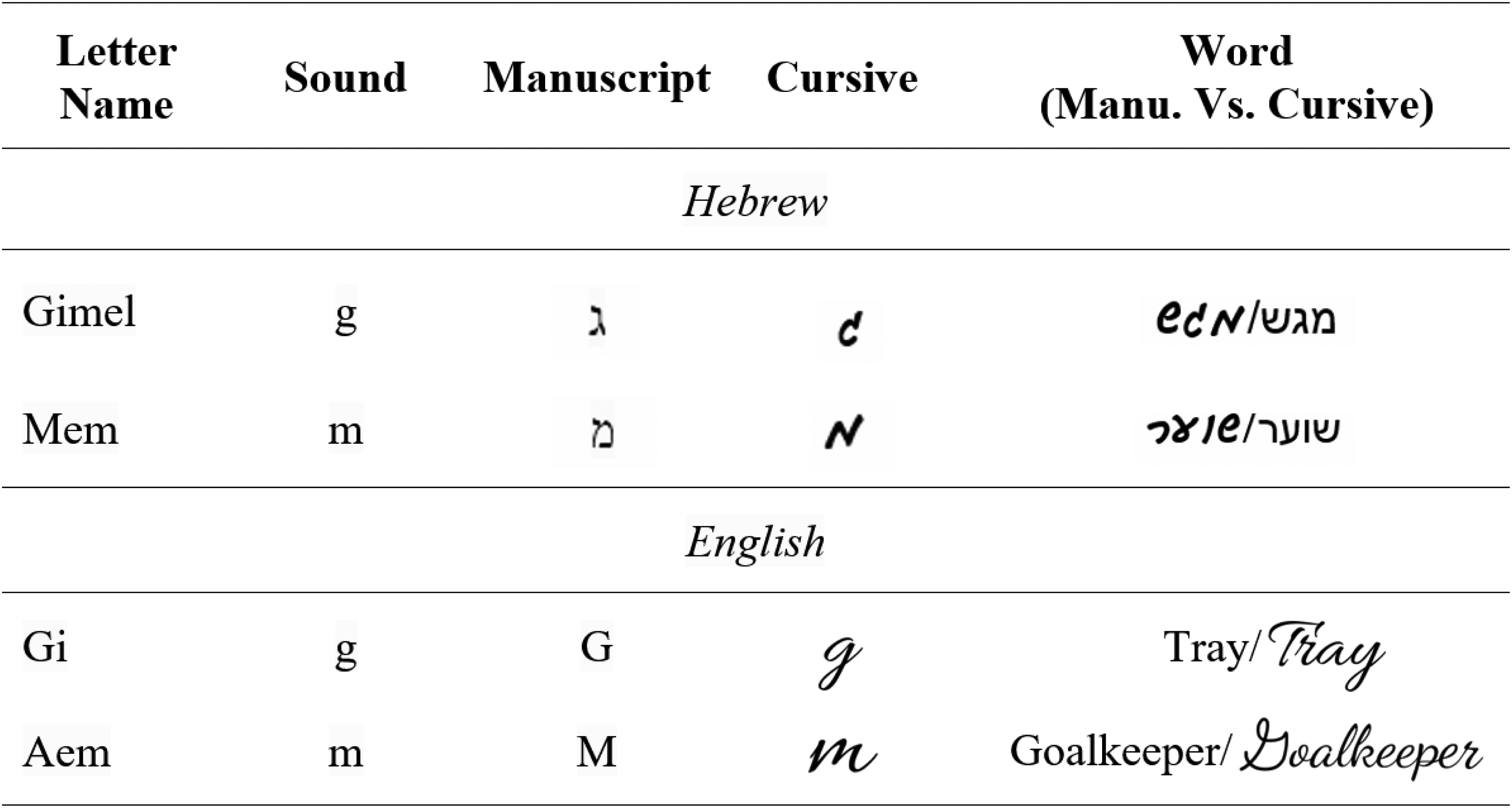
Examples of Hebrew letters and words versus English. Note. Hebrew is written from right to left.
Manuscript letters in Hebrew tend to feature straight vertical, diagonal, and horizontal strokes, whereas cursive letters are more slanted and rounded. Several cursive letterforms can be produced with fewer pen lifts within a single letter than their manuscript counterparts, which may facilitate more efficient letter formation. Besides letters, the Hebrew orthography uses diacritics that can appear below and above the letters, usually in the manuscript version (see Figure 2). Whereas the letters usually represent the consonants, the diacritics represent the vowels. This orthography, called pointed or voweled Hebrew, is considered transparent (Vaknin-Nusbaum, 2021, 2025).
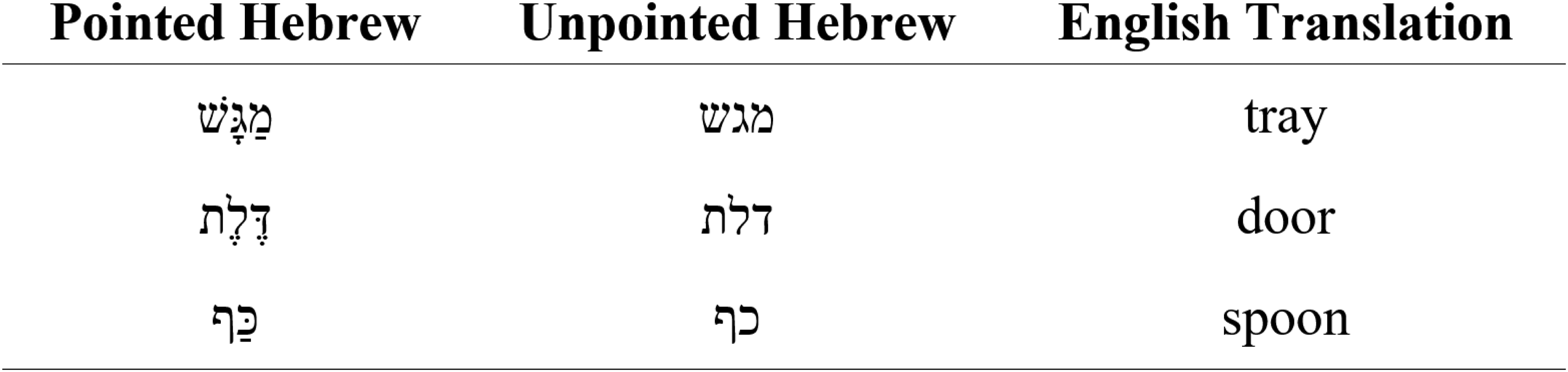
Examples of Hebrew pointed and unpointed words in manuscript version. Note. Written materials in Hebrew typically appear in the manuscript script. Pointed orthography is mainly used in children's texts, but it may also appear in adult texts for loanwords or foreign names that do not follow typical Hebrew word patterns, to assist readers with accurate pronunciation. In cursive handwriting, pointed Hebrew is almost never used.
During third grade, diacritics are gradually omitted from print, turning orthography from highly transparent (pointed) into “deep” (unpointed), which represents only the word's consonants (called unpointed Hebrew). Thus, children learn to read in pointed orthography and are expected to reach relatively high reading performance, in terms of fluency (72 familiar words per minute) and accuracy (93%) at the beginning of second grade (Shany et al, 2006). These norms are based on the manuscript version which, as previously noted, appears in books and texts and also frequently appears in children's surroundings before they enter school (Levin & Aram, 2005).
This Study
As reviewed above, despite substantial work on handwriting, few studies have directly tested whether the type and timing of handwriting instruction (manuscript vs cursive) influence reading acquisition (eg, Bara et al, 2016; Morales-Rando et al, 2021; Morin et al, 2012). Much of the literature instead targets handwriting legibility and fluency, leaving transfer to reading largely unexamined (eg, Case-Smith et al, 2014; Santangelo & Graham, 2016). This gap is particularly salient across orthographies, where differences in script form and orthographic complexity may moderate the handwriting-reading relation (Arfé et al, 2020).
Within Hebrew, prior work has emphasized children's letter-name knowledge and sound-grapheme mapping (Aram et al, 2021; Aram & Levin, 2004; Levin & Aram, 2005), but has not addressed how the timing of cursive versus manuscript instruction affects reading acquisition. The distinct roles of manuscript (print) and cursive (everyday handwriting) in Hebrew may create challenges for orthographic consistency at the start of schooling. To address this gap, we compared two first-grade instructional conditions: (a) manuscript-only instruction, with cursive introduced at the end of the school year, and (b) simultaneous manuscript-and-cursive instruction from the start of the year. Beyond evaluating overall effects on reading outcomes, we also examined whether and how these instructional methods affect typical and at-risk readers differently.
Research Questions
How does the type of handwriting instruction in first grade (manuscript-only vs manuscript plus cursive) affect the development of reading fluency, accuracy, and comprehension across the school year?
Does the type of handwriting instruction affect typical readers and at-risk (based on word reading performance) readers differently?
Based on prior research, we considered two alternative hypotheses. First, manuscript-first instruction may support reading acquisition due to the visual consistency between printed and handwritten forms (Berninger & Wolf, 2009). Second, given the transparency of Hebrew orthography, where basic decoding is relatively easy to acquire, early introduction of cursive may not necessarily disrupt reading development.
Method
Students and Setting
A total of 102 first graders, Hebrew-native speakers, participated in the current study; 56 boys (54.9%) and 46 girls (45.1%), with ages ranging between 5.10 to 7 years (M = 6.22, SD = 0.53). The students learned in four classes (about 27 students in each class) in one school located in the north of Israel, in an area of middle to high SES (Israel Central Bureau of Statistics, 2014). All students in the four participating first-grade classrooms were included in the study, with the exception of children receiving inclusive education support services (Sal Shiluv).
Classrooms were randomly assigned to manuscript-first versus concurrent manuscript-and-cursive instruction. While both groups learned according to the same phonetic reading program, handwriting instruction was different: One group learned only manuscript version with cursive type added at the end of the school year (52 participants); the second group learned both scripts in parallel starting Day One (50 participants). The manuscript group included 31 boys (59.6%) and 21 girls (40.4%) with a mean age of 6.29 (SD = 0.50); the cursive group included 25 boys (50%) and 25 girls (50%), mean age = 6.14, SD = 0.55. Gender distribution did not differ significantly between the groups: χ2(1) = 0.95; p = .329. Similarly, no mean-age differences were found between the two groups: t(100) = 1.47, p = .144.
Instruments
Three types of measurements were taken at the beginning, middle, and end of the school year, respectively.
Language and Literacy Tests Administered at the Beginning of the School Year
Language and letter-naming tests were delivered at the beginning of the year to learn about students’ level of readiness for reading and writing acquisition, which takes place in first grade in elementary school. The preschool period is devoted to cultivating language, metacognitive abilities, and letters (manuscript) naming. The tests, all of which have been found to predict reading acquisition (Wolf, 2008), were delivered to learn about the starting points of the two groups of students: manuscript versus cursive.
Phonemic awareness, morphological awareness, and vocabulary knowledge were delivered individually to assess children's language abilities and letter naming to assess their emergent reading ability (letter naming). Phonemic awareness was taken from the Israeli National Authority for Measurement and Evaluation battery of language and reading measures (RAMA, 2015), which was developed and validated with 325 first-grade students from 60 schools. The battery comprises seven separate measures of language and reading abilities, and is delivered at the beginning of the year to all first graders in Israel, to identify children at risk for reading acquisition difficulties.
Morphological awareness and letter-naming tests were taken from the Shatil battery tests (Shatil, 2002). The battery was designed to examine language and emergent literacy abilities for Hebrew-speaking children and was constructed on a sample of 349 children to identify preschoolers and first graders at literacy risk.
Finally, the vocabulary test was taken from Elul battery assessments tests for identifying children at literacy risk in various thinking and reading abilities (Shatil et al, 2007).
Reading Tests Administered at the Middle and the End of the School Year
Tests of Level of Word Reading Performance at the End of the School Year
Children were presented with 80 words, of which 25 represented animals (target words), and were asked to circle the words that represented animals, under a time limit. The score was the percentage of identified animal words out of the total number of words. In the Elul standardization sample, internal consistency for this subtest was Cronbach's α = .94 (Shatil et al, 2007).
Procedure
Two research assistants, who were teachers with MA degrees in inclusive education and had above 10 years of teaching experience, tested each student individually in all language, letter-naming, and reading fluency (rate and accuracy) tasks. Reading comprehension and orthographic word recognition tasks were delivered in groups according to the reading battery tests’ instructions. Tests were delivered at three time points: Time 1: Preliminary tests were administered at the beginning of the school year (October 2016) in two sessions of approximately 15 min each. The battery included language and letter-naming tasks. Times 2 and 3: Reading tests (fluency and reading comprehension) were administered approximately at the middle of the year and again at the end of the year (June 2017). The tests were delivered in two different sessions during the same week. First, the fluency test was delivered individually and lasted approximately 5 min; then, group reading tests (reading comprehension) were delivered, which lasted between 15 to 20 min.
The orthographic recognition test was delivered only at the end of the school year to determine students’ word reading level, which is considered a basic and necessary skill for the development of both fluency and reading comprehension (Anastasiou & Griva, 2009; Perfetti et al, 2008). Most differences between readers’ performance originate from gaps in word reading level (Shimron, 2006).
All group reading tests were delivered to students in their homeroom and the individual tests in the school library. Each test was preceded by two practice examples, and the child began the test only after the child understood the assignment.
Language Arts Curriculum
Language arts instruction in all classes followed the national first-grade phonics-based Hebrew language arts curriculum, with the only manipulated variable being the timing of cursive handwriting instruction (see reading and handwriting instruction section). Lessons were delivered according to national guidelines, which allocate 6 weekly hours for approximately 36 weeks, adjusted for holidays and school activities. All instruction followed the Koach Likro program (the power to read; Snir, 2013), the national first-grade phonics-based program in Hebrew, which prescribes the order and pacing of letter and vowel introduction across the school year.
Fidelity of instruction is considered an integral part of first-grade teaching in Israel. Recognizing the importance of reading and writing as the foundation for later academic skills and lifelong learning, the Ministry of Education established a national Grade 1 diagnostic assessment developed by the National Authority for Measurement and Evaluation in Education (RAMA; https://rama.edu.gov.il). The assessment is administered in all schools by trained staff during three checkpoints across the first grade, following the same standardized instructions and scoring criteria. Results are uploaded to a central RAMA database, ensuring comparability across schools and providing a standardized mechanism for monitoring reading and writing development. At the school level, in the current study, regular grade-level meetings were held every 2 weeks under the supervision of the principal. These meetings focused on coordinating instructional pacing and monitoring student progress.
Reading and Handwriting Instruction
Allocation to instructional conditions was determined by cluster randomization at the classroom level using a coin flip. All children learned to read using the same phonetic method, but handwriting instruction differed between the two conditions: Two classes practiced only manuscript handwriting throughout the year, with cursive introduced during the final 2 months, whereas the other two classes were taught both manuscript and cursive from the beginning of the school year. All four teachers were specialists in reading and writing instruction and held an MA in education.
In both conditions, instruction was embedded in Koach Likro (the power to read), a Ministry of Education-approved first-grade phonics-based language arts program, together with its companion writing workbook Koach Liktov (the power to write; also called first writing) (Snir, 2013). According to the program, all consonants and vowels are introduced sequentially across seven booklets throughout the school year with decoding and comprehension integrated from the outset. For example, the first booklets introduce consonants with Kamatz and Pataḥ (a-vowels), while later booklets gradually add Hirik (i-vowel) and other vowels. Beginning with the first lessons, children read words formed from the currently taught letters and vowel diacritics. All classes used the reading passages, vocabulary activities, and phonics sequence prescribed by the program.
Handwriting instruction followed Koach Liktov stages, which prescribe systematic manuscript handwriting practice in Grade 1. Accordingly, all students in both groups practiced manuscript letters using the same workbook activities. Each letter was introduced with explicit modeling of stroke order and directionality, often supported by visual navigation cues (eg, arrows, dotted lines) and memory prompts. Instruction combined motor execution with phoneme articulation, so children pronounced the sound while writing the letter, reinforcing grapheme-phoneme mapping. Practice included tracing, copying, and independent writing within lined or gridded spaces, followed by short dictation tasks designed to strengthen retrieval and integration of letters into words.
All students in both groups followed these same manuscript routines. The only manipulated variable was cursive exposure: In the Concurrent Condition, teachers introduced the cursive form of each letter alongside the manuscript form, while in the Manuscript-First Condition, cursive was deferred until the final 2 months of the school year.
Data Analysis
Data were analyzed with SPSS ver. 27. Descriptive statistics were used to describe the participants’ demographic characteristics and the research variables. t-tests and Mann–Whitney U Tests were calculated for group differences at the beginning of the year according to variable distribution. Pearson correlations were calculated to assess the associations between reading abilities and students’ ages, and t-tests for gender differences. Repeated-measures analyses of covariance were calculated for the reading abilities by group and time (2X2), controlling for letter naming and gender. Significant interactions were interpreted with estimated marginal means.
At the end of the year, the students were divided into typical versus at-risk readers using the median score of the orthographic identification scale (measured at the end of the year). Orthographic word identification was chosen because it is a fundamental predictor of reading fluency and comprehension (Perfetti, 2007; Shimron, 2006; Wolf, 2008). The task contained 80 words with 25 animal targets; scoring was the percentage of correctly identified targets (0–100). Based on the test norms, the average performance in our sample aligned with the normative 50th percentile. On this basis, students were divided into at-risk versus typical readers using a median split on the orthographic word identification score (see results for the full descriptive statistics). Two-way analyses of covariance were calculated for reading abilities at the end of the year, by group and type of reader (2X2), controlling for letter naming and gender. Significant interactions were interpreted with estimated marginal means.
Results
Preliminary Results
Language and reading abilities, assessed at the beginning of the year, were rather high (see Table 1). Phonemic awareness showed a ceiling effect, and vocabulary showed a total mean of about 81.71 (SD = 8.30), with no group differences. Letter naming was rather high as well, with some preliminary advantage to the manuscript group. Class differences, within-group, were not significant (p = .065 to p = .938).
Means, Standard Deviations (SD), t and Z Values for the Initial Language and Reading Abilities by Group (N = 102).
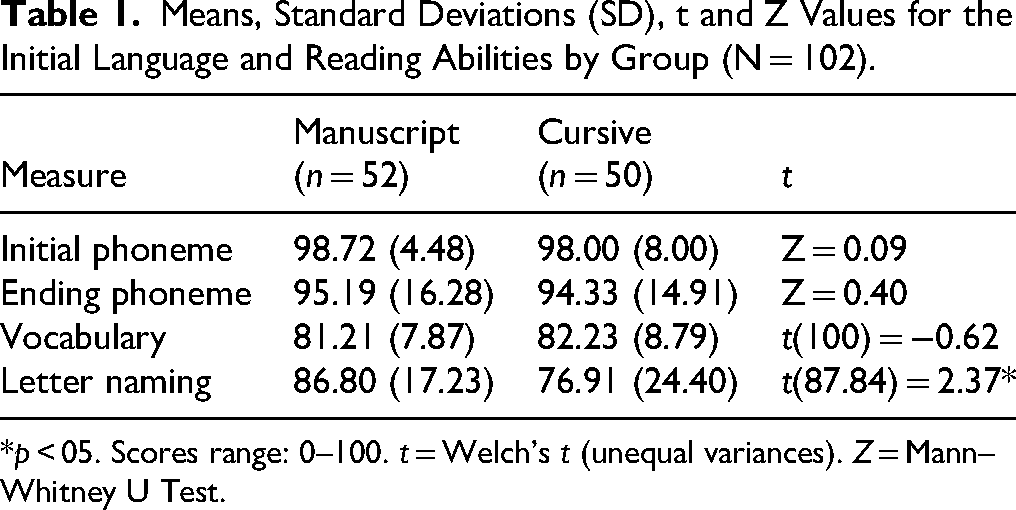
*p < 05. Scores range: 0–100. t = Welch's t (unequal variances). Z = Mann–Whitney U Test.
Reading abilities in the middle and at the end of the year were unrelated to the students’ ages (p = .215 to p = .768). They were generally also unrelated to gender (p = .115 to p = .457), except for reading comprehension at the end of the year, which was higher for girls (M = 64.22, SD = 25.72) than for boys (M = 51.71, SD = 25.24), t(100) = 2.47, p = .015. In light of the initial difference in letter naming, and this gender difference, both variables will be controlled for in further analyses.
Reading Abilities by Time
Repeated-measures analyses of covariance were calculated for reading ability by group (manuscript vs cursive) and time (2X2), controlling for letter naming and gender (see Table 2). Results showed a significant increase in reading fluency, to a greater extent among students in the manuscript group, F(1, 98) = 101.24, p < .001, η2 = .508, than among students in the cursive group, F(1, 98) = 34.87, p < .001, η2 = .262. No differences were found for reading accuracy or reading comprehension.
Means, Standard Deviations (SD), and F Values for Reading Abilities by Time and Group (N = 102).
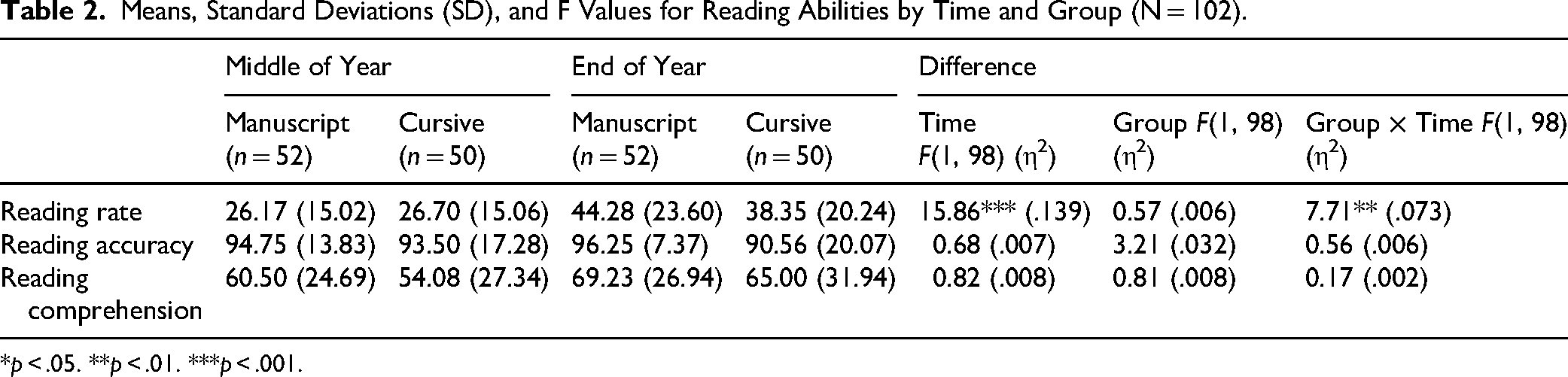
*p < .05. **p < .01. ***p < .001.
To better learn about differences between readers, students were divided according to their orthographic word recognition level measured at the end of the year. Score in this test was generally found moderate (M = 63.06, SD = 28.09) and did not differ by group (p = .649). Students were divided into typical versus at-risk readers, using the median score of the orthographic identification scale (median = 62). At-risk readers had scores ranging 0–60 (M = 38.40, SD = 16.64, n = 50) and typical readers had scores ranging 64–100 (M = 86.77, SD = 11.30, n = 52). Two-way analyses of covariance were calculated for reading ability at the end of the year, by group and type of reader (2X2), controlling for letter naming, and gender (1-boys, 0-girls) (see Table 3).
Means, Standard Deviations (SD), and F Values for Reading Abilities by Group and Type of Reader (N = 102).

Note. Simple-effects p-values are Bonferroni-adjusted across the two comparisons within each outcome (α = .025).
*p < .05. **p < .01. ***p < .001.
Results revealed significant differences. All reading abilities were significantly higher among typical readers than among at-risk readers. Further, all group differences were significant, in favor of the manuscript script instruction. Finally, the group by type of reader interaction was significant for reading fluency and accuracy (yet not for reading comprehension).
Interpretation of the significant interaction for reading fluency, with estimated marginal means, revealed that for typical readers the manuscript script instruction yielded better results than the cursive one, F(1, 96) = 11.91, p < .001, η2 = .111, and no significant difference was found for at-risk readers, F(1, 96) = 0.10, p = .749, η2 = .001, who had an overall lower mean score than the typical readers. Interpretation of the significant interaction for reading accuracy revealed a different result: For at-risk readers, the manuscript script instruction yielded better results than the cursive one, F(1, 96) = 7.50, p = .007, η2 = .073, and no significant difference was found for typical readers, F(1, 96) = 0.01, p = .969, η2 = .001, who showed an overall ceiling effect.
Discussion
This study examined whether learning to write in manuscript or cursive script differentially influences the reading performance of Hebrew-speaking first graders. We first asked whether type of handwriting instruction influenced the development of reading skills across the school year. Manuscript-first instruction yielded greater progress in fluency from midyear to year's end and, by year's end, higher scores than the concurrent manuscript-and-cursive group on all reading measures.
We also examined whether effects differed for typical versus at-risk readers (based on orthographic word recognition). At-risk readers performed lower on all reading measures, consistent with the view that word recognition is foundational for reading development (Anastasiou & Griva, 2009; Perfetti et al, 2008). Typical readers showed higher fluency scores under manuscript instruction, with accuracy already at ceiling; at-risk readers showed higher accuracy under manuscript instruction. Both groups demonstrated better comprehension when instruction used manuscript consistent with print.
In general, court findings support the claim that learning to write in manuscript letters supports the process of reading acquisition in novice readers (Berninger & Wolf, 2009; Graham, 2010). Using the same letters’ script, as appearing in reading for writing, seems to contribute to their representation in memory. As previously established, the motor movement involved in letter writing is correlated with the visual recognition of that same letter (Bara et al, 2016; James & Engelhardt, 2012; James & Gauthier, 2006; Longcamp et al, 2003, 2008; Ray et al, 2022).
Viewed through Frost's (2012) universal model of reading, the advantages of manuscript-first instruction can be interpreted as evidence that script consistency provides an additional route that readers can rely on to support the cognitive processes of reading. This information, gained through writing, is integrated with other linguistic sources (orthographic, phonological, and morphological) used in reading. By minimizing variability between written and printed letter forms, children may make more efficient use of their cognitive resources and achieve more stable orthographic mapping and representation.
Current findings can also be explained by McBride et al.'s (2021) developmental-cognitive model. Handwriting reinforces orthographic representations through visual-motor integration. The act of writing in forms that are consistent with printed texts strengthens perceptual familiarity and promotes mental consolidation of letter patterns. Moreover, both frameworks help explain why benefits were particularly visible for at-risk readers in accuracy. From Frost's (2012) perspective, children with poor word recognition may especially depend on stable orthographic-phonological correspondences. Manuscript instruction reduces variability and provides a clearer pathway for establishing these mappings. From McBride et al.'s (2021) developmental-cognitive perspective, practicing manuscript script likely reduced cognitive load and reinforced memory traces through consistent visual-motor experiences, strengthening grapheme-phoneme correspondences. That is, script consistency may help consolidate orthographic knowledge during foundational stages of literacy acquisition during which multiple linguistic processes are still being integrated.
Typical readers, who had already consolidated these correspondences, showed better fluency performance, consistent with the idea that stable motor routines promote automaticity once accuracy reached a certain level. Because both accuracy and fluency are related to reading comprehension (Katzir et al, 2006; Nevo & Vaknin-Nusbaum, 2020; Perfetti, 2007; Vaknin-Nusbaum & Nevo, 2021; Wolf, 2008), both types of readers showed higher comprehension when instruction started with manuscript letters.
It is important to note that both groups of readers received systematic manuscript handwriting instruction according to the language arts curriculum, which included (a) teacher modeling of letter formation and directionality, (b) supported practice with visual cues, (c) phoneme articulation during writing, and (d) gradual progression from tracing to copying and dictation. This instructional context reflects core practices highlighted in the handwriting intervention literature (eg, Case-Smith et al, 2011; James & Engelhardt, 2012; Lopez-Escribano et al, 2022). Moreover, it is consistent with research showing that handwriting practice enhances visual-orthographic processing and supports letter recognition (James & Engelhardt, 2012; Longcamp et al, 2005, 2008) and orthographic memory, which contributes to reading development (Berninger & Wolf, 2009; Graham, 2010).
Notably, the current results are not in line with Bara and Morin's (2009) study. One plausible explanation is differences in participants’ grade level and stage of acquisition. Their study examined children in their second year of reading instruction, whereas our sample comprised first graders at the very beginning of acquisition. Script instruction may be most consequential when automaticity in grapheme-phoneme translation is still developing. At this stage, every piece of relevant information, including motor memory of letters, can support the building of literacy foundations. Once a certain level of accuracy and fluency is achieved, however, it may become easier to integrate cursive writing.
In addition to grade level, the broader pattern of exposure to different scripts may also be relevant. Bara and Morin's (2009) study was conducted in a French-speaking educational context, where cursive played a central role in early handwriting instruction, whereas in the Hebrew context examined here, children's prior exposure to written language is predominantly in manuscript, as reflected in emergent writing and environmental print, and cursive is rarely seen in children's own writing before school entry (Levin et al, 2005; Levin & Aram, 2005). Thus, children in our sample entered first grade with more experience seeing and producing manuscript forms, whereas cursive represented a new set of letter shapes and motor patterns. This difference in prior exposure may contribute to why concurrent manuscript-and-cursive instruction placed higher demands on beginning readers in our context, whereas comparable costs were not evident in Bara and Morin's second-grade sample.
Another explanation can be attributed to differences between orthographies. At the beginning of first grade, children learning to read Hebrew, a transparent orthography, generally acquire decoding relatively early (Nevo et al, 2020; Nevo & Vaknin-Nusbaum, 2020; Vaknin-Nusbaum et al, 2018) compared with learners of deep orthographies, such as French. Visual consistency between the letters children encounter in print and those they produce in handwriting, as in manuscript instruction, may further support decoding, as reflected in improved accuracy among at-risk readers in this study. By reducing the need to reconcile two visually distinct scripts, readers may consolidate orthographic-phonological mappings more efficiently. Together with Hebrew's transparency, this consistency likely also helped children cope with the high visual similarity of some manuscript letters (eg, ב/ח or ח/ת), which might otherwise challenge visual-motor memory. In deeper alphabetic orthographies and/or where cursive is joined, the relationship between handwriting and reading may differ (Arfé et al, 2020).
Current results raise an additional issue that merits consideration. Handwriting begins early, as children acquire the motor building blocks that later support more complex forms of writing. Early routines often involve straight strokes and basic shapes, which gradually extend to curved and continuous movements and form the basis for letter formation (Maurer, 2024; Strooband et al, 2020). From this perspective, manuscript instruction in the first stage of reading acquisition may provide children with a structured opportunity to consolidate these early motor routines. Cursive, by contrast, relies on rounder and more continuous strokes and may represent a complementary motor pathway that supports the development of fluency and fine-motor control.
In the present data, at-risk readers showed higher accuracy under manuscript instruction, whereas typical readers showed advantages primarily in fluency. One way to frame this pattern is in terms of visual-motor integration and basic letter knowledge. When early writing practice relies on relatively simple, segmental strokes, as in manuscript, visual-motor demands are reduced and, therefore, children may have more cognitive resources available to consolidate stable correspondences between letter shapes and letter names. Such consolidation is particularly important for children who are still establishing accurate word reading. By contrast, once accurate decoding is in place, as is more often the case for typical readers, consolidated letter representations and well-practiced motor routines can more readily support gains in reading fluency. At the same time, one could hypothesize that learning both manuscript and cursive from an early stage might enrich motor development by engaging distinct but complementary movement patterns. Evidence from a transparent orthography (German) supports this interpretation, showing that early handwriting legibility predicted later gains in handwriting speed and spelling. These findings highlight the foundational role of grapho-motor routines in supporting broader literacy skills (Truxius et al, 2025). While our study was not designed to examine these developmental possibilities, it nonetheless raises the broader question of how grapho-motor development interacts with orthographic learning during the earliest stages of reading acquisition.
Current findings carry practical implications for classroom instruction, particularly for children at risk. They suggest that at-risk readers may benefit from explicit and sustained practice with manuscript script handwriting as this provides them with a consistent orthographic framework and strengthens accuracy, which in turn allows them to develop fluency later. Teachers might consider integrating daily manuscript writing exercises with connected reading activities, thereby reducing cognitive demands linked to script conversion and allowing at-risk readers to focus on core decoding and reading comprehension skills. Early intervention in first grade, with targeted support for at-risk students using manuscript script, can, therefore, serve as a preventive step against later reading difficulties.
Limitations and Future Directions
Educational research is typically conducted in natural classroom environments. This design increases ecological validity by capturing children's learning in authentic contexts, but it also introduces constraints that limit the strength of causal inferences. In this context, several limitations of the present study should be considered. Although cluster randomization at the classroom level was used, potential influences such as teacher effects or other contextual factors cannot be excluded, and findings should, therefore, be regarded as suggestive rather than definitive evidence of causal influence.
Further, the sample size was relatively small, and handwriting was examined under only two instructional conditions. In addition, no observational fidelity measures of handwriting instruction were collected by the researchers; fidelity was inferred from the use of a single mandated curriculum and companion handwriting workbook, shared pacing guidelines, and school-level monitoring of instruction (eg, grade-level meetings and principal oversight), and did not include systematic classroom observations conducted by the research team. More detailed information about the exact time allocated to manuscript versus cursive practice and about adherence to the planned instructional conditions would require systematic classroom observations and time-sampling procedures in future studies. Examining a larger group and including a third condition in which cursive is introduced only in second grade might provide stronger evidence regarding the role of timing in script instruction.
Furthermore, because the study was conducted in a school serving a middle-to-high SES population, the ability to generalize findings to children from more diverse socioeconomic backgrounds is limited. A similar caution applies to the broader cross-linguistic context: Since the study was conducted in Hebrew, results may not extend to orthographies with features such as upper- and lower-case distinctions or joined cursive scripts. Future research across different SES settings, orthographies, and longitudinal designs could, therefore, provide a better understanding of the relationship between handwriting instruction and reading development.
Footnotes

Funding
The authors received no financial support for the research, authorship, and/or publication of this article.
Declaration of Conflicting Interests
The authors declared no potential conflicts of interest with respect to the research, authorship, and/or publication of this article.