




Abstract
This article provides a review and practice-based examples of three research-supported approaches to vocabulary instruction for students with learning disabilities (LD). In the first half of the article, we introduce and discuss the research bases for semantic, mnemonic, and strategic approaches to vocabulary instruction. Each approach encompasses a range of instructional activities that educators can select depending on relevant words for instruction and their instructional goals. In the last half, we use a middle-grade science passage along with vocabulary words from that passage to demonstrate how semantic, mnemonic, and strategic approaches can be emphasized or combined to promote text comprehension and vocabulary learning for children with LD.
Keywords
It is widely acknowledged that vocabulary knowledge, or knowing the meanings of words, is centrally important for text comprehension. Indeed, every predominant component model of reading comprehension demonstrates direct and/or indirect relations between vocabulary knowledge and reading comprehension (e.g., Active View of Reading: Duke & Cartwright, 2021; Simple View of Reading: Gough & Tunmer, 1986). In addition, there is theoretical support for the notion that knowledge of word meanings facilitates comprehension (Anderson & Freebody, 1979). Learning the meanings of unknown words and using appropriate vocabulary to express learning is also emphasized in K-12 state standards (National Governors Association Center for Best Practices [NGA] & Council of Chief State School Officers [CCSSO], 2010). Collectively, therefore, researchers and educators recognize the value that vocabulary knowledge brings to the reading process.
A range of studies have demonstrated positive effects of vocabulary instruction on word knowledge and sometimes also comprehension of texts containing taught words. Within learning disabilities (LD) research, three syntheses (e.g., Bryant et al., 2003; Jitendra et al., 2004; Kuder, 2017) have identified numerous promising types of vocabulary instruction and strategies that promote word learning outcomes for students with LD in Grades 4 through 12. Across reviews, authors identified the following types of instruction: direct instruction, constant time delay, cognitive strategy instruction or concept enhancement approaches, activity-based methods, computer-assisted or multimedia instruction, mnemonic strategy instruction, learning strategies instruction (including morphemic analysis), peer-based approaches, and fluency building.
To help translate research to practice, researchers have published articles guiding educators’ use of vocabulary activities. For example, Swanson and colleagues (2017) emphasized the importance of engaging adolescent students in teacher-directed, text-based, and morphology-based instruction. Barnes and Cartwright (2024) showed how different vocabulary activities can be used before, during, and after an instructional unit to build background and vocabulary knowledge for students with LD. Both articles provide helpful instructional recommendations and routines for teaching vocabulary. However, both researchers and practitioners would benefit from a clear framework for organizing vocabulary instructional activities, recognizing that activities vary in research support and develop students’ word knowledge in distinct ways. In the section below, we introduce and explain a framework that organizes vocabulary instruction into three main approaches.
Three Approaches to Vocabulary Instruction
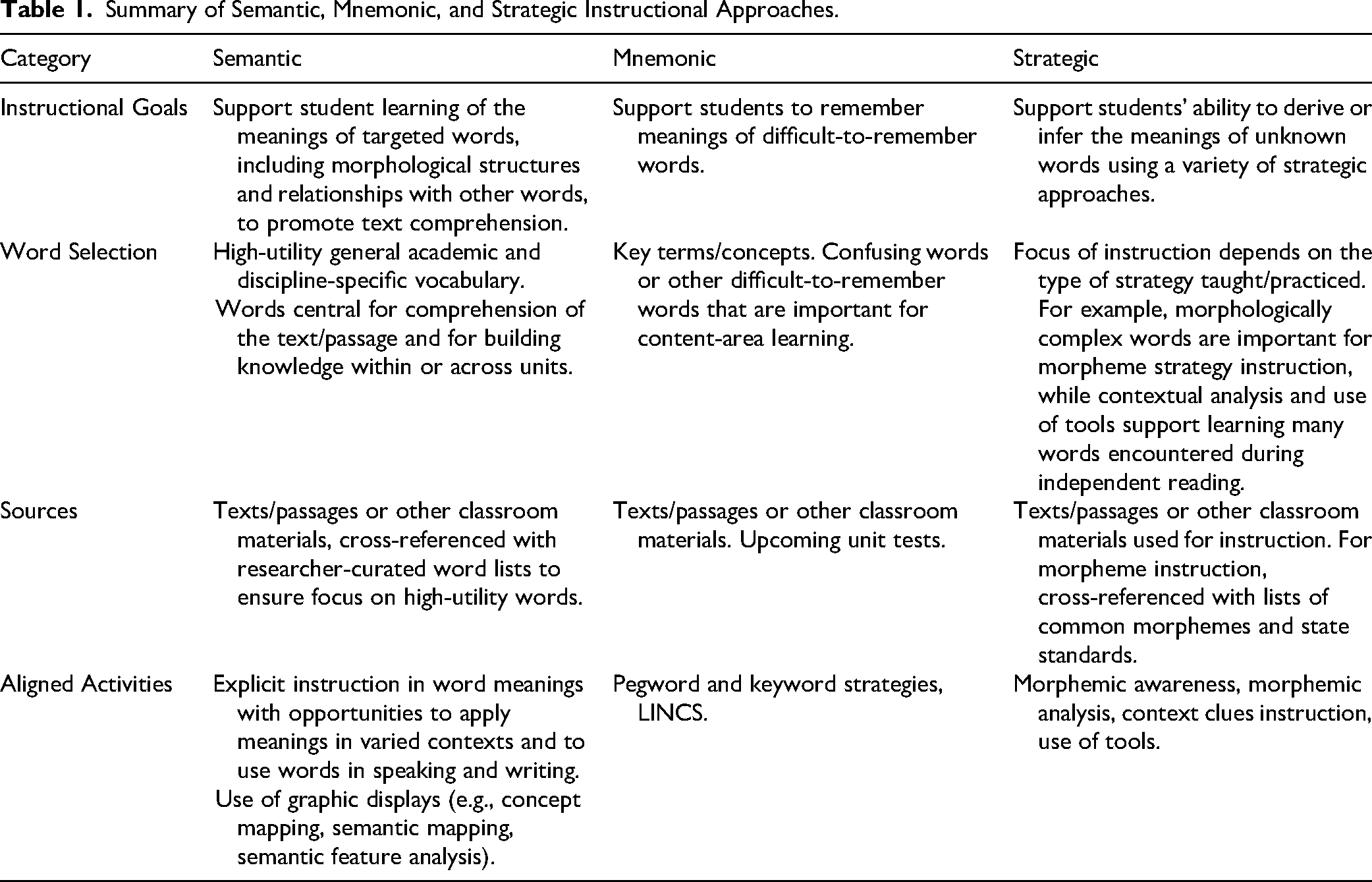
In this article, we classify vocabulary instruction into one of three theoretically grounded and empirically supported approaches: semantic instruction, mnemonic instruction, and strategic instruction (Table 1). Although each of these approaches can play a critical role in the development of a child's vocabulary knowledge, they support word learning in distinct ways. In the sections that follow, we describe these approaches, their research bases, and instructional activities aligned with each approach. We subsequently present examples of how each approach can be used to support word learning in the context of text-based instruction. The first example illustrates the use of semantic and mnemonic vocabulary instruction with some attention to morphology during text reading to promote comprehension; the second example illustrates how educators can leverage text to provide instruction and practice for strategic vocabulary instruction.
Summary of Semantic, Mnemonic, and Strategic Instructional Approaches.
Semantic Instruction
Semantic instruction involves teacher-directed explicit instruction (EI) in word meanings, with variable levels of focus on how word meanings apply to diverse contexts and in relation to other words and concepts. A major goal of semantic vocabulary instruction is to build students’ knowledge of a set of words contained in particular texts, or across texts, to promote text comprehension within and across content areas. Targeted words might be discipline-specific academic vocabulary (e.g., science, mathematics, history words) or general academic vocabulary words that are interdisciplinary, showing up with relatively high frequency across disciplines. Words for instruction are typically drawn from classroom texts. Cross-referencing with a variety of academic word lists (e.g., Coxhead's [2000] “A New Academic Word List,” Biemiller's [2010] Words Worth Teaching, or Hiebert et al.'s [2018] “Core Vocabulary” [found at textproject.org]) can help to ensure selected words appear across texts frequently enough to warrant instruction, or are appropriate for teaching given the grade level.
Multifaceted Teacher-Directed Instruction
Perfetti's (2007) Lexical Quality Hypothesis posits that having deep and multifaceted knowledge of words is important for efficient recognition of words and application of meanings to comprehend text. Accordingly, semantic approaches commonly emphasize explicitly teaching definitions and/or synonyms of targeted words, paired with multiple opportunities for students to hear, say, read, and write words across contexts. Though word meanings are a focus, semantic approaches also involve supporting students to apply phonetic and morphological knowledge to support reading and spelling target words across activities. Often, definitions are presented in student-friendly terms and paired with graphics to demonstrate usage. Instruction also involves opportunities for students to write definitions or create sentences, but the type and amount of writing varies across studies. Additional learning opportunities include reviewing background knowledge related to targeted words (e.g., Green et al., 2015; VanUitert et al., 2020); discussing word meanings in multiple contexts (e.g., Green et al., 2015; O’Connor et al., 2019); engaging in a variety of written application activities (e.g., sentence writing; Sanchez & O’Connor, 2022); reading texts (e.g., O’Connor et al., 2021); playing word games (e.g., Green et al., 2015; O’Connor et al., 2021); and embedding distributed practice opportunities (e.g., O’Connor et al., 2019, 2021). Many of these knowledge-building activities also support students’ oral language, reading, spelling, and comprehension development.
As discussed in detail in Black and Wright (2023) and Moody et al. (2018), extended instructional practices associated with semantic instruction are derived from several theoretical frameworks. For example, social constructivism (Palincsar, 1998) highlights the importance of social interaction in learning and meaning-making (e.g., discussion of words). Psycholinguistic and schema theories (Anderson, 2013) focus on how knowledge is structured and how learners engage with that information (e.g., connecting words to established knowledge). Dual coding theory (Sadoski, 2005) emphasizes the integration of verbal and nonverbal information to enhance understanding (e.g., connecting words with visual images), whereas motivation theory (Schiefele et al., 2012) addresses interest and engagement with learning words (e.g., using word games). Although some instructional interventions incorporate only one or two of these activities, others combine several into a multifaceted instructional approach.
Designed for middle-grades students with LD specifically, Creating Habits That Accelerate the Academic Language of Students (CHAAOS: O’Connor et al., 2019, 2021, 2022; Sanchez & O’Connor, 2022) incorporates EI in reading and defining words, multiple encounters with words in instructional and authentic contexts, rich word play, scaffolded writing experiences and distributed practice, and review for general academic vocabulary words typically encountered in the middle grades. In a series of studies that included sixth-, seventh-, and eighth-grade students with disabilities and their special education teachers, O’Connor and colleagues demonstrated significant and meaningful effects of CHAAOS on students’ knowledge of taught words, as evidenced by receptive measures as well as expressive measures of definition knowledge and comprehension of taught words in sentence- and paragraph-length texts.
Additionally, in the studies that focused on a longitudinal sample of students from sixth to seventh grade (O’Connor et al., 2021) and from sixth to eighth grade (O’Connor et al., 2022), O’Connor and colleagues documented significant effects of CHAAOS on a norm-referenced measure of general vocabulary knowledge. The effect for seventh graders in O’Connor et al. (2021) was driven by an increase in generalized vocabulary for the treatment group after receiving 24 weeks of instruction across two academic years, and by a decrease in standard scores for the comparison group. The effect for eighth graders in O’Connor et al. (2022) was driven by a significant decline in standard scores for the comparison group and maintenance of scores for the treatment group, who had received 36 weeks of vocabulary instruction across three years. The program of research by O’Connor and colleagues highlights the potential impact of well-designed multifaceted semantic vocabulary instruction on vocabulary knowledge and text comprehension for students with LD.
Language- and Concept-Based Graphic Displays
Semantic instruction also involves use of graphic displays or charts to support students’ consideration of the different semantic features of words, or how words relate to other words or concepts. Semantic maps, semantic feature analysis tables, syntactic feature analysis tables, and concept maps or diagrams are examples of graphic displays and charts designed to deepen students’ word and conceptual knowledge. Prior reviews of research with students with LD across Grades 4–12 (Bryant et al., 2003; Jitendra et al., 2004) have found that when students engaged in creating graphic displays, they demonstrated stronger word knowledge and comprehension gains than with definition instruction alone.
Much research on graphic displays used with students with LD occurred in the late 1980s and early 1990s. During this time, Bos and colleagues (Bos et al., 1989a; Bos, Anders et al., 1989b; Bos & Anders, 1990, 1992) conducted a series of studies exploring the relative effectiveness of several types of graphic displays or charts on word learning and comprehension for students with LD from elementary through high school. Studies compared effects of semantic mapping, semantic feature analysis, and/or semantic/syntactic feature analysis compared to dictionary learning or definition instruction on students’ word learning and comprehension outcomes. Reviewed thoroughly in Jitendra et al.'s (2004) research synthesis, the group of studies reported that students receiving instruction involving graphic displays or charts, all of which involved opportunities for analysis and discussion of words and related concepts, outscored students in dictionary or definition learning conditions on measures of word learning and comprehension.
In a more recent single-case design study, Fore III et al. (2007) compared effects of concept mapping and a dictionary method on word learning for middle-grade students with LD, finding stronger definition knowledge for students in the concept mapping condition than the dictionary method. Graphic displays are also highlighted in the Institute of Education Sciences Educator's Practice Guide on reading interventions for students in Grades 4–9 (Vaughn et al., 2022). Specifically, the authors demonstrate how word mapping (WM) can be used to support learning for morphologically complex words that share morphemes.
Overall, study findings indicate that semantic vocabulary instruction is effective for teaching elementary through high school students with LD the meanings of specific words (Bryant et al., 2003; Jitendra et al., 2004; Kuder, 2017). Active processing activities, characterized by students making personal connections to words, making decisions about the extent to which meanings or contexts apply to words, identifying sets of related words and concepts, and using words and their meanings in oral and written formats, are generally more effective at promoting word learning than definition-only instruction (e.g., Bos & Anders, 1990; Fore III et al., 2007; Stahl & Fairbanks, 1986). Graphic displays, as used in semantic feature analysis and semantic mapping, are also effective in promoting word learning and conceptual understanding as compared to direct definition instruction alone (Bryant et al., 2003; Jitendra et al., 2004).
Mnemonic Instruction
Mnemonics are procedurally driven strategies that aid in memory and recall of information, including the meanings of words; thus, the goal of mnemonic vocabulary instruction is to promote the remembering of words and their meanings. Research in mnemonics is grounded in information-processing models and dual-coding theory (Sadoski, 2005), in addition to other frameworks that highlight the importance of rapid retrieval of word meanings from memory (e.g., Perfetti's [2007] Lexical Quality Hypothesis). When students can recognize a word and quickly and efficiently access its meaning, they are better equipped to apply that meaning to support text comprehension.
Mnemonic-based instruction is relatively brief (i.e., a few minutes per word) and promotes students’ ability to recall definitional-level information about a word (e.g., a synonym or definition). Mnemonic-based approaches for teaching vocabulary typically involve pegword or keyword methods. Pegword methods are memory supports for numbered or ordered information, and involve several interconnected stages, beginning with rhyming number-word pairs (e.g., “one-bun,” “two-shoe”). These rhyming pairs are then linked to mental images that connect the number-word pairs to targeted information to facilitate recall (Scruggs et al., 2010). Keyword methods also involve multiple stages, but rather than connecting number-word pairs to targeted information, keywords are created for targeted vocabulary words with the requirement that the keyword and vocabulary word are acoustically linked. Next, a visual connects the vocabulary meaning to the keyword (Scruggs et al., 2010).
Decades of research with students with LD support mnemonic instruction as an effective approach for a range of academic outcomes (Lubin & Polloway, 2016; Wolgemuth et al., 2008), including vocabulary learning for students in middle and high school (Condus et al., 1986; King-Sears et al., 1992; Mastropieri et al., 1985, 1990). Most studies focused on mnemonics for vocabulary learning and students with LD were conducted in the 1980s and 1990s. These studies explored the impact of keyword mnemonics on recall of vocabulary definitions, contrasting mnemonic approaches with direct instruction approaches. For example, Mastropieri et al. (1990) compared effects of keyword mnemonics with imagery to a definition rehearsal condition on students’ ability to orally provide definitions of taught words and on their ability to match a taught word with an untaught context (e.g., a novel sentence with a context relevant to a taught word) for middle-grade students with LD. The authors reported statistically significant effects in favor of the mnemonics group on both definition production and context matching outcomes.
More recent research on mnemonics vocabulary instruction for students with LD is limited. However, two studies—one by Slemrod et al. (2022) and one by Kennedy et al. (2015)—examined mnemonic instruction alone or in combination with semantic instruction, delivered via technology support. Working with high school students with LD, Slemrod and colleagues (2022) investigated the impact of keyword mnemonic instruction on science vocabulary learning, manipulating instructional delivery. Specifically, using a single-case design, the researchers compared a nontechnology index card condition with an iPod Touch condition and found that students learned the words equally well within both conditions, but showed interest in the technology condition.
Kennedy et al. (2015) examined the impact of combining keyword mnemonics with teacher-directed EI within a multimedia vocabulary intervention using Content Acquisition Podcasts (CAPs) on vocabulary learning for high school students with and without LD. The researchers randomly assigned students to one of four groups—EI using CAPs that adhered to specific instructional design principles, Keyword Method Strategy (KMS), a combined EI + KMS, and EI alone (NM)—and compared the performance of all four groups on a measure of vocabulary knowledge.
Results for students with LD, in particular, indicated significantly higher vocabulary scores for the combined EI + KMS group than NM, with a large effect size (d = 1.97, p < .025). Additionally, the authors reported nonsignificant trends with large effect sizes in favor of EI + KMS compared to EI (d = 1.09) or KMS (d = 1.40), demonstrating the potential power of integrating keyword mnemonics with other teacher-directed instructional approaches. This and earlier research on mnemonic approaches to vocabulary instruction highlight the important role mnemonics can play in supporting students’ ability to recall word meanings, especially when paired with semantic instruction.
Strategic Instruction
In contrast to teacher-directed semantic and mnemonic approaches, a major aim of strategic approaches is to support students to independently derive or infer meanings of unfamiliar words encountered in text. Comprehension of the text remains a goal, but the process for achieving that goal relies on different pathways to understanding word meaning. Strategic approaches to vocabulary are rooted in cognitive strategy instruction, whose theoretical basis comes from cognitive psychology information processing frameworks, motivation theory, and social cognitive theory (Dole et al., 2009; Reid et al., 2013). These strategies have foundations in schema and psycholinguistic theory, which requires students to utilize prior knowledge of words to support current learning (Black & Wright, 2023; Moody et al., 2018).
There is strong evidence for the effectiveness of strategy instruction in enhancing student learning, especially for students with LD (Jitendra et al., 2011; Swanson et al., 1999). Furthermore, strategic approaches are “generative” word learning strategies; that is, they have the potential to unlock meanings of far more words than can be targeted with semantic instruction alone, making them a powerful tool to support word knowledge and text comprehension (Harris et al., 2011). The following three strategies are most common when using strategic approaches to instruction: morphemic analysis, contextual analysis, and using tools (Graves et al., 2018).
Morphemic Analysis
Morphemic analysis involves teaching students to use knowledge of morphemes such as affixes and word roots to derive working definitions of an unknown word. Morphemic analysis generally involves (a) looking for known word parts, (b) attaching meaning to those parts, (c) combining meanings of each part within a word to derive a working definition, and (d) testing the definition in the context of the text. Important, educators may need to directly teach morphemes prior to or in conjunction with morphemic strategy instruction. For example, students might be taught the prefix, “inter-” and its meaning “between,” so that they can apply that knowledge to a word, such as “interstate,” to derive a working definition, “between states.”
Numerous systematic reviews and meta-analyses have shown that morphological instruction and analysis strategies can effectively impact the literacy skills, including vocabulary acquisition, for younger and older students and for typical and struggling learners (Bowers et al., 2010; Brady & Mason, 2023; Carlisle, 2010; Goodwin & Ahn, 2012; Reed, 2008). Researchers have also investigated the effectiveness of morphological instruction and analysis among students with LD across elementary, middle, and high school. For example, Brady and Mason (2023) reviewed findings from 10 studies of morphological awareness interventions for struggling readers and students with disabilities in kindergarten through 12th grade. The authors reported positive effects on a range of outcomes, including word reading, spelling, comprehension, and vocabulary. One study included in that review, Brimo (2016), explored effects of a 10-week explicit morphological intervention on the morphological knowledge and analysis skills of 10 third-grade students with reading disabilities. Students assigned to treatment received 16 lessons that taught inflectional and derivational suffixes directly, and provided opportunities for students to listen to, sort, produce, identify, and write each affix. Despite low power, results indicated a statistically significant effect of intervention in favor of the treatment group on a morphological awareness task that required students to create a novel word from two morphemes and then define that word according to its parts.
Working with middle school students with LD, Brown et al. (2016) conducted two single-case experimental design studies on the impact of prefix instruction on students’ ability to define words that combined taught roots and prefixes. Students received instruction for 30–45 min over 8 weeks. Study 1 included one eighth- and five seventh-grade students, and Study 2 included four eighth-grade students. Single-case design graphs in both studies suggested a functional relation between the intervention and students’ correct written definitions. In Study 2, the authors also provided instruction and practice in using sentence context in conjunction with prefix knowledge to infer a word's meaning. Results of nonexperimental pre- to posttest comparisons between the first and second study samples provided promising yet mixed evidence for the combined morphological and prefix instruction on students’ ability to comprehend sentences using prefixed words.
Working with high school students with LD, Harris et al. (2011) investigated the impact of a morphemic analysis strategy called WM on students’ ability to define words containing word parts targeted for instruction. Using a quasi-experimental design, the researchers assigned intact classes of students to receive WM instruction or instruction in Vocabulary LINCs (VL), and compared the impact of instruction in either condition to business-as-usual instruction. Word Mapping instruction consisted of a series of steps for identifying and assigning meaning to morphemes to predict whole-word meaning. Vocabulary LINC involved teaching students to use keyword mnemonics and visualization to remember word meanings.
Results showed that students in both treated conditions outscored business-as-usual on knowledge of taught words, with a large effect size for the WM condition and moderate effect size for the VL condition; differences between treated groups were nonsignificant. In addition, students in the WL condition outscored students in the VL and business-as-usual conditions on a measure of morphological analysis that required students to define morphologically complex untaught words. Overall, these results demonstrate positive effects of morphemic and mnemonic-based instruction on ability to define taught words, and an advantage for morphemic instruction on inferring definitions of morphologically complex words.
Although there is not a large number of morphology-based studies on students with LD, in particular, the evidence from existing studies suggests that students with LD from elementary to high school can benefit from morphologically based instruction, both in defining taught words and generalizing knowledge to define untaught, morphologically complex words (Brimo, 2016; Brown et al., 2016; Harris et al., 2011).
Contextual Analysis
Contextual exposure (without instruction) is not an efficient word learning tool for struggling readers, including students with low levels of comprehension (Cain et al., 2003), prior vocabulary knowledge (Cain et al., 2004; McKeown, 1985; Shefelbine, 1990), and working memory (Cain et al., 2004). Teaching strategies for deriving word meanings from context (i.e., contextual analysis) has some research support, especially for adolescents and when contextual analysis is combined with other strategies, such as morphemic analysis. Contextual analysis for vocabulary learning involves teaching students to derive word meanings of unfamiliar words by analyzing the surrounding text for information about the word's meaning. Instruction typically involves teaching students to recognize when they do not know a word's meaning, how to analyze surrounding text for clues, and how to utilize particular types of context clues to infer the unknown word's meaning.
Aside from a few relatively recent studies, research on the effects of contextual analysis for students with LD, in particular, is sparse. In a single-case experimental design, Helman and colleagues (2014) analyzed the effects of the Clue Word Strategy, a combined contextual and morphemic analysis strategy, on science word learning for three high-school-aged English learners with LD. The Clue Word Strategy combines WM (Harris et al., 2011) with a context clue strategy by Baumann et al. (2003). Results indicated that all three students improved in their ability to select correct morpheme meanings using context. Furthermore, at maintenance, all three students’ ability to analyze untaught science words improved.
In a later single-case design study, Helman et al. (2020) investigated the effects of CLUES, an approach that combined morphological instruction, context clue instruction, and cognate instruction, on strategy use and science vocabulary learning for four high school students who were classified as English learners with reading disabilities. The effect of instruction on strategy use was immediate and large (Tau-U = 1.0). Students also improved from pre- to postintervention on their ability to define untaught, morphologically complex science words presented in sentence contexts. Finally, as mentioned earlier, Brown et al. (2016) documented improved sentence comprehension after adding a sentence context analysis component to their morphology-based intervention for middle school students with LD.
In short, few studies of contextual analysis for students with LD exist. While the findings in the existing studies outlined earlier were positive, the limited research base on contextual analysis for students with LD suggests that contextual analysis should be, at best, a supplement to semantic and/or morphemic vocabulary instruction.
Using Tools
Students can learn how to efficiently and effectively use tools, such as dictionaries, thesauri, and online word resources, to determine, confirm, and deepen a word's meaning. Some evidence suggests that using tools might support word learning for general populations of students when it is part of a more comprehensive vocabulary learning program. For example, the Word Learning Strategies supplemental program for fourth and fifth graders (Graves et al., 2018) is a comprehensive vocabulary intervention that teaches students a morphemic strategy, a contextual analysis strategy, a dictionary strategy, and a combined strategy to support their ability to infer words they encounter while reading. In the dictionary strategy, upper-elementary students were taught to look up the word, read every part of all definitions, and decide which definition best fits the context. The research team conducted multiple trials to assess the effectiveness of the intervention in helping students learn and apply the strategies to infer the meanings of target words. While the trials did not report on the effectiveness of the individual strategies, overall, treatment students demonstrated significant gains from pre- to posttest, while the control students did not.
The research base supporting tool use as a vocabulary learning strategy for students with LD is quite limited. The dictionary method has been used as a comparison condition in several studies examining the effectiveness of graphical displays and charts (e.g., Bos et al. 1989a; Bos, Anders et al., 1989b; Bos & Anders, 1990, 1992), and in each case, has been found inferior to the mapping approaches in terms of promoting word learning. However, it is unclear from those studies whether students had received appropriate EI and practice in using tools or whether it was just general classroom practice. Nevertheless, instruction in using tools to identify word meanings should only be used supplement other research-supported instructional efforts.
Selecting Approaches for Instruction
The literature is clear: There are theoretically grounded and empirically supported approaches to improving the vocabulary knowledge of children with LD—and there are a few instructional activities that lack adequate support. A comprehensive vocabulary program should include multiple approaches (Graves, 2006; Manyak et al., 2020; Vaughn et al., 2022), so that students are equipped with several options for word learning that may be flexibly applied depending on learning goals, student needs, and instructional context (e.g., specific content, materials, or instructional support available). Specifically, semantic instruction, which involves directly teaching words and their meanings, providing multiple opportunities for students to encounter and use words in reading, speaking, and writing, and using graphic displays, is best used to teach a set of carefully selected target words directly to facilitate text comprehension and build content knowledge. Mnemonic instruction, consisting of pegword, keyword, and LINCS methods, is best used to assist students in remembering difficult-to-remember words, and could be paired with semantic instruction to enhance students’ definition recall. Finally, strategic instruction, involving morphology instruction alone or in combination with context instruction and use of tools, supports students to derive word meanings independently during wide reading.
Considering these core instructional approaches and the role they play in developing vocabulary knowledge can support educators in selecting vocabulary activities according to instructional goals (e.g., understanding a particular passage or supporting independent word learning) and students’ needs (e.g., prior content or vocabulary knowledge).
To illustrate how teachers might use semantic, mnemonic, and strategic vocabulary approaches to build knowledge within the context of text-based learning, in this section, we use a sample middle-grade science text, “The Arctic Tern,” (Figure 1), generated with the support of Chat Generative Pre-Trained Transformer (ChatGPT; OpenAI, 2024). Though we use this passage to illustrate how to select words and activities that are aligned with each approach, we do not anticipate that teachers would teach all of the words or engage in all of the instruction described. Rather, we anticipate that teachers would use their purpose for instruction on vocabulary within the text to guide word selection and instructional activities. For example, we would expect that “The Arctic Tern” would be part of a thematic set of texts that students would be reading within a science unit on migration, so in our recommendations, we reference connections to potential other texts in a themed set on migration. Furthermore, although our focus is on vocabulary instruction, we recommend that educators monitor students’ learning of targeted words. This can be accomplished by observing students’ word use in class discussions and written products, and by evaluating knowledge via curriculum-based assessments (e.g., multiple choice or open-ended vocabulary quizzes).
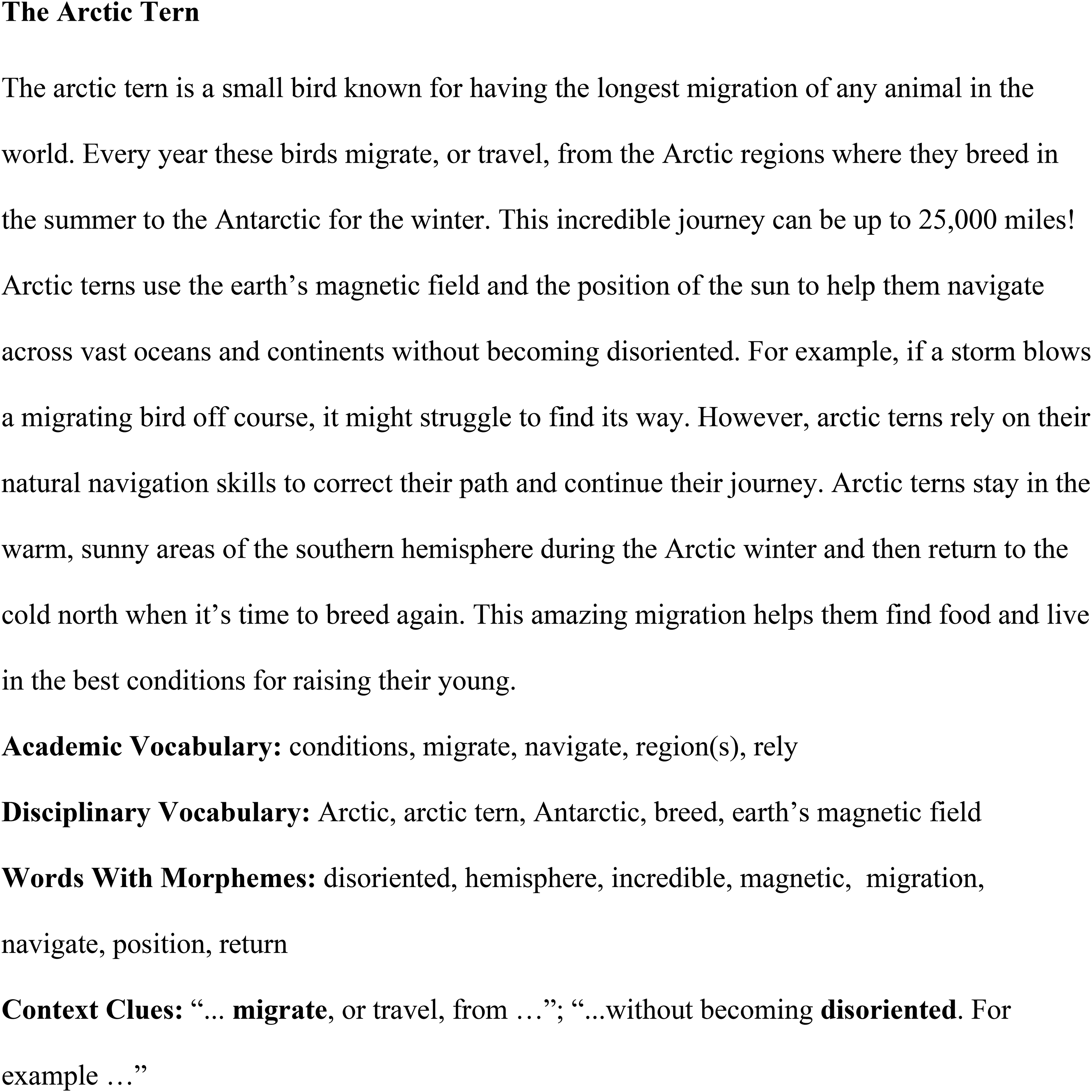
Sample middle-grade science passage to illustrate vocabulary word and activity selection. Note. “The Arctic Tern” was created using ChatGPT (OpenAI, 2024) using the prompt, “Write a paragraph about arctic tern migration that is appropriate for middle school students.” It was modified by this article's authors to include opportunities for semantic, mnemonic, and strategic, approaches to vocabulary instruction.
Semantic and Mnemonic Instruction in the Context of Text-Based Learning
Perhaps the most common reason why educators might teach vocabulary is to promote students’ understanding of core academic concepts through text-based learning. Knowing the meanings of both general academic and discipline-specific vocabulary is critical for understanding texts across the content areas. General academic vocabulary words (a) appear with relatively high frequency across a range of disciplines, (b) are typically new terms for students at the grade levels in which they are taught, and (c) are critical for facilitating text comprehension (Nagy & Townsend, 2012). Disciplinary-specific vocabulary appear within one particular content area (e.g., science, social studies) and are critical for building content knowledge (Nagy & Townsend, 2012). Both types of words are appropriate targets for instruction when the goal is to facilitate text comprehension, but targeting general academic vocabulary words has the potential to support knowledge across the disciplines while targeting discipline-specific words is critical for building knowledge within a particular discipline.
If the instructional goal is to promote comprehension of a text and to build content knowledge, semantic instruction is the appropriate instructional choice. Embedding attention to morphology can expand students’ knowledge about target words. Mnemonic instruction can also be integrated for words that are particularly difficult to remember, given the strong research base for using mnemonics to promote recall.
Word Selection
Both general academic and discipline-specific words are important to learn when engaging with content-area text. In the sample text, “The Arctic Tern,” we have identified five general academic vocabulary words and five discipline-specific words (Figure 1) as candidates for instruction. We cross-referenced these words with Coxhead's Academic Vocabulary (Coxhead, 2000) and Word Zones for 4000 simple word families (https://textproject.org/) to ensure they appear with some frequency across disciplines. To narrow word selection for instruction, educators can consider the following questions.
Question 1: Do the Students Already Know the Word? If there is evidence that students already know the word, perhaps through prereading discussion or prior instruction, a brief review of the word and its meaning may be all that is needed. Question 2: How Central Is the Word to Understanding the Text? Words that are most central to the text should be prioritized for instruction. Importance can be determined by the extent to which words are related to the central idea of the passage, and also by word frequency within the passage and across a unit. “The Arctic Tern” is about the migration of a bird, the arctic tern, from one region to another during different times of year for the purposes of breeding in the summer and staying warm in the winter. The listed discipline-specific vocabulary (Figure 1) is important for understanding the central idea of the passage. For example, “Arctic Tern” is the subject of the passage, and reference to the bird appears at least four times; thus, it is a good candidate for instruction. Additionally, understanding that “Antarctic” and “Arctic” are regions located at the south and north poles will provide students context related to the extent of the migration journey. Understanding these terms will also help students make connections across the passage, specifically relating “sunny areas of the southern hemisphere” to the Antarctic and “the cold north” to the Arctic regions. “Breed” is used twice in the passage and is one reason driving migration to the north in the summer. Finally, the “earth's magnetic field” makes the migration journey possible, and so is a candidate for instruction.
Regarding general academic vocabulary, the term “migrate” or a morphological relative (e.g., “migration,” “migrating”) appears four times in the passage. The arctic tern is a migrating bird, and the passage is mainly describing the migration patterns of the bird; thus, “migrate” is an important word to teach. “Region” shows up explicitly only once in the passage, but is useful for describing animal migration from one region to another. Multiple regions are named in the passage, including the Arctic, Antarctic, southern hemisphere, and the north; learning the word “region” will allow students to both understand and discuss the passage's content. “Navigate” is another term with strong ties to the passage's meaning. This term shows up twice, once as “navigate” and the second as “navigation,” and is an important term to explain how an arctic tern migrates from one region to another. Finally, the terms “rely” and “conditions” are also important for understanding the text, though they play a less central role in the main idea of the text compared to the other academic vocabulary words.
Question 3: Do the Words Contain Morphemes That Can Be Leveraged for Instruction, and Do They Come From Large Morphological Families? Considering the opportunity that a word brings for drawing on and building students’ morphological awareness is another consideration when selecting words or narrowing the list of words to teach. For example, according to Brittanica, “Arctic” is derived from the Greek word “arktos” meaning “bear” and referring to the northern constellations Ursa Minor and Ursa Major. Both “Arctic” and “Antarctic” contain the suffix “ic” meaning “pertaining to.” “Antarctic” also contains the prefix “anti” meaning “opposite.” Together, this morphological knowledge could be leveraged to connect both terms to regions of the earth: “Arctic” pertaining to the north where Ursa Minor and Ursa Major are found, and “Antarctic” pertaining to the south, opposite (“anti”) the Arctic north.
Other words in the passage have relatively large and useful morphological families. For example, “magnetic” contains the Latin root “mag,” which references magnetic properties and can be connected to other related words that the student may know or have learned, including “magnet,” “magnetism,” and “magnetize.” “Migrate” and “navigate” also have relatively large morphological families. For example, the Latin root “migr” in “migrate” is also found in “migration,” “migrant,” “migratory,” “immigrate,” “immigrant,” and “emigrate,” to name a few. Focusing on this word for instruction, therefore, will allow the teacher to facilitate cross-curricular connections (e.g., Snow et al., 2009), leveraging students’ knowledge of other terms containing the root “migr” when learning the new word “migrate.” Additionally, learning that “migr” means “to move” can help students connect that the other terms in the word family also have something to do with moving from place to place.
Question 4: How Semantically Related Are the Words? This consideration can help teachers narrow a larger set of words to a smaller thematic set for instruction. “Arctic” and “Antarctic” are related in that they are regions of the earth. Additionally, the terms “region,” “migrate,” and “navigate” share semantic relations in reference to migration. Together, these words facilitate understanding of migration patterns of the arctic tern. Indeed, the passage is mainly about the arctic tern migrating between the Antarctic region and Arctic region through use of its navigation skills. Teaching these words together can help provide opportunities for using the words in meaningful ways to discuss the content of the passage.
Instructional Activities for Semantic Instruction
As noted previously, semantic instruction encompasses various activities, ranging from brief synonym or definition instruction to extended opportunities where students analyze and discuss words in speaking or writing, or to graphically displaying words, their characteristics, and their relations to one another. The method of instruction depends in part on how familiar students are with the words, how central the words are to the larger curriculum unit, and whether the words and their meanings are mostly concrete or are more abstract, multifaceted, or nuanced.
We recommend different kinds of instructional activities to teach the five academic and five discipline-specific words identified in Figure 1. The following examples are modeled after the instructional activities developed in the semantic vocabulary literature (Beck et al., 2013; O’Connor et al., 2019, 2020, 2021; Snow et al., 2009; Vaughn et al., 2022). As appropriate, educators should support their students in reading and examining the spelling and morphological features of any targeted word. Relatively brief, definition-focused instruction with visuals may be used prior to or during reading to teach the meanings of all of the discipline-specific words. These words are relatively concrete and may be explained with a picture and brief explanation. The academic vocabulary “region,” “rely,” and “conditions” may also be briefly introduced with simple explanations and visuals. For example, “region,” though centrally important for understanding migration, can be explained as “an area of land” with relevant examples from the text (e.g., Arctic, Antarctic, southern, northern) and visuals (i.e., maps), and by referencing students’ personal experiences (e.g., regions of the city where they live; regions of the country that they have visited) (Ogle et al., 2016). A simple definition for “region” could be enough to promote understanding of “region” in the passage and support discussion of migration across regions.
The remaining academic vocabulary, “migrate” and “navigate,” might receive additional attention beyond definitions with examples. These words are central to passage meaning and have large and useful morphological families. In a unit on migration, they are likely to come up again. Additionally, although each could be explained with a simple synonym or phrase (e.g., “move” for “migrate” and “find your way” for “navigate”), the word meanings are more complex than a simple definition can portray. Focused, deeper instruction might be warranted to support students in learning the nuances of word meanings (Ogle et al., 2016). These words might be targeted for instruction across the unit, with initial instruction on this text targeting a working definition, examples and nonexamples, and application to comprehending the text.
For example, drawing on the text application of “migrate,” the teacher might introduce the definition “to travel between different areas at different times of year.” They might draw attention to the Latin root “migr” and explain that it means “to move.” They might encourage students to generate other words in the morphological family, perhaps first by scanning the text, which contains “migration” and “migrating.” Students might also come up with additional words in the family, including “migrant,” “immigrate,” “immigration,” and “immigrant.” In this discussion, the teacher might clarify the distinction between seasonal animal migration and (im)migration of humans, such as what might be referenced in social studies contexts. Connecting the term to its morphological family containing words with which students may be familiar can help connect the new word, “migrate,” to the students’ existing semantic network.
Notably, the pronunciation of the root “migr” varies across the morphological relatives listed earlier. Integrating instruction that combines knowledge of decoding and morphology can help students apply a range of knowledge to read, spell, and understand words. For “migrate,” the teacher could support students in identifying that the word “migrate” has two syllables, “mi” as an open syllable and “grate” as a silent-e syllable. Thus, with multifaceted instruction, students would be supported in accurately reading, spelling, and defining words.
In addition to promoting awareness of the Latin root “migr” and its connection to “migrate” and other words in the morphological family, the teacher might leverage the text to provide examples and nonexamples of “migrate.” An example would be how the arctic tern migrated from the warm southern hemisphere where they stayed in (Arctic) winter to the northern hemisphere where they went to breed. A nonexample could be moving nests when one is destroyed by a storm. The students might also be encouraged to discuss the different places where the arctic tern migrated in the passage, using the word “migration” as well as the disciplinary vocabulary “Antarctic” and “Arctic” in their oral and written discussions, or to come up with additional examples and nonexample of “migrate.” As “migrate” appears in additional texts, the teacher can support students in recalling the word meaning and using meaning to facilitate comprehension of the next text. Discussing and applying text meanings across texts and content areas will deepen and expand students’ understanding of migration.
Extended instruction on discipline-specific words may also be warranted, especially if the words are central to the unit and are represented in texts used throughout the unit. For example, if the unit is focused on different migrating animals, semantic feature tables or concept maps could be used to keep track of methods, patterns, and reasons for migration for each animal. The academic and disciplinary vocabulary could be included within and across these graphic displays. “The Arctic Tern” text might drive initial creation of the map, and the teacher could lead students in adding information to the map as they encounter different texts about migration across the unit.
Each of the semantic instruction activities presented in this section is provided for illustrative purposes. We would not expect a teacher to engage in all the activities at once; rather, teacher are encouraged to select the activities that best align with their purpose for instruction, content of the text and texts within the unit, selected words, and opportunities for instruction inherent in the words (e.g., based on students’ prior knowledge, importance, morphological structure, concreteness, and semantic relatedness). Across the year, the teacher would engage students in many different types of semantic instructional activities to build their vocabulary knowledge, but activity selection would always be guided by instructional goals, student needs, and instructional context.
Integrating Mnemonic Instruction. Mnemonic instruction is particularly useful when important terms are difficult for students to remember. Mnemonic instruction is best used as a study strategy, but can also supplement semantic instruction (Kennedy et al., 2015). For example, if the sample text is part of a unit on migration, understanding migration is critically important for learning within the unit. If students demonstrate difficulty remembering “migration,” a keyword mnemonic could be developed to help with definition recall. The term “migrate” is acoustically similar to the phrase “my great.” Using that similarity in sound, students might be taught to link the term “migrate” to the phrase “my great journey.” The teacher might use imagery of an animal taking a journey across a continent, and ask students to think of “my great journey across the continent” when they hear the word “migrate.” The keyword mnemonic paired with explicit teacher-directed instruction can strengthen students’ ability to recall meanings of difficult words.
Strategic Instruction in the Context of Text-Based Learning
The previous section showed how various instructional activities aligned with the semantic approach to vocabulary instruction can promote word learning during text-based instruction. This approach also incorporated mnemonic techniques to strengthen students’ associations between core terms and their meanings, as well as attention to morphology to deepen word knowledge. In this section, we demonstrate how the same text, “The Arctic Tern,” can serve a second instructional purpose—to promote the learning and use of vocabulary strategies. Neither approach—semantic or strategic—is inherently superior; rather, each serves a different instructional purpose and would be used when the relevant purpose aligns with the instructional goal.
As previously mentioned, strategic instruction is a key component of comprehensive vocabulary instruction (Graves, 2006). Unlike semantic and mnemonic approaches, which are typically teacher-directed and focused on teaching meanings of a particular set of words, strategic approaches help students independently infer the meanings of unfamiliar words during wide reading. Although there is some research across strategic approaches, the research base on morphological strategies, provided alone or in combination with contextual analysis, is most well developed. Therefore, we do not focus on the use of tools as a strategy in our example.
“The Arctic Tern” provides several opportunities for students to practice morphemic analysis, and two opportunities for students to practice contextual analysis (Figure 1). These strategies require EI and guided practice before students apply them independently.
Morphological Strategies
Teaching students to derive word meaning from the morphemes within words is an important aspect of vocabulary strategy instruction. However, teachers must be aware of what morphemes students have working knowledge of and which must still be taught. State academic standards, common affixes and root lists, and knowledge of students’ mastery of particular affixes and roots can guide selection of morphemes for instruction and practice. “The Arctic Tern” is a middle-grades text, and when using it, middle-grade students should have prior knowledge of inflectional suffixes (e.g., -s, -est, -ed, -ing), common prefixes and suffixes (e.g., re-, in-, dis-, -tion), and should be working toward mastery of Greek and Latin roots (e.g., hemi, sphere, migr, cred, posit) (NGA & CCSSO, 2010). With that in mind, there are several morphologically complex words in “The Arctic Tern” that could be appropriate for direct instruction in morphemes and/or morphemic strategy instruction and practice. These include “hemisphere,” “magnetic,” “migration,” “navigate,” “return,” “disoriented,” “incredible,” and “position.” Students’ prior knowledge of these terms and their morphemes could further narrow the instructional set.
One morphemic analysis strategy that includes an explicit routine to infer word meanings is the WM Strategy (Harris et al., 2011). Word Mapping includes four steps: (a) Break the word into its morphemic parts; (b) Attach meaning to the morphemic parts; (c) Predict the meaning of the word based on the meaning of the morphemic parts; and (d) Check the dictionary for the definition. Thus, morphological awareness and knowing how to use the dictionary are important prerequisite skills.
Consider the word “hemisphere” in “The Arctic Tern.” Having already provided an explanation of WM along with modeling, the teacher could guide students to identify that “hemisphere” includes the common Greek roots “hemi” and “sphere.” If needed, they would provide direct instruction on pronunciation and meanings of each root: “hemi” means “half” and “sphere” means “round shape.” Then the teacher would guide students to create a predicted meaning from the morphemic parts, for example, “half a round shape.” A dictionary check at collinsdictionary.com suggests that “hemisphere” means “half a sphere” or, in the context of science, “half of the earth.” Morphemic analysis strategies paired with direct instruction on unknown morphemes as needed should be practiced on important and morphologically complex words in text.
Context Strategies
Teaching students to analyze sentence and paragraph contexts to infer meanings of unknown words can supplement semantic and/or morphological vocabulary instruction within “The Arctic Tern.” Prior to using context clues strategies to derive word meanings, teachers might provide EI on specific types of context clues, such as definition, synonym, antonym, example, and general context clues (Baumann et al., 2003). Then, teachers can provide students with strategies for using context to derive word meaning. The Context Strategy (Graves et al., 2017), for example, includes four steps: (a) Pause when you find an unknown word whose meaning you do not know; (b) Read the surrounding words and sentences to look for context clues about meaning; (c) Use the clues to infer the meaning of the unknown word; and (d) Try out your inference to see if it makes sense. For example, the following sentence in “The Arctic Tern” is an illustration of a definition context clue: “Every year these birds migrate, or travel, from the Arctic regions where they breed in the summer to the Antarctic for the winter.” The sentence contains specific information about the meaning of “migrate” that students can use to infer a definition.
Following the Context Strategy, the teacher could remind students to (a) pause after reading the sentence containing “migrate”; (b) read the surrounding sentence(s) to look for context clues, and recognize that the definition, “to travel,” follows the word “migrate” in the sentence; (c) infer the meaning of “migrate” to be “travel”; and (d) try it within the sentence to see if it makes sense: “Every year these birds travel from the Arctic regions where they breed in the summer to the Antarctic for the winter.” The “Arctic Tern” also exemplifies an example context clue within the passage for the word “disoriented,” and students could practice the Context Strategy to determine its meaning within the passage.
Conclusion
In this article, we have provided a brief review of research on semantic, mnemonic, and strategic approaches to vocabulary instruction followed by detailed instructional examples using a middle-grades text. A summary of instructional considerations is presented in Table 1.
Semantic approaches to vocabulary instruction are widely supported in the literature for improving vocabulary knowledge of students with and without LD. Employing student-friendly definitions and providing rich opportunities for students to interact with words leads to improved knowledge of word meanings for taught words (Bryant et al., 2003; Jitendra et al., 2004; Kuder, 2017). Mnemonic approaches to vocabulary instruction are common strategies within the special education literature and are an effective tool for definition recall (Condus et al., 1986; King-Sears et al., 1992; Mastropieri et al., 1985, 1990). Strategic approaches, such as morphemic analysis, have strong empirical support for its effectiveness in helping students learn taught words and generalize their knowledge to untaught words (Bowers et al., 2010; Brady & Mason, 2023; Carlisle, 2010; Goodwin & Ahn, 2012; Reed, 2008). Other strategic approaches, such as contextual analysis, can support word learning (Baumann et al., 2002, 2003; Fukkink & de Glopper; 1998; Graves et al., 2018), especially when combined with other types of instruction. However, expecting students to incidentally learn words from context without instructional support is not recommended, especially for struggling readers (Cain et al., 2003; Shefelbine, 1990). The use of tools to derive word meanings has been shown effective in combination with other strategies (Graves et al., 2018; Lubliner & Smetana, 2005), but research is limited.
Notably, each research-supported approach serves a different purpose in the development of vocabulary knowledge. The research base for students with LD is not evenly developed across approaches, and much of the research is outdated. Nevertheless, there is some evidence that semantic, mnemonic, and strategic instruction promotes word learning for students with LD. A comprehensive vocabulary program will include multiple approaches (Graves, 2006; Manyak et al., 2020; Vaughn et al., 2022), and studies have demonstrated that combining approaches results in large effects on students’ vocabulary knowledge (see Baumann et al., 2002, 2003; Graves et al., 2018; Helman et al., 2014; Kennedy et al., 2015). The challenge is for teachers to decide when to teach each approach, and which instructional activities to use based on their instructional goals, students’ needs, and instructional context. In our instructional example, we illustrated how approaches could be emphasized or combined effectively within text-based vocabulary instruction to promote students word knowledge, use of strategies, and text comprehension. We hope the illustration can serve as a guide as teachers consider and use multiple approaches to vocabulary instruction for students with LD.
Footnotes

Funding
The author(s) received no financial support for the research, authorship, and/or publication of this article.
Declaration of Conflicting Interests
The author(s) declared no potential conflicts of interest with respect to the research, authorship, and/or publication of this article.