




Abstract
This study assessed the positive perception of distance learning of undergraduate students with and without attention deficit hyperactivity disorder (ADHD) and/or specific learning disorder (SLD), and examined their personal resources (academic self-efficacy [ASE] and sense of coherence [SOC]), and social vulnerability (loneliness) in predicting their positive distance learning perception. Participants were 276 Israeli undergraduates, 138 diagnosed with ADHD/SLD and 138 in a comparison group without disabilities. Students’ positive perceptions toward distance learning, ASE, SOC, and loneliness were assessed via self-report questionnaires. Students with ADHD/SLD reported a less positive perception of distance learning, lower ASE and SOC, and higher loneliness than students without disabilities. In both groups, females had a more positive perception of distance learning than males. ASE uniquely contributed to a positive perception of distance learning only for students with ADHD/SLD. As hybrid learning becomes more and more common in higher education, it is critical to understand the unique needs and adaptation to distance learning of students with ADHD/SLD.
Keywords
“Distance learning” generally refers to learning and instruction that takes place via remote means (Laslo-Roth et al, 2022; Milman, 2015). This kind of instruction has been found to have advantages such as increased flexibility in studying and easier access to course material, but also presents certain disadvantages such as a lack of interaction with peers and professors, poorly organized course management systems, and the need to rely on self-regulated learning (eg, Lightfoot et al, 2018; Madaus et al, 2012). During the recent COVID-19 pandemic, as fears of contagion of the virus shut down in-person learning, distance learning became fairly ubiquitous at higher education institutions around the world (eg, Crawford et al, 2020).
While the move to distance learning was challenging for students in general (Marinoni et al, 2020), it was more complicated for students with attention deficit hyperactivity disorder (ADHD) and specific learning disorders (SLD) (Kalman-Halevi et al, 2023), for whom having to adjust to a new learning environment and new technological requirements alongside social distancing and loneliness (Crawford et al, 2020; Engler et al, 2020) posed significant challenges due to generally lower feelings of competence (Serrano et al, 2023), fewer personal resources such as academic self-efficacy (ASE), a lower sense of coherence (SOC) (Ben-Naim et al, 2017; Yu et al, 2018), and higher levels of loneliness (Laslo-Roth et al, 2022; Sharabi et al, 2016) than students without these disabilities. Indeed, studies conducted in the adjustment period to distance learning during the pandemic found that students with ADHD and SLD reported greater learning difficulties and a negative experience with distance learning, alongside greater social and personal difficulties and higher levels of loneliness as an expression of their distress compared to students without these disabilities (Kalman-Halevi et al, 2023; Laslo Roth et al, 2022; Zhang et al, 2020).
Although defined, diagnosed, and treated differently, ADHD and SLD have common characteristics, and previous studies on students in higher education with these disorders have tended to combine the two groups (eg, Kalman-Halevi et al, 2023). In Israel, where the current study took place, it is also common to combine these groups when referring to postsecondary students (Law on the Rights of Students with Learning Disabilities in Postsecondary Institutions, 2008; Monnickendam-Givon, 2022; State Comptroller, 2013).
As the pandemic waned, many higher education institutions integrated distance learning as a part of their traditional programs and combined it with face-to-face learning, terming it “hybrid learning” (Guppy et al, 2022). In light of the changes facing students with ADHD and SLD, it is important to identify the various factors that predict their feelings and perceptions towards distance learning as a means of facilitating appropriate support to help these students adapt to the unique characteristics and requirements of distance learning.
As such, the goal of the current study, which was conducted after about one year of adjustment to distance learning (in 2021), was to explore the factors that predict a positive perception of distance learning among students with and without ADHD and/or SLD, 1 and to explore the differences in the positive perceptions of distance learning, personal resources (ASE, SOC), and vulnerability (loneliness) between students with and without these disabilities.
Distance Learning and Students With ADHD/SLD
Prior to the recent COVID-19 pandemic, distance learning was used primarily in select courses, and most students did not experience this type of learning as a regular part of their education (Allen et al, 2016). Although distance learning, in general, provides flexibility in terms of when and where to study (Levy, 2017), and has advantages such as increased personal responsibility and independence (Lischer et al, 2022), it is also characterized by certain limitations. For example, it is inaccessible to many students, due to a lack of infrastructure in their communities, as well as students’ lack of competencies and pedagogies for distance learning (Marinoni et al, 2020), which, in turn, are reflected in lower levels of persistence in courses and reduced academic success compared to students in face-to-face courses (Xu & Jaggars, 2013). In contrast, in-person learning supports and contributes to the learning process, offers opportunities to share knowledge and seek help if needed, and provides readily available communication with instructors (Cuevas et al, 2017; Miliszewska, 2007).
Studies relating to students with disabilities encountering distance learning prior to the COVID-19 pandemic also reflect both advantages and disadvantages of this learning approach. For example, distance learning courses rely on more self-regulated learning and executive function skills, which may challenge students with ADHD/SLD, who often experience difficulties in these areas (Madaus et al, 2012). Further, students with SLD studying in a distance learning framework reported slightly higher levels of academic stress and reduced academic success than students without learning disabilities, often attributing their lack of academic success to external factors such as an absence of appropriate test conditions, anxiety, or luck (Heiman, 2006). At the same time, the ability to have control over their studies and feeling less social pressure were found to be advantages of distance learning by students with disabilities (Kotera et al, 2019).
With the outbreak of the COVID-19 pandemic, the higher education system around the world largely shut down and suddenly moved from physical learning on campus to learning online from a distance (Duong et al, 2020; Rashid & Yadav, 2020). Studies conducted in the United States during this transition found that a majority of higher education students expressed a dislike for distance learning and reported impaired personal wellbeing stemming from increased stress or anxiety as a result of extended sitting in front of a screen and social distancing in the learning and work environments (Duong et al, 2020; Hagedorn et al, 2022).
Similarly, in a study conducted in Israel during the first wave of the pandemic (Feb–May, 2020), higher education students reported low ratings of adjustment to distance learning (Shraga-Roitman et al, 2022). However, students who were more open-minded about the use of the online environment for the teaching-learning process reported a higher degree of satisfaction with the online learning experience during the pandemic (Coman et al, 2020).
For students with ADHD and SLD, the immediate transition to distance learning at the outbreak of the pandemic was particularly challenging (Laslo-Roth et al, 2022; Sarid & Lipka, 2023), as they tried to cope with various difficulties in meeting their institutions’ academic demands (Canu et al, 2021). In particular, changes to the learning environment during this period were a source of social distress and loneliness for students with ADHD, and they reported more difficulties and negative experiences in distance learning compared to their peers without disabilities (Kalman-Halevi et al, 2023; Laslo-Roth et al, 2022). At the same time, a study exploring adjustment to distance learning found that while students reported lower rankings of adjustment to the transition, there were no differences between students with and without ADHD (Shraga-Roitman et al, 2022).
Regarding sex differences, significant differences were found at different developmental stages. For example, female high school students (Liu et al, 2021) and females in higher education reported better adjustment to distance learning than their male counterparts (Aristovnik et al, 2020; Shraga-Roitman et al, 2022).
Towards the end of the pandemic, many higher education institutions began to include distance learning as a regular part of their programs. Indeed, a study examining views of future scenarios of learning in higher education among college and university faculty, students, and administrators revealed that most of those surveyed expected that the greatest growth would be in hybrid learning, alongside an increase in fully online courses (Guppy et al, 2022). In light of this increase in distance learning facing all students, including those with disabilities, the current study delved more deeply into the experiences of undergraduates with ADHD/SLD, particularly their personal resources of academic self-efficacy and sense of coherence, as well as their vulnerability to loneliness and how these related to their perceptions of distance learning.
Academic Self-Efficacy (ASE) and Students With ADHD/SLD
Self-efficacy relates to the degree to which individuals believe that they have the ability to meet their desired outcomes or achieve their goals (Bandura, 2012). According to Bandura (2018), perceived self-efficacy is a set of self-beliefs linked to distinct realms of functioning rather than a global trait. One of these domains is academic self-efficacy (ASE), which expresses a person's expectations and beliefs in their ability to meet their academic requirements (Bandura, 1997) and their confidence that they have the necessary skills to achieve their desired academic performance (Zimmerman, 2000). ASE has been found to be associated with greater academic success (Høigaard et al, 2015).
Students with ADHD/SLD (in both high school and higher education) reported lower ASE than students without these disabilities both before and during the COVID-19 transition to distance learning (Ben-Naim et al, 2017; Einav et al, 2018; Mana et al, 2022; Sarid & Lipka, 2024; Sharabi et al, 2016). For example, Casali et al (2024) found that ASE is significantly positively related to both academic achievement and academic satisfaction, suggesting the importance of this variable for students’ performance and extending its relevance to academic wellbeing among students with SLD. Important, Yokoyama (2019) argued that ASE relates to academic performance in a distance learning environment similarly to face-to-face learning. Finally, ASE has been shown to correlate with SOC, which is an important inner protective factor that helps students, particularly those with disabilities, cope with academic and social challenges (Ben-Naim et al, 2017; Sharabi et al, 2016).
Sense of Coherence (SOC) and Students With ADHD/SLD
Sense of coherence is a primary variable in Antonovsky's (1987, 1996) salutogenic model (“health promotion”). That is, SOC is a global orientation that expresses the extent to which (a) one has an enduring (though dynamic) feeling of confidence that the stimuli deriving from one's internal and external environments are structured, predictable, and explicable (comprehensibility); (b) one has resources available to meet the demands posed by these stimuli (manageability); and (c) these demands are challenges worthy of investment and engagement (meaningfulness). As a measure of an inner personality resource, SOC is considered a significant protective factor of personal adjustment (Lundman et al, 2010), and based on a review of studies, Braun-Lewensohn et al (2017) found that SOC can be a meaningful resource for effectively coping with a wide variety of stressful situations.
The COVID-19 pandemic was challenging for undergraduate students who faced numerous stressors such as reduced social interactions due to the implementation of distance learning. This has been associated with an increase in psychological symptoms (eg, stress, negative well-being), decreased SOC, and an increase in students’ feeling of “mental burden” (Misamer et al, 2021). Kulcar et al (2023) found that SOC mediated the effects of stressors on undergraduate students’ wellbeing, particularly stressors such as financial strains, unsatisfactory study situations, or disrupted plans.
While the pandemic seems to have had an impact on all college students’ SOC, it is not clear how it related specifically to the SOC of students with ADHD/SLD. In general, in studies on SOC at various developmental stages across the school years, including higher education, students with SLD reported lower SOC than their typical peers (Ben-Naim et al, 2017; Idan & Margalit, 2014; Sharabi, 2013; Sharabi et al, 2016). Additionally, among adolescents and adults with ADHD, SOC emerged as a protective factor from the adverse effects of ADHD symptoms and moderated the relation between ADHD symptoms and antisocial behavior (Dayan et al, 2022). Thus, difficulties related to the learning challenges of students with ADHD are prevalent throughout their education. Moreover, even if these students are academically successful, their ongoing struggles are reflected in reduced personal strength expressed by lower SOC, along with lower future expectations and pathways as college and university students (Ben-Naim et al, 2017). Finally, among students with and without SLD, lower SOC has also been related to higher levels of loneliness (Sharabi et al, 2016).
Loneliness and Students With ADHD/SLD
Loneliness is a negative emotional experience that affects one's quality of life and can impair one's overall wellbeing. Influenced by life experiences, personal variables, and situational factors, a sense of loneliness stems from a discrepancy between an individual's current social relationships and their expected ones (Margalit, 2012; Peplau & Perlman, 1982). Loneliness may be conceptualized as an index of personal and interpersonal distress and as a risk factor for wellbeing and health (Cacioppo et al, 2015). Studies with children, adolescents, and adults have shown that people who express greater loneliness differ from their less lonely peers in the ways in which they interpret social encounters and deal with difficulties in relationships (Qualter et al, 2015). Further, more recent research on differences in the experience of loneliness across cultures, age, and sex, found that loneliness increased with individualism, decreased with age, and was greater in men than in women (Barreto et al, 2021).
In terms of individuals with disabilities, students with ADHD/SLD in various developmental stages reported higher levels of loneliness than their peers without disability (Margalit, 2012). This includes students in higher education before and during the transition to distance learning, and in relation to difficulties with distance learning (Laslo-Roth et al, 2022; Mana et al, 2022; Sharabi et al, 2016).
Study Rationale and Hypotheses
In light of the move to distance learning in higher education institutions during the COVID-19 outbreak, and the continued use of distance learning post-pandemic (ie, hybrid learning), along with the potential for increased difficulties facing students with ADHD/SLD, the current study examined the perceptions of undergraduate students with ADHD/SLD towards distance learning after about one year of intensive distance learning. Specifically, the study adopted a positive approach based on individuals’ strengths and resources and ways to promote them, with the aim of positively influencing their functionality (Casali et al, 2024; Ruch et al, 2020). Further, the study explored the factors that predict a positive perception of distance learning, comparing students with and without ADHD/SLD. More specifically, the following three hypotheses were posed: H1 - Differences between students with and without ADHD/SLD: Based on the existing literature, we expected students with ADHD/SLD to report lower levels of positive distance learning perception (Laslo-Roth et al, 2022), lower ASE (Mana et al, 2022) and SOC (Ben-Naim et al, 2017; Sharabi et al, 2016), and higher levels of loneliness (Laslo-Roth et al, 2022; Mana et al, 2022) than students without disabilities. H2 - Sex differences: Based on previous studies H3 - Associations between positive distance learning and study variables: Based on existing studies, we hypothesized that distance learning perception would be negatively correlated with loneliness (Laslo-Roth et al, 2022). Due to a lack of research, we further explored the variables that predict a positive distance learning perception without a particular hypothesis.
Method
Participants
The sample consisted of 276 undergraduate students in Israel. Of the total sample, 138 were students who reported having received a diagnosis of ADHD/SLD from a neurologist/psychiatrist/licensed psychologist: 35 males (25.4%) and 103 (74.6%) females (mean age = 26.6; SD = 3.07). Of this group, 58 reported a diagnosis of ADHD (42.5%), 24 reported a diagnosis of SLD (16.5%), and 56 reported a diagnosis of both ADHD and SLD (41%). In terms of academic accommodations, 114 (85.1%) reported being eligible for exam accommodations, but only 91 (70%) reportedly used accommodations during distance learning. Among students with ADHD, 84 (62.6%) reported using stimulant medication in general, but only 61 (48.1%) reported using medication during distance learning. The comparison group consisted of 138 students without ADHD/SLD, 29 (21%) males and 109 (79%) females (mean age = 26.5, SD = 4.32).
In terms of their studies, 71 participants were first-year students (23 with ADHD/SLD and 48 non-ADHD/SLD), 56 were second-year students (34 students with ADHD /SLD, 22 non-ADHD/SLD), and 149 were third-year students (81with ADHD/SLD, and 68 non-ADHD/SLD). Chi-square and t-tests revealed no significant differences in age or proportion of the sexes between the groups with and without disabilities.
In Israel, ADHD is diagnosed by a psychiatrist or neurologist, based on evidence of significant difficulties in attention and executive functioning and/or hyperactivity and impulsive symptoms. A diagnosis of SLD includes the presence of a verbal and/or performance IQ score in the low-average range or above (ranging from 85 to 120) and evidence of a processing deficit in reading, writing, and/or mathematics, using Israeli Ministry of Education criteria confirmed by a psychologist via psycho-educational evaluation. ADHD and SLD are diagnosed as separate disabilities, even if they may co-occur. Students with these disorders are recognized by the Israeli Ministry of Education as entitled to testing accommodations such as extended time or use of a computer instead of writing during examinations.
Due to Israeli confidentiality standards and a request for anonymity by the ethics committee at the authors’ institution, the data for this study relied on participants’ self-report of their diagnosis. ANOVAs revealed no significant differences in terms of the study variables (ie, distance learning perspective, ASE, SOC, and loneliness) between participants based on their disability (ie, ADHD, SLD, or combined ADHD + SLD).
Measures
Five instruments were used to gather information on the variables of interest.
Demographics
A demographics questionnaire was administered to all participants. Ten of the 18 items making up the questionnaire were administered to all participants, such as age, sex, school year, and degree; an additional 8 items were administered to students with ADHD/SLD. The latter included questions such as the date and method of their diagnosis (eg, psycho-didactic, neurological, psychiatric), along with questions about the support they received (eg, eligibility for test accommodations) and whether they were taking stimulant medication in general and during distance learning.
Positive Distance Learning Perception Scale
This researcher-designed questionnaire was developed following the transition to distance learning in Israeli institutions of higher learning in 2020 with the outbreak of COVID-19. The instrument specifically examines how students perceive distance learning with an emphasis on a positive perspective. For example, “I prefer distance learning over face-to-face learning”; “Distance learning has many benefits”; and “I learn better in distance learning than in face-to-face learning.” The questionnaire includes 10 items to which participants respond on a Likert-type scale ranging from 1 = do not agree at all to 5 = agree very much. Higher scores indicate a more positive perception of distance learning. Internal consistency was high, with Cronbach's α = .93.
Academic Self-Efficacy Scale
The Hebrew adaptation (Lackaye & Margalit, 2006) of the Academic Self-Efficacy Scale (Zimmerman et al, 1992) consists of 11 statements describing how students cope with various academic tasks in order to succeed in their studies and self-regulate their learning activities (eg, “I can remember what has been studied in class and the textbook”). Participants’ responses reflect their level of confidence using a 7-point Likert-type scale ranging from 1 = not sure at all to 7 = completely confident. A higher score indicates a higher level of ASE. Internal reliability in the current study was high, with Cronbach's α = .89.
Sense of Coherence Scale
The short version of this self-report scale (Antonovsky, 1987) was used to rate students’ sense of confidence in themselves in their world: their “comprehensibility” and feelings that they understand their environment; their “manageability” of their environment and feelings of control; and their “meaningfulness” and involvement in a variety of areas of their environment. The scale consists of 14 items to which participants respond on a 7-point Likert-type scale. For example, statements such as “Doing the things you do every day is …” were rated using descriptors ranging from 1 = a source of pain and boredom to 7 = a source of deep pleasure and satisfaction. Higher scores reflect a greater sense of coherence. Internal consistency in the current study was Cronbach's α = .80.
Loneliness Scale
The Hebrew adaptation (Iecovich, 2013) of the Loneliness Scale (De Jong Gierveld & Van Tilburg, 2006) consists of nine statements describing social and emotional loneliness. Items include “I miss having a really close friend” and “I often feel rejected.” The measure uses a scale of 1 = no, 2 = sometimes, and 3 = yes. A higher score indicates a greater sense of loneliness. Internal consistency in the current study was Cronbach's α = .86.
Procedure
Approval to conduct the study was provided by the ethical review board of the authors’ institution. The study was conducted in the second semester of 2021, during the “third wave” of COVID-19, after students had been involved in about one year (two semesters) of distance learning in higher education. The students were recruited primarily through an online survey circulated via social media. The first page of the survey contained an informed consent form; starting the survey constituted provision of consent. It was made clear that participation in the study was voluntary and anonymous and that the study adhered to all relevant ethical guidelines.
The initial sample included 185 students with ADHD/SLD and a comparison group of 138 students without a disability, all of whom filled out the Google Form survey. To create two equal-sized groups, we randomly selected 138 students with a disability. Chi-square and t-tests revealed no significant differences between the adapted and original samples.
Data Analysis
The preliminary analysis consisted of Pearson correlations to examine associations among the research measures and a MANOVA to examine the differences between (a) students with and without ADHD/SLD and (b) males and females (sex). In addition, two sets of hierarchical regressions were performed to identify predictors of the students’ positive perception of distance learning, separately for students with and without ADHD/SLD.
Results
Descriptives
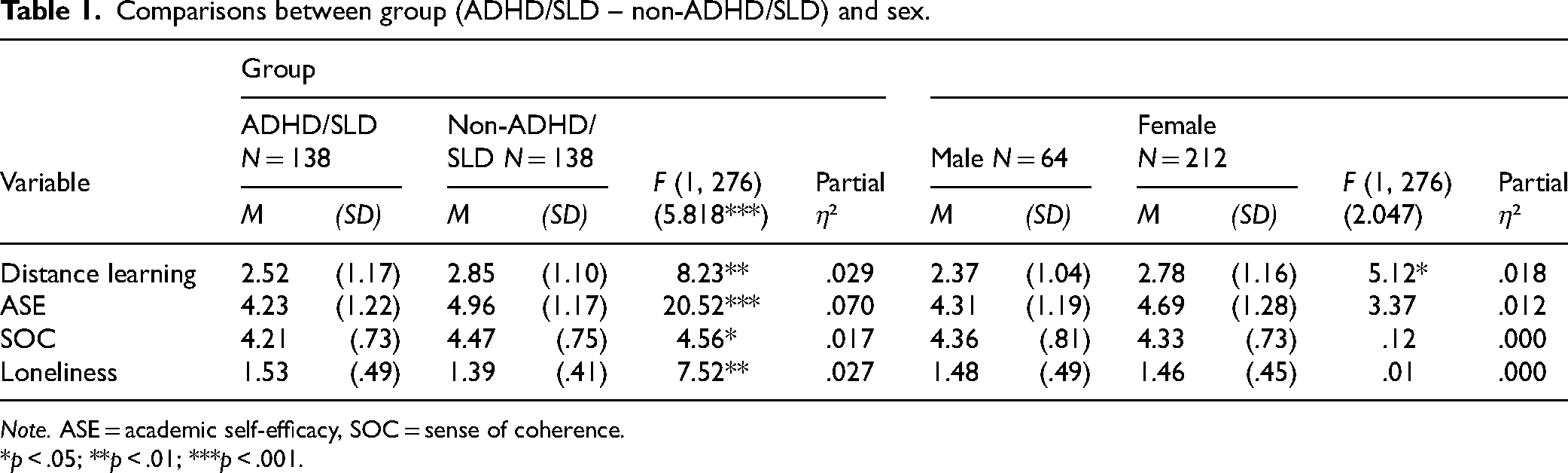
Overall, the average positive perception of distance learning held by students (with and without ADHD/SLD together) was somewhat lower than the average of the Positive Distance Learning Perception Scale of 1–5 (M = 2.68; SD = 1.15). The personal resources scales (Sense of Coherence Scale and Academic Self-Efficacy Scale; scale of 1-7) were also both above average: SOC (M = 4.3, SD = .75), ASE (M = 4.59, SD = 1.26), whereas the Loneliness Scale (1-3) was average (M = 1.46, SD = .45). Means and standard deviations of each of the variables for each group (with/without ADHD/SLD) are presented in Table 1.
Comparisons between group (ADHD/SLD – non-ADHD/SLD) and sex.
Note. ASE = academic self-efficacy, SOC = sense of coherence.
*p < .05; **p < .01; ***p < .001.
Correlations
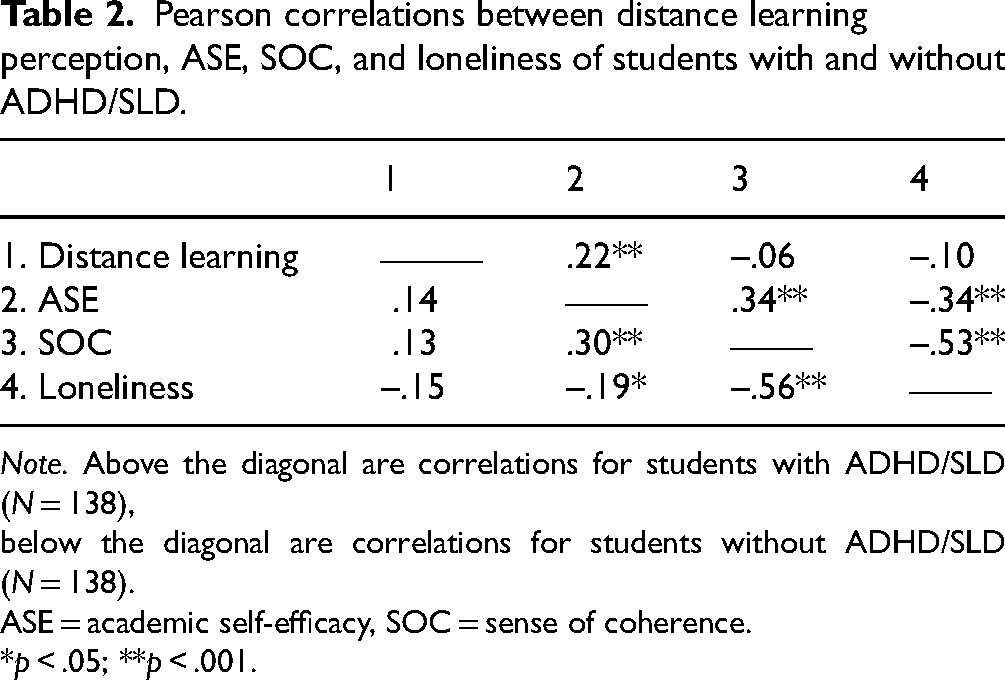
Pearson correlations between study variables were performed separately for students with and without ADHD/SLD (see Table 2). A significant positive correlation between positive perception of distance learning and ASE was found only among students with ADHD/SLD. A significant positive correlation between ASE and SOC and a significant negative correlation between loneliness and ASE and SOC were found in both groups.
Pearson correlations between distance learning perception, ASE, SOC, and loneliness of students with and without ADHD/SLD.
Note. Above the diagonal are correlations for students with ADHD/SLD (N = 138),
below the diagonal are correlations for students without ADHD/SLD (N = 138).
ASE = academic self-efficacy, SOC = sense of coherence.
*p < .05; **p < .001.
Group Differences
To decrease the chance of Type 1 errors, a two-way MANOVA was conducted with Group (with/without ADHD/SLD) and Sex (male/female) as the independent variables, and with the following dependent variables: positive perception of distance learning, ASE, SOC, and loneliness. Partial η² was calculated as an estimate of effect size. Results revealed a significant main effect for Group, F(1, 272) = 6.72, p < .001, partial η² = .09, but no significant main effect for Sex, F(1, 272) = 2.05, p = .088, partial η² = .03, and no significant interactions, F(1, 272) = 1.29, p = .273, partial η² = .019. Students with ADHD/SLD reported a less positive perception of distance learning, lower ASE and SOC, and higher levels of loneliness than students without disabilities. Significant differences for sex were found only for positive distance learning perception, with female students reporting a more positive perception than male students (see Table 1).
Prediction of Positive Perception of Distance Learning
To examine the variables predicting the positive perception of distance learning, hierarchical multiple-regression analyses were conducted separately for students with and without ADHD/SLD with self-reported positive perception of distance learning as the dependent variable. In each regression, the variables (personal characteristics, ASE, SOC, and loneliness) were entered in two steps as detailed below.
Students With ADHD/SLD
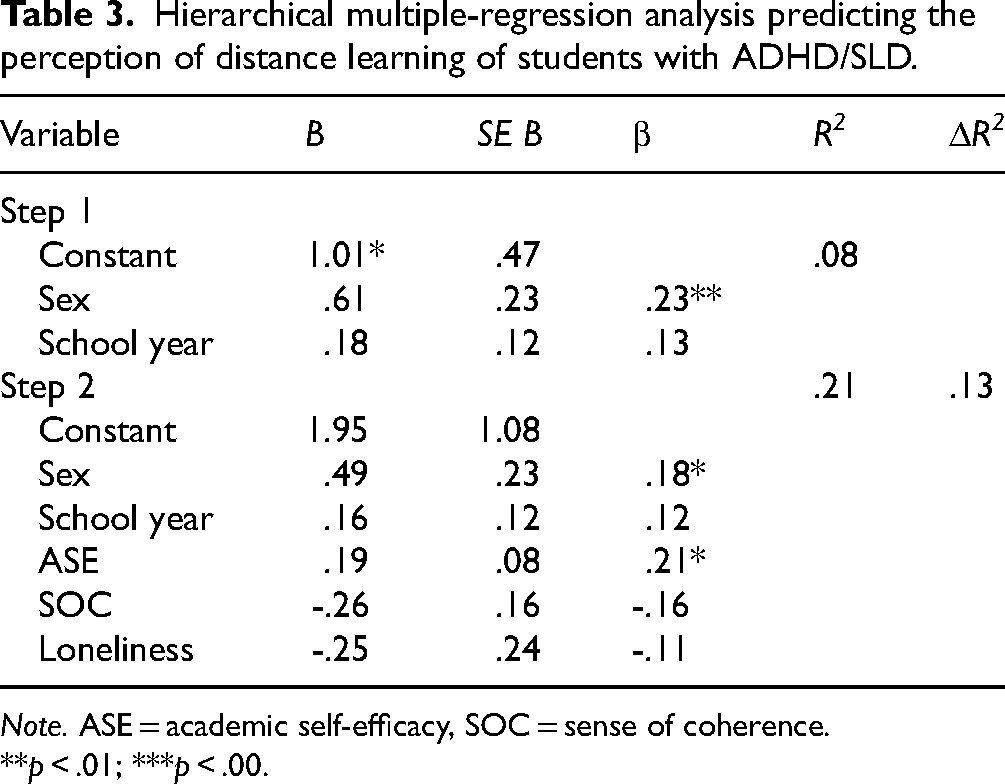
In the first step, the personal variables of Sex and School year (first, second, or third year in higher education) were entered; these variables showed a significant contribution, F(2, 135) = 5.41, p < .01, explaining 8% of the variance in positive perception of distance learning. Sex had a unique explanation, with females predicted to have a higher level of positive perception of distance learning (see Table 3). ASE, SOC, and loneliness were entered in the second step, explaining an additional 13% of the variance, F(5, 132) = 4.78, p < .01, for a total explanation of 21%. ASE had a unique explanation of the variance in positive distance learning perception (higher ASE predicted a higher positive perception of distance learning). The other variables did not significantly predict students’ positive perception of distance learning.
Hierarchical multiple-regression analysis predicting the perception of distance learning of students with ADHD/SLD.
Note. ASE = academic self-efficacy, SOC = sense of coherence.
**p < .01; ***p < .00.
Students Without ADHD/SLD
In contrast to students with ADHD/SLD, in the regression for students without disabilities, both the first step, F(2, 135) = .262, p = 0.77, and the second step, F(5, 132) = 1.21, p = .31, showed insignificant contributions. The personal variables of Sex and School year (first, second, or third year in higher education) were entered in the first step, which explained 1% of the variance in students’ positive perception of distance learning; ASE, SOC, and loneliness were entered in the second step, explaining 5% of the variance, for a total explanation of 6%.
Discussion
The current study examined the differences between undergraduate students with and without ADHD/SLD regarding their positive perceptions of distance learning, personal resources (ASE, SOC), and vulnerability (loneliness), and explored the variables that predict a positive perception of distance learning. The investigation of positive perception rests on recent models advocating the adoption of a positive approach based on a person's strengths and resources and the positive tendencies they present, along with the ways that they can be nurtured in order to positively influence their functioning (Niemiec et al, 2017; Ruch et al, 2020).
Differences Between Students With and Without ADHD/SLD
In line with Hypothesis 1 (H1), students with ADHD/SLD reported having a less positive perception of distance learning, lower ASE and SOC, and higher levels of loneliness than their peers without disabilities. These findings are consistent with those of previous research, both before and during COVID-19, which showed that undergraduates with ADHD and SLD consistently reported difficulties in adapting to academic demands along with social-emotional challenges, fewer personal resources, and more vulnerabilities than their peers (Ben-Naim et al, 2017; Casali et al, 2024; Laslo-Roth et al, 2022; Mana et al, 2022; Sarid & Lipka, 2024; Sharabi et al, 2016). Moreover, our findings validate the presence of these difficulties after one year of adaptation to distance learning during the COVID-19 pandemic. Our findings reinforce the importance of focusing on the personal resources and vulnerabilities of students with these disabilities in distance learning contexts, as these frameworks become ever-present in higher education (Guppy et al, 2022).
Sex Differences
Supporting Hypothesis 2 (H2), sex differences were found in the context of distance learning, with female students both with and without ADHD/SLD reporting a more positive perception of distance learning than their male counterparts. This finding supports those of other studies conducted during the transition to distance learning, where female undergraduates adjusted better and were more self-regulated to distance learning than males (Aristovnik et al, 2020; Shraga-Roitman et al, 2022). Distance learning requires different organization skills than in-class learning (eg, physical space, technological needs; Crawford et al, 2020), and it is important to explore various adaptations required of both female and male students with and without ADHD/SLD. Further, it is necessary to determine how to best support male students to improve their adjustment to and increase their positive perception of distance learning.
Correlations Between Positive Perception of Distance Learning and Loneliness
In contrast to Hypothesis 3 (H3) and the study of Laslo-Roth et al (2022), we did not find a significantly negative relation between positive perception of distance learning and loneliness among students with and without ADHD/SLD. This may relate to the time period when the research was carried out. Whereas Laslo-Roth et al conducted their study during the move to distance learning at the beginning of the pandemic, the current study took place one year into the adaptation to distance learning. We believe that this, along with the support students received from their higher education institution during that time, helped the students cope with the challenges of the rapid move to distance learning. This argument is also supported by Lee (2022), who found that college students (without distinguishing disability status) related supports such as prompt feedback from the instructor, interaction among students, and effective design of tasks to their satisfaction with online learning. Similarly, Johnson et al (2023) highlighted the importance of learners feeling connected and establishing communities of practice for increasing the effectiveness of online learning.
Variables Predicting a Positive Perception of Distance Learning
With regard to predicting a positive perception of distance learning, we assessed whether personal resources (ASE and SOC) and vulnerability (loneliness) promoted or hindered a positive perception. Surprisingly, although students with ADHD/SLD reported lower ASE and a lower positive perception of distance learning than students without disabilities, a unique contribution of ASE to predicting a positive perception of distance learning was found only among the students with ADHD/SLD. The research on the relationship between ASE and academic performance via distance learning is still in the beginning stages, but so far it has primarily revealed a positive relation between these variables (Yokoyama, 2019). Moreover, to date there is little research relating ASE to academic outcomes for students with disabilities. Sarid and Lipka (2024) found that higher ASE for cognitive operations and social interactions was related to higher engagement in online learning for undergraduates with and without ADHD/SLD. At the same time, the subgroup of students with ADHD reported lower ASE for cognitive operations than did students without disabilities and were less engaged in online learning than students without ADHD/SLD.
The unique contribution of ASE in explaining the variance in the positive perception of distance learning among students with ADHD/SLD found in the current study underlines the need to examine the characteristics of the relationship between these variables in line with the unique needs of students with ADHD/SLD. Moreover, these findings indicate the need to promote personal resources such as ASE in efforts to develop a positive perception towards distance learning.
In sum, it is important for all students to be prepared for, adapt to, and develop positive attitudes towards distance learning, but it is especially so for students with ADHD or SLD, who are more challenged academically. As suggested by Yokoyama (2019), familiarity with online learning may affect both ASE and academic performance in online learning settings in general. This is particularly important as hybrid settings have become a common learning environment after COVID-19, and sometimes are the preferred environment in academic settings and in higher education curricula (Guppy et al, 2022). Additionally, students with ADHD/SLD in higher education, who tend to demonstrate lower levels of ASE and SOC and higher levels of loneliness (Ben-Naim et al, 2017; Casali et al, 2024; Laslo-Roth et al, 2022; Mana et al, 2022; Margalit, 2012; Sharabi et al, 2016), it is important to examine the types of support they receive in the context of distance learning. This is true for academic supports such as ongoing communication and direct support from lecturers and techno-pedagogical support as well as emotional support in dealing with the social distancing involved in distance learning (Sarid & Lipka, 2023).
Limitations and Future Directions
The current study is subject to a number of limitations. First, the study relied on students’ reports of their ADHD/SLD diagnoses, but these could not be verified due to the restrictions of privacy regulation in Israel and the request for anonymity by the ethics board of the participating institution. Additionally, the study relied on self-report questionnaires, which are often subject to social desirability bias. It is recommended that future research continue to explore these aspects by integrating in-depth interviews that will provide greater insight into the needs and motives of students with ADHD/SLD regarding distance learning.
While the study was conducted about one year after the initial adjustment to distance learning, given the increase in the frequency of hybrid learning in higher education, it is also important that future studies investigate distance learning and its influences on students with ADHD and SLD based on positive models, including the positive perceptions of students with these disabilities and how they relate to their perceived ASE and academic success.
Implications for Practice
The results of the study have several practical implications focusing on promoting the success of students in higher education with ADHD/SLD. Support centers for these students should take into consideration the factors that promote or hinder positive perceptions of learning in general, such as ASE, and particularly distance learning, which is becoming more common, along with the factors that impede the social-emotional adjustment of these students. Such interventions, whether in a group or individual format, should address the individual's needs, including the unique characteristics (socio-emotional and educational) of these students with ADHD/SLD.
It was notable that, compared to when they engaged in face-to-face learning, fewer students with ADHD/SLD reported relying on their typical supports such as medication and testing accommodations when participating in distance learning during the pandemic, despite reporting a less positive perception of this way of learning. It is important for support centers and lecturers in higher education institutions to explore the use of academic and emotional supports available to these students and encourage their use in accordance with their needs.
Educators can also benefit from professional development in incorporating principles of universal design of instruction (UDI), which aim to make learning and instruction accessible for all students, including those with disabilities (Burgstahler, 2009; Sanger, 2020). For example, instructors of online courses could incorporate various assignment formats and frequent contact with students into classes that rely on distance learning (Rao et al, 2015).
Conclusions
This study helps fill the existing knowledge gaps regarding personal resources and vulnerabilities in light of changes in learning practices in the transition to distance learning, while comparing students with and without ADHD/SLD. Surprisingly, loneliness neither promoted nor hindered a positive perception of distance learning among students with ADHD/SLD, whereas ASE made a unique contribution to their positive perception. Consideration of this predictive factor in a population that is at risk for increased learning difficulties enables a broader view of various learning environments (including hybrid and full distance learning), while paying particular attention to these students’ needs. Overall, the study emphasizes the importance of focusing on the resources and positive tendencies that people present, with the aim of promoting them and positively influencing the academic, social, and emotional functioning expected of them.
Footnotes
Declaration of Conflicting Interests
The author(s) declared no potential conflicts of interest with respect to the research, authorship, and/or publication of this article.
Funding
The author(s) received no financial support for the research, authorship, and/or publication of this article.
