




Abstract
This article identifies novel insights from a detailed analysis of the travaux préparatoires of the right to science provisions in the Universal Declaration of Human Rights (UDHR) and the International Covenant on Economic, Social and Cultural Rights (ICESCR). It makes five main contributions. First, it demonstrates the bidirectional influence between the UDHR and the earlier American Declaration of the Rights and Duties of Man in the formulation of the right to science, as opposed to unidirectional borrowing. Second, it traces the origins of Article 15 ICESCR to the UNESCO Constitution and argues that Article 15, specifically subclauses 2–4, were intended as implementation measures, though Article 15(3) was elevated into a separate and additional obligation due to its perceived importance for scientific and creative progress. Third, it clarifies an apparent conflict between drafting history and subsequent instruments concerning scientific purpose by distinguishing the development and use of science. Fourth, it suggests facilitating the search for truth as an unarticulated object and purpose of these provisions. Finally, it shows that many drafters acknowledged a broad scope of ‘science’ beyond the natural sciences. Overall, this article elucidates overlooked aspects of the travaux to inform contemporary debates on this important yet obscure right.
INTRODUCTION
The right to ‘share in scientific advancement and its benefits’ was first recognised in Article 27(1) of the 1948 Universal Declaration of Human Rights (UDHR). When efforts were made to turn the commitments in the UDHR into binding Covenants, this provision was reformulated in Article 15(1)(b) of the 1966 International Covenant on Economic, Social and Cultural Rights (ICESCR) as the right of everyone ‘to enjoy the benefits of scientific progress and its applications’. 1
This right is complemented by the right of everyone to ‘take part in cultural life’ in Article 15(1)(a), 2 to ‘benefit from the protection of the moral and material interests resulting from any scientific, literary or artistic production of which he is the author’ in Article 15(1)(c), 3 as well as three further science-related provisions within Article 15 ICESCR, specifically, sub-clauses 2–4. According to Article 15(2), ‘[t]he steps to be taken by the States Parties to the present Covenant to achieve the full realisation of this right shall include those necessary for the conservation, the development and the diffusion of science and culture’. 4 Under Article 15(3), States parties ‘undertake to respect the freedom indispensable for scientific research and creative activity’. 5 Article 15(4) exhorts States parties to ‘recognise the benefits to be derived from the encouragement and development of international contacts and co-operation in the scientific and cultural fields’. 6
The ‘right to science’, as the science-related parts of Articles 27(1) UDHR and 15 ICESCR have since become known, 7 is a topical and important right given the immense power of modern science and technology. Despite its potential relevance to topics such as the regulation and governance of emerging technologies, the spread of misinformation, and other topics at the intersection between science and society, this ‘most obscure of all the international human rights treaty provisions’ 8 has ‘long been overlooked, with the result that its legal development is rudimentary, at best’, 9 and ‘is often ignored in practice by the governments bound to implement it’. 10
Despite growing interest from scholars
11
and UN expert bodies,
12
the right to science remains incompletely understood. Riedel, writing as a member of the CESCR, believed this neglect was in part due to the absence of definitions and guidance on the meaning of its terms, leading to difficulty in determining the normative content of the right.
13
Oberleitner notes that: [t]he complex language, overlapping interlinkages, and vague content of Art. 15 ICESCR gave rise to many questions as to the contour, scope, and utility of constructing a human right to science and, for decades, relegated this provision to the backyard of human rights theory and practice.
14
In addition to the ambiguity of its terms, several issues complicate an analysis of this right. First, the normative content of the right to science has yet to be authoritatively settled by a competent court and the available State practice has received little detailed attention. 15 Second, the object and purpose of the provision, as well as the significance of its context, are not readily apparent from the text alone. These elements, which, according to the general rule of interpretation in Article 31 of the 1969 Vienna Convention on the Law of Treaties (VCLT), 16 might help elucidate the ordinary meaning of the terms used, have yet to be thoroughly examined in scholarship on the right to science. Existing soft law instruments also do not clarify the context and intended object and purpose behind the right. Under these conditions, customary international law as codified in Articles 31–32 of the VCLT authorises recourse to supplementary means of interpretation, including the preparatory work and circumstances of a treaty's conclusion. 17
Given the lack of other material useful for interpretation, the relative importance of these supplementary means of interpretation is greater for the right to science than for other human rights. This article focuses on one such supplementary means of interpretation: the drafting history, as reflected in the travaux préparatoires (‘travaux’) of the UDHR and the ICESCR. While scholars have analysed the debates on moral and material rights in Articles 27(2) UDHR and 15(1)(c) ICESCR, few have delved into the drafting history of the science-related provisions in the remaining sections of Articles 27 and 15.
Those that have examined the drafting history tend to be doubtful of their value for elucidating the normative content of the right. In a 2007 contribution, 18 Schabas surveys the origins of the right and focuses on the discussions concerning the inclusion of the word ‘benefits’ in Article 27(1) UDHR and the moral and material rights provision in Article 15(1)(c) ICESCR. In a later 2015 piece, 19 Schabas extends this analysis by looking in detail at debates surrounding amendments, which were ultimately unsuccessful, proposed by the USSR aimed at including language to the effect that science should serve the interests of peace and democracy. For Schabas, the travaux are ‘relevant perhaps not so much for any contribution they may make to legal interpretation […] as for their intrinsic historical interest’. 20 The best that may be said of them ‘is that they are inconclusive’. 21
In a recent paper, Smith, like Schabas, focuses on the relatively extensive debates concerning scientific purpose. 22 Taking her departure from the appearance of language in the recently issued General Comment No. 25 on Science and Economic, Social and Cultural Rights which appears to reopen the issue, she concludes that ‘the concerns raised by the drafters of the UDHR and the ICESCR regarding the subjective interpretation of terms such as peace remain valid in the context of following the guidance in General Comment No 25’. 23 In a companion piece, Smith argues more broadly that the drafters’ decision to categorize the right to science as a cultural right may have been a mistake. 24 She also touches on debates concerning the inclusion of the word ‘indispensable’ in the provision on scientific freedom in Article 15(3) ICESCR and on other key terms used in Article 15. 25 Though acknowledging that ‘some interpretive guidance may be derived from the drafting history of the UDHR and ICESCR,’ Smith writes that ‘the right is far from being perfectly drafted’ and that ‘[n]o real interpretive guidance is to be found in the drafting history of the right for key terms such as scientific progress, or for what it means to conserve, develop, and diffuse science’. 26
Yet this author argues that a close reading of the travaux préparatoires reveals that the drafters engaged thoughtfully with many of the same questions now being debated in the scholarly literature. As Mancisidor has written, ‘[a]bsorbing the lessons of those debates and reflecting on their ideas is not only to pay due homage, but also to undertake an exercise of extraordinary relevance and practicality’. 27 In what follows, the author presents five lessons of contemporary relevance from the drafting histories of the right to science provision in the UDHR and ICESCR. While the first two relate to details on the origins of the right and the relations of the various paragraphs of Article 15 ICESCR to each other, the latter three pick up on important areas of substantive interpretation that have either been mentioned only in passing (Section 3.5) or not at all (Sections 3.3 and 3.4). Section 2 provides more detailed reasoning on the choice and significance of a historical approach to interpreting the right to science using the travaux as supplementary means of interpretation under the VCLT. It also describes the methods used to identify material relevant to the right to science, as well as the reasons for choosing the five lessons for contemporary scholarship derived from these materials.
The first, detailed in Section 3.1, confirms scholarship that has traced the origin of the right to science to the American Declaration of the Rights and Duties of Man (ADRDM) 28 and extends this by demonstrating that the ADRDM was the sole, rather than the primary, inspiration for its inclusion in the UDHR and by showing that the ultimate phrasing of the right to science provision in both Declarations was the result of a process of bidirectional, rather than unidirectional, influence. Section 3.2 traces the origins of Article 15 ICESCR beyond Article 27 UDHR to the UNESCO Constitution and shows that Articles 15(2)-(4) were intended as implementation measures for Article 15(1), with Article 15(3) elevated into a separate and additional obligation due to its fundamental importance for realising the rights in Article 15(1).
Section 3.3 argues that a recent debate over the merits of imposing aims and goals on science, noted in particular by Smith, 29 can be resolved by noticing a distinction made by the drafters between the development and the use of science. When this distinction is kept in mind, the apparent conflict between the drafting history and some subsequent soft law instruments highlighted by Smith disappears. Smith is nevertheless correct in pointing out the tension between the drafting history and the recent General Comment No. 25 on Science and Economic, Social and Cultural Rights. 30 Section 3.4 argues that facilitating the search for truth can be understood as one object and purpose of the right to science provisions, a topic that has not been discussed in the extant right to science scholarship. Finally, Section 3.5 raises the question of the scope of ‘science’ and posits that many of the drafters had a broad conception of ‘science’ as serious intellectual inquiry, though they acknowledged narrower meanings as well. This has implications for contemporary reliance on narrower definitions and is intended to start a debate on this important topic, which has yet to be explored in any depth by right to science scholars. Section 4 concludes by reflecting on the potential implications of these lessons.
This article's overall argument is that ‘science’ was repeatedly characterised during the drafting in a broad sense as a serious search for truth, 31 a usage which was common in the English language until the early twentieth century 32 and remains so in several other languages. 33 The progress of science towards truth was seen as important because it contributes to the wellbeing of humans, as well as to the full development and expression of the human personality. 34 To ensure the benefits of scientific progress for all citizens, a series of specific implementation measures (under Article 15(2)-(4)) were deemed necessary. 35 In addition to refraining from interference in the scientific process, 36 the State must facilitate the search for truth by developing mechanisms for the development, maintenance, and exchange of ideas and inventions domestically 37 (and is encouraged to do the same internationally). 38 Finally, many drafters made an important distinction between science itself, which must be free as far as possible, and the results or applications of science, on which aims and purposes can legitimately be imposed. 39
TRAVAUX PREPARATOIRES AND THE VIENNA CONVENTION RULES
According to customary international law as codified in Article 31(1) of the VCLT ‘[a] treaty shall be interpreted in good faith in accordance with the ordinary meaning to be given to the terms of the treaty in their context and in the light of its object and purpose’. 40 Article 32 VCLT authorises recourse to supplementary means of interpretation, including the preparatory work and circumstances of a treaty's conclusion, to confirm the meaning resulting from the application of the general rule of interpretation laid out in Article 31.
These materials are ‘supplementary’ in the sense that they are to be used to confirm an interpretation resulting from the application of the general rule laid out in Article 31. 41 Where such application leads to an ambiguous, obscure, manifestly absurd or unreasonable interpretation, supplementary materials may be used to determine, rather than confirm, the meaning. 42 The formulation in Article 32 reflects an attempt to reconcile the primacy of a treaty's text in guiding its interpretation with ‘frequent and quite normal recourse to travaux préparatoires without any too nice regard for the question whether the text itself is clear’. 43 The effect of Article 32 was not intended to discourage ‘automatic recourse to preparatory work for the general understanding of a treaty’, 44 but rather to delimit the circumstances under which such work could be relied on as dispositive in establishing meaning. 45
In addition to contributing to general understanding, the drafting history may shed light on a treaty's object and purpose; 46 help ascertain which materials were available to the drafters of a treaty and thus may form part of the circumstances of its conclusion; 47 and may serve more generally as an indication of the intentions of the parties. 48 In seeking to understand how ‘an international legal norm has come about, interpreters respect its sources and, therefore, States qua primary lawmakers’. 49 For this reason, Lauterpacht considers the travaux ‘a fundamental, if not the most important, element in the matter of treaty interpretation’. 50 In practice, litigating parties and international tribunals make frequent use of travaux, and the VCLT rules ‘could hardly be said to be reflective of customary international law if [they] did not in fact fairly reflect state practice and judicial precedent’. 51
However, statements made during the drafting of a treaty, unlike its concluded text, do not represent a final expression of an agreement to which parties have consented to be bound. Additionally, the historical record may be indeterminate or incomplete, and it may be difficult to correctly ascertain the collective intention of a group of drafters whose statements may conflict. 52 For these reasons, reliance should not be placed on statements which reflect isolated positions or ones that were subsequently abandoned, nor on travaux which are not publicly available. 53 More generally, the usefulness of statements made during treaty drafting hinges on the extent to which they reflect a concurrence of wills among the parties with respect to the meaning attached to the treaty provisions. 54
Moreover, it is widely recognised that the meaning of terms used in treaties can evolve over time. Thus, the International Court of Justice, European Court of Human Rights, Inter-American Court of Human Rights, and the UN Human Rights Committee have all held that a dynamic or evolutive interpretation, in which treaty provisions are interpreted in light of present-day conditions (as opposed to those prevailing at the time of negotiation or adoption of the treaty in question), can or should be used in the context of human rights treaties. 55 Thus, while the travaux, as I argue below, contain several insights of relevance to current scholarship, it is also the case that the contemporary context must be kept in mind when evaluating their implications.
LESSONS FROM THE TRAVAUX
This Section lays out five lessons derived from the drafting history of the right to science provision in the UDHR and ICESCR. Although the right to science was first recognised in the ADRDM, and thus predates these international human rights documents, the subsequent analysis is limited to the UDHR and ICESCR travaux due to constraints on this article's length. The interested reader is referred elsewhere for more information on the right to science in the ADRDM. 56 Nevertheless, one of the lessons presented below does trace the bidirectional influence between the drafting processes of the ADRDM and the UDHR.
To derive these lessons, a careful attempt was made to comprehensively identify and analyse all discussions relating to the right to science in the UDHR and ICESCR travaux, as collated by Schabas 57 and Saul, 58 respectively. A proper historical analysis could go far beyond these sources, for example by delving into the delegates’ diplomatic correspondence, memos, personal notes, or reports of the various delegations. The present contribution's more modest scope, which relies exclusively on heavily edited records of meetings, cannot establish the actual thoughts and intentions of the drafters. Instead, it aims to add depth to existing discussions of the drafting history of the right to science by pointing out areas and interpretations of the travaux that have not yet been fully reported.
The drafting of and associated debates concerning the right to science provision in the UDHR and later the ICESCR spanned across the decade beginning in 1947 and ending in 1957. During this time, the provision would be discussed on seven occasions, 59 three of which featured relatively substantial debates. 60 Based on close readings of these materials, several drafting debates of potential relevance for the right to science scholarship were identified. Five of these were selected for presentation in the present article according to their novelty and potential importance for contemporary right to science scholarship as judged by the author. Thus, though one of the most active areas of debate in the travaux concerns the desirability or otherwise of including the provision that would become Article 27(2) UDHR and 15(1)(c) ICESCR, these topics have been discussed in detail elsewhere 61 and are thus not taken up here. Another important area not discussed here due to length constraints is the context of the right to science as a cultural right and the relation between science and culture thus implied.
ADRDM and UDHR: A bidirectional influence on the origins of the right to science
In February 1947, John Peters Humphrey, the Director of the UN Secretariat's Division of Human Rights, began work on the first draft of the UDHR. 62 Hobbins, through meticulous research in the Humphrey archives at McGill, has found a series of manuscripts and typed drafts which do not appear in the travaux. 63 Sheet 16 of the first hand-written manuscript contains the precursors of the right to science. It included Article XXXIII which stated that ‘[e]very one has the right to share in the benefits of science’ (see ‘Humphrey hand-written draft,‘ Table A1, Appendix B). Preceding this, Article XXXII states, ‘[e]very one has the right to culture and to the enjoyment of the arts’.
The precise source of Humphrey's inspiration for the right to science provision has been a matter of debate. Scholars have stated that he came to his task armed with an extensive survey of the world's existing rights documents drawn from previous drafts and from national constitutions. 64 According to Humphrey's memoirs, however, his original draft was based on a much smaller selection of drafts: ‘since the Secretariat had collected a score of drafts, I had some models on which to work’. 65 Humphrey explained: ‘The documentation which the Secretariat brought together ex post facto in support of my draft included texts extracted from the constitutions of many countries. But I did not have this before me when I prepared my draft’. 66 A memorandum dated 23 January 1947 confirms that the draft ADRDM was one of the items available to Humphrey. 67
There is an undeniable similarity between the right to science provisions in the ADRDM and the UDHR. 68 Some authors draw from this similarity the conclusion that the wording of the ADRDM was essentially copied over into the UDHR and, from there, to the ICESCR. 69 Yet this account overlooks the fact that draft versions of both instruments were circulated among the drafters before they agreed on the final wording. While the phrase ‘to share in the benefits of science’ appears first in the draft ADRDM, 70 the rest of the formulation of Article XIII and Article 27(1) (placing science together with culture and the arts) appears to be derived from Humphrey's original Article 44. Thus, although the overlap between Article XIII and Article 27 is indeed significant, this is not due to a unidirectional line of influence from the ADRDM to the UDHR, but rather because both phrasings derive from Humphrey's draft.
The role UNESCO and the relationship between article 15(1)(b) and 15(2)-(4)
UNESCO's constitution lays out in its Article 1(1) the purpose of the organisation, which is: to contribute to peace and security by promoting collaboration among the nations through education, science and culture in order to further universal respect for justice, for the rule of law and for the human rights and fundamental freedoms which are affirmed for the peoples of the world, without distinction of race, sex, language or religion, by the Charter of the United Nations.
71
Over the course of the drafting of Article 15 ICESCR, the drafters explicitly used UNESCO's constitution as a source of inspiration. Havet, the UNESCO representative, introduced the right to science provision in part by saying that the right to take part in cultural and scientific life presupposed individual initiative.
72
He further noted: However, as was stated in the Constitution of UNESCO, an effort was still required of the public authorities to promote such participation in cultural life and scientific progress, to encourage and co-ordinate activities to that end, to facilitate international exchanges, to relax the restrictions sometimes imposed by the State on cultural and scientific life, and, finally, to eradicate drastically all discrimination against individuals and groups.
73
Apart from the non-discrimination element, these aspects are precisely what would end up being covered by Articles 15(2)-(4). Juvigny, a French representative, stated that ‘[i]n drafting article [15], the Committee should follow the example set in the UNESCO Constitution, in which there was a clear distinction between the purposes, which were proclaimed in the preamble, and the means, which were laid down in the operative articles’. 74 Referring to the Czechoslovakian proposal of including in Article 15 the text that would eventually become 15(4), Juvigny stated that this proposal ‘was linked in its origins to the concrete measures of application laid down in article I, paragraph 2, of the UNESCO Constitution’. 75 Morozov of the USSR, referring to the same proposal, ‘pointed out that the original article [15] (E/2573, annex I A) laid down the right in paragraph 1 and provided for measures for putting the right into effect in paragraphs 2 and 3’. 76
In a memorandum on the general implementation measures contained in Article 2 ICESCR, the UN Secretary-General noted that the: view prevailed that there should be a general article (article 2) containing what was felt to be the firmest commitment which could reasonably be undertaken in relation to all the rights treated in the covenant, but that its inclusion would not prevent the elaboration of what the obligation of the general article would signify in relation to any selected right, or even the imposition of stricter obligations in connexion with such a right. […] article [15], paragraph 2, thus elaborate[s] upon the obligation of article 2 in relation to […] rights relating to culture and science, while separate and additional obligations are included in […] article [15], paragraph 3, on respect for the freedom indispensable for scientific research and creative activity.
77
Inspired by UNESCO's constitution, the drafters of Article 15 ICESCR thus borrowed freely from it. Like UNESCO's constitution, the right to science provision was seen as setting out a purpose in Article 15(1)(b). This purpose was to be achieved, in addition to the means detailed in the ICESCR general implementation clause, 78 by specific measures outlined in Articles 15(2)-(4), though the guarantee of scientific freedom in Article 15(3) was considered of such importance for scientific progress that it was elevated into a separate and additional obligation. In contrast, the drafters made clear that they did not intend Article 15(4) to contain a legally binding obligation. 79
Scientific purpose
Attempts to assign one or more goals for scientific development or its applications featured prominently in the drafting history of both the UDHR and ICESCR. Such attempts were the subject of four proposed amendments by the USSR or its allies, each of which generated significant discussion but were subsequently rejected. Despite this background, the issue has since resurfaced. According to the 1975 Declaration on the Use of Scientific and Technological Progress in the Interests of Peace and for the Benefit of Mankind (‘1975 Declaration’), States must ‘ensure that the results of scientific and technological developments are used in the interests of strengthening international peace and security’. 80 The 2017 UNESCO Recommendation on Science and Scientific Researchers (‘UNESCO Recommendation’) states that ‘Member States should develop or devise machinery for the formulation and execution of adequate policies, that is to say, policies designed to avoid the possible dangers and fully realise and exploit the positive prospects inherent in such discoveries, technological developments and applications’. 81 General Comment No. 25 envisions that ‘the development of science in the service of peace and human rights should be prioritised by States over other uses’. 82
Noting the apparent conflict between the drafting history and subsequent soft law instruments on the subject of scientific purpose, Smith states that ‘the reality is that [the drafters] did make a decision to exclude the identification of a purpose for science […] and that decision calls into question the value and validity of resurrecting a purpose in General Comment No 25’. 83 Smith is correct in pointing out that the drafting history may not support the General Comment on this point. Yet in referring to a ‘purpose for science’, Smith elides a distinction made by many of the drafters between imposing aims and goals on the development of science itself versus doing so on the applications or results thereof.
Azkoul of Lebanon noted, for example, ‘[i]t could be argued that limitation and orientation of the use of scientific discoveries was desirable, but that could not apply to the development of pure science’.
84
In an earlier debate he explained that he ‘had voted against the USSR amendment because he felt it confused the true aims of science with its accidental results’.
85
Whitlam of Australia ‘agreed with other speakers that the reference to the development of science in the interests of progress and democracy in the USSR amendment was undesirable, since that reference did not relate to the application of science, but to science itself’.
86
Jeremovic of Yugoslavia was ‘prepared to accept a formula prohibiting any use of science inconsistent with the principles of democracy and the maintenance of peace and international co-operation, without giving governments the right to impose the aims which science must pursue’.
87
According to Rossides of Greece: [s]cientific progress could be used for peaceful purposes or for the destruction of mankind. To limit the freedom of the individual in his research or study would not alter that situation. It was in the possible application of scientific discoveries that the danger lay and that was not the concern of the individual but rather of the State.
88
the concept of how science was to be applied was as liable to abuse as the original concept of the limitation of the development of science. Both those concepts were contrary to the general idea of the freedom of science and were open to the Yugoslav representative's own objections with regard to the possibility of abuse by dictators.
89
The drafters were sympathetic to, if not unanimously in favour of, the idea that applications of scientific progress should be directed at peaceful and democratic ends. Yet the notion that the direction of science itself – as distinct from its applications and results – should serve any kind of ends was met with fierce critique. 90 When this distinction is kept in mind, the apparent conflict between the drafters’ apparent intentions and the statements in the 2017 UNESCO Recommendation and the 1975 Declaration vanishes. The latter is concerned with ‘the results of scientific and technological developments’, 91 as opposed to scientific development itself; and the former with ‘discoveries, technological developments and applications’. 92 The formulation in General Comment No. 25 is, however, ambiguous on this point. On the one hand, the General Comment refers to ‘the development of science’—suggesting the legitimacy of imposing a purpose on the development of science itself. On the other, it contrasts this purpose with ‘other uses’—implying that the purpose pertains to the uses to which scientific development is put.
Facilitating the search for truth: An object and purpose of the right to science provisions
Explaining their rejection of the proposed amendments assigning a purpose to scientific development, several drafters pointed out that doing so might interfere with the true aim of science, which was the pursuit of truth. This characterisation of science as the pursuit of truth was put forward by a number of delegates and was never contested. Carton de Wiart of Belgium put it very succinctly: [W]hile he wanted science to serve the cause of peace and co-operation among nations, he thought it was not for the declaration of human rights to define its role. In any case, if it had to be done, it would have been better to say that the aim of science was to search for truth’. 93 According to Perez Cisneros, ‘the Cuban delegation was convinced that science should remain entirely free and that the State should not interfere at any stage in scientific or literary creation. On the contrary, it was democracy which should be placed at the service of science, the latter itself the servant of truth’. 94 Watt said that the ‘Australian delegation would be unable to accept the USSR amendment which subordinated scientific research to a political principle; the sole aim of science could only be the quest for truth […]’. 95 Lebanon's Azkoul stated that ‘[it] was true that those results should be put to the service of peace and progress; to say that, however, without at the same time stating that the purpose of science was to enquire into the mysteries of nature in the search for truth was to distort the meaning of science’. 96 In a subsequent discussion, ‘he explained that he had criticised the USSR amendment because, firstly, it made the development of science subject to certain conditions, whereas it should depend only on scientific considerations and seek only truth’. 97
According to many drafters, any restraint or limitation on scientific development not arising from purely scientific considerations was dangerous because it would inhibit the ability of science to advance towards truth: Bey of Egypt stated that ‘science should be free from any mundane considerations, no matter how praiseworthy, and scientists should receive no guidance from outside but should obey only their own conscience and the exigencies of their work. The search for truth must remain unshackled’. 98 Hoare of the UK ‘entirely agreed with the Egyptian representative concerning the USSR amendment. Science in the past had always grown from within; it was and must remain autonomous, and no external criterion, no matter how praiseworthy, should be applied to it or to its development’. 99 According to Australia's Whitlam, ‘[s]cience could be regarded only as an autonomous growth, and as such should not be subjected to any interests, however admirable they might be in themselves’. 100 Chaudhury of Pakistan noted that ‘[s]cience and culture could develop only in an atmosphere of complete freedom. The State should not therefore impose restrictions on scientific research or control creative activity, but on the contrary eliminate all obstacles’. 101 UNESCO's Maheu said that ‘by their very nature, either [science, education, and culture] were free or they did not exist’. 102 According to India's D'Souza, ‘certainly scientific and cultural progress was conceivable only in a climate of freedom’. 103
In turn, an unrestrained search for truth was seen as instrumental for the wider interests of humanity. Bernardino of the Dominican Republic explained that her delegation ‘had voted against the USSR amendment because it did not wish to impose any restrictions on the free development of science which should serve all the interests of humanity’. 104 Lin of China agreed, stating that ‘[i]n the interest of humanity itself, scientists and scholars should receive no instructions from outside and should trust their consciences as their only guide. To restrict their activity would be to impede progress’. 105 Devasar of Malaysia said that ‘[t]he principal contributions of science to the welfare of mankind had been for peaceful purposes, and restrictions might deprive the world of valuable benefits’. 106 Encinas of Peru expressed his delegation's opinion that ‘not only must the right of every person to take part in the cultural, artistic and scientific life of the community be recognised, but also the right to do so in that complete freedom without which there could be no creation worthy of man’. 107
On the basis of this apparent agreement among many drafters, a case can be made that the drafters’ intended purpose for the right to science provision was to ensure that all could participate in and benefit from the search for truth. The rights recognised in Article 15(1)(b), as well as the obligations laid out in provisions under Article 15(2)-(4), are, on this understanding, all objects meant to facilitate the search for truth. Thus, one object and purpose of the right to science provision in Article 15 ICESCR is to facilitate, and encourage participation in, the search for truth for the benefit of all.
The scope of ‘science’
Although strongly associated in modern English colloquial use with the natural and social sciences, the term ‘science’ has no straightforward ordinary meaning. A modern reader approaching the English language version of the UDHR and ICESCR is likely to have a narrow sense of the word ‘science’ in mind, corresponding to the physical, biological, and perhaps social sciences. Indeed, soft law instruments and scholarship on the right to science have relied on a 2017 UNESCO definition of science, which most closely approximates this sense. 108 General Comment No. 25 adopts and adapts the UNESCO definition. 109 Yet this narrow sense of ‘science’ reflects a modern usage which has only become widespread since the late nineteenth century. 110 Prior to this point, English commentators more commonly used ‘science’ to refer to a wider conception of serious intellectual study aimed at discovering the truth. 111 This sense is perhaps best captured by the German term for ‘science’, that is, ‘Wissenschaft’. 112 The German Constitutional Court defines Wissenschaft as any activity which ‘in content and form is to be seen as a serious, structured attempt at reaching the truth’. 113 According to the Court, the function of science is to seek the truth. 114 Plozza has suggested that ‘science’ for the purposes of the right to science can be understood in this broader sense. 115 A comparison of the authentic language versions of the UDHR and ICESCR further reveals that the terms used in the Russian, Arabic, French, Spanish, and Chinese texts are all broader in scope than the modern English term. 116
The issue of what was meant by ‘science’ was addressed directly only once. During the drafting of the ICESCR, the representative of Egypt, Azmi Bey, asked ‘whether the expression “scientific research” […] was meant to apply to the social sciences as well as to science properly speaking’. 117 In response, ‘[t]he CHAIRMAN confirmed that the term applied to every possible branch of research’. 118 Although this affirmation was made in response to a question which referred only to the status of the social sciences, the answer given, which was not subsequently challenged or remarked upon, referred more expansively to ‘every possible branch of research’. This supports the notion that the delegates had a wide conception of ‘science’, as does the choice of ‘science’ as opposed to a more specific phrase, such as ‘natural science’.
As can be seen from the way the Egyptian delegate framed the question, this broad sense of ‘science’ was not the only one on display during the drafting debates. In referring to ‘science properly speaking’, Bey presumably meant the natural or exact sciences, or what might be termed the narrow, as opposed to the broad, sense of ‘science’. A third, intermediate scope can also be identified in Bey's question: ‘the social sciences as well as […] science properly speaking’, that is, the natural plus the social sciences.
Remarkably, the question of the scope of science has gone largely untreated in the extant scholarship despite its fundamental importance. This neglect may, in part, be due to a general reliance on the definition of science in the 2017 UNESCO Recommendation, which features an intermediate scope (natural plus social sciences). Yet the travaux demonstrates that this is not the only possible interpretation of the scope of ‘science’. Indeed, the fact that the scope of ‘science’ is broader in the other authentic language versions of the UDHR and ICESCR motivates interpreting ‘science’ in a wide sense. This view is also supported by the argument advanced above that one object and purpose of the right to science is the facilitation of the search for truth, as disciplines other than the natural or social sciences also seek to progress towards the truth.
CONCLUSION
This publication has argued that a close reading of the travaux reveals several lessons of interest to contemporary scholarship. Perhaps most importantly, the material reviewed here suggests that the scope of ‘science’ is an important topic that has yet to be addressed in the right to science scholarship. The scope of the right to science hinges directly on the scope of ‘science’. If, as argued here, there are strong reasons to support a broad scope of ‘science’, one significant implication of this is that the protections afforded by Article 15(1)(b) and 15(2)-(4) ICESCR extend to the social sciences and humanities in addition to the natural sciences.
The article is the first to suggest an object and purpose for the right to science. To the extent that the interpretation advanced here is correct, it will have important implications for VCLT-based interpretations of the content of the right to science. Should facilitating the search for truth be an object and purpose, as argued in this article, it would imply a broad interpretation of ‘science’ as disciplines beyond natural sciences also seek to establish reliable knowledge. This reading may also be relevant to the issue of restrictions on the right to science, which, to be legitimate according to the Article 4 ICESCR limitation criteria, must be ‘compatible with the nature of these rights’. 119 Thus, restrictions that have the effect of interfering with the ability of science to pursue truth may not, under this interpretation, be compatible with the nature of the right to science.
The article also introduces the distinction between the use and the development of science in the context of the imposition of aims and goals on science. Eliding this distinction has the potential to introduce confusion on this important topic. It is submitted that the approach apparently taken by the drafters, in which the development of science must be free from external interference while the results and applications of scientific progress can legitimately be directed towards specific goals, has much to recommend it.
It has not been the goal here to contend that these historical readings must determine current interpretations of the right to science. However, as illustrated in particular by the three topics just mentioned, the drafters engaged thoughtfully with the right in ways that can at least serve as inspiration to current scholars and which, in certain respects, may be superior to today's efforts. While others are free to disagree with these interpretations, the hope is that they nevertheless serve to start a debate on potentially important areas of interpretation that have so far indisputably been neglected.
Footnotes
Declaration of conflicting interests
The author declared no potential conflicts of interest with respect to the research, authorship, and/or publication of this article.
Funding
The author received no financial support for the research, authorship, and/or publication of this article.

Notes
APPENDIX: VERSION HISTORY OF THE RIGHT TO SCIENCE
Version history of the right to science provision.
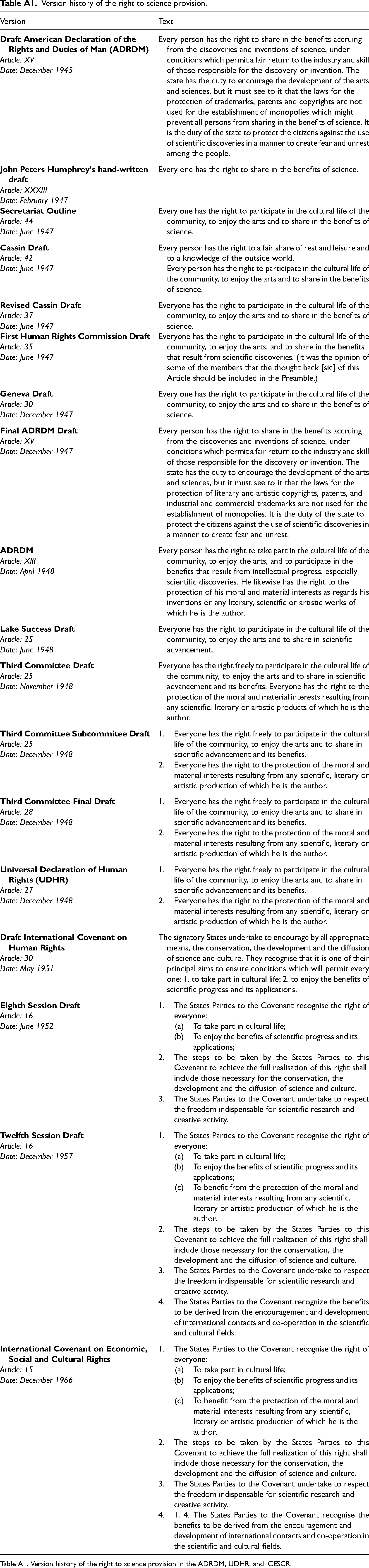
| Version | Text |
|---|---|
|
|
Every person has the right to share in the benefits accruing from the discoveries and inventions of science, under conditions which permit a fair return to the industry and skill of those responsible for the discovery or invention. The state has the duty to encourage the development of the arts and sciences, but it must see to it that the laws for the protection of trademarks, patents and copyrights are not used for the establishment of monopolies which might prevent all persons from sharing in the benefits of science. It is the duty of the state to protect the citizens against the use of scientific discoveries in a manner to create fear and unrest among the people. |
| Article: XV | |
| Date: December 1945 | |
|
|
Every one has the right to share in the benefits of science. |
| Article: XXXIII | |
| Date: February 1947 | |
|
|
Every one has the right to participate in the cultural life of the community, to enjoy the arts and to share in the benefits of science. |
| Article: 44 | |
| Date: June 1947 | |
|
|
Every person has the right to a fair share of rest and leisure and to a knowledge of the outside world. Every person has the right to participate in the cultural life of the community, to enjoy the arts and to share in the benefits of science. |
| Article: 42 | |
| Date: June 1947 | |
|
|
Everyone has the right to participate in the cultural life of the community, to enjoy the arts and to share in the benefits of science. |
| Article: 37 | |
| Date: June 1947 | |
|
|
Everyone has the right to participate in the cultural life of the community, to enjoy the arts, and to share in the benefits that result from scientific discoveries. (It was the opinion of some of the members that the thought back [sic] of this Article should be included in the Preamble.) |
| Article: 35 | |
| Date: June 1947 | |
|
|
Every one has the right to participate in the cultural life of the community, to enjoy the arts and to share in the benefits of science. |
| Article: 30 | |
| Date: December 1947 | |
|
|
Every person has the right to share in the benefits accruing from the discoveries and inventions of science, under conditions which permit a fair return to the industry and skill of those responsible for the discovery or invention. The state has the duty to encourage the development of the arts and sciences, but it must see to it that the laws for the protection of literary and artistic copyrights, patents, and industrial and commercial trademarks are not used for the establishment of monopolies. It is the duty of the state to protect the citizens against the use of scientific discoveries in a manner to create fear and unrest. |
| Article: XV | |
| Date: December 1947 | |
|
|
Every person has the right to take part in the cultural life of the community, to enjoy the arts, and to participate in the benefits that result from intellectual progress, especially scientific discoveries. He likewise has the right to the protection of his moral and material interests as regards his inventions or any literary, scientific or artistic works of which he is the author. |
| Article: XIII | |
| Date: April 1948 | |
|
|
Everyone has the right to participate in the cultural life of the community, to enjoy the arts and to share in scientific advancement. |
| Article: 25 | |
| Date: June 1948 | |
|
|
Everyone has the right freely to participate in the cultural life of the community, to enjoy the arts and to share in scientific advancement and its benefits. Everyone has the right to the protection of the moral and material interests resulting from any scientific, literary or artistic products of which he is the author. |
| Article: 25 | |
| Date: November 1948 | |
|
|
Everyone has the right freely to participate in the cultural life of the community, to enjoy the arts and to share in scientific advancement and its benefits. Everyone has the right to the protection of the moral and material interests resulting from any scientific, literary or artistic production of which he is the author. |
| Article: 25 | |
| Date: December 1948 | |
|
|
Everyone has the right freely to participate in the cultural life of the community, to enjoy the arts and to share in scientific advancement and its benefits. Everyone has the right to the protection of the moral and material interests resulting from any scientific, literary or artistic production of which he is the author. |
| Article: 28 | |
| Date: December 1948 | |
|
|
Everyone has the right freely to participate in the cultural life of the community, to enjoy the arts and to share in scientific advancement and its benefits. Everyone has the right to the protection of the moral and material interests resulting from any scientific, literary or artistic production of which he is the author. |
| Article: 27 | |
| Date: December 1948 | |
|
|
The signatory States undertake to encourage by all appropriate means, the conservation, the development and the diffusion of science and culture. They recognise that it is one of their principal aims to ensure conditions which will permit every one: 1. to take part in cultural life; 2. to enjoy the benefits of scientific progress and its applications. |
| Article: 30 | |
| Date: May 1951 | |
|
|
The States Parties to the Covenant recognise the right of everyone:
To take part in cultural life; To enjoy the benefits of scientific progress and its applications; The steps to be taken by the States Parties to this Covenant to achieve the full realisation of this right shall include those necessary for the conservation, the development and the diffusion of science and culture. The States Parties to the Covenant undertake to respect the freedom indispensable for scientific research and creative activity. |
| Article: 16 | |
| Date: June 1952 | |
|
|
The States Parties to the Covenant recognise the right of everyone:
To take part in cultural life; To enjoy the benefits of scientific progress and its applications; To benefit from the protection of the moral and material interests resulting from any scientific, literary or artistic production of which he is the author. The steps to be taken by the States Parties to this Covenant to achieve the full realization of this right shall include those necessary for the conservation, the development and the diffusion of science and culture. The States Parties to the Covenant undertake to respect the freedom indispensable for scientific research and creative activity. The States Parties to the Covenant recognize the benefits to be derived from the encouragement and development of international contacts and co-operation in the scientific and cultural fields. |
| Article: 16 | |
| Date: December 1957 | |
|
|
The States Parties to the Covenant recognise the right of everyone:
To take part in cultural life; To enjoy the benefits of scientific progress and its applications; To benefit from the protection of the moral and material interests resulting from any scientific, literary or artistic production of which he is the author. The steps to be taken by the States Parties to this Covenant to achieve the full realization of this right shall include those necessary for the conservation, the development and the diffusion of science and culture. The States Parties to the Covenant undertake to respect the freedom indispensable for scientific research and creative activity. 1. 4. The States Parties to the Covenant recognise the benefits to be derived from the encouragement and development of international contacts and co-operation in the scientific and cultural fields. |
| Article: 15 | |
| Date: December 1966 |
Table A1. Version history of the right to science provision in the ADRDM, UDHR, and ICESCR.