



Abstract
This Special Issue aims at raising understanding of governmental human rights focal points (GHRFPs). It forms part of a renewed attention to the importance of domestic-level institutions within the international human rights regime. GHRFPs have emerged as a key recommendation of UN bodies, and a defined trend in setting up such State structures is observed in practice. Addressing GHRFPs as a single field of inquiry, this introductory article presents a common analytical approach, which makes it possible to analyse various forms of GHRFPs, with a view to generalising findings and enriching each type of GHRFP with the experiences and lessons learned of others. Hereby, the Special Issue consolidates and structures a research agenda on GHRFPs around key attributes identified in a preliminary manner, in order to spark some critical and constructive analysis of this specific manifestation of the domestic institutionalisation of human rights.
Keywords
1. Introduction
This Special Issue aims at raising understanding of governmental human rights focal points (GHRFPs). There has been a renewed attention to the importance of national-level institutions within the international human rights regime. In recent years, GHRFPs, understood as administrative structures mandated to provide the human rights response of the executive power and to ensure human rights implementation at the national level, have emerged as a key recommendation of UN bodies, and define a trend in States’ practice of setting up such structures.
We claim that GHRFPs constitute a central element of a wider strategy developed by various international actors as a response to the persistent human rights compliance gaps. This strategy encourages the ‘domestic institutionalisation’ of human rights, through the promotion of and support to national institutional actors and processes. 1 Invariably, establishing a government-based entity in charge of coordinating the State’s implementation efforts has been suggested, alongside the creation of an independent State actors in charge of monitoring, promotion and protection, known as National Human Rights Institutions (NHRIs). Recognising the ambivalence of government administrations – potentially involved in either human rights implementation or violations, GHRFPs deserve critical exploration.
The proliferation of GHRFPs also springs from States’ own initiatives, and in practice, they emerged in various forms and shapes. In the absence of generic guidance or core principles capturing the commonalities and superseding the diversity of GHRFPs, international prescriptions have been fragmented and called for different models – labelled ‘machineries’, ‘committees’ or more recently ‘national mechanisms for implementation, reporting and follow-up’ (NMIRFs). In turn, academic scholarship has also tended to review different GHRFPs in silos. Each set of guidance tends to be analysed as innovative and putting forward a new ideal element of a national human rights system. However, a closer look reveals that taken together the guidance shares common recommendations and a coherent set of attributes all governmental human rights structures should display.
In 2019, we initiated an international and interdisciplinary research project. 2 Its objectives were to:
document guidance and practice on GHRFPs, reviewing how they partake in the same phenomenon and their potential to constitute a single field of inquiry;
analyse this guidance and practice to conceptualise GHRFPs, and offer a common framework for research; and
generate empirical case studies covering a range of GHRFPs and contexts, testing the proposed conceptual framework with a view to generating findings that could enrich academic understanding of GHRFPs at large.
This introduction reviews each of the above points and makes a significant effort to present the field of inquiry as well as the conceptual and methodological background for the work and critical analyses comprised in the Special Issue. Section 2 provides an overview of the international standards and practice outlining GHRFPs as a phenomenon and a field of inquiry. Section 3 proposes our conceptual definition of GHRFPs, as inferred from the analysis of international guidance. Section 4 presents the research project and in particular the four case studies analysed in this Special Issue.
2. GHRFPs as a field of inquiry: Overview of international guidance and state practice
Human rights treaty bodies have long identified intra-governmental coordination as fundamental to human rights implementation. However, they have also tended to shy away from prescribing detailed international blue-prints for such actors, displaying a deference towards States and their discretion over institutional arrangements. 3 Similarly, the Office of the High Commissioner for Human Rights (OHCHR) has attempted to produce guidance, but with a constant emphasis that there is no ‘one-size-fits-all’ model, and always within the clear remit of its mandate, resulting in several guidance pieces dedicated to distinct types or functions of GHRFPs. As such, there is no overarching set of common standards for GHRFPs, but rather different ‘pockets’ of guidance, and diffuse State practices. This Section provides an overview of such guidance and practices. 4
2.1 Standards and diffusion of GHRFPs with thematic mandates
The practice of nominating GHRFPs first emerged in thematic fields. International State conferences provided significant momentum, in particular those in which civil society movements channelled ideas for State institutional commitments. 5
Governmental agencies dedicated to ‘the advancement of women’ or ‘gender equality’ have been called for in every UN-convened international conference on women since 1975. The first high-level mechanisms were set up in 1976 by Canada and Iceland, and the first full-fledged ministry in New Zealand in 1984. 6 In 1995, the Beijing World Conference on Women provided detailed guidance on mandates and institutional design for gender equality governmental focal points. Organisationally, they shall be ‘vested in the highest possible level of government […e.g.] a Cabinet minister, [and] critical elements would be adequate resources and the ability and competence to influence policy and formulate and review legislation’. 7 Ten years later, 80% of the States had established government-based mechanisms. Today, all but one State have designated a national gender mechanism, including 17 countries that appointed a ministerial structure. 8
In parallel, the 1982 World Programme of Action concerning Disabled Persons provided that ‘governments should establish a focal point (for example, a national commission, committee or similar body) to […] follow the activities […] of various ministries, or other government agencies and of [NGOs]’. 9 In 1991 and 1993 further soft law guidelines detailed the expectations placed on those institutional mechanisms. They foresaw that these bodies should serve as a national focal point on disability matters, that should ‘be permanent and based on legal as well as appropriate administrative regulation[,…] combin[e] representatives of private and public organizations [and] achieve an intersectoral and multidisciplinary composition’. 10 By 2006, at least 90 countries had formed permanent coordinating committees, 11 but there is no updated overview of State practices. 12
Uniquely, these two thematic fields on gender equality and disability respectively are also marked by a later codification of an obligation of States to establish governmental focal points. In 2006, the Convention on the Rights of Persons with Disabilities (CRPD) required States to ‘designate one or more focal points within government for matters relating to the implementation’ of the Convention, and to duly consider ‘the establishment or designation of a coordination mechanism within government’. 13 At the regional level, the 2011 Council of Europe’s Convention on preventing and combating violence against women and domestic violence (Istanbul Convention) provided that ‘parties shall designate or establish one or more official bodies responsible for the co-ordination, implementation, monitoring and evaluation of policies and measures to prevent and combat all forms of violence covered by [the] Convention’. 14
The adoption of focal points-type structures has become increasingly commonplace in a number of human rights or related fields. For instance, 49 countries have established National Contact Points (NCPs) for Responsible Business Conduct. States adhering to the Guidelines for Multinational Enterprises of the Organisation for Economic Co-operation and Development (OECD) 15 are obliged to nominate NCPs for ‘promotional activities, handling enquiries and contributing to the resolution of issues’. 16 Since 2011, those Guidelines include a dedicated human rights chapter. 17 A second example is the establishment of Focal Points for the Responsibility to Protect (or R2P Focal Points), promoted by a group of States and the Global Centre for Responsibility to Protect since 2010, and currently established in 61 States. 18
Our review of these sets of guidance shows that while they all embrace similar core institutional features, variations exist between thematic fields. For instance, for the promotion of women’s rights, the focus is on coordination structures that are internal to the government, but in the field of disability, the focus is on coordination through joint councils and boards which gather both State actors and rights-holders. Other thematic GHRFPs boast original mandates and features, such as the remedial role of NCPs or incorporation in international networks for both NCPs and R2P Focal Points.
2.2 GHRFPs with a comprehensive human rights mandate
Governmental structures covering the entire spectrum of human rights have flourished since the 1990s. A remarkable embodiment of GHRFPs has been the establishment of ‘human rights ministries’. The contexts of their establishment indicate that ministries responded to internal political needs in periods of contestation or transition, but their convergence in the 1990s points to an international emulation. Human rights ministries may have appeared as a modern feature of democratic States in the post-Cold War period. As of May 2019, 32 governments in the world include a specialised human rights ministry. 19
There are other types of comprehensive GHRFPs, for which information is more difficult to gather. In many countries, a human rights bureau, unit or division exists in one or several ministerial departments – usually in the ministries of justice (e.g. New Zealand), foreign affairs (e.g. Belarus), interior (e.g. Mexico) or in the Presidential/Prime Minister’s offices (e.g. Nepal). In other countries, inter-ministerial committees, councils or delegations have been established, either as self-standing or with a secretariat in central services (e.g. Tunisia).
The international promotion of national human rights action plans and of systemic approaches to human rights at the national level, initiated at the 1993 Vienna World Conference on Human Rights 20 and subsequently by other actors such as the Council of Europe, 21 have made the need for comprehensive structures more salient and spurred some guidance. The 2002 OHCHR Handbook on National Human Rights Plans of Action suggested the establishment of national coordinating committees for planning, encompassing all State branches and non-State actors. It encouraged countries ‘to institutionalize the coordinating committee as a body with functions that extend beyond the national action plan [in view of] mainstreaming human rights issues within government agencies’. 22 In 2008, the establishment of the Universal Periodic Review (UPR) also enhanced the need for States to set up structures with transversal mandates able to draw on inputs from different policy areas, for the purpose of international reporting.
A few countries have attempted to establish a unified architecture that would articulate comprehensive and thematic GHRFPs. In 2011, the Colombian government created the National System of Human Rights and International Humanitarian Law ‘to articulate and coordinate the rules, policy, entities and instances of national and territorial, and thus promote the observance and protection of human rights’. 23 It established an Intersectoral Commission composed of various ministries, supported by a Technical Secretariat. Subsystems on eight themes (equality, justice, armed conflicts, etc.) were gradually established and generated their own inter-ministerial working groups. The objectives of the whole system were enshrined in the National Strategy for the Guarantee of Human Rights 2014–2034. 24
2.3 Current focus on NMIRFs
In 2016, the OHCHR published a study and a practical guide on ‘National Mechanisms for Reporting and Follow-Up’, 25 later renamed National Mechanisms for Implementation, Reporting and Follow-Up (NMIRFs) by the Human Rights Council. 26 The guidance is dedicated GHRFPs with a comprehensive mandate. In keeping with the mandate given to the OHCHR in the context of the treaty body reform, it however pertains only to GHRFPs’ reporting and follow-up functions. 27 Nonetheless, the UN hoped that it would indirectly ‘build national ownership and empower line ministries, enhance human rights expertise in a sustainable manner, stimulate national dialogue, facilitate communication within the Government, and allow for structured and formalized contacts with parliament, the judiciary, [NHRIs] and civil society’. 28
The guide accommodates various arrangements and invites States to review and adapt those aspects which could strengthen their effectiveness. In terms of institutional design, the guidance strongly recommends that States:
establish standing mechanisms rather than ad hoc arrangements for each reporting cycle;
enshrine the mechanism centrally at the highest administrative level to ensure the necessary political support, preferably with a formal comprehensive mandate based on law or a policy;
assign ‘dedicated, capacitated and continuous staff’. 29
In addition, the NMIRFs shall possess four types of capacities: engagement with UN machineries; coordination within domestic executive actors involved in reporting and follow-up; consultation with all stakeholders at the national level; information management, organised by planning and measuring activities. For each capacity, the guide suggests that States consider specific arrangements be made. 30
Various actors intensively sponsor the diffusion of the NMIRF model. 31 Between 2017 and 2019, the OHCHR’s capacity-building programme team alone assisted 24 States in establishing or strengthening NMIRFs. 32 UN country teams call on the pre-existing structures created in connexion with earlier guidance on national human rights systems, such as the Inter-Agency Human Rights Council of Georgia, to ‘transform’ themselves in NMIRFs. 33 Amongst States, a ‘Group of Friends’ composed of 28 countries actively support NMIRFs and ensure that the matter features in UPR recommendations and in the work of the UN Human Rights Council. The latter adopted resolutions in 2017 34 and 2019 35 encouraging States to establish or strengthen NMIRFs. In 2020, States from the Pacific Community endorsed the ‘Pacific Principles of Practice of [NMIRFs]’, 36 a policy document guiding the establishment and strengthening of NMIRFs in the region and identifying overarching principles for their operationalisation. These initiatives benefit from resolute advocacy by the human rights think tank the Universal Rights Group, 37 and increasingly serve as a framing reference for additional Geneva-based actors. 38
As such, NMIRFs’ promoters tend to herald them as an innovative cornerstone of national systems. In 2017, the UN Secretary-General hailed NMIRFs as a ‘new type of governmental structure’ that has ‘the potential to become one of the key components of the national human rights protection system’. 39 Accordingly, ‘key elements at the national level’ include NMIRFs, NHRIs, and parliamentary human rights committees. 40 For the Universal Rights Group, NMIRFs provide a framework that unifies all governmental human rights activities, integrating all thematic fields and functions. 41
This tendency to address all GHRFPs through the prism of the NMIRFs’ guidance (although the latter was issued only to guide certain functions) raises questions. To what extent would the NMIRFs’ guidance, taken as the overarching reference, recast pre-existing guidance from thematic fields? This guidance’s formal focus is on effective State engagement with international human rights mechanisms. It does not address issues at the core of earlier thematic GHRFPs, such as accountability to rights-holders and social movements, or at least not with the same intensity. On the other hand, the NMIRFs’ guidance also addresses areas that were only superficially touched upon previously. It better tackles administrations as complex entities, populated by civil servants and animated by bureaucratic dynamics, and offers a more sophisticated attention to the role of=staff.
By contrast, we suggest that addressing the various types of GHRFPs as constitutive of the same phenomenon allows us to contextualise the NMIRFs as the latest proposal in a series of developments which took root in the 1970s. It relativizes the alleged novelty of NMIRFs, and puts them in perspective, casting light on the salient dimensions contained in this proposal, but also the significant ways new models recast earlier guidance and practice. It can also help scholars to assess new institutional proposals being put forward as part of new treaties being negotiated, such as the treaty on business and human rights. In order to consolidate a field of inquiry around this phenomenon, in which insights on different GHRFPs would speak to each other, a common concept is needed to serve as an analytical reference point.
3. Conceptualising GHRFPs: Definition and attributes
Our analysis of the sets of guidance presented in Section 2 show that GHRFPs are ideally intended to share some core attributes, which together define GHRFPs as a concept. While sometimes named ‘mechanisms’, ‘machineries’, ‘contact points’, etc., we adopted the terminology ‘focal point’ because it is the one codified in international human rights law, through CRPD Article 33. ‘Focal point’ is a vernacular concept that proliferates across policy fields and organisational structures, without clear definition. It is therefore a sufficiently popular and broad terminology that may encapsulate the range of institutional set-ups and specialised organisations constitutive of the phenomenon under review.
Six core attributes of GHRFPs may be inferred from the analysis of existing guidance. While presenting each attribute, we also flag key questions that are likely to arise when they are operationalised.
1. Governmental human rights focal points shall have a human rights mandate. This mandate may be comprehensive, covering all human rights – including national and international commitments, or specific to thematic rights or categories of rights-holders. Several international or regional treaties or policy frameworks require States to nominate a focal point for the purpose of implementing a specific set of commitments, while others are created in relation to national dynamics – e.g. political priorities or regime transitions.
In appearance straight-forward, this attribute causes operational questions. First, is there an optimal number of GHRFPs in a country, covering several themes, or should those be unified, or at least articulated in a joint architecture? Second, to what extent do thematic GHRFPs embrace a human rights normative approach to the issue at stake? Themes discussed in Section 2 have gradually been more connected to human rights: the NCPs received a clear human rights mandate with the 2011 revision of the OECD guidelines. Similarly, the adoption of the CRPD in 2006 consolidated the transition from a health or welfare approach to a human rights approach to disability. But the same theme may be addressed in practice using different normative frameworks, and may lose the human rights angle.
2. Governmental human rights focal points shall be governmental structures, with a main emphasis on coherence within executive actors’ work. They conceptually differ from other human rights specialised State actors which are not based in the government, such as NHRIs or parliamentary human rights committees. GHRFPs are also ‘governmental’ in that they necessarily refer to State-level focal points, matching the fact that States are legally bound by their international commitments as one entity. While all State branches may engage the States’ responsibility, the executive organises it. 42
This is likely to trigger at least three operational questions. First, GHRFPs’ governmental nature necessarily implies that they include both an administrative and a political dimension. However, how the nexus between politics and civil service shall be articulated is not spelled out in guidance. Second, depending on a State’s system of organisation, GHRFPs are not necessarily only ‘national’. Countries need to take into account the distribution of competencies between different levels of government. CRPD Article 33(1) foresees the designation of ‘one or more focal points within government’ to accommodate the situation of federal states, but the CRPD Committee has not produced guidance in this regard. Third, if GHRFPs are always government-based, they are not necessarily only governmental. Hybrid forms exist, comprised of both State- and non-State actors. The practice of States nominating mixed councils as ‘focal points within government’ under CRPD, and its acceptance by the CRPD Committee, is a case-in-point.
3. GHRFPs should not directly implement policies. This is explicitly stated in the NMIRFs’ guidance 43 and other thematic guidance. Gender equality mechanisms, for instance, shall act as ‘a catalyst for […] mainstreaming, not [as agencies] for policy implementation’. 44 Their impact on rights enjoyment is indirect, by triggering other actors into action through coordination and mainstreaming. Coordination arises from the transversal nature of human rights work and seeks to overcome fragmentation of competencies of executive actors, avoid duplication of activities and maximise the use of resources. It also identifies policy sectors that have under-prioritised rights-related issues and suggests initiatives. 45 Mainstreaming is more ambitious and aims at transforming institutional missions of other actors, in terms of agenda and everyday routines.
In practice, it happens that GHRFPs directly implement activities in addition to playing a catalytic role. This may be part of their mandate for historical reasons, when institutional choices have followed specific pathways that were also project-oriented. It may also be due to practical redefinition of mandates by the GHRFPs themselves, for instance where the structure found that it did not have the administrative authority, protocolary rank or political clout to trigger other State bodies into action, and reverted to direct implementation of activities. 46 Dual track approaches have been accepted as a way to operationalise the Beijing Declaration provided that direct implementation activities do not overshadow mainstreaming activities. 47
4. A pivotal task of governmental human rights focal points is to accumulate and ‘translate’ specialised human rights knowledge, for advisory functions, policy proposals, reports, etc. The Beijing Declaration requires States to ‘establish procedures to allow the machinery to gather information on government-wide policy issues at an early stage and continuously use it in the policy development and review process within the Government’. 48 The OHCHR posits that ‘information management’ is one of the four key types of capacity that an NMIRF should possess, 49 and the CRPD enshrines an obligation for States to collect information – including statistical and research data – to formulate and implement policies. 50 In turn, GHRFPs ‘translate’ human rights knowledge in ways that are adapted to other actors they seek to influence given their mainstreaming and coordination mandates.
This attribute raises operational questions, in particular regarding the type of data collected and tools for data management. In recent years, the UN has tended to subsume expertise with the production of statistical data and indicators, 51 and the guidance on NMIRFs is resolutely accompanied with the development of technologies for automatic planning and data management. 52 The use of indicators and measurements is one area that has been the object of extended research. It shows that while measurements appear to increase objectivity and automaticity, they also conceal discretionary practices and normative questions. As captured by anthropologist Sally Engle Merry, measurements displace contestation over substantive rights issues into seemingly technical decisions, yet the ‘production of indicators is itself a political process, shaped by power to categorize, count, analyze’. 53 Such literature calls for a much more granular understanding of the everyday routines and various interactions – including internal bureaucratic dynamics – that frame and influence translation activities.
5. Guidance on GHRFPs systemically encourages States to establish permanent structures, that outlive a time-limited or process-specific need (political transition or report-specific structure). 54 The OHCHR finds that it is ‘fundamental’ that NMIRFs should be standing and recommends that governments invest in strengthening existing bodies’ legal basis and capacities. 55 Permanence is a condition for the sustainable accumulation of expertise and other types of capacities. Standing bodies can follow the whole cycle of monitoring, reporting, review and follow-up and stand ready for future cycles, without necessitating processes of creating temporary ad hoc structures and assigning and training staff.
Inevitably questions arise as to how to ensure institutional permanence. Is there an ideal legal basis – e.g. in law, the constitution or a decree? Some institutional designs are more fragile than others: most notably, human rights ministries are highly vulnerable to discontinuation or dismantlement, depending on political priorities of changing governments. Furthermore, legal permanence does not guarantee operational continuity in practice: some organisations exist on paper but not in real life, and it is not unusual for structures to suffer from high staff turnover. Are there complementary ways to ensure permanence – beyond a legal basis?
6. Given GHRFPs’ administrative nature and the objectives of knowledge building, a strong focus is placed on professionalisation of agents, work routinisation and technical capacities. GHRFPs are structures composed of staff – usually civil servants. While allusions appeared in all guidance, a particular attention given to staff ‘professionalisation’ as part of the NMIRFs guidance, that emphasises that staff shall be trained and retained and lists administrative actions to be performed. While the OHCHR finds that it is not fundamental for budget and staff to be autonomous (they are not independent institutions), it is crucial that NMIRFs would enjoy an adequate level of resources, and have a ‘dedicated, capacitated and continuous staff, building expertise, knowledge and professionalism at the country level’. 56 Processes shall also be in place to support rational work routines and interactions with other national or international actors. GHRFPs aim at ensuring that the multiple executive actors are interlocked, with well-established interfaces leading to automaticity of administrative action.
In inferring the core attributes of GHRFPs, we reviewed a wider range of additional recurring mandates and institutional recommendations, but assessed that they are not (yet) common to all GHRFPs. One was the focal points’ mandate for providing or facilitating redress and reparations in cases of violations. This dimension is totally absent from the guidance on NMIRFs, but the non-judicial remedial function of NCPs for Responsible Business Conduct is well-established. 57 Is it advisable for GHRFPs to play a remedial role? The question of redress and accountability has emerged in creative commentaries on CRPD focal points, 58 and more insight into how this plays out in practice, taking the case of NCPs for instance, could inform such proposals and the future development of focal points’ attributes.
Our research project posited that the above six core attributes serve as analytical yardsticks to overcome heterogeneity and organise the GHRFPs’ phenomenon as a coherent field of inquiry. They can support the cross-analysis of case studies focused on specific types of GHRFPs, by singling out and reflecting how divergence in institutional design and mandate functions may impact GHRFPs’ institutional practice. This conceptual frame could play a role not dissimilar to the role played by the Paris Principles in generating and structuring academic attention on NHRIs. 59 To demonstrate how this conceptual approach can generate insights and enrich GHRFPs understanding and practice, all case studies in this Special Issue adopt this analytical grid.
4. Investigating GHRFPs: A research agenda
Our previous research on the ‘domestic institutionalisation of human rights’ has decrypted the tendency by the UN, by activists and also by scholars to act as norm entrepreneurs to prescribe models for national human rights systems, in particular for State actors. 60 A case-in-point is the expansive literature on focal points on the rights of persons with disabilities. 61 Our critical review of this literature 62 showed how scholars attempt to unpack the meaning of CRPD Article 33 with a view to extrapolate a new model for human rights governmental institutions at large, beyond the thematic focus, and how they do so by borrowing ideas from public management theoretical models. 63 As such, two main interpretative paths emerged for focal points: one that privileges internal bureaucratic rationality à la Weber, with a focus on administrative organisations within government, while the other focuses on participatory institutions imprinted with new governance theories, insisting on hybrid structures comprising both State actors and rights-holders or their representatives. 64
In view of understanding how these institutional models actually lead to improved compliance at the national level, we recommend adopting a research approach anchored on legal realism and neo-institutional studies drawing on several disciplinary fields. For the past two decades, empirical international legal studies have aimed at clarifying the mechanics of law’s influence and its reception at the domestic level. 65 While legal scholarship explores how and under what conditions international human rights law works in practice, 66 political science looks into the capacities of domestic institutions and social forces to mobilise and realise human rights at country level. 67 The necessity to focus attention on the mediating power of domestic institutions is at the heart of orchestration theories, 68 but the latter have focused on NHRIs. Similarly, the scholarship on human rights localisation offers a powerful conceptual apparatus and methodology to understand ‘translation’ processes, but has not yet applied it to governmental actors. 69 Such studies have called to expand research to such actors, 70 and suggested methods to open the ‘black box’ of administrations. 71 This calls for a dive into case studies which in essence focuses on a given GHRFP in a given State and operating according to a specific mandate in a specific administrative and political context.
The focus on case studies does not mean that findings must remain specific and cannot be generalised. If case studies are organised around a common analytical grid and concept, it is then possible to structure the analysis of GHRFPs as a coherent field of inquiry, where the analysis of different types of GHRFPs speak to each other, and enable a fertile cross-analysis of sets of guidance. This approach adds meaningful perspectives to the understanding of entities and models otherwise reviewed as novel and analysed on their own. So far, existing scholarship on GHRFPs has been fragmented and used dedicated analytical lenses. The literature on gender equality mechanisms has for instance produced numerous case studies 72 that could inform new models, but much of it has used a distinct critical feminist analytical approach to generate conclusions. 73 Apprehending GHRFPs as one field of inquiry also helps to identify gaps in attention: no reviews of human rights ministries exist, and studies on NMIRFs are rare. 74 One important research project – taking a closely aligned legal-realist approach looking into one function of GHRFPs, namely the implementation of individual decisions of international and regional human rights bodies – has recently been completed and generated useful conclusions. 75 Much remains to be done to connect and complement these areas of inquiries.
Our research project started with an analysis of international human rights developments and standards as well as State practices. The review of guidance enabled us to recognise common characteristics of GHRFPs, carve out a conceptual framework and identify key research questions. It also led us to select paradigmatic cases relevant for exploration. As such, the project explored eight key forms of GHRFPs. 76 Four of those case studies are featured in this Special Issue. It opens with an article on an under-researched type of GHRFP, namely a Human Rights Ministry, taking the case of Burkina Faso where such a specialised human rights ministerial portfolio has been in place since 2000 (Sébastien Lorion). It then analyses the experience of two countries in implementing the legal obligations to set up a focal point under the CRPD (Colin Caughey) and the Istanbul Convention (Matthieu Niederhauser), examining the United Kingdom and Switzerland, respectively. Lastly, the R2P Focal Point was selected, studying Denmark’s case (Martin Mennecke).
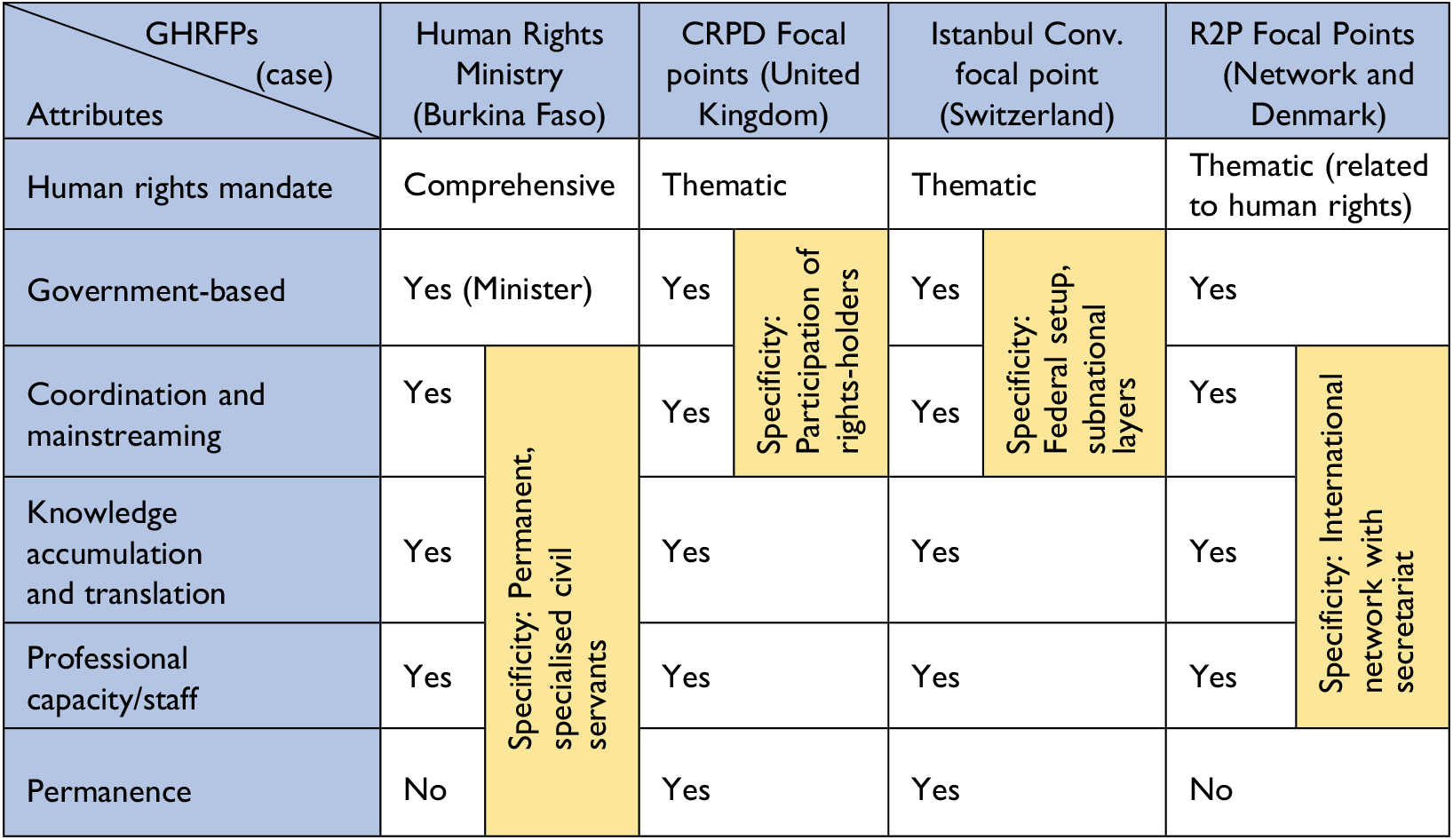
All case studies adopt the conceptual apparatus presented in Section 3. The review of the case using the six core attributes helps single out specificities in institutional design choices and analyse how they act as variables impacting performance. Such specificities may spring from the type of GHRFP explored: the CRPD focal point maximises rights-holders’ participation in governmental structures, possibly leading to their hybridisation; and the R2P Focal Points point to the role of international networks of GHRFPs. Specificities may also spring from the specific embodiment of the GHRFP in context: in Burkina Faso, a dedicated and specially trained corps of human rights civil servants have emerged to support the Ministry, offering insights on the civil servant’s role in coordination, knowledge and translation and professionalisation; and Switzerland offers a paradigmatic case to study the practical questions emerging when GHRFPs operate in a federal context. The following table enables one to visualise similarities and variations between case studies.
Taken together, the observations presented in the articles confirm the relevance of addressing GHRFPs as a consolidated field of inquiry, using a common conceptual framework as a yardstick. It enables a cross-analysis of findings that shows, first, that the assessment of the variations of a specific GHRFP’s function or design offers insights that could be used by others. For instance, the ways in which the international network adds value to the role of R2P Focal Points could inspire other types of GHRFPs.
Second, the cross-analysis of different types of GHRFPs allow scholars to undertake a more granular and informed assessment of the related guidance. Most notably, while claims have been made that NMIRFs’ insistence on consultations ‘democratises’ national decision-making processes, Colin Caughey shows how CRPD guidance suggests a much more meaningful and detailed approach to rights-holders’ participation. Similarly, insights from decades of professionalisation of human rights civil servants in Burkina Faso cast a light on the NMIRFs’ guidance on staff capacity. It helps to debunk certain assumptions made in the guidance regarding the role of civil servants and ways to reinforce their performance, and it warns against potential counter-productive impacts of some proposed solutions.
Third, the case studies cast a light on practical issues that are not yet properly covered by existing guidance. The question of GHRFPs’ organisation in federal States is discussed in relation to women’s rights structures, but the analysis of the Swiss approach could inform other thematic and comprehensive GHRFPs. Taken together, the introduction and generated research carve out further issues of importance that are inadequately covered by both guidance and research. How does the preferred institutional design emerge in context? How does the nexus between political and administrative components of focal points play out in practice – and what would the recommendations be on this? Is a mandate limited to coordination and excluding direct implementation practical and endurable in practice? What is the ideal number of (thematic) GHRFPs and is it desirable and feasible to unify them under a single architectural structure? Further research on those issues would be welcomed, and would also help refine our understanding and the relevance of the six core attributes inferred for the GHRFP concept, by testing their conceptual boundaries.
This Special Issue shows that it is relevant and meaningful to address GHRFPs as a single field of inquiry. Decompartmentalising studies of various types of GHRFPs enables scholars to cross-analyse sets of guidance and draw on empirical insights arising from decades of State practices. This approach notably contextualises and informs the analysis of more recent guidance, in particular on NMIRFs. Our common analytical approach, identifying a field of inquiry and a concept, makes it possible to analyse various forms of GHRFPs, with a view to generalising findings and enriching each type of GHRFP with the experiences and lessons learned of others. This Special Issue consolidates and structures a research agenda on governmental human rights focal points around key attributes identified in a preliminary manner, in order to spark some critical and constructive analysis of this specific manifestation of the domestic institutionalisation of human rights.
More research – covering a broader sample of GHRFPs, refining our conceptual framework, and exploring the questions still open – is needed. This is necessary to reflect on the model of human rights governance that is being promoted at both supranational and domestic levels and to examine whether it meets its objective of enhancing human rights implementation and compliance at the national level.
Footnotes
Declaration of conflicting interests
The author(s) declared no potential conflicts of interest with respect to the research, authorship, and/or publication of this article.
Funding
The author(s) received no financial support for the research, authorship, and/or publication of this article.
