




Abstract
The implementation of international human rights law in federal States is an underexplored process. Subnational entities regularly enjoy a degree of sovereignty, which raises questions such as whether they implement obligations of international law and how the federal level may ensure that implementation takes place at the subnational level. This article aims to answer these questions, using the implementation of the Convention on Preventing and Combating Violence against Women and Domestic Violence (Convention) in Switzerland as a case study. To implement the Convention at the cantonal level, federal actors decided to use networks of civil servants in charge of domestic violence issues, who act as governmental human rights focal points (GHRFPs). This article is based on original empirical data, on 25 interviews with State officials who participate in this implementation. The findings show how complex GHRFPs networks work in practice to implement the Convention and highlight the role played by numerous non-legal State actors in this process. As a result, the article argues that international human rights law implementation becomes more diversified both within and across federal States.
Keywords
1. Introduction
This article is part of a Special Issue aimed at generating academic understanding of governmental human rights focal points (GHRFPs) 1 and focuses on the need to consider the perspective of federal states—from both a legal guidance and an empirical standpoint. The emergence of governmental structures dedicated to human rights is rooted in trends aimed at bridging the gap between human rights commitments and actual implementation through a strategy of domestic institutionalisation. It complements the traditional focus on legal harmonisation and judicial protection, and the more recent monitoring by independent institutions, with proactive dynamics focused on public policies and implementation strategies by States’ executive actors. 2 While the first two implementation strategies have been analysed with regard to federal states, 3 this has not been the case with regard to GHRFPs. The emerging international guidance on implementation of—and follow-up to—international law by GHRFPs does not specifically address the situation of federal states, 4 despite the fact that the degree of sovereignty held by subnational entities raises critical challenges for the implementation of international law.
This points to a fundamental area of enquiry linked to the specificities of GHRFPs’ organisation and operations in federal contexts, particularly in regard to treaty implementation. This raises the following questions: do subnational entities implement obligations of international human rights law, how may the federal level ensure that implementation takes place at the subnational level, and what role do GHRFPs play in such processes?
To answer these questions, this article takes the implementation of the 2011 Convention on Preventing and Combating Violence against Women and Domestic Violence (Istanbul Convention or Convention) in Switzerland as a case study. Several factors make this selection relevant. First, the Istanbul Convention is one of the only human rights treaties to oblige State Parties to designate a GHRFP. 5 Paragraph 1 of Article 10 requires States to appoint ‘one or more official bodies responsible for the co-ordination, implementation, monitoring and evaluation of policies and measures’. Second, Switzerland is one of four federal States that ratified the Convention, and several obligations directly fall under the competencies of its subnational entities—the cantons. Third, the Convention’s subject matter is a pressing issue in Switzerland, recognised as a political priority. 6 In a context of deterioration of domestic violence and political mobilisation on the issue, the entry into force of the convention in 2018 has captured attention, triggering discussion and activity around its implementation at the federal level and in most cantons, as this article will demonstrate.
This article draws on the literature on the implementation of international human rights law and on social science literature on law making and administration dynamics. It is further based on data collected through two complementary methods. First, on the analysis of international, Swiss, and cantonal official documents related to the Istanbul Convention. Second, on the basis of 25 semi-structured interviews with governmental, administrative, and parliamentary actors who have participated in the implementation of the Istanbul Convention at the federal level and in six cantons. 7
The next section outlines the conceptual framework and the literature on which this article is based. Section 3 presents the two-tier network of GHRFPs put in place in Switzerland to implement the Istanbul Convention, while Section 4 sheds light on the nature of GHRFPs and the functioning of this network. Finally, Section 5 uses a law making process in the canton of Neuchâtel as an example to highlight the main claims of this article.
2. Implementation of human rights in federal states
2.1. Treaty implementation, State actors and bureaucrats
Treaty implementation requires States to take all sorts of measures. In the case of the Istanbul Convention, this might go from legislative measures, such as ensuring that physical violence is criminalised (Article 35), to more practical measures, such as ensuring that there are enough shelters for victims of domestic violence (Article 23). More precisely, Article 23 states that ‘[p]arties shall take the necessary legislative or other measures to provide for the setting-up of appropriate, easily accessible shelters in sufficient numbers to provide safe accommodation for and to reach out pro-actively to victims, especially women and their children’ (emphasis added). This illustrates the fact that States have a degree of freedom in the choice of measures they want to take. At the same time, Article 23 is quite specific and will arguably require different kinds of measures to be effectively implemented. This article examines how State actors take measures to implement specific obligations such as Article 23.
Since the early 2000s, international human rights instruments have been more prescriptive when considering the ‘structures and processes that states should set up domestically in order to implement treaties’. 8 The 2006 Convention on the Rights of Persons with Disabilities (CRPD) constitutes a decisive development in this domestic institutionalisation. 9 Its Article 33(1) stipulates that State Parties shall establish focal points within the government to ensure the implementation of the Convention, and consider setting-up coordination mechanisms ‘to facilitate related action in different sectors and at different levels’. 10 Article 10 of the Istanbul Convention followed suit, and a panoply of guidance has emerged in recent years addressing certain mandates and functions of GHRFPs. 11 While such guidance accommodates federal States by remaining sufficiently flexible, none of it – nor ensuing scholarship – has specifically analysed or issued recommendations tailored to the challenges of federal States. 12 This article ambitions to fill this gap and focuses on the work carried out by one type of thematic GHRFPs in a federal State.
Human rights treaties’ implementation is not a rigid one-way process. It has long been recognised that some rights, in particular economic, social, and cultural ones, are subjected to progressive realisation. Moreover, in the wake of the CRPD, scholars have underlined how international norms may play a more indicative role and need to be transformed into concrete standards depending on national contexts. 13 As pointed out by Mégret, the CRPD ‘comes up with a sui generis concept, which encompasses elements of absoluteness and relativity, and locates the obligation at the intersection of the desirable and feasible—the idea of “reasonable accommodation”’. 14 As a result, human rights treaties often involve a ‘diversity of local implementation practices’. 15 Domestic State actors have become crucial in organising the convergence between the legally compulsory and the locally feasible.
In these processes, administration dynamics and individual bureaucrats play an important role, as social science literature reveals. Looking at the role of civil servants in law making processes, Chevallier 16 explains that bureaucrats are not passive executioners. Their resources, such as the knowledge of what is at stake and the control of information sources, allow them to take on more responsibilities and influence the production of norms. They are influenced by ‘the problems they have to manage [and] a vision of the difficulties to solve, measures to take [and] reforms to make’. 17 Moreover, they can use the margin of interpretation they have to make strategic use of the law. This plays out in specific ways in the field of human rights. The literature on State feminism and femocrats highlights the blurred boundary between State gender equality agencies and women’s movements. 18 Agencies are often staffed by women formerly active in women’s movements, who develop a ‘dual identity’ 19 as a result of this double affiliation. As such, these actors form an integral part of the processes of domestication and vernacularisation of international human rights norms, as detailed by Merry. These processes approach human rights not only as law but also as a discourse and set of values for asserting claims. 20 Specialised bureaucrats navigating plural loyalties (to the State and to the cause) and positioned at the intersection between the international and the local—or the legal and the real—are therefore an important nexus for human rights implementation. Their role is not yet fully understood, 21 especially so in federal contexts, where additional institutional layers exist between the legal norm and the ground.
2.2. Treaty implementation in federal states: The swiss example
Federal contexts add a layer of complexity in this meeting point between the international and the local. Risse, Ropp, and Sikkink have argued that domestic human rights compliance is more difficult to reach when it requires collaboration between several decentralised actors. 22 In a rare study on subnational implementation of treaties, Ku and others facilitate better understanding of this process in the context of US implementation of international law. 23 The study discusses a few examples to highlight forms of cooperation between national and subnational levels but also calls for additional empirical research. The present article seeks to complement this work by investigating a single in-depth case study and by providing original empirical data.
Switzerland is a federal State, which consists of 26 subnational entities, or cantons. Each canton has a parliament, a government, and an administration. Switzerland is considered to be amongst the ‘most federal’ states—i.e., one where subnational entities have the most wide-ranging competencies. 24 According to Article 3 of the Swiss Federal Constitution, ‘[t]he Cantons are sovereign except to the extent that their sovereignty is limited by the Federal Constitution’. Consequently, constitutional experts have considered cantons as ‘limited subjects of international law’. 25 Cantons have ‘considerable room for manoeuvre in significant political areas (e.g. education, culture, language, health care, law enforcement)’. 26 According to Gerring’s typology of case studies, 27 Switzerland thus constitutes a crucial case, i.e. if cantons do implement international human rights law obligations, we could expect subnational entities in other countries to do so as well.
Such a federal structure can raise particular problems for human rights implementation but perhaps also opportunities, as certain obligations fall within the competencies of cantons, depending on what area they relate to. Article 7 of the Federal Act on the Participation of Cantons in the Foreign Policy states that ‘[w]hen the implementation of international law falls within [the canton’s] responsibility, cantons must make necessary adjustments in a timely manner’. 28 However, it is unclear whether—and how—cantons implement such international human rights obligations in practice. 29 This article aims to shed light on how information about international obligations that concern cantons reaches them. Another challenge of federalism is linked to the fact that cantons are very asymmetric in population and administrative capacity. The Canton of Zurich, ‘has almost twice as many administrative employees today than the smallest canton (the Canton of Appenzell Inner-Rhodes) counts residents’. 30 Cantons with limited capacities might struggle to engage with international instruments that are ever more numerous and often very specific.
2.3 Switzerland’s implementation of the Istanbul convention as a case study
Domestic violence is a complex and multifaceted issue which requires a comprehensive approach and involves several fields. In Switzerland, State action related to domestic violence is strongly decentralised. 31 The Istanbul Convention contains obligations that fall within the competencies of the federal State but also others that fall within the competencies of the cantons. For instance, on the one hand, Article 35 of the Istanbul Convention provides that ‘[p]arties shall take the necessary legislative or other measures to ensure that the intentional conduct of committing acts of physical violence against another person is criminalized’. As criminal law is federal in Switzerland, it is the federal State that has to make sure to respect this obligation. On the other hand, the abovementioned Article 23 on the setting-up of shelters for victims of domestic violence falls under cantonal competencies. 32 Therefore, the cantons are the entities that can ensure that Switzerland fulfils this obligation.
This division of competencies does not preclude the fact that the federal government is solely responsible for respecting the Convention at the international level under international law. Indeed, the internal organisation of the State cannot be used as a justification in the event of a disregard of international law obligations. 33 Switzerland recognised this with respect to the Istanbul Convention, stating that the federal State is responsible for executing international law obligations—even those that fall within the competencies of the cantons. 34 However, if international law does not require a specific type of implementation, cantons enjoy some freedom in the implementation process as long as the obligation is effectively implemented. 35
In preparation for its ratification of the 2011 Istanbul Convention, Switzerland organised a consultation procedure 36 sometimes referred to as a ‘pre-parliamentary consultation procedure’, which ‘has the aim of allowing the cantons, political parties and interested groups to participate in the shaping of opinion and the decision-making process of the Confederation’. 37 Such a consultation is mandatory for the adoption of certain legal instruments—notably for international law agreements that are subject to a referendum—and for projects that ‘significantly affect individual cantons or all the cantons’. 38 Cantonal constitutions generally foresee that cantonal governments are consulted by the federal authorities during this process. 39 Usually, cantonal governments then consult the relevant services of their administration. This procedure provides cantons with an opportunity to oppose the acceptance of new international norms by Switzerland. In the case of the Istanbul Convention, the Convention was submitted for consultation in October 2015 with the statement that ‘globally, Swiss law fulfils the requirements of the convention’, but it was acknowledged that ‘a few points must be clarified with regard to cantonal competencies […] notably on the question of whether enough shelter possibilities exist for victims’. 40 All the cantons, the major political parties, and interested institutions and organisations were invited to submit their positions by January 2016. The vast majority of the participants clearly supported Switzerland’s ratification. Only three cantons and one party opposed it. 41
At the federal level, according to Article 166 al. 2 of the Federal Constitution, the Swiss parliament has to ‘approve international treaties, with the exception of those that are concluded by the Federal Council [the Swiss government] under a statutory provision or an international treaty’. Therefore, on 2 December 2016, the Federal Council requested the Swiss parliament to approve the Istanbul Convention, which it did on 16 June 2017. The Federal Council then ratified the Convention on 14 December 2017, and the Convention entered into force for Switzerland on 1 April 2018.
The Istanbul Convention takes a global approach to combating violence and follows the ‘4 Ps structure’ of ‘Prevention’, ‘Protection’, ‘Prosecution’, and ‘integrated Policies’. 42 The Convention requires parties to ensure that a gender perspective is applied, both when designing measures in the implementation of the Convention and when evaluating their impact (Article 6). In accordance with this global approach, Article 7 requires that relevant policies include different actors and agencies that take several measures in order to provide a holistic response to violence against women. 43 More specifically, paragraph 3 of Article 7 calls for the involvement of ‘all relevant actors, such as government agencies, the national, regional and local parliaments and authorities, national human rights institutions and civil society organisations’. According to the Explanatory Report, the drafters ‘wished to reflect the different levels of lawmaking powers in Parties with a federal system’. 44 Although the provision explicitly calls upon regional authorities, the Federal Council does not mention these in its message. 45 The message stipulates that several cantons have adopted specific legislation on domestic violence, whereas in other cantons, the relevant rules are to be found in different legislation (such as in the laws on police or the laws on social welfare). 46
3. Uncovering a two-tier network of GHRFPs in federal context
3.1. Implementation entities foreseen for the Istanbul convention
Article 10, paragraph 1 of the Istanbul Convention states that parties shall ‘designate or establish one or more official bodies responsible for the co-ordination, implementation, monitoring and evaluation of policies and measures’. The Explanatory Report specifies that ‘[t]he term “official body” is to be understood as any entity or institution within government’. 47 It adds that ‘[r]egarding the tasks of implementation, monitoring and evaluation this body should be in existence on the respective level of a Party’s structure which is responsible for the carrying out of the measures. This means that in a federal government structure it may be necessary to have more than one body’. 48 Despite this, Switzerland decided to designate only one official body: the Domestic Violence Domain of the Federal Office for Gender Equality (BFEG). 49
In addition to this single official body, Swiss governmental authorities designated other entities to ensure the implementation of the Convention at the cantonal level, although they were not designated as official bodies. The implementation of the Convention at the cantonal level was discussed at ‘intercantonal conferences’. These conferences are coordination mechanisms where members of federal and cantonal governments meet to discuss issues of common interest. These conferences are relatively recent instruments of federalism in Switzerland. The Conference of Cantonal Governments, the most important of these conferences, was set up in 1993 ‘to ensure that the cantonal interests are considered in the Europeanization process’. 50 More generally, the aim of these conferences is to increase the canton’s influence on the Federation. In federalism literature, intercantonal conferences are seen as reinforcing the power of cantons vis-à-vis the federal level. 51
In the case of the Istanbul Convention, the Conference of Cantonal Ministers for Justice and Police and the Conference of Cantonal Ministers of Social Affairs mandated the Swiss Conference against Domestic Violence (CSVD) to facilitate the intercantonal implementation of the Convention. 52 The CSVD regroups civil servants embedded within the governmental administration who are in charge of domestic violence issues. As opposed to most intercantonal conferences, the CSVD does not include a federal actor (the BFEG has regular exchanges with it but does not formally take part in it). The CSVD was founded in 2013 so that civil servants could speak with one voice in cases of consultation procedures or other national projects regarding domestic violence. Before that, they had been grouped into two conferences, according to their linguistic region. These two conferences—one Latin and one German—still often meet to exchange experiences and collaborate on specific projects. The two linguistic regions have organisational differences: in the Latin section, civil servants in charge of domestic violence work within the cantonal Bureau de l’égalité (Office for Gender Equality), while in the German section, they are usually attached to the justice and security cantonal department. 53 This means that in Latin cantons, they are generally also responsible for violence against women, while not in German cantons. For simplicity, this article focuses on domestic violence and will refer to those cantonal civil servants as domestic violence (DV) delegates.
3.2. Implementation entities as GHRFPs in practice
A review of the role and functions of the DV delegates shows that they act as GHRFPs at the cantonal level, with the CSVD constituting a coordination mechanism. This comes in addition to the Domestic Violence Domain of the BFEG, 54 officially designated by Switzerland as focal point under the Convention’s Article 10, which constitutes a GHRFP at the federal level. In other words, this creates a two-tier network of GHRFPs charged with the implementation of the Istanbul Convention (Figure 1).
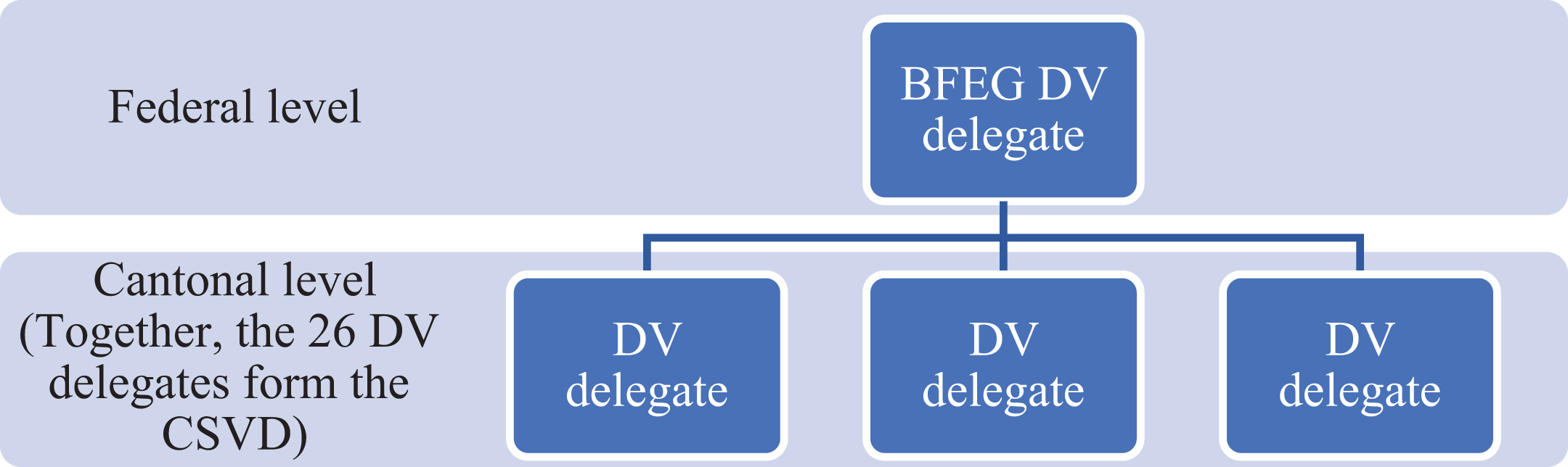
The two-tier network of GHRFPs.
The DV delegates’ roles as GHRFPs becomes apparent when assessing their mandate against the six common attributes of GHRFPs identified in this Special Issue.
First, DV delegates are part of a governmental structure. They are generally located either in the cantonal Office for Gender Equality, or in the cantonal Justice and Security Department. In both cases, they report to a member of the cantonal government. This governmental nature implies that the work of DV delegates includes both an administrative and a political dimension. DV delegates are a purely governmental form of GHRFP: they do not include non-State actors. However, the CSVD and DV delegates work closely with the civil society, as the next section of this article shows.
Second, DV delegates have been indirectly mandated, through the CSVD, to serve as cantonal entities for implementing the Istanbul Convention. Thus, they have a thematic mandate on human rights. 55 Assuming each canton has GHRFPs on a different topic, there are probably a large number of GHRFPs in Switzerland. Coordination between domestic violence focal points, as well as the consequences of this large number of domestic violence focal points, is discussed in the next section.
Third, DV delegates generally do not directly implement policies. This is due to the fact that the response to domestic violence issues requires actions of governmental actors from various fields. Consequently, DV delegates mainly take on coordination and mainstreaming roles. Sometimes, however, this coordination role implies that DV delegates might take the lead on certain implementation processes, as seen in the example of Neuchâtel. This coordination role also is a key element at the federal level: the DV Domain of the BFEG was created in 2003 with the mandate to ‘foster collaboration and networking within the federal administration and between the federal state, cantons and NGOs’. 56
Fourth, one of the main tasks of the DV delegates is to produce and accumulate specialised knowledge on domestic violence. As one interviewed DV delegate put it, ‘we are a public service, so our discourse is based on research, statistics, laws, other countries’ experience, international conventions’. 57 As this knowledge is used for advisory functions and prevention, DV delegates point to the need to ‘translate’ it according to their interlocutor. 58 For instance, DV delegates need accurate statistics on domestic violence that include the gender of the perpetrators and of the victims in order to have better targeted prevention campaigns. This production of knowledge is also done collectively through the CSVD, whose first task was to provide an overview of the Istanbul Convention thematic fields relevant to cantons and to suggest measures on this basis. 59 The CSVD 2018 Report on the implementation of the Convention at the cantonal level was published as a result of this undertaking. 60 The Report takes stock of relevant measures taken by cantons and identifies seven priority fields for the first phase of the implementation. As regards the BFEG DV delegate at the federal level, the Explanatory Report of the Convention states that the official body is ‘also assigned the task of coordinating the collection of the necessary data and to analyse and disseminate its results’. 61
Fifth, DV delegates and the CSVD are permanent structures that existed before the Istanbul Convention. However, DV delegates are not officially designated under the Convention’s Article 10, so their mandate under the Convention is not legally sustainable. At the federal level, the BFEG was designated as an official body. However, the BFEG was designated because it ‘had the necessary network at the federal and cantonal level to effectively implement the convention’. 62 Arguably, the Federal Council purposely selected a permanent entity with the expectation that this would lead to more effective implementation.
Lastly, DV delegates dispose of professional staff and administrative capacities. These capacities are highly dependent on the sizes and budgets of the cantons. For instance, in a small canton like Neuchâtel, the DV delegate has only a few employees under her command. The use of the CSVD as a coordination mechanism reinforces bureaucratic efficiency. According to the interviewees, CSVD meetings primarily are a place to exchange and share experiences and discuss potential common projects. Similarly, other administrative arrangements are aimed at reinforcing the work of DV delegates. In Geneva, there is a consultative commission on domestic violence, which gathers representatives of the cantonal administration, of the judiciary and of public and private institutions and aims to advise the cantonal government on domestic violence issues and to support the cantonal Office for Gender Equality. 63 At the federal level, an interdepartmental working group meets once a year to facilitate the implementation of the Istanbul Convention. 64
4. Empirical lessons from the Swiss two-tier GHRFPs network
This section first presents Switzerland’s official strategy for the Convention’s implementation, providing a basis for the analysis of how implementation takes place in practice and of the functioning of the BFEG DV delegate and DV delegates.
4.1. The official set up of the network
Upon receiving its mandate, the CSVD published a September 2018 report on the implementation of the Istanbul Convention at the cantonal level, 65 which takes stock of relevant measures taken by cantons and identifies seven priority fields for the first phase of the implementation. Drawing on this, on 29 October 2018, the BFEG published an ‘Implementation Concept’, which aims to clarify the collaboration between the federal State and the cantons. This document acknowledges the fact that large parts of the Convention fall into the competencies of the cantons and specifies that in such cases, the cantons are responsible for completing the necessary measures. 66 Accordingly, the Conference of Cantonal Ministers for Justice and Police and the Conference of Cantonal Ministers of Social Affairs agreed to prioritise six fields during the first phase of the convention’s implementation, 67 which lasts from mid-2018 to the first Swiss State Report to the Council of Europe.
A Committee was also created to ensure the coordination of tasks between the federal State and the cantons. Its mission differs from that of the CSVD, whose primary aim is to coordinate the implementation at the intercantonal level. Nonetheless, the responsibilities of the two groups may overlap to a certain degree, since, according to the Implementation Concept, the CSVD is also tasked with ‘ensuring the collaboration with the confederation’. 68 The Committee meets at least once a year.
In sum, a complex network of actors has officially been set up for the implementation of the Istanbul Convention. However, very little is known about the functioning of the CSVD and the work of DV delegates.
4.2. The BFEG, an intermediary between the international level and the CSVD
The BFEG Deputy Director (hereafter the ‘BFEG DV delegate’) leads the Domestic Violence Domain of the BFEG. The Federal Office of Justice lead the process during negotiations and up to ratification; however, during this process, the BFEG proved to have a strong understanding of the systems involved and existing relationships with the cantons and with NGOs, and the parties agreed the BFEG would lead the implementation phase. 69
The BFEG DV delegate is responsible for monitoring the implementation of the Istanbul Convention in Switzerland. She also reports to international actors, mainly by preparing the State Report for the Council of Europe, and she participates in the Committee of the Parties of the Convention. When asked whether she was concerned that certain cantons did not respect the Istanbul Convention, she explained that the Federal Council had judged that ‘legally speaking’ 70 the minimal standards of the Istanbul Convention were already fulfilled in Switzerland (including at the cantonal level), whereas some other countries that ratified the Convention were far from meeting the standards presented in the whole text.
The BFEG works with the CSVD, but not with cantons on an individual basis. According to the BFEG DV delegate, the cantons should implement the Istanbul Convention because they accepted it by a large majority during the consultation procedure. As the Convention is binding, cantons have an ‘auto-obligation to implement’. 71 However, as the BFEG DV delegate explained, if a canton does not implement the Convention, the federal State has no means to intervene. For her, this is a consequence—and a challenge—of Swiss federalism that external stakeholders do not fully grasp. According to the BFEG DV delegate, NGOs in particular do not understand this and ask for the federal government to ‘give orders’ and intervene in cantonal matters. 72 This creates a disparity between external expectations and the actual avenues available for the exercise of administrative authority. While this challenge might be particularly acute in Switzerland due to its strongly decentralised structure, it can to a certain extent be generalised to federal States. Nonetheless, federal authorities have some non-legal options at their disposal. Notably, a lawyer for the Federal Office of Justice—who confirmed that their office only verified that federal law was in conformity with the Istanbul Convention, not cantonal laws—indicated that one way to encourage cantons to implement international law was to link its implementation to federal funding. For instance, Switzerland’s federal government provided funding for the construction of prisons in the cantons under the condition that international norms (for instance minimum cell size) were respected. 73 A lawyer for the Federal Department of Foreign Affairs who worked on the Istanbul Convention confirmed that the federal level can only ‘sensitize’ cantons or ‘encourage’ 74 them to act.
The BFEG DV delegate further explained that the Committee is the central actor for coordination with the cantons. It is led by the BFEG; the other State-level members are representatives of the Federal Statistical Office and the Federal Office of Justice. On the cantons’ side, there is one representative of the Conference of Cantonal Ministers for Justice and Police, one of the Conference of Cantonal Ministers of Social Affairs, and two representatives of the CSVD (one per linguistic region). They decide collectively on priorities; there is no voting process. The current priorities include the State Report for the Council of Europe. They are currently collecting data for this report: the BFEG at the federal level and the CSVD at the cantonal level. The coordination takes place in the Committee, but the BFEG then merges the data and drafts the report, which must be adopted by the Federal Council in 2021. The organizational structure of the report is based on a questionnaire prepared by GREVIO, the international body responsible for monitoring the implementation of the Convention by Member States. 75
Overall, Switzerland has set up a comprehensive implementation network in which the BFEG acts as an intermediary between the international level and the CSVD.
4.3. The CSVD, a subnational network of GHRFPs
4.3.1. Functioning of the CSVD
The CSVD acts as a link between the BFEG and the individual cantons. Members of the CSVD meet three to four times a year. Interviewees stated that these meetings are primarily a place to exchange information and share experiences (e.g. what works well and what does not), to discuss potential common projects, and ‘sometimes to implement’. 76 Some DV delegates who are not familiar with the Istanbul Convention take advantage of the CSVD to ask fellow members which actions they should take to respond to the Convention. This is more likely to happen to DV delegates of smaller cantons, who have less resources. 77 The CSVD creates working groups on specific topics, for prevention campaigns, or when they want to take a stance on a distinct political issue. These working groups serve as fora for officials to receive input from members of private associations active in relevant fields, such as shelter institutions. There is, both in the CSVD and in the cantonal offices for gender equality, a ‘culture […] of collaborating with the civil society […] in order to assist victims in the most harmonized and comprehensive manner’, 78 and the working groups are one instrument for organising such collaboration.
The CSVD has regular exchanges with the BFEG, who comes once a year for a bilateral exchange, to discuss both sides’ priorities. As the BFEG does not have contact with individual cantons, the CSVD acts as a ‘seismograph on the field’ 79 for them. Thus, the CSVD also works as a link between the cantons on the one hand, and the BFEG on the other.
The two regional conferences (Latin and German), which are at the origin of the CSVD’s creation, still function and seem to carry more importance for DV delegates. According to one DV delegate, the Latin conference meets at least five times per year and is able to produce more output, while CSVD meetings are limited to information exchange. This is probably because the regional conference existed before the CSVD and their members are less numerous, speak the same language, and, as a result, probably know each other better. Regional conferences, for instance, allow the creation of prevention campaigns and exhibitions. Cantons join forces to produce regional strategies. In short, the CSVD allows the exchange of information and best-practices but plays a limited role in the actual implementation processes. The CSVD’s lack of a federal actor who could coordinate efforts across all cantons also likely contributes to its reduced role in the actual implementation of the Convention.
4.3.2. The CSVD Report on Implementation
The CSVD Report on the implementation of the Convention at the cantonal level, published in September 2018, identified the seven priority fields for the first phase of the implementation. This report was written by the Committee of the CSVD—i.e. by the two co-presidents and two other members—in consultation with the CSVD as a whole. 80
The co-president of the CSVD explained how this report was produced: the Committee decided to do an assessment exercise and to look at what was addressed in the Istanbul Convention, what were the current needs, and what should be prioritised. The report was drafted on this basis and was consequently produced exclusively at the cantonal level. Neither the BFEG, nor any other federal entity was consulted. Thus, the report was written by people who had excellent knowledge of the field but were not necessarily lawyers nor human rights specialists. Similarly, the DV delegates did not seem to see the CSVD as an implementation mechanism in the legal sense. Instead, they viewed the exchange of information and other activities as contributing to the implementation of the Istanbul Convention. The findings of this research on the empirical work of individual DV delegates confirm this discourse and general non-legal understanding of what implementation means in practice.
4.4. The DV delegates
4.4.1. A non-direct and non-legal implementation?
Most DV delegates are professionals with extensive experience on domestic violence. Implementation responsibilities assigned to them under the Istanbul Convention are additional tasks rather than their primary role. However, they have an indirect mandate (through the CSVD) to implement the Istanbul Convention. According to the data gathered, action plans have been adopted, or measures taken, in a majority of cantons as a result of the Convention. In the interviews, DV delegates discussed measures and programs that are underway, but without explaining precisely how they contribute to implementing the Convention. When asked about implementation more specifically, they said that these measures and programs were ‘linked to the convention, but not only’, 81 that ‘the convention falls within something more global’, 82 and that it was useful ‘to place the projects [they] are working on in the context of an international convention’. 83 Furthermore, the DV delegates explained that when they mention the Convention while speaking in public, saying that it is binding and that it must be implemented, they are using it as ‘a tool to raise awareness’. 84 In this sense, DV delegates use the Convention as an argument, a set of values and as ‘a practice of claims-making rather than as a system of law’. 85
In the canton of Neuchâtel, the DV delegate used the Istanbul Convention to support a legislative change she had already planned. She used the idea that the canton would be ‘honour[ing] its obligations’ 86 under the Convention to increase acceptance of her proposal, but in the interview she explained that this was a reference to the text as a whole, not to specific obligations. As another illustration, several reports point to a lack of capacity in shelters in Switzerland. Article 23 of the Convention obliges States to take the necessary measures to provide for the setting-up of shelters in sufficient numbers to serve victims of domestic violence. When asked whether DV delegates would use this Article to push political authorities to act, one DV delegate replied: ‘[i]n the canton of Neuchâtel, we always manage to find solutions […] there are times where it is not sufficient and others where we find solutions, sometimes people are placed in a hotel […] the whole problem is to inform people, and that people arrive where they should arrive’. 87
This DV delegate saw implementation as a problem-solving exercise, rather than a legal exercise. This echoes Chevallier’s approach 88 on the role of civil servants in the law-making process. In the production of norms, civil servants are influenced by the problems they must solve. Furthermore, as noted in Section 2.1., they may use the margin of interpretation they have to make a ‘strategic use’ of the law. 89 These are precisely the two phenomena identified during interviews. First, DV delegates implement the Istanbul Convention in their own way, by focusing on the problems they have to solve and the measures they want to take, rather than trying to identify specific legal obligations that should be implemented. Second, DV delegates make strategic use of the Convention, using it as a tool and as an argument to facilitate pursuing their main task: preventing and fighting domestic violence.
DV delegates do not directly implement specific legal obligations emanating from the Istanbul Convention in their work. As shown above, they rarely refer to the Convention’s articles, nor do they base their initiatives and actions on them. They do not apply a human rights perspective in their work—and they almost never use the term ‘human rights’ during interviews. However, as domestic violence specialists, the work that they do makes a significant contribution towards implementing the goals and values of the Convention. 90 This constitutes an indirect form of implementation, which forms part of the dynamic and iterative effects of human rights treaties. 91 Arguably, as DV delegates have previous knowledge of the field and are committed to their mandate, this indirect implementation is likely to result in the protection of the Convention’s beneficiaries. In other fields, GHRFPs might not always have such knowledge and commitment, which in turn might have negative consequences on implementation. Finally, it must be noted that this indirect form of implementation likely leads to some diversity in the measures taken in different cantons, depending on the ideas and priorities of the local DV delegates.
4.4.2. Remoteness from international actors
The fact that DV delegates do not have direct links with the international framework and actors further reinforce the indirect character of their implementation. At the federal level, the BFEG took part in the negotiations of the Istanbul Convention and must prepare the first State Report on implementation for the Council of Europe. Moreover, as Switzerland’s designated official body, the BFEG must be able to communicate directly with its counterparts in other countries, according to Article 10, paragraph 3 of the Convention. The BFEG DV delegate is the federal equivalent of the DV delegates. She has a similar profile to many DV delegates, but her interview shows that her contacts at the international level have provided her with thorough knowledge of the international framework surrounding the Istanbul Convention.
By contrast, DV delegates do not have any direct link with those at the international level. The BFEG acts as an intermediary for all official information. The BFEG publishes documents, but does not give instructions to the cantons, as it must respect the cantons’ competencies. This was confirmed by a DV delegate, who stated that she did not receive any instruction from the federal level and that the implementation was up to her. Often, cantonal civil servants do not read the Istanbul Convention, but only official documents prepared at the federal level. Even lawyers from cantonal legal offices, who sometimes assist DV delegates, do not necessarily read the text of the Convention, as seen in the example of Neuchâtel.
To sum-up, DV delegates have no direct links to international actors: the BFEG acts as an intermediary but does not issue instructions to the cantons. Moreover, DV delegates often base their implementation on documents prepared at the federal level rather than on the Istanbul Convention directly. These consequences of Switzerland’s multi-level setting reinforce the finding that the Convention is only indirectly implemented at the cantonal level.
4.4.3. The political-administrative nexus
Each DV delegate reports to a member of the cantonal government, i.e. a cantonal Minister, who is an elected politician. As a result, DV delegates find themselves in a political–administrative nexus. This subsection shows how this political–administrative nexus influences the work of DV delegates.
While DV delegates are not institutionally independent from government and therefore political decisions, they can generally carry out their mandate in a relatively autonomous manner. First, as DV delegates need a certain degree of autonomy to carry out their mandate, their office is generally located high up in the administrative hierarchy and they have direct access to the cantonal minister. Second, their mandate to prevent and fight domestic violence is no longer politically contested, 92 especially in the current political context. Consequently, DV delegates can generally count on the support of their minister. Financial considerations are the main obstacle to political support. If a project requires more funding than the usual budget of the office, this is likely to raise opposition, perhaps not from the minister, but from the cantonal government as a whole. As one interviewee stated: ‘if resources are needed, it becomes a political decision, and not a legal one’. 93 In the example below of the canton of Neuchâtel, the new legislation proposed by the DV delegate as part of the implementation of the Istanbul Convention received broad support. The only controversial points related to the DV delegate’s request for more manpower, which meant more budget.
The work of DV delegates is political and relates closely to civil society. Several DV delegates come from the political scene and/or associations. One of the DV delegates part of this study had a political career and was involved in women’s movements before becoming the head of the Office for Gender Equality. While in office, she has been accused of being too political, but in the interview, she stated ‘I am political; I accept that, but this job is political, whether you want it or not’. 94 Another DV delegate had worked more than 20 years in an association supporting victims of violence. She was able to compare the two entities, saying that being a public service with the backing of an international convention gives more authority than being a feminist association. She said that as a public service, they are more listened to, but their discourse has to be ‘legally sound, factual, argumentative’. 95 Indeed, most DV delegates possess what Kardam and Acuner refer to as this ‘dual identity’ 96 : they are both bureaucrats and close to women’s movements. 97 In this sense, they also find themselves in a societal–administrative nexus.
In sum, the fact that they are located within the administration provides DV delegate with a certain authority to carry out their mandate and helps them in their implementation of the Istanbul Convention. Even if they enjoy a certain degree of autonomy vis-à-vis political whims, DV delegates are close to the political scene and they know that their job is political in nature. As a result, implementation of the Istanbul Convention in the cantons is a political process.
4.5. Implementation in the canton of NeuchÂtel as an example
In the canton of Neuchâtel, the DV delegate initiated a process that led to the adoption of new legislation to fight domestic violence in November 2019, in the wake of the ratification of the Istanbul Convention. 98 The DV delegate is the head of the Office for Family Policy and Gender Equality. She has been heading this office for 12 years. In 2018 she considered producing a new cantonal report on domestic violence, because the last had been completed in 2008. But as the Istanbul Convention entered into force in Switzerland around the same time (1 April 2018), she decided to take the opportunity to actually change the cantonal law on domestic violence, which dated back to 2004, ‘to adapt it to the Istanbul Convention’. 99
She mentioned that the Latin Conference on Domestic Violence ‘was charged with applying the Istanbul Convention in the cantons’. 100 Even though the other Latin cantons had not undertaken any legal changes at that time, she thought the advent of the Istanbul Convention presented a good occasion to change the law in Neuchâtel—’it seemed like the right time’. 101 The BFEG sometimes sends information to DV delegates by e-mail, and DV delegates received information sheets on the Istanbul Convention. However, she noted that ‘the cantons are still sovereign to apply [the Istanbul Convention], due to federalism’. 102 In her experience, ‘nothing comes from the upper level’. 103 In short, she decided to change the cantonal law on her own and used the Convention as a supporting argument. She also mentioned that those at the federal level are not really aware of what the cantons are doing.
The DV delegate used the fact that Switzerland had ratified the Istanbul Convention and that it had to be implemented as a means to support her draft legislation. The report presenting the new legislation to the cantonal parliament mentioned that the canton ‘will be able to honour its obligations coming from the signature of the Istanbul Convention’. 104 She stated that this was a reference to the text as a whole, not to specific obligations. This report was made by her office, including her and two colleagues, and it was then passed on to her superior, the Cantonal Minister for Education and Family. The minister read it and suggested changes, and there was a bit of back and forth between them. The cantonal minister in particular helped to make the political proposals more acceptable. Issues that are the most politically sensitive are by far those related to budget, for instance, the fact that she requested more manpower for her office. 105
The new legislation was drafted by her office together with the legal office. She explained that they took the former law and the Istanbul Convention, and looked at the differences. The main change was to modify the scope of the legislation. The former legislation was the 2004 cantonal law on fighting violence in couple relationships. This had to be adapted to the Istanbul Convention, which covers domestic violence, a more global concept which also includes persons who are not in a relationship and situations of violence involving children. In addition, they deleted a few articles that had become obsolete, and they included language on prevention. She stated that this process was ‘a bit artisanal’. 106
A lawyer from the legal office who worked on this with the DV delegate explained that when they work on new legislation, they have to fill in a form to assert that the draft law complies with federal law. 107 When asked if they verify that it also complies with international law, she said that they probably should, but that they do not. She believes that in such cases, it is the office in charge (here the Office for Family Policy and Gender Equality) that should take care of this compliance, because the legal office is not necessarily aware of the Istanbul Convention, whereas the office in charge is. Interestingly, both the DV delegate and the legal office responded that it would be the job of the other to know whether specific legal obligations in the Istanbul Convention had to be implemented.
When the lawyer received the report and the new legislation, she did not read the whole Istanbul Convention. She went instead to look at the documents established by the BFEG and the Federal Council’s message, ‘because federal services made the [legal] analysis’. 108 Thus, federalism arguably increases the trend for administrative actors to believe that someone else is responsible for a particular task. In the end, she made only few changes to the new legislation, because ‘it was considered’ that ‘broadly speaking’ 109 the canton respected the Convention. When asked who ‘considered’ this, she said it was both the legal office and the DV delegate.
This example illustrates many of the points made in this article. First, it shows that neither the DV delegate nor the lawyer from the legal office carried out a provision-by-provision analysis of the Convention to see if specific obligations had to be implemented. Interestingly, all actors seem to think this is someone else’s task. The unclarity of the situation is notably, but not only, due to Switzerland’s multi-level structure and to the fact that cantonal actors have no direct link with international instruments and actors. Nevertheless, cantonal actors did implement the general ideas of the Convention—notably its scope—through this new legislation, performing a kind of indirect implementation. The DV delegate took this initiative and used the Convention as a tool and as an argument to ensure the adoption of the legislation. However, it was a personal initiative; in this sense, implementation is likely to vary significantly from one canton to another. The adoption of the legislation was a political process, as it first had to be supported by the minister in charge, then by the whole cantonal government, and finally adopted by the whole cantonal parliament. However, the project received broad support during the whole process, notably because the topic is widely supported across the political spectrum, and it was successfully adopted by the cantonal parliament with only minor changes.
5. Conclusions
This article used the implementation of the Istanbul Convention in Switzerland as a case study to assess the extent to which subnational entities implement obligations of international human rights law, and to specifically consider how the federal level ensures that implementation takes place at the subnational level. This has demonstrated that Switzerland used a two-tier network of civil servants to implement the Convention, at both the federal and cantonal levels. In this network, the CSVD is supposed to act as a top-down mechanism, to facilitate the implementation of international norms at the cantonal level. The article shows that the CSVD allows the exchange of information and best practices but plays a limited role in implementation. More generally, although cantons are required by federal law to implement international law, Switzerland does not have means to ensure that cantons effectively implement international human rights law. This shows that the multi-level structure of federal States complexifies and causes challenges in the implementation of international human rights law.
In particular, this article shows that subnational actors are separate from international frameworks and actors. Hence, despite mechanisms such as the CSVD, federalism raises communication issues between levels and increases the trend for administrative actors to believe that someone else is responsible for a particular task. Moreover, smaller cantons are more likely to lag behind in implementation due to limited administrative capacities. Nevertheless, the data shows that most cantons have taken some measures to implement the Convention (although financially demanding measures, such as the setting-up of more shelters for victims, are much more difficult to take). Most of these findings on the challenges raised by federalism can be generalized to other federal States. Nonetheless, as Switzerland was characterised as a crucial case, where cantons have room for manoeuvre, we can expect that implementation will also occur in other federal States, where subnational entities have narrower competencies vis-à-vis the federal level.
To assess how complex GHRFP networks implement the specific obligations of the Istanbul Convention in practice, this article focused on the work of DV delegates, the civil servants who act as GHRFPs and are theoretically in charge of implementing the convention at the cantonal level. Doing so demonstrated that DV delegates generally are experienced professionals, specialised in domestic violence with links with the political world, but are not lawyers nor human rights specialists. For these reasons, they are often supportive of the Istanbul Convention, but they see it as a tool and as an argument rather than as a Treaty to be implemented. As civil servants, they are first and foremost driven by the problems they have to solve, and they make a ‘strategic use’ 110 of the law for this purpose. This also allows for the formulation of conclusions about the consequences of the federal structure of States on the implementation of human rights law, at least relative to thematic treaties. Implementation is likely to vary significantly among subnational entities, as it depends on the knowledge and commitment of individual actors. In general, this confirms the theory that compliance can be more difficult to reach when it requires collaboration among several decentralized actors. 111 Nevertheless, federal States surely enable efficient and context-based implementation in some cases.
Overall, this article confirms that GHRFPs involved in the implementation of international human rights law are becoming more numerous, 112 but it also shows that they are becoming increasingly diverse. This, and the fact that such actors are not necessarily human rights specialists, require further academic attention. Finally, the implementation of international law remains a political process, perhaps even more so in subnational entities which are remote from the international scene. While the topic of domestic violence generally gathers political support, it would be interesting to study topics that are politically more sensitive, such as international migration law.
Footnotes
Author’s note
I am most grateful to Sébastien Lorion and Stéphanie Lagoutte for the valuable comments and discussions that helped me throughout the process of writing this article. The interviews mentioned in this article were conducted together with Jonathan Miaz, whom I thank for all the stimulating discussions that helped to enrich the article. I also thank Martino Maggetti, Evelyne Schmid, Constance Kaempfer, Colin Caughey, Patricia Herrera Kit and two anonymous reviewers for their comments and suggestions.
Declaration of conflicting interests
The author(s) declared no potential conflicts of interest with respect to the research, authorship, and/or publication of this article.
Funding
The author(s) disclosed receipt of the following financial support for the research, authorship, and/or publication of this article: This article is part of the Swiss National Science Foundation (SNSF) project “Bypassing the Nation State? How Swiss Cantonal Parliaments Deal with International Obligations” ( ). The author acknowledges funding from the SNSF (project number 182148).