




Abstract
Inspired by W. E. B. Du Bois’s notion of double consciousness, Yeison F. García López assumes multiple identities: Afro-Colombian and Afro-Spanish. This multiplicity allows García López to assert a politically active citizenship, articulated through his migrant journey, his Afro-descendant and Colombian heritage, and his connection with Madrid society. This conversation delves into how García López’s body of work as a poet, theorist, activist, and cultural agent contributes to an emerging Spanish, global, and transatlantic LatinX Latinity (LatinXness) from the Spanish capital. Overall, García López’s efforts shine a spotlight on Spain’s present-day plurality, highlighting the contributions of Africans and Afro-descendant people. He establishes connections among migrant communities of Latin American, Afro-descendant, and Asian origin as well as migrants from Eastern Europe descent, and Roma people and subverts Eurocentrism, colonialism, and white supremacy. García López’s publications and cultural initiatives serve as a platform to amplify the voices of Madrid’s migrant and racialized people, promoting culture as a form of resistance, healing, and empowerment.
Multiple, migrant, and Afro identifications are at the heart of Yeison F. García López’s political views, poetry, and activism. Culture serves as a vehicle throughout his work as a means of resistance, transformation, and healing. Born in 1992 in Cali, Colombia, García López migrated to Madrid at age nine. Today, he strings together several lines of action that are shaping a nascent Spanish, global, and transatlantic LatinX Latinity, or LatinXness, from the Spanish capital while simultaneously reconfiguring global LatinX studies as well as Afro-Spanish and Afro-LatinX sociocultural and political identities.
LatinX and LatinXness, with two capital letters, are employed here to explore the liminal space among languages and modes of existence in García López’s creative approaches and perspectives. This semiotic decision is in line with Claudia Milian’s propositions, who argues that LatinX’s X stands for plurality and the border areas between languages (from Spanglish to Spanchinglish). In this way, LatinX accounts for the need to navigate between various modes of living in the world that are linked to cultural encounters precipitated by colonialism (Milian, 2023: 160–165). Overall, García López’s poetry and prose take on the notion of a multifaceted border area, not only between languages, but also between the identities and self-definitions produced as a result of forced mobility and diaspora.
Inspired by W. E. B. Du Bois’s (2007) foundational theory of double consciousness, which will be discussed and elaborated below, García López assumes an Afro-Colombian and Afro-Spanish duality. This twoness is visually expressed in his poem “Autoadscripción identitaria” (“Self-Ascribed Identity,” 2021a: 31), where “Afro Colombian” and “Afro Spanish” are centered on the page. Yet they are separate from the verses that come before and after them: one to the left, the other to the right. Afro is italicized, thereby enlivening the term as a word, as a vocabulary, as a thought––in effect, as a practice. One might add, even, that this reiterative italicized Afro in Colombia as much as in Spain also has a speculative function: an Afrofuture that must account for García López’s past, present, and the what is to come beyond these realms.
His politically active citizenship establishes connections with other contemporary LatinXs around the world and participates in cultural production and political action networks designed to build bridges among communities of Latin American, Afro-descendant, and Asian origin, as well as Eastern European and Roma people. Through these budding networks, García López demonstrates a global and transatlantic LatinXness from the Peninsula. The range of his community projects include the Espacio Afro cultural center and collaborations with organizations such as SOS Racismo Madrid, Li Wai, La Parcería, and Casa Drag Latina (García López, 2021b: 62).
In these projects culture is a medium to empower racially marked bodies, making the unknown and invisible X’s of the “newcomer” ––the racialized migrant––come to the fore. “Culture” is referenced throughout this introductory essay and interview, yet a few words are necessary to clarify what this approach might entail. García López’s efforts take the X’s of the LatinX uprooted world, of the Africana diaspora, of what is pushed to the side––X’s that may seem as devoid of culture––to produce culture from those “particularities.” García López’s culture-making culturalizes Madrid on Afro-LatinXs not as raw sociological data but as public intellectuals, individuals who love art and literature, and who, to extract and expand on Du Bois’s aims (1924), bring the gifts and visions of Afro-descendants in the making of twenty-first-century Spain. This stance does not deny the existence and necessity of open channels for artistic communication with white artists who are also confronting Spain’s colonial history and contemporary neocolonial practices from their own place of enunciation (see, for example, El águila, “The Eagle,” 2021).
“Growing Up Landless”: Dwelling in the borderlands
García López’s approach frames narrative subjectivity as an “autobiographical-poetic journey” (“Crecer sin tierra,” “Growing Up Landless,” 2023c: 41), one that recounts his and his family’s migration. Through a meta-analysis, he reflects on the process of going beyond the personal to address social and structural problems (41). This chronicle, “Crecer sin tierra” (2023c), is accompanied by three poems from Derecho de admisión (“Right of Admission,” 2021a) that exemplify this transcendence: “Crecer sin tierra,” “Sin fecha” (“Undated”), and “Grité” (“I Screamed”). “Crecer sin tierra,” the poem, examines the sense of rootlessness that child migrants come to grips with, describing what it’s like to grow up in that liminal space that Gloria Anzaldúa (1987) referred to as “the borderlands/la frontera.” Two of Anzaldúa’s (1942–2004) verses from “To live in the Borderlands means you,” (1987: 194) close the chronicle. They are cited after the poem “Grité,” where García López affirms “un día grité y no estaba solo” (“one day I screamed and I was not alone,” 49). Anzaldúa’s textual presence––witnessing––infers that García López walks alongside her foundational work. The citation, by extension, forges a nexus with the Chicano civil rights movement, one that also gave rise to the Chicano cultural renaissance vis-à-vis poetry, painting, sculpture, theater work, music, dance, and novels, to cite some of its productions (see Maciel et al., 2000). García López’s lines of action share principles and values with Chicano reclamations, but he gives these debates a renewed relevance in light of overdue conversations about Spain’s ideological and concrete borders.
Anzaldúa explores the complexities of living on the cultural, racial, linguistic, and geographic boundary between the United States and Mexico in Borderlands/La Frontera: The New Mestiza (1987), a hybrid monograph that blends autobiography, poetry, and critical essays. These boundaries have marked Chicano/a/X communities who have been internally colonized in the US Southwest. Anzaldúa, a Chicana, lesbian, indigenous, Tejana, mestiza, and activist, posits that those who live––dwell––in the borderlands defy normativity. She writes: “the prohibited and the forbidden are its inhabitants. Los atravesados live here: the squint-eyed, the perverse, the queer, the troublesome, the mongrel, the mulato, the half-breed, the half-dead: in short, those who cross over, pass over, or go through the confines of the ‘normal’” (1987: 3). The borderlands are a conceptual space––“a vague and undetermined place created by the emotional residue of an unnatural boundary” (1987: 3) ––in which one negotiates multiple, contradictory, and simultaneous identifications that are not solid and cohesive.
These “borderlands” are limbo-spaces in “Crecer sin tierra.” García López speaks of the resilience of the people who inhabit, cross, and recross these borderlands. Consider the first stanza: A las que migramos en la niñez nos toca gravitar en el aire, ser puente entre varios universos, reclamar nuestra libertad de pertenencia a las cosas de las que nos hablaban en casa, y a otras que han rodeado la mirada (2021a: 43). “Those of us who migrated as children are left hovering in midair, serving as bridges between various universes, asserting our freedom to belong to the things they told us about at home, and to other things that we saw around us.”
But these border crossers are not adults. Forging continuities and disjunctions with US LatinX cultural productions that are bringing into literary English the stories of child migrants who cross America’s North/South divide––including, for example, Salvadoran American poet Javier Zamora’s memoir Solito (2023) ––García López takes us to transatlantic and Mediterranean transits. The children “are left hoovering in midair.” The poet captures the sensation of not having a solid base to stand on. The idea of “serving as bridges between various universes,” not nations, reflects how migrants, from a young age, become intermediaries between their cultures of origin and the new ones. Landlessness is a site to hold steady and feel free to belong. Migrant children learn to listen, look, and sense in simultaneous plural universes, where in-betweenness, as a realm, allows for the dismantling of the national. Standing between two different worlds, they are often caught in the middle of these contrasting cultural realities.
“Crecer sin tierra” emphasizes the challenge and value of living and communicating in a multicultural and multilingual environment. García López writes: Hemos crecido en mil mundos, hablamos diferentes lenguas para poder comunicarnos desde el limbo (43). “We grew up in a thousand worlds; we speak different languages so that we can communicate from limbo.”
His sentiment resonates with Anzaldúa’s words: To survive the Borderlands you must live sin fronteras be a crossroads (1987: 195).
Anzaldúa abandons socially restrictive, geographically prohibitive, and ideological borders, inviting others to embrace, instead, serving as cross-roads. She highlights the demands of living in in-between spaces. For García López, this space is limbo, the liminal place one inhabits, in any geographical latitude, when one is a migrant. Coming to terms with these various spaces—or one’s multiplicity—is what makes it possible to establish a foundation from which to become an active and committed political subject. Both Anzaldúa and García López offer a deeply situated, profound, and impactful view of the lives of people dwelling in the geographic or cultural borderlands.
“Right of Admission”: Reframing the literary and cultural canon
The idea of transcending individual circumstances is also present in the poem “Derecho de admisión,” which lends the collection its title (2021a). The poem offers a powerful social commentary that highlights the exclusion, discrimination, and abuse inherent in appealing to the “right of admission” in public and private places, and in Madrid society in general. García López resorts to a narrative structure to recount a personal testimony that reflects a collective experience. The poem starts with short stanzas recalling the expectation of gaining entrance to a public establishment free of charge. This celerity contrasts with the second part, composed of longer stanzas that focus on the disappointment and indignation of being the target of discrimination.
The poem denounces Madrid’s systemic problems like segregation and inequality. This denouncement is made explicit when García López affirms: “Es un Madrid que me cercena desde la infancia,/Una parte de esta ciudad nos quiere fuera” (“This is a Madrid that has been fencing me in since childhood,/A part of this city wants us out”) (47). The poet also stresses the failure of authorities and institutions to respond to these violations: “¿Dónde denunciamos?/No servirá de nada” (“Where do we report this?/It won’t do any good”) (46) and, later declares: “Llamé a los que dicen protegernos,/Me dijeron: ‘derecho de admisión’,/Te preguntas a ti mismo ¿por qué les has llamado?” (“I called those who claim to protect us,/They told me, ‘right of admission,’/It makes you wonder why you bothered to call”) (46). Segregation and being neglected by law enforcement are not unique to Madrid’s Afro and migrant lives. They are common to various nations and continents, and García López’s critique resonates on the other side of the Atlantic.
“Derecho de admisión” concludes with some challenging verses, explicitly confronting the reader by censuring a tendency to look the other way when witnessing discrimination. These verses say: Perdonad si estos versos os incomodan, os lanzan una realidad que no queréis mirar, permitidme deciros que vuestra fragilidad en este espacio no importa, que soy yo el que habla ahora del derecho de admisión a vuestros comentarios (47). “I’m sorry if these verses make you uncomfortable, hurling you into a reality you’d rather not look at, let me tell you that your fragility does not matter in this space, that I’m the one talking about the right of admission now with respect to your comments.”
The opening apology suggests that the speaker anticipates a negative reaction to his condemnation. The stanza refers to the audience’s “fragility,” critiquing their lack of courage to confront an awkward truth. The readers’ vulnerability becomes irrelevant compared to centuries of exclusion. A clear self-affirmation and empowerment takes over, and the poet exercises his agency by reserving his own “right of admission” with respect to other people’s opinions and comments, much like some establishments exercise this right with respect to their clients. “Derecho de admisión” is an appeal to social conscience and sociopolitical transformation.
García López takes on the learned Western world and representation in its literary and cultural canon. He asserts in Matria poética’s (Poetic Mater) prologue: “Es el momento de las nuestras, de las que han sido borradas de la historia, de las que están fuera del canon literario” (“This is our time, the time for those who were erased from history, those who are outside the literary canon”) (2023a: 9). Through cultural production, he aims to transform the power structures that perpetuate marginalization and exclusion. García López’s deliberations appear to ask not only what is the canon, but also what is the Spanish canon now (see Brown, 2010). More than building a sense of solidarity among Matria poética’s contributors, García López moves toward new ground and traditions where writing and reflection are critical. In the words of Africana philosopher Lewis R. Gordon (2000): “Writing is one among many activities with creative universal potential, and it is the theorist’s work not only to articulate this in the body of literature left behind by prior theorists, but also to draw out creative dimensions for subsequent generations, the effect of which, in each stage, is the complex symbiosis of epistemological, historical, and ontological possibilities” (3).
García López’s reference to being “erased from history” (2023a: 9) resonates with critical debates on Afro-Spanishness, such as the ones elaborated by scholar Antumi Toasijé (2009). Toasijé denounces government and media discourses that obscure Spain’s African heritage by negating the history of cultural, political, and social exchange between Africans and Europeans in the Iberian Peninsula. By doing so, they also obfuscate the sociocultural contributions of Afro-descendants to Iberian societies. On a global scale, this criticism echoes the work begun by Michel-Rolph Trouillot (1949–2012) in Silencing the Past: Power and the Production of History (1995). Beyond censuring that erasure, García López creates platforms for the voices of migrant and racialized people and promotes poetry as a form of resistance and empowerment. Questioning and expanding the traditional definition of canonical literature to include the voices and perspectives of diasporic and racially marked communities has become imperative. García López reclaims that space when he affirms “la poesía ya no es blanca, nunca lo fue” (“poetry is no longer white; it never was”) (2023a: 9).
Matria poética’s migrant collective embarks on a journey through Spain’s plurality, expressing the various modes of existence of a global and transatlantic LatinXness. With language at the center of a dispute around culture and identity, the anthology includes works by poets of origins as diverse as they are wide ranging, but who all share the same language and territory. From Madrid-based authors of Asian origin; people from Lima, Caracas, Bogotá, and Mexico City; Caribbean authors born in Puerto Rico, Colombia, Cuba, and the Dominican Republic, and even Brazilian, Moroccan, Iraqi, Egyptian, and Spanish-speaking Filipino poets. All of these contributors call for racial and linguistic justice, translating cultural production into social action, as well as realizing the need to put migrant and racialized people’s agency at the center.
García López’s prologue serves as a road map, a declaration of poetic and political intentions. He writes that, as a collective, Matria poética’s contributors are “personas migrantes realizando un acto de desobediencia poética” (“migrants performing an act of poetic disobedience,”) (2023a: 9) and disobeying the very category of migrant (2023a: 10). This disobedience entails a form of resistance through poetic creation. Matria poética’s migrant poets challenge the prevailing narratives about forced mobility, belonging, and identity. They also subvert purist conceptions of language, so that, in addition to Spanish, we read Chinese characters, Spanglish and Arabic. The idea of disobeying the category of migrant alludes to the racist notion that confines migrants to poorly paid service jobs and menial labor. Hence, these artists do not only question literary norms, they also question the social and cultural categories to which they are often relegated. They are rejecting the migrant label as a definition that restricts that identity.
García López also uses this genre of autobiographical, propositional, and analytical writing in other publications, including “Construyendo antirracismo desde la cultura” (“Using Culture to Construct Anti-Racism,” 2021b), an open manifesto against Spanish and European integration policies. These policies are described as exclusionary forms of control, homogenization, and ethnic-racial hierarchies (72). As García López will soon expand below, Spain has a system of structural exclusion where non-white people are constantly “foreignized.” To counter this systemic alienation and debunk the idea of a homogenous Spanish identity, García López advocates the notion of “racialized” people to show how those who are racially marked are Spanish citizens, too. Meanwhile, and as a counterpoint to institutional authorities, García López offers a profile of Madrid’s various migrant cultural organizations to highlight the cultural contributions of diasporic peoples. He counters assimilationist narratives through cultural policies. To ensure these fundamental rights are met in Madrid, he also calls for spaces where members of racialized migrant communities can participate in political life through administrative positions.
García López’s prose and poetry pursue similar objectives via two complementary genres. The poem “No quiero que me integres” (“I don’t want you to integrate me,” (2021a: 35), explicitly states his position on Spain’s integration policies: Ya no puedo veros sin el disfraz de la desmemoria. En vuestras palabras reconozco a De Las Casas y a Sepúlveda, negándonos nuestra humanidad. No pienso demonstrar que tengo alma, (…) (35) “I can no longer see you without the guise of amnesia. In your words I recognize De Las Casas and Sepúlveda, denying us our humanity, I’m not about to prove that I have a soul, (…)”
The poem’s brevity and direct, clear, concrete language underscores the urgency of the author’s message. In the present tense the poet addresses the silencing and oblivion around Spain’s colonial and slave history, calling attention to the “amnesia” Spain uses as a mask or disguise to evade its responsibility in those undertakings. García López explicitly defies the historical figures of Bartolomé de las Casas (1474–1566) and Juan Ginés de Sepúlveda (1490-1573), two key individuals in justifying and legitimizing slavery. The words “I’m not about to prove that I have a soul” suggest a certain sense of despair or weariness over the need to prove one’s humanity in a world that often denies it.
“No quiero que me integres” is preceded by an epigraph quoting Spain’s most widely recognized Equatoguinean author, Donato Ndongo (b. 1950-). In this quote, the author articulates the need for Spain to acknowledge, be held accountable for, and redress the historical injustice associated with slavery. The consequences of slavery in the peninsula, Ndongo states, are either not discussed or simply overlooked. This lack of awareness is not exclusive to a particular political or social faction, rather, it is a deeply rooted problem in Spain (Ndongo 2021).
Honoring this overdue recognition, García López has recently extended his literary and political initiatives to Madrid’s two major institutions: the Prado Museum and the Thyssen-Bornemisza National Museum. At the Thyssen, he served as one of the curators of the 2024 exhibition “The De-centered Gaze. Art and Colonialism in the Thyssen Collections.” At the Prado, the poet launched a project titled “Madrid Negro” (“Black Madrid”) to map the city’s history of slavery, as well as to interrogate the museum’s archive. To make visible Madrid’s “Afro-Spanish” legacy, García López brought to the capital the memory of Juan de Pareja (1608–1670), the artist enslaved by celebrated painter Diego Velázquez (1599–1660). Staring at the portrait of de Pareja, García López recited an unedited poem: “Juan de Pareja soy, Juan de Pareja somos” (“I am Juan de Pareja, we are Juan de Pareja”). On the screen, a photograph of the poet merges with de Pareja’s portrait, blurring the difference between the two until they are intertwined. The result is a sense of continuity, a call to acknowledge past and present forms of racial discrimination.
“Poetic disobedience”: Afro-self-affirmation
García López’s literary work is in a dialogue with Afro-Colombians such as nineteenth-century author Candelario Obeso (1849–1884) and twentieth-century writer Manuel Zapata Olivella (1920–2004), among others. Obeso’s poetry in Cantos populares de mi tierra (“Folk Songs from My Land,” 1877) is, to use García López’s words, a form of “poetic disobedience” (2023a: 9). Amid the rise of nationalist discourses that appealed to the notion of Colombia as a homogeneous territory, Obeso captured the worldview of the bogas (oarsmen), and other Afro-descendant inhabitants of the rural areas along the Magdalena River’s banks. He left a record of their speech that emphasized the phonetic variants typical of the lowlands of Mompox, a district of the department of Bolívar in Colombia’s Caribbean region (Correa, 2010: 56). Both Obeso and García López divulge the voices of communities on the margins: in Obeso’s case, nineteenth-century bogas in Mompox, and in García López’s, twenty-first century racialized migrants in Madrid. Obeso’s work, not unlike García Lopez’s, politically subverts the homogeneity of the national project. Similarly, by making a record of the oral language prevalent in Colombia’s Caribbean region, Obeso refuted linguistic purity (Rodriguez García, 2010) and challenged the literary canon of the time. He decentered Eurocentric reason by shining a spotlight on the beliefs and worldviews of rural Afro-descendants. The nation proposed in Obeso’s work is a heterogeneous land that embraces and validates multiple identities, a plurality that is also a part of García Lopez’s oeuvre.
Manuel Zapata Olivella’s prose and poetry put Africa and Afro identity at the center, in line with García López’s critical proposals. Although their projects may differ aesthetically, Zapata Olivella and García López’s political agenda aligns in that it seeks to subvert colonialism and Eurocentrism. Zapata Olivella’s most outstanding work is Changó, el gran putas (1992, published for the first time in 1983 and in English in 2010 as Changó, the Biggest Badass). The novel is an epic that reconstructs the five-hundred-year history of the African diaspora throughout the Americas, marked by human trafficking and slavery. Changó decenters Eurocentric reason and epistemology by inverting the hierarchical order and reading the history of slavery from the perspective of the slaves and their gods, who accompany them in their resistance and struggle for liberation (Londoño, 2023). The novel challenges the Latin American literary canon by offering the unique and underrepresented viewpoint of enslaved Africans and their descendants in the Américas, a perspective often marginalized or ignored in the works of the most representative Latin American authors. While Zapata Olivella creates an epic prose of resistance against white supremacy, García López creates a poetic presence that calls for determined and courageous action.
In one of his most recent poems, “¿En qué lugar te quieres situar?” (“Where Do You Stand?” 2023b: 281), García López challenges readers to take a clear stand with respect to centuries of exclusion and inequity. He also calls on migrant and racialized collectives to take action to dismantle structural racism. The poem lists a series of recent attacks on the integrity and humanity of Africans and Afro-descendants in Spain. García López says the names of the victims of these abuses, as well as those of people who have resisted these atrocities (2023b: 281). This enumeration, and the timespan covered—2023, 2020, 2017, 2014—underscores how this poem is not about a distant past but about a contemporary, all too familiar social reality. This is reflected in the second stanza: No hay canto a la vida que destruya esta violencia, ni pulmones preparados para albergar tanta ira, ni ojos lo suficiente aguados, ni mejillas que soporten tanto peso (281). “No anthem to life can destroy this violence. No lungs are equipped to harbor all this rage. No eyes are sufficiently teary. No cheeks can bear all this weight.”
These verses convey the emotional toll that racial violence imposes on African and Afro-descendant people. In the poet’s words, nothing is strong enough to counteract this brutal violence or contain the buildup of five hundred years of frustration and anger in the face of racial discrimination. The repeated use of negation at the start of each verse highlights the lack of solutions, generating a sense of despair and discouragement, and highlighting the impossibility of finding an adequate solution or response to dismantle racial violence.
In the face of colonial forgetfulness, memory emerges as a form of escape and source of hope. It is a tool for remembering the history and struggles of peoples subjected to exploitation throughout the planet and is presented as a way to keep the struggle for equality alive: Nuestra reacción debe ser la memoria, ella es anhelo de raíces, irradia e ilumina lo comunitario, nos permite ser presente, nos recuerda que somos tanto lo que está delante como lo que está detrás de nosotras (García López, 2023b: 282). “Our response must be remembrance, that is, a longing for roots, radiating from the community and shedding light upon it, allowing us to be the present, reminding us that we are both what lies ahead of us and everything we have left behind.”
Memory, for García López, can serve as the ground that sustains and supports the community, a substrate in which to take root and, at the same time, counteract that sense of “hovering in midair” expressed in “Crecer sin tierra” (2021a: 43).
Anchored in memory, the poem’s last stanza cries out for the existence of diasporic and racially marked people. Circling back to the list in the first stanza, the last stanza records the names of people who have fought and continue to fight for racial justice: Dr. Alphonse Arcelin, Nzinga Mbande, Remei Sipi (García López, 2023b: 283). Likewise, it indexes African and Afro-descendant migrant groups and collectives whose labor helps sustain the Spanish economy (283). Naming specific individuals and groups acknowledges resistance to discrimination and recognizes the contributions these communities make to their host societies. The words “en las miles de hora [sic] de trabajo sin pagar” (“in the thousands of hours of unpaid labor”) (García López, 2023b: 283) allude to colonialism and slavery as the pillars on which industrial capitalism is founded, a reference to the notion of racial capitalism (Robinson, 1983). Based on this awareness of capitalism’s role and labor exploitation in maintaining unequal power structures, García López calls for Black revolution as “la única salida material a todo esto” (“the only possible way out of all this”) (2023b: 283). As discussed in this interview, rather than a call to violence, in this case, invoking the Black revolution is an invitation to take collective, coordinated action to fight for social justice and against racial discrimination. The poem ends with questions that challenge the reader, forcing them to take a stand with respect to this reality.
García López’s writing creatively rearticulates the idea of citizenship, nationality, and diaspora in Spain while actively contributing to the foundation of a new contemporary Afro-Spanish and Afro-LatinX cultural canon. The poet connects his lived experience to authors who have been previously overlooked in Spain despite having vast recognition in other latitudes. At the same time, he joins the voices of those historically excluded from the logics of the traditional catalog of established authors. His work contributes to the emergence of a global and transatlantic LatinXness from Madrid. The central X in the LatinXness of García López’s work convergences between the local and the global. Anchored in Madrid’s specific context, this X extends its arms in multiple directions, reaching out to touch various geographies and the theoretical-practical insights located therein.
García López’s poetry does not abandon readers to their own interpretation but, instead, seeks to accompany them throughout the poetic journey. Both Derecho de admisión and Matria poética have QR codes on the covers and their inner pages that offer readers the chance to access audiovisual versions of the poems in the poets’ voices. Following the interview are four poems by García López adapted for the first time into English by poet and translator Eva Obregón Blasco. A QR code is also included to access a subtitled version of one of his video poems. Derecho de admisión’s code leads to a playlist with songs to accompany the collection and video art pieces that offer visual interpretations of the poems created by photographer and poet Heidi Ramírez. The collection also includes recommendations on the best time to listen to or watch the accompanying clip for each poem and contains a guide with “Instructions for reading this book” (2021a: 7). The poet encourages readers, finishing this manual with the lines: “Ahora sí, adéntrese en el texto. Allá al fondo está la vida, pero no tenga miedo” (“Now, dive into the text. There is life at the bottom, but don’t be scared,” 7). And that concludes these “Instructions for Reading Yeison F. García López.” Now, let’s dive into the conversation.
— S. M. S.
[Post]
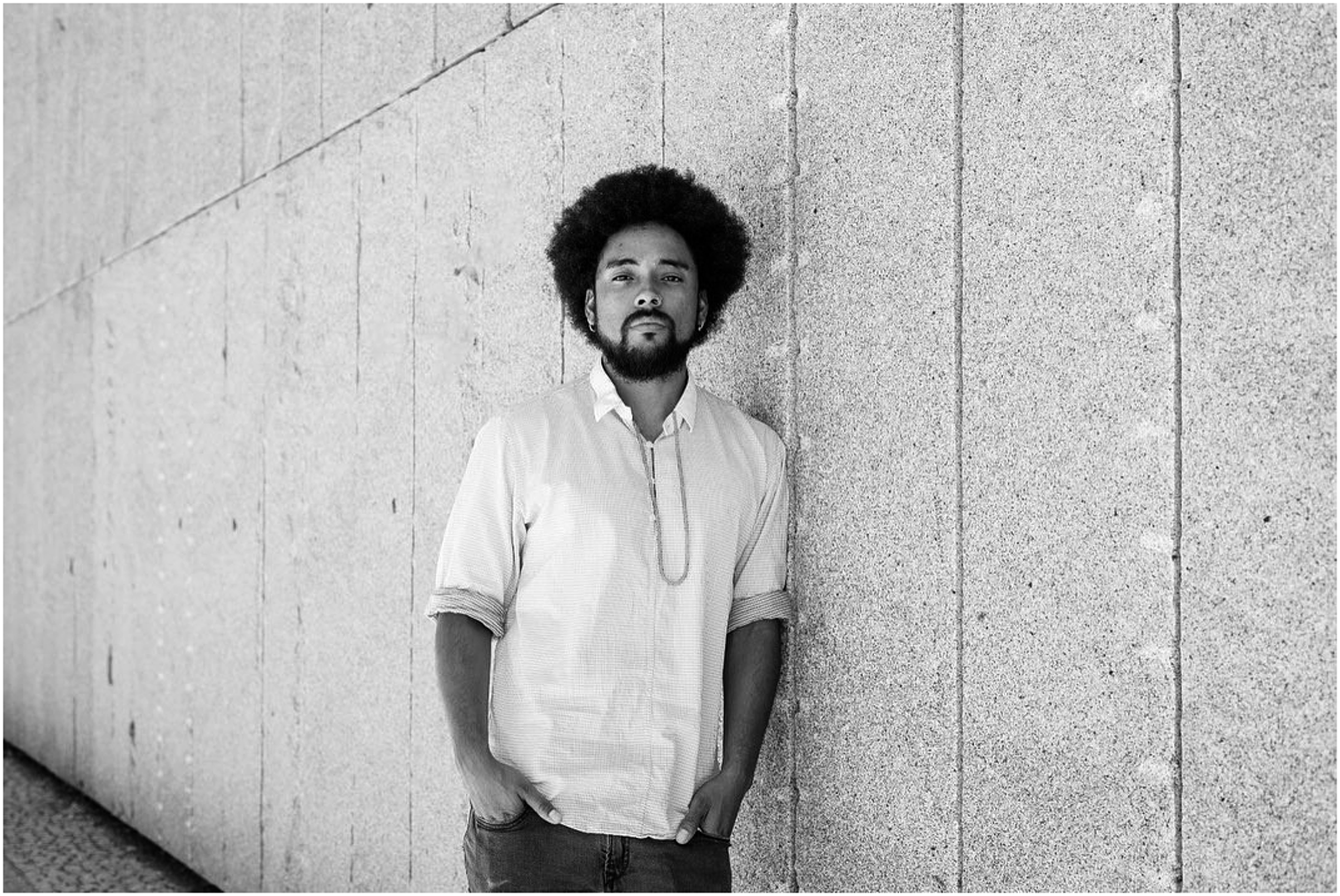
Yeison F. García López in Madrid. Photo by Javier Sánchez Salcedo. Used by permission.
A Conversation with García López
I never thought I’d go to college; no one ever suggested that I imagine myself in that space. When I started, I saw that I was the only Afro-descendant person at the School of Social Science, and I began asking myself a lot of questions: Why didn’t anyone ever tell me I could go to university? Why aren’t there more people like me here? Why do I feel so out of place among my classmates and among the faculty? I had never been a good student. I realized that I did not have the same background knowledge as the rest of the student body at all. I didn’t even know there was such a thing as a field of studies called Political Science. So, I spent my first year at university reading, attending conferences, staying up late watching “must see” documentaries, interviews, and films. I spent more time off campus than on it. I needed to find answers to the questions I was asking myself. These questions led me to distance myself from my day-to-day life so that I could analyze who I was, who we were, and why we lived in this state of inequality. That’s how I started gaining a critical and empowering understanding of myself as a Black, working class, migrant man.
My introduction to activism happened at around the same time. The first organization I joined was Amnesty International. I worked on Economic, Social and Cultural Rights for a while. But I felt that this organization didn’t have that much to do with what I was looking for at the time. In this search, I came upon SOS Racismo Madrid. This was my first introduction to the anti-racist struggle and migrant rights.
For a year, I was part of a group in charge of visiting migrants detained at the Foreigners’ Internment Center in Madrid. I discovered that the police station I used to go to with my mother to renew my immigration permit had a place in the back where they locked up people like me. I vividly recall the story of a young Colombian guy who had come to Spain at about the same age as me. I started visiting him to see how our organization might help him. We put him in touch with some lawyers, but there was nothing they could do. This kid who had been raised in Madrid and knew no one in Colombia was deported. He and I share the same story. The only difference is that my mom did everything possible to keep our permits up to date. That is when I became aware of my situation as a migrant person. Later, at the School of Political Science at the Complutense, we founded one of the first university organizations for Afro-descendants, “Kwanzaa Asociación Afrodescendiente Universitaria.” That is where I developed my Afro-consciousness.
As far as the fight against racism, I have been greatly influenced by some of the theorists published in the newspaper El Salto’s blog “1492: Por un antirracismo político” (“1492: For a Political Anti-Racism”). In fact, much of the renewal of the narratives and frameworks of analysis around anti-racism that we’ve seen in recent years in Spain has been thanks to the intellectual efforts of people like Helios F. Garcés, Ainhoa Nadia Douhaibi, Natali Jesús, and Salma Amzian, as well as the artistic-political endeavors of Daniela Ortiz and Colectivo Ayllu, who have been active in Madrid since 2017.
As for the poetic referents that have marked me, and still mark me, many poets have used their poetic voices to advocate on behalf of African and Afro-descendant people: Nicolás Guillén (1902–1989), Aimé Césaire (1913–2008), Audre Lorde (1934–1992)… Also poets who are not associated with Afro identity: Rosalía de Castro (1837–1885), Miguel Hernández (1910–1942), Paul Verlaine (1844–1896), Rimbaud (1854–1891).
And on a more personal level, along the way, I’ve been greatly influenced—not so much in the way I write but in helping me feel like a poet—by my friend-mentor, Peruvian poet Leo Zelada (b. 1970‐). He is doing an excellent job with a literary discussion group called Exiles that he started more than ten years ago in Madrid. The group is composed of a generation of very young poets of migrant origin who are poised to transform Spanish poetry.
I try to combine biographical and structural issues, because that is how I started becoming more aware myself. I remember the first Kwanzaa assemblies we had, where we talked about racist incidents we had went through. I was totally shocked to see that these people I had barely just met had endured the same sort of racism I had. In fact, those conversations triggered memories that were buried somewhere in my mind. It was incredible. I made the switch from individual to collective experience. And from there, through reading Afro authors like those mentioned earlier, I arrived at the structural-systemic-historical aspects.
Talking about multiple identities, especially for children of migrant origin, is an attempt to generate a space of convergence between the factors that determined your family’s, or your own, migrant experience and the things you have internalized over the years in the host society where you were born or raised. Oftentimes, due to racist logic, the daughters and sons of families of migrant origin end up embracing their family’s identity of origin. And, in many cases, these people have never set foot in that country. This form of escapism is often accompanied by a total disconnection from the struggles taking place in their immediate surroundings. What is behind this is a feeling of not belonging, with the ultimate result being that these people do not get involved in any sort of social struggle. I say this with all due respect because these processes are very complex and highly personal. But I feel that we end up slipping into a passive attitude where we internalize the notion that we mustn’t do anything because we are not part of this society.
Reconciling these two identities, your migrant background and the identity the society you grew up in has created for you over the years, tends to generate a sense of belonging that makes you become politically active. What direction this political activity takes is another matter entirely. I think that this reconciliation of identities is one point of departure for constructing that idea of the anti-racist migrant political subject. We are fighting for our rights in the society we live in without losing sight of the social struggles taking place in our countries of origin.
The dialogue between my work and feminist movements, particularly Black feminist movements, began when I started thinking about myself as a Black man. This happened thanks to conversations with sisters who pointed out several omissions in my referents, discourse, and political action. Until then, I hadn’t thought about how my status as a Black heterosexual man generated a series of power dynamics that were opposed to everything I was advocating. Ever since, I have been engaged in a learning process to stop me from succumbing to male chauvinist tendencies. But, at the collective level, despite the strong presence of Black feminist movements in our debates (see projects such as Afroféminas (2019); La Casa Encendida (2021); Sipi Mayo (2020)), Black men have yet to own up to our share of responsibility in creating spaces where the ways in which heterosexual Black masculinities are constructed are called into question. Aside from some isolated initiatives, and the work carried out by people like Senegalese activist Marra Junior (García E, 2021), very few spaces in Spain are addressing the issue of Black masculinities.
Although heterosexual Black men have a lot of work to do, I think that, in practice, feminist, anti-racist, and anti-capitalist political activities are in fact interconnected. This is largely the case because many of the people in these organizations are women who raise concerns about this issue and Afro-descendant sexual dissidents who are trying to expand the framework of our struggle.
Similarly, there is a radical Black think tank called “In the Wake” (Matadero Madrid, 2022) still active today coordinated by Esther Mayoko Ortega, who published an academic article last year called “Céspedes y la colonialidad del archivo: historias de negritud y fuga en la modernidad española peninsular” (“Céspedes and Archival Coloniality: Stories of Blackness and Flight in Modern Peninsular Spain,” 2021). Other academic works in the field of education include Ana Cebrián Martínez’s study “Etnoeducación y artivismo: Aplicaciones de la Educación Artística contemporánea no formal en el colectivo afroespañol” (“Ethnoeducation and Artivism: Examples of Informal Contemporary Art Education among the Afro-Spanish Collective,” 2017) and Patricia Rocu’s “Guía: Estrategias para incorporar la perspectiva étnica en la universidad” (“Guide: Strategies for Incorporating the Ethnic Perspective in University,” 2019).
Then, there are various publications that have sought to raise awareness about our community. I’m thinking of Inongo-vi-Makomè’s book España y los negros africanos (“Spain and Black Africans,” 1990), Jeffrey Abé Pans’ Cuando somos el enemigo. Activismo negro en España (“When We’re the Enemy: Black Activism in Spain,” 2019), as well as other, more institutional, initiatives like the study published by the General Directorate for Equal Treatment and Ethnic-Racial Diversity, “Aproximación a la población africana y afrodescendiente en España. Identidad y acceso a derechos” (Cea D’Ancona MA and Valles Martínez MS, “Close-Up of the African and Afro-Descendant Population in Spain. Identity and Access to Rights,” 2021) and the Observatorio Español del Racismo y la Xenofobia (OBERAXE)’s or Spanish Racism and Xenophobia Observatory’s “Estudio para el conocimiento y caracterización de la comunidad africana y afrodescendiente” (“Study to Understand and Describe the African and Afro-Descendant Community,” 2020). I offer this bibliography to demonstrate that there are several knowledge-generating initiatives in place, and I’ve probably left several more out. But I’m not sure if all these projects would fit the framework of that idea of Afro-Spanish Studies. I think that’s up for debate.
As I mentioned earlier, although the categories indicated have yet to be defined, what we can do is find points of convergence. The first of these is a commitment to creating an aesthetic-cultural framework to help generate the social conditions necessary to ensure that anti-racist demands are on the public agenda. It is key that more and more sectors of society become familiar with a series of narratives, realities, and demands outside the paternalistic and disempowering frameworks used to construct the imaginary around migrant and racialized people in Spain.
Many of these proposals, such as Silvia Albert Sopale’s 2019 play No es país para negras (“No Country for Black Women”), Paloma Chen’s 2022 poetry book Invocación a las mayorías silenciosas (“Invoking the Silent Majority”) and Lucía Mbomío’s 2019 novel Hija del camino (“Daughter of the Road”), set out to challenge the notion that we are a racially homogeneous society, so prevalent in the Spanish imaginary. And another common characteristic of many of these proposals is perhaps that their target audience are those very same diasporic and racially marked communities and populations. In other words, they’re using artistic and cultural creation to generate processes of anti-racist empowerment among these communities, as opposed to trying to inspire “empathy” among society’s white majority.
Based on these references from Colombia and the United States, in addition to cultural public policies, what else would help make interculturality, equality, and inclusion real in Spanish society? This question is connected with another question you posed, which is, how can we ensure that the idea of an anti-racist cultural public policy won’t become an empty signifier (García López and Segarra, 2024)?
To imagine public policies that create conditions of racial justice it is key that we gather data on ethnic and racial origin. This debate raises questions around the existing dialogical relationship between true and formal equality. In this sense, gathering data about ethnic and racial origin would allow us to name, count, and differentiate to identify specific problems and, from there, build real equality. Not only that, but gathering this data would also enable us to counteract the foreignization of “non-white” people.
Opening a debate to discuss these data represents a historic opportunity to do away with statistical invisibility, recognize structural inequality, and transform the way we approach the fight against racism. We cannot eradicate it by simply changing discriminatory ideas. In other words, we cannot eradicate it through awareness-raising campaigns alone; we also need to redistribute resources and power. And data is necessary to carry out this redistribution in the best possible way. We need data to give our anti-racist claims more weight.
Gathering that information to create specific public policies is not at odds with applying universal measures; it simply entails developing instruments targeted at tackling concrete problems that have their own origins and cannot be reduced to the general phenomena of exclusion or poverty. Far from being the solution to structural racism, collecting data is a tool to ensure that public policies to combat racial injustice and racism, including cultural policies, won’t end up being devoid of content. Public policies should use data to provide concrete solutions for repairing historic injustice.
This debate is still being defined internally within the anti-racist movement in Spain. It’s a very complex issue because, historically, there is a mistrust of the State, and we’re asking it to gather more data about our communities and peoples. This is not a simple issue, and there is yet more debate to be had to reach a more or less consensual position on this matter. Nevertheless, for me, it is one of the priorities on the anti-racist political agenda.
The greatest limitation as far as the use of the concepts of migrant and immigrant is the ongoing foreignization of racial difference. This is the discourse that is hegemonic in Spain right now: that racial difference is foreign. In this sense, I think using the concept of “racialized,” another academic term redefined by social struggles, is useful. In a way, when we talk about racialized people, we’re talking about the “non-white” communities and people who live in this country. With this concept, it’s not quite as easy to foreignized racial difference, and this makes it possible to begin to direct the debate toward the racialization processes at work in our country.
Yeison F. García López (Derecho de admisión, 2021: 67)
Translated by Eva Obregón Blasco
Yeison F. García López (Derecho de admisión, 2021: 61-63)

Translated by Eva Obregón Blasco
Yeison F. García López (Derecho de admisión, 2021: 43-44)
Translated by Eva Obregón Blasco
Yeison F. García López (Matria poética, 2023: 281-283)
Translated by Eva Obregón Blasco
Footnotes
Acknowledgements
I am deeply appreciative to the editors of this special issue, Claudia Milian and Elia Romera-Figueroa, for their knowledgeable and insightful contributions to the introduction of this piece and their editorial support. I am thankful to Eva Obregón for her fine and caring translation. I am grateful to Yeison F. García López for taking the time to have this conversation with me over several months and for his generosity in sharing his reflections on the questions I asked. I thank Erik Zitser for the conversations that helped me think through García López’s work and Ofelia López Madrigal for her editorial assistance.
Declaration of conflicting interests
The author(s) declared no potential conflicts of interest with respect to the research, authorship, and/ or publication of this article.
Funding
The author(s) received no financial support for the research, authorship, and/or publication of this article.