




Abstract
This commentary explores some of the cultural practices among people of Latin American origin living in Madrid. By establishing a link between Latinx migration and the process of racialization, the author describes how contemporary archives are being created and the ways that “migrant culture” is expressed and perceived in modern-day Spain, using the term “Latinx” as a critical category that refers to Latin American “Xs” living in the diaspora. This preliminary inquiry keys into the following question: What is the cultural history of Latinx communities in Madrid and how was this history constructed? In this way, the piece contextualizes the conflicts and misunderstandings experienced by Latinx migrants upon arrival in the host society from the standpoint of taking ownership of spaces of signification to generate a sense of belonging through cultural practices and creative projects. For these communities, such spaces are tangible and symbolic places of action, meaning making, and resistance. Culture—both its everyday manifestations and specifically artistic practices—is a critical space of expression, creativity, and thought. This makes it a suitable way to incorporate the migrant population into a new perception of Spanish national identity, thus generating enough of a sense of belonging.
Is the migrant seen as a cultural subject? How is this culture perceived in Spain when those migrants are from its former colonies? What is migrant Latinx culture like? Has the perception of the Other X that migrants represent in the (brief) history of contemporary migrations in Madrid and the rest of Spain changed? How has the cultural history of the Latinx community in Madrid evolved? How does one go about constructing this history?
I begin my exploration with this series of questions in hopes of understanding the impact and reception of Latinx migration in Spain as well as the strategies Latinx communities have used to integrate into the host society through their interactions and adaptations. The relationship between migration and culture explains why migrants establish their own spaces to counteract the reactionary narratives that are often constructed around the presence of Latinx migrants, which have historically been subject to a dynamic of subordination within the Kingdom of Spain. I propose this overview of issues of culture and migration as a Latin American researcher and cultural mediator who has been living in Spain since 2002 and, especially, based on my experience as founder and director of the YoSoyElOtro Cultural Association, created in 2008. In 2016, I started investigating the shift I had noticed in cultural activity among migrants in the city. In addition to publishing articles and organizing conferences, in 2021, my research took the shape of a project called El Otrx: arte, cultura y migración en la ciudad de Madrid (“The Other X: Art, Culture, and Migration in the City of Madrid”). The project is still alive and growing and comprises an exhibition on 12 organizations and collectives, a book, and a website, https://www.migracionycultura.es.
The term “Other X”—with a capital “O” and “X”— is used both in that project and in the present text above all to give otherness a proper name. Speaking both personally and as a cultural association, for us, otherness as an exercise in diversity and difference offers a space to articulate our participation in Spanish society as Latinx migrants. Furthermore, using the x is inclusive of gender-diverse and sexual dissidents who are breaking away from the feminine/masculine categories imposed by the Spanish language, which is marked by a cis-heteropatriarchal dynamic in which, additionally, the masculine ending prevails when forming the plural. For instance, in Spanish, there is no gender-neutral term for “children,” so people say “the boys are in class” even if they’re talking about nine girls and one boy.
My use of the “x” reflects a political stance of flouting the precepts established by the Royal Spanish Academy (RAE, Real Academia Española). The letters “x” and “e” are often used to indicate inclusion and break away from this binary classification. Both are commonly used among society’s more progressive sectors. Both letters are pronounced alike, as /e/, and they both have the same meaning, indicating an openness to dissidence by reflecting social integration within language itself. I am more partial to the “x” because of its disruptive potential vis-à-vis academic standards, since it is stronger, linguistically, compared to the “e” sound produced when the x, /equis/ in Spanish, is pronounced like the vowel e. The x will appear whenever I refer to specific people, subjects, individuals, or collectives. Nouns and adjectives that already end in the gender-neutral “e”—as is the case with the word “migrante” (“migrant”)—will remain unchanged. For other nouns and adjectives that are either gendered femine or do not refer to people, I will follow the grammatical usage prescribed by the Academy. Despite the efforts of feminist movements and dissidents to have these uses accepted as grammatically correct, the RAE does not sanction the use of “x” or “e” to indicate alternative gender categories. As stated in the Academy’s website, since 1713, the RAE has ruled that “the changes the Spanish language has undergone in its ongoing adaptation to the needs of its speakers shall not undermine the basic sense of unity throughout the Spanish-speaking world” (RAE, 2023). This is a decisive factor for Latin American and Latinx Spanish speakers and for the Spanish language in Latin America. The Spanish Academy is the leading institution of its kind and plays a key role compared to the other national academies—in each of the countries where Spanish is one of the official languages—that constitute the Association of Academies of the Spanish Language. My use of the “x” reflects a political stance in defiance of the RAE’s guidelines.
Throughout this preliminary inquiry, “Latinx” is used to designate the migrant majority from Latin American and the Hispanic Caribbean living in the city of Madrid. Latina/o/x/e is a generic label that we Latinx migrants in Madrid use to differentiate ourselves from migrant communities from other regions––i.e., Africans, Asians, etc. Is it feasible to try to transcend this “generic identity” that we often use instinctively but not always deliberately? Is it possible that Latinx might imply something more than belonging to a specific geographical region and the mystique surrounding it? Can we transcend this definition? Without venturing into tentative attempts to self-identify as Abya Yalasian, I prefer to use Latinx as a generic adjective, a contrived yet consensual demonym that, despite its meaning, is not used as an insult. Latinx will help provide a sense of collectivity by identifying and grouping subjects and communities (nationalities, regions, affections, etc.) with roots in the geographical area known as Latin America or Abya Yala. At the same time, Latinx is a point of convergence for subjects of that “Latinx” diaspora that contains so many other diasporas. As discussed in the volume El Otrx, the x reflects the inclusion of dissidence and cultural diversity in general, thus highlighting a political and linguistic positioning. In this context, Latinx is a concept, a critical construct, that represents the space where this group’s existence takes space in the diaspora and leverages the strategies of plural, critical, and diverse self-organization, resistance, creativity, and collectivity.
The Latinx subject informing this piece is a migrant whose existence is constantly marked by social, economic, and historical precariousness. This subject is not part of the recent boom in economic migrants that constructs Madrid as a sort of Miami, a fertile ground for real estate investments. The latter is a fairly recent trend in Latinx migration flows toward Spain and is championed by a very specific, elitist segment composed of Venezuelan migrants. The Latinx subject referenced here is not necessarily white, although they can be. Their existence is marked by otherness. They are at that zone of “non-being” that Frantz Fanon (2009) attributes to Blackness, their relationship with the metropolis and with everything the White man represents to colonized peoples, and vice versa. In this case, this status rests on mestizo, indigenous, and Afro-descendant peoples, and on the wide range of subjects that represent Other Xs in Madrid society, both phenotypically and culturally. Although the process of racialization is a crucial factor in constituting that Latinx Other, it is not exclusionary when talking about colonial enclaves, like Latin America in the case of Spain. The relationship between Latinx Others and the autochthonous, native population of Madrid—mainly Spanish nationals—experiences fluctuating levels of harmony and hostility, familiarity and rejection, associated with its bastard nature, in line with the ideas proposed by Bolivian artist and activist María Galindo.
Madrid: Colonial impulses and subordination
The discussion here focuses on the Latinx community and how some of the cultural, racial, and linguistic friction and dynamics within Madrid society affect it. These problems are not exclusive to Latinxs. They also affect migrants from other nationalities, such as Moroccans—which comprise the largest non-European foreign community—African and Afro-descended populations, Asian and Asian-descendants, among other ethnic and racial groups. Because of the Latinx community’s specific characteristics, the complex relationship between kinship and strangeness is prevalent.
Madrid’s central role in this work is due to several factors. First, Madrid is the biggest city in the country and its steady economic growth serves as a magnet for Latinx migrants who tend to settle in large Spanish cities (although they live all over the country). Second, the capital is marked as both the geographic and the administrative center. It is the seat of Government and, by extension, the center of the cultural sphere. Madrid is where relevant aspects of the Spanish language are debated and postulated. It houses the offices of the aforementioned Spanish Royal Academy (RAE). It is also where Spain’s biggest and most visited museums and some of its oldest and most prestigious universities are located. Not to mention the many other cultural notions, including the concept of “Spanishness,” that radiate from the capital to the rest of the territory.
The Diccionario de la lengua española (DRAE, “Dictionary of the Spanish Language,” 2023) defines “españolidad” (“Spanishness”) as “the quality of being Spanish” with a secondary sense of “having a genuinely Spanish character.” These tautologies do not shed much light on the aspects that define it. There is a certain sense of “Spanishness” that was revived by the Franco dictatorship and still persists as a legacy in modern-day Spain. This identity is primarily based on prioritizing the use of Castilian Spanish over the country’s other co-official languages (Catalan, Galician, and Basque), on the Catholic religion, and on whiteness as a distinguishing feature with respect to the non-White Other. Ecuadorian-Mexican philosopher Bolívar Echeverría (2018) proposes a genealogy of modern-day whiteness and, more specifically, whiteness as it relates to the accumulation of capital, that is “intertwined or closely linked with a diffuse or sublimated set of ethnic-ethical traits that once characterized the people of Northern Europe” (Echeverría, 2018: 15). These ethnic traits have some bearing on Europeans’ self-concept as White people, but they are not enough in and of themselves. Identification also requires a set of ethical precepts about the universal idea of the value their own whiteness represents and its expansionist nature in economic terms (Echeverría, 2018). Whiteness operates on white skin, but it is not unique to it. If we think in terms of whiteness, the people of Northern Europe are very white, but can the same be said of the people of Spain? The answer is relative. Nevertheless, as the idea and origin of a superiority that is articulated in ethnic-racial, economic, and cultural terms, whiteness is present in Spanish society and has been straining the relationship with the Other for a while now.
In Madrid, old colonial impulses that have shaped the idiosyncrasy of a key part of the population are still simmering. Part of the genealogy of the relationship between modernity and whiteness is embedded in the history of Spain, as Madrid-based Chilean writer, poet, and curator Francisco Godoy Vega (2023) reminds us. Godoy explains that, as a result of the changes brought about by “the so-called expulsion of the Moors and Jews from the Iberian Peninsula and discovery of America,” 1492 was a key moment in the foundation of “white supremacy” (Godoy Vega, 33). Since then, these impulses have emerged and, to a greater or lesser extent, are still present in Spanish society and in the discourses on Spanishness. Both events are part of the epic that underpins the notion of racial purity as a result of, on the one hand, the ethnic and religious cleansing those expulsions entailed and, on the other, the subjugation and plunder that turned the Kingdom of Castile into an international empire. As Godoy Vega states, these events led to “a turning point that put whiteness and Europeanness at the center of the world equation” (Godoy Vega, 33). This turning point has been and still is the epicenter from which this worldview is recreated, imposing itself on the present and, quite frequently, on the migrant populations that inhabit the city.
For the most part, I’m talking about economic migrants who moved to Madrid in hopes of improving their own lives and the lives of their families. Spain is not the United States, and the “European dream” is not the “American dream.” Living in a European country like Spain offers a certain state of wellbeing: a fairly stable economy; a service sector with a huge demand for workers; public universal education and health care; no visa requirements for many countries; a Spanish-speaking population. All these factors serve as incentives for people from Latin America to embark upon a migratory process. This is not the same process undertaken by tourists, soccer players, internationally renowned artists, or investors, among others, who arrive as temporary visitors or upscale residents. These displacements generate a different set of tensions than those provoked by migrant X subjects. Rich and prestigious visitors like Mexican tourists, Senegalese soccer players—despite the frequent racist affronts at the soccer stadium—and internationally renowned artists like Shakira, or Chinese investors, don’t get the same kind of treatment.
An economic migrant from the Global South is perceived as an intruder, a stranger, an Other X. This strangeness cuts across various areas of Latinx being that inhabit the imaginary of the host society. Beyond culture shock, there is a “Spanish culture” that must be protected from contamination and the Latinx intruder represents poverty, ignorance, noise, parties, hyper-sexualized and overly fertile women, Xs who are too Black, too Brown, too Indigenous… Latinx migrants bear many marks of distinction that position them as something menacing and strange in Spain. But they’re not. Godoy Vega (2023) insists that, over the past several centuries, indigenous people have never been alien to Spain. Ever since Spaniards first arrived in what we now call America, indigenous peoples were forcibly transferred to the Court, as was the case with the Taíno natives Columbus brought before King Ferdinand (Godoy Vega, 2023: 38–39). Here, indigenous people are portrayed as representing otherness, or difference, within Spanish society. But the Latinx Other is not a stranger. Although these various groups’ existence is a historical fact, whitewashing and concealment of religious and ethno-racial diversity are another part of the history of the Iberian nation. The presence of otherness, whether in the form of Jews, Muslims, or Roma people, has been viewed with suspicion, generating purist discourses and discrimination that have led to “othering” various subjects.
It’s worth asking what distinguishes Latinx otherness in present-day Spain? Latinx subjects have been migrating to Spain since the late 1980s. But neither Spain nor Spaniards have been strangers to Latinxs. Even though, to many Spaniards, Latinxs were strangers. Race, racism, and violence have made themselves manifest in numerous ways, and there is an abundance of analysis of these issues. I would like to highlight the 1992 murder of the Afro-Dominican migrant Lucrecia Pérez Matos in Madrid at the hands of neo-Nazis. This was the first crime recognized by the courts as being racially motivated, thus calling attention to a pattern of tension toward migrants, especially those who are poor and racially marked. The use of racist language on the street is another example. This is, unfortunately, a common occurrence in interethnic, interracial contexts and other situations in which people of diverse backgrounds are brought together. When that bias is reflected in Spanish language policy in Spain, it becomes “institutional racism.” Violence as an “adjective” was made vocal and escalated to the rest of today’s Latinx community when, in 2016, the members of the RAE ruled that the term “panchito/a”––defined as “adj. desp. coloq. Esp. hispanoamericano de aspect aindiado” (DRAE, 2023), which elsewhere in this publication Ana Ugarte translates as “a Spanish-American person of Indian-like appearance”––should go from being a word that was used as an insult on the streets to being incorporated into the royal dictionary. Despite criticism from Spain’s Latinx community, including a group called “Comunidad de Latinos en España” who claimed it was an offensive slur used to define its citizens, the RAE defended itself by arguing that its job is to make the language used on the street official (García, 2016). This response is suspicious and can be seen as racist given that other demands to incorporate on-the-street usage—such as gender pronouns or the feminine plural—have not been heard.
When organizations like the RAE, which is in charge of standardizing language, institutionalize this type of terminology, they send a clear message to the international community ratifying a hierarchical superiority that goes beyond race and has an impact on society. Colonial subordination is evident, for instance, in this act of designating us panchtixs or “sudacas” (from “sudamericano/a/x,” the Spanish colloquial word for South American), possibly the first “pejorative adjective” in decades used and legitimated to designate difference and otherness. Although slang words like “Machupichu,” “payoponi,” and other terms used to refer to other ethnic groups such as “moro” are also used on the street, these have not been legitimized by the RAE or the meanings proposed are not outright negative, as is the case with panchito.
The role of migration and culture in critical and collective meaning-making
The action of migrating takes place when an individual moves from one place to another, so I will use the term migrant in a broad sense, without making any distinction between the causes of this displacement or the migrant person’s administrative status in the host country. This same framework was applied in the book I edited, El Otrx. In this concise examination, I will review some key points that serve to contextualize and analyze the history of migration in Madrid as a way to understand its impact on culture in the city.
The International Organization for Migration (IOM) defines migration as “the movement of persons away from their place of usual residence, either across an international border or within a State” (IOM, 2006: 38). This definition encompasses all sorts of movement of persons, regardless of their number, identity, or motives. It includes refugees, displaced and uprooted persons, and economic migrants. This view of the migrant subject as someone who has moved—regardless of what the reasons for moving or the legal status of their displacement or arrival may be—serves as a correlate between migration and migrants and their large-scale participation in the cultural and artistic life of the host society (Olívar, 2021), thus auguring the real and symbolic impact of their actions.
In addition to “migrant subjects” I’m also including other categories such as “of migrant origin” and “racially marked.” The term “people of migrant origin” is used because, since the Latinx migrant population has been present in the country for over 30 years, we need to have a way to refer to the children of those migrants, whether they arrived with their parents or through family reunification or were born in the host country. The children of migrants are not migrants. Migration and displacement are part of their roots, but they did not have a say in the decision to migrate, even though they are susceptible to being othered, especially if they are racially marked. I employ the term “racially marked” to refer to non-White people in general. Some people who migrate from the Global South are White and are not discriminated against or othered because of their race, but rather because of their culture, language, religion, social class, gender, etc. Race and racialization are controversial concepts that are not accepted by certain public authorities and specialists in the field. Nevertheless, these categories are crucial when talking about human migratory movements and their impact on the societies of the Global North.
Understanding migrants’ participation in cultural activities requires a more pragmatic approach. The concept of culture and cultural policy espoused by Susana Beirak (2022), a member of Madrid’s regional government, is pertinent here. Beirak points out the need to “reclaim culture as an everyday tool for building ways of inhabiting the world that are less individualistic, less rigid, less unscrupulous, and less hostile” (30). She proposes transcending the purely artistic and sectorial to fully incorporate culture and cultural practices in daily life without denying the purely artistic aspect of cultural production and creation. This aspiration would allow us to turn culture into “a cross-cutting framework through which to interpret and intervene in the world” (Beirak, 2022: 30), since expanding the controversial definition of culture would help generate public policies to democratize its social legitimation and role, promoting a concept of commonality. In Spain’s case, applying said concept to the structural presence of migrants would improve relationships and social integration, given culture’s potential as a means of generating critical and collective meaning. Migration and its structural impact may be present in the political agenda, but they are barely incipient on the cultural agenda.
If we don’t do it, no one else will
Migrant cultural practices have occurred in different places around Madrid. Artist and researcher Fiacha O’Donnell (2018) points out that numerous sporting, festive, and commercial practices that were profoundly marked by the cultures of each of the national communities involved have been carried out in public spaces around the capital. One such event was Ecuavóley, a very popular Ecuadorian sport similar to volleyball that has had a significant impact in the city. Over the course of just six weekends, one project carried out in Madrid between 2011 and 2012 counted 150 courts covering a total surface area of 24,300 square meters, with nearly 1,050 people participating in activities directly (O’Donnell, 2018: 117).
These cultural activities often lack any sort of official authorization to use the spaces in which they are organized. Nevertheless, they imprint a complex richness of identity on the city that transcends the society where they were created to occupy certain locations throughout Madrid. These actions have very boldly occupied public space thanks to those distinctive components of identity that transcend the material nature of bodies through cultural practice. In this sense, for migration specialist and researcher Eduardo Thayer (2007: 65), the presence of migrants in the city’s physical and public spaces subverts “the conditions of subordination” to which migrant individuals are subjected in the host society, allowing them to re-signify and renew the differences made manifest in other spheres and the subjectivities that sustain them.
The emphasis here is on the symbolic dimension, the presence of migrants in the city’s spaces is vital, and culture is a key element in occupying these spaces. Whereas the example of life in the neighborhoods, parks, and other public spaces is paradigmatic of the sociocultural impact of Latinx communities in the city, a (re)evolution and (re)generation of collective identity(ies) in Madrid—and the rest of the country—would require understanding and approaching the Other (migrants, people of migrant origin, and racially marked persons) through art and culture. Culture, as a material and symbolic space for collective and individual thought, action, and (artistic and intellectual) creation, can facilitate a critical coexistence, counter colonial prejudices and, of course, encourage the exercise of difference, or otherness, as a democratic principle. For sociologist Saskia Sassen (2017: 194), associations and cultural activities foster democratic participation among migrants in the host society. But Sassen insists that this participation must transcend the notion of integrating or assimilating migrants into the host culture.
Comprehension: Language under dispute
For Latinxs, Spanish is a “common” language and a space for participation that is under dispute. Few capital cities are as obsessed with navel-gazing as Madrid, particularly when it comes to the use of the “Castilian” language. That is why Latinx expressions are often met with incomprehension and no attempt to explore ways of understanding. It is true that we do not use the same words for everyday objects: we call a computer “computadora” whereas Spaniards call it “ordenador”; we call a car “carro” or “auto” while they call it “coche”; and we say “agarrar” for “to grab” whereas Spaniards use “coger.” But some frequent corrections transcend any linguistic, grammatical, or even communication concerns, social class, educational level, and other such criteria and put us at the same level of isolation and incompetence as far as the handling of “our mother tongue” is concerned. Peruvian writer and journalist Gabriela Wiener, who is based in Spain, draws attention to this situation in her poem “Panchilandia” (“Panchiland”). The following verses attest to this phenomenon: The first time they told me I wasn’t writing in Spanish. That I didn’t speak proper Spanish. Vosotros, not ustedes, for the plural you. Edits are excisions. Echar de menos, not extrañar, for miss. […] Four horses galloping in opposite directions to quarter the body. To slice off our braids. Migration is not being reborn, it’s renaming a thing that no longer has a name (2023: 173).
This poem, first published in Wiener’s autobiographical novel Huaco retrato (2021), was recently translated into English as Undiscovered (2023). It is a mission statement outlining issues of concern for Latinx people in Spain, including colonialism and racism. There are many ways to interpret “Panchiland.” Starting with the title, which appropriates the insult “panchito” and turns it into a territory, a sort of Disneyland where many of the problems continually encountered by Latinxs/panchitxs/sudacas in their host society are expressed. Of all these troubles, the issue of language and its affectation are notoriously common to Latinxs living in Madrid. These linguistic identities are based on linguistic practices in a living language shared by various territories, a single multifaceted tongue that many in Spain are not always willing to comprehend, nor do they make any effort to do so.
What is the point of this comprehension? How does this change the rules of equality and inclusion? Comprehension is integral to coexistence. In the case of Spanish and its Latin American variants, these processes of linguistic and, therefore, day-to-day, neighborly coexistence itself comprises several levels or layers of unequal communication, because one version of this language considers itself superior to the rest. Castilian Spanish—named after the Spain’s central provinces, with Madrid in the middle—is considered the first, correct, pure, in short, the most appropriate version of the second-most widely spoken mother tongue in the world. In other words, a region that is home to just 10 million speakers dictates the norms on how the other four hundred and 80 million speakers of Spanish should express themselves. This regulatory zeal is what gave rise to the RAE, which was pointed out earlier. But there are also ordinary citizens who consider themselves the guardians of the Spanish language and its purity. As I experienced while working as a Language and Literature tutor in the district of Carabanchel in Madrid, this group of champions of Castilian Spanish includes high school teachers who tell young Latinx students that they’re not speaking Spanish, or to be more precise, that “that thing they speak isn’t Spanish.” For children and young people, hearing this kind of reprimand with respect to a “shared” language can potentially impact their professional development and their sense of belonging in the host society.
At a plenary session of Madrid’s regional assembly, Diana Carol Paredes—a member of the left-leaning Más Madrid party—raised the aforementioned concern before the head of the city’s Department of Education, demanding linguistic inclusion for Latinx students and an end to anti-Latinx discrimination in the classroom. Wiener, the writer cited above, has also experienced this. Whether in the universities, at government agencies, or in companies, we have all at some point modified or adapted our Spanish either through the natural assimilation of autochthonous forms or through imposition, out of a need to adapt or survive. As Wiener writes, “Migration is not being reborn, / it’s renaming a thing that no longer has a name.” Faced with incomprehension and its consequences, we prefer to keep quiet and adapt our bastard tongue to the official, legitimate language.
There is another level at which neither the RAE nor the stewards of language remain operative: popular culture. With the Latin music industry at the forefront, for decades now various Latin rhythms that have made an impact around the world have gradually begun to permeate Spanish society. Since the emergence of reggaeton, trap music, and their derivatives, Spanish youngsters have undergone a continuous process of Latinization personified by commercial music artists like Rosalía and C Tangana—to name some recognizable examples—who are not necessarily Latinx but who imitate Latin sounds. All things Latinx have become trendy and fashionable. But beyond that, and without delving into issues of cultural appropriation and the whitewashing of Afro-Caribbean forms of expression—both of which are also a factor in interior regions of Latin America—the fact is that Spanish youth have been strongly influenced, taking on Puerto Rican or Dominican accents and using Colombian idioms or expressions, among other linguistic borrowings. Faced with this turn of events, one may wonder: is this a form of comprehension? Certainly, beyond the entertainment industry, fads, and trends, both Latinx cultures and Latinx migrants have been exerting an influence and staking a claim to their own space in Spain for years. Far removed from the standards designed to control language, young people have the potential to serve as a bridge. They are disobedient and persist in communicating and engaging in a dialogue with Latinx Others. Perhaps they feel they belong to this collective, or is it that it is familiar to them?
But this Latinx linguistic movement is peripheral. Although it has numerous speakers, these speakers are marginal, so their words, as explained above, are corrected. In this sense, the feeling Wiener’s character describes brings to mind Gloria Anzaldúa (2016) when she declares: “If you want to really hurt me, talk badly of my language,” because “ethnic identity is twin skin to linguistic identity” (110). Here, the writer is talking about Chicanos. Similarly, there are plenty of variants of Spanish spoken by Latinxs in the Spanish capital, an endless variety. And, apparently, even though they are all the same language, these variants are incomprehensible. Hence, once again, corrections represent the ache of the “colonial wound” that Walter Mignolo (2007) describes, and that we often feel festering. They attack an identity already subjugated by a language that was imposed. Dagmary Olívar Graterol’s rewording of an excerpt from Gloria Anzaldúa's Borderlands/La Frontera.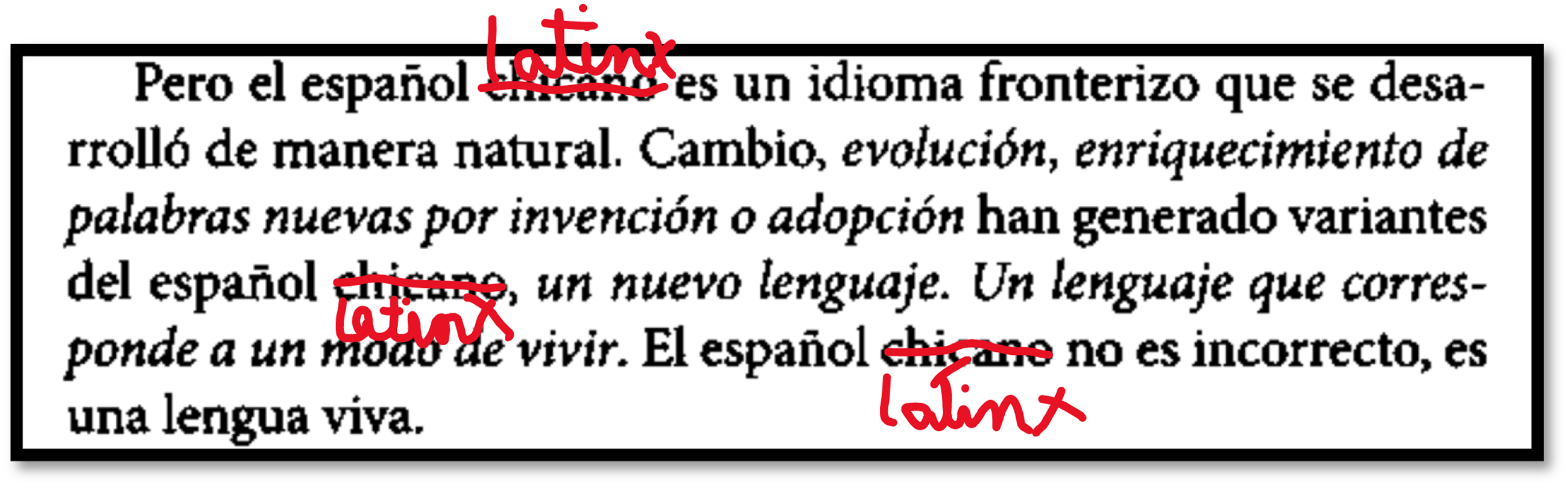
To draw an analogy with Anzaldúa’s Chicano Spanish, Latinx Spanish is a living language that is constantly mutating and inhabited by multitudes and diversities. But it is on the border; it inhabits the borderlands. It is established at the origins of the diaspora. It seems that, when we leave the country where our versions of Spanish originated, we leave our nationalities behind and become Latinx. Displacement transforms it into a different language. This is a language in constant motion that travels with its migrants and, like them, it lives on the border, inhabiting spaces that are sometimes contradictory, denying or simply delegitimizing its existence. Within our own diaspora, our Spanish, Latinx Spanish, is enriched with other accents and vocabularies from other variants of the language, including forms that are distinct to Madrid. It is not an incorrect language; Latinx is a bastard language, spoken by bastard “Xs,” whose strength lies in that crossroads, in its limits, far from the center, in encounters and agreements. Speakers of Latin American Spanish know that we are diverse, different, and so is the way we communicate. There are no corrections between one Latin American Spanish and another. Instead, there are questions and compromises to ensure comprehension. When we manage to communicate, there is no such thing as being incorrect.
Language is the site of another cultural struggle to take possession of words, to name and rename ourselves. The way Latinxs are represented in film and on television and other content platforms relegates another collective, actors in this case, to continuously rethinking their position and prospects, limiting their job options to stereotypes. Efraín Rodríguez (2021), a Mexican actor and activist based in Madrid, points out that, behind the representation of Latinxs in the media there is a commonly recurring stereotype that affects the collective imaginary and can potentially impact reality.
Rodríguez and Colombian actress and activist Ari Saavedra form a collective called Es(Tu)Yo that questions these challenges through audiovisual content, workshops, and actions that use the performing arts to put the “accent” on the cultural, dialectal, and ethnic diversity that constitute modern-day Spanish society. In their video “A(s)ento Neutral Español” (“Neutral Spanish Accent”), they criticize the notion of the Castilian accent’s neutrality and how this impacts their careers. The piece is based on material gathered through surveys, Instagram actions, and a series of other processes that enabled them to generate a humorous and ironic critical perspective. They use this to question a cultural system at odds with their presence, their accent, and their diversity, a system that excludes them, asking them to change their pronunciation or play up their Latinxness to the point of becoming caricatures, as they do in other videos like “Bodas de sangre, tequila y reguetón – De Federico Gar(s)ía Lorca” (“Blood Wedding, Tequila and Reggaeton – By Federico Gar(s)ía Lorca”). At the same time, they criticize the representation of Latinxness without Latinxs, which, for Saavedra and Rodríguez, is epitomized by having Spanish actors play Colombians or Mexicans, as is evident in parts 1 and 2 of “Para hablar como latine – sin ha(s)er el ridículo” (“How to Talk Like a Latine – Without Making a Fool of Yourself”), which, like the previous video, is part of their web series Reflexiones (“Reflexions”). Stereotypes, brownface, and discrimination are just some of the affronts this collective light-heartedly denounces.
How can we feel at home?
We will feel at home in Spain when there is no longer a need to talk about migration and culture. In the meantime, we aim to have migrant people and projects represented in 15%–20% of the programming for official events and festivals, publisher’s catalogues, conferences, and, especially, the cultural institutions where decisions are made. Migration is on the social and economic agendas, but its active inclusion in cultural agendas lags far behind. As far as culture is concerned, it is imperative that cultural promoters apply a cross-cutting markedly anti-racist perspective based on inclusive cultural policy to their (de)localized work.
This profoundly anti-racist migrant perspective has been fueled by various left-wing, especially feminist, struggles. Although this sort of mutual enrichment is common among activists throughout the world, some concrete examples can be found in Madrid. Exhibition spaces like FelipaManuela use a tool developed by Mujeres en las Artes Visuales (MAV) to study gender parity in museum institutions as a model to prepare a report about ethnic/racial diversity in Madrid’s institutions (Ariza and García, 2022). On a more institutional and not directly cultural level, the Ministry of Equality has incorporated anti-racism and diversity as part of state policy, creating a General Directorate for Equal Treatment and Ethnic-Racial Diversity headed by Rita Bosaho, a politician of Equatorial Guinean origin. We must insist on the specificity of that ethnic-racial aspect and the cultural diversity it represents, activate the real and symbolic participation of migrant and racially marked people, and regulate it by law.
Participating in the cultural life of the host society facilitates the necessary process of recognition and socialization for migrants. Culture is sometimes the only area where the migrant subject can exercise some form of citizenship, especially if their administrative status is “irregular” (Olívar, 2021: 43–44). It is the space where we can think about ourselves and create “other” (Otrxs) ways of being and belonging beyond whatever administrative or professional status society and our circumstances may ascribe to us. Everything that has happened in the last two years—that is, since El Otrx was published—leads me to think that we have made progress. But there is still a lot of work to be done and many challenges to be overcome to reach an optimal situation on the issue of migration and culture. These challenges include: (1) promoting legislation to protect the existing ethnic-racial diversity in the country; (2) ensuring its visibility as part of society, coupled with other actions to educate the autochthonous community on intercultural relations; (3) revising the history, language, and literature curricula; and (4) rectifying the way Spanish history, especially colonial history, is told in academic, institutional, urban, and museological contexts, among others. Finally, I would like to highlight a fifth objective: promoting referents so that children and young people can find role models that reflect their differences. This would help counteract the precariousness and stereotypes that plague migrant and racially marked people in Spain.
Migrants, people of migrant origin, and racially marked people comprise a cultural community that is drawing attention from the top cultural institutions in Spain. A case in point is the announcement and program for the 8th Conference on Culture and Citizenship, organized by the Ministry of Culture and Sports in Seville in October 2022, which included a significant selection of cultural figures and projects working on issues of otherness, emphasizing the presence of ethnic-racial minorities in Spain and highlighting their work. Another example is the motion presented by the Socialist Parliamentary Group on measures to promote cultural and ethnic-racial diversity in the cultural sector (March 2023), which calls for our full participation within a protective and supportive framework; although we still have to fight to have the motion become a law. The most ambitious and tangible official initiative to date is, no doubt, the Barcelona City Council’s 2021–2030 Intercultural Plan (2021). Not only does ethnic-racial diversity among migrant populations constitute its main line of action, but the plan also covers other minorities native to the region, including the Roma population and the various intersectionalities of the identities that inhabit the city (5).
As a meeting point and site of dispute that redefines our participation in the host society, culture can become a driver of transformation for collective identities in need of conceptualizing an inclusive, shared future in which everyone in Madrid, and in the rest of Spain, is represented. This is the context in which migrants’ interaction with culture has taken place in Spain. The inquiry I proposed here is an exploratory exercise in theorizing and recalling some of the contemporary initiatives that are going on around me and which I access through a “bastard place,” to use Galindo’s words. This place is a sort of “space to escape to [... and] legitimize disobedience and cultural critique in every sense” (2020: 78). This “borderland” that Anzaldúa also invoked (2016) is inhabited by the subordinate bodies of the panchitxs, sudacxs, and other Other Xs who move through it and who, like me, occupy and decentralize the center of Madrid in various ways.
Footnotes
Declaration of conflicting interests
The author(s) declared no potential conflicts of interest with respect to the research, authorship, and/or publication of this article.
Funding
The author(s) received no financial support for the research, authorship, and/or publication of this article.