



Abstract
The article explores how children with migrant backgrounds, placed in foster care, perceive and navigate heritage language maintenance. We analyse qualitative interviews with 14 children and 27 foster carers in Norway and Sweden. Findings indicate that language is significant for children’s social identity and opportunities to establish a sense of home, across foster and birth families. Heritage language maintenance, however, may be hindered due to a lack of support. We argue that children’s linguistic rights may be strengthened through transforming how language is conceptualized and attended to through welfare practices.
Introduction
For all children placed in foster care, establishing a sense of belonging and home in a new setting is a complex process (Fylkesnes et al., 2021). Beyond coping with trauma and loss, children must adapt to new routines, relationships, and surroundings, while also sustaining relationships with their birth families. For those with migrant backgrounds, this journey often includes adjusting to a new home language. Research indicates that children in foster care may struggle to maintain their heritage language (Gruber, 2020; PROBA, 2017) and language loss may restrict contact with ethnic communities. Child welfare services (CWS) in the Nordic countries have been criticised for insufficient attention to children’s linguistic and cultural rights (Gruber, 2020; Vassenden and Vedøy, 2019). This is a critique also rooted in historical practices where out-of-home placements contributed to assimilation and language loss among Indigenous and national minorities (Engebrigtsen, 2016; Sköld and Markkola, 2020). How best to support multilingual children’s language needs and rights in foster care, remains contested requiring decision-makers to balance language rights in the context of children’s multiple needs and wishes (Tonheim et al., 2024). In this article, we examine this issue from the perspectives of children with migrant backgrounds and their foster carers, exploring language in a setting where children are relocated into a new environment and mobility shapes processes of belonging and home (Boccagni, 2016). The young participants had either migrated themselves, or were children born to migrant parents in Sweden and Norway. As our analysis demonstrates, defining a single “heritage language” was often challenging given participants’ complex migration, family, and foster care histories.
To situate our study we, first, review relevant studies on language in foster care settings. Next, we define the concept “heritage language” and meaning of language for children and families in migration more generally. Finally, we outline how the concept of “home” informs our understanding of language and belonging.
Background
Research on how children with migrant backgrounds navigate questions of heritage language maintenance in foster care remains limited (Costa et al., 2015; PROBA, 2017). A small number of qualitative studies with unaccompanied minor refugees suggest that the process of making oneself at home can be accelerated when foster families share the child’s language (Luster et al., 2009; Ní Raghallaigh and Sirriyeh, 2015; Wade et al., 2012). For instance, a Dutch study found that a shared language enhanced communication and the child’s transition into the foster family (Rip et al., 2020). Two smaller studies from Norway examined how foster care meets children’s cultural needs more generally and present a complex picture (Hansen, 2024; PROBA, 2017). Young people who lost their heritage language during placement reported feelings of loss and regret, expressing a wish that CWS and foster carers had supported its maintenance (PROBA, 2017). Foster parents, however, described challenges in supporting heritage language maintenance, due to children’s resistance, limited guidance and follow-up from CWS and uncertainty about their mandate (PROBA, 2017). Moreover, foster parents tended to prioritize Norwegian language proficiency, to promote children’s wellbeing and future social mobility (PROBA, 2017). These findings illuminate how CWS practices and prevailing norms for successful integration may shape foster parents’ role in supporting children’s heritage language rights.
Most children, including our young participants, maintain contact with their birth families throughout their foster care trajectory (Baker et al., 2016). Birth parents with migrant backgrounds fear heritage language loss when children grow up in environments that may be indifferent, or even hostile, to their linguistic heritage (Fylkesnes et al., 2015; Ljones et al., 2025; PROBA, 2017). Møller and Skytte (2004) found that among parents in Denmark who were dependent on the heritage language to communicate with their children prioritized its preservation more strongly than those proficient in Danish.
When CWS in Norway and Sweden make decisions about out-of-home placement, children’s language needs and rights must be considered in line with the Convention on the Rights of the Child. Article 20 obligates the states to “pay due regard to the desirability of linguistic continuity”, while Article 30 affirms that children should not “be denied the right, in community with other members of his or her group, to […] use his or her own language”. This paper contributes to the knowledge base by examining what it may require ensuring children’s linguistic rights in foster care contexts. The status of minority languages remains contested in Nordic welfare states, where shifting immigration debates continually shape public opinions and language policy (Bubikova-Moan, 2017). Norwegian and Swedish dominate social life and institutional practices; minority language speakers are therefore often compelled to adapt to the majority languages, a process which accelerates language shift and eventually loss. Following May (2013), we acknowledge that minority languages in Sweden and Norway hold significantly less “power, prestige, influence and/or communicative reach” (p.1).
In this article, the term heritage language refers to the languages of ethnic minority communities - languages other than Swedish and Norwegian (Dávila, 2017: 396). In everyday use, terms such as ‘mother tongue’ and ‘home language’ are more common in our two countries. As an analytical term, however, we use ‘heritage language’ because it originates in studies on language shift and maintenance in migration contexts. It also aligns with our analysis of young people’s experience of often lacking a home environment for language practice in foster care. At the same time, we acknowledge critiques that the term ‘heritage’ fails to capture the future oriented aspects of language maintenance in migrant contexts (Ahmed et al., 2017). Building on this, we conceptualize language as a multifaceted, dynamic phenomenon that shapes social life and individuals’ sense of home in highly complex ways (Akintayo et al., 2024; May, 2013). Children in migration navigate a sense of belonging across diverse linguistic communities and both local and transnational social interactions (Valentine et al., 2008). While schools immerse children in the majority language, the household often serves as a crucial space for practicing the heritage language. Heritage language maintenance thus largely depends on parental effort (Oh and Fuligni, 2010). Age and migration history further influence individuals’ language trajectories: children born in migration and younger children tend to learn the majority language rapidly, and may prefer it at home, whereas older children often face challenges in achieving proficiency and even feel most comfortable speaking the heritage language (Peace-Hughes et al., 2021). Within households, language preferences can vary between parents and siblings (Obojska, 2021; Valentine et al., 2008), making the role of the heritage language an issue of negotiation and, at times, conflict (King, 2013; Motaghi-Tabar, 2016). Children's attitudes are equally diverse, and even ambivalent (Peace-Hughes et al., 2021), which may be due to experiences of racism and discrimination in social life (Fangen and Lynnebakke, 2014; May, 2023).
To analyse the role of language and belonging within foster care, we draw on Boccagni’s (2016) concept of ‘home’. He views home as a complex social process “through which individuals negotiate a sense of home vis-à-vis their external circumstances” (‘homing’, p.3). A sense of home is thus not a fixed endpoint but an ongoing process where individuals strive to establish a sense of security, familiarity, and control within changing surroundings (mobility). Establishing a sense of home entails cognitive aspects (what ideas and expectations we have of home), emotional aspects (how certain places and social connections feel homely), and practical aspects (how we organize ourselves to establish a sense of home). As outlined in the literature review, children with migration experiences and their families have experienced multiple relocations, before and during CWS placement. According to Boccagni, mobility shapes individuals’ homing practices in multifaceted ways, with relational, social, and material dimensions all playing a role. We considered that a theory placing mobility at its core was particularly well-suited to our purpose of examining how making oneself at home in foster care shapes children’s language practices and attitudes.
Research questions
To our knowledge, few studies have examined how growing up in foster care shapes children and young people’s language practices and attitudes. We argue that an in-depth study of children and foster parents’ experiences would allow us to explore what it means for children and young people to maintain the heritage language after placement. We ask: How do young people in foster care and foster parents talk about the meaning of maintaining the heritage language(s) over time? What do their narratives teach us about how the foster family setting shapes children’s language practices and sense of home?
Our analysis will centre on how children navigate (Vigh, 2009) language use in their everyday lives. Emphasising children’s agency, we seek to unpack what individual and contextual factors children navigate that shape their thought, feelings, and practices around language use. We prioritize an exploration of language within the foster family and interactions with birth families. This focus reflects our project design, which examined narratives from children and foster carers concerning their experiences of “becoming family”, including how collaboration, support, and expectations from the CWS came into play. However, our analysis also reflects how language practices are shaped in other arenas, such as peer relationships and local communities, a point which is mirrored in our conceptual framework.
In the sections that follow, we outline our methodological approaches, including what aspects of home we explored in the interviews. Next, we present the three narrative themes we derived from the analysis and finally discuss how these findings may inform child welfare policies and practices aimed at safeguarding children’s linguistic rights in foster care.
Methods
Project design
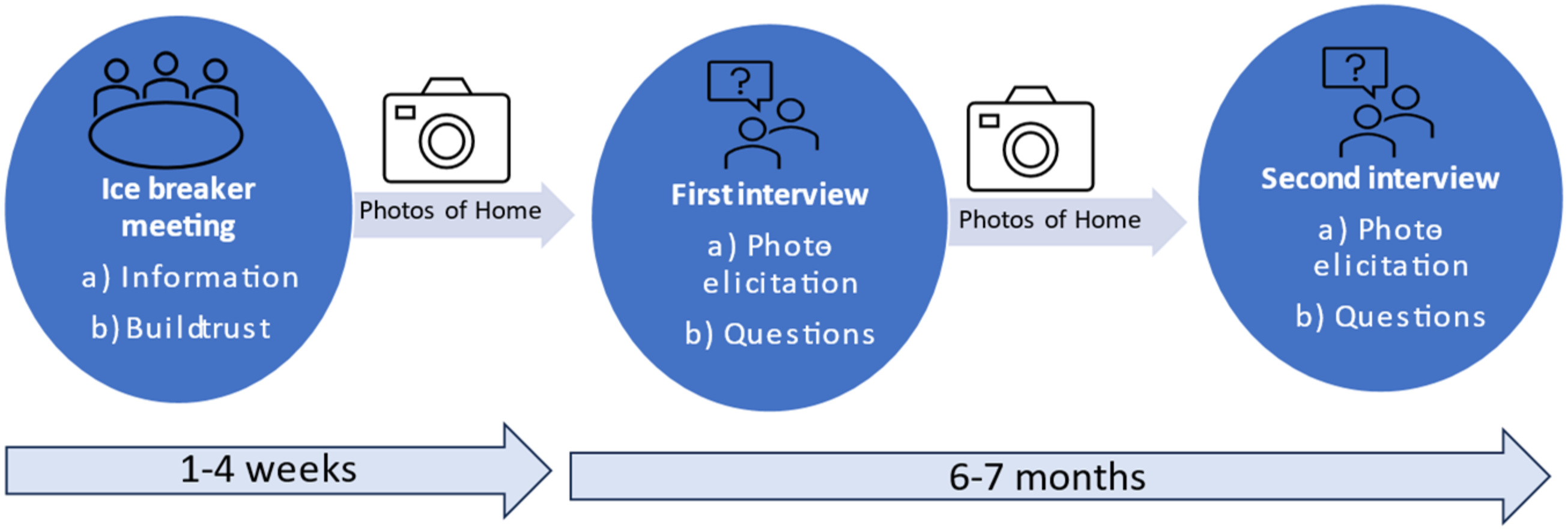
This article draws on a larger research project, Home and (dis)continuity: foster care for children with migrant backgrounds (HoMi), which investigates how foster care arrangements address the needs of children with migrant backgrounds. We analysed data from qualitative interviews with children and foster parents, complemented by photo-elicitation exercises (Harper, 2002). To build trust and ensure that children and foster carers were fully informed about the project and their rights, we began with introductory “icebreaker” meetings with all families, followed by two subsequent interviews designed to capture change and continuity in their everyday life over time. The design was structured as follows:
Recruitment and interviews
Children and foster parents were recruited through child welfare services (CWS), governmental and non-governmental organizations, interest groups, as well as our own professional networks in 2023 and 2024. We wished to reach children and foster parents from the same family to elicit rich, complementary narratives about shared experiences and processes, as seen from the distinct perspectives of the young person and their caregivers. Due to recruitment challenges, we also opened for recruitment of individual foster parents and children.
Interviews were conducted by six researchers in Sweden and Norway (authors included), each responsible for a subset of families. By assigning specific families to individual researchers, we aimed to build trust with families as well as ensure continuity and depth in the understanding of each young person’s context. Separate interviews were carried out with children and foster parents; in two cases, two researchers were present in individual interviews. Interviews took place in the foster homes, with a few exceptions following participants’ wishes. The interview guide comprised two main components. The first was a photo-elicitation exercise, in which participants shared and discussed photographs they had brought to the interview. These images depicted places, objects, and relationships they associated with “feeling at home.” The second component consisted of open-ended questions organized around three thematic areas: (a) everyday life in the foster home over time; (b) significant places and relationships outside the foster home; and (c) reflections on the meaning of cultural, linguistic, religious, and ethnic background. Interviews lasted between 30 minutes and 2.5 hours, were audio-recorded, and transcribed verbatim either by a researcher or by a professional transcription and translation service.
Participants
Young participants.
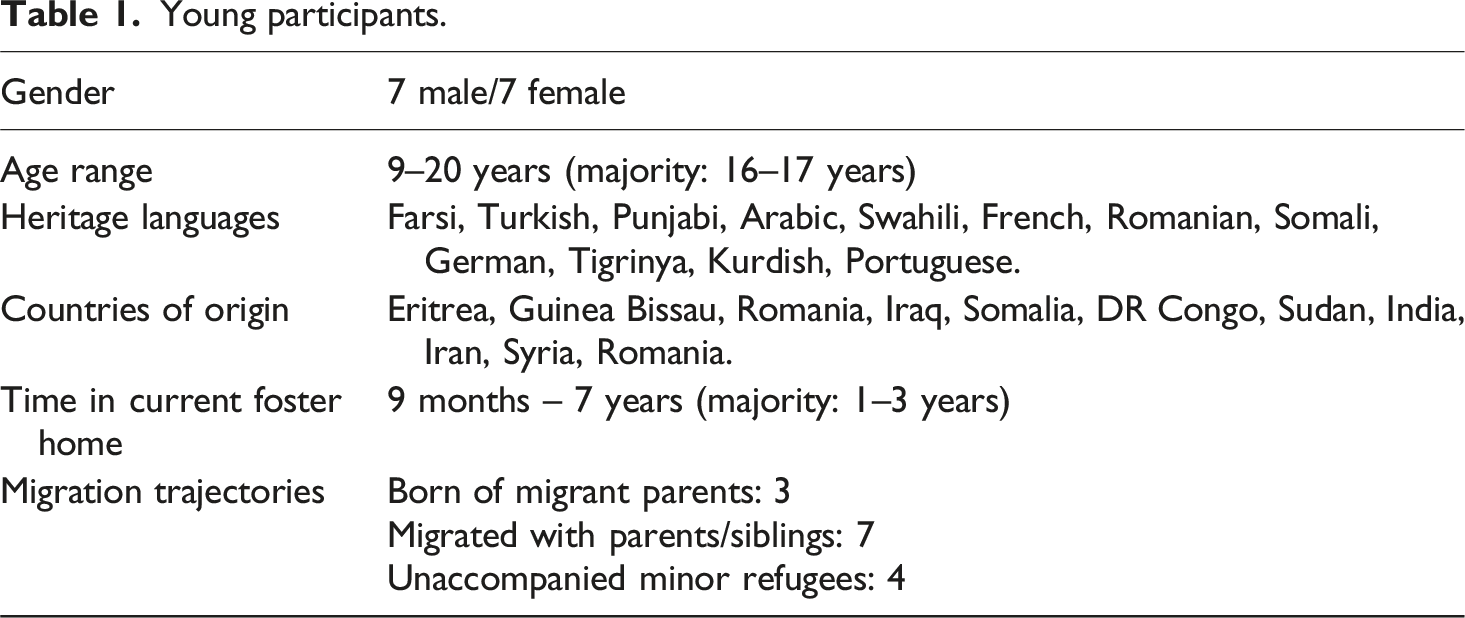
Foster parents stemmed from 15 different families and comprised 15 women and 12 men (N = 27). They ranged from around 40 to 70 years of age. A majority worked full time, had higher education and lived in affluent residential areas. Several foster parents noted that the young people’s birth families, in contrast, were socioeconomically marginalised. CWS had recruited foster parents from within and outside the child’s family and social network. A majority spoke Norwegian or Swedish, while a small minority were multilingual families and practiced the young person’s heritage language at home.
Ethics
The study was assessed by The Norwegian Centre for Research Data [Refnr.399339 ] and by the Swedish Ethical Review Authority [Dnr. 2020-06343]. All participants received oral and written information, and provided written consent, including birth parents or guardians of children under the age of consent (16 years). We emphasised throughout that withdrawal from the project would have no impact on participants or their child welfare case, and we treated consent as an ongoing process throughout the project. Given that both foster parents and their foster children were interviewed, we recognized a high risk of disclosure. We took several steps to ensure confidentiality and anonymity when presenting empirical examples and quotations in the analysis below. For instance, we withheld information about ethnic, linguistic and religious backgrounds, as well as country of residence (Norway or Sweden). Although these choices limit contextual detail at the individual level, we offer a rich description of the participants’ backgrounds at the group level.
Data analysis
To explore what it means for children in foster care to navigate questions of language within the broader process of constructing belonging and home, we adopted a thematic narrative approach (Riessman, 2008). We directed our attention to linkage (Gubrium and Holstein, 2009) - how participants connected “heritage language talk” with other themes and evaluated its role and meaning through storytelling. We began by reading all interviews, identifying sections of “heritage language talk” and tracing narrative themes within and across cases. Reflections around heritage language most often occurred when researchers explicitly asked about language. While photos rarely prompted language-related talk, conversations around them provided important insights into young participants’ home-making practices. We also observed differences in how children and foster parents talked about the heritage language. For young participants, questions about language frequently opened for reflections on relationships - both local and transnational – as well as issues of identity and belonging. Foster carers, by contrast, tended to emphasise the child’s language use and proficiency and their own role in supporting both the majority and heritage language learning, including collaboration with CWS and school. Because our aim was to foreground children’s voices and focus on their perspectives and practices, we allowed their accounts and ways of talking about language to guide the development of themes and subthemes. The foster carers narratives served to enrich and nuance the analysis by adding their perspective and highlighting areas of convergence and divergence with children’s views.
Findings: Languages and home in foster care
As outlined, our young participants’ migration histories varied, ranging from children who had arrived just a few years before our interviews to those born in Norway/Sweden to migrant parents. They also differed in their family and foster care histories, including age at placement, challenges faced prior to placement, time in their current foster home, and the languages spoken within the foster family. Our analysis demonstrates that these diverse circumstances shape how children articulate the role and meaning of heritage languages in their past, current, and aspired future lives. We structure the analysis around three main themes that illuminate children’s meaning making around heritage languages and how the foster care setting shapes language practices and attitudes: (1) language, identity, and home, (2) heritage languages and home across families, and (3) language and home within the foster family.
Language, identity, and home
This first theme shows how our young participants connected heritage language maintenance with social identity and establishing a sense of home. Across their narratives, maintaining the heritage languages was described both as a resource and a challenge. Mona’s narrative, cited in the title of this article, provides a fruitful point of departure. She migrated as a young child with her family and was placed in a majority-language foster family during early adolescence. Asked about her heritage languages, she remarked: “My language defines me in a way” and elaborated: You can very quickly see that I am not an [ethnic majority], and when I know my own language, I have something that I can call my own. Because when I consider the [majority language] and [majority] culture, I don’t think about that as my culture. It is a bit of my culture, but not in the same way as [country of origin].
Mona emphasizes that the minority language of her birth family serves as repository for cultural knowledge and appreciation (May, 2013). She also emphasises emotional aspects. The term “cosy”, commonly used to describe what “feels homely” in Swedish (“mysig”) and Norwegian (“koselig”), suggests that the heritage languages foster a feeling of comfort and home. Similarly, Leyla linked heritage language, emotions, and social identity. She said: “I love my language. It makes me who I am”. Explaining the value of speaking four different languages, Ali said: You are four different people when you know four languages, you can speak with four different worlds”. […] you learn more about other people, you get more information. For example, if you have a task in school: What’s it like in [country]? Then I know that type, what religions they believe in, since I know the language and I have been there.
Mona, Leyla, and Ali’s narratives illuminate the complex functions of language in social life; a tool for communication, a means of access to cultural and religious communities, and as gateways to information, cultural understanding, and belonging.
However, all participants identified with multiple languages, illustrated by Mona’s observation that the majority culture also represented “her a bit”. Notably, Mona also highlights the power of others’ gaze; she needed “something of her own” when others defined her as “non-majority” based on visual difference. Her narrative demonstrates how certain identity markers, such as skin colour and accent, may exclude children and young people from identifying as Norwegian or Swedish (Gullestad, 2002). Dominant discourses about who may call the nation ‘home’ and who is defined as ‘visitor’, are thus embedded in narratives about heritage language maintenance in foster care.
For some, defining one language identity as ‘heritage’ was challenging. For example, when asked what language he considered to be his ‘mother tongue’, Simon responded: “it’s complicated”. He explained that his parents originated from a linguistically diverse region and several languages were spoken in his home prior to placement: My father is from [country], my mother is from [country 2]. So, the language, or the main-mother tongue is [heritage language]. But it depends. There are different languages in the family […]. But from what I understand, the majority (of family members) speak [heritage language].
Simon portrays a multilingual family and thus challenges any simplistic understanding of language use in migrant households. It also illustrates how questions of language use involve engaging with family and migration histories.
Young people also expressed ambivalent feelings towards prioritizing heritage language maintenance, weighing its significance against mastering the majority language. Kim stated that their heritage language was “broken” at the time they moved into kinship foster care and explained that: “I feel that my personality hides behind it… because my [heritage language] is so bad. Many people don’t understand me; it sounds like I am babbling away all this random stuff.” Unlike Mona and Simon, Kim struggled to express themself in the heritage language, which sometimes evokes a sense of being an outsider or feeling un-homeliness. However, improving the heritage language was not a priority; she communicated well with family and kin in the majority language and English. With aspirations for higher education and a good job, the majority language was a priority. Struggles before placement had led to poor school outcomes, and it was important for Kim to ‘get ahead’ academically. This illuminates how young people’s decisions regarding heritage language maintenance are shaped by their aspirations for future social mobility.
Over time, and as they came of age, some young participants re-evaluated the role and value of heritage languages in their lives. Two foster parents shared that their young person had lost the heritage language after multiple placements. They observed how this made interactions with the birth family challenging and encouraged their young person to attend heritage language instruction in school. At the time, their young person resisted instruction because he saw himself as Swedish/Norwegian. However, when he started to befriend peers from his country of origin, he felt excluded from conversations and banter: Foster father: When he came here, he was 99% from [local town] and 1% brown. Then, when he started high school he was suddenly a 100% from [country of origin]. Foster mother: So, then he found it a real bummer that he no longer spoke the language.
This example illuminates how young people renegotiate multiple identities over time within changing contexts, including ethnic identities and associated languages. Such processes have implications for what emplacing a sense of home in their present and future lives might entail (Boccagni, 2016).
Heritage languages and home across families
This second narrative theme addresses the role of heritage languages in contact with birth families. We use the term ‘families’ because sustaining family connections often involved interactions across households. In addition to parents, participants spoke about contact with siblings, often placed in different foster homes, residential care, or living with their divorced parents who had formed new families. Participants also mentioned aunts, uncles, and grandparents, living both locally and transnationally. Some relied on heritage languages, or the assistance of an interpreter, to sustain these relationships. Lisa was grateful that she still mastered one heritage language after 4 years in a majority-language foster home: It has been really important, because then I can at least talk, especially with my Mum, because she does not know how to speak [majority language]. So, then it is really important that I can communicate with her and talk with her. Then there is my family, both those at home in [homeland] and here [locally]. (It is important) that I can talk with them without, in a way… that I understand them, that I’m not like “I don’t really know what you’re saying”.
Heritage language proficiency could thus play a pivotal role in fostering a sense of home across households. Moreover, speaking heritage languages was a source of autonomy, as illustrated by Mona, whose grandmother lived transnationally: “When my grandmother calls me, I am very grateful that I know and remember [my heritage language], because then I can talk with her, and my mother does not have to translate.”
However, as noted in the first theme, birth families were also multilingual spaces. Simon elaborated on how language use had evolved over time in the family: “We spoke some [heritage language] (prior to placement). But I think we would rather speak [majority language] to teach my father or something like that. I don’t know. […] Today my mother’s [majority language] is better than my father`s, so I can speak [majority language] with her. But my father is a bit ahhh (sighs), so I mix a bit [heritage language] and [majority language] with him. But if it’s really challenging, we just switch to English (laughs).”
This excerpt illuminates how migration shapes language use within transnational families in complex ways (Obojska, 2021), as children often act as language brokers (Deng et al., 2022). Simon expressed frustration at his father’s lack of proficiency in the majority language, noting that language barriers sometimes hindered their communication. He also found it embarrassing when his father struggled to express himself in the company of others.
Family dynamics could also shift over time, influencing how young participants valued and prioritized heritage languages. For some, relationships with parents were strained due to conflicts prior to placement, or challenges sustaining a sense of family at a distance. Consequently, some young people chose to limit contact, either temporarily or permanently. A potential outcome was reduced opportunity to practice heritage languages. This was the case for David, who had lost his heritage language. Placed in foster care during primary school, he explained: “(Before placement), I spoke [majority language] in school and [the heritage language] at home. But after I moved, it was mostly [majority language]. I did not want to talk to (my parents) so there was no [heritage language]. And we could not choose [heritage language] in school. So, I forgot the language since I focused on Norwegian and wanted to learn that”.
David highlighted several reasons for his loss of language: a simultaneous desire to distance himself from his parents, a wish to immerse himself in the majority language, and limited opportunity to practice his heritage language. The foster parents shared similar reflections regarding young people’s reluctance to maintain heritage languages after placement. One foster parent even speculated whether loss of language was strategic: “I think she was afraid that speaking [the heritage language] would lead to reunification with the parents. So, if she did not speak the language, she could not move home”. These reflections illuminate how the mandate of child welfare services (CWS) to promote family reunification can sometimes impose stress on children who wish to remain with their foster families, and how young people can exercise their agency through language choices.
Compared with the ambivalent feelings participants sometimes expressed towards sustaining relationships with parents, sibling relationships were described with more consistent engagement and joy. Communication between siblings often involved a mix of languages, as some siblings had been placed out-of-home at different ages. Older siblings were typically more proficient in heritage languages and emphasised that, as “the older” sibling, they felt responsible for maintaining contact with parents. This also provided greater opportunities for language practice. At the time of the interview, Lisa lived with a heritage-language foster family. She contrasted her situation with that of her younger brother, who lived in a majority-language foster home and struggled to communicate with their mother: “He moved into a [majority-language] speaking family. […] I have had a lot more contact with my mother, so I really needed to speak it. Now I moved here […] and I hear it every day and speak it every day. He gets nothing of that”.
Lisa explained that she often had to interpret between her mother and brother, which made her feel sad. Similarly, Leyla said that her siblings’ loss of language hindered a sense of family togetherness, and she had decided to teach her brother the heritage language: “I try every day, and my mother does too”.
Over time, as circumstances changed and young people came of age, their aspirations for contact with family members could also shift. During our second interview, David expressed a desire to learn his heritage language. A few weeks earlier, he had reconnected with kin transnationally and experienced language barriers. When asked about his strategies moving forward, he replied: “I will at least practice and watch YouTubes or something”. This theme thus brings forth how CWS placement shapes sibling and kin relationships, and how loss of language may negatively affect siblings’ opportunities to establish a common sense of home.
Language and home in the foster family
The previous themes unpacked how exposure to the heritage languages within the foster home enhanced opportunities for heritage language maintenance, but also that the majority language was often prioritized. In this third theme, we delve further into how the foster family context shapes young people’s language practices in different ways.
For children living in majority-language foster families, proficiency in this new home language served as a vehicle for immersion into family routines and for establishing a sense of safety, familiarity, and control (Boccagni, 2016). When asked what he valued about his foster family, Abdul answered “learning the language well. […] And that they are kind. That feels really good. They are so kind. I really love them.”. Abdul had arrived as an unaccompanied minor refugee and learning the majority language was crucial for integration within the family and beyond. The foster home thus functioned as a space for language learning, a point emphasized by participants who were newly settled in Norway or Sweden, as well as those with strong ambitions for social mobility.
Majority-language foster parents also emphasised the home as a space for learning and perfecting the majority language. Asked about how to support heritage language maintenance one foster mother said that her young person spoke two minority languages (heritage language1 and heritage language2): He only practices [heritage language1] on Tuesdays (in language instruction at school). And at home he is part of us, with the majority language. When he watches TV in [heritage language2] I try to (encourage him) to use majority language subtexts, and the other way around. To mix a bit. Because it’s very… In the beginning it was like only [heritage language2], but he really needs the majority language. […] So it’s like we push for the majority language.
This foster mother valued that her young person watched films in the heritage languages but also saw it as a potential barrier for majority-language learning. Therefore, she encouraged subtexts in the majority language. In this context, where her young person was in an early phase of settlement, foster parents “pushed for” majority language learning to enhance integration processes. The quote also illustrates how foster parents express attitudes and wishes towards the young person’s heritage languages through their parenting practices.
While all foster parents emphasized the importance of majority language learning, they differed in their views on heritage language maintenance. One majority-language speaking foster parent said that he was unsure about the value of maintaining heritage languages since the young person had limited proficiency moving into the family. Another shared that they had witnessed stressful arguments between the young person and their birth parents: “They tend to argue in [the heritage language]. So, there is nothing positive about maintaining that language.” This example illuminates foster parents’ complex role, with a mandate to protect young people from harm and provide a safe family environment. However, the same young person spoke very warmly about his heritage language in conversations with researchers, both in relation to identity formation and contact with birth families. We interpret this as indicating that his foster parent may have been unaware of this aspect, which may have hindered heritage language support.
However, foster parents also described different steps they had taken to support heritage language learning, but how they still experienced it as a challenging task (see also the first theme concerning identity). One Norwegian speaking foster parent said: The thing about heritage language instruction, we never really got an answer regarding their rights […] We have tried to ask the school and tried to ask CWS. We never got a proper answer, right? […] But I am thinking, maybe there are some guidelines? That they must receive it, or should receive it? […]
This illuminates how foster parents may struggle to access information and support from both school and CWS. In this case, the foster parent knew that heritage language maintenance was important for the young person’s parents and a key to contact with transnational family. Another foster parent shared similar struggles to access heritage language education for their young person who had lost the heritage language after placement in emergency foster care: “We tried to get heritage language education in school, but it was impossible. […] We were quite despaired when he did not get any language learning”.
Supporting heritage language maintenance was also talked about as a challenging task for heritage language speaking foster parents. One pair of foster parents expressed that they had encouraged their young person to practice the language at home, since they saw heritage language proficiency as an asset, both in relation to family cohesion and as an alleyway to work opportunities later in life. Their young person did not see the usefulness of prioritizing the heritage language. In the interview he nonetheless said: “It’s kind of a pity that I don’t know it. It would have been nice to talk to them (family and kin).” This example illuminates how questions of language may be contested and an issue of negotiation within families in migration (Obojska, 2021) as well as in kinship foster families. Notably, the young participants who did not master heritage languages at the time of the interview had in common that they moved into majority language speaking foster families at a young age and had often experienced multiple placements prior to their current home. They also described little contact with their parents and siblings while residing in foster care. Age of placement, opportunities to practice, and levels of proficiency moving into foster care thus matter.
Discussion
This paper explores how young people in foster care and foster parents talk about the meaning of maintaining heritage languages. We wished to understand how the foster family setting shapes children’s language practices and sense of home. By focusing on children’s agency and navigational strategies, we developed three themes. The first theme, language, identity and home, demonstrates how heritage languages act as a cultural repository and a medium of communication, enabling young people to feel at home. Conversely, losing the language over time, and experiencing negative attitudes and stigma can create feelings of estrangement. The second theme, heritage language and home across families, shows how maintaining heritage language can help sustain relationships with birth families, locally and across borders. Reduced contact with birth families after placement can accelerate language loss. However, shifting to a majority language can also become a way for young people to assert agency and autonomy. The third and last theme, language and home in the foster family, showed how feeling at home in majority-language foster families requires mastering that language well, which may enforce language shift. In contrast, heritage-language foster families can strengthen language maintenance but also instil ambivalent feelings.
Across these themes, we trace how children and young people actively navigate competing expectations regarding heritage language maintenance, balancing the views of parents, foster carers, child welfare professionals, and mainstream society. They continually evaluate the value of maintaining heritage languages against aspirations for present and future socioeconomic mobility. Young people’s aspirations also change over time, across life course stages and within changing individual and contextual circumstances. A complex interplay of material, social, and relational factors (Boccagni, 2016) thus shapes how young people practise and aspire to maintain heritage languages as part of their ongoing navigation towards a sense of home.
Our analysis also illuminates that young people and foster parents perceive heritage language maintenance as a resource, a challenge and at times even a problem. In contrast, proficiency in the majority language was talked about as an uncontested resource, a necessity. These findings reflect the contested status of minority languages and multilingualism within Nordic welfare states (Bubikova-Moan, 2017; Salö et al., 2018). Existing studies, however, show that bilingualism can enhance learning, identity formation, and parent-child relationships (Oh and Fuligni, 2010) while also promoting children’s overall wellbeing (Müller et al., 2020). Our analysis shows that young people recognize the practical, relational, and emotional benefits of maintaining heritage languages for their sense of home. Regardless of background, foster parents reported that supporting heritage language maintenance was challenging, for instance, due to uncertainty about its significance, the young person’s motivation, and limited support from schools and child welfare services. Negative attitudes towards minority languages are communicated in subtle ways through structural arrangements, public discourses and everyday interactions (May, 2023; Olszewska and Opsahl, 2024). When foster parents and social workers lack knowledge and critical awareness of how racialised power structures shape daily life, their practices risk undermining young people’s language use, attitudes, and opportunities for belonging. A recent study by Hultman et al. (2025) found that although social workers express commitment to provide cultural continuity, other care needs are often prioritized due to shortages of foster families and inadequate guidance. These findings are consistent with Australian research (Waniganayake et al., 2019). We argue that a troubling consequence of insufficient systematic support is that heritage language maintenance largely depends on the efforts of young people themselves and, where possible, their birth families.
However, our analysis also shows that maintaining heritage languages does not always play a central role in young people’s sense of home in foster care. Children entering foster care are often multilingual, with varying levels of heritage language proficiency and diverse wishes and needs regarding learning and maintaining the heritage languages (Hansen, 2024; Akintayo et al., 2024). Heritage language proficiency may also be more or less important for their participation in family and ethnic networks locally and transnationally (Møller and Skytte, 2004). An individual perspective is therefore essential to avoid overemphasising cultural aspects in decision-making and culturalization (Buzungu and Rugkåsa, 2023). Overemphasis on heritage language maintenance may even silence young people in decisions that matter to them (Fylkesnes et al., 2021). Group-level measures may thus be problematic given young people’s multiple identities, migration trajectories and individual aspirations. For some, prioritizing heritage language maintenance in foster care may be overwhelming. A pertinent question, then, is whether young people who have transitioned out of care should have an extended right to language instruction. More broadly, language shift is a common feature of family life in migration (Peace-Hughes et al., 2021). Language loss in foster care, and professional challenges, must therefore also be understood within the wider context of migrant parents’ struggles to sustain heritage languages for their children. Policies to support heritage language maintenance should thus address a wider population (Eisenchlas and Schalley, 2019).
Methodological reflections and concluding remarks
In our interview guide, language was one of several themes addressed providing an opportunity to examine heritage language maintenance within the broader context of everyday life and home. A more exclusive focus on heritage language could have elicited additional nuances, tensions and possibilities. Our combination of photos and interviews, and in-depth exploration of a smaller group of young people with highly diverse migration backgrounds, enabled us to capture a range of themes. Nevertheless, the sample characteristics limit our ability to analyse how specific experiences intersect with ethnic and linguistic differences or gender. We deliberately focused on the experiences of both children and their foster parents, which we consider a strength. However, we also reflected on how this influenced recruitment and the data. For example, children’s awareness of foster parents’ participation and collaboration with researchers may have influenced what they chose to share and what they chose to withhold. In the future, there is a pressing need for research on how changing policies are implemented and affect diverse children and families’ everyday lives. For example, exploring child welfare workers’ experiences can broaden our knowledge about how they attend to language, attitudes, and how guidelines and structural constraints affect decision making. Further exploring young people’s lived experiences may illuminate how gender, ethnicity, migration histories, and social class, etc. intersect and shape children’s agency, their needs for support and their opportunity to belong (Fylkesnes et al., 2021).
To conclude, our findings illuminate how complex factors interplay and affect children’s language attitudes and practices in foster care. An important question for child welfare practice is how to ensure that children are provided with the opportunities they need, and that they are not denied the right to use and develop their heritage language growing up in foster care. On the one hand, support measures must be tailored to the context and wishes of individual children and their families; drawing on knowledge about the role of language in transnational families’ lives is central to this effort. On the other, acknowledging that embedded linguistic hierarchies (May, 2013) are reproduced in the foster care context, ensuring language rights also requires thorough exploration of how dominant social norms and structural arrangements (for example, limited access to heritage language learning, lack of support to access to communities of practice) may deny children the opportunity to maintain their heritage language. We therefore argue that transforming how language is conceptualised and addressed through welfare policies and practices is essential, supported by ongoing research and systematic policy evaluation.
Footnotes
Acknowledgments
We acknowledge and thank the young people and foster parents who took the time and effort to share their experiences with us. We also acknowledge the efforts of child welfare workers who helped us recruit families.

Ethical consideration
This study was evaluated by the Norwegian Agency for Shared Services in Education and Research on the 25.06.2021 (Approval number: 399339) and by the Swedish Ethical Review Authority on 03.03.2021. Sweden (Approval number 2020-06343).
Consent to participate
Information about the study and participants’ rights (voluntary participation, anonymity) was communicated both orally and in writing. All participants provided written informed consent prior to participating. Written informed consent to participate in this study was provided by the minor participants’ legal guardians/next of kin.
Authors contributions
All three authors have contributed to all phases of the research process; data collection, analyzing data and write-up of the manuscript. Authors Fylkesnes and Höjer additionally contributed to the project design and developing the project proposal to the Norwegian Research Council.
Funding
The authors disclosed receipt of the following financial support for the research, authorship, and/or publication of this article: This work was supported by the Norwegian Research Council [grant number: 302183]
Declaration of conflicting interests
The authors declared no potential conflicts of interest with respect to the research, authorship, and/or publication of this article.
Data Availability Statement
The data consists of individual interviews with young people in foster care and their foster carers. Interview data are sensitive and cannot be shared since availability will breach the participants’ rights.