




Abstract
Children’s drawings are central in children’s meaning-making and can say something about their thoughts and feelings. 43 drawings from Norwegian children (7–8 years) depicting school during the pandemic lockdown in 2020, were studied. Results show that students primarily depicted the ‘official school’ which was represented by their workplace such as large tables not intended for schoolwork, underscoring children’s diminished size. Drawings of ‘Informal school’ were illustrated in colorful outdoor settings whereas ‘Physical school’ showed buildings functioning as school. Unclear boundaries between school life and private life dominated the children’s drawings. Their drawings are presented and discussed in this article.
Introduction
Children’s visual texts may be understood as reflections of their thoughts, and emotions (Tørnby, 2020), and drawings are ways in which to know oneself and the world (Latham and Robyn, 2018). To comprehend what school felt and looked like during the first COVID-19 lockdown (spring 2020), this article gives a window into the world of some children during this historic time. From previous research we know that children use drawings, either alone or in combination with other modes, especially verbal texts such as small labels or comments (Hopperstad, 2010), to construct meanings and narratives (Anning, 2002; Coates and Coates, 2006; Deguara, 2017; Hopperstad, 2010). Drawings reflect children’s immediate and cultural contexts (Deguara, 2017). Home and school may represent qualitatively different contexts for children’s drawing, with different rooms, furniture, drawing materials and degrees of voluntariness related to the activity (Anning and Ring, 2004). This traditional distinction between drawing in home and school is challenged in this project, as the drawing takes place in the home environment based on a task about school in home confinement. The drawings in this study were produced in an authentic and naturalistic, yet extraordinary, school context. The structure of schools changed immensely in Norway and other countries worldwide during the covid lockdown. From a physical learning space with students and teachers present in a classroom in a school building, the school transferred into a virtual room with online teaching. The loss of a school building, a classroom, a playground, and the physical presence of other students and teachers marked this period as abnormal and an emergency situation. Schools were closed for 6 weeks for the youngest students in grades 1 – 4 (age 6-9). To understand the children’s perceptions of school in home confinements more profoundly, numerous students were asked about their school at home. The aim of this article is to present students’ perspectives and expressions of a school in this historic and unfamiliar situation.
On the surface, the Norwegian pandemic context was the same for all primary school students; however, the differences discovered through interviews with the students’ teachers and analyzes of student texts were striking (Bjørkvold et al., 2022; Svanes et al., 2021). All children stayed in their homes, with limited contact with people other than their closest family members. They received instructions and tasks from their teachers either through their individual school tablets on a digital learning platform or through e-mails. The verbal contacts with the teachers differed: some talked on the phone or online daily, some weekly, and some not at all. Some children had parents working from home, whereas others were left to themselves when the parents had to work away from home. Participants of the study belonged to urban, suburban, and rural areas of Norway. In rural areas, many households comprise a one-family house surrounded by a garden. The garden premises often cater for private swings and large trampolines, which are frequently used elements in children’s lives. In contrast, urban, more densely populated areas often have common playgrounds in backyards and parks.
The writing task the students got was “How is your home school day? Write or draw.” The second part of the writing task “Write or draw”, invited the children to choose how they wanted to inform the researchers. In total 203 student texts were submitted, of which 43 students chose to draw and not write. For this article, we focus to study only the student drawings. Our research question is as follows: How is school in-home confinement during lockdown drawn by children in 2 nd grade?
Theoretical background
Drawings are a form of expression through which children can create meaning. The content, or motives, of the drawings may graphically represent the children’s world and their understanding of it, but also the aesthetic form of the content is meaningful and most often chosen by the child itself (Wright, 2010). Meaning-making through visual affordances entails the ability to create and understand visual texts such as drawings (Dresang and Koh, 2009; Kress and Jewitt, 2003; Kress and Van Leeuwen, 2006). Kress and Van Leeuwen (2006) analyzed how characters are connected in a visual image, revealing the meaning of and connection between characters and elements and argue that how the characters or elements are positioned on the page constitutes meaning-making.
Kress and Van Leeuwen (2006) hold that ideas of placement on the page create meaning from investigating what is foregrounded, what is centered, and what lingers in the background. Furthermore, looking at the function of framing devices and elements placed to “attract the viewer’s attention” may offer new insights into the meaning of the visuals according to Kress and van Leeuwen. The affordances of colors and their quality create meaning because colors, among other things, communicate through value (scale of light), saturation (degree of intensity), purity and transparency (Kress and Van Leeuwen, 2006 p. 245). In contrast to Kress and van Leeuwen’s thoughts regarding construction of meaning in drawings, Malchiodi (1998, p.42) reminds us that one cannot “see the children’s drawings with anything but our [their] adult eyes”. Moreover, Spyrou (2011) warns against the complexity and messiness of doing research on children’s voices, because “the problem is one of actualizing children’s voices: to get children to freely and openly express themselves in such a way that the goal of understanding is served” (p. 3). Her main argument is that it is important to know something about the context and background of the child invited into a research project. Particularly research on children’s visual ways of expressions requires a sensitivity of representation and a fundamental conception that visual texts “cannot be authentic depictions of social reality” (p., 4). Despite these drawbacks and limitations, this article leans on Malchiodi (1998) who holds that children’s drawings offer an opportunity for a child to tell stories and for the adult to conceive meaning from the perspective of a child (p. 43).
Previous research
We limited the voluminous research on children’s drawings, see for instance (Anning and Ring, 2004; Dileo, 1983; Malchiodi, 1998), to a review of empirical research on children’s drawings about their school and school life.
Researchers have studied students’ drawings from school from both a pedagogical and psychological purpose, as to obtain knowledge about the classroom climate, bullying (Marengo et al., 2022), and student – teacher relationship (Aronsson and Andersson, 1996; Harrison et al., 2007; Murray et al., 2023), as well as for a more practical purpose, for example, to let students draw their desired schoolyard as a basis for building a new one (Farmer et al., 2018) or their ideal school environment .
Several studies have explored students’ drawings about starting school (Dockett and Perry, 2005; Kaplun, 2019; MacDonald, 2009). The children express their expectations, showing, for instance, an oversized school building and feelings of sadness or excitement (Dockett and Perry, 2005). Other children drew school activities related to rules and routines, for instance, “sitting in a row”, and learning activities such as painting and drawing (Dockett and Perry, 2005). Einarsdottir (2010) found that the students saw reading, writing, and mathematics as the most important elements of the school and coincidently identified these as challenging and tiresome. Students’ drawings may also include more informal activities, such as play. The playground and friends appeared frequently in the students’ drawings, indicating that students appreciate their playground, friends, and toys (Einarsdottir, 2010). In Dockett and Perry’s (2005) study, the main part of the drawings depicted the child together with other children, interpreted as the children seeing themselves as belonging to the school. The teacher was present in several drawings, which again was interpreted as the teacher and school belonging together. These findings were similar to one by Anning (2002), who found that significant others, parents or teachers, played a key role in children’s drawings from school life. In their analysis of young students’ drawings, Coates and Coates (2011, 2006) revealed that some age-typical elements, such as rainbows, butterflies, hearts, flowers, trees, houses, and family members, frequently appeared, indicating children’s preferences.
Clark (2010) explored young students’ perspectives of their school through drawings and photographs. The environment as described was understood from three aspects: official, informal, and physical (Clark, 2010; Gordon et al., 2000). The official school tended to be connected to the learning aspects, such as rules, routines, and teaching, while the informal school was linked to relations with friends and the school as a meeting place, including emotional aspects. The pictures of the informal school showed the school as a place for developing identity, including motives for what it means “to be me” (e.g., playing with friends). The physical school included pictures of outdoor and indoor environments, such as the school building and different rooms within the building. The pictures of elements such as ceilings, carpets, doors, and benches revealed insights into scales and perspectives as well as how a physical object can represent something personal. One of the findings was the importance of playgrounds and outdoor spaces functioning as both private and social arenas. The three aspects of schools were intertwined in the students’ pictures; however, the informal school was foregrounded. Later in this article, we use Clark’s distinction among the official, informal, and physical schools as categories for analyzing students’ drawings from schooling in home confinement.
Hopperstad (2010) showed how Norwegian first graders created meaning by using different visual resources. Some students used graphic lines to frame elements, while others had empty space on the sheet. Important elements were reinforced using color or placed higher up on the page than less important factors, which were put in the background or on the lower part on the sheet. Coates and Coates (2011) found that children tend to separate different objects from each other and avoid overlapping. They often exaggerate important elements, for instance, by drawing some people or parts, such as their head, large. The same line of thought was found in an English first-grade classroom (Martens et al., 2018). An increased understanding of using tools as colors, lines, perspective, contrast, and elements of space, improved their drawings and art when reading and composing.
Children’s drawings during the COVID-19 pandemic
Of the published studies on children’s drawings during the pandemic, quite a few aimed to gain knowledge about the psychological effects of the lockdown. In a Spanish study (Idoiaga Mondragon et al., 2022), the researchers used students’ (age 6-14) drawings to discuss possible social challenges that might arise in the aftermath of the pandemic. For instance, the large number of TVs and other technological devices in the drawings and the lack of outdoor physical activity were interpreted as an unhealthy passivity (Idoiaga Mondragon et al., 2022). One study from Iraqi Kurdistan investigated the drawings of 15 children aged 6 – 13 years and revealed that the fear of the coronavirus, safety procedures, distress, and loneliness dominated in these drawings (Abdulah et al., 2021). A similar dark impression was observed in Swedish teenagers’ drawings (Tishelman et al., 2022), describing disrupted relationships and negative emotions. However, Italian studies showed that especially the youngest students expressed wellbeing together with their family (Cornaggia et al., 2022) and children chose to draw joyful moments (Capurso et al., 2022). A large number (N = 900) of drawings in Capurso et al.’s (2022) study was characterized by an indoor environment as the students were not allowed to go outside. Most of the drawings were colorful, and the people represented were drawn in full body. In half of the drawings made by older children, the artist’s self was missing, and examples like a football field without players expressed a more downcast impression. Additionally, the distance learning situation was described by the researchers including technological devices, such as screens, in the drawings.
In the present study, we asked the students about the school in home schooling confinement specifically, which seems to differ from the reported studies, which have been more generic in their approach and sought information about children’s well-being during the pandemic. Moreover, we studied the drawings not only to understand the pandemic situation but also to gain insights into children’s perception of schools and school life.
Methods
Sample
The drawings analyzed in this study were extracted from a set of student texts collected during the first lockdown of the pandemic in spring 2020. The participants were recruited through an information video made by two of the researchers on the Facebook page “Learning resources.” The video presented the researchers and their study: to get information from the school in home confinement from the participants themselves, the teachers, and their students. The page had 62,215 followers the day the video was shared; the video was watched 825 times. Through this video and further contacts, we got in touch with teachers from 18 primary schools, grades 1 – 7, who wanted to participate in the research project. They were asked to give their students the following task: How is your home school day? How do you work with reading and writing? Write or draw.
The teachers chose how to gather the texts and informed the students that their texts would be part of a larger research project. The parents took pictures of or scanned the texts and either downloaded them into the class’s learning management system or sent them digitally to the teacher. Because of school closure and danger of infection, all texts were distributed digitally.
In total, we received 203 student texts. Of these, there were 43 drawings. These drawings constitute the data material in this article. Because we wanted to explore the affordances in children’s drawings, only these were included. The text material as a whole is analyzed using other frameworks (Bjørkvold et al., 2022; Svanes et al., 2021), such as literacy (Barton, 2007) and writing purposes (Berge et al., 2016). All the drawings were made by 2nd graders (age 7-8) from three schools. Why all the drawings were from the second grade, is unknown to us and due to anonymity in the project, we could not investigate this further.
Analysis
Categories used in the current study, based on Clark’s (2010) study.
Within each category, we analyzed some of the drawings, focusing on color, elements, and placement in detail (Kress and Van Leeuwen, 2006; Painter, 2018). In the result section, the analyzes were structured according to which category we found dominant in the drawings.
Trustworthiness and limitations
All three researchers collaborated in creating the categories, trying them out on the data material, and discussing reliability issues. In the analysis process, we recognized our limited knowledge of the students and our lack of information about their previous experience with drawings as a tool for meaning-making (Elden, 2013; Spyrou, 2011). Thus, our knowledge of the students’ familiarity with composing drawings as a way of offering information and insight, was unknown. All inferences beyond the motives were our interpretations based on our knowledge about students and the school lockdown in Norway on a generic level.
A limitation of this study is that the task was assigned as part of the children’s schoolwork. We do not know if the task was experienced as authentic enough to, for instance, give room for more challenging situations and feelings than what is present in the material. Some may have perceived the task as just another job to get done; consequently, they may not have invested much time and effort into it. In addition, the receiver was unknown to the student. Although this can trigger an interest in presenting, it can also seem less important. Further, we do not know how the teacher might have influenced the students and their drawings.
All drawings were collected during the lockdown period, not when the students were back in schools, which validates the study and the drawings as authentic expressions that are real and naturalistic but crafted in an unusual situation. However, we probably lost potential drawings because of the requirement of parents’ informed consent. This procedure may also have prevented vulnerable children from participating (e.g., if the child did not want to show the drawings to the parents or the teacher). Another challenge was that there was no trace of the children’s intentions or thinking regarding their drawings due to the lack of interviews. Interviews would have provided a more extensive comprehension of the data (Berti and Cigala, 2022).
This project was approved by the Norwegian Centre for Research Data and followed their guidelines for data storage (SIKT, 2023). The parents provided informed consent on behalf of the students, and all drawings were kept anonymous. An ethical challenge in the research on children’s drawings was that researchers have their own agenda for which the children are “used,” through a personal expression, to share information (Hall, 2015). This point became extra relevant in this study, as we gathered data within a specific and vulnerable context. We thus pursued transparency in the information presented to the students, parents, and teachers for the purpose of this study. It was made clear that the texts and drawings would be received by the researchers and that the participation was voluntary. The analysis indicated the students’ drawings as independent and valuable meaning-making, and not just as sources of information in research (Hall and Robinson, 2013).
Results
The results are categorized in accordance with the steps followed in the analysis, as described in the Methods section, the official, informal and physical school. Generally, we go into a detailed analysis of one or more drawings at the beginning of each section to present typical examples. Thereafter, we comment more briefly on other drawings, to show the breadth in the material.
Official school
Most of the drawings in our data material represented the official school, therefore a greater selection of the drawings was included in this category. In this set of children’s drawings, formal parts of the school were exemplified through indoor workspaces in a home confinement. Many students depicted themselves at a table, with different school materials and tools. We chose to interpret a child in the drawing as a first-person representation of the person making the drawing.
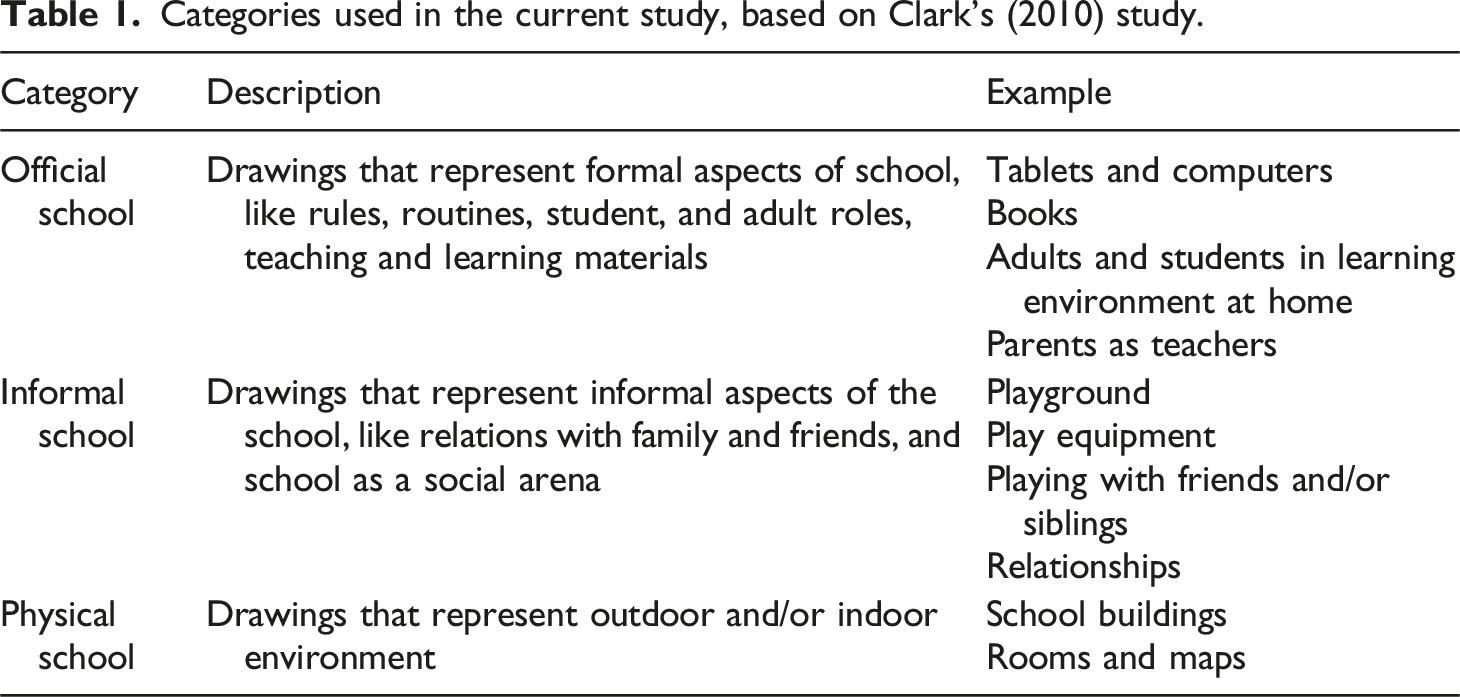
In Figure 1 top left, we see a person who appears to be a boy by a black table, looking straight at us with a smile. He is by himself and has a book open in front of him, a book which has only verbal text on the pages. To the left, there is something that may represent a tablet, common in the Norwegian school and used as the main tool of communication and schoolwork during the pandemic. The drawing was most likely made on a tablet, where a limited set of colors are available, with a set quality of transparency. Bright blue is complimentary to the boy’s orange hair. The dark, black table may be understood as a divider (Painter, 2018) that separates the boy, his work, and the viewers. The centering (Kress and Van Leeuwen, 2006) of the boy, the book, and the table is interpreted as that these are the most important elements of the home confinement, elements which mirror the learning situation in a formal school setting. Example of official school, the workplace. The written text says “My homeschool day.”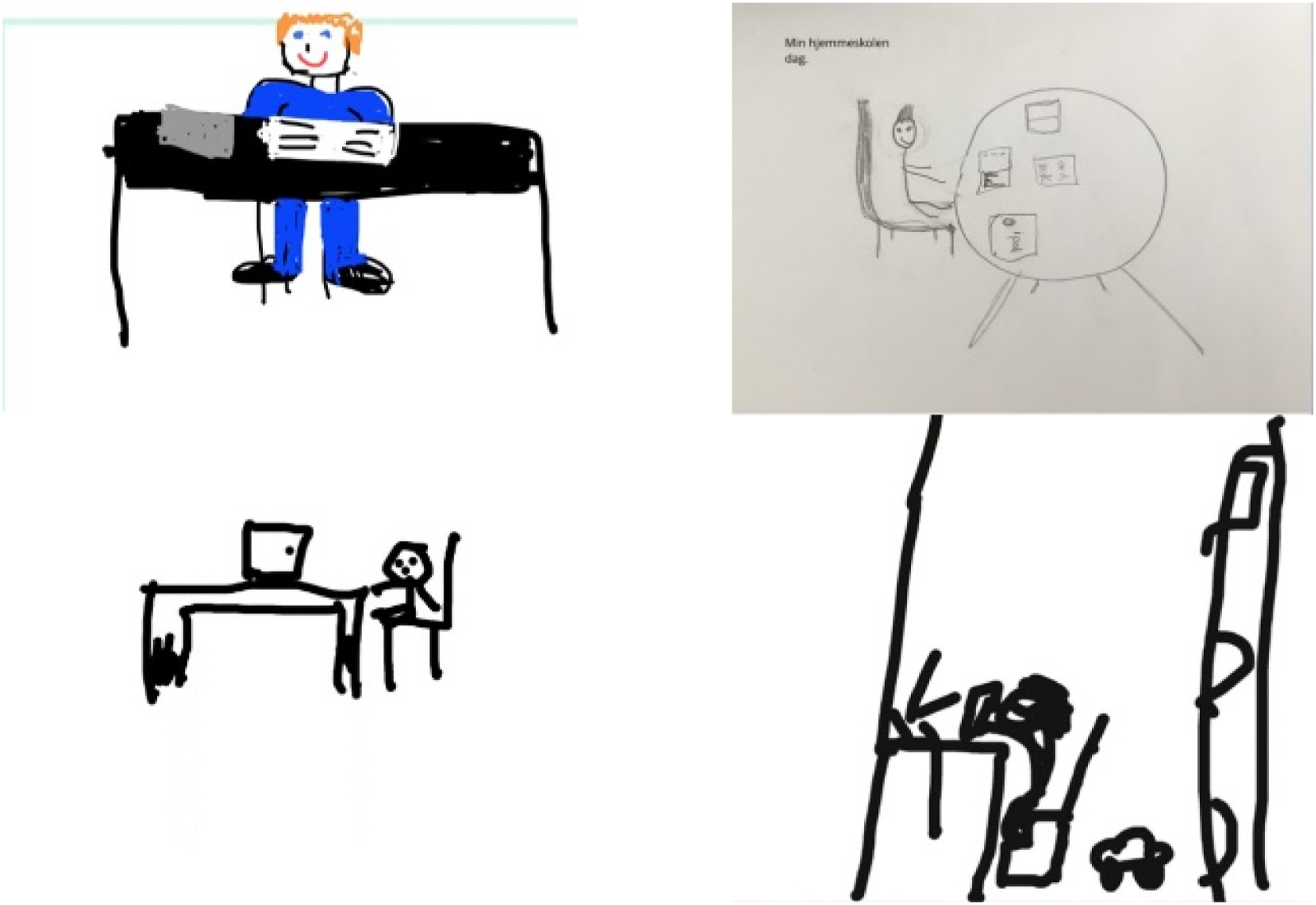
In Figure 1 top right, a workplace is depicted as a large round table, with a smiling person interpreted as a boy sitting on a large chair with short legs. Spread out on the table are his school things, a workbook with a large letter E, a textbook, and yet another book. A tablet is seen to the right of the student and drawn in detail. This drawing is made in grayscale. The saturation afforded by the pencil drawing is soft. Again, the table is placed in the center of the page, underscoring the importance of the table as a place for learning. The boy and his books are located on the left side of the page, leaving the right side empty and white. A few things are given extra layers of pencil strokes in this drawing; the chair, which looks like a coffee table chair, rather than a school chair; his hair; and the letter E. The round shape of the table invites the viewer in (maybe to the available side) rather than functioning as a divider or fence. The round coffee table and low chair show association to a living room space, thus reminding us that the school is in the living room.
In Figure 1 bottom left, the large table with a computer screen dominates the picture. The interpreted boy on the chair on the right side looks small because the chair is too big for him and because the computer screen is almost the same size as the boy. The sense of “too large” is communicated through the drawing. The drawing was most likely made on a tablet, but the student only used black color, which gives a bleak impression.
The drawing exposed in Figure 1 bottom right differs from the others because the person interpreted as a boy is depicted working in a room. The walls around him are quite narrow, placed to the left and right, creating a frame or a box wherein the boy works by a desk. We believe there is a depiction of a tablet on a stand leaning against the wall on top of his desk. The side view of the drawing communicates a sense of looking in or into a room. To the right in the drawing is an element resembling a bookshelf. Behind the boy, on the floor, we see a toy car, reminding us that the school takes place at home. The walls, bookcase, chair, and desk are drawn in a large size, whereas the boy is drawn too small for the chair and desk, creating a sense of dissonance in the spectator. The elements of the official school are intertwined with those of the home, represented by the toy car and bookshelf.
In Figure 2 top left, a person interpreted as a girl is depicted on her way to school from the bedroom upstairs, where she is in bed snoring, walking downstairs to the left, following a plateau, and finally, down another staircase to the right. There, she arrives at her workplace downstairs. She sits smiling on a large chair on the left side of a large brown table. Her only school artifact is her tablet. We can also see a window with four panes, each with a different kind of weather outside. This drawing blends the official aspect of the school (working at a desk) with the space of home (sleeping in a bed). When in bed, the size of the girl corresponds with that of the bed; in contrast, when the girl is by the table, she is quite small, and the chair and table are too large for her. The walkway to the school from the upper floor to the ground floor divides the picture, as it may also divide the official and informal aspects of the school. The window with the outside scenery is a reminder of indoor confinement. Using purple color on her bedcover and sweater can be interpreted to give a warm, cozy feeling, which is also true for the bright yellow hair and sun outside her window. Similar to the drawings in Figure 1, the sense of feeling small in a home confinement during the COVID-19 lockdown comes across to the viewer. Example of official school, school way and learning environment. The names of a boy, a girl and Mamma “Mom” are written with arrows pointing at the different people. Here anonymized.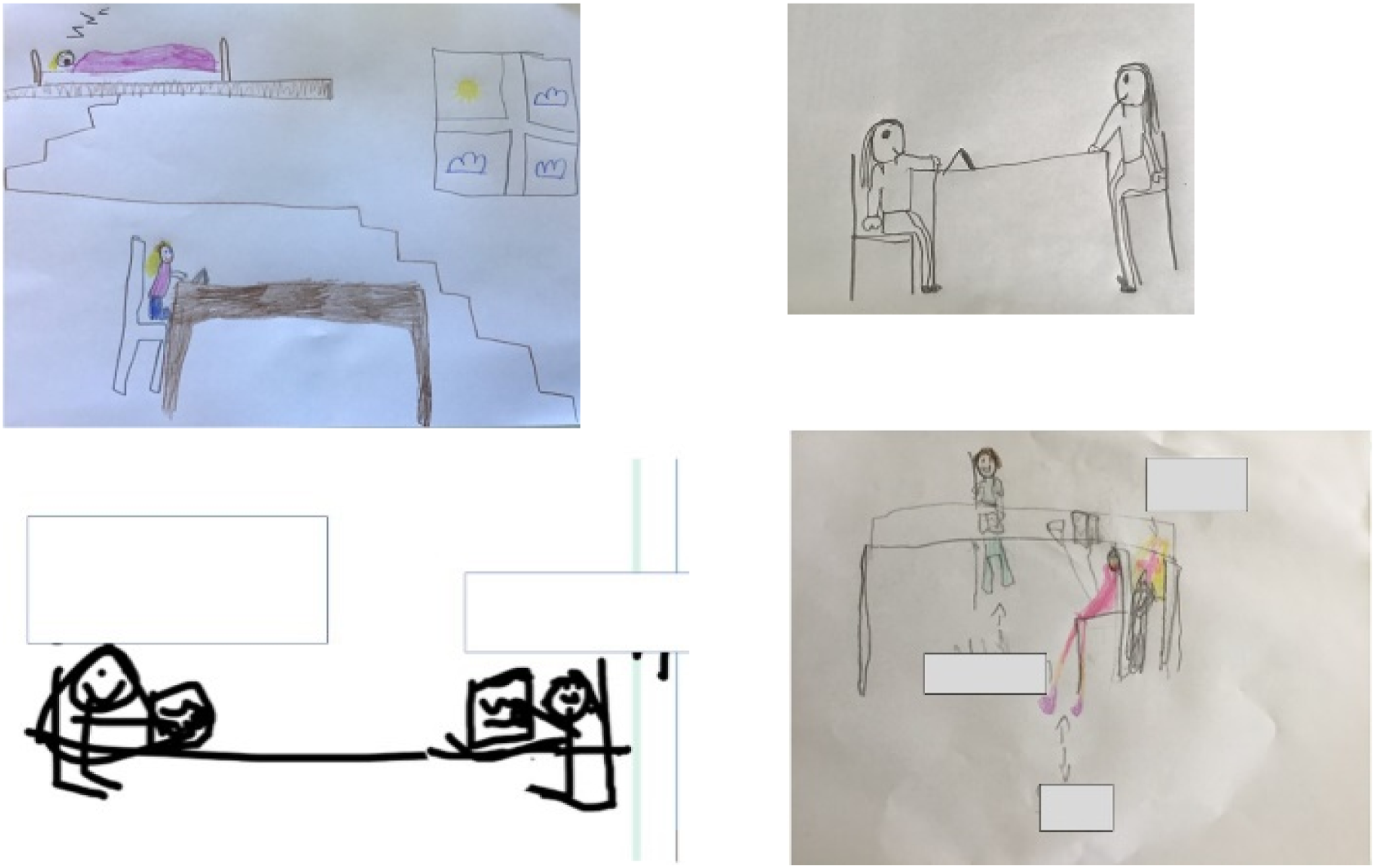
In Figure 2 top right, a person interpreted as a girl is sitting by a table with a tablet in front of her, and on the opposite side, there is an adult, probably the mother, facing the girl. The girl and mother are looking at each other, smiling. In this example, the table functions as both a divider and a connector, it binds the two characters together in a horizontal line. The way the two characters look at each other enforces this bind, suggesting that in this child’s home confinement, her mother is present.
In Figure 2 bottom left, two people, interpreted as girls, named in the drawing but anonymized here, are sitting at each side of a large table while holding their books. Both characters are facing us, smiling happily. The placement and function of the large table correspond to the function of a divider and a unifier. It is an example of the official school without an adult present. Drawn in a black marker, the lines are thick and clear giving. What makes the two girls happy is not explicit but may possibly be derived from the sense of togetherness.
Figure 2 bottom right, shows a situation in which three people interpreted as a girl, a boy, and their mother are gathered around a big table. The two children have books in front of them, the mother not, indicating that the students are doing schoolwork, while the mother is helping them.
One boy chose to narrow the presentation of his school during lockdown to the tablet, his main device for communication, tasks, content, and a place to hand in his work, as shown in Figure 3 left. He drew a tablet with a black frame and a stand. On the screen, we see the school’s learning platform, Showbie. The screen shows that the boy is most likely in dialogue with someone through the two or three talking bubbles. The coloring of the bubbles indicates who is “talking,” accompanied by the initials to the left of the bubbles. To the left, there is something written in a rectangular box, normally the subject, here “Fysisk aktivitet” - “Physical activity.” Example of offical school, details. Middle drawing: “Everything will be fine” is written on the roof. In speech bubbles “Cozy”, “finally done”. Right drawing: “Maths – I made this – I read – Audiobook”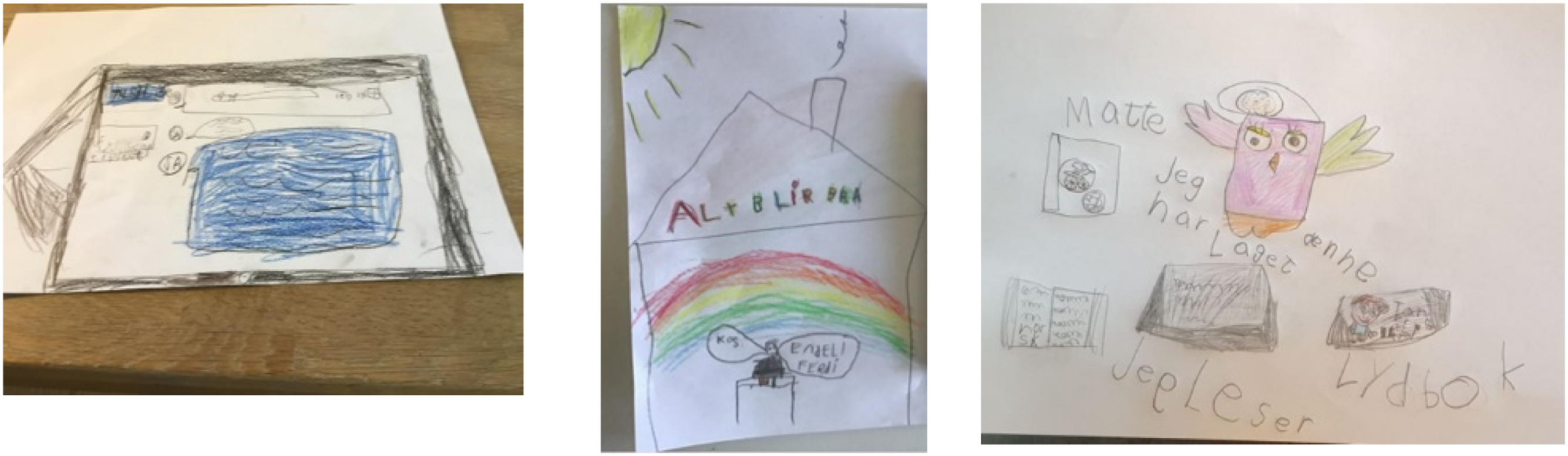
The middle drawing in Figure 3 comprises the workplace with a student saying “Cozy” and “Finally done” in a one-family house with smoke coming out of the chimney on a sunny day. A rainbow functions as a background on the inside wall. The rainbow and the words “Everything will be fine” written on the roof in colorful letters are symbols frequently used to communicate hope during the pandemic.
In the category formal school most of the drawings only had one main motif. However, we saw a few examples displaying several aspects of the school during lockdown, as shown in Figure 3 right. The student in this drawing explained the content in her school with math, reading, audiobooks, handcraft, and a drawing of an owl, probably inspired by the figure in a well-known math application. This is the only drawing in the material that pictured the school content with explanations.
Informal school
Drawings categorized as the informal school mainly depicted outdoor situations, where the students played with other children or a pet, or alone. There were fewer examples in this category, than in the formal school category, therefore fewer drawings are represented here.
In many cases, different play equipment was drawn, such as swings, slides, trampolines, or monkey bars, see Figure 4. Additionally, we found examples of students placed outside (e.g., on a lawn). All of these drawings were categorized as social spaces , because they showed the intentions or actions of the community (Clark, 2010). A common trait in these drawings was that all of them were made with pencils and crayons on paper. Furthermore, they exhibited more extensive use of color than most of the drawings of the official school. Bright colors, like yellow, blue, and red, bring about a sense of happiness and contentment. Additionally, togetherness and playground facilities placed outside in nature give associations to spring and everyday life. Sometimes in the drawings, school content is taken outdoors. Examples of informal school, social spaces.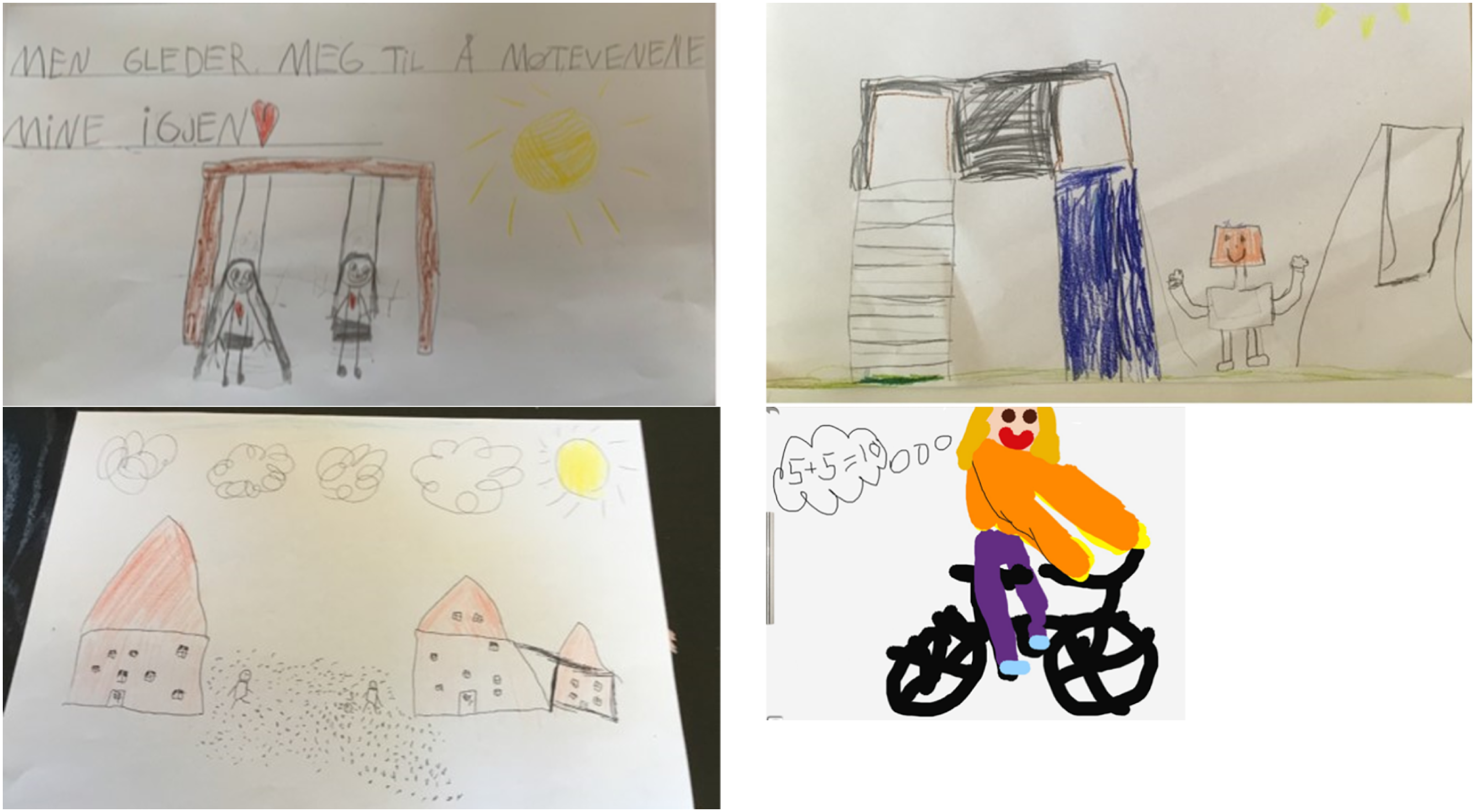
In Figure 4 bottom right, a girl is thinking about math while bicycling. Thus, the drawing is partly informal, because the girl is bicycling, and partly official, because she is thinking about math.
There were a few examples of drawings in which the students were alone, not placed in a working space or a play situation. The two drawings in Figure 5 are examples of this category. To the left, we see a person interpreted as a girl in bright colors sitting on a big couch, smiling, with her tablet on the side, not in use. A thinking bubble has the text “I am bored.” The same motif is observed in the drawing on the right, a person interpreted as a boy drawn with only a simple black line lying on his bed, with an unsatisfied expression on his face, also with the verbal text “I am bored” on top of the sheet. We view these drawings as private spaces (Clark, 2010). Uttering the thought of boredom, both drawings remind us of the consequences of the lockdown, when there were limitations on where one could go and whom one could meet. Despite the same verbal texts, the visual texts are in stark contrast, where one invites us into a homey, colorful atmosphere, while the other is stripped down to bare minimum content, a bed and a child in grayscale. Examples informal school, private spaces. Two drawings with the same content in the verbal text, “I am bored”.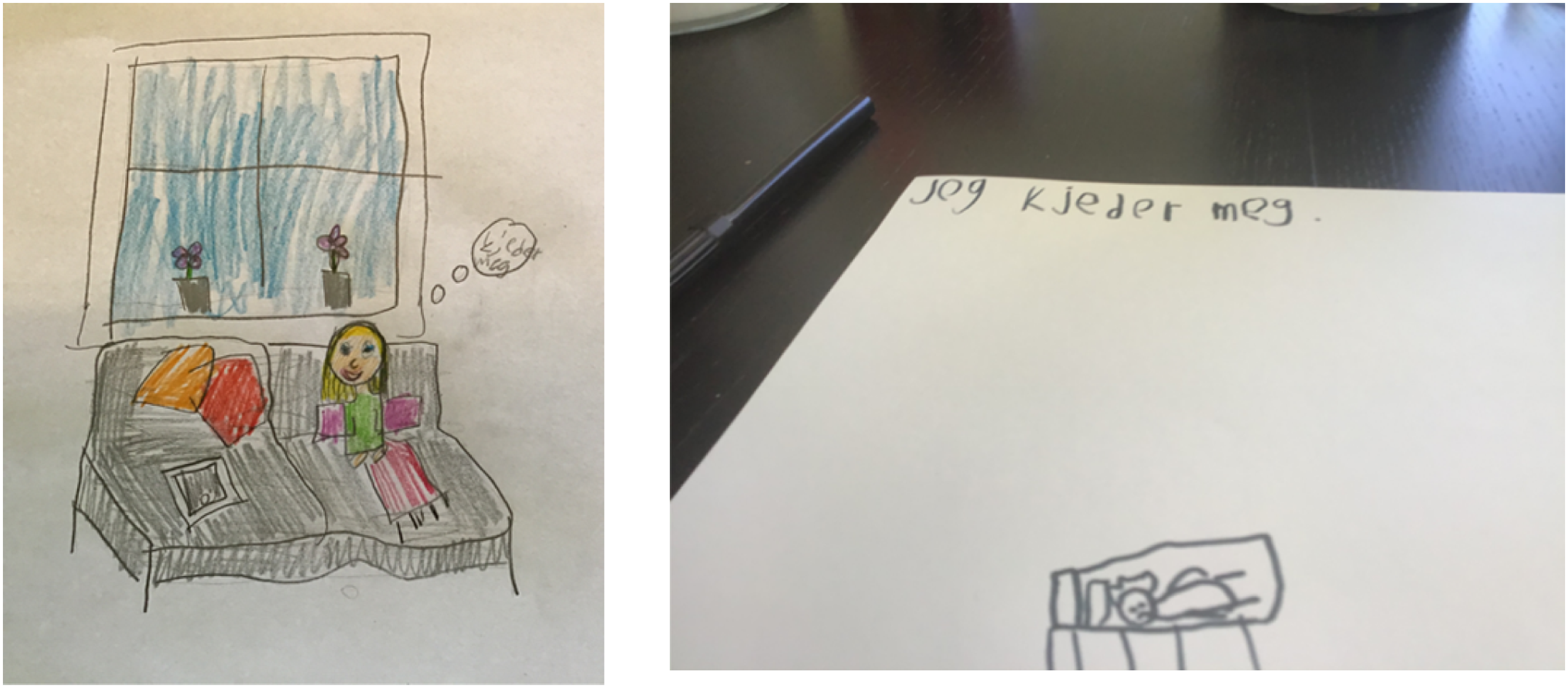
Physical school
Several of the students chose to draw the school building as examples of physical school. In the data material there are fewer drawings that fall into this category than the abovementioned categories. Thus, we presented only a few examples.
The four examples in Figure 6 show a building that now functions as a school but is a private home at the same time. The children drawing the school building when asked about what their school during lockdown, most likely associated school with a specific place or room. The drawing on top gives an X-ray effect of the house where the unique spaces of kitchen, living room, and workplace are embedded. Furthermore, we see traces of the walkabout inside the house during their school day. The happy mood stems from a smiling sun, blue sky, and green grass outside the house. Examples of physical school, homes functioning as school buildings.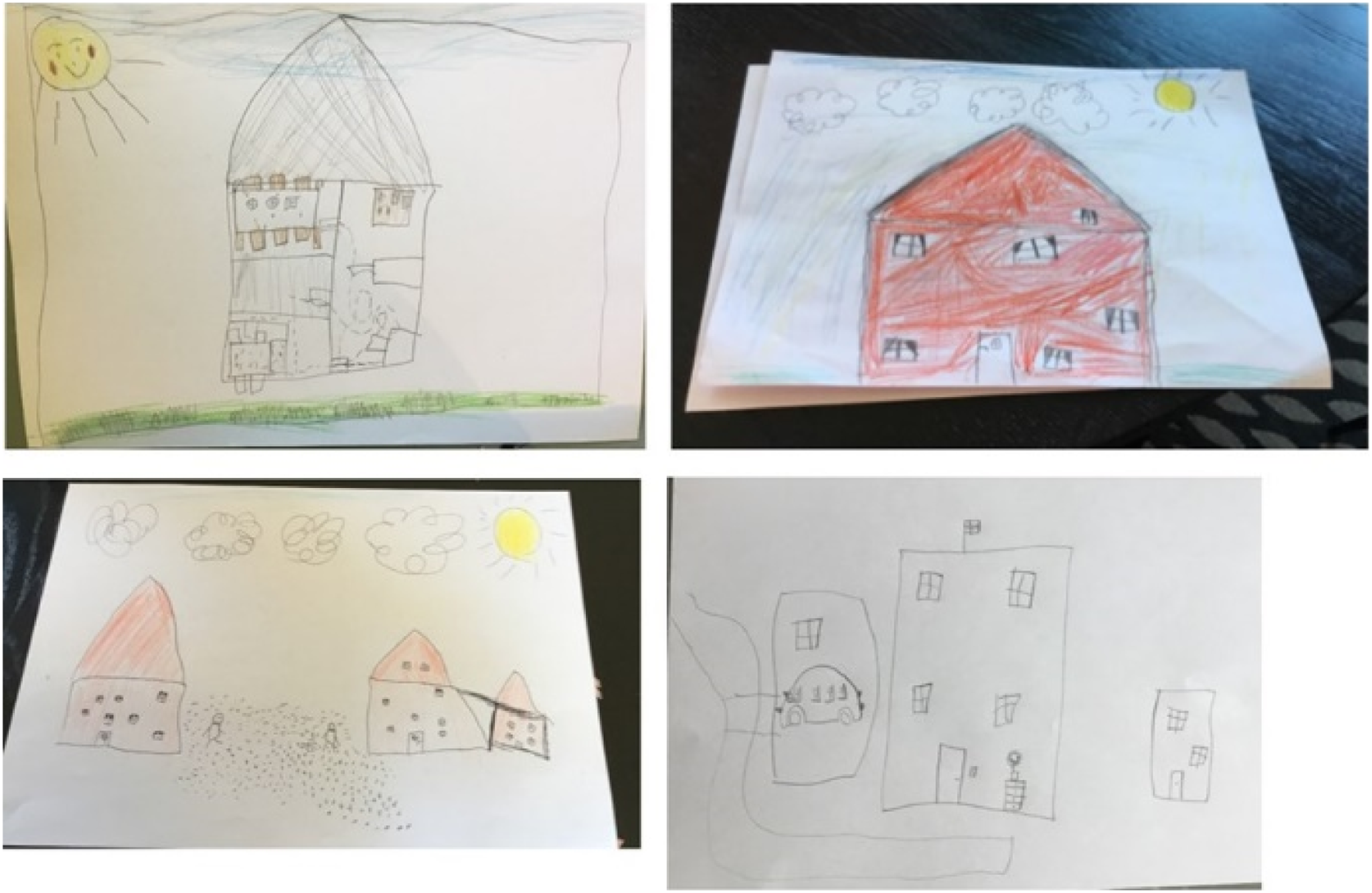
Discussion
In this study, we have analyzed children’s (age 7 - 8) drawings from the time when school was in home confinement during the COVID-19 pandemic. The research question How is school in home confinement drawn by children in 2 nd grade? has given new insight. In the following we chose to highlight some central findings: the perception of the school, unclear boundaries between the school and private life, and affordances in children’s drawings.
We understand that the analysis is limited to our interpretation of these drawings based on the approach of Kress and Van Leuween (2006) and the categories of Clark (2010), and is does not give access to the children’s thoughts or intentions, a much debated theme within research on children’s drawings (Elden, 2013; Malchiodi, 1998; Spyrou, 2011). Furthermore, we have only the drawings and no access to what the children themselves have intended with their work. Due to the anonymity in the data collection phase, there is no way back to match the drawings with the children who created them, thus there is no possibility of interviewing these students. Additionally, observing the children in their work was out of the question due to covid restrictions. Therefore, we have no information of their social background and context. Still, we think that the data material is unique and gives important information about a very specific time in history.
Experiences of space during school in home confinement
The students were asked to draw their school in home confinement. As a continuation of this, one can interpret that the drawings represent what the students think of as central or unique in their school situation at home. Interestingly, in these drawings, schools were seen as a physical place to work. Students sitting by a table with workbooks and tablets as part of the formal school dominated the material. The tablet was often drawn as the main motif, similar to findings suggesting that digital devices are frequently depicted in drawings from the pandemic lockdown and represent the digital school (Capurso et al., 2022; Idoiaga Mondragon et al., 2022). These findings correspond with previous research indicating that young children’s drawings from school often depict them working sitting in a chair (Capurso et al., 2022; Idoiaga Mondragon et al., 2022). In contrast to Einarsdottir’s (2010) study, working was associated with a smile, even though the students oftentimes depicted themselves alone, and less frequently together with a parent or sibling. None of the children’s drawings illustrate a teacher, which seems logical since teachers were not present in the students’ homes.
Furthermore, the fact that the school is in the home, was characteristic in our material, be it the physical building from the outside, a map over school activities within the house, or the way from bed to the workplace. In the drawings the informal school was outside, in a playground or garden, often showing school as a social arena (Clark, 2010). Einarsdottir (2010) found that playing is a significant part of schools for younger students. Norwegian children were clearly outdoors even during the lockdown, in contrast to the observations made in international research. A few motifs may be related to a common Norwegian way of life, such as trampolines and access to green grass close to homes and individual tablets in the working spaces. Furthermore, we hardly saw examples of playful activities inside, a finding that corresponds with a classical school, where children play outside for dedicated hours. Pets were included in some of the drawings, which may be understood as part of the private sphere (Clark, 2010) and different from official schools.
Emotional experiences of school in home confinement
What is typical of the data, is that students oftentimes depict themselves on a small scale compared to the furniture or surroundings associated with the formal school. This is evident in Figure 2, where the bed (private environment) is just fit, but the representation of the formal school is “too big.” One possible reading of this is that homes were not tailored for the pandemic situation, where suddenly schooling was moved to homes, in a private, informal environment. Another more symbolic reading is that schooling in the home confinement is “too big” of a task for a young child.
Motifs like a shining sun, smiles, blue skies, and rainbows resemble motifs in children’s drawings in other studies (Coates and Coates, 2006, 2011) and reinforce a positive impression of schooling in home confinement; however, it also indicates that children draw what they like, including these age-typical elements. Boredom is another emotional experience drawn by students in the study. Children sit passively inside. Interestingly, other emotions, such as fear, uncertainty and to be unsure of the future are not present in this material.
Unclear boundaries between official and informal schools
During the lockdown, schools were shifted into people’s homes, making the home an arena for the official school. In the drawings analyzed here, the kitchen and living room became workspaces, where parents and siblings worked alongside. Thus, the boundaries between the school and the private spheres became unclear and the distance between the rest and work decreases. A distance that fits on the same sheet of paper in the drawings — children drew their movements from the workplace to the bedroom, onto the sofa, into the garden with a cat, onto the trampoline, and back to the tablet in the same drawing. This blurred life is generally presented as something positive, corresponding to previous research suggesting that younger students tend to present the community with family members and more joyful parts of life during the pandemic than older students (Capurso et al., 2022; Cornaggia et al., 2022).
Affordances in children’s drawings
The students participating in this study chose to draw. Some students combined these drawings with labels or a few sentences. The drawings provide information about schools during the lockdown and show reflections and emotions, as described by Mackenzie (2011) expressing, for instance, that “I am bored.” Images may, in many cases, convey meaning more directly than words, and drawing may be more familiar to young students than writing verbal texts. Drawings are diverse and, at times, complex narratives displaying great details, such as the drawings that imply movement from the bed to the workplace, or traces of the student’s walkabout inside the house. Drawings have the affordance of presenting an impression, a situation as a whole, reflecting the context (Deguara, 2017). The drawings analyzed in this study were in line with (Martens et al., 2018) study, with different perspectives. The students participating in this study chose to draw. Some students combined these drawings with labels or a few sentences (Deguara, 2017; Mackenzie, 2011; Martens et al., 2018; Tørnby, 2020). When drawing houses, the students used both a normal perspective, looking straight forward, and an overview perspective, similar to a map. Furthermore, drawings depicting the formal school used digital affordances, whereas those illustrating the informal school used pencils and crayons. Digital drawings give a coarse impression, as the drawing line is customized as thick, and the students draw with their finger, not a pencil.
Implications
Receiving and analyzing the set of young pupils’ drawings provided us with exclusive information about their experiences during the first lockdown. Studying children’s drawings in other contexts related to schools may offer valuable insights into what it means to be a student in a place at a specific time (Clark, 2010). Many students in this study chose drawings to present a complex situation, even in a school setting with an emphasis on reading and writing. Therefore, one implication can be to further pursue drawings as a relevant visual text through the school years and not primarily as a pause activity or part of arts education.
In this study, we saw diverse perceptions of what a school entails. In future studies, it would be interesting to follow the students’ idea of a school through several years of schooling. Another captivating idea would be to study presentations of school in both children’s literature and picture books thematizing school.
Conclusion
The worldwide pandemic lockdown changed the understanding of a school for millions of children. We asked students aged 7 – 8 years to share their experiences from their school situation, and many chose to draw. These drawings provided unique insights into what the students saw as their school. Drawings entail the affordance of complexities that verbal texts rarely have for the youngest children. The drawings analyzed in this study indicated that the formal school (Clark, 2010), exemplified by working at a table, using books and tablets, alone or with family members, is dominant and central for the students. However, the informal aspects of school were also present, especially through playing outside in the garden. Some depicted boredom, however, the school lockdown was overall apprehended as happy.
Footnotes
Declaration of conflicting interests
The author(s) declared no potential conflicts of interest with respect to the research, authorship, and/or publication of this article.
Funding
The author(s) received no financial support for the research, authorship, and/or publication of this article.
