



Abstract
The paper is based on a study where 28 pupils of a Finnish school were asked to complete a fictional post-apocalypse story to afford an understanding of 15–17-year-olds’ rationales underlying complex alliances and non-alliances in school. Informed by the notion of spatial solidarity, the analysis reveals that the teenagers drew on three types of solidarity: pre-existing, reflective and affective solidarity. The findings suggest that solidarities in school stem from nuanced place-based power dynamics. Understanding these solidarities can inform approaches incorporating teenagers’ specific rationales and help adults to identify and support spaces where solidarities develop.
Introduction
Solidarity is necessary for the functioning of societies and to improve the quality of life of individuals and communities (OHCHR, 2022). This concerns children and young people to the greatest extent as they, following current research on childhood and youth, are important contributors in societies and in the formulation of contemporary communities. Therefore, there is an increasing need to understand the rationale behind solidarity among children and young people and how they negotiate solidarities in the spaces and communities they inhabit. Children’s societal contributions reflect the conditions they are living in (see e.g. Cavazzoni et al., 2021), and their understanding of their societal role shows differently in various settings (see e.g. Clemensen, 2016). In their everyday lives children make agentic yet relational choices about whom to attach to and ally with (e.g. Raithelhuber, 2016; Spyrou, 2022). Understanding children’s ‘micro level solidarities’ in their everyday shared spaces is important as it can inform approaches that will incorporate children’s own rationales and hence help professionals to identify and support spaces where solidarities develop.
According to a common understanding, solidarity refers to individuals being bound to each other through a sense of empathy and shared interest that promote mutual support and collective action (e.g., Wilde, 2007). Contemporary communities characterized by pluralism of values and attachments, however, complicate the emergence of such connectedness, calling for analysis of how solidarity today is embodied and enacted in practice in children’s and young people’s everyday encounters with others. Hence, in this paper, we examine what constitutes solidarity among teenagers (15–17 years) and how they reason their choices of alliance and detachment in a school environment shared with peers and adults.
Earlier research has established solidarity as a useful concept in attempts to understand how children and young people position themselves in the wider world. Recent studies have, for instance, investigated young people´s sense of solidarity as manifested in activism in supporting or including unprivileged groups and people (De Castro, 2022; Turjanmaa, 2020) or in the framing of environmental issues (Walker, 2020). Most typically their sense of solidarity has been connected to intergenerational relations (Cortellesi and Kernan, 2016; McGovern and Devine, 2016) or on transnational issues and cultural diversity (Scholtz and Gilligan 2017; Vincent et al., 2018). Solidarity has also been associated with children´s rights and participation, particularly through the ideas of recognition (Sime et al., 2021; Thomas et al., 2016) and citizenship (Bath and Karlsson, 2016; García Gómez, 2024). These studies have made a significant contribution to the understanding of the concept by demonstrating the relevance and importance of solidarity for the wellbeing of children and young people. However, research is limited on children´s own understanding of whom they choose to ally with and why in their everyday communities. This pinpoints a need to understand the various perceptions of solidarity and, particularly, the types, sources and expressions of solidarity that manifest in children’s interpretations of their social and spatial everyday living environments.
Interaction with adults such as parents and teachers undeniably plays a role in the development of children´s moral values, including solidarity, but at the same time, children themselves actively make their own moral judgements and form their own understanding of solidarities. Peer relationships in particular have been identified as meaningful for the development of children’s solidarities (Bartos, 2013; Korkiamäki and Kallio, 2017; Vincent et al., 2018). Kennedy (2013) argues that children need both vertical and horizontal forms of alliance to develop social morality. The complex relationship between these two forms may go underacknowledged if there is an underlying assumption that adults are somehow morally superior (Kennedy, 2013). It is often taken for granted that children should construct their values merely in accordance with adult expectations, whereas their self-acquired understanding of complex moral questions and agentic construction of solidarities remains hidden from the adult gaze.
In this paper we focus on how teenagers construct solidarity in the sphere of the school within the complex setting of vertical and horizontal moral negotiations. The questions we pose are: what are the sources of teenagers’ contemporary solidarity, how do they reason their choices, and what is the role of intergenerational relations in children’s choices of alliance? To approach this sensitive and complex topic, our participants were given an opportunity to create an imaginary post-zombie apocalypse school environment where they were individually responsible for creating alliances. The study contributes to the theoretical debate on contemporary solidarity among children and young people, and the methodological innovations for creating data with teenagers on morally sensitive issues.
From shared values to place-based solidarities
Despite being a classic concept in sociology, solidarity has not featured as a central conceptual focus in childhood studies (see Bühler-Niederberger, 2021). This may be due to the conceptual unclarity and abstractness that have limited the ‘hands-on’ utilization of the concept of solidarity both in research and in policy (e.g. Bayertz, 1999). In addition, a critical view of the traditional conceptualization of solidarity (e.g., Durkheim, 1947[1893]) has gained popularity. Rather than assuming people’s emotional attachment to a single community based on sympathy and shared values, research and practice need to acknowledge the complexity of contemporary social life, where children and young people are simultaneously members of several groups, plural communities and intersecting social categories (see Nikunen 2019; Oosterlynck et al., 2017).
Consequently, theorists of solidarity have explored alternative views to investigate the dynamics of inclusion and exclusion as an intrinsic aspect of solidarity in heterogeneous societies. For example, specifying affective and reflective types of solidarity helps to grasp the complex alliances and divisions in societies characterized by differences in personal values. Firstly, drawing on feminist theories and the notion that women may have many common experiences but also differ from each other, Dean (1998) in her conceptualization of reflective solidarity recognizes that it is, in fact, difference that forms the basis of what it means to be one of ‘us’. Solidarity comes into being because we are different from one another, not because we are similar. This diversity among individuals makes us co-dependent and inclined to reach out to others, and to understand and reason with one another. Developing the concept further, Butler (2004) emphasizes how humans simply could not survive if we were all too similar. Hence, reflective solidarity derives from a basic human vulnerability and need for other people´s strengths to compensate for our own weaknesses.
The definition of affective solidarity has proven more difficult to pin down than that of reflective solidarity, as feelings and emotions are often multilayered and difficult to access. Markham (2019) distinguishes reflective solidarity from affective solidarity by stressing the chaotic element in solidarity. Whereas reflective solidarity can be defined through the human ability to reason, affective solidarity “consists not in spite of but precisely in the distracted, conflicted, discontinuous practices of being in environments that […] insist on being understood while forever exceeding our grasp” (Markham, 2019: 478). This understanding highlights the search and enactment of solidarity in relation to a wider human struggle to make sense of the unpredictable environment which is constructed not only by looking for belonging and alliance but also by divisions, conflicts and misalignments.
Finally, the concept of spatial solidarity has proven to be particularly helpful in comprehending negotiations that manifest in place-based communities, such as in schools and neighbourhoods. Relying on their research on ethnically diverse communities, Oosterlynck et al. (2016) acknowledge that place-based encounters across ethnic and cultural boundaries produce solidarities in parallel with solidarities that are bound by the borders of nation-states. They emphasize that the solidarities produced by these micro-level encounters require negotiations and that there are endless opportunities for such negotiations to take place. Traditional solidarity may hence stem from closeness, reflective solidarity from common goals, and affective solidarity from changes on alliance after conflict. Highlighting that all types of solidarity are created in spatial interaction, the concept of spatial solidarity makes it possible to step outside the idea of shared values at the core of solidarity. Rather, solidarity is always in the making. Power struggles connected to the features of a particular place, such as the school in the case of our study, are necessary to these solidarity producing processes.
The idea of spatial solidarity puts the emphases on spatio-temporal solidarities in terms of belonging, attachment and alliance within a place-based community (Agustín and Jørgensen, 2016; see Oosterlynck et al., 2017). This is particularly significant for children and young people who, because of top-down adult-based decisions, experience ‘thrown-togetherness’ (Massey, 2008) in their everyday communities such as schools and neighbourhoods. In these communities, solidarities are neither fixed nor self-evident but negotiated at the intersection of individual, communal and structural positions offered to or imposed on them. In addition, solidarities are not available to children equally. Communal alignments are built on and expressed as togetherness, reciprocity and support but also as differentiation, othering and control. Solidarities may therefore also cause polarization of people and ideas and reproduce inequalities (Nurmi et al., 2011; Oosterlynck et al., 2016).
Because of the ‘thrown-togetherness’, schools provide an interesting environment for the exploration of children’s solidarities. On the one hand, at school children experience limitless opportunities for solidarities to develop. These opportunities manifest in spatial encounters that children inevitably experience every day at school (see Oosterlynck et al., 2017). On the other hand, while some alliances are successfully forged in schools, the complex dynamics of inclusion and exclusion are always present. Children develop morality under varying kinds of cultural influences, some of which can be traced back to the school environment and others elsewhere. As children’s ideas of solidarity do not depend on vertical relations alone, investigation into children´s own understanding of solidarity is essential.
Consequently, this paper draws on two theoretical implications. Firstly, our research aims to recognize the horizontal and vertical relations underlying children’s choices of solidarity. Secondly, we concede that particularly in schools, solidarities are negotiated in an environment where individuals are thrown together without a shared value set or choice to opt out. Understanding children´s perceptions of the sources of solidarity, the reasoning behind them, and the expression of solidarity as regards both peer and adult relations in the school environment is influential since it recognizes children as social agents who develop a moral understanding with and without adults.
Methodology
To explore teenagers’ understandings of solidarity at school we wanted to give the participants the opportunity to describe moral decisions without fear of being judged. It was also deemed important that the research did not provoke children’s evaluations and judgments regarding each other. Hence, we looked for a method where children could present their personal views under a ‘fake identity’ and did not need to name real people. A fictional story completion method was deemed suitable for exploring this sensitive topic as the participants could distance themselves from moral hierarchies through a fictional character (see Clarke et al., 2019). The method is, however, useful when trying to comprehend real life morals, values and motivations, as even though the stories are fictional, to build a coherent narrative, an individual is compelled to draw on the sociocultural sense-making resources available (Jennings et al., 2019).
Story completion is a technique whereby a person tells a story following a short story stem designed by the researcher (Clarke et al., 2019). For this research, the first author developed a story stem consisting of a couple of sentences in which a ninth grader (age 15–17 years) of the school was the sole survivor of a zombie apocalypse and in possession of a rare medicine with which the character was able to cure ten others at the school to build a new post-apocalypse society. The zombie theme of the story drew on the Young Adult literature, films and video games (‘YA’) which we understood to be popular among teenagers. Moreover, the apocalypse scenario offered a way to ensure that the stories would centre on solidarity rather than on friendships, for instance. Essentially an end-of-the-world scenario entails social dilemmas and challenges that broach the topic of solidarity, i.e. loyalty, shared interests and goals. In addition, as use of the concept of solidarity was avoided, the design was assumed to give access to children’s views that were not restricted to their pre-learned ideas of what ‘solidarity’ entails. To make sure that the story stem was easy for the teenagers to identify with and that the wording was age-appropriate, we circulated the stem among teenagers in our personal networks prior to data collection. The participants continued the written story identifying themselves as a fictional character called Emma or Tommy depending on their choice.
The research was conducted in a culturally and socioeconomically diverse school of approximately 500 pupils in an average-sized provincial Finnish town. At the time of data collection, 33 pupils were ninth graders in basic education, and they were all invited to participate. Due to the limitation to basic education classes, newly arrived immigrant pupils, who were in preparatory education and still learning Finnish, did not participate in the research. As these classes operate differently, for instance they are not age based and each pupil has an individual study plan, it was decided by the school that participation for these children was not logistically feasible. While we consider this to be a limitation of the research, we acknowledge that all pupils, including those in preparatory education, shared the school premises and were in contact with each other regularly during lunch hours, breaks between classes, shared art and exercise classes, school events and so on.
The study was approved by the Ethics Committee of the Tampere Region, and research permission was granted by the local authority and the head of the school. Informed consent was obtained from the participating ninth grader and their parents/guardians. Written and oral information explained that participation was not part of schoolwork, and hence voluntary. All but one of the ninth graders chose to take part. As three pupils were absent from school on the day of data collection, this resulted in 28 completed stories by fifteen boys, eleven girls and two who chose not to report their gender. Twenty of the participants were 15 years of age, seven were 16, and one was 17. One answer was excluded because it did not continue the story.
The stories were collected by the researchers, who were personally present in the classrooms. An anonymous electronic platform was used on which the participants wrote their stories. The researchers deliberately provided only scant instructions: the pupils were simply instructed to continue the story. The pupils also provided brief demographic information (gender, age, years in this school). The completed stories ranged from five to 212 words, 26 of the 28 stories were more than one hundred words long. The average time used to write the story was 13 minutes, ranging from a couple of minutes to half an hour. Following Clarke and others (2019), the ‘minimality’ of the stories was not of concern to us as one of the basic ideas of the fictional story completion method is to obtain quick and short stories to access participants’ intuitive ideas.
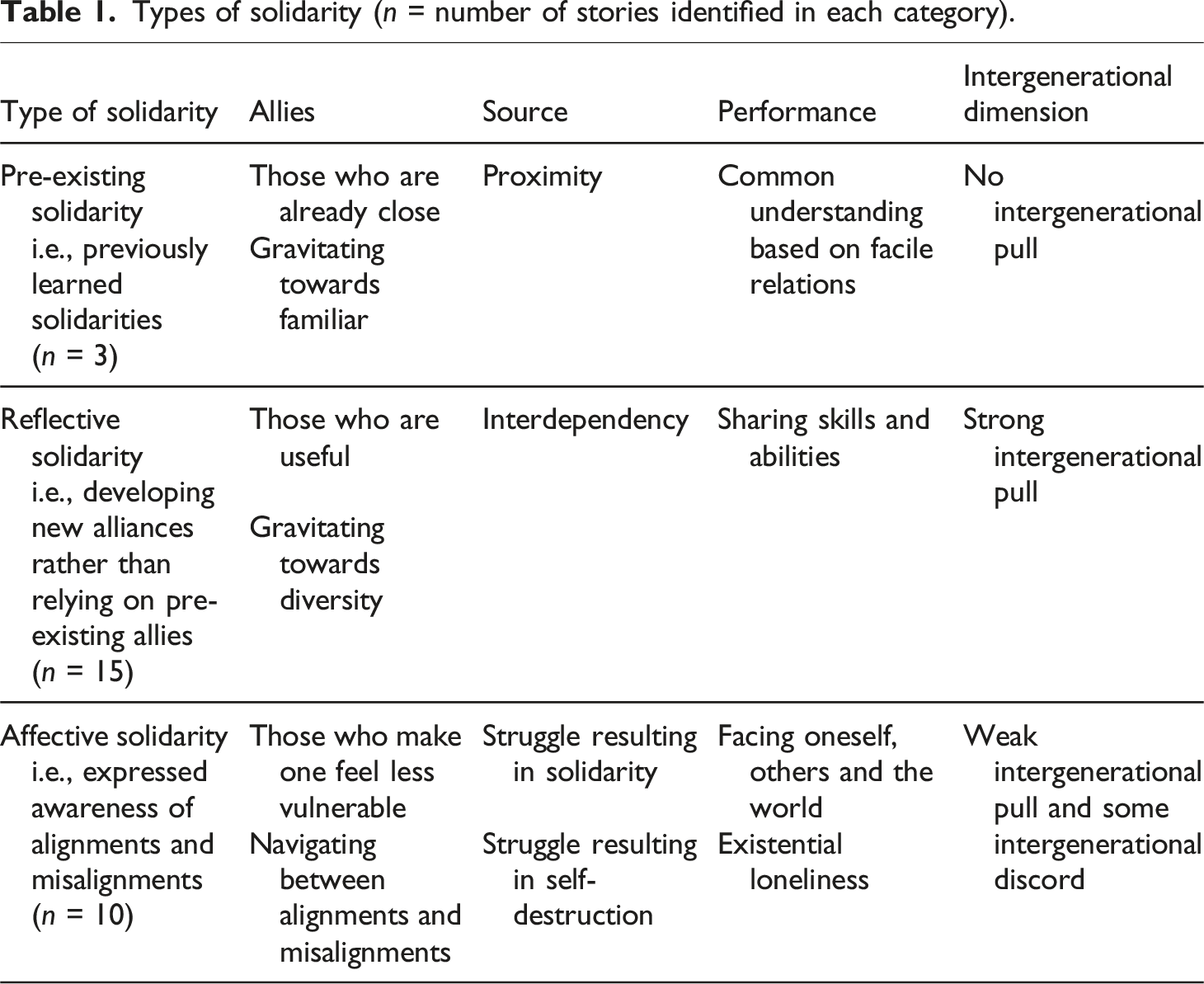
Types of solidarity (n = number of stories identified in each category).
Place-based solidarity in the teenagers’ stories
In the participants’ post-apocalyptic fiction stories, we identified three main lines of solidarity: pre-existing solidarity, where the alliances were justified on the basis of previously learned solidarities, mainly their existing peer friendships at school; reflective solidarity, where the allies within the school were chosen mainly for their usefulness and the various abilities needed in the post-apocalypse society; and affective solidarity, where the stories drew on negotiations and dilemmas about whom to ally with and whom to take distance from. Each of the 28 participants’ stories was relatively easy to assign to one the three categories, implying that each participant reasoned their choice of alliance mainly according to one of the primary solidarity types. However, this does not mean that other types of solidarity were entirely absent from their stories.
In Table 1 we present an overview of the findings, which we then explain further in the following sections. In 15 of the stories, the post-apocalypse society was reasoned with a rational perspective, whereas ten stories were built following an affective disposition. Only three stories were narrated around pre-existing loyalties to friends at school.
Pre-existing solidarity
In three of the 28 stories (2 boys, 1 girl), the allies chosen consisted solely of friends. We found the small number surprising, as earlier research on teenagers’ social relationships report school as an arena for informal peer relationships and friendships (e.g., Korkiamäki, 2016; Korkiamäki and Wiro, 2022; Rodkin and Ryan, 2012). We therefore expected more conventional rationales for solidarity, emerging from shared values, homogeneity and emotional closeness (see e.g., Juul, 2010) uniting a group of friends or a value community.
The extracts from data illustrate how the teenagers´ need for familiarity exceeded the wish to succeed as a community. For instance, Participant 25 wrote “I would choose only my closest friends so we can put our tiny brains together”, describing how the most important thing is to stick together. Similarly, Participant 6 emphasized pre-experienced trust and reliability and hence chose “best friend” and “women I know”. In another story, Participant 5 portrayed himself as a fun-loving person who in the post-apocalypse school wanted to associate exclusively with close friends. In these three stories the participants were inclined towards existing trusted relationships, namely peers. The adults at the school were not chosen for the new society in this story frame.
The stories identified as relying on pre-existing solidarity as the main type of solidarity were among the shortest stories. This may be due to the participants’ intellectual shortcuts in deciding on who is an ally and, perhaps, because of the lack of motivation to participate thoughtfully in the story completion. It is undoubtedly easier to fall back on people one already knows. Alternatively, the friendship ties established at school may have been so strong and have resulted in such bonding as to prevent participants from considering new alliances (see e.g., Weller, 2007).
Reflective solidarity
In a complex contemporary school context, informal acts of reciprocity and support may be challenged by differences in personal values within the community. In such heterogeneous communities, pre-existing solidarities based on shared values and emotional connection are limited. Instead, reflective solidarity, based on the recognition of interdependency and defined as a “mutual expectation of a responsible orientation to relationship” (Dean, 1998: 22) has potential to develop (e.g., Nikunen, 2019). We identified 15 stories that relied mostly on the reflective type of solidarity. Nine of these were written by participants identifying as males, and six by participants identifying as females. This was the most common type of solidarity among the stories in our data.
Unlike the stories revealing mainly pre-existing solidarity, in the reflective solidarity stories the author evaluated who is beneficial to the new society. In most of the stories in this category, a close friend was still chosen to be among the ten people to be saved, but alliances were not restricted to friends: First me and my friends were thinking why we should save anyone else. We could take over the world between the three of us but then we realized that it would be good to have wise people in addition to us dummies. (Participant 28)
In another story, Participant 13 chose “wise” peers, “hardworking” peers and “positive” peers but in addition to these, she chose “one lazy pupil”. This was because “lazy ones are always looking for shortcuts and easier ways of doing things, so this is why they can come up with fresh and simple ideas.” These examples aptly illustrate the mix of allies appearing in the stories demonstrating reflective solidarity.
In the reflective solidarity stories, the people chosen by the participants were carefully considered on the bases of interdependency rather than proximity. Various reasons were given by the participants for choosing a peer not necessarily close to them. Participant 1 wrote that he would save “whoever is the best problem-solver”, and Participant 7 intended to save “the two highest achieving pupils in the school [because] they have a lot of knowledge [and] I can trust them to help me”.
While these teenagers appreciated intellectual knowledge, others looked for support, such as Participant 28, who wrote “It would be good to save a pupil who is extremely wise and kind”. In addition, peers with practical skills were thought to be needed to build a functioning society as the participants chose to rescue, for example, “true survivors, those able to build and farm” (Participant 12) and “two people in excellent physical shape” (Participant 22).
In addition to peers, the adults at the school were seen to possess skills lacked by the teenagers themselves. Relying on one another seemed important in the stories in this category, and the intergenerational pull was strong. This led to co-operation with adults to build a new society and broadened the (reflective) solidarity from peers to a more varied community of relationships: Adults/teachers are in possession of more skills [than children], which is very important when the world ends. Young people are fast, though, this is a benefit when we need to get food, for example. (Participant 15) Teachers would be the brains in our group, because without them we would die straight away […] I would choose the cleverest teachers, the ones who can survive and don´t feel fear. (Participant 23)
Most typically the reasoning behind including adults involved the skillsets adults had developed as professionals. For instance, janitors, craft teachers, school nurses, biology and physics teachers were chosen among the ones deemed ‘useful’. However, adults were also chosen because of their social skills. Participant 7 chose the school cook and the school social worker because the new society will need “kind and positive” people. Participant 28 chose the head of the school because “[she] has always been very nice to me and helped me when I was in need of help so I would choose her”. Participant 27 on the other hand chose the head because of her good leadership: “our head is good at her work so I can´t think why she would not be a good person to assist in leading the new world”. As the above extracts show, the reasoning included both communal thinking and personal preferences.
These examples demonstrate how in this category the participants were looking for individuals with skills and abilities different from their own in order to build a good society. Emphasizing interdependency connects the participants’ rationale in the choice of allies with Dean’s (1998) and Butler’s (2004) understanding of reflective solidarity. The participants comprehended that it is precisely difference that forms the basis of ‘us’ as a community. Solidarity, therefore, in the form of choosing allies for a ‘good society’ came into being because of difference. This differs from the reasoning behind pre-existing solidarity, where relying on closeness and similarity were an asset in ‘getting by’ and the aim was not so much to ‘get ahead’ as a community (see Billett, 2014; Skobba et al., 2018; Weller 2007).
Affective solidarity
Ten of the 28 stories (4 boys, 4 girls, 2 did not report their gender) portrayed the existential struggles that teenagers may experience when navigating their loyalties and alliances in the world. These stories were in line with Markham’s (2019) argumentation on affective solidarity. Representing more complex reasoning than in the manifestations of reflective solidarity, affective solidarity is born of a need to connect with others but at the same time, as Markham explains, we cannot truly connect until we understand that we are separate individuals and, in a sense, alone in this world. Affective solidarity, hence, stems from distracted, conflicted and discontinuous practices (Markham 2019), which through identification of ‘adversaries’, may result in connection with others. Hence, Markham´s interpretation of affective solidarity is more than mere feltness.
As affective solidarity is about differentiation and othering as much as about belonging and togetherness, the stories describing non-alignment and disengagement were assigned to this category. In a rather extreme story by Participant 11, solidarity towards peers appears repressed due to bullying and spreading gossip. Due to having been betrayed by peers, the teenager in this story decided to save family members only, despite the researchers’ instructions to keep the story within the school setting. By making this choice, she detached herself from the school environment and reconstructed (pre-existing) solidarity with family members. The choice is further explained as the story continues: Just a minute ago I saw one of those who bullied me [get killed by a zombie]. I am happy that the bully died since the bully has been saying terrible things about me and spreading rumours about me for a long while. At least now no-one can call me names or make me feel bad in any way. (Participant 11)
In this story, mistreatment by other teenagers at school caused disengagement from the school community and reinforced loyalty with family. Another participant (9) wrote how he anticipated an internal conflict and therefore chose: three physically fit people who can defend themselves and others… I would cure two of my friends so they can be on my side and defend me if I am betrayed [by group members].
A need to create loyalties against mistrust was also discernible in another story where Participant 3 likewise anticipated betrayal: he did not choose teenagers “popular” in the school “because they will stab you in the back”. In such stories solidarity was developed in a struggle between trust and mistrust, which became the borderline between ‘us’ and ‘them’. Solidarity, hence, comes to be defined as a continuous struggle and an affective combination of alignment and withdrawal (see Markham 2019).
While eight of the ten stories in this category exhibited struggles resulting in (exclusive) solidarity, two stories resulted in ‘self-destruction’ or ‘existential loneliness’, as identified by Markham (2019) as a potential result of solidarity struggles. In the story written by Participant 14, the events unfolded as follows: After careful consideration, I decided that I do not want to save anybody. I will take care of everything myself. In 15 minutes, I see the zombie and the zombie sees me. Zombie starts running towards me. I die in the zombie attack.
Similarly Participant 17 decided to save nobody and “would live life to the full [and] do exactly what I want until I reach the end”. Both stories reflect Markham´s claim that existential loneliness is tied to the struggles experienced in the effort to connect with others and that these struggles are present in the processes that may also produce affective solidarity. In both stories the author does not want to save anyone, but in the first story the character dies due to this decision, whereas in the second story, he lives as the sole survivor until he reaches the end.
The relationships between school adults and the character were strained in the category of affective solidarity. Participant 8 reasoned: I will not waste my medicine on teachers. Nor will I waste it on other school staff… The new world does not need teachers or schools.
In this example, the participant makes a break from the past by choosing a different future without schools. In another story also defined by struggle, Participant 21 declares “I would most definitely not choose any assholes”. Later in the story he makes a concession to this declaration by choosing the physics teacher “even though he is a complete asshole”. Thus, the need for a physics expert outweighs his personal dislike and the participant is willing to compromise for the benefit of the future society and for his own and others’ wellbeing. In this sense the struggle leads to solidarity whereas in the case of Participant 8 the struggle leads to rejecting school and adults.
Withdrawing from the adults at school may also result from sympathy for peers who have struggled at school. Participant 4 chose “those who have failed most in school, to give them another chance [in life]”. The story does not reveal if Participant 4 sees herself in this position, but either way, she discusses shared struggles with the school system as a decisive factor in solidarity.
Discussion and conclusions
In this story completion study teenagers aged 15–17 were asked to use a fictional character to reinvent the school setting by choosing allies for a new society. As outlined in the literature review of this paper, schools are of interest specifically from the standpoint of everyday solidarities, since children cannot choose with whom they share the school space. This thrown-togetherness (Massey 2008) affords a multilayered perspective on place-based solidarities, as it reveals the attachments, exclusions and power struggles within the perimeter and, at the same time, enables endless encounters for solidarities to develop (Agustín and Jørgensen, 2016; Oosterlynck et al., 2016, 2017).
For contemporary children and young people, school is an everyday communal space which cannot be described by conventional solidarity based on homogeneity of values, experiences and background. We have therefore sought to determine the sources of teenagers’ solidarity in school and how their choices concerning alliance and detachment are reasoned. As this is inherently a moral question, we used fiction in data creation to allow the participants to express their views without feeling judged regardless of their output (see Clarke et al., 2019).
The findings suggest that in a thrown-together school space the teenagers draw on proximity, interdependency or struggle as the sources of solidarity (see Table 1). When the source was proximity, solidarity was based on pre-established friendships. In the stories demonstrating such pre-existing solidarity, teenagers decided to rely on reciprocal and emotionally bonding relationships with close friends. Their main concern seemed not to be to build a sustainable co-existence but rather to reinforce familiar alliance. We hence conclude that in accordance with the ‘conventional’ understanding of solidarity, children’s solidarities are sometimes based on proximity achieved through a shared understanding in facile relationships, resulting in comfortable but exclusive solidarities (see Billett, 2014; Leonard, 2008; Weller, 2007). However, it is important to note that these stories were a clear minority among the stories written by the participants in this study.
By contrast, in the stories where the source of solidarity was interdependency, the participants reconsidered alliances with an open mind. Gravitating towards diversity instead of homogeneity, they appreciated the variation in skills and abilities and recognized difference as an asset. Illustrating reflective solidarity, these stories expressed a responsible orientation to create a sustainable community of heterogeneous relationships. As this was the most popular solidarity category in our analysis, we conclude that the majority of the teenagers in our study acknowledged the essence of interdependency, the value of newly established alliances, and the need for various skills and qualities within a community or society (see also Leonard, 2008; Turjanmaa, 2020).
The stories in the category of affective solidarity showed alliances that were unclear or unstable and the social environment was described as rather chaotic or even hostile. In these scenarios, solidarity seemed to emanate from affective struggle and vulnerability: situational navigation between trust and mistrust, and alignment and misalignment, rather than relying on reason. Most often these struggles resulted in creating alliance and solidarity with certain groups or individuals while detaching from others. This seemed meaningful in the process of ‘placing oneself’ in the plural world of potential attachments and belongings. Sometimes, however, the struggle resulted in seclusion and loneliness. These struggles may renew existing hierarchies and power positions in children and young people’s intragenerational and intergenerational communities, hence the recognition of the unpredictable nature of contemporary spatial communities is important (see Markham, 2019).
Regarding the teenagers’ relational position (see e.g. Kennedy, 2013; Spyrou, 2022) in school, the findings (see Table 1) revealed that when the source of solidarity was proximity, intergenerational relations were absent, since pre-established connections with friends were emphasized. This implies that effortless ‘at hand’ solidarity in school is established more within the peer group (also Emond, 2014; Weller, 2007). By contrast, when the source of solidarity was affective struggle, the participants expressed mistrust or anger toward peers, adults and the school system alike. However, when the source of solidarity was reflective and the teenagers rationalized their solidarities through interdependency, their stories typically involved descriptions of positive peer and intergenerational relationships. This may be partly due to the Finnish societal discourse, which places solidarity in the context of welfare state, i.e. entailing redistribution of wealth and provision of universal social protection (see e.g. Halmetoja et al., 2019). It is possible that these types of collective societal goals made reflective solidarity into the most common type of solidarity among our participants, but this needs to be investigated further in future research.
While earlier childhood research is limited to studying more universal forms of solidarity, such as societal activism, our research has shed light on children´s own understanding of whom they choose to ally with and why in their mundane everyday communities. We agree with recent research that solidarity in today’s plural communities needs to be scrutinized with complexity in mind (e.g., Oosterlynck et al., 2017). Distinguishing our findings from early understandings of solidarity, sameness did not appear to be a significant source of solidarity in our data. As pointed out by Sedano (2012), homogeneity in people’s backgrounds is often taken for granted as a defining factor through which children assign themselves to groups. In our data, however, the majority of the participants focused on differences and saw these as an asset. Also solidarity based on ethnic background was absent from the data, and the study revealed no significant differences between gender (see also Scholtz and Gilligan 2017). Yet another interesting finding in comparison to earlier research was that in our participants’ stories solidarity was not based on sympathy or pity, despite sympathy often being a key element in defining solidarity; apart from the one participant feeling sorry for the peers who had failed at school. Perhaps in the fictional storytelling there is no need for such bravado (see Bhabha 2022; Markham 2019), or maybe teenagers do not feel obliged to this type of conventional solidarity.
Methodological contribution and limitations
It can be argued that the findings are limited by the fictional nature of the stories. On the other hand, real-life experiences were explicitly discussed in the stories through the fictional relations. Clarke et al. (2019) explain that an ambiguous story stem that must be continued in a short amount of time forces the participant to draw on personally and socially available resources (also Jennings et al., 2019). The story completion method is hence useful when participants should not feel that they will be held accountable for their responses. For instance, the death of a bully described by one of our participants conveyed emotions that perhaps would not have arisen in a face-to-face conversation. As children are not always able to display negative emotions, such as anger relating to injustice, research space at best can offer an opportunity to articulate and express such feelings (Aruldoss et al., 2021; Haavind et al., 2015). As Clarke et al. (2019) point out, the story completion method produces more than just a story. The topic is addressed indirectly, which makes the method ideal for addressing themes likely dictated by social norms.
We can infer that story completion provided access to the teenagers’ understanding of everyday solidarities at school. For example, it is reasonable to assume that those whose fictional character trusts school adults, also trust adults at school in real life. We were pleasantly surprised at how seriously the teenagers completed the assignment to tell a story via a fictional character. Most participants put significant effort into reasoning the choices between potential allies in their stories. This indicates that a carefully constructed story completion that aligns with the target group’s popular culture is a viable method when engaging with teenagers. The stories did not show major disparities between participants’ ability to express themselves, even though the participants were a diverse group in terms of school performance and background. The method also included an opportunity to express oneself without the constraints of grammar or correct spelling or having to stick to a certain length when writing the story.
Unfortunately, we had no chance to ask for feedback from participants on how they felt about the assignment. However, when meeting some of the school staff later, we heard that the pupils had talked about participating in the research with enthusiasm. This was reinforced by the fact that nearly all pupils participated.
Implications
What makes solidarity a fascinating concept is that it entails both the promise of togetherness and the threat of antagonism, which may inhibit the possibility of compromise (Wilde, 2007). However, if children and young people are to be recognized as contributors in their everyday worlds, they need to be able to voice their understanding of meanings around political concepts such as solidarity. As children’s societal contributions reflect the conditions they are living in (e.g. Cavazzoni et al., 2021) and their understanding of their societal role manifests differently in various settings (e.g. Clemensen, 2016), these conceptualizations need to be explored in their various everyday environments. The realization of various forms of solidarity will serve to guide people working with children and young people in supporting children’s spontaneous and self-motivated enactments of solidarity in institutional settings such as in school.
We suggest that the idea of spatial solidarity is useful for adults working with young people in institutional spaces. Firstly, the concept offers a promise of solidarity to potentially emerge in the inevitable relational encounters in the space, as demonstrated in particular by the stories of reflective solidarity in our data. Secondly, it can be utilized to become aware of the practices of how solidarities are performed and power arrangements negotiated in ‘thrown-together’ space. As Erpyleva (2020) states, the crucial question is how adolescents try to practice politics within the limits set by adult society. The findings from our study demonstrate most teenagers’ willingness to share power with others, even though the story stem afforded the option to act alone. Thus, we conclude that supporting and arranging potential spaces for solidarity takes a step towards allowing solidarities among (young) people to develop ‘here and now’.
Footnotes
Acknowledgements
We thank the participating teenagers and the school personnel for making this research possible. We also thank the Childhood editorial team and the anonymous reviewers for their valuable input.
Declaration of conflicting interests
The author(s) declared no potential conflicts of interest with respect to the research, authorship, and/or publication of this article.
Funding
The author(s) disclosed receipt of the following financial support for the research, authorship, and/or publication of this article: The research was funded by the Finnish Research Council, project SA351051, and by the Finnish Cultural Foundation’s Satakunta Regional Fund.
