




Abstract
If it is dehumanising to refer to an adult with it, why is it applied happily to their children? The use of the neuter pronoun it to refer to children is an understudied aspect of English pronoun use. This paper explores this usage in the Aotearoa/NZ news media. It shows that the pronoun is used in more contexts than the literature suggests and there may be diverse motivations for its adoption. Irrespective of speaker intentions, this usage may contribute to deficit views of children, portraying them as lesser humans through association with the non-human entities to which it typically refers.
Introduction
Over the past 50 years, we have witnessed widespread debates about English pronouns. In the 1970s and 1980s, attention focused on the sexist implications of (purported) generic he. The debates led to changes in use, with generic he no longer standard usage in formal written English (Curzan, 2014). More recently, increased recognition of gender diversity has focused attention on the assumptions and problems underlying binary he and she. Nonbinary pronouns are today a topic of public debate (Konnelly et al., 2022), with singular they now used in an expanding range of contexts (Baron, 2020; Konnelly and Cowper, 2020) and endorsed by authorities like APA (2022). These debates have highlighted that pronouns are indeed political (Baron, 2020).
Throughout this period, however, another pronoun usage has attracted little attention: the use of it to refer to children. An exception to this trend is a series of articles by Saunders and Goddard which draw attention to this use in a range of genres, including written news media, fiction, and literature on children’s rights (Goddard and Saunders, 2000; Saunders, 2017; Saunders and Goddard, 2001). The authors argue that this usage has potential to undermine children’s human dignity, to objectify and depersonalise a child. UNICEF made a similar point in 1988 during the technical review of the draft convention on the rights of the child, labelling the pronoun “demeaning or even dehumanizing” (UNICEF, quoted in Office of the UN High Commissioner on Human Rights, 2007: 188). However, beyond often brief references in the descriptive linguistics literature, the use of it to refer to children has generated little further scholarly interest.
There are some possible reasons why this usage has received so little attention. Firstly, the pronoun is often used to refer to very young children (Payne and Huddleston, 2002). Unlike the women who challenged generic he and other androcentric terms in the 1970s and 1980s, babies and infants are not in a position to object. Secondly, people may not always notice their own pronoun choices (McConnell-Ginet, 2020) or others’. Thirdly, some claim that the usage is rare (Baron, 2020; Flores Ohlson, 2022); it may be perceived as not warranting attention. Yet it occurs more often than one might expect in fiction (1), academic nonfiction (2), spontaneous speech (3), and the written news media (4):
1
(1) Becka’s Handmaid had given birth to a baby girl: (2) It assumes perhaps that the child is not in a position to know (3) [SO439]…if I accidentally have a child I wouldn’t mind having (4) When the baby was found some time later,
We argue that it is worth attempting to understand why a pronoun which is considered dehumanising when applied to adults (Baron, 2020)—and objectifying when applied to animals (Merskin, 2022)—is happily applied to children, even in supposedly neutral contexts like academic nonfiction (2) and serious journalism (4). Yet, as shown by the deliberate use of it to reinforce the baby’s not-fully-human status in (1), the usage is not necessarily neutral. It adds meaning.
The purpose of this paper is to contribute to the discussion Saunders and Goddard initiated in the hope of igniting a longer-term debate about this pronoun use. The paper begins with a brief outline of why using it to refer to a child is problematic. There follows a review of descriptive linguists’ accounts of the usage and a summary of Saunders and Goddard’s analysis. The paper then explores the use of it in reference to children in written articles appearing in the mainstream Aotearoa/NZ news media. The aims of the study are twofold: To determine whether the distribution of this pronoun in the news media articles is consistent with descriptive linguists’ accounts; and to ascertain whether we can build on Saunders and Goddard’s findings to shed further light on motivations for its use.
The problem with it
The English pronoun system has a troublesome gap: There is no third person, exclusively singular, gender-neutral/inclusive pronoun which is used productively (liberally) in reference to human beings: A writer must consider [ _____ ] words carefully.
The neuter pronoun it sometimes fills this gap, but mostly (although not exclusively, as we shall see) when talking about very young children (Payne and Huddleston, 2002), for example, when a baby’s or infant’s sex is unknown to the speaker (Downing, 2015). Another gender-neutral alternative is singular they. However, since the 18th century, prescriptive grammars of the English language often claimed that singular they is ungrammatical, prescribing generic he instead (Curzan, 2014). Yet studies such as MacKay (1980) demonstrated that generic he is not gender-neutral: Faced with a gender-neutral antecedent 2 like writer, followed by generic he, a high proportion of subjects in his study interpreted the antecedent as male. As Payne and Huddleston (2002) point out, the “male” meaning attached to he is not easily neutralised. A similar situation may exist with it. This pronoun is used liberally to refer to non-human entities—inanimates and animals—while its use with humans is highly restricted. Hence the non-human associations of it may not be fully neutralised when it is applied to humans. This may explain why discussions about the use of it to refer to children—and other humans—often label this usage “dehumanising”, as UNICEF suggested in 1988.
A critique of the portrayal of children as lacking full human status compared to adults is a central theme in childhood studies. The dominant framework for the study of children and childhood, informed by theories of developmental psychology and socialisation, was criticised (inter alia) for its depiction of childhood as a journey not only towards adulthood, but “more fundamentally, as a journey toward being fully human” (Lee, 2001: 38). Under this interpretation, children lack those “supplements” that make one a human being, viz, socialisation and rationality (Lee, 2001), rendering children incomplete compared to adults (see also James and Prout, 1997; Tisdall et al., 2023). The equation of full human status with adulthood locates children at the margins of that category, attributing to them a lower status compared to adults (Knezevic, 2023). Using (non-human) it to refer to children is arguably one way that language use can reinforce that lower status and the view of children as on the path to full human status, rather than as rational, agentive human beings in the present. However, the usage also reflects distinctions within childhood: If adults are the perceived “standard model of a person” (Lee, 2001: 9) against whom children are measured and found wanting, it is telling that it is claimed to apply mostly to babies and infants (Downing, 2015; Payne and Huddleston, 2002)—those furthest removed in age from this purported standard.
Previous scholarship on it for children
The Cambridge Grammar of the English Language explains the distribution of the personal pronouns he, she and it in modern Standard English thus:
3
In the most straightforward cases, he is used for males, she for females, and it for entities which are neither male nor female… (Payne and Huddleston, 2002: 488)
Beyond these core uses, she can also be used for inanimates (e.g., she for ships) while it can be used for animates, viz, animals and human babies (see also Siemund, 2008). The use of it for children has long been noted by language scholars, even if only in passing. For example, in Payne and Huddleston’s (2002) analysis, nouns can be categorised on the basis of their compatibility with he, she or it. Sex-neutral nouns denoting young humans, like baby and child, are compatible with all three. Non-sex-neutral nouns like boy and girl are compatible with he and she respectively, but not it. Further restrictions include that it cannot be used for human babies when the antecedent is a proper noun (Brown and Miller, 2016; Payne and Huddleston, 2002) or when the antecedent noun is son or daughter (Payne and Huddleston, 2002). In the latter case, Payne and Huddleston (2002: 489) argue that “there is here no motivation for failing to encode the sex of the baby”. The implication is that speakers will use gendered pronouns when the child’s sex is known. As we will see, this does not always hold.
The use of it with children may also be influenced by whether the speaker is referring to a particular child (specific reference) or not (nonspecific). In specific reference to a child, the speaker has a particular child in mind (e.g., Jane’s baby is teething). The child’s sex is knowable, even though the speaker may not know the child’s sex. In a nonspecific context, the speaker does not have a particular child in mind, e.g., Alex hopes to have a child one day. Here, a child could mean a young human of any sex. Similarly with generic uses such as A baby needs love where a generalised, universal claim is made (Payne and Huddleston, 2002): Under a generic interpretation, a baby means “any baby who exists”—irrespective of sex—rather than referring to a particular (specific) baby of specifiable sex. Turning to the context of pronouns referring to children, Siemund tentatively suggests that the distinction between specific and generic reference may account for pronoun choice: It appears that the use of he/she in comparison to neuter it is tantamount to a difference in terms of reference: The non-neuter or animate pronouns are used for specific reference whereas neuter it is used for generic reference. If this is correct… (Siemund, 2008: 163)
Similarly, McConnell-Ginet (2014) notes the use of it with very young humans and in generic contexts, as does Downing (2015: 371) who advises that it can “refer to babies and infants, especially if the sex is undetermined by the speaker… or the reference is generic”.
However, scholars argue that this usage is not neutral. Miller (2002: 110) notes that parents use gendered pronouns to refer to their children, but sometimes use it for their baby, “a usage that typically expresses love for the baby”. However, when others use it, they risk causing offence: Adults without a close link to a baby might use it (Does it sleep through the night?) at the risk of gravely offending the parents. (Brown and Miller, 2016: 166)
The notion of offence is highlighted by Payne and Huddleston (2002), who argue that the use of it with children can have negative associations: It can be dehumanising or suggest a negative attitude toward the referent or a de-emphasising of individual identity, although the context may influence those associations: Because the normal pronouns for humans are he and she, the use of it tends to have a dehumanising effect, and it is more likely in the context of a maternity hospital with lots of potentially undifferentiated babies than in that of a private home with just one or two: it in this latter context would tend to suggest resentment or antipathy. (Payne and Huddleston, 2002: 489)
Similarly, McConnell-Ginet (2014: 23) argues that “…it tends to sound dehumanizing if used in speaking about a particular human, even a very young one”; when applied to people beyond infancy, it is invariably contemptuous, “a refusal to attribute fully human status”. Krauthamer (2021: 35) too highlights the association with human status: She points out that we ask a newborn’s parents, “’Is it a boy or a girl?’” so we can, “convert the baby from a not-quite-human ‘it’ to a real person ‘he’ or ‘she’”. The same theme is evident in Wales’ (1996: 159-60) assessment of the pronoun, which she further associates with emotional distance: Although this usage can at best be justified on the grounds that the baby might not yet be born, or the speaker may not actually know the sex of the baby concerned…or at worst that babies lack reason and speech that make them ‘human’…it-reference however, is apt to be interpreted as being tactless or insensitive, because of it’s associations with lack of emotional involvement or interest.
However, she argues that, in a generic context, it in reference to a child is “appropriate enough” (Wales, 1996: 160). Finally, Curzan (2009: 63) reports that it has been hypothesised that the use of it reflects the “lack of gendered characteristics in the child”.
While the use of it with children is discussed, few studies have focused on this usage at length.
4
An exception is the series of articles by Saunders and Goddard noted above. Across a range of genres, including literature promoting children’s rights, the authors identify language practices which they label the textual abuse of children, that reflect children’s low status and a lack of respect for their dignity (Saunders and Goddard, 2001). These practices include the use of it with children. The authors highlight a phenomenon which they label “gender slippage”, where a child of known sex is referred to by it, e.g., “The baby girl born at a country hospital… Child protection workers took the baby from
Saunders and Goddard are highly critical of the use of it for children. They equate it with objectifying and depersonalising children, overlooking a child’s individuality (Saunders, 2017), and treating a child as not-quite-a-person (Saunders and Goddard, 2001). The authors draw attention to the pronouns adopted in successive instruments outlining children’s human rights, from it to refer to a (generic) child in the 1924 Declaration of the Rights of the Child, to generic he in the 1959 Declaration on the Rights of the Child. The 1989 UN Convention on the Rights of the Child adopted disjunctive he or she which Saunders and Goddard (2001) interpret as clarifying children’s status as rights-bearing persons with their own identities, including a gender. They lament that the Convention’s drafters’ “insight and language development” is not shared by all writers, including those whose work focuses on childhood and children’s rights: some authors may, consciously or unconsciously, consider children to be in a stage of ‘becoming’ or ’less than fully human, unfinished and incomplete’ (Jenks, 1996: 9 and 21). (Saunders and Goddard, 2001: 448)
In summary, scholars argue that the use of it to refer to children can be influenced by a range of factors. These include the type of reference (specific vs nonspecific); the antecedent noun (whether it is sex-neutral or a proper noun); the child’s age (mostly with babies and infants) and situation (whether the child has been maltreated or is at risk). Speaker knowledge and stance are also cited as relevant (whether the speaker knows the child’s sex or perceives the child to have gendered characteristics; the speaker’s attitude towards and attachment to the child; the speaker’s view of children). As for the effects, scholars have associated the usage with dehumanisation, tactlessness, insensitivity, offensiveness, and a disregard for children’s humanity. However, the literature also highlights differences in the pronoun’s interpretation: it expressing resentment/apathy towards a child in domestic contexts (Payne and Huddleston, 2002), a lack of emotional involvement (Wales, 1996) versus parental love (Miller, 2002). There are also divergent views on the role of specificity in explaining the pronoun’s distribution. As will be seen, the data do not support Siemund’s (2008) view that it is restricted to generic contexts; indeed, the usage is found in a wider range of circumstances than he and other scholars have suggested.
The use of it to refer to children in Aotearoa/NZ news media articles
The data
While the use of it to refer to children is not as rare as some suggest, it is not particularly common either. Hence the data is drawn from a convenience sample of 46 written media articles, published between 2002 and 2023, 5 which yielded 90 tokens of it in reference to a child. The criteria for inclusion were that the article appeared in the Aotearoa/NZ written media (mostly online) and contained at least one instance of it in reference to a child. Articles were identified by periodically searching local news media websites for articles featuring children and handsearching them to determine if they met the criteria. Variations on the formulaic expression “It’s a boy/girl” (e.g., to announce a newborn’s sex) were excluded.
The dataset includes written articles from mainstream media: the broadsheet New Zealand Herald, Stuff (Aotearoa/NZ’s largest news website), regional newspapers, a medical news publisher, and Radio NZ’s website. 6 Two articles were published in the local media but were sourced from overseas. Hence the articles represent New Zealand English and other varieties. The articles range from ones reporting on current events through to feature articles and opinion pieces. They cover a variety of topics, including child maltreatment and child protection, child development, medicine, parenting, education, and accidents/misfortunes involving children.
The dataset does not solely contain samples of the written language of journalists/editors. It also includes a reader report published on Stuff 7 (Mason, 2014) and examples of it appearing in the reported direct or indirect speech of interviewees. The dataset is not claimed to comprise a representative sample of either journalistic writing or instances of it in reference to children. It is nonetheless a suitable basis for an exploratory study examining how the pronoun it is used by a range of speakers, as found in the written news media.
A discourse analysis approach was adopted, viz, examining patterns in the language used across texts, within their social and cultural contexts (Paltridge, 2022). Each instance of it was examined to ascertain whether it aligned with the accounts of this usage discussed above or whether the context suggested other plausible explanations for its adoption. Hence, the study addressed questions fundamental to discourse analysis: “Why is this stretch of discourse the way it is? … Why these particular words…?” (Johnstone, 2018: xxiii).
Findings
Third person singular pronouns used to refer to children.
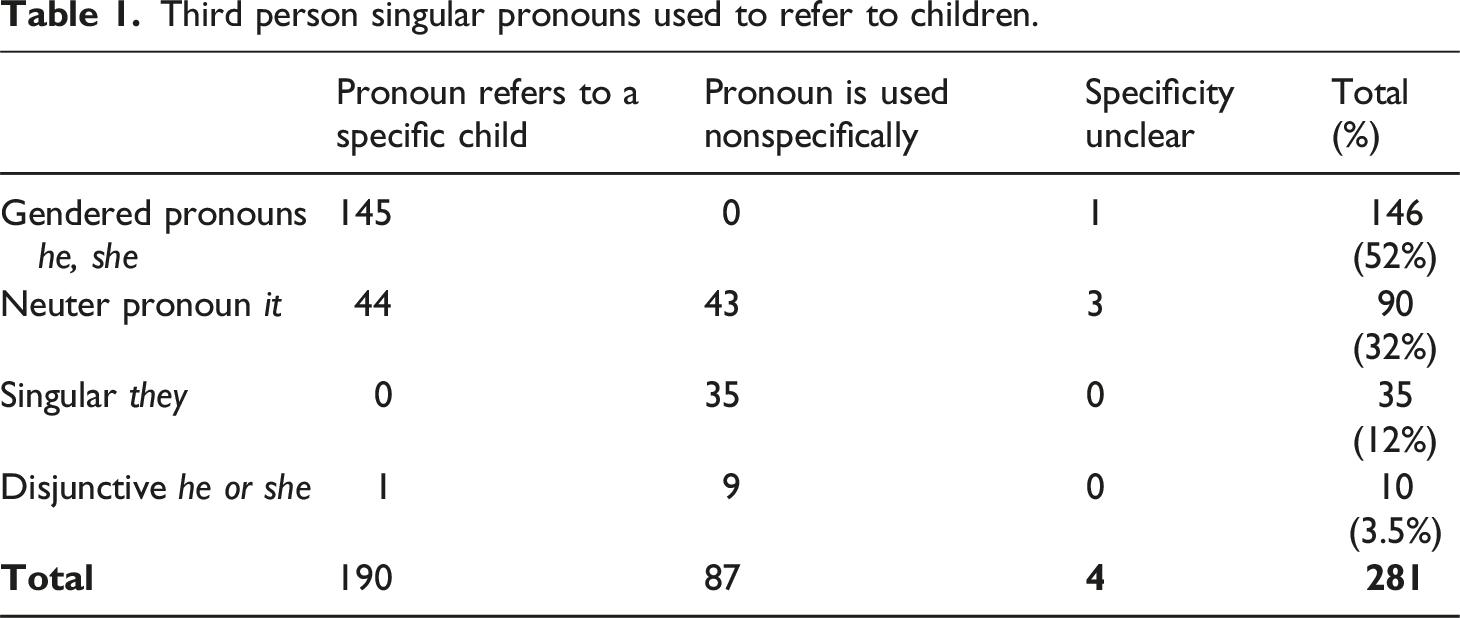
In the following section, we compare the distribution of it in the dataset against the accounts of its use described above. Specifically, we examine its distribution in terms of type of reference (specific vs nonspecific); speaker knowledge of the child’s sex and the nature of the antecedent; the child’s characteristics (age and circumstances); and speaker attitudes and stance towards the child. We then examine cases of “pronoun switch” where a specific child is referred to with a gendered pronoun and it within the same article (this is a slightly narrower category than Goddard and Saunders’ (2001) “gender slippage”).
In all extracts cited below, proper nouns referring to humans are replaced with a pseudonym.
Type of reference: Specific versus nonspecific
Siemund (2008) tentatively suggested that he and she are used to refer to specific young children while it is reserved for nonspecific contexts. His suggestion is partially borne out by the data here. Table 1 shows that he and she were indeed used to refer to specific children, viz, in cases where the child’s sex is knowable. However, it was not restricted to nonspecific contexts, but found equally often in specific reference, e.g.: (5) When the baby was found some time later,
Knowledge of the referent’s sex/nature of antecedent
Payne and Huddleston (2002) state that, in reference to babies, it is not used when the antecedent noun is son, daughter or a proper noun (see also Brown and Miller, 2016). These restrictions are upheld in the current data. However, there is one exception to Payne and Huddleston (2002)’s argument that the noun boy is only compatible with he and not it: (6)…the boy was taken into Child, Youth and Family (CYF) care where
One exception does not nullify the “rule”. However, it is difficult to explain why the writer/editor selected it when the child’s sex is clearly known. As we will see under “pronoun switches” below, nine other specific children (five female, four male) were referred to with both it and a gendered pronoun, demonstrating that knowledge of the child’s sex does not automatically inhibit the use of it.
Child’s characteristics (age and circumstances)
While the use of it is often discussed in reference to babies and infants, the data reveals its use with older children too. For example, the pronoun was used for a nonspecific primary school pupil (i.e., in the 5–10 age range) in a discussion about benchmarking achievement (7). In (8) it refers to a specific child who is described by another news outlet as a 4-year-old (see Gosselink, 2011): (7) ‘As soon as you take data and numbers and put it out on a piece of paper without the context and narratives behind a child and (8) A teenager says he did not think about his own safety when he ran into a smoke-filled house…and rescued a young boy…. It wasn’t until he had handed the child to
As for children’s circumstances, in Goddard and Saunders’ (2000) data, gender slippage was restricted in news articles to children who had been maltreated or were at risk. The current data reveals examples of gender slippage with children in other circumstances, e.g., in relation to misfortunes (8 above) and medical conditions (9): (9) Dr Jones…said more research will confirm whether the girl’s improved condition is a one off, or the basis of treatment for other babies…. The baby was born in a rural hospital
In a further case of gender slippage, the child’s mother uses it to refer to her child and him in reporting the direct speech of others. The explanation for this may lie in deliberate comedic effect (discussed further as (20) below): (10) ‘After I had the baby, they put
Speaker attitude
Some accounts of it reported above are more difficult to test against the data. For example, without supporting contextual evidence, we can only speculate on whether this usage reflects resentment or antipathy in a domestic setting, as Payne and Huddleston (2002) suggest. Nor can we be certain whether the usage reflects a speaker’s perception that the child lacks gendered characteristics (as reported by Curzan, 2009), evidences a lack of emotional involvement or interest (as per Wales, 1996), reflects a view of children as less-than-fully-human (as per Krauthamer, 2021; Saunders and Goddard, 2001) and/or is intended to produce the dehumanising effect noted by McConnell-Ginet (2014), Payne and Huddleston (2002) and others. The latter seems unlikely in the cases cited above. In other cases, it is beyond reasonable doubt that the speaker has a strong emotional attachment to the child in question. One involves a grieving mother who uses it in reference to her unborn child at the 12-week scan: (11) We saw our perfect little baby and
The baby subsequently died in the womb; she was then delivered and named. From this point in the story, the mother (the author of the article) only uses gendered pronouns to refer to her daughter, consistent with the restriction on the use of it when the antecedent is a proper noun (12) or daughter (13) (Payne and Huddleston, 2002): (12) Bella was born…the day before her due date. (13) with our daughter. She felt love from so many people.
It seems highly unlikely that the author would have used it in this context if they perceived that usage to be dehumanising or demeaning (assuming the pronoun was not inserted by an editor). It is more likely that this is an example of it expressing affection, as Miller (2002) proposed.
Pronoun switches with specific children
Ten specific children were referred to with both gendered and neuter pronouns (“pronoun switch”). This begs the question: Why was it used if the child’s sex is explicit in the article? We can rule out the possibility that it was used to conceal the child’s sex to protect their identity, as the sex is stated elsewhere. In four cases, however, the answer may lie in disambiguation, capitalising on the tendency for it to refer to children, rather than adults.
For example, sentence (14) is from an article about an infant who was cured of HIV. In (14)(a) two females are mentioned: the baby (already established as female) and the mother. In (14)(b), the child is referred to as it. If she were used instead, it would be unclear whether the pronoun referred to the mother or the child. The same would be true if singular they were used, with the added complication that they could mean the mother, baby, or both. The pronoun it clarifies the intended referent, assuming the reader is familiar with the tendency for it to refer to young children, rather than adults. (14)(a) The baby was born in a rural hospital where the mother had only just tested positive for HIV infection. (b)
By way of further example, the use of its in (15) clarifies whose placenta is referred to (the child is identified as female subsequent to this excerpt): (15) A stunned mother, who didn’t even know she was pregnant, took her premature new born baby to Buller Hospital in a bucket on Friday night. It is understood the 34-year-old had not realised she was pregnant until she went to the toilet. She arrived at the hospital with the baby and
Alternatively (or in addition), the bucket may be relevant. We usually carry inanimate objects or substances in a bucket, not humans. This may have triggered the selection of (inanimate) it over (human) her.
A larger sample of pronoun switches is needed to ascertain whether these are isolated cases or examples of a regular pattern. Yet, disambiguation may explain some of Goddard and Saunders’ (2000) examples of gender slippage too. In (16), from an article about a female singer’s daughter, the use of its clarifies whose father is referred to: (16) [Female singer]…wants an English [nanny]…with her hair in a bun who speaks Spanish so the child can bond with
Another explanation for pronoun switches occurring in news media articles is point of view. For example, in (17) below, the writer/editor uses it to refer to a child, while the interviewees use gendered pronouns for the same child: (17) … the boy was taken into Child, Youth and Family (CYF) care where
Differing points of view may explain why a child might be referred to with both neuter and gendered pronouns in the same article. However, it does not explain why the writer/editor selected it. Wales’ (1996) suggestion that the usage reflects a lack of emotional involvement may be relevant and/or the writer/editor may simply view the pronoun as an unproblematic choice.
In two other articles, the writer/editor uses gendered pronouns while it appears in an interviewee’s indirect (18) or direct reported speech (19). A lack of emotional involvement could conceivably explain (18) if the spokeswoman used that pronoun herself. However, the article from which (19) was drawn suggests that Mr Salt did take an interest in the infant’s wellbeing and probably knew her sex: (18) (a)…the baby was taken to bag portal [sic], where (19) Mr Salt took the baby first, carrying
A further case of pronoun switch involves deliberate concealment of a child’s sex for comedic effect. The article tells the story of expectant parents who were told during a pregnancy scan—mistakenly, as it turns out—that the baby was a girl. The mother’s use of it conceals the newborn’s sex, so avoids spoiling the punchline: (20) ‘After I had the baby, they put
In two other cases of pronoun switch, it is difficult to identify a rationale with certainty. The first has already been discussed (see (11)-(13)). In the second, an individual repeatedly uses it to refer to a former partner’s daughter (21) although on one occasion they use she. Whether resentment or antipathy (Payne and Huddleston, 2002) is relevant here cannot be known for sure: (21) ‘Well I’m sorry but
There is an analogous example which does not involve pronoun switch. Here, the child is referred to with it three times in one sentence even though the child is identified later in the article as male: (22) The owner of a rottweiler dog that killed a one-day-old baby by grabbing
While the infant is downgraded to an it, the dog is upgraded to humanlike status when the writer states (ironically?) that the dog was not afforded the secrecy of name suppression: (23) ‘The effects [on her] were devastating…’ remarked Judge Jones, shortly before granting both the mother and infant permanent name suppression. There was no such secrecy permitted for Smith or the rottweiler, who was named Bear…(Mather, 2023)
Limitations
There are a number of limitations to this exploratory study. Firstly, the data comprises a small convenience sample of articles, intended to explore an understudied usage in naturally occurring texts. It is unknown whether the patterns identified here would be repeated in a more representative sample of articles or in other genres of written or spoken language. Secondly, the articles cover a 20-year period. Usage may have changed over that period, so that the sample captures older, now redundant, patterns. However, it seems unlikely that significant changes in usage would occur over a relatively short time period (short in terms of pronoun change, anyway) without public debate drawing attention to the usage. But it is still possible. Nonetheless, we identified it in similar contexts across the time periods sampled (e.g., for specific and nonspecific reference; where the child’s sex is overt and not overt in the article; and in articles on similar topics, like parenting, misfortunes, child maltreatment).
Discussion
The findings demonstrate that the use of it in these articles was partially consistent with earlier accounts. Yet, even within this limited dataset, there were exceptions: the use of it with the antecedent noun boy (contra Payne and Huddleston, 2002); the use of it in specific contexts (contra Siemund, 2008); and gender slippage involving children who were not maltreated or at risk (extending Goddard and Saunders’ (2000) findings). The pronoun is sometimes used with children beyond babyhood/infancy and also by parents in reference to their own babies. The latter emphasises the potential for differing interpretations of the pronoun noted earlier (i.e., resentment/apathy, lack of emotional involvement vs parental love). However, pronouns having opposite associations is not unheard of. The pronoun thou had similarly contrasting associations by late Middle English, when it could signal “either emotional distance (e.g., contempt, anger) or proximity (e.g., love, liking) to the addressee” (Nevala, 2018: 79).
The findings also suggest that other considerations may sometimes explain why a speaker selected it even when a child’s sex is known, e.g., to avoid ambiguous reference or for comedic effect. Examination of a larger set of examples is needed to test whether these are regular patterns.
What we can state with certainty is that the motivation for using it is not always to get around the English pronoun gap where the child’s sex is unknown (as Saunders and Goddard (2001) found) or with a nonspecific, sex-neutral antecedent noun. The findings further show that the distribution of it cannot be usefully explained by appeal to a single binary feature, such as specific versus nonspecific reference; nor do all of the above examples fit comfortably with the idea that it signals a speaker’s negative attitude towards the child(ren). Rather, speakers use the pronoun in a wide range of contexts, in reference to children in similarly diverse circumstances. It appears that the context of use must be considered in any attempt to explain why someone might adopt this pronoun and the meaning intended (if any).
Yet speakers do not select it so readily in reference to adults in similar, seemingly neutral contexts. But they sometimes do—or did. In sentence (24) from 1988, there is pronoun switching in reference to a specific adult: (24) One representative expressed
This comes from a report of the Working Group that drafted the UN Convention on the Rights of the Child. The referent of her is a member of that group, representing a nation. This use of it may be a feature of 1980s United Nations editorial conventions, whereby the pronoun refers to the nation or organisation that the individual represents, rather than the individual themself. If not, it would suggest that, in the 1980s at least, it in reference to people beyond infancy did not have the invariably contemptuous flavour that McConnell-Ginet (2014) identified in the 2010s. In any event, this example further highlights the importance of context in imputing motivation.
A key question is whether the use of it for a child is evidence that, consciously or otherwise, the speaker views the child as an incomplete person, as not fully human, as an object. The Linguistic Society of America’s (2016) guidelines for nonsexist usage note that, “sexism is often not a matter of intention but of effect”. The distinction between intention and effect may be relevant here too. No doubt, some speakers quoted above would strenuously object to any accusation that their use of it is evidence that they were objectifying the child(ren) or intended to demean, depersonalise, dehumanise, show contempt. (I too had no intention of othering nonbinary children when I used generic, disjunctive he or she in years past; it had just not occurred to me then that these pronouns were problematic). Of course, the intentions and attitudes behind a speaker’s pronoun choices are not always evident—we can only speculate unless there are other clear indicators in the text or context. However, at least some of the speakers cited above may simply perceive it as a convenient gender-neutral pronoun with little or no negative baggage attached—useful for avoiding referential ambiguity; for concealing a child’s sex; for filling the pronoun gap where a child’s sex is unknown or unspecifiable; for avoiding other workarounds, like the widely unloved disjunctive he or she; or even as an endearment. Or they might not have even noticed they had used it. We do not always pay close attention to our pronoun choices (McConnell-Ginet, 2020).
This is not to say that innocuous intentions (or the absence of intentions) have innocuous effects. At least some speakers notice the use of it and associate it with non-human entities (Hanna, in submission). Its use with children may well contribute to views of children as less than fully human—as incomplete versions of the “standard model of a person” (Lee, 2001: 9), less deserving of respect for their human dignity. If so, when influential publishers like the news media and academic presses adopt this usage, they risk perpetuating such deficit views of children, reinforcing children’s low status, whether they intend to or not. The potential for harm justifies further investigation into this usage, over and above the value of gaining a fuller understanding of how personal pronouns are used in English.
Conclusion
The use of it to refer to children has received little attention in the literature to date. The current study aimed to expand our understanding of the contexts in which it is used. The findings demonstrate that current explanations do not fully account for its distribution. They also suggest that speakers interpret the usage differently: For some, it may be perceived as dehumanising; for others, it may be perceived as benign, at least in some contexts (see also Hanna, in submission). The writers/editors and others who used it to refer to children in the articles discussed above may fall into the latter camp, if they gave it any thought at all. That speakers may interpret the pronoun differently and/or according to context cautions against drawing firm conclusions about a speaker’s underlying attitudes on the basis of its use. Yet the potential for this usage to do harm, by perpetuating deficit views of children as falling short of the standard model of a person, demonstrates the importance of developing a better understanding of how speakers interpret it in reference to children and to continue the conversation that Saunders and Goddard (2001) initiated 20 years ago.
Footnotes
Acknowledgements
The author is grateful to Franco Manai, Alison Cleland, and Camille Nakhid for insightful comments on an earlier draft, and to Monica Holland for assistance with data coding and robust discussions about the topic. Any remaining deficiencies remain the sole responsibility of the author.
Declaration of conflicting interests
The author(s) declared no potential conflicts of interest with respect to the research, authorship, and/or publication of this article.
Funding
The author(s) disclosed receipt of the following financial support for the research, authorship, and/or publication of this article: This work was funded by Auckland University of Technology.
