




Abstract
This study explores the ‘sex-map’, a didactic object developed in Sweden. The analysis focuses on teacher guidelines and an animated movie for classroom use and how the sex-map becomes a method for emphasizing students as actors in defining sexuality. Building on Mol’s notion of ontonorms, the emphasis is on ways in which the ontology of young sexuality is associated with arguments about what is ‘good’ in and for sex education. The sex-map incorporates ideal students’ experiences, discoveries, and positive feelings. Via students, a critique is mounted against one-path sexuality, underscoring the importance of ‘good’ non-hierarchical sexuality as exemplary sex education.
Introduction
In this study, we explore a Swedish case involving the export of sex education: the ‘sex-map,’ which is part of the animated movie Sex på kartan (2011). This movie has previously been discussed in research, in terms of both the display of sex in the movie and the public controversies that arose when the movie was launched. For example, the content was interpreted as child pornography and thus was not considered appropriate for school sex education (Björklund, 2014). In-service teachers also described the content as pornographic when exposed to it in a research study (Ollis, 2016). Another critique suggests that the movie is grounded in queer and feminist perspectives but that there is no engagement with matters concerning culture, religion, morals, and norms, and an absence of critical perspectives on racism and ethnicity (Bredström, 2014).
In addition, the movie is discussed as ‘edutainment’ (Bolander, 2015: 292), and its way of signifying the role of the condom reinforces the coital imperative even though, in its approach of naming sexual practices regardless of sexual identity, the movie signals ‘an attempt to go beyond the borders of sexual identity to address young people of various sexual identities at the same time’ (Bolander, 2015: 296). The naming of practices is seen as ‘a deliberate strategy to destabilise the norm of the coital imperative’ (Bolander, 2015: 296; see also Björklund, 2014).
The fact that Sex på kartan is animated offers something new in the historical context of Swedish school film and meta-educational film in terms of how it depicts the ways in which classroom teaching of sex education takes place (Björklund, 2012). In using concepts from film studies, the movie is understood as part of a ‘schoolroom genre’ which ‘typically depicts classroom lessons, activities, or lectures’ (Gregory, 2015: 199). In Sex på kartan, the sex-map plays an essential role as a didactic object providing ‘good practices’ in what can be learnt from Sweden from a global perspective (Ketting and Ivanova, 2018: 155).
As this brief overview of the research suggests, Sex på kartan is simultaneously enacted as a legitimate didactic object, a movie that is part of sex education, and an illegitimate object that risks satisfying a pedophilic gaze or being a force used by advocates of protecting children and young people from knowledge about sexuality. In this article, the focus is instead on what happens when we focus on the sex-map as a didactic object (Kalthoff et al., 2020), which takes an active role in the making of students’ sexuality in practice in education that is not necessarily seeking to reflect sexuality ‘out there’ (Allen, 2015; Sparrman, 2018). Exploring the sex-map as a didactic object relating to other didactic objects enables a focus on programs of action (Sonnenberg-Schrank, 2020: 19) that extend beyond passively consuming a movie in class. Building also on Annemarie Mol’s (2013) notion of ontonorms, we explore how particular realities enacted in and through sex education are addressed as ‘good’ sexuality, suggesting a certain type of ideal student—in sex education as well as in relation to everyday life. In this article, we steer the interest towards how a sex-map as a didactic object actualizes activities towards ‘good’ sexuality. A key concern is how a didactic object that offers possibilities of defining sexuality enacts students and young people in sex education. We approach this by asking questions about what is actualized as ‘good’ sexuality in relation to the realities that are enacted.
Methodology: Exploring teaching methods and the sex-map as didactic object
In exploring the sex-map, our strategy has been to make an inventory of the presence of this didactic object in two steps. Firstly, we traced the production of the sex-map back to what is termed ‘The Puberty and Sex project’ (TPS project), formulated by RFSU, a Swedish non-profit organization focusing on sexual and reproductive health and rights, and the Swedish Educational Broadcasting Company (Utbildningsradion, UR). Both organizations are involved in national and international cooperation. UR and RFSU are well-known organizations, with a history in their different fields that includes the production and distribution of media resources for schools. The TPS project was awarded funding in 2008. The application for funding included a description of the intended use of Sex på kartan over time, and in parts of the world where ‘sex education is even more undeveloped than in our context’ (Arvsfondsdelegationen, 2008). Hence, the movie is intended to be suitable for export.
The TPS project application argued for its usefulness with reference to the challenging role of teachers, who need time and competence to develop sex education. This is a well-established rhetoric that has been present in the Swedish sex education discourse since the early 20th century (cf. Lindgren and Backman Prytz, 2021). The mission of the TPS project is to develop and use a ‘method’ for the enhancement of a form of sex education that is able to transgress cultural, geographic, and political differences. The sex-map is key in an outspoken and global—from a Swedish point of view—aspiration to develop and export ‘good’ liberal and permissive sex education (Zimmerman, 2015), which is presented as something different from (progressive) state school sex education (Lindgren and Backman Prytz, 2021). The TPS project generated a variety of content and guidelines for education. The movie Sex på kartan is specified as a cornerstone of the teaching method, and as a central element in the project. Accordingly, the animated format is fun, sustainable over time, and less offensive than the photographic images used in sex education media, it is argued.
Our second strategy involved exploring the current circulation of the sex-map, which led us to three products where it is introduced as a central didactic object. These products are distributed for use in sex education in schools in Sweden and widely elsewhere. The three products we focus on in the investigation of the sex-map are: (1) Sex på kartan (Sex on the Map): a 28-min animated movie. It is aimed at grades 7–9, and Upper Secondary School. Presented in six episodes on DVD, which include a guideline for teachers (Sex på kartan, 2011). Sex på kartan has been broadcast on Swedish television. It is also available for streaming in full through UR Play, Vimeo, and YouTube. (2) Sexualkunskap (Sex education) (Dahlöf, 2011) (208 pages). A set of teacher guidelines, including exercises in how to use Sex på kartan in classroom practice. Published by UR. (3) Handledning till Sex på kartan (Foxhage, 2011) (60 pages). A set of teacher guidelines for the movie Sex på kartan. An English translation is available as a PDF file: Teaching notes for Sex on the Map (Foxhage, 2012). Published by RFSU. Quotes in English are from Foxhage (2012).
Hence, the sex-map is a didactic object that is central in an animated movie and in three sets of teacher guidelines (see 1–3, above). The movie was subtitled in 10 languages. 1 In 2023, various versions have been streamed over five million times. The English version on YouTube accounts for over 3.6 million views. 2 As this shows, the aim of producing a film for export has been achieved.
As a visual entity, the sex-map is a recurring feature: it is on the cover of the products from the TPS project. In this article, we analyze the didactic objects one to three listed above, i.e., the actual movie Sex på kartan and the adjoining teacher guidelines. 3 These products are presented in relation to different categories of childhood encountering and using the sex-map: schoolchildren, young people, teenagers, children, and teachers (Dahlöf, 2011; Foxhage, 2011; Sex på kartan, 2011). There are different versions of the sex-map in the empirical material. We explore each of these versions, including ways in which expectations of the students’ and teachers’ versions of the sex-map are created in classroom practices.
Kalthoff et al. (2020: 281, 283) argue that a focus on didactic objects makes visible how an ‘arsenal of artifacts’ prescribes actions for students, teachers, and situations, and ‘anticipate[s] the lesson they were developed and produced for.’ Introducing the notion of didactic objects, Kalthoff et al. (2020: 281) ask us to learn more about objects, to challenge the taken-for-granted, ‘closed’ status of objects (Kalthoff et al., 2020: 284). Looking at the sex-map, we address what is defined as a ‘child-oriented’ approach in Kalthoff et al. (2020: 286), to learn more about a specific didactic object (the sex-map) which is presented through different educational products (the movie Sex på kartan and versions of the teaching guidelines). By looking at several materials that conceptualize what the sex-map ‘is’ and suggest different actions in education, we gain the opportunity to learn more about complex and multiple realities—valued differently (Mol, 2013, 2021)—which are expected by and enacted via the sex-map.
Our analytical process recognizes the complexity of texts and visual materials, drawing on concepts of ontological multiplicity developed in STS (see Law, 2002; Mol, 2013), including enactments of different ideal worlds (Law and Lynch, 1988). Using John Law’s (2002: 12, 32) terminology, we refer to an important part of this process in terms of a naïve reading, which is highlighted on different versions of the sex-map, and their coordination. Thus, rather than assuming the existence of one singular sex-map, which Law (2002: 15) would advocate against (‘not one, but many’), multiplicity is documented in terms of making visible the ways in which sex-maps are coordinated in text and visual materials. Following Mol (2013, 2021), there are different versions of objects and realities, which are coordinated in practices—including, we argue, sex education. In particular, we focus on documenting the sex-map, which includes transcripts of movie dialogue regarding the sex-map and sexual practices, creating inventories of images (focusing on empty maps, occurrences of figures which are added to sex-maps, and figures from the sex-map used in ornamental ways elsewhere), and note-taking, which ranges from initial descriptions of visual objects and stories/dialogues to analytical comments throughout the research process.
In childhood studies, the work of Law, and Mol in particular, has been inspirational for studies of children and sexuality (Sparrman, 2018), child culture (Sparrman et al., 2016), education and aesthetic norms (Sørenssen and Franck, 2021), and bodies and food (Eßer, 2017). A focus on material objects and education provides insights into different adult ideals of what childhood is (Kraftl, 2006). Furthermore, a focus on didactic objects allows childhood scholars to find ways of exploring the novel ways in which the voices of young people become meaningful in relation to the material stuff of education (Cooper, 2023).
We pick up on Mol’s (2013: 381) invitation to playfully develop the notion of ontonorms as a ‘methodological tool’ for exploring multiple realities where science and daily life intersect, e.g., in sex education. The study of values and norms is important in Mol’s (2013, 2021) work, for addressing how certain realities come to carry weight, in the enactment of ‘good’ food or eating. Particularly informative is Mol’s (2013) exploration of ontonorms in Dutch dieting, which present what eating ‘is’ and suggest what is ‘good’: eating can be enacted as pleasure or as energy, and is thus constituted differently. In dieting, Mol (2013) identifies techniques such as counting calories and making lists. Dieting not only presents guidance or advice, but also suggests what a body is and offers enactments of ‘good’ eating. An exploration of the sex-map allows for a similar understanding of ontonorms: how realities and values intersect in sex education. We explore how current sex education involves more than one version of sexuality. The following questions guide our playful exploration of the sex-map as a didactic object: What is a ‘good’ sex-map reality? Does the sex-map allow for the enactment of multiple realities, or only one? If multiple, what are these realities?
Analysis: Realities and discoveries via the sex-map
Having presented the TPS project as a context for the emergence of the sex-map, we now outline our analysis of the sex-map, focusing on three products distributed for sex education. Firstly, we identify the ways in which the didactic object of the sex-map is introduced as part of school settings in the animated movie Sex på kartan. We describe how the sex-map is connected to a ‘traditional’ map, a guiding tool to be used when exploring uncharted territories, which in this case is the landscape of sexual practices. An unpeopled sex-map becomes peopled, and during this process the teacher and students become involved in a teaching method. We then discuss how this mapping, discovering, and exploring of the sexual is steered towards inclusiveness.
Finally, and in relation to ontonorms, we focus on how the sex-map challenges ‘scripts’ of sexuality to enact what is perceived as an alternative ‘good,’ multiple-path sexuality. Discussing scripts, we outline how general sexual norms and individual behaviors are enacted in relation to one another via the sex-map. These were previously discussed in terms of levels of scripting (Wiederman, 2015), which become relevant for teachers and students via the sex education being studied here. Consequently, we address sexual scripts among alternative enactments of sexuality.
Introducing a map becoming a sex-map: Navigating sexual practices in a flat landscape
In the opening scene of Sex på kartan, we follow Kim, a female student, leaving class. Kim moves swiftly on a skateboard through a hallway busy with teachers and students. Kim is on her way to take part in a voluntary mathematics class in the school library. In addition to Kim, four other students (two girls and two boys) wait for the teacher. The situation actualizes same-sex fantasies as well as heterosexual experiences via visual and verbal narratives. Jao, a substitute teacher, enters the library and presents an unexpected alternative—since math is not really ‘his’ subject, he will not be able to help. He can, however, run a sex education class. One student explicitly resists this offering, but Jao insists and starts the class.
We are now approximately halfway into the movie, and Jao introduces the map as a resource for navigation, by asking the students: what can one use when ‘going somewhere you haven’t been before’? In the movie, he uses a didactic object to make the right answer visible, stretching up his arm to pull down what he refers to as an ‘old traditional map’ from the ceiling (Figure 1). In the movie, this is the first actualization of a map (see also Foxhage, 2011: 36). It presents a heart-shaped landscape with no references to a known real world, and it is unpeopled. On the lower right-hand side of the map, something similar to a compass is represented, connoting science as a tool for exploring and navigating the unknown, i.e., for making discoveries. The purpose of this class, the students learn, is to ‘draw a sex-map’ which includes ‘everything possible you can do when you have sex.’ Teacher Jao pulls down an ‘old traditional map’ from the ceiling (Sex på kartan, 2011).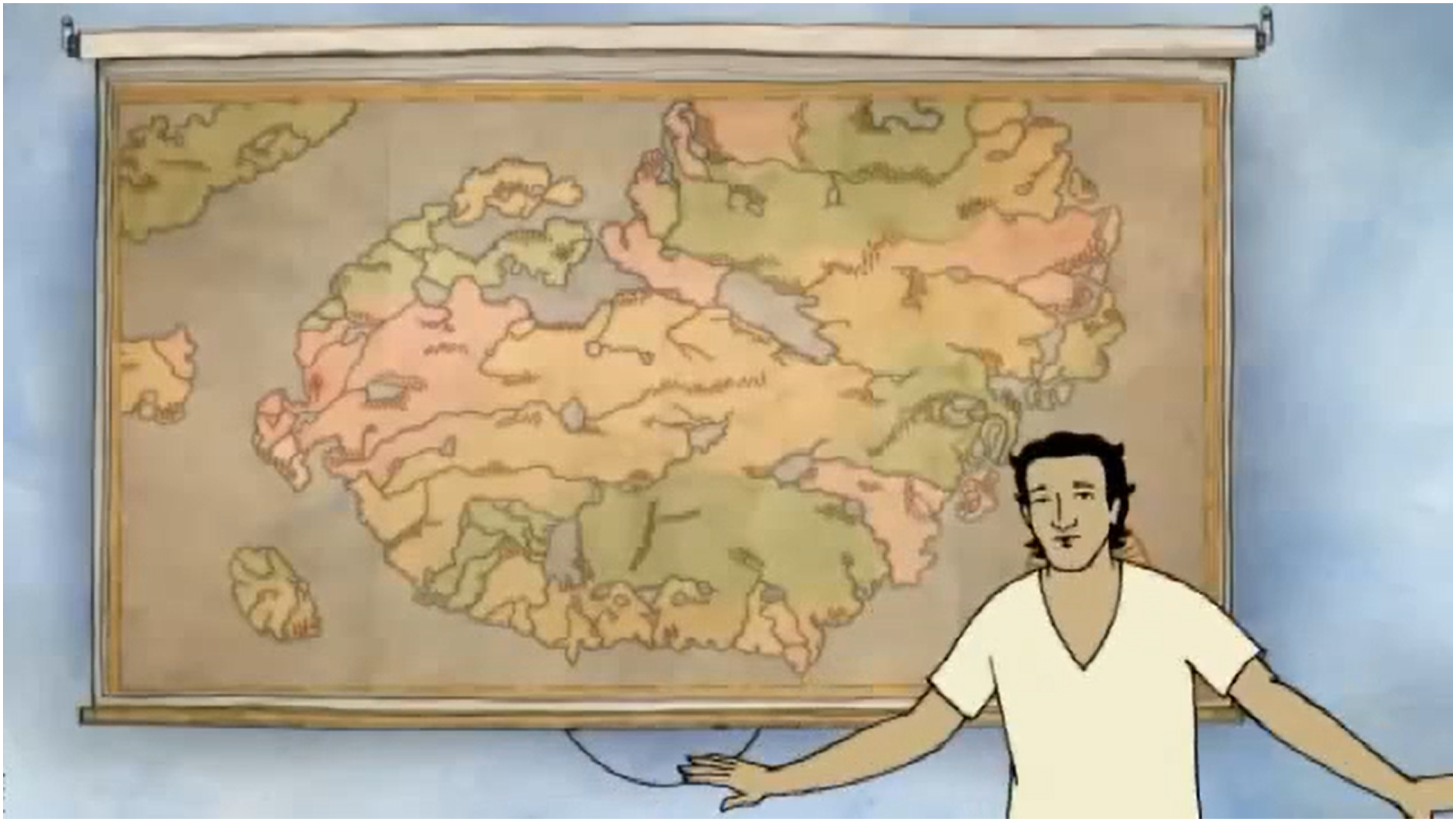
Jao encourages the group to ‘think freely’ about what ‘you can do when you have sex.’ The students answer: fucking, making out, the 69, watch porn, kiss, masturbate, blowjob, flirt, anal sex, touch a breast, threesome, talk dirty, touch the pussy, doggy style, ride, lie close, hug, lick, suck a dick, and to be in love. Each time, Jao acknowledges the students’ answers verbally, by repeating what a student says, often followed by saying ‘good, and more’ (see also Dahlöf, 2011: 64–66; Foxhage, 2011: 18).
In addition, each student’s answer is transformed into a drawing representing the sexual practice suggested. Jao uses what looks like a laser finger to beam each drawing-answer onto the map (Figure 2(a) and (b)). Then the students’ answers, given by boys and girls respectively, appear in red flashes.
4
Teacher Jao uses his finger as a laser to (a) attach a visualization of the students’ answer to the question of what ‘you can do when you have sex.’ and (a) display the image for a boy’s answer ‘fuck.’ In (b) the answers also appear in red flashes; here, a girl answers ‘touch a breast.’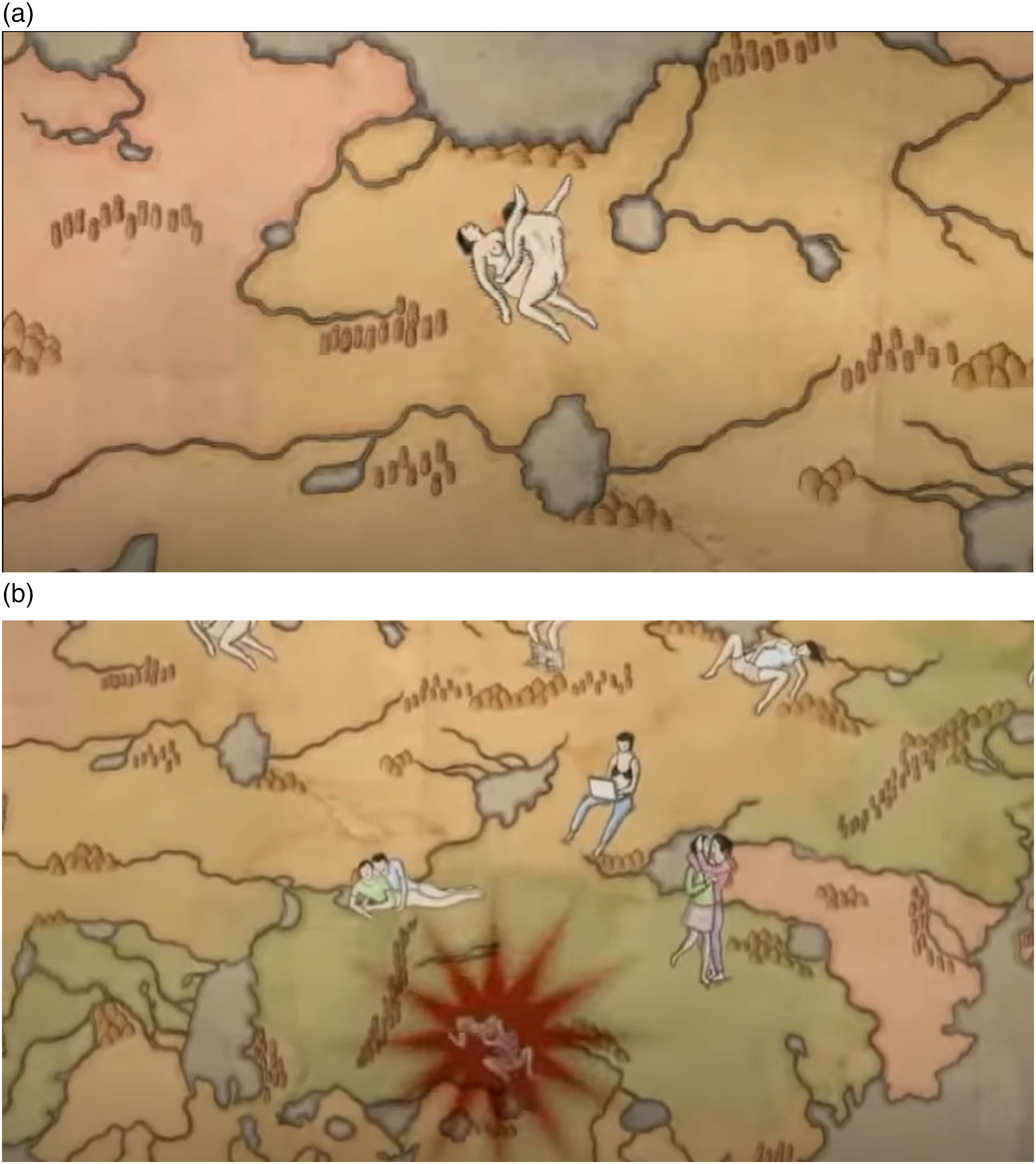
Eventually, the sex-map appears and Jao says: ‘Yes, everything that makes you horny can be on this map, fantasies should also be acknowledged’. Hence, the teacher acknowledges the students’ suggestions both verbally and visually. In the teacher guidelines, there are visualizations of peopled sex-maps (Figures 3(a)–(b)). The range of sexual practices potentially suitable to appear on the sex-map is infinite, as one boy student comments in the movie, which Jao acknowledges as an accurate reflection. In addition to becoming an ‘infinite map,’ as suggested by this student, it can also ‘differ from one time to another what one wants to do,’ Jao adds. He says that some people only visit some places on the map, while others make ‘massive exploration trips’ to many places on the map. ‘You can go to a place and never want to go back, and then you don’t need to go back,’ Jao lectures. (a) A peopled sex-map in the guidelines (Dahlöf, 2011: 58–59). (b) A peopled sex-map in Sex på kartan.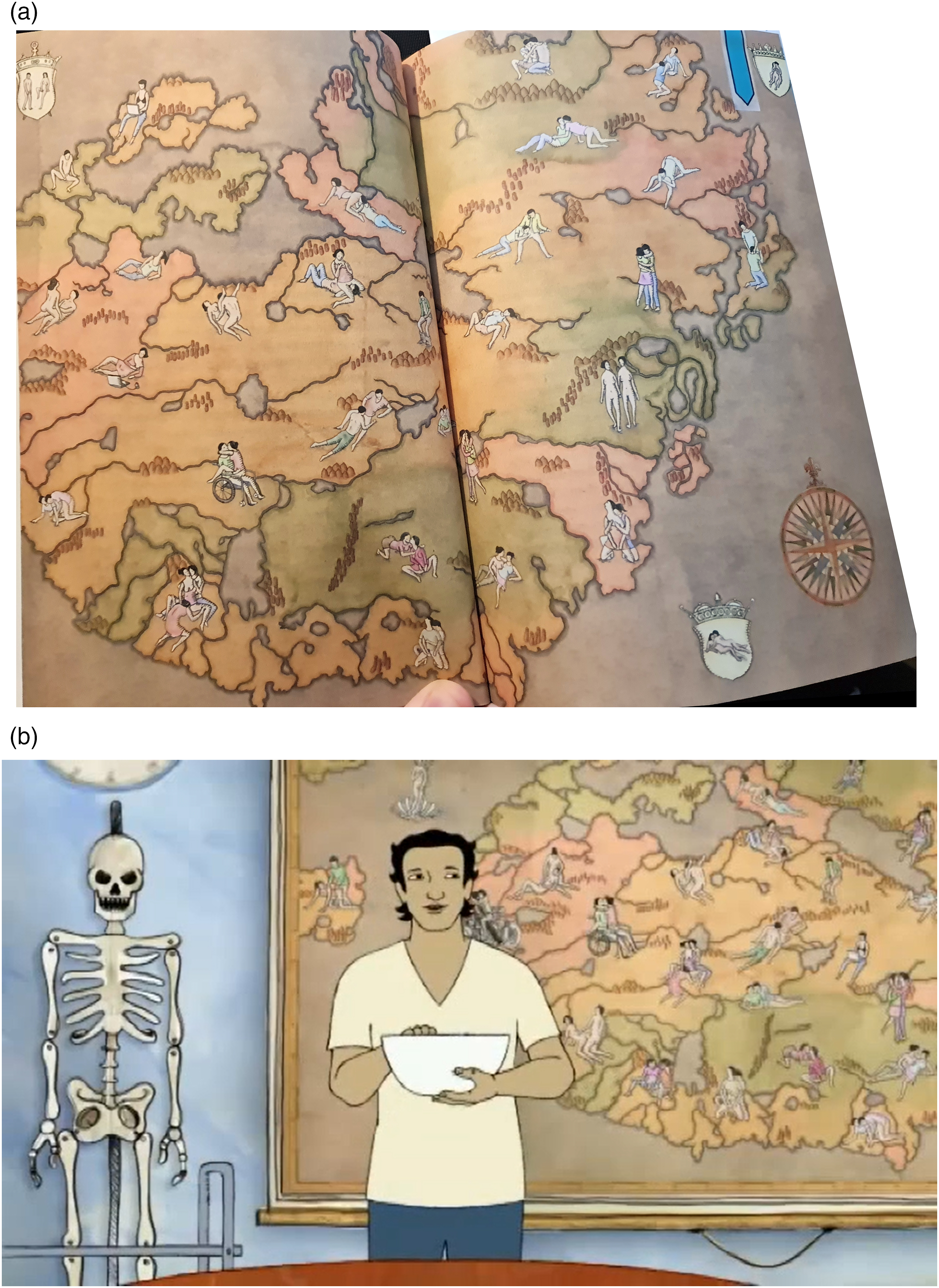
Figure 2(a)–(b) and Figure 3(b) show how the sex-map takes shape as an encounter between students, the teacher, and images attached to the map. Verbal and visual confirmation from Jao becomes part of the process that adds figures representing sexual practices unfolding as a series of sexual realities. Hence, gradually, the ‘traditional map’ transforms into a sex-map in front of the eyes of the students in the movie, as well as students watching the movie (cf. Eberwein, 1999).
In the teacher guidelines, three ways of making versions of a sex-map are proposed as complementary education. One is to create a sex-map about ‘different feelings that may arise in the context of sexuality’ (Foxhage, 2012: 35). The teacher should ask the students about feelings and name them, together with geographical places; for example: ‘a town called “Fantastic”, a village called “Uncertain”, Lake “Horny”, “Difficult” Mountain’ to produce a sex-map (Foxhage, 2012: 35). Another suggestion is that ‘the class and you [the teacher] make your own sex-map, like the one in the movie’ (Dahlöf, 2011: 193). A third proposal is for the teacher to write ‘sex’ on the board in the classroom and then ask the students to ‘fill in with all the sexual acts they can think of,’ which will create ‘a list’ (Dahlöf, 2011: 63–64). Hence, the sex-map could also be in the shape of a list. This, the sex-map as a matter of listing practices building on feelings, allows for what Law (2002: 191) calls a pinboard mode: one practice is listed next to another – not necessarily suggesting a hierarchy or central point of reference. Instead, the logic is a flat ontology, indicating the production of a flat landscape of sexual practices.
When Jao presents the map becoming a sex-map in a coordinated process with the students, the movie and guidelines do not differentiate between sexual practices in terms of appropriateness, which is in line with the idea of a flat ontology. Jao represents a teacher who knows about, or at least is not upset by, all the things the participants want to add, and he listens and takes their answers seriously. His way of repeating what the students say signals that he is not embarrassed to use their wordings and that he is connected to the everyday reality of the young people producing or using the sex-map. He is a teacher leading the lesson, and at the same time he is connecting himself to their worldview without creating hierarchies of practices.
Moreover, when coordinating the content of the sex-map, the connection between life outside school and the school space becomes visible through the inclusion of everything that comes to mind in relation to the topic of sex (cf. Casemore, 2010). Thus, the students’ contributions become important as they have something to bring into education. In addition, the sex-map works as a ‘distancing device,’ allowing students to contribute, but not ‘to expose themselves or their experience in the classroom’ (Bragg, 2006: 321), since sexuality is addressed through brief or impersonal examples. Furthermore, the focus is to provide an overview via the sex-map, rather than zooming in on one representational figure or unpacking details about sexual practices.
Consequently, the idea emerges that the sex-map, with its inclusion of a variety of sexual practices, is a relevant way for young people to explore their own sexuality. Thus, the sex-map expects a particular version of the student and young person, which is not limited by modern Western ideals of sexuality within stable relationships with the goal of reproduction (cf. Rubin, 2011) or that knowledge about sexuality is not for children and young people (Robinson, 2013).
Mapping, discovering, and exploring the sexual: Becoming inclusive
The visual story of Sex på kartan imbues the sex-map actors with individual interests, varying colors of skin and hair, and a broad range of names and sexual preferences, in addition to presenting school as a place for dialog and curiosity. The school as a context for a sex education lesson producing sex-maps is enacted as a place and space that welcomes diversity (exemplified in Figure 4). A variety of examples underscores the philosophy that constructing a sex-map is open to different ideas, and does not consider any practices to be intrinsically right or wrong, good or bad. The visual presentation of school as a place and space that welcomes diversity and sex education lessons producing sex-maps (Foxhage, 2012: 59; not included in Foxhage, 2011).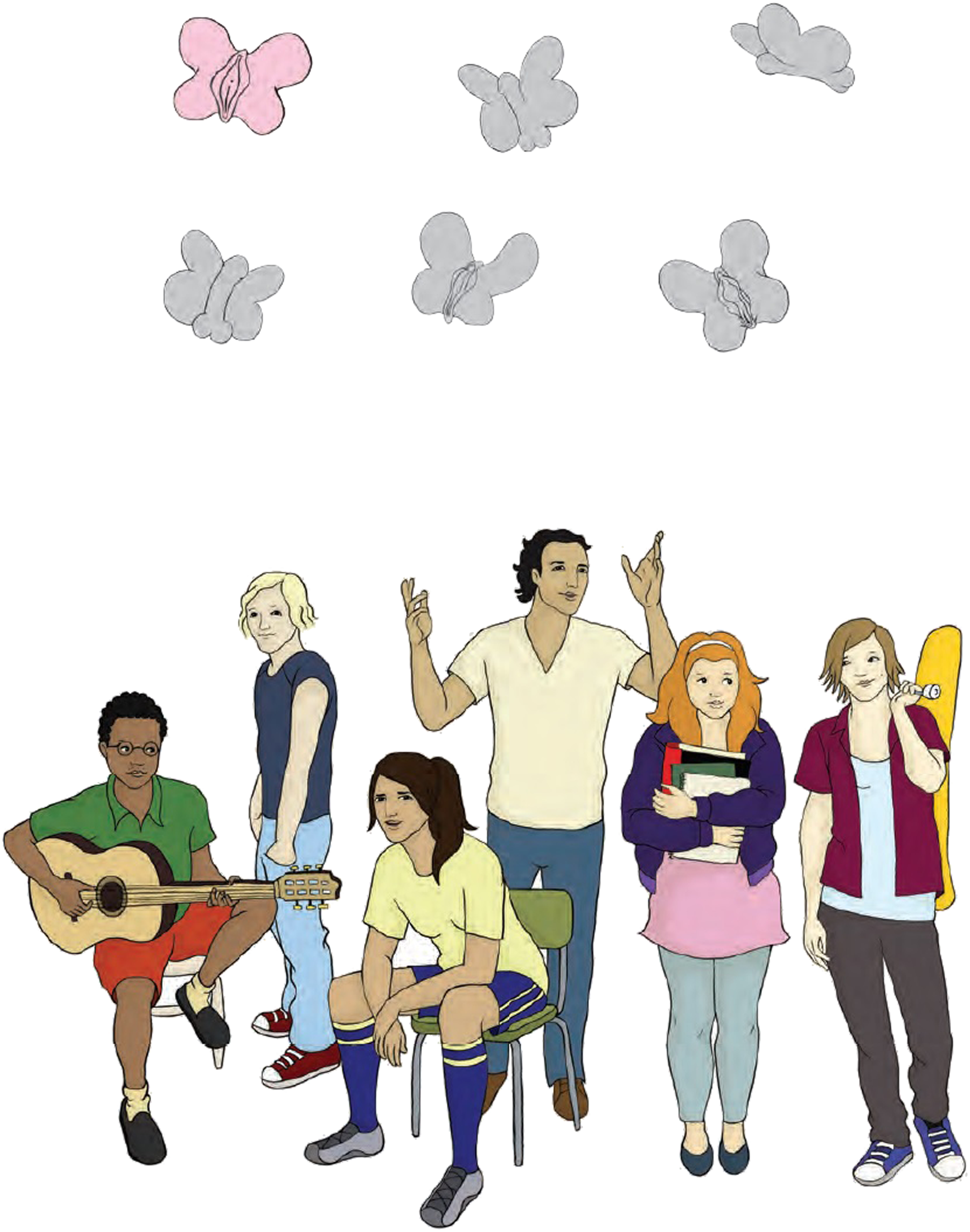
Hence, rather than a focus on tests of individual knowledge (as in most school subjects) or sexual preferences, both the movie and other TPS materials stress dialog and student involvement through the sex-map, which is addressed as a tool for navigation and discovery among various possible sexual practices. In addition, drawing a sex-map as a choreographed joint and parallel endeavor enacts the navigation and exploration of sexuality as an adventurous and yet common activity—similar to navigating in any unknown geographical landscape.
The task of listing practices in class using the sex-map as didactic object relies on a specific ontology of what a student is, in which young people uncover a landscape of sexuality. The sex-map suggests that young people are to be encouraged to ‘discover’ sexuality as ‘an area.’ The sex-map does not associate sexuality with a home setting, and it is not about particular forms of heterosexual relationships. Commercial aspects (e.g., pornography) as well as noncommercial elements (e.g., positions and practices) are included. Young people do not need to be in a relationship to have sex, since sexuality concerns practice. In principle, the sex-map can free the young sexual person from relational constraints, enabling them to focus on expanding sexual discoveries. It does, however, rely to some extent on binary categories of male and female, which is often the case in school sex education (Ringrose et al., 2019: 261).
However, the sex-map also suggests that sexuality is transformative and that practices are not defined by the gender of the participants. Jao turns down answers from students about ‘homo,’ ‘bi,’ and ‘trans’ as sexual practices. Such references are about ‘who you would like to do it with’ and not the sexual acts per se. Sexual practices are the same, regardless of the gender of the sexual partner, Jao explains. The exclusion of ‘sexual orientation’ and ‘gender identity’ from the sex-map opens up the possibility of focusing on sexual practices beyond who a person ‘is,’ it is explained in the guidelines (Foxhage, 2012: 36–37).
In consequence, the sex-map does not provide answers about exactly who should be involved in sexuality-as-practice, or where it will take place. If such answers had been provided, the sex-map would have risked presenting specific guidelines to a fixed destination, or a hierarchical ‘pyramid’ model of sexuality (Rubin, 2011: 149), rather than one which is flat. The sex-map method actualizes a pleasurable promise of the possibilities presented by navigating and discovering a flat landscape of sexuality. Moreover, it addresses sexuality in terms of practices rather than inherent ‘possessions’ (Sparrman, 2018). At the same time, the sex-map expects young people to ‘be’ something in terms of mobile subjects who are willing and capable of challenging, or even transforming, cultural scripts of modern Western sexuality (cf. Robinson, 2013; Rubin, 2011).
In terms of recognizing young people, there is value in their contributions to the sex-map. Jao accepts the students’ suggestions—including hugs, pornography, and fantasies. Sometimes he is affirmative, as when a girl suggests ‘being in love’ as a sexual practice, and he adds: ‘yes, that can feel sexy.’ Uncertainty is attributed to the students themselves, not the teacher, when, for example, they ask whether making out is to be considered as ‘real’ sex, or more like a ‘beginning.’ Several times, and in relation to the sex-map, Jao presents masturbation as a sexual practice. In this matter, the students do not agree with the teacher, arguing that masturbation is not a sexual act, it is a substitute for sex. Jao does not agree, and stipulates that masturbating ‘is’ a sexual practice and gives a lecture, supported by visual images, about how to masturbate and he proposes the use of lubrication when touching one’s own anus and including fantasies. Masturbation is a way to have sex with oneself, and one may also want to masturbate with a partner, Jao explains. He is very clear that ‘you’ can masturbate and that no one will ever know how, or when, or how often, ‘you’ do it. The same point is made in one set of guidelines, where masturbation is presented as ‘the most common sexual practice’ (Foxhage, 2012: 37).
The emphasis on masturbation as sex is in line with trends in the contemporary international sex education discourse (Hirst, 2013, 2014). It could also be argued that this view of masturbation is in dialog with a school sex education discourse in Sweden in which masturbation has been regarded as something positive since the 1940s, in a context where young people have been encouraged not to have sex before marriage (cf. Lindgren and Backman Prytz, 2021). Hence, the student and teacher realities voiced via the movie open up space for at least two contradictory interpretations: that masturbation is sex and hence encourages young people’s sexuality, or that it is a substitute for sex as a social practice and hence a covert message to students about avoiding sexual encounters with others. These interpretations converge in that they both propose and actualize multiple understandings of what young people’s sexuality ‘is.’
Multiple sexual ontologies: The sex-map and one-path or multiple-path sexuality
A key challenge that teachers are invited to accept, when using the sex-map, is to move beyond what is considered a problematic version of sexuality: one-path sexuality. Such an ontology of sexuality challenges an aspiration that is crucial here: constituting students and young people as explorers, through the didactic object of the sex-map.
One set of teacher guidelines claims that a reference point for sexuality is ‘usually’ penile–vaginal penetration, which is discussed as one specific path (Dahlöf, 2011: 56). A key principle is that the sex-map serves the purpose of disconnecting various sexual practices from a sequential logic (Dahlöf, 2011: 72). The sex-map, in its spatial organization of multiple practices, broadens the scope of sexuality beyond notions of one specific path. Thus, a kiss should not be understood as foreplay on the way to one ‘goal,’ i.e., penile–vaginal penetration. This method of overtly avoiding the one-way path marks a difference from sex education in various parts of the world (Bay-Cheng, 2003; Hirst, 2004, 2008; Jackson, 1984; Kiely, 2005; Svendsen, 2012).
Diverging from an approach that stresses sexuality-as-path in terms of sequence, the sex-map as didactic object focuses on pleasurable moments. The focus is on addressing what young people find most pleasurable, and typical examples, again presented in a list-map format, include: making out, mutual masturbation, and rubbing (Dahlöf, 2011: 72). Again, one practice is listed next to the other—not necessarily suggesting a hierarchy or central point of reference. The pinboard mode allows for both the inclusion of penile–vaginal penetration and a critique of this practice as the single point of reference. In comparison with ontonorms in dieting—where differences are made invisible (Mol, 2013: 380)—sex education in this case mounts an explicit critique of specific ideas about what sex ‘is’ or should be. When they arise, conflicts, as shown above, include both teachers and students connecting with different ideals about sexuality circulating elsewhere.
Reorganizing and challenging limited ideas about sexuality as a path is a way of stressing social and cultural dimensions. One set of guidelines explicitly encourages the uncovering of ‘scripts,’ because they guide sexual practices in certain ways: ‘What is meant [by a script] is that people adapt their behaviors to what is expected of us’ (Dahlöf, 2011: 29). The notion of a script, the guidelines explain, underscores that there is a system and hierarchy of sexuality. This can be effectively challenged through knowledge, such as that provided in the sex education proposed in the TPS project, where the sex-map is a key didactic object. With this teaching method, education can approach sexuality as a drama, building on social ‘manuscripts’ that shape social interactions (Dahlöf, 2011: 29).
Manuscripts refer to the power of others, where someone else is the author. This is exemplified by a comment about other possibilities, in that individual fantasies are always available and ‘surpass’ what might be experienced via television or pornography (Dahlöf, 2011: 101). We argue that this offers a key for understanding the offering of a teaching method in which sexuality-as-practice is connected to sexuality-as-map, which involves young people’s reality as a reference point, rather than manuscripts produced by others. The experience and knowledge coming from young people is thus envisaged as being closer to their own epistemologies and having the potential to trump sexuality-as-artificial/industrial product.
In consequence, the sex-map simultaneously accepts pornography and addresses this phenomenon in relation to alternatives. The notion of scripts and manuscripts in relation to sexual practices offers a chance to build on ‘real-world’ observations as fundamental and to offer a contrast to a sexuality that is too much focused on one thing, be it pornography or one specific sexual practice. In effect, varying sexual practices, proposed by the young people themselves, become valuable as resources in sex education. Thus, young realities are emphasized as important and valuable via the didactic object of the sex-map. In contrast, adults’ fantasies have no place in the classroom. Teachers should not ‘reveal’ their ‘ultimately private’ fantasies, and including adult fantasies is transgressing a ‘limit’ (Dahlöf, 2011: 101).
The sex-map relies on an inclusive logic, so that many different sexualities can be addressed outside of adult judgments. However, recurring references to young people places them in a special role in terms of sexuality, especially when it comes to fantasy, in which their fantasies have priority over adult sexuality and commercial sex.
In focusing on the positive dimensions of young sexuality, products in the TPS project provide only a marginal position for, or alternatively exclude, what Mol (2013: 390) calls ‘bad things,’ posing threats to sex and the didactic object of the sex-map. Briefly, and in the teacher guidelines, there is mention of medical concerns, STDs (Foxhage, 2011: 19–22), and genital mutilation as a concern in Africa that could affect girls before their arrival in Sweden (Dahlöf, 2011: 51–52).
The enactment of ‘bad things’ makes it possible to locate problems elsewhere, outside of the sex-map, and external to accounts of sexual practices among young people in Sweden. The guidelines stress problems in terms of distance, presenting Sweden in positive terms compared to other parts of the world. However, in developing sex education in Sweden and elsewhere, the sex-map addresses what is considered a broader problem, which concerns generational gaps.
Within the sex-map, there is no evident visual place for ‘bad things’. However, when we explore the texts about ways of using the sex-map, it becomes evident that the map, as such, faces challenges related to adults and teachers, who are required to present it in particular—expected—ways in education for students. The guidelines—and an (adult male) conservative model of teaching in the movie—suggests that adults are not necessarily willing to listen to young people, which resonates with previously identified risks of teachers transferring their own ideas and values to students. Consequently, the guidelines presented in relation to the sex-map remind us that adult opinions risk silencing young people.
Discussion: Ontonorms and ‘good’ sex-map sexuality
In this article, we have focused on the sex-map that was introduced as a didactic object via the educational movie Sex på kartan and explained in teacher guidelines. The sex-map suggests that the experiences and ideas of young people should play a key role in sex education. It is suggested that teachers will face a variety of concepts of sexuality, ranging from hugs to pornography, intercourse, feelings, and fantasies. Thus, the idea is that school, mass media, and peer groups are all relevant to sexuality (Gagnon and Simon, 2005: 89), and hence to sex education. This integrative process involves young people in the potential making of sex-maps, which verbally and visually document and actualize their concepts of sexuality-as-practice as well as sexuality-as-feeling, and actively exclude sexuality-as-identity.
The sex-map suggests that young people can explore sexuality in terms of discoveries while navigating across a flat, non-directional, and non-hierarchical landscape, rather than offering a substantial, clear-cut answer to what sexuality ‘is.’
The teacher is not supposed to impose their own norms or morals regarding sexuality on the students. Consequently, there is a divide between adults’ and young people’s sexuality since teachers must learn about it by listening to students’ wordings, repeating them verbally and making sense of them visually as a sex-map. Schools and teachers are expected to accept the idea of a young person who has sexual experiences, and is able to share these experiences and ideas. It is up to the students to decide their individual preferences by themselves. Any sexuality included within the sex-map is potentially desirable and ‘good.’ What is left outside the sex-map is pain, infections, diseases, and sexual identity or orientation.
Distancing the sex-map from potentially complex issues and ‘bad things’ presents an ideal world of young people’s sexual practices. Young people who are unable, or unwilling, to join in with the suggested variety of sexual practices are invisible on the sex-map. Thus, the ‘good’ sexuality of the sex-map as presented to students—globally—becomes entwined with observations of standard sexual experiences in Sweden. Childhood scholars, including Turmel (2008), have noted the relevance of visualization in establishing standard childhoods. We recognize that the ambition of exporting the sex-map, and a specific version of a standardized childhood, comes with the risk of colonialism; yet, an open question remains as to how young people respond to—or criticize—didactic objects, and dialogues emphasized via teaching materials. Can the ‘good’ sexuality of the sex-map turn into a ‘bad thing’ in education; for example, resonating with previous adult-dominated discussions regarding the different norms and practices of pornography/education? Didactic objects always involve uncertainty, and the current study highlights the ways in which sex education enacts particular desirable and agentic positions for students in relation to adult society, sexual norms, and emerging possibilities.
The emphasis on discoveries in terms of movement suggests problems in approaches to sex that are static, as exemplified by the discussion of a one-path sexuality. The sex-map does not accept scripts that limit sexuality to certain practices as one-path sexuality. Thus, a ‘good’ sex education involving the sex-map relies on inclusion, overview, and the idea of using a didactic object which anticipates that students will present complementary answers actualizing a multi-path sexuality. Thus, the sex-map as it is outlined in the movie and the teacher guidelines builds on the idea that young people’s sexuality involves differences, which are expressed in education using the words of the young people themselves, with the teacher as a facilitator who gains support from a particular method and information about what can be expected from it. The ways in which the sex-map allows for both presence and distance in relation to young people’s discoveries around sexuality, contrasts with what has been described as a failure of sex education that does not ‘acknowledge this reality of sexual diversity in the lives of teens’ (Bay-Cheng, 2003: 67).
The notion of ontonorms has been helpful in addressing how the sex-map establishes an ontological representation of what is ‘out there,’ i.e., multi-path sexuality via young people’s ‘reality,’ that needs to be integrated into sex education. Thus, young people’s reality becomes a key element for the emerging realities of a ‘good’ sex education, with the sex-map as part of the teaching methods. ‘Good’ here, in the case of the sex-map, underscores adult acceptance rather than judgment. Sex education is not there to ‘save’ young people or exclude sexuality from childhood, but to provide an overview, information, and detail about the possibilities of life—and some of its challenges. An ideal student of the sex-map is available for export via didactic products created for Swedish sex education; a young person in search of sexuality, discovering the world, who is expected to be mobile, informed, open to new experiences, and to recognize positive feelings—in contrast to one who is negatively affected by social structures, peer pressure, or judgmental teachers.
Our use of Mol’s concept of ontonorms has provided direction in making visible ideal young subjects, allowing us to highlight the ways in which the sex-map contrasts with notions of childhood as innocent and pre-sexual. Through its emphasis on students who can contribute and add to the education via their own experiences of sexual practice, the sex-map actively challenges a generational binary in education that would reproduce assumptions about adult knowledge versus childhood innocence (Kitzinger, 2015; Moore, 2013). Further, the sex-map challenges sexual scripts as a blueprint for the sexuality of young people, challenging notions of young people as passive. Thus, making young people into authorities on their own lives, via the use of didactic objects in education, has consequences for an understanding of sexuality and childhood.
Footnotes
Declaration of conflicting interests
The author(s) declared no potential conflicts of interest with respect to the research, authorship, and/or publication of this article.
Funding
The author(s) disclosed receipt of the following financial support for the research, authorship, and/or publication of this article: This work was supported by the Swedish Research Council under Grant number 2018-05311.
