



Abstract
In 2021, the Australian Government commissioned a review and update of My Time Our Place, its curriculum framework for School-Age Care services for primary-age children. One update trialled was the introduction of passive leisure. Whilst children’s passive use of leisure time is recognised as a right, it is often problematised and associated with negative health outcomes. This article explores a trial of passive leisure provision. It provides hopeful evidence that passive leisure spaces can be interactive, conversational and restful.
Introduction
Australian School Age Care services became subject to regulation with the introduction of the National Quality Framework (NQF) in 2009. Prior to this time the programs in school age care settings were devised at the discretion of the coordinator of the service. There was very little governance, regulation and research about the features of school age care programs. The NQF consisted of The Education and Care Services National Law (National Law) and The National Quality Standard (NQS). Underpinning the NQS was a learning framework My Time Our Place: Framework for School Age Care in Australia (MTOP) (Australian Government Department of Education Employment and Workplace Relations (DEEWR), 2011) that services were expected to use to guide their practice. It was introduced in 2011 and was the first learning framework approved for Australian SAC (Hurst, 2020). In 2020, nine Education Ministers representing Australia’s Federal, State and Territory governments commissioned an update of the two national Approved Learning Frameworks for care and education settings. This paper focusses on the update of MTOP with particular reference to the concept of leisure in children’s lives in the middle childhood period.
A description of the landscape and processes in which the update of the Frameworks was undertaken provides the context for the discussion about leisure as a component of school age care programming. The tension about the concept of leisure, including the academic debates that contributed to the quandary about the conceptualisation of leisure in the original framework is described. Finally, the inclusion of the term passive leisure in the update of MTOP is substantiated using examples from the data gathered in the three stages of the update process.
Since 2009 Australian National Law (National Law) required approved school-age care (SAC) and Early Childhood Education and Care (ECEC) settings to base their educational program on these approved learning frameworks:
My Time Our Place: The Framework for School-Age Care (MTOP), which was developed for settings that provide care, play, leisure and education for children aged 5 to 12 years in the hours outside school.
Early Years Learning Framework (EYLF), which was developed for early childhood settings including Long Day Care, Preschool/Kindergarten, Family Day Care and Occasional Care.
These frameworks outline principles, practices and learning outcomes that guide educational leaders and educators in their curriculum decision-making, and assist them in planning, delivering and evaluating quality programs in school age and early childhood settings (ACECQA, 2023). Whilst MTOP and EYLF are not the only learning frameworks available, they are the only national, government-developed frameworks and used by the majority of settings. MTOP is of great importance to SAC educators.
The 2011 version of MTOP bore great similarity to the EYLF in its wording and content. The EYLF was developed first and released in 2009. It was only after pressure from SAC peak bodies and advocates that governments committed to giving SAC its own framework (Cartmel and Hurst, 2021). Whilst SAC and ECEC are similar in adopting play-based approaches, there are important differences; in particular, SAC is a setting that provides leisure, in addition to care, play and education (Cartmel and Hurst, 2021). Despite the vision statement about the importance of leisure in the 2011 MTOP, the remainder of the information in the framework gave little specific attention to leisure. The update of MTOP sought to ensure that MTOP continued to reflect contemporary developments in how SAC is practiced and conceptualised, while providing a guiding curriculum framework to be used by all educators to promote wellbeing, learning and development of children and young people.
During the process of updating MTOP, much consideration was given to whether the concept of leisure needed greater attention. Leisure is recognised alongside play and recreation as a right under Article 31 of the United Nations Convention on the Rights of the Child (United Nations, 2013). Article 31 is foundational to the philosophies promoted in MTOP, and SAC’s assigned purpose as a free-time service (ACECQA, 2023). When leisure is mentioned, it is mostly paired with play and does not distinguish between the two terms (DEEWR, 2011). In this pairing, play is more synonymous with childhood (Grieshaber and McArdle, 2010) and therefore the dominant term. This acts to silence leisure and its distinct meaning. However, as Foucault (1978) reminds, silences are exercises of power and generate knowledge, and therefore demand interrogation. Whilst the 2011 MTOP blends leisure and play, Hurst's (2019) research demonstrates that some children in SAC engage in silent acts of waiting and ‘doing nothing’ that grate against the cultural desires for productive childhoods expressed in the 2011 MTOP. Rioseco et al. (2019) expanded understandings about the scope of Australian children’s before and after school activities as well as formal services for school age child care.
Consideration of this literature prompted the researchers responsible for updating MTOP to include passive leisure in the updated version. Prior to finalising the update, piloting was conducted in SAC settings to use and test the new inclusions, which included passive leisure. This article considers data from the pilot sites along with contemporary research into leisure and SAC. It investigates the following questions:
How was the inclusion of leisure experienced by SAC pilot sites participating in the revision of MTOP?
What is the role of passive leisure in providing SAC?
The data was analysed thematically and it emerged that there were multiple perspectives about how leisure was understood.
Leisure and its place in children’s lives
The definition of leisure is not always clear and often intertwined with the related concepts of play and recreation (Frohlich et al., 2013; Hurst, 2017; Stebbins, 2018). The UNCRC General Comment 17 on the right of the child to rest, leisure, play, recreational activities, cultural life and the arts (Article 31) provides some clarity, defining leisure as time in which play or recreation can take place. It is defined as free or unobligated time that does not involve formal education, work, home responsibilities, performance of other life-sustaining functions or engaging in activity directed from outside the individual. In other words it is largely discretionary time to be used as the child chooses (UNCRC, 2013: 5).
Leisure therefore appears to be non-work time where children engage in play and recreation experiences controlled by themselves. General Comment 17 provides further detail stating that play and leisure are “undertaken for (their) own sake” (6) with no requirement to be productive. The breadth of possible leisure experiences is also made clear stating that play can take “limitless forms” (6). Together these statements define leisure as an activity directed by children, not limited by restrictions imposed by adults, and with no requirement for it to be purposeful beyond being something enjoyed by participating children.
The UNCRC does not take a purist view of the right to play and leisure. All Articles are intersecting and co-dependent (Tobin, 2013); for instance, that SAC educators would attend children’s rights to safety, play and voice at the same time. Additionally, there are financial and physical limitations unique to Australian SAC that restrict the sorts of leisure activities that can take place (Cartmel and Hurst, 2021). However, if educators are to honour Article 31 they have an obligation to provide.
Leisure time, free from other demands… and accessible space and time for play, free from adult control and management (UNCRC, 2013: 11).
Importantly for this analysis and the updated MTOP is the guidance General Comment 17 provides about passive leisure stating that leisure is time “which they can choose to fill as actively or inactively as they wish” (UNCRC, 2013: 5). Whilst Article 31 allows for its provision, passive leisure does not seem to be viewed positively. Many papers reviewed for this article position passive leisure negatively. The most common type of research investigates connections between children and young people’s sedentary leisure choices and poor physical and mental health outcomes, arriving at the conclusion that active leisure is preferable to passive (Holder et al., 2009; Mukherjee, 2023; Shin and You, 2013; Tremblay et al., 2011). Mukherjee (2020) confirms the prevalence of this form of leisure research and raises important questions, arguing that such studies are underpinned by silent assumptions. This reduces the complex field of leisure possibilities to a simple binary opposing active/good against passive/bad (Mukherjee, 2020). For example, studies by Holder et al. (2009) and Shin and You (2013) limit definitions of passive leisure to use of television, gaming and digital devices, ignoring other passive uses of leisure time. The field is also criticised as being adult-centric, ignoring children’s perspectives on what leisure they value and reflecting instead adult desires and anxieties about what is beneficial for children (Mukherjee, 2020; Sullu, 2021). The concept of restorative effects of exposure to nature and leisure for children and young people is less well known (Moll et al., 2022). More nuanced understandings about the efficacy of passive leisure might be attained with greater attention to children’s views and social complexities like gender, class and context (Moll et al., 2022; Sullu, 2021; Mukherjee, 2020). In spite of these shortcomings the concept of leisure was prioritised using the children’s rights focus.
The 2011 MTOP reflects adult preoccupations with active leisure critiqued by Mukherjee (2020). Throughout the document, leisure is paired with play, an activity that is commonly regarded as active and busy (Grieshaber and McArdle, 2010). In the glossary, leisure is not defined, instead using the term meaningful leisure which it defines as opportunities for children to develop their imagination, social ability and the sense of community including participation, collaboration and responsibility (DEEWR, 2011: 42).
THE 2011 MTOP requires leisure to be educationally and developmentally beneficial, and in tension with General Comment 17, which states that leisure need not be productive and can be undertaken for its own sake (UNCRC, 2013). The 2011 MTOP’s emphasis on productive leisure is emblematic of neoliberal discourses that circulate within Australian culture and govern the types of play and leisure possible in SAC (Hurst, 2019).
Whilst there is no research that establishes definitively whether neoliberalism is an influence on SAC, it is likely to be the case. Neoliberalism is a way of thinking and being that seeks to reduce everything to economic expression and has influenced the delivery of social services globally (Brown, 2016). It has infiltrated every aspect of people’s lives including policy, speech, action and how they see the world and everything in it (Roberts-Holmes and Moss, 2021). Neoliberal governance is a significant influence on how ECEC is provided and monitored in Australia (Sims and Waniganayake, 2015). Australian SAC operates under near-identical systems to ECEC. Services are judged by a quality assessment and ratings regime of which MTOP is a central component. The sector also operates as a market where services compete against each other, and private and community operators compete for the right to operate services. These cultures of competition and self-assessment are hallmarks of neoliberal governance (Sims and Waniganayake, 2015; Moss, 2014). Neoliberal ideas are part of the fabric of MTOP. Frequent references to meaningful play and leisure in curriculum documents generate a perception that even children’s free time should produce educational and economic benefit (Frohlich et al., 2013; Hurst, 2019). Neoliberalism influences SAC provision in other contexts, for example in Sweden, there are similar cultural expectations that leisure be productive (Lago and Elvstrand, 2021; Holmberg, 2020). Swedish websites can juggle contradictory images, presenting play in School Age Educare (similar to School Age Care) as productive, but also child-directed and free, speaking to intertwining cultural desires (Holmberg, 2020).
Whilst neoliberal desires to see play as productive find expression and acceptance in Australian and Swedish SAC, it does not mean they should be taken for granted. This review sought to trouble the assumption presented in Version One that children’s leisure should be productive. General Comment 17 suggests that leisure should be regarded as an end and benefit in itself (UNCRC, 2013). Hurst (2019) demonstrated that even in the busiest times, some children in SAC actively and strategically construct spaces for down time and non-productive activities. Some choose experiences that do not require the deep immersion characteristic of busy play (Lester and Russell, 2014), instead preferring to wait for parents who they expect to arrive soon. The economic preoccupations of neoliberalism take a narrow view of what is or is not valuable. Children’s decisions to step away from play may have non-economic value as acts of care for SAC educators juggling their own demands for productivity (Hurst, 2019). Additionally, this review needed to accept that whilst not productive, supporting children to engage in passive experiences was an important act of care by practitioners, who were attentive to the reality that not all children wanted to play all the time.
The decision to trial the concept of passive leisure in the draft update of MTOP attends to the very purpose of SAC. There is no universally accepted purpose for SAC. Perspectives vary across stakeholders, contexts, adults and children (Cartmel and Hurst, 2021). However, it is broadly accepted that SAC is predominantly children’s free time before and after school. As such, SAC is understood as a place where practitioners support children to have substantial control over how they pass that time (UNCRC, 2013; Australian Government Department of Education, 2022). This update demanded consideration that as well as being a busy place of productive play, SAC might also sometimes be for some children, a quieter place away from busyness. The following sections describe the pilot of Version Two, the leisure provisions it contained, and implications for the updated framework.
Methodology
The review and updating of MTOP and EYLF was a three-stage process designed to provide insights from a range of stakeholders. In Stage 1, perspectives were sought on the 2011 MTOP from families, educators, approved providers and associated professionals via surveys. Children and young people’s views were sought through multi-modal methods of via drawings, photo elicitation and/or Talking Circles (Barblett et al., 2022). State and territory government officers involved in the assessment and rating of SAC services were invited to share their views in a series of focus groups. Stakeholder feedback, along with an international review of literature and curriculum frameworks (Barblett et al., 2021), were used to inform the writing of a discussion paper with 20 recommendations for updating the frameworks. The recommendations pertained to the principles that underpinned educator practices including concepts such as relational pedagogy, sustainability, and collaboration with children and community partners, and practices such as holistic ways of working, intentionality and supporting children’s play. Stage 2 gathered stakeholder feedback on these recommendations from families, educators, approved providers and associated professionals via surveys and written submissions. A diverse range of ECEC and OSHC professionals and practitioners were invited to participate in Delphi Panel discussions conducted by the consortium. Educators in services across Australia were supported to gather the perspectives of children and young people, via a video that explained the suggested multi-modal methods (Cartmel et al., 2021). These Stage 2 data sources were analysed and used to develop the draft updated version of MTOP. In Stage 3, the draft updated MTOP and EYLF, were trialled in 13 ECEC settings and three SAC services from different locations in Australia over a 6-week period at the beginning of 2022 (Macquarie University, 2022).
Piloting the update of the My Time, Our Place Framework for School Age Care in Australia
This article draws on data from the Stage 3 pilot of the draft update of MTOP. The selected pilot sites were from different states and territories with the aim of representing different economic and linguistically diverse communities and multiple contexts. The SAC pilot sites were asked to trial seven of the 20 proposed recommendations (developed and tested in Stage 2). The sites were asked to rank the recommendations they would like to focus on. Two of the recommendations were tested by all pilot services, and the remaining five recommendations to ensure that all recommendations were trialled in at least one service. This approach ensured some consistency across pilot sites whilst also allowing services to trial recommendations that reflected their interests. During the trial, participants from each site had one-on-one support from the researchers. Meetings were conducted three times during the pilot either on-site or via video conferencing and provided a space for educators to share their planning, emerging thinking and experiences of the pilot. These meetings also allowed for important information sharing with a member of the project team who had contributed to the development of the revised framework and could provide insight into the changes.
There were six types of data collected at each site during the pilot. The combination of different data sources allowed services’ participation to be understood from a range of perspectives. Prior to the pilot, demographic and contextual information was collected via a survey that provided basic information on the SAC setting, the staff who worked there, and the communities who use it.
Each of the 6 weeks, participants submitted an audio or video diary of 5 to 10 min responding to the following prompts: • Which updated area(s) did you focus on this week? • What did you plan and why? • What happened? • What worked? What didn’t work? • Tell us about a memorable moment or significant learning based on your work in these areas this week.
These diaries allowed participants to talk about their experiences in ways that felt comfortable and at a time that was convenient, helping to reduce labour. Participants were also asked to submit a weekly sample of curriculum documentation. Producing and collecting documentation of curriculum programming and practice is established practice in Australian SAC (Grant et al., 2016). Documentation can take multiple forms including written reflections on practice, photographs and video, learning stories and records of professional conversations. Researchers also kept written records of their conversations with participants, paying attention to their work engaging with the revised framework and any information that felt significant. Data was also collected at focus groups conducted at the end of the pilot. Two focus groups were held for SAC pilot sites and were conducted as a shared professional conversation that allowed participants to hear the experiences of others and share multiple perspectives on implementing policy change (Macquarie University, 20,200).
The final data source was provided by a small group (n = 6-8) of children attending SAC at the pilot sites. Children were invited to participate in the research towards the end of the pilot after having experienced the trial of the revised MTOP. Conduct of the children’s consultation was overseen by the educational leaders of the pilot site who could seek children’s views via drawings, photo elicitation and/or Talking Circles. This approach allowed educational leaders to choose a method best suited to the children they worked with. Drawing consultations took a ‘draw and talk’ approach where children were asked to draw pictures about their experiences of SAC and educators would ask open-ended questions about the meanings of and motivations for their pictures. This form of consultation is now widely used in settings for young children (Barblett et al., 2022). Drawing is a familiar, comfortable and non-confrontational medium for many children (Einarsdottir et al., 2009). It is also a way for children to both form and express their views (Clark and Moss, 2001). Drawing has also been used successfully with the broad age range of children who attend SAC (Hurst, 2020, 2022). In Australia, this was the first time children had been invited to contribute to research about the Approved Learning Frameworks.
Talking Circles are a consultation method where groups of children and adults work together to think and listen about a topic. The framework provided by Cartmel and Casley (2014) supports researchers to create a space where children feel safe to contribute, can build relationships with each other and educators, and engage in shared thinking and learning about topics that concern them. It was expected that educators in pilot sites had not conducted Talking Circles before. Talking Circles were the preferred method for consultation in the SAC sites. To assist, the research team provided pilot sites with written instructions, suggested questions and the opportunity to talk to a researcher about their plans.
The following format was suggested to participating services. In the getting started phase, children took a trip around their SAC service. They were asked to do so silently so as to engage in the act of ‘noticing’, taking in the details of the service and reflecting on their recent experiences during the trial. Educators from the pilot site then conducted a conversation asking the children: • Tell me about what happened? • How did you feel about what happened? • How does it link to other things we do here with your family and community? • How could we do this in future?
In the final phase, closing the circle, children were asked, what they had heard or thought about during the conversation that was interesting or important (Cartmel and Casley, 2014). Educators were provided with a template to record children’s main contributions and those they felt most important. It was not possible to record a full transcript of the talking circles as the research team were concerned about the amount of additional labour for the educators.
This combination of data sources provided a more robust understanding of the pilot and its implications for participating children and services. It provided for multiple ways of thinking about and engaging with the draft framework and recognising that truth is multiple and contextual (Patton, 2015). Ethics approval was obtained from the four universities involved in the update of the Frameworks and assent was gained from all participating children.
This analysis focuses on passive leisure. Of the three SAC pilot sites, only one chose to submit data relating to the provision of passive leisure. Another site mentioned it in their initial conversations but did not provide any further evidence in the data gathered. Consequently, the analysis presented in this article focuses on the data from this one site. All children, adults and SAC services in this article are protected by pseudonyms assigned by the researchers. Analysis was inductive and involved deep reading of data to find any reference to passive leisure. This included looking for silences, which often construct knowledge about the phenomenon they ignore (Patton, 2015; Foucault, 1978). It was hoped that this approach to analysis would provide insights into individuals’ experiences of programming for passive leisure, their attitudes to passive leisure and implications for stakeholders. Data from the other two sites was examined, but few references to passive leisure were found.
Results and discussion
This research reports on the pilot of the passive leisure provisions in the draft of the updated MTOP. Even though the four pilot sites had the opportunity to do so, only one SAC service, Boondaburra SAC, chose to submit data about the provision of passive leisure. Boondaburra shares characteristics with many Australian SAC settings. The service is located in a large metropolitan city school. The venue includes a hall and playgrounds with large areas of open space and playground equipment. The indoor space is a multi-purpose room that is shared by other school activities, such as physical education classes. Shared spaces are common in Australian SAC. Whilst they are an effective way for schools to maximise the use of buildings, they present unique challenges for SAC educators, who have to set up and pack away all of their equipment each day of operation. The use of shared spaces and the challenges they present reflect SAC’s low status and the reality that it is often a low level concern for school principals (Cartmel, 2007). Boondaburra has a team of nine staff, with only the Nominated Supervisor and Educational Leader having diploma level qualifications. There is also a lack of experience in the team with only two members having more than 1 year of experience working in SAC. This reflects broader workforce trends, where large numbers of SAC workers are unqualified, work in SAC whilst studying for other degrees and only remain in the sector for short periods (ACECQA, 2021; Cartmel and Hurst, 2021; Cartmel et al., 2020).
Boondaburra elected to pilot the provisions for passive leisure in week three of the project. We also had discussions sort of around using different spaces within the school to help with the passive and active leisure spaces (Educational Leader, Audio Diary, Week 3).
The staff met to think about the ways they would deliberately plan for both active and passive leisure. The team attended to both the indoor and outdoor areas. Indoors they used objects like benches and ropes to divide the space into passive and active areas, making clear the distinctions for children and educators. Outdoors, educators made use of a deck attached to the main building. They added all-weather bean bags and a rug to the space for children to sit and lounge (Figure 1). Outdoor lounge at Boondaburra SAC.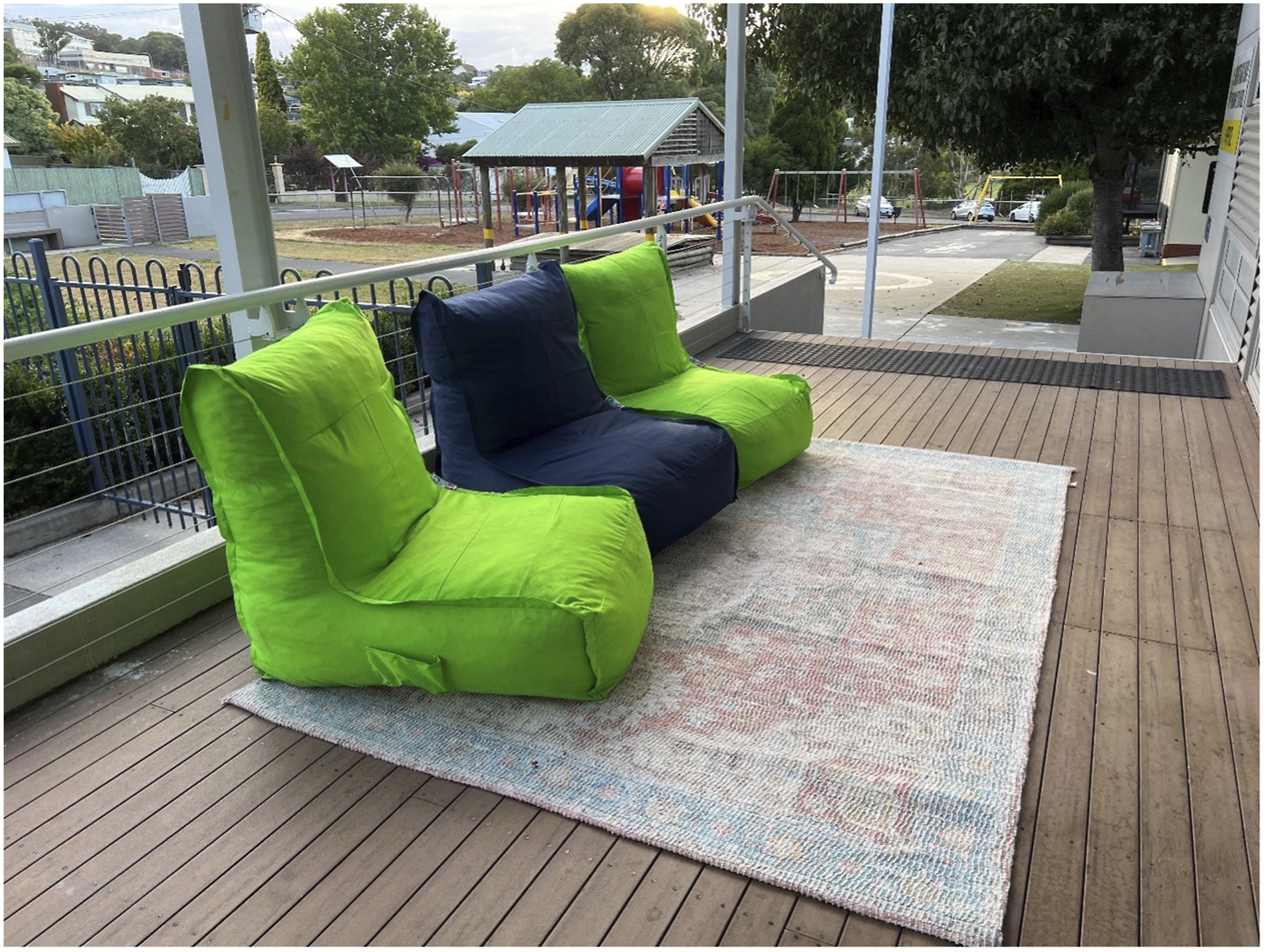
The staff team made changes to other outdoor spaces. I’m also utilising outside our room there's a strip between the classroom buildings and the set up of Astro turf so … we've actually set down a couple of blankets and cushions and some toys that would generally be used as indoor toys like the Lego has gone outside a couple of times. And the doll houses…indoor toys like books (Educational Leader, Audio Diary, Week 3).
It is important to recognise the disruptive nature of some these changes, particularly creating quiet outdoor spaces with blankets, cushions and “indoor toys” like Lego. Whilst there is a lack of research about SAC programming, anecdotally it is understood that outdoor spaces are commonly used for active play and sports. The division of indoors for quieter play and outdoors for active play is also evident in two small studies by Hurst (2013, 2019). The common programmed division of play into outdoor and active, and indoor and quiet gives the appearance of a binary conception of play and space. The educators at Boondaburra reinforce this binary distinction in setting up the indoor space. Our goal is next week to set up our environment effectively to promote both passive and active leisure so we've divided the hall up into spaces and to use as a divider we have some benches, … you know that sort of a passive activities on one side of the room and some more a little bit of sports for children that are more active (Educational Leader, Audio Diary, Week 3).
They communicate a hope that using barriers indoors will quarantine quiet from active play, creating safe spaces for quiet activity. Despite these efforts, there is no guarantee that the two types of activity will remain separate. The purposes assigned to spaces in SAC and early childhood settings are unstable and can be disrupted by children’s visible and covert acts (Myers, 2019; Hurst, 2017).
One factor that impacted on the ways passive leisure was provided was how educators interpreted the term. So at our service to promote both forms of leisure we divided our indoor space… one side was for the passive side of play … we had activities set out like dolls houses, a home corner for home play and all the construction being like Lego and Stickle Bricks and also the children's craft available on active side we had set out some hula hoops and a couple of small balls (Educational Leader, Audio Diary, Week 3).
When updating MTOP, understandings of passive leisure drew on the UNCRC as time that is inactive or unproductive (UNCRC, 2013). In the above quote, the educational leader seems to define the term more broadly including activities that are quiet rather than passive. The quiet activities described like Lego appear far from passive. Lego engages children in productive acts like creativity and construction. Home corner encourages productive uses of children’s imaginations to form and perform creative roles and also the performance of normative gendered identities (Blaise, 2005). However, as detailed by Rojek (1995), leisure is not a clearly bounded activity and inevitably infused with productive acts. Children’s passive leisure might therefore also contain productive acts as Hurst (2019) documents that when killing time in SAC, children still engage in work-like acts of identity construction and slip in and out of more productive activities. The fluid nature of leisure in its varied forms complicates attempts to draw clear distinctions between activities like passive leisure and quiet play.
Acknowledging the interconnectedness of leisure, play and production, it is still important to distinguish between passive leisure and more productive forms. The workforce of Australian educators has a broad range of qualifications or no qualifications (Cartmel et al., 2020). This landscape of educator knowledge including with qualifications in disciplines other than SAC (Cartmel et al., 2020) means that it is likely that most educators do not address such distinctions. Therefore, when encountering passive leisure for the first time in the revised MTOP, educators may bring and form their own views about the meaning of the term. One risk this poses is that educators may fail to provide passive leisure. In a context where non-productive leisure is problematised (Mukherjee, 2020) educators may find that quiet, productive activities like Lego align more with their understandings about what is ‘okay’ for children and be reluctant to include passive leisure in their programming.
The outdoor lounging area created for the pilot appeared to have multiple benefits for the children, educators and families. Children can watch the world go by… having their riveting little conversations that they're having and it's actually a really lovely set up… They (the children) love them… there has not been a chair empty for the entire before and afternoon session. In before school care the children actually use it to take their breakfast outside …and watch the cars come and go on the street (Educational Leader, Audio Diary, Week 3).
In this account, the educational leader documents the popularity of the lounges and how they are constantly used by children. They appear to be places for conversation and also have found utility in other routines such as mealtimes. The phrasing of the educational leader communicates that there is a restful feel to the lounges, something that is reinforced elsewhere in their video diary. So that is a chill out area that's really nice because it is… sort of away from other sort of areas that you might be doing that more active play. And there's sort of a nice sort of spot that they can hang out for some time uninterrupted, you know, by too much going on to have their afternoon tea and talk with their friends and yeah have some chats with some of the educators… and where that that corner is as well it's quite cosy and so clear that the educators can see them… but they're also not interrupted by adult educators (Educational Leader, Audio Diary, Week 3).
The educational leader details how the lounges create not only a quieter space, but one where children talk with educators. Respectful, collaborative relationships between children and adults are one of the core principles of MTOP and important in constructing a program that reflects children’s requirements (Australian Government Department of Education, 2022). These sorts of incidental and less formal communications can be a useful alternative to the more formal consultation processes often used in SAC (Hurst, 2022).
There were some unexpected benefits to the passive leisure space. (We) noticed much more settled behaviour, also helped with transitions into the service and through the routines of the day (SAC Focus Group number 2). if we get those passive leisure spaces …. (we might) have a bit of more of a calming space specially for children that don't want that noise (Educational Leader, Audio Diary, Week 4).
The educators commented similarly during a conversation with one of the researchers that the space had contributed to the setting feeling calmer, whereas previously it had been noisier and dominated by boys engaging in active play. This has the potential to create less stressful spaces that better support children’s wellbeing and also broaden the range of activities possible in a single space. Supporting a range of activities is particularly important in SAC services, which cater for a broad range of ages, interests and abilities. These educators also propose that it contributed to children feeling more settled in the program, something that was discussed by one other pilot site. They highlight the check-in routine where some children use the lounges to sit outside and wait for friends to arrive.
The calming nature of the space was believed to benefit specific children at Boondaburra. I think it will help to continue moving those relationships, especially at the times… that children have withdrawn themselves from the group …and that is building those relationships is with one child in particular that was having negative thoughts last year… he has a good one-one-one chat… they talk so how his day’s going and what he is doing at home so yeah being able to take it quieter (Educational Leader, Audio Diary, Week 3).
In their audio diary, the educational leader details the benefits for a child who experiences mental health challenges. They describe how the space is somewhere for the child to withdraw from the busyness of the rest of the program and take time out. It is also a space where the child can talk with educators about their day and what might be concerning them.
One other unexpected benefit was that parents also began to use the lounges. In a meeting, Boondaburra educators told a researcher that parents had begun sitting in the lounges whilst they waited for their child to finish activities and prepare to leave. They suggested this created a more relaxed departure routine with opportunities for parents to take time out and sometimes have conversations with educators. Positive relationships with parents can help develop programs and services that reflect what is important to children and their families and create environments that are welcoming and inclusive (Australian Government Department of Education, 2022). It also offers new possibilities for how educators build relationships with families, something, anecdotally, with which services can struggle.
So far this analysis has focused on the accounts of adults. Children were also consulted at the end of the pilot. In a Talking Circle conducted by Boondaburra educators, children were asked to respond to a photograph of the outdoor lounges. Their responses align closely with the accounts of educators already presented.
We like this area because we can see everything from here.
We like to sit with our friends.
We can sit and talk with (the educators).
The chairs are really comfortable.
We would like to do art projects in this space.
We like to laugh in the chair (Children, Talking Circle, Week 6).
These comments, whilst brief, suggest that children found the passive leisure space beneficial in ways similar to those communicated by educators. They highlight the space’s value for social interactions with peers and educators, the comfortable chairs, and that it is a good space to observe others. One comment that draws attention is the desire to engage in art projects in the lounges. This again highlights the interconnectedness of different types of play and leisure discussed earlier in the analysis. These accounts reinforce the belief that there is value in providing passive leisure from the perspectives of both adults and children.
Conclusion
In 2022, Version 2.0 of My Time, Our Place (MTOP) the curriculum framework for Australian School Age Care (SAC) services was approved by Australia’s nine Education Ministers and released early in 2023. The researchers undertaking the review regarded this as an opportunity to produce a framework that better represented contemporary practice in Australian SAC. One change considered by the researchers was including provision for passive leisure. The reasons for this were multiple. In particular, MTOP is informed by the United Nations Convention on the Rights of the Child and Article 31, children’s rights to play and leisure, including the right to use leisure time passively (UNCRC, 2013). Recent Australian research also prompted consideration that even though passive leisure can be problematised, children in SAC still find ways to enact their right to ‘do nothing’ (Hurst 2019).
The draft review of MTOP was subject to a pilot where a small number of SAC services trialled the new framework. One of the pilot sites chose to review the passive leisure provisions. The accounts of educators and children from the pilot site provided valuable data suggesting that there may be benefit in considering passive leisure as an integral part of a holistic SAC program. Educators transformed their program by providing a lounge area where children could sit, rest and take time away from play. They suggested the innovation was popular with children and had multiple benefits. The lounges became a place where children could rest, talk to friends and educators, eat meals, observe peers at play and wait for friends to arrive. These passive ways of being at SAC were also believed to contribute to a calmer, less noisy environment. There were also unexpected benefits in that the space became popular with parents, transforming the departure routine. These findings were corroborated by the children who attend SAC, stating that they found the new lounge restful and a good place to talk with friends and educators.
These results are hopeful and provide important support for the proposition that children should have the opportunity for passive leisure. However, the limited scope of this research needs to be acknowledged. The provisions were only trialled at one site, so no generalisable findings can be drawn from the research. Additionally, the data from the research site was limited. The educators’ audio diaries provided rich information but left the researchers with many unanswered questions. Opportunities for researchers to further probe the educators’ responses through a semi-structured interview would add richness to the responses and allow researchers to better understand the effects of the trial. Similarly, time and resource limitations for the project meant that the children’s contributions to the data, whilst useful, lacked depth. Direct engagement between child participants and researchers would enable deeper understandings of the ways that children found value in passive leisure. Perhaps also the addition of an ethnographic component to such research would introduce a different perspective on the trial and its possible benefits, and better test the claims of educators.
Children’s passive leisure is not often viewed positively and can be associated with adverse health effects and life outcomes. However, passive leisure may be unfairly problematised through a combination of research that adopts a limited view of inactivity and neoliberal discourses that privilege productive childhoods (Mukherjee, 2020). This research unsettles the assumption that passive leisure is bad for children, providing instead some evidence that it may be beneficial. It seems reasonable to suggest that after a day of work in school classrooms that some children desire time to rest and relax. Much passive leisure research associates it with solitary, anti-social behaviours (Mukherjee, 2020). However, this research indicates the children’s down time can be interactive and conversational. This research falls a long way short of providing definitive results in support of children’s passive leisure in SAC. It does though highlight the need for more research so that passive leisure and its likely benefits are more deeply understood and therefore better supported and understood by SAC educators, parents, communities and policy-makers.
Footnotes
Declaration of conflicting interests
The author(s) declared no potential conflicts of interest with respect to the research, authorship, and/or publication of this article.
Funding
The author(s) received no financial support for the research, authorship, and/or publication of this article.
