




Abstract
This study employs a poststructuralist theoretical framework to explore parents’ attitudes towards children’s right to play in Shanghai, China. It adopted mixed methods of online questionnaires (N = 880) and semi-structured interviews (N = 11). The findings suggest that participants struggle with embracing and practising children’s right to play as defined by the United Nations Convention on the Rights of the Child (UNCRC), reflecting culturally-sensitive and -contextualised concerns around their children’s future success. Those concerns are connected with the hegemony of Confucianism in shaping educational values in Chinese education. In the context of globalisation, this paper points to the empowerment of parents in practising children’s rights to play in China.
Introduction
Across disciplinary perspectives, play has long been placed at the heart of early childhood education in Western contexts (Ailwood, 2010; Hurst, 2019; Van Oers, 2013). The importance of play is also increasingly recognised in other parts of the world (e.g. China), arguably due to the influence of globalisation/westernisation (Lin et al., 2019). Play is considered as a key tenet of childhood experience that allows children to engage in different activities leading to physical, social and psychological development (Jones and Welch, 2018; Lester and Russell, 2010; Sahlberg and Doyle, 2019). It is also emphasised as children’s right in article 31 of the United Nations Convention on the Rights of the Child (UNCRC), which advocates ratified states to recognise, respect and promote children’s right to play and to ‘encourage the provision of appropriate and equal opportunities for cultural, artistic, recreational and leisure activity’ (UNCRC, 1989: 10). However, regarding the claimed universality of the UNCRC, research increasingly urges the need for cultural sensitivity in children’s play, where article 31 should be interpreted subject to context (Collins and Wright, 2019; Garrido, 2018).
Those criticisms specify the deeply rooted neoliberal and individualistic ideology in the UNCRC agenda that privileges the western middle-class image of children’s play. Consequently, scholars aim to accentuate the divergence in childhood as they cast doubt on the assumed all-embracing nature of article 31 and advocate the understanding of different forms of play across local contexts (Goncu and Vadeboncoeur, 2017). The dominant play discourse in article 31 is romantic, intrinsic and developmental, yet complications within play are frequently ignored (Ailwood, 2002; Grieshaber and McArdle, 2010).
Previous empirical research indicates that children, regardless of their socio-cultural background, do not always have a pleasant play experience (Chapman, 2016; Cederborg, 2019). Certain activities, such as waiting and risk-taking that are not recognised as play by adults, are reckoned as play by children (Hurst, 2019; Yates and Oates, 2019). Despite the widely recognised importance of play to children, the notion of children’s right to play is not likely to achieve a unanimous definition. Constant reflections and investigations within cultural contexts are needed, especially in the Global South (Sullu, 2018). In the light of challenging a universal definition of children’s right to play, this article adopts a poststructuralist stance to examine Chinese parents’ attitudes towards children’s right to play. By conducting both online questionnaire and semi-structured interviews, we seek to reveal how the right to play discourse is (re)constructed in China. Our paper provides insights into how Chinese parents’ understanding of the right to play is situated in the dual contexts of the UNCRC and Confucian discourses, with the two constantly competing with and complementing each other.
Children’s right to play in China
The investigation of children’s right to play is a complicated and controversial topic in China. It was not until China’s ratification of the UNCRC in 1992 that the notion of children’s rights was officially introduced. As argued above, the UNCRC embraces a liberal and romanticised discourse of play, underpinned by neoliberal and individualistic ideologies that privilege western and middle-class images of childhood (Freeman, 2007; Raby, 2014; Souto-Manning, 2017). Such a right to play discourse contradicts certain traditional ideologies in the Global South, including the Confucian discourse of play in China - which presents play as a threat to children’s academic achievement (Xu and Ma, 2017). While children’s autonomy in play is considered critical in the UNCRC, Confucianism sanctifies children’s unconditional compliance to parents as a virtue, namely filial piety or xiao - a concept that funds the backbone of traditional Confucian education discourse (Bedford and Yeh, 2019).
Nevertheless, a shift in Chinese parents’ attitudes towards play has been witnessed, possibly resulting from China’s opening-up and one-child policies in the past decades (Lin et al., 2019). Contemporary Chinese parents increasingly recognise that children’s play can be educative and beneficial (Xia, 2020; Wu, 2017), especially the younger generations who are influenced by ‘a myriad of social forces in modern China, including Confucianism, Socialism, and Capitalism’ (Wang, 2014: 765). Indeed, Confucian parenting has adapted to the changing economic and socio-cultural circumstances in China, shifting from an authoritarian and paternalistic model to a relatively liberal one, with the aim of developing children’s autonomy (Xia, 2020). Play is also receiving more attention in Chinese education policy, such as the Early Learning and Development Guidelines for Children Aged 3 to 6 Years (2012), which pushes further changes in the understanding of play among Chinese parents. Recent research finds that Chinese parents’ aspiration for children’s education prioritises their social and emotional wellbeing over academic achievement (Ren and Edwards, 2016). Chinese parents who live in urban areas with high income and tertiary education backgrounds are particularly supportive of play (He, 2018). However, not all types of play are appreciated. Research finds that Chinese parents tend to adore children’s play activities with adults’ guidance and pre-academic purposes (Lin and Li, 2018). This phenomenon provides culturally specific meaning to the discourse of play in the contemporary Chinese context where play is deemed as an effective tool to enhance academic learning (Wu, 2017). Rao and Li (2009) have termed this discourse as ‘eduplay’ with detailed explanations.
Despite growing understanding of the significance of play for children among Chinese parents (and with cultural adaptations to its meaning), they rarely perceive play as a children’s right (He, 2018). In fact, although some limited studies of children’s rights in China point to the growing recognition and awareness of children’s rights among Chinese parents (Jiang and Zhang, 2020; Su, 2016), those studies also concern that in practice children’s rights are ignored or violated. Protecting and practising children’s rights in China is a persisting challenge, especially when these rights are not exposited beyond the UNCRC - politically or culturally. For example, in the Early Childhood Education Draft Act 2020 (targeting 3–6 years old) young children’s right to play is mentioned (Ministry of Education, 2020). Nevertheless, it fails to expound on what the right to play entails in the Chinese early childhood education context. There is also limited research exploring Chinese parents’ (and other key stakeholders’) understanding of children’s rights, including the right to play. This paper addresses those knowledge gaps and attempts to investigate Chinese parents’ interpretation of children’s right to play.
Reconcile children’s rights with poststructuralism
Our paper adopts a poststructuralist approach that disrupts the assumptive understandings of children’s rights and poses questions on how ‘knowledge becomes possible at any particular time under specific historical conditions’ (Harcourt, 2007: 18). We aim to reimage the hegemonic discourse of children’s rights in the UNCRC through the lens of Laclau and Mouffe (1985), who theorise the hegemonic discourse as a product from an antagonistic relationship that dichotomises the social sphere. Although Laclau and Mouffe acknowledge the ‘ineradicability of antagonism’ in any power relationship, they assert that antagonism is more than dividing the social structure into two oppositional camps. They appraise that the division of a discursive sphere into two antagonistic camps obscures the divergences within each camp and creates the appearance of homogeneity in what is in reality heterogeneous. Laclau and Mouffe’s theory hereof aids the re-imagination of human rights since the content and remit of human rights discourse is persistently amended through hegemonic politics within contexts of power (McNeilly, 2016).
In the realm of children’s rights, the hegemonic discourse of children’s right to play derives from article 31 of the UNCRC - a Global North understanding - which is supposedly universally applicable (Freeman, 2010). However, as Laclau and Mouffe (1985) would argue, a hegemonic discourse would lead to the division into and antagonism between two camps (in this case, Global North and Global South) (Imoh et al., 2019). Nevertheless, this antagonistic relationship ignores the original heterogeneities in each of the camps, for the discourse of children’s right to play can be incompatible and divergent within either Global North or South (Laclau and Mouffe, 1985). In the light of poststructuralism and Laclau and Mouffe’s (1985) theory on antagonism, our paper questions the legitimacy of a claimed universal discourse of children’s right to play (the UNCRC) and sheds light on a pluralistic interpretation from the perspectives of Chinese parents in Shanghai.
Two research questions are addressed: (1) How do Chinese parents understand and interpret children’s right to play in Shanghai? (2) What discourses shape their understanding and interpretations? And how?
The study
This paper presents findings from a study that adopted a mixed-method approach to explore Chinese parents’ understanding of young children’s right to play in Shanghai. Under the poststructuralist paradigm, the study started with an online questionnaire that investigates parents’ understanding of the notion of play and their attitude towards children’s right to play. Both direct and indirect questions about children’s right to play were included to examine whether participants understand children’s rights in a consistent manner (Cohen et al., 2018). The questionnaire critically integrates the UNCRC discourse of the right to play where this discourse is deemed as the hegemonic discourse that symbolises the universal interpretation of right to play. That is, the description of children’s right to play in the questionnaire implies the normative understanding of the UNCRC (1989), where children’s participation and autonomy are the focus. A typical question includes: ‘If your children feel their right to play has been violated, and they would like to defend their right to play. How would you respond to your children?’ This integration reflects the unavoidable antagonist feature of a hegemonic discourse and helps to compare the UNCRC discourse with the participants’ responses. The option of ‘other’ is offered in the survey so that participants have the freedom to provide their interpretations beyond the UNCRC discourse (Dale and Walsoe, 2020).
Data from the questionnaire served as background information for the design of semi-structured interviews. The interview questions focused on how participants define play, how they understand children’s rights and children’s right to play. The semi-structured interview aims to make sense of the contradicting pattern that emerged from the questionnaire; and to investigate the heterogeneities in each of the camp (Global North and South) that is produced by the antagonistic relationship. We are aware that the mix-method approach is not commonly used in poststructuralist research (Given, 2012) since the quantitative aspires to universal truth and the qualitative emphasises the interpretative nature of social knowledge (Greene et al., 2004). However, due to limited research on Chinese children’s right to play, the mixed-method approach allows us to first have a glimpse of parents’ perceptions on this topic and then develop a further focus on parents’ attitudes towards children’s right to play.
Sampling and participants
In this study, all participants are parents who have children between 3 to 6 years old (preschool age) in Shanghai. Shanghai is selected as the research site not only for its embodiment of both western and eastern cultures but also for its emphasis on play in education policy. Yet the integration of play into early childhood education faces barrier in Shanghai, as play has to be sacrificed for academic achievement and school readiness under the current competitive education environment. Although the Several Opinions of the CPC Shanghai Municipal Committee and the Shanghai Municipal Council on Deepening Reform and Regulating Development of Pre-school (Shanghai Municipal People’s Government, 2020) restates the significance of play and advocates kindergartens to ‘insist on playing as children’s basic activity’, the impact of the policy is frequently criticised as ineffective (Qiu, 2019). Therefore, it is critical to understand how parents think about children’s right to play in these social and political contexts.
880 parents were recruited for the online questionnaire through the authors’ networks, among whom 72 signed up for the semi-structured interview. By using data from the questionnaire, these 72 participants were grouped into three categories: participants who support children’s right to play consistently, participants who support children’s right to play inconsistently, and participants who have mixed feelings about children’s right to play. With obtained consent, 11 participants representing the three categories were eventually selected to attend the semi-structured interview. The interviews were conducted online via WeChat and each lasted for 30 minutes on average.
Roughly 63.5% (N = 559) of the participants are 30–40 years old, middle-class females who have completed tertiary education or above, with children mostly registered in public kindergartens in Shanghai. The majority rest (N = 283) are fathers with similar backgrounds, excluding those who did not indicate their gender. Approximately 26% (N = 250) of the participants' children were registered in private and/or intenrational kindergartens, revealing even better socio-economic status. Almost all of the participants (N = 867) are Han Chinese with a Shanghai hukou. The hukou system, including urban (e.g. Shanghai) and rural hukou, is unique to China. Compared to rural hukou, urban hukou grants residents better access to education, health care and job opportunities especially in developed cities like Shanghai (Afridi et al., 2015). Therefore, regardless of the household income of the participants, having a Shanghai hukou alone is indicative of the participants’ privileged status in accessing educational resources. Confidentiality is assured throughout this paper. The limitations of our samples are acknowledged and discussed in the conclusion.
Data analysis
SPSS was used to obtain the frequency of descriptive statistics from the questionnaires. The integrated nominal and ordinal data generate a pattern of how parents understand children’s right to play. This pattern also helps to create the design of interview questions, aiming to unfold the conflicts and tensions in parents’ attitudes. The semi-structured interview was analysed via thematic coding (Cohen et al., 2018). Four themes were constructed, including ‘adults’ role towards risks in play’, ‘xiguan (habitus) and play’, ‘transition, learning and play’ and ‘adults and children in making decision and play’. Each theme responds to the questionnaire and captures the ‘qualitative richness of the phenomenon’ (Fereday and Muir-Cochrane, 2006: 4).
Findings
Findings are presented in two parts. Online questionnaires show a self-contradictory pattern in Chinese parents’ attitudes towards children’s right to play. That is, while the parents indicate support to children’s right to play, they also tend to restrict children’s autonomy and set limitations to play. The aforementioned four themes that emerged from the semi-structured interview help to make sense of this pattern and indicate the discourses that shape Chinese parents’ attitudes towards children’s right to play.
Self-contradictory attitude in children’s right to play
Parents in this study regarded play as a combination of free play activities and pre-academic activities, featured by role play games (84.2%), puzzle and construction games (82.6%), and playing with playground equipment (79.4%). Participants added that ‘travelling’, ‘any forms of activities that make children happy’, ‘chilling’ and ‘imagining’ are play activities. (Figure 1). In your understanding, what is regarded as play for 3–6 years old children?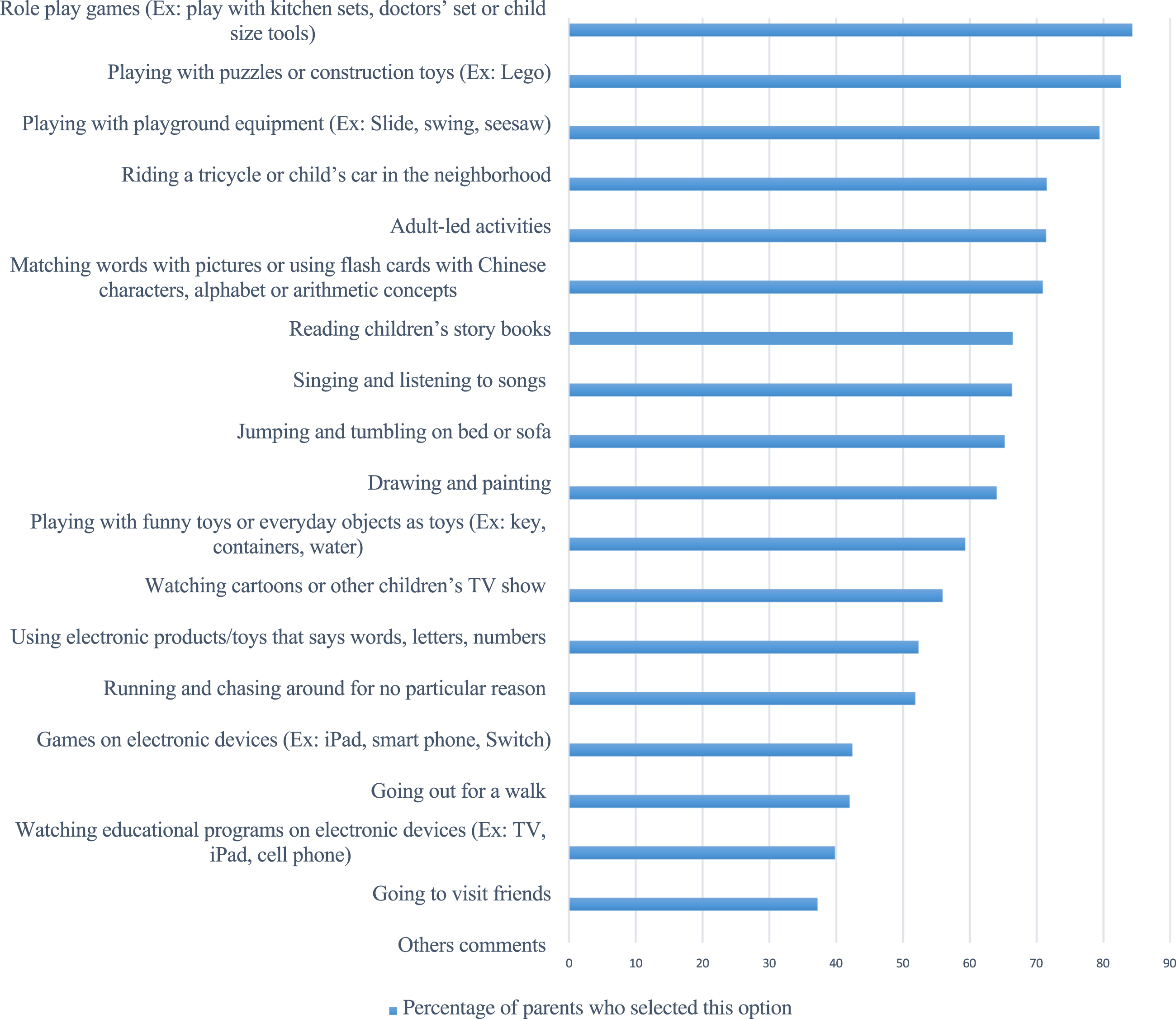
Most parents saw play as a basic need of children which allows them to explore the world, live a happy life and learn knowledge. In a question that asks participants’ perception on the relationship between their children and play, 84.8% of participants regarded play as children’s basic need. 11.8% of parents deemed play as unnecessary, stating academic achievement and learning are more important; only 3.1% of the participants perceived play as a waste of time, claiming children shall only play as a reward of behaving or learning well. However, participants were not without concerns. As presented in Figure 2, participants’ primary concerns included the physical harm in play (37.8%) and the negative impact that play could have on children’s learning (25.7%). Behavioural problem is also a concern for parents (10.5%), for they worry that their children can either be bullied or misbehave towards others through play. Which of the following statement shows your concern towards play the most?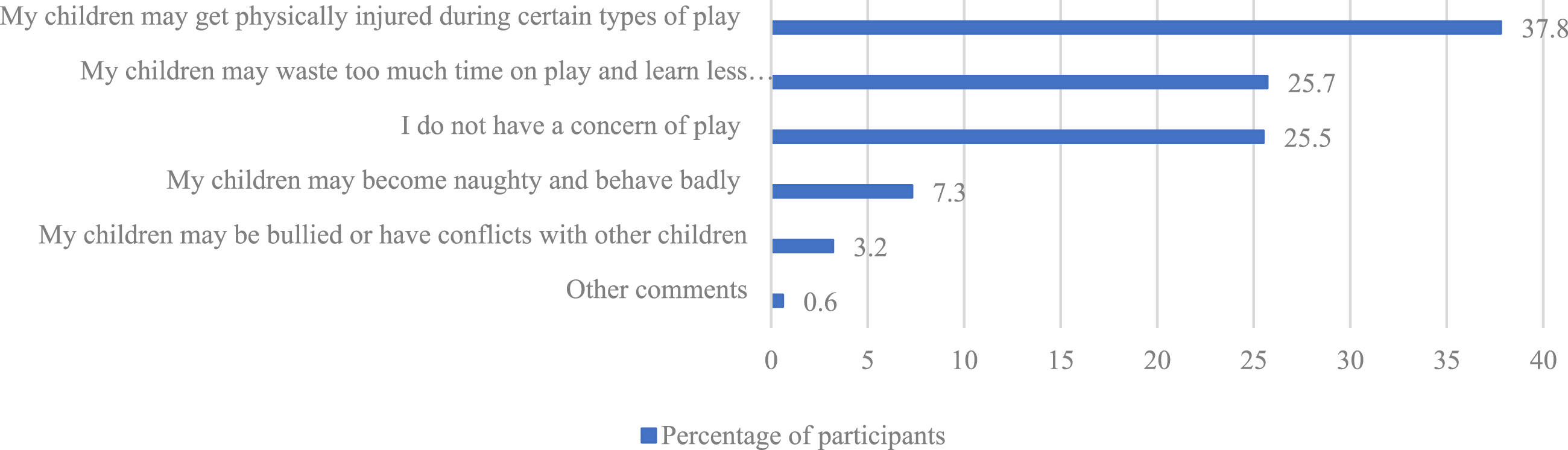
Further concerns emerged when it comes to questions that relate to children’s autonomy in play. According to Figure 3, although almost 92% of participants supported children’s right to play (question 8), none of the other questions (questions 7, 9, 10, and 16) that touch on the realisation of children’s rights have equal level of support. Furthermore, question 12, which is the antithesis of children’s right to play in the UNCRC, received more than 50% of respondents’ support. Comparison of questions which examine parents' understanding of children’s right to play.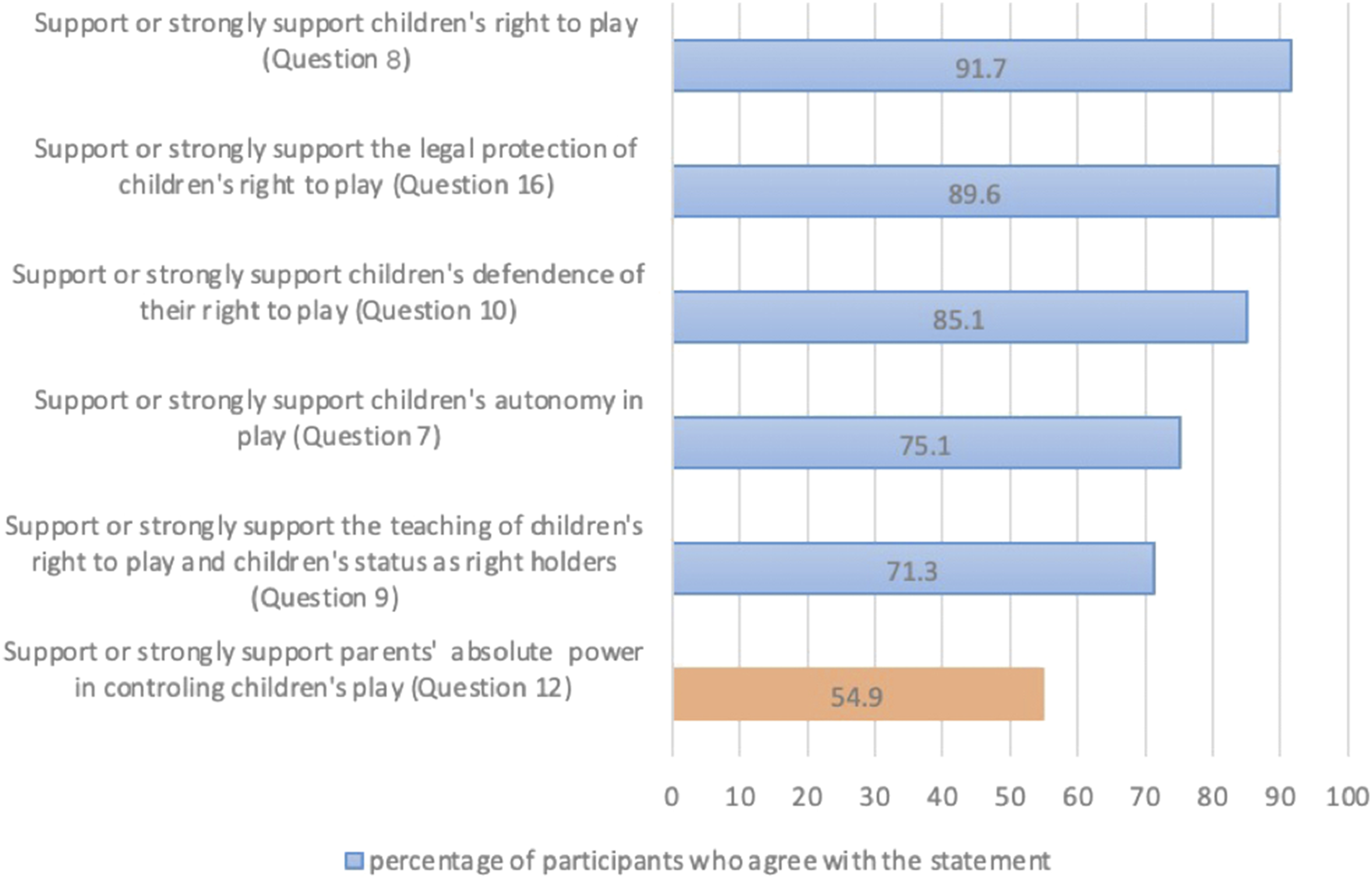
If article 31 of the UNCRC is regarded as the ‘right’ understanding of children’s right to play, participants’ self-contradictions are evident in the questionnaire: on the one hand, parents support children’s right to play in a UNCRC legitimate way; on the other hand, they also have thoughts oppositional to the normative understanding of the UNCRC, as approximately 50% of parents prioritised parental discretion on play. This ambivalence seems to reflect both understanding of children as immature and in need of protection (Xu, 2020), and the discourse of ‘eduplay’ (Rao and Li, 2009) in Chinese societies. It also demonstrates the emerging and unsettled understanding of play among Chinese parents, in hybrid global and local contexts that shape Chinese education (He, 2018; Wu, 2017). However, the antagonistic relationship exists if and only if one accepts the hegemonic discourse (UNCRC) on children’s rights as the correct metric. The interview finding aims to assist the analysis to move beyond the antagonism.
Adults’ role towards risks in play
Although the pattern emerged from the questionnaire indicates participants’ concern towards risks in play, all 11 parents interviewed regarded risk play as beneficial and believed children can gain experience of life and develop curiosity by taking risks. A typical understanding of the risks in play is as follows: ‘We should definitely think from children’s perspectives. When parents see some children’s activities as dangerous and stop them immediately, it can be problematic…Risk can be anywhere’ (Jie, male, 31–40 years old, bachelor’s degree).
Though Jie argued that parents should think from children’s perspectives, how children’s voice comes into the discussion remains unknown. His response seemed to suggest that parents have the final say on what is risky and what is not. Other participants also noted that children have to take risks under the supervision of parents. In this regard, risk play is a given freedom by parents to children and children can only take risks in environments that are designed and supervised by adults. This position indicates an incipient fusion between the paternalistic parenting discourse and the children’s autonomy discourse; and specifies participants’ struggles in between the ‘traditional’ and ‘modern’ understandings of children and childhood.
Xiguan (habitus) and play
Participants also regarded developing good xiguan and following daily routines as the premises of children’s play. Xiguan, which can be translated as habitus, comprises a set of activities relating to both one’s self-discipline at all levels and life management skills considered as appropriate in a specific socio-cultural context (Li et al., 2020). Cultivating children’s habitus, marked by following a daily routine and being obedient to parents, is deemed as a critical virtue and lies the foundation of being a good learner under Confucian ideology (Ho et al., 2017). Most participants mentioned the importance of habitus cultivation. They thought that developing the right habitus is external to and more important than play, characterising habitus developed as passively learned. In this case, play becomes a reward to children rather than a right that children have. ‘I told her, it’s okay if you want to play every day, but you have to finish your daily works first, like playing the piano, do the writings and tell grandparents a story. When you finish all of them, you can play’. (Kai, male, 30s, bachelor degree).
In this light, participants fail to perceive the educational elements in play and deem play as a barrier of developing good habitus. This narrowed understanding of play contributes to the struggles that Chinese parents have in play. While participants were aware of the benefits of play, its benefits were not deemed as all-embracing and can be problematic in habitus development.
Transition, learning and play
Participants’ understanding of knowledge shapes their attitude towards play, which is dependent on how play can help their children’s transition to primary education. Three types of views emerged from the interviews. The first type of participants (N = 3) suggested that only adult-led play can initiate learning. They argued that learning-involved play can only take place in early years institutions, particularly in extracurricular classes (xingquban) where there are teachers who can guide children to learn academic knowledge through play (Lau and Cheng, 2016). Type-two participants (N = 5) considered play as oppositional to learning. Although they appreciated the benefits of play, they did not think that learning and play are compatible in the competitive education environment in Shanghai; since children have to prepare for primary schooling and face competitions throughout their school life. A major concern of learning- and play-combined activities is the lack of efficiency in preparing children for school readiness. According to one of the participants, ‘free play is only possible if my child studies abroad in the future, where competitive school exams are not required’ (Xialing, female, 30s, master’s degree). This statement addresses participants’ concerns on whether the advocate of children’s play is feasible in the Chinese education context. The last type of participants (N = 3) understood learning as integrated into play. They indicated that social skills, communication skills and life skills are all acceptable forms of knowledge - a definition of knowledge that is frequently spotted among younger generations in China (Lin et al., 2016; Sewell, et al., 2019). Overall, the majority of parents understood that certain forms of learning are embodied in children’s play. However, they also thought learning that emerges from play could not meet the expectation of the competitive education environment in Shanghai - which is constituted by an amalgam of neoliberalism and Confucianism striving for education accountability and excellence (Imoh et al., 2019;Lin et al., 2016). Therefore, most parents either brought their children to attend academic-orientated learning programs or take their children to attend teacher-led play and learning combined activities.
Adults and children in making decision and play
The last theme focuses on how participants understood their relationship with children in the decision-making process in play, considering its connection to children’s rights. The finding here responds to concerns from previous sections since children’s autonomy and participation constituted a dominant part in children’s right issues (Davey and Lundy, 2011). Majority of participants suggested that parents should respect children’s voices in making decisions, presenting a liberal discourse of play. Parents should negotiate with children rather than abuse parental power when there are conflicts (Lin et al., 2020). Participants mentioned how western TV shows, such as Growing Pains, lead their parenting strategy to a liberal one; some also showed great appreciation to Scandinavian parenting philosophy. Daila (female, 30s, master’s degree) presented her admiration to Finish education ideology that children’s autonomy is the priority. She believed that this ideology is good for the child’s future development. Notably, while almost all parents considered the western, (assumingly) liberal parenting strategy to be advanced, they also highlighted the need to reserve certain paternalistic Chinese characters in parenting style: ‘I don’t think I can, like western parents, allow my child to go out and buy things by himself, Shanghai is safe, but I don’t think I can do this as a Chinese parent, I will be worried’ (Jie, male, 30s, bachelor degree).
Participant parents were also aware of children’s possible tokenistic participation and recognised the legitimacy of such tokenism. Here, tokenistic participation is deemed as children’s inevitably limited autonomy in decision making. One parent (Jiamei, female, 30s, bachelor’s degree) argued that ‘the statement that children can make decisions freely is a false proposition because the options that children can access are the options preselected by parents’. This phenomenon is further described as a ‘seemingly democratic but actually dictatorial’ character of parents in child-parent relationship since ‘it is the parents who are affording the cost of children’s decision’ (Duoli, female, 30s, bachelor’s degree). Nevertheless, parents showed concern for such a tokenistic participation and indicated the need to give children greater autonomy: ‘adults have their limitations, if we have the condition for children to make decisions freely, we shall not limit their future possibilities’ (Jiamei, female, 30s, bachelor’s degree). Participants’ responses noted the struggles in balancing Confucian discourse and the UNCRC discourse in the debate of decision making. Although participants are aware of the harm in tokenistic participation, they refute the possibility of challenging such a tokenism.
Discussion and conclusions
By critically engaging with the UNCRC discourse of the right to play, our questionnaire findings reveal that the participants hold self-contradictory perceptions: they claimed to support children’s right to play under the UNCRC agenda while violating children’s autonomy. However, this ambivalence postulates that the UNCRC is universally applicable irrespective of culture. As criticised by Liebel and Budde (2016), this assumption about the UNCRC is based on eurocentrism and is not even legitimate in European nations since there is phenomenological heterogeneity among children within them. By looking beyond the supposedly universal agenda of the UNCRC, our interview data indicate that participants’ understanding of children’s right to play reflects both the UNCRC and the Confucian discourses. This seeming self-contradiction links to their struggles in embracing global and local contexts that shape the understanding of play. For the participants, play is, on the one hand, beneficial to children’s development. On the other hand, they worry that play without parental intervention can come with costs. Therefore, parents justified this tension by involving appropriate and necessary parental intervention in children’s play.
Our findings reflect the problematic aspects of antagonism. If the UNCRC discourse is regarded as universally applicable, as Laclau and Mouffe (1985) argue, an antagonistic relationship is inevitable. In this study, such a relationship is evident from the participants’ response - the hegemonic position of the UNCRC discourse opposes the Confucian discourse, delineating the UNCRC (‘western’) discourse as advanced. The findings suggest that participants’ struggles between the UNCRC and Confucian discourses are situated in their interpretations of learning-play relationship, risk play, and children’s habitus cultivation; with concerns of child-parent relationship in decision making spotted in all three themes. Although the UNCRC discourse is preferred by participants, both the Confucian and the UNCRC discourses shape how they contextualise children’s right to play and construct their struggles - that a liberal approach to children’s right to play is arguably rhetoric and difficult for parents to realise in the Shanghai (Chinese) context. As participants think the UNCRC discourse cannot be fully integrated into Chinese society, they reported to make compromises constantly. Their advocacy of some Confucian values is such a compromise to the irresistible social forces rather than a championing of traditional culture. Shanghai parents’ struggles point to the challenges of connecting global and local understandings of children’s right to play, indicating a socio-cultural incompatibility in the translation progress of UNCRC. The findings also reveal the heterogeneity within the ‘eastern camp’, where participants’ struggles in children’s play encourage the re-imagination of parents’ position in children’s rights issues.
In this paper, we argue that although the participants believed in the ‘superiority’ of the UNCRC discourse of children’s right to play and adored its benefits, they have demonstrated a culturally-sensitive understanding of the UNCRC, challenging its universality and recognising the local contexts that need to be considered when practising UNCRC in China. Participants’ understanding of children’s right to play is situated in the dual contexts of the UNCRC and Confucian discourses, with the two constantly competing with and complementing each other. Although participants’ ideas towards children’s right to play align with the UNCRC discourse, they struggled to resist the Confucian discourse when they were confronted with tensions in the learning-play relationship, risk play, and habitus cultivation. Their seeming self-contradiction in interpreting children’s right to play should not be simply explained as a violation of this right. Instead, it reveals the tension of translating the UNCRC from global to local levels (Milne, 2015; Collins and Wright, 2019; Faulkner and Nyamutata, 2020). According to Hanson and Nieuwenhuys (Nieuwenhuys and Hanson, 2013: 12), the translation of right is a ‘multiple-way process that transforms the power relations of all actors involved’. As such, this paper signposts the importance of engaging parents in translating and adapting UNCRC into China and in practising children’s right to play.
Our paper thus problematizes the claimed universality of the UNCRC. However, we do not intend to reject it or deny its value in the Chinese context, for such a rejection would lead to a pre-globalisation era where Confucianism had hegemony in Chinese society. As Otto (1999) argued, while universality and cultural relativity are polarised as two binary camps, the advocacy of cultural relativity should promote actual diversity rather than having the cultural relativity camp claim for ‘universality within its own sphere of influence’ (p.25). Overall, this paper attempts a re-imagination of the previous construction of dualism in the field of children’s rights studies in two ways: the division between the Global North (in this case the UNCRC discourse) and the Global South (in this case the Confucian discourse) in ideology, and the division between children and parents in power relationships. In terms of the dualism of Global North-South division, we present an image that parents from the Global South share westernised ideologies of play and that their understanding is produced by a myriad influence from both camps. In terms of the division in the child-parent relationship, we question the frequently assumed agency of parents. Although parents are usually considered as a powerful side, they themselves are not fully autonomous agents in society. Their will to safeguard children’s right to play is hindered by socio-cultural and personal factors.
Limitations and recommendations
Our paper has certain limitations. First, the demographic diversity of the 880 participant parents is limited to those from relatively privileged socio-economic backgrounds in Shanghai. Although gender is not the focus of our analysis, we realised that more mothers than fathers participated in the questionnaire survey reflecting women’s higher levels of involvement in child rearing in Chinese society. We thus claim no generalisations of our findings to parents with different backgrounds or in other parts of China. That said, our aims in this paper are to understand the power of certain discourses in shaping individual parents’ interpretations of children’s right to play, as situated in broader local and global contexts. Second, our interpretations and presentations of the findings are one of the many possible explanations to the research questions and should not be taken as fixed or final. The participants’ experiences should be recognised as contingent (Harcourt, 2007). Third, the study was conducted at the time of COVID-19 outbreak and participants were aware that a pandemic can influence children’s play. How parents may respond to children’s play in a post-pandemic era is susceptible to changes. Yet, the idea that participants’ attitudes can be affected by an unexpected event speaks to the contingency of people’s experience and demonstrates that their attitude is constantly changing. Finally, children’s perspectives on their own right to play are not included in our study. Both children and parents are potential agents of change. Future research can explore how to engage children and parents as co-researchers in exploring culturally sensitive ways of practicing children’s right to play in their local contexts.
Footnotes
Declaration of conflicting interests
The author(s) declared no potential conflicts of interest with respect to the research, authorship, and/or publication of this article.
Funding
The author(s) received no financial support for the research, authorship, and/or publication of this article.
