




Abstract
In this article, we explore the common worlds of children and companion animals, and ask how animals are contributing to the making of contemporary families, and of childhood therein. Departing from D. H. Morgan’s conceptualisation of family practices, we explore the possibility of extending this concept to children-animals relationships and ask whether it is possible to talk about children-animal practices. We draw on empirical data from 48 interviews conducted within 24 Portuguese families, with children aged 8–14, and living with at least one dog and/or one cat for six months or more. We propose that animals are actively doing family, and contributing to the making of contemporary childhood and parenthood. We conclude that there is theoretical and methodological potential in developing the concept of children-animal practices.
Keywords
Introduction
Our article departs from a perplexity: the invisibility of children-animals’ relations, and the presence, so very discrete, of companion animals in childhood studies. Such lack of visibility – and thus, of recognition – strikes us, at least, as bizarre, if we compare it to the prominence of digital technologies or toys in childhood scholarship (Buckingham, 2000, 2011, Livingstone and Helsper, 2007). How can this be, given the pervasiveness of animals, both material and symbolic, in children’s daily lives? Almost everything in their worlds evokes animals in some way, directly or indirectly. From real animals with whom it is possible to interact face-to-face, such as one’s family pets, other people’s pets, or strays; to animals transformed into food and diet; to representational animals, such as characters in story books, toys, clothes, films, cartoons or TV programmes: animals are everywhere in children’s lives.
While developmental psychology has long highlighted the role of animals in children’s healthy development (Melson, 2003, 2005), recent sociological studies have shown how children very often regard animals as members of their families (Charles, 2014, Charles and Davies, 2008, Irvine and Cilia, 2017, Morrow, 1998, Tipper, 2011). Statistically, pets are also more likely to be found amongst families with children, as opposed to households containing only single or elderly people (Charles and Davies, 2008). According to the pet industry (Bedford, 2022), in the USA around 70% of households own at least one pet, representing a 14% increase since 1988. A large majority of 69 million own dogs, followed by cats and freshwater fish. In Europe, studies confirm the same trend: the pet industry reports that 46% of households own a pet, of whom 26% are cats and 25% are dogs (Fediaf, 2023). In Portugal, data collected by GfK market research company in (2015) report that around 55% (circa 2 million) of households own at least one pet, a 9% increase over the previous 4 years.
Aiming to fill this void within childhood studies, we explore in this article the relationships between children and animals, at home. We ask: how are animal companions contributing to the shaping of childhood and family life? Drawing on empirical data collected in a project on Children and Animal Friendships (CLAN - PTDC/SOC-SOC/28415/2017), from 24 Portuguese families, we hypothesize that animal companions are actively contributing to the making of contemporary families and, within them, of the contemporary child. Focusing our reflection on contemporary western families, we argue that the social practices through which children and animals engage with each other are critical to this making of contemporary families. Therefore, we look at what children and animals do together, i.e., we try to unpack children-animal practices.
We address this topic at the crossroads of Family Studies and Human-Animal Studies, in particular through the lens of family practices: how families are done and undone through every day, repeated, ways of doing and relating between those that share the same domestic space and the ebb and flow of daily life. In the following section, we briefly sketch the theoretical landmarks through which family practices have been conceptualised, as well as how they can be used to think about children and animals’ relationships. We then describe our methodology and ethical procedures. In the following section, we discuss how these child-animal relations are described by both parents and children, and whether and (if so) how they acknowledge the contributions of animals to the family dynamics. We then discuss our results through the theoretical lens of family practices, to conclude with a reflection on the complex status of animals as companions in contemporary families.
Children and animals: Challenging anthropocentrism and the species divide through family practices
Despite the pervasiveness of animals in children’s lives, only quite lately has the study of their mutual relationships come onto the radar of social scientists. This is surprisingly true also in regards to the sociology of family and personal life, which only quite lately began to address animals as constitutive family members.
This move takes place in the context of what sociologists have coined as relational turn. Sociologists of family life have shown how power relations in families are also negotiated, in dependence on affects, emotions, expectations, memories and practices (Morgan, 2013, Smart, 2007). In this reconceptualization of family life through a relational lens, the concept of family practices (Morgan, 1996, 2011, 2013) has been key to “des-institutionalise” families as plural entities, rather than singular. Drawing on practice theory, with a particular emphasis on Bourdieu’s habitus and acquired dispositions, Morgan describes family practices as practices oriented towards co-family members (Morgan, 2013: p. 163), despite the type of tie (blood, institutional, relational). They encompass the dimension of social construction of everyday life, where the individual and the collective meet through the daily repetition of actions. Such habits embody cultural norms, to the same extent that they also contribute to making, and transforming, them. On the other hand, family practices incorporate the fluidity of intimate and personal relationships, thus not restricting family membership to roles or institutional statuses, rather putting an emphasis on the relational and affective constitution of meaningful bonds (Jamieson, 2011, Smart, 2007). They also help to move beyond the hegemony of the household, a limited set of family roles, or the centeredness of “nuclear family”, as a reference for defining family, following a configurational approach (Widmer and Jallinoja, 2008).
Morgan (2013, pp. 5-12) organises his definition in six main dimensions, referred to previous scholarship on both social practices and family life. Firstly, family practices enable movement between the perspectives of the observers and the family members, through its focus on the apparently insignificant details of everyday life. This is key to conceptualise families from “within”, based on emic experience of all those engaged; rather than from the “outside”, based on formal, pre-defined, assumptions. Secondly, it describes families as actions, and thus as verbs, rather than roles or nouns: for instance, parenting (the action of becoming, or performing, parenthood) rather than parent. When eating, cooking, playing, talking, engaging in bodily exchanges, and all sorts of activities performed in certain ways, individuals are doing family. Thirdly, the focus is on everyday life, in the sense both of the banal, taken usually as unremarkable, background of social life; and of the commonalities of human, though socially located, experience. Fourthly, it draws attention to the importance of regularity, and repetition, to produce a common ground of experience for family members. Fifthly, family practices share a quality of fluidity, in a double sense: that of family boundaries, limiting who is included, or excluded (vg to family festivities); and that of referring to practices that may usually be described otherwise. Finally, they articulate the historical and the biographical: they describe how the frameworks through which family has been signified across History shape, on the one hand, and are reinvented, on the other, by individuals through their own biographies. The concept thus bear a quality of inclusiveness, diversity and movement. Families are not (pre)defined. They are in the making. There is also a continuous and affective quality in it – families are defined in a relational continuum, based on the performance of regular activities that affect all those engaged, despite the type of institutional bond.
Such a definition opens the way to think within a sociological framework about animals as full members, and active contributors to contemporary families. If families are what individuals do in their everyday life, repeatedly and regularly, then their fluid boundaries must also encompass the nonhumans that share lives with humans. Just as an institutional bond such as marriage is no longer a sufficient indicator to understand contemporary families, so is not species membership.
However, Morgan (2013) does not mention explicitly the contribution of animals to doing family. Instead, such approach was developed by sociologists that explored in a different way the fluidity of boundaries in which the dynamics of family and personal life take place (Charles, 2014, 2017; Charles and Davies, 2008; Fox, 2006; Irvine and Cilia, 2017; Power, 2008). Animals emerge in personal arrangements as kin (Charles, 2014, Charles and Davies, 2008), and yet subject to power and gender relations that crosscut family dynamics (Irvine and Cilia, 2017), vulnerable to changes affecting families along its life course, such as relocating, losing one’s job and source of income, or the birth of a child (Shir-Vertesh, 2012). Family arrangements with life with pets are therefore multiple, accommodating in different ways the species differences (Doré et al., 2019, Fox, 2006, Power, 2008).
Questions related to the importance of situating child-animal interactions in context thus emerge from this
Taking stock of this research patrimony about family dynamics, and in particular of Morgan’s conceptualisation of family practices, with this article we explore the possibility of extending this concept to children-animals relationships. We ask whether it is possible to talk about children-animal practices, in a way that helps us to understand how children and animals are actively contributing to doing family. In so doing, we explore the dimension of reciprocity in children-animal relationships in the family, but also the extent to which it is constricted to fit a parental framework of educational hopes, expectations and norms. This will enable us to explore the ways in which animals co-construct the interspecies social worlds inhabited by children at home, looking into relatedness, interdependence and connection as constitutive processes of children’s and animals’ worlds. These are seldom organized and kept within the boundaries of expectations, rules or norms set by the adults and/or parents. Rather, we hypothesize that the messy entanglements of children and animals are key elements in understanding how contemporary families are made and remade and, within them, of what it means to be a child.
Methods
In order to explore tentative answers to our research questions, we draw on empirical material from Project CLAN - Children-Animal Friendships (PTDC/SOC-SOC/28415/2017), 1 collected in Portugal, between October 2019 and June 2020.
Characterization of the families that participated in the CLAN project.
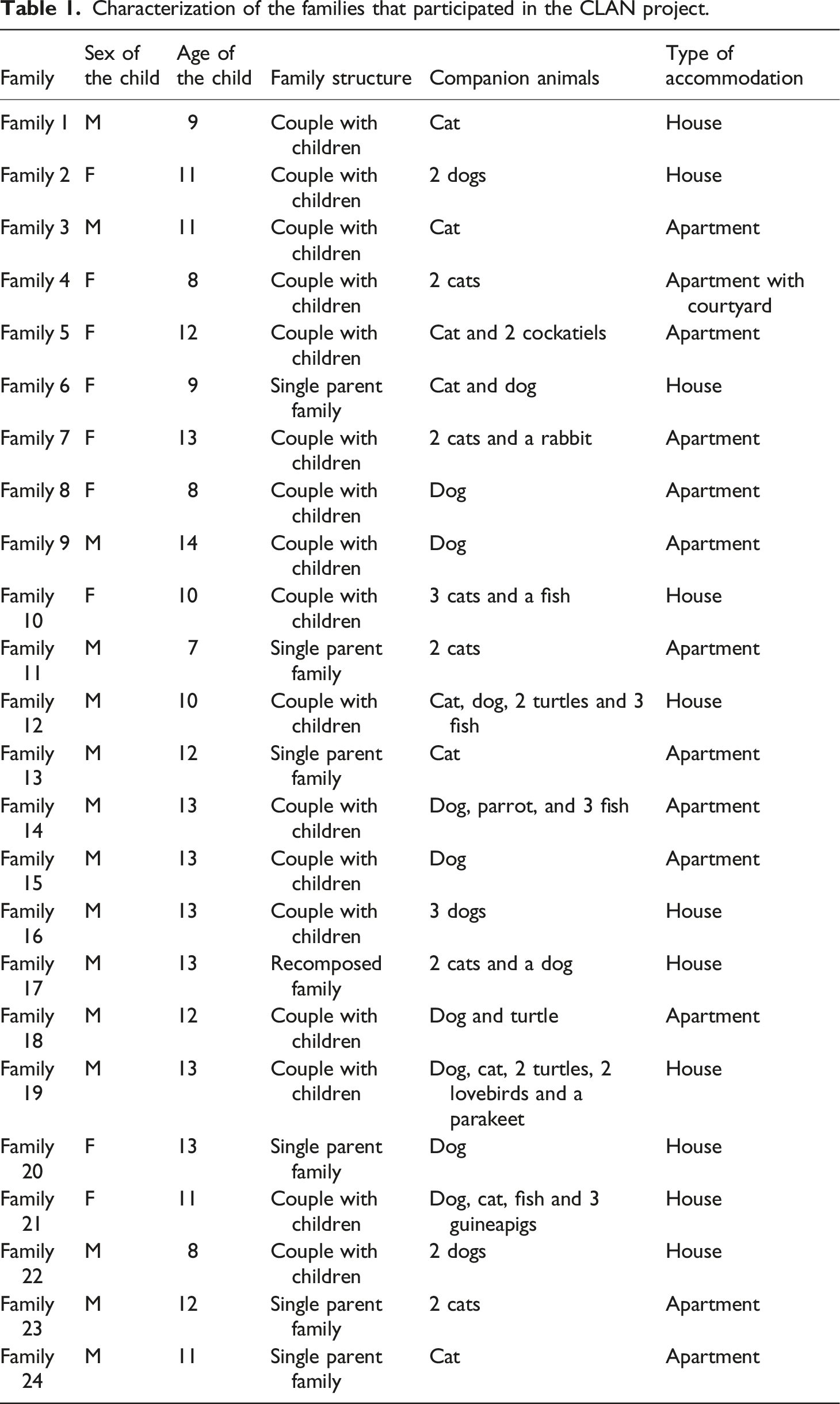
CLAN explored how children build their relationships with their animal companions through shared practices within the home. Therefore, the type of housing in which the family lived was also a relevant variable, to the extent that it was a proxy of how different spatial and environmental structures and arrangements influence the human relation with animals (vg, preference for certain species, or even the very possibility of having a pet). Three types of housing were included: apartments, houses with backyards, and small farms. In terms of social background, the sample is mainly constituted of middle-class families with highly educated parents, with 14 of the 24 parents holding a higher education degree. This skew towards more highly educated families might have been caused by the selection process. Because the sample was drawn from the database of a market research company, some kind of snowball effect might have occurred, namely due to the fact that the families that participated in the studies of the market research company often did so from hearing from other families that they knew. In fact, in our own sample, we found families that knew each other and were from the same area. This unintentional result, well known in snowball sampling, might be the reason for the bias in our sample towards highly educated participants. The reduced number of families with lower education and/or income may have overshadowed how families, and in particular children, in such contexts might relate with their companion animals in different ways. This is certainly an area to be explored in future research.
The study followed a qualitative multi-method approach based on in-depth interviews, conducted simultaneously with the child and respective reference parent. Researchers always visited the field in teams of two, and interviewed parents and children separately, though at the same time, to minimise the risk of parental interference in the children’s discourses. This resulted in 48 interviews (24 parents and 24 children), in the first phase of fieldwork. 2 We also observed the animals in the house, and how they interacted with children and adults. However, in this article, we focus on the verbal discourses of both parents and children from the 24 families. The interview schedules included several dimensions, ranging from the family history with past animals to current daily routines and practices of care. Here, we focus on two specific questions from the script: “How did the animal(s) reach the family/why did you decide to bring in an/this animal(s)?”; and “Did you think in advance of the possible benefits, or hindrances, of having an animal, both for the family and the child?” The discourse triggered by these questions was subject to thematic content analysis, comparing children and adults. It was then out in the broader narrtive context of the story told by each participant, in the interview.
Personal information was anonymized in order to protect the identity of participants. The names of parents, children and animals were all anonymised through the use of aliases. All ethical aspects of fieldwork were supervised by the host institution’s Ethical Commission, prior to the beginning of fieldwork, and received its approval. Participants were informed and asked to sign consent forms about their rights, and about how their information was going to be used and kept for scientific and outreach purposes.
As said before, the scope of this paper fits within a larger research project, the CLAN project. This project had the goal of studying the relationships between children and their companion animals through their affective practices and how they co-produced the worlds in which they live. Thus, this paper contributes to the larger scope of the project by exploring how animals contribute to the making of family and family life.
Results and discussion: Children and animals doing family
The discourses of children and parents open up four different streams of thought and discussion, relevant to a better understanding of children-animal relationships, and their joint contribution to family life.
Animals actively “do family”
Firstly, our results “[Life without her] would be more like, I wouldn’t talk so much with other people. Because sometimes we are in the kitchen and she comes with her toy and then we hang around with each other more. (…) And when we are lying down, sometimes we are watching a movie and she goes there, then she begins to touch us… asking to be petted, and we immediately begin to play with her. And in the kitchen, we are all sitting and she comes with her toy.” (F20, Carla, 13, single-parent family, 2 children and dog)
Both animality and familiality are thus performative, something that we do, rather than we are as an essence (Birke et al., 2004). Through specific performative practices, such as those described by Carla, animals are actively doing family (Morgan, 2013), alongside their human fellows.
This is particularly salient in all activities around
A tension between what it means to be a person, and a human, lies beneath these different modalities of play. Children oscillate between seeing the animal more as an object (to be used for play), or alternately, as a subject capable of creating playfulness themselves. Animals emerge as more egalitarian partners in play whenever children recall positive emotions, such as laughter, joy or happiness. For Rodrigo, it is a matter of “lots of company… and… be happy with the animals, laugh with them as well” (F3, Rodrigo, 11, only child of nuclear family with a cat).
This was closely linked with a
Unsurprisingly, thus,
Within this framework, trust, a feature also strongly correlated with friendship amongst humans and adults (Policarpo, 2015), becomes a major differentiator. As Paulo reports, “[animals] are like humans, only more faithful… they don’t have a way of betraying us” (F9, Paulo, 14, only child of nuclear family with a dog). This extends beyond the scope of close forms of relating, towards more universal ones. For Bárbara, animals are a way for children to “learn how to love more people, instead of just loving their own friends, learn that there are other beings that also need love. It’s not only about people and friends, one also needs the animals” (F8, Bárbara, 8, couple with 2 children and a dog).
Animals also “do family” through “the love that an animal gives us, the feedback we have from an animal, the attention, the interaction… he’s another family member, the house becomes warmer. And... the house becomes warmer, the house becomes warmer. The house is different, it’s more joyful.” (F9, Bernardo, 50, couple with only child and a dog)
Animals also “the dog, for her, is like a toy… he’s a son for her. She carries him around… He’s where she discharges her energy, because otherwise she will be constantly sucking up my own energy, all the time!” (F6, Antónia, 40, single-parent, 2 children, dog and cat)
As such, animals emerge full active contributors to the making of contemporary families in some of its most distinctive dimensions: relationality and affectivity (Morgan, 2013, Smart, 2007). Moreover, children and animals seem to form a relational unit whose boundaries no longer describe possible differences between the “human” and the “animal”, but rather their distinctiveness towards other human-animal units, such as the one formed by adults and children. As Tipper (2011, pp. 152 and ss) also found, animals are also important players in the processes through which children negotiate their power(s) with the world of adults. This accounts for the fluidity of boundaries that is a key feature of family practices in contemporary families.
Animals contribute to the individualization of the child within the family
Secondly, our results suggest that animals are also actively contributing
On the one hand, having “an animal of one’s own” becomes important for children (and some adults), in the economy of power relations and affects within the family. It impacts power relations between siblings, and between parents and children, and sometimes entails tensions and/or conflicts. For instance, when a child loses “her own animal”, vg, by death, there is an imbalance within the distribution of affects within the family, which families sometimes feel the need to correct, as by getting another companion animal.
On the other hand, depending on the species, certain animals also have “a human of their own”. This means that they choose a human to do kinship with (Charles and Davies, 2008, Haraway, 2016), in a closer or privileged way. Having “their own preferred humans”, their agency is acknowledged at the affective level, and they are helping to legitimize the singular relational position of the child within the family, through his/her participation in a particular child-animal hybrid. Human-animal boundaries are therefore blurred; the relevant boundary becomes that between the child-animal unit and other family members, both human and non-human.
Animals lead parents to “doing family”, and parenting, differently
Thirdly, our results suggest that, contrary to what parents declare as educational goals, “The fish? Usually, it is my dad who cleans their aquarium. I don’t know how to do it very well, it’s complicated.” (F14, José, 13, couple with only child, dog, parrot and 3 fishes)
This confirms what Muldoon et al. (2014) found in their study among UK children, whose practices of pet care were not only restricted by the strong influence of parental norms and roles, but also lacked responsibility as something the children would reluctantly take on themselves. It is also in line with what is known about the daily lives of Portuguese middle-class children, whose parents mostly “spare” them the work of domestic chores (Almeida 2003, Almeida et al. 2011). The norm is that parents should sacrifice themselves for the sake of their children, at all levels. This includes domestic chores, and also encompasses the tasks related to animal care. This form of parental sacrifice is represented as a form of investment not only in the children’s present wellbeing, but mainly on their future, through (re)allocating time resources to schooling performance and trajectory. “In the morning my mom gives him food, in the afternoon either my mom, or my stepdad give him water. I usually go inside, take a bath and do other things. I’m busy because of my practice and school.” (F17, Bernardo, 13, recomposed family with only child, dog and 2 cats)
Rather, the affective and emotional sides of what it means to “care for” the non-human seem to prevail, over the instrumental, task-oriented ones. Just like the responsibility for children, being responsible for the non-human means first and foremost to nurture and provide love and affection (Almeida, 2003, 2011).
Animals open new territories for “doing childhood”
Fourthly, our results suggest that
Final remarks: Towards a conceptualisation of children-animal practices
In this article, we explored the mirrored discourses of 24 Portuguese parents and children around the reasons for the decision on getting an animal companion in the family. Parents, and mainly children, highlighted how animals play a key role in bringing the house and family to life. Animals also play a key role in the making of the embodied and affective dimensions of these families, through practices of care and play.
This extends to what it means to be a child in these contemporary, western, middle-class families. Caring for, playing with, or any other activities around pets seem to fall off the parental radar in terms of regulation of children’s performance and achievement, in particular at school. Moreover, even though “educating to be a responsible adult” is at the core of parental justification for the choice of sharing life with a companion animal, the emotional and affective aspects take the lead in the ebb and flow of daily life.
Furthermore, animals are acknowledged as relevant and full participants in the family dynamics, in particular in children’s discourses. This points to the urgent need, on the one hand, to bring the animals, and the relationships they develop with children, into the study of contemporary childhood. It is surprising that information and communication technologies are taken as relevant in children’s lives, but the living animals they share lives with are not. On the other hand, our article highlights the importance of bringing animals, and children-animals’ relationships, into the study of the making of family, in particular through children-animals’ practices.
Here, we need to address whether it is possible to speak about children-animal practices as particular forms of family practices. We argue that the practices through which children and animals engage with each other have all the qualities that D.H. Morgan proposed to describe how families are entities in the making, done (and undone) by the repetitive, meaningful, affective interaction between those that share lives. First, looking at children-animal practices means taking in consideration the perspective of social actors that are often (and almost always, in the case of animals), ignored when studying family life, and social practices in general. It thus brings to the front what Morgan called a quality of movement between observer and observed. Second, our results highlighted how these relationships can be described as verbs, i.e., as actions in which both animals and children take equal parts. Caring for, accompanying, playing, cuddling, all are actions that bring particularity to children and animals’ interactions, in the context of family and the home. Third, they happen in the ebb and flow of everyday life, both in the sense they are so banal that we hardly notice them, and in the sense they are common to many families. Fourth, they too have a quality of regularity, repetition, through which both children and animals grow incorporating, embodying, the norms and expectations of mutual existence. Fifth, they share a quality of fluidity. It is sometimes difficult to spot the boundaries between these practices, many overlapping in meanings, actors or consequences. Is bathing an action of care or play? Is walking one’s dog friends on a leash an act of care or control? Is the animal companion a friend, a sibling or a pet? Whom do animals recognize as a “reference”, the human parent who feeds them, or the human child who plays with them? Finally, and sixth, these children-animal practices are rooted in social, shared, assumptions and norms of what a child, and a “pet”, are, and how they should behave. Through their embodied interactions in daily life, children and animals enact such background. Finally, children-animal practices are grounded in the history and memory of the family. This becomes clear when new animals are brought into the family to replace deceased animals, or to honour a childhood memory, or dream. The family history then becomes deeply entangled with the animal (and the child) biography. As authors like Charles (2017) or Redmalm (2015) also mention, such deep entanglements are sometimes less available to the researcher using verbal interviews, due to social norms that block the authentic expression of emotions. We had no space in this article to explore this topic, nor the best methodologies to make them emerge, both certainly deserving further exploration, in the future.
Equally important to be explored in the future are the perspectives of the animals themselves, as reconstituted through multispecies ethnography. Our methodology, though encompassing a phase of direct observation of the animals in their interactions with the children, during the visits to the families, relied mostly on the human accounts of such interactions. We did think of including multispecies methods in our methodological design, a plan we had to drop due to restrictions of time and resources. In turn, we tried to overcome this limitation by asking the children to put themselves “in the paws” of their animal companions, thus stimulating their sociological imagination – something that is disregarded whenever children are not taken as full subjects in research. Their accounts point to an embodied experience of what it means to be an animal at their home. Multispecies methods will add the animals’ perspectives as well.
To conclude, we argued that it is possible to talk about children-animal practices as specific manifestations of family practices. We also tried to demonstrate that, according to our data, animals are actively contributing to doing family, as full actors, just like children, which becomes evident precisely by approaching children-animal interactions as social practices.
Finally, we sustained that there is high potential in questioning both childhood and pethood together, as categories that were co-constructed in tandem, across history, through sharing a common condition of subordination and vulnerability (Faulkner, 2011). Questioning them jointly renders some adult/human domination structures visible, and acknowledges both children’s and animals’ capabilities to challenge them. It also opens up new opportunities to explore inter-species relations, such as children-animals’ relations of care, and how they mutually share and support each other in the spaces they inhabit, namely the household. This reflection has recently extended to political agency, rights and citizenship, as both children’s and animals’ citizenship benefit from rethinking their rights from a contract-based formal notion of citizenship to one based on membership of a common living condition (Donaldson and Kymlicka, 2019). We hope to have contributed to this discussion, adding insights about how children-animal practices may look like.
Footnotes
Author’s note
Acknowledgements
The research leading to the present article was funded by the Portuguese Foundation for Science and Technology, through project CLAN - Children-Animals Friendships: challenging boundaries between humans and non-humans in contemporary societies - PTDC/SOC-SOC/28415/2017, coordinated by Verónica Policarpo (Principal Investigator) and Ana Nunes de Almeida (Co-Principal Investigator). More information at  . The first author was further funded by an individual research contract [CEECIND/02719/2017], and the third author by an individual PhD scholarship [DFA/BD/5345/2020]. The authors wish to acknowledge the work of all members of the CLAN team who, throughout the project, contributed to its making. We also wish to express our gratitude to the anonymous reviewers of Childhood, whose dedicated reading and generous comments contributed to a creative dialogue and improvement of the final version. Last, but not the least, to all the participants in project CLAN: companion animals, children and parents, for their generous and decisive contribution to the project.
Declaration of conflicting interests
The author(s) declared no potential conflicts of interest with respect to the research, authorship, and/or publication of this article.
Funding
The author(s) disclosed receipt of the following financial support for the research, authorship, and/or publication of this article: This work was supported by the FCT - Portuguese Foundation for Science and Technology; PTDC/SOC-SOC/28415/2017.