



Abstract
Adolescents with disabilities in Jordan, and particularly girls, are marginalized within their household, often isolated from their peers and communities, at greater risk of violence, and have limited access to opportunities for education, work, and agency. This paper focuses on intersectionality-informed participatory and qualitative research. Through two case studies we explore the ways that gender, disability, and refugee status intersect to produce particular experiences of social exclusion, which in turn highlight entrenched and complex structural inequalities.
Keywords
Introduction
The past decade has seen marked improvements in terms of global commitments to the inclusion of people with disabilities, as evidenced in the Sustainable Development Goals (SDGs) and in the 2018 United Nations (UN)-wide Disability Inclusion Strategy, which calls for sustainable and transformative progress on disability inclusion. In line with these commitments, the United Nations High Commissioner for Refugees (UNHCR) launched a new Age, Gender and Diversity Policy in 2018, calling for greater attention to the inclusion of people with disabilities in all aspects of UNHCR’s work in contexts of forced displacement. Despite this progress, there is still very limited understanding about the lived experiences of young people with disabilities in refugee communities. To address this gap, this paper uses an intersectional framework to analyse the experiences of young refugees with physical disabilities living in Jordan.
Intersectional theory was developed by Black feminist thinkers to capture the ways that race, gender, class, ethnicity, age, socioeconomic status and other types of social identity constitute people’s identities and experiences, with structural social inequalities along these lines serving to interact and reinforce marginalisation for individuals at the ‘intersections’ (Collins, 2015; Crenshaw, 1989). In this paper, we use detailed case studies to analyse the experiences of two adolescents over a period of 3 years (including during Covid-19 lockdowns), in the context of restrictive gender and age-related social norms, economic marginalisation and precarity, and the politics of refugee management. Our findings emphasise how these wider relations of power interact to shape the trajectories of adolescents with different social identities. They also offer nuanced insights into the challenges for designing inclusive and adaptive policies and programming to support the capabilities of adolescent refugees with disabilities in the Middle East and North Africa (MENA) region.
Background
This paper focuses on the experiences of adolescent refugees from Syria living in Jordan. Jordan has hosted multiple waves of refugees from conflicts across the Middle East, including 1.3 million Syrians since 2011 (UNHCR, 2021). 1 Yet Syrian refugees in Jordan face higher levels of poverty and lack access to essential services (Verme et al., 2016; Yamamoto and Matsuo, 2017; Jones et al., 2019a). Syrian refugee girls have limited mobility and generally have little or no say in decisions about their lives (Sajdi et al., 2021a). Syrian refugee boys are even less likely to be in school in Jordan than girls, due to the economic pressures on households that necessitate boys’ early participation in the labour market, and lack of prospects for higher education due to its cost.
In the aftermath of the Syrian crisis, it was estimated that around half of the Palestinian refugees who had been living in Syria since 1948 also fled the country (United Nations Relief and Works Agency for Palestine Refugees in the Near East (UNRWA, 2022). However, Jordan instigated a non-admittance policy from January 2013 for Palestinian refugees from Syria (BBC News, 2014). 2 As a result, Palestinian refugees who had been living in Syria are at risk of deportation unless they can prove Jordanian descent (Human Rights Watch (HRW), 2014). Discrimination against Palestinians living in camps in Jordan-and especially against ex-Gazan Palestinians, who are stateless-is commonplace within schools, employment and housing (Ali, 2021).
Research in Jordan by Humanity and Inclusion 3 (Handicap International, 2014) found that 28% of Syrian refugees have an impairment or functional disorder. However, due to stigma, disability is often under-reported and insufficiently discussed, leading to inadequate policy responses. Discrimination and a lack of adapted school provisioning (especially in under-resourced areas of the country) also drive poorer educational outcomes for adolescents with disabilities (Bani Odeh et al., 2021). Gender norms that limit girls’ prospects to marriage and motherhood mean that families are often particularly reluctant to disclose that their daughter has an impairment (AlMakhamreh et al., 2015; Jones et al., 2019a). These norms become strengthened in contexts of displacement because of the lack of opportunities available to girls, and family concerns about protecting girls’ honour (Abu Hamad et al., 2021; Sajdi et al., 2021b). To date, however, there has been scant attention to the mutually constituting processes of exclusion that occur at the intersections of disability, citizenship status, age, geographical location, socioeconomic status and gender.
An intersectional approach is particularly pertinent for analysing the experiences of adolescent refugees with disabilities in the Jordanian context because this lens can help to overcome ‘thinking in categories’ when it comes to social identities (Hunting, 2014). This occurs when the complexity, context-specificity, and nuance of experiences is lost through approaches to analysis that are additive or unitary, in which experiences are simplified to categories of people that become defined by their social identities, or when the interactions (and consequences) of social identities are overlooked (Hancock, 2007). Intersectionality demands careful attention to the rationale for the analysis of social identities; researchers must recognise social categories as fluctuating and interwoven (Hillsburg, 2013). This requires making space for participants to ‘self-categorise’ and discuss experiences in terms of the identities that resonate with them, rather than those an interviewer assumes will have significance (Bowleg, 2008).
Furthermore, an intersectional approach sees the structural determinants of marginalisation in a given context as central to understanding the production of social inclusion and exclusion (Hankivsky et al., 2012; Hankivsky and Grace, 2014; Rogers and Kelly, 2011; Sallah, 2014). Disability is thus recognised as a social construct emerging through interactions between impaired bodies and ableist norms, institutions and practices that exclude certain people (MacKinnon, 2013; Teachman and Gibson, 2013). Discrimination and the denial of opportunities to refugee adolescents with disabilities to go through the same life transitions as their peers are underpinned not only by social perceptions of what they are capable of, but by a lack of investment in systems, policies and resources that can address the barriers they face to fulfilling these capabilities (Flynn, 2020). We suggest that intersectionality is therefore an ideal lens through which to view possibilities for policy and practice that address discrimination based on disability.
Methodology
The qualitative research discussed in this article was undertaken as part of the Gender and Adolescence: Global Evidence (GAGE) programme, a longitudinal mixed-methods study following the lives of adolescents in low- and middle-income country (LMIC) contexts. Research with adolescents from Syrian and Palestinian refugee communities and Jordanian adolescents was undertaken in Amman (the capital), Irbid and Mafraq governorates, and in refugee camps (with Syrian adolescents in Zaatari and Azraq camps, run by UNHCR, and with young stateless Palestinians without documentation in Jerash camp, run by UNRWA). 4
The process of identifying participants began with a scoping search of listed community-based organisations working with and for people with disabilities in the governorates and camps. Previous fieldwork in 2016 and 2017 had enabled GAGE researchers to identify areas with a lack of services for refugee adolescents with disabilities, and local and international organisations working with these adolescents. We then used snowball sampling, whereby disability activists recommended other people to speak to, coordinated field visits, and made introductions to parents of adolescents with disabilities.
Sample overview.
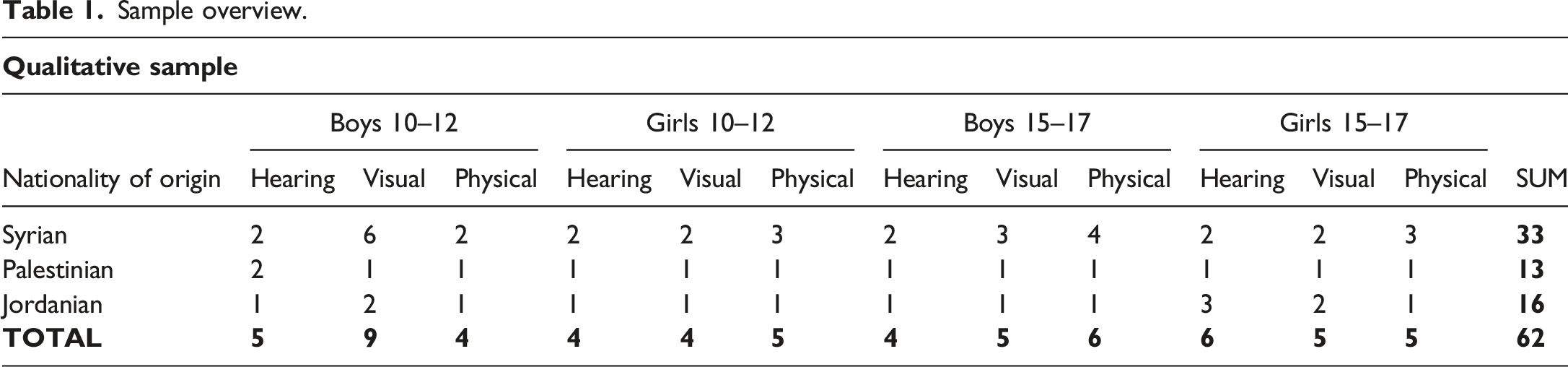
GAGE developed a diverse research toolkit that would attend to the interests and abilities of adolescents with different ages, experiences, impairments and developmental stages. These included the My Favourite Things exercise, a Social Network Hexagon, the Friendship Circle activity, and the EMERGE tool (see below) (Jones et al., 2019b; Małachowska et al., 2020). My Favourite Things asks adolescents to think of a favourite object and reflect on its significance in their life, with researchers probing further. The Social Network Hexagon explores the range of people an adolescent interacts with (family, friends, neighbours, community members, romantic interests and online contacts) and the quality of those interactions. The Friendship Circle invites adolescents to bring two friends to discuss their friendship, what they enjoy doing and talking about, and their worries and hopes.
In 2020, the onset of the Covid-19 pandemic (with associated restrictions on people’s mobility and personal interactions) meant that data collection had to move to virtual methods. To capture the effects of the pandemic, we used two other tools in phone interviews with the same adolescents. The EMERGE tool 5 was developed to explore the shorter-term effects of the pandemic on adolescent health and wellbeing, and how these effects were mediated by gender norms; the other tool focused on the medium-term legacy effects of lockdowns and service closures.
We used a case study approach to analyse the data collected. Case studies rely on multiple sources of evidence, and are thus particularly useful for ‘holistic, in-depth investigation’ (Ebneyamini and Sadeghi Moghadam, 2018; Feagin et al., 1991). This aligns with the demand of intersectionality-informed research that sample sizes allow for in-depth understanding of phenomena rather than prioritising generalisability (Hunting, 2014). Our case studies explore the lives of Fariha and Abbas-two adolescents with physical disabilities who fled Syria to Jordan. 6 In selecting these two individuals, we seek to balance representativeness (to allow insights into the challenges facing all adolescents with disabilities) while also permitting inductive explorations of how social identities and the broader dimensions of power they intersect with produce particular experiences for the individuals in question (Bowleg, 2008). With reference to the literature on case study reporting, these examples may be categorised as both intrinsic and instrumental, in that they are unique accounts but also illustrative of broader patterns of social relations (Hyett et al., 2014; Stake, 1995).
Figures 1 and 2 show the research tools used with Fariha and Abbas, and at what point in the research timeline. Fariha’s research timeline. Abbas’s research timeline.

The next step of the analysis involved comparative and iterative discussions by researchers based in Jordan and those who were part of the international GAGE consortium hub to elicit the core themes of the case studies, and particularly how individual accounts were informed by age, gender, refugee status, geographical location and disability. After identifying key social identities (from participants’ own accounts), we reflected on how these categories interacted with each other to produce particular experiences (for example, how age, gender and citizenship status interacted to shape access to services and programme support). We also explored how these experiences interacted with broader social categories and dynamics, especially in relation to the support available for adolescents with disabilities. Our approach was informed by Bilge’s (2009) two-step hybrid approach to intersectional analysis, in which inductive analysis generates themes from individual accounts without assumptions about the social categories they deploy. Deductive reasoning then asks how these accounts are related to broader social relations that are structured by inequalities in a given context (Bilge, 2009; Cuadraz and Uttal, 1999).
Findings
‘Fariha’
Fariha came to Jordan from Syria in 2014 when she was 12 years old; one of thousands of Syrians of Palestinian heritage who fled in the aftermath of the civil war that began in 2011. A year after arriving in Jordan she was diagnosed with a degenerative motor disease, a condition that also affects two of her nine older siblings. She was enrolled in a mainstream government school and described herself as a good student, with supportive parents who encouraged her and her sister to obtain an education. She was the only Syrian student in her class; many of her peers had dropped out around 7th grade due to family pressure to marry. Fariha herself did not feel this pressure from her own family because of the value they placed on education but also in part because of her disability, which limited her marriageability (see ‘Discussion’ section). Fariha hoped to study until the Tawjihi national exam. 7
In 2018, at age 16, Fariha was struggling a great deal with her feelings towards her disability. She experienced frequent falls due to the nature of her condition, but shunned using a walking device because she did not want to acknowledge that it was getting worse. She was living in a refugee camp for Palestinians 8 and needed transportation to and from school. Fariha reported frustration about her disability and feeling isolated from her classmates, saying that if she did not have her disability, it would be easier to make friends. While her peers talked about marriage and romance, she felt that her disability meant she would never marry.
Fariha also linked her sense of isolation from her immediate peers with her Syrian nationality. She tended to sit alone in classes and could not participate in school trips because her family were not able to work due to their legal status and could not afford the costs. Her peers also laughed at her accent. However, she had strong links with friends and family from Syria who were living elsewhere, and used a mobile phone to stay in touch with them. Four of her siblings were living in Europe or the United States. She had an Instagram account and had joined WhatsApp groups that allowed her to maintain these relationships. Most of these friendships were with people she knew before her disability was diagnosed. She also had a long-distance online friendship with a young Palestinian living in Palestine, from whom she had hidden her disability.
Fariha had participated in adolescent empowerment programming provided by UNICEF and local partners, including educational tutoring, life skills classes, and a social innovation lab. However, she felt discriminated against by programme teachers due to her nationality, and did not enjoy the social innovation lab because it was mixed sex; she felt this was not appropriate given local cultural norms about sex-segregated spaces, and moreover, the boys dominated the group. (The programme eventually closed.) Over time, Fariha had joined various groups to undertake activities, and there was one just for people with physical disabilities, but because she and her sister were the only female members, she felt uncomfortable and did not continue attending.
By 2020, Fariha (now 18) felt that her disability had become noticeably worse. She needed support when walking and fell over regularly. While in 2018 she had aspired to complete her schooling, the cost of transportation to school in 2020 was proving too much for the family, and her mother had asked her to stay at home and help with the housework. Fariha decided to drop out of school. Her family moved from the Palestinian refugee camp to a cheaper house to save money on rent, but this meant that she and her sister now had no privacy, sharing a small room that doubled during daytime hours as the family living room. When school closures during Covid-19 led to classes going online, Fariha did not want to re-join as she was preoccupied with worries about the health of her family members, especially those in other countries, and so could not focus on studying. Her family was also turned down for immigration to the United States during this time. As the pandemic progressed, Fariha turned more to religion-reading the Qur’an and praying-because she said that diseases are punishment from God. She said that she often entered a room, caught sight of herself in the mirror and cried, but did not talk to anyone about her feelings. A year later, in 2021, she still felt unable to tell people that she was depressed, scared or frustrated, choosing instead to cry alone. She noted that her friends, of the same age or younger, were all now married.
‘Abbas’
Abbas and his family lived on the outskirts of a large city when we first met in 2018, and he was 18 years old. Abbas and his sister and parents came to Jordan when he was 12, after Abbas was shot in Syria and suffered spinal cord injuries that left him unable to walk. They hoped to find a cure but found there was none. As he had studied for 4 years in Syria, his parents tried to enrol him in a Jordanian school, but schools said they were not equipped for students in wheelchairs, and would need more than one disabled student in order to adapt classrooms, so they would not enrol him. Abbas felt upset that he was treated differently from other children and was excluded, as he had really wanted to study and get higher qualifications. His family was eligible for a UNHCR cash transfer, but no one overseeing that programme inquired about his schooling status. He had been made aware of his rights to education and services, but he did not know to whom he could voice these demands. He felt sure that part of his exclusion from school was based on the fact that he was a refugee.
When Abbas was initially interviewed in 2018, he had been feeling very isolated. He used to participate in a non-formal education centre for boys with similar conflict-acquired physical disabilities, but that centre had closed down 2 years previously due to lack of funding. Although he had a group of friends from his athletics club, and was a member of a Facebook group of Syrian boys with similar experiences, he had no friends in his neighbourhood. His family had already moved several times due to insecurity, and he had not had a chance to meet people. Uneven streets and an absence of ramps into buildings were challenges that prevented Abbas accessing public places. He had started studying a vocational course on mosaic design and craft in Amman run by a local NGO, and his family were paying for his transport (with his wheelchair) in a taxi.
When we spoke again in 2019, things were looking very different for Abbas. Through his work in mosaic design, he had learned how to become a trainer-and, as a result, had been able to afford to move out of his parents’ home and rent a place with friends he had met through the programme. His group of friends, almost all of whom have a disability, went together to visit other people with disabilities and provide psychosocial support. They were advertising their training business through local non-governmental organisations (NGOs) working to support Syrian refugees, and Abbas was even discussing with one NGO how to work on making Amman more disability-friendly, through building ramps and improving infrastructure.
Abbas felt that in some ways it was easier being a boy and suffering this injury and disability than it would have been if he had been a girl. He observed that due to the stigma around disability, it would be impossible for a girl with a disability to marry, as her impairment would limit her marriageability. It was also much easier for him, as a boy, to participate in social networks and make the connections that have made his life better, believing that it would be more difficult for girls with disability to do so given the prevailing gender norms among Syrian communities that limit girls’ mobility outside the home.
The Covid-19 pandemic had had a number of immediate effects on Abbas’s life when we spoke in 2020, but he felt that it paled into insignificance compared to what he and his family had been through before. Prior to Covid, he was out and about every day, going to the market or to see friends. However, due to a downturn in work, he was now back living with his family, and he found staying at home during lockdowns boring and upsetting. He described feeling ‘empty’ in the initial days of the pandemic, but coped by chatting with friends on his mobile phone and reading the Qur’an.
Discussion
The rich case study data clearly show that for Fariha and Abbas, relations of power at the axes of age, gender, socioeconomic status, disability, nationality and refugee status interact to produce very different experiences of marginalisation and exclusion. Here, we analyse how their personal experiences of these social categories can be understood in the context of structural marginalisation.
Both Fariha and Abbas described exclusion from education and other services. For Abbas, overt exclusion from school was explicitly due to his disability, though he later reflected that it was also linked to being a refugee; he also struggled to access public spaces because of a lack of adapted infrastructure and affordable transportation. Fariha’s perception of discrimination by her fellow students led to less direct forms of exclusion from social networks, and this was exacerbated by her family’s financial situation, which prevented her taking part in extracurricular activities. Fariha had also internalised social stigma surrounding disability, which led her to self-exclude from peer networks.
In both case studies, structural discrimination against people with disabilities and against refugees interacts to create different individual experiences of exclusion. While both Abbas and Fariha recounted a mixed group of friends and networks, they spent more time with refugee friends due to common experiences; indeed, by 2019, almost all Abbas’ friends were other young refugees with disabilities. Although both Fariha and Abbas perceived negative attitudes towards refugees on the part of teachers and school authorities, Abbas had had some very positive experiences of dedicated and supportive non-family adult mentors, such as the trainers who taught him mosaic design and the NGO supervisors he worked with.
These findings also underline that age and the changes that happen to adolescents’ social circles over time have an impact on the resources available to help them cope with marginalisation. Abbas’s experience underlines that boys with disabilities are able to access more opportunities to diversify their support networks as they get older (Jones et al., 2021), whereas Fariha found that her social exclusion intensified as she aged-albeit amplified by her experience of entering young womanhood under Covid-19 lockdowns, which were enacted the same year she turned 18.
Gender clearly also interacts with disability and refugee status to shape experiences. Like many boys, Abbas had significantly more opportunities for mobility and networking than girls his age, despite being in a wheelchair. Fariha had internalised social norms about the inappropriateness of mixed-sex spaces and interactions during adolescence, with her physical mobility challenges exacerbated by gender norms that constrain girls’ mobility outside the home (Jones et al., 2019a; Bani Odeh et al., 2021). Meanwhile, in Jordan there are far more opportunities for boys to join non-formal education spaces because they do not have to think about how participating in mixed-sex activities may make them subject to negative talk and rumours. Relatedly, there is more proactive support for boys with disabilities to access skills-building opportunities, such as the training programme Abbas took part in, because of a perception that they will need to earn pursue a livelihood to earn an income, whereas girls are expected marry or look after their families so do not need to earn (Gauri et al., 2019). However, Fariha’s perception of her limited marriageability-and Abbas’s recognition that things would be very different for him if he were a girl-evidences the stigma that exists towards girls with disabilities in the Middle East (AlMakhamreh et al., 2015).
The case studies also highlight how socioeconomic status interconnects with gender inequality. Over the research timeline, Fariha’s family increasingly struggled to make ends meet, especially during the pandemic. Their inability to pay her school fees and the pressure on her to stay at home to help out exacerbated her immediate sense of isolation from peers, and meant she was increasingly distanced from opportunities to fulfil her aspirations. The change in the family’s living conditions also negatively impacted her mental health. Furthermore, the research reveals how changes over time in socioeconomic status affected Fariha and Abbas differently due to their gender and age, with Abbas’ family able to afford the opportunity cost of his attendance at training sessions that enabled him to attain financial and social independence.
According to Fariha and Abbas, social connections played an important role in helping them to cope with marginalisation. Some of these connections were online; both young people were able to connect with others in a way that was not hampered by infrastructure or physical mobility constraints. Research with Syrian refugees has found that digital contact with the wider diaspora represents an important source of support (Kaufmann, 2018). Our case studies offer nuanced insights into the different ways in which Abbas and Fariha drew on these networks. Whereas Abbas used Facebook to connect with other youth with disabilities in Jordan, Fariha used her online presence as a way to distance herself from her condition-both by maintaining connections with those from her former, pre-disability life and by presenting herself as non-disabled to those who did not know her in person.
Fariha’s online friendship with another young person in Palestine also underlines her status as a Palestinian Syrian ‘double refugee’ and the challenges for social inclusion that come with straddling these national identities. Until 2020, Fariha was living in a Palestinian refugee camp, where she attended school with Palestinian refugees; she described not fitting in at the local school, where she was the only Syrian student, and would have been perceived largely in terms of her Syrian identity as a ‘new’ refugee. At the same time as feeling out of place with her Jordanian peers, and not explicitly articulating her status as a ‘double refugee’ due to the political implications of this identity in the Jordanian context (with Palestinian refugees specifically denied entry into Jordan), her online friendship saw her connecting with her Palestinian identity.
Fariha and Abbas also had very different types of impairment. As noted, reduced marriage prospects for people with disabilities are more likely to be a concern for girls and their family anyway, but the genetic basis of Fariha’s disability was likely to compound this stigma, due to the potential for the condition to be inherited by any children born in future. Meanwhile, Abbas’s physical impairment was caused by the conflict in Syria; his impairment will not affect any children he fathers, and there is a sense of heroism and support for war martyrs within the Syrian community in Jordan.
Although both Abbas and Fariha participated in formal skills-building programmes, these appear to have had mixed outcomes when it comes to breaking down intersecting sources of exclusion. Fariha had been uncomfortable at the activities she attended at the UNICEF Makani centre (a community centre offering empowerment programming to children and adolescents) due to being part of a mixed-sex group. Moreover, adolescents with disabilities are rarely included in broader non-formal education programming. By contrast, where there is longer-term support provided by NGOs (such as that experienced by Abbas), these interventions can be empowering. However, as Fariha’s account illustrates, barriers to participation are more complex than simply opening programmes up to all; it is also necessary to adapt programming in ways that engage with the intersecting barriers that perpetuate marginalisation.
Research on young people growing up in adverse environments finds that psychosocial resilience is enabled by supportive networks comprising peer groups, family and community actors (Armstrong et al., 2005; Ungar, 2011). Both Abbas and Fariha regarded their religious faith as an important part of their coping repertoire, and both have supportive families. Both also relied on online contacts to maintain these relationships because of the complications of their physical mobility. However, for Abbas, there was one key difference explaining his wider range of networks and access to in-person friendship groups and opportunities-and that was his social mobility, borne of the less constraining gender norms that refugee boys face in Jordan. Whereas boys are encouraged to widen their world as they go through adolescence, research with refugee girls in Jordan has found that over-protectiveness (due to gender norms) becomes intensified in contexts of displacement, as parental concerns about daughters’ safety leads to further limits being placed on their mobility (Sajdi et al., 2021b). The case studies show that Abbas’s plans and aspirations for the future were flourishing, even in the context of the pandemic and related restrictions, while Fariha’s world, by 2021, was becoming smaller and smaller.
The experiences of Abbas and Fariha during the pandemic highlight an aspect of marginalisation that is underexplored within extant literature that draws on an intersectional lens: how exclusion changes over time both in a given context and for individuals. This consideration is particularly important when researching people with disabilities; a social model of disability accounts for the ways that experiences of disability change over time due to interactions between an individual’s impairment and the meanings attached to the stage they are at in the life course (Priestley, 2003). For Abbas and Fariha, the nature of their disability compounded the challenges they face as they transition through adolescence, grow up as refugees, and cope with a pandemic.
Coming to terms with disability and its impact on one’s life trajectory is complicated by the nature of the disability and what it means in the context of other forms of marginalisation. For Abbas, the traumatic acquisition of his impairment through conflict was a continual reminder of his refugee background; together, his disability and refugee status have led to the truncation of his schooling. For Fariha, seeing the impact on her older siblings of the same degenerative condition that she herself was managing was a clear source of her difficulty in remaining optimistic for the future. She also knew she had limited agency due to her gender and her family’s poverty because of their refugee status.
Indeed, the pandemic has clearly exacerbated the social isolation of adolescents with disabilities, as the closure of programming made it even more difficult to access social networks and non-formal education. However, whereas Abbas was not fearful and has proactively sought to manage his emotions around the pandemic through support from friends and by keeping an eye on the future, by 2021, Fariha was deeply anxious and appeared increasingly hopeless about the future. Her decision not to take up distance education-even though the cost of transportation that had caused her to leave school back in 2019 was no longer an issue-indicates her increasing exclusion.
Conclusion
Our two case studies provide important insights into the ways that gender, disability and refugee status intersect to produce individual experiences of marginalisation. These in turn highlight entrenched and complex structural inequalities; gender norms, nationality and refugee status, poverty, limited social protection, and limited tailored services for adolescents all serve to compound the challenges facing adolescents and young people with disabilities. Furthermore, temporal changes-both over an individual’s life course and over time within the context of Jordan during a global pandemic-affect experiences of social exclusion because an adolescent’s disability status compounds the other intersecting challenges they face as they navigate adolescence during such very difficult times.
The pandemic affected Fariha and Abbas very differently as a result of their social identities and positioning. For both individuals, their pre-pandemic level of resilience, which was shaped by the forms of exclusion they had already encountered or overcome, played an important role in how they were able to cope during lockdowns. Whereas Fariha was struggling and her world becoming smaller, Abbas was able to draw on psychosocial resources such as emotional support from friends, family and other contacts with whom he has a close relationship to weather the challenges of having to move home and stop work. The case studies highlight Fariha’s comparatively limited opportunities to develop relationships where she felt she could genuinely express her emotional needs. Although their disability and refugee status have affected both Abbas and Fariha, it is here that we see most starkly how gender norms intersect with other forms of marginalisation. Fariha lacks encouragement and support to think about her future beyond the pandemic; her family’s financial difficulties mean she is also unable to access the privacy she needs to feel comfortable and secure as a young woman in a context where modesty is a key feminine norm.
Yet at the same time, the narratives we present here illuminate various factors that can mitigate the social exclusion experienced by the most marginalised adolescents. The support of family members is instrumental: for Abbas, parental help enabled him to access the mosaic training that led to quality social connections and ultimately more independence; and for Fariha, parental support initially meant she was able to attend school but their need for her help at home was explicitly connected to her departure from education. Our findings also underline the significant role of online contact with relatives and friends-especially those in the diaspora-in helping adolescents to feel connected and supported. Furthermore, non-family trusted adults can support the resilience and coping repertoires of young people when they are attuned to the intersecting vulnerabilities they face and how these impact their participation. This is evident in the positive experience of Abbas with his mosaic trainer and the NGOs he subsequently worked with, but also in the negative experiences of Fariha in attending groups intended to ‘empower’ her but in fact making her feel uncomfortable or unsafe.
Although this article presents two case studies which are, at first glance, differentiated by gender, it is important to keep in mind the indivisibility of the social relations that shape the experiences of marginality that we recount. It is the ‘simultaneous working’ (Bilge, 2009) of gender, disability, refugee status, nationality and other characteristics, in interaction with broader structures such as norms and institutions, which shape the unique experiences of Fariha and Abbas. An intersectional framework offers insights into the consequences of these dynamics for policy and programming that aim to promote and support both initial access to opportunities and continued participation by adolescents with disabilities in Jordan. Addressing this issue is key if global commitments to the inclusion of people with disabilities-as embedded in the SDGs and the UN’s Disability Inclusion Strategy-are to be met.
Footnotes
Declaration of conflicting interests
The author(s) declared no potential conflicts of interest with respect to the research, authorship, and/or publication of this article.
Funding
The author(s) disclosed receipt of the following financial support for the research, authorship, and/or publication of this article: This work was supported by the Foreign, Commonwealth and Development Office.
