




Abstract
This paper deals with the unpredictable outbreak of the pandemic, explaining its impact on the education system, and with structural flexibility as a way to face unpredictability, based on the generalisability and coordination of manifestations of agency. The pandemic has enhanced a narrative of the child as a medium of learning, which undermines children’s agency. The example of the research project CHILD-UP (Children Hybrid Integration: Learning Dialogue as a way of Upgrading policies of Participation) is used to show how children’s agency and structural flexibility in classroom interactions can be supported and analysed.
Introduction
This paper deals with the consequences of a sudden outbreak of unpredictability in society focusing on the SARS-CoV-2 virus pandemic, which provides the opportunity for a reflection on the effects of this outbreak on the social condition and cultural consideration of children, in particular in the education system. Moreover, we consider the function of social research in changing this condition and consideration.
At first sight, the pandemic might be interpreted as a danger for human life coming from the natural environment. However, the pandemic is also a social construction of contagion and illness, their effects, and the possibility to overcome them. From this point of view, the pandemic is an exceptional example of sudden outbreak of the generalised, but not sufficiently recognised, social phenomenon of unpredictability. It shows that the sudden outbreak of unpredictability redefines social processes as contingent and uncertain.
The next sections deal with the condition of unpredictability and its consequences in terms of social change, the impact of the pandemic on the narratives about children, and the conditions of children’s participation in education. Further, we propose a reflection on the ways in which sociological research can support the resurgence of children’s agency in schools, thus enhancing their personal responsibility. We do this through a synthesis of how the activities and the research methodology planned within the European research project H2020, CHILD-UP (Children Hybrid Integration: Learning Dialogue as a way of Upgrading policies of Participation) have been adapted to the current situation. These changes highlight the need to investigate the effect of unpredictability on social structures and the need for sociological research to embrace structural flexibility.
Social unpredictability and the pandemic
Unpredictability may be seen as the unavoidable outcome of communication processes, which cannot be controlled by a centralised or hierarchical source of power or knowledge (Luhmann, 1995). Unpredictability is thus a permanent condition of society. The unpredictable outcomes of communication processes can destabilise the social structures which guide these processes. However, social structures also limit the effect of unpredictability, thus causing structural change to be slow. For instance, while educational organisation and forms of teaching and evaluation have widely changed during the last century following the unpredictable success of specific communication processes (e.g. students’ protest, new pedagogical orientations), the structural conditions of education, i.e. teaching and evaluation of pupils’ performances, have remained stable (Baraldi, 2021). Against this background, a sudden outbreak of unpredictability can increase and accelerate change of social structures. This is a potential effect of the outbreak of the pandemic caused by the SARS-CoV-2 virus. The question is to what extent the outbreak of the pandemic destabilises social structures.
In this paper, the outbreak of the pandemic is interpreted as a risk which depends on social actions, rather than a danger deriving from the natural environment of society (Beck, 1992; Giddens, 1991; Luhmann, 1993). Firstly, the origin of this outbreak may be observed as dependent on the impact of social action on the natural environment (e.g. globalized social interactions, accidents in scientific laboratories). Secondly, and more importantly, this outbreak enhances risky actions regarding prevention plans, political decisions, healthcare management, scientific research, media coverage, and so on. The outbreak of the pandemic has greatly increased the social awareness of unpredictability and, in so doing, it has made the general observation that any action is risky (Luhmann, 1993) very evident. The effect is a significant increase in uncertainty in society.
Uncertainty has destructive effects on social structures through communication processes, as the case of the pandemic shows (Ruiu, 2020). Classic sociology trusted normative structures to limit unpredictability and uncertainty at both macro (e.g. Parsons, 1951) and micro (e.g., Blumer, 1969; Goffman, 1967) levels. Normative structures are based on reflexive expectations, i.e. on expectations which include other participants’ expectations (Luhmann, 1995). Normative expectations enhance stable conditions of action and communication. However, these expectations can quickly fail when unpredictable communicative processes are triggered by a sudden outbreak of environmental irritations. Following such a sudden outbreak of unpredictability, normative expectations are quickly disappointed, the structured normative order fails and the level of uncertainty in society becomes very high.
A possible (and usual) reaction to uncertainty in modern society is the establishment of expectations open to change (Luhmann, 1995). When a normative order fails, expectations of change can ensure the reproduction of communication. For instance, with the raise of science in the 17th century, the normative order based on the laws of God was transformed in a contingent and open order in which change of knowledge was (and is) systematically expected. However, when the outbreak of unpredictability is sudden, change becomes fuzzy and/or negative, thus entailing that even expectations of change may fail and claims for rationality become unrealistic and ineffective. In these conditions, the last resource is structural flexibility, which does not ensure stability, but facilitates fluid communication processes which can deal with unpredictability and uncertainty.
Structural flexibility is based on generalisability of personal contributions to communication, for instance in healthcare services, political and administrative offices, schools and universities, businesses, scientific laboratories, and so on. Generalisability of personal contributions is a risky way of ensuring a thorough treatment of unpredictable events, since it is based on expectations of unpredictable personal expressions. In early modern European society, personal expression was discouraged and contrasted through normative expectations, which gave a negative value to individual initiatives, narrated as forms of individualism. Sociological theories have frequently seen individualism as a menace for social solidarity and sense of belonging to the community (e.g. Bauman, 2000; Beck and Beck-Gernsheim, 2002; Elias, 2010). Today, however, normative control of individual action may be seen as a serious obstacle to structural flexibility, i.e. to the generalisability and coordination of personal contributions to fluid communication processes. This obstacle can be overcome when it is possible to distinguish between individualistic disruption of norms and personal engagement in effective communication. From a sociological point of view, this means introducing the value of person in role performances. Person is a social form (Luhmann, 2002): the social orientation to a person enables the social consideration of the individual as having the option to act and of being motivated to act. The value of person in role performance is based on structures which give value to personal expressions in social roles, which is different from individualistic indifference for solidarity.
The success of the concept of agency in sociology reflects the increasing importance of personal expression in role performance in society. Agency has been associated with human capacity of action in general (Archer, 2000); however, human capacity of action in itself does not imply the value of personal expression. Agency is better understood as a specific form of participation which shows the availability of personal choices of action and can thus enhance change in social systems (Baraldi, 2014). Agency is combined with social structures (Giddens, 1984): the attribution of agency to participants in communication is a social construction depending on specific structures of expectations giving value to personal expression in communication.
Structural flexibility, as based on generalisability and coordination of personal contributions, requires the enhancement of agency based on the social construction of the positive value of personal responsibility in achieving role performances. Personal responsibility is an important presupposition of individual choice as a way of acting and expressing oneself as a person. Personal responsibility also ensures respect for interlocutors’ personal expressions, i.e. it ensures mutual empowerment of and sensitivity for agency. In this way, personal responsibility ensures a dialogic form of communication (Bohm, 1996; Gergen et al., 2001; Wierzbicka, 2006), which means coordination of different personal choices.
In the sociology of childhood, the recognition of the importance of children’s agency is widespread, although its interpretation is controversial (e.g. Baraldi and Cockburn, 2018; James, 2009; Kirby, 2020; Leonard, 2016). This paper is based on the concept of agency as children’s availability of choices of action which enhance changes in their social context (Baraldi, 2014; Hill et al., 2004; Percy-Smith, 2018). From this viewpoint, agency highlights the meaning of the child as a person, i.e. the attribution to the child of options and responsibility of action.
Failures in dealing with the sudden breakdown of unpredictability depend on limited institutional interest in enhancing and supporting agency, personal responsibility, and dialogue which is a basic presupposition of agency (Baraldi, 2021). This limited interest is also a limitation to structural flexibility. In the following section, we shall observe this limitation for what concerns the value of children’s agency and personal responsibility, with a particular focus on dialogue between children and adults in the education system and during the pandemic.
The breakdown of education and the narrative of the child as a medium of education
Following the outbreak of the pandemic, the unsustainable condition of children has been widely stressed not only in Europe but also around the world (Cuevas-Parra and Stephano, 2020; Eurochild, 2020; Unicef, 2020). Here, we use the concept of “narratives” to describe the social construction of this unsustainable condition and its consequences for children’s agency. Somers (1994) describes different types of narratives, among which ontological narratives making sense of people’s lives, public narratives and metanarratives concerning “the epic dramas of our time” (Somers, 1994: 619). According to Somers, ontological narratives are embedded in public narratives, and metanarratives are present in both public narratives and ontological narratives. In time of pandemic, the mainstream public narrative is that education is a way to rescue children from social detachment.
This public narrative concerns the protection of children’s right to education, which refer to the societal function of education (e.g. Luhmann, 2002). Children are mainly seen in their role performances as pupils, although the length of the pandemic has also introduced some concern for children’s personal difficulties. The weakness of the educational agenda of children’s agency has been stressed in several sociological contributions on childhood in the last 20 years (e.g. Devine 2002; Farini 2018; Gallagher 2006; James and James 2004; Wyness 1999).
The education system is based on the positive value of the conveyance of knowledge (Luhmann, 2002) and of evaluation (Mehan, 1979), which provide indications of what knowledge is conveyable for learning and what makes the results of conveyance visible, distinguishing between pupils’ correct and incorrect performances, by testing learning. The structures of conveyance of knowledge and evaluation determine the hierarchical differentiation of the roles of teacher and pupil, so that teachers can convey knowledge and evaluate pupils’ learning. The complementary and asymmetric structure of teachers’ and pupils’ roles is the most striking peculiarity of education (Delamont, 1976; Mehan, 1979). The structures of conveyance of knowledge and evaluation guide the transformation of individuals in persons, thus providing the possibility for them to be addressed in society as personally responsible for their actions. However, these structures orient teaching to understanding the individual child as a medium (Luhmann, 1991) that must take the form of a person. Thus, the intentional transformation of individuals in persons is accomplished in a hierarchically structured system in which children’s involvement is important, but children’s agency is very weak, since they have not yet reached the status of persons. Personal responsibility is thus interpreted as a future objective, rather than a present condition.
Under the pressure of new pedagogical approaches, education has progressively included methods to support children’s agency (e.g. Hicks, 1996; Mercer and Littleton, 2007). However, during the pandemic, the consideration of the child as a medium of learning has been strengthened by the widespread worry for the breakdown of teaching interaction. Teaching interaction is considered extraordinarily important in the education system since (1) it ensures the independence of school education from incidental education and (2) establishes effective relationships between teachers and pupils (Delamont, 1976; Eder, 1981; Stevenson, 1991).
The breakdown of teaching interaction in the classroom has determined the risk of failure of children’s learning. However, the attempt to re-establish education through distance teaching has reduced children to disembodied media for learning working through digital media. The construction of the child as a medium, which is in itself problematic from the point of view of children’s agency, has been separated from the construction of the child as a person, which got lost in the narrative of children’s need of education. Thus, the breakdown of the school organization of teaching interaction has led to radicalisation of the metanarrative of the child as a medium of learning, which has dramatically disrupted “the age of children’s agency” (Oswell, 2013: 3). This radicalisation can generate children’s distrust in education. Thus, if children do not have some opportunity of showing agency at school, their distrust in institutions is likely to increase and informal gatherings are likely to be the only contexts of agency, “as everyday life arenas and practices” (Percy-Smith, 2010: 118), accorded with children’s personal life (James, 2013).
Research, facilitation and possible resurgence of children’s agency
We propose here a reflection (1) on the ways in which sociological research can support the resurgence of children’s agency in schools, thus enhancing their personal responsibility, and (2) on the conditions of structural flexibility in schools based on teachers and educators’ enhancement of children’s agency, through the production of ontological narratives which make sense of children’s personal experiences. This reflection is based on the European Horizon 2020 research project CHILD-UP (Children Hybrid Integration: Learning Dialogue as a way of Upgrading policies of Participation), funded by the European Commission (GA 822400) which supported the organisation of activities aiming to recover children’s agency in the school agenda. The research project aimed to provide opportunities of exercising agency within the classroom to migrant-background children. This research investigated the conditions of integration of children with a migration background and their possibilities for active exercise of agency in changing their social and cultural conditions in seven European countries (Italy, Belgium, Finland, Germany, Poland, United Kingdom and Sweden).
The research involved all the children in the classroom, since integration is considered “hybrid”, i.e. based on the effects of dialogue involving all the interlocutors of migrant children. The research aimed to analyse dialogic practices in schools which propose methodologies and tools to support and improve hybrid integration by enhancing and supporting children’s agency in order to change the educational context of this integration. The final objective of the project is to develop guidelines for dialogic methods improving children’s agency at European level.
The CHILD-UP project was not designed for the specific aim of contrasting the negative effects of the pandemic on children’s agency. However, its realisation provided an opportunity to reintroduce in schools children’s agency and to support structural flexibility in the education system. This was possible through the researchers’ encouragement of classrooms workshops based on facilitative methods supporting migrant children’s exercise of agency, thus re-establishing the value of children as persons and increasing children’s abilities to deal with multiple views in a dialogic way. Facilitative methods are based on educators’ consideration of children as “co-constructors of knowledge and expertise” (Hill et al., 2004: 84), leaving aside the role of “teacher with all the answers” (Blanchet-Cohen and Rainbow, 2006: 122) in the interaction with children. Facilitative methods may activate, encourage, and support children’s agency as children’s rights and responsibilities in terms of both accessing and producing knowledge (e.g., Baraldi, 2015; Davies, 1990; Kovalainen et al., 2001; O’Connor and Michaels, 1996), through actions such as active listening, responding, supporting, suggesting discourse developments, appreciating, thus introducing dialogue in educational interactions (Baraldi, 2012). Facilitation aims to enhance structural flexibility regarding the production of knowledge in the education system, showing that structural flexibility relies on a distribution of agency between educators and children. Facilitation shows that structural flexibility only works if personal responsibility in choosing actions and producing knowledge is generalised, rather than condensed in or limited to some participants.
Methodology
This paper deals with three connected aspects: (1) the enhancement of facilitative methods, (2) the innovative use of digital platforms, (3) a method for the observation of agency and dialogue. The paper concerns research conducted in Italy, for two reasons. First, Italy was the only country in which the original research plan was completed, thanks to the extraordinary collaboration of teachers and children. Based on negotiations with school heads and teachers, and the collection of consent forms from children and children’s parents/guardians, the researchers were able to promote and analyse 66 facilitated meetings in 33 classes, in 24 nursery, primary and secondary schools, in three Italian cities, involving a similar number of boys and girls. These workshops were video-recorded and followed by focus groups with the children to discuss their understanding and appreciation of facilitation. The meetings were facilitated either by external experts or by teachers.
Second, and linked to this, the research was successful since it adopted some strategies enhancing structural flexibility in the unpredictable conditions determined by the pandemic. The video-recordings of activities and focus groups started at the end of January 2020 but the activities were almost immediately suspended for the pandemic. In September 2020, video-recordings and focus groups restarted under the pandemic restrictions and continued until June 2021. The workshops were significantly revised and adapted to the new conditions of social distancing and contagion prevention. In particular, this adaptation was based on the use of digital platforms to support facilitative methods and enhance children’s agency.
With the outbreak of the pandemic, the use of digital platforms for teaching has greatly expanded in Italy, reaching unprecedented levels. In recent years, the use of digital platforms in education has been largely explored for what concerns both their ambivalent effects (e.g., Beuchamp and Kennewell, 2010; Biagi and Loi, 2013; Livingstone, 2012) and their ideological meanings (e.g. Grimaldi and Ball, 2019; Decuypere, 2019; Landri, 2018; Selwyn and Facer, 2013). A massive use of digital platforms for teaching has negative effects on children’s exercise of agency in the education system, as we have seen above. However, some studies have explored how and with which limitations participation based on personal needs and interests can meet institutional aims through the example of patients contributing to medical research by including their personal experiences in digital platforms (e.g., Tempini, 2015). This aspect of the use of digital platforms is particularly interesting for the facilitation of children’s agency in conditions in which classroom interaction is not possible or allowed in schools.
Research and facilitation in the pandemic era
Researchers and teachers collaborated to use digital platforms to realise and video-record the workshops, in particular those facilitated by external experts who, under pandemic restrictions, were not admitted in the classroom. Adapting facilitation of children’s agency to digital platforms is not easy. Non-verbal communication strategies in face-to-face interactions, such as eye-contact or smiles, which are usually adopted to involve children in dialogue, are not an option during digital meetings. Despite this limitation, the use of digital platforms introduced structural flexibility in facilitation of children’s agency in a variety of ways, which are shown in the next subsections.
Use of the chat function
Use of digital platforms enhanced alternative ways of interacting. A good example is the chat function. The children’s use of this function replaced the informal background of small talk which is common in classroom interactions. The chat function was also an opportunity for hesitant children to share views with their classmates without taking the floor orally during the meeting. The chat became a tool to share children’s viewpoints on topics related to their life in general and their school experience in particular.
An example of effective use of the chat function is a workshop in a lower secondary school attended by many Chinese children. This workshop was organized in collaboration between a school and an external agency employing some Chinese mediators to facilitate communication about Chinese culture and language. The workshop involved children from different classes. The meetings were planned as face-to-face interaction, but had to move to a digital platform since it was not possible to take children coming from different classes to the same room. Thus, relationships with new mates were entirely constructed through the digital platform. Chinese children were invited to act as tutors of their classmates, supporting them in understanding the Chinese culture and differences of language background, and allowing the other children to engage in discussions and reflections about diversity and identity. The chat function was particularly useful, in particular to allow for Chinese students’ tutorship.
Extract 1
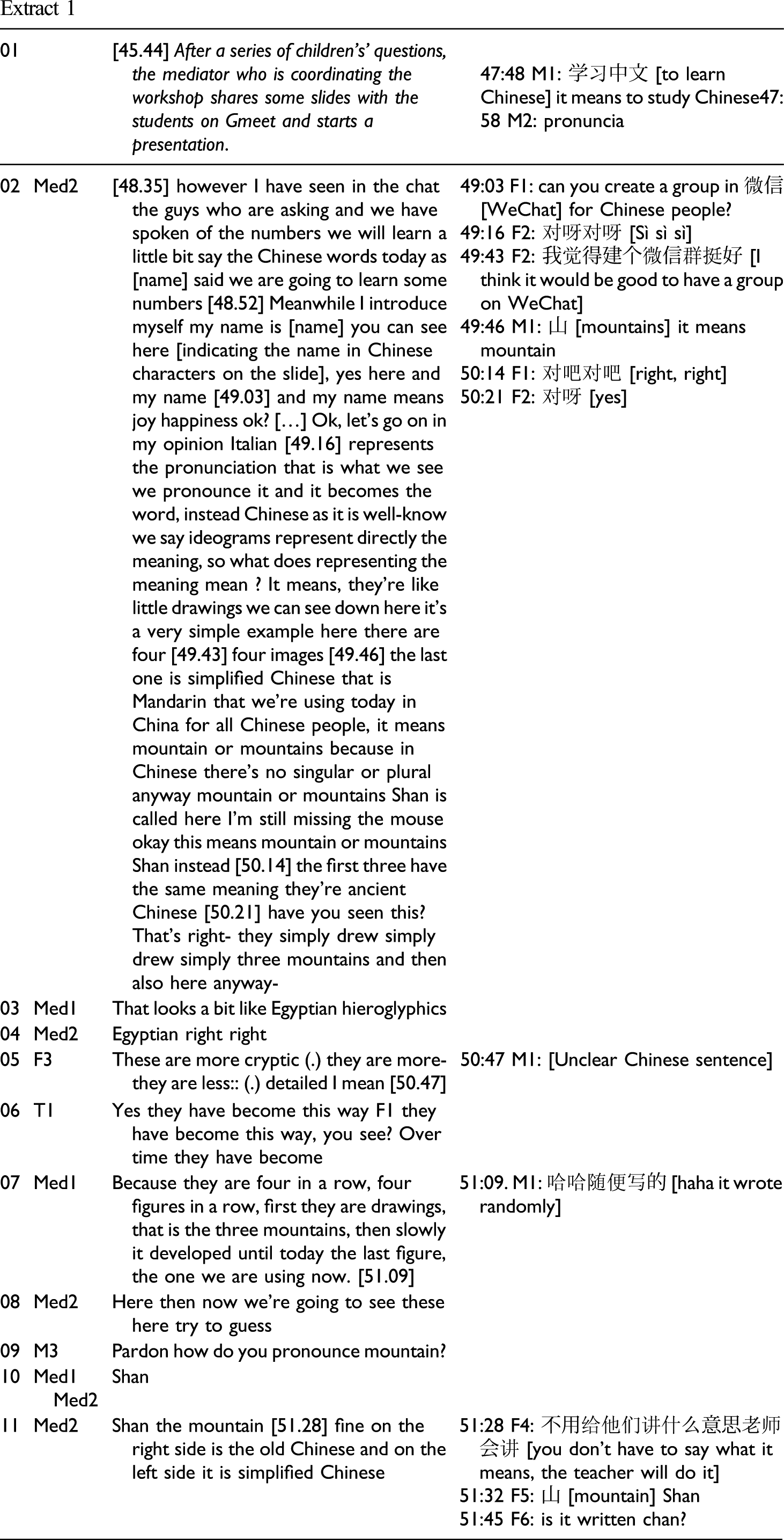
Extract 1 shows that children’s verbal participation is limited to turns 5 and 9, but children’s participation is much more relevant in the chat, which in particular allows the enhancement of Chinese children’s agency as construction of knowledge, in turns 1, 2 5, 7 and 11. The chat function contributes to expanding personal responsibility in choosing actions and producing knowledge, thus enhancing structural flexibility of facilitation.
Despite the limits of remote interactions, during the final focus group, the children expressed appreciation for this workshop because it increased their opportunities to interact, to know each other and to rely on the support of Chinese children from other classes, fostering the establishment of friendly relations. Teacher: Has the relationship with the Chinese changed? M1: Yes, especially those from other classes, so that they helped us, slowly I got to know them, I started talking to them, we became friends (Teacher and 11 year-old boy)
In my class there is at least one of my classmates who doesn’t speak much Italian and he is Chinese, so this course helped me to exchange more or less a few words (Girl, 12 years old)
Ways of participating in focus groups
The use of digital platforms introduced structural flexibility during focus groups in “mixed” conditions, i.e. with children in nursery classrooms and researchers and facilitators online. During a workshop, children were asked to express their opinions not through emoticons, as it was done before the pandemic, but by moving through different areas in the classroom or showing objects having certain colors, where each area, or color, corresponded to a preference. In another workshop, children left their place to move in front of the camera and talked directly to the researcher; although this might apparently compromise dialogue among children, it enhanced each child’s agency in producing narratives and views. This resulted in an amplified sense of personal responsibility.
Enhancement of personal narratives and agency
Extract 2
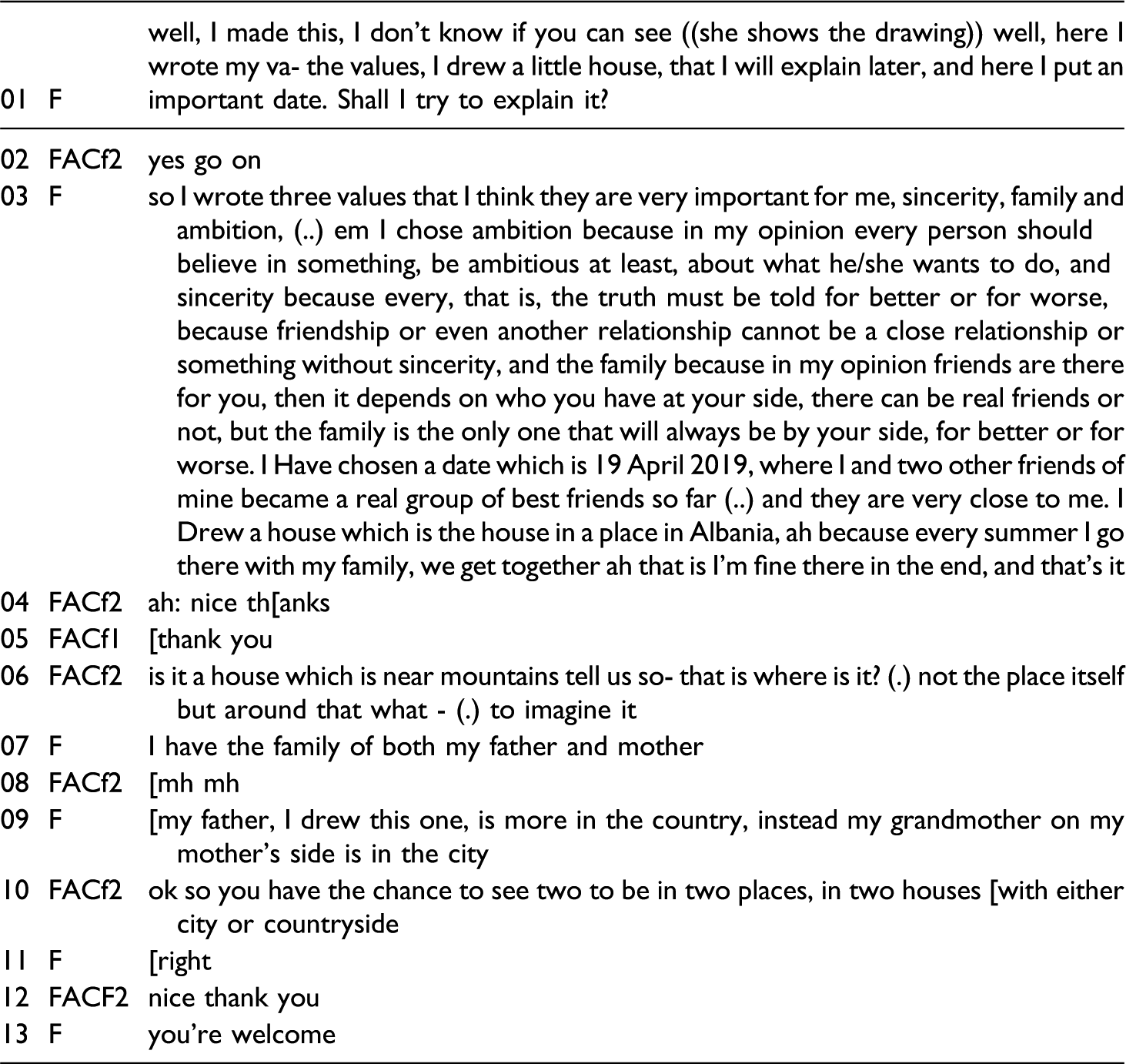
In extract 2, a drawing, shown on the screen by F, a migrant girl, is used to facilitate the production of a narrative on important interpersonal relations. The facilitator’s actions include active listening showing interest (turns 4, 5 and 8), appreciations (turns 4 and 12) and an open question (turn 6). These actions enhance the girl’s narrative. The extract shows that the use of digital platforms did not prevent from sharing knowledge, from adopting facilitative methods and from enhancing children’s agency.
Creating a relaxed context for agency
Extract 3
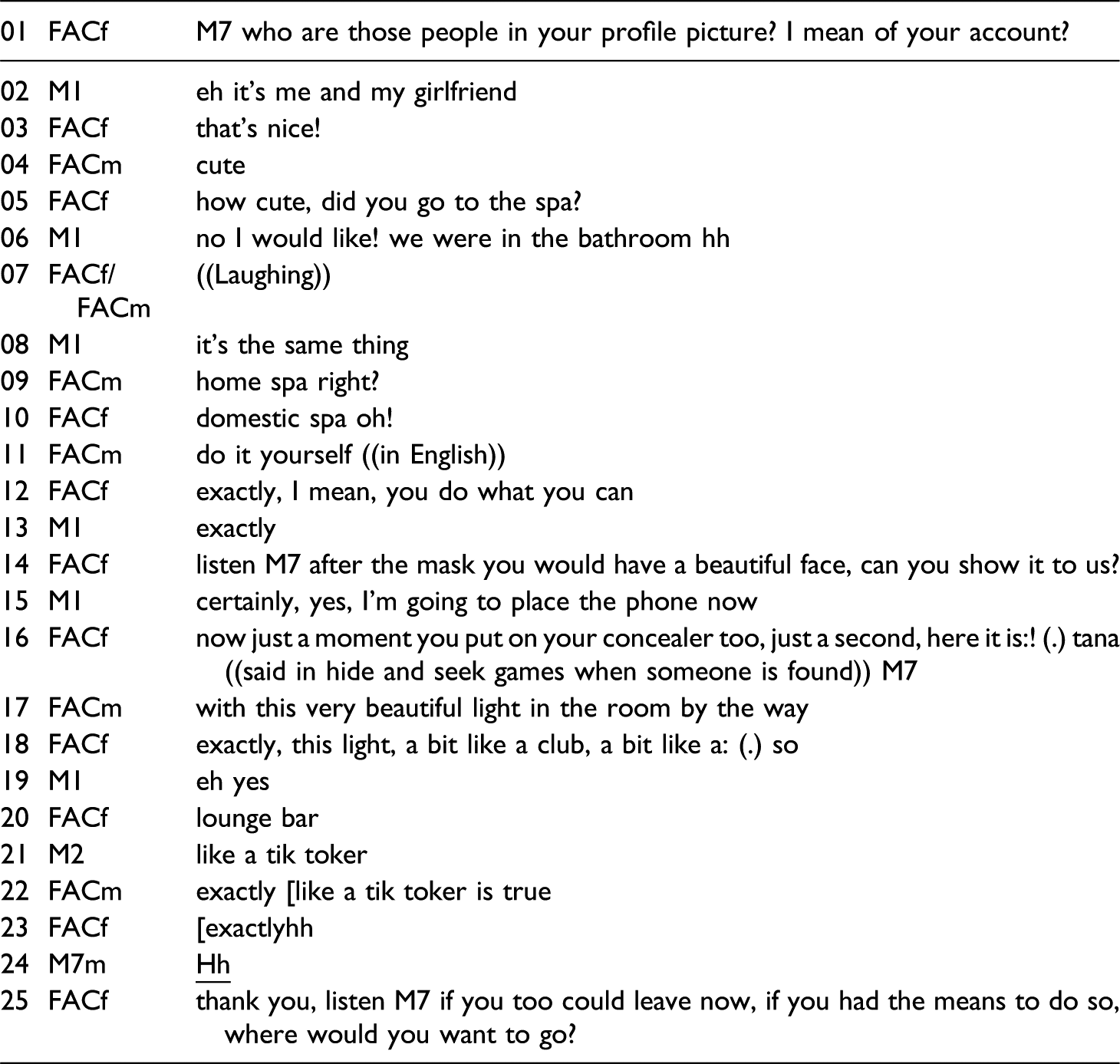
M1, a migrant adolescent, participates without showing his face. In turn 1, FACf asks for the identity of people shown in his profile picture, then both facilitators appreciate the picture. In turn 5, FACf starts a joke about the setting of the picture, thus initiating a sequence in which the facilitators and M1 play joke about this topic (turns 6–13). In turn 14, FACf asks M1 to show his face and M1 complies. His appearance on the screen triggers a second joke about M1’s way of appearing (turns 16–24), until FACf in turn 25 opens a new phase of interaction with a question. Extract 3 shows how the adolescent’s disembodiment is used to create a joyful and equal relation with the facilitators in a way which would not have been possible in face-to-face interaction.
Video-recording
Structural flexibility was also based on the adaptation of the research methodology of video-recording to digital platforms. Video-recordings and their analysis are used by several researchers working in classroom contexts as an important source of knowledge (Sparrman, 2005). Our method employs video-recordings to explore interactional processes and strategies of facilitation. Video-recordings are useful to understand both the results of classroom activities and the social processes that lead to these results. The analysis of video-recordings is supported by the transcription of extracts, and the analysis of these extracts allows the recognition of successful and unsuccessful social practices which can either enhance or jeopardise children’s agency in the interaction. Video-recordings are particularly useful in this type of research because they make it possible to analyse many factors (Pearce et al., 2010; Wilmes et al., 2018) related to interactional situations (e.g., background reactions and non-verbal communication) and the features of the environment in which the interaction takes place. Video-recordings can help the researchers to consider these and other factors related to the interaction, which might be overlooked during the activity, especially when research involves many participants, as is the case in a classroom. The use of digital platforms certainly shows methodological problems for video-recording, since synchrony and reciprocity of non-verbal communication get lost, but it also enhances this research methodology. Recordings on digital platform are more discreet compared to a camera in front of children in the classroom, which is often conceived in the literature as an element adding further differences in power relations (Sparrman, 2005) between researchers, on the one hand, and children, on the other. This adaptation of video-recording can contribute to creating favourable conditions for children’s exercise of agency.
Conclusions
The variety of research experiences which have been presented in the previous section shows how it is possible, and with what limitations, to encourage and investigate children’s exercise of agency in schools through the use of digital platforms. Facilitated activities and focus groups made the new conditions of life determined by the pandemic evident through the research plan of including children’s agency in the “new” ways of experiencing schooling. This research plan has shown a variety of ways of introducing structural flexibility through research and facilitation of children’s agency on digital platforms: (1) use of the chat function; (2) adaptation of ways of personal expression during focus groups, e.g. in nursery schools; (3) enhancement of personal narratives; (4) creation of relaxed relational atmosphere between facilitators and adolescents. In these ways, the use of digital platforms can reduce children’s perception of role performance, enhancing richer personal expressions; (4) adaptation of video-recording.
We have shown that research can support the exercise of children’s agency (see also Percy-Smith, 2018), and thus the transformation of the child from a medium into a responsible person able to position as a social agent. This highlights the importance of a collective engagement of adults (facilitators) and children as agents of both resurgence of personal responsibility in school and society and enhancement of structural flexibility in the education system.
It is clear that, with the pandemic, research projects focusing on classroom activities and the promotion of children’s agency have faced an unforeseen and unpredictable challenge. This challenge concerns adaptation of classroom activities to new conditions required by school closures, classroom quarantines, and social distancing. A particular challenge for research projects is methodological. They require flexibility to grab the unexpected and ability to deal with its effect on social structures, by transforming unpredictability in new knowledge. These research projects can have the important chance to pave the way to the opening of public space for children’s agency, thus facilitating their reflection on changes which deeply affect their lives and the inclusion from the beginning of their agency in school life. Sociological research highlights that the recovery of children’s personal responsibility in the public agenda requires the recognition of a space outside domestic and informal environments, in which children’s views and ways to deal with the unexpected and change are not treated as isolated from adults’ constructions of meanings and agency, but are intertwined with them and give valuable contributions to the understanding of this new historical condition based on a sudden outbreak of unpredictability.
In particular, in this time of exceptional unpredictability and uncertainty, it seems important that sociological research explores and compares conditions of structural flexibility in different social systems. Education is only one among many examples of the ways in which generalisability of personal responsibility can increase structural flexibility in social systems. The same type of research, looking for ways of enhancing structural flexibility, could be applied to healthcare, politics, science, the economy, and the media. Manifestations of agency and ways of showing personal responsibility are probably rather different in these systems, but they can converge in establishing conditions of structural flexibility.
A common feature of these conditions of structural flexibility might be dialogue, i.e. equal participation in communication based on empowerment of and sensitivity for all personal expressions (Baraldi, 2012). What facilitating dialogue may imply in different social systems and what obstacles it may face are still open questions.
Footnotes
Declaration of conflicting interests
The author(s) declared no potential conflicts of interest with respect to the research, authorship, and/or publication of this article.
Funding
The author(s) disclosed receipt of the following financial support for the research, authorship, and/or publication of this article: This work was supported by European Commission (GA 822400).
