




Abstract
This article compares democratic participation research in Scottish schools over a 10-year period. The comparison reveals how ‘organic’ aspects of decision-making arise in arenas of school activity. We argue that research heretofore has focussed on pupil councils to the exclusion of more everyday embedded and embodied choices. Primary researchers in the studies revisited data, drawing on their respective theoretical frameworks, to consider how new materialist perspectives offer ways to attend differently to the recursive, relational dynamics of participation.
Introduction
At a time when the shape of civil society is becoming uncertain, not least in Europe, it is important to consider how young people begin their participation in public decision-making (Ball, 2013; Biesta, 2019; Peters et al., 2017). Some reports indicate that young people are more discerning and resilient in this post-truth era (Buchannan, 2016) than older generations. However, this should not be accepted uncritically (Channel4.com, 2017; Thomas, 2011), for the complex dynamics of post-truth society increase the onus on educators to embed, not only media literacy, but also the capacity to effectively engage in deliberative processes (Mackenzie and Bhatt, 2019). There is a need for intergenerational dialogues (Wyness, 2012) to test media representations against everyday choices in order to be aware of how this interplay shapes cultures and political allegiances. Dewey argued that education for democracy requires the application of scientific methods to real world problems, the development of relational skills and an understanding of affective dynamics in civic discourse (1916). He expressed concern that, without these skills, media had the potential to put, ‘hate in place of attempts at understanding’ (Dewey, 1940: 45). Schools can be sites of public political pedagogy (Andersson, 2019) but as many have observed (Fielding and Moss 2011; Unger, 2005) exemplars of this seem fiendishly resistant to wide-scale implementation. One reason for this may be a lack of attention to the materiality of children’s lived experience of decision-making, or the lack of it, within schools.
Scotland provides an interesting context in which to examine these dynamics. In education policy, there are signs of new approaches being trialled that advance young people’s involvement in decision-making beyond the regimes of formal governance groups (Education Scotland, 2020) whilst at the same time the age of enfranchisement has been lowered to 16. Meanwhile, two distinctly different referenda that redefine Scotland’s place within the global community (one on independence in 2014 and the other on membership of the EU in 2016) have put a spotlight on political engagement.
In this article, where we analyse participation research in Scotland, we argue that the focus, heretofore, has been to emphasise formal mechanisms of representation, such as Pupil Councils and Youth Parliaments, to the exclusion of recognising more everyday embedded and embodied decision-making processes where identity choices are often grounded. In this article we look at three studies over a 10-year period for evidence of how the more mundane aspects of decision-making practices and opportunities relate to formal governance and representative participation mechanisms in schools.
Our findings resonate with the wider body of international literature that also calls for attention to this under-researched dimension of children and young people’s participation (Andersson, 2019; Larkins, 2014; Nolas et al., 2017). The significance of recognising participation across many spheres of engagement is important in that it alerts policy makers and professionals to attend differently to the everyday and on-going practices and relations with young people. Realisation of rights-based service provision of all kinds depends on this (Percy-Smith and Thomas, 2009).
For many years, critically engaged educators have found ways to embed in everyday activities children and young people’s decision-making (Graham and Fitzgerald, 2010; Tholander, 2007). Moll’s Funds of Knowledge work (1994) in the United States focussed on the expertise within communities and children’s expertise and decision-making within the curation of this. Problem-based learning, which has its roots in Nordic adventure playgrounds, similarly creates a learning space where students’ own individual and collective decision-making is the primary engine of learning projects (De Coninck-Smith and Gutman, 2004; O’Connor and Palmer, 2002). Nevertheless, as Nolas et al. (2017) observe, citizenship education largely remains fixed on tropes of programmatic and spectacular moments, overlooking the political activism that arises within assemblages of everyday meaning, practices and relational activity with its freedoms, choices and solidarities (Rose, 1998).
The context for participation in Scotland
Scottish curriculum distributes citizenship education across the curriculum. The broadest survey of school participation found that, by and large, the main mechanism of student decision-making remains the representational forum of Pupil Councils (Cross et al., 2009). Within Scotland’s national curriculum framework, Curriculum for Excellence (Scottish Government, 2011), the nature of these forums has diversified and developed alongside a range of other curricular mechanisms that aim to develop critical thinking, problem-solving and group work skills (Cross et al., 2009; Mannion et al., 2015; Scottish Government, 2011). However, there is growing evidence that these forums, rather than encouraging participatory engagement, can act to inoculate young people against any further civic participation (Cross et al. 2014; Kerr, 2006). This suggests that representational forums are not the seedbed of democracy their designers intend them to be. To understand why requires further attention to aspects of school systems that are too often overlooked.
In this rethinking through of research data, we bring together metaphors that helped us conceptualise participation spatially in order to understand the materiality of children’s everyday choices and chances to participate in schools. We each come to this work from distinct backgrounds as educational ethnographer, children’s geographer and legal and social policy analyst. Reading Barad (2007) encourages us to not only consider the different arenas (Mannion et al., 2015) of participation activity, but the arcs (Altrum Risk Research Team 2011) of effects that ripple from them, their intersections, amplifications and reverberations.
Theorising the materiality of participation
In the decade in which these studies unfolded a shift in conversation within the social sciences was underway. Although many academic practices still construct research as discrete bounded events, there is a growing appreciation that inquiry itself has an on-going interaction with its surroundings that is material and dynamic. Thus, we took the occasion of working together to take stock of how we had lived with our data and particularly with our concerns that some of the most difficult to document encounters whilst in the field were perhaps the most crucial. As Burawoy (2003) has pointed out, there is much to be gained by returning to previous research, particularly with the insights gained from further work and wider discussion with colleagues. Whether we consider Schön’s (1995) observation that problems of importance to society and people rarely come packaged in the discrete time bound frames of conventional research or Law’s (2006) critique of a social science in which ‘everything that fails to fit the standard package’ of research is ‘othered’, expanding the range of how research is done is more relevant than ever.
Barad also councils being mindful of previous work that shapes our own approaches. Her interest in moving from reflective to diffractive thinking sees the task not as an attempt to supersede conceptions, but as using them as resources to think with: My approach is to place the understandings that are generated from different (inter)disciplinary practices in conversation with one another . . . to engage aspects of each in dynamic relationality to the other, being attentive to . . . the constitutive exclusions that are enacted and questions of accountability and responsibility for the reconfigurings of which we are a part. (2007: 93)
Barad sees this ‘relational ontology’ as a diffractive process that is core to agential realism, where causality is not out there and other but entangled with the agency of our sense-making (2007: 90) and contrasts this with reflection as ‘setting one up as the other’s unmovable and unyielding foil. (2007: 92)’
Applying these insights to our inquiry, we were interested to consider how Gramsci’s (1971) argument that participation begins not at the representational formal level but at an organic level might have bearing on our data. How does this embodied level of agency underpin democratic engagement? If participation is to be understood from the ground up, a quite close material reading of school experience is required to understand the embodied, tacit ways they show up in habits and ways of being, before they become articulated in political speech or instantiated in political acts. More simply put, people, including children and young people, vote with their feet before they vote with anything else.
We would do well to attune our sensitivities to these dynamics in educational settings. To do so prompts us to look across our three studies at the informal and incidental places and moments of institutional life and to appreciate the multiplicity of affect that occurs within them for this is how the material, organic stuff of children’s coming into being as participants emerges. Deleuze and Guattari’s concern with the complexity and relative contingency of social relations that are precarious, contingent and temporary, also draw attention to this same strata of focus (Gilbert, 2013).
These theoretical considerations spurred our return to data with attention to the mundane, micro-actions where the reciprocity of respect plays out. In doing so, we were looking for where participation is voluntary and open to active involvement by students, where dialogue ‘allows the flow of conversation to be persistent and extensive across a range of shared concerns’ and is ‘undertaken in a spirit of mutual respect and concern’ (Burbules 1993: 80–82). Manifestations of this respect can be as subtly instantiated as within a glance, and as pervasive as where in the school one is allowed to be, or not be, as well as how one is allowed to be. We re-examine the case study data below for signs of this relational organic activity and the importance children and young people suggest it had for their understanding of more formal collective decision-making.
Methodology
In thinking again through the studies, we are seeking to understand the historical movement, wider context and social processes in which our contexts and theorising are caught up (Burawoy, 2003: 646). Even in the conducting of our initial projects, we were aware that there was more to understand than conventional methods would yield. For this reason, two of the projects incorporated opportunities for young people to have a range of ways to communicate their experience through workshops that invited their creative and embodied engagement with the research topic. Our practitioner experience meant we were aware trust is earned incrementally and that extending the time period and the range of media through which young people could get the measure of us as researchers was important. We were also aware that visual and poetic depictions might allow children to express aspects of their experience and views that were subtle and otherwise below the radar (Greene et al., 2018).
Study methodologies.
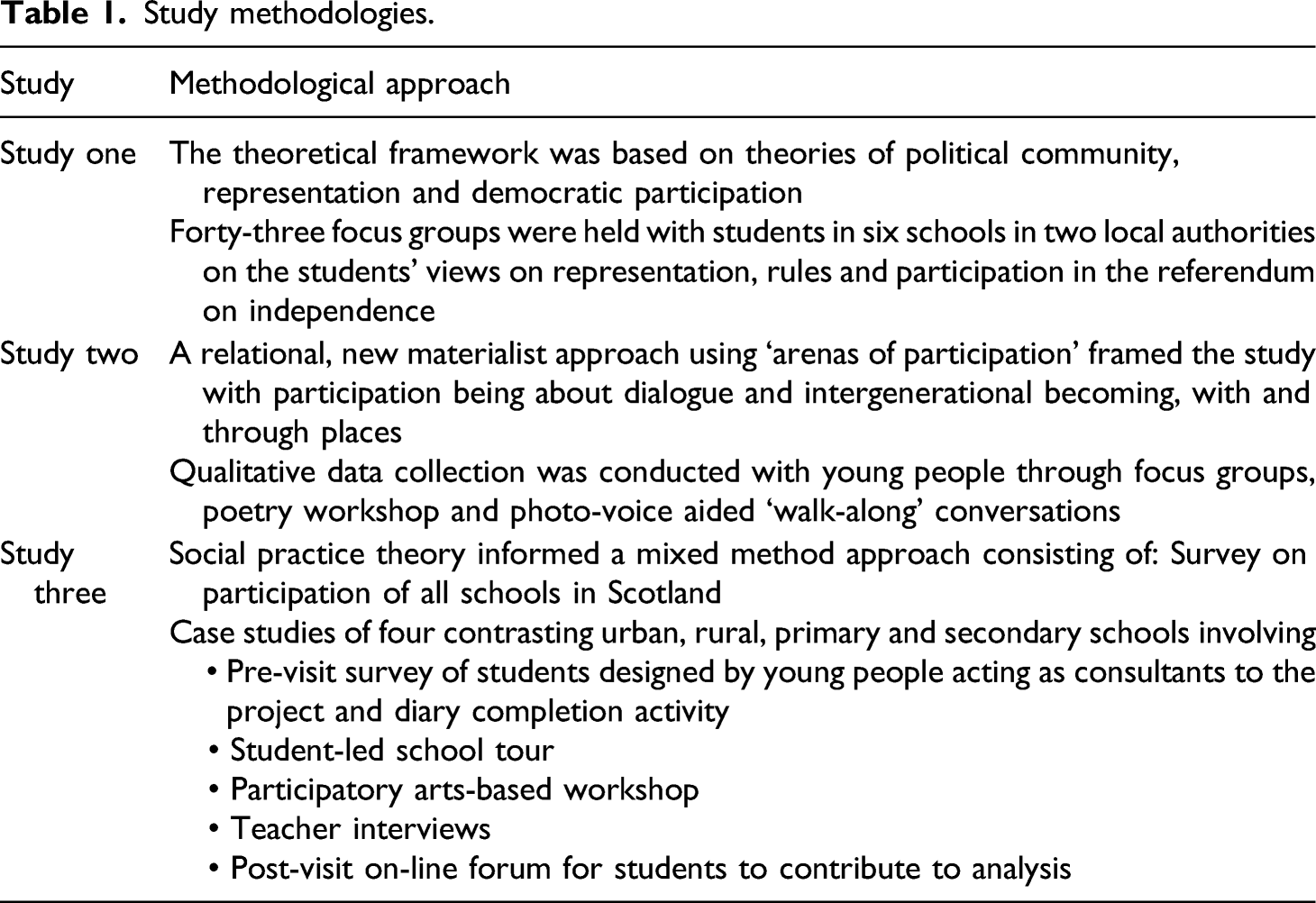
For this article, we revisited data analysis using the same processes of reading and re-reading the data archive, examining analytic coding as well as looking for emergent codes and continually checking the data carefully for disconfirming cases and other possible interpretations of data. We opened up this process to the other authors for their perspectives, skills and insights over four iterations of discussion and analysis.
In the absence of longitudinally funded research on citizenship education, comparing evidence across these projects makes it possible to identify emerging patterns and trends. If we accept fluid and partial assemblages comprise the reality of experience (Nolas et al., 2017), it follows that it is important to draw on evidence, no matter how fleeting, that captures instances of participation over longer frames of time.
To aid us, we drew on the framework of ‘arenas of participation’ to look at distinct spheres and purposes of participation across projects. The idea of ‘arena’ has roots in grounded theory (Clarke, 2005), situated learning (Henning, 2004) and the sociology of ‘public space’ (Mahoney et al., 2010). Arenas are connected to types of socio-material place. Any given arena is instantiated in physical, social, cultural and discursive ways in a given local setting, with participants and arenas co-shaping each other. From practice theory, we can say arenas of school life are types of intersubjective socio-material spaces. In adopting this lens to examine participation, like the editors of the special issue on circulation, children and childhood in this journal (Stryker and Yngvesson, 2013), we would stress the importance of a porous understanding of this analytic frame that sees children’s spaces as taking place where ‘movement is prescribed, yet flexibly perceived and embodied; imposed, yet flexibly enacted’ (2013: 297).
Research by Mannion et al. (2015) has led to guidance on Learner Participation (Education Scotland, 2020) incorporating four overlapping arenas of participatory activities as depicted in Figure 1 below: This four-arena framework of learner participation is incorporated within guidance from the curriculum policy body in Scotland (Education Scotland, 2020). Note: achievement in Arena 2 indicates real world contributions to the life of the school and community, as opposed to attainment which refers to academic success.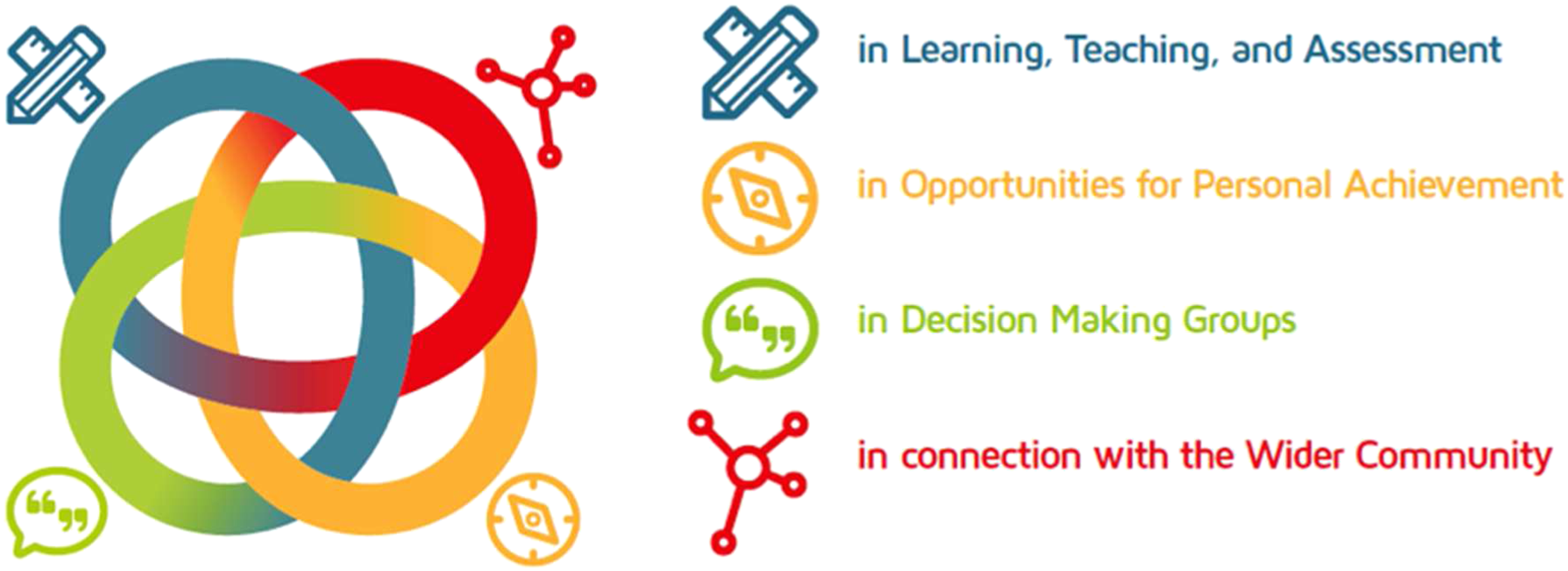
In taking an arenas-based approach our intention was to counter the risks of equating participation to that in formal governance. A narrow view of pupil or citizen ‘voice’, consultee or novice vote-caster can easily be co-opted by adult-oriented agendas and views of school improvement focussed on organisational reputation. Using an arenas-based framing, we looked for when children and young people were involved in many kinds of practices that amounted to having a say in how school life unfolded. These included formal decision-making, discursive interactions (such as discussions, dialogues and decision-making) but also activities that both express and constitute participation (for example, written work, art and design, gardening and play). This approach allowed us to capture more evidence on the lived experience of participation across the three studies, that is, the expressive processes embedded in everyday school life, whether audibly voiced or not, that emanated from an assemblage of human and non-human elements – the entanglement of people, material settings and school discourses.
Widening the lens for participation through examining the arenas of interaction
In each study, we examine activities to look at what distinct activity happened within different arenas, but also what interactions cumulatively happened across these arenas that effect a whole school culture, in Barad’s (2007) terms the intra-actions of the larger system.
Study one: The role of representation in political community in and beyond schools
The first case study lends insight into students’ views on the fourth arena that connects school to the wider community. One of the questions posed in the focus groups of the study was: Do you feel represented by people in authority? Focus group respondents made several observations about how they felt positioned in this arena. When asked if MPs (Members of the UK Parliament) and MSPs (Members of the Scottish Parliament) represented voters, a minority agreed that they did. Others noted that MPs do not listen, or if they did listen, nothing happened or it took too long for things to change (Shanks and Molloy, 2017). While some students stated that teachers and schools represent them, there was no consensus on this and a more or less equal divide between the focus group respondents. One student stated, ‘schools don’t represent us, we represent them’. It is often stated before students leave on a school trip, that they must be on their best behaviour as they will be representing the school. Here we see representing used to express contrasting positions of power, with one coming very close to the lowest scale of participation, that of window dressing. On a more positive note some of the students regarded teachers as their advocates or representatives within the school, for example, if the students were attempting to change a school policy or rule.
To explore the same theme of representation as it applied to relations within the school, most notably the arena of formal decision-making processes, participants were all asked, ‘do you have any say in rules and decisions in school? And is there any way of objecting to them’? Several student focus groups had mixed views in relation to this question and while students were involved they felt that their ideas and contributions were not taken forward (4 focus groups in 3 schools) or that it depended on the situation. Others were more sceptical about their Pupil Council stating that it was a waste of time and patronising and that students are not listened to ‘when it comes to big decisions’, or that students weren’t that interested in it and that Pupil Council did not meet often enough to be effective. Some focus group members explicitly stated they drew on other relational strategies, such as speaking directly to the school’s senior management, to teachers and house captains or to guidance teachers or student support as a more effective means of redress than the Pupil Council.
Students also picked up on the specific details of performance, such as aspects of the dress code, in response to considering representation. Members of an Advanced Higher Modern Studies focus group contrasted having a say in the design of the school tie and in organising charity events but not being allowed to make what they viewed as a more important decision, whether or not the school prom could be held in a city centre venue outside the school. Within another focus group, participants pointed out they could circumvent not having a say by recourse to their own actions. A focus group related that, as they did not have a say, the way to object to the rules was by not following them.
This analysis reveals that students experience contradictory application of representation. Whilst experiencing a lack of right to representation they nevertheless associate representation with a sense of duty placed upon them to represent the school in a good light. In regards to how arenas interact, the study revealed that activity between school and the wider community can be episodic. One example is a school that acts as the locus, using Arena 3 (decision-making forum within school), for the election of a youth member on the local Community Council thus enabling Arena 4 (participation in wider community governance). However, respondents also highlighted where there were tensions between Arena 1, what they were taught about what good democratic processes require, and Arena 3, the paucity and tokenism of those processes within the school.
Study two: Understanding how participation supports achievement and attainment
The second study explored young people’s own sense of how participation supported their achievement and attainment in Scottish secondary schools in areas of deprivation. The study lent insight to the Arena 1 (learning, teaching and assessment). For this article, we focus on a subset of the data: experiences found in a range of learning spaces including classrooms playrooms, sports space, laboratories and libraries.
It is worth noting that this study collected data from young people in secondary schools that were gaining better than expected attainment rates for their socio-demographic designation. Young people explored what participation may have to do with their sense of ‘doing well’. Students spoke about how they valued participation in learning in particular ways. They indicated they valued collaborative and experiential ways of working that allowed them to take responsibility. Student: There’s a lot of learnin’ where the teacher actually gets you to go up and sometimes actually try and teach the class. And there’s a lot of collaborative learning. [School C]
Intergenerational dialogue characterised interactions in most cases. Students valued the opportunities for in-depth conversations with teachers about how they learn and progressed. Student: Our maths teacher asks how we are with things, and if we’d like it taught a different way, or she’ll go over things for us. [School G]
Student–teacher relationships were key to engagement especially within the formal curriculum: Student: The good relationship with the teacher makes you feel comfortable asking for extra help. […] Student: The whole school is a group of friends. We obviously have our disagreements... but we are all friends. We all have laughs; [it] creates a good vibe, a good atmosphere. [School E]
They explained how in-class cultures of respect supported this. Researcher: What happens in class that makes your school distinctive in its achievement and attainment? Student 1: I feel there’s a really high level of mutual respect, that students listen to the teachers, but the teachers listen – and value – the students’ points of view and things to say, so it makes you more confident and you’re open with your ideas. Student 2: A teacher will never pass a pupil off – they don’t give up, or anything like that. They’ll always push you…
Across schools, there were many systems for tracking student achievement and attainment that meant staff knew how each student was doing and efforts were made in many ways to ensure students were not forgotten and helped to ‘stay on track’ in order to ‘do well’.
Analysis showed young people valued engaged forms of teaching and learning: active, hands on, experiential learning involving personalisation and expressions of choice. They also valued opportunities to influence and participate in decisions about the approaches taken in regard to subject choice, content, timetabling, structures and flow of lessons. For example, (see Figure 2 below) students in one school could explore and publicise their favoured educator qualities. Students valued being asked to explain the ‘Qualities of an Excellent Teacher’. Student-taken photograph. (School B).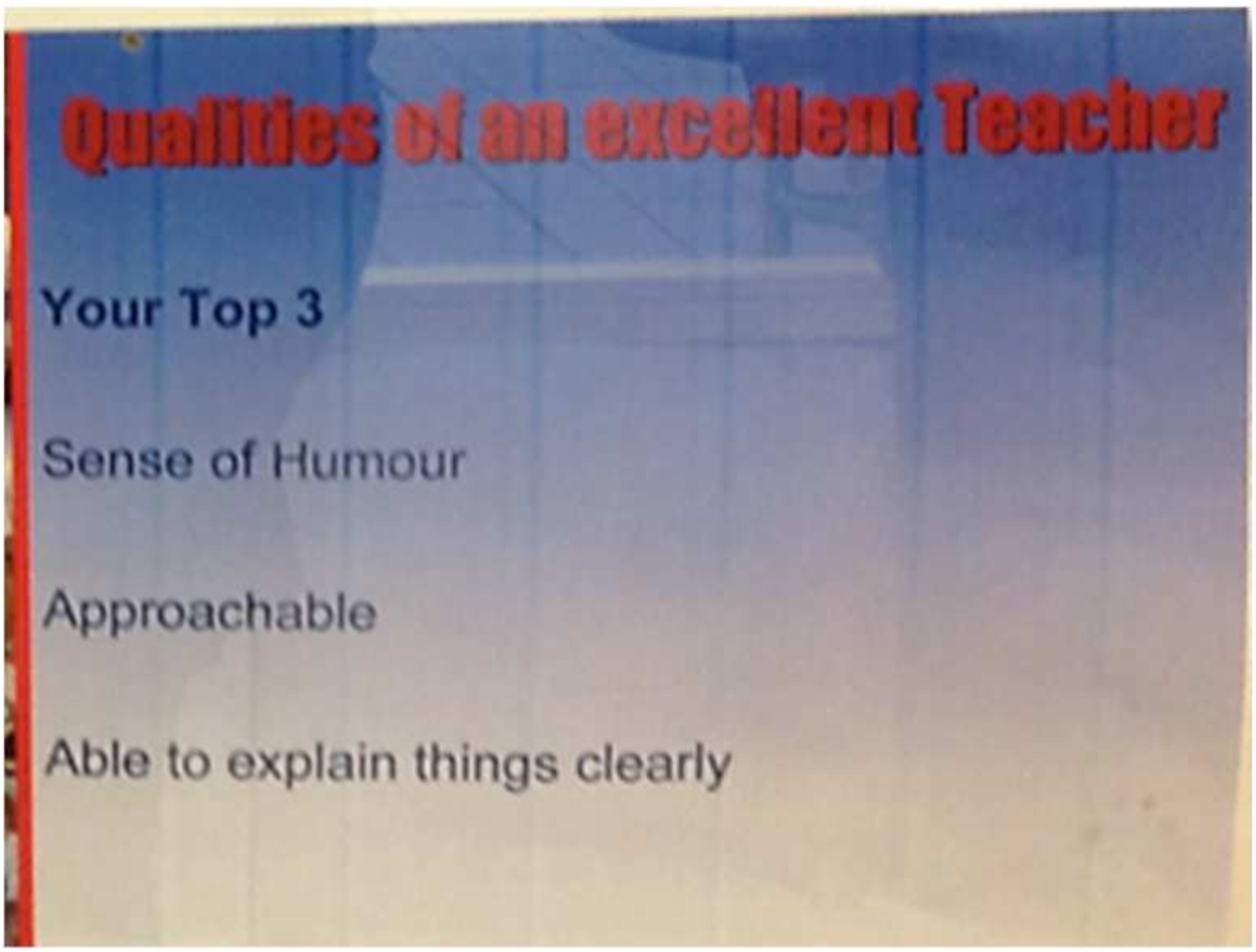
Students indicated that participation in school life was often experienced in less obvious, everyday, mundane ways through activities in places that might appear otherwise insignificant. Many kinds of interaction were deemed important in supporting achievement and attainment: school trips, quiz nights and time to chat informally to staff were all valued contexts for having a say and shaping school culture. As Figure 3 (below) exemplifies, it can be the mundane assemblage of students and teachers in everyday spatial contexts (‘the base’) with everyday materials (chocolate and handkerchiefs) that affords the valued participation of a young person in school life, enabling them to have a say in matters that affect them. The student-taken photograph of this school notice captures the importance placed on staff-student support as a basis for achieving and attaining.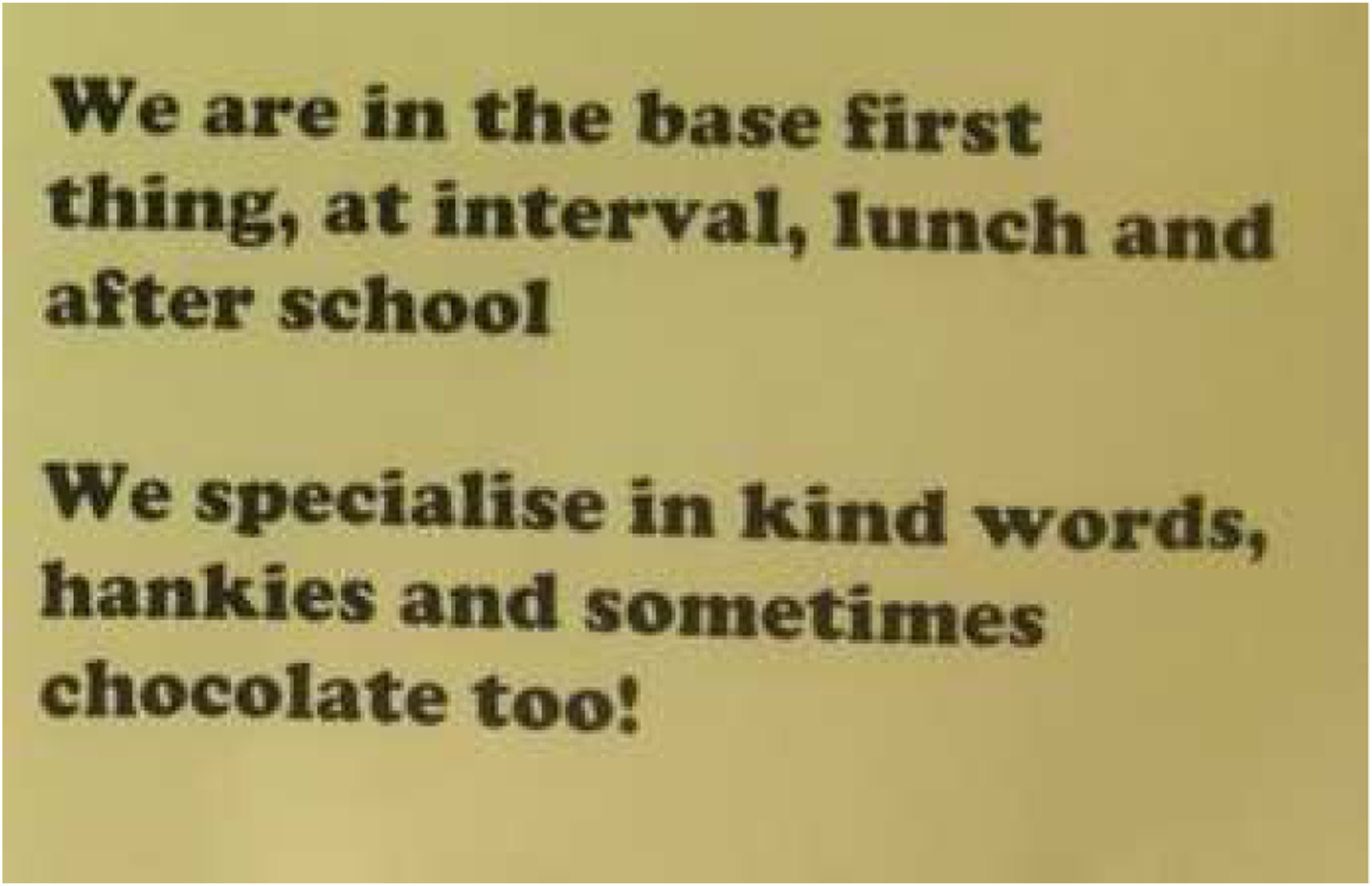
Importantly, in all schools in study two, students had ways of more directly helping to shape the school curriculum. Such participation spanned activities and interactions well beyond the formal work of Pupil Councils. Across the four identified arenas, study two found that inclusive and respectful relations appeared to form a bedrock for various forms of participation.
Study three: Embedded democratic school governance
The example we turn to from the third study is an exceptional rather than typical case. It is worth looking at for the lessons it holds for possible ways forward in which formal and informal practices more fully instantiate respect and the sense of citizenship this engenders. This primary school’s approach to embedding participation in all arenas of school life culminated in a School Parliament. The Parliament involved the entire school community debating and then voting to set goals for the school for the following year. Each person in the school community, adult or child, had equal voting rights. The parliament was supported by a project based curriculum sequenced across classes that encouraged team building. It is difficult in the limited space here to do justice to the vivacity of the problem-based team learning observed during the case study visit, where primary two groups had heads together agreeing the best use of a windowsill garden space and primary five groups were reporting back to the whole class their strategies to devise a rocket launch. This opportunity to understand roles within group projects and make decisions together along with a phased critical thinking curriculum, paved the way for the Parliament to effectively entrust the majority stakeholders in the school, that is, the children, to have the most say in the Parliament deliberations. In tour interviews and within the arts-based participatory workshop of the study, children often described or depicted learning from other students and saw the project based ‘challenges’ as an activity through which they learnt to respect a widening range of abilities of their peers. In effect, these challenges provided a microcosm for testing ideas and solutions as preparation to propose larger, more permanent and financially significant decisions when participating in the School Parliament. Thinking again with the conception of organic participation, it is interesting to note the mutually reinforcing dynamics of these activities that resemble the organic gardener’s use of companion planting. This school’s approach demonstrated the ground work in-class activities and school ethos that underpinned a participatory democratic process in which the School Parliament created the agenda that its representative body, its pupil council, played an important role in facilitating, thus making it more than a token gesture.
Though students had been involved in the improvement of several aspects of the school, including behaviour policy, curriculum development, learning resources, and play facilities, the decision about which students expressed the most excitement was the decision to dedicate an entire classroom to use as an art studio for the school. When the students opened the door to the studio and ushered us in, their words made evident their pride in their achievement, but it was their eye contact that conveyed the most impressive message. It said we know the difference between pretend power and consequential power, between playing at making decisions and making ones with real effect. We know this surpasses adult expectations of us and we expect you to be surprised. In effect, students had used the formal participation mechanism to provide themselves with greater opportunity to experience and enjoy organic moments of participation. Given the opportunity, they chose to allow themselves greater freedom of expression within a protected space that had permanency rather than the fleeting quality art activities otherwise commonly have within school culture.
Reference to the art studio was prominent in every opportunity that children had to speak within the study. The studio was used: to create displays that illustrated progress in achieving other Parliament goals, such as that depicted in Figure 4 that celebrates the band concert’s efforts to raise funds for a running track around the school; to create props and scenery for school shows; for class art activities and for students’ individual creations. Within the study’s art workshop children had the opportunity to use a range of collage materials to depict what participation meant in their school. They depicted very mundane decisions such as the one to befriend a fellow student depicted in Figure 4. They also took the opportunity to explore, ‘what would a school look like where you are head teacher’? A common feature of those who used this prompt were schools with a dedicated art room. It is striking that, given authority, they would replicate the choice children had made in their own school to create more room for affective, tactile, material exploration of aesthetic choice. Scaling Up Decision form micro to macro. At the micro-level, within the research art workshop children depict the importance of everyday relational decisions to befriend each other in panel 1. At the macro level, the school display board depicts where use of the art studio has been made to celebrate school achievements in panel 2.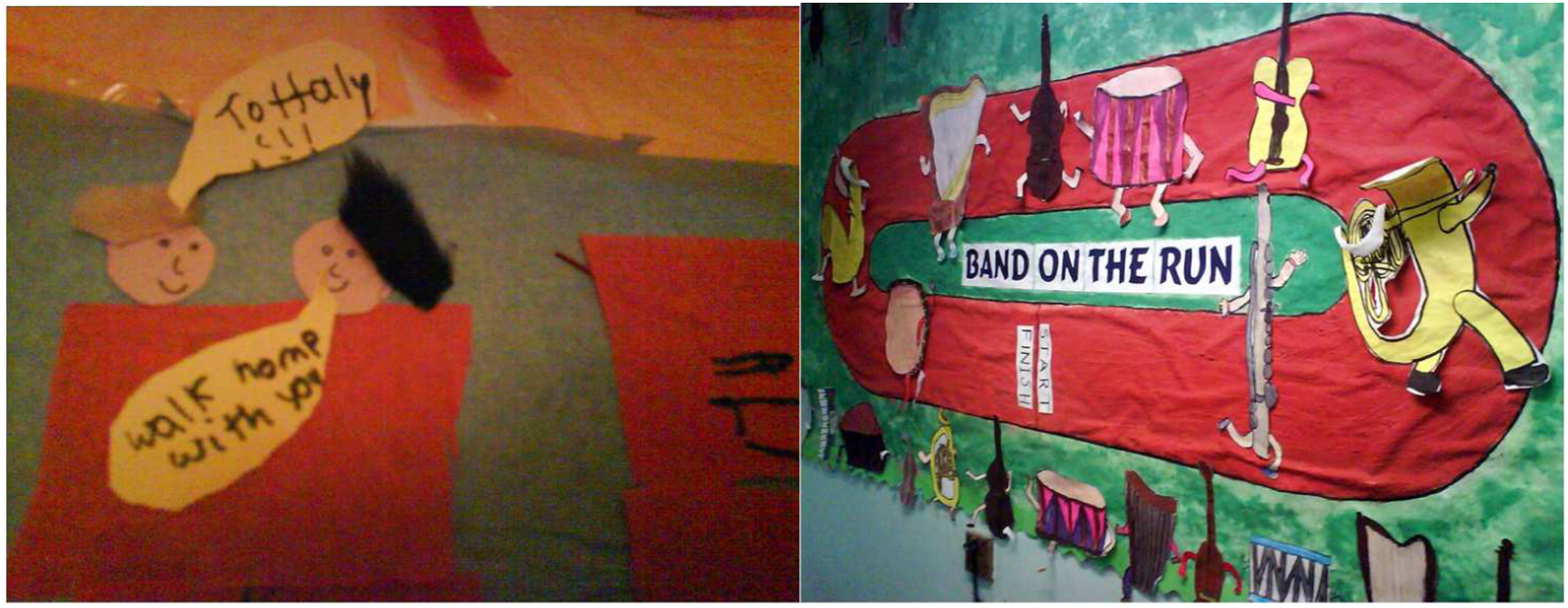
On the back of the blueprint of the school where they were head teacher, one student listed the kinds of activities that would happen in their school. Beginning to read down the list with the student led to a discussion which lent interpretive insight into the drawing. Two of the items were • By students’ behaviour choices are made • Build confidence into the students (school shows).
When asked how school shows would build confidence, the student explained that shows were a collaborative effort of performers and those who contributed to making the set. This had a particular positive connotation for this student who explained it provided a space for a student to be recognised and to contribute. In a sense this student was arguing for the importance of interacting participation across a range of arenas and opportunities. The flow of agency she depicts in her narrative of the importance of both art studio and place where its products can purposefully be used resonates with a posthumanist reading of performance (Barad, 2007) where the emphasis is on the mutual forming that performance bring about. The student made particular connections between spaces to create confidence and a wider choice of relationships and roles these afforded. For this student, art, with its playful connotations, served as a conduit towards what could be seen as more serious or higher stakes participation within the political arena of the school. Here, Barad’s (2007) concept of diffraction helps us see the ripple effect these students are valuing in their participation. In our concluding remarks, we return to discuss the arcs of such ripples.
Cross-study discussion
Bringing the studies together, we can identify some emerging patterns with a focus on how dynamics in arenas of participation affect each other. Evidence from Study Two and Three suggest respect and confidence had a mutually reinforcing effect that had the impetus to cross arenas. Students articulated the importance of reciprocity: in how they valued it in Study Two and Three and how they resented its lack in Study One. Making space for students to take increased responsibility is a recurrent theme linked to respect. Again, looking across studies we find students articulating the positive effect this has when it percolates across arenas and the negative impact when it is truncated. In Study Three students valued it when different forms of participation reinforced each other and developed a meaningful culture where leadership roles could be rehearsed, revised and extended. We could go so far as to suggest evidence in Study One reveals students make their own spaces for challenging lack of representation, drawing on a wide range of allies to make change when the formal mechanisms are felt to be ineffective.
In concluding our analysis of arenas, it is useful to consider the difference in scale of activities that are interacting. Looking across studies we see where students draw attention to small details as illustrative of important relational dynamics be that school ties in Study One or more fleeting encounters with staff depicted in Study Two. Although Barad (2007) cautions against taking the metaphor of diffraction too literally, in this instance the diffraction of waves does provide a useful insight. Arcs of Impact (Altrum Risk Research Team 2011) is an illustrative tool that maps the range of decision-making processes from micro-decisions that a person makes and acts upon immediately, to ones that are made on a larger scale. Figure 5 is useful as it visualises how long and extenuated arcs can become. And yet, these long-term decisions are being made in an environment where micro- and meso-level decisions refract with them, like the overlapping circles that raindrops trace out on water. Arcs of Participation across scale of involvement. (a) Individual decision-making, no negotiation or delay necessary, such as individual learning choices. (b) Small group decisions with quick feedback and ability to act such as within group work. (c) Decision-making within same organisation, possibly requiring levels of decision-making with further reaching consequences over longer periods of time, such as pupil councils. (d) Decision-making across organisations with more complex levels that may be lengthy and opaque, such as school input into decision-making through government policy channels or in the local community or where crucial decisions may be more informal, embodied and difficult to demarcate. Note: Arcs of effect can ripple across each other as they reach across different arenas to either amplify or dampen their consequence not unlike ripples across water, (photo by Anna Turolla).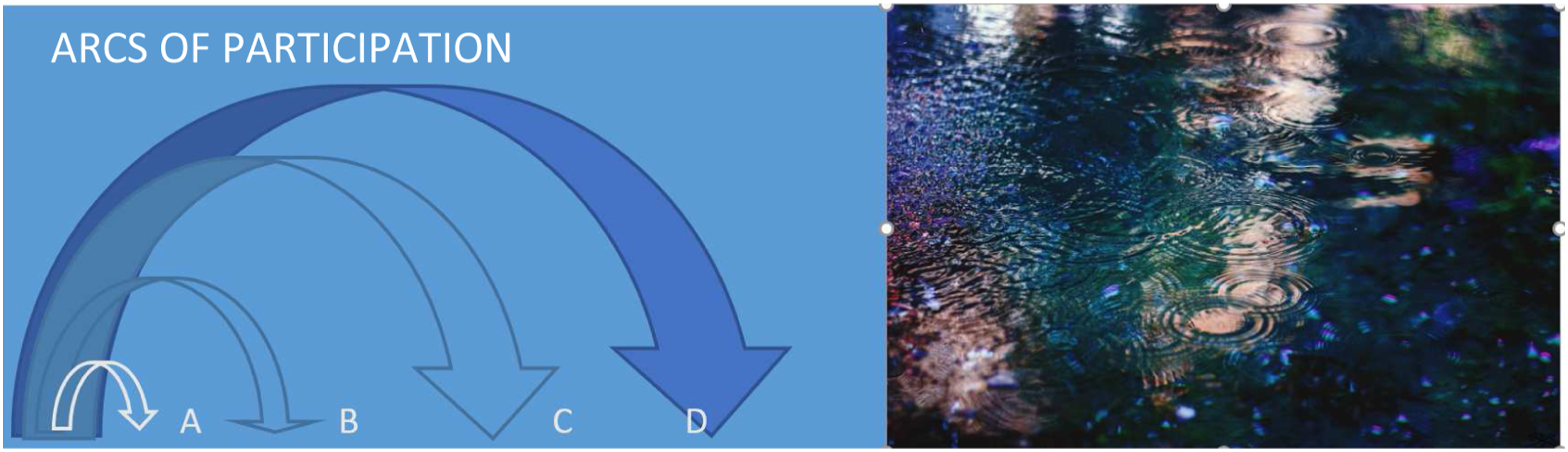
Each different category of arc involves more people and thus expands into more space and requires more time. However the size or length of the decision should not be equated with the strength of their impact or their efficacy to transmit change. It is important to bear in mind all arcs are comprised of socio-materialist activity and have socio-materialist consequences. As part of complex interactions their signatures are unique and the dynamics of their influence across scale unpredictable. We suggest in the caption above how different arcs may be generated within different arenas.
Arenas are sites of the emanation of decision arcs at different levels of scale. The formal curriculum takes place at the micro-scale as students internalise it and on the meso-scale where students negotiate with individuals and groups of students. Rarely does the formal curriculum involve the school body acting as a whole. In contrast, formal decision mechanisms largely take place at the level of whole classroom or cross school fora. Potentially activities that involve the school in interaction with the community have the widest scope of scale from small interactions between individuals to the level of engaging in national politics. We can consider the small action of Greta Thunberg sitting alone on her first ‘School Strike’ (which led to global impacts for school systems) as an example of these rippled connectivities in relation to participation across scale.
Analysis across studies reveals a complex picture. Some forms of resisting rules take a very embodied form, such as the decision not to obey or to ignore rules. This can happen on a micro-level and involve consultation with no-one. However, if it entails resistance to school dress code, one individual’s decision not to conform is quickly visible and as such becomes a resource that enables other individuals to also make choices conveyed in the exchange of a glance. Here, we see an instance of organic participation in Gramsci’s terms and of the interdependency of choice (Larkins, 2014). In a way, similar to reading if school ties are being worn or not, students also read embodied stance and counter-stance as instantiating respect or not. In this way decisions made at a micro-level are read publicly and influence decisions made at all higher levels of interaction crucially influencing the decision whether to trust and take part in formal decision-making or not. It is worth pausing here to consider how this kind of lateral decision-making can be said to take place in-between individuals rather than being attributed to individual decision makers (Spector and Kidd, 2019).
Moving beyond resistance to proactive agency requires verbally negotiated change. We see many examples of students verbally negotiating change within specific moments of curriculum articulation. In Study Two an ethos of respect, whilst attached to no specific formal mechanism, is articulated as nevertheless something that permeates the school as a whole. Encapsulated in the student’s remark: Student: You wouldn’t treat someone badly – so you wouldn’t treat a teacher badly.
In Study Three, we see interlocking formal mechanisms which students credit with supporting a multi-modal development of confidence and agency. If we consider the concept of diffraction (Barad, 2007), that is, the understanding that interactions always involve multiple intersecting actants, human and material, that resemble interacting wave fronts, we would expect to see consequences of activity in one arena rippling out to influence activity in others whilst themselves also being affected. That trust and respect, or their deficits, suspicion and disrespect, are what flow between arenas and across scales of interaction to create the ethos of a school as a whole is a dynamic requiring more attention. Agential realism provides relational acuity that can shift the focus of analysis so that what amplifies and dampens these dynamics emerges.
Conclusion
As these cases illustrate, relational and intergenerational (Mannion 2007) activity plays an important constitutive role in the life of a school and young people’s experience of its culture, democratic or otherwise. Our analysis suggests that thinking through all four arcs of impact (A-D Figure 5) as they cross the identified four arenas (Figure 1) can help educators think outside the silos of curriculum and practice to better appreciate these dynamics and their very real, visceral consequences for children and young people’s lived experience and life choices. Arcs of participation across arenas are starting points to think through interactions beyond notions of formal governance in ways that are more mindful of everyday lived experiences and mundane relational encounters as they create ripples of effect in democratic cultural enactments. This kind of analysis also takes us beyond a binary view of participatory democratic curriculum as simply ‘either/or’: formal/informal, within school/community-linked or activism/learning.
Being better attuned to these dynamics can help students become equipped for new forms of democratic engagement developing outside of schools. The conception of citizenship as an assemblage of affective and ethical relationships between a fluid self and a networked society (Pedwell, 2017) is articulated in research on new publics (Mahony et al., 2010) and new social movement formation (Bayat, 2010). As Anderson and Graham (2016) note, within these new frames of political activity the dynamics and processes of people coming together over what matters is largely emergent and unpredictable. In examining these complexities, it is important not just to sharpen theoretical concepts, but to shift to more proactive scholarship and educational practice. As Menser frames our dilemma in this moment, we must move beyond critique to: identify best practices (to) help improve the weak ones and protect the strong ones, so that, in this moment of global chaos and system change, creating a more democratic, sustainable, and inclusive system is not a speculative fantasy but an engaged and multisector strategy. (2018: 6)
As he concludes, climate change may well make it necessary to move from theorising preoccupied with why participation will not work, to what can make it work. The Fridays for Futures student-led movement as we write this article is already extending arenas of learning and arcs of decision-making for wider impact. Policy makers and educators alike would do well to examine what we might do differently to better support young people as they engage with them. In the course of our professional activities we are beginning to see new forms of decision-making that take a crowd-sourcing approach to involving students in decisions. For instance, schools where Pupil Councils are opened up to all who volunteer to take part. Here, head teachers are taking the initiative to reconfigure opportunities without waiting for permission from higher levels of policymaking. Lateral initiatives like this taken by teachers can be a powerful lever of educational ethos transformation. Such actions loosen modernist assumptions and enact experimentation with more self-organising, organic even, modes of deliberation. Lessons from these studies suggest that the amplification of such experiments across different arenas of school life could have mutually reinforcing benefits.
Footnotes
Acknowledgements
The three co-authors wish to acknowledge the contributions of co-researchers on the antecedent studies (cited herein) which made this cross-project research possible, the funders and the young people as respondents and other facilitators in the three respective projects. The views expressed herein are our own.
Declaration of conflicting interests
The author(s) declared no potential conflicts of interest with respect to the research, authorship, and/or publication of this article.
Funding
The author(s) disclosed receipt of the following financial support for the research, authorship, and/or publication of this article: Study Two was funded by the Children and Young People’s Commissioner Scotland. Link: https://www.cypcs.org.uk/ufiles/achievement-and-attainment.pdf. Its follow-on project was funded by Education Scotland (2018). Link: https://education.gov.scot/improvement/Documents/learner-participation.pdf. Study Three was funded by Teaching and Learning Scotland. 