




Abstract
The Iron Swords War induced severe psychological distress in the Israeli population. This study examined the relationship between perceived threat, psychological distress, and the volunteering behavior of Israeli citizens at the start of the war. We hypothesized a positive correlation between perceived threat and volunteering, with psychological distress playing a mediating role. We found that higher perceived threat was associated with increased psychological distress, which predicted greater volunteering activity. These findings suggest that volunteering in wartime may serve as a coping mechanism for psychological distress stemming from perceived threat. The results contribute to understanding prosocial behavior in times of national crises.
Keywords
Introduction
Volunteering involves prosocial activities where individuals freely donate their time and efforts to benefit others, groups, or organizations without expecting compensation (Wilson, 2000). Volunteering is often perceived to be driven by altruistic motives, but research on volunteer motivation shows that it also benefits the volunteer (Karhina et al., 2017). Grounded in functional perspectives on the motives and purposes underlying human behavior, Clary and Snyder (1999) identified six personal and social functions that volunteering may fulfill (see also Clary et al., 1998; Stukas et al., 2016). These volunteer motivations can be broadly categorized into altruistic-ideological and egoistic-instrumental (Kulik, 2017). Altruistic-ideological motives focus on helping others, and volunteers are driven by the desire to assist those in need, often expressed through social solidarity and commitment to community welfare (McLennan & Birch, 2009). For example, studies of volunteer firefighters found that community-oriented motives dominated their reasons for volunteering (Aitken, 2000; McLennan & Birch, 2009). By contrast, egoistic-instrumental motives aim to fulfill personal needs and self-oriented goals (Kulik, 2017). These can include career enhancement, personal empowerment through developing new skills, escaping from negative feelings or reality, and strengthening social networks (Clary & Snyder, 1999; Francis & Jones, 2012; Kulik, 2017). Research has shown that the two types of motives often coexist, with volunteers reporting multiple reasons for their service (Domaradzki et al., 2022).
In wartime and following terror attacks, volunteering motivations also vary, combining both altruistic and egoistic elements (Hapon et al., 2024; Kulik, 2017). Studies have shown that in addition to altruistic values and the desire to help, feelings of compassion, anger, and a strong desire to act often drive individuals to engage in such prosocial behavior (Domaradzki et al., 2022). Yet, even in crises, volunteers may also be motivated by egoistic considerations such as seeking personal growth, developing new skills, or strengthening social connections (Piferi et al., 2006; Wilson, 2000).
Common volunteering activities during crisis include donating time, money, blood, or food; providing shelter to displaced persons or rescue workers; offering professional services such as counseling; and assisting with logistics and transportation (Adams & Boscarino, 2015; Kulik, 2017). Volunteers may engage in tasks such as searching for missing individuals, correcting misinformation, organizing help for those in need, and providing support services at disaster sites (Ruohonen & Backholm, 2023). Volunteer activities can take on both physical and digital forms. During military conflicts, physical volunteering often involves providing tangible aid and resources to support military operations and assist the wounded (Kulik, 2017). Digital volunteers can use social media platforms to collect data, correct misinformation, organize and coordinate relief efforts, and recruit additional volunteers (Ruohonen & Backholm, 2023). These prosocial behaviors often emerge spontaneously as citizens seek to supply unmet needs in their communities in times of crisis (Domaradzki et al., 2022).
During routine times or crises, volunteering may affect the volunteers’ well-being and psychological state (Han et al., 2020; Wilson, 2012). Research on volunteering during crisis and in wartime has found an association between volunteering and higher levels of psychological distress indicators (such as post-traumatic stress symptoms, anxiety, and depression) in volunteers (Pidbutska et al., 2023; Shevtsova, 2024) but the causal direction of this association is unclear. Volunteering may expose individuals to traumatic situations and human suffering, potentially leading to secondary traumatization (Adams & Boscarino, 2015; Pidbutska et al., 2023; Shevtsova, 2024). Alternatively, pre-existing psychological distress may motivate individuals to volunteer as a coping mechanism or to find meaning in difficult circumstances (Chudzicka-Czupała et al., 2023; Wilson, 2012). The latter explanation is supported by findings suggesting that volunteering can have positive effects on mental health, such as reducing negative feelings and strengthening social networks (Chudzicka-Czupała et al., 2023). However, the relationship between psychological distress and volunteering in wartime remains unclear. For example, Hapon et al. (2024) reported higher scores for psychological distress indicators of Ukrainian volunteers compared with their Polish counterparts during the Russo-Ukrainian war, although both groups volunteered with Ukrainian refugees. Such differences raise questions about the underlying mechanisms at work. This study investigated the relationship between psychological distress and volunteering during the October 7, 2023, events in Israel and the subsequent outbreak of the Iron Swords war. By examining these relationships in a war crisis situation, we contributed to the understanding of the psychological processes underlying volunteering in times of war and crisis.
October 7, 2023, Events and the Outbreak of the Iron Swords War
On October 7, 2023, Hamas launched a large-scale attack on Israel from the Gaza Strip. The assault began at approximately 6:30 a.m. with a massive rocket barrage targeting civilian areas in southern and central Israel. Simultaneously, Hamas militants infiltrated Israeli communities surrounding the Gaza Strip, leading to violent confrontations with residents, law enforcement, and the Israel Defense Forces (IDF) (Elyoseph et al., 2024). The attack resulted in more than 1,400 Israelis killed, more than 4,600 injured, and more than 230 taken hostage to Gaza (Elyoseph et al., 2024; Levi-Belz et al., 2024; Paluch-Shimon et al., 2023). This incident marked the worst terror attack in Israel since the establishment of the State in 1948 (Paluch-Shimon et al., 2023; Yadlin & Evental, 2024). In response, Israel declared war officially for the first time since 1973 and launched the Iron Swords war against Hamas in Gaza (Barnea, 2024).
The events of October 7 and the subsequent war have led to a significant sense of threat and created substantial psychological distress in Israeli citizens (Levi-Belz et al., 2024). Residents living in proximity to the conflict zone were forced to evacuate their homes, and rocket launches targeting civilian settlements from southern Israel to its center killed and wounded civilians and damaged property and infrastructure. Similarly to other modern wars, the civilians’ life routines were disrupted (Kulik, 2017). Numerous alerts to seek shelter increased the sense of threat and distress. A cross-sectional study conducted on October 11–12, 2023, revealed that more than 70% of Jewish Israeli respondents reported experiencing at least one anxiety symptom related to news consumption about the war, with approximately 21% reporting all four measured anxiety symptoms (uncontrolled fear, physiological hyper-arousal, fearful thoughts, and sleeping difficulties) (Kaim & Bodas, 2024). This psychological effect was observed across various demographics, including different political affiliations, suggesting that the threat was perceived as existential to all sectors of the Jewish population in Israel (Kaim & Bodas, 2024). The increased need for mental health support was evident in the response to a mental health support project launched by the Israeli Mental Health Nursing Association for Healthcare Providers following the October 7 events (Segalovich et al., 2024). The findings indicate a widespread and acute psychological response to the crisis by Israeli citizens.
The events of October 7, 2023, and the war triggered an unprecedented surge in volunteerism across the country. A survey conducted by the Israeli Volunteering Council revealed that 49% of the Israeli population engaged in volunteer activities in the weeks following the outbreak of the conflict (Israeli Volunteering Council et al., 2023) and 28% of respondents reported volunteering exclusively during this crisis period, having not previously engaged in such activities (Bagno, 2023). The exceptional nature of this response is further evidenced by the documentation of more than 1,000 civilian initiatives across Israel since the onset of the conflict (Israeli Volunteering Council et al., 2023). Some volunteers participated as part of organized groups through youth movements, student unions, NGOs, workplace initiatives, academic institutions, local authorities, and various aid organizations. A substantial portion of volunteers, however, participated through spontaneous, independent, or private initiatives, or through informal grassroots organizations. The volunteering activities encompassed diverse areas, including equipment and monetary fundraising, collecting and preparing supplies and food, transportation and logistics support, agricultural assistance in conflict areas, sending encouraging letters to soldiers and security forces, participating in international advocacy efforts regarding events in Israel, and supporting conflict-affected areas through product purchases (Goldberg, 2024; Israeli Volunteering Council et al., 2023). These data indicate a substantial shift in civic engagement patterns, with a large portion of previously inactive individuals becoming actively involved in emergency response efforts (Goldberg, 2024).
The high rates of volunteering that emerged in response to psychological distress and feelings of threat following the October 7, 2023, events and the outbreak of the Iron Swords War raised questions about the relationship between volunteering, perceived threat, and psychological distress. Specifically, it prompted an inquiry into whether the volunteering activities of Israeli citizens were connected to the intense feelings of threat and distress they experienced or perhaps even stemmed from them.
This Study: Psychological Distress, Threat Perception, and Volunteering at the Outbreak of the Iron Swords War
Previous studies have found an association between psychological distress and volunteering during war or in the aftermath of terrorist attacks, but the association between war-related threat and volunteering remains largely unexplored. Research on the relationship between trauma exposure and prosocial tendencies (Frazier et al., 2013; Vollhardt & Staub, 2011) has found that traumatic events (such as war, terror attacks, pandemics, and nature disasters) often create a sense of threat in individuals (Grimalda et al., 2021). The studies indicated that engaging in prosocial behavior and helping others after traumatic events provides significant psychological benefits and can serve as an effective coping mechanism for the helpers (Frazier et al., 2013; Xu et al., 2024). Altruistic behavior can help restore a sense of meaning and purpose, which is often shattered by traumatic experiences (Janoff-Bulman, 1989; Politi et al., 2023). Prosocial actions during crises can also enhance one’s sense of self-efficacy and control, countering feelings of helplessness often induced by traumatic events (Grimalda et al., 2021; Midlarsky, 1991). Furthermore, engaging in helping behaviors can strengthen social connections and support networks, which are crucial for resilience and recovery in the aftermath of trauma (Kaniasty & Norris, 1995; Piferi et al., 2006).
War exposes populations to trauma and suffering, which generate both objective and subjective threats (Harel-Fisch et al., 2010; Kurapov et al., 2024). Objective threat may arise from geographic proximity to combat zones or direct exposure to risk or danger whereas subjective threat stems from individuals’ perception of danger, regardless of actual risk. This perceived threat, which may not correlate with objective danger, often predicts psychological distress (Kurapov et al., 2024; Shields et al., 2023).
Prosocial behavior, such as volunteering, may serve as a coping mechanism; therefore, we suggest that incorporating the variable of perceived threat resulting from crises extends our understanding of the relationship between psychological distress and volunteering. We propose that psychological distress mediates the relationship between threat perception and volunteering, that is, people perceiving themselves as threatened experience psychological distress, which motivates them to volunteer to improve their situation. This approach may provide a more comprehensive explanation for the surge in volunteerism often observed during and after crises (Grimalda et al., 2021; Piferi et al., 2006). By considering psychological distress as a mediator between perceived threat and volunteering, we can better elucidate the psychological mechanisms that drive individuals to engage in prosocial behaviors in response to traumatic events.
The distinctive contribution of the study lies in its examination of the association between these three variables in circumstances of war and crisis. Previous research has investigated either the association between psychological distress and volunteering or between threat perception and prosocial behavior such as volunteering, but the relations between all three variables remain unexplored. Most studies examining the relationship between psychological distress and volunteering have focused on motivations for rather than actual rates of volunteering (Chudzicka-Czupała et al., 2023; Hapon et al., 2024; Kulik, 2017). By contrast, this study investigated how threat perception and psychological distress correlate with individuals’ actual extent of volunteering engagement to achieve a deeper understanding of how individuals respond psychologically and behaviorally to severe national crises.
Study Hypotheses
Building on the existing research on the relationship between perceived threat, psychological distress, and prosocial behavior, this study proposed the following hypotheses regarding the response of the Israeli population to the October 7, 2023, events and the subsequent Iron Swords war:
Method
Participants and Data Collection
The study included 220 participants, 49.76% (105) of which are women. Participants’ mean age was 41.61 (SD = 13.54) years, and 54.93% of the sample (n = 117) had some academic education. The participants were mostly married (69.48%, n = 148), had children (68.25%, n = 144), were employed (73.49%, n = 158), and were not affected economically by the war (59.69%, n = 125).
Participants completed an anonymous online questionnaire distributed by a large Israeli panel service (iPanel). The inclusion criteria were participants over the age of 18 and living in Israel. Following the events of October 7, 2023, and the outbreak of war, many Israeli residents were evacuated from their homes, a circumstance that can induce psychological distress in itself; therefore, we decided not to include residents who had been evacuated in this study. Thus, we excluded participants who were evacuated from their homes as a result of the events and the war. Participants choosing to complete the questionnaire were compensated by the panel service. Questionnaires were completed voluntarily, and respondents were told that they could stop participating at any point. Data collection took place during the last week of November 2023. The complete study protocol was approved by the College Institutional Review Board. All participants provided written informed consent.
Measures
Psychological distress was assessed using the Hebrew version of the Depression, Anxiety, and Stress Scale (DASS-21), retrieved from the DASS21 website on October 18, 2023 (http://www2.psy.unsw.edu.au/dass/), and originally developed in 1995 (Lovibond & Lovibond, 1995). This 21-item self-report questionnaire assesses the frequency of symptoms in three domains: depression (seven items), anxiety (seven items), and stress (seven items). In this study, participants rated the extent to which each statement described their state since the events of October 7 and the outbreak of the war using a 4-point Likert-type scale, ranging from “never” (0) to “most of the time” (3). For the depression scale, a score above 11 indicates severe depression; for the anxiety scale, a score above 8 indicates severe anxiety; and for the stress scale, a score above 9 indicates moderate or severe stress. The DASS-21 demonstrates good reliability (Alon-Tirosh et al., 2021) and validity in clinical and nonclinical samples (Asghari et al., 2008; Coker et al., 2018). In this study, the internal reliability for the total score of this questionnaire (Cronbach’s alpha) was 0.950.
Volunteering was assessed using a 13-item scale developed for this study. Participants were asked to rate the frequency of their engagement in various volunteering activities on a 4-point Likert-type scale, ranging from “never” (0) to “multiple times” (3). The activities included the most prevalent forms of volunteering during this period and spanned various domains. These activities were as follows: collecting or transferring equipment and food, assisting in agriculture in conflict areas, sending encouraging and supportive letters to soldiers, assisting in explaining and disseminating information about the events in Israel around the world, and purchasing products from conflict areas. The 13 items were summed to create the volunteering index. Cronbach’s alpha indicated a good reliability for the scale (α = .792).
Objective threat was assessed using a six-item scale. Participants were asked to rate the frequency of various threat-related events in their residential area on a 5-point Likert-type scale, ranging from “never” (1) to “very frequently” (5). The events included rocket impacts, sounds of alarm sirens, gunfire, explosions, and the extent to which people in their immediate vicinity were evacuated from their homes because of the war. The internal reliability of the questionnaire (Cronbach’s alpha) was 0.738 for the total score.
Perceived threat was measured by a single item asking, “To what extent did you personally feel threatened by the current events in Israel?” Participants were asked to rate their responses on a 10-point Likert-type scale, ranging from “did not feel any threat” (0) to “felt extremely threatened” (10).
Demographic variables such as age, gender, education, marital status, and number of children were collected.
Statistical Analysis
We used Spearman correlations to assess the correlations between the main study variables. We conducted mediation analysis using the process macro for SPSS (model 4; Hayes & Rockwood, 2017). A coefficient was determined as significant when the bootstrapped confidence intervals (5,000 samples) did not include zero.
Results
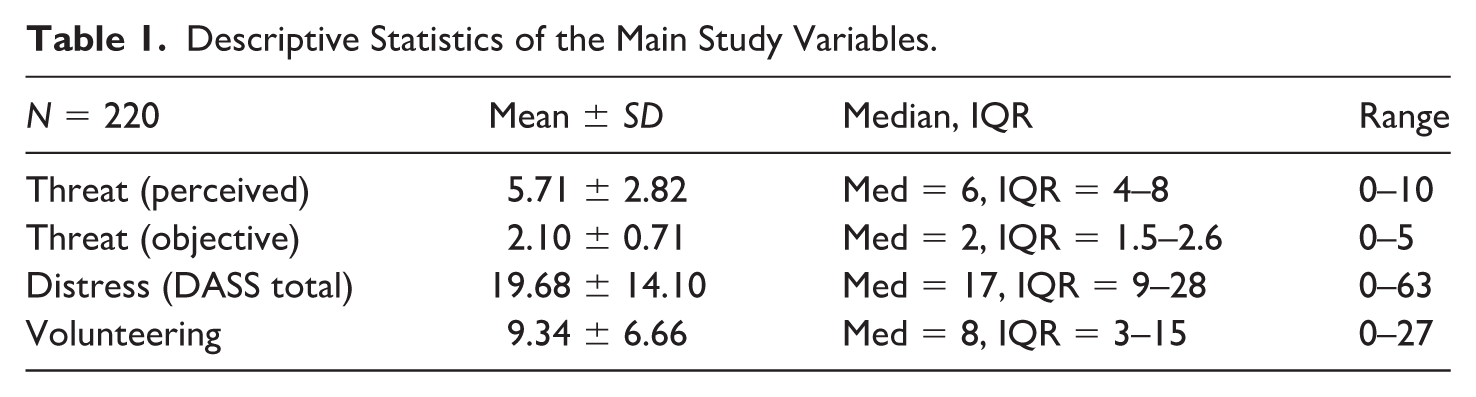
The descriptive statistics of the study variables are presented in Table 1.
Descriptive Statistics of the Main Study Variables.
To examine the first hypothesis, we computed Spearman correlations between the study variables. Volunteering was positively correlated with distress (rs = .339, p < .001), perceived threat (rs = .213, p < .01), and objective threat (rs = .224, p < .001). Perceived threat was positively correlated with objective threat (rs = .216, p < .01), suggesting that participants with higher perceived threat tended to face higher objective threat. The correlation between distress and perceived threat (rs = .480, p < .001) was significantly higher (Z = 2.22, p = .013) than the correlation between distress and objective threat (rs = .314, p < .01).
To test the second hypothesis, that distress level mediated the association between perceived threat and the tendency to volunteer, we conducted a mediation analysis (Figure 1). We focused on perceived rather than objective threat because the correlation between perceived threat and distress was significantly higher in this study, consistent with previous research (Kurapov et al., 2024; Shields et al., 2023). Therefore, we assumed that the driving force behind volunteering was also the individuals’ perception of threat rather than the objective level of threat they faced. In other words, people experiencing high levels of objective threat may not be motivated to volunteer unless they also experienced a high level of perceived threat. As having a family may affect the time available for volunteering, we used family status as a covariate (binary variable, 0 = solitary, 1 = nonsolitary).
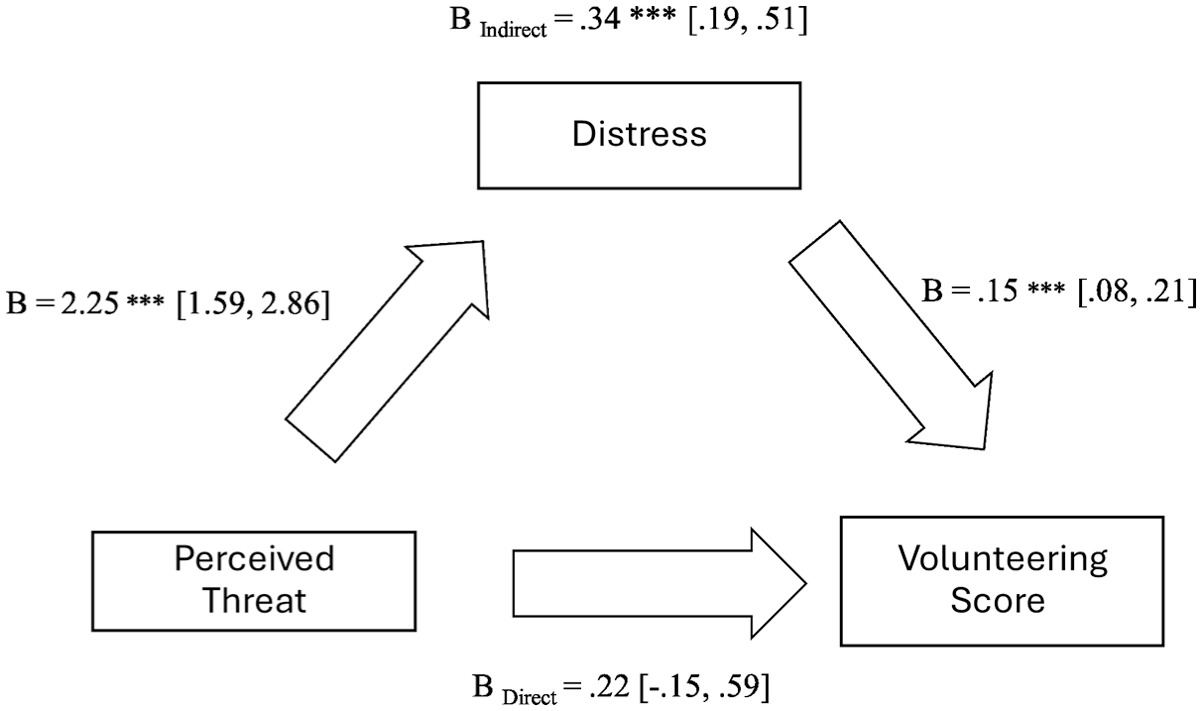
Mediation Analysis.
Perceived threat was positively and significantly associated with distress (b = 2.25, CI = [1.59, 2.86[), and distress was positively and significantly associated with volunteering (b = 0.15, CI = [0.08, 0.21]). The direct pathway between perceived threat and volunteering was not significant (b = 0.22, CI = [−0.15, 0.59]). Family status was not associated with distress (b = −1.88, CI = [−6.06, 2.13]) or volunteering (b = −1.08, CI = [−3.09, 0.78]). A positive and significant mediation effect was found (b = 0.34, CI = [0.19, 0.51]), suggesting that participants with higher perceived threat also reported higher distress and in turn were more likely to volunteer.
Discussion
This study investigated the relationship between perceived threat, psychological distress, and volunteering in times of war and conflict, an area that has not been sufficiently researched. The study focused on the simultaneous occurrence of significant psychological distress (Kaim & Bodas, 2024; Levi-Belz et al., 2024) and exceptionally high volunteering rates (Israeli Volunteering Council et al., 2023) in the Israeli public following the October 7, 2023, events and the outbreak of the Iron Swords war, which induced intense feelings of threat. Significant correlations were found between perceived threat, psychological distress, and engagement in volunteering activities. Although perceived threat alone did not explain the levels of volunteering, psychological distress was found to mediate the relationship between perceived threat and volunteering: higher levels of perceived threat were associated with increased psychological distress, which in turn was linked to greater volunteering activity. These findings provide valuable insights into the relationship between perceived threat, psychological distress, and volunteering. The results support the hypothesis that volunteering served as a potential mechanism to cope with psychological distress stemming from the sense of threat generated by war. Previous research on volunteering has identified an association between psychological distress and volunteering (Han et al., 2020; Pidbutska et al., 2023; Shevtsova, 2024). Concurrently, studies focusing on the effect of trauma and perceived threat (resulting from war, terror attacks, pandemics, or nature disasters) have found that these experiences were often associated with prosocial behaviors, such as volunteering (Frazier et al., 2013; Vollhardt & Staub, 2011). This study is unique in connecting these two aspects and formulating an integrative model. According to this model, in times of war and conflict, psychological distress mediates the relationship between perceived threat and volunteering activities.
This approach offers a more comprehensive framework for understanding the surge in volunteerism often observed during and after crises (see Chudzicka-Czupała et al., 2023; Domaradzki et al., 2022) by considering psychological distress as a mediator between perceived threat and volunteering. It elucidates the psychological mechanisms that drive individuals to engage in prosocial behaviors in response to traumatic events, contributing to a more profound understanding of volunteering behavior in times of war and national crisis.
The findings suggest that volunteering in response to the October 7, 2023, events and the Iron Swords war was primarily driven by protective motives (volunteering to reduce one’s negative feelings and thoughts); that is, it was induced by egoistic-instrumental motives (Clary & Snyder, 1999; Kulik, 2017). These results align with the study by Chudzicka-Czupała et al. (2023), which also found that protective motivation was one of the central motivations for Ukrainians volunteering to work with refugees from their country at the beginning of the Russia-Ukraine war.
The findings of this study contribute to understanding the mechanisms leading to volunteering, particularly in directing attention to the psychological state of volunteers. The understanding that volunteering is related to increased feelings of threat and psychological distress suggests that volunteers have psychological needs that should be addressed.
Limitations and Future Research
The study has some limitations. First, the cross-sectional design does not allow for a clear determination of causality. Although the proposed model—suggesting that perceived threat creates psychological distress, which in turn increases volunteering—is logical in the sequence of events (threat arises immediately upon exposure to events and volunteering begins slightly later), the correlational nature of the study does not allow drawing definitive conclusions on this matter.
Second, the study examined psychological distress as expressed in measures of depression, anxiety, and stress but did not measure additional indicators such as symptoms of post-traumatic stress disorder, personality traits, and psychological capital that may relate to psychological distress and could also influence the degree of psychological distress. Third, subjective threat was measured using one-item. Future research should consider additional measures to deepen the understanding of these aspects and examine how resilience factors and psychological capital influence the relationship between distress and volunteering.
Furthermore, although the study findings suggest that people tended to volunteer out of a desire to reduce the distress they experienced, the findings do not indicate whether the act of volunteering reduced the volunteers’ feelings of psychological distress. To examine this issue, longitudinal studies are needed that follow the long-term psychological effects of volunteering in times of war and crisis on the volunteers.
Another aspect that warrants consideration concerns the demographic characteristics of the sample. The participants were predominantly well-educated, employed, and family-oriented; these demographic features are commonly associated with volunteer populations (Wilson, 2012). This alignment reinforces the relevance of the sample to broader patterns observed in volunteering research and provides contextualization for interpreting the findings.
Conclusion
The study found connections between perceived threat, psychological distress, and volunteering in Israeli society following the events of October 7, 2023, and the Iron Swords War. The research findings suggest that volunteering, like other prosocial behaviors, although ostensibly intended to assist recipients, apparently also aims to help the volunteers themselves. Future research should continue to explore these complex relationships to enhance our understanding of volunteering behaviors in times of crisis and conflict. Understanding and establishing these relationships may provide a foundation for translating these insights into practical strategies, such as fostering supportive environments for volunteering during crises or emphasizing the potential psychological benefits of prosocial engagement. Such directions, once further substantiated, could inform initiatives aimed at promoting public health and strengthening resilience among affected populations.
Footnotes
Acknowledgements
None.

Ethical Considerations
This study was approved by The Max Stern Yezreel Valley College Ethics Committee (Ethics Code: YVC EMEK 13-2024) on November 14, 2023.
Consent to Participate
This study was approved by The Max Stern Yezreel Valley College Ethics Committee (Ethics Code: YVC EMEK 13-2024) on November 14, 2023. All participants provided written informed consent.
Consent for Publication
Not applicable.
Author Contribution Statement
Both authors contributed to the conceptualization, formal analysis, and manuscript writing (original draft, review, and editing).
Funding
The authors received no financial support for the research, authorship, and/or publication of this article.
Declaration of Conflicting Interests
The authors declared no potential conflicts of interest with respect to the research, authorship, and/or publication of this article.
Data Availability Statement
The data and codes necessary to reproduce the analyses presented here are available from the corresponding author, as are the materials necessary to replicate the findings. The analyses were not preregistered.