



Abstract
Volunteers play a central role in contemporary society, yet the value created through their contributions remains fragmented across academic literatures. Drawing on a systematic literature review of 146 academic articles, this study provides a comprehensive overview of volunteer value. It addresses the proliferation of terms used to describe value, changes in the volunteering landscape, and the expanding range of value recipients. The review conceptualizes volunteer value distribution across three analytical levels—micro, meso, and macro—and identifies a broad set of value types and recipients. In doing so, it advances research on volunteer value creation and distribution. This article calls for greater inclusion of the nonprofit sector in volunteer value research, increased attention to uneven value distribution among recipients, and further investigation into how volunteer value equity can be promoted.
Keywords
Volunteers are increasingly relied upon by organizations, individuals, and communities. Despite their vital role in contemporary society, the value produced by their contributions remains underexamined in scholarly discourse. A deeper understanding of this value could reshape how we perceive and appreciate the services they provide. For instance, certain services are perceived differently when performed by volunteers rather than paid staff (e.g., Hoogervorst et al., 2016; Ronel, 2006). Paid activism carries a different legitimacy than volunteer activism, and parents relate differently to a paid soccer coach than a volunteer coach who is also a parent of one of the young players.
Scholars and practitioners have used a wide variety of terms to describe value in the nonprofit sector and in connection with volunteering. Despite the complex and varied nature of volunteer contributions, volunteer value is often first described numerically, using volunteer numbers, hours, or replacement cost calculations (Bowman, 2009; Mook et al., 2007), to show how important volunteers are to an organization or society. When researchers go beyond numbers, they commonly use words with positive connotations (e.g., benefit, advantage) as well as those with negative connotations (e.g., disadvantage, challenge) to describe volunteer value in a general manner. In a recent study, Wæraas and colleagues (2024) argue that in most definitions, value is understood as an intangible perception held by recipients. They define added value as “a contribution that is different from or better than that provided by government or commercial providers, as seen from the perspective of beneficiaries and funding agents” (p. 760). This definition also acknowledges that value created is often distributed among different groups of recipients. Specifically, volunteer value can be located at the microlevel (for individuals), the mesolevel (organizations), and the macrolevel (society), and it can range from increased well-being to civic learning and from higher organizational impact to societal solidarity (e.g., Afkhami et al., 2019; McBride et al., 2011). With these considerations in mind, and for the purposes of this research, I define volunteer value as a contribution resulting from volunteer work, distributed among individuals, organizations, and society.
In recent decades, changes in volunteering and society have altered the ways in which civil societies create and distribute volunteer value. Traditionally, formal volunteering was seen as a collectivist, ongoing activity that took place within volunteer-involving organizations (e.g., nonprofit organizations that directly recruit and guide their own volunteers). The value created by volunteers was then distributed among the volunteers themselves, their beneficiaries, and the nonprofit organizations or communities. However, as a result of modernization, shifts in society, and changing motivations (Hustinx et al., 2012), volunteers are now more likely to choose volunteer opportunities of an episodic character (Cnaan et al., 2022) and to find roles in organizations that align with their life stories (Hustinx & Lammertyn, 2003), in addition to engaging in traditional forms of volunteering. This pluralization of volunteering (Hustinx et al., 2012) has not only influenced the relationship between volunteers and volunteer-involving organizations but also resulted in other actors (e.g., government agencies, businesses, and educational institutions) becoming involved in volunteering and creating volunteer value. In the literature, this phenomenon is referred to as third-party volunteering (Haski-Leventhal et al., 2010; Koolen-Maas et al., 2023). Examples include corporate volunteering, in which employers allow their employees to volunteer during working hours, and service learning, in which students volunteer to achieve learning goals embedded within higher-education curricula (Brudney et al., 2019).
These new actors, sending organizations, are also part of the equation in terms of value creation and distribution, resulting in a fundamentally different process. In addition to potentially creating value for volunteers, beneficiaries, nonprofit organizations, and communities, these sending organizations might also receive value themselves from the volunteering they support. These third parties often have instrumental goals (e.g., team building through corporate volunteering), thereby creating additional value for the volunteers they send to volunteer-involving organizations (Koolen-Maas et al., 2023). At the same time, however, they might also, perhaps unintentionally, appropriate any value that is created for themselves at the expense of the intended recipients of that value (e.g., the beneficiaries of the nonprofit organization).
Given the variety of terms, the diversification in volunteering, and the widening range of actors in volunteer value creation and distribution, a new, holistic framework of value creation and distribution is needed. Existing studies tend to focus on isolated outcomes (e.g., how volunteering improves health), specific recipients (e.g., volunteers), or specific terms for describing value (e.g., benefits). This review synthesizes and categorizes what types of value are created by volunteers and how that value is distributed at multiple levels through. I address the following research question:
An analysis of 146 articles reveals that value creation by volunteers is widely researched across many disciplines, albeit with some important uncharted territory remaining. By answering the research question, this article makes three important contributions. First, the development of a broad overview of volunteer value creation that can guide future research. The overview highlights extensive knowledge about value created through regular or traditional volunteering and direct service volunteering, involving contact with clients, while drawing attention to the limited research on indirect service volunteering, which lacks such interactions (Hartenian, 2007). It also identifies avenues for future research on special forms of volunteering, including membership volunteering, activist volunteering, indirect service volunteering, and many forms of third-party volunteering. Second, the review exposes a strong focus on the positive side of value creation and calls for more research on negative volunteer value, including inequitable value distribution and potential value appropriation. Third, by situating value creation at three levels—micro (individual), meso (organizational), and macro (societal)—this review provides a framework that distinguishes among types of recipients, ranges of value created, and patterns of imbalance favoring microlevel value to individual volunteers.
Methodology
The scope of this review encompasses volunteer value creation and distribution among the various recipients of this value. The review is structured according to the PRISMA (Preferred Reporting Items for Systematic Reviews and Meta-Analyses) framework to ensure transparency and replicability in the search, screening, and selection processes (see Figure 1).

PRISMA Flowchart (see Page et al., 2021).
Search Strategy (Identification)
I constructed a Boolean search string in collaboration with other scholars, combining the keyword “volunteering” with a range of terms previously used to describe the concept of value (see, e.g., Metz et al., 2017; Mook et al., 2007), in both the positive and negative senses: Volunteer* AND (Valu* OR Benefit OR Impact OR Result OR Effect OR Advantage OR Worth OR Quality OR Cost OR Disadvantage OR Loss OR Contribution OR Challenge OR Gift OR Return). This search string was intentionally limited regarding keywords and synonyms, excluding broader terms that could describe volunteering-like activities without using the word “volunteer” (e.g., crowdsourcing, participation, or citizenship). This decision preserved focus but could have omitted relevant studies using alternative vocabulary; to mitigate this risk, I solicited feedback from other scholars in the field 1 concerning the term “value” at academic presentations and revised the string accordingly.
An initial search in all fields within the Web of Science yielded 175,214 records. To focus the review and manage scope, I limited the search to a set of 71 peer-reviewed journals recognized for their influence in the nonprofit (Walk & Andersson, 2020) and business (FT 50, 2021) literatures. These journals span disciplines including nonprofit management, public management, social work, human resource management, general management, and multidisciplinary research. This restriction reduced the pool to 743 records. The rationale for this exclusion was twofold: (1) a high volume of medical and experimental studies involving volunteers as research subjects (e.g., clinical trials) introduced noise unrelated to organized volunteering and (2) all 71 journals were available within Web of Science, making it a practical single-database choice for identification. A cross-check of other databases yielded additional hits for identification but not for screening and inclusion. In the remaining set, only one duplicate was detected and removed.
Selection (Screening)
After removing the duplicate, 742 articles underwent title and abstract screening according to three inclusion criteria. First, I included only articles addressing formally organized volunteering; however, I did not exclude work using broader operationalizations of volunteering in other aspects. Specifically, I followed the semi-strict definition of Cnaan and colleagues (1996), which allows for limited social obligation, stipends or low pay, and some self-benefit. Second, I treated motivation to volunteer as a form of individual value creation and therefore retained studies on motivations even when they did not use the term “value” explicitly. Third, I confined the sample to empirical research (qualitative, quantitative, or mixed methods), thereby excluding reviews, commentaries, book chapters, and purely theoretical papers to avoid double counting empirical findings. Applying these screening criteria resulted in 198 articles for full-text retrieval and closer examination based on abstracts.
Analysis
The selected articles were analyzed deductively (quantitative findings) and inductively (qualitative findings) through an iterative process. I iteratively moved between papers to refine the coding frame and resolve ambiguities. To ensure coding reliability, samples of coded articles were independently checked by two colleagues; disagreements were discussed until consensus was reached. After full-text review, 52 articles were excluded because they failed to meet the inclusion criteria upon closer inspection, leaving a final sample of 146 articles for synthesis.
I began by coding descriptive study characteristics: journal, year of publication, methodological approach (qualitative, quantitative, mixed), theoretical lens (when explicitly stated), and geographic location of the volunteer activity. I then coded volunteer-specific features, including the host organization (the organization in which volunteering occurred), the presence and type of sending organization, the volunteer role (direct vs. indirect service), the volunteer group (e.g., students, employees, elderly), and special volunteering forms (e.g., corporate volunteering, international volunteering, service learning, episodic volunteering).
For host organizations, I followed C. Handy (1988) and Meijs (1997) and distinguished three categories: mutual support/benefit organizations (associations where members provide services to fellow members, e.g., sports clubs or mutual aid groups), service delivery organizations (organizations providing services to external clients, e.g., Meals on Wheels), and campaigning/advocacy organizations (e.g., Greenpeace). Sending organizations—where applicable—were coded according to type (corporation, educational institution, government program, international volunteer program, volunteer center, etc.), following prior work on third-party volunteering (see Brudney et al., 2019; Haski-Leventhal et al., 2010).
Volunteer roles were categorized as direct service volunteers (roles involving face-to-face contact with beneficiaries, e.g., mentoring, elderly care) or indirect service/support volunteers (roles without beneficiary contact, e.g., governance, fundraising) as described by Hartenian (2007). I also coded whether the study reported a single volunteer task type, multiple types, or did not report task details. The fourth volunteer-specific characteristic concerned the type of volunteer, which I coded according to whether the article treated volunteers as a single, homogeneous group or investigated a specific subgroup (e.g., students, older adults, migrants). Finally, I coded special forms of volunteering (e.g., stipend volunteering, episodic volunteering) when applicable (see, e.g., Compion et al., 2022).
The core of the analysis focused on coding value-related characteristics. Drawing on Austin and Seitanidi (2012a, 2012b) and Studer and von Schnurbein (2013), I coded the level at which value was discussed as micro (individual), meso (organizational), or macro (societal). Within these levels, I identified specific recipients and appropriators of value—at the microlevel: volunteers, beneficiaries, and paid co-workers; at the mesolevel: host organizations and sending organizations; and at the macrolevel: communities and society at large. I coded value expression as financial (e.g., cost savings, donations) or nonfinancial/social (e.g., well-being, social capital) and the direction of value as positive (beneficial) or negative (i.e., destructive).
The specific values noted in the articles were coded inductively and grouped into overarching themes through thematic analysis (Braun & Clarke, 2006). This process involved multiple rounds of coding and theme refinement. The thematic structure was then organized by recipient type and by level (micro, meso, macro), resulting in the set of value themes reported throughout the “Findings” and “Discussion” sections.
Findings
The coding process yielded both descriptive and qualitative findings. This section begins with a presentation of the quantitative findings, followed by a discussion of the qualitative findings regarding specific types of volunteer value created for recipients at the micro-, meso-, and macro-levels.
Quantitative Findings
An overview of the quantitative findings of this review is presented in the appendix. They show (e.g., journal, year of publication, methods, theoretical framing, and geographic location), volunteer-specific details (e.g., type of sending and host organization, type of volunteer and volunteer task, and specific forms of volunteering) and value-specific details (e.g., the level at which value is found, whether it is considered positive or negative, and whether it is social or financial).
Overall, the analyses show a strong increase in publications on volunteer value since 2016, with a growing emphasis on quantitative research methods. The findings reveal a skewed geographical distribution, with only 12 studies conducted in the Global South (majority world), compared with 132 studies conducted in the Global North (minority world). Moreover, much of the existing knowledge is based on studies conducted in service delivery organizations and on volunteering “in general,” meaning that limited information is available regarding the specific volunteer work performed. Similarly, most articles focus on “volunteers in general,” indicating that little is known about what volunteering may mean for specific groups of people (e.g., students, disadvantaged groups). The quantitative analysis further demonstrates that most research focuses on value created and distributed at the microlevel, particularly value created for individual volunteers.
Qualitative Findings
This section presents the qualitative findings of the review. It addresses specific types of value created for various recipients categorized at three levels: micro (individual volunteers, beneficiaries, and paid co-workers), meso (host and sending organizations), and macro (communities and society). Each subsection includes tables presenting an overview of the types of value identified for each category of recipients. A detailed overview specifying the types of value and the sources in which they are discussed is included in the Supplemental Appendix.
Microlevel Value: Volunteers, Beneficiaries, and Paid Co-workers
At the microlevel, the findings indicate that value is created and distributed among three categories of recipients: individual volunteers, beneficiaries (e.g., youth, elderly), and paid co-workers within host organizations.
Value Created for Individual Volunteers
Volunteers create value for themselves in many ways, a topic that has been examined extensively in the literature. The present review identifies 10 overarching themes of individual-level value, as summarized in Table 1.
Value for Individual Volunteers.

Note. Numbers in parentheses represent the number of journal articles addressing the specific value theme and created value.
Individual development is the most frequently studied theme. Examples include learning to work with others, developing intercultural communication skills, improving ethical judgment, gaining personal empowerment, increasing autonomy, and enhancing skills (e.g., Afkhami et al., 2019; Classens, 2015; de Wit et al., 2019; Yanay-Ventura et al., 2021). The second theme is social capital (Gagnon et al., 2021; Isham et al., 2006; Ruiz Sportmann & Greenspan, 2019). Both bridging and bonding forms of social capital are examined in the reviewed studies. Third, volunteers may experience professional development through their volunteer work, for example, by acquiring knowledge and strengthening their résumés (e.g., Classens, 2015). A fourth theme concerns well-being. Research shows that volunteering can improve physical, social, and environmental quality of life (Krägeloh & Shepherd, 2015) and increase psychological, physical, mental, and subjective well-being (e.g., Haski-Leventhal et al., 2020; Manetti et al., 2015). Fifth, volunteer value is expressed through affective outcomes, including pleasure and feelings of accomplishment. Volunteers frequently report enjoyment and satisfaction when performing volunteer tasks (e.g., Gevorgyan & Galstyan, 2016; Ramsden, 2020; Shah, 2006) and describe volunteering as fun (e.g., Compion et al., 2022; Goudeau & Baker, 2021). A sixth theme involves the opportunity for volunteers to express their norms and values (e.g., Katz & Sasson, 2019; Nichols & Ralston, 2016). Seventh, volunteering contributes to the development of personality traits and characteristics, such as increased empathy, compassion, and interest in others (Casselden & Dawson, 2019; Gage & Thapa, 2012). The eighth theme consists of reputational outcomes, including recognition, praise, and reputation-based rewards. Financial value represents another theme and includes stipends (e.g., Vos et al., 2012; Yanay-Ventura et al., 2021) and higher future wages (Duerrenberger & Warning, 2019; Shantz et al., 2019). Finally, volunteers may receive tangible rewards, such as social events or opportunities to travel or live abroad (Jackson & Adarlo, 2016; Okabe et al., 2019; Shannon, 2009).
Value Created for Beneficiaries
Volunteers create value for beneficiaries of volunteer-involving organizations in two primary ways: through outcomes for beneficiaries and through mutual relationships (see Table 2). Beneficiaries are defined as individuals who receive services provided by volunteers through nonprofit organizations (e.g., youth in care).
Value for Beneficiaries.

Note. Numbers in parentheses represent the number of journal articles addressing the specific value theme and created value.
Most studies describe value created for beneficiaries primarily in terms of beneficiary outcomes (McBride et al., 2011; Ronel, 2006; Samuel et al., 2016; Thoits, 2021; Townsend et al., 2014). While many articles refer broadly to positive impacts, others identify more specific outcomes. For example, volunteers may increase beneficiaries’ satisfaction, comfort, and happiness, while also reducing anxiety, loneliness, and vulnerability (e.g., F. Handy & Srinivasan, 2004; Samuel et al., 2016). Volunteers can therefore contribute positively to beneficiaries’ social rehabilitation (Yanay-Ventura, 2019). In addition, relationships between volunteers and beneficiaries often differ from those between beneficiaries and paid staff members (Gazley et al., 2012; Nichols & Ojala, 2009). These relationships are frequently perceived as closer and more genuine, as volunteers are viewed as “not part of the establishment” (Ronel, 2006, p. 1144). Consequently, beneficiaries may perceive volunteers as more altruistic and sincere (Hoogervorst et al., 2016) and appreciate the enthusiasm, empathy, and unconditional support volunteers provide (e.g., Meyer et al., 2013; Nichols & Ojala, 2009).
Value Created for Paid Co-workers
The findings suggest that volunteers create value for paid co-workers within host organizations in four main ways (see Table 3).
Value for Paid Co-workers.

Note. Numbers in parentheses represent the numbers of journal articles addressing the specific value theme and created value.
One form of value relates to employee outcomes. While some studies report that volunteers provide additional support to paid staff, others indicate that volunteers may increase the workload (F. Handy & Srinivasan, 2004; Rogelberg et al., 2010; Thomsen & Jensen, 2020). Volunteers’ presence can also influence work outcomes, with evidence of both positive and negative effects on organizational commitment, intention to quit, stress, and emotional experiences (Rogelberg et al., 2010; Ward & Greene, 2018). Some studies further suggest that volunteers may be perceived as a threat to paid workers’ job security (Einarsdóttir & Osia, 2020; Thomsen & Jensen, 2020). The mutual relationship between volunteers and paid staff is often characterized by perceptions of unreliability and lack of trust, contributing to relatively negative relational value (Einarsdóttir & Osia, 2020; Thomsen & Jensen, 2020). Financial outcomes also vary, with some studies reporting higher wages for paid staff in organizations involving volunteers and others reporting lower wages (Pennerstorfer & Trukeschitz, 2012; Prouteau & Tchernonog, 2021).
Meso-Level Value: Host and Sending Organizations
At the mesolevel, the review identifies two categories of value recipients: host organizations in which volunteers perform their work (most often nonprofits) and sending organizations, where applicable.
Value Created for Host Organizations
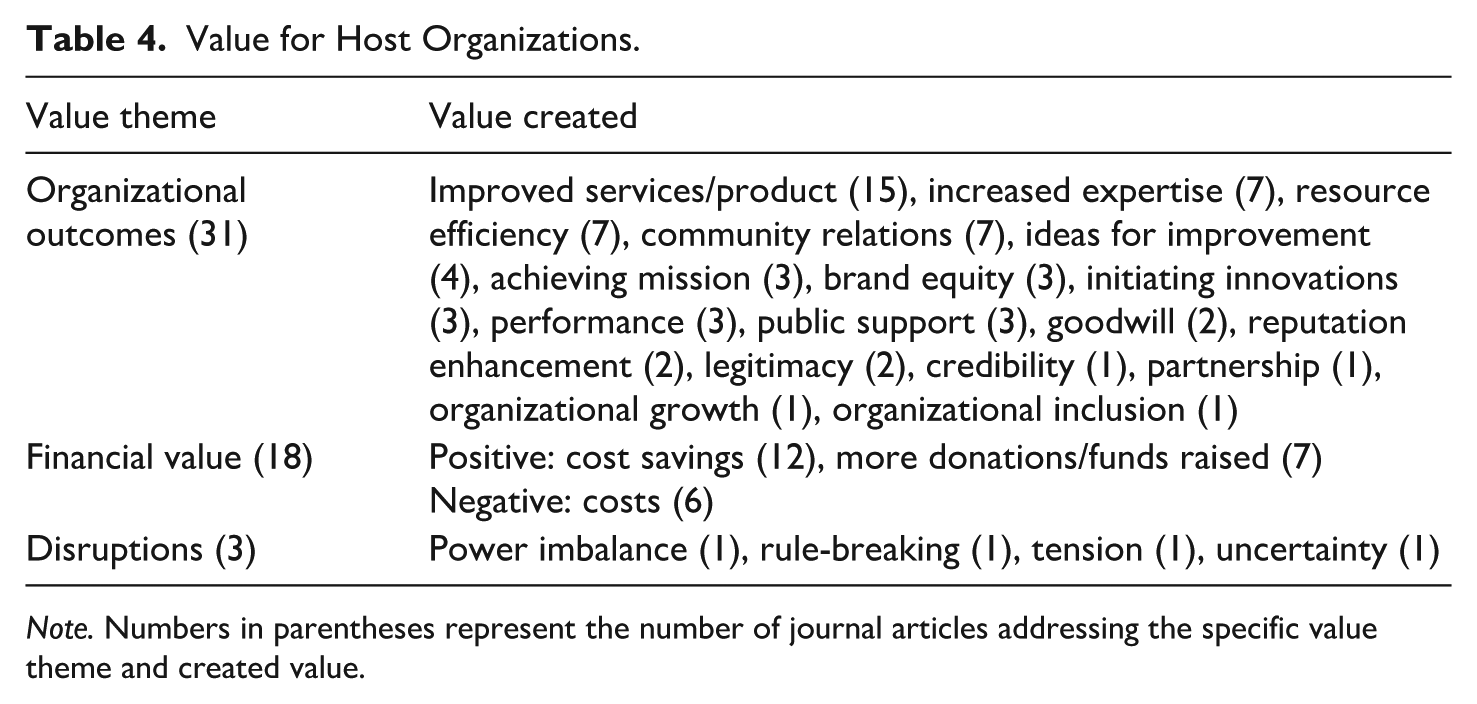
For host organizations, the review identifies two primary value-related themes, as summarized in Table 4.
Value for Host Organizations.
Note. Numbers in parentheses represent the number of journal articles addressing the specific value theme and created value.
Volunteers contribute to organizational outcomes in multiple ways. Organizations involving volunteers report increased expertise, greater resource efficiency, improved services, broader reach, and enhanced legitimacy and credibility (e.g., Brudney & Kellough, 2000; Haski-Leventhal et al., 2020; Loiseau et al., 2016). Volunteers also create financial value for host organizations, typically reflecting a balance between positive value (e.g., cost savings) and negative value (e.g., costs incurred through recruitment, training, and coordination) (e.g., Bowman, 2009; Dunn et al., 2022). Researchers employ various methods to calculate this value, often offsetting costs against savings (e.g., Social Return on Investment, Economic Value Added). In addition, organizations with volunteers often receive increased donations, both monetary and in-kind (e.g., F. Handy & Greenspan, 2009; Hrafnsdóttir & Kristmundsson, 2017). At the same time, some studies report negative value in the form of disruptions. These include volunteer rule-breaking, uncertainty regarding continuity, tensions between volunteers and paid staff, and power imbalances between sending and host organizations (Einarsdóttir & Osia, 2020; Jacobs, 2017).
Value Created for Sending Organizations
Volunteers also create value for sending organizations, such as schools and corporations. The review identifies three overarching value-related themes, as presented in Table 5.
Value for Sending Organizations.

Note. Numbers in parentheses represent the number of journal articles addressing the specific value theme and created value.
The first theme concerns outcomes for employees and students. For example, employees participating in corporate volunteering programs may exhibit higher productivity, improved job performance, and increased accountability (Afkhami et al., 2019; Knox, 2020). These outcomes benefit sending organizations, often to a greater extent than individual volunteers, which is why this theme is categorized at the organizational level. The second theme relates to organizational outcomes, including enhanced public image, improved community relations, and increased legitimacy (e.g., Hjort & Beswick, 2021; Rodell et al., 2020). The third theme concerns financial value. In some cases, sending organizations experience increased donations or income (Lasker, 2016). In corporate and customer volunteering contexts, organizations may also benefit from increased patronage or purchases (Rodell et al., 2020). As third-party volunteering becomes more prevalent, scholars have begun to question how value is created, who benefits from it, and how it may be appropriated. For instance, Hjort and Beswick (2021) observe that value created by British volunteers in Rwanda ultimately reverts to the United Kingdom when volunteers return home rather than remaining in the community where the volunteering took place.
Macrolevel Value: Community and Society
At the macrolevel, the review distinguishes between two types of value recipients: specific communities and society at large.
Value Created for the Community
By performing volunteer tasks, volunteers can create value for local civil society and the communities in which they operate. Table 6 provides an overview of these forms of community-level value.
Value for Community.

Note. Numbers in parentheses represent the number of journal articles addressing the specific value theme and created value.
Volunteers help meet community needs in various ways. Some studies report general outcomes such as community development or improved local environments, while others identify more specific outcomes, including safer and healthier communities (e.g., Gagnon et al., 2021; Lasker, 2016; Ramsden, 2020). Volunteers also enhance community outcomes. For example, volunteers tend to report a greater sense of belonging than nonvolunteers and are often more engaged in and committed to their communities (Seymour et al., 2018; Zanbar, 2019). Moreover, volunteers contribute to the sustainability of local civil society by supporting nonprofit missions, increasing organizational visibility and reach, and, in some cases, sustaining volunteer communities themselves (e.g., Compion et al., 2022; Edwards et al., 2001; Rodell et al., 2017). Volunteers further contribute to nonprofit sector outcomes by increasing voice and enhancing trust in charitable institutions. Finally, volunteers also generate financial value at the community level. For example, Rajan et al. (2009) report that individuals who volunteer are more likely to donate money, particularly to domestic causes.
Value Created for Society
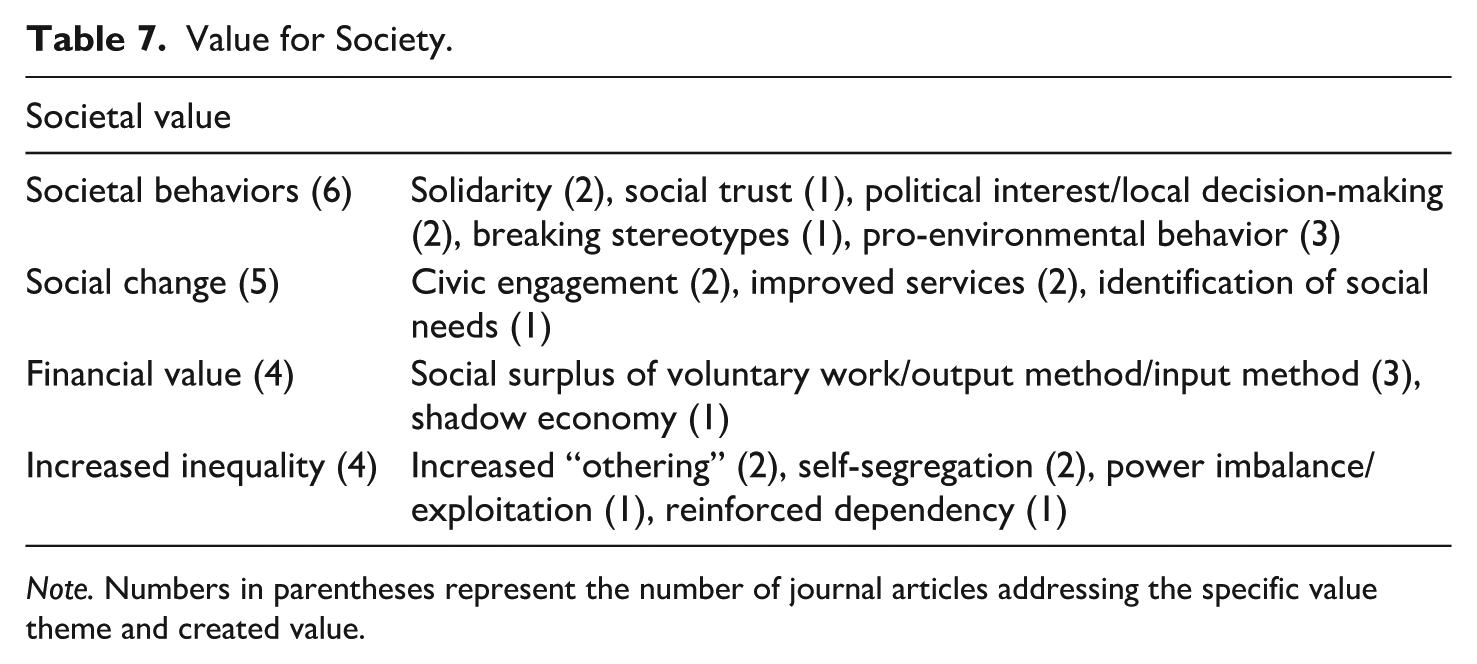
Societal-level value can be categorized into four broader themes, as presented in Table 7.
Value for Society.
Note. Numbers in parentheses represent the number of journal articles addressing the specific value theme and created value.
Volunteering contributes to changes in societal behaviors, including increased social solidarity, broader worldviews, and higher levels of social trust (Afkhami et al., 2019; Dahl & Abdelzadeh, 2017; Serrat et al., 2017). Volunteering may also foster social change by enabling volunteers to identify social needs that can then be addressed by civil society organizations (de Wit et al., 2019). In addition, volunteers have been reported to improve services for society at large (Edwards et al., 2001; Tooley & Hooks, 2020) and to exhibit higher levels of civic engagement than nonvolunteers (Isham et al., 2006; Serrat et al., 2017). Studies also identify societal-level financial value. One approach involves calculating the monetary value of volunteer hours produced within a country (e.g., Brown, 1999; Butcher, 2010). However, some forms of volunteering, such as stipend volunteering, may contribute to a shadow economy with negative societal consequences (Vos et al., 2012). Finally, multiple scholars warn that volunteering can also generate negative value at the societal level, specifically in terms of increased inequality. For example, Khvorostianov and Remennick (2017) demonstrate that volunteering may lead to self-segregation, while others highlight risks of increased “othering” (Horvath, 2020; Perold et al., 2013). Certain forms of volunteering, such as volunteer tourism, have also been associated with power imbalances, reinforced dependency, and a lack of sustainable community development (Loiseau et al., 2016; Perold et al., 2013).
Discussion
This systematic literature review synthesizes the existing literature on how volunteers create value, distributed among a variety of value recipients. The findings identify topics that have been researched thoroughly, as well as a substantial number of subjects that require further attention. An overview of the types of volunteer value addressed in this review is presented in Table 8.
Overview of Value Themes Situated at the Micro-, Meso-, and Macro-Level.

In this section, I highlight the most salient findings and contributions of the review, as well as the gaps identified in the current body of knowledge. I discuss volunteer value at the three levels, differences in value creation based on context, and perspectives related to research methodology. This section concludes with an agenda for future research (Table 9).
Overview of Current Knowledge and Future Research Agenda.

Volunteer Value Creation at Three Levels
Microlevel
One particularly telling finding is that the overwhelming majority of studies published on this topic focus on the microlevel, implicitly positioning volunteers themselves as the most important recipients of the value created through their efforts. While these insights provide valuable information about individual experiences—which can be highly relevant for policymakers and practitioners seeking to design value-based approaches to volunteer recruitment, coordination, and retention—this narrow emphasis also highlights a gap in understanding how volunteering generates value beyond individual volunteers. This focus is somewhat paradoxical, given that volunteering is inherently oriented toward creating value for others.
The two other groups of value recipients at the microlevel, beneficiaries and paid co-workers, remain under-researched and warrant greater scholarly attention. Specifically, beneficiaries in certain organizational contexts (e.g., youth care agencies) attribute substantial value to volunteer involvement, particularly when volunteers share similarities with beneficiaries, whether actual or perceived (Hoogervorst et al., 2016; Metz et al., 2017; van Overbeeke & Ouacha, 2022). Regarding value created for paid co-workers, the reviewed studies present mixed results, with some reporting positive forms of value creation and others identifying negative effects. Future research should therefore focus on identifying ways to enhance positive value and mitigate negative outcomes.
Only a small number of studies (too few to be included in the overview) have examined added value for other individuals, such as family members of volunteers or beneficiaries. This represents an interesting and under-researched topic with the potential to contribute meaningfully to both scholarship and practice (Nichols & Ojala, 2009; Peloza & Hassay, 2006; Townsend et al., 2014).
Mesolevel
Relatively, few studies on value creation have been conducted at the mesolevel. Greater scholarly attention should be directed toward organizations, both sending and receiving, to help them better understand when and why they engage volunteers beyond purely budgetary considerations. Within the existing literature, studies predominantly focus on service delivery organizations. However, the type of value created by volunteers is likely to vary depending on the organizational context in which volunteering takes place. In particular, mutual support/benefit organizations and campaigning or advocacy organizations deserve greater attention. Volunteering in these settings often stems from motivations that differ from those typically associated with structurally organized volunteering (Koolen-Maas et al., 2023) and is therefore likely to result in different forms of value creation. For example, Ruiz and colleagues (2023) demonstrate that immigrants volunteering in youth organizations and cultural organizations experience different types of integration—psychosocial and professional integration, respectively.
Third-party volunteering arrangements involving sending organizations or programs remain relatively understudied. This is understandable, as although such arrangements are not entirely new, they occur less frequently than traditional forms of volunteering. However, given that third-party volunteering is becoming increasingly embedded in contemporary society, further research is needed to examine how volunteer value is created and distributed in these contexts (Haski-Leventhal et al., 2010; Koolen-Maas et al., 2023).
A notable observation in this body of research is that scholars tend to focus primarily on value created for sending organizations, such as universities and corporations. While this emphasis is important in that it provides legitimacy for sending organizations to continue operating volunteer programs (Haski-Leventhal et al., 2019; Plewa et al., 2015), it also risks overlooking how value is distributed to nonprofit organizations and beneficiaries. Future research should therefore explicitly examine value distribution across all stakeholders involved in third-party volunteering arrangements.
Macrolevel
Research on volunteer value creation at the macrolevel remains limited. Although many studies begin by acknowledging the importance of volunteers for communities and society, authors frequently shift their attention to broader aspects of value creation—such as the role of civil society in addressing social issues—without differentiating between volunteer and paid contributions. As a result, many studies describe the value of civil society in general, rather than isolating the specific value generated through volunteering.
While macro-level value may be more difficult to measure, additional research is needed to examine volunteering as a distinct contributor to the value created by the nonprofit sector and civil society. Such research should consider both community-level outcomes and broader societal impacts.
Direction and Distribution of Value
The majority of research articles emphasize the positive value created by volunteering. In recent years, however, both practitioners and scholars have become increasingly aware of the potential negative consequences of volunteer involvement. Future research should therefore engage more explicitly with this “dark side” of volunteering (Hustinx et al., 2022).
Moreover, researchers should pay greater attention to how the value created through volunteering is distributed or appropriated (see also Bacq & Aguilera, 2022). Most existing studies focus on a single type of value recipient at a single level. Yet value created at one level may also have indirect effects at other levels. For example, van Overbeeke et al. (2022) show that third-party volunteering can enhance volunteer inclusion, which benefits volunteers directly, organizations organizationally, and society indirectly.
To better understand the broader influence of volunteer contributions, future research should adopt multi-level perspectives and examine the interconnections between different forms of value. This is particularly important in third-party volunteering contexts, where research has demonstrated disproportionate value distribution among stakeholders. For instance, corporations may gain substantial publicity through corporate volunteering programs (Basil et al., 2009; Peloza & Hassay, 2006), while international volunteering organizations may generate significant revenue through volunteer tourism (Tomazos & Cooper, 2011). Future research should therefore explore when value appropriation is perceived as fair or unfair and how such perceptions shape the legitimacy of volunteer value creation.
Volunteer Added Value
The findings of this review suggest an important distinction between value created by volunteering and value added by volunteering. Value created refers to outcomes that are likely to occur regardless of whether a task is performed by volunteers or paid staff. For example, individuals can build social capital through both paid and unpaid roles, and organizations may benefit from outcomes such as positive word-of-mouth regardless of employment status.
Value added, by contrast, refers to situations in which value arises specifically because volunteers perform the task (e.g., Hoogervorst et al., 2016; Ronel, 2006; van Overbeeke et al., 2025). For instance, beneficiaries may derive particular value from interacting with volunteers precisely because they are volunteers (Metz et al., 2017). This distinction highlights the importance of identifying which aspects of an intervention are effective specifically due to volunteer involvement (see also Studer, 2016). Future research should further explore this distinction by examining the mechanisms through which volunteer-specific value is generated. Such insights can help volunteer-involving organizations maximize positive social value and support managerial decisions regarding when volunteers or paid staff are best suited for particular tasks.
Volunteer and Volunteering Context
Volunteer Characteristics
Researchers often treat volunteers as a homogeneous group, typically distinguishing only between those who volunteer and those who do not. However, the limited body of research that examines volunteers with specific characteristics or backgrounds (e.g., students, people with disabilities) suggests that volunteer profiles shape the forms of value created, often in ways that reflect volunteers’ own circumstances (Haski-Leventhal et al., 2020; Ramsden, 2020; Yanay-Ventura, 2019). Future research should move beyond one-size-fits-all approaches and systematically examine how demographic, social, motivational, and experiential factors influence value creation at all three levels. In addition, scholars should explore contexts in which similarities or differences between volunteers and beneficiaries enhance value.
Volunteering Task
Many studies do not report the specific tasks volunteers perform, relying instead on simple yes/no indicators of participation. Yet the type of value created through volunteering is likely to depend on the nature of the task undertaken. For example, volunteers engaged in physically active roles (e.g., sports referees, park rangers) may experience greater physical health benefits, whereas administrative or desk-based roles may foster cognitive or social forms of value. Moreover, existing research focuses predominantly on direct service volunteers, with comparatively less attention given to other types of volunteer roles. While direct service volunteering almost inherently generates value for beneficiaries, value creation associated with indirect service roles, such as governance or fundraising, is less well understood and warrants further investigation.
Volunteering Form
Most existing knowledge on volunteer value is based on regular, traditional forms of volunteering. Given ongoing changes in the field and the decline in traditional volunteer participation alongside the growth of alternative forms (Koolen-Maas et al., 2023), future research should examine special forms of volunteering in greater detail. These include third-party volunteering, online volunteering, micro-volunteering, and spontaneous volunteering. Given the inherent differences in the characteristics of these forms, they can reasonably be expected to generate different types of value. Moreover, the value created through these forms of volunteering may be distributed differently across the micro-, meso-, and macro-levels, further underscoring the need for research on value distribution and appropriation.
Research Context
Location
The review does not reveal clear differences between studies conducted in the Global North and the Global South with respect to the types of value or value recipients examined. However, the limited number of studies conducted in the Global South makes meaningful comparison difficult. In addition, some research conducted in the Global South is led by scholars based in the Global North. Differences in how civil society operates across regions (Butcher & Einolf, 2017; Salamon et al., 2017) suggest that comparative, cross-national research could uncover additional forms of volunteer value and enrich existing knowledge.
Methodology
Most studies included in the review rely on quantitative or mixed-methods approaches. While these approaches offer valuable insights, they may obscure important nuances. Qualitative research, in particular, is well suited to exploring complex and underexamined dimensions of volunteer value, especially in contexts where quantitative data are limited.
Theory
It is also difficult to identify dominant theoretical frameworks, as many studies do not explicitly reference theory. Where theory is employed, functional theory (Voluntary Functions Inventory), self-determination theory, social exchange theory, and social capital theory are most common. Future research could benefit from engaging with theories of value creation drawn from adjacent fields, such as for-profit management and social entrepreneurship (Lorenzo-Afable et al., 2023).
Limitations
Many considerations were made during the process of this review that should be acknowledged. First, the search strategy was limited to a select group of academic journals, excluding certain subfields such as pro bono work. Second, the focus on English-language publications in high-impact journals may have introduced publication bias, particularly given the strong skew toward research conducted in the Global North. Finally, limiting search terms may have excluded relevant studies using alternative terminology to describe volunteering or value. Despite these limitations, the review provides a comprehensive synthesis with clear implications for research and practice.
Conclusion
Volunteers make indispensable contributions across individual, organizational, and societal domains. This systematic literature review positions current knowledge on volunteer value creation at the micro-, meso-, and macro-levels and provides a foundation for future research in this area. The review highlights both the depth of existing scholarship and the gaps that warrant further attention.
The concept of value has long been debated across disciplines. Economic perspectives typically frame value in terms of utility, productivity, or exchange and emphasize monetary measurement (e.g., Bowman, 2009; F. Handy & Srinivasan, 2004), while psychological approaches focus on subjective experience, motivation, and individual well-being (e.g., Loi et al., 2020). Sociological perspectives conceptualize value as relational and socially constructed through interaction and shared meaning (e.g.,Rodell, 2013), and philosophical approaches engage with normative questions concerning what should be valued and why. Despite this diversity, nonprofit scholars often examine value without explicitly defining or operationalizing the concept. This review therefore serves as a starting point for a broader conversation on how value should be defined and operationalized within nonprofit and volunteering research.
Overall, this review contributes to an interdisciplinary dialogue on volunteer value and offers several implications for future research and practice. First, it calls for a shift away from an exclusive focus on value created for individual volunteers, particularly within service delivery organizations in the Global North, toward greater attention to other value recipients and organizational contexts, including sending organizations and research conducted in the Global South. This echoes Smith’s (1997) appeal to include the whole of the nonprofit sector in future research. Second, future research should more systematically incorporate multi-level perspectives on value creation and interaction by explicitly placing value on the micro-, meso-, and macro-levels. Third, recognizing the absence of attention to fairness in value appreciation and distribution opens new avenues for research on equity in volunteer value creation.
Supplemental Material
sj-docx-1-nvs-10.1177_08997640261424432 – Supplemental material for Volunteer Value Creation and Distribution: A Systematic Literature Review
Supplemental material, sj-docx-1-nvs-10.1177_08997640261424432 for Volunteer Value Creation and Distribution: A Systematic Literature Review by Philine S. M. van Overbeeke in Nonprofit and Voluntary Sector Quarterly
Footnotes
Appendix
Value-Specific Details.

| Level | Number |
|---|---|
| Micro | 112 |
| Meso | 54 |
| Macro | 23 |
| Number of levels per article | Number |
| One level | 109 |
| Two levels | 31 |
| Three levels | 6 |
| Value direction | Number |
| Positive | 98 |
| Both | 36 |
| Negative | 12 |
| Value type | Number |
| Nonfinancial/social | 115 |
| Financial | 17 |
| Both | 14 |
| Value recipient micro | Number |
| Volunteers | 99 |
| Beneficiaries | 18 |
| Paid co-workers | 11 |
| Others | 4 |
| Value recipient meso | Number |
| Receiving organization | 37 |
| Sending organization | 12 |
| Both | 5 |
| Value recipient macro | Number |
| Society (including environment) | 12 |
| Local community | 7 |
| NPO sector/volunteer community | 7 |
| Disabled community | 1 |

Funding
The author received no financial support for the research, authorship, and/or publication of this article.
Declaration of Conflicting Interests
The author declared no potential conflicts of interest with respect to the research, authorship, and/or publication of this article.
Data Availability Statement
The datasets generated during and/or analyzed during the current study are available from the corresponding author on request.
Supplemental Material
Supplemental material for this article is available online.
Notes
Author Biography
References
Supplementary Material
Please find the following supplemental material available below.
For Open Access articles published under a Creative Commons License, all supplemental material carries the same license as the article it is associated with.
For non-Open Access articles published, all supplemental material carries a non-exclusive license, and permission requests for re-use of supplemental material or any part of supplemental material shall be sent directly to the copyright owner as specified in the copyright notice associated with the article.
