




Abstract
This study increases our understanding of coordination in co-production in elderly care as we explore models of co-production where voluntary organisations recruit and coordinate individual volunteers and where municipalities assume this role. We examine these models of co-production informed by an analytic framework where we combine third-sector and co-production theory. Based on 30 qualitative interviews with public and voluntary sector representatives within elderly care in four Norwegian municipalities, we find that additional resource mobilisation is the primary benefit of municipal coordination. Municipalities that coordinate citizens directly and independently of voluntary organisations consider this to increase the overall number of volunteers. A disadvantage of municipal volunteerism is that it may replace traditional voluntary organisation activity, weakening civil society’s role as critical correctives and providers of special expertise. Policymakers must take such trade-offs into account when choosing co-production models with or without voluntary organisations as coordinating actors.
Keywords
In the face of population ageing and a shrinking workforce, Western governments are embracing a varied set of instruments to motivate volunteers to contribute to public service provision (Haski-Leventhal et al., 2010; Zimmer & Priller, 2023). This comes at the same time as citizens increasingly seek to volunteer in a less committed fashion, with looser bonds with organisations and an increasing willingness to engage in limited high-impact activities (Eimhjellen et al., 2018; Hustinx & Lammertyn, 2003).
Elderly care is one area where the need for additional resources is acute, as more people need the services and professional staff are a limited resource. With regard to covering the social needs of users in particular, volunteers are expected to play a role (Skinner et al., 2019). Co-production is one strategy that is available for governments to include citizens in service provision, as this is both an enduring feature of Nordic welfare societies (Eimhjellen, 2021) and a vehicle for developing new solutions (Ansell & Torfing, 2021).
The traditional form of co-production in the Nordic countries has been characterised by voluntary organisations recruiting and coordinating the individual volunteers, thereby making them a collective partner to the public sector (Frederiksen & Grubb, 2023; Ibsen, 2021). Today, we see that the public sector is, to a considerable extent, taking the role as recruiter and coordinator of volunteers (Andfossen, 2020; Kristensen & Ibsen, 2018). We thus have two modes of co-production, where one is based on voluntary organisations mediating the state–citizen relationship, and the other where such organisations play a lesser role. This latter approach may be related to a growing demand for volunteers in elderly care and a different supply of volunteers, as citizens are more prone to reflexive forms of volunteerism (Hansen & Slagsvold, 2020). However, we have limited knowledge about the wider implications of changing the roles of voluntary organisations and the public sector in the co-production of public services for older adults. We ask: Why do Norwegian municipalities sometimes prefer co-production directly with volunteers rather than through voluntary organisations? What are the benefits and challenges of public rather than voluntary sector coordination of volunteers in the co-production of elderly care?
The choice of mode of coordination is not merely a practical question; it may have wide implications for both the voluntary and the public sector. If a municipality rather than a voluntary organisation recruits and coordinates individual volunteers, this may blur the distinction between the two sectors, challenge the role of civil society as a guardian of social values and create competition over available volunteers (Eikenberry & Kluver, 2004). Such possible consequences merit a study of municipalities taking over the role as a volunteer recruiter and coordinator. Although we do not intend to evaluate and then recommend one mode over the other, our study aims to provide insights into the important reasons for, and consequences of, choosing one model, as governments across the Western world search for strategies for including volunteers in formal services (McMullin, 2021).
How to coordinate contributions across organisational boundaries has been part of the agenda from the very outset of research on co-production (Kiser & Percy, 1980). Despite contemporary reviews identifying organisational factors as key for facilitating co-production (Sicilia et al., 2019), our understanding of how to coordinate the actors in co-production remains underdeveloped. Furthermore, although co-production involving volunteers and public services almost by definition involves a mixing of public sector and civil society actors, logics and values, there is a dearth of research that merges the third sector and co-production literatures (Gazley, 2021). Thus, to study co-production in elderly care, we have developed an analytical framework that encompasses essential aspects of government–civil society relations. With an explorative, qualitative case study design, we study the consequences of different co-production coordination strategies based on how these affect the relationship between civil society and the public sector.
The empirical context for our study is Norwegian elderly care including both home care services and nursing homes. Norway is an interesting case, as voluntary organisations have historically dominated public–voluntary co-production. Elderly care is predominantly a municipal service, and municipalities thus have a choice of modes of coordination when including volunteers in elderly care. As in many other European countries, organisational membership rates in Norway are decreasing, and we are seeing a trend towards reflexive volunteerism where volunteers prefer limited and case-specific activities rather than long-term commitment. These challenges, together with demographic changes, correspond to what we see across Europe, making Norway a typical case of such developments (Seawright & Gerring, 2008).
Co-Production and Different Models of Volunteer Coordination
Co-production is a contested concept where one can identify a number of different conceptualisations (Loeffler & Bovaird, 2021). A fruitful point of departure is based on Ostrom (1996, p. 1073) who defined it as ‘the process through which inputs used to produce a good or service are contributed by individuals who are not “in” the same organization’. One key distinction is between collective and individual co-production. In individual co-production, ‘a state actor and a lay actor work directly with each other’ (Nabatchi et al., 2017, p. 770). In collective co-production, professional agencies work with organised groups of citizens. In the Nordic context, collective co-production has traditionally taken the form of a collaboration between voluntary organisations and public institutions in the development and production of public welfare services (Frederiksen & Grubb, 2023; Ibsen, 2021; Trætteberg & Ervik, 2025). An important aspect of our operationalisation of co-production is that we limit our analysis to a subgroup of co-production where the intention is not primarily to benefit the co-producing lay actors themselves, nor is it enjoyed by the wider community – it is targeted at a particular group of third-party citizens, namely the recipients of municipal services (see McMullin, 2023).
First, these recruitment and coordination tasks could be left to the voluntary organisations. This is arguably the most widespread approach in the Nordic welfare context (Ibsen, 2021), where formal voluntary organisations play a pivotal role in recruiting, training, coordinating and managing the volunteers, no matter where they contribute. Traditionally, almost all voluntary action in the Nordic countries has been routed through the voluntary organisations (Selle et al., 2019), reflecting the central positions of civil society in mobilising citizens and mediating citizen–public sector relationships. Indeed, even today, Nordic governance papers identify increasing collaboration with voluntary organisations as a key instrument for developing new care solutions for older adults (e.g., NOU, 2011, p. 11).
Second, we see increasing signs that some municipalities are attempting to mobilise, organise and manage volunteers, but without using the voluntary organisations as mediating actors. Indeed, reviews of what facilitates co-production suggest that the public sector should itself develop appropriate organisational arrangements, such as setting up co-production offices and officers and/or seeking boundary-spanning activities with partners and community volunteers to facilitate the coordination of co-production (Sicilia et al., 2019). Indeed, we see examples of countries using such means to include citizens in services, such as the Netherlands, which has recently institutionalised citizen responsibility (Verhoeven & van Bochove, 2018). Brudney et al. (2022) estimate that between 20% and 28% of U.S. volunteers have given time to government organisations since the end of the 1990s, and government volunteers are also common in Canada (Dover, 2010). Qualitative (Trætteberg et al., 2020) and quantitative (Andfossen, 2016) studies also suggest that this alternative model has gained relevance in Norway.
According to Young (2000), the third sector can complement, supplement or play an adversarial role to the public sector. The third sector complements the state when it acts as an agent that delivers public policies and thus aligns with the government as partner; in a supplementing role, third-sector organisations are more autonomous and operate more independently of the government and will often provide services to users not catered to by the public sector (Anheier et al., 2019); the adversarial relationship becomes visible when the third-sector actor stresses advocacy and value promotion, sometimes clashing with those of the government (Toepler et al., 2023).
When co-production takes place without voluntary organisations as mediating actors, this means that the complementary, adversarial or supplementary functions are not attended to, or that they must be generated in the direct citizen–public sector relationship. Although to date there has been an untapped potential in combining theories of the third sector with co-production approaches (Gazley, 2021), Young developed the framework for a somewhat different purpose. In continuation, we thus develop the three dimensions inspired by Young (2000) to enable analysis in our context. For each dimension, we discuss how it aligns with co-production and develop empirical indicators that constitute operationalisations of the three dimensions of co-production: the complementary, adversarial and supplementary role (Adcock & Collier, 2001). Simultaneously, as Young (2000) pointed out, the three lenses on public sector–third sector relationships are multilayered, and we may find aspects of each of them at the same time.
Complementary Relationship – Recruitment and Follow-Up of Volunteers
The relationship is complementary when the public sector takes broad responsibility and defines the content and roles of the voluntary organisations. In our context, this dimension relates to the fulfilment of the roles in recruitment and follow-up of volunteers. These are core tasks for voluntary organisations, and in co-production, this is an area where they can complement the municipalities by feeding voluntary efforts into the municipal service system. In traditional public–voluntary sector collaboration, where the civil society organisations organise volunteers, municipalities liaise with an organisational representative and leave most coordination tasks to the organisations. As the public sector determines the nature of volunteer incorporation in the public services, the organisations complement the public sector.
Alternatively, by recruiting volunteers directly, municipalities can aim to reach volunteers who do not follow a traditional pattern of committing to a voluntary organisation. When municipalities recruit volunteers, they must also coordinate the volunteers. This takes place on two levels. First, coordination must take place between the professional care service and the volunteers (Fredriksen et al., 2021). A well-established finding is that coordination is a major hurdle for integrating volunteers in care work (Lorentzen & Skinner, 2019). For example, Tingvold and Skinner (2019) find a fundamental lack of understanding between staff and volunteers about the rationale and extent of voluntary work.
Second, it is a formidable coordination job to follow up the volunteers, as research on voluntary work is indisputable in its conclusion that coordination is crucial in order to have lasting and well-functioning voluntary activities (Studer, 2016). Voluntary work is asked for not only in nursing homes (institutions) but is just as important – and even more in demand – for home-dwelling older adults. Thus, the required pool of volunteers is rather comprehensive. Municipalities can take on the coordination role, but this requires considerable investment in public sector coordination, as coordination is time-consuming and expensive in terms of salary for an employed coordinator (Mullan et al., 2021).
Legitimacy is a related aspect of this dimension. In a study of local co-production, Trætteberg and Enjolras (2024) demonstrate how voluntary organisations have legitimacy among the population that can be unavailable for the municipalities. Voluntary organisations have an ability to provide community development by fostering and reinforcing informal social bonds, which implies that voluntary organisations can play a different role for municipalities in recruiting and coordinating the volunteers.
Adversarial Relationship – Control
When voluntary organisations assume the role of value guardians and advocate for change, they can engage in an adversarial relationship (Anheier et al., 2019). A central aspect here is the balance between the municipal need for control of its elderly service and the autonomy of the voluntary organisations that coordinate volunteers. A core feature of voluntary organisations is their ability to formulate and aggregate the preferences and grievances of the citizens with regard to the political system (Selle et al., 2022). In this respect, the role of the voluntary organisation is to assume an adversarial role vis-à-vis the municipalities when the situation demands it.
If volunteers are coordinated by the municipalities, this may undermine the ability of voluntary organisations to fulfil such a role, as they will not receive information and knowledge about the service and will not develop institutional meeting points where they can raise issues with the public sector (Espersen et al., 2021; Kristensen & Ibsen, 2018). Moreover, even if the volunteers directly coordinated by the municipalities are involved in the service production, if they are excluded from the policy phases during which policies are designed and decided upon, the municipalities can develop services without civil society interference (Ibsen et al., 2018).
Indeed, from a municipal perspective, voluntary organisations may appear as unmanageable and even as opponents, because they are not primarily loyal to municipal policy and are more concerned with organisational practice and what they consider to best serve the interests of users. From the perspective of voluntary organisations, being too loyal to the municipality would mean losing autonomy (Frederiksen & Grubb, 2023). Recruiting volunteers directly thus becomes an attractive option for the municipality. This reduces bureaucracy and makes management easier; as such, direct volunteers are more compliant and ‘more activity- and care-oriented’ (Frederiksen & Grubb, 2023, p. 513). Control thus constitutes a possible trade-off between increased municipal steering capacity and the autonomy of the voluntary sector and competition for the (scarce resource of) volunteers.
Supplementary Relationship – Competence
A final dimension concerns voluntary organisations having a supplementary relationship with the government. This dimension is based on the work of Weisbrod (1978), who advanced the view that the third sector provides services to niches – minority preferences in society that are not well served by the government. The third sector supplement for public sector undersupply was traditionally based on a more autonomous agency where the third sector could operate independently of the government (Toepler et al., 2023). However, the point of departure for a supplementary dimension of co-production is that the co-production is centred on municipal services. A defining feature of the supplementary dimension of the relationship is how the voluntary organisations have autonomous abilities that supplement those of the more resourceful public administration. One such independent resource is competence, and co-production enables voluntary organisations to supplement the in-house expertise of municipalities. The central distinction here is between general and specific competence. General competence suffices when the volunteer only needs to commit time – visiting services and social activities could be examples. Conversely, specific competence involves professional skills on par with what is found in municipal care systems – such as trained nurses – or particular competences concerning the values, preferences or interests of the users. To fulfil their mission towards niche parts of the population, municipalities may need to draw on co-production, as municipalities provide this service to the whole range of the population, even if they fail to adapt the service to certain minorities (Czapka & Sagbakken, 2020). Although much of the discourse on the ageing population is about having enough hands, another aspect is having the right hands with the most relevant expertise (Verhoeven & van Bochove, 2018). While working with organisations does not guarantee success in this respect, the selection, training and follow-up of volunteers will be outside municipal responsibility. In a vibrant civil society as in Norway, there will be organisations directed towards different needs; admittedly, however, these will not necessarily be present in all (e.g., small) municipalities.
Below we present the context, data and methods of the study. We then proceed with findings related to our two research questions on the benefits and challenges of public rather than voluntary sector coordination of volunteers in the co-production of elderly care and why municipalities sometimes prefer co-production directly with volunteers rather than through voluntary organisations.
Context
Norway is a typical example of a Scandinavian welfare model where the state assumes large responsibilities for the welfare of citizens. This welfare model is service-intensive (Anttonen et al., 2012), and municipalities are the public unit responsible for much of the care services, including elderly care. Broadly speaking, elderly care can be differentiated into home care services and nursing homes. Far more people receive home care than nursing home services.
Norway has a world-leading share of the population doing volunteer work, but this is mostly directed towards expressive functions, that is, civic and cultural rather than service oriented (Enjolras & Strømsnes, 2018). In addition to voluntary organisations, Norwegian municipalities have volunteer centrals that can be owned and run by the municipality or by one or (most often) more voluntary organisations. These have a dual mandate of coordinating voluntary organisations and activities and of running their own activities to the benefit of participants and other groups in society.
Data and Method
Our empirical strategy consists of an explorative, qualitative case study design. Elderly care in Norway is part of the municipal responsibility, and municipalities thus represent a natural frame of study. Our choice of cases is informed by context, supply of volunteer organisations and expected demand for volunteers in elderly care services. Regarding context, we selected four municipalities with variations in terms of geographic location, size and urbanisation. This included two large, one medium and one small municipality. The cases thus vary according to how Statistics Norway (2024) classifies the centrality of Norwegian municipalities in terms of geography and access to central functions. Given that Norway has a scattered population with many small municipalities, this means that our selection had a bias towards larger cities. We chose this strategy because larger municipalities have more citizens, and hence more service providers and more volunteers. The coordination issue thus becomes more salient in these settings.
Supply can be understood as the availability of voluntary organisations. We calculated organisational density in the four cases based on information on the number of inhabitants provided by Statistics Norway and all organisations registered in the National Register of Non-Profit Organisations. The four cases have an organisational density close to the national average, which implies that there are organisations present to coordinate volunteers.
We expected demand for volunteers to be influenced by the economic capacity of the municipalities, where low economic capacity would entail a higher probability of wanting to include volunteers. Based on the categorisation from Statistics Norway (Kringlebotten & Langørgen, 2020), we ensured that all the cases had a medium level of economic capacity.
Prior to the interview study, we conducted an analysis of municipal policy documents that gave us an indication of public–voluntary collaboration, demand for elderly care services and how the municipalities understand the overall challenges resulting from this demand. The municipalities address collaboration with the voluntary sector in different ways, which underlines the relevance of this issue for all four cases. To avoid disclosing the municipalities, we do not provide all the data here.
Given our limited number of cases, we selected municipalities with diversity in context but with less variation in demand for volunteers and supply of organisations. Our diverse case selection strategy is suitable for our research goal of describing rationales for chosen coordination strategies and the consequences of the chosen form of coordination of co-production (Gerring, 2017). Findings that are consistent across a varying set of frame conditions can thus be assumed to have a wide applicability (Flyvbjerg, 2006).
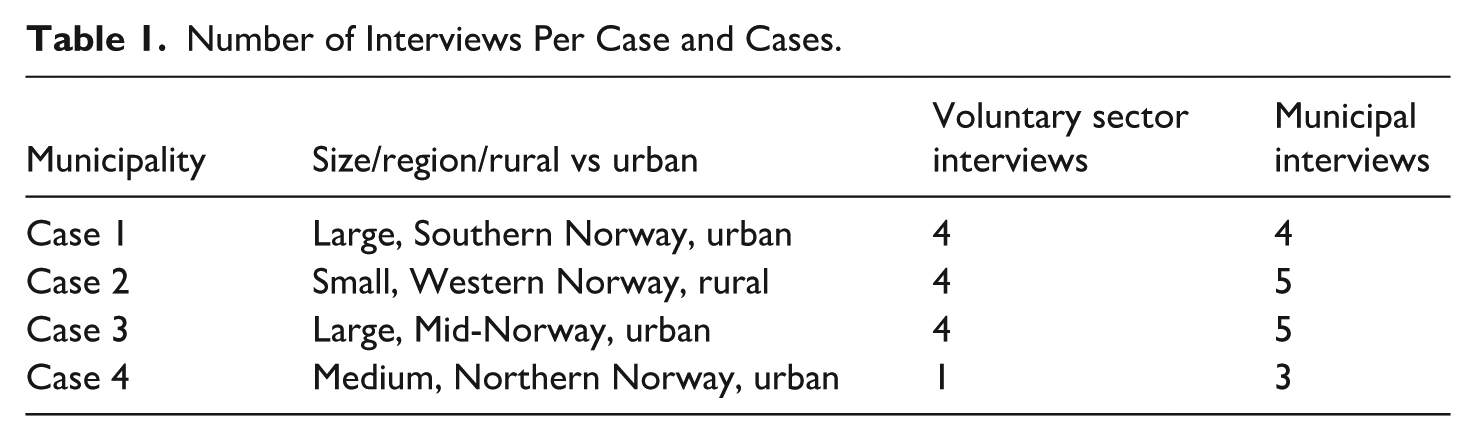
To unearth the reasons for, and consequences of, different co-production coordination strategies, we needed information from actors within the public and voluntary sectors in positions to provide overall views on collaboration. We thus mainly approached representatives of municipalities and voluntary organisations with some degree of experience as leaders, managers or coordinators. In each municipality, we interviewed representatives working with municipal elderly care and leaders from the voluntary organisations. These were typically administrative leaders in the municipalities and staff at institutions or other municipal employees that engage extensively with the voluntary organisations, perhaps in the form of a coordinator for voluntary sector collaboration or a leader of an elderly care unit service. We also carried out interviews with a few politicians, such as a municipal health and care committee member. Within each case, we thus tried to reach actors with experience in services where volunteers are involved. We mostly identified the voluntary organisations through their counterparts in the municipalities. Interviewees were leaders of the organisations or those responsible for an activity carried out together with the municipality. We also interviewed representatives of the mandatory municipal elderly care council and user organisations for people living with dementia. In addition, we interviewed representatives (often leaders) from volunteer centrals, where these were involved in the coordination of voluntary work in municipal elderly care. As shown in Table 1, we conducted 30 interviews in all. Interviews were semi-structured, lasted between 45 and 60 minutes and were conducted digitally in 2022–2023.
Number of Interviews Per Case and Cases.
A team of four researchers conducted interviews based on a shared interview guide with questions intended to capture a general overview of the relationships between the municipality and voluntary organisations in elderly care, the role of volunteers in the municipal care services (supplementary and complementary relations), the role of the voluntary organisations as a ‘critical corrective’ to public authorities (adversarial relations), facilitators and inhibitors for successful integration of volunteers in care work, and how users experience the participation of volunteers in care.
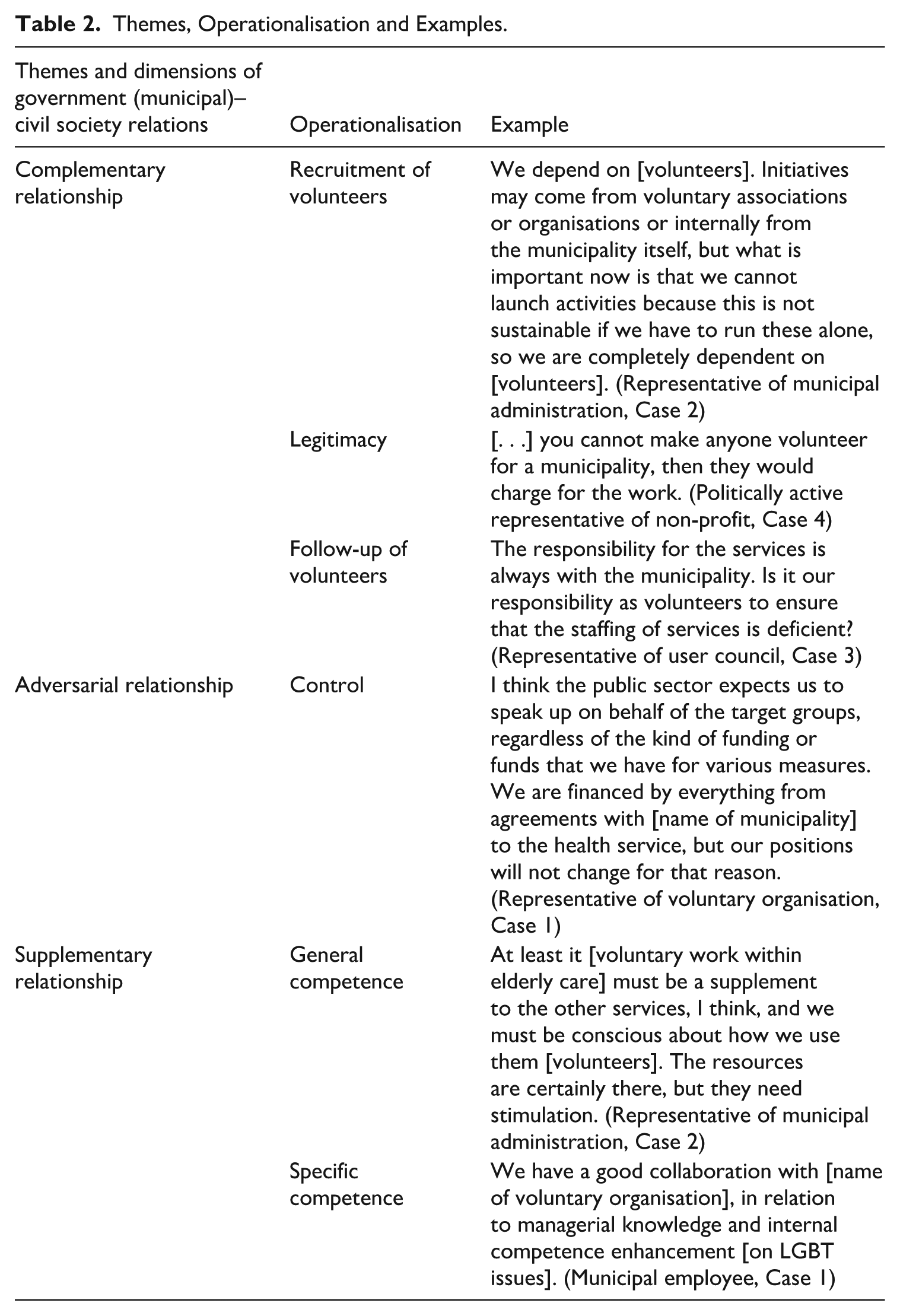
We asked explicitly about co-production towards the end of the interview, as this is an unfamiliar concept for many practitioners and, importantly, there is variation in how the concept is understood. Research assistants transcribed all interviews, and the ensuing analysis took the form of a content analysis (Krippendorff, 2018). The research team coded the transcripts with theme codes. The coding was guided by the structure and topics of the interview guide, reflecting our research interests in seeing the data in light of the three dimensions inspired by Young (2000). In addition, we inductively developed new themes from the transcribed interviews to make sure that our predefined categories did not limit the scope of the analysis. We accordingly applied an abductive approach to the analysis (Timmermans & Tavory, 2018), where we combined an analysis in accordance with our prior theoretical constructs with an inductive approach where we developed new themes from the data. To demonstrate how we interpreted the data, we refer to Table 2, which provides some illustrations.
Themes, Operationalisation and Examples.
Findings
When analysing the data, we organised the presentation along the three main factors that we identified in the theory section when integrating third sector and co-production theory: complementary, adversarial and supplementary relationships. A general finding was that, even though municipalities chose a main model for including citizens as volunteers in co-producing services for older adults, they may also have had elements from each of the two modes. Typically, this implies that the municipality had one main strategy yet allowed some volunteers to contribute through the alternative mode.
Complementary Relationship – Recruitment and Follow-Up of Volunteers
As explained above, a complementary relationship signifies that the public sector takes broad responsibility and defines the content and roles of the voluntary organisations. Our focus here is on the recruitment and follow-up of volunteers. Our data suggest that the follow-up of volunteers is both a major reason why municipalities chose a certain mode of coordination and an important advantage or disadvantage accompanying this choice.
Across all cases, quality in the ‘services’ provided by volunteers is a core issue for choosing a given model of co-production. This entails coordinating the volunteers to ensure the quality of volunteers, and matching volunteers and users when it comes to person-to-person volunteering. A voluntary organisation in Case 1 had approximately 7,000 volunteers through a programme of ‘visiting friends’, which predominantly served older adults. This thus constitutes a massive amount of volunteer work and was the only citywide form of volunteering.
In their self-presentation, the organisation stressed that all volunteers need to participate in classes before meeting the users, and that the matching process is done through a careful process in each case. The organisation thus took responsibility for the whole process, from recruitment and initiation to follow-up and, when needed, termination of the volunteering for each individual. These volunteers see both nursing home patients and home care users. When municipalities recruit and coordinate their own volunteers independently of organisations, this is usually restricted to older adults living in institutions. This role of the organisations as guardians of ‘service quality’ cut across both municipalities and regardless if the interviewee is from a municipality or a volunteer organisation. A municipal employee has a similar view on the quality of ‘services’ provided by volunteers: We must have some sort of quality assurance, and then we think it is important to have this through a voluntary organisation because we prefer not to have individuals. We want the people we use who volunteer their time to be organised in some way. Then we make demands to the organisation. Then we can subsidise the organisation, and they can run a simple training programme or have some digital solutions where people may enroll. (Case 3, Interview 2)
Interestingly, however, according to a municipally employed volunteer administrator at a nursing home in a different municipality, the quality work at the voluntary organisation was not vital for their contributions at her institution: Regardless of how much they are trained or prepared there [at the organisations], it is a different reality here. It is very good that they have this course, but they still need my follow-up here. (Case 1, Interview 9)
This means that a certain level of coordination is needed at the nursing home in any case. According to both municipal employees and representatives from voluntary organisations, there is variation in the extent to which the institutions can ensure that someone actually conducts this coordination. When a nursing home does not have a person dedicated to volunteer coordination, they depend more on voluntary organisations. One challenge of this is that, although the public sector prioritising of volunteer coordination can be temporal, the presence of a voluntary organisation is more durable. This is supported by interviews in Case 4, where the municipality recently abandoned a model with wide-ranging municipal coordination. The abrupt change in strategy was spurred by budget deficits and meant that volunteers had no contact person, and their work was not acknowledged in the way it had previously been. Some volunteers quit, and according to a municipal employee, it is unrealistic that voluntary organisations can compensate for the lack of municipal coordination to which volunteers had become accustomed.
Several interviewees point out that it is easier for a voluntary actor to ask volunteers to perform tasks than it is for the municipalities or other public agencies, because organisations enjoy more legitimacy. This is a potential benefit of volunteer organisations over municipalities, as they are understood as having a role in community building – that is, social capital, trust and legitimacy. In the words of one politically active representative of a non-profit organisation, ‘[. . .] you cannot make anyone volunteer for a municipality, then they would charge for the work’ (Case 4, Interview 2).
From the perspective of the municipalities, although underlining good relationships with the organisations, they find that recent developments often make it necessary for them to conduct their own volunteer recruitment. One important reason why the municipality sometimes chose the municipality as the mode of coordination is that some people do not wish to be a member of a voluntary organisation. Several interviewees, especially in the smaller municipalities, emphasise this. This trend, which is observed by municipal representatives and volunteer centrals, is also identified by national surveys (Folkestad et al., 2017).
One benefit of the voluntary organisations is that they can add something ‘extra’ to the care experiences that is more difficult to achieve within the public sector hierarchy. This is partly a matter of organisational logic; a public sector organisation is rigged to solve specific tasks and there is limited room to develop activities that go beyond the core care. Furthermore, although the public sector can recruit and coordinate volunteers, it has limited ability to seek alternative forms of resources. Conversely, a voluntary organisation can contribute volunteers and provide other forms of resources, such as the funding needed to initiate social activities, and people with time to organise and carry out such activities. A case in point is when restrictions caused by the COVID-19 pandemic limited social life in nursing homes, and a voluntary organisation arranged ‘socially distanced garden parties’ with food, live music and other activities. The initiative came from the voluntary organisation, the funding was obtained from a philanthropic foundation by the voluntary organisation, and volunteers hosted the event. At the same time, the public institutions had to contribute to make it happen. This form of co-production would likely be unavailable for the public sector if it had monopolised the coordination of volunteers. Indeed, the existence of alternative institutions with organisational capabilities enriches the services that are subject to the co-production.
Adversarial Relationship – Control
One central role of voluntary organisations is to serve as a watchdog, safeguarding and representing weak groups in public debate and promoting their interests (Haugen, 2018; Wijkström & Zimmer, 2011). Here, we present our interviewees’ views of whether this role applied to them and whether they saw any tensions between a role as watchdog and the collaboration with the municipality within elderly care.
The role as watchdog is, according to the informants, often carried out at the national level of such organisations or in local councils (e.g., user councils). Such councils represent different arenas than local service production and are often composed of other civil society representatives than those participating in the actual voluntary activities, yet still with the possibility to bring in experiences from the field. Informants from the municipalities describe the organisational representatives as active and constructive actors in this work, although the service delivery and watchdog roles are executed in different arenas. This could be one of the reasons why, when asked, most representatives of public sector employees and volunteers, across municipalities, do not describe strong tensions at the local level:
There are, however, exceptions. This leader of a volunteer central explains why public funding means that he finds himself unable to express strong criticism of the municipality: [. . .] if someone constantly nags or bites you on your ankles, you will have a bad relationship with them. This would preclude me from doing what I need to do. Because what makes me efficient is precisely the fact that I can call [name of municipal partner] and say that this is what I want to do, is that okay? Then he says: Yes, we trust you. (Case 1, Interview 10)
Furthermore, when the interviewees were asked about their practices, more issues of contestation appeared. One central issue is what should and what can be co-produced with volunteers, and when the municipality should assume sole responsibility. In one way, it is a public sector responsibility to draw this line, but a voluntary organisation can also have an institutional ability to reflect on this and to challenge the judgement of the public sector to an extent that is difficult for individual volunteers. Volunteer centrals may play an important role in this regard: We are the ones who have the meeting with the municipality on behalf of voluntary organisations. This is where we are a bit of a watchdog, because we often get questions from the municipality such as ‘Is it possible that you can [deliver food]?’ [. . .] we have said no to that. We believe that it is the municipality’s task to do that. People getting food should not be dependent on volunteers. (Case 2, Interview 1)
A related example from these interviewees is how volunteer centrals take part in discussions about when a citizen would benefit from having a volunteer visitor without special skills, and when the municipality should provide a paid support person. The interviewed representatives of volunteer centrals speak of a need for the clarification of expectations of what volunteers can and cannot do, and how volunteer centrals can help voluntary organisations with this. The watchdog function is about making such clarifications and drawing lines between the public responsibility and the volunteer’s room for offering supplementary activities and identifying what value such activities have.
When the municipalities coordinate volunteers directly, these issues of contestation are not something they have to deal with. Although this might be comfortable, the municipal staff also recognise that something is lost when voluntary organisations are not involved, as voluntarism has a fundamentally different logic than the professional services. One public employee with a background in community development experienced a shock when he started working with voluntarism in elderly care, where volunteers were directly recruited independently of organisations, as he observed competition and a blurring of sector lines: When I started working with elderly care, I initially could not understand how they [municipal administrators] were thinking. Because, you know, when the Directorate of Health has very much promoted this way of recruiting volunteers to work for the municipality, this was alien to me. [. . .] I realise that this is very problematic. Because I do not understand why nobody has put their foot down. It is problematic because you interfere with organisational life and become a competitor to the voluntary sector, and you get judicial challenges by doing it this way. Who is responsible if something goes wrong? (Case 1, Interview 1)
Policy makers wanting to boost voluntarism through their public organisations thus run a risk of alienating the volunteers, as they are driven by different institutional logics (Thornton et al., 2012).
Supplementary Relationship – Competence
As demonstrated in the theory section, the form and role of competence in our framework are key to understanding the supplementary dimension of co-production. Here, we highlight how certain voluntary organisations possess specific competences that frame their role as a co-production partner.
One such niche could be the lesbian, gay, bisexual and transgender (LGBT) community, who often receive inadequate respect or understanding of their orientation when using elderly care services (Mahieu et al., 2019). Uniquely for Case 1, a voluntary organisation with competence in issues relating to LGBT citizens plays an important role. The public services have traditionally had low competence regarding the needs and preferences of this group, but through co-production with this organisation, they have been able to develop their skills, according to both municipal administrators and a representative from the organisation. The representative from the volunteer organisation explains how the co-production spans both the development of skills among care staff and the social needs of the users: We contacted them and said that we would like to meet and help them increase the competence in LGBT issues among employees in elderly care. Secondly, investigating the possibility for research to generate knowledge, and thirdly, establishing a visitation service for queers. So, a three-part assignment with two knowledge-generating parts and one that is more socially directed. (Case 1, Interview 7)
Both this interviewee and the interviewed counterpart in the municipal administration agree that it is difficult to envision how a municipality could develop such tailored services for its niche population without co-production with a relevant voluntary actor that possesses not only expertise but also legitimacy among the LGBT population.
A broader group of users suffer from dementia. These residents are often in a vulnerable situation that requires special skills from volunteers who want to interact with them. Interviewees explain that individual volunteers with a background and education in the health professions can possess such skills. In addition, we find one major organisation that has invested a lot of effort in training its volunteers in how to engage with people who suffer from dementia. One municipal interviewee exemplifies the value of such training by comparing two of the major voluntary organisations, of which only one has such special training: Well, we have many with dementia and cognitive impairments. And they do not have that competence in [name of big organisation without special training]. So, it is of utmost importance, especially with this group, that you have this competence and that those who contribute – not always, it depends on what it is, but when situations occur – know how to deal with it. (Case 4, Interview 4)
Discussion
The most important reason why municipalities recruit and coordinate volunteers seems to be that they believe it increases the overall number of volunteers and hence the amount of resources in elderly care. Whether the number of volunteers actually increases, we do not know. However, this does not appear to stem from discontent with the traditional model but rather because changing approaches to volunteerism in society have inspired a more differentiated set of volunteer recruitment and coordination activities, and accordingly, more models for co-production to reap the potential for co-production in elderly care. Norway is part of the international trend of a more reflexive volunteerism (Eimhjellen et al., 2018; Hustinx & Lammertyn, 2003), and the resulting development of new co-production models also follows a pattern that is found elsewhere (Ibsen et al., 2018). One possibility open to municipalities is to attract volunteers who are motivated to contribute to one particular task yet with no interest in becoming member of an organisation. Referring to Young (2000), an important reason why municipalities choose not to draw on the complementary potential from organisations is thus simply that their own coordination provides extra volunteers. As the finding fits well with earlier studies of public sector volunteerism in the United States, for example, this poses the question of whether Norway is becoming more similar to other contexts that do not necessarily (or exclusively) focus on social policy, and where volunteer programmes may be rather comprehensive, where studies argue that government volunteers may enhance cost savings and offer services the government otherwise could not offer (Brudney & Kellough, 2000; Ivonchyk, 2019). On the contrary, we find that professional follow-up by organisations may relieve municipalities of responsibility for coordination. This corresponds to what Kristensen and Ibsen (2018) and Verhoeven and van Bochove (2018) conclude regarding municipal volunteerism in Denmark and the Netherlands, respectively. Still, one of our interviewees places follow-up by a municipal coordinator on an equal footing with what the voluntary organisations may offer, thereby implying that this complementary potential of voluntary organisations may not be decisive. At the same time, our data suggest that the willingness to volunteer via the municipality is fundamentally lower than via organisations, which is also supported by survey experiments of a representative sample of the Norwegian population (Christensen et al., 2020). This testifies to the role that voluntary organisations can have in community building, where initiatives taken by voluntary organisations may enjoy greater legitimacy than similar municipal initiatives. Organisations can create feelings of belonging, togetherness and trust, and vibrant local communities, that public entities cannot provide in the same way.
Our second research question on the benefits and challenges of public rather than voluntary sector coordination of volunteers in the co-production of elderly care overlaps with answers to the first question. Although our study has not been designed to compare and recommend models of coordination, the study does provide several comparative insights regarding reasons for, and consequences of, choosing one model. First, it seems that large municipalities are more likely to allow voluntary organisations to coordinate volunteers. The reason can be as simple as that the diversity of organisations is larger in large municipalities, while the task of coordinating is also greater where there are more volunteers. This insight must be qualified, however, as the smallest municipality very clearly prefers the traditional method of coordination through organisations, and the medium-sized case has varied experience of municipal coordination.
Second, from the perspective of the municipalities, there are several benefits of collaborating with voluntary organisations. These benefits are universally observed by informants, but we generally find that the bigger municipalities find themselves more dependent on the organisational capacities of volunteer coordination. The voluntary organisations follow up their members, whereas individual volunteers demand more municipal coordination and resources. We find that the capacity building that takes place within the organisations is also important for the public sector. This underlines that with a growing number of people suffering from dementia, special skills – such as knowing how to interact with dementia patients – are also relevant for covering the social needs of users. In short, organisational expertise is an important reason for the traditional voluntary–public collaboration identified across our four cases.
With few exceptions, representatives of voluntary organisations find that municipalities are respectful of their role and autonomy. The role as watchdog thus, although to a limited extent, leads to an adversarial relationship. We observe a division of labour like Frederiksen and Grubb (2023) identified within welfare services, in that one part of the voluntary organisations takes an advocacy role, and another part takes the co-production role. However, it is clear that when drawing the line between municipal responsibility and voluntary efforts, there are ongoing negotiations whereby the institutional structure of organisations enables them to act as a counterweight to municipalities in a different way than individual volunteers. A reduced advocacy role and blurring of sector responsibilities thus constitute the possible challenges of municipal volunteerism if voluntary organisations were to be excluded from co-design and volunteers were only to be included in the co-delivery of services.
How can we summarise the relevance and usefulness of our integration of Young’s framework with the co-production of elderly care? In much of the research literature, co-production involving voluntary organisations has been understood as collective co-production, as the public sector co-produces with voluntary organisations (Ibsen, 2021; Nabatchi et al., 2017). By combining third-sector research and co-production approaches, we demonstrate that this notion must be qualified. The public sector co-produces collectively with the voluntary organisation, but at the same time, also individually with the volunteers who are recruited and – to some extent – coordinated by the voluntary organisation. This strategy of direct recruitment represents an individualisation of co-production (Frederiksen & Grubb, 2023). In elderly care, some of the users are in a vulnerable situation, which demands that the professional staff supplement the coordination of volunteer co-production. We can thus identify two layers of coordination – one in voluntary organisations and one in public organisations. The need for municipal coordination means that co-production can imply more rather than less work for professionals (see also Verhoeven & van Bochove, 2018, p. 16).
If co-production with volunteers is to become a more important feature of elderly care in the future, the delimitation between public responsibility and tasks that are suitable for co-production may become more salient. In this respect, the voluntary organisation can be an institutional counterpart to the municipalities in negotiating the balance. This watchdog function and making clarifications and drawing lines between public sector responsibility and the volunteers’ room for offering supplementary activities illustrate the importance of the adversarial dimension (Young, 2000). From a municipal perspective, however, this balance may be too limited in terms of the scope of co-production to face the growing need for services. Still, as Norwegian voluntary organisations traditionally have a strong focus on expressive functions – that is, having an advocacy role and a more limited role when it comes to service provision (Enjolras & Strømsnes, 2018) – municipal volunteerism has the potential to challenge a key characteristic of state–civil society relations.
To overcome lacking expertise within municipal services, co-production is a fruitful approach to service development. This is, however, dependent on suitable organisations being present, as in the case with LGBT competence in our data. A more general finding is that certain organisations systematically develop the skills of volunteers in a way that can be exploited for improving services – for example, within dementia. Performing this work within a municipal–volunteer co-production model is considerably more demanding for already burdened services. This illustrates the relevance of the supplementary function of the third sector (Young, 2000).
Although our study reveals interesting trade-offs regarding a co-production model with and without voluntary organisations as coordinating actors, it is based on the findings from only four Norwegian municipalities. Even though some drivers for the observed mechanisms are universal, such as demographic changes, scarcity of health care staff, and a more reflexive and individualised volunteerism, statistical generalisations of our findings are not possible. Quantitative work exploring this same issue is therefore called for. A possible avenue for further research is to rely on the framework developed in this article and to increase the number of case municipalities to ensure variation in characteristics such as size, centrality and organisational density. This would provide information on which municipalities choose which model and allow for an assessment of how different models perform in different contexts. Such an analysis could also examine the dimensions we develop here more closely. Within recruitment and follow-up (complementary relationship), one could, for example, study which sector is most successful in matching volunteers and older adults and in establishing well-working and enduring connections. Another interesting approach would be to study how voluntary organisations adapt if municipalities take a stronger role as coordinators; will they (have to) change their way of recruiting, motivating and following up their volunteers? In addition, our inferences are embedded in a given welfare and civil society model. We therefore hope to see more corresponding studies from other contexts.
Conclusion
This article has asked two questions: Why do Norwegian municipalities sometimes prefer co-production directly with volunteers rather than through voluntary organisations? What are the benefits and challenges of public rather than voluntary sector coordination of volunteers in the co-production of elderly care? We have applied an explorative, qualitative case study design that uncovers the rationales and consequences of two different co-production strategies, inspired by Young’s (2000) three dimensions of the voluntary sector–public sector relationship. Although our point of departure was that municipalities may choose between two modes of coordination, whereby either municipalities or voluntary organisations coordinate citizens in voluntary activities, we find that municipalities may also combine the two modes, or at least allow some individual volunteers to contribute via the alternative mode. Municipalities that have chosen to coordinate citizens directly and independently of voluntary organisations consider this to increase the overall number of volunteers. Voluntary organisations’ participation is important for their role as critical correctives to public service providers and the special expertise they bring in. A disadvantage of municipal volunteerism is that it may replace traditional voluntary organisation activity, thus weakening civil society’s role as critical correctives and providers of special expertise.
Footnotes
Acknowledgements
We thank the three reviewers and editors for helpful comments. We would like to thank participants in the 10th open meeting of IIAS study group on ‘Coproduction of Public Services’, Radboud University Nijmegen, the Netherlands, May 11–12, 2023, for valuable comments. We would also like to thank the project group and project leader Ivar Eimhjellen.

Funding
The authors disclosed receipt of the following financial support for the research, authorship, and/or publication of this article: This work was supported by the Research Council of Norway under grant number 314525.
Declaration of Conflicting Interests
The authors declared no potential conflicts of interest with respect to the research, authorship, and/or publication of this article.
Data Availability Statement
The data are not publicly available due to ethical, legal or other concerns.