




Abstract
This article examines to what extent life course changes are associated with the likelihood to start humanitarian volunteering, and how many people start, quit or continue humanitarian volunteering over a longer time period, in the Netherlands. Using rich panel data from 2008 to 2022, we test hypotheses derived from influential theories on resources and role substitution. We find that the volunteer pool of humanitarian organizations is volatile, indicating that the solid core of stayers is small. Most life course changes in people’s lives do not (directly) relate to individuals’ voluntary behavior regarding starting humanitarian volunteering. In contrast, comparisons between respondents are more in line with the literature. We recommend to extend this study to all forms of volunteering to further assess the applicability of static theories when transposed to dynamic within-person transitions.
Introduction
In recent years there is an increased awareness that participation in philanthropic activities, such as volunteering, is a dynamic process (Nesbit, 2012; Rooney et al., 2021). “Volunteering needs to be understood as occurring as part of a lifelong process of decisions made among changing circumstances, and [is] therefore best understood longitudinally” (Hogg, 2016, p. 169). Recent studies based on longitudinal panel surveys examined the relationship of various life course changes with volunteering for different organizations. Examples of these dynamic studies are changes related to the composition of the household (Einolf, 2018; Nesbit, 2012, 2013), changes in religiosity (Aksoy & Wiertz, 2023; Johnston, 2013), paid work (Qvist, 2021), primary occupation (Wiertz & Lim, 2019), retirement (Eibich et al., 2022; Grünwald et al., 2021), and health (Broese van Groenou & Van Tilburg, 2012). Several studies examined multiple life course changes (Gray et al., 2012; Hogg, 2016; Lancee & Radl, 2014; Niebuur et al., 2022). In this article, we study how these life course changes are related to volunteering for humanitarian organizations.
Building on the resource perspective (Wilson & Musick, 1997, 1998) and the role substitution perspective (Mutchler et al., 2003), this study analyzes panel data in which volunteers for humanitarian organizations are tracked over a period of 15 years. In doing so, we seek answers to two research questions:
Following Sandri (2018), “humanitarian volunteering” is defined as giving support, or providing aid to people in need who lack the provisions to overcome their issues. 1 Volunteering for humanitarian organizations is unique in at least two aspects, which makes it a relevant and important case for testing hypotheses on life course changes and changes in volunteering. First, humanitarian volunteers typically do not work for the benefit of ingroup members, as compared with much volunteering for other organizations, but they devote their time to help out-groups in society. Second, humanitarian volunteering is more subject to volatility over time than other forms of volunteering. Societal events, such as, for example, the refugee crisis of 2015–2016, led to an increased demand for humanitarian volunteers while such societal pressures can be less prominent in other time periods. Hence, it is fair to assume that many people start and quit this type of volunteering, as the need for these type of volunteers is largely influenced by societal events or crises. In sum, this volatility is typical for volunteering for humanitarian organizations, especially when compared with other types of organizations where volunteering is much more continuous over time (Meijeren et al., 2023b).
Understanding the relationships between volunteering and life course changes is important, as recruiting and retaining volunteers has become increasingly challenging (Piatak & Carman, 2023; Prince & Piatak, 2023). Next, humanitarian crises create migration flows that fuel dynamics in the need for volunteers. Consequently, it is important to know why people start volunteering. A longitudinal, that is, panel perspective tracking individual volunteers for a longer period of time might, therefore, reveal important findings that could foster the understanding of sustainability in humanitarian volunteering, which has come increasingly under pressure (e.g., Snyder & Omoto, 2008). Importantly, the data in the present study allow us to map changes in volunteering for humanitarian organizations that occur after life course changes over a period of 15 years. In doing so, this study contributes to our scientific knowledge of the dynamics in the pool of volunteers for humanitarian organizations. In addition, we advance on previous studies that usually included only a small set of life course changes, by considering a large number of life course changes.
By taking a life course perspective, we make five contributions. First, this study deepens knowledge in the specific area of volunteering for humanitarian organizations. In doing so, we move away from the observed tendency that volunteering is often approached too generally (Brudney et al., 2019). Second, we take a rather unique approach by examining the relationship between changes within the life course of individuals and transitions into humanitarian volunteering. Third, we transpose theories developed for cross-sectional (static) comparisons between the personal characteristics of volunteers and nonvolunteers to the dynamics of changes in volunteering within persons. So, we test to what extent the theories developed to explain why people with certain characteristics are more likely to volunteer can be generalized to explain associations between changes in the life course and changes in volunteering. Fourth, the data allow us to give a very detailed individual-level view, from year to year, of what kind of people start (or continue) humanitarian volunteering and what kind of people drop out. In applying this detailed perspective, we advance on related studies with only a static design (e.g., Hustinx, 2010). Fifth, previous static research (e.g., Meijeren et al., 2023a) has shown that people with certain sociodemographic characteristics are more likely to volunteer for humanitarian organizations. Using a dynamic perspective, however, we show how life course changes are related to changes in humanitarian volunteering.
Theoretical Insights
Resource Perspective
We use two complementary perspectives to explain how life course changes relate to volunteering. The resource perspective (Wilson & Musick, 1997, 1998) emphasizes that the likelihood to volunteer is dependent on three different forms of capital. 2 First, volunteer work is productive work that is facilitated by human capital, defined as resources that make work more productive, and therefore enable people to volunteer (Wilson, 2012). Examples are one’s education, health condition and income level. Second, volunteer work is facilitated by social capital. Social ties supply information on volunteer opportunities, foster trust and norms of generalized reciprocity, provide support and create obligations (Wilson & Musick, 1997). Third, volunteer work is facilitated by cultural capital. Wilson and Musick (1997) emphasize the moral component of culture with norms and prosocial values that facilitate compassion regarding those people who deserve help. Bekkers and Schuyt (2008, p. 77) describe that churches stimulate volunteering because “they bring together communities of people who interact frequently with each other and who view [. . .] volunteering as a positive social activity.” Religious groups clearly have norms that prescribe giving and volunteering. In doing so, frequent churchgoers are socialized in an environment where volunteering is propagated.
Wilson and Musick (1997, 1998) show that persons in the United States with more human, social, and cultural capital are more likely to be engaged in volunteer work. Bekkers (2006) provides such evidence for the Netherlands. While the resource perspective is mainly used to explain volunteering differences between people in static studies, it can also be applied to changes within individual life courses in dynamic research. Lancee and Radl (2014) propose that each person’s stock of resources fluctuates over the life course. The resource perspective therefore “predicts changes in volunteering behavior over people’s life course to the extent that their biographical trajectory affects their capacity to engage in volunteering” (p. 836). Lancee and Radl (2014) found that life course transitions related to the family realm, such as parenthood, marriage, or divorce, are related to changes in volunteering behavior. However, their results may be biased because the analysis used characteristics of respondents at the time of the survey to “predict” back in time what respondents have done in terms of volunteering in the past year.
Role Substitution Perspective
Next, the role substitution perspective predicts that the relationship between productive activities is characterized by a trade-off (Mutchler et al., 2003). Volunteering is a social role, next to other roles that individuals possess in life such as, for instance, the worker-role. If roles are dropped (e.g., when people retire), together with the identities and rewards that go along with these roles, people might (try to) compensate for this loss by taking up other roles in life, such as the volunteer role. Indeed, studies reasoning from this role theory approach (e.g., Mutchler et al., 2003; Niebuur et al., 2022; Wilson, 2000) have shown that life course changes generate shifts in individuals’ roles, resulting in changes in volunteering behavior. The odds of starting volunteering increase when roles are dropped, for instance, when children leave the household or when individuals retire from paid work (Einolf, 2018).
We focus on several life course changes that may impact humanitarian volunteering. Following Kregting et al. (2023), we present these changes as much as possible in the order in which they typically, but not necessarily, occur over the course of life.
Hypotheses
A first important change in the life course, usually in early adulthood, are changes in educational attainment. Education is seen as one of the strongest resources for volunteering (Wilson, 2012), and is strongly related to humanitarian volunteering as well, at least in static studies (Meijeren et al., 2023a). However, there are dynamic studies (Ruiter & Bekkers, 2009) that find no effect of educational attainment on starting volunteering. They reason that higher educated individuals are more likely to be members of organizations and, therefore, more likely to have a broader network and more social capital and consequently more likely to volunteer. Despite mixed evidence we assume that an increase in educational attainment contributes to resources to meet the demands of voluntary work. 3 Hence, for our first hypothesis (H1), we expect that an increase in educational attainment increases the likelihood to start volunteering for humanitarian organizations.
A second life course change is related to organized religion. There is a large body of research demonstrating a static association between religious involvement and volunteering (Bekkers & Schuyt, 2008; Piatak, 2023), and humanitarian volunteering (Meijeren et al., 2023a). Moreover, using panel data, Aksoy and Wiertz (2023) and Johnston (2013) found a positive relationship of religion with volunteering. On one hand, frequent churchgoers are more socially integrated, with higher levels of social capital, and therefore more likely to be asked to volunteer (Bekkers & Schuyt, 2008). On the other hand, the more frequent people attend religious gatherings, the more likely they are to be socialized with cultural capital in sermons teaching them prosocial values (Bekkers & Schuyt, 2008) and the virtue of doing volunteer work. Because they possess more social and cultural capital, frequent churchgoers should be more prepared to engage in volunteering. 4 Hence, for our second hypothesis (H2), we expect that an increase in attending religious gatherings increases the likelihood to start volunteering for humanitarian organizations.
The change to mature adulthood typically is a more stable phase in life where one’s socio-economic position becomes more or less established (Gray et al., 2012), with stable or rising incomes. Persons with more financial resources are more likely to volunteer (Wilson, 2000, 2012). Moreover, a high income can enable people to stop working full-time, freeing up time for other activities. 5 Therefore, we formulate a third hypothesis (H3), expecting that an increase in income increases the likelihood to start volunteering for humanitarian organizations.
Next, parenthood is another example of a change in the life course. Theorizing from a role substitution perspective, the birth of a (first) child imposes an important (new) role in life which means that other roles, as the volunteer role, are not likely to be taken up. Both static studies (Piatak, 2023), as well as dynamic studies (Nesbit, 2012; Niebuur et al., 2022) documented this relationship. Reasoning from a resource perspective, however, the presence of children also creates opportunities for volunteering as parents can get in touch with other parents and institutions related to their children’s lives, increasing their social capital. When children grow older, therefore, parents are often drawn into volunteering opportunities, especially those related to their children’s activities (Einolf, 2010, 2018). 6 However, this mechanism concerns leisure organizations rather than humanitarian ones (e.g., Gray et al., 2012; Meijeren et al., 2023a). When children leave the household, and parents enter the empty-nest phase, parental roles are dropped which increases the likelihood to volunteer. Therefore, (H4) we expect that a decrease in number of children in the household increases the likelihood to start volunteering for humanitarian organizations.
Another life course change is retirement. Arguing from a role substitution perspective, retirees lose an important role and might start volunteering to seek a new role in life (Mutchler et al., 2003). However, the evidence for this mechanism is inconclusive. Wilson (2012) describes that the literature does not suggest that volunteering is used as a substitute for work. Piatak (2016) found that retirees are more likely to initiate volunteer work than people in paid employment. In dynamic contributions, Grünwald et al. (2021), Mutchler et al. (2003), Nesbit (2012) and Niebuur et al. (2022) demonstrated that retirees have higher odds to start volunteering. Eibich et al. (2022) report more longitudinal evidence by showing that retirement increases the frequency of volunteering in thirteen European countries and the United States. Seen from a resource perspective, however, retirement implies the loss of social ties with colleagues, reducing opportunities to be asked to volunteer (Piatak, 2016). Taken together, in our fifth hypothesis (H5), we expect that retirement increases the likelihood to start volunteering for humanitarian organizations.
In later life, health problems might affect individual resources (Broese van Groenou & Van Tilburg, 2012). A good health is a resource, while bad health raises the costs of doing voluntary work (Wilson & Musick, 1997). A good health condition is, therefore, positively related to volunteering (Wilson, 2012), and positively related to volunteering for humanitarian organizations in static research (Meijeren et al., 2023a). Conversely, dynamic evidence reports that deteriorated health decreases the likelihood to volunteer (Broese van Groenou & Van Tilburg, 2012; Niebuur et al., 2022). 7 Hence, for our sixth hypothesis (H6), we expect that an increase in one’s health condition increases the likelihood to start volunteering for humanitarian organizations.
Throughout the life course, the composition of the social network of individuals changes, with typically a decreasing network size in later life (Broese van Groenou & Van Tilburg, 2012). Having a large social network creates resources that foster volunteering in multiple ways. Previous studies have argued that people with larger networks have more access to information (Bekkers & Ruiter, 2008; Wilson, 2000, 2012), more opportunities to be asked to volunteer (Piatak, 2023), and are exposed to more normative pressure to volunteer (Bekkers, 2006). Empirical evidence confirms that people with larger networks are more likely to volunteer (Niebuur et al., 2018; Wilson, 2000, 2012), a finding that also emerges from dynamic research (Broese van Groenou & Van Tilburg, 2012; Nesbit, 2012). Previous static research showed that network size is positively related to volunteering for humanitarian organizations (Meijeren et al., 2023a), although humanitarian volunteers report that they were not specifically motivated to volunteer because their friends did so (Meijeren et al., 2024b). Nevertheless, in our seventh hypothesis (H7), we expect that an increase in social network size increases the likelihood to start volunteering for humanitarian organizations.
Methods
Data
In this article, we make use of data from the LISS panel (Longitudinal internet studies for the Social Sciences) managed by the nonprofit research institute Centerdata (Tilburg University, the Netherlands). LISS uses a household panel that is aimed to be representative of the population of the Netherlands of 16 years of age and older. LISS provides high-quality survey data and is developed to monitor changes in the life course and living conditions of the panel members aimed to represent the general Dutch population (Scherpenzeel, 2009). The panel is a random sample of Dutch household addresses, drawn by Statistics Netherlands. After the selected households are invited and informed with a letter, a face-to-face recruitment interview is conducted with them. When their response is positive, every household member with a minimum age of 16 years is able to participate in the panel. Self-selection into the panel is hence not possible.
This recruitment method to refresh the panel is repeated every 2 to 3 years, starting from 2007. To measure the degree of (selective) attrition and panel representativeness, the data set is compared with the population figures of Statistics Netherlands. This is monitored throughout the year for specific sociodemographic characteristics on the household level, and for individual members of the household. These specific sociodemographic characteristics are, respectively, gender, age, educational level, net income per household, urbanity, province, household size, and residential form. 8 When there is dropout and the panel becomes too small, a new recruitment round is started to reach the desired number of at least 5,000 respondents. A new recruitment round is also launched when there arises a threat of significant deviation from population figures of Statistics Netherlands, on specific characteristics as outlined here above. When attrition is selective on specific characteristics, Statistics Netherlands starts a stratified sampling round to overcome sampling error in the LISS panel. 9
Data are annually collected in two fieldwork periods of both 3 and 4 weeks. A reminder was sent twice to nonresponders. A second fieldwork period is directed to those who did not respond in the first fieldwork period, again followed by two reminders. Questionnaires are filled out online. The data had a minimum of 5,051 respondents in 2019 and a maximum of 7,352 respondents in 2008. There are three reasons as to why the number of observations varies between the years. One, the selected number of household members who are part of the LISS panel differs from year to year, due to attrition and refreshment samples. Two, the annual data collection can be planned close to or close after a necessary recruitment round (see endnote nine for an overview). Three, the response rates differ slightly from year to year. 10
The yearly retention rate is very high: about 90% and, as said, refreshment samples are drawn aimed to ensure panel representativeness. We make use of the data of the annual modules on (a) Social Integration and Leisure; (b) Health; and (c) Religion and Ethnicity (Centerdata, 2022). These data have been collected between the years 2008 and 2022. Moreover, we use data of (d) the Background Variables module. This is a monthly module in which, for the years 2008 to 2022, we have selected the December module each time. Finally, data sets of all included years were merged into one data set.
We retained only respondents who participated in the panel for at least 2 years to observe within-respondent changes over the years. Consequently, we removed observations from respondents who only participated once in the panel (1,7%). Our final data set contained 118,451 observations of 15,011 respondents. 11 Note that we, straightforwardly, limited our analyses to individuals who are “at risk” to start volunteering for humanitarian organizations. This means that we focus on cases who did not volunteer at t − 1 to predict whether they started volunteering at time t0. Consequently, the analyses concerning starting volunteering for humanitarian organizations were performed with 50,009 observations of 9,474 respondents. On average, respondents had been in the LISS panel for almost 11 years, with a standard deviation of more than 4 years. Participation in the panel varied from a minimum of 2 years, up to a maximum of all available 15 years.
Measurements
Dependent Variable
Starting to Volunteer for Humanitarian Organizations
Respondents were asked whether they had volunteered for humanitarian organizations in the past year, with the question: “We now list a number of organizations that you are free to join. Can you indicate, for each of the organizations listed, what applies to you at this moment or has applied to you over the past 12 months?—Performed voluntary work for an organization for humanitarian aid, migrants or human rights.” 12 We considered respondents who had not reported volunteer work for humanitarian organizations in one wave, but did so in the consecutive wave, to be persons who started volunteering for humanitarian organizations. Over the entire period of 15 years, there are 1,398 respondents who started volunteering for humanitarian organizations. So, there are 1398 within-respondent observations with a change to starting volunteering for humanitarian organizations, compared with the year before.
Independent Variables
Educational attainment is measured with the question: “Please select the highest level that you have completed (with a diploma or certificate).” Answer categories are (0) not yet started/completed an education, (1) primary school, (2) intermediate secondary education, (3) higher secondary education, (4) intermediate vocational education, (5) higher vocational education, and (6) university. 13 The frequency of attendance at religious gatherings is measured with the question: “Aside from special occasions such as weddings and funerals, how often do you attend religious gatherings nowadays?” Answer categories are (0) never/I do not know, (1) once or a few times a year, (2) at least once a month, and (3) once a week or more.
Following the operationalization of Meijeren et al. (2023a), the variable monthly average income per household member (in euros) is constructed by dividing the monthly net household income in euro by the number of members in the household. We applied data imputation to predict the monthly average income per household member among respondents with a missing value on this variable. Moreover, we divided the variable by one thousand to facilitate interpretation of the results. Next, home ownership refers to whether or not the respondent possesses a self-owned dwelling. Answer categories are (0) no and (1) yes. To measure number of children, LISS asks for the number of living-at-home children in the household and/or children of the household head or his/her partner. 14 We then created four dummy variables to capture important changes in the life course that relate to children entering or leaving the household (Einolf, 2018; Nesbit, 2012), being (1) first child in the household (the change to parenthood), (2) additional child in the household, (3) child leaving the household, and (4) last child leaving the household (leaving an empty nest).
Next, to measure primary occupation, LISS asks what the primary occupation is of the respondents. Original answer categories are grouped into three categories, being (1) performs paid work, (2) is pensioner ([voluntary] early retirement, old age pension scheme), and (3) other activities. Subjective health is measured by asking: “How would you describe your health, generally speaking?” Answer categories are (1) poor, (2) moderate, (3) good, (4) very good, (5) excellent. Next, we follow Meijeren et al. (2023a) in the construction of interactions in the social network. This scale is constructed out of three items in LISS: spend an evening with family “spend an evening with someone from the neighborhood” ‘spend an evening with friends outside your neighborhood.’ The answer categories of these three variables are similar, and as follows: (1) never, (2) about once a year, (3) a number of times per year, (4) about once a month, (5) a few times per month, (6) once or twice a week, and (7) almost every day. Answers on these questions led to a sum score, which was then divided by three. The higher the score on the scale, the more social interactions in the network. Note that, similar to Meijeren et al. (2023a), we allow that respondents with at least one score on the three items remain included in this variable. This is done to reduce the number of missing values.
In the regression analyses we include four covariates to reduce the risk of spurious relationships. Gender is included and measured with (0) male and (1) female. 15 Because younger Dutch cohorts are less active in voluntary associations (Van Ingen, 2008), we control for birth year of respondents, categorized in decades, running from (1) the oldest years of births up to 1939, (2) 1940–1949, (3) 1950–1959, (4) 1960–1969, (5) 1970–1979, (6) 1980–1989, (7) 1990–1999, and (8) 2000 up to the youngest years of birth. We follow Kregting et al. (2023), measuring religious socialization with the question: “When you were 15 years old, how often did your parents attend religious gatherings?” 16 Answer categories are reversed, so that a higher score indicated more religious socialization, being (1) never, (2) once or a few times a year, (3) at least once a month, (4) once a week, (5) more than once a week, and (6) every day. 17 Finally, we include year of measurement to control for period effects and to be able to visualize trends. Table 1 reports the descriptive statistics for the variables used in this study.
Descriptive Statistics Dependent and Independent Variables (n = 118,451).
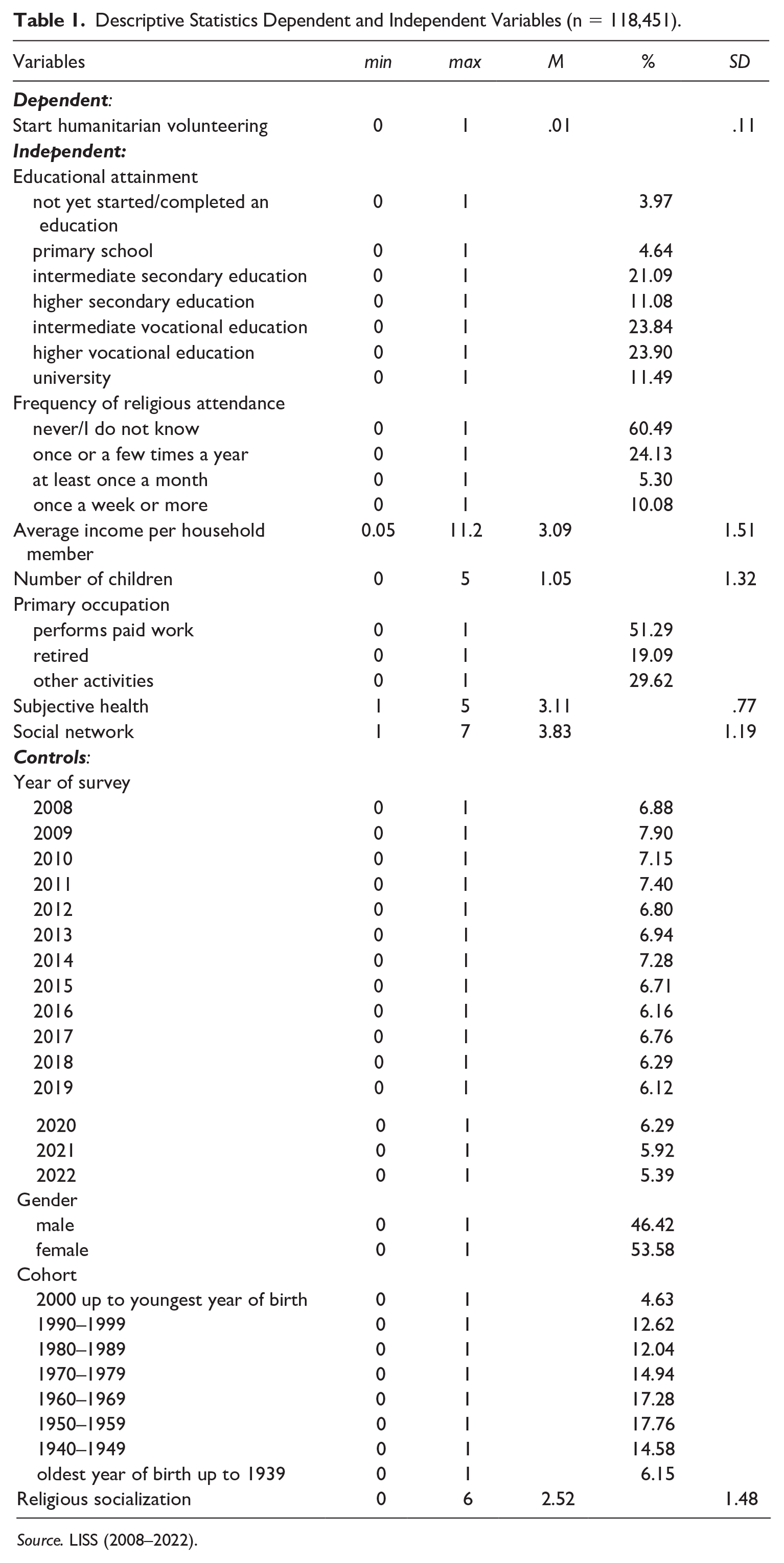
Source. LISS (2008–2022).
Method of Analysis
To obtain estimates for within-person changes in characteristics of respondents, we transformed the predictor variables into deviations from their person-specific means, following Schunk (2013). For each predictor, we subtracted person-specific scores from the person-specific means, resulting in person-specific deviation scores. Their descriptive statistics are presented in Table 2.
Descriptive Statistics Within-Person Change Variables (n = 118,451).

Source. LISS (2008–2022).
We estimated hybrid panel models to examine the relationships of life course transitions with starting humanitarian volunteering. 18 Hybrid panel models allow us to estimate changes within persons and differences between persons at the same time, combining the benefit of controlling for unobserved heterogeneity in fixed effects models (Allison, 2009; Brüderl & Ludwig, 2015) while keeping the possibility of estimating differences between persons (Kregting et al., 2023). In a hybrid model variables reflecting within-person changes and between-person differences can be included.
Ruling out bias due to unobserved heterogeneity is a major advantage of fixed effects models over a pooled ordinary least squares or a random effects model. However, note that fixed effects models only address unobserved heterogeneity if the predictors in the model do not change over time. By definition, fixed effects models eliminate all characteristics that are stable within individuals. Fixed effects models control for all time-invariant differences between persons and only report on effects of time-varying independent variables (Allison, 2009), which in our case are the life course changes. Statistically significant coefficients in a fixed effects regression imply that a within-person change in a life course variable is associated with a within-person change in starting volunteering for humanitarian organizations. Following Eberl and Krug (2021), within-person estimates provide a stronger basis for causal inference compared with static comparisons between persons with different characteristics. “However, researchers often have no information about which change came first—the change in the dependent or the independent variables. Thus, bias due to reverse causality is possible” (Eberl & Krug, 2021, p. 280). We reduce the risk of reverse causality bias, using lagged predictors, that is, the value of the predictors in a previous time period (here: the previous year).
Many relationships between volunteering activity and characteristics of persons presented in previous research focus solely on differences between volunteers and nonvolunteers, and not on changes within individuals. We formulated our hypotheses in terms of changes within persons. The hybrid models we estimate allow us to observe to what extent relationships between participation in volunteering and person characteristics are attributable to differences within and between individuals. In our models, the between effects of life course changes refer to average differences in humanitarian volunteering between all persons who did and persons who did not experience a certain life course change, regardless of when that change occurred. Between-effects models eliminate within-person variation by averaging observations over time and correspond to a regression based on group means (Allison, 2009). Thus, between-effects estimates are equivalent to taking the person-specific mean of each particular variable across time and estimating an ordinary least squares (OLS) regression on this set of means. In doing so, between-person estimates allow for differences between subjects to be assessed without temporal changes influencing the results. The results of the fixed effects part of the hybrid model of starting humanitarian volunteering are presented in Table 3. The results of the between-effects part can be found in Appendix A. Crucially, we limit our analyses to individuals who are “at risk” to start volunteering for humanitarian organizations. This means that we selected persons who did not volunteer at t − 1 and seek to predict whether or not they started volunteering at time t0.
Parameters From a Mixed Effects Model on Starting With Humanitarian Volunteering.

Source. LISS (2008–2022). *p < .05, **p < .01, ***p < .001 (tested two-tailed).
Note. (1) The analyses concern 50,009 observations of 9,474 respondents; (2) year 2008 not estimated due to lagged predictors; and (3) estimations are from one mixed effects model including the predictors of Table A1.
Results
Starters, Quitters, and Stayers per Year
Figure 1 shows changes in the proportion of survey participants who started, quitted, or continued humanitarian volunteering during the years of study. The figure distinguishes (1) those who started volunteering compared with the year before (starters); (2) those who quitted volunteering compared with the year before (quitters) and those who volunteered for two consecutive years (stayers). Note that for each year, the total of starters, quitters and stayers adds up to a 100%.
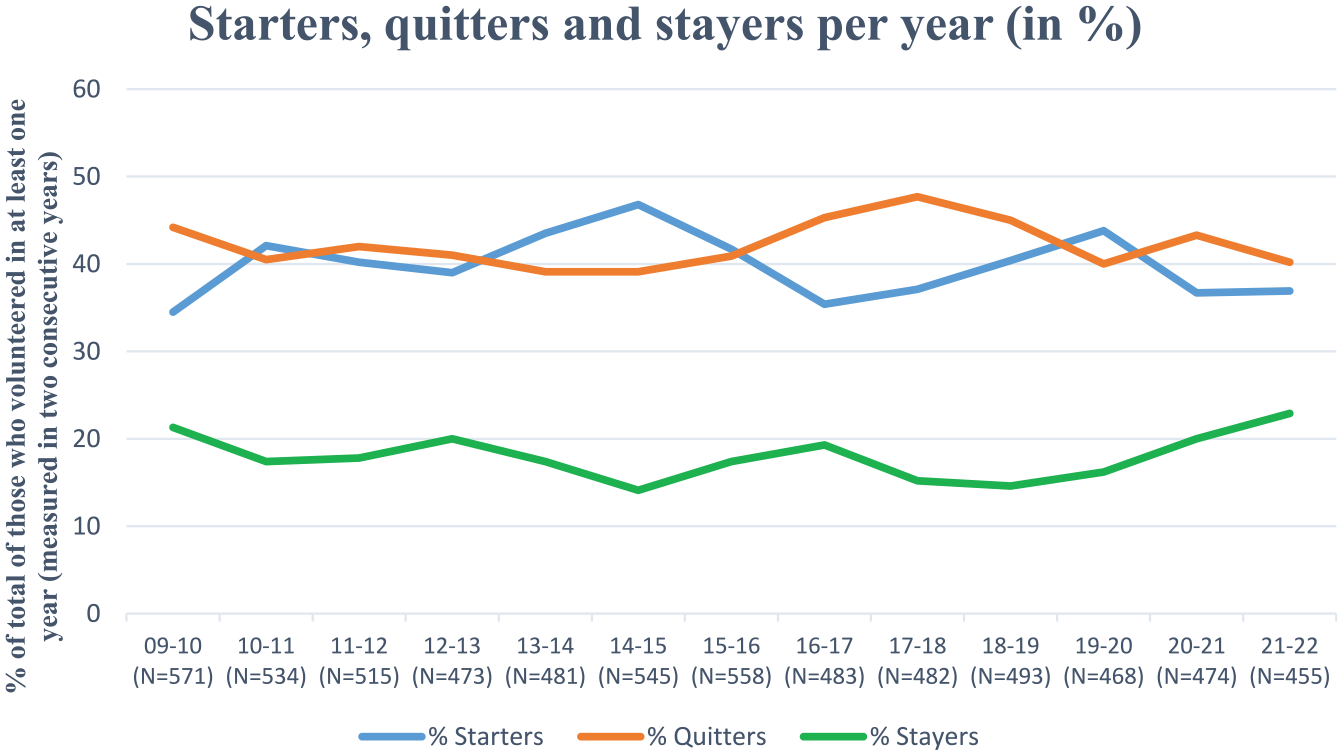
Longitudinal Overview of Starters, Quitters, and Stayers per Year (in Percentages).
Figure 1 displays that there is large fluctuation in the volunteer pool of humanitarian organizations, given that the more solid core of stayers is low and the inflow and outflow of volunteers is high. In 2014–2015, larger numbers started volunteering for humanitarian organizations. This larger inflow is likely to be related to the refugee crisis of 2015, when the influx of asylum seekers in the Netherlands was twice as high compared with the year before and more than 4 times larger than 2013 (Statistics Netherlands, 2024). In the years 2016–2018 and around 2021 the number of volunteers who quitted was higher than those who started. This may also be related to the influx of asylum seekers, as those numbers in 2016–2018 were sharply lower than in 2015 (Statistics Netherlands, 2024). The larger outflow of volunteers in 2021 could be related to the impact of the COVID-19 crisis. Dederichs (2023) demonstrated that the elderly, women and the higher educated in particular stopped volunteering at that time, and these are also the people who are more likely to volunteer for humanitarian organizations (Meijeren et al., 2023a). These descriptive results support our argument on the over-time volatility of this type of volunteering as compared with other types of volunteering.
Starting to Volunteer for Humanitarian Organizations
Table 3 presents the results of the fixed effects portion of the hybrid model of starting with humanitarian volunteering. The analyses concern 50,009 observations of 9,474 respondents. We start with a focus on significant findings. We find support for Hypothesis 7: respondents who expand their social network are more likely to start volunteering for humanitarian organizations, though the association is weak (b = 0.002, p < .05). We find a contradictory relationship for hypotheses 2. Here, the result shows that when Dutch people increase their attendance at religious gatherings, they are less likely to start humanitarian volunteering (b = −0.003, p < .05). This result runs counter to the prediction, and thus provides food for thought: not only is Hypothesis 2 rejected, the outcome is also the exact opposite of what this hypothesis proposed.
We find no support for our hypotheses on an increase in educational attainment (Hypothesis 1, b = 0.003, p > .05), changes in monthly income (Hypothesis 3, b = −0.001. p > .05), changes in number of children (Hypothesis 4, respectively: b = 0.017, p > .05 (first child in household), b = −0.006, p > .05 (additional child in household), b = −0.000, p > .05 (child leaving the household)), a change into retirement (Hypothesis 5, b = 0.009, p > .05), and changes in subjective health (Hypothesis 6, b = −0.002, p > .05). Notably, the signs of the parameters of monthly income, number of children and subjective health run counter to the predictions, though they are not significant, and all associations are weak. Some of the parameters point in the direction we expected, such as the parameters of an increase in educational attainment and a change to retirement, though they are close to zero. The rejections of our hypotheses imply that (recent) changes in people’s lives do not (directly) relate to their voluntary behavior regarding starting volunteering for humanitarian organizations.
While the results of the fixed effects analyses lead to the rejection of most of our theoretical expectations, the results of the between-effects analyses paint a more familiar picture that is largely in line with previous literature. These results, and its discussion, are presented in Appendix A.
Conclusion
This study examined to what extent life course changes are associated with the likelihood to start volunteering for humanitarian organizations, and how many people start, quit or continue humanitarian volunteering over a longer period of time. We took advantage of Dutch panel data in which humanitarian volunteers were individually tracked over a period of 15 years, with an average panel participation of almost 11 years. Regarding our first research question, we found that the volunteer pool of humanitarian organizations is characterized by large fluctuations. On average, based on all pairs from consecutive years in the period 2009–2022, we found that more than 42% of the volunteers quitted, whereas almost 40% started and only 18% sustained humanitarian volunteering. To some extent, the fluctuations in the inflow and outflow of volunteers can be related to fluctuations in the inflow of asylum seekers coming to the Netherlands. In the years of the refugee crisis of 2015, when the influx of asylum seekers in Europe was considerably larger than the years before, the amount of starting volunteers was higher. In the years thereafter, when the influx of asylum seekers was considerably lower (Statistics Netherlands, 2024), the amount of quitting volunteers was higher. This tells us that volunteers in some years are more needed than in other years, which influences the dynamics of starting, quitting and continuing humanitarian volunteering. Previous work suggests that humanitarian volunteers tend to quit when they find that they only have few tasks left to perform (Meijeren et al., 2024a).
We used two complementary theoretical perspectives to derive testable hypotheses about the relationship between life course changes and starting humanitarian volunteering to address our second research question. First, the resource perspective emphasizes the dependency on resources for the likelihood to volunteer. Second, the role substitution perspective emphasizes the tradeoff between multiple social roles in life which could ultimately fuel or hamper volunteering.
Hypotheses about the life course changes are discussed in the order in which they typically, but not necessarily, occur over the course of life. Overall, the pattern is that the majority of life course changes in people’s lives do not (directly) relate to individuals’ voluntary behavior regarding starting humanitarian volunteering. This applies to educational attainment (Hypothesis 1) as well, as we found that obtaining an educational degree was not related to an increased likelihood to start humanitarian volunteering in the subsequent year. This result is in line with a finding for voluntary work in general. Lancee and Radl (2014) argue that the higher prevalence of volunteering among the higher educated is due to a selection effect: people who will later attain a higher level of education perform more voluntary work even before they finish their education. Next, and to our surprise, increasing religious attendance (Hypothesis 2) is associated with a lower likelihood to start humanitarian volunteering. This contradicts the evidence of Aksoy and Wiertz (2023) and Johnston (2013) for the United Kingdom and the United States. Future research should further examine this relationship to assess if our outcome is an exception, as the Netherlands is a very specific case with a high level of secularization (e.g., Kregting et al., 2023). Furthermore, findings revealed that changes in income are unrelated to starting humanitarian volunteering (Hypothesis 3). This fits with the outcome of a meta review on determinants of voluntary participation (Niebuur et al., 2018), where it was found for the majority of studies that income appeared to be unrelated to volunteering of any kind.
Changes in number of children were unrelated to starting humanitarian volunteering, rejecting Hypothesis 4. This implies that important changes in the composition of the household, being the birth of a first child, children leaving the household and the moment that the last child leaves the household, creating an empty nest (e.g., Einolf, 2018), do not lead to a decreased likelihood to volunteer. These outcomes contradict several studies in the broader volunteering domain (Einolf, 2018; Nesbit, 2012; Niebuur et al., 2022), but findings from a meta review found more heterogeneous results on this relationship (Niebuur et al., 2018). The straightforward interpretation may be that parents are not drawn into humanitarian volunteering via their children, as this is more applicable to leisure-related activities (Einolf, 2010, 2018). As such, in the case of humanitarian volunteering, parents’ social networks and social activities are not affected when their child(ren) leave(s) the household. Next, a change to retirement had no significant relationship with starting humanitarian volunteering, in contrast to Hypothesis 5. This is in line with some previous contributions on volunteering in general, although there are also contributions reporting positive (e.g., Eibich et al., 2022) or negative (e.g., Qvist, 2021) relationships. In addition, changes in health are also unrelated to starting humanitarian volunteering (Hypothesis 6). The explanation might be that changes in health are generally small and gradual, and the impact of those changes is also small (De Wit et al., 2022). Next, an expanding social network is positively related to starting humanitarian volunteering, supporting Hypothesis 7. This finding is in line with outcomes of static work (Meijeren et al., 2023a).
In sum, we have found some important associations between life course changes and starting humanitarian volunteering. Furthermore, results for the between-effects part of the hybrid model on differences between persons starting to volunteer for humanitarian organizations and those who do not are largely consistent with predictions based on previous static studies. Importantly, however, these theories cannot explain how life course changes are associated with changes in humanitarian volunteering.
Discussion
Taken together, the results in this study do not constitute a reason to disqualify important theories about volunteering altogether. The resource perspective (Wilson & Musick, 1997, 1998) and the role substitution perspective (Mutchler et al., 2003) received considerable support in the explanation of differences between volunteers and nonvolunteers. But it is clear that these theories are not that fruitful when transposed to dynamic conditions to picture changes in humanitarian volunteering. The question that remains is whether our results are unique to humanitarian volunteering. We cannot rule out the possibility that both theories would have received support when applied to the broader volunteering field. Therefore, we suggest that future research expands the analysis we presented here to all forms of volunteering. In expanding the analysis, the unique contribution of this article—being the monitoring of specific volunteering behavior within individuals as related to changes in the life course over time—could be examined for other volunteering forms as well.
Next, we primarily assumed that volunteers for humanitarian organizations provided help to outgroups in society rather than giving aid to their ingroup. At the same time, aid recipients may also become volunteers themselves (Fadel et al., 2024). However, we suspect that this phenomenon is rather rare and moreover not covered by our data, since these have not been designed to contain representative amounts of minorities. This suggests that the boundary between in- and outgroups is more blurred than the paper might imply.
Finally, this article focused on theories applied to the decision whether people start to or quit to volunteer. The theories do not necessarily hold for other aspects of volunteering, such as the frequency and the number of hours spent on volunteering. Theories on the allocation of time (e.g., Becker, 1965) and the application of the opportunity cost approach are suitable theoretical directions to explain these decisions (Downward et al., 2020; Wallrodt & Thieme, 2023).
Footnotes
Appendix A
Appendix B
Author contributions
The authors jointly developed the idea and the design for this study. Meijeren wrote the main part of the manuscript and conducted the analyses. Bekkers and Scheepers substantially contributed to the manuscript.
Data Availability Statement

Declaration of Conflicting Interests
The author(s) declared no potential conflicts of interest with respect to the research, authorship, and/or publication of this article.
Funding
The author(s) disclosed receipt of the following financial support for the research, authorship, and/or publication of this article: This study is part of the research program Sustainable Cooperation—Roadmaps to Resilient Societies (SCOOP). The authors are grateful to the Netherlands Organization for Scientific Research (NWO) and the Dutch Ministry of Education, Culture and Science (OCW) for generously funding this research in the context of its 2017 Gravitation Program (grant number 024.003.025).